Glimpses of Abraham Lincoln: awaiting election results with Charles Dana
Posted: April 3, 2025 Filed under: presidents, WOR Leave a comment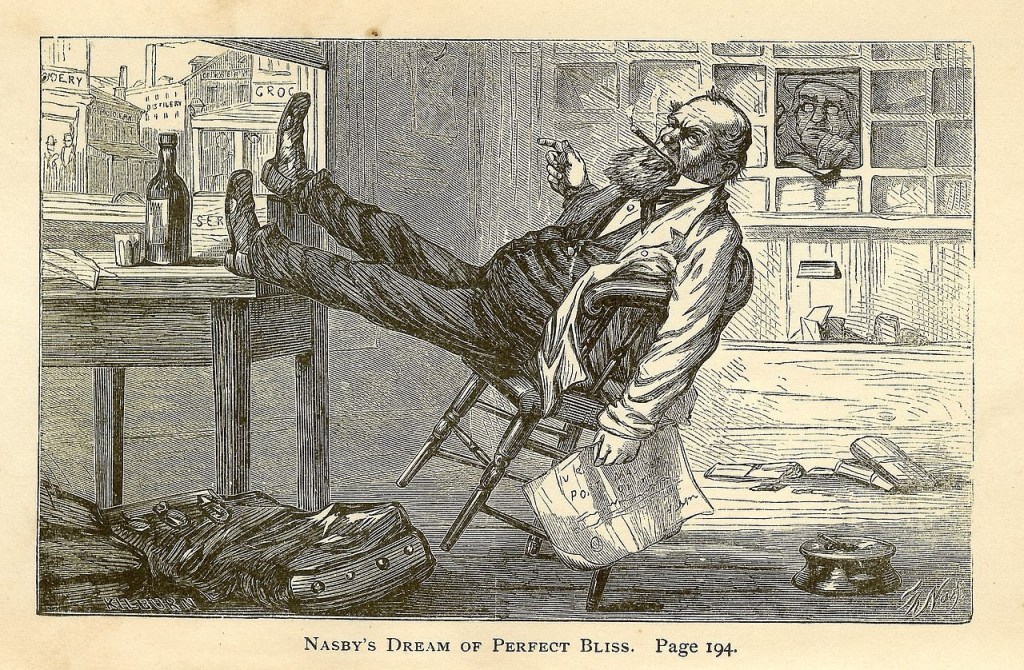
Charles Dana, former journalist and assistant secretary of war was with Abraham Lincoln as he awaited results of the election of 1864:
All the power and influence of the War Department, then something enormous from the vast expenditure and extensive relations of the war, was employed to secure the re-election of Mr. Lincoln. The political struggle was most intense, and the interest taken in it, both in the White House and in the War Department, was almost painful. After the arduous toil of the canvass, there was naturally a great suspense of feeling until the result of the voting should be ascertained. On November 8th, election day, I went over to the War Department about half past eight o’clock in the evening, and found the President and Mr. Stanton together in the Secretary’s office. General Eckert, who then had charge of the telegraph department of the War Office, was coming in constantly with telegrams containing election returns. Mr. Stanton would read them, and the President would look at them and comment upon them. Presently there came a lull in the returns, and Mr. Lincoln called me to a place by his side.
“Dana,” said he, “have you ever read any of the writings of Petroleum V. Nasby?”
“No, sir,” I said; “I have only looked at some of them, and they seemed to be quite funny.”
“Well,” said he, “let me read you a specimen”;
“let me read you a specimen”;
and, pulling out a thin yellow-covered pamphlet from his breast pocket, he began to read aloud. Mr. Stanton viewed these proceedings with great impatience, as I could see, but Mr. Lincoln paid no attention to that.
He would read a page or a story, pause to consider new election telegram, and then open the book again and go ahead with a new passage. Finally, Mr. Chase came in, and presently somebody else, and then the reading was interrupted.
Mr. Stanton went to the door and beckoned me into the next room. I shall never forget the fire of his indignation at what seemed to him to be mere nonsense.
The idea that when the safety of the republic was thus at issue, when the control of an empire was to be determined by a few figures brought in by the telegraph, the leader, the man most deeply concerned, not merely for himself but for his country, could turn aside to read such balderdash and to laugh at such frivolous jests was, to his mind, repugnant, even damnable. He could not understand, apparently, that it was by the relief which these jests afforded to the strain of mind under which Lincoln had so long been living, and to the natural gloom of a melancholy and desponding temperament-this was Mr. Lincoln’s prevailing characteristic-that the safety and sanity of his intelligence were maintained and preserved.
Petroleum Naseby was a character, a cowardly Copperhead who supported the Confederacy but didn’t want to do anything about it, invented by David Ross Locke.
In his day Locke was up there with Josh Billings and Mark Twain.
Turned Inside Out: Recollections of a Private Soldier in the Army of the Potomac by Frank Wilkeson
Posted: March 15, 2025 Filed under: WOR 1 Comment
This is one of the most vivid books I’ve ever read. It’s cinematic. It describes the journey of a teenage boy from upstate New York into hell. A harrowing journey in a series of scenes that get more and more intense. It’s like watching 1917 or something.
(Trigger warning: sad)
The war fever seized me in 1863. All the summer and fall I had fretted and burned to be off. That winter, and before I was sixteen years old, I ran away from my father’s high-lying Hudson River Valley farm. I went to Albany and enlisted in the Eleventh New York Battery, then at the front in Virginia, and was promptly sent out to a penitentiary building. There, to my utter astonishment, I found eight hundred or one thousand ruffians, closely guarded by heavy lines of sentinels, who paced to and fro, day and night, rifle in hand, to keep them from running away. When I entered the barracks these recruits gathered around me and asked, “How much bounty did you get?” “How many times have you jumped the bounty?” I answered that I had not bargained for any bounty, that I had never jumped a bounty, and that I had enlisted to go to the front and fight. I was instantly assailed with abuse. Irreclaimable blackguards, thieves, and ruffians gathered in a boisterous circle around me and called me foul names. I was robbed while in these barracks of all I possessed—a pipe, a piece of tobacco and a knife.
I remained in this nasty prison for a month. I became thoroughly acquainted with my com-rades. A recruit’s social standing in the barracks was determined by the acts of villany he had performed, supplemented by the number of times he had jumped the bounty. The social standing of a hard-faced, crafty pickpocket, who had jumped the bounty in say half a dozen cities, was assured.
The first people he sees killed are three men attempting to desert as they march down State Street in Albany. They take a steamboat to New York, where a guard kills another man trying to desert. Then they’re put on another steamboat:
Money was plentiful and whiskey entered through the steamer’s ports, and the guards drove a profitable business in selling canteens full of whiskey at $5 each. Promptly the hold was transformed into a floating hell. The air grew denser and denser with tobacco smoke.
Drunken men staggered to and fro. They yelled and sung and danced, and then they fought and fought again. Rings were formed, and within them men pounded each other fiercely. They rolled on the slimy floor and howled and swore and bit and gouged, and the delighted spectators cheered them to redouble their efforts. Out of these fights others sprang into life, and from these still others. The noise was horrible. The wharf became crowded with men eager to know what was going on in the vessel. A tug was sent for, and we were towed into the river, and there the anchors were dropped. Guards ran in on us and beat men with clubbed rifles, and were in turn attacked.
We drove them out of the hold. The hatch at the head of the stairs was closed and locked. The recruits were maddened with whiskey. Dozens of men ran a muck, striking every one they came to, and being struck and kicked and stamped on in return. The ventilation hatches were surrounded by stern-faced sentinels, who gazed into the gloom below and warned us not to try to get out by climbing through the hatches.
Men sprang high in the air and clutched the hatch railings, and had their hands smashed with musket butts. Sentinels paced to and fro along the vessel’s deck, and called loudly to all row-boats to keep off or they would be fired upon. They did not intend that any fresh supplies of whiskey should be brought to us. The prisoners in this floating hell were then told to “go it,” and they went it. We had been searched for arms before we entered the barracks at Albany. The more decent and quiet of us had no means of killing the drunken brutes who pressed on us. There was not a club or a knife or an iron bolt that we could lay our hands to. I fought, and got licked; fought again, and won; and for the third time faced my man, and got knocked stiff in two seconds. It was a scene to make a devil howl with delight.
They reach Alexandria, and then are put on a train to the Union winter camp at Brandy Station. Five more deserters are shot along the way. In the spring, Wilkeson is marched into Virginia. Along the road they pass the bones of unburied dead left from the battle of Chancellorsville.
As we sat silently smoking and listening to the story, an infantry soldier who had, unobserved by us, been prying into the shallow grave he sat on with his bayonet, suddenly rolled a skull on the ground before us, and said in a deep, low voice: “That is what you are all coming to, and some of you will start toward it tomorrow.” It was growing late, and this uncanny remark broke up the group, most of the men going to their regimental camps.
I found this book in a strange way. I was trying to sort out Grant’s Overland Campaign. Here’s an informative video of the strategic level. You can read Grant’s memoirs and many histories and accounts from officers. But what was it like? At Spotsylvania Courthouse, at the Mule Shoe Salient, there was a 22 hour hand to hand scrum, thousands of people killed in like a one square mile bit of earthworks. Did anyone survive to tell about that? In the course of investigating I did find these Australian guys recreating the battle with miniatures:


Their work is amazing.

I’d been playing around with testing various AIs on historical questions. I asked Claude:
What are some notable firsthand account of the fighting at mule shoe salient in the us civil war?
Claude came back with a numbered list of seven sources. Six were officers’ memoirs or official reports, and one was Frank Wilkeson’s “Recollections of a Private Soldier.”

Wilkeson wasn’t actually at the “mule shoe” I don’t think, but close enough. Strangely, on other occasions, Claude has completely made up sources that don’t exist. I go to check them and find they’re nothing, I tell Claude “hey can you give me more information about this, I can’t find it” and Claude says “I apologize, you’re right, I was mistaken.” Weird.
Anyway Frank Wilkeson is very real, his book was reprinted by University of Nebraska Press in 1997. The original title, Recollections of A Private Soldier in the Army of the Potomac, is so boring that it possibly caused this book to be ignored. The new title, Turned Inside Out, refers to how the pockets of the dead would all be turned out by battlefield ghouls and robbers of the dead.
At one point Wilkeson actually sees Grant:
One of my comrades spoke to me across the gun, saying: “Grant and Meade are over there,” nodding his head to indicate the direction in which I was to look. I turned my head and saw Grant and Meade sitting on the ground under a large tree. Both of them were watching the fight which was going on in the pasture field. Occasionally they turned their glasses to the distant wood, above which small clouds of white smoke marked the bursting shells and the extent of the battle. Across the woods that lay behind the pasture, and behind the bare ridge that formed the horizon, and well within the Confederate lines, a dense column of dust arose, its head slowly moving to our left. I saw Meade call Grant’s attention to this dust column, which was raised either by a column of Confederate infantry or by a wagon train. We ceased firing, and sat on the ground around the guns watching our general, and the preparations that were being made for another charge.
Grant had a cigar in his mouth. His face was immovable and expressionless.
His eyes lacked lustre.
He sat quietly and watched the scene as though he was an uninterested spectator. Meade was nervous, and his hand constantly sought his face, which it stroked. Staff officers rode furiously up and down the hill carrying orders and information. The infantry below us in the ravine formed for another charge. Then they started on the run for the Confederate earthworks, cheering loudly the while. We sprang to our guns and began firing rapidly over their heads at the edge of the woods. It was a fine display of accurate artillery practice, but, as the Confederates lay behind thick earth-works, and were veterans not to be shaken by shelling the outside of a dirt bank behind which they lay secure, the fire resulted in emptying our limber chests, and in the remarkable discovery that three-inch percussion shells could not be relied upon to perform the work of a steam shovel. Our infantry advanced swiftly, but not with the vim they had displayed a week previous; and when they got within close rifle range of the works, they were struck by a storm of rifle-balls and canister that smashed the front line to flinders. They broke for cover, leaving the ground thickly strewed with dead and dying men. The second line of battle did not attempt to make an assault, but returned to the ravine. Grant’s face never changed its expression. He sat impassive and smoked steadily, and watched the short-lived battle and decided defeat without displaying emotion. Meade betrayed great anxiety. The fight over, the generals arose and walked back to their horses, mounted and rode briskly away, followed by their staff. No troops cheered them. None evinced the slightest enthusiasm.
The enlisted men looked curiously at Grant, and after he had disappeared they talked of him, and of the dead and wounded men who lay in the pasture field; and all of them said just what they thought, as was the wont of American volunteers. This was the only time that I saw either Grant or Meade under fire during the campaign, and then they were with. in range of rifled cannon only.
For a “you are there” quality of the War of the Rebellion – what Wilkeson calls “the suppression of the slaveholders’ revolt” – I’m not sure this book can be matched by anything I’m aware of except Ambrose Bierce and Sam Watkins. The power here is the scenes.
Before noon we came to the village of Bowling Green, where many pretty girls stood at cottage windows or doors, and even as close to the despised Yankees as the garden gates, and looked scornfully at us as we marched through the pretty town to kill their fathers and broth-ers. There was one very attractive girl, black-eyed and curly-haired, and clad in a scanty calico gown, who stood by a well in a house yard. She looked so neat, so fresh, so ladylike and pretty, that I ran through the open gate and asked her if I might fill my canteen with water from the well. And she, the haughty Virginia maiden, refused to notice me. She calmly looked through me and over me, and never by the slightest sign acknowledged my presence; but I filled my canteen, and drank her health. I liked her spirit.
Everybody who knows their Civil War history knows that a key moment was when Grant, after a disastrous first fight with Lee’s Army of Northern Virginia at the Wilderness, advanced instead of retreating like every previous Army of the Potomac commander. But Wilkeson’s there, man.
” Here we go,” said a Yankee private; “here we go, marching for the Rapidan, and the protection afforded by that river. Now, when we get to the Chancellorsville House, if we turn to the left, we are whipped at least so say Grant and Meade. And if we turn toward the river, the bounty-jumpers will break and run, and there will be a panic.”
“Suppose we turn to the right, what then?”
I asked.
“That will mean fighting, and fighting on the line the Confederates have selected and in-trenched. But it will indicate the purpose of Grant to fight,” he replied.
Then he told me that the news in his Sixth Corps brigade was that Meade had strongly advised Grant to turn back and recross the Rapidan, and that this advice was inspired by the loss of Shaler’s and Seymour’s brigades on the evening of the previous day. This was the first time I heard this rumor, but I heard it fifty times before I slept that night. The enlisted men, one and all, believed it, and I then believed the rumor to be authentic, and I believe it to-day. None of the enlisted men had any confidence in Meade as a tenacious, aggressive fighter. They had seen him allow the Confederates to escape destruction after Get-tysburg, and many of them openly ridiculed him and his alleged military ability.
Grant’s military standing with the enlisted men this day hung on the direction we turned at the Chancellorsville House. If to the left, he was to be rated with Meade and Hooker and Burnside and Pope-the generals who preceded him. At the Chancellorsville House we turned to the right. Instantly all of us heard a sigh of relief. Our spirits rose. We marched free. The men began to sing. The enlisted men understood the flanking movement. That night we were happy.
The site of the turn:

as it was:

James McPherson notes in the introduction, Shelby Foote and Bruce Catton took some of the best stuff from Wilkeson.
The most intense chapter of Wilkeson’s book is called “How Men Die In Battle.” You can read it here if you like. Here’s an excerpt (warning: intense, sad):
Near Spottsylvania I saw, as my battery was moving into action, a group of wounded men lying in the shade cast by some large oak trees. All of these men’s faces were gray. They silently looked at us as we marched past them. One wounded man, a blond giant of about forty years, was smoking a short briar-wood pipe. He had a firm grip on the pipe-stem. I asked him what he was doing. “Having my last smoke, young fellow,” he replied. His dauntless blue eyes met mine, and he bravely tried to smile. I saw that he was dying fast. Another of these wounded men was trying to read a letter. He was too weak to hold it, or maybe his sight was clouded. He thrust it unread into the breast pocket of his blouse, and lay back with a moan. This group of wounded men numbered fifteen or twenty. At the time, I thought that all of them were fatally wounded, and that there was no use in the surgeons wasting time on them, when men who could be saved were clamoring for their skillful attention. None of these soldiers cried aloud, none called on wife, or mother, or father. They lay on the ground, pale-faced, and with set jaws, waiting for their end. They moaned and groaned as they suffered, but none of them flunked. When my battery returned from the front, five or six hours afterward, almost all of these men were dead. Long before the campaign was over I concluded that dying soldiers seldom called on those who were dearest to them, seldom conjured their Northern on Southern homes, until they became delirious. Then, when their minds wandered, and fluttered at the approach of freedom, they babbled of their homes. Some were boys again, and were fishing in Northern trout streams. Some were generals leading their men to victory. Some were with their wives and children. Some wandered over their family’s homestead; but all, with rare exceptions, were delirious..
so I guess that’s what it was like.
In looking for info on the original Chancellor House I find this:
In the early 20th century, Susan Chancellor would often stop by for unannounced visits to the re-built house, much to the chagrin of a young girl who lived there with her family. “It was odd that she never knocked,” 89-year-old Hallie Rowley Sale told the Fredericksburg Free-Lance Star in 2003. “It was like she still thought of it as her home. We would hear a door open. And the next thing we knew, Mrs. Chancellor would be leading a group of people through the house.”
The Fate of John Sedgwick
Posted: March 2, 2025 Filed under: photography, WOR Leave a comment
Of General John Sedgwick, Grant wrote:
I had known him in Mexico when both of us were lieutenants, and when our service gave no indication that either of us would ever be equal to the command of a brigade. He stood very high in the army, however, as an officer and a man. He was brave and conscientious. His ambition was not great, and he seemed to dread responsibility. He was willing to do any amount of battling, but always wanted some one else to direct. He declined the command of the Army of the Potomac once, if not oftener.
and
he was never at fault when serious work was to be done
I was reading up on Timothy O’Sullivan, a somewhat mysterious character, and his haunting photographs:
On May 5, [Timothy] O’Sullivan and his camera were at the Wilderness where men fought in a virgin forest of oak and pine, choked with underbrush.
It was so thick the troops moved in single line, the powder smoke so heavy, that men stumbled blindly into enemy lines. Two days later OSullivan was with Grant, moving toward Spotsylvania, where on May 8, Grant and Lee faced each other again. One of the last pictures OSullivan made before the battle began was of his old friend General Sedgwick, who liked to describe himself as “practical as distinguished from the theoretical soldier,” standing on the steps of a house surrounded by his staff. A short time later Sedgwick would be killed, as he told a soldier dodging Rebel bullets not to worry, “they could not shoot an elephant at that distance.” The words had just fallen from his lips when he fell, killed by a sharpshooter.
That from James D. Horan, Timothy O’Sullivan: America’s Forgotten Photographer.
A firsthand account of the end of Sedgwick, from Martin McMahon, who was Sedgwick’s chief of staff:
After this brigade, by Sedgwick’s direction, had been withdrawn through a little opening to the left of the pieces of artillery, the general, who had watched the operation, resumed his seat on the hard-tack box and commenced talking about members of his staff in very complimentary terms.
He was an inveterate tease, and I at once suspected that he had some joke on the staff which he was leading up to. He was interrupted in his comments by observing that the troops, who during this time had been filing from the left into the rifle-pits, had come to a halt and were lying down, while the left of the line partly overlapped the position of the section of artillery. He stopped abruptly and said, ” That is wrong. Those troops must be moved farther to the right ; I don’t wish them to overlap that battery.” I started out to execute the order, and he rose at the same moment, and we sauntered out slowly to the gun on the right. About an hour before, I had remarked to the general, pointing to the two pieces in a half-jesting manner, which he well understood, ” General, do you see that section of artillery? Well, you are not to go near it today.” He answered good-naturedly, “McMahon, I would like to know who commands this corps, you or I? ” I said, playfully, “Sometimes I am in doubt myself”; but added, ” Seriously, General, I beg of you not to go to that angle; every officer who has shown himself there has been hit, both yesterday and to-day.” He answered quietly, ” Well, I don’t know that there is any reason for my going there.” ‘ When afterward we walked out to the position indicated, this conversation had entirely escaped the memory of both.
(you can see the inveterate half-jester in this portrait of him, taken probably in 1864, by Matthew Brady or one of his employees)

back to McMahon:
I gave the necessary order to move the troops to the right, and as they rose to execute the movement the enemy opened a sprinkling fire, partly from sharp-shooters. As the bullets whistled by, some of the men dodged. The general said laughingly, ” What! what! men, dodging this way for single bullets! What will you do when they open fire along the whole line? I am ashamed of you. They couldn’t hit an elephant at this distance.” A few seconds after, a man who had been separated from his regiment passed directly in front of the general, and at the same moment a sharp-shooter’s bullet passed with a long shrill whistle very close, and the soldier, who was then just in front of the general, dodged to the ground. The general touched him gently with his foot, and said, ” Why, my man, I am ashamed of you, dodging that way,” and repeated the remark, ” They couldn’t hit an elephant at this distance.” The man rose and saluted and said good-naturedly, ” General, I dodged a shell once, and if I hadn’t, it would have taken my head off. I believe in dodging.” The general laughed and replied, “All right, my man; go to your place.”
For a third time the same shrill whistle, closing with a dull, heavy stroke, interrupted our talk; when, as I was about to resume, the general’s face turned slowly to me, the blood spurting from his left cheek under the eye im a steady stream. He fell in my direction ; I was so close to him that my effort to support him failed, and I fell with him.
Colonel Charles H. Tompkins, chief of the artillery, standing a few feet away, heard my exclamation as the general fell, and, turning, shouted to his brigade-surgeon, Dr. Ohlenschlager. Major Charles A. Whittier, Major T. W. Hyde; and Lieutenant Colonel Kent, who had been grouped near by, surrounded the general as he lay. A smile remained upon his lips but he did not speak. The doctor poured water from a canteen over the general’s face. The blood still poured upward in a little fountain. The men in the long line of rifle-pits, retaining their places from force of discipline, were all kneeling with heads raised and faces turned toward the scene ; for the news had already passed along the line.

After the war, Timothy O’Sullivan accompanied several expeditions out west, and photographed stuff like this:

John Sedgwick was from Cornwall, Connecticut, which seems like a pleasant place. Mark Van Doren wrote a poem about it, here’s an excerpt:
The mind, eager for caresses,
Lies down at its own risk in Cornwall;
Whose hills,
Whose cunning streams,
Whose mazes where a thought,
Doubling upon itself,
Considers the way, lazily, well lost,
Indulge it to the nick of death–
Not quite, for where it curls it still can feel,
Like feathers,
Like affectionate mouse whiskers,
The flattery, the trap.
In Cornwall there’s House VI, an experiment in deconstructivist architecture (a failed experiment?)

The Sedgwicks are a big name in the Berkshires, although I don’t see that our John is connected to the Main Line with Kyra and Edie. There’s a monument to John Sedgwick in Cornwall, but it seems ununique, like a thousand other Civil War monuments:

On the other hand, there’s a monument of him at West Point that has a tradition attached:
Legend holds that if a cadet is deficient in academics, the cadet should go to the monument at midnight the night before the term–end examination, in full dress, under arms, and spin the rowels on the monument’s spurs. With the resulting good luck, the cadet will pass the test.
It seems like he might’ve enjoyed that.

sources, for the photo, for Waud’s drawing and more.
Mystery of the 27,574 muskets collected at Gettysburg
Posted: February 15, 2025 Filed under: War of the Rebellion, WOR Leave a comment
From Randall Collins, Violence: A Micro Sociological Theory. He’s speaking on firing rates among soldiers in wartime:
But the firing ratio in parade-ground formations was far from maximal. In American Civil War battles, 90 percent of muzzle-loading muskets collected after the battle of Gettysburg were found loaded, and half of those were multiply loaded, with two or more rounds on top of one another in the barre!
(Grossman 1995: 21-22); this implies that at least half the troops, at the moment they were hit or threw away their arms, had been repeatedly going through the motions of loading, but without actually firing, time after time. As we see later, casualties produced by these mass-formation troops were not high, and that could be attributed partly to non-firing, partly to inaccurate firing.
Collins thesis is that face to face violence is very hard for humans, it causes great stress and tension. In this section he’s arguing that even soldiers in battle have great difficulty shooting at each other, and often fire high or otherwise avoid shooting at each other. This detail got my attention, I wanted to know more. Collins source is David Grossman, On Killing. Grossman says:
Author of the Civil War Collector’s Encyopedia F. A. Lord tells us that after the Battle of Gettysburg, 27,574 muskets were recovered from the battlefield. Of these, nearly 90 percent (twenty-four thousand) were loaded. Twelve thousand of these loaded muskets were found to be loaded more than once, and six thousand of the multiply loaded weapons had from three to ten rounds loaded in the barrel. One weapon had been loaded twenty-three times. Why, then, were there so many loaded weapons available on the battlefield, and why did at least twelve thousand soldiers misload their weapons in combat?
A loaded weapon was a precious commodity on the black-powder battlefield. During the stand-up, face-to-face, short-range battles of this era a weapon should have been loaded for only a fraction of the time in battle. More than 95 percent of the time was spent in loading the weapon, and less than 5 percent in firing it. If most soldiers were desperately attempting to kill as quickly and efficiently as they could, then 95 percent should have been shot with an empty weapon in their hand, and any loaded, cocked, and primed weapon dropped on the battlefield would have been snatched up from wounded or dead comrades and fired.
There were many who were shot while charging the enemy or were casualties of artillery outside of musket range, and these individuals would never have had an opportunity to fire their weapons, but they hardly represent 95 percent of all casualties. If there is a desperate need in all soldiers to fire their weapon in combat, then many of these men should have died with an empty weapon. And as the ebb and flow of battle passed over these weapons, many of them should have been picked up and fired at the enemy.
The obvious conclusion is that most soldiers were not trying to kill the enemy. Most of them appear to have not even wanted to fire in the enemy’s general direction. As Marshall observed, most soldiers seem to have an inner resistance to firing their weapon in combat. The point here is that the resistance appears to have existed..
The amazing thing about these soldiers who failed to fire is the they did so in direct opposition to the mind-numbingly repetitive drills of that era. How, then, did these Civil War soldiers consistently “fail their drillmasters when it came to the all-important loading drill?
Some may argue that these multiple loads were simply mistakes, and that these weapons were discarded because they were misloaded. But if in the fog of war, despite all the endless hours of training, you do accidentally double-load a musket, you shoot it anyway, and the first load simply pushes out the second load. In the rare event that the weapon is actually jammed or nonfunctional in some manner, you simply drop it and pick up another. But that is not what happened here, and the question we have to ask ourselves is, Why was firing the only step that was skipped? How could at least twelve thousand men from both sides and all units make the exact same mistake?
Did twelve thousand soldiers at Gettysburg, dazed and confused by the shock of battle, accidentally double-load their weapons, and then were all twelve thousand of them killed before they could fire these weapons? Or did all twelve thousand of them discard these weapons for some reason and then pick up others? In some cases their powder may have been wet (even through their oiled-paper coating), but that many? And why did six thousand more go on to load their weapons yet again, and still not fire? Some may have been mistakes, and some may have been caused by bad powder, but I believe that the only possible explanation for the vast majority of these incidents is the same factor that prevented 80 to 85 percent of World War II soldiers from firing at the enemy. The fact that these Civil War soldiers overcame their powerful conditioning to fire through drill clearly demonstrates the impact of powerful instinctive forces and supreme acts of moral will…
Griffith’s figures make perfect sense if during these wars, as in World War Il, only a small percentage of the musketeers in a regimental firing line were actually attempting to shoot at the enemy while the rest stood bravely in line firing above the enemies’ heads or did not fire at all.
Well now hang on.
Let’s start with, how do we know this? What’s our source? This statistic on the 27,574 muskets, where do we get that?
I don’t have a copy of The Civil War Collector’s Encyclopedia handy. But luckily, with all questions related to the American Civil War, you can find the answer on some forum or another, which led me to this article, citing a source from 1867:

It seems strange to me that you would ship loaded weapons from Gettsyburg to Washington. Wouldn’t that be dangerous? Or maybe they weren’t likely to go off without the percussion cap? I’m not expert on Civil War firearms and don’t intend to become one. Still, the mystery puzzled me. Wouldn’t most of these weapons be kinda fucked up from being knocked around and exploded and so on? What does it tell us about the firing or non-firing of soldiers during the battle? Maybe these weapons were loaded and their unlucky holders were knocked out of action before they could be used?
A source the forum posters frequently point to is Paddy Griffith, Battle Tactics of the Civil War. Paddy Griffith was an English scholar: here is a lovely obituary of him, he died in 2010.
Large, convivial yet dedicated to the serious analysis of military history, Paddy Griffith was a fearless challenger of the accepted versions of events and an iconoclastic war-gamer.
The absolute extremes of research in military history matters are often reached by war gamers and amateurs of various sorts. If you try and get to the ultimate authority on Civil War gunboats, for instance, you’ll end up being directed to The Western Rivers Steamboat Cyclopoedium, which is really a set of plans for model builders.
Anyway Griffith’s book arrived, and it’s excellent.

Vividly written, profound, a tremendous aid to understanding the Civil War in every way, from how troops carried their stuff and trained and spent their time to the macro history of the war, full of detail and extracts from memoirs and history. From the preface:
The past, of course, is a foreign country, and every historian is to some extent a tourist looking in from the outside upon the people and events he describes. In my own case, I have an added perspective as a British citizen who has literally been a tourist to many of the battlefields on which the Civil War was fought…
Both the tourist and the historian have a duty to be clear about their motives, especially in a case like the Civil War which remains important in modern-day life…
The experience of attaining military age also seems to have left me with another legacy, for like many another before me I became fascinated to discover just what a battle is, or was, like – preferably without actually venturing into one in person. I suspect that this somewhat unhealthy obsession is really quite common among military historians, and it can even be seen as a precondition of their calling. Each generation has had its own group of military writers who have wished to see the elephant of warfare without getting too close to it, and then relay their findings faithfully and truly to their readers.
It so happens that one of the most successful of all attempts to see the elephant in a war book was made in a novel about the American Civil War – about the battle of Chancellorsville, to be precise. This was of course Stephen Crane’s The Red Badge of Courage, first published in 1894 when the author was only twenty-three years of age. It would be difficult to overstate the importance of this work to the general development of war writing, since its influence has been enormous and its perceptions remain as fresh and vigorous today as when they were originally penned. The amateur elephant watcher is especially captivated by what Crane had to say, and is led on inevitably into a closer examination of the Civil War battles. There is a sense in which Crane has consecrated these particular combats for every student of battles. I, for one, freely acknowledge my debt to him in much of what follows…
For the student of Napoleonic tactics, accustomed to a thin and insubstantial diet of secondary sources and unreliable data, the Civil War comes as a severe shock to the metabolism. It provides an unexpectedly rich feast of detailed personal memoirs, a cornucopia of fine regimental histories, and a solid dessert of circumstantial after-action reports. The student may gorge himself on these delicacies until he can move no more, yet still find that he has barely scraped the surface of what is on offer. In this respect, at least, the Civil War can indeed be seen as the first modern war. The spread of education and the desire to record personal experiences on paper is here exponentially greater than anything seen in Napoleonic times, even among Wellington’s endlessly scribbling light infantry. This wealth of first-hand evidence, furthermore, has been lovingly preserved and sifted by succeeding generations in a manner that puts modern Napoleonic studies to shame. Civil War history remains a living subject today, whereas Napoleonic analysis was all but killed off in 1914.° Indeed, this qualitative difference between the way the two eras have been studied may perhaps have helped to conceal their essential underlying unity.
Whereas the Napoleonic campaigns have been subconsciously relegated to a distant past, those of the Civil War are still being discovered in all their freshness from primary sources – lending them an air of modernity that may be subtly misleading.
There’s a touch of Bill James to Paddy Griffith’s passion. His book illuminated the War of the Rebellion for me in many ways. Among other things, it’s often pretty funny. You find this in the Civil War literature. Sam Watkins is very funny, even as he’s describing stumbling near-barefoot from disaster to disaster. Here’s Griffith describing a battle situation:
By 1864 it seems that there were numerous cases of combat refusal when an attack on fortifications was proposed. Even if this did not lead to a formal mutiny it could often lead to an ‘attack’ which went to ground almost before it had crossed its start line. The abortive ‘battle’ of Mine Run was an example of this on the grandest possible scale, since the entire Army of the Potomac came into position to storm Lee’s works but then thought better of it and went home.
The action of 35th Massachusetts at Spotsylvania provides a good example of how the 1864 fighting must often have been conducted. The regiment advanced behind another unit until it came under fire, when a bounty-jumper shouted ‘Retreat!’ and the whole regiment routed in panic. They rallied calmly when they had regained their own earthworks, insulted their new general (whom they did not recognise), then advanced again to a position in open ground one hundred yards from the enemy entrenchments. “Then the whole line lay down, without firing a shot, and in this position calmly sustained the fire of the enemy two or three hours, with little loss to us as the shells and bullets of the Confederates passed over our heads. The order was simply to ‘feel the enemy’, and as it was plain they were ready to receive us, no final assault was ordered.”
And that’s from their own regimental history! (Company I of the 35th Massachusetts was made up of men from Dedham, Needham and Weston, incidentally).
This decline to really get after it battlewise would seem well in line with Collins’ thesis, that people will do almost anything to avoid face to face violence. Griffith mentions many cases where individuals preferred to joke around or share supplies when they were supposed to be killing each other. On the other hand, Griffith describes plenty of situations where the two sides really did just stand there and blast away at each other at close range until one side couldn’t take it. As Shelby Foote says (discussing naval battles), it’s almost unbelievable, but they did it!
The amazing things about naval engagements are the accounts of men firing eight-inch guns at each other from a range of eight-feet. I’m afraid that is beyond my understanding. But they did it all the time in naval battles. It was a very strange business.
Let’s return to the matter of the collected muskets from Gettysburg. Here’s what Griffith says
An often quoted set of statistics from Gettysburg has it that the Union forces salvaged 27,574 ‘muskets’ after the battle, of which 24,000 were loaded, including 12,000 loaded twice, 6,000 loaded between three and ten times, one with twenty-three charges and one with twenty-two balls and sixty-six buckshot. Some had six balls and only one charge of powder; others had six unopened cartridges. Others again had the ball behind the powder instead of the other way round.
It is open to doubt whether twenty-three full cartridges could in fact be physically squeezed into the barrel of a Civil War rifle, and still more dubious that the proportion of misloaded weapons in the sample (some 45 per cent) actually reflects the proportion in the whole of the two armies during combat. It is most likely that many of the guns salvaged by the Union forces after Gettysburg were discarded by their users precisely because they had become unusable, hence the figure of 12,000 should be seen as a proportion of the total muskets in the battle rather than of the total salvaged. That suggests that perhaps 9 per cent of all muskets were misloaded – a less dramatic figure, but nevertheless still very significant. If we add the unknown total of misloaded muskets which were either salvaged by the Confederates or retained by their original owners, we are forced back to the conclusion that a very high proportion of infantry weapons must indeed have become inoperative in combat due to faulty handling.
Thus, it seems like these extra-loaded muskets weren’t unshot because their holders didn’t want to, contra Collins and Grossman. It was because they were busted.
A Civil War battle like any battle was totally chaotic and loud; Griffith’s book is largely about the problems of dealing with chaos, confusion, missed communication, strange terrain, and how people handled or failed to handle these challenges effectively. How to approach the truth of what happened in such a situation is an endless puzzle. Trying to get as close as possible to the source in this case has proved interesting. Griffith got as close as we’re likely to get, here are his sources:


My guy was tracking down unpublished doctoral theses to make his war games as accurate as possible. Despite the somewhat grim subject matter (guys blasting away at each other) learning about Griffith has uplifted my feelings about human nature and the power of curiousity. For those without any particular passion for the subject Griffith’s cover illustration probably tells you everything you need to know about a Civil War battle, although ironically no source is listed beyond “Cover Design by Maggie Mellett”.
Hopper’s America, discussing that painting, Dawn at Gettysburg:
Hopper himself relayed a story, told to him by a guard at the Museum of Modern Art, about Albert Einstein’s viewing of ‘Dawn Before Gettysburg’ in a show at MoMA.
‘Einstein in going through the galleries had stopped a long time before this picture of mine,’ Hopper said, ‘and I suppose it was his hatred of war that prompted him to do this as these men were evidently all ready for the slaughter.’
It’s easy to see why this little painting has made such an impact over the years. The colors are breathtaking, in particular the blood red of the dawn sky.
The individual soldiers are just that: individuals. As Warner points out, one has a blister on his foot from marching. Another has just vomited and is leaning on his friend, deathly ill. A standing soldier is getting orders ready, representing duty to his country.
I’ll have to discuss these matters with my uncle Dan next time I see him, he lives quite close to the battlefield. As we’ve discussed before Civil War battlefields can be very peaceful and pleasant to visit. They tend to be preserved farm and pastureland. It’s nice to be in a field.
(Previous coverage of Gettysburg, and the War of the Rebellion in general).
Gordon Granger
Posted: June 24, 2023 Filed under: WOR Leave a comment
Juneteenth is not about any one man but it was Gordon Granger who posted and enforced General Order #3 in Galveston, kicking off the day.
The historian’s eye was intrigued by this line in Granger’s Wikipedia page:
General Ulysses S. Grant disliked Granger[11] and prevented him from gaining more prominent commands in the West or in the Eastern Theater of the American Civil War.
The citation there is for a bio of Granger, but why not get the word from Grant himself? We scanned Grant’s memoirs for mentions of Granger:
While the advance up Mission Ridge was going forward, General Thomas with staff, General Gordon Granger, commander of the corps making the assault, and myself and staff occupied Orchard Knob, from which the entire field could be observed. The moment the troops were seen going over the last line of rebel defences, I ordered Granger to join his command, and mounting my horse I rode to the front. General Thomas left about the same time. Sheridan on the extreme right was already in pursuit of the enemy east of the ridge. Wood, who commanded the division to the left of Sheridan, accompanied his men on horseback in the charge, but did not join Sheridan in the pursuit. To the left, in Baird’s front where Bragg’s troops had massed against Sherman, the resistance was more stubborn and the contest lasted longer. I ordered Granger to follow the enemy with Wood’s division, but he was so much excited, and kept up such a roar of musketry in the direction the enemy had taken, that by the time I could stop the firing the enemy had got well out of the way. The enemy confronting Sherman, now seeing everything to their left giving way, fled also. Sherman, however, was not aware of the extent of our success until after nightfall, when he received orders to pursue at daylight in the morning.
He got too excited. Later he’s grumpy:
Finding that Granger had not only not started but was very reluctant to go, he having decided for himself that it was a very bad move to make, I sent word to General Sherman of the situation and directed him to march to the relief of Knoxville. I also gave him the problem that we had to solve—that Burnside had now but four to six days supplies left, and that he must be relieved within that time.
More or less the last we hear of him:
All these movements were designed to be in support of Sherman’s march, the object being to keep the Confederate troops in the West from leaving there. But neither Canby nor Thomas could be got off in time. I had some time before depleted Thomas’s army to reinforce Canby, for the reason that Thomas had failed to start an expedition which he had been ordered to send out, and to have the troops where they might do something. Canby seemed to be equally deliberate in all of his movements. I ordered him to go in person; but he prepared to send a detachment under another officer. General Granger had got down to New Orleans, in some way or other, and I wrote Canby that he must not put him in command of troops. In spite of this he asked the War Department to assign Granger to the command of a corps.
Boy Grant is an efficient writer. Granger died of a stroke in Santa Fe in 1876 after chasing around Apaches for awhile.
Sinalco
Posted: October 29, 2022 Filed under: Mississippi, WOR Leave a comment
Saw this old sign in Corinth, Mississippi. You can’t find a Sin Alco in the United States these days but apparently it’s still the third most popular soda in Germany.
Both Corinth and Vicksburg, Mississippi have Coca-Cola related museums, and of course Atlanta is all about Coke. It got me wondering if the spread of Coca-Cola was connected to the total devastation of the South in the wake of the Civil War. Recall that Coca-Cola was invented by John Stith Pemberton, a former Confederate officer wounded in the war who was experimenting with increasingly wild home brews in an effort to cure himself of morphine addiction. There were a lot of people around with shattered nerves looking for a tonic. There was a big demand for alternatives to alcohol:
The first successful effort to limit the sale of alcohol was an 1874 law that required anyone wanting to sell alcohol to obtain a license from a majority of the area’s registered voters plus a majority of all women over age fourteen
From the Mississippi Encyclopedia. In law if not in practice Mississippi went dry in 1908. (That’s part of why the river towns on the Arkansas side got so wild).
Strange and haunting to visit these parts of the country that were ruined by defeat in war and an occupying army. When you wonder why Jackson, MS is so messed up it’s worth remembering the city was burnt to the ground not once but twice during the war, nothing standing but a few brick chimneys. Maybe they should have their mess together by now, but it’s only a few generations ago. Irene Triplett was getting a Civil War pension two years ago.
Good slogan for a soda: “You’ll Like It”
Coming up at Shiloh
Posted: October 15, 2022 Filed under: America, WOR Leave a comment
The sky had cleared, the clouds raveled to tatters, and at four oclock the sun broke through, silver on the bright green of grass and leaves and golden on the puddle sin the road; all down the column men quickened the step, smiling in the sudden burst of gold and silver weather.
So goes the first sentence of Foote’s book. You hear about things being unraveled, but “raveled” not so much.
From Stuart Chapman’s biography of Shelby Foote:

Faulkner would tell his son-in-law that Foote wrote as if he had been there himself.
He knows what he’s talking about.
We must agree, there are parts of Foote’s novel that are very vivid and feel very real.

Winston Groom is perhaps most notable as the author of the novel Forrest Gump. Don’t sleep on his narrative histories. They are terrific: compelling, clear, human, personal, funny even sometimes. Winston Groom was in the Vietnam War. When it comes to battle he writes like he knows what he’s talking about.


Civil War battlefields can be some of the most peaceful places in America. Some days tour buses or school groups must crowd the roads, but driving and walking around Shiloh in the late afternoon, a random Wednesday some days ago, I had the place to myself. On beautiful marked roads, stopping wherever I wanted to read some information. Walking in the woods, looking at the water, or the mowed fields. I was in a nine square mile park, quiet, undisturbed. Preserved landscape.

That the landscape is spooky, haunted, a burial ground, only adds to the draw. Certain places, certain moments, you can feel the reverie. A break in the veil to the past. Is there something worrying in being drawn to that? This place was the scene, for several thousand people, of the most traumatic event in their lives. At the end of the first day, there were something like two thousand dead bodies on the ground. An even higher number of people with an arm or a leg blown off or other mangling wound. And that’s not to mention the horses. Ambrose Beirce said dead horses were everywhere. Several soldiers in their accounts remembered some pitiful moment or another involving a hurt horse.
At night, after the first day ended, thunderstorms rolled in:
Flashes of lightening showed hogs feeding on the ungathered dead.
as they put it in the PBS Civil War series (holds up, Shiloh is in episode two).
If you want to visit a place where that happened, are you a bit of a sicko?
In War of the Worlds Tom Cruise’s son says:
Dad, I need to see this!
“Seeing the elephant.” Bruce Catton, asked to explain why boys joined the armies, says we shouldn’t overlook the simple fact that they were bored.
Shiloh is the cosmic joke answer to that desire. The twisted reward to a Devil’s bargain. Oh, you want to see what a war is like? Here you go!
One of Abraham Lincoln’s great and compelling qualities was a resolve to find some meaning in these events. Suffering and horror on this scale had to be worth something. Had to be made to be worth something.
Shiloh was decisive. Grant’s army could’ve been driven into the Tennessee River, or surrounded in the swamps and forced to surrender or retreat. Grant or Sherman could’ve been killed. Albert Sidney Johnston was killed. Many considered him the best of the Confederate generals. His conduct on the first day had changed the outcome of the battle, but then he was shot, and not realizing the extent of the wound he bled to death. Johnston has the biggest monument at the Texas State Cemetery in Austin.

Sherman was shot three times on the first day. One bullet passed through his hat. In his memoirs Grant gives much credit to the way Sherman conducted himself. Facing disaster the two of them, Grant and Sherman, managed to keep their cool.
At close to the last possible second, Union reinforcements arrived. The second day, their commander dead, the Confederates were driven away.
That would be more or less the furthest the Confederacy got in the Mississippi Valley. Some weeks after the battle, the Confederate army abandoned Corinth, Mississippi. Corinth was key: it was the crossroads where the railroad from Memphis to Charleston intersected the railroad that ran from the Ohio river to the Gulf port at Mobile, Alabama.

The crossroads at Corinth: it all connected here.
In the aftermath of Shiloh, the South was cut in half. Grant, assessing the situation years later in his Personal Memoirs:
The Confederates were now driven out of West Tennessee, and on the 6th of June, after a well-contested naval battle, the National forces took possession of Memphis and held the Mississippi river from its source to that point. The railroad from Columbus to Corinth was at once put in good condition and held by us. We had garrisons at Donelson, Clarksville and Nashville, on the Cumberland River, and held the Tennessee River from its mouth to Eastport. New Orleans and Baton Rouge had fallen into the possession of the National forces, so that now the Confederates at the west were narrowed down for all communication with Richmond to the single line of road running east from Vicksburg. To dispossess them of this, therefore, became a matter of the first importance. The possession of the Mississippi by us from Memphis to Baton Rouge was also a most important object. It would be equal to the amputation of a limb in its weakening effects upon the enemy.
By May 1862, something like this was the situation:

Once Vicksburg fell (not easy, Winston Groom has a whole book about it) it was all over but the crying. Of which there’d be plenty, there are places in the former Confederacy where they’re still crying.

The ground at Shiloh can be confusing. Almost every part of the battlefield was in the hands of different armies at different times. The Shiloh church for instance was the headquarters of the Union’s Sherman and the Confederate Beauregard at different points.

The church at the park today is a reproduction. The original was damaged, bloodstained, torn apart for souvenirs. You’ll notice all the pictures of the church are taken at the same angles. This is because no one wants to spoil the 1862 time travel aspect of their photos by including the modern Methodist church that sits just out of frame.

From the church’s Facebook page.
Everyone who was at the battle of Shiloh found it weird:
Everything looked weird and unnatural
recalled John Cockerill years later. He was sixteen at the time.
Actions took the grotesque form of a nightmare
remembered another veteran. Groom tells us:
At least two soldiers’ accounts report a lone woman walking across the battlefield in the midst of heavy fighting
In one forested part of the battlefield there are old Indian mounds. There were used as vantage points by Forrest’s cavalry, among others. At the time they were widely believed to be burial mounds, thus participants could believe they were fighting on an abandoned Indian burial ground.
It occurred to me that the closest thing to a battle I’ve been at is a huge concert festival. Ridiculous comparison but go with us. Take away the maiming and the killing: there were over 100,000 people at Shiloh. How many times in US history prior had there been a gathering of that size? Ever? I’m not aware of any Revolutionary battle that was close to that size. There were revival meetings, some even in the same area, but they never exceeded 10,000 or so.

Pittsburg Landing, where Union reinforcements under General Don Carlos Buell disembarked late on the first day of the battle, ensuring Grant’s salvation, is stop 22 on the driving tour. The National Park Service must have good reasons for that. But if you want to follow the battle as a narrative, take Pittsburg Landing as the starting place.
Follow the journey of Ebenzer Hannaford. Hannaford was in the Sixth Ohio. On Sunday April 6, they woke up near Savannah, Tennessee, broke camp, and marched ten miles. Late in the afternoon, maybe around five PM or so, an hour before sundown, he and his comrades boarded a steamboat and were ferried across the river. As they got close, they saw probably five thousand Union soldiers who’d taken themselves out of the battle and were huddled by the river, warning the guys coming over that they were doomed:

The same scene was witnessed by Ambrose Bierce, coming the same way as Hannaford:
Along the sheltered strip of beach between the river bank and the water was a confused mass of humanity—several thousands of men. They were mostly unarmed; many were wounded; some dead. All the camp-following tribes were there; all the cowards; a few officers. Not one of them knew where his regiment was, nor if he had a regiment. Many had not. These men were defeated, beaten, cowed. They were deaf to duty and dead to shame. A more demented crew never drifted to the rear of broken battalions.
A detail stuck out to Hannaford, when he wrote an account two years after the event, published as “Coming Up at Shiloh” in The Continental Review :

The antic drummer boy sticks in the mind. Shelby Foote may write like he was there, but in the end it’s pretend. Hannaford was there, and what he remembered was a boy pounding away on his drum, “to what purpose we could none of us divine.”
Travel tip: if you are visiting Shiloh, I recommend approaching via Corinth, MS. The Corinth Civil War Interpretative Center, built in 2004, is a stunning building and the film, exhibits and National Park staff there do a great job putting everything in context. They told me their site is designed to be a starting point on a journey to Shiloh. There’s a tantalizing library there for the serious buff:

The NPS guy in Corinth had so much integrity he would not recommend a lunch restaurant due to “favoritism,” but he allowed that The Rib Shack in Corinth was very popular. I recommend The Rib Shack in Corinth.
 Helytimes