Randall Collins on Sex and Violence
Posted: May 8, 2024 Filed under: advice, brain Leave a comment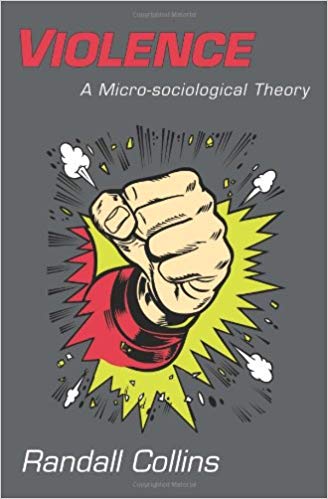
We’ve discussed before the work of microsociologist Randall Collins. Not sure why his work isn’t more popular. His insights about violence are both profound and practical. Here’s a summary he gave of much of his own work.
Now that we have photos and videos of violent situations, we see that at the moment of action the expression on the faces of the most violent participants is fear. Our folk belief is that anger is the emotion of violence, but anger appears mostly before any violence happens, and in controlled situations where individuals bluster at a distant enemy. I have called this confrontational tension/fear; it is the confrontation itself that generates the tension, more than fear of what will happen to oneself. Confrontational tension is debilitating; phenomenologically we know (mainly from police debriefings after shootings) that it produces perceptual distortions; physiologically it generates racing heart beat, an adrenaline rush which at high levels results in loss of bodily control.
Collins speaks of what sociologists have learned from CCTV footage of fights at bars:
This explains another, as yet little recognized pattern: when violence actually happens, it is usually incompetent. Most of the times people fire a gun at a human target, they miss; their shots go wide, they hit the wrong person, sometimes a bystander, sometimes friendly fire on their own side. This is a product of the situation, the confrontation. We know this because the accuracy of soldiers and police on firing ranges is much higher than when firing at a human target. We can pin this down further; inhibition in live firing declines with greater distance; artillery troops are more reliable than infantry with small arms, so are fighter and bomber crews and navy crews; it is not the statistical chances of being killed or injured by the enemy that makes close-range fighters incompetent. At the other end of the spectrum, very close face-to-face confrontation makes firing even more inaccurate; shootings at a distance of less than 2 meters are extremely inaccurate.
(Now, Collins does cite the work of S. L. A. Marshall, who is controversial. Story for another day.).
Why do most potential fights defuse before they start?:
Most of the time both sides stay symmetrical. Both get angry and bluster in the same way. These confrontations abort, since they can’t get around the barrier of confrontational tension.
Practical advice:
Keep any confrontation emotionally symmetrical; make confrontational tension work for you by maintaining face contact; avoid micro-escalations; let the situation calm down out of boredom, which is what happens when an interaction becomes locked into repetition. In the violent sociology of emotions, boredom is your friend.
Go read the whole thing. He also speaks on sex:
the strongest sexual attraction is not pleasure in one’s genitals per se, but getting the other person’s body to respond in mutually entraining erotic rhythms: getting turned on by getting the other person turned on. If you don’t believe me, try theorizing the attractions of performing oral sex. This is an historically increasing practice, and one of the things that drives the solidarity of homosexual movements. Gay movements are built around effervescent scenes, not around social media.
 Helytimes