Todd Graves / Raising Cane’s, and staying craveable
Posted: December 11, 2025 Filed under: food Leave a comment
listening to Raising Canes founder Todd Graves on David Senra podcast. The man’s intensity about chicken fingers:
Todd Graves: Yeah, you have to focus on doing one thing and do it better than anybody else. And so, since I have that singular product focus, right? And so, some people call it, like, a simple menu. I say, “Well, it’s not simple. It’s focused.” And here’s why it’s not simple. Because our chicken has to be exactly right. Look, it comes from the weight of the bird that we want to get the size tender we want. It comes from the species of bird that gives the most tender and flavorful chicken. There’s a lot of technical stuff. Rigor mortis on the bone after the chicken’s slaughtered.
David Senra: Mm-hmm.
Todd Graves: Then it stays on the bone a certain amount of time. Then you get it fresh. Then you brine it for 24 hours. Like, all those things are that. Like, our fries, right? So, we have crinkle-cut fry, but a thinner crinkle-cut fry. You get fries from different times of the year, right? They do the crop harvest, and it sits in the warehouses. At certain times of the year, you get more sugar tips in the fries. Those sugar tips have to come out, so we have to remind our crew, “Hey, when you see those black sugar tip ends, take those out. It’s not visually pleasing.”
Todd Graves: Our bread. So, we get bread made by bakeries all over the country, but that recipe has to be exactly right. And it’s little dough balls put together and baked together, so it’s pull-apart bread. It’s not sliced loaves. Sliced loaves end up being more stale. This is dense, moist, flavorful bread. Our coleslaw, we secure all over the country. We have to make sure all those vendors have the right type of slaw that we want, from the right type of growers, grown in a certain amount of time. In that slaw, you have cabbage, but you also have purple cabbage. You have carrots. All those things.
Todd Graves: And so, you go down to your tea. Our tea gets brought from three different countries, the tea leaves, but we have to get it at the right time of the year. We might pay more for that, but it’s that focus on that. So, my team can focus on those menu items and deliver it every time to where it tastes exactly the same around every Cane’s across the country. So, since we’re focused, it’s not a simple thing, we can focus on those things.
(Do you want rigor mortis?) The intensity, the focus. Later in the interview Graves tells about an early partner who quit because he just didn’t care about chicken fingers that much.
Graves reminded me of Kent Taylor of Texas Roadhouse. Listening to anyone who’s that passionate about anything is pretty compelling.
They’ve opened a Raising Cane’s on Sunset and Highland, directly opposite from the Chick-Fil-A, a brazen challenge. I have to drive by most days. Finally I couldn’t resist trying a Box Combo. It is indeed craveable. Two different staffers were speaking kindly with an apparently homeless man who was settled in. The music in the place is loud. The original target market for RC’s was college kids at LSU. The place still has a college kid feel.
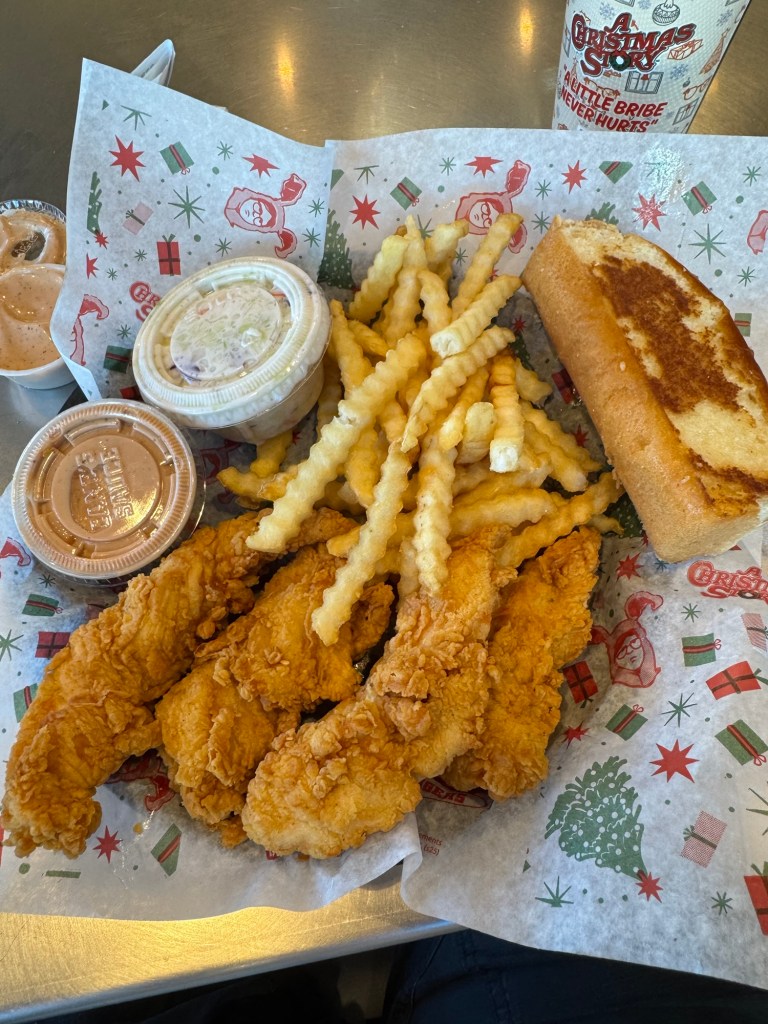
The Box Combo was really damn good. Even the coleslaw tasted fresh. The fries were just perfect. The fingers, the one thing they do better than anyone, well, they do them excellently. Cane’s sauce is perfect. But, later, I did not feel amazing. Maybe you’re not supposed to eat this if you’re over age 40. The Box Combo is the second biggest combo on the menu, behind the Caniac, and provides something like 1400 calories. I felt like I myself had been brined for 24 hours.
Sometimes I remember the book Fast Food Nation by Eric Schlosser. When it came out in 2001, everybody read that book. But in the twenty five years since, fast food – “quick service restaurants” in the term the industry prefers – has only made itself more craveable. The worst aspects described in FFN had to do with the beef industry, so maybe a chicken-only restaurant is a net positive. I’m sure there’s gnarliness to the industrial production of chicken but it’s easier to handle mentally than the mass slaughter of mammals.
Surely there are some negatives to processing food at this speed and scale, but from the optimist side? Raising Cane’s is astounding. Consider Leander Stilwell’s memoir of his service in the Civil War. He remembers a chicken dinner:
Soon were audible the death squawks of chickens in the barn-yard, which we heard with much satisfaction.
In due time supper was announced, and we seated ourselves at the table. And what a banquet we had! Fried chicken, nice hot biscuits, butter, butter-milk, honey, (think of that!) preserved peaches, fresh cucumber pickles,-and so forth.
He was writing that in 1916, over fifty years after the events and he still remembers his meal, it was that remarkable. True, this was in the deprivations of wartime, but it sticks with him. Today you can get close to the equivalent (minus the peaches) at over 900 locations in the US, and 40 in the Middle East, for about the price of an hour’s labor at the California minimum wage. You don’t even have to get out of your car. That’s just an incredible system.
 Helytimes