F2: Fridericus II
Posted: March 1, 2026 Filed under: hely's history, Italy, Savoy Leave a commentAn important offscreen character in Dante’s Inferno is Fredrick II, the Holy Roman Emperor (to use an anachronistic term).
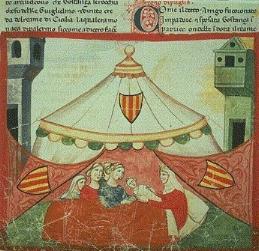
was he really born in the marketplace?
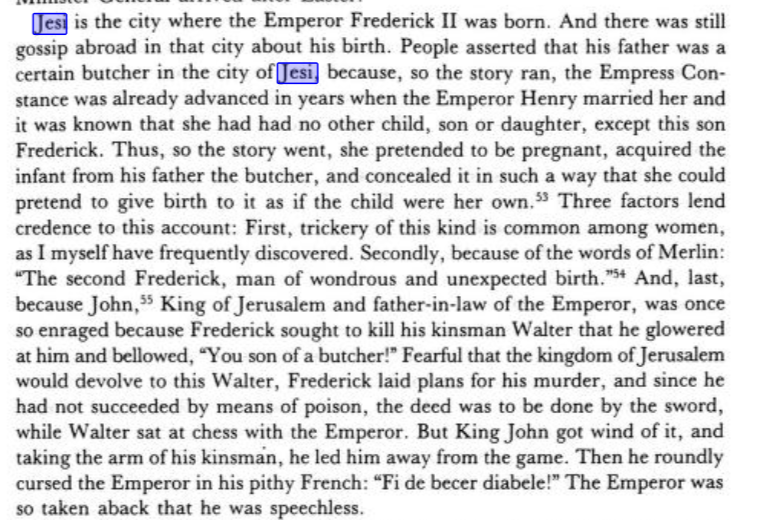
Friderick II (you’ll see why it’s important to spell it that way later) lived from 1194-1250 common era . This was the extent of his domain, in orange and red.
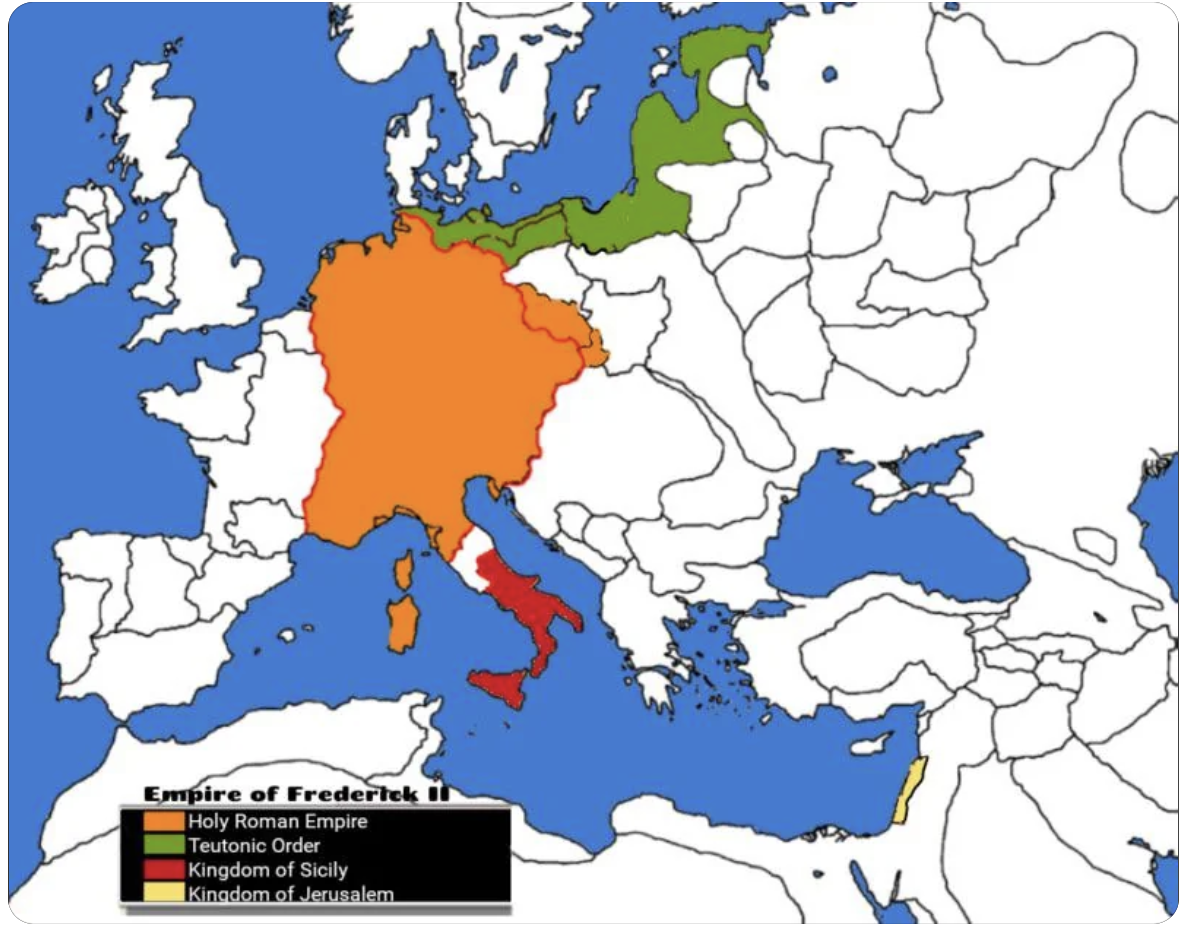
(I got that map from Reddit, you can see that the first commenter is already finding fault, but for our purposes it works).
You can see why Friderick would have conflict with the Pope, who had the lands in white that separated Friderick’s lands from each other. Thus begins (or thus continues) the conflict that tore apart Dante’s Florence, between Guelphs and Ghibellines, supporters of the Pope and supporters of the Emperor, that had such a huge impact on Dante’s life (Dante was Team Pope, but then his own side split into White and Black and he (White) lost and was exiled.)
He knew bird:
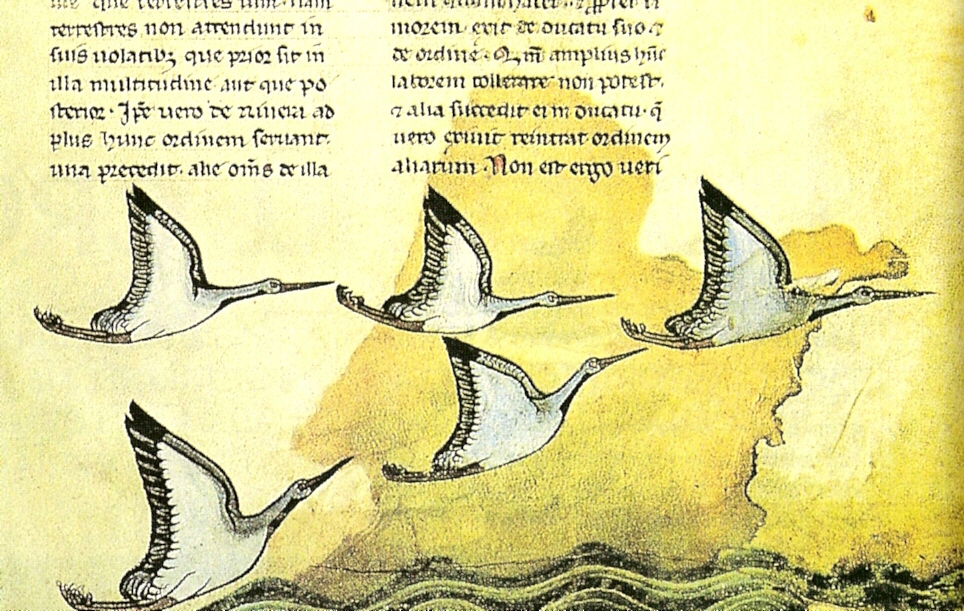
Frederick II is the author of the first treatise on the subject of falconry, De Arte Venandi cum Avibus (“The Art of Hunting with Birds”)…
For this book, he drew from sources in the Arabic language. Frederick’s pride in his mastery of the art is illustrated by the story that, when he was ordered to become a subject of the Great Khan (Batu) and receive an office at the Khan’s court, he remarked that he would make a good falconer, for he understood birds very well. He maintained up to fifty falconers at a time in his court, and in his letters he requested Arctic gyrfalcons from Lübeck and even from Greenland. …
David Attenborough in “Natural Curiosities” notes that Frederick fully understood the migration of some birds at a time when all sorts of now improbable theories were common.
Now here’s something interesting:
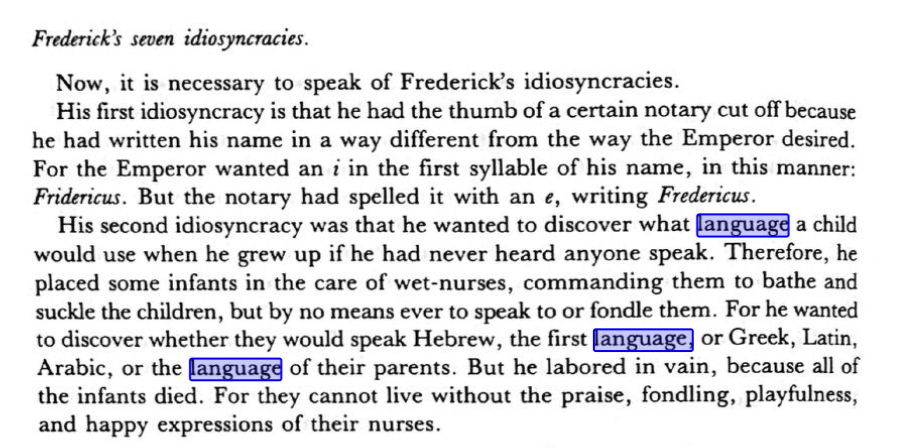
In the language deprivation experiment, young infants were supposedly raised without human interaction in an attempt to determine if there was a natural language that they might demonstrate once their voices matured. It is claimed he was seeking to discover what language would have been imparted unto Adam and Eve by God. Salimbene alleged that Frederick bade “foster-mothers and nurses to suckle and bathe and wash the children, but in no ways to prattle or speak with them; for he would have learnt whether they would speak the Hebrew language (which had been the first), or Greek, or Latin, or Arabic, or perchance the tongue of their parents of whom they had been born. But he laboured in vain, for the children could not live without clappings of the hands, and gestures, and gladness of countenance, and blandishments”.
Our source for that is the Cronica of Salimbene di Adam:
(source)
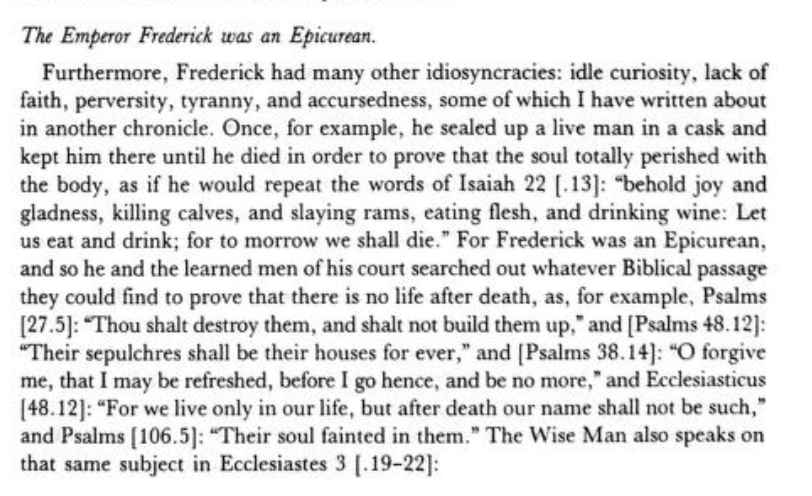
More experiments reported:
As for his appearance?
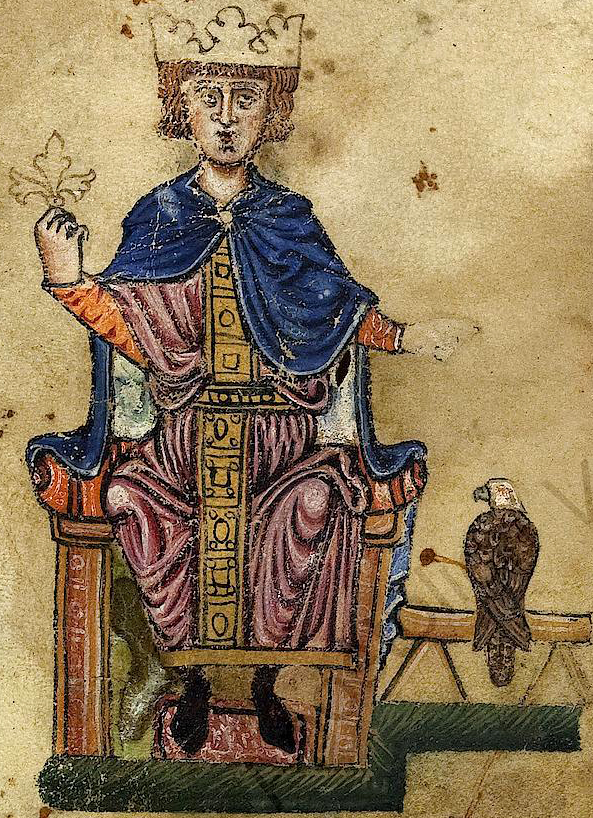
A Damascene chronicler, Sibt ibn al-Jawzi, left a physical description of Frederick based on the testimony of those who had seen the emperor in person in Jerusalem: “The Emperor was covered with red hair, was bald and myopic. Had he been a slave, he would not have fetched 200 dirhams at market.”
It’s very possible we would put this guy today into one of several categories ranging from oddball to neuroatypical. Some clues are he did weird experiments, looked weird, and had a guy’s finger cut off for spelling his name wrong.
Lansing and English, two British historians, argue that medieval Palermo has been overlooked in favour of Paris and London:
One effect of this approach has been to privilege historical winners, [and] aspects of medieval Europe that became important in later centuries, above all the nation state…. Arguably the liveliest cultural innovation in the 13th century was Mediterranean, centered on Frederick II’s polyglot court and administration in Palermo…. Sicily and the Italian South in later centuries suffered a long slide into overtaxed poverty and marginality. Textbook narratives therefore focus not on medieval Palermo, with its Muslim and Jewish bureaucracies and Arabic-speaking monarch, but on the historical winners, Paris and London.
Dante preferred Friderick’s successor, Henry VII.
 Helytimes