Chambéry
Posted: July 14, 2026 Filed under: France, Savoy 2 Comments
A passion: traveling and seeing the places on the map come to life.
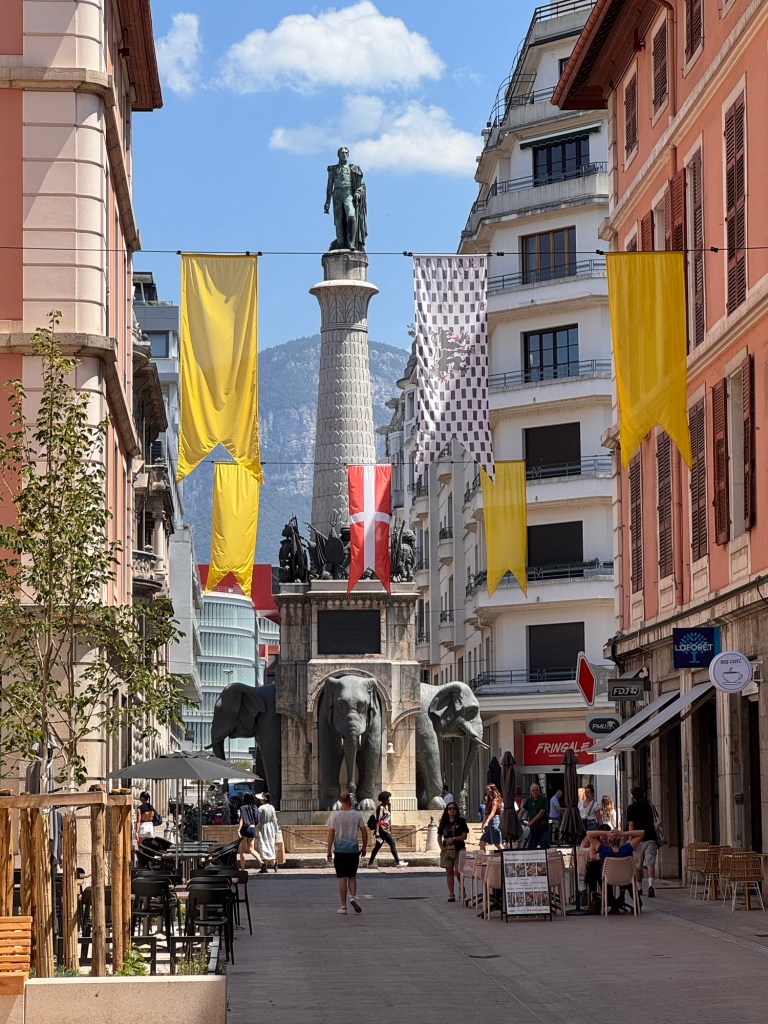
Reading the history of Savoy, Chambéry came up again and again. A 30-40 minute train ride from Annecy, we decided to have a morning’s look.

Chambéry sits in a nice, elevated spot on a mountain pass, near Lac du Bourget. It’s a good location. Says Claude:
Together, these features turned Chambéry into the natural “hinge” between Italy, France, and Switzerland — a role formalized when the Counts (later Dukes) of Savoy made it their capital in the 13th century, since holding this valley meant holding the keys to Alpine trade and military movement in the region.
The most distinct attraction in Chambéry is the Elephant Fountain, commissioned by Benoit Boige:
Benoit Boigne, the son of a Chambéry glove maker, left in 1769 aged seventeen, to join the Irish regiment in Louis XV’s army. He then tried his luck in the Russian navy, was captured by the Turks, escaped, was shipwrecked in Egypt, and finally joined the Madras regiment of the East India Company. In India, his career took off; after just six years he became the commander-in-chief of the 30,000-strong army of the Maharajah of Sindh. Boigne accumulated a fortune and thirty-five years after leaving Chambéry, he returned and spent his wealth, and the last twenty-eight years of his life, reshaping the capital of Savoy.
(so says John Dormandy in A History of Savoy: Gatekeeper of the Alps)
Sometimes this elephant statue is called “les quartre sans cul,” the four without asses, which sounds kind of like Les Quatre Cents Coups, Truffaut’s movie, and thus is the kind of wordplay French people enjoy.
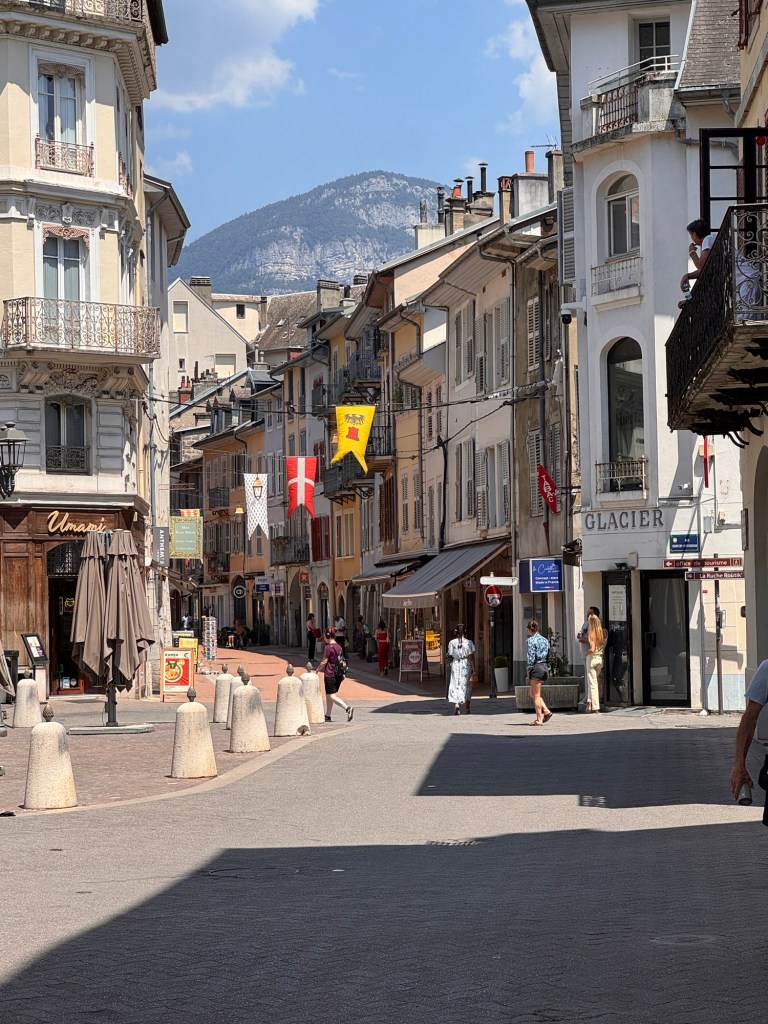
There is something distinct about Chambéry, the Savoy quality, the Alpine influence.
It was very hot the day we visited. This may have accounted for the empty streets. Real Rick Steves vibes as the medieval town revealed itself to us.
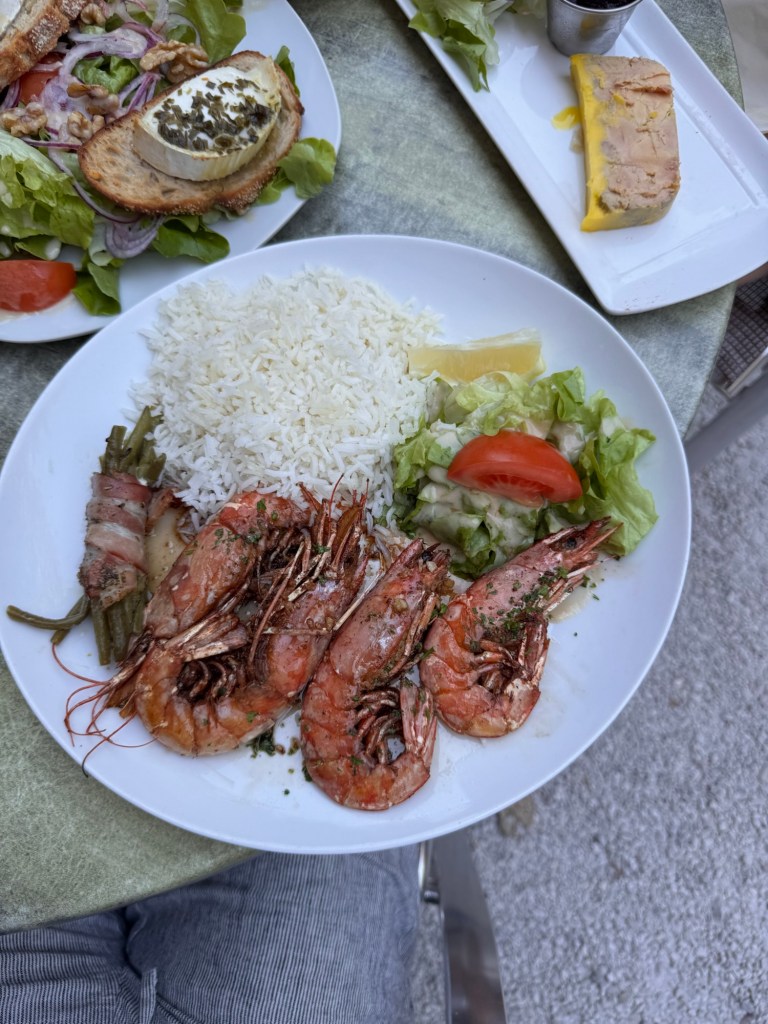
We lunched at Le Sporting, right next to the church. The birds and the quiet French chatter of the elderly lunchers was a very soothing acoustic accompaniment to the prawns cooked in calvados.
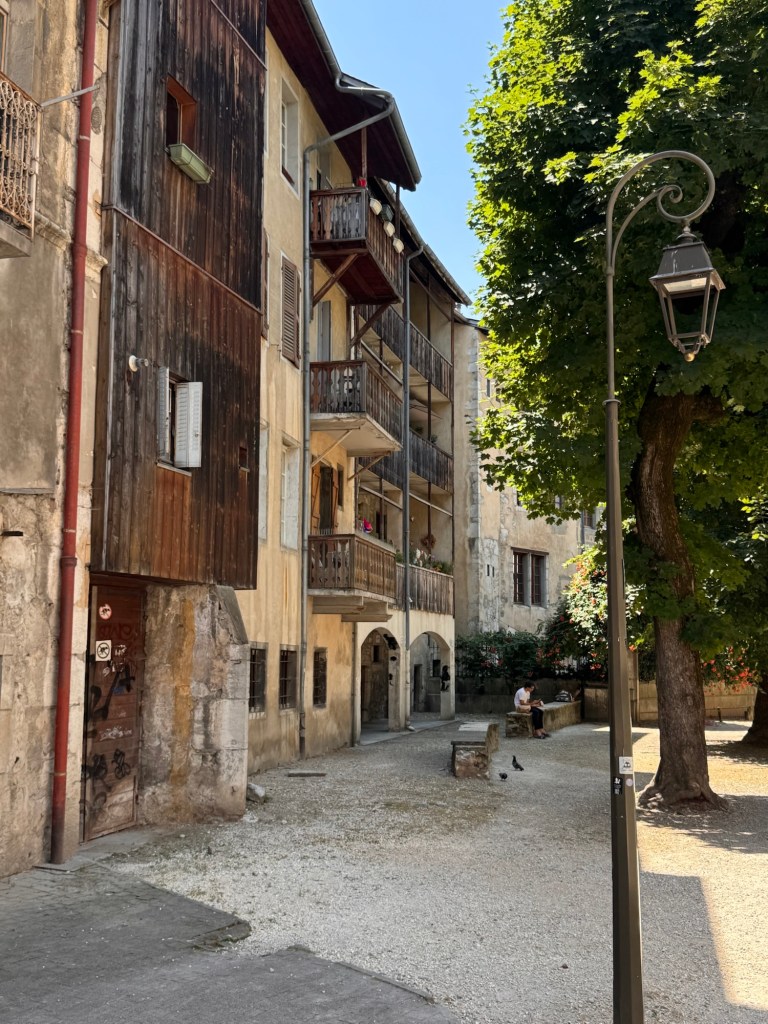
Chambéry was the capital of Savoy for two centuries. It maybe peaked by the year 1563, when Duke Emmanuel Philibert moved his capital to Turin, in what’s now Italy. Chambéry still kept a Senate (one of three for Savoy, it seems like this was more like an appeals court) and the Chamber of Accounts, so there was government business. At times the traveler can imagine himself as a 16th century visitor arriving on some annoying business and looking for lodging.
Over half of the 800 aristocratic families in Savoy lived in or near the old capital, Chambéry, almost none in the Alpine valleys. About two-thirds had acquired their titles more than 150 years earlier.
Walking the streets of Chambéry you can still be transported to that era. You can picture the events of an earlier time:
Discontented with a ruling of the ducal council in Chambéry, [Jacques de Montmajeur] and his men stormed into a council meeting, cut off the head of its president, and laid it on the council table.

The de Maistre brothers were Chambéry dignitaries, writers, political figures. Joseph was a monarchist political philosopher who thought the French Revolution was a terrible idea. His brother Xavier ended up fighting with the Russian army. As a younger man, Xavier was sentenced to house arrest for participating in duel. He wrote a whimsical memoir of his captivity called A Journey Around My Room. I took a look at it, there are some interesting philosophical musings. It’s not exactly funny to the modern reader but you can feel how it might’ve been delightful, even hilarious to readers at the time.
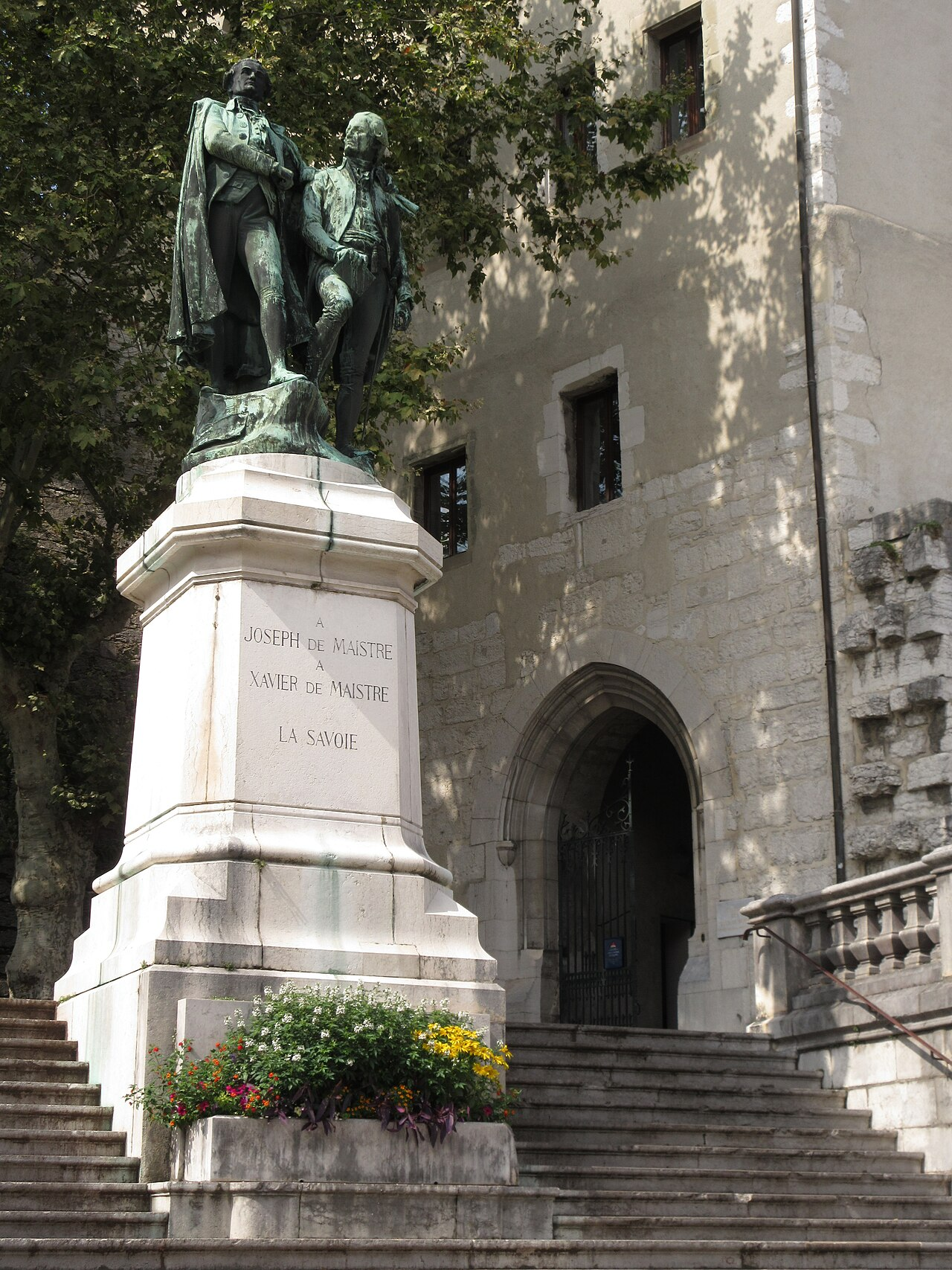
(Wikipedia photographer S23725 took that one. I concede my photography is amateur. So what?)

If life were infinity long maybe I would’ve checked out the exhibit of Albanian religious icons at the Musée de Beaux-Arts.
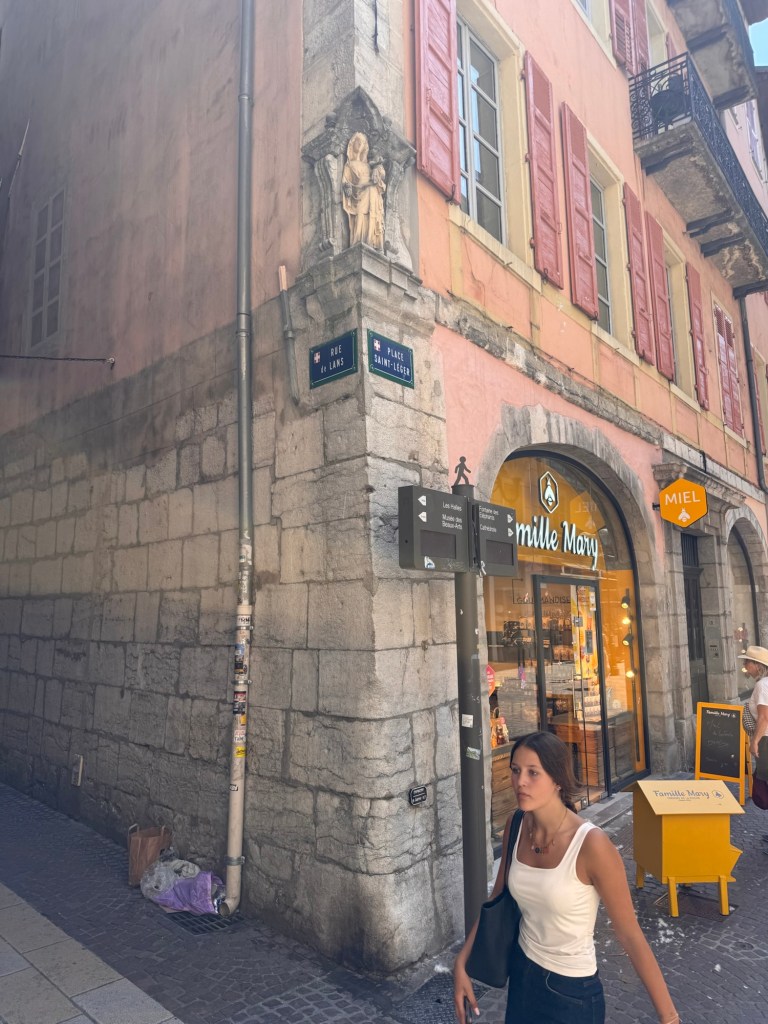
I was trying to photograph this Virgin Mary carved into the building when a Savoyard woman wandered into my shot, creating a much more compelling and memorable photo.
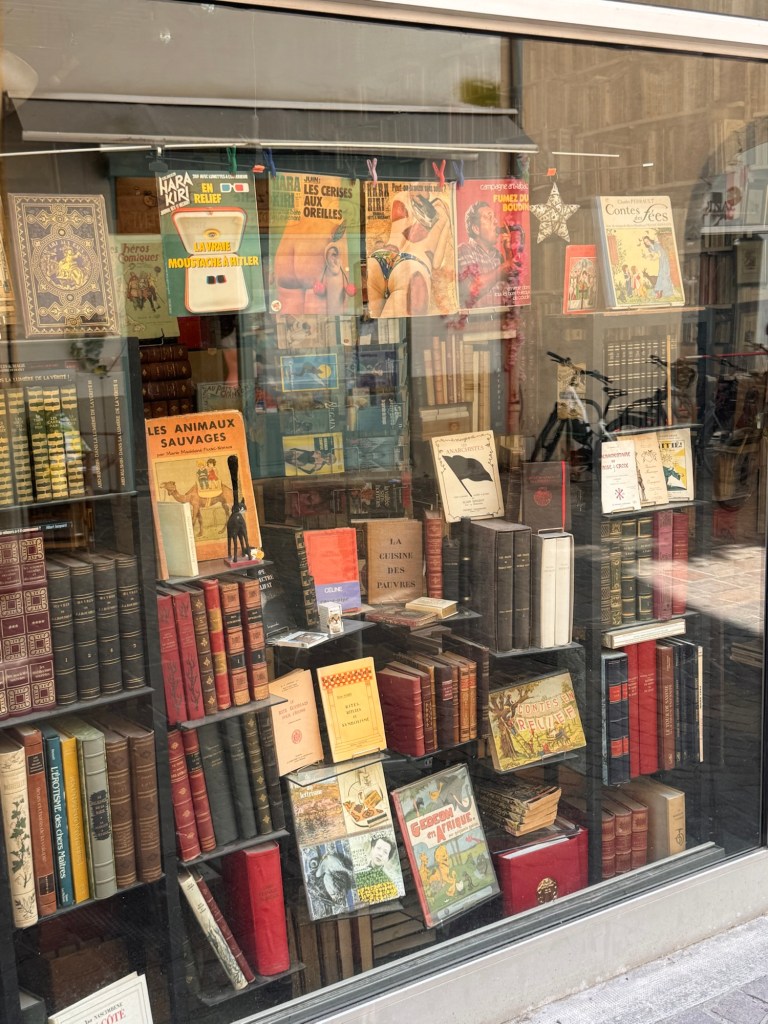
Yes.
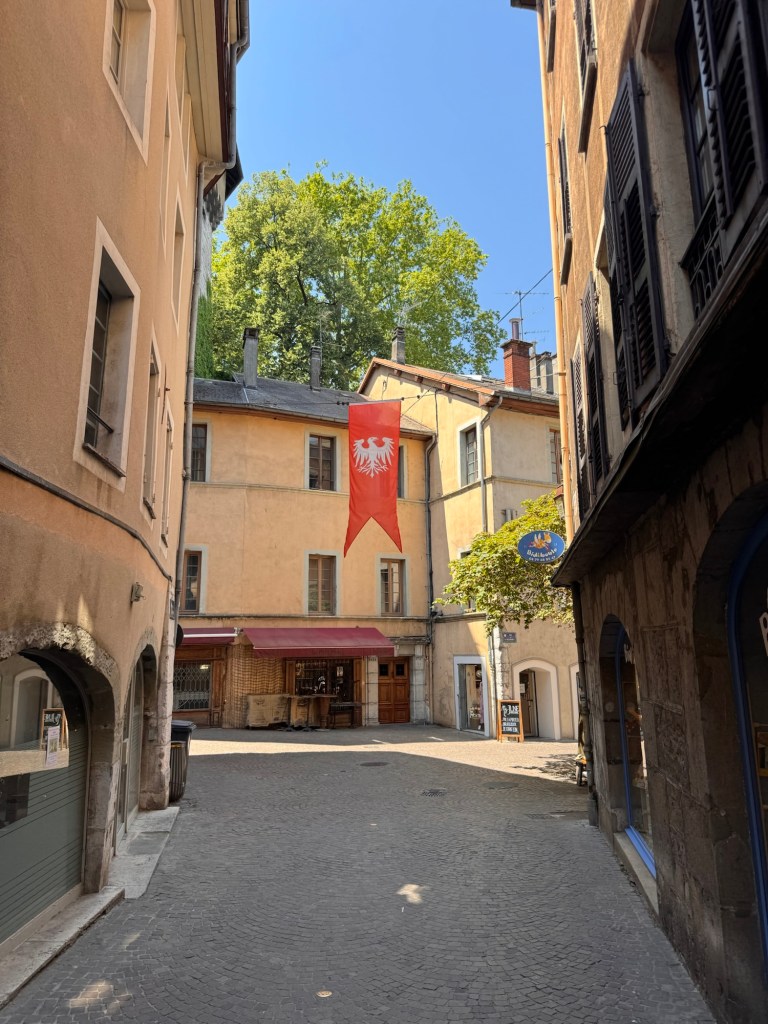
from the section on Savoy in Norman Davies Vanished Kingdoms:
Chambéry in the 1850s was a small provincial town still harbouring memories of its past glory. It was increasingly overshadowed both by the nearby spa of Aix-les-Bains, with its boisterous casino, and, across the frontier, by the French city of Grenoble, which was more than twice its size.
Bayle St John liked it: Chambéry is the capital of the province of Savoy; and, it has… a far more complete and metropolitan character than might have been expected. There is no trace of the village about it… evidently a place accustomed to be the seat of government [and] somewhat annoyed to be so no longer… Everything seems to be arranged for making the city a comfortable winter-quarter… During the summer everyone who can afford it disperses… up the lower slopes of the mountains which are dotted with villas…
However, the streets and… the Place Saint Léger, where the band played each evening, were sufficiently well-thronged… The aristocracy of the place being away, the middle classes tried to lord it… I wished to change some English sovereigns. The money-changer had gone to Paris. This is confirmation of a truth… that the English… all go to Switzerland, or only make a dash into northern Savoy to visit Mont Blanc… The fountain of De Boigne, with its four half-elephants stuck together is one of the ugliest things I have ever seen… M. de Boigne… earned a colossal fortune in India… He built the long street through the centre of town, adorned like the Rue de Rivoli [in Paris], with porticos… Then there is the old castle–so many times rebuilt that only a scrap is really old… Underneath the terrace of the castle… not far from the place where Mme. de Warens once [held]… her extraordinary interviews with Jean Jacques [Rousseau], extends a botanical garden.
In 1860, after the events of the Franco-Austrian war, this part of Savoy including Chambéry was ceded to France:
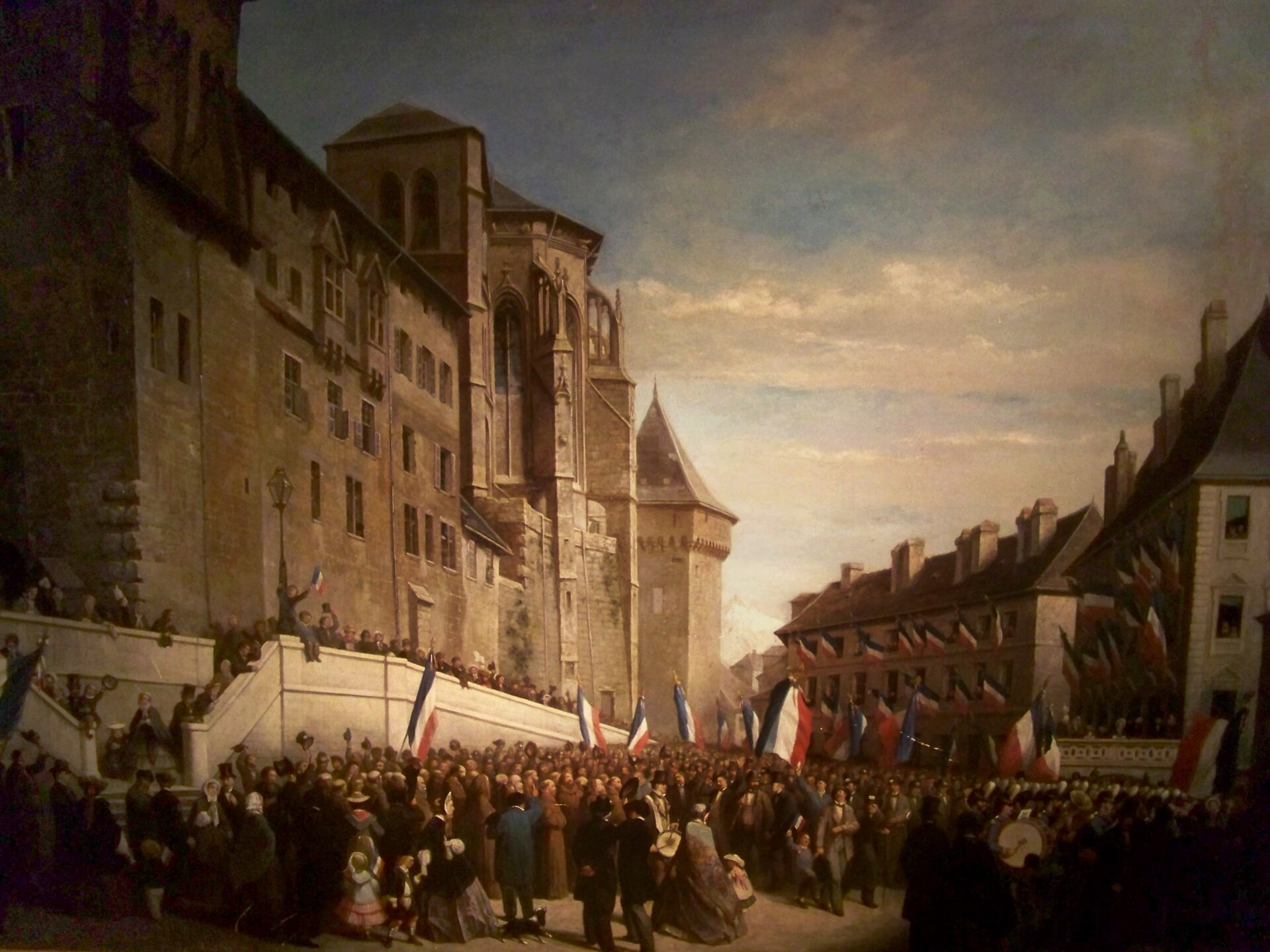
Louis Houssot painted the scene.
Any stocked bar will have a product of Chambéry in it:
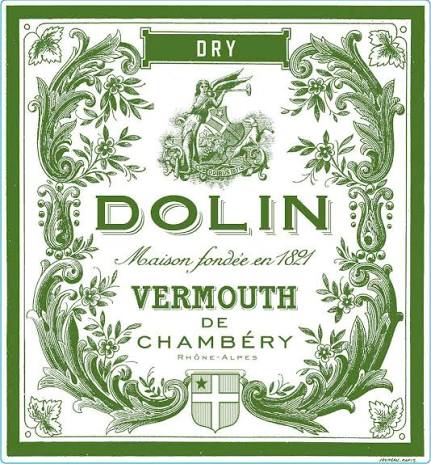
As far as I can tell you can’t tour the factory or do a vermouth tasting or anything. (Who would want to?)
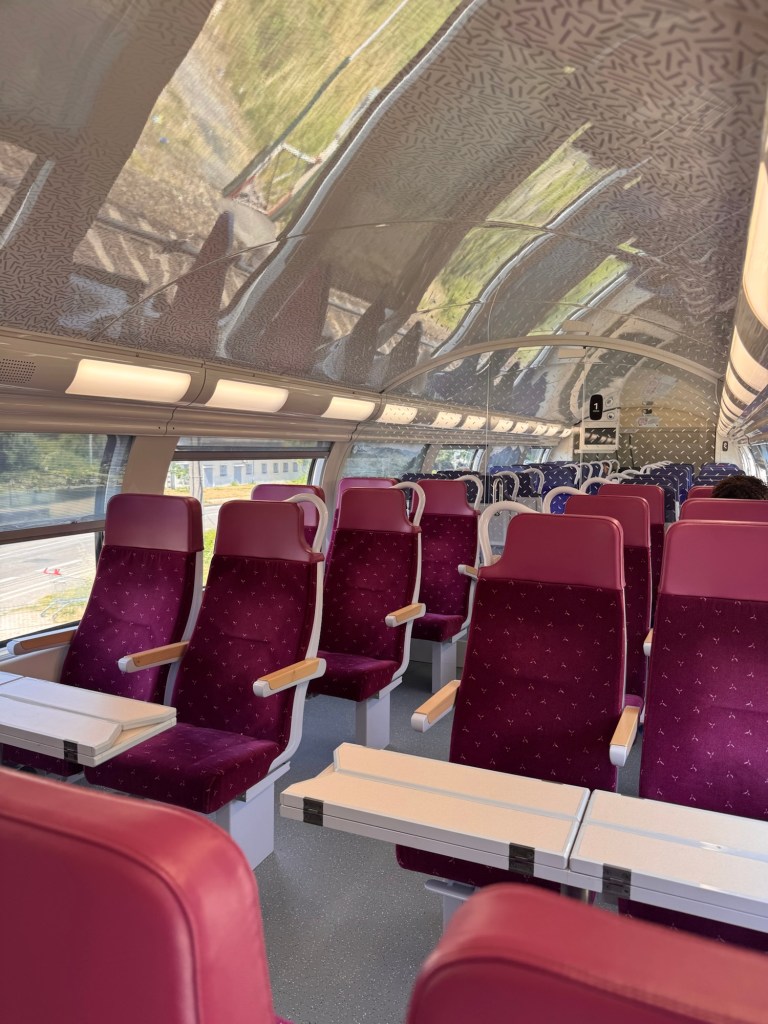
A French 2nd class train can get pretty sweaty. A French 1st class train is nice.
Aix-les-Bains
Posted: July 11, 2026 Filed under: France, Savoy Leave a comment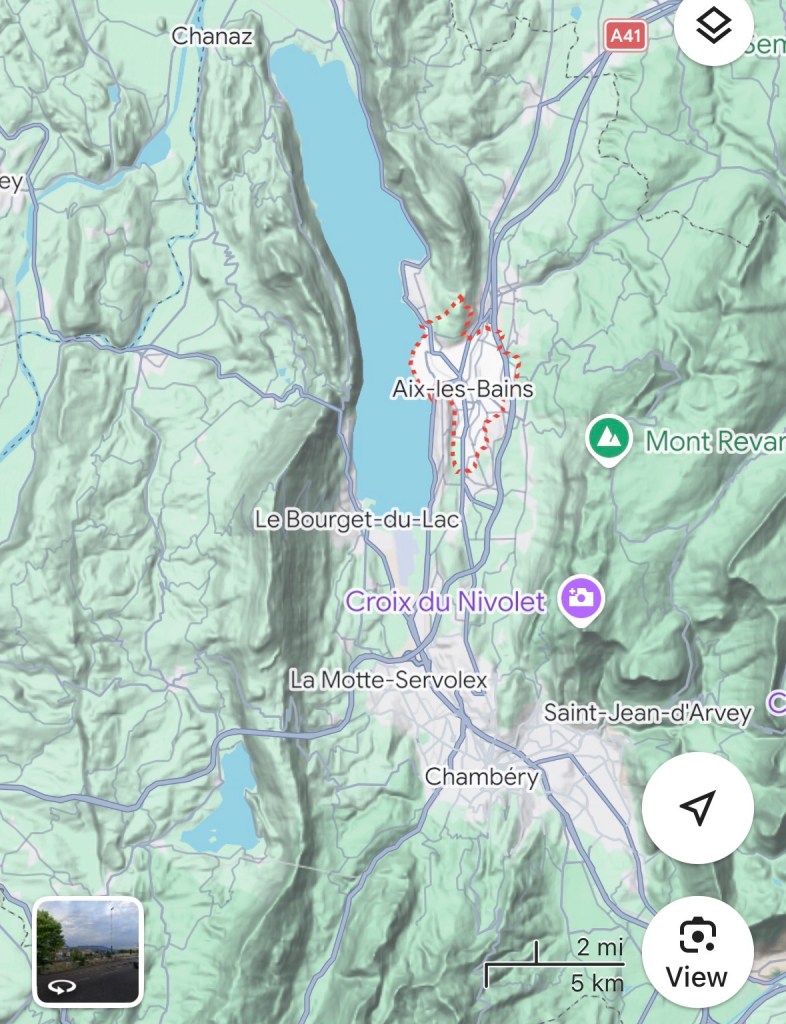

Great advertising.
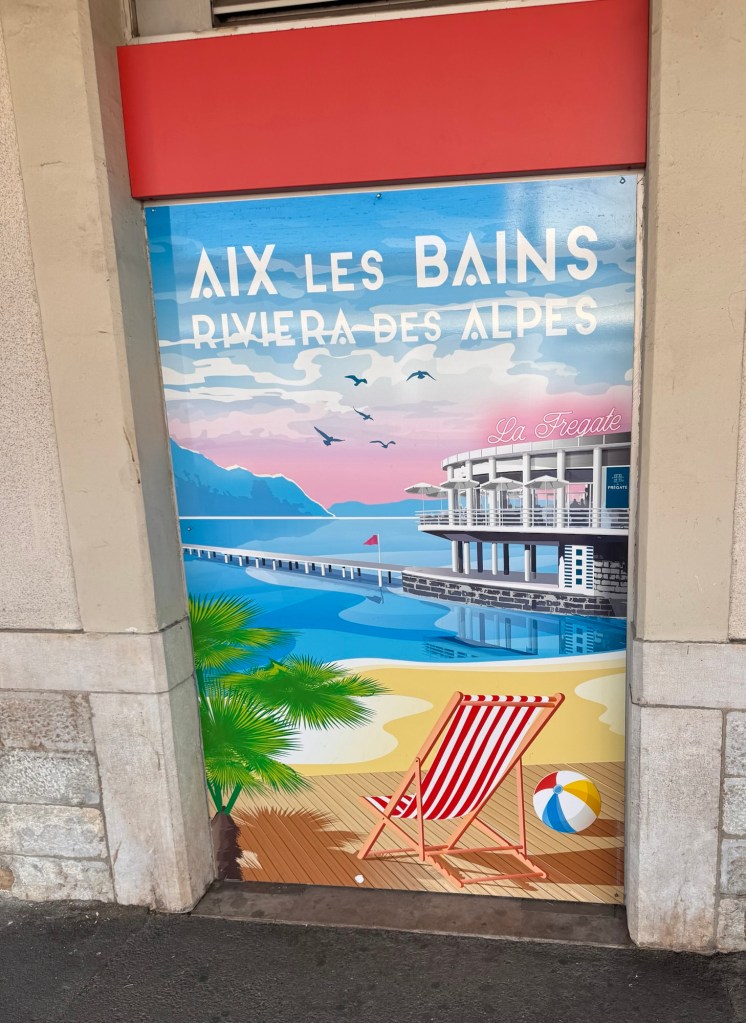
The town is not exactly like it pretends be at the train station.

But it’s not bad.
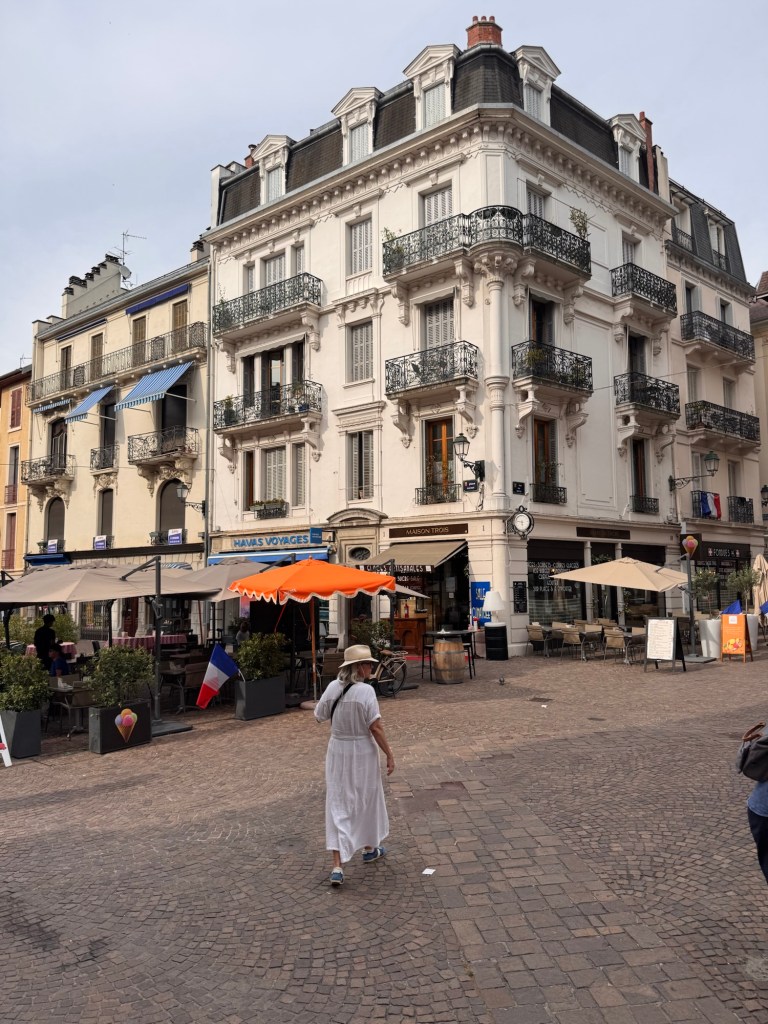
We love when a country looks like itself, or our idea of itself. Aix-les-Bains looks like the idea of France.
Aix-les-Bains is blessed with thermal springs which have been an attraction since Roman times. People would come and soak, and at night you would gamble. Sacha Guitry’s novel Le Roman d’un tricheur / Story of a Cheat, culminates at a casino in Aix-les-Bains in 1924.
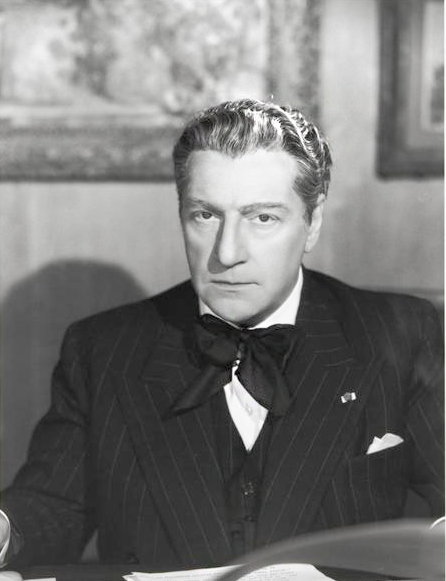
Guitry’s French wikipedia page is a fine read that can lead one anywhere.
There are a number of impressive old hotels, from the Belle Epoque era, though most of them today have been converted to apartments.
French history is so wild: a series of strong kings wage war against everybody, a revolution and a reign of terror, then Napoleon, then disfunction, then the history-repeated-as-farce of Napoleon III, a disastrous war, the Commune and subsequent executions, and then a period called “the beautiful era” where the art and architecture is killer. All this could’ve been experienced in one lifetime. Then two world wars, disaster overseas. Here we are today with a France that has to be one of the world’s most pleasant places to live, even if Houellebecq presents it as nightmare. That there’s even a serious novelist working and getting readers and discussion suggest France has still got it.
The concept of a spa town runs through French culture. Apparently French Social Security will pay for three weeks of thermal water treatment. There are many of these towns, my favorite has to be Bains-les-Bains.
There’s a Smurfs book where they build themselves a spa town:
On the day we visited Aix-le-Bains, by train from Annecy, there was a dance going on at the park:
Great sculpture of a lion with his balls exposed.
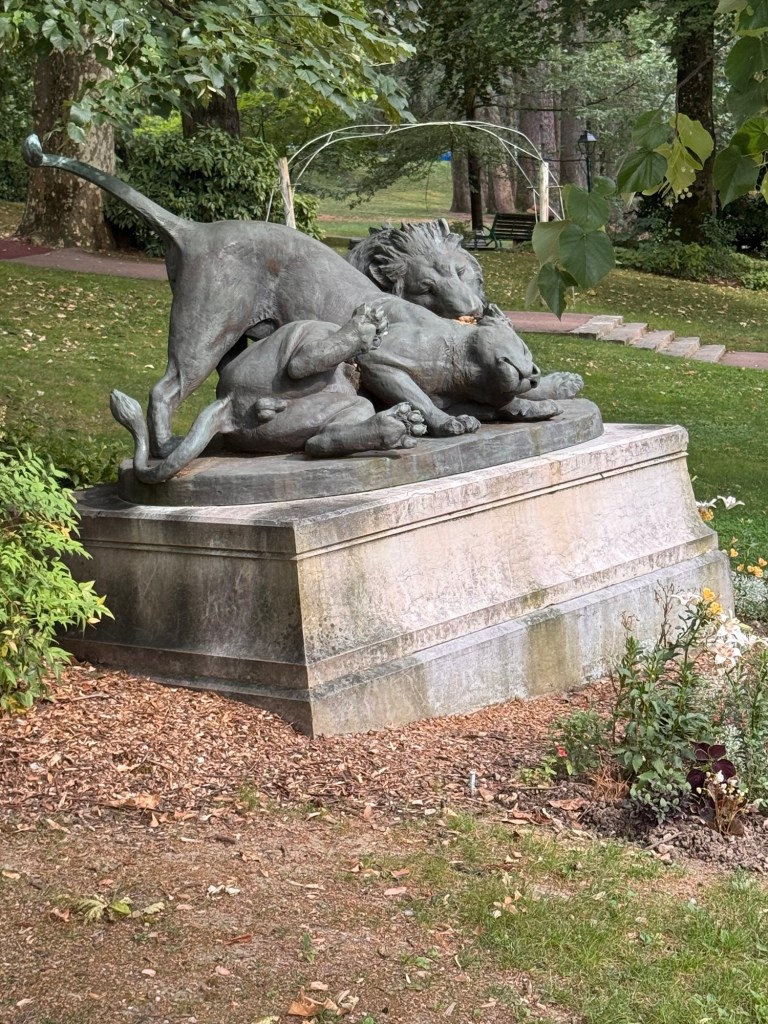
Are they kissing?
You can park your car next to the ancient Roman arch.
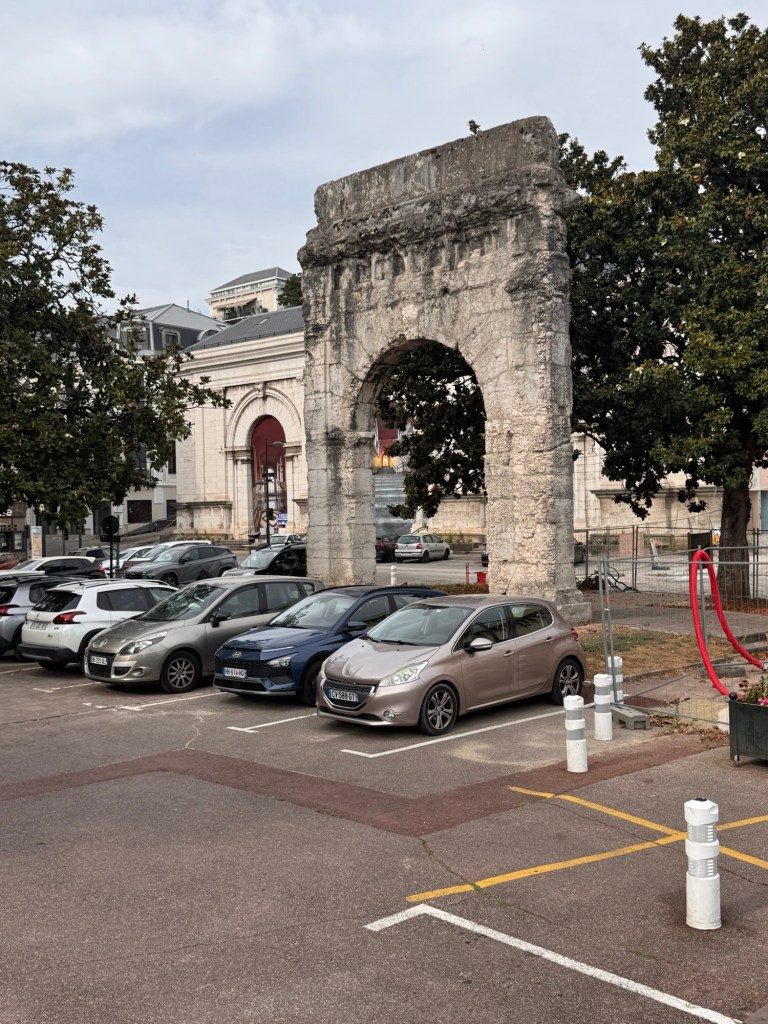
Although the arch bears inscriptions in honour of the Campanus family (the monumental glorification of elites and their families was an innovation of this era[2]), the function of the monument remains uncertain.
Congratulations Campanus, now you have a Honda parked next to you.
Aix-les-Bains is not the most famous Aix. There’s Aix-en-Provence. It’s not even the most famous spa town Aix: Aix-la-Chapelle, aka Aaachen, German, has quite a beautiful bath situation. Why are there so many Aixs? Apparently it comes from the Latin aqua. Aix-les-Bains=”Water The Baths.” French place names can seem strange to the Anglo but then again I grew up in Needham, Massachusetts and now live in Los Angeles, California.
Aix-les-Bains merits no section in the Lonely Planet: France guide I had on Kindle.
Lacking a guide I had Claude generate one.
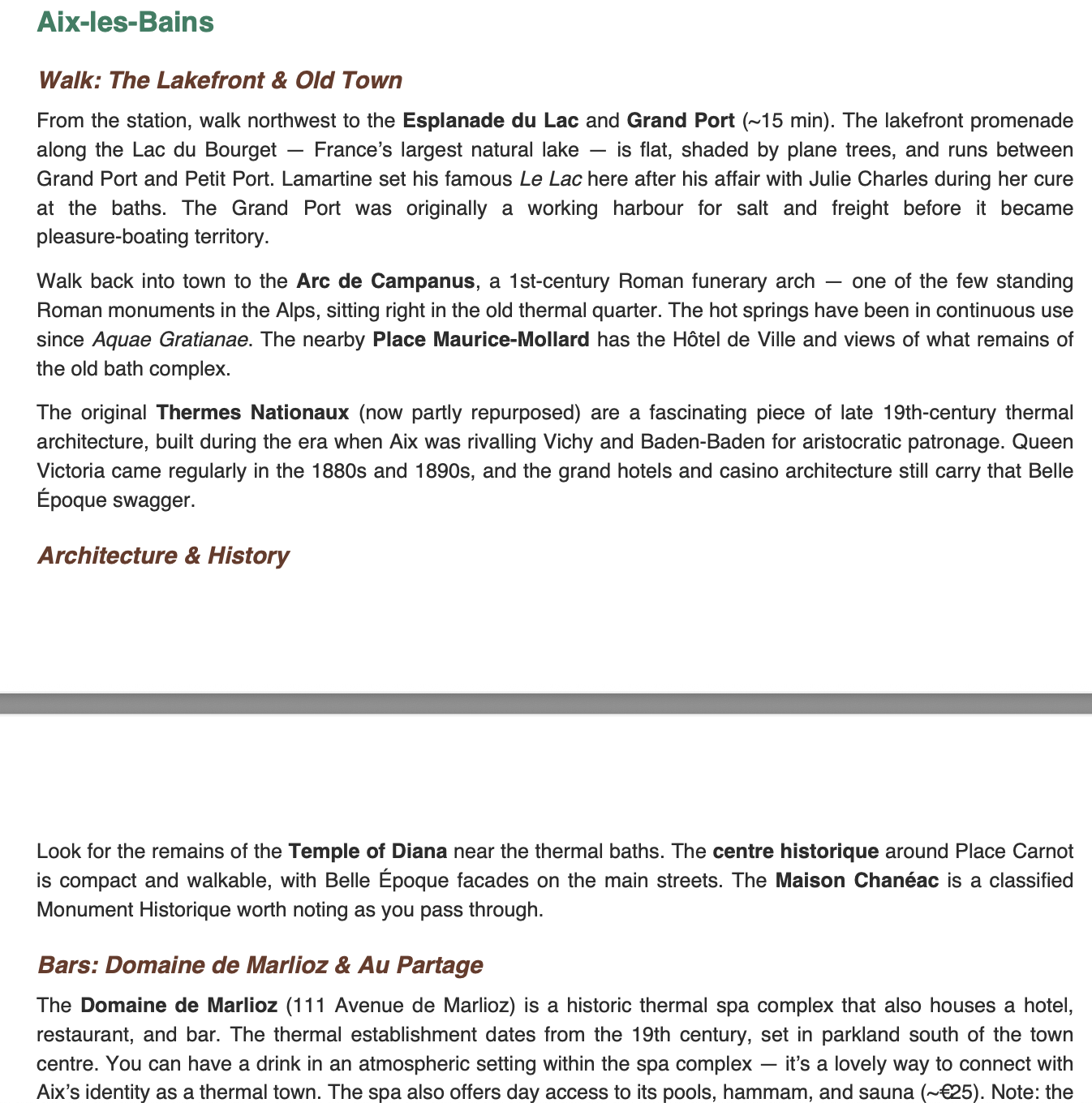
The schedule it devised was very optimistic. It failed to budget or warn for instance for French train delays.
The lakeshore, to me the main draw of Aix-les-Bains, is somewhat below the town, about a 2.3 km walk.

Always moved by the French war memorials. Something like 15-20% of the military age young men of France died in World War I. For what? It’s hard to comprehend.
Our walk took us mostly through a residential area. Short on time we decided to Uber.
In reading about Aix-les-Bains I was surprised to learn that the median household income is something like 26,375 Euros a year. By American standards that is pathetic. In Los Angeles (city) the median household income is $79,700 a year. In LA County its even higher. Aix-les-Bains is comparable to Rosedale, Mississippi on this metric.
However, in France the government covers health care, childcare, university. The public spaces seem well-maintained by American standards. The numbers for Aix-l-B are a little skewed because there are quite a few retirees (39.6% of households).
I had Claude create a comparison for the US, France, and Australia:
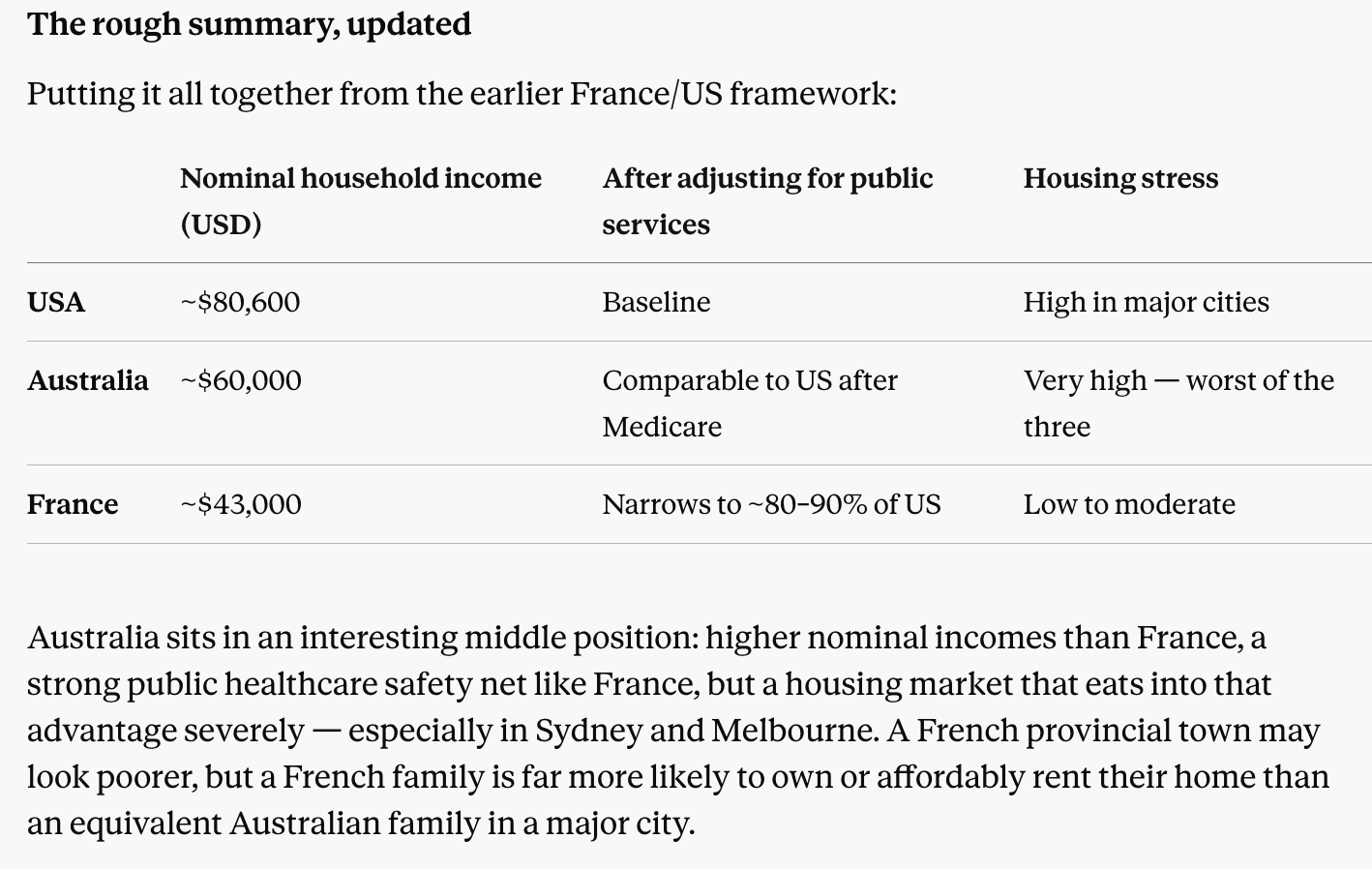
A takeaway, certainly, is that in money terms, the United States is stupendously rich.
On the other hand I enjoyed the style of life I saw on display in Aix-les-Bains. The accumulated layers of a built environment with 2,000 years of refinement can’t be bought.
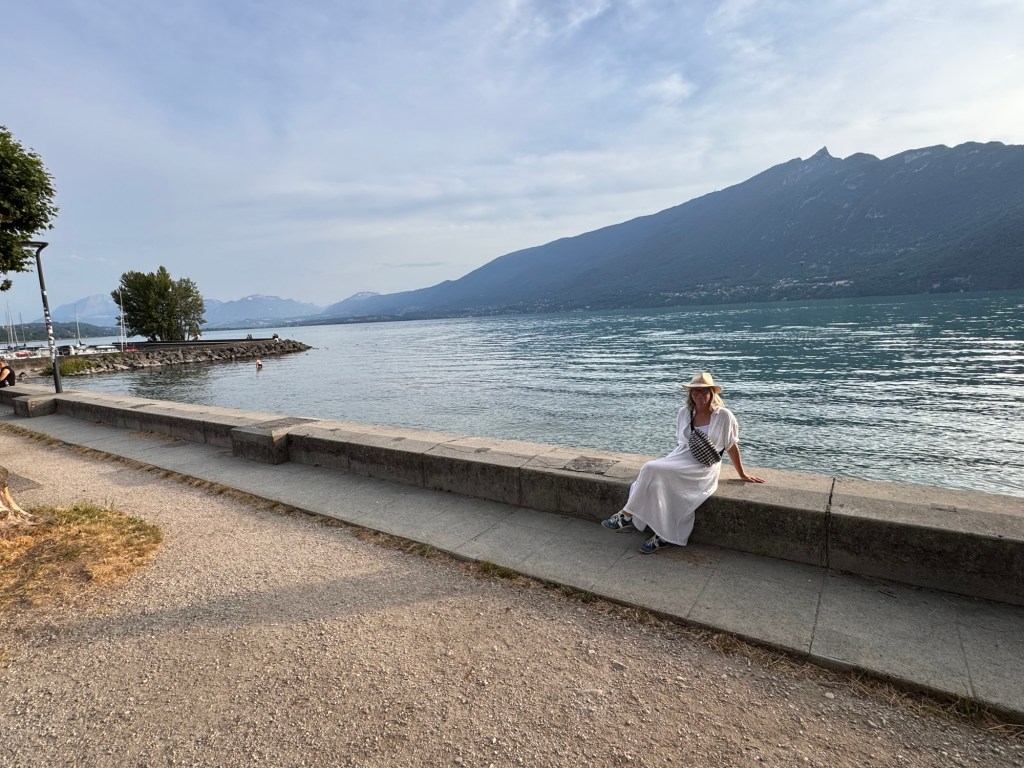
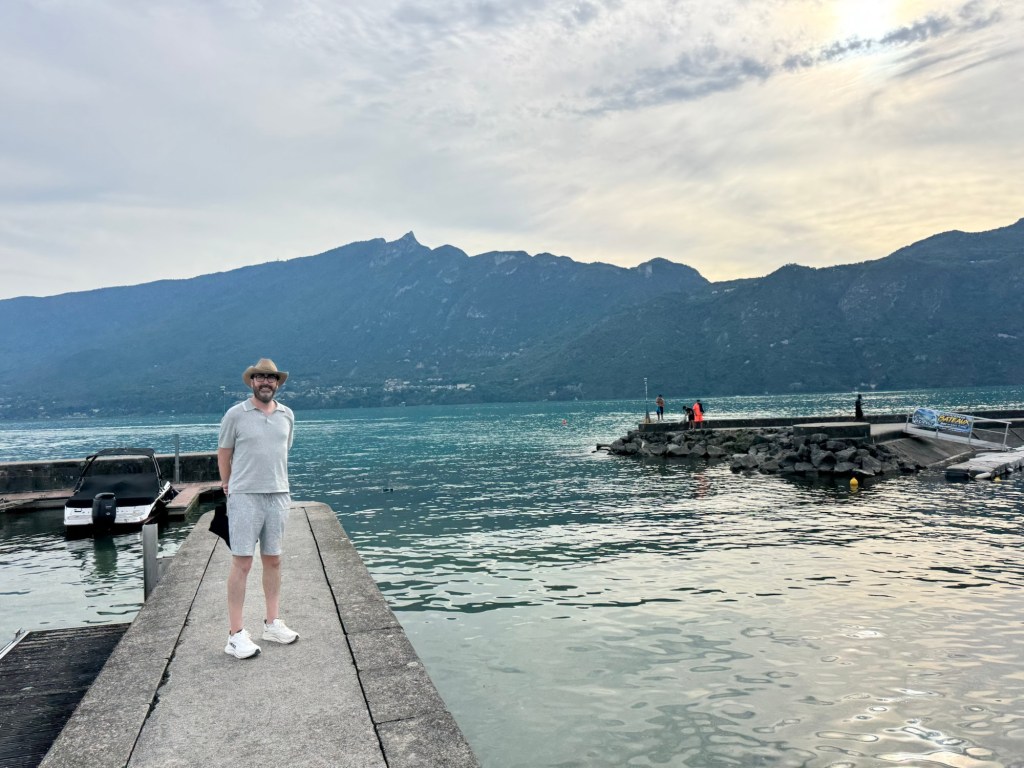
Lac du Bourget is famous for a poem about it, by Alphonse de Lamartine. The lake itself is a poem.
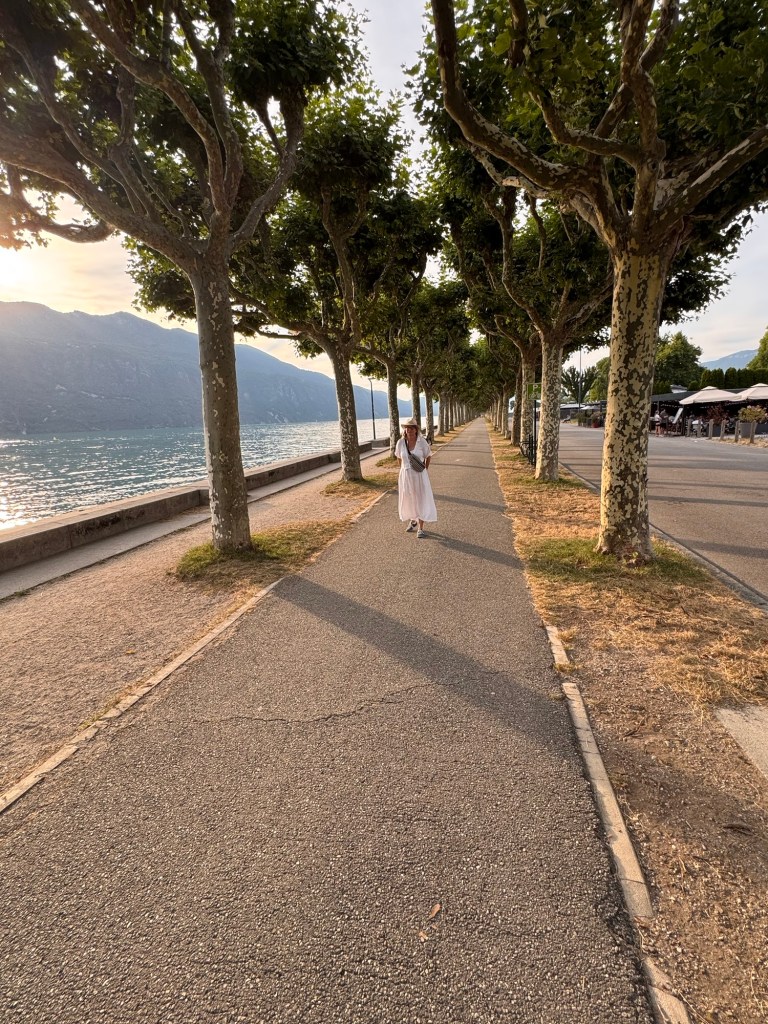
A lovely esplanade.
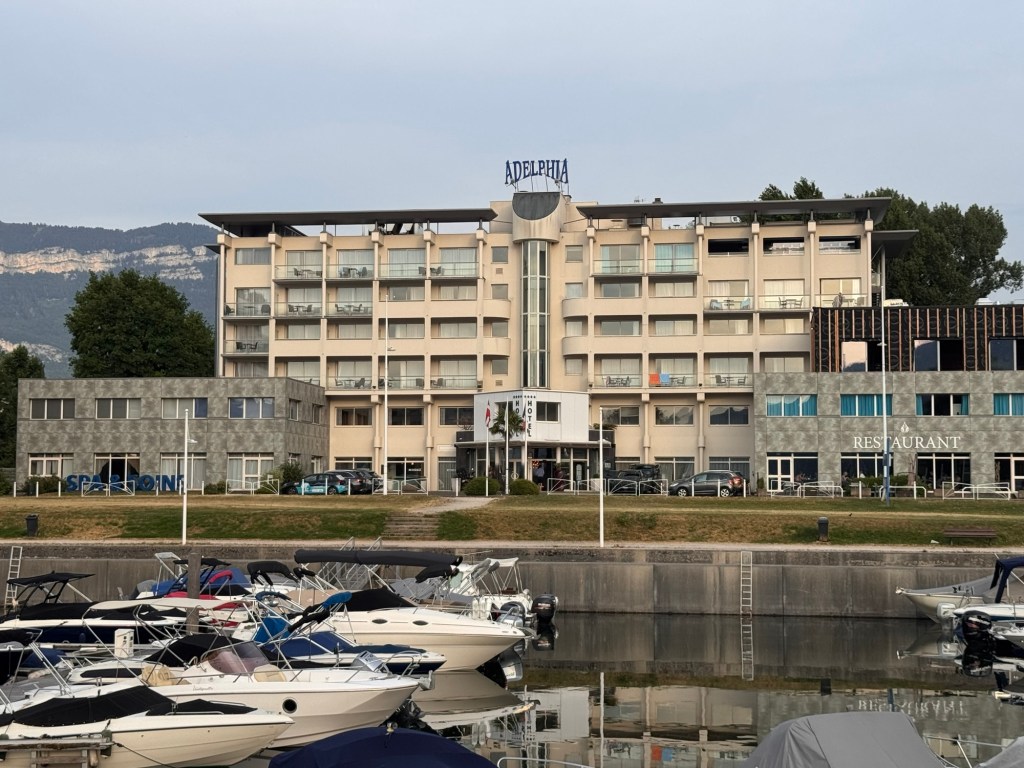
The Adelphia Hotel looked to me like it could be “low budget Wes Anderson.”
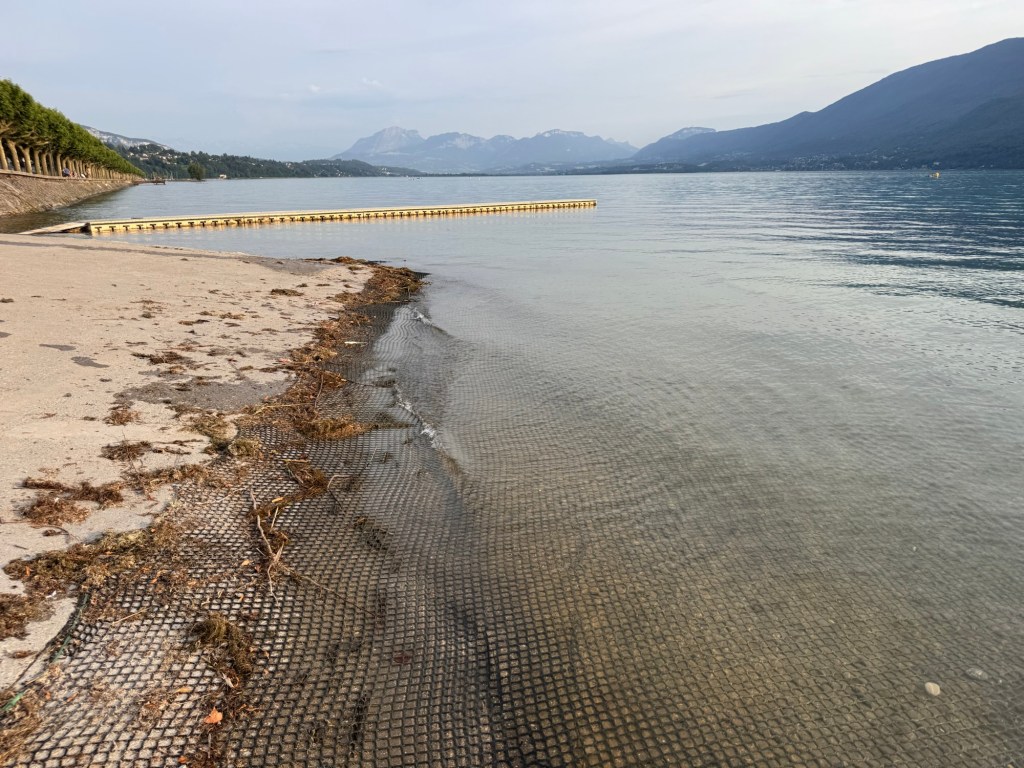
Beautiful but sort of severe.
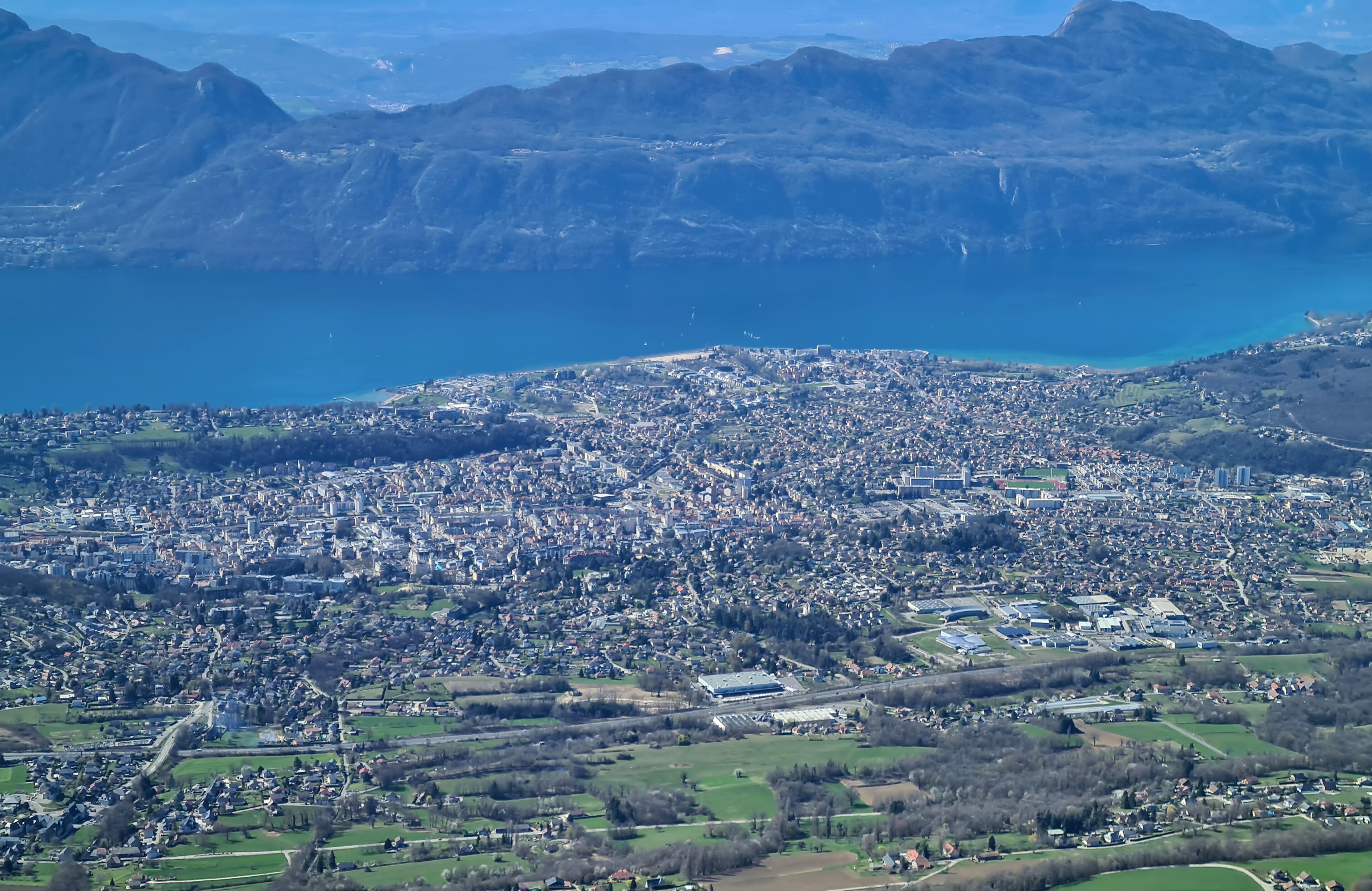
(source)
Canicule
Posted: July 3, 2026 Filed under: France, Savoy, Uncategorized Leave a comment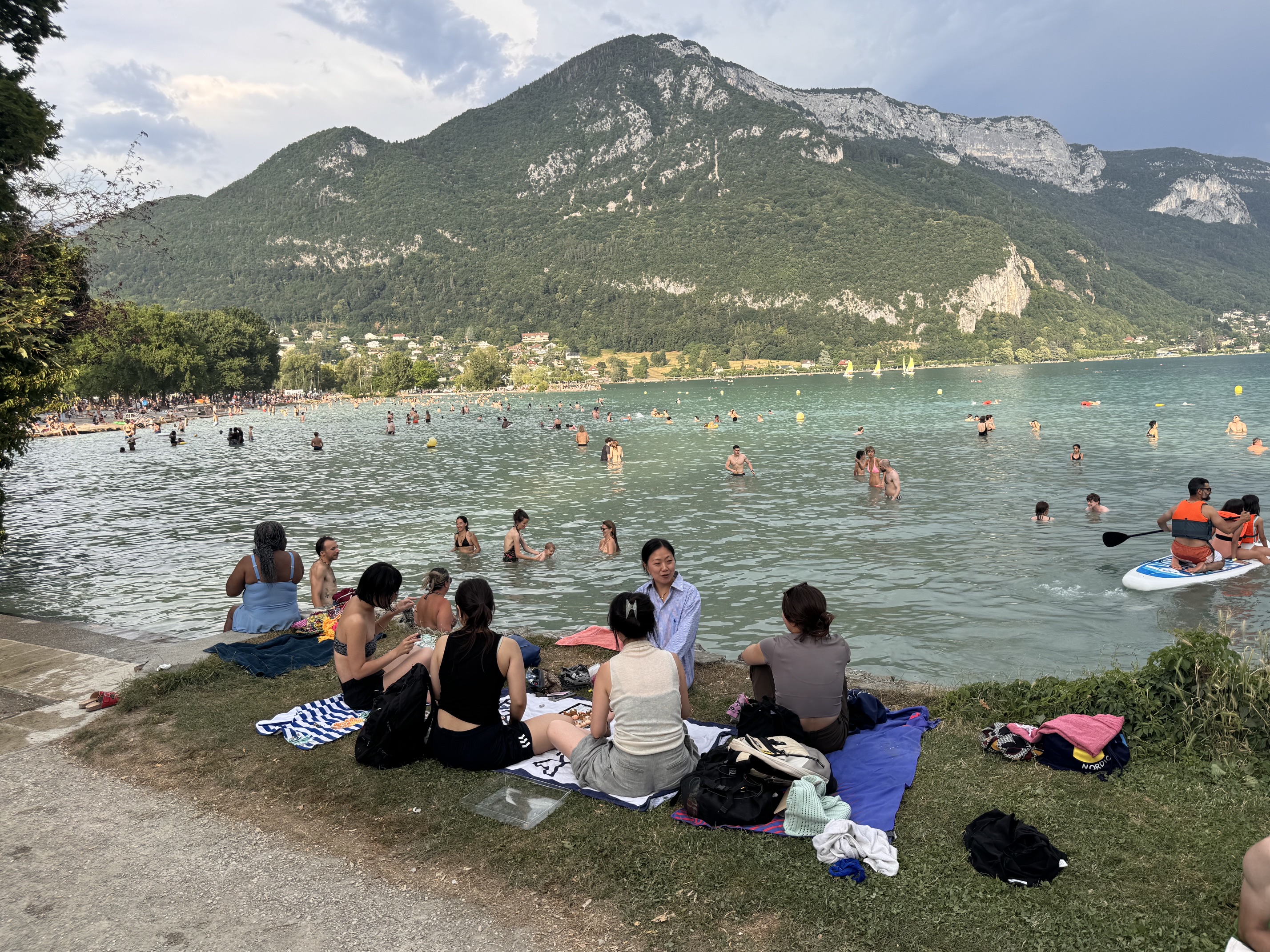
France was hot. Blessedly we were near the lake, and everyone was taking advantage.
The topic in everyone’s conversation was the heatwave. Even though it sounded unprecedented, there seemed to be a French word for it:
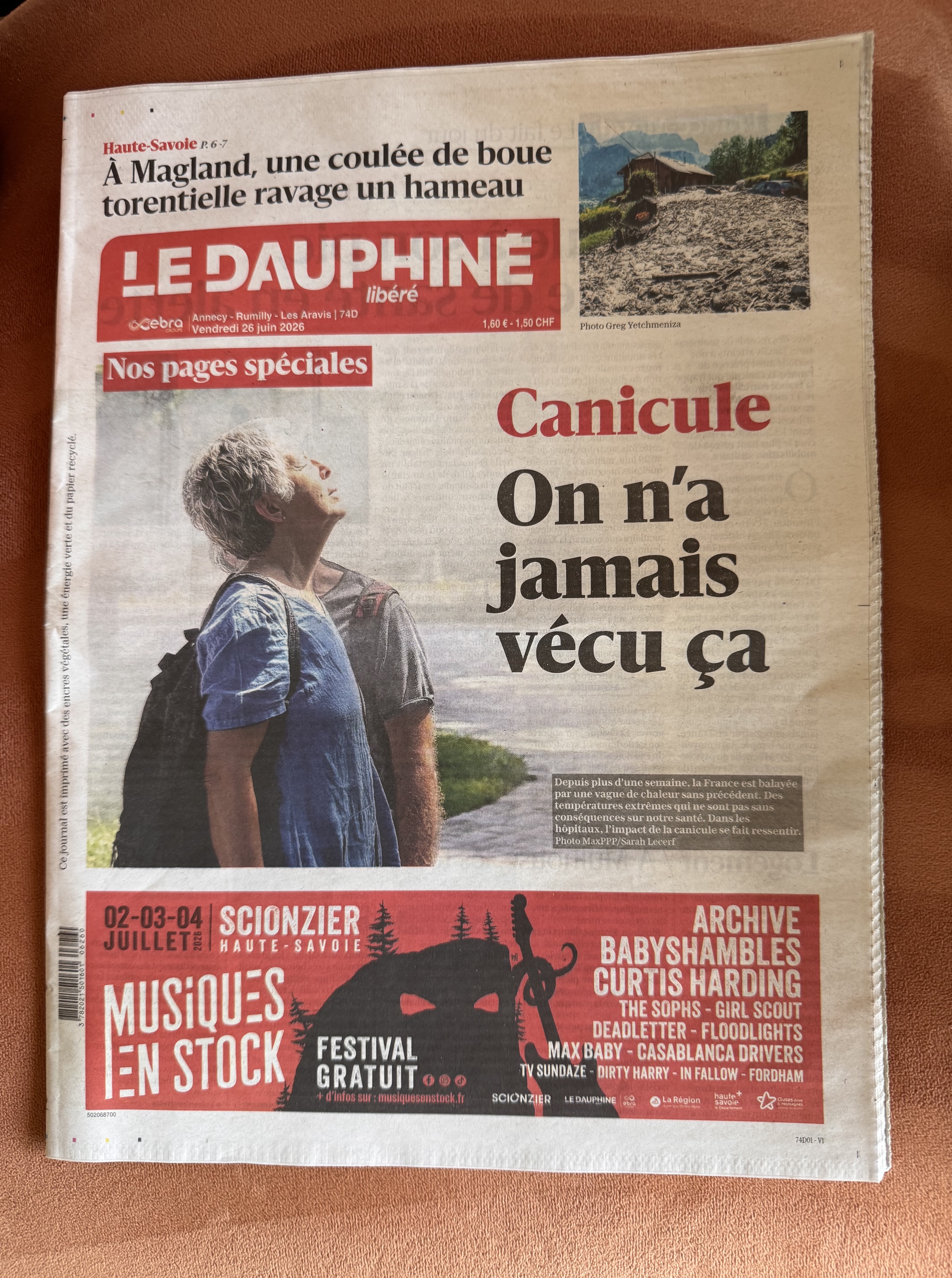
Canicule.
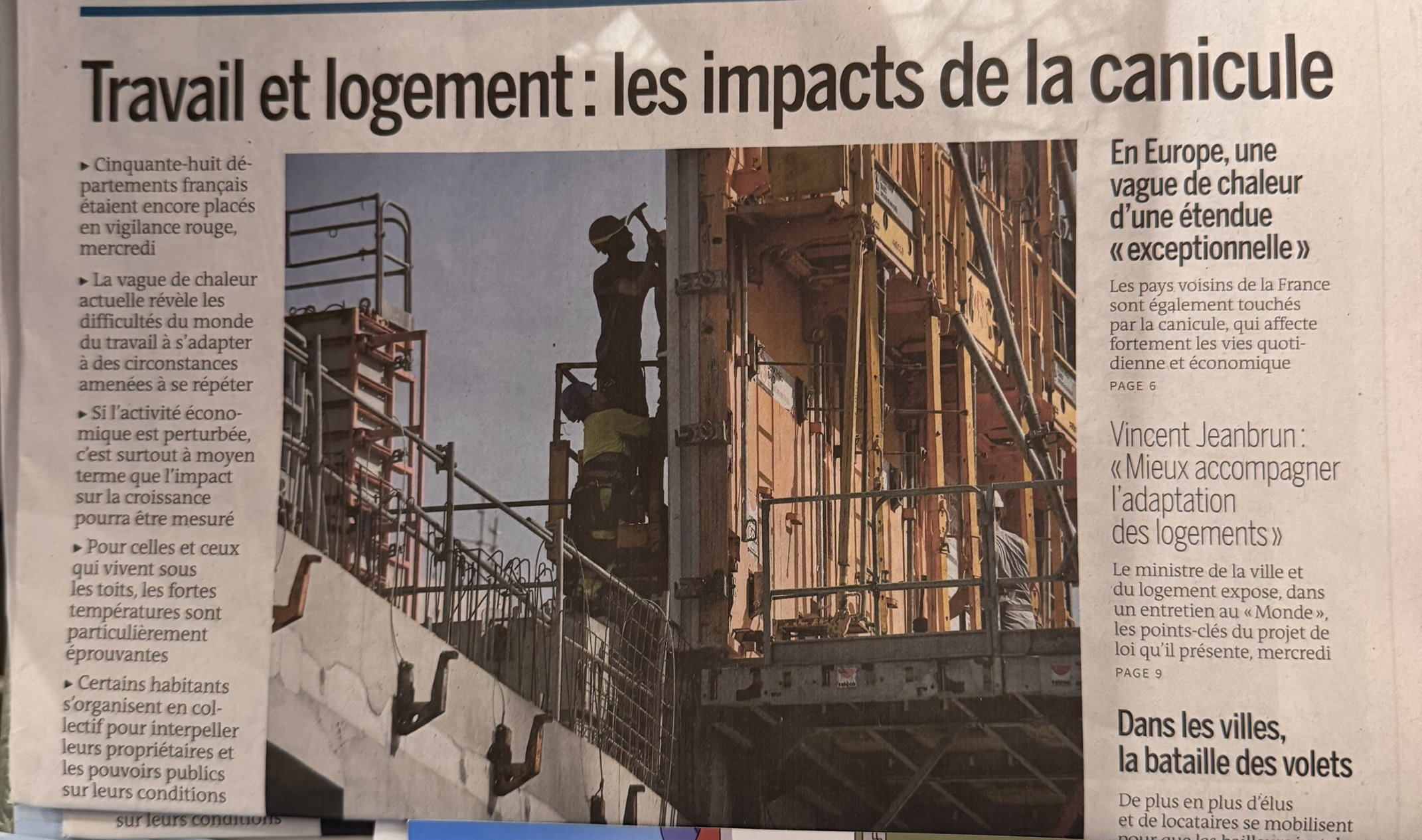
It even made Le Canard:
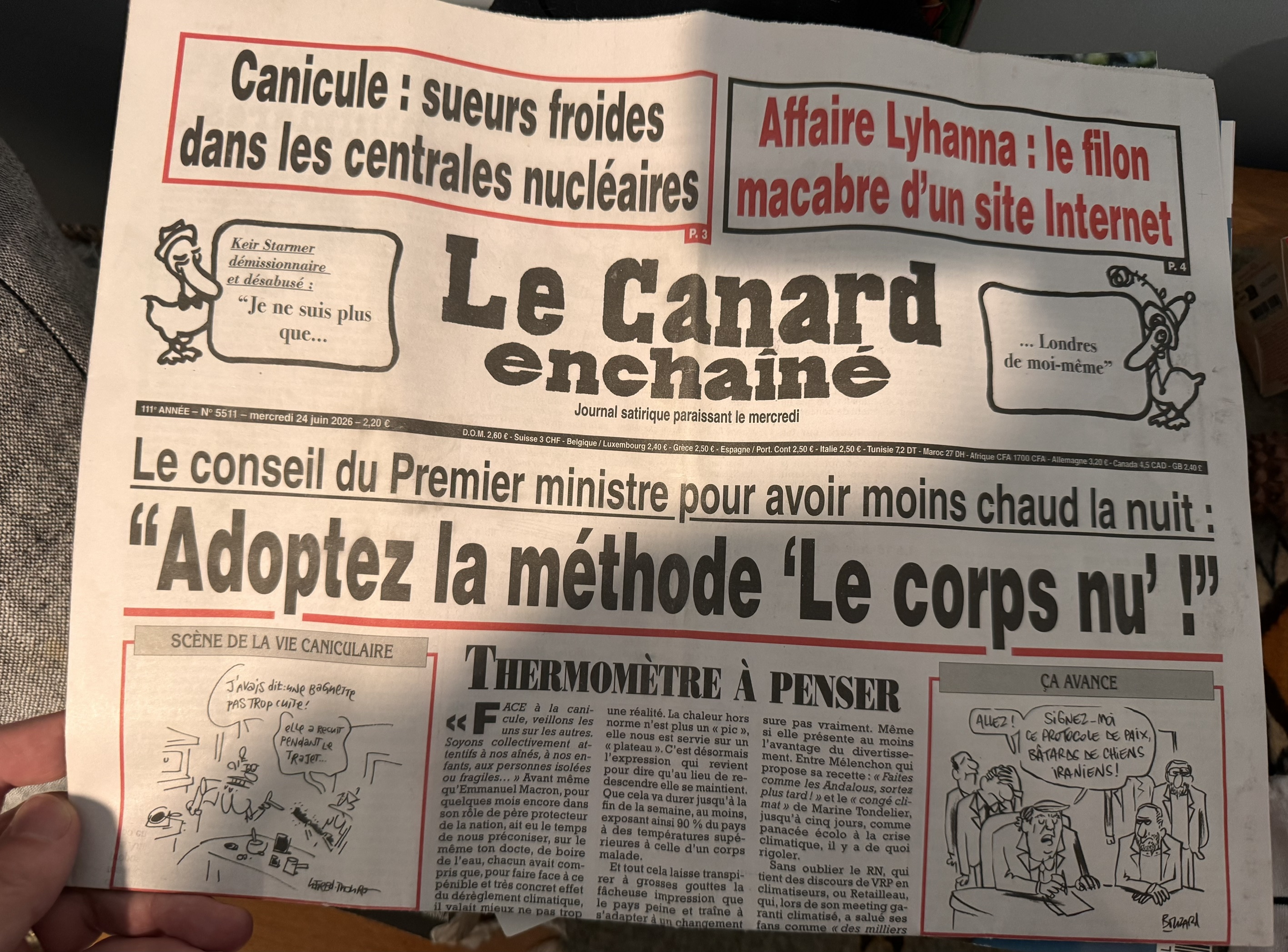
Where does this word “canicule” come from?
I’m not qualified to read French etymology. Is my robot friend Claude?:
Etymology
It comes from Latin canicula, literally “little female dog” — a diminutive of canis (“dog”). This was the Roman name for Sirius, the brightest star in the constellation Canis Major (the “Great Dog”), a usage already found in the Roman writer Varro, translating the ancient Greek kýôn (“dog”) used to designate the same star, Sirius, the dog of Orion. WikipediaWhy a star became a heat term
At the 45th parallel north — i.e., in Europe — during the period from July 24 to August 24, this very bright star rises at the same time as the sun, which led the ancients to believe there was a link between the star’s appearance and the great summer heat. Pliny the Elder even wrote that when Sirius/Canicula rises, it “kindles the sun’s heat,” boiling the seas, fermenting wine in cellars, and stirring stagnant waters. WikipediaThe link goes back even further than Rome: in ancient Egypt, the goddess Sopdet, personifying Sirius, was depicted accompanied by a dog, and the star’s heliacal rising marked the Egyptian new year and the start of the Nile flood around July 19 — the hottest time of year. Wikipedia
Semantic shift
Originally “canicule” just named that astronomical period (the “dog days”). Over time the word’s meaning shifted from the astronomical event to the weather phenomenon people associated with it — French dictionaries like Larousse still list the original astronomical sense (“the period when Sirius rises with the sun, coinciding roughly with the start of summer in antiquity”) alongside the now-dominant modern sense, a spell of abnormally high day-and-night temperatures lasting from several days to weeks.Modern technical meaning
Today canicule has an official meteorological definition in France: a heat wave is officially declared when temperatures stay above roughly 35°C by day and 20°C by night for several consecutive days, with thresholds varying by region. The word also picked up public-health weight after the catastrophic 2003 heat wave, which killed close to 15,000 people in France — since then “canicule” has been tied to heat-alert plans and prevention campaigns, which is likely why you noticed it used so frequently. Apple PodcastsSo: a star named “little dog” → a hot summer period → a meteorological and public-health term, all in one word that’s stayed essentially unchanged since antiquity.
from Doreen St. Felix in The New Yorker, “Scenes from La Canicule in Paris“:
“La Canicule,” the term that the French have used to describe an elongated spell of oppressive, often dangerous temperatures, doesn’t really translate to “heat wave”—the phrase for that would be “vague de chaleur.” The spirit of La Canicule is more like dog days. Typically, the dog days arrive in late July or August, when the country winds down for its prolonged weeks of vacation. And those days tend to hover some twenty degrees Fahrenheit lower than what it is experiencing now. La Canicule is an old term, a cheeky one, just newly representative of the climate crisis.
There’s a way to look at the Canicule as a sign of climate catastrophe. But first reaction was like if there’s a word for it maybe it’s just a part of life, like the mistral.
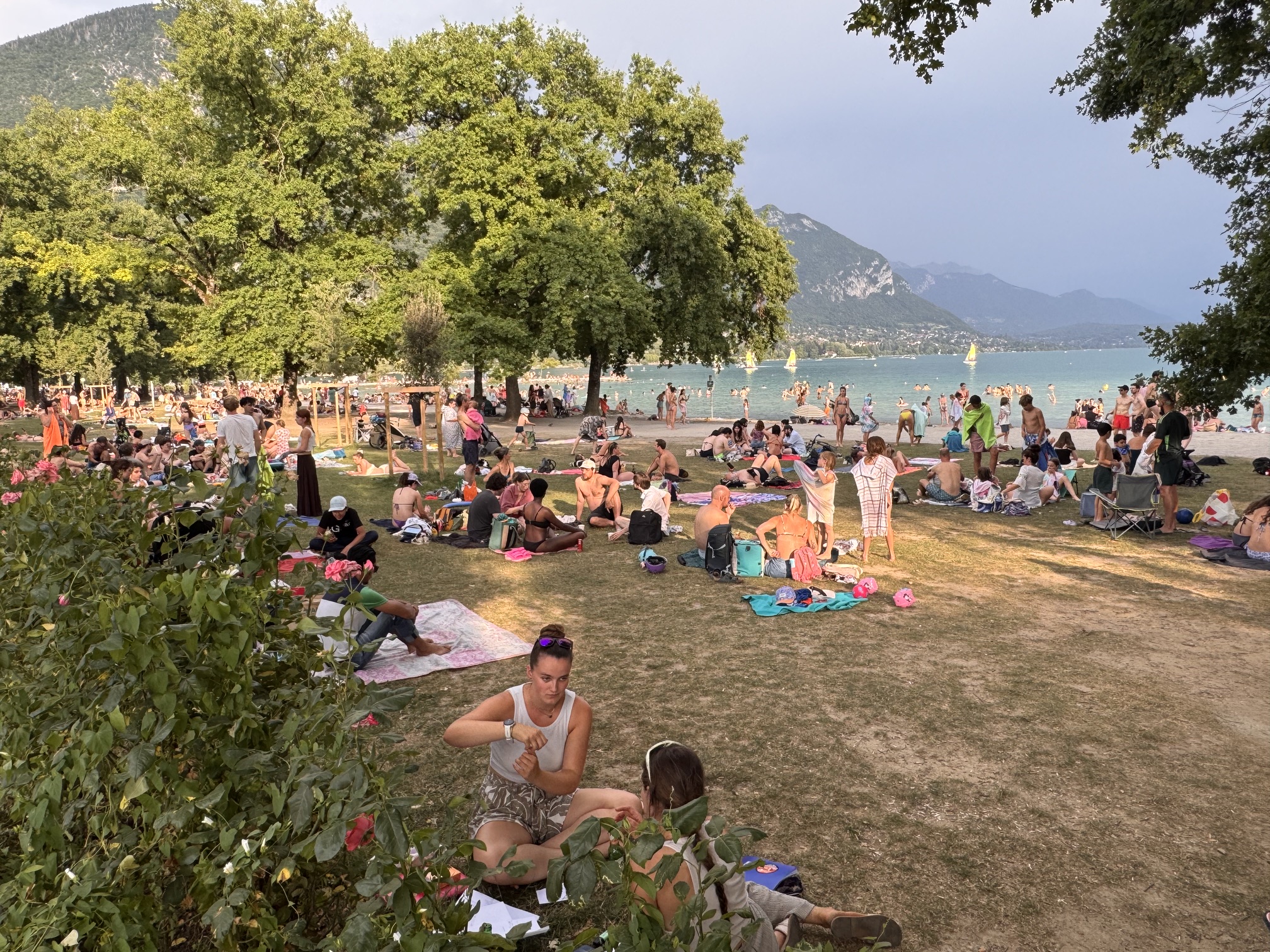
(by mistral I’m talking about the wind, not the French AI company).
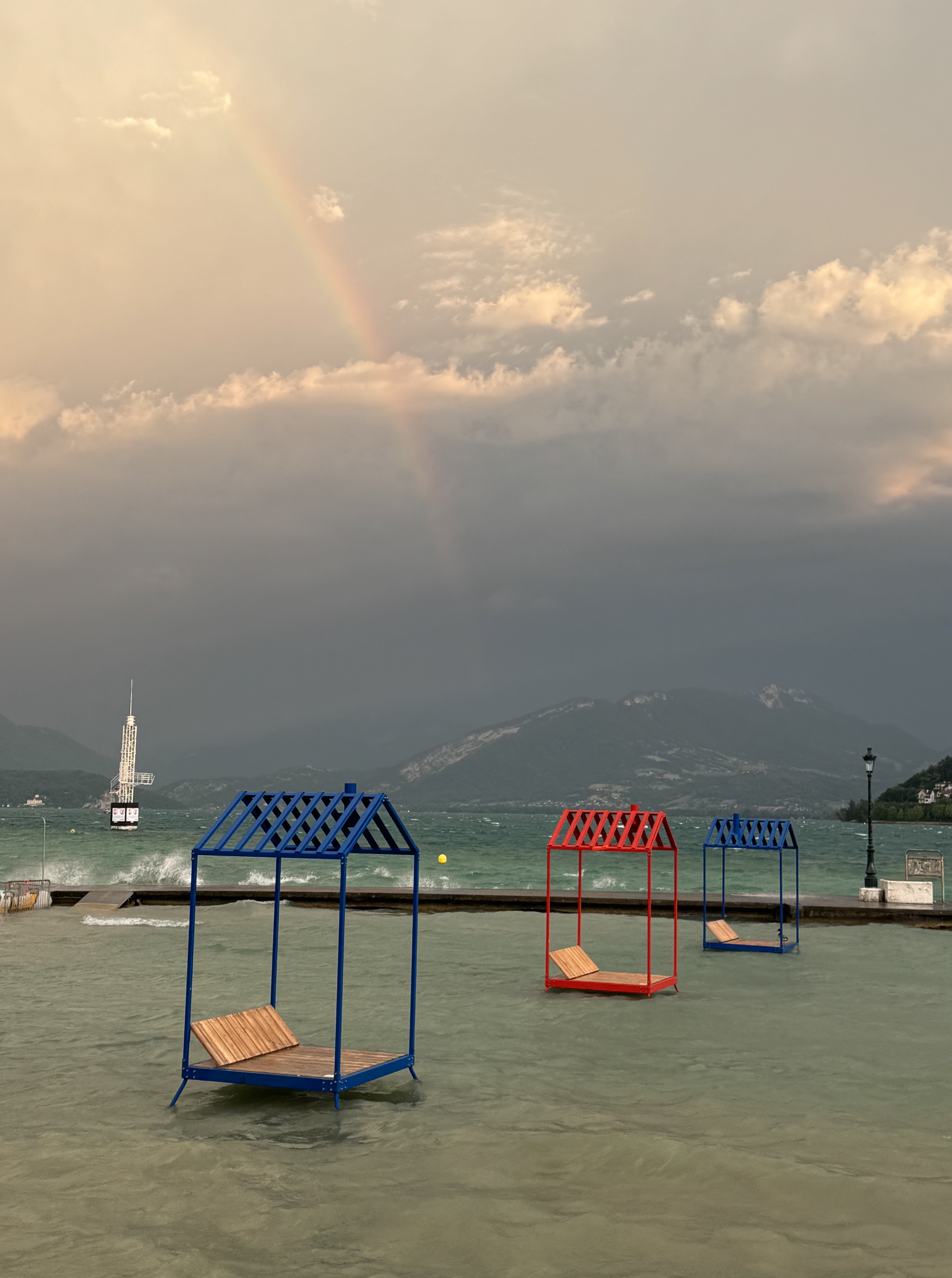
One day there was a windy storm, lightning in the distance. It seemed like there might be an American-style thunderstorm to break the heat. But it never quite came. There was though a nice rainbow:
You, happy Austria, marry!
Posted: June 21, 2026 Filed under: Savoy Leave a comment
Traveling to the former Habsburg lands. What was the deal with these guys?
Origins:
As far back as we can trace, the Habsburg family was illustrious. In the 10th century, its progenitors carved out a medley of discontinuous lordships and manors in the region of the Upper Rhine, ranging across Alsace, the Black Forest, and what is now northern Switzerland. Around 1030, the earliest Habsburg of whom we have a definite record, Radbot (c.985-1045), founded the Benedictine abbey at Muri in the Swiss Aargau. Muri served over several centuries as the family’s place of burial. About the same time, Radbot built a stone fort called Habsburg some 30 kilometres away from Muri.
The name probably means Castle by the Ford, but is usually given the grander rendering of Castle of the Hawk. It was by the title of Habsburg that Radbot’s descendants were generally known.
The family had various forged documents that connected them to Julius Caesar and beyond:
By virtue of this and other similar deceptions (including a charter purportedly written by the Roman emperor, Nero), the Habsburgs ‘discovered’ that they were entitled to the rank of archduke. It was by this spoof title that all senior members of the dynasty subsequently styled themselves, in honour of which they wore a cloak trimmed with ermine and a coronet.
The story behind the forgeries rests on politics and ambition. In the 1lth and 12th centuries, Radbot and the first Habsburgs had sought to carve out a principality in the region of Switzerland and the Upper Rhine. They were, however, unable to consolidate their disparate properties into a unified block, for the region was intersected by too many rival lordships, cities, and confederacies.
One thing the early Habsburgs did have was money, for they controlled the Alpine toll stations which stood between the upland pastures and the cities of the valleys. In the hope that his family’s wealth might be deployed to bring order to the Holy Roman Empire, the German princes elected Rudolf of Habsburg as king in 1273. He did not disappoint them, deploying his armies against the robber-knights whose Rhineland castles impeded merchants and commerce.
One key to their success: using their daughters:
The Habsburgs were striking in the way that they used daughters not only as political pawns but also as political players, administering parts of the dynasty’s possessions.
Not that it was great to be a Habsburg daughter, you probably had to marry some prince you didn’t like, maybe more than one.
Meanwhile, Charles’s younger brother, Ferdinand, for whom Maximilian had engineered marriage into the Polish Jagiello line, acquired in 1526 the crowns of Hungary and Bohemia, following the death in battle of his Jagiello brother-in-law, Louis. In the space of just half a century, therefore, the two Habsburg brothers, Charles and Ferdinand, had through Maximilian’s marriage schemes taken over half of Europe, and they had done so more or less peacefully. Only in Hungary was there any concerted resistance. As an adage put it at the time, ‘Let others fight, you Happy Austria marry.’
It’s hard to understand the period from the end of the Roman Empire until at least the 20th century if you can’t comprehend that Christianity did really matter to people. There were sinners and cynical operators but there were people at both the top and the bottom who really believed and acted on their belief.
Dynastic ambition was only one factor that guided the Habsburg rulers. Indeed, on occasions the policies they pursued were potentially damaging and even ruinous to the dynasty’s interests and survival. These other guiding principles and determinants of policy included the conviction that as Holy Roman Emperors the Habsburg rulers had an obligation to defend the Catholic Church and to promote its spiritual interests, which included the promotion of peace.
How this worked (or didn’t):
They also embraced the belief that government was a trust and that rulership implied duties to subjects. Although rarely doubting the divine providence that vindicated their power and ordained the secular hierarchy on which they stood at the apex, the Habsburg emperors took their obligations to their subjects seriously. Right through to the 20th century, their mornings were typically occupied by audiences at which up to a hundred petitioners queued to ask the sovereign for his help or advice, or (which was more usual) to thank him in person for some kindness shown.
There were two problems with the cultivation of good government.
The first was the problem of distance, which meant that Habsburg rulers might demonstrate their personal rule and fatherly concern only to a few. Country folk from Lower Austria might thus travel to Vienna to have a private word with the emperor about their daughters’ marriages, but this was scarcely possible for most Habsburg subjects. The old adage of Spanish colonial rule, ‘If death came from Madrid, we would be immortal, was a fitting verdict on the problems of communication that beset Habsburg rule more generally.
How did we get here?:
In 1437, the Emperor Sigismund, son of Charles IV of Luxemburg, died without heir. Meanwhile, the various cadet lines of the Habsburgs either expired or faltered, leaving children as heirs. In 1438, the electors chose as king Albert of Habsburg, the late Emperor Sigismund’s son-in-law. Upon Albert’s death the next year, they appointed as successor his second cousin, Frederick of Styria, who was now the senior member of the dynasty.
Frederick was chosen by the electors because there was no one else available for the role of king. Nevertheless, he looked the part, for he was tall and muscular, with long blond hair-characteristics that he had inherited from his Polish mother, Cymburga, a woman of prodigious beauty and physical strength, who could reputedly drive nails into oak tables with her bare fist. Frederick ruled as king of Germany from 1440 and, following his coronation in Rome, as emperor from 1452 until his death in 1493.
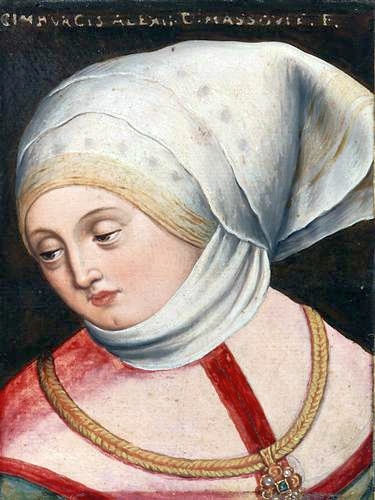
That nails in oak claim sounds like a seven almonds story: a joke or quip that is taken too literally and enters the historical record.
Historians have not looked kindly upon Frederick III, too readily following the later description of him as the ‘arch-sleepyhead or averring by reference to the Austrian poet Rilke that his main achievement was to have reigned in adversity for so long: Who speaks of victory, when to endure is all?’ An even harsher verdict blames Frederick for Germany’s later misfortunes. Instead of busying himself with the Holy Roman Empire and trying to bring order to its politics, Frederick withdrew to provincial Wiener Neustadt and occupied himself with Habsburg family affairs.
Where all this led:
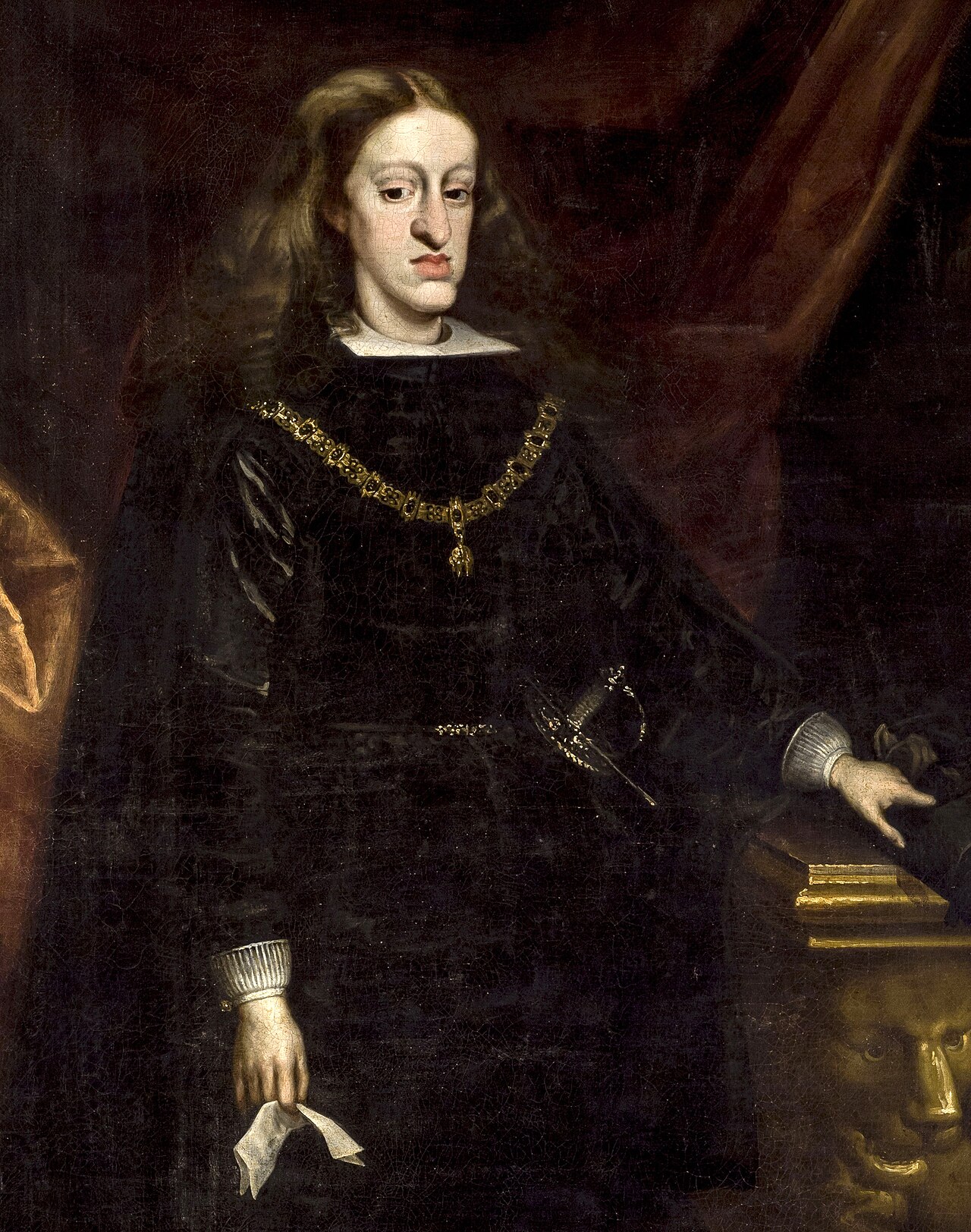
[The Habsburg dynasty] held to a mythologized history that taught it to expect greatness. It was tenacious in acquiring lands, kingdoms, and titles, either by war or by marriage. Its members were, moreover, bound together both biologically and by the distribution of power and honours. The branches of the dynasty thus regularly intermarried, to such an extent that Charles II of Spain (1665-1700) had only two-thirds the normal number of great-and great-great-grandparents.
Inbreeding between cousins and uncles caused the prognathism for which the Habsburgs were famous and was most pronounced in Charles II (Figure 2).
Magenta
Posted: June 20, 2026 Filed under: Savoy Leave a comment
So many topics we’re working through here could be filed as “footnotes to footnotes.”
In John Dormandy’s A History of Savoy: Gatekeeper of the Alps he drops this one:
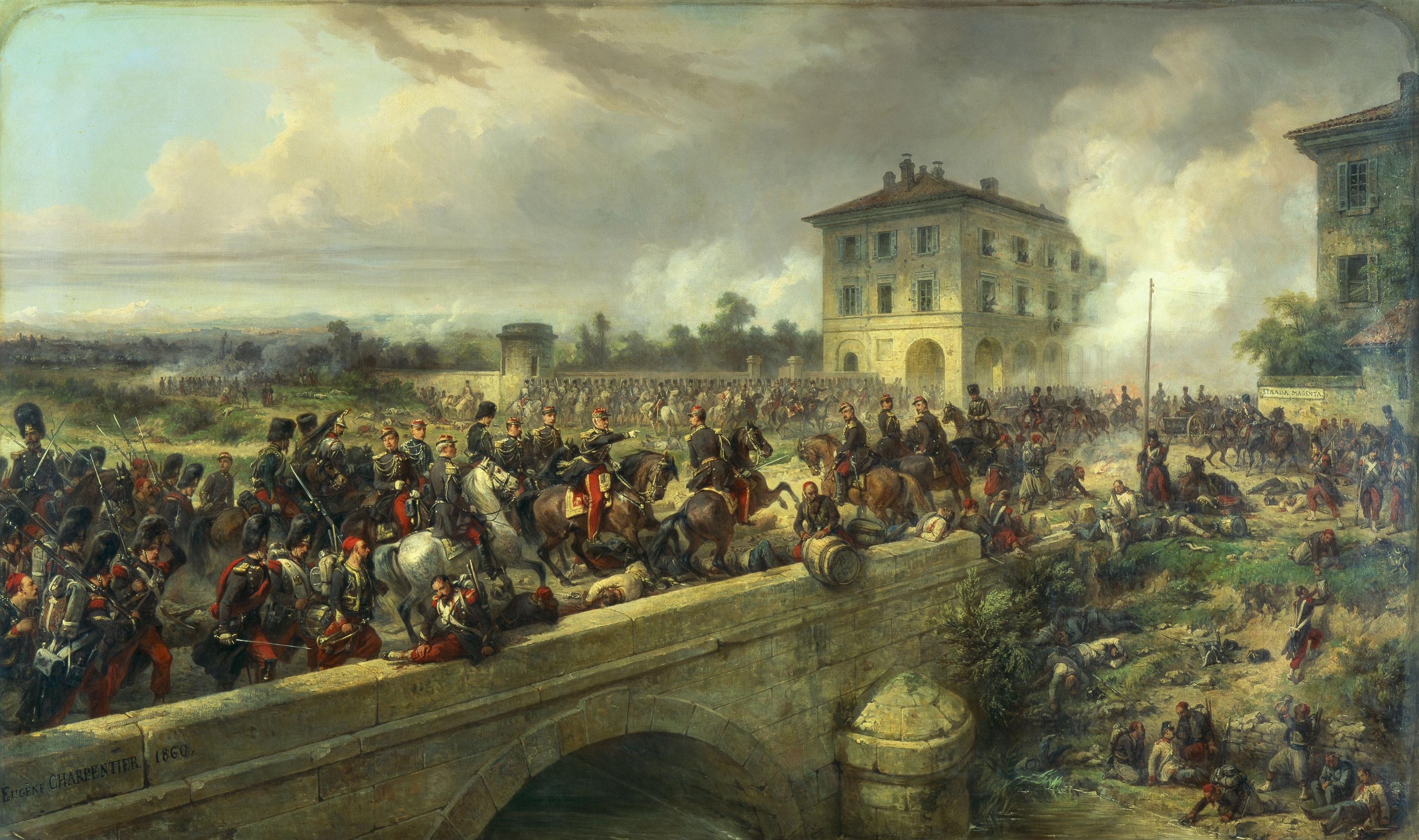
In 1858, Emperor Louis Napoleon III and Count Benzo Cavour, prime minister of King Victor Emmanuel, met secretly in the small spa town of Plombières in the Vosges mountains to hatch a plot. The two men, equally devious, agreed to provoke an attack by Austria on the Kingdom of Sardinia that included Savoy; the French would then promptly come to the aid of poor Sardinia, and together they would expel the Austrians from northern Italy. Following that happy outcome, Sardinia would acquire all of northern Italy and in recompense for his help, Napoleon III would be allowed to annexe Savoy to France. That was exactly what happened, except that by the mid-nineteenth cen-tury, Europe, particularly Victorian England, was beginning to baulk at countries being traded as commodities, especially if the recipient of the gift was France under a second Napoleon. Cavour and Napoleon, ever resourceful, organised a ‘free’ plebiscite in Savoy in which 99 per cent of the population voted for annexation to France.
Savoy has had our attention. Savoy is a region of alpine lakes, mountains, valleys and passes in what’s now France, Italy, maybe a touch of western Switzerland. Savoy was a duchy, a principality, a state, a province, the seat of an empire, a poor source of refugees and emigrees, a retreat for aristocrats, a land of dairies, of resorts, of monestaries. Savoy was an idea, and it was a catchy idea. It spread in funny ways, through marriages and princesses and neighborhoods and towns, a hotel, and then many hotels, a cake, and a dance hall and a song and a beer and a fictional baseball bat.
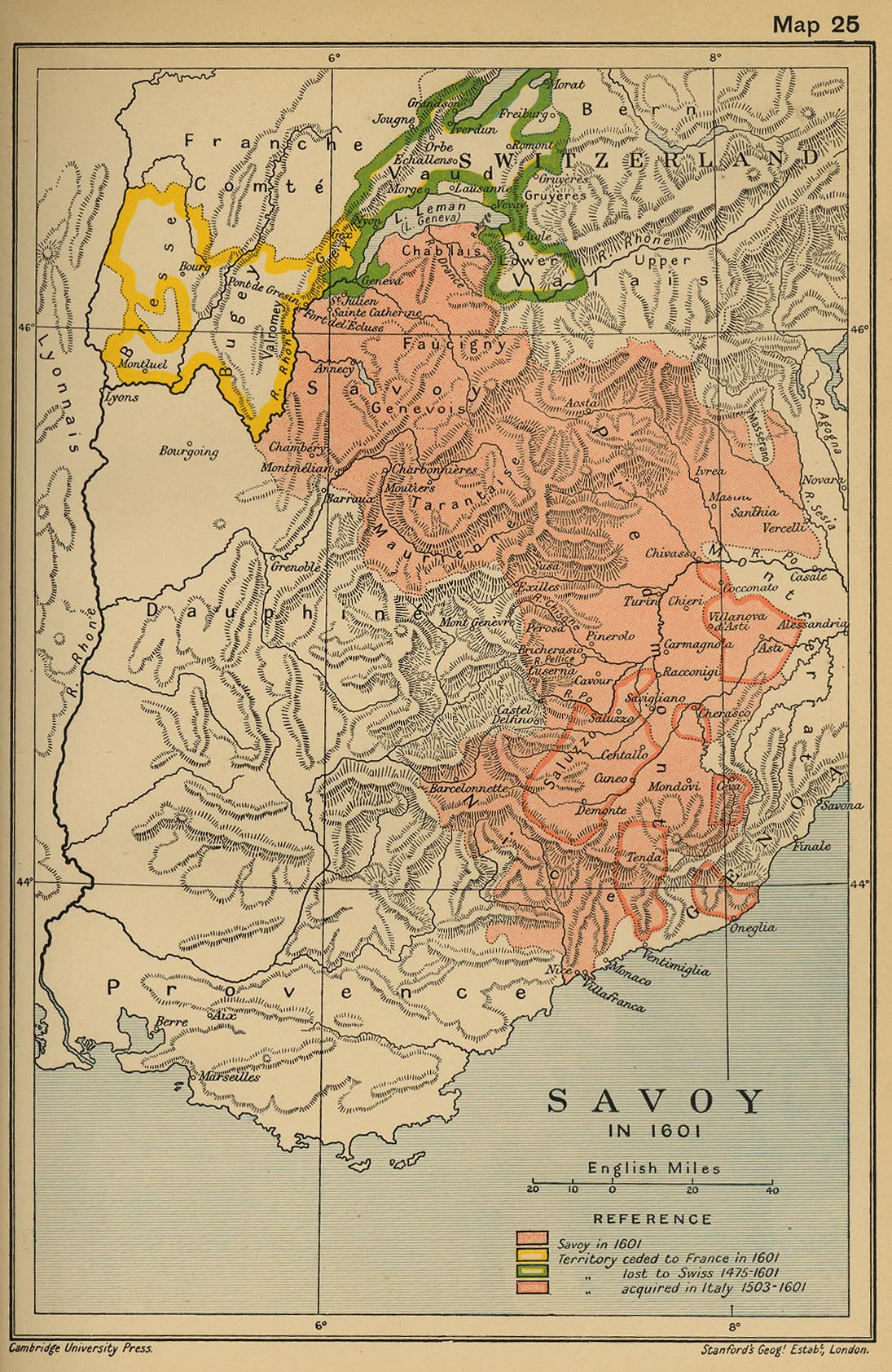
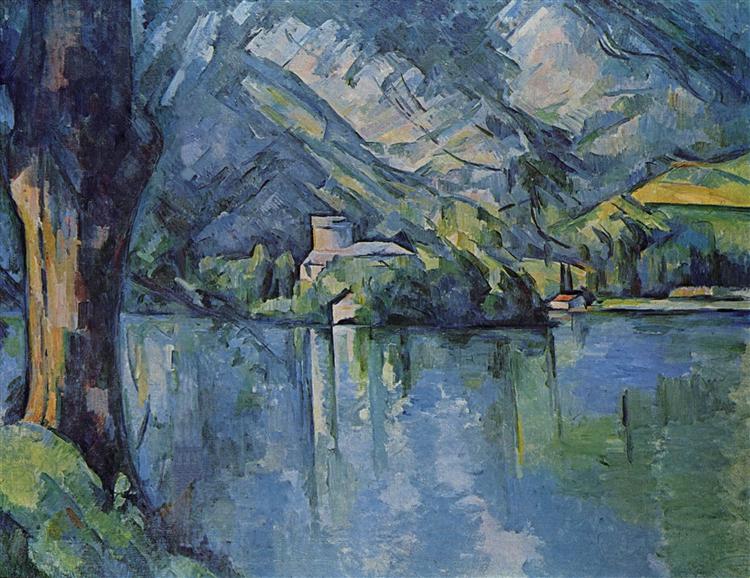
Fortune brought us twice to Savoy to one of her most favored spots, Lake Annecy. We’ll be there again.
If you’re at the animation festival, come see us. We have two panels, one for Common Side Effects on Thursday at 2:30pm at Salle Pierre Lamy, one for Adult Swim on Friday at 1:30pm at MIFA Tent at the Imperial Hotel.
Back to Magenta:
Undeterred by their lack of any military experience, there was no way Napoleon and Victor Emmanuel were going to be talked out of leading their armies in person. Parliament in Turin dissolved itself and gave the King, and therefore Cavour, full executive powers. Once war was declared the anti-Cavour faction in Savoy became as patriotic as everybody else, cheering the French troops as they crossed Savoy, on the way to Italy.
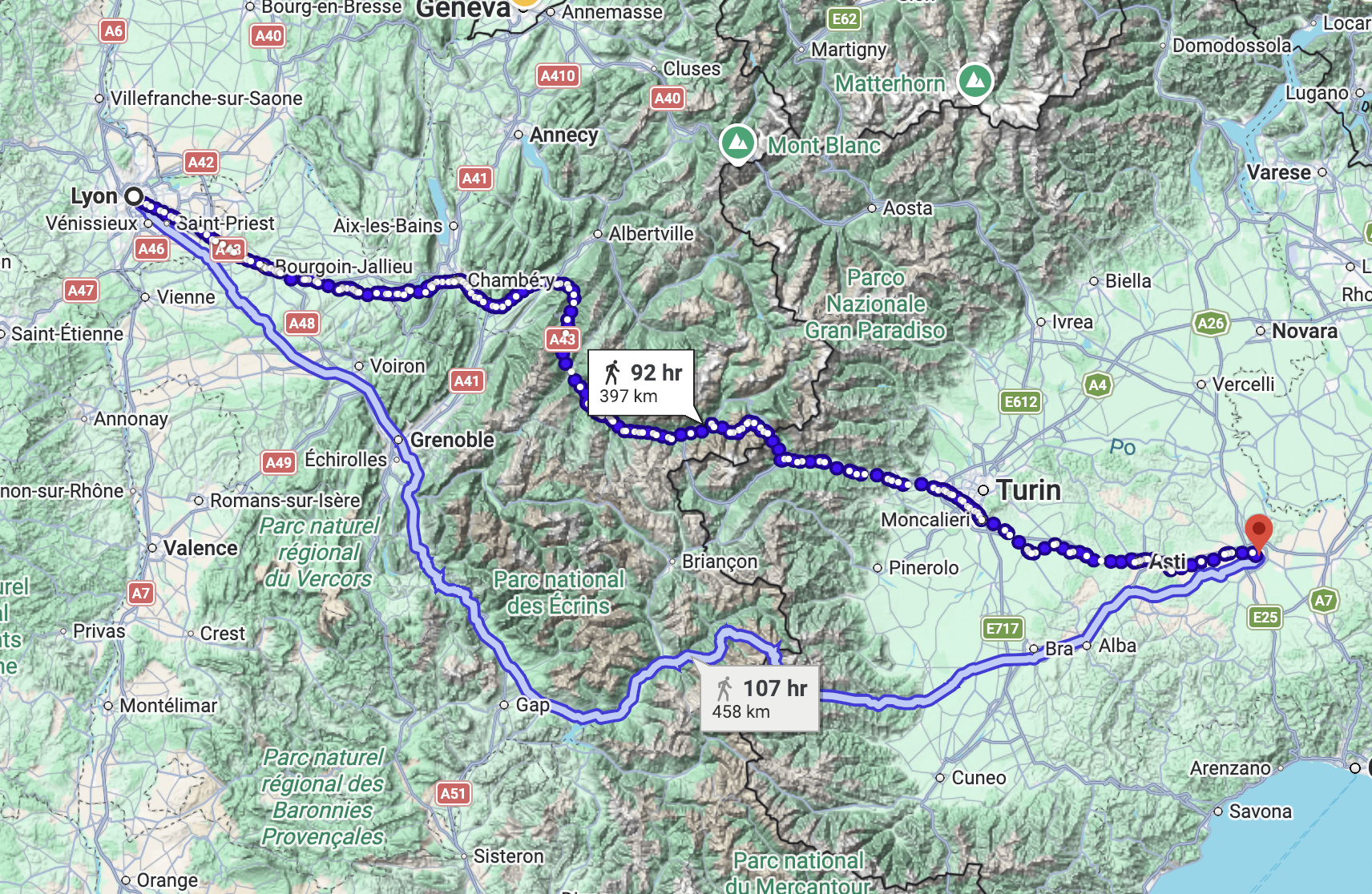
The forty-year-old King concentrated the Sardinian army of 50,000 men between Alessandria and Casale. Napoleon had been gathering his army near Lyons and French troops started crossing Savoy within forty-eight hours of the Austrian army entering Piedmont territory. The French Army used the railway as far as St-Jean-de-Maurienne, but the Mont Cenis Pass had to be crossed on foot. Within days, French soldiers were streaming down the Alps into Piedmont at the rate of 10,000 a day. On 14 May, the fifty-year-old Napoleon joined his army of 107,000 men and 324 cannons in Alessandria.
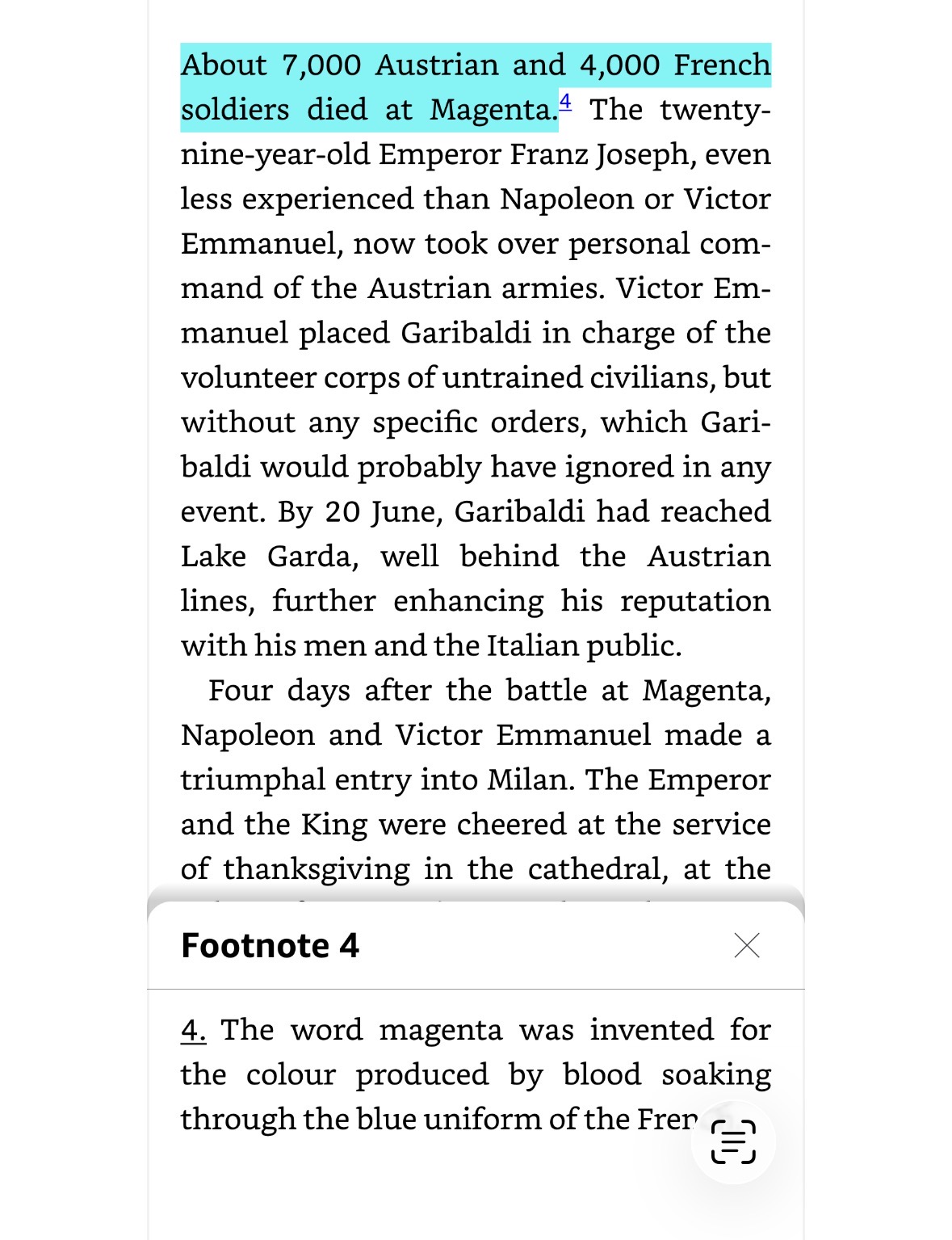
For reasons that are unclear, General Gyulai stopped the unopposed advance of the Austrian army behind the Ticino river and did not resume his advance till 20 May, more than three weeks after crossing the frontier … Ninety-year-old Field Marshal Radetzky was brought out of retirement, but he was too late to undo Gyulai’s blunder. The first major battle took place on 4 June at Magenta, 20 km west of Milan. Some 50,000 French soldiers faced an equal number of Austrians. It was Napoleon’s first experience of commanding an army in battle and for several hours, the outcome was in balance, until finally the French prevailed. About 7,000 Austrian and 4,000 French soldiers died at Magenta.* The twenty-nine-year-old Emperor Franz Joseph, even less experienced than Napoleon or Victor Emmanuel, now took over personal command of the Austrian armies. Victor Emmanuel placed Garibaldi in charge of the volunteer corps of untrained civilians, but without any specific orders, which Garibaldi would probably have ignored in any event. By 20 June, Garibaldi had reached Lake Garda, well behind the Austrian lines, further enhancing his reputation with his men and the Italian public.
Four days after the battle at Magenta, Napoleon and Victor Emmanuel made a triumphal entry into Milan. The Emperor and the King were cheered at the service of thanksgiving in the cathedral, at the gala performance in La Scala, and at a series of banquets. Napoleon assured everyone that he had no personal agenda and that his only motive for being there was to help his ‘brother’ Victor Emmanuel fulfil the legitimate aspirations of the Italian people and liberate Italy…
Napoleon III and Cavour got exactly what they wanted. At first.
Then events got out of their control, Italy became independent, Napoleon III was a prisoner, then died in exile in England. Cavour died of malaria while Prime Minster of Italy, an office that would eventually go to Mussolini. Even these guys who briefly seem as if they bend history end up toppled by unforeseen consequences.
Savoy, meanwhile, took off! It’s great for skiing in the winter and relaxing in the summer. It’s probably the richest it has ever been.
Previous coverage:
Savoy Special (and knowing and not knowing in the age of AI)
Everyday Life in the Holy Roman Empire
Swiss History series: Part One, Bernese Chronicles, William Tell etc., League of God’s House, Why Switzerland?, Calvin’s Geneva, Geneva Conventions
Not a great nursery rhyme
Posted: June 18, 2026 Filed under: advice, Savoy, the California Condition Leave a comment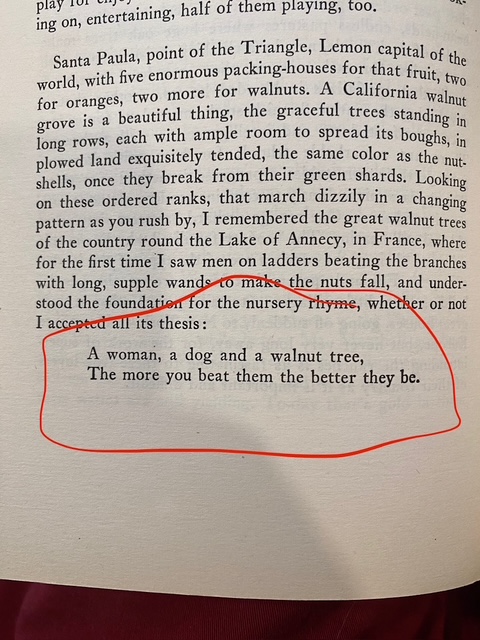
from this kinda strange book:
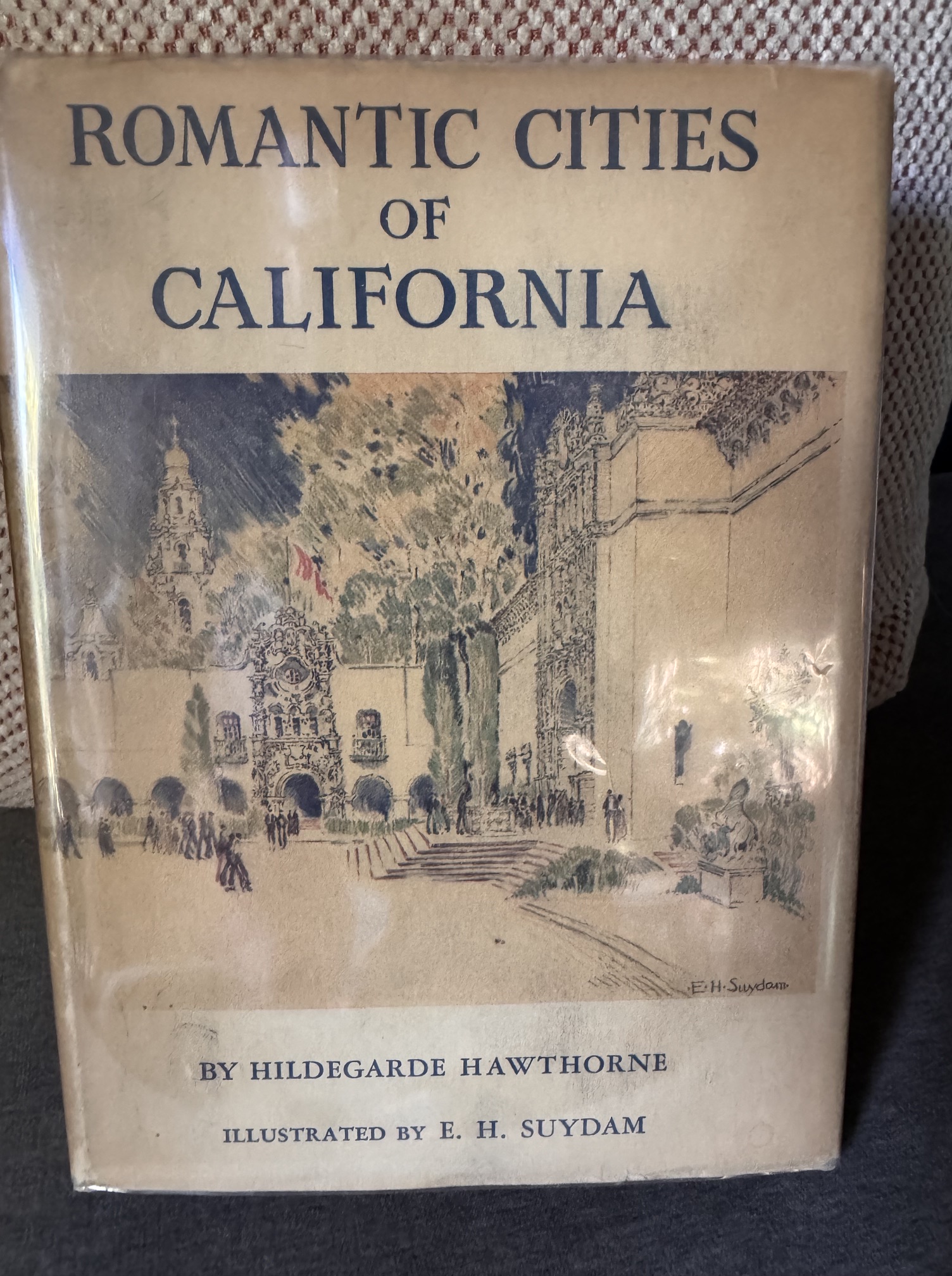
Hildegarde Hawthorne, Nathaniel’s granddaughter, swans around California musing on the Spanish and Mediterranean majesty. I know, it sounds interesting, but it’s not. The best part of E. H. Suydam’s illustration.
Holy Roman Empire
Posted: April 19, 2026 Filed under: Savoy, Switzerland Leave a commentReader, don’t make the mistake I did. This book:
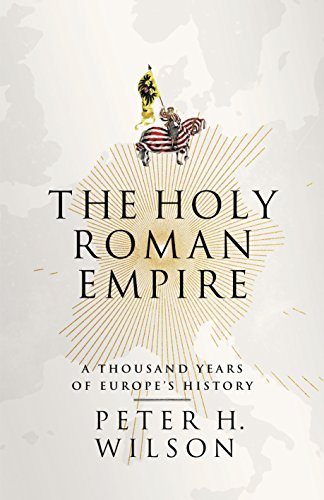
and this book:
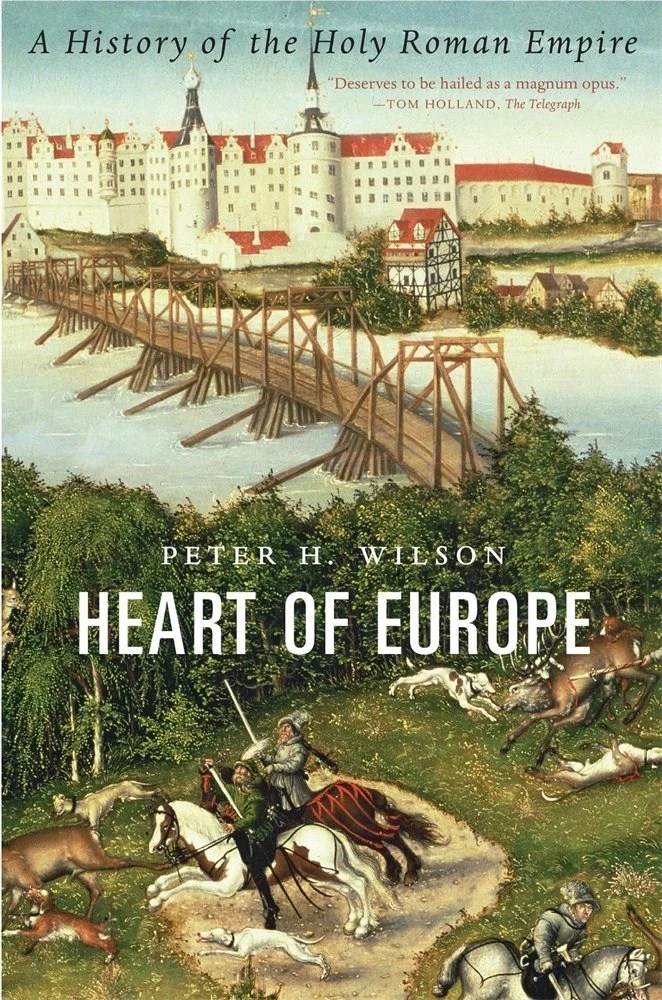
are the same.
I can’t tell you what peace The Holy Roman Empire: A Thousand Years of European History by Peter H. Wilson brought me. I read a page or two at night before going to sleep. Perfect: both interesting but distant, engaging and somnolent at the same time.
When I was finished, I felt like I’d barely scratched the surface, so I checked out The Heart of Europe, but that’s just a British reprint or something of the same work.
Wilson’s work is one of those books where every sentence feels like it’s a summary of some Ph.D thesis. A selection at (near) random:
Charles’s victory of the Schmalkadic League in 1547 at the battle of Mühlberg appeared to offer an opportunity for him to attempt a significant reorganization of imperial governance at the “Armoured Reichstag” in Augsburg the following year
If you’re a reader of Helytimes you’ve no doubt heard Voltaire’s quip about “neither holy nor Roman nor an empire.” Wilson goes even further and says it was barely even called The Holy Roman Empire:
The words Holy, Roman and Empire were only combined as Sacrum Romanum Imperium in June 1180, and though used more frequently from 1254, they never appeared consistently in official documents. Nonetheless, all three terms formed core elements of the imperial ideal present from the Empire’s foundation. This chapter will consider each in turn, before investigating the Empire’s troubled relationship with the papacy.
When did it start? When did it end? Start:
First, the Empire was a joint creation of Charlemagne and Leo III, ‘one of the shiftiest occupants of the throne of St Peter’. Accused of perjury and adultery, Leo was unable to assert authority over the Roman clans, who orchestrated a mob which attacked him in April 799, nearly cutting out his eyes and tongue – acts of mutilation that were considered to render their victim unfit for office.
Already at his accession, Leo had sent Charlemagne a banner and the keys to St Peter’s tomb, symbolically placing the under Frankish papacy protection. Charlemagne was reluctant to assume this responsibility, which could require him to judge and possibly remove a wayward pontiff. Writing a generation later, the Frankish chronicler Einhard claimed Leo sprang the idea of an imperial coronation when Charlemagne finally visited Rome in November 800.
End:
On the morning of 6 August an imperial herald full regalia rode through Vienna to the Jesuit church of the Nine Choirs of Angels. After climbing to the balcony, he summoned the inhabitants with a silver fanfare to announce the end of the Empire. The Reichstag was formally informed on 11 August, while letters were sent to foreign diplomats over the following week. The Empire was certainly not dead by the late eighteenth century, and if it was sick, as Zedler and others suggested, it was not yet on life support. If revolutionary France had not intervened, the most likely prognosis was that the Empire’s socio-political order would have persisted further into the nineteenth century, but it is unlikely that this could have been sustained against the levelling and homogenizing forces unleashed by capitalism and industrialization around 1830.
But hang on:
Much of the socio-legal order survived… Prussian manors enjoyed tax exemption until 1861, police authority up to 1872, and favourable control over servants until 1918, with lordly influence over local churches persisting even after that. Manorial districts remained the primary units of state administration in Prussia until 1927, all despite the fact that reforms between 1807 and 1821 emancipated serfs from the manorial economy. Hamburg’s Jewish Ordinance from 1710 remained in force into the later nineteenth century, while Bavaria’s partially codified civil code from 1754 persisted until 1900. Prussia lacked a uniform commercial code before 1861, while a supreme court for the German states was not established again until 1879. Codification of civil law across the states of the Second German Empire took from 1879 until 1900 to complete. Some cultural elements of the old order displayed still greater longevity: Buchenbach parish near Freiburg assumed the spiritual responsibilities of the Swabian monasteries secularized in 1803 and continued to say prayers in memory of Emperor Frederick I ‘Barbarossa’ until after the First World War.
The postal service kept going until the 1870s.
The Pope needed a strong guy to protect him, and the strong guy needed the Pope to give him authority:
This assertion of imperial authority did not unduly trouble most popes at this point, since they wanted an emperor who was strong enough to protect them, yet not so close by as to be an oppressor. The Carolingian civil wars after 829 exposed Rome to the Arabs, who sailed up the Tiber and sacked St Peter’s in 846.
How did the Church maintain this authority?
The Empire’s elite was uniformly Christian and shared a concern for salvation and the belief that God influenced earthly events. The idea of penance was powerfully attractive to a warior elite engaged in killing, fitted with Germanic legal customs that demanded reparations for victims, and encouraged lavish endowments of material resources to the church. The development of indulgences at the end of the eleventh century allowed warriors to gain remission from in by serving in the crusades. Endowments were additionally encour aged by the belief in vicarious merit in which prayers and intercessions by the living benefited the donor’s soul long after their death.
To even understand the Holy Roman Empire we have to just assume the power of Christianity over hearts and minds, which is its own huge topic (next up maybe is Tom Holland’s Dominion, on how and why this wacky cult was so damn powerful).
Origin of the Guelph/Ghibelline conflicts that vexed poor Dante so bad:
Northern Italy was a dense mosaic of bishoprics, lordships and cities, often enmeshed in their own conflicts.
Support from one for the emperor usually prompted its rivals to back the papacy.
…
Ghibelline sentiment persisted during the prolonged imperial absences after 1250 amongst those like Dante and Petrarch who believed only a strong imperial presence could provide the order that Italy so urgently needed. The papacy’s ‘Babylonian Captivity’ in Avignon after 1309 increased interest, while many opposition groups within Italian towns hoped the emperor could liberate them from their local opponents. Given such unrealistic expectations, most imperial visits inevitably disappointed. Charles IV was criticized for appearing more concerned to extort money than address local problems. Moreover, Italian cities were accustomed to self-governance and resented paying for the expensive imperial entourage. The Pisans rioted in May 1355, setting fire to the palace where Charles and his wife were staying.
Disparate authority:
Meanwhile, the Empire was undergoing a fundamental transformation through rapid institutional growth, consolidating its definitive, early modern form as a mixed monarchy in which the emperor shared power cities collectively known as the imperial Estates
It’s easy to get confused, and hard to put our modern conceptions on territories of the past:
The Empire’s principal kingdoms were not clearly delineated before the eleventh century. Their inhabitants lacked maps and regarded geography differently from later generations. For example, rivers like the Rhine were medieval expressways rather than potential frontiers. Politics involved networks and chains of obligations and responsibilities, not uniform control of clearly bounded territories.
You sometimes see this map pop up on Reddit:
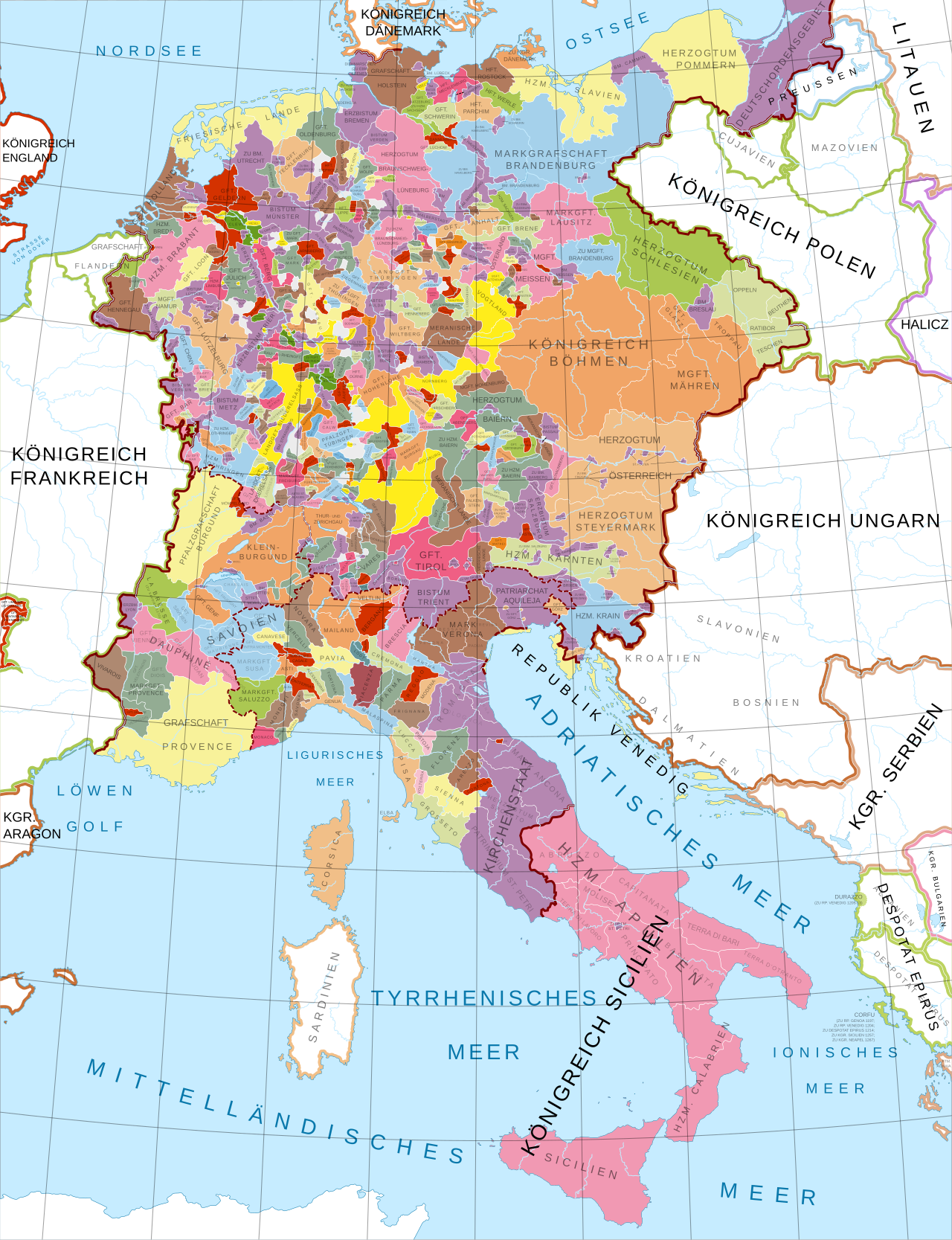
And when you look at that it is like, yeah, the HRE seemed kooky, how did all this work. But then, consider a political map of just Los Angeles County:
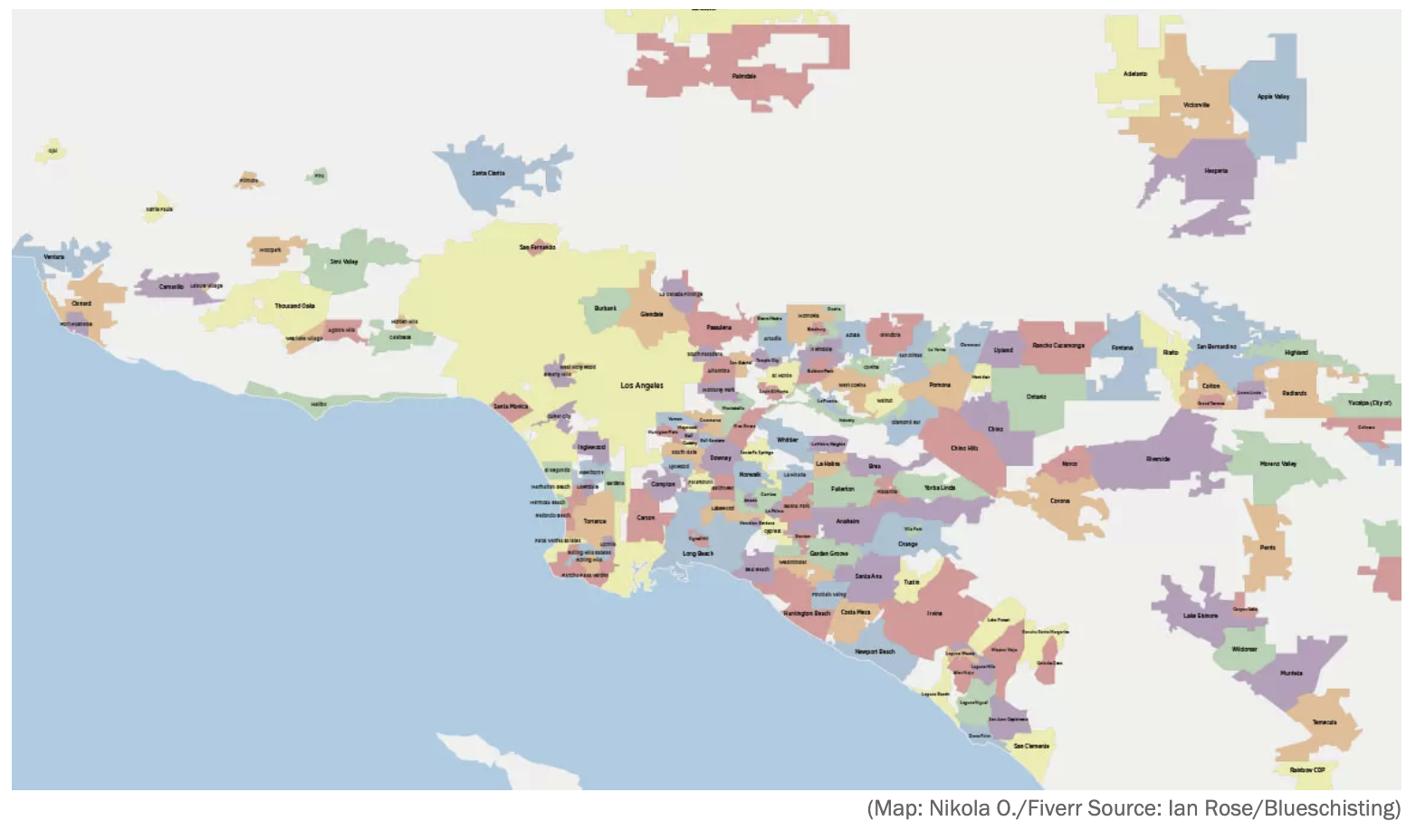
(source). Here where I live, there’s the City that runs the police and paves the streets (in theory, and some of those are federal, and some are CalTrans), the County that runs the schools and most of the courts, the State that runs some courts, its own police, then there’s the federal government. Was it that much more confusing to live in an imperial immediacy?
Small astounding details:
Emperor Basil II blinded 14,000 Bulgarian prisoners, earning the title of the ‘Bulgar Slayer’.
The French turn up their noses:
French writers increasingly drew disparaging contrasts with the Empire, which they presented as declining from an (allegedly) hereditary monarchy under Charlemagne’s ‘French’ rule into a degenerately elective one under the Germans. It was no longer an empire, but merely a sorry shadow of one, whereas the continuous line of Christian French kings had existed beyond the combined span of republican and imperial Rome. France was a divine monarchy, with its king chosen by God through hereditary succession. As the Sun King, Louis outshone any other ruler. Thanks to his Christian credentials and practical power, he, not the emperor, was the natural arbiter of Europe.
What is an Empire, anyway?:
Although Napoleon’s Grand Empire collapsed in 1814, his nephew ruled a Second French Empire between 1852 and 1870, while the subsequent republican regime expanded the country’s overseas possessions into a large colonial empire from the 1880s. Prussia’s victory over the Second French Empire led to the foundation of the German Second Empire in 1871. Queen Victoria finally formalized British imperialism by assuming the title ’empress of India’ in 1876. Throughout, Austria, Russia and the Ottomans remained imperial states. There were now six empires on one continent. ‘Empire’ ceased to mean a singular ‘world order’ and became the title accorded a monarch ruling a large state.
I bought this book to better understand the history of Annecy in what’s now France but was once Savoy, a subset of the HRE:
The significance of this is demonstrated by the anomalous position of Savoy, which assumed such significance in the process of Italian unification in the nineteenth century, yet remained the one Italian lordship formally integrated within ‘German’ imperial structures. Unlike the rest of imperial Italy, Savoy remained in the hands of an old lordly family, the Humbertines, who were originally Burgundian counts. Conrad II rewarded the Humbertiner for their help in securing Burgundy in 1032 with the gift of Alpine lordships. Further grants followed their support during the Investiture Dispute, developing Savoy as a secure anchor at the intersection of the Empire’s three main kingdoms in the western Alps. Its strategic position prompted Charles IV to incorporate it within the kingdom of Germany in 1361, where it formally remained until 1797….
Savoy, champion of Italian unification, in fact emerged from the kingdom of Burgundy and between 1361 and 1797 was formally part of Germany. This, of course, did not prevent its ruling family, the Humbertines, from pursuing territorial ambitions south of the Alps. Later national perspectives make little sense given that Savoy also encroached on what is now Switzerland, held land that is now part of France, and claimed royal status through tenuous links to Cyprus…
the House of Savoy became full royalty in the settlement ending the War of the Spanish Succession, which awarded it Sicily in 1713. Subsequent Austrian pressure forced the Humbertines to trade this for Sardinia in 1720, placing them in a position roughly equivalent to the Hohenzollerns in holding land within the Empire but also a sovereign kingdom beyond it.
Savoy’s position within the former German kingdom was not entirely meaningless, since it sustained influence within the Empire. Cooperation with Charles V was instrumental in Duke Emanuel Filiberto’s recovery of his possessions 23 years of French occupation. Savoy’s 1559 after dukes either attended in person or sent a representative to every Reichstag between 1541 and 1714, and they accepted jurisdiction of the Empire’s other supreme court, the Reichskammergericht, over themselves as imperial Estates. Even after their elevation as sovereign kings, Savoy’s rulers continued to pay feudal dues on behalf of their imperial fiefs. They remained interested in imperial politics. Duke Charles Emanuel I was a serious candidate for the Bohemian crown in 1619, while the family pushed after 1788 to receive a new electoral title, securing Prussian backing for this ambition. The overall situation of imperial Italy and Savoy thus remained relatively stable until the shock of the French Revolutionary Wars saw both severed from the Empire in 1797. Now styled the House of Savoy, the Humbertines were restored in 1814 and eventually became monarchs of united Italy between 1861 and 1946.
The Empire splits into something closer to modern countries:
The developments around 1490 have largely been interpreted in national terms as the secession of Italy, Burgundy and Switzerland from the Empire, reducing it to a ‘German Reich’. Austria has also often been regarded at this time as distinct, either by those seeking to trace that country’s ‘origins’ or by nineteenth-century critics accusing the Habsburgs of pursuing their own interests to the detriment of alleged common ‘German’ ones. Prussia’s rise as a second German great power from the mid-eighteenth century appears to confirm this perspective. However, it would be wrong to reduce the Empire’s later history to that of ‘Reichstag Germany’: the mass of smaller principalities and imperial cities with little or no chance of a separate existence in a Europe now more obviously composed of independent national states. Rather than seeing early modernity solely as the origins of later nations, it is better to interpret it as a significant reordering of how the Empire’s different components interacted.
You can’t go back to before people had one name:
The transition from one to two names was completed between the thirteenth and fourteenth centuries amongst the urban population and adopted by the early fifteenth century in the countryside
What is history, anyway?:
Early chronicles are largely by clerics recounting the deeds of kings with varying levels of approval. However, it was common by the eleventh century for monks to compile lists of abbots or bishops to demonstrate the continuity and purity of local religious practice. They were joined by secular chroniclers during the later Middle Ages who traced the origins of their home town, often in considerable detail.
Most were commoners, but they proclaimed the ‘nobility’ of their own town, boasting a lineage equal to that of any aristocrat. Other, more personal documents also testify to individuals’ identification with specific places, such as nuns writing for the edification of their community, or Jewish memory books of local martyrs
how did you become the Emperor?:
variety of methods were used to decide the succession prior to their standardization in the Golden Bull of 1356. The elective element has long been blamed as a prime source of political weakness. For the following, it is important to remember that until the late Middle Ages contemporaries did not regard ‘elective’ and ‘hereditary’ monarchies as sharply defined constitutional alternatives. Even English kingship contained elective elements in that the aristocracy’s consent was required for a succession to be legitimate, while hereditary rule in France was achieved in practice by many kings crowning their sons as successors during their own lifetime.
women:
Women were disbarred from citizenship in imperial cities on the grounds they could not bear arms, but those in the countryside could still stand in for sick or absent husbands in village assemblies, or in some cases represent a household themselves as widows.
writing and records:
There was certainly a surge in writing: 7,000 manuscripts survive across continental Europe from the ninth century, compared to 1,800 for the previous eight centuries combined
Cities were bought and sold:
Only 13 imperial cities were never pawned between 1273 and 1438. Unlike transfer by gift or enfeoffment, the king retained the option of recovering the erty by redeeming the mortgage. However, the mortgages were often so high as to make redemption unlikely: Louis IV mortgaged Eger for 20,000 pounds of silver in 1322 back to Bohemia, which retained it permanently. Eger is still today the westernmost point of the Czech Republic. Meanwhile, mortgages cut the king off from the real value of the land since the mortgagee drew the revenue and other benefits in the meantime. Lucrative assets like Rhine tolls, mints, and ore and salt mining rights were repeatedly mortgaged until they were effectively permanently alienated
The Emperor didn’t really have a place, he moved around. The one stop he had to make was Aachen:
History records the Empire’s kings as members of different dynasties, and this is certainly a useful shorthand. However, true dynasticism only emerged in the fourteenth century, and in fact simply reinforced existing ideas that each ruler could claim descent from his illustrious predecessors. Wipo of Burgundy expressed this as ‘Charlemagne’s stirrups hang from Conrad [II]’s saddle’.” Most medieval kings tried at least once in their reign to sit on Charlemagne’s stone throne, which was carefully preserved in Aachen. Frederick I renovated the Carolingian palaces at Ingelheim and Nimwegen. As time progressed, Charlemagne became an idealized role model.
Wilson brings all this into the modern era by pointing out how some contradictions and struggles of the Empire continue with the EU. The President of the EU is Ursula von der Leyen.
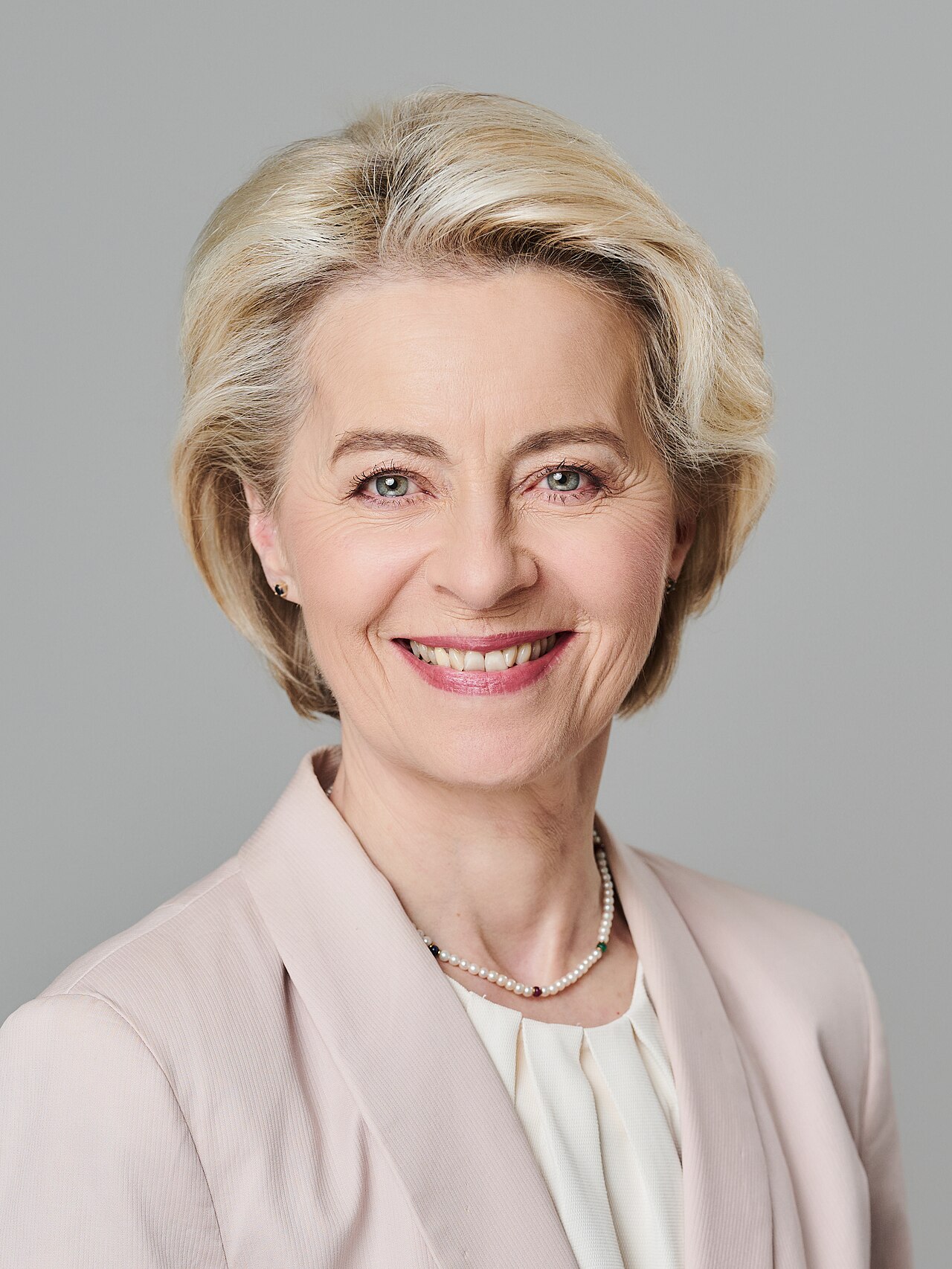
Wilson notes:
The von der Leyen family, elevated from imperial knights to counts as recently as 1711, became princes in 1803 and survived after 1806 thanks to kinship with both Dalberg and Josephine Bonaparte. Their possessions were only mediatized in 1815, passing first to Austria and then Baden after 1819.
You might not think the Holy Roman Empire is that relevant today, but then you turn on the news and there’s the US President, our closest thing to an emperor, chosen in an election that has a strong element of money/bribery, ruling over a fragmented polity, and spatting with the Pope.
F2: Fridericus II
Posted: March 1, 2026 Filed under: hely's history, Italy, Savoy 1 CommentAn important offscreen character in Dante’s Inferno is Fredrick II, the Holy Roman Emperor (to use an anachronistic term).
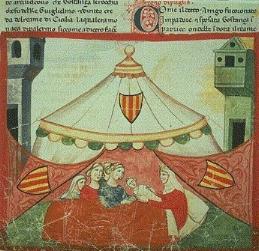
was he really born in the marketplace?
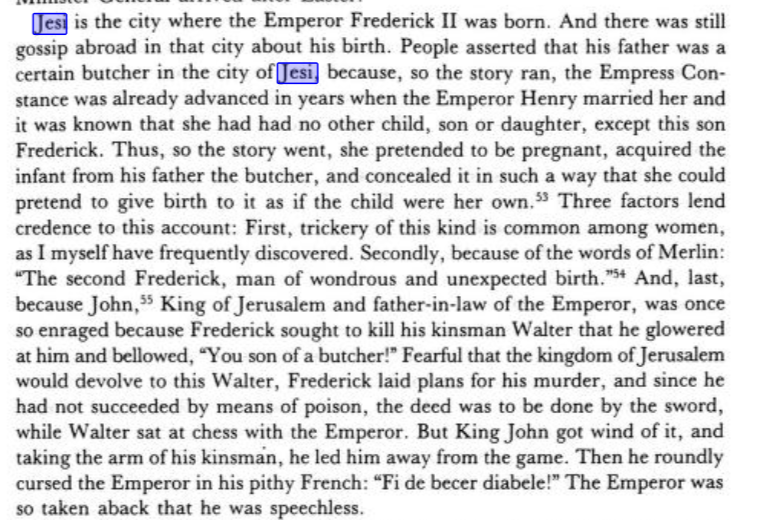
Friderick II (you’ll see why it’s important to spell it that way later) lived from 1194-1250 common era . This was the extent of his domain, in orange and red.
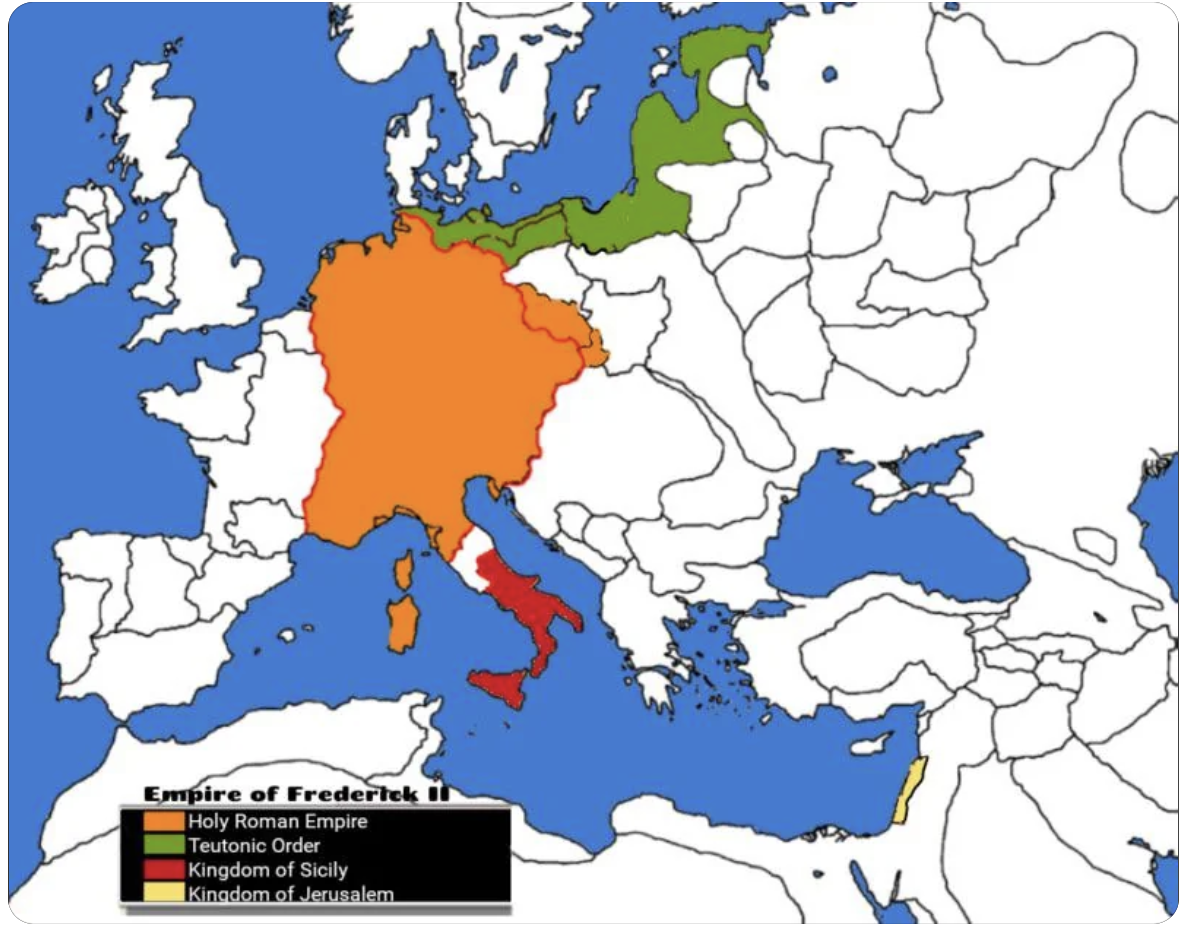
(I got that map from Reddit, you can see that the first commenter is already finding fault, but for our purposes it works).
You can see why Friderick would have conflict with the Pope, who had the lands in white that separated Friderick’s lands from each other. Thus begins (or thus continues) the conflict that tore apart Dante’s Florence, between Guelphs and Ghibellines, supporters of the Pope and supporters of the Emperor, that had such a huge impact on Dante’s life (Dante was Team Pope, but then his own side split into White and Black and he (White) lost and was exiled.)
He knew bird:
Frederick II is the author of the first treatise on the subject of falconry, De Arte Venandi cum Avibus (“The Art of Hunting with Birds”)…
For this book, he drew from sources in the Arabic language. Frederick’s pride in his mastery of the art is illustrated by the story that, when he was ordered to become a subject of the Great Khan (Batu) and receive an office at the Khan’s court, he remarked that he would make a good falconer, for he understood birds very well. He maintained up to fifty falconers at a time in his court, and in his letters he requested Arctic gyrfalcons from Lübeck and even from Greenland. …
David Attenborough in “Natural Curiosities” notes that Frederick fully understood the migration of some birds at a time when all sorts of now improbable theories were common.
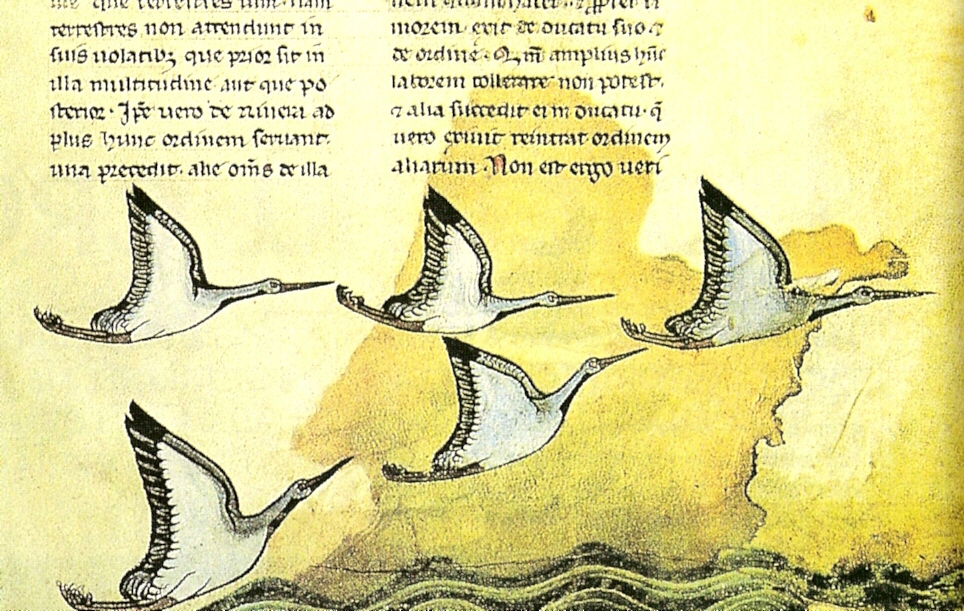
Now here’s something interesting:
In the language deprivation experiment, young infants were supposedly raised without human interaction in an attempt to determine if there was a natural language that they might demonstrate once their voices matured. It is claimed he was seeking to discover what language would have been imparted unto Adam and Eve by God. Salimbene alleged that Frederick bade “foster-mothers and nurses to suckle and bathe and wash the children, but in no ways to prattle or speak with them; for he would have learnt whether they would speak the Hebrew language (which had been the first), or Greek, or Latin, or Arabic, or perchance the tongue of their parents of whom they had been born. But he laboured in vain, for the children could not live without clappings of the hands, and gestures, and gladness of countenance, and blandishments”.
Our source for that is the Cronica of Salimbene di Adam:
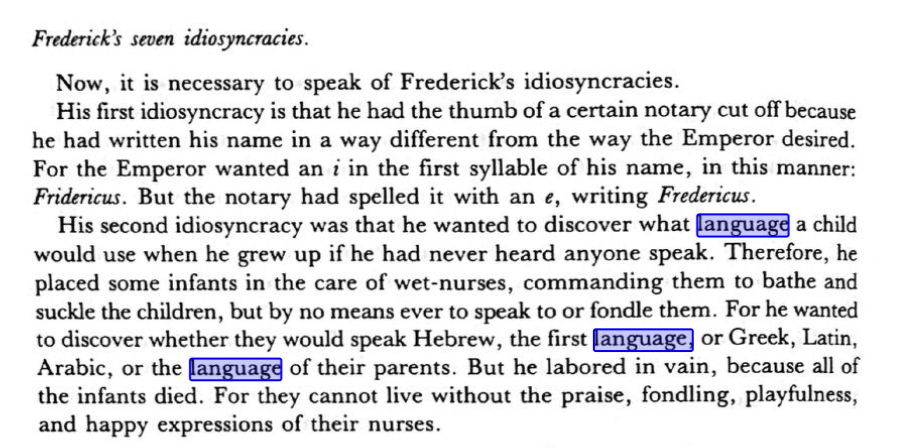
(source)
More experiments reported:
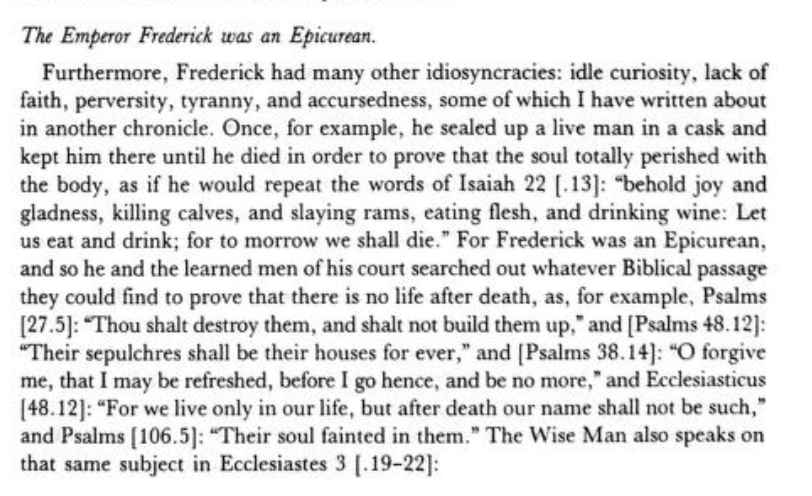
As for his appearance?
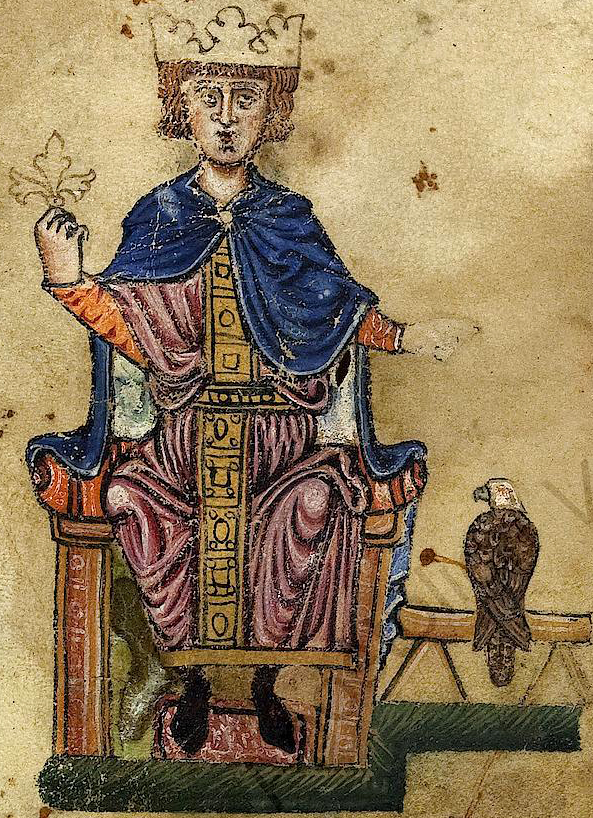
A Damascene chronicler, Sibt ibn al-Jawzi, left a physical description of Frederick based on the testimony of those who had seen the emperor in person in Jerusalem: “The Emperor was covered with red hair, was bald and myopic. Had he been a slave, he would not have fetched 200 dirhams at market.”
It’s very possible we would put this guy today into one of several categories ranging from oddball to neuroatypical. Some clues are he did weird experiments, looked weird, and had a guy’s finger cut off for spelling his name wrong.
Lansing and English, two British historians, argue that medieval Palermo has been overlooked in favour of Paris and London:
One effect of this approach has been to privilege historical winners, [and] aspects of medieval Europe that became important in later centuries, above all the nation state…. Arguably the liveliest cultural innovation in the 13th century was Mediterranean, centered on Frederick II’s polyglot court and administration in Palermo…. Sicily and the Italian South in later centuries suffered a long slide into overtaxed poverty and marginality. Textbook narratives therefore focus not on medieval Palermo, with its Muslim and Jewish bureaucracies and Arabic-speaking monarch, but on the historical winners, Paris and London.
Dante preferred Friderick’s successor, Henry VII.
John Dormandy’s Savoy
Posted: February 7, 2026 Filed under: Savoy Leave a comment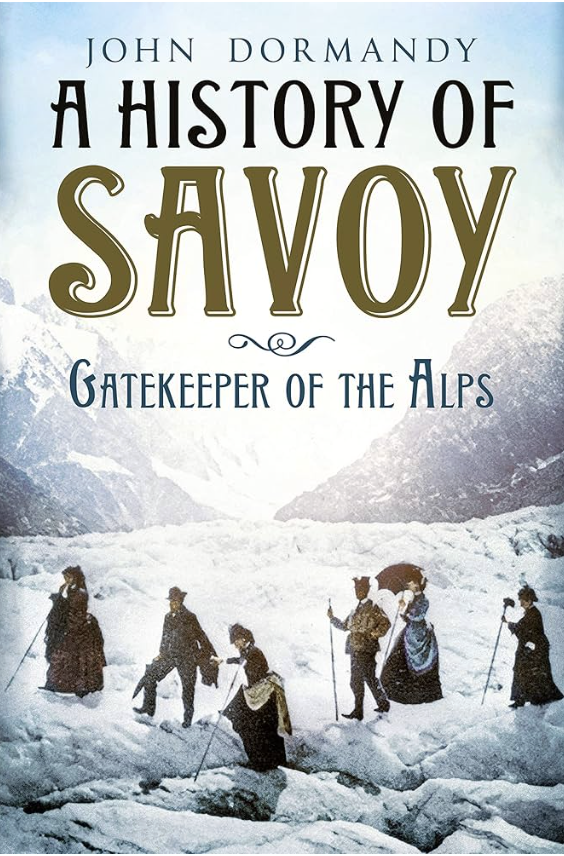
Savoy was a small state – a principality, a dukedom, a kingdom – that covered parts of what’s now northwest Italy, Switzerland, and southeastern France. The borders were always shifting. For a time Savoy was its own country. The ruling family ended up as kings of Italy, until that ended shortly after World War Two. I’m interested in Savoy because I’ve twice been lucky to travel to the animation festival at Annecy, France, historically part of Savoy.
I judged this book by its cover, thought it might be kinda slop, and ignored it even though I have a strong interest in the history of Savoy. But after burning through most English language Savoy specific content, I bought and started reading it, and it’s fantastic! John Dormandy is a great, conversational, witty writer. He makes a great case for the importance of Savoy as a topic. Blessed with some clever rulers it managed to survive a long time while many other small states like Burgundy were swallowed up. Just an excerpt:
In 1858, Emperor Louis Napoleon III and Count Benzo Cavour, prime minister of King Victor Emmanuel, met secretly in the small spa town of Plombières in the Vosges mountains to hatch a plot. The two men, equally devious, agreed to provoke an attack by Austria on the Kingdom of Sardinia that included Savoy; the French would then promptly come to the aid of poor Sardinia, and together they would expel the Austrians from northern Italy. Following that happy outcome, Sardinia would acquire all of northern Italy and in recompense for his help, Napoleon III would be allowed to annexe Savoy to France. That was exactly what happened, except that by the mid-nineteenth century, Europe, particularly Victorian England, was beginning to baulk at countries being traded as commodities, especially if the recipient of the gift was France under a second Napoleon. Cavour and Napoleon, ever resourceful, organised a ‘free’ plebiscite in Savoy in which 99 per cent of the population voted for annexation to France.
I looked up John Dormandy, and sadly, he’s died. He wrote this book as a retirement project. He led a remarkable life. Here’s an edited version of an obituary I found here:
John Dormandy was born on 3 May 1937 in Budapest. He was the son of Paul Szeben, a pea grower who was accustomed to exporting his crop to the UK, and his wife Clara, who was an author and dramatist. He had a sister, Daisy, and his elder brother, Thomas, was to become a consultant chemical pathologist, renowned for his research on the actions of free radicals. The family were Jewish and went into hiding in 1944 when the Nazis invaded Hungary. After several months sheltering in a convent, they escaped to Geneva. In 1948 they made their way to London, where they settled and changed their surname to that of a village in Hungary which was 150 miles east of Budapest, where they had a country estate. John was educated in Hungary, Geneva and Paris before enrolling at London University to study medicine and graduating MB, BS in 1961. Apart from a spell as a registrar at the Royal Free, he was to spend most of his career at St George’s Hospital, progressing from lecturer in applied physiology to senior lecturer in surgery and, eventually, professor of vascular surgery.
He was famous for his pioneering work investigating the diagnosis and treatment of peripheral artery diseases. A colleague referred to him as an unusual surgeon since he was keen to conserve affected limbs rather than to correct [the problem] immediately with a knife. Written with three co-authors, his book Clinical haemorheology (Springer, 1987) remains a standard work in the field. In the early 1990’s he was the first to advocate the use of specialist nurses to manage clinics for patients with chronic vascular disease and eventually this led to a nationwide network. He saw the benefits of multidisciplinary information sharing and was a leading figure in setting up the Trans-Atlantic Consensus for the management of peripheral artery disease (TASC) which published uniform guidelines in 2000. It was due to his personal involvement that so many vascular societies across Europe and North America collaborated in the research and adopted the recommendation. The author of five medical books and over 200 research papers, he continued to write and appear as an expert witness after his retirement in 2001.
In the 1980’s, as his fame grew, he was called upon to deal with some high profile patients. Flown to Baghdad, he operated on the varicose veins of Saddam Hussein’s mother, to be rewarded with a gold watch which was later stolen. In 1983 he went to Libya where he is thought to have treated either Colonel Gaddafi himself or one of his advisors. John was said to be extremely angry that the large bill for this was never paid due to the row over the siege of the Libyan Embassy the following year.
Due to his multicultural upbringing he was fluent in several languages. He was a popular and gregarious host, enjoying fine wines and good food often followed by a cigar. It was said that when he had to implement a no smoking policy as clinical director of St Georges he put a sign on his office door reading You are now leaving the premises of St George’s Hospital. A keen downhill skier, he also enjoyed playing golf and tennis and travelled at hair-raising speed round town on his beloved scooter. Other interests were art, architecture, theatre, opera and travelling – in retirement he published a book on his favourite part of France A history of Savoy: gatekeeper of the Alps (Fonthill, 2018).
His wife, Klara, predeceased him in December 2018 and he died suddenly in Paris on 26 April 2019. He was survived by his children Alexis and Xenia and stepchildren Gaby and Alex. His brother Thomas predeceased him in 2013.
What a guy! I feel like he’s a pal.
Dormandy thinks Konrad Witz’s Crucifixion depicts Annecy:
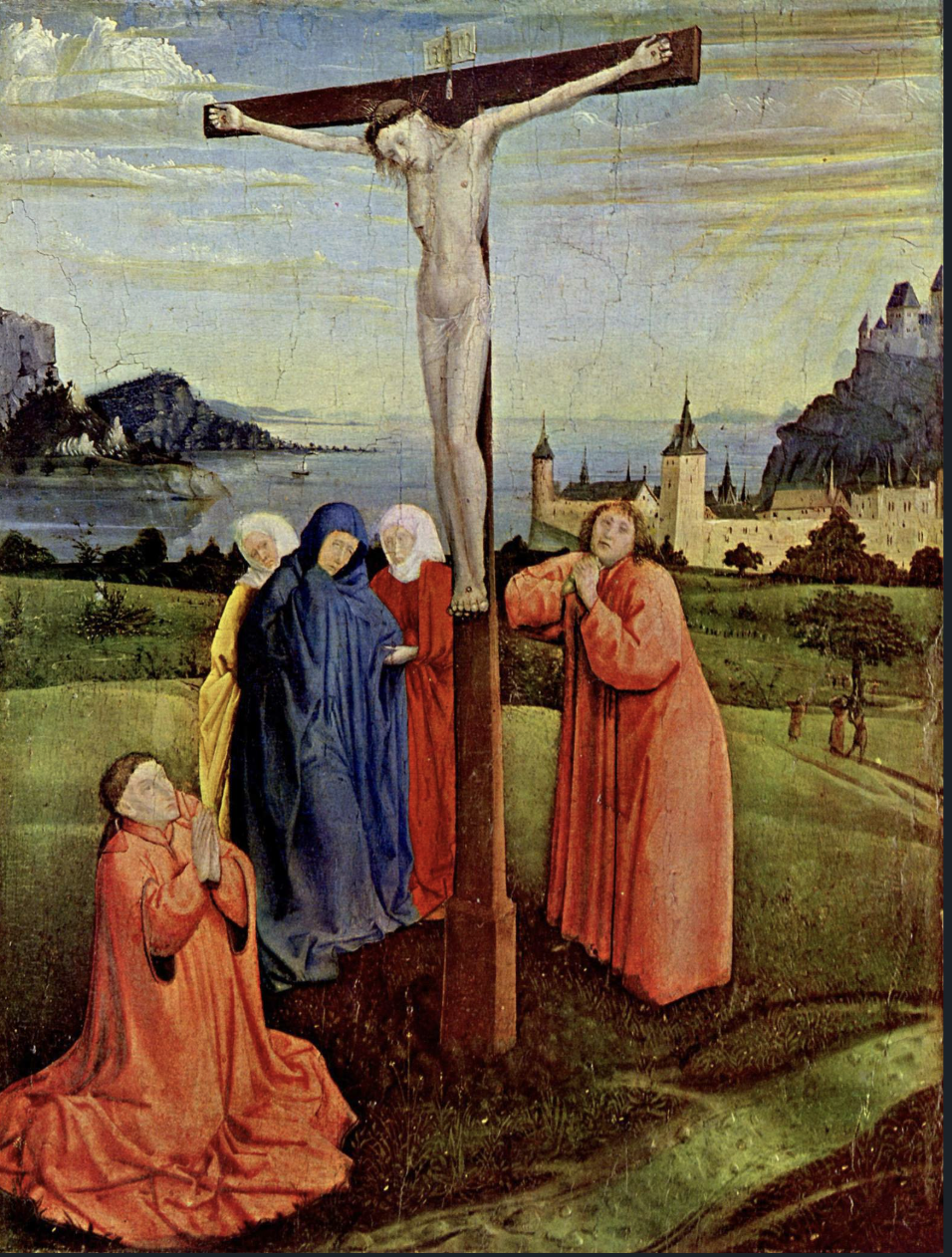
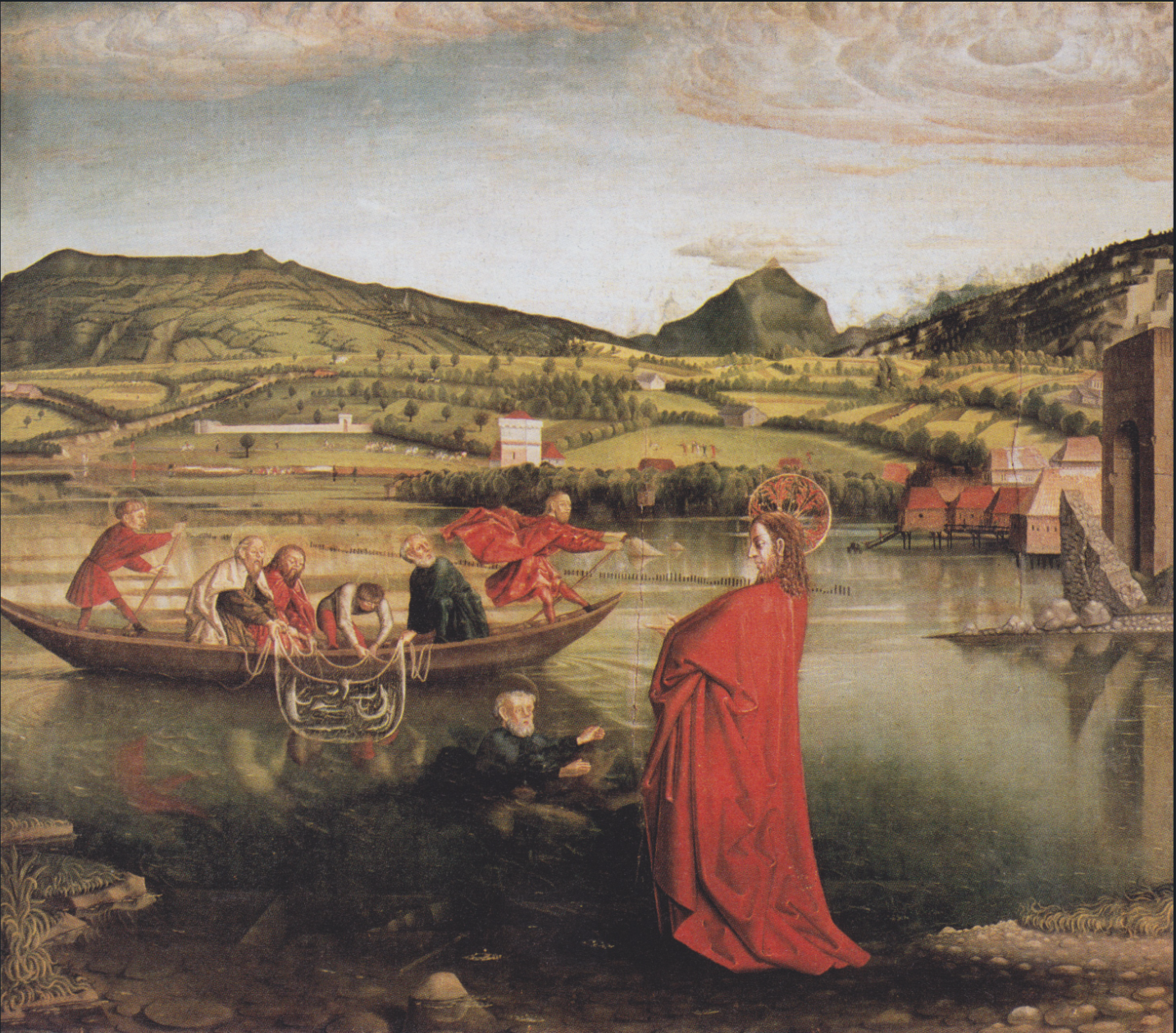
It does look like it. He also thinks Witz’s Miraculous Draught of Fishes depicts Lake Geneva, with Mont Blanc in the background, and that very much looks like it!:
 Helytimes


.jpg)