Holy Roman Empire
Posted: April 19, 2026 Filed under: Savoy, Switzerland Leave a commentReader, don’t make the mistake I did. This book:
and this book:
are the same.
I can’t tell you what peace The Holy Roman Empire: A Thousand Years of European History by Peter H. Wilson brought me. I read a page or two at night before going to sleep. Perfect: both interesting but distant, engaging and somnolent at the same time.
When I was finished, I felt like I’d barely scratched the surface, so I checked out The Heart of Europe, but that’s just a British reprint or something of the same work.
Wilson’s work is one of those books where every sentence feels like it’s a summary of some Ph.D thesis. A selection at (near) random:
Charles’s victory of the Schmalkadic League in 1547 at the battle of Mühlberg appeared to offer an opportunity for him to attempt a significant reorganization of imperial governance at the “Armoured Reichstag” in Augsburg the following year
If you’re a reader of Helytimes you’ve no doubt heard Voltaire’s quip about “neither holy nor Roman nor an empire.” Wilson goes even further and says it was barely even called The Holy Roman Empire:
The words Holy, Roman and Empire were only combined as Sacrum Romanum Imperium in June 1180, and though used more frequently from 1254, they never appeared consistently in official documents. Nonetheless, all three terms formed core elements of the imperial ideal present from the Empire’s foundation. This chapter will consider each in turn, before investigating the Empire’s troubled relationship with the papacy.
When did it start? When did it end? Start:
First, the Empire was a joint creation of Charlemagne and Leo III, ‘one of the shiftiest occupants of the throne of St Peter’. Accused of perjury and adultery, Leo was unable to assert authority over the Roman clans, who orchestrated a mob which attacked him in April 799, nearly cutting out his eyes and tongue – acts of mutilation that were considered to render their victim unfit for office.
Already at his accession, Leo had sent Charlemagne a banner and the keys to St Peter’s tomb, symbolically placing the under Frankish papacy protection. Charlemagne was reluctant to assume this responsibility, which could require him to judge and possibly remove a wayward pontiff. Writing a generation later, the Frankish chronicler Einhard claimed Leo sprang the idea of an imperial coronation when Charlemagne finally visited Rome in November 800.
End:
On the morning of 6 August an imperial herald full regalia rode through Vienna to the Jesuit church of the Nine Choirs of Angels. After climbing to the balcony, he summoned the inhabitants with a silver fanfare to announce the end of the Empire. The Reichstag was formally informed on 11 August, while letters were sent to foreign diplomats over the following week. The Empire was certainly not dead by the late eighteenth century, and if it was sick, as Zedler and others suggested, it was not yet on life support. If revolutionary France had not intervened, the most likely prognosis was that the Empire’s socio-political order would have persisted further into the nineteenth century, but it is unlikely that this could have been sustained against the levelling and homogenizing forces unleashed by capitalism and industrialization around 1830.
But hang on:
Much of the socio-legal order survived… Prussian manors enjoyed tax exemption until 1861, police authority up to 1872, and favourable control over servants until 1918, with lordly influence over local churches persisting even after that. Manorial districts remained the primary units of state administration in Prussia until 1927, all despite the fact that reforms between 1807 and 1821 emancipated serfs from the manorial economy. Hamburg’s Jewish Ordinance from 1710 remained in force into the later nineteenth century, while Bavaria’s partially codified civil code from 1754 persisted until 1900. Prussia lacked a uniform commercial code before 1861, while a supreme court for the German states was not established again until 1879. Codification of civil law across the states of the Second German Empire took from 1879 until 1900 to complete. Some cultural elements of the old order displayed still greater longevity: Buchenbach parish near Freiburg assumed the spiritual responsibilities of the Swabian monasteries secularized in 1803 and continued to say prayers in memory of Emperor Frederick I ‘Barbarossa’ until after the First World War.
The postal service kept going until the 1870s.
The Pope needed a strong guy to protect him, and the strong guy needed the Pope to give him authority:
This assertion of imperial authority did not unduly trouble most popes at this point, since they wanted an emperor who was strong enough to protect them, yet not so close by as to be an oppressor. The Carolingian civil wars after 829 exposed Rome to the Arabs, who sailed up the Tiber and sacked St Peter’s in 846.
How did the Church maintain this authority?
The Empire’s elite was uniformly Christian and shared a concern for salvation and the belief that God influenced earthly events. The idea of penance was powerfully attractive to a warior elite engaged in killing, fitted with Germanic legal customs that demanded reparations for victims, and encouraged lavish endowments of material resources to the church. The development of indulgences at the end of the eleventh century allowed warriors to gain remission from in by serving in the crusades. Endowments were additionally encour aged by the belief in vicarious merit in which prayers and intercessions by the living benefited the donor’s soul long after their death.
To even understand the Holy Roman Empire we have to just assume the power of Christianity over hearts and minds, which is its own huge topic (next up maybe is Tom Holland’s Dominion, on how and why this wacky cult was so damn powerful).
Origin of the Guelph/Ghibelline conflicts that vexed poor Dante so bad:
Northern Italy was a dense mosaic of bishoprics, lordships and cities, often enmeshed in their own conflicts.
Support from one for the emperor usually prompted its rivals to back the papacy.
…
Ghibelline sentiment persisted during the prolonged imperial absences after 1250 amongst those like Dante and Petrarch who believed only a strong imperial presence could provide the order that Italy so urgently needed. The papacy’s ‘Babylonian Captivity’ in Avignon after 1309 increased interest, while many opposition groups within Italian towns hoped the emperor could liberate them from their local opponents. Given such unrealistic expectations, most imperial visits inevitably disappointed. Charles IV was criticized for appearing more concerned to extort money than address local problems. Moreover, Italian cities were accustomed to self-governance and resented paying for the expensive imperial entourage. The Pisans rioted in May 1355, setting fire to the palace where Charles and his wife were staying.
Disparate authority:
Meanwhile, the Empire was undergoing a fundamental transformation through rapid institutional growth, consolidating its definitive, early modern form as a mixed monarchy in which the emperor shared power cities collectively known as the imperial Estates
It’s easy to get confused, and hard to put our modern conceptions on territories of the past:
The Empire’s principal kingdoms were not clearly delineated before the eleventh century. Their inhabitants lacked maps and regarded geography differently from later generations. For example, rivers like the Rhine were medieval expressways rather than potential frontiers. Politics involved networks and chains of obligations and responsibilities, not uniform control of clearly bounded territories.
You sometimes see this map pop up on Reddit:
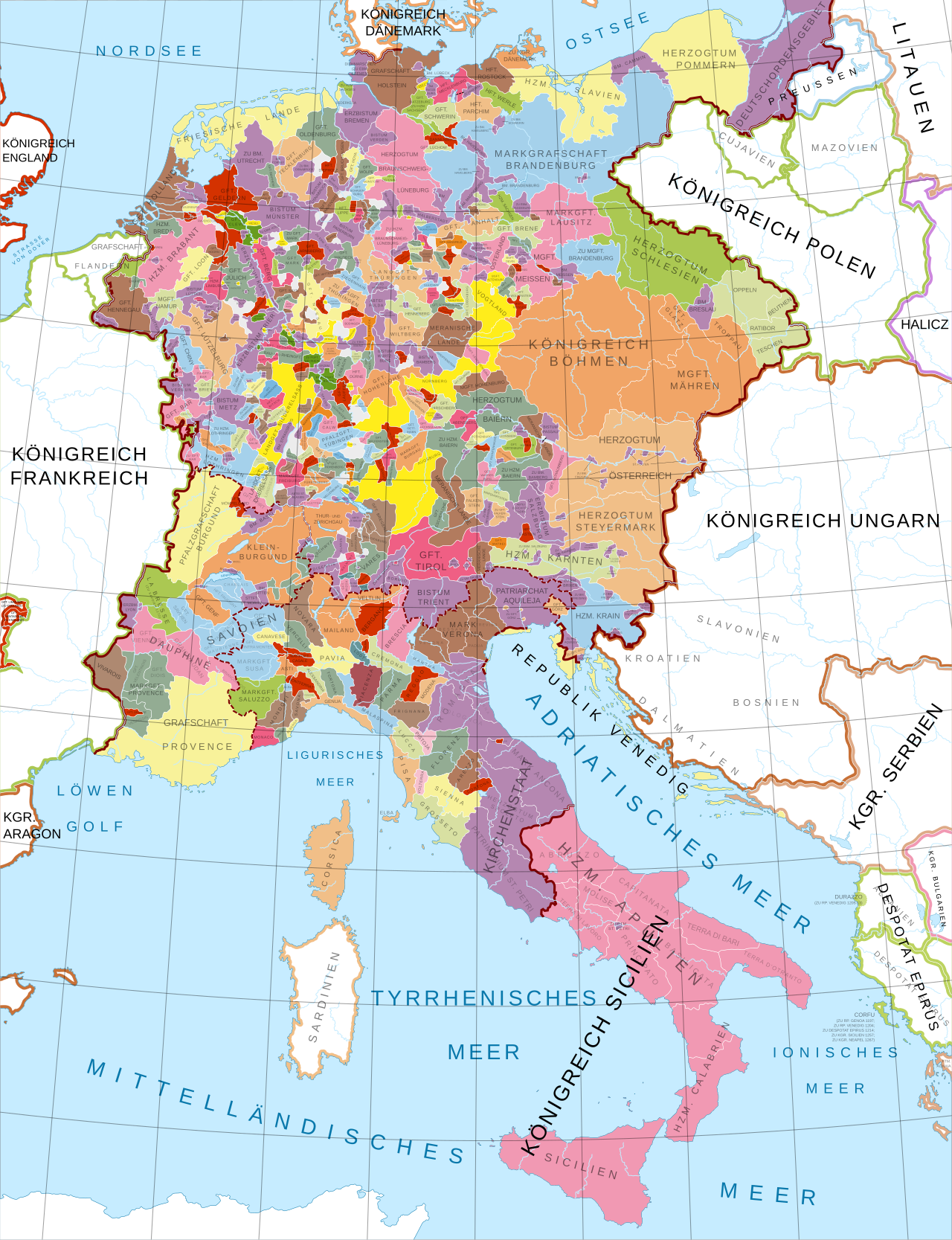
And when you look at that it is like, yeah, the HRE seemed kooky, how did all this work. But then, consider a political map of just Los Angeles County:
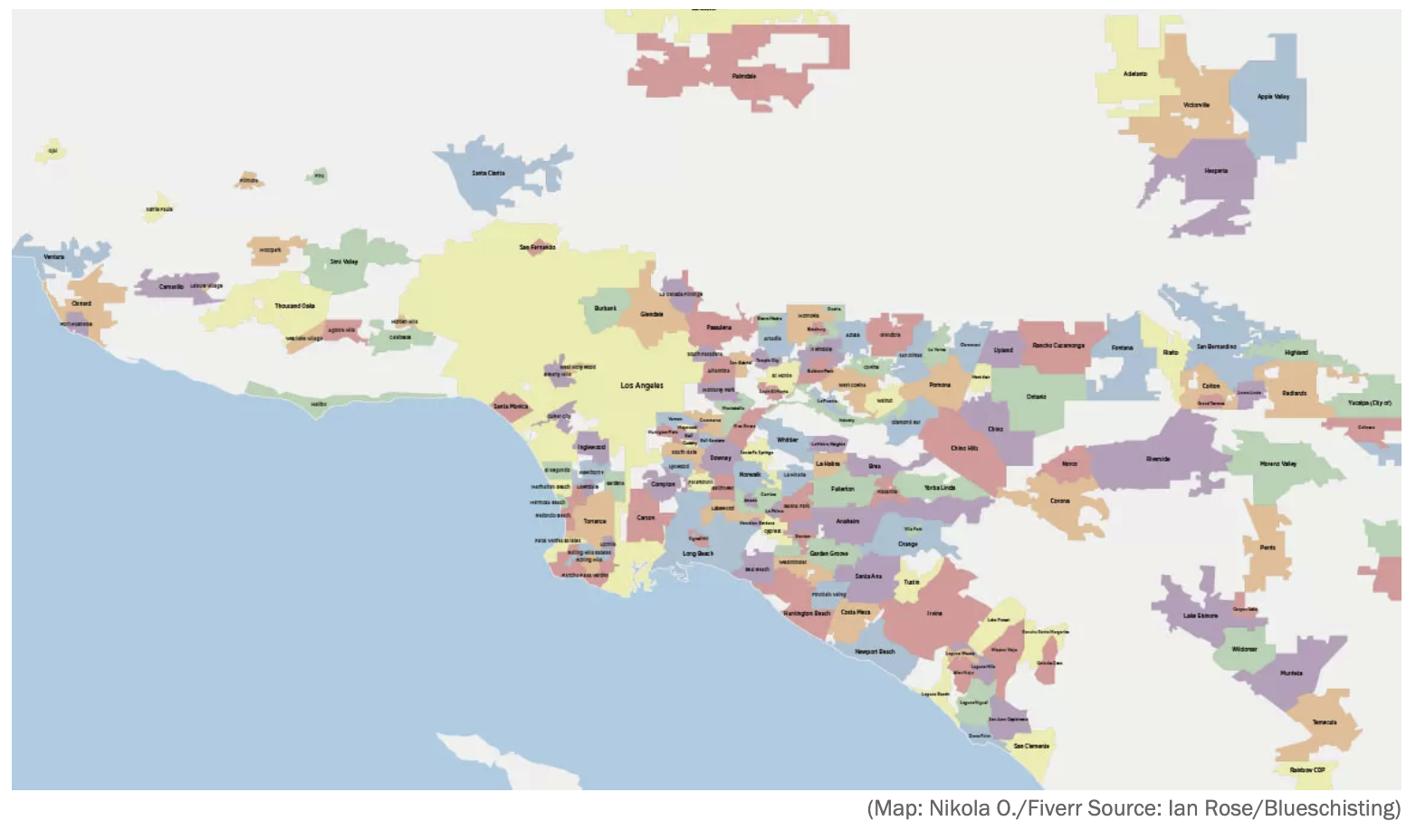
(source). Here where I live, there’s the City that runs the police and paves the streets (in theory, and some of those are federal, and some are CalTrans), the County that runs the schools and most of the courts, the State that runs some courts, its own police, then there’s the federal government. Was it that much more confusing to live in an imperial immediacy?
Small astounding details:
Emperor Basil II blinded 14,000 Bulgarian prisoners, earning the title of the ‘Bulgar Slayer’.
The French turn up their noses:
French writers increasingly drew disparaging contrasts with the Empire, which they presented as declining from an (allegedly) hereditary monarchy under Charlemagne’s ‘French’ rule into a degenerately elective one under the Germans. It was no longer an empire, but merely a sorry shadow of one, whereas the continuous line of Christian French kings had existed beyond the combined span of republican and imperial Rome. France was a divine monarchy, with its king chosen by God through hereditary succession. As the Sun King, Louis outshone any other ruler. Thanks to his Christian credentials and practical power, he, not the emperor, was the natural arbiter of Europe.
What is an Empire, anyway?:
Although Napoleon’s Grand Empire collapsed in 1814, his nephew ruled a Second French Empire between 1852 and 1870, while the subsequent republican regime expanded the country’s overseas possessions into a large colonial empire from the 1880s. Prussia’s victory over the Second French Empire led to the foundation of the German Second Empire in 1871. Queen Victoria finally formalized British imperialism by assuming the title ’empress of India’ in 1876. Throughout, Austria, Russia and the Ottomans remained imperial states. There were now six empires on one continent. ‘Empire’ ceased to mean a singular ‘world order’ and became the title accorded a monarch ruling a large state.
I bought this book to better understand the history of Annecy in what’s now France but was once Savoy, a subset of the HRE:
The significance of this is demonstrated by the anomalous position of Savoy, which assumed such significance in the process of Italian unification in the nineteenth century, yet remained the one Italian lordship formally integrated within ‘German’ imperial structures. Unlike the rest of imperial Italy, Savoy remained in the hands of an old lordly family, the Humbertines, who were originally Burgundian counts. Conrad II rewarded the Humbertiner for their help in securing Burgundy in 1032 with the gift of Alpine lordships. Further grants followed their support during the Investiture Dispute, developing Savoy as a secure anchor at the intersection of the Empire’s three main kingdoms in the western Alps. Its strategic position prompted Charles IV to incorporate it within the kingdom of Germany in 1361, where it formally remained until 1797….
Savoy, champion of Italian unification, in fact emerged from the kingdom of Burgundy and between 1361 and 1797 was formally part of Germany. This, of course, did not prevent its ruling family, the Humbertines, from pursuing territorial ambitions south of the Alps. Later national perspectives make little sense given that Savoy also encroached on what is now Switzerland, held land that is now part of France, and claimed royal status through tenuous links to Cyprus…
the House of Savoy became full royalty in the settlement ending the War of the Spanish Succession, which awarded it Sicily in 1713. Subsequent Austrian pressure forced the Humbertines to trade this for Sardinia in 1720, placing them in a position roughly equivalent to the Hohenzollerns in holding land within the Empire but also a sovereign kingdom beyond it.
Savoy’s position within the former German kingdom was not entirely meaningless, since it sustained influence within the Empire. Cooperation with Charles V was instrumental in Duke Emanuel Filiberto’s recovery of his possessions 23 years of French occupation. Savoy’s 1559 after dukes either attended in person or sent a representative to every Reichstag between 1541 and 1714, and they accepted jurisdiction of the Empire’s other supreme court, the Reichskammergericht, over themselves as imperial Estates. Even after their elevation as sovereign kings, Savoy’s rulers continued to pay feudal dues on behalf of their imperial fiefs. They remained interested in imperial politics. Duke Charles Emanuel I was a serious candidate for the Bohemian crown in 1619, while the family pushed after 1788 to receive a new electoral title, securing Prussian backing for this ambition. The overall situation of imperial Italy and Savoy thus remained relatively stable until the shock of the French Revolutionary Wars saw both severed from the Empire in 1797. Now styled the House of Savoy, the Humbertines were restored in 1814 and eventually became monarchs of united Italy between 1861 and 1946.
The Empire splits into something closer to modern countries:
The developments around 1490 have largely been interpreted in national terms as the secession of Italy, Burgundy and Switzerland from the Empire, reducing it to a ‘German Reich’. Austria has also often been regarded at this time as distinct, either by those seeking to trace that country’s ‘origins’ or by nineteenth-century critics accusing the Habsburgs of pursuing their own interests to the detriment of alleged common ‘German’ ones. Prussia’s rise as a second German great power from the mid-eighteenth century appears to confirm this perspective. However, it would be wrong to reduce the Empire’s later history to that of ‘Reichstag Germany’: the mass of smaller principalities and imperial cities with little or no chance of a separate existence in a Europe now more obviously composed of independent national states. Rather than seeing early modernity solely as the origins of later nations, it is better to interpret it as a significant reordering of how the Empire’s different components interacted.
You can’t go back to before people had one name:
The transition from one to two names was completed between the thirteenth and fourteenth centuries amongst the urban population and adopted by the early fifteenth century in the countryside
What is history, anyway?:
Early chronicles are largely by clerics recounting the deeds of kings with varying levels of approval. However, it was common by the eleventh century for monks to compile lists of abbots or bishops to demonstrate the continuity and purity of local religious practice. They were joined by secular chroniclers during the later Middle Ages who traced the origins of their home town, often in considerable detail.
Most were commoners, but they proclaimed the ‘nobility’ of their own town, boasting a lineage equal to that of any aristocrat. Other, more personal documents also testify to individuals’ identification with specific places, such as nuns writing for the edification of their community, or Jewish memory books of local martyrs
how did you become the Emperor?:
variety of methods were used to decide the succession prior to their standardization in the Golden Bull of 1356. The elective element has long been blamed as a prime source of political weakness. For the following, it is important to remember that until the late Middle Ages contemporaries did not regard ‘elective’ and ‘hereditary’ monarchies as sharply defined constitutional alternatives. Even English kingship contained elective elements in that the aristocracy’s consent was required for a succession to be legitimate, while hereditary rule in France was achieved in practice by many kings crowning their sons as successors during their own lifetime.
women:
Women were disbarred from citizenship in imperial cities on the grounds they could not bear arms, but those in the countryside could still stand in for sick or absent husbands in village assemblies, or in some cases represent a household themselves as widows.
writing and records:
There was certainly a surge in writing: 7,000 manuscripts survive across continental Europe from the ninth century, compared to 1,800 for the previous eight centuries combined
Cities were bought and sold:
Only 13 imperial cities were never pawned between 1273 and 1438. Unlike transfer by gift or enfeoffment, the king retained the option of recovering the erty by redeeming the mortgage. However, the mortgages were often so high as to make redemption unlikely: Louis IV mortgaged Eger for 20,000 pounds of silver in 1322 back to Bohemia, which retained it permanently. Eger is still today the westernmost point of the Czech Republic. Meanwhile, mortgages cut the king off from the real value of the land since the mortgagee drew the revenue and other benefits in the meantime. Lucrative assets like Rhine tolls, mints, and ore and salt mining rights were repeatedly mortgaged until they were effectively permanently alienated
The Emperor didn’t really have a place, he moved around. The one stop he had to make was Aachen:
History records the Empire’s kings as members of different dynasties, and this is certainly a useful shorthand. However, true dynasticism only emerged in the fourteenth century, and in fact simply reinforced existing ideas that each ruler could claim descent from his illustrious predecessors. Wipo of Burgundy expressed this as ‘Charlemagne’s stirrups hang from Conrad [II]’s saddle’.” Most medieval kings tried at least once in their reign to sit on Charlemagne’s stone throne, which was carefully preserved in Aachen. Frederick I renovated the Carolingian palaces at Ingelheim and Nimwegen. As time progressed, Charlemagne became an idealized role model.
Wilson brings all this into the modern era by pointing out how some contradictions and struggles of the Empire continue with the EU. The President of the EU is Ursula von der Leyen.
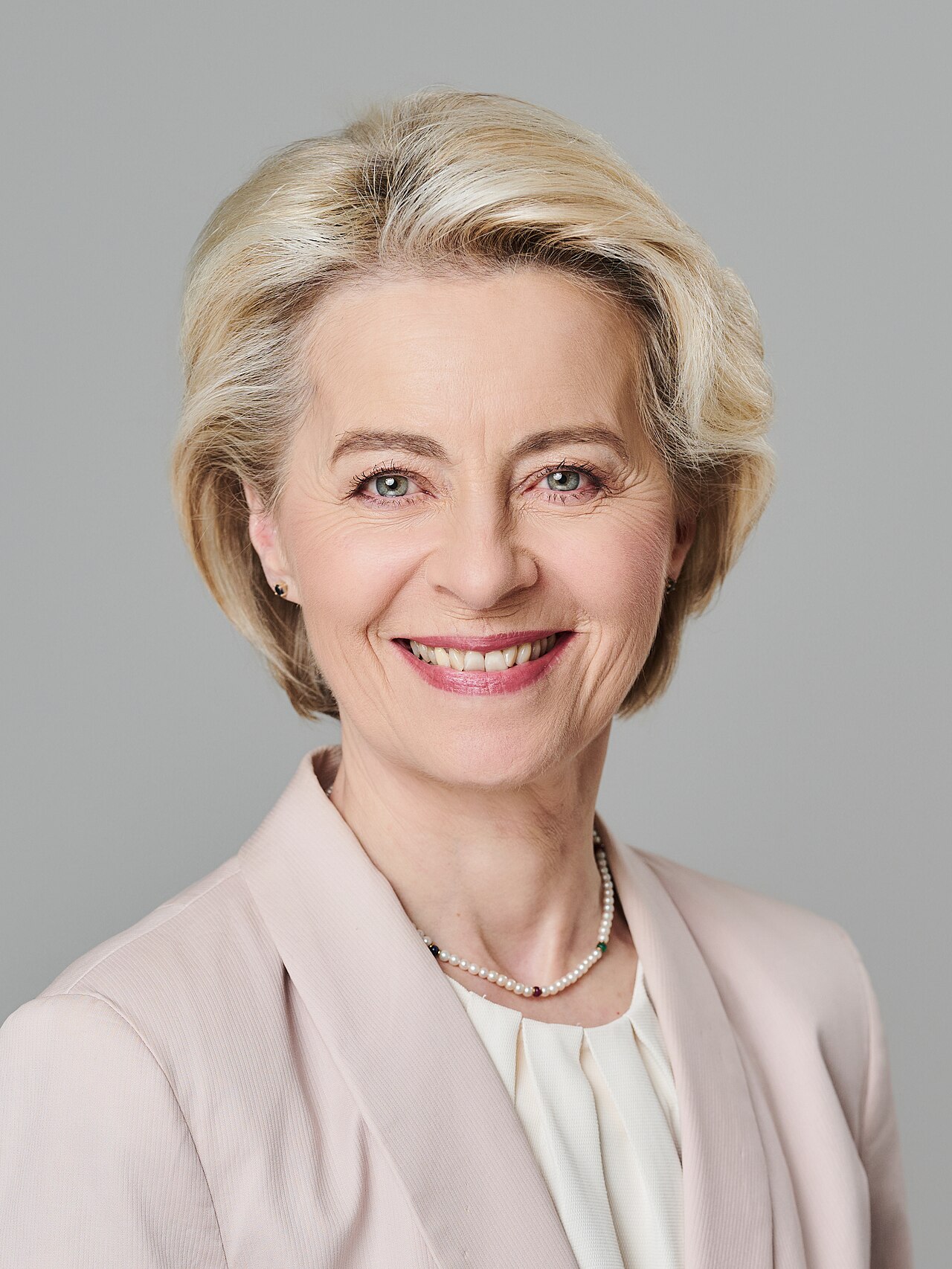
Wilson notes:
The von der Leyen family, elevated from imperial knights to counts as recently as 1711, became princes in 1803 and survived after 1806 thanks to kinship with both Dalberg and Josephine Bonaparte. Their possessions were only mediatized in 1815, passing first to Austria and then Baden after 1819.
You might not think the Holy Roman Empire is that relevant today, but then you turn on the news and there’s the US President, our closest thing to an emperor, chosen in an election that has a strong element of money/bribery, ruling over a fragmented polity, and spatting with the Pope.

