Embracing Cormac
Posted: April 18, 2026 Filed under: America Since 1945, cormac, writing, writing advice from other people Leave a comment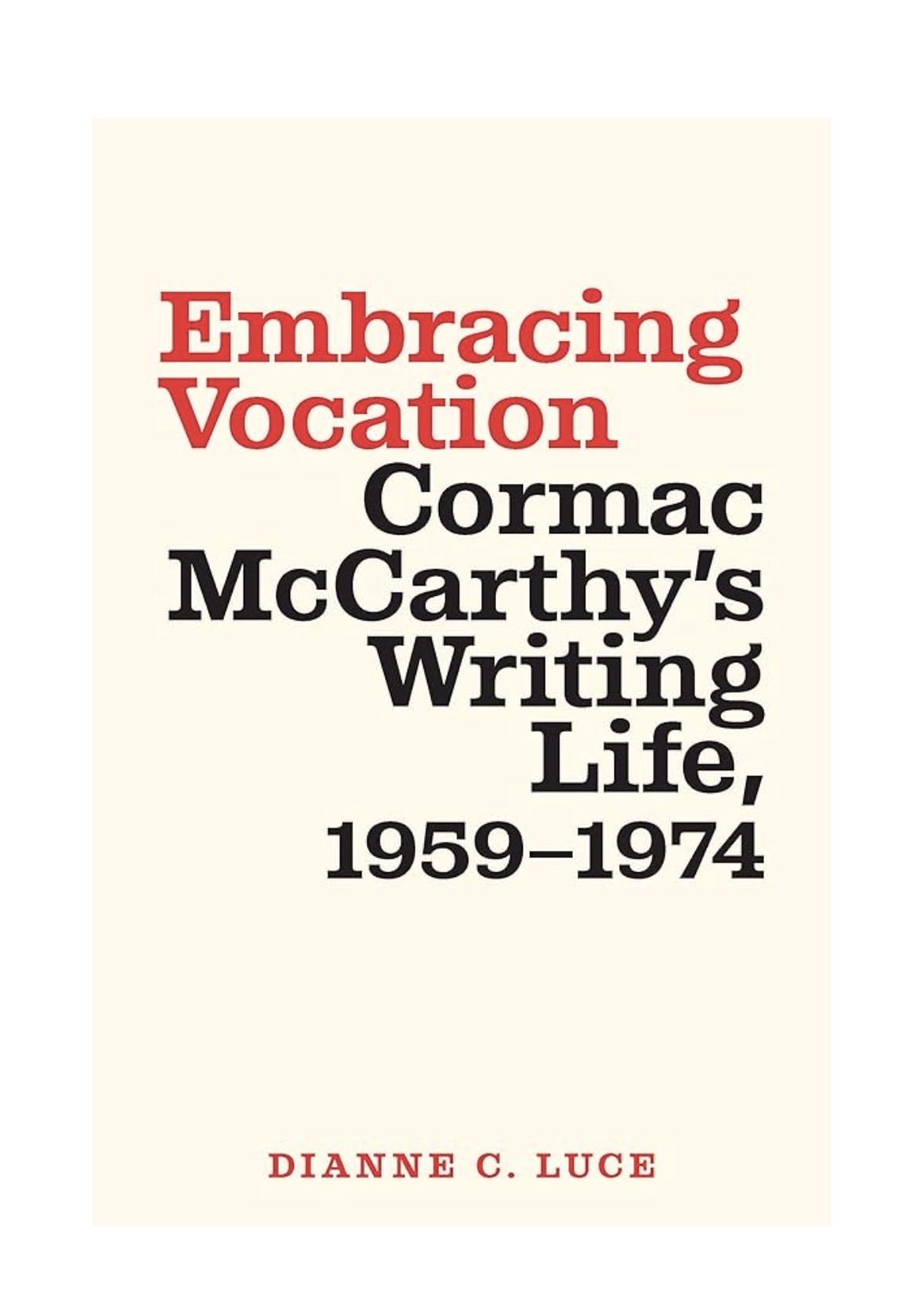
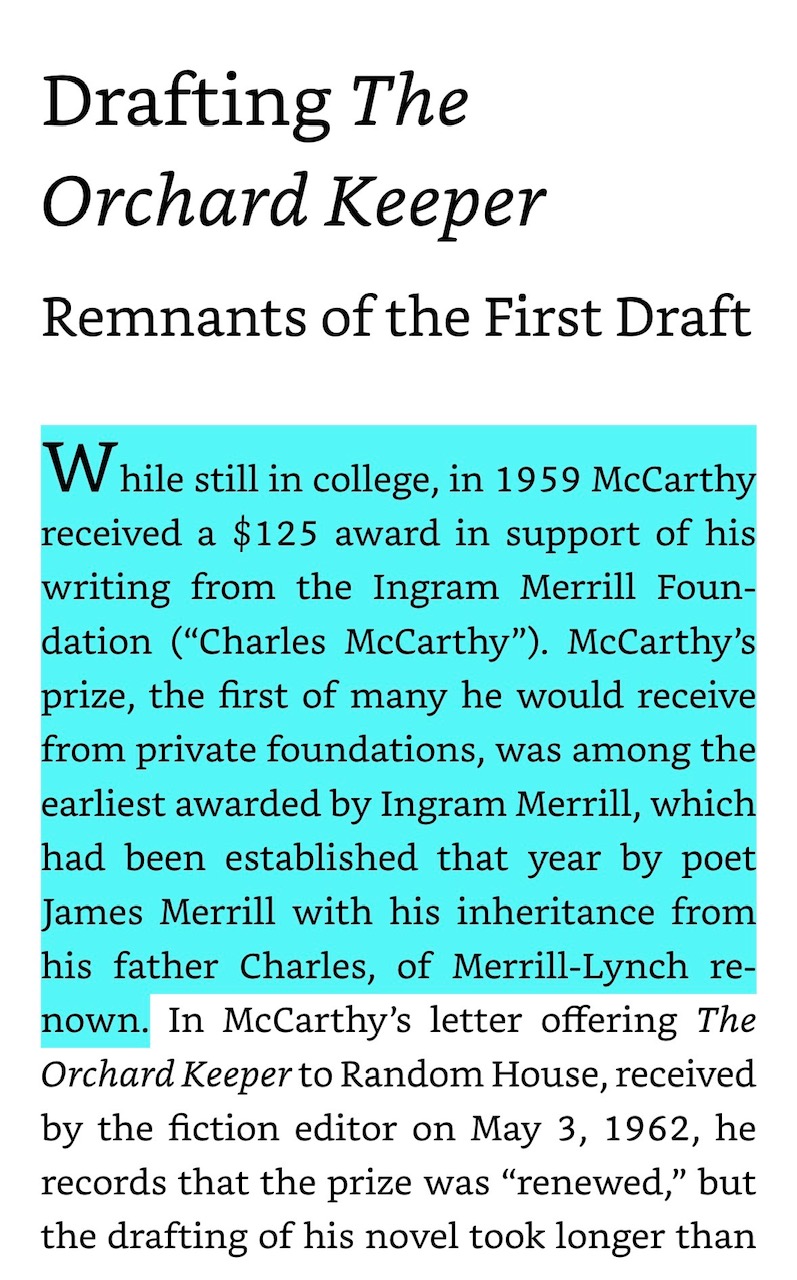
Interesting that James Merrill may have launched Cormac McCarthy:
This book isn’t for casuals – most of it is intense analysis of the drafting and editing process of Cormac McCarthy’s first three books. An interesting aspect that comes out is how difficult it was to revise a novel in the days before word processors. Copying and retyping were time consuming and expensive. It got me to wondering whether any really great novels have emerged post-word processor. McCarthy was still using a typewriter, and passing revisions with his publisher back and forth was laborious.
Between all this stuff a thin biography emerges. For a McCarthyhead every nugget can be meaningful.
His sister Barbara (Bobbie) McCooe reports that although his first assignment in the Air Force was as a navigator, he preferred his second role as a radio disc jockey for the base in Alaska, not only because it gave him more autonomy, but also because it allowed him to work at night and fish in the daytime (Interview with Bryan Giemza and Dianne Luce).
Family:
McCarthy’s ex-wife Anne De Lisle has remarked that McCarthy’s analytical, pragmatic father “didn’t know what to make of him” (Conversations). And his sister Barbara McCooe recalls that it was the impracticality of his chosen career in the arts to which his parents objected (Interview with Bryan Giemza and Dianne Luce).
McCarthy’s first book, The Orchard Keeper, was discovered through the slush pile. Would this happen today? (could it not happen today because word processors/computers make it too easy and thus the slush pile too full?)
The novel immediately garnered attention. Bensky recalled: There was a protocol in the place where you read from the slush pile. The manuscripts came in by the cartloads. Really: every day a hand-truck full of manuscripts arrived. Jimmy, the drunken mailboy, would bring them upstairs and dump them in this office … at the reception area…. The office had shelves up to the ceiling. You read them in order of arrival. Usually the readers, Maxine [Groffsky] and Natalie [Robins], would read three or four pages, decide if they wanted to read more, or say: “This is ridiculous.” (Josyph, “Damn Proud” 16–17)… Groffsky alerted Bensky that McCarthy’s novel had potential, jotting “Larry/ This might be good” in a note she affixed to McCarthy’s cover letter (Groffsky, Note to Larry Bensky, [May 1962]).
why did this change in reading habits occur? It feels drastic:
Cerf, who had purchased the Modern Library imprint from Horace Liveright in 1925, recalled, “When I started publishing, fiction outsold nonfiction four-to-one. Now that ratio is … reversed, [and] … the bulk of new fiction doesn’t sell at all. It’s heartbreaking to bring out a good first novel and watch it die virtually at birth” (Cerf, At Random, 203–204).
I put this question to WDM who suggested it’s because people now read nonfiction to gain advantage in making investment decisions. Maybe it all comes back to the collapse of Bretton Woods.
Sales were low but esteem was high:
Between 1965 and 1969, when a second printing was issued, the book sold 3,926 copies (Lane, Letter to J. Howard Woolmer). Since the publishing summary for the book prepared in October 1964 had projected that the publisher would break even if 3,155 copies sold, this was a modest success for the publisher of a first novel. McCarthy was to receive $ 2,105 in royalties or advances, whichever was larger. But the novel was more successful by the measure of critical esteem than it was financially.
for context:
Partly to keep his hopes realistic, Scribner had informed F. Scott Fitzgerald that a good sales performance for a first novel would be 5,000 copies; but This Side of Paradise (1920) proved dramatically more successful, with 35,000 sold in the seven months after publication; and Hemingway’s The Sun Also Rises (1926) had initial sales of 20,000 (Berg, Max Perkins 20, 41, 100). Both had been edited by Scribner’s legendary Maxwell Perkins, who energetically promoted his writers and who had an uncanny instinct both for talent and for what would sell. On the other hand, Boni and Liveright had less confidence in Faulkner’s first novel, Soldiers’ Pay (1926), and had printed only 2,500 copies. By the end of the depression year of 1930, Faulkner’s The Sound and the Fury and As I Lay Dying together had sold fewer than 4,000 copies (Blotner, Faulkner I 494, 685).
It’s astounding the number of reviews McCarthy’s early books got, especially in our age of declining local newspapers and book sections. He’s getting reviewed in the Tampa Tribune, the Charlotte Observer, the Anniston (Alabama) Star.
Travel:
McCarthy met and fell in love with English dancer Anne De Lisle on his trans-Atlantic voyage on the Sylvania, where she was employed as an entertainer, half of the duo The Healey Sisters. She spotted him on the dance floor, asked him to dance with her, and they quickly bonded, spending their spare time together. Anne recalls that his trip terminated in Ireland, while she sailed on to Southampton, England.
…
Cormac and Anne married in the old Norman St. Andrews Episcopal Church of Hamble (c. 1100) on May 14, 1966. Since none of his family attended, Anne’s younger brother Richard stood as Cormac’s best man. Her performing partner, singer Nicky Banks, was her maid of honor, and some one hundred friends and members of Anne’s family attended the wedding and the reception at her father’s sports club. The couple rented a car and honeymooned for two weeks in Devon and Cornwall on England’s southwestern coast. They stayed in Mousehole Village and toured the thirteenth-century Tintagel Castle (constructed on the birth site of King Arthur, according to the twelfth-century legend that had originated with Geoffrey of Monmouth). On their honeymoon, they attended the Bugatti races in Cornwall, when Anne first discovered Cormac’s love of race cars, and later that summer they took a train from Paris to see Le Mans, sleeping in the open air (De Lisle, Conversations).
…
This letter is composed on stationery from the Hotel Mont-Joli on Rue Fromentin near the Moulin Rouge and Sacré-Coeur Basilica. Anne had introduced him to the hotel, and it became their usual place to stay in Paris (De Lisle, Conversations). In The Passenger, Western stays at the Mont Joli and McCarthy describes it as “favored by traveling entertainers and any morning there would be jugglers and hypnotists and exotic dancers and trained dogs in the lobby coffeeshop” (198)…
the couple took a twelve-day automobile trip in a used gold Jaguar XK-120 convertible that Cormac had bought and repaired. The car had a torn black ragtop, and when he first saw it, chickens were roosting inside it, as in one of the junkyard cars of Child of God (De Lisle, Conversations). Their tour began in Paris and wended through France to Geneva, across Italy and back along the southern coast of France to Barcelona, where they stayed a few days before they took the car ferry to Ibiza in early August 1966. There they settled in a finca on the outskirts of town…
They also socialized with Clifford Irving and his fiancée Edith Sommer, who hosted them several times at their finca. Their electricity was unreliable, so they often baked potatoes in foil in the fireplace…
Late in summer 1967, he and Anne finally left Ibiza and traveled back to her family home in Hamble via Madrid and the mountain hamlet, Burgete, in Navarre, where Hemingway’s Jake Barnes enjoys fishing in The Sun also Rises. McCarthy too did some trout fishing there. Then they drove back to Paris, where McCarthy sold the Jaguar (De Lisle, Interview with Bryan Giemza and Dianne Luce).
As he left his friend Leslie Garrett, who later developed serious addictions, McCarthy advised him to give up the drinking and partying life in Ibiza for fear it would kill his work (Williams, “An Interview with Leslie Garrett” 54), and concerns about drinking and over-socializing may have been one reason for his own return to the United States. “If there is an occupational hazard to writing, it’s drinking,” he later told Woodward (Woodward, “Venomous Fiction” 36). De Lisle recalls that McCarthy drank, but never so much that it could affect his writing ability—only his discipline (Conversations).
Stonework:
In summer 1971, McCarthy and Bill Kidwell collaborated for six weeks on the creation of two marble and river rock mosaics set in mortar in downtown Maryville, funded by an urban renewal grant from the US Department of Housing and Urban Development. Kidwell had secured the grant, De Lisle remembers, but he did not have the masonry skills to execute the project, so he asked for McCarthy’s help. Kidwell reminisced that as they were constructing the mosaics in full view of the public on Main Street, passersby would stop and comment on their work. Kidwell wanted to engage them in conversation, but McCarthy asked him to keep still and listen. He was gathering speechways for his fiction.
(You can see it here, I’d argue he was more impressive as a novelist). Lifestyle:
When Mark Owen interviewed McCarthy in 1971, he found him witty, uncynical, and happy with the independent life he had created, a life of reading among his 1,500 books, writing his novels, and building his house. “I’ve always been horrified by the way people live their lives,” McCarthy remarked. “On one hand there is a nine-to-five job you don’t like and a totally artificial life. At the other end is the life of a hermit. But I don’t want to be cut off from society and have to … compromise.”
…
McCarthy would usually write for four or five hours each day (Runsdorf, “Recognition Acceptable” 5). In the late afternoon, he would announce to Anne, “Well, it’s cocktail time” and “take a shower as if washing all that stuff out of his hair,” after which they would enjoy a candle-lit dinner (Williams, “Cormac McCarthy” E2). In the evenings, he would often read her some of what he had written that day.
As noted earlier, on Thanksgiving 1964 he had recorded on a draft page of Outer Dark “writing = happy”
Sheddan in The Passenger was a real guy:
Sheddan features as an important character in The Passenger, one of Bobby Western’s friends from East Tennessee with whom he converses in New Orleans bars and restaurants. Sheddan claims that Western thinks of him as a psychopath and that he may be right about that (31). In the novel, Sheddan is a petty criminal, but he is also highly intelligent and well-read. Of their friendship, Sheddan says, “I will tell you Squire that having read even a few dozen books in common is a force more binding than blood” (143). Wesley Morgan has learned from one of their classmates that McCarthy and Sheddan met in an American Literature course at the University of Tennessee, where Sheddan was the more vocal of the two.
I hope Dianne C. Luce continues this series.

