F2: Fridericus II
Posted: March 1, 2026 Filed under: hely's history, Italy, Savoy Leave a commentAn important offscreen character in Dante’s Inferno is Fredrick II, the Holy Roman Emperor (to use an anachronistic term).
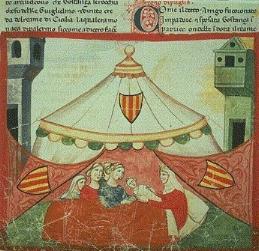
was he really born in the marketplace?
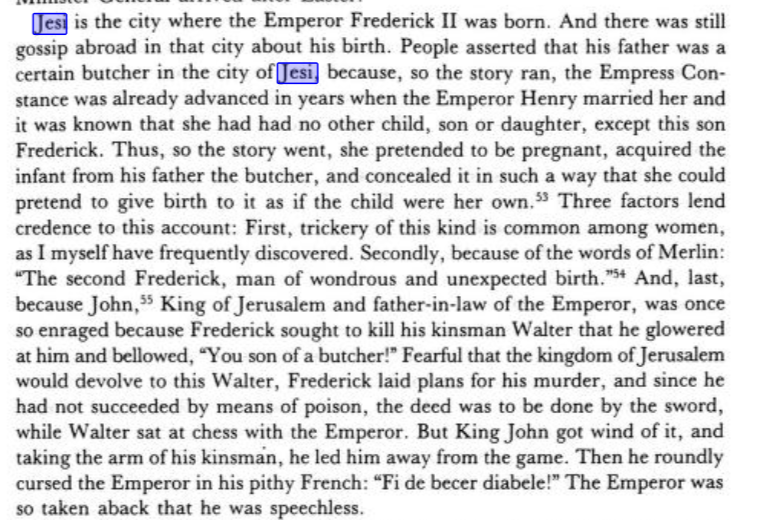
Friderick II (you’ll see why it’s important to spell it that way later) lived from 1194-1250 common era . This was the extent of his domain, in orange and red.
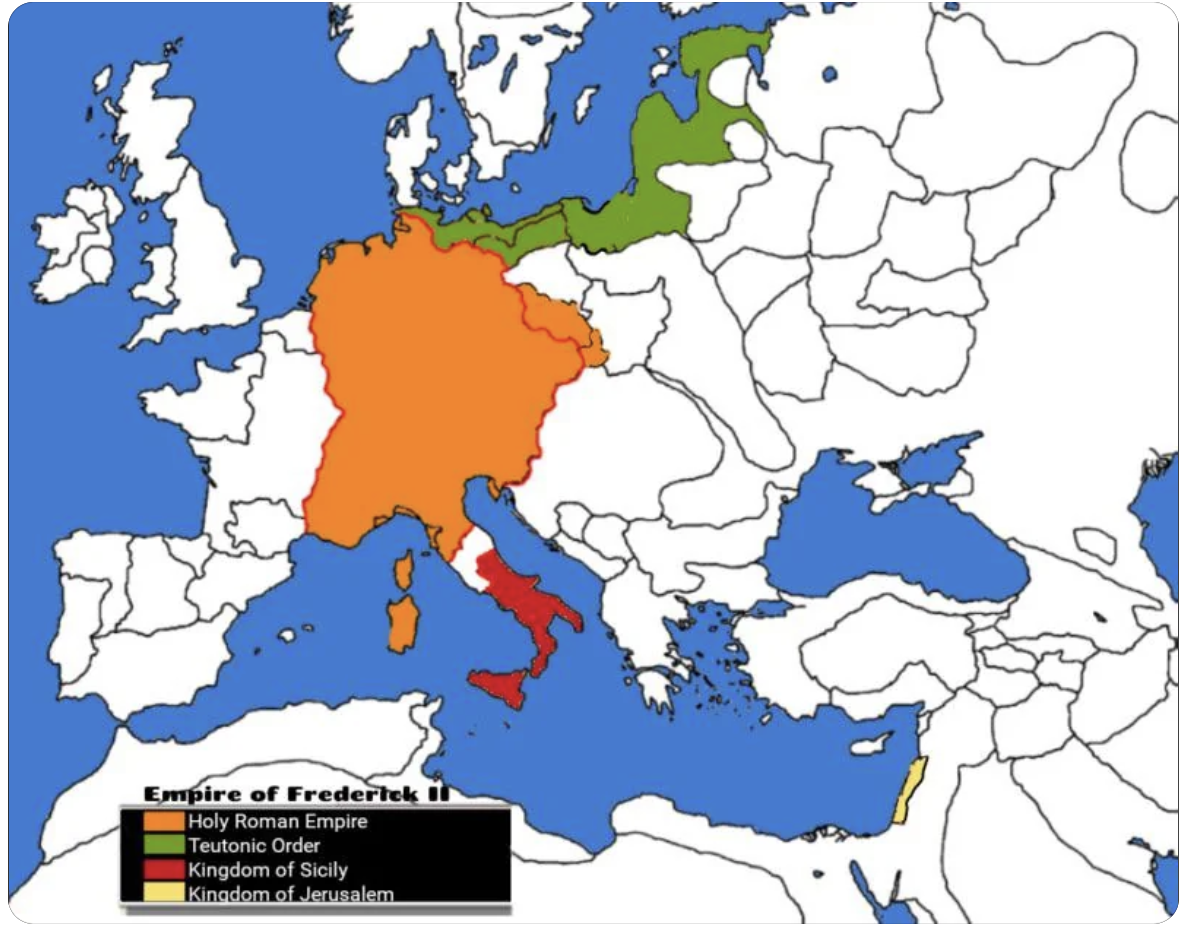
(I got that map from Reddit, you can see that the first commenter is already finding fault, but for our purposes it works).
You can see why Friderick would have conflict with the Pope, who had the lands in white that separated Friderick’s lands from each other. Thus begins (or thus continues) the conflict that tore apart Dante’s Florence, between Guelphs and Ghibellines, supporters of the Pope and supporters of the Emperor, that had such a huge impact on Dante’s life (Dante was Team Pope, but then his own side split into White and Black and he (White) lost and was exiled.)
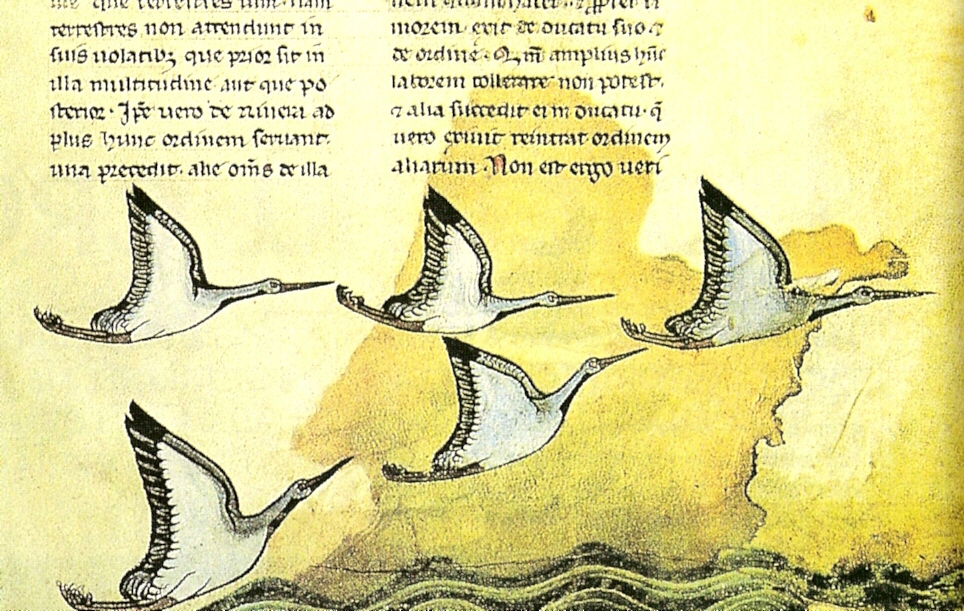
He knew bird:
Frederick II is the author of the first treatise on the subject of falconry, De Arte Venandi cum Avibus (“The Art of Hunting with Birds”)…
For this book, he drew from sources in the Arabic language. Frederick’s pride in his mastery of the art is illustrated by the story that, when he was ordered to become a subject of the Great Khan (Batu) and receive an office at the Khan’s court, he remarked that he would make a good falconer, for he understood birds very well. He maintained up to fifty falconers at a time in his court, and in his letters he requested Arctic gyrfalcons from Lübeck and even from Greenland. …
David Attenborough in “Natural Curiosities” notes that Frederick fully understood the migration of some birds at a time when all sorts of now improbable theories were common.
Now here’s something interesting:
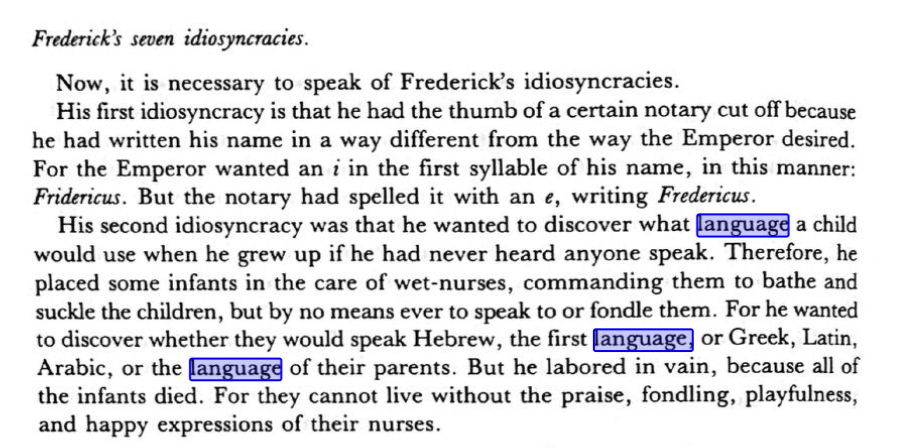
In the language deprivation experiment, young infants were supposedly raised without human interaction in an attempt to determine if there was a natural language that they might demonstrate once their voices matured. It is claimed he was seeking to discover what language would have been imparted unto Adam and Eve by God. Salimbene alleged that Frederick bade “foster-mothers and nurses to suckle and bathe and wash the children, but in no ways to prattle or speak with them; for he would have learnt whether they would speak the Hebrew language (which had been the first), or Greek, or Latin, or Arabic, or perchance the tongue of their parents of whom they had been born. But he laboured in vain, for the children could not live without clappings of the hands, and gestures, and gladness of countenance, and blandishments”.
Our source for that is the Cronica of Salimbene di Adam:
(source)
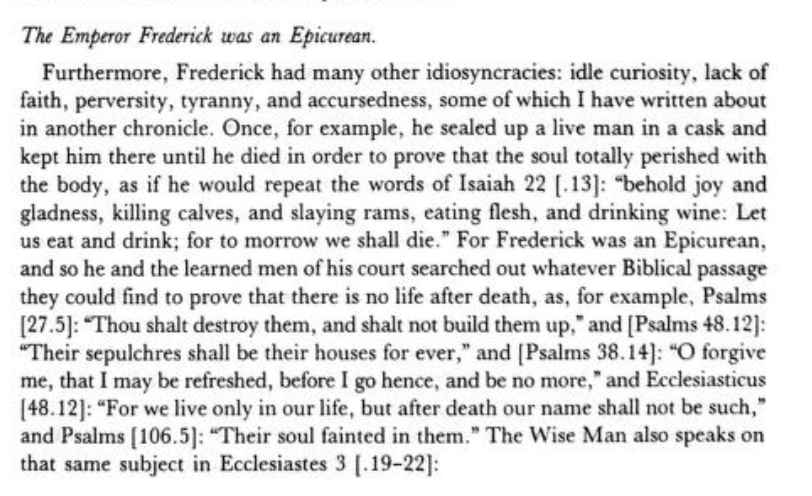
More experiments reported:
As for his appearance?
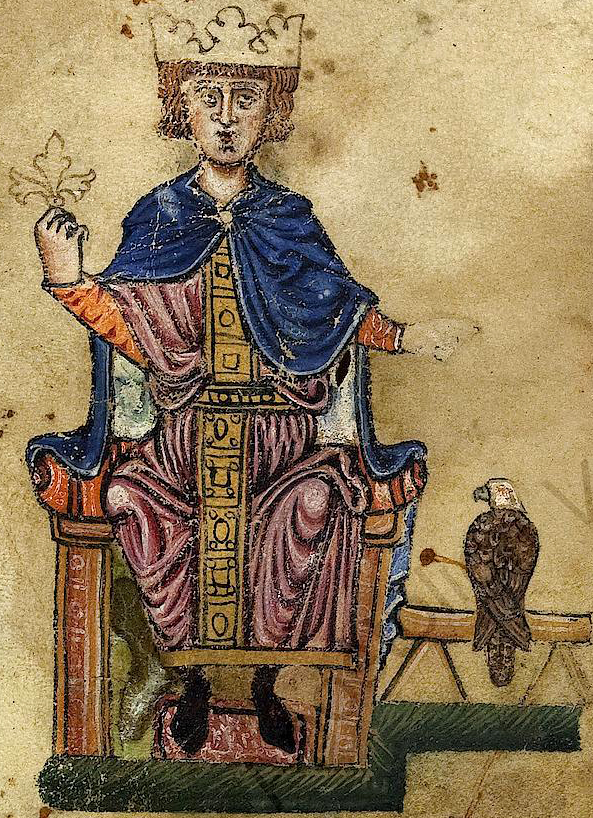
A Damascene chronicler, Sibt ibn al-Jawzi, left a physical description of Frederick based on the testimony of those who had seen the emperor in person in Jerusalem: “The Emperor was covered with red hair, was bald and myopic. Had he been a slave, he would not have fetched 200 dirhams at market.”
It’s very possible we would put this guy today into one of several categories ranging from oddball to neuroatypical. Some clues are he did weird experiments, looked weird, and had a guy’s finger cut off for spelling his name wrong.
Lansing and English, two British historians, argue that medieval Palermo has been overlooked in favour of Paris and London:
One effect of this approach has been to privilege historical winners, [and] aspects of medieval Europe that became important in later centuries, above all the nation state…. Arguably the liveliest cultural innovation in the 13th century was Mediterranean, centered on Frederick II’s polyglot court and administration in Palermo…. Sicily and the Italian South in later centuries suffered a long slide into overtaxed poverty and marginality. Textbook narratives therefore focus not on medieval Palermo, with its Muslim and Jewish bureaucracies and Arabic-speaking monarch, but on the historical winners, Paris and London.
Dante preferred Friderick’s successor, Henry VII.
Confederate Surrender Day
Posted: April 17, 2022 Filed under: hely's history, history Leave a comment
Everybody knows about Appomattox, Lee and Grant, that whole story. But the larger Confederate surrender began on April 17, 1865, when Joseph Johnston met William Tecumseh Sherman near Durham, North Carolina. They met at the Bennett farmhouse, and after a few days of negotiation, 89,270 or so Confederate soldiers surrendered.
Some years later, John Sergeant Wise, a former Confederate officer whose father had been a Confederate general, went with a friend to visit Johnston.
One cold winter night about 1880, Captain Edwin Harvie, of General Johnston’s staff, invited me to join him in a call upon the general, who was then living in Richmond. Harvie was one of his pets, and we were promptly admitted to his presence. He sat in an armchair in his library, dressed in a flannel wrapper, and was suffering from an influenza. By his side, upon a low stool, stood a tray with whiskey, glasses, spoons, sugar, lemon, spice, and eggs. At the grate a footman held a brass teakettle of boiling water. Mrs. Johnston was preparing hot Tom-and-Jerry for the old gentleman, and he took it from time to time with no sign of objection or resistance. It was snowing outside, and the scene within was very cosy. As I had seen him in public, General Johnston was a stiff, uncommunicative man, punctilious and peppery, as little fellows like him are apt to be. He reminded minded me of a cock sparrow, full of self- consciousness, and rather enjoying a peck at his neighbor.
Johnston told Wise and his friend an anecdote about the surrendering, which Wise recorded in his book, The End of an Era.
Johnston had known Sherman well in the United States army. Their first interview near Greensboro resulted in an engagement to meet for further discussion the following day. As they were parting, Johnston remarked: “By the way, Cumps, Breckinridge, our Secretary of War, is with me. He is a very able fellow, and a better lawyer than any of us. If there is no objection, I will fetch him along to-morrow.”
Sherman didn’t like that idea, not recognizing any rebel “Secretary of War,” but agreed to allow Breckinridge to come in his capacity as a Confederate general.
The next day, General Johnston, accompanied by Major-General Breckinridge and others, was at the rendezvous before Sherman.
“You know how fond of his liquor Breckinridge was?” added General Johnston, as he went on with his story. “Well, nearly everything to drink had been absorbed. For several days, Breckinridge had found it difficult, if not impossible, to procure liquor. He showed the effect of his enforced abstinence. He was rather dull and heavy that morning. Somebody in Danville had given him a plug of very fine chewing tobacco, and he chewed vigorously while we were awaiting Sherman’s coming. After a while, the latter arrived. He bustled in with a pair of saddlebags over his arm, and apologized for being late. He placed the saddlebags carefully upon a chair. Introductions followed, and for a while General Sherman made himself exceedingly agreeable. Finally, some one suggested that we had better take up the matter in hand.
” ‘Yes,’ said Sherman; ‘but, gentlemen, it occurred to me that perhaps you were not overstocked with liquor, and I procured some medical stores on my way over. Will you join me before we begin work?'”
General Johnston said he watched the expression of Breckinridge at this announcement, and it was beatific. Tossing his quid into the fire, he rinsed his mouth, and when the bottle and the glass were passed to him, he poured out a tremendous drink, which he swallowed with great satisfaction. With an air of content, he stroked his mustache and took a fresh chew of tobacco.
Then they settled down to business, and Breckinridge never shone more brilliantly than he did in the discussions which followed. He seemed to have at his tongue’s end every rule and maxim of international and constitutional law, and of the laws of war, – international wars, civil wars, and wars of rebellion. In fact, he was so resourceful, cogent, persuasive, learned, that, at one stage of the proceedings, General Sherman, when confronted by the authority, but not convinced by the eloquence or learning of Breckinridge, pushed back his chair and exclaimed: “See here, gentlemen, who is doing this surrendering anyhow? If this thing goes on, you’ll have me sending a letter of apology to Jeff Davis.”
Afterward, when they were nearing the close of the conference, Sherman sat for some time absorbed in deep thought. Then he arose, went to the saddlebags, and fumbled for the bottle. Breckinridge saw the movement. Again he took his quid from his mouth and tossed it into the fireplace. His eye brightened, and he gave every evidence of intense interest in what Sherman seemed about to do.
The latter, preoccupied, perhaps unconscious of his action, poured out some liquor, shoved the bottle back into the saddle- pocket, walked to the window, and stood there, looking out abstractedly, while he sipped his grog.
From pleasant hope and expectation the expression on Breckinridge’s face changed successively to uncertainty, disgust, and deep depression. At last his hand sought the plug of tobacco, and, with an injured, sorrowful look, he cut off another chew. Upon this he ruminated during the remainder of the interview, taking little part in what was said.
After silent reflections at the window, General Sherman bustled back, gathered up his papers, and said: “These terms are too generous, but I must hurry away before you make me sign a capitulation. I will submit them to the authorities at Washington, and let you hear how they are received.” With that he bade the assembled officers adieu, took his saddlebags upon his arm, and went off as he had come.
General Johnston took occasion, as they left the house and were drawing on their gloves, to ask General Breckinridge how he had been impressed by Sherman.
“Sherman is a bright man, and a man of great force,” replied Breckinridge, speaking with deliberation, “but,” raising his voice and with a look of great intensity, “General Johnston, General Sherman is a hog. Yes, sir, a hog. Did you see him take that drink by himself?”
General Johnston tried to assure General Breckinridge that General Sherman was a royal good fellow, but the most absent- minded man in the world. He told him that the failure to offer him a drink was the highest compliment that could have been paid to the masterly arguments with which he had pressed the Union commander to that state of abstraction.
“Ah!” protested the big Kentuckian, half sighing, half grieving, “no Kentucky gentleman would ever have taken away that bottle. He knew we needed it, and needed it badly.”
Wise had the opportunity to tell that story to Sherman later:
On one occasion, being intimate with General Sherman, I repeated it to him. Laughing heartily, he said: “I don’t remember it. But if Joe Johnston told it, it’s so. Those fellows hustled me so that day, I was sorry for the drink I did give them,” and with that sally he broke out into fresh laughter.
(wikipedia user Specious took that photo of the reconstructed Bennett Place)
 Helytimes
