Black Swan vs Sarco
Posted: March 20, 2024 Filed under: horses, the California Condition 1 Comment
(source)
Black Swan was a mare, a horse in Australia whose reputation reached Jose Antonio Andres Sepulveda all the way in California.
The Sepulveda family was Southern California aristocracy, landowners whose holdings ranged from what is now Newport Beach to Santa Monica.
Sepulveda bought Black Swan sight unseen and had her sent to San Francisco:
When the fragile creature stepped off the gangplank in San Francisco in late 1851, along with her traveling companion, a gray gelding named Ito, she was unsteady, gaunt and sickly. Onlookers were not impressed.
Sepulveda turned the horse over to Yankee trainer Bill Brady.
Communicating with his gentle touch instead of force, Brady took her over winding paths, carefully avoiding sharp stones and other hazards that might injure her.
As he waited, Sepulveda hatched a plan that turned into a bonanza. His purse was still fattening with the enormous profits he began reaping three years earlier, when the discovery of gold had driven up the price of beef, and he delighted in racing and gambling.
Sepulveda challenged Pio Pico to pit his stallion Sarco in a race against Black Swan.
[Sepulveda] made sure that a crowd, among them Pico, was in Los Angeles when Brady rode into town on Black Swan. Seeing the mangy and emaciated mare only confirmed Pico’s and his cronies’ opinion that the majestic, cinnamon-colored Sarco was invincible.
Recklessly, Angelenos wagered their life savings on Sarco. Carrillo family members bet their last $400. The total bet in the $50,000 match race: $25,000 each in octagon-shaped gold slugs, in addition to 500 horses, 500 mares, 500 heifers, 500 calves and 500 sheep.
Sepulveda, Brady and Sepulveda’s son-in-law, Tom Mott, had three months to condition Black Swan. While building up her weight, they exercised her with discretion, running her after dark when no one could see her.
Pico and his hard-core betting pals were confident that Sarco was the better horse and therefore needed no training–an unbeatable mount, powerful and ready for a race at any moment.
As the date–March 20, 1852–drew near, the excitement and the bets grew higher. The Avilas and Duartes, who were friends of Sepulveda, bet a “bottle of brandy, two broken horses and $5.” For others just as low on cash, every animal imaginable–cattle, horses, goats, pigs, chickens–was fodder for a wager, along with land and furniture.
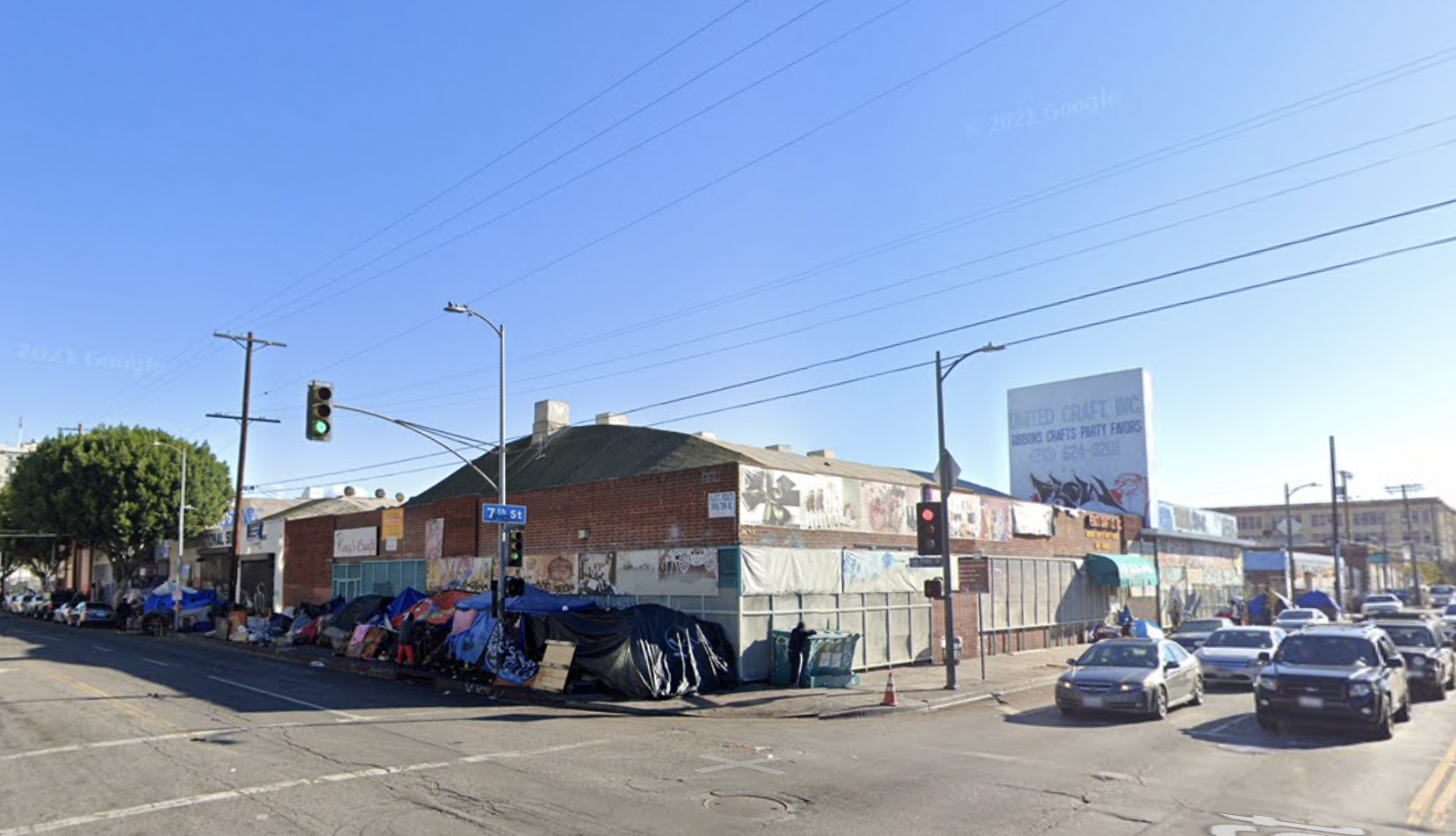
Families from as far away as San Francisco and San Diego arrived for the race, which began at what is now 7th and San Pedro streets.
The track extended 4 1/2 miles south to a wooden stake, where the horses and their riders turned around and headed back to the start.
Springtime mustard plants growing 10 feet tall lined the roadway, making it difficult to see. Bystanders stood in their wagons and climbed trees, gates and rooftops of the occasional house.
As the tension mounted, Sepulveda’s wife, Francisca, arrived in her carriage, holding a fortune in gold coins. Unwrapping her handkerchief, she ostentatiously handed each of her servants and many bystanders a shiny $50 gold piece to bet on the race.
A gasp of astonishment went up when Black Swan appeared, no longer looking like a sickly nag, but sleek with a shiny blue-black mane. Mounted on her back, sitting in a lightweight English saddle, was a small black man, dressed in bright clothing with a small cap turned backward on his head. Atop Sarco sat a hefty Mexican youth in a heavy Western saddle.
…
With so many animals made nervous by the crowds, the starter began the race not with a gunshot but with the cry of “Santiago!”
Sarco jumped out to an early lead, and all those betting on him breathed a sigh of relief. Many leaped to their own horses and followed, tearing through the mustard plants. But the fleet horses soon lost them, and the spectators headed back to watch the finish.
Frenzy gripped the crowd at the halfway mark when Black Swan pulled ahead. Sarco strained every muscle to keep up with the speedy little foreigner.
Nineteen minutes, 20 seconds from start to finish, Black Swan crossed the finish line five lengths ahead. She was bleeding from her nose and flanks from the spurs, and foaming from her mouth.
Racing fans stood around in stunned silence, as others broke down and cried. While Sarco tasted his first defeat, Black Swan, in her moment of triumph, wiped out entire family fortunes. The race contributed to the downfall of Pico, who lost $25,000 and who, more than four decades later, would die penniless.
All that from a 2001 LA Times piece by Cecilia Rasmussen. Not sure her sources, they sound vivid!
The Bowers Museum has a portrait of Sepulveda riding Black Swan:
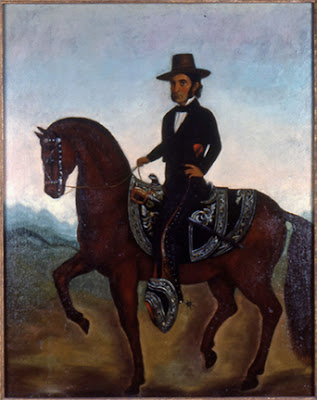
Sepulveda’s son-in-law and a witness to the race wrote later that not much of it could be seen except for the start and the finish because the wild mustard plants stood ten feet high on both sides of the road. Soon after the race Sepulveda took Black Swan to El Refugio, the elaborate adobe home and acreage he had purchased from Domingo Yorba about 1854. El Refugio was located near present day First and Sullivan Streets in Santa Ana. It has been said the family used to feed the horse sugar from the veranda.
A walk beginning at Seventh and San Pedro might be one of the worst nine mile explorations you could make in LA, that’s the butt end of Skid Row.
The poet Fred D’Aguiar took the race as inspiration for a book of poems, For The Unnamed.
For the Unnamed was originally entitled ‘For the Unnamed Black Jockey Who Rode the Winning Steed in the Race Between Pico’s Sarco and Sepulveda’s Black Swan in Los Angeles, in 1852′. That title provided the full narrative in a nutshell: we know the names of the owners of the two horses, we know the horses’ names, the place and date of the race. But apart from his colour, and his victory, we know nothing about the jockey who made the whole thing happen.
(cheers to reader Raj V for putting me on to this tale).
 Helytimes
What a great story! What a bold move to import the horse! I’m a 5th generation Californian, Malibu and West LA raised. I know every name in this story — Pico, Sepulveda, Carillo, Refugio — but was never told the history of these names. Simply fantastic! Dawn (by the way, I’m a lifelong horseperson and farrier) https://soulhorseride.wordpress.com/2024/03/17/physical-labor-building-stamina/