Swisstory (Part One)
Posted: April 13, 2024 Filed under: Uncategorized Leave a commentWe’ll be at the Annecy Animation Festival in June to present the world premiere of COMMON SIDE EFFECTS, hope to see you there! Although Annecy is of course in France, this trip will bring me for the first time to the nation of Switzerland, so I’ve been reading up on her history.
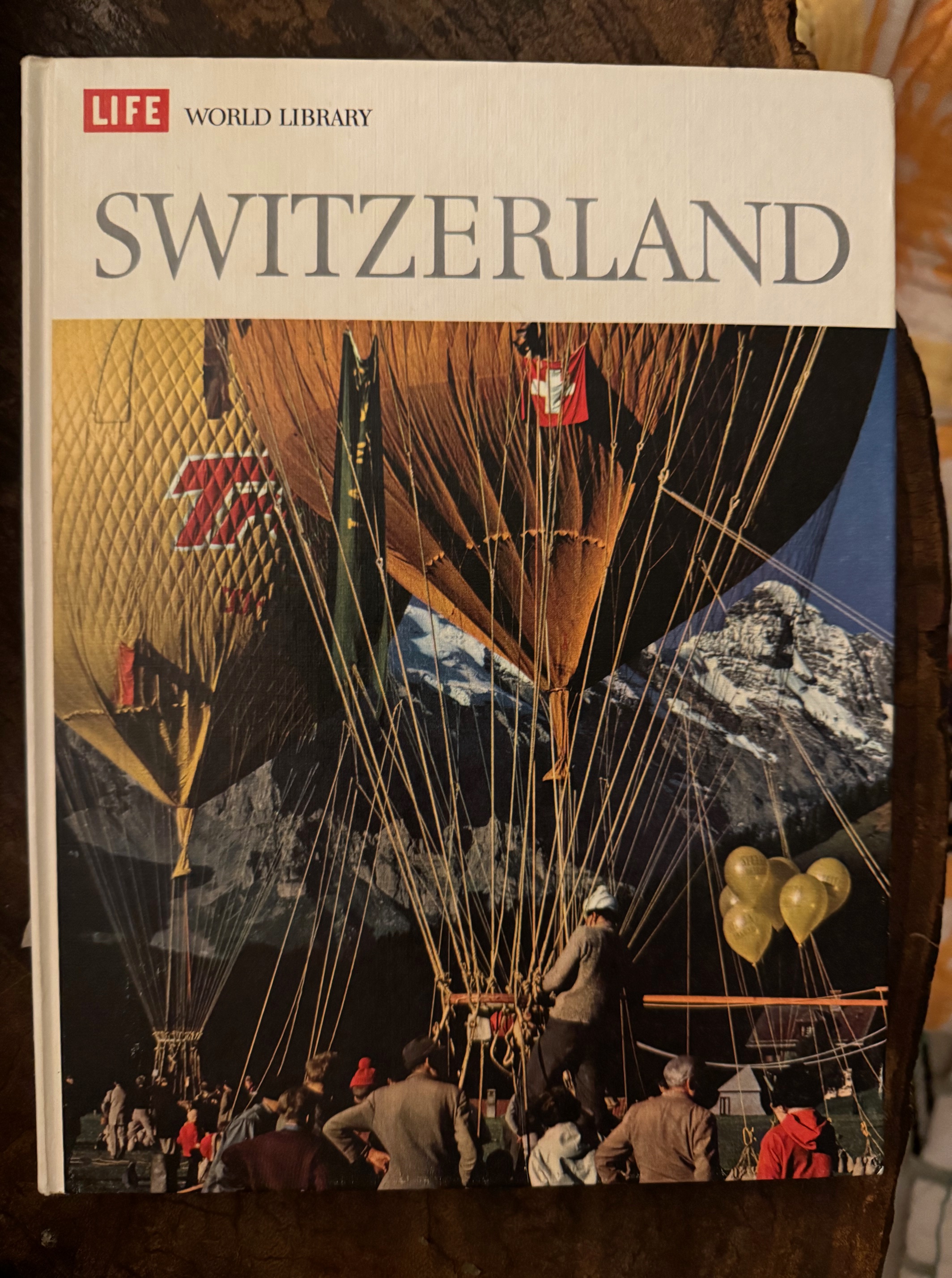
I took Tyler Cowen’s advice and bought a picture book:
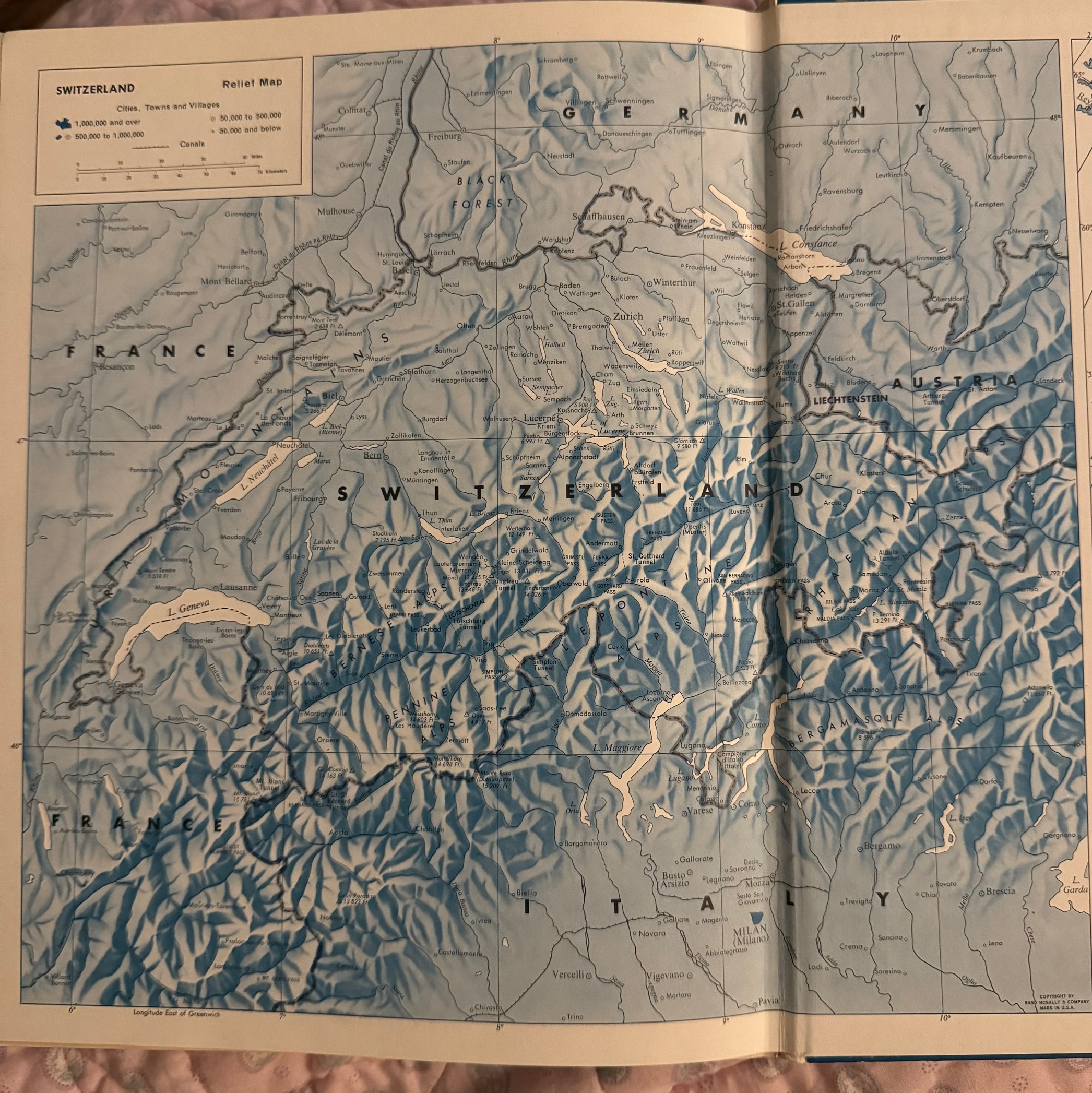
The map in there is really good:
Here’s Google:
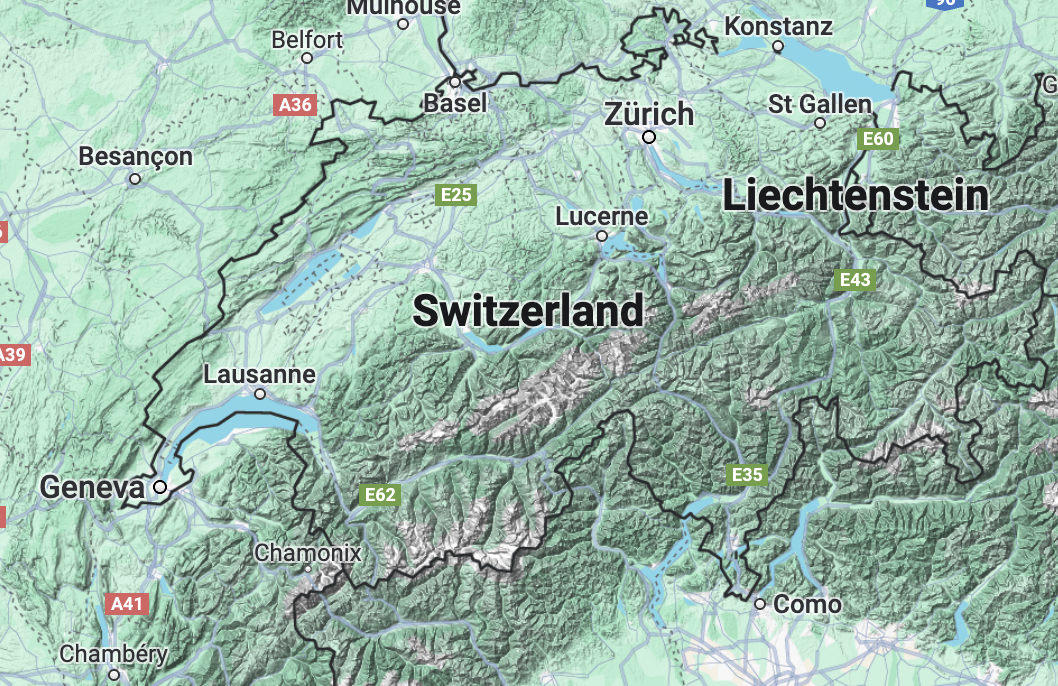
Here’s another map:

As you can see we have the Alps, some tough to traverse terrain, to the south, another gentler spine of mountains, the Jura, running along the northwest, and a juicy plateau in the middle, where you’ll find Geneva, Bern, and on up to Zurich.
Remember Otzi, the Ice Man? Here’s a reconstruction of the withered ice-mummy:
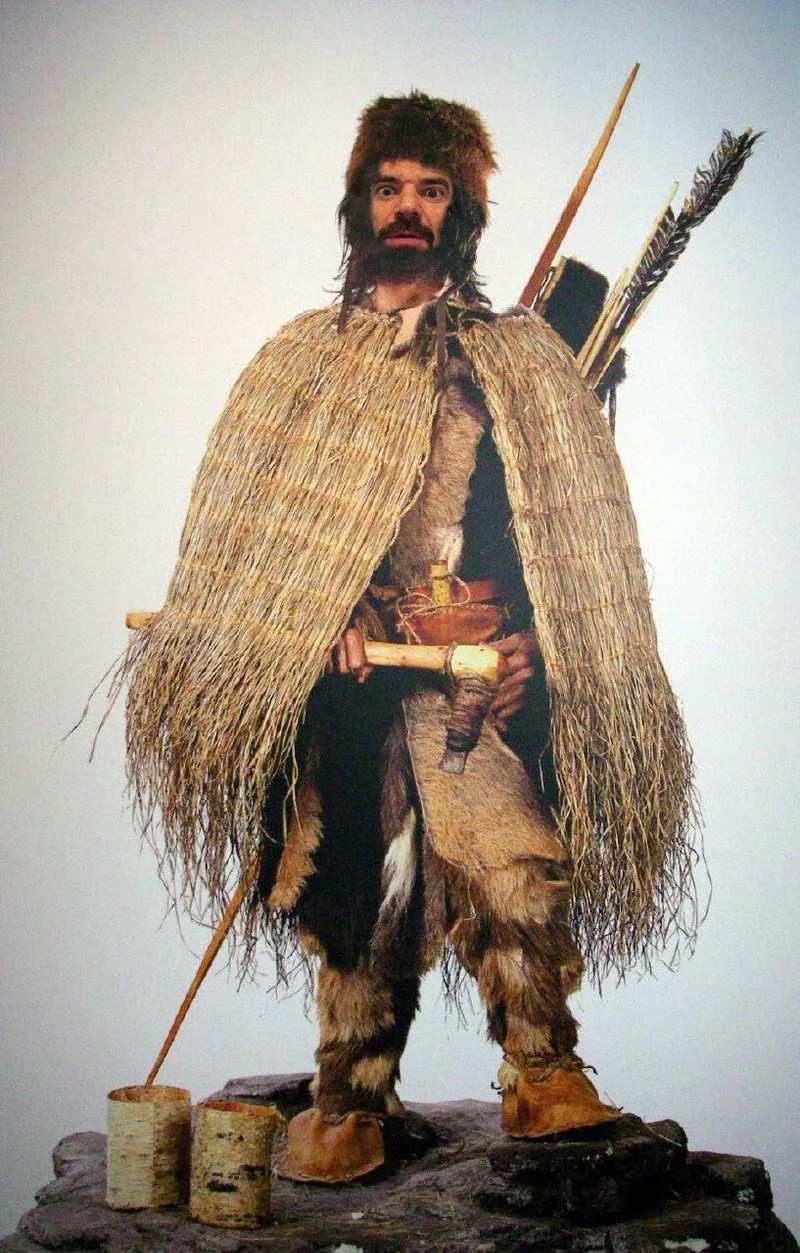
(source)
Otzi was found in the Italian Alps near Austria, and he lived around 3000 BC. Presumably there were wandering ice men and women all over what’s now Switzerland in wayback times. Now you can see Otzi in a special refrigerated chamber in the South Tyrol Museum of Archaeology in Bolzano. His murderer has yet to be identified. Boy, talk about a cold case!
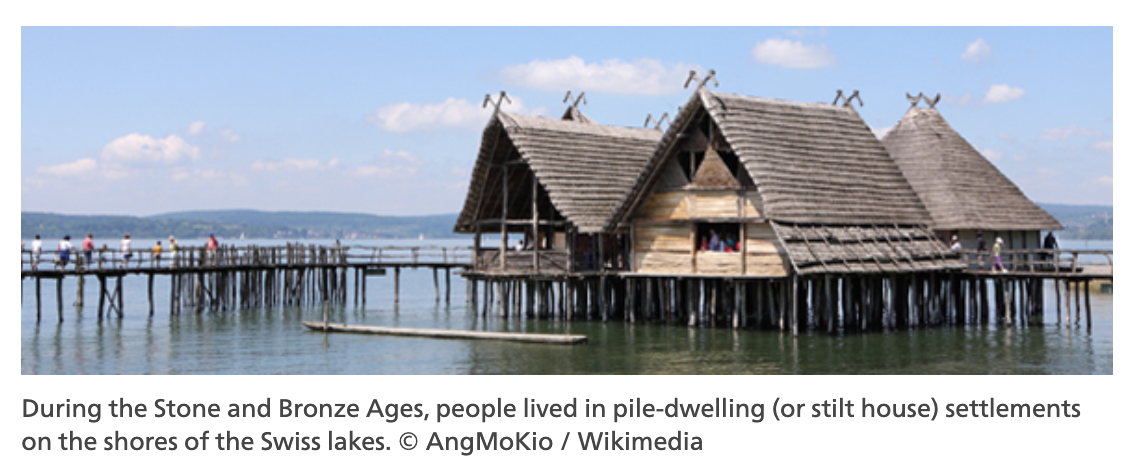
A lucky or industrious iceman might’ve built himself and his family a pile-dwelling. The various alpine pile-dwellings are a UNESCO World Heritage Site. A reach, in my opinion. There’s apparently one in Bourg I may get to check out. Do the people of Bourg live any better now?

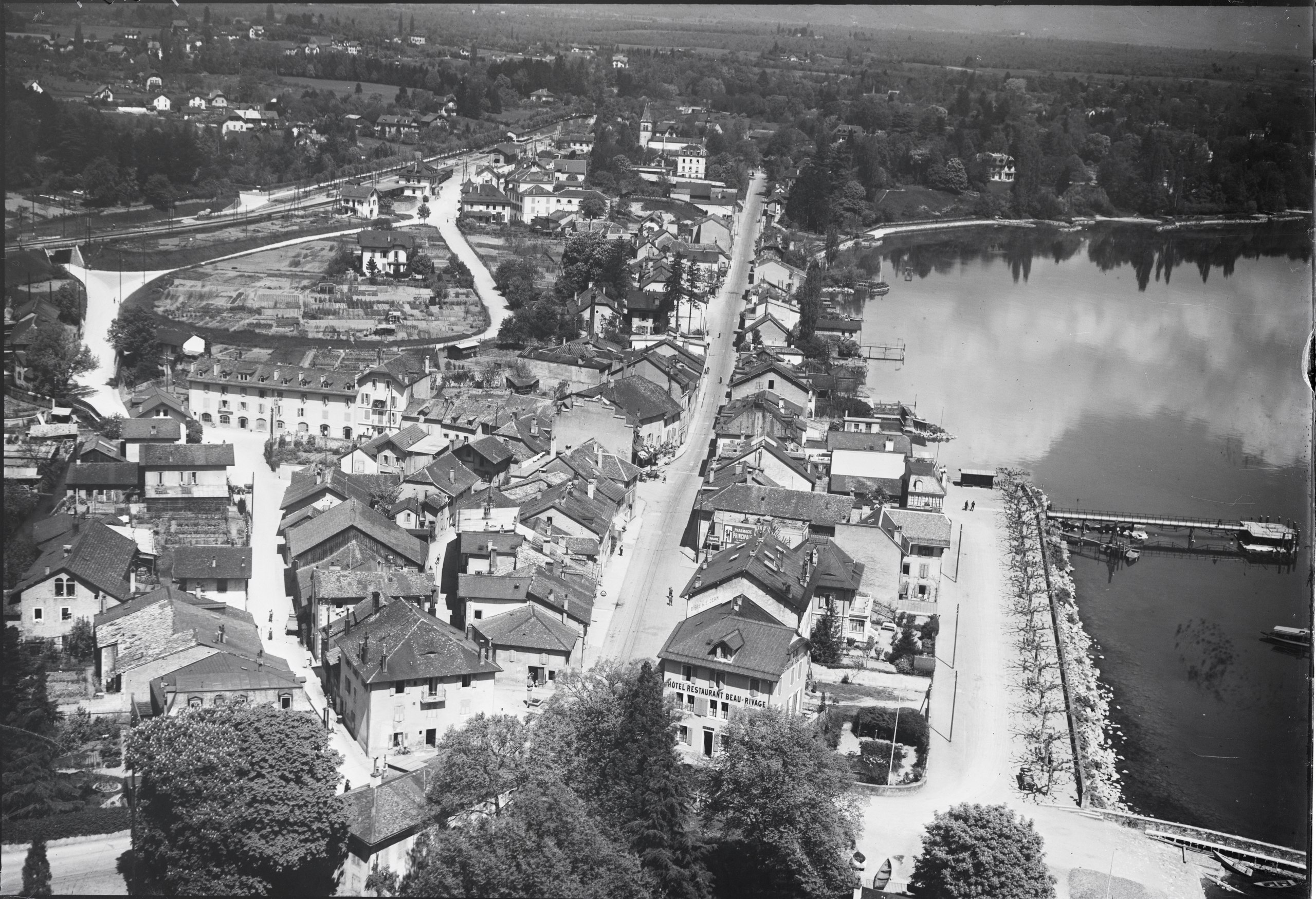
In looking into that I found this cool picture of nearby Versoix, taken in 1925 by aviator Walter Mittelhozer.
But we’re getting ahead of ourselves.
Fast forward from the iceman and the pile houses a couple thousand years. Herbert Kubly, writing the Time Life text, does a great job:
Switzerland was brought into history by Julius Caesar.
Backing up a bit:
During the Iron Age several tribes of barbaric Celts overran the area and one of them, the Helvetii, stayed. By 500 B.C. these Helvetians seem to have shared the land with a wild tribe called the Raeti, from northern Italy. They were not destined to share the land in peace.
Soon restless and powerful Germanic tribes from north of the Rhine began to press relentlessly southward.
Driven westish by these invaders, the proto-Swiss met the Romans in what’s now France. There they scored a win at Agen, in what’s now France.
According to Caesar, the captured Roman soldiers were ordered to pass under a yoke set up by the triumphant Gauls, a dishonour that called for both public as well as private vengeance. Caesar is the only narrative source for this episode, as the corresponding books of Livy’s histories are preserved only in the Periochae, short summarising lists of contents, in which hostages given by the Romans, but no yoke, are mentioned.
This episode was painted by Swiss artist Charles Gleyre:

Gleyre also did a nice portrait of Sappho:

That’s now in the Musee Cantonal des Beaux Arts in Lausanne, I hope I have a chance to view it.
In any case the Helvitii victory was short lived. Caesar went after the bad boys of the plateau. Says Kubly:
In 58 B.C., a great column of men, women and children, with their cattle and provisions, started westward toward what is today southern France, their goal the mouth of the Garonne River and the Atlantic coast.
It was this attempted tribal relocation that ushered Switzerland onto the stage of world 25 history. Southern France was a Roman province and Caesar was understandably reluctant to have this disrupting human tide cross his territory. He rushed 700 miles from Rome to Geneva in eight days, marshaled six legions and defeated the Alpine tribesmen in a battle near the present-day French city of Autun. After the defeat, Caesar ordered the Helvetii to stay home.
Another version:
In 58 BC, Julius Caesar prevented the Helvetians from leaving the Swiss plateau when they wanted to avoid the Germanic incursion from the west by migrating to the south of France. They were stopped by Julius Caesar at Bibracte (Montmort near present-day Autun, Burgundy, F). He sent the Helvetians back and settled them as a “buffer people” under the control of the Roman army. After Caesar’s death, the Romans, now under Emperor Augustus, increased their influence over Swiss territory.
so says the Swiss tourist board, which has a great website. Here’s a nice Roman arena at Aventicum/Avenches:
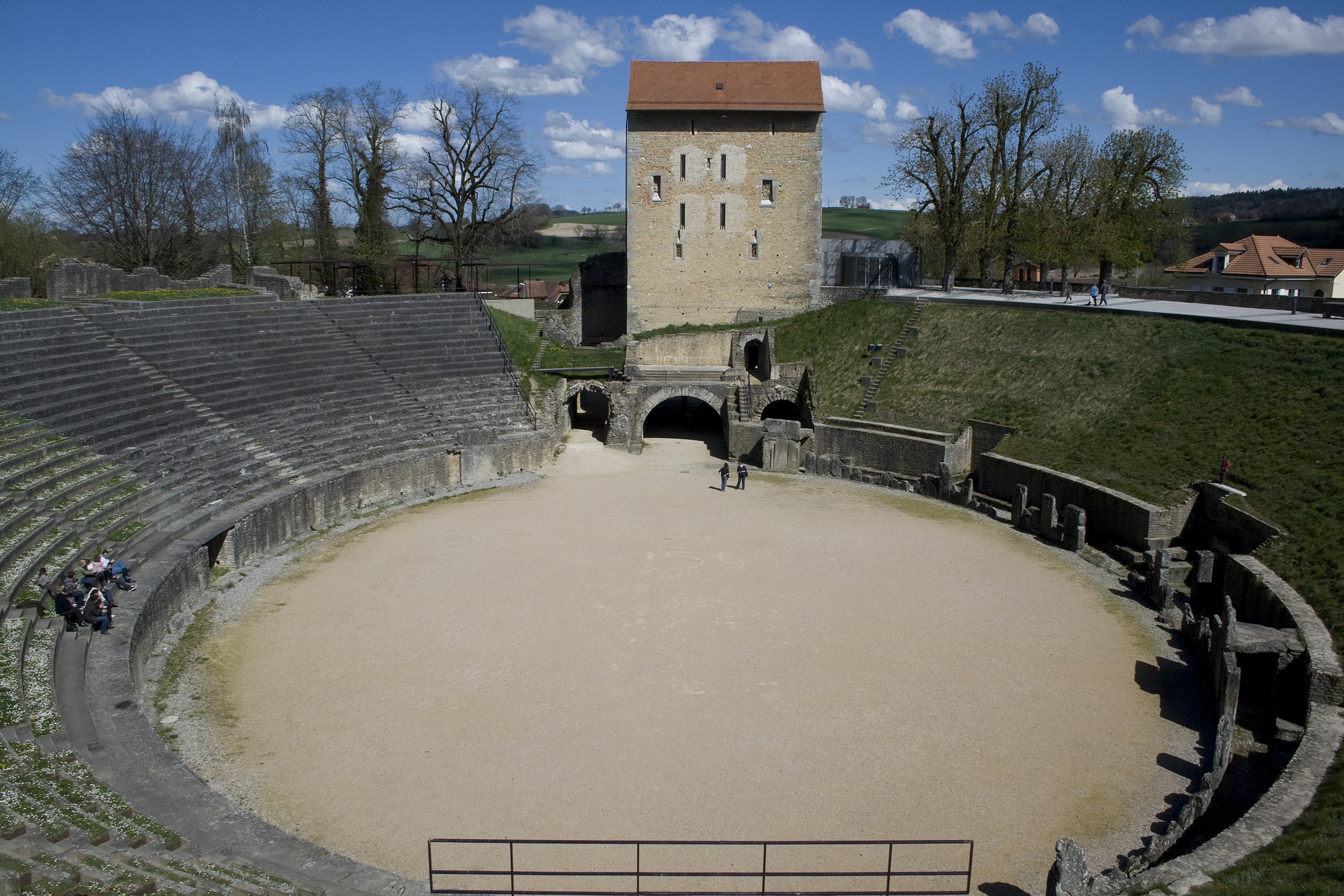
(source: Ludovic Péron for Wiki)
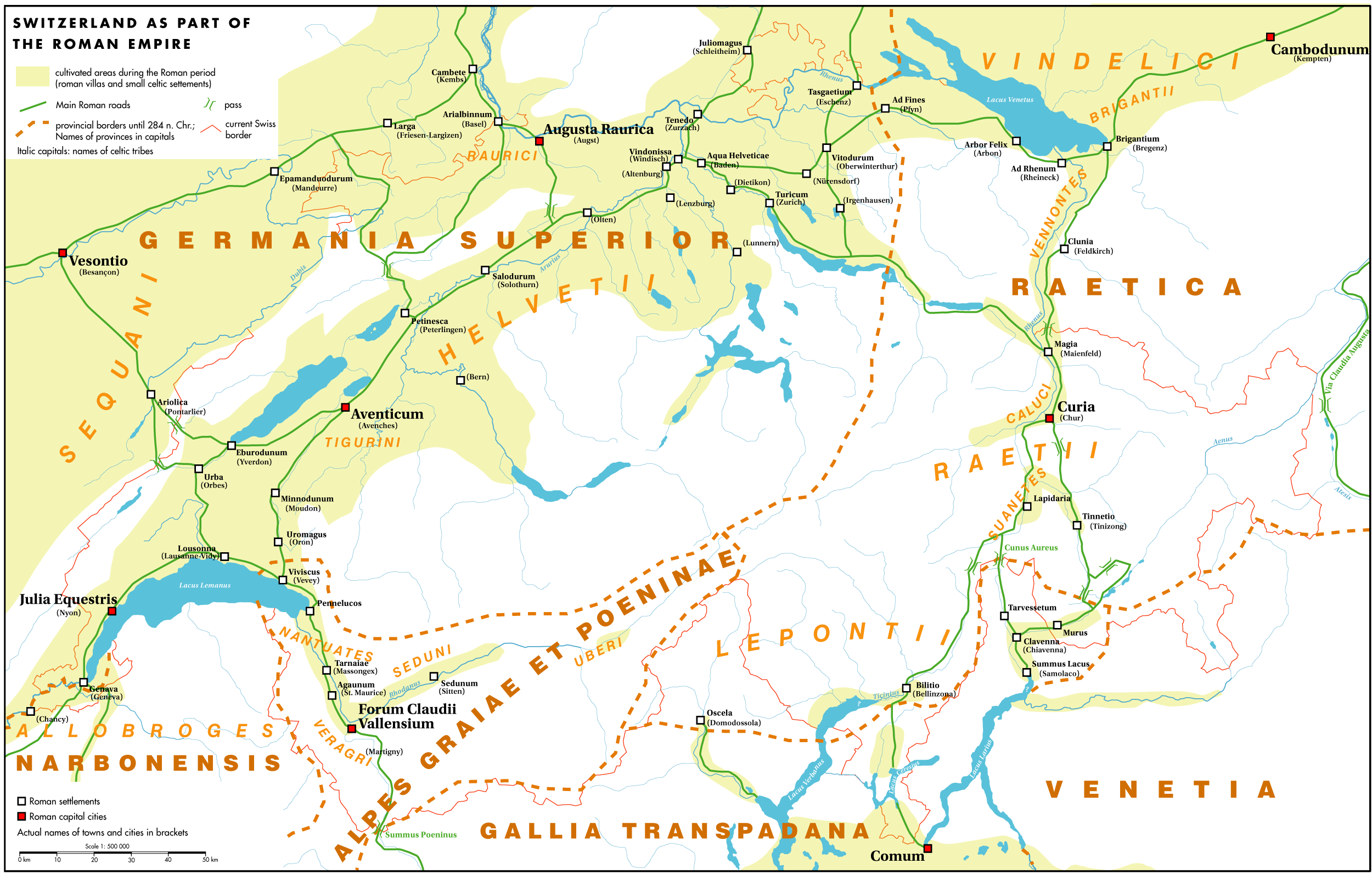
There were some Roman outposts in Switzerland:
and it seems like it was mostly a good time:
The hundreds of villae found in Switzerland, some very luxurious, attest to the existence of a wealthy and cultured upper class of landowners. Many villae belonged not to Roman immigrants, but to members of the Celtic aristocracy who continued to hold their lands and their rank after the Roman conquest. Of the lower classes, much less is known, although there are inscriptions attesting to the existence of guilds (collegia) of boat skippers, doctors, teachers and traders, as well as to the existence of a trade in slaves.

A Roman era arch on Lake Geneva, thanks Hapax.
Says Kubly:
Over the succeeding centuries the troops and the Roman governors established Roman law and built towns with palaces, temples and amphitheaters. They introduced cherries and chickens to Helvetian agriculture and improved cattle breeds and the cultivation of vineyards.
Their most enduring enterprise was the construction of roads with which they crisscrossed the country, including a road over the Great St. Bernard Pass which assured permanent communication between Italy and the north.
Then it all went to hell. The “catastrophe of 260” led to the place being overrun by warlike German tribes, the Romans retreated, they were gone completely by 454 AD.
There’s a small little nook of Switzerland where people still speak Romansh, which is something like Vulgar Latin.
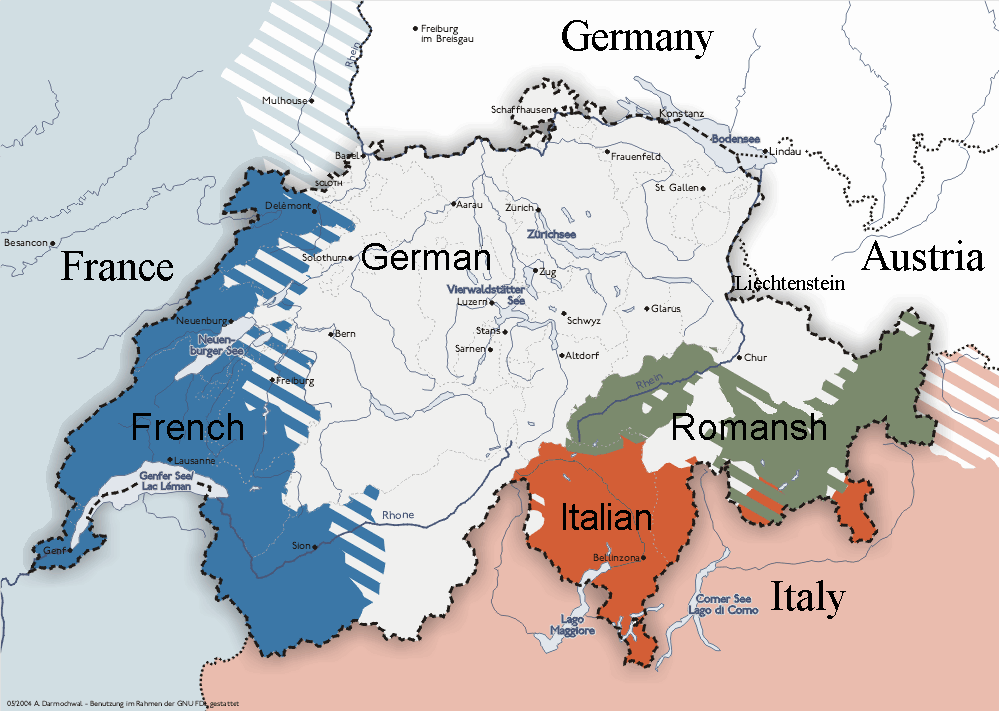
(source)
But mostly the Germanic / Frankish peoples would be running the show in what’s now Switzerland from now on.
Now we enter a period where like four or five hundred years goes by and very little is recorded, aside from the occasional mention of a monastery or something. What the hell was happening? “I’m in the dark here” as Al Pacino says in Scent of a Woman. It’s unfashionable to call it the Dark Ages, but… it was dark! Like literally, there was probably very little light. World Lit Only By Fire as William Manchester titled his fascinating and bizarre book. People livin, dyin, lovin. All vanished.
Says Kubly, deftly summarizing a few centuries of what must’ve been intense struggle times:
With the Romans gone, two Germanic tribes gradually took over Switzerland. The Burgundians moved in from the west. The Alemanni, invading from the north, gradually pushed the Burgundians to the Sarine River, which became the border between the two and established permanently the division which still exists today between Switzerland’s French- and German speaking peoples.
In the Sixth Century both tribes came under Frankish rule, and the country eventually became a part of Charlemagne’s Holy Roman Empire. After Charlemagne died in 814, his descendants fell to bickering among themselves and Switzerland was once again divided, this time between two of Charlemagne’s grandsons who ruled upper Burgundy and Germany. In 888, a minor despot named Rudolf seized part of the old Burgundian territories and had himself crowned ruler.
When we come back: oaths, Eidgenossenschaft, and the Bern Book.

Santa Anita Derby
Posted: April 5, 2024 Filed under: Uncategorized Leave a comment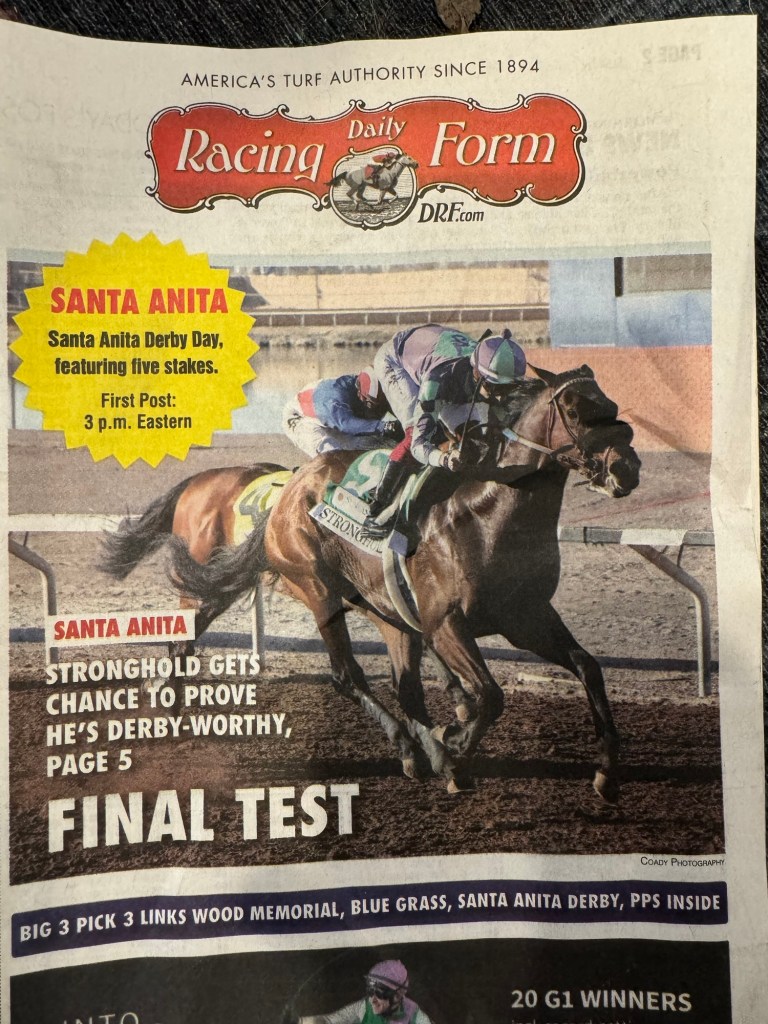
Tomorrow at Santa Anita an interesting Derby is shaping up.

Sort of a good vs evil thing against Bob Baffert’s Imagination
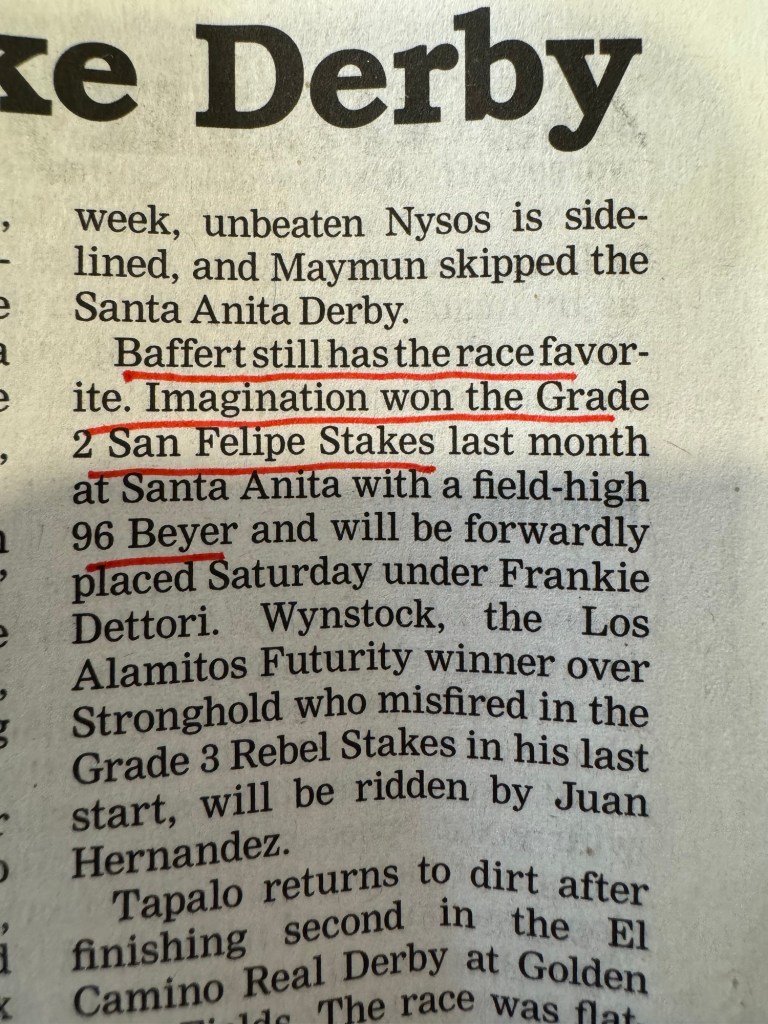
Plus we can’t rule out Wynstock.
Scale
Posted: March 19, 2024 Filed under: Uncategorized Leave a comment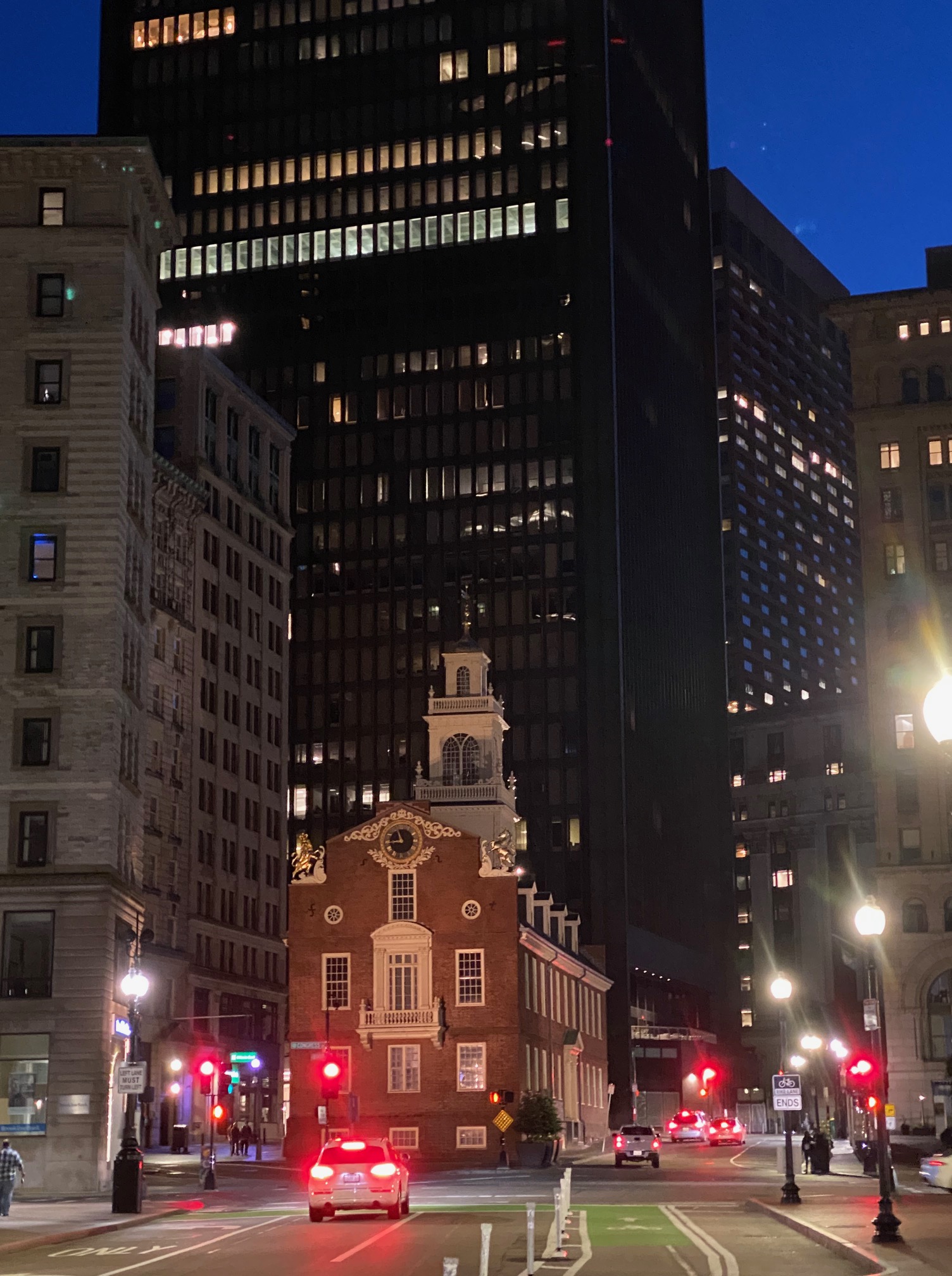
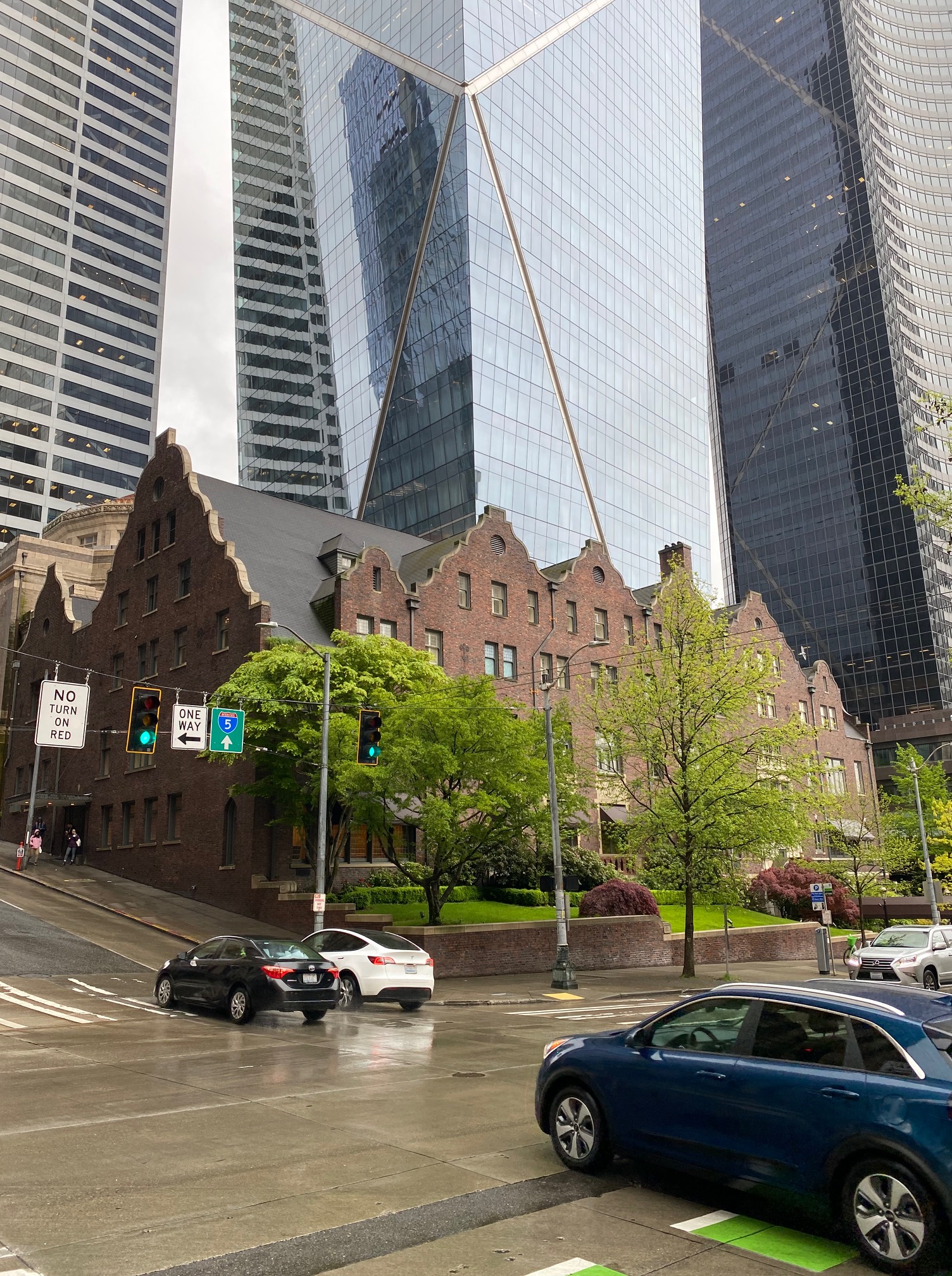
Sometimes I’m struck by how jarring a transition in scale has occurred in human life in the last few hundred years. Sure, there’ve been all kinds of massive changes in information speed, travel speed, etc. But don’t ignore simple scale of size. What was considered a big, grand, monumental building in 1776 is now dwarfed by even a mundane office building. Or take the Rainier Club in Seattle:
A good list to review:
https://en.wikipedia.org/wiki/List_of_tallest_structures_built_before_the_20th_century
Texas
Posted: March 12, 2024 Filed under: Uncategorized Leave a comment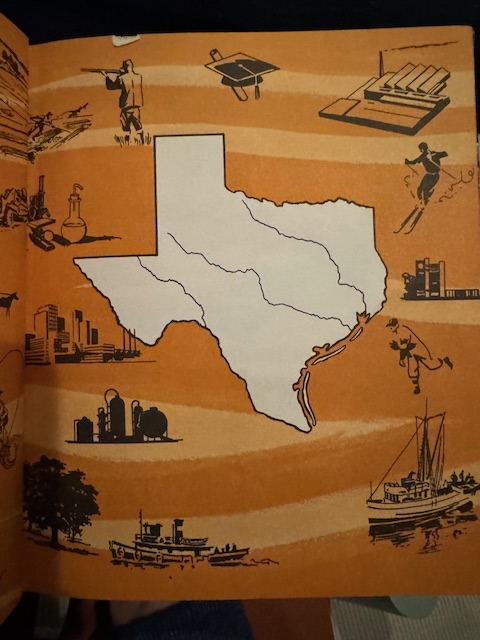
Can you name these major rivers of Texas? from this excellent book my wife got at the thrift store:

I’ve been reading it to my daughter (she finds it somnolent).
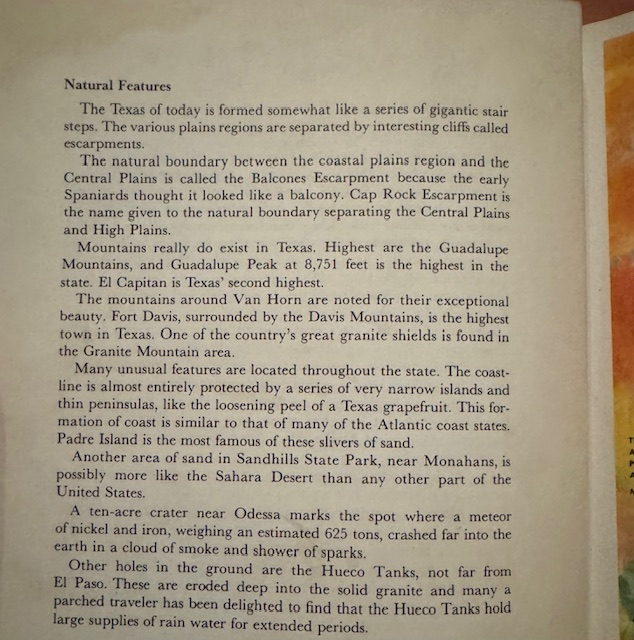
Pretty map:

The importance of bird hunting in American politics
Posted: January 14, 2024 Filed under: America Since 1945, birds, Uncategorized Leave a comment
JAB III used to turkey hunt with Lawton Chiles despite being in opposing parties. According to JAB that paid off during the 2000 Florida recount:
BAKER:
Jeb ran against Lawton Chiles in a very divisive and semidirty race. I had become a good friend of Lawton because I was Treasury Secretary and he was Chairman of the Senate Budget Committee. We did a lot of work together. He was an adversarial Democrat and I was an adversarial Republican, but we both liked to turkey hunt. He would invite me to Florida to hunt turkeys and I would invite him to Texas to hunt turkeys. I would call the turkeys for him and he would shoot them, and he would call them for me and I would shoot them.
One thing that really paid dividends with respect to the Florida recount—I know I’m jumping ahead of you here—Before I’d gotten over there, but it was reinforced after I’d gotten over there, I remembered the types of people that Lawton had appointed to the Florida Supreme Court. I’d probably met some of them. There was a guy named Dexter Douglass—You may remember who that was.
RILEY
He shows up in your book.
BAKER
In my book, yes. He was an advisor to Lawton. He was the guy who told Lawton whom to put on the Florida Supreme Court. He gave him advice about which lawyers to put on. They were all liberal trial lawyers. So when I got to Florida I was of the view, pretty much right off the bat, that if we weren’t able to get this into federal court we had a really tough row to hoe. As it turned out, that was very true. The Florida Supreme Court pulled us out twice, once in the face of a direct order from the United States Supreme Court to review their opinion—They reversed an earlier opinion. So that relationship I had with Lawton Chiles really paid dividends when it was time to go to do the recount.
There was a significant moment in George W. Bush’s governor campaign in Texas that turned on how he handled accidentally killing a killdeer, the wrong kind of bird, during a publicity event on the first day of bird hunting season. Here’s Karl Rove:
Then also, the famous killdeer incident had a big impact, because it showed—Her attitude toward good old boys was condescending. She felt she needed to placate “Bubba” by every September first going dove hunting in East Texas, outside of Dallas. Of course, she was not a hunter, she could care less, but it was a nice show and she’d get a nice picture for the newspapers. Bush went dove hunting and shot a protected bird, a killdeer, and when he discovered that he had done so, after a sharp-eyed television sports reporter noticed that the white markings on the bird meant that it was a killdeer, Bush’s response was not to deny it, but to dispatch a young aide to the game warden’s office to pay the fine immediately.
Then there was the incident where Cheney shot his buddy in the face by accident. Rove:
Rove
On my lease, and that was my lawyer. I was shocked that fact never came out. If you go back to incorporation papers of Rove and Company in 1981, my lawyer, the secretary/treasurer of my corporation, and my landlord is Harry M. Whittington Jr., and that’s the guy Cheney shot. The press corps never figured it out, but could you imagine the headline in the Washington Post? “Cheney Shoots Rove’s Lawyer in Sign of West Wing Tension.”
Riley
Did you get a funny feeling in your stomach when you got that news?
Rove
We could not get Cheney to make it public, and we needed to. It took until the next morning, before Cheney allowed Katharine Armstrong to feed the news to a reporter at the Corpus Christi Caller-Times. The White House press corps was furious with us for having hid this fact from the afternoon and to the next morning.
Why did Cheney’s team bungle releasing that news? Dan Bartlett, W. communications director, explains:
The second one is when he shot Harry Whittington and he shut down all internal communication. We couldn’t get hold of him, couldn’t get hold of his staff. Only learned later that there were some back channel communications with Karl, but they decided that no one in the world would understand or have context for him accidentally shooting somebody while hunting except for one reporter at the Corpus Christi Caller-Times who they couldn’t find because she was on a drunk bender for 12 hours. It took that long to find her.
in good news
Posted: October 8, 2023 Filed under: Uncategorized Leave a commentIn good news, we saw Reba McEntire at Terroni
Reno
Posted: September 16, 2023 Filed under: Uncategorized 1 Comment
Reno, Nevada named for Jesse Lee Reno:
He was brought by stretcher to Brigadier General Samuel D. Sturgis’s command post and said in a clear voice, “Hallo, Sam, I’m dead!” Sturgis, a long-time acquaintance and fellow member of the West Point Class of 1846, thought that he sounded so natural that he must be joking and told Reno that he hoped it was not as bad as all that. Reno repeated, “Yes, yes, I’m dead—good-by!”, dying a few minutes later.
Jesse Lee Reno made an impression at the time. There was a Fort Reno as well that turns up in reading on the Plains. Nothing suggests Jesse Lee was related to the unfortunate Marcus Reno of the Little Bighorn incident.
I learn in Tom Hanks interview on Rick Rubin’s podcast that Hanks spent some of his boyhood in Reno. In this interview I think Rick asks Tom about four questions, that’s enough to generate two hours of interesting content.
Trevor Bexon took that photo of Reno (the city) for Wikipedia. We were not enamored of Reno, the city on our visit there last summer. The best thing you can do in Reno is drive away to Lake Tahoe.
we’re all eating wood pulp
Posted: May 13, 2023 Filed under: Uncategorized Leave a comment
This piece in Bloomberg by Ken Parks about a wood pulp mill in Paraguay caught my attention. In trying to learn about “tons of cellulose” as a product and measurement I learned that they really mean like plant meal, which we then eat.
A 2014 NPR piece by Allison Aubrey sums it up with the headline: From McDonald’s to Organic Valley, You’re Probably Eating Wood Pulp
but don’t worry, the people putting wood pulp in our food say that it’s fine:
“A good way to think about it is to ask: Would our food be any better or worse if the cellulose used was sourced from another plant?” And Coupland says the answer is no. “Cellulose is just a molecule, and probably one we want more of in our diets.”
“Ah, yes, the ‘wood pulp in cheese’ stories,” Elizabeth Horton of Organic Valley responded to us when we asked her about the headlines.
Paraguay has had a rough go, something like half the country or more died in some meaningless war in the 1860s. The photos of it can look eerily like photos of our Civil War, happening at the same time.

Coachella
Posted: April 16, 2023 Filed under: Uncategorized Leave a comment
125,000 some people expected each day – would that make the concert and arts and unofficial fashion festival California’s 49th biggest city, somewhere ahead of Clovis and behind Pasadena? For two weekends anyway.
An “ARTIST A PASS” ticket costs $9,495 through a secondhand retailer.
Is it interesting that of the biggest acts at Coachella in 2023, several perform in a blended English/X language? Spanish for Bad Bunny, Korean for Blackpink? Are we evolving a new global pidgin of pop?
The Coachella event I would’ve most liked to have attended, even more than Beyoncé, might be AC/DC, 2015. When they played their first chord the ground was said to shake in the farthest parking lot. A feeling more body than sound. Felt in the bones.
How The World Really Works and Natural Gas
Posted: February 19, 2023 Filed under: America, America Since 1945, energy, Uncategorized Leave a comment
In my ongoing effort to understand how the world really works, I started listening to How the World Really Works by Vaclav Smil. Smil has a cool origin story:
Growing up in a remote mountain town in the Plzeň Region, Smil cut wood daily to keep the home heated. This provided an early lesson in energy efficiency and density.
Now he lives in cozy Manitoba. Great introduction to the man:
“I have never been wrong on these major energy and environmental issues,” he says, “because I have nothing to sell.”
How the World Really Works can be a tough listen at times, because the gist of it is there are no easy answers, anything’s gonna require tradeoffs. One big takeaway: we’re not getting off fossil fuels any time soon. Sometimes though Smil has a rhetorical flourish that’s sort of fun. Much like Paul Johnson’s Birth of the Modern, however, the book is so overwhelming, so full of information that the result can be a glum feeling as I’m reminded of how much I don’t know, how complex everything is, it can be paralyzing. I see I’m in good company feeling this way:
After reading his first Smil book, [Bill] Gates “felt a little beat up. … Am I ever going to be able to understand all of this?” But he ultimately concluded that “I learn more by reading Vaclav Smil than just about anyone else.”

Natural Gas on the other hand I found quite exciting. Methane, ethane, and propane: you can see why Hank Hill loved the stuff. Smil, impartial though he tries to be, seems to have a soft spot of natural gas.
inhabitants of large northern cities hardly ever think about having their gas supply interrupted because such experiences are exeedingly rare.
Where does this wonderful gas come from?
Methane is produced during strictly anaerobic decomposition of organic matter by species of archaea, with Methanobacter, Mathanococcus, Methanoscarina, and Mathothermobacter being the major methanogenic genera
Here’s some methanobacter:
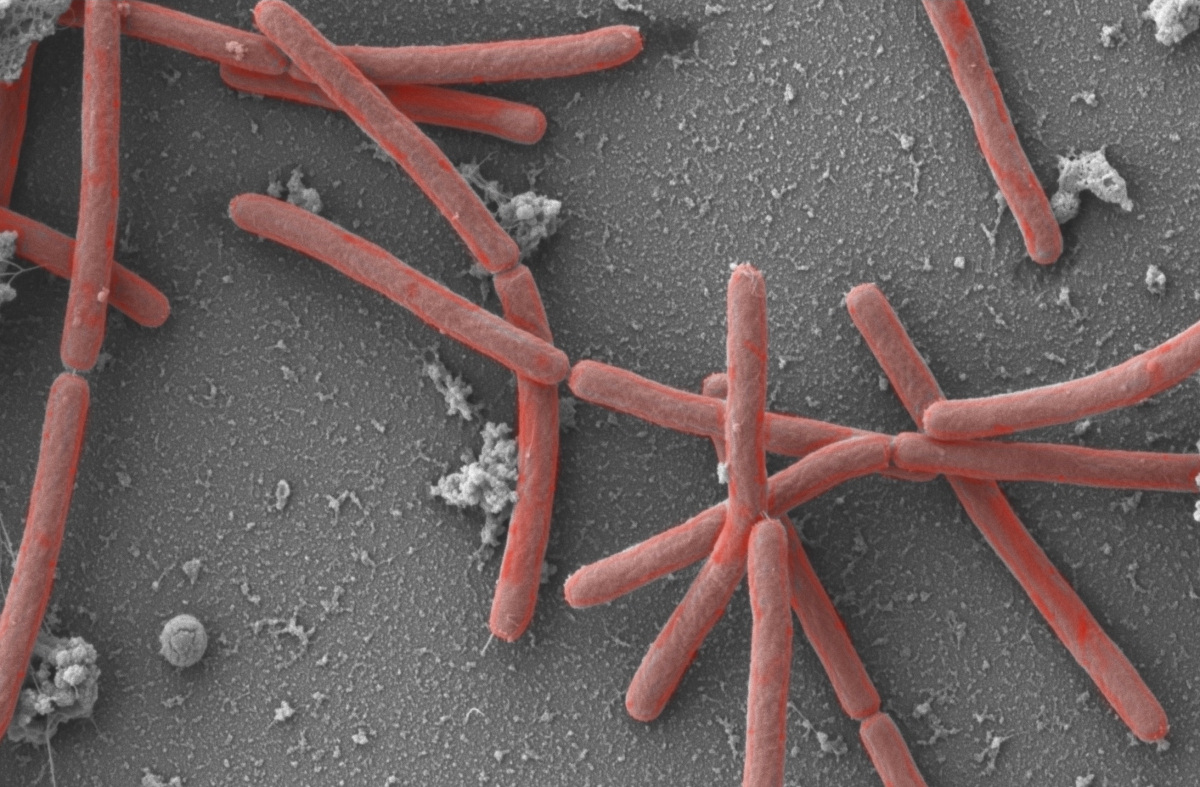
So we’re talking about the released gases over three billion years or so from prehistoric swamps. It might seem crazy that all that gas comes from the breathing out of life forms. And indeed, some have questioned that:
But what if hydrocarbons were of inorganic, rather than biogenic, origin? That was assumed by Dmitri Ivanovich Mendeleev, Russia’s leading nineteenth-century chemist, and that has been an alternative to the biogeneic explanation offered by the so-called Russian-Urkanian hypothesis about the abiogenic formation of oil and gas in abyssal environments. … Porfir’yev (1959, 1974) had also argued that abiogenic formation of giant oil fields is a better explanation of their origins than assuming truly gigantic accumulations of organic material that would be needed to create such structures…
The American Thomas Gold got in on the act. An astrophysicist, he pointed out that methane exists on planets apparently devoid of life, and theorized that methane:
can from by combining hydrogen and carbon under high temperatures and pressures in the outer mantle, and after this mantle-derived methane migrates it is then converted to heavier hydrocarbons in the upper layers of the Earth’s crust
After giving that a fair hearing, Smil says
I will note here half a dozen of major realities that undermine the abiogenic hypothesis
Submanticular squeezing, the exhaust of ancient wetlands, either way, it’s valuable stuff! The invention of liquified natural gas and compressed natural gas are remarkable examples of human ingenuity, and there may be more to come, but Smil, as usual, notes that energy transitions take a long time, and it won’t be soon that we convert all trucks to methane.
[Energy transitions] incremental progress can be accelerated or retarded by specific policies – but only rarely do such measures result in truly revolutionary shifts; energy systems are too complex and generally fairly long-lived and hence too inertial to be rapidly redirected by deliberate action designed to change their fundamentals. Grand plans aimed at their basic redesgn thus have a very low probability of success, and we are left trying to do the best we can to nudge the process in what we think is the best direction – but we still must keep in mind that, in retrospect, we may find such actions not as beneficial as we thought them to be at the beginning.
It’s not that we haven’t tried to occasional big swing. Smil notes about natural gas extracting:
one of the methods that was not just proposed, but actually tried several times in the United States is truly incredible (an adjective used with restraint).
That was the Plowshare Program, where we detonated underground nuclear bombs to try and loosen up natural gas.
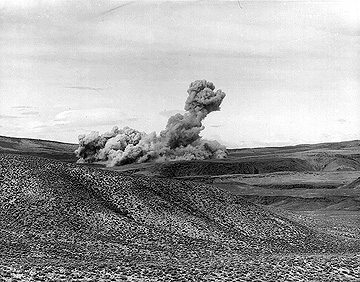
Source on that. Here they are loading up Gasbuggy:
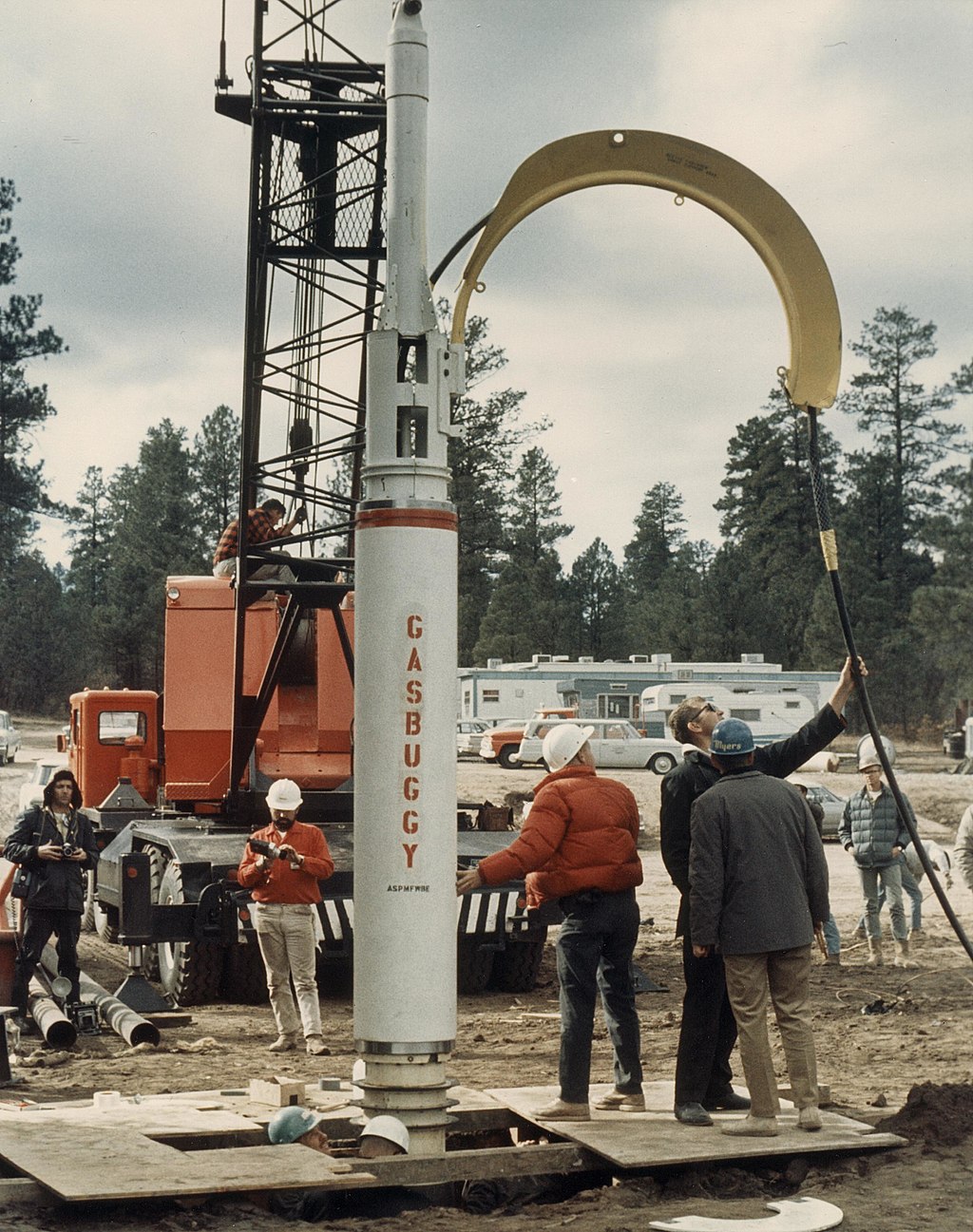
Smil:
Reading this four decades later has only increased the sense of incredulity: how could these frequent detonations be ever justified in net energy terms, and how could regular detonation of powerful nuclear bombs underneath the grassland, fields and forests of the American West be accepted by the public as routine means of producing gas used for heating and cooking?
Didn’t work.
Crevasse
Posted: December 19, 2022 Filed under: Uncategorized Leave a comment
I looked up the Wikipedia page for Crevasse and found this photo:
The glacier Taschachferner below the Wildspitze (left, 3.768 m) in Tyrolia in Austria in April 2005. There are some zones with large open crevasses, e.g., the spot-shaped area below the middle of the image and most right. The line marks the ascent track of mountaineers on skis which intentionally avoided these dangerous areas.
Here is the source. Thanks and good cheer to my many thousands of readers, other projects have diverted me from making regular updates to this website but I appreciate you and our shared enthusiasms!
That’s where the juice comes from
Posted: August 29, 2022 Filed under: Uncategorized Leave a commentTraditional sportsbooks are market makers. They set a betting line—the Cubs will win by two runs or more, for example—to attract a roughly equal number of wagers on each side while keeping a small amount for themselves. DraftKings and competitors start with the same approach, but other techniques they use are controversial and likely to attract regulatory scrutiny if the apps draw tens of millions of new customers, as many analysts expect.
The companies harvest user data to ensure that losing bets outnumber winning ones. This process starts with the companies’ ability, so far permitted by state regulators, to profile customers based on betting histories and limit the size of wagers from those expected to win, much like traditional casinos kicking out sharps from the blackjack table. The apps use internal ratings to target the biggest losers, marshaling online tracking technology in a way that casinos—which once handed out rolls of quarters to entice repeat business—could only have dreamed of. DraftKings and FanDuel hire spokespeople, often retired athletes, to pitch risky multi-leg bets that aren’t likely to pay out. In states where it’s allowed, the ultimate prize is cross-selling sportsbook customers into online casino games. “That’s where the juice comes from,” Adam Kaplan, FanDuel’s general manager and vice president for content until last year, said at an industry conference in New York in April.
from this Bloomberg piece about the DraftKings bar coming to Wrigley Field.
The Open
Posted: July 16, 2022 Filed under: Uncategorized Leave a comment
(Gordon Hatton for Wikipedia)
What with The Open going on I was reading up on The Old Course. Bobby Jones:
After he received the key, he said “I could take out of my life everything but my experiences here in St Andrews and I would still have had a rich and full life.”
I believe that monument you can see in the background commemorates some Protestants who were burnt at the stake.
authenticity / domain expertise
Posted: June 29, 2022 Filed under: Uncategorized, writing, writing advice from other people Leave a comment
Have been mulling over Paul Graham’s statement here: does this apply to all writing? Think on the compelling novels. Don’t they usually combine authenticity and domain expertise? Even if the domain expertise is gained by a passionate amateur, as in Tom Clancy.
Last terrific novel I read was Elif Batuman’s Either/Or: authenticity and domain (Harvard, literary studies, sexual trauma) expertise? Check and check on that one.
Or here’s John Grisham:
I read a lot of books written by other lawyers–legal thrillers, as they are called–I read them because I enjoy them, also I have to keep an eye on the competition. I can usually tell by page three if the author has actually been in a fight in a courtroom, or whether he’s simply watched too much television.
(Grisham in that speech itemizes three essential elements of voice: clarity, authenticity, and veracity).
Or how about Ellison on Hemingway‘s authenticity and domain expertise:
when he describes something in print, believe him
Somewhere Shelby Foote said that the reason his Ken Burns interviews were compelling was simply that he knew what he was talking about, he’d been thinking, reading, writing about the Civil War for twenty years. (He still got some stuff wrong).
Is it that simple? Is the key to writing just 1) being genuine and 2) knowing what you’re talking about?
Gotta work on this.
How To Be Rich by J. Paul Getty
Posted: April 21, 2022 Filed under: Uncategorized Leave a comment
Couldn’t resist purchasing this handsome volume in the bookstore of the Getty Center (cheers to MLo for the invitation). I like that the title isn’t “How To Get Rich” but “How to BE Rich.”
On page 2 he gives away one of the formulas: have a rich dad!

I’ll report back when I finish the volume. First: Jimmy Buffett’s autobiography.
More on sugar ruination
Posted: April 20, 2022 Filed under: Uncategorized Leave a commentReading up on the Pintupi Nine, a band of Australian Aboriginal people who walked out of the desert and encountered white people and their creations for the first time in 1984. More evidence on the power of sugar over the human mind:
McMahon did not want to put the group under any pressure to join the community, but he witnessed the moment they were persuaded. “It was unthinkable that they would stay out there because the modern world was so seductive. One of the fellows suggested, ‘Give them a taste of the sugar and they’ll be in for sure.'”
Indeed, the taste of sugar had a big impact on the Pintupi Nine and it is this aspect of their story which now animates them most. “I tasted the sugar, we didn’t know what it was, but it was so sweet. I tasted the sugar and it tasted so sweet – like the Kulun Kulun flower. My mother tasted it and it was so sweet. It was good,” says Warlimpirrnga.
That was that for bush life.
Checking out the news
Posted: March 20, 2022 Filed under: Uncategorized Leave a comment
That’s over at the Wall Street Journal. Am I supposed to use this information to trade stocks?

Now that one’s tradable. (Imagine being the couple chosen to illustrate this headline!) Observed this phenomenon in Santa Fe, overrun with flush Boomers on Indigenous Peoples Day weekend, threatening the very specialness they were seeking (or was it the other way round?)
East Coast Greenway
Posted: March 20, 2022 Filed under: Uncategorized 1 Comment
I gotta check the ECG out next time I need a three thousand mile stroll. Do we need a West Coast Greenway? (obv). Idgar Sagjedev gets credit for this picture from the American Tobacco Trail segment:

so the caves are the stars?
Posted: February 19, 2022 Filed under: Uncategorized Leave a comment
Christopher Reynolds writing about Pinnacles in the LAT, “Why are so many people heading to California’s newest national park?”
Hello on the Steps of Friendly Greetings
Posted: February 19, 2022 Filed under: Uncategorized Leave a commentFrancis Ford Coppola profiled in GQ by Zach Baron:
But he has made a lot of money: first in the film business and then, spectacularly, in the wine business. His second fortune has allowed him to spend most of his time here now, he said, reading things like the 18th-century Chinese novel Dream of the Red Chamber, one of the longest books ever written. “They spend their time inventing poetic names for things,” Coppola told me about the characters in the novel. “For example, if I were to say hello to you, I should have met you on the Steps of Friendly Greetings and greeted you there. And when I say goodbye to you, I should take you into the Pavilion of Parting. And it’s the sort of attitude of making everything in life beautiful and a ritual of a kind. And you can do it! I’ll say goodbye to you in the Pavilion of Parting—you’ll never forget it.”
 Helytimes


.jpg)

