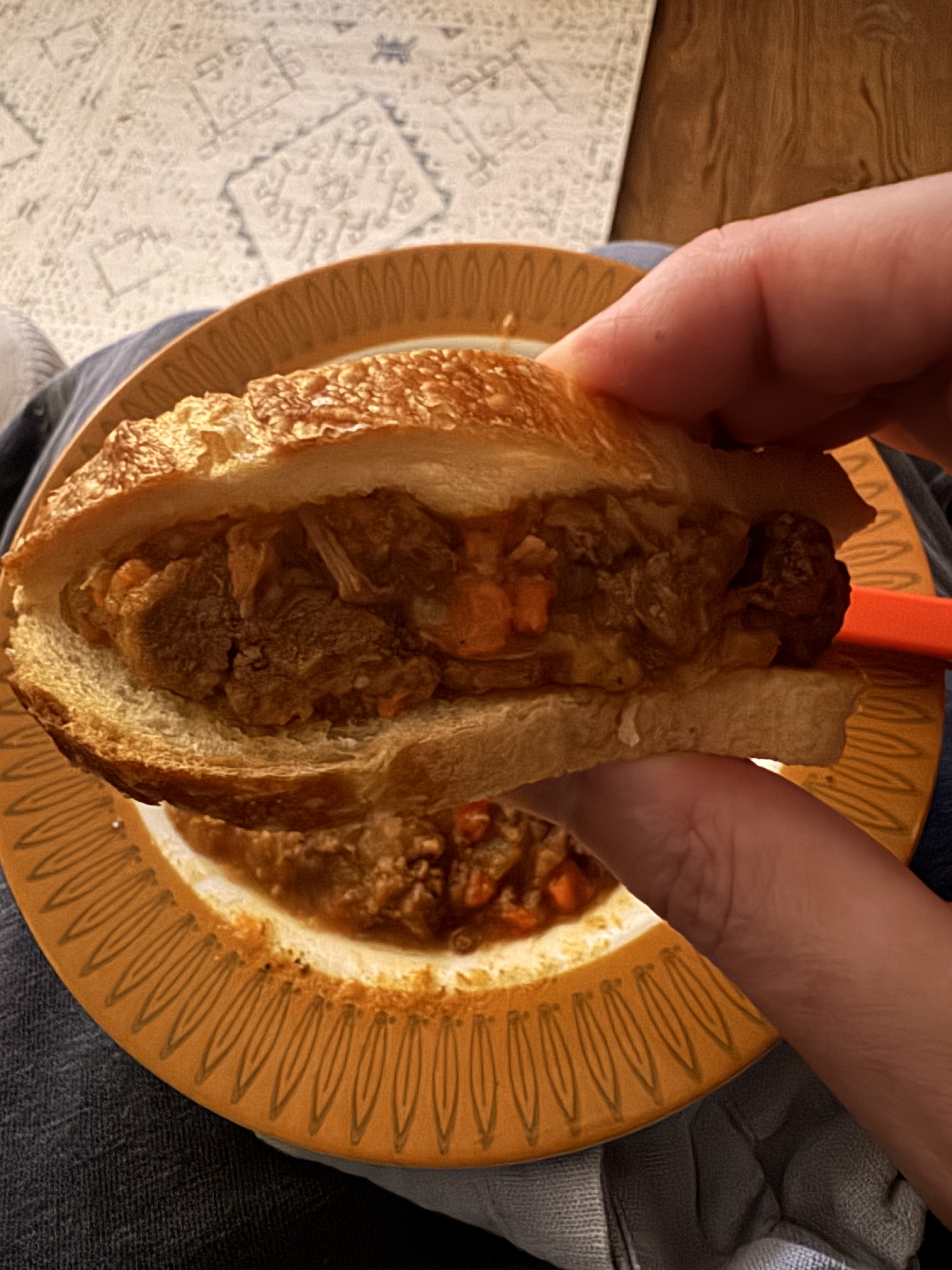
Picked up some beef stew with a piece of bread, and wondered if you really need two slices. Was the first sandwich more like this, a kind of Anglo taco?
The modern sandwich is named after Lord Sandwich, but the circumstances of its invention and original use are the subject of debate. A rumour in a contemporaneous travel book by Pierre-Jean Grosley, Tour to London (published 1772), formed the popular myth that bread and meat sustained Lord Sandwich at the gambling table, but Sandwich had many habits, including the Hellfire Club, and any story may be a creation after the fact. Lord Sandwich was a very conversant gambler, the story goes, and he did not take the time to have a meal during his long hours playing at the card table. Consequently, he would ask his servants to bring him slices of meat between two slices of bread, a habit known among his gambling friends. Other people, according to this account, began to order “the same as Sandwich!”, and thus the “sandwich” was born.The sober alternative to this account is provided by Sandwich’s biographer N. A. M. Rodger, who suggests that Sandwich’s commitments to the navy, to politics, and to the arts mean that the first sandwich was more likely to have been consumed at his work desk.
Islands named after Sandwich by Capt. James Cook
Lord Sandwich was a great supporter of Captain James Cook. As First Lord of the Admiralty, Sandwich approved Admiralty funds for the purchase and fit-out of the Resolution, Adventure and Discovery for Cook’s second and third expeditions of exploration in the Pacific Ocean. He also arranged an audience with the King, which was an unusual privilege for a lower ranking officer. In honour of Sandwich, Cook named the Sandwich Islands (Hawaii) after him, as well as the South Sandwich Islands in the Southern Atlantic Ocean and Montague Island in the Gulf of Alaska.
Dr Daniel Solander, Sir Joseph Banks, Captain James Cook, Dr John Hawkesworth and Lord Sandwich by John Hamilton Mortimer, 1771.
This guy came damn close to having two great things, the sandwich and Hawaii, named after himself.
listening to Raising Canes founder Todd Graves on David Senra podcast. The man’s intensity about chicken fingers:
Todd Graves: Yeah, you have to focus on doing one thing and do it better than anybody else. And so, since I have that singular product focus, right? And so, some people call it, like, a simple menu. I say, “Well, it’s not simple. It’s focused.” And here’s why it’s not simple. Because our chicken has to be exactly right. Look, it comes from the weight of the bird that we want to get the size tender we want. It comes from the species of bird that gives the most tender and flavorful chicken. There’s a lot of technical stuff. Rigor mortis on the bone after the chicken’s slaughtered.
David Senra: Mm-hmm.
Todd Graves: Then it stays on the bone a certain amount of time. Then you get it fresh. Then you brine it for 24 hours. Like, all those things are that. Like, our fries, right? So, we have crinkle-cut fry, but a thinner crinkle-cut fry. You get fries from different times of the year, right? They do the crop harvest, and it sits in the warehouses. At certain times of the year, you get more sugar tips in the fries. Those sugar tips have to come out, so we have to remind our crew, “Hey, when you see those black sugar tip ends, take those out. It’s not visually pleasing.”
Todd Graves: Our bread. So, we get bread made by bakeries all over the country, but that recipe has to be exactly right. And it’s little dough balls put together and baked together, so it’s pull-apart bread. It’s not sliced loaves. Sliced loaves end up being more stale. This is dense, moist, flavorful bread. Our coleslaw, we secure all over the country. We have to make sure all those vendors have the right type of slaw that we want, from the right type of growers, grown in a certain amount of time. In that slaw, you have cabbage, but you also have purple cabbage. You have carrots. All those things.
Todd Graves: And so, you go down to your tea. Our tea gets brought from three different countries, the tea leaves, but we have to get it at the right time of the year. We might pay more for that, but it’s that focus on that. So, my team can focus on those menu items and deliver it every time to where it tastes exactly the same around every Cane’s across the country. So, since we’re focused, it’s not a simple thing, we can focus on those things.
(Do you want rigor mortis?) The intensity, the focus. Later in the interview Graves tells about an early partner who quit because he just didn’t care about chicken fingers that much.
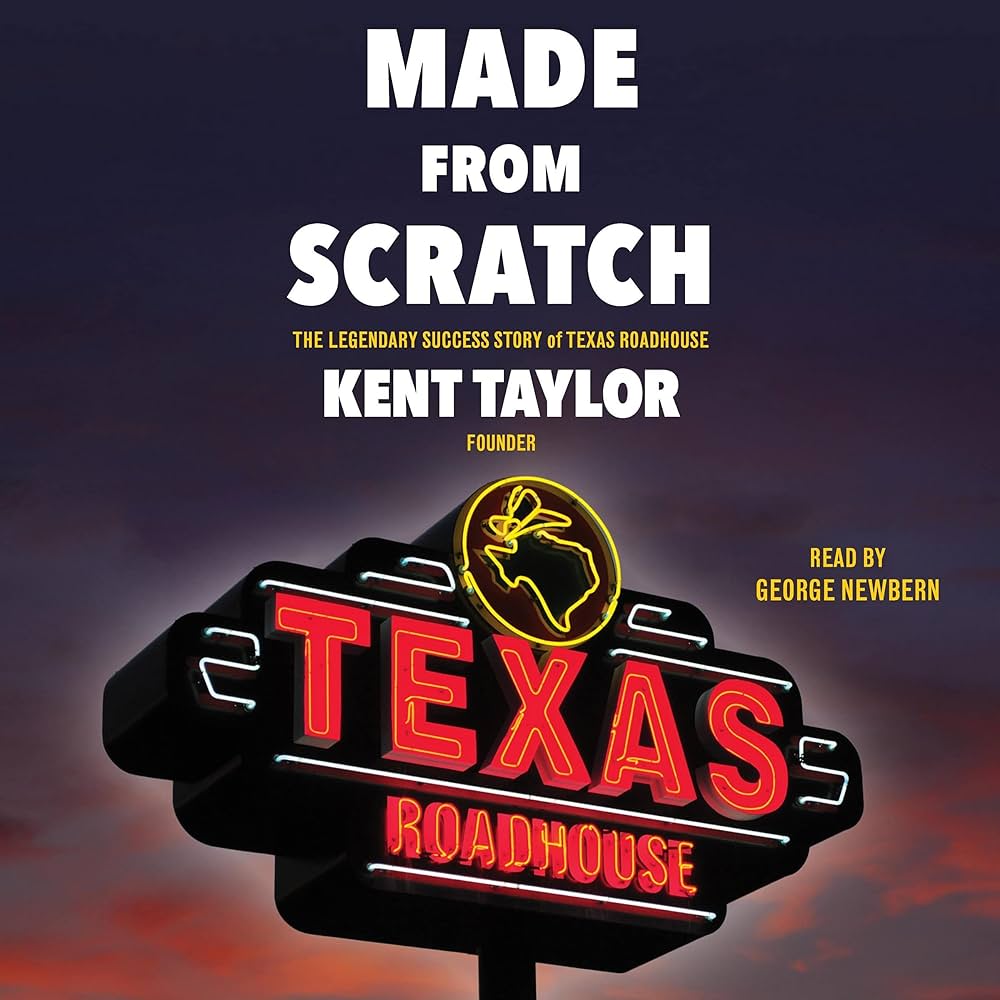
Graves reminded me of Kent Taylor of Texas Roadhouse. Listening to anyone who’s that passionate about anything is pretty compelling.
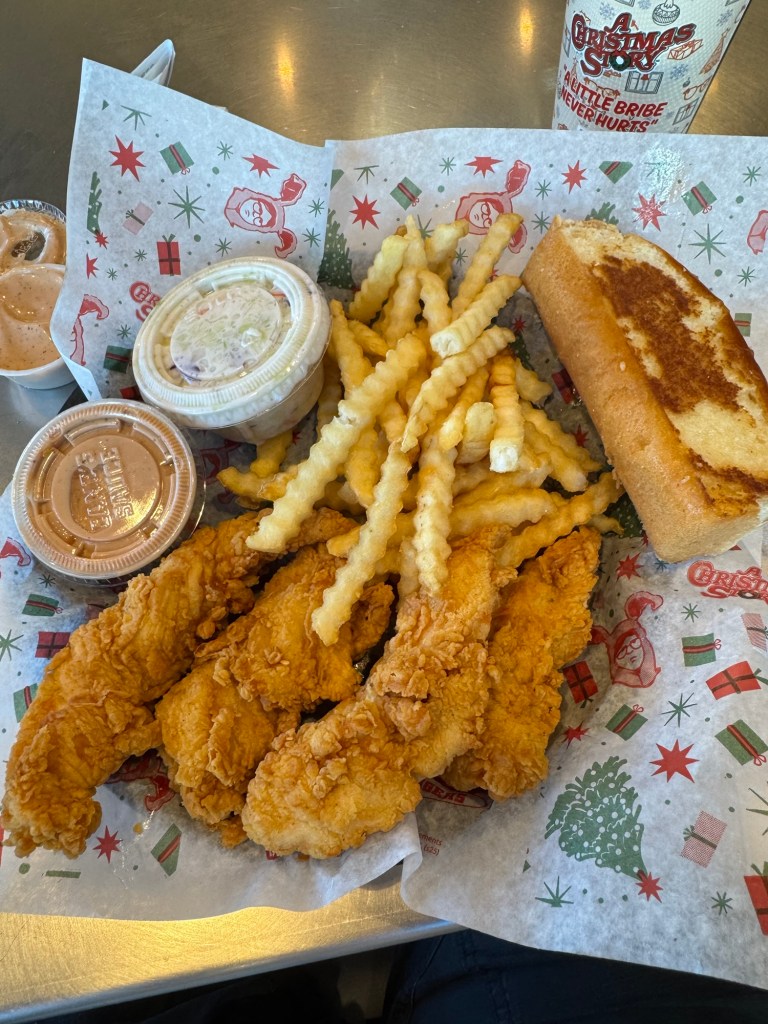
They’ve opened a Raising Cane’s on Sunset and Highland, directly opposite from the Chick-Fil-A, a brazen challenge. I have to drive by most days. Finally I couldn’t resist trying a Box Combo. It is indeed craveable. Two different staffers were speaking kindly with an apparently homeless man who was settled in. The music in the place is loud. The original target market for RC’s was college kids at LSU. The place still has a college kid feel.
The Box Combo was really damn good. Even the coleslaw tasted fresh. The fries were just perfect. The fingers, the one thing they do better than anyone, well, they do them excellently. Cane’s sauce is perfect. But, later, I did not feel amazing. Maybe you’re not supposed to eat this if you’re over age 40. The Box Combo is the second biggest combo on the menu, behind the Caniac, and provides something like 1400 calories. I felt like I myself had been brined for 24 hours.
Sometimes I remember the book Fast Food Nation by Eric Schlosser. When it came out in 2001, everybody read that book. But in the twenty five years since, fast food – “quick service restaurants” in the term the industry prefers – has only made itself more craveable. The worst aspects described in FFN had to do with the beef industry, so maybe a chicken-only restaurant is a net positive. I’m sure there’s gnarliness to the industrial production of chicken but it’s easier to handle mentally than the mass slaughter of mammals.
Surely there are some negatives to processing food at this speed and scale, but from the optimist side? Raising Cane’s is astounding. Consider Leander Stilwell’s memoir of his service in the Civil War. He remembers a chicken dinner:
Soon were audible the death squawks of chickens in the barn-yard, which we heard with much satisfaction.
In due time supper was announced, and we seated ourselves at the table. And what a banquet we had! Fried chicken, nice hot biscuits, butter, butter-milk, honey, (think of that!) preserved peaches, fresh cucumber pickles,-and so forth.
He was writing that in 1916, over fifty years after the events and he still remembers his meal, it was that remarkable. True, this was in the deprivations of wartime, but it sticks with him. Today you can get close to the equivalent (minus the peaches) at over 900 locations in the US, and 40 in the Middle East, for about the price of an hour’s labor at the California minimum wage. You don’t even have to get out of your car. That’s just an incredible system.
warning: there’s some rough language in this post.
Is the barbecue sauce my first association with Kansas City?
KC Masterpiece is a barbecue sauce that is marketed by the HV Food Products Company, a subsidiary of the Clorox Company
It was invented by Rich Davis, a child psychologist and former Dean of the University of North Dakota Medical School, who also experimented with “mustchup,” a mustard ketchup combo.
Kansas City became famous in song as a party town. The Beatles sing about it:
“Kansas City” was written by Jerry Leiber and Mike Stoller, two nineteen-year-old rhythm and blues fans from Los Angeles. Neither had been to Kansas City, but were inspired by Big Joe Turner records.
from Big Joe Turner’s Wikipedia page:
At that time Kansas City nightclubs were subject to frequent raids by the police; Turner said, “The Boss man would have his bondsmen down at the police station before we got there. We’d walk in, sign our names and walk right out. Then we would cabaret until morning.”
Why Kansas City?:
In the 1930s, Kansas City was very much the crossroads of the United States, resulting in a mix of cultures. Transcontinental trips by plane or train often necessitated a stop in the city. The era marked the zenith of power of political boss Tom Pendergast. Kansas City was a wide open town with prohibition era liquor laws and hours totally ignored, and was called the new Storyville. Most of the jazz musicians associated with the style were born in other places but got caught up in the friendly musical competitions among performers that could keep a single song being performed in variations for an entire night.
In the late 1930s and early 1940s, when Kansas City was a hotbed of jazz activity, Mr. McShann was in the thick of the action. Along with his fellow pianist and bandleader Count Basie, the singer Joe Turner and many others, he helped establish what came to be known as the Kansas City sound: a brand of jazz rooted in the blues, driven by riffs and marked by a powerful but relaxed rhythmic pulse.
“You’d hear some cat play,” he told The Associated Press in 2003, “and somebody would say, ‘This cat, he sounds like he’s from Kansas City.’ It was Kansas City style. They knew it on the East Coast. They knew it on the West Coast. They knew it up north, and they knew it down south.”
from a pretty interesting 1948 article in the Journal of Criminal Law and Criminology, “The Myth of hte Wide-Open City,” by Virgil W. Peterson:
In 1933 Tom Pendergast openly boasted that while gambling and slot machine complaints might be frequent, Kansas City afforded its citizens greater protection from violence and crime than any other American city. But that was only the usual prating of a machine boss. The die had been cast,-wide-open gambling, always a chief pillar of organized crime and political corruption, had resulted in powerful alliances between officialdom and the underworld. Kansas City had become the most wideopen town in the United States,-a haven for the toughest gangsters from every part of America. The officials who had utilized the underworld in maintaining political dominance had created a monster they could no longer control. The underworld was completely out of hand. In May, 1933, the daughter of the city manager, Henry F. McElroy, was kidnaped. John Lazia, the gangster, took over the task of raising the ransom money. She was released. On the morning of June 17, 1933, a brazen attempt was made to liberate the notorious bank robber and escaped federal prisoner, Frank Nash, who had been captured and was being returned to the federal penitentiary. As officers emerged with Nash from the Kansas City Union Station, machine guns blasted forth. Five persons were killed, including two members of the Kansas City Police Department, a special agent of the FBI, a chief of police from Oklahoma and, ironically, Frank Nash himself. Two other officers were wounded. The massacre had been engineered by the outlaw, Vern C. Miller, who had been placed in touch with the killers, Pretty Boy Floyd and Adam Richetti, by the gambling czar John Lazia. In July, 1933, the kidnaping of the wealthy Charles F. Urschel in Oklahoma attracted nationwide attention. Ransom money paid in the case was traced to a prominent Kansas City criminal gang. In the same year a lieutenant of John Lazia attempted to kill Sheriff Thomas B. Bash.
In the March, 1934, election, fraud was rampant and it was conducted in Hitler fashion. Four people were killed and eleven seriously injured in election violence. The attention of the entire United States was focused on Kansas City. The United States Senate announced its intention to conduct an official investigation. John Lazia was then recognized in Kansas City as one of its most influential and powerful political figures. A short time later, on July 10, 1934, John Lazia fell in a hail of gangland bullets. Tom Pendergast’s chief lieutenant and gambling overlord was dead. And, ironically, the gun which fired the fatal bullets had been used a year earlier in the Union Station massacre in which Lazia had figured. Kansas City still had to endure five years of the “rule of ruin” before Tom Pendergast was committed to the federal penitentiary May 29, 1939. Unfortunately, the story of the Pendergast machine is not the story of Kansas City alone. Disgracing the pages of American political history, comparable stories are recorded of many of our large municipalities.
Peterson argues that “wide open city” method – letting the gangsters get away with their vices in exchange for keeping murder outside of the cities – didn’t work. I don’t know if it was ever really intended to, seems like bullshit the likes of Pendergast invented so they could justify the profitable vices and criminal alliances.
While it may not have worked for keeping order, the wide open city did seem to lead to a raucous music scene. The greatest Kansas City jazzman has got to be Charlie Parker.
In 1940, he returned to Kansas City to perform with Jay McShann and to attend the funeral of his father, Charles Sr. The younger Parker then spent the summer in McShann’s band playing at Fairyland Park for all-white audiences; trumpet player Bernard Anderson introduced him to Dizzy Gillespie.
You won’t have a bad time if you go to Spotify or YouTube and put on Charlie Parker Radio as you read the rest of this post.
Music and violence still seem to intersect in Kansas City. Mac Dre was shot and killed there:
After Hicks and other Thizz Entertainment members had performed a show in Kansas City, Missouri on October 31, 2004, an unidentified gunman shot at the group’s van as it traveled on U.S. Route 71 in the early morning hours of November 1. The van’s driver crashed and called 911, but Hicks was pronounced dead at the scene from a bullet wound to the neck.[13] Local rapper Anthony “Fat Tone” Watkins was alleged to have been responsible for the murder, but no evidence ever surfaced, and Watkins himself was shot dead the following year.
Although maybe there’s one of those in every city if you go digging.
Before Pendergast, Kansas City was already wild. From David McCullough’s Truman, describing Kansas City around 1900:
It. was a wide-open town still, more than living up to its reputation. Sporting houses and saloons far outnumbered churches. “When a bachelor or stale old codger was in sore need of easing himself [with a woman], he looked for a sign in the window which said: Transient Rooms or Light Housekeeping,” remembered the writer Edward Dahlberg, whose mother was proprietor of the Star Lady Barbershop on 8th Street. To Dahlberg, in memory, nearly everything about the Kansas City of 1905, the city of his boyhood, was redolent of sex and temptation. To him it was a “wild, concupiscent city.” Another contemporary, Virgil Thomson, who was to become a foremost composer, wrote of whole blocks where there were nothing but saloons, this in happy contrast, he said, to dry, “moralistic” Kansas across the line. “And just as Memphis and St. Louis had their Blues, we had our Twelfth Street Rag proclaiming joyous low life.” But with such joyous low life Harry appears to have had little or no experience. Years afterward, joking with friends about his music lessons, he would reflect that had things gone differently he might have wound up playing the piano in a whorehouse, but there is no evidence he ever set foot in such a place, or that he “carried on” in Kansas City in any fashion.
Young Ernest Hemingway was a reporter for The Kansas City Star in 1917-1918, when he was roughly 17-18. Hemingway biographers and documentarians like to point out the influence of The Kansas City Star style sheet, which begins:
but it also has a bunch of stranger rules:
I’m glad I printed it out, it used to be online at the Kansas City Star’s website but the link appears dead.
An interstitial section in in our time contains a Kansas City story fragment:
At two o’clock in the morning two Hungarians got into a cigar store at Fifteenth Street and Grand Avenue. Drevitts and Boyle drove up from the Fifteenth Street police station in a Ford. The Hungarians were backing their wagon out of an alley. Boyle shot one off the seat of the wagon and one out of the wagon box. Drevetts got frightened when he found they were both dead.
Hell Jimmy, he said, you oughtn’t to have done it. There’s liable to be a hell of a lot of trouble.
—They’re crooks ain’t they? said Boyle. They’re wops ain’t they? Who the hell is going to make any trouble?
—That’s all right maybe this time, said Drevitts, but how did you know they were wops when you bumped them?
Wops, said Boyle, I can tell wops a mile off.
15th and Grand? 15th is now Truman Road.
In Across the River and Into the Trees, Hemingway’s Colonel Cantwell tells his young Italian mistress about the Muehlebach Hotel. They’re fantasizing about an American road trip?
‘Do you mind being here out of season?’
‘Did you think I was a snob because I come from an old family? We’re the ones who are not snobs. The snobs are what you call jerks and the people with all the new money. Did you ever see so much new money?’
‘Yes,’ the Colonel said. ‘I saw it in Kansas City when I used to come in from Fort Riley to play polo at the Country Club.’
‘Was it as bad as here?’
‘No, it was quite pleasant. I liked it and that part of Kansas City is very beautiful.’
‘Is it really? I wish that we could go there. Do they have the camps there too? The ones that we are going to stay at?’
‘Surely. But we’ll stay at the Muehlebach hotel which has the biggest beds in the world and we’ll pretend that we are oil millionaires.’
‘Where will we leave the Cadillac?’
‘Is it a Cadillac now?’
‘Yes. Unless you want to take the big Buick Roadmaster, with the Dynaflow drive. I’ve driven it all over Europe. It was in that last Vogue you sent me.’
‘We’d probably better just use one at a time,’ the Colonel said. ‘Whichever one we decide to use we will park in the garage alongside the Muehlebach.’
‘Is the Muehlebach very splendid?’
‘Wonderful. You’ll love it. When we leave town we’ll drive north to St. Joe and have a drink in the bar at the Roubidoux, maybe two drinks and then we will cross the river and go west. You can drive and we can spell each other.’
‘What is that?’
‘Take turns driving.’
‘I’m driving now.’
‘Let’s skip the dull part and get to Chimney Rock and go on to Scott’s Bluff and Torrington and after that you will begin to see it.’
‘I have the road maps and the guides and that man who says where to eat and the A.A.A. guide to the camps and the hotels.’
‘Do you work on this much?’
‘I work at it in the evenings, with the things you sent me. What kind of a licence will we have?’
‘Missouri. We’ll buy the car in Kansas City. We fly to Kansas City, don’t you remember? Or we can go on a really good train.’
from Wikipedia. The windowless section is an addition. It’s now part of the downtown Marriott, and it sounds like you’d struggle to find anything of what the Colonel remembers.
They imploded the 1952 Muehlebach Tower annex building and in 1998 built a new, modern Muehlebach tower in its place. A “skybridge” was also built that connects both hotel buildings on their second floors. The original 1915 Muehlebach building’s lobby and ballrooms were restored and are now used as banquet and convention facilities by the Marriott. The original hotel guest room floors above have been gutted and remain unused.
In A Moveable Feast, published posthumously but written around 1960, a sickly fellow in Paris makes Hemingway reminsce:
Some RFK Jr. type thinking..
Back when we were learning about Savoy Special, we came across the Savoy Hotel of Kansas City:
It’s now the Hotel Savoy Kansas City, Tapestry Collection by Hilton. I’d at least check this place out on a next visit.
On my first trip to Kansas City, around 2009, stopping in for a night on a transcontinental train trip, I stayed at the Sheraton Crown Center, formerly the Hyatt Regency, which was famous for a disastrous walkway collapse that killed 114 people. Some grim photos there tell the story and also evoke the era, when hundreds of people would attend a “tea dance.”
Kansas City is famous for barbecue, specifically a style that’s just some meat with a sweet sauce.
Kansas City–style barbecue is a slowly smoked meat barbecue originating in Kansas City, Missouri in the early 20th century. It has a thick, sweet sauce derived from brown sugar, molasses, and tomatoes. Henry Perry is credited as its originator, as two of the oldest Kansas City–style barbecue restaurants still in operation trace their roots back to Perry’s pit.
Those would be Arthur Bryant’s (subject of a New Yorker piece by Calvin Trillin) and Gates B-B-Q. There’s also Jack Stack, Oklahoma Joe’s now Joe’s, and more.
Henry Perry himself was from Memphis:
He had a sign in his restaurant that said “my business is to serve you, not to entertain you,” and it was known for its far-reaching BBQ smells. He was known for his generosity, and would often give food to people for free.[1]
He later moved a few blocks away within the neighborhood of 19th and Highland, where he operated out of an old trolley barn throughout the 1920s and 1930s when the neighborhood became famed for its Kansas City Jazz during the Tom Pendergast era.
Customers paid 25 cents for hot meat smoked over oak and hickory and wrapped in newsprint. Perry’s sauce was described as “harsh, peppery” (rather than sweet). Perry’s menu included such barbecue standards of the day as beef and wild game such as possum, woodchuck, and raccoon.
According to Mr. Gates, the meats at a Kansas City barbecue joint historically all had one thing in common: They were cheap.
Cooking inexpensive cuts low and slow is the foundation of every American barbecue tradition, but Kansas City had an advantage — one of the largest stockyards in the country. “Brisket was practically a giveaway,” Mr. Gates said. Abundance inspired new ideas: Burnt ends, a signature of Kansas City barbecue, began as overcooked brisket edges that Arthur Bryant’s cooks chopped up and gave away to customers.
The stockyards never fully recovered from a devastating flood in 1951 and closed permanently in 1991.
I ate all the barbecue, went to the Negro Leagues Baseball Museum and the American Jazz Museum, walked the Power & Light District when I went there alone. When I went there with my wife, again a brief stop before a train trip, we looked at the Christmas lights on Country Club Plaza, and we had a KC strip steaks in the West Bottoms.
The Kansas City of reality didn’t quite match the myth. That might be my fault, who knows. If I ever get back, I’d like to visit the Nelson- Atkins Museum, and see Bosch’s Temptation of St. Anthony:
The other day on my plane back from New Jersey I looked out the window and saw Kansas City below me. There was Arrowhead Stadium and Kauffman Stadium, and the surrounding car-consumed wasteland:
it’s too bad there wasn’t a game on. I could’ve seen a tiny Travis Kelce and a tiny Patrick Mahomes.
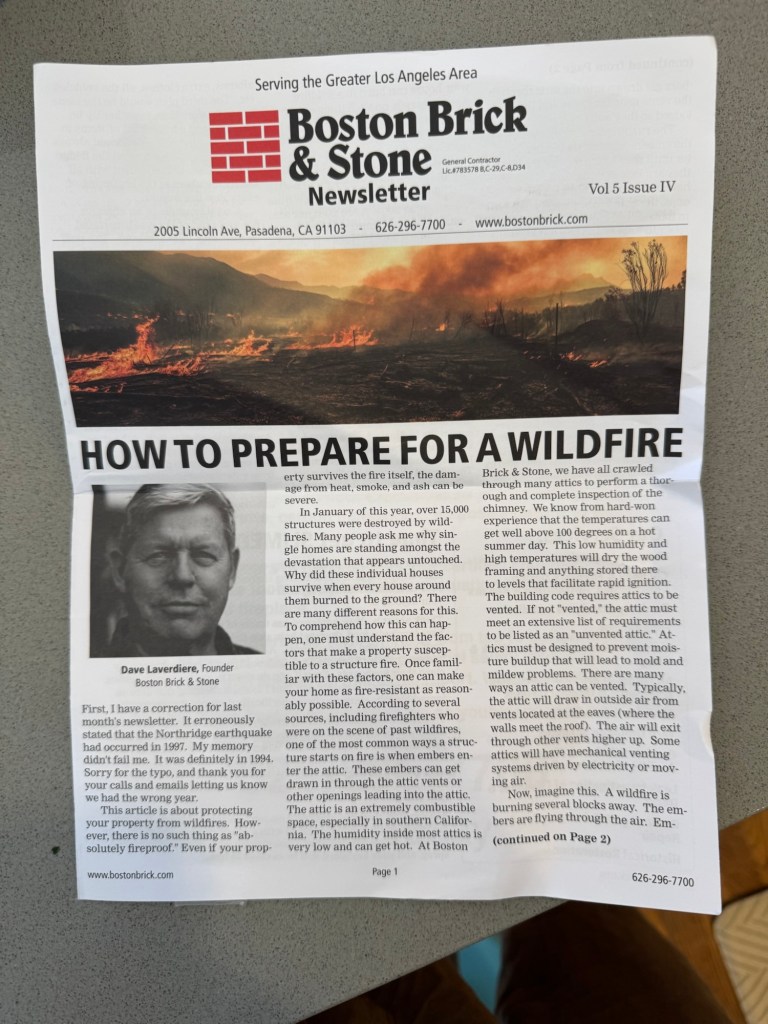
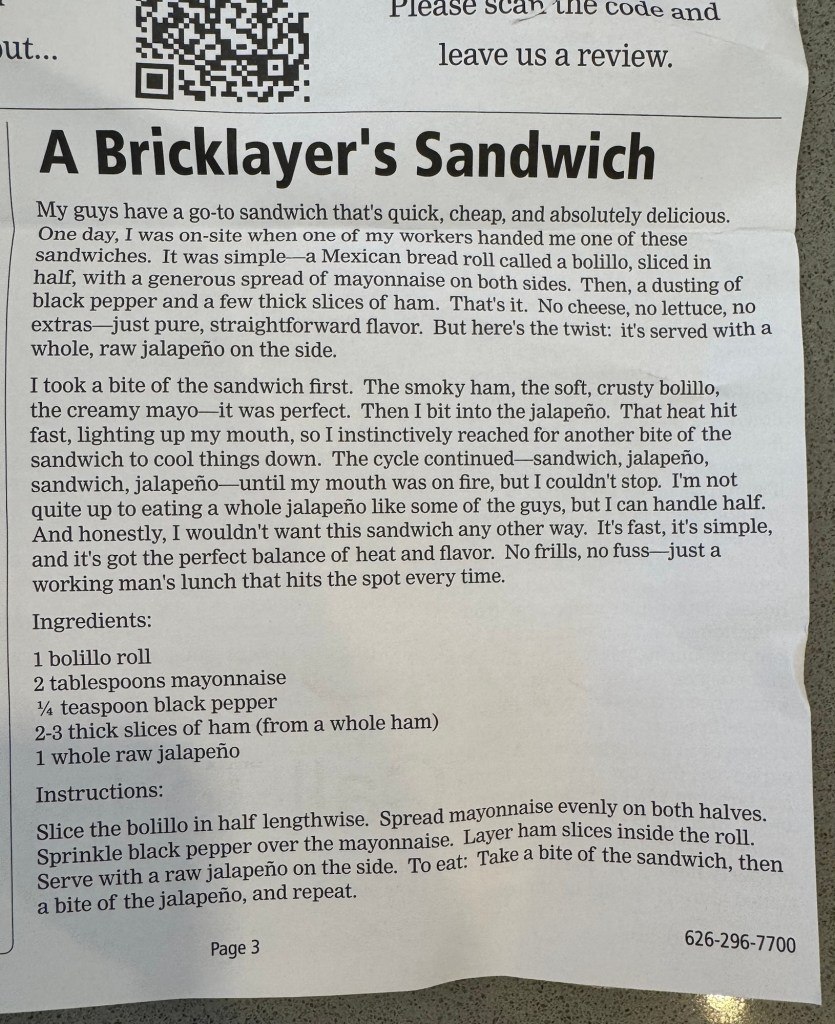
The Boston Brick & Stone newsletter is interesting marketing, and honestly one of my favorite periodicals. I’m awarding it a Helytimes Prize for Sandwich Journalism for this feature, “A Bricklayer’s Sandwich.”
Once I’m cast off from show business perhaps I’ll start a newsletter called Restaurants and Railroads. This will analyze those two types of businesses, specifically publicly traded companies. Hedge funds as well as passionate hobbyists will subscribe. They’ll invite me to their conferences, to which I’ll travel in style, by rail when possible. I’ll sample the various restaurants as I go, Tijuana Flats for example, and Pizza Inn which I’ve never tried. In a world of niche media I wonder if I could make that work.
You might not think restaurants and railroads are a natural combination. Fred Harvey might disagree, but I’ll concede they’re very different businesses. The railroads have no new competition, no one is building a new railroad. Only a handful of companies control all the track. Two railroads serve the port of LA: one is BSNF, owned by Berkshire Hathaway, and one is Union Pacific. A duopoly.
The restaurants on the other hand are in frantic, constant competition. They must capture taste and vibe. Tastes change, vibes shift. Plus your customer could always just make a sandwich. How restaurants stay profitable? How do they maintain quality, especially at scale?
These two differing business categories are the two I’m excited to read about when I get an issue of ValueLine. Consumer Staples, Metals & Mining, etc, these lose our interest. But take a look at a personality like Kent Taylor’s or a real railroader like Hunter Harrison (or Casey Jones) and the mind comes to life, it’s hard to get bored.
Chili’s may have just pulled off one of the greatest comebacks in restaurant history.
Same-store sales at the bar and grill chain surged more than 31% from October to December, marking its best quarter since the period just after COVID and accelerating a streak of double-digit same-store sales increases that began last April.
The growth once again was driven by a mix of social media buzz, value-based advertising and a renewed focus on restaurant operations and atmosphere that seemed to snowball as the year progressed.
Just to put this into context, these numbers are comparable to when Popeye’s went off with their spicy chicken sandwich. CEO Kevin Hochman points to TikTok:
About halfway through last year, its Triple Dipper appetizer platter, a staple on the chain’s menu for years, went viral on TikTok, where young customers showed off their “cheese pulls” with the Triple Dipper’s fried mozzarella sticks. …
“What’s happening is that young people are coming in after they’ve seen us on TikTok, and they’re like, ‘Wow, this experience is really good,’ and it becomes a part of the rotation,” Hochman told analysts during an earnings call Wednesday. “I think that’s why you’ve seen the longevity in the results and the acceleration, not just kind of a boom-splat that you typically would see without the operational investments that we’ve made in the business.”
Triple Dipper
Kevin Hochman seems like a brand guy: while at P&G he worked on Old Spice. $EAT stock has indeed thrived:
On an episode of A Deeper Dive, a quick service restaurant business podcast, the host and guest discussed Chili’s phenomenal success, and possible reasons for it. The fast food competitive price with the sit down experience came up, as did the mix and match. But in the end they agreed people just kinda like it.
It does seem like Chili’s is doing something right:
I don’t care for Applebee’s, it’s sub Friday’s and way sub Chili’s, but I do like living in the United States of America. All told this was a nice story. The conclusion:
source. sometimes I consume the fruit and coffee breakfast.
somewhere in an old book I read a lengthy 19th century style description of how people in the tropics need to have a languid, light breakfast of fruits and sweets for their constitutions to function properly in the climate. Do places have appropriate breakfasts?
Coach Nick Saban having two Little Debbie oatmeal cream pies for breakfast every morning (“what you do every day matters”), that’s another breakfast that sticks in the mind.
saw someone on X (formerly “Twitter”) raise the old red flag of The Great Gatsby isn’t that good actually so I took it off the shelf.
That’s how it starts. (Struck me that my edition, the one we read in school I believe, has no introduction foreward or any of that bog you down scholarly junk at the front.* Your enjoyment of classic books will improve we believe if you always skip those and plunge right in. You can always come back later.)
If you’re like me you first read this book in school. It is a great summer book. It’s even set at the seaside.
Been meaning to document some items from Sheilah Graham’s The Real F. Scott Fitzgerald, and perhaps now is the time. Their relationship was tumultuous:
I knew that “Portrait of a Prostitute” was also a drunken commentary. He must have written it on the photograph after the first of our two bad quarrels in 1939 when he was drinking so heavily. We had struggled for his gun, I had slapped him—the first person in his life ever to do so-and as I walked out, I had delivered a harsh exit line, “Shoot yourself, you son of a bitch. I didn’t raise myself from the gutter to waste my life on a drunk like you.”
When they met:
When I first met Scott on July 14, 1937, neither of us was looking for a relationship of such intensity. He had too many other responsibilities. I was engaged to the Marquess of Donegall-who died recently-and planning a New Year’s Eve wedding to be followed by a honeymoon cruise around the world. Part of the unwritten marriage contract was that I would give Don an heir as soon as possible, and a doctor had told him that the swaying of a ship was conducive to pregnancy.
Zelda:
To hold Scott on a string when the engagement was off and to continue to make him jealous, Zelda invented an “engagement” to the famed golfer Bobby Jones. Scott always believed that she had promised to marry Mr. Jones. He told me this with conviction. But when Andrew Turnbull was writing his biography of Scott, he questioned the golfer, who denied even knowing Zelda.
later:
I think their lives also suffered from Zelda’s increasing desperation as to what to do with herself. She had no idea of being a wife shortly after they were married Scott discovered all his dirty shirts piled up in a closet-and, although she tried in the times of sanity, still less of being a mother
Scott’s diet:
When I think now of the abuse that Scott inflicted on himself, it’s a miracle that he lived as long as he did. Aside from his drinking there was, drunk or sober, the incessant smoking and also the reliance, when not drinking, on coffee and dozens and dozens of bottles a day of Coca-Cola. He would line up the Cokes all around the walls of his office at M-G-M and announce, “I’ll drink these up, and when they’re gone I’ll go back to beer.” Dr. Richard Hoffman, who had examined him in New York, told my Beloved Infidel collaborator, Gerold Frank, that Scott drank-both the liquor and the Cokes-be-cause he had the reverse of diabetes, an insufficiency of sugar in the blood. Is this true for all who drink unwisely?
This is when they were healthy:
For the first time for both of us, we were leading average lives, working by day, reading or walking in the evening after the same dinner prepared for us every night by our shared housekeeper, a thin T-bone steak (at 35 cents a pound!), a baked potato, peas, and a grapefruit jelly.
…
I would not have wanted to examine Scott’s inside, with not only all the above but also the strange food that he ate-sometimes just fudge and crab soup, in that order. He was eating a little more in that last year, lots of cookies, candy, and cake to compensate for the sugar in the alcohol.
But there were nice times too:
lunches at the elegant Vendome Restaurant in Hollywood, at the Brown Derby in Hollywood or in Beverly Hills, and our dancing in the evenings, particularly in the first year, at the Trocadero. Scott danced the collegiate style of the time-heads close together, rears at a thirty-three-degree angle.
Looking back, I marvel at what a full, active life we had. We also went away together for weekends, especially in the first two years before Scott was so hard up—to Santa Barbara, La Jolla, Del Monte, Monterey, over the south U.S. border into Mexico, and to the San Francisco Fair. I loved those long drives with Scott, even though he drove at twenty to twenty-five miles an hour.
“Del Monte,” a resort in Monterey that now belongs to the Navy. Monterey on the old roads before the 5 is about 331 miles away. At twenty five miles an hour that trip must’ve taken like thirteen hours. And that’s if you don’t stop every hour for more Cokes.
*in writing that sentence I got to wondering what those obstacles the Germans and their various conscripts) set up on the D-Day beaches were called. You know the ones I’m talking about? Turns out they are called hedgehogs.
continuing a deranged hobby of reading corporate materials for fast food companies. See if you can guess what the acronym C.R.A.V.E.D stands for at $JACK, the corporate parent of Jack In The Box and Del Taco.
To buy time while you think, here is a story about Herb Kelleher, founder of Southwest Airlines, who had a strong, clear mission focus:
There is a great story shared by Chip and Dan Heath in the book “Made to Stick” about the late founder Herb Kelleher. Kelleher once posed a question to someone about their strategy,
“Tracy from marketing comes into your office. She says her surveys indicate that the passengers might enjoy a light entree on the Houston to Las Vegas flight. All we offer is peanuts, and she thinks a nice chicken Caesar salad would be popular. What do you say?”
The person stammered for a moment, so Kelleher responded:
“You say, `Tracy, will adding that chicken Caesar salad make us THE low-fare airline from Houston to Las Vegas? Because if it doesn’t help us become the unchallenged low-fare airline, we’re not serving any damn chicken salad.’
Kent Taylor was a spectator at the 1971 NCAA cross-country championships:
I will never forget [Steve] Prefontaine powering through that tough hilly course, challenging anyone to catch him as he picked up the pace on each rise, daring all comers to endure pain only he was capable of enduring. Steve won the race, no problem, and wore about him afterward an aura of extreme confidence that captivated me. Still, to this day, I can remember that look, as if he wanted his challengers to bring on whatever they had, and he’d find a way to bring that much more.
Kent Taylor was a skinny kid who was kicked off the football team by a coach who told him he might die out there. He went into track and cross country and drove himself to become better. One summer he trained by running over a thousand miles. He got good enough that with some persistence and luck he got a partial scholarship to UNC. There he ran the steeplechase, obstacle running complete with a water hazard.
Kent Taylor had drive. After college he moved back to Louisville, managed some nightclubs in Cincinnati, managed a Bennigan’s in Dallas for a bit, worked for KFC. What he wanted to do was launch his own concept for a restaurant: Texas Roadhouse.
My initial thought regarding Texas Roadhouse was to combine a rough and somewhat rowdy live music joint with a reasonably priced restaurant featuring steaks and ribs. I wanted to have the same quality of beef that Outback and Longhorn featured at the time, but with price points more similar to Chili’s and Applebee’s. I wanted to target the blue-collar segment of America (my peeps) who would be comfortable with jukebox country music and a casual and lively atmosphere with energetic servers in jeans and T-shirts. In short: Baby, if you want to dress up, then visit somewhere else; but if you want to dress down, we would welcome you with open arms and a warm smile.
Two of his first investors were Dr. Amar Desai and Dr. Mahendra Patel. The concept sparked but there were bumps. Kent opened the second restaurant in Gainesville, Florida 700 miles away from the first one because he had good memories of Gainesville. Three of the first five restaurants failed. But Kent Taylor and the Roadhouse team started to figure it out:
Another idea was to offer free rolls. We played around with giving out popcorn, something for people to munch on immediately, but realized we wanted the smell of rolls to hit our guests when they walked in. If we were going to offer them, though, I wanted to get the recipe perfect. I set my assistant kitchen manager, Rod, to driving all over town to buy as many types of flour and yeast as he could find. We then experimented. Rod and I would try this type of flour with this type of yeast, adding so much water, so much oil, and a dash of sugar and a few other ingredients for good measure. Then we tried again. We also experimented with dozens of variations to proof and bake the rolls. Nothing tasted right. I wanted a fairly sweet roll, but sugar and yeast fight each other, so I needed a flour that would work with both. The process of discovering the best Roadhouse rolls consumed our waking days for three weeks. I’m pretty sure it also consumed Rod’s sleep. He probably dropped off at night counting bags of flour. I was tormenting the poor guy with my relentless pursuit of the perfect roll. Finally, we hit it when we mixed a certain flour with another flour. The mix came together in no time and we created the rolls we use to this day. Our honey cinnamon butter followed a similar process, eventually finding positive results.
Kent had a vision for restaurants that was something like Wagner’s for opera*. He wanted immersive, overpowering. The word Legendary, that’s key. Legendary food, legendary service, legendary margaritas. Texas Roadhouse is full of wood and tin: Kent wanted it loud. Big neon signs on the places are the only advertising. Texas Roadhouses don’t open for lunch** because Kent Taylor envisioned one big, energized shift, almost a performance
We had the chargrills visible to the guests, a meat display case to view our freshly butchered steaks, and you could smell the steaks cooking and the freshly baked bread coming out of the oven. The six senses would come alive for our guests—sight, smell, taste, hearing, and touch. The sixth sense was a feeling of a warm and friendly vibe.
It worked. There are 741 Texas Roadhouse restaurants in 49 countries. The nearest one to LA would be either Rialto or Corona, CA. This makes sense: LA real estate is expensive and Texas Roadhouse knows to their customer every dollar matters. Being involved in the community is part of the business model and the Kent Taylor vision.
On a recent trip down the 10, we stopped at the Rialto location. It was just after opening time (3pm) and there was already a 20 minute wait. It was all there, just as Kent described. Friendly people, country music, wood and tin. The sweet rolls with the cinnamon honey butter are brought to your table as you sit down. Bag of peanuts waiting for you. No server has more than three stations so they’re on top of it. We signed up for the Texas Roadhouse VIP Club beforehand, which merits you a free appetizer: we got rattlesnake bites of course, delicious. Part of the popularity might be the $13.99 Early Dine Menu. You’re getting a steak dinner for under $14. Tried the Legendary Margarita, and it was a lot of fun. By the time we left every seat at the bar was occupied. There were big families, elderly couples, hard-work looking dudes having some cold ones.
Kent Taylor in this book comes through as such a boosterish, positive person that it’s hard to grapple with his end. From The Wall Street Journal, March 2021:
After coming down with a mild case of Covid-19, W. Kent Taylor found himself tormented by tinnitus, a ringing in the ears. It persisted and grew so distracting that the founder and chief executive of the restaurant chain Texas Roadhouse Inc. had trouble reading or concentrating.
Mr. Taylor told one friend he hadn’t been able to sleep more than two hours a night for months.
In early March, he met friends at his home in Naples, Fla., and led them on a yacht cruise in the Bahamas. Some of those friends thought he was finally getting better. Then his tinnitus “came screaming back in his head” last week, said Steve Ortiz, a longtime friend and former colleague.
On Thursday, March 18, Mr. Taylor died by suicide in his hometown of Louisville, KY.
Very sad. But his vision lives on. I predict Texas Roadhouse will continue to succeed as long as they remember the lessons of founder Kent Taylor. He’d seen what happens when you lose that:
The decline of Bennigan’s was another wake-up call to keep our standards sky-high and not slip into corporate-think. Thankfully, our company is run by people who have grown up in actual restaurant operations and many were eyewitnesses to either Chi-Chi’s or Bennigan’s’ demise.
* not that Kent would use this comparison. He preferred: Willie Nelson, Three Doors Down, Keith Urban, Kenny Chesney, Aerosmith, etc. Mentioning who played at which corporate celebrations is a big part of the book
** some of them do open for lunch one day a week, usually Friday or Saturday
Bloomin Brands (ticker symbol: BLMN) owns Outback Steakhouse and Fleming’s. 50 new Outback Steakhouses opened in Brazil since 2021.
There are 3,427 Chipotles (CMG) in the United States, with 97,660 employees. Here’s Slate recently on Chipotle’s dominance:
But despite that backlash, the fact remains that for a lot of Americans, from San Diego to New Haven and everywhere in between, Chipotle has become effectively synonymous with good Mexican eating. When the Wall Street Journal interviewed Mary Hawkins, the mayor of Madison, Mississippi—one of the tiny population centers Chipotle has in its sights—she said the town had recently polled its citizenry about the brands it would most like to see take up residence on its streets. Chipotle, perhaps unsurprisingly, came in first, and Arellano does not see that trend slowing down.
“It’s like Galactus from Marvel Comics. It’s eating up burrito cultures from across the country,” he said. “Chipotle taught an entire generation of Americans to eat a very specific style of burrito. If they want a burrito, they’re going to want the one they grew up with and neglect the other styles.”
McDonald’s (MCD) of course is the king, with 42,000 stores. Here’s Ian Borden, McDonald’s CFO, being interviewed at a UBS conference:
Dennis Geiger
That’s great. Want to go over to core menu. And you just talked about some of the opportunities at chicken I think in particular. As we think about beef, chicken and coffee and some of the biggest opportunities to kind of further your advantages on core menu anything else to kind of highlight there across those key equities?
Ian Borden
Yes. Sure. Well look I talked about core is critically important. 65% of our global system-wide sales, $17 billion brands across that core categories and I think a few headlines under each of those three. Beef obviously we’re by far the largest player in beef globally. We’ve gained share since 2019 pretty consistently across our markets. I think a couple of the key things from an opportunity standpoint in beef. Best Burger which is just a series of what I’ll call small changes in how we cook and prepare our core beef products that’s been out to about 70 markets. It’s going to be in the rest of the system by end of 2026. It’s driving significant improvements in taste and quality. Taste and quality are the two biggest drivers of consumer visits to our restaurants. So that’s impactful.
The second thing on beef that I think is worth highlighting is the opportunity we see around large burger. And it’s a good example of how I think we are more precisely understanding consumer need and then getting after that consumer need and I’ll call it a one-way approach. So we’ve tried to get after this opportunity for a number of years because we thought the opportunity was about premium burger which was wrong. And we — so we didn’t — we weren’t successful. We now understand what the opportunity is for a large more satiating-type burger. That opportunity is significant. It’s consistent across many of our large markets.
And we have innovated a couple of products that we’re in the process of piloting. We’re going to pilot those products in two or three what we call market zeros. We’re then going to — if those products work we’re then going to scale one solution to that opportunity globally where in the past you would have seen us probably try and get after that opportunity in 20 different markets in 20 different ways and then you don’t have the ability to build a global equity that you can drive at scale. So that’s a little bit about beef.
McDonald’s is essentially a real estate company with a restaurant system they can affix and then turn over to franchisees.
The Darden Group (DRI) owns: Ruth’s Chris Steak House, Eddie V’s and The Capital Grille, Olive Garden Italian Restaurant, LongHorn Steakhouse, Bahama Breeze, Seasons 52, Yard House and Cheddar’s Scratch Kitchen. Until July 28, 2014, Darden also owned Red Lobster. Darden has more than 1,800 restaurant locations and more than 175,000 employees, making it the world’s largest full-service restaurant company. (says Wikipedia). There are 77 Ruth’s Chris and 562 Longhorn Steakhouses.
Brinker (EAT) has Chili’s and Maggiano’s Italian Grill. They’re having a killer year, surprising to me to learn, as the local Maggiano’s is closed and troughs of Italian slop don’t seem in fashion. But my heart still warms at the thought of Chili’s. Norman Brinker was a pioneer of the casual dining space.
Dine (DIN) owns IHOP (1,787 restaurants), Applebee’s (1,654) and Fuzzy’s Taco Shop (137 branches). The local IHOP near me is closing. A few years ago I tried an Applebee’s and was dissatisfied with the experience. I’ve never even seen a Fuzzy’s. As for pancakes, feels like they peaked as a food in like 1880?
Domino’s has 20,197 franchises. Their stock (DPZ) over the last twenty years returned investors something like 2,600% (vs 239% for the S&P 500). The key is the easy to use app.
Restaurant Brands International (QSR) has Burger King, Tim Horton’s, Popeyes, and Firehouse Subs, for a total fo 30,375 franchises. Noted investor and Harvard administration gadfly Bill Ackman has a big position in QSR, as well as Chipotle. In his recent Lex Friedman podcast he noted that some of his biggest wins have been in restaurants.
Shake Shack (SHAK) has expanded very fast, they now have 440 stores. I remember going to the very first branch in the summer of 2009, before starting my new job on 30 Rock. Who was in line behind me but Scott Adsit?!
Texas Roadhouse (TXRH) is booming, returning 738% for investors since founding. The story of founder W. Kent Taylor is worthy of its own post, when I have the time. I listened to a couple podcasts, one with Jerry Morgan, current CEO and one with VP of communications Travis Doster, and they project a “fun with purpose” coherent and vigorous company culture inspired by Kent Taylor’s vision.
Starbucks (SBUX) has 10,628 company owned stores and 18,216 licensed. Personally I consider that a drug dispensary rather than a restaurant.
Wendy’s (WEN) has 7,095 restaurants worldwide. Their new CEO Kirk Tanner made some noise recently with his comments about AI order-taking and flexible pricing, which the company then walked back. It sounded kinda fun to me (what if you could get a deal at an off hour or something) and made for many a meme. Kirk Tanner seems to get in the news a lot: Wendy’s doing drone delivery was a headline on Drudge the other day. Those all seem like distractions or possibly stunts? Wendy’s big play at the moment is expanding into breakfast.
Wingstop (WING) is growing fast: 1,996 restaurants. The stock has doubled in the last year. The people love wings!
Yum Brands (YUM) with KFC, Pizza Hut, Taco Bell, and Habit Burger is on another level. They opened 4,754 new units last year.
Jack in the Box (JACK) swallowed Del Taco a few years ago. Here’s CEO Darin Harris speaking about the culture of servant leadership. I like what I hear!
New York hot dog chain Nathan’s and Chicago hot dog chain Portillo’s are both public companies, NATH and PTLO respectively. I’m not bullish on the future of hot dogs myself. If I were on the board of Nathan’s (I’m not) I’d lean into the hot dog eating contest aspect. That could be completely the wrong way to go, who knows, but they’ve got to take a swing.
I’ve never seen a Kura Sushi, but some investors appear to be optimistic about the technology-enabled Japanese sushi concept – the stock (KRUS) is up 41% this year.
Casey’s (CASY) runs some 2,500 gas station pizza joints in the Midwest. The Casey’s in Corning, Iowa was the only place to eat one Sunday night last summer. It was not bad at all! Iowan amigo Brooks tells me it’s beloved, that you should try the sausage pizza. Not much more is easily available to me on founder Donald Lamberti other than that he is in the National Sprint Car Hall of Fame. “Kind of a monopoly on many, many tiny markets”? A growing business.
Flanigan’s (BDL) is a Florida chain famed for their dolphin sandwich (don’t stress, it’s actually mahi mahi). Why it’s publicly traded doesn’t make sense to me, but there you go. I’ve never been, I collected a firsthand report or two that suggested it’s a real good time, if not necessarily Wall Street’s most ambitious concern.
Some amateur investor types love RCI, aka Rick’s (RICK), a chain of strip clubs, on the thesis that it’s kind of hard to launch a new strip club, as nobody wants ’em in their neighborhood. I’m not sure Bombshells counts as restaurants, but a publicy traded strip club joint with an expressive CEO is a noteworthy indicator.
Anyone been to a Chuy’s (CHUY)?
On May 31, 2001, then President George W. Bush’s twin daughters, Jenna Bush and Barbara Bush, were cited for using fake IDs at the Barton Springs Road Chuy’s, which put Chuy’s in the national spotlight
Next time in Austin maybe. What’s the gameplan for Chuy’s? From their recent earnings call:
As we look ahead, we will continue to do what we do best to provide our guests with fresh, made from scratch food and drinks at an incredible value. Despite weather issues across the country that has impacted the restaurant industry in January, we believe the initiatives we put in place to drive long-term sustainable top line growth and profitability has positioned us well to weather these near-term challenges.
With that, let me provide some update on our growth drivers. Starting with menu innovation. As we mentioned on our last call, we introduced our first barbell approach to the CKO platform during the fourth quarter, and we were very pleased with how well it was received by our guests. In fact, this was our second most successful Chuy’s Knockouts campaign to-date.
Following this success, we were thrilled to introduce to our guests the next CKO iteration in late January with Shrimp & Crab Enchiladas with Lobster Bisque sauce as a higher-priced CKO menu item, along with Macho Nachos and the Cheesy Pig Burrito. Again, early feedback continues to be positive as our CKOs are resonating well with both new and returning guests.
Alongside our exciting CKO offering, we recently added several new menu items to our permanent menu, including reintroducing the Appetizer Plate and adding the Burrito Bowls. If you recall, Burrito Bowls were part of our CKO platform during the second and third quarter of 2023 and this menu
etc etc. Good luck Chuy’s!
And of course, Cheesecake Factory (CAKE), much mocked, but enduring. Ate there the other day with some colleagues. You know what? My Santa Fe Salad was good. What do we think of this?:
Much lunch conversation turned on this.
CAVA is a new Mediterranean restaurant concept from the East Coast. A new one appeared here in LA. I tried it. Their operating system was not perfect (in fairness, think this is a new branch). Kinda salty?
The stock seems to excite investors, possibly because everyone is looking for “the next Chipotle.” Appears to be up 5% just today! I checked in with one of my Vibes Reporters:
i have had cava once. ok but didnt feel the need to go back
Kinda how I felt? The pita chips are fun. I just don’t think Mediterranean food will have quite the appeal of Chipotle.
Sweetgreen (SG) is a salad deal, I’ve tried that one. Somehow, I always feel gross afterwards.
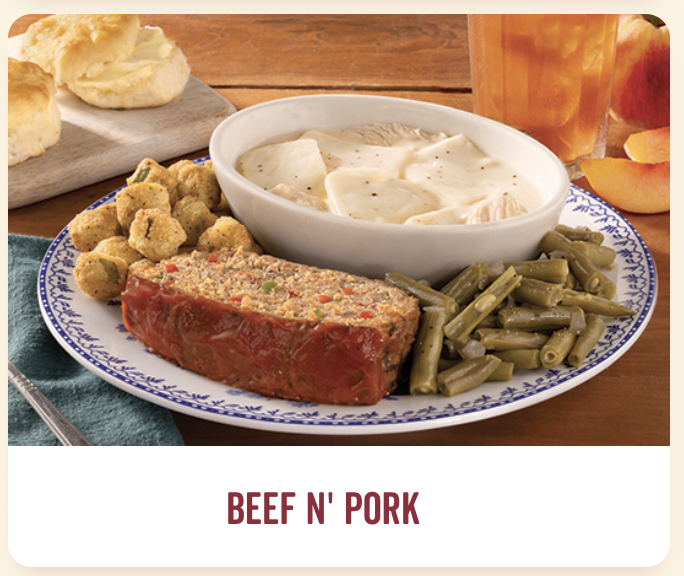
On the other end of the spectrum is Cracker Barrel (CBRL) serving Southern-inspired slop to old people. Valueline reports:
Macroeconomic factors have impacted Cracker Barrel Old Country Store’s sales. Elevated inflation, though now apparently easing, has stressed the company’s customers. Many of these customers are in the 65-and-older demographic, commonly characterized as a fixed-income category. Management is working to bring in more of a younger crowd into Cracker Barrel restaurants and in-location retail shops,
Good luck guys, but this looks to me like the past, not the future:
Then again, Cracker Barrel has (had?) their loyalists:
From 1977 to 2017, married couple Ray and Wilma Yoder drove a combined total of more than 5 million miles (an average of 342 miles per day) to visit 644 Cracker Barrel locations. When the company opened their 645th restaurant, in Tualatin, Oregon, in August 2017 (on Ray Yoder’s 81st birthday), it flew the Yoders out for the grand opening and presented them with custom aprons and rocking chairs, among other gifts.[52][53]
Yoshiharu (YOSH) is a Southern California ramen concept I have yet to try. There’s also Noodles & Company (NDLS). Why is their ticker symbol not NOOD? Missed opportunity. The noodles game seems too competitive to me, talk about low margins.
But then again look at the big winners here: MCD, DPZ, CMG. Burgers, pizza, burritos. You couldn’t come up with businesses with more competition, no barriers to entry. And yet these three systematized delivery and managed quality control in such a way as to create unstoppable empires.
I began this post as I was reading Value Line’s restaurant issue and enjoying contemplating the massive scale of these restaurant chains. As an occasional restaurant consumer I can engage with these places and sense their vibe, it’s a sector I can know in a way I can’t know, say, semiconductors or industrial products. So it’s an engaging, practical and delicious topic for our continued education in business.
So restaurants are different from retail because it’s not as easy to scale. There aren’t a bunch of large cap restaurant chains unlike retail. The franchise model is pretty powerful and what Chipotle has done is pretty powerful, too. But the similarities are like real estate matters, the store experience matters. But in a tight labor market, it’s tough.
And what’s interesting about McDonald’s — I have such an affection for that company. It works everywhere. They have one concept. I think it’s 60% or 70% of their operating income is from rent. They’re a landlord. They control the real estate. The others didn’t, so that’s why they’ve endured. They had a big insight about like let’s own the real estates so our franchisees don’t get whipped around with pricing, and we can co-invest with them in the experience.
And now digitals. The mobile ordering is enhancing the productivity and reducing even those kiosks. That need for labor and in a tight labor market, it’s big. The little guys can’t invest. They have some external dynamics now that are contributing to scale. But it’s really interesting.
Rory Sutherland brought up McDonald’s automated screens on Rick Rubin’s Tetragrammaton podcast. He wondered if they might allow for customers to make certain shameful orders they feel bad about saying to a person. I’ve tried out the automated screens, they work great at getting you your junk, but they make the world a little less human.
Remember when Eric Schlosser’s book Fast Food Nation came out in 2001? Absolutely everybody was reading it. They made a movie (pretty good! Richard Linklater). Yet here we are, almost twenty five years later, eating more fast food than ever.
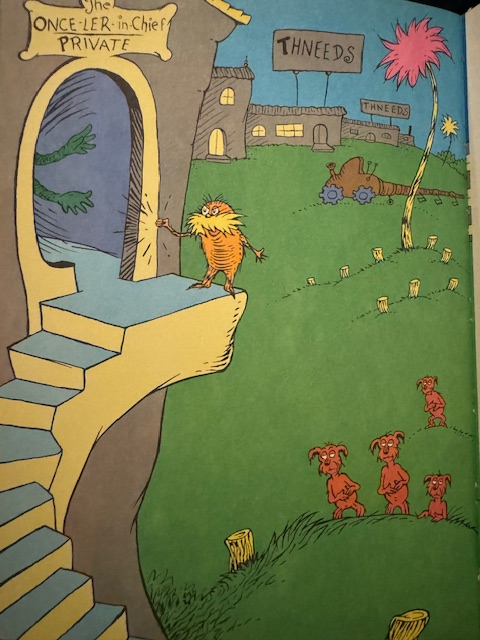
I was reading The Lorax to baby and it reminded me of Schlosser.
Here’s a more comprehensive list of restaurant stocks as I’ve skipped a few, notably Denny’s (DENN, slumping), Red Robin (RRGB, hopeless), El Pollo Loco (LOCO, stop trying to make citrus-marinated chicken happen), BJs, a few others.
“Treat” shops such as Krispy Kreme are beyond the scope of this post.
A former Navy mechanic named Doug Rose helped to popularize meltdowns after he created a dragster using a jet engine from a scrapyard. According to his widow, Jeanne, he conducted his first fire show around 1968 with a car he named the Green Mamba. Over the years, he honed his craft until he could torch a half-dozen vehicles at once. “Doug’s objective was to please the people,” she said.
WSJ also has a photographic review of how McDonald’s is revamping her burgers.
We’re not convinced. Yesterday stopped at the Yucaipa In-N-Out. Two cheeseburgers, fries, medium soda, side of pickles and free hot peppers for $12.50. Is there a better deal in America? Of course when you drive by Harris Ranch you get a tough look and smell of the system that makes that possible.
Joe Weisenthal Tracey Alloway interview their colleague Tim Culpan about FoxConn and founder Terry Guo.
And so one of the first things Terry Guo did was he said, okay, I want all of my workers to eat well. So every single one of them would get an egg a day, so they could get a bit of protein. That was kind of a bit of a way out idea at the time. This was, just to be clear, this was in the eighties, seventies and eighties, seventies and eighties. And so Terry Guo is not an electronics guy. Most people in the tech industry have a tech background, they have an electronics background, maybe electronic engineering, Terry Guo studied at a maritime college in Northern Taiwan. So he really studied shipping and logistics, and then he moved into plastics. So his kind of opening business was plastic injection molding. And if you think of Taiwan in the seventies and eighties, it was known, as you know, ‘Made in Taiwan,’ cheap plastic toys, Barbie dolls, and everything else was made in Taiwan.
That’s my bold.
Some of the history of the world:
Joe: (13:44) How did Apple find Foxconn?
Tim: (13:48) Well when Steve Jobs came back, as we all know, the company was in trouble, they, Apple was actually making their computers — like physically making them in California, but over a period of time, many companies, you know, Michael Dell and Hewlett Packard, Compaq, and others were starting to outsource to Asia. And at some point during that period of time, Tim Cook, who was operating officer at the time, he’d not yet become CEO, would’ve discovered Foxconn and realize that, you know, these guys make the components. We should probably get to know them. And they really jumped into bed deeply when the iPod came out in the early 2000s.
food writing is wild. That’s from a LA Times piece suggesting places to pick up a picnic before a concert at the Hollywood Bowl. You’re bringing a smashburger to see Dudamel? I guess I must respect it!
When I was a kid I loved Andes candies, which I feel like I sometimes got at like Italian or steakhouse type restaurants, and maybe sometimes on holidays. I dreamed they would make something like this, a full-sized candy bar Andes, and didn’t understand why they didn’t. Now, they do. And I have access to them whenever I want at Ralph’s. And I think I’ve bought them like once a year tops. That’s adulthood for you!
Here’s an excerpt from On The House, the memoir by former Speaker of the House of Representatives, John Boehner:
Cheers to this tweet for calling my attention to this, via Marginal Revolution. I got Boehner’s book and read it, and found it very illuminating in many ways (his harshest words are for Ted Cruz).
This is from The Half Has Never Been Told: Slavery and the Making of American Capitalism, by Edward E. Baptist:
The creation of the first slavery complex, with its “drug foods” – sugar, tobacco, tea, coffee, and chocolate – stimulated Western Europe’s desire to seek out and consume still more resources. The massive Atlantic slave trade required ships, trade commodities, and new structures of credit, and growth spilled over into sectors less directly linked to sugar. Many in Western Europe began to work longer hours in order to get new commodities, in what is sometimes called an eighteenth-century “Industrious Revolution.”
(boldface mine). Other scholars have written about the connection of sugar to capitalism, power, etc.
What if sugar has all of our balls in a vice, to use Boehner’s phrase?
“The brain is dependent on sugar as its main fuel,” says Vera Novak, MD, PhD, an HMS associate professor of medicine at Beth Israel Deaconess Medical Center. “It cannot be without it.” Although the brain needs glucose, too much of this energy source can be a bad thing.
so we learn over here from Harvard Medical School. My wise dentist called my attention to this as we were discussing why TV writers’ rooms are stocked with candy.
What if we’re trapped in a loop of feeding our brains sugar, and our brains getting bigger and trapping us in a sugar addiction loop? What if that’s what’s really driving capitalism, the whole mess we’re in?
Consider the Biblical tale of the garden of Eden. Adam and Eve are chilling happily there, and God asks them but one thing: don’t eat the fruit from the tree of knowledge of good and evil. What if, instead of being a metaphor, this was meant literally? God was telling the first people don’t eat too much sugar, or your brains will get too big and you’ll ruin everything?
When the woman saw that the fruit of the tree was good for food and pleasing to the eye, and also desirable for gaining wisdom, she took some and ate it. She also gave some to her husband, who was with her, and he ate it. 7 Then the eyes of both of them were opened, and they realized they were naked; so they sewed fig leaves together and made coverings for themselves.
This is where it all went wrong. Recall that as punishment for this, Adam is cursed to work:
Cursed is the ground because of you; through painful toil you will eat food from it all the days of your life. 18 It will produce thorns and thistles for you, and you will eat the plants of the field. 19 By the sweat of your brow you will eat your food
And as for Eve:
I will make your pains in childbearing very severe; with painful labor you will give birth to children.
Human labor is indeed very painful, and why? Because our heads/ brains are so big! Compare with a horse or goat, who can drop a baby and then scamper off, nbd.
Maybe humans never should’ve fucked with sugar, and Genesis actually contains a pretty straightforward origin story for the mistake that led to our predicament. Is it possible to observe the very mistake happening in chimps?










 Helytimes
_-_DSC07833.JPG)
