Purgatories
Posted: March 7, 2026 Filed under: Italy Leave a commentCanto IV of Dante’s Purgatorio. Dante’s trying to describe the mountain of Purgatory:
Vassi in Sanleo e discendesi in Noli,
montasi su Bismantova in cacume
con esso i piè; ma qui convien ch’om voli;
dico con l’ale snelle e con le piume
del gran disio, di retro a quel condotto
che speranza mi dava e facea lume’
Or:
One goes to Sanleo and descends to Noli,
one climbs the summit of Bismantova
with his feet; but here one must fly;I mean with slender wings and the feathers
of great desire, following that guide
who gave me hope and gave me light.
Gerald Davis gives us this as:
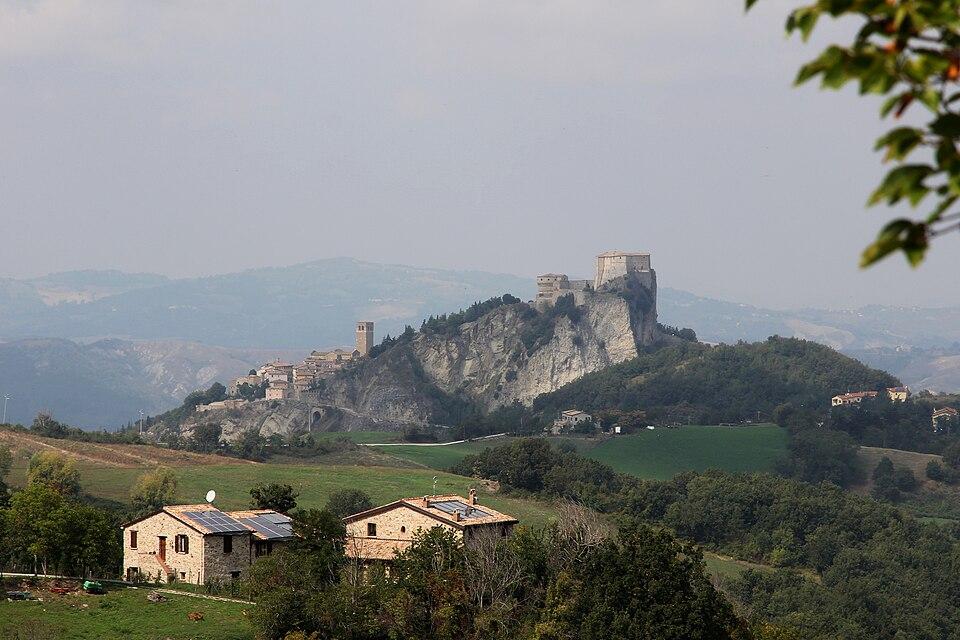
San Leo (source)
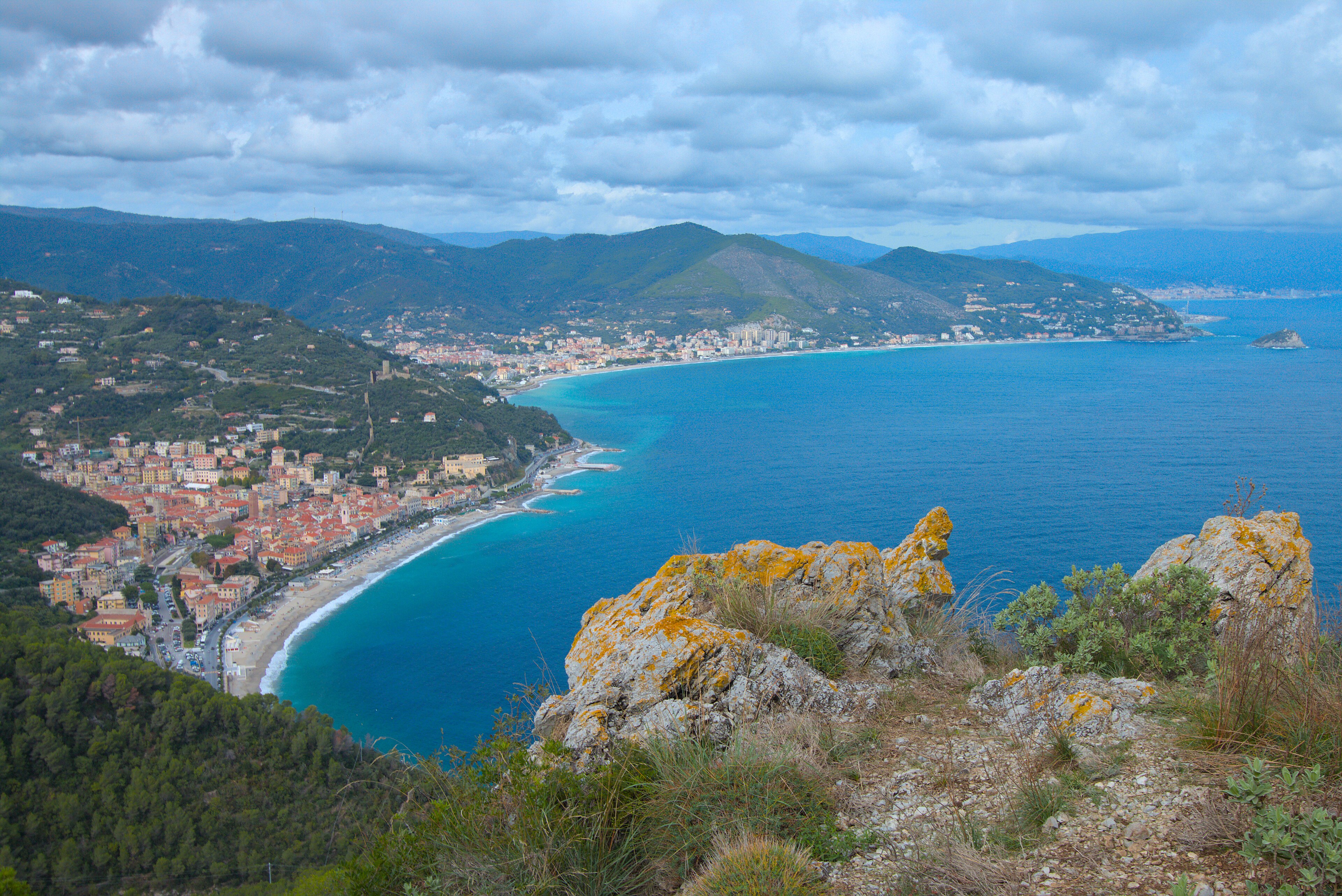
Noli (source)
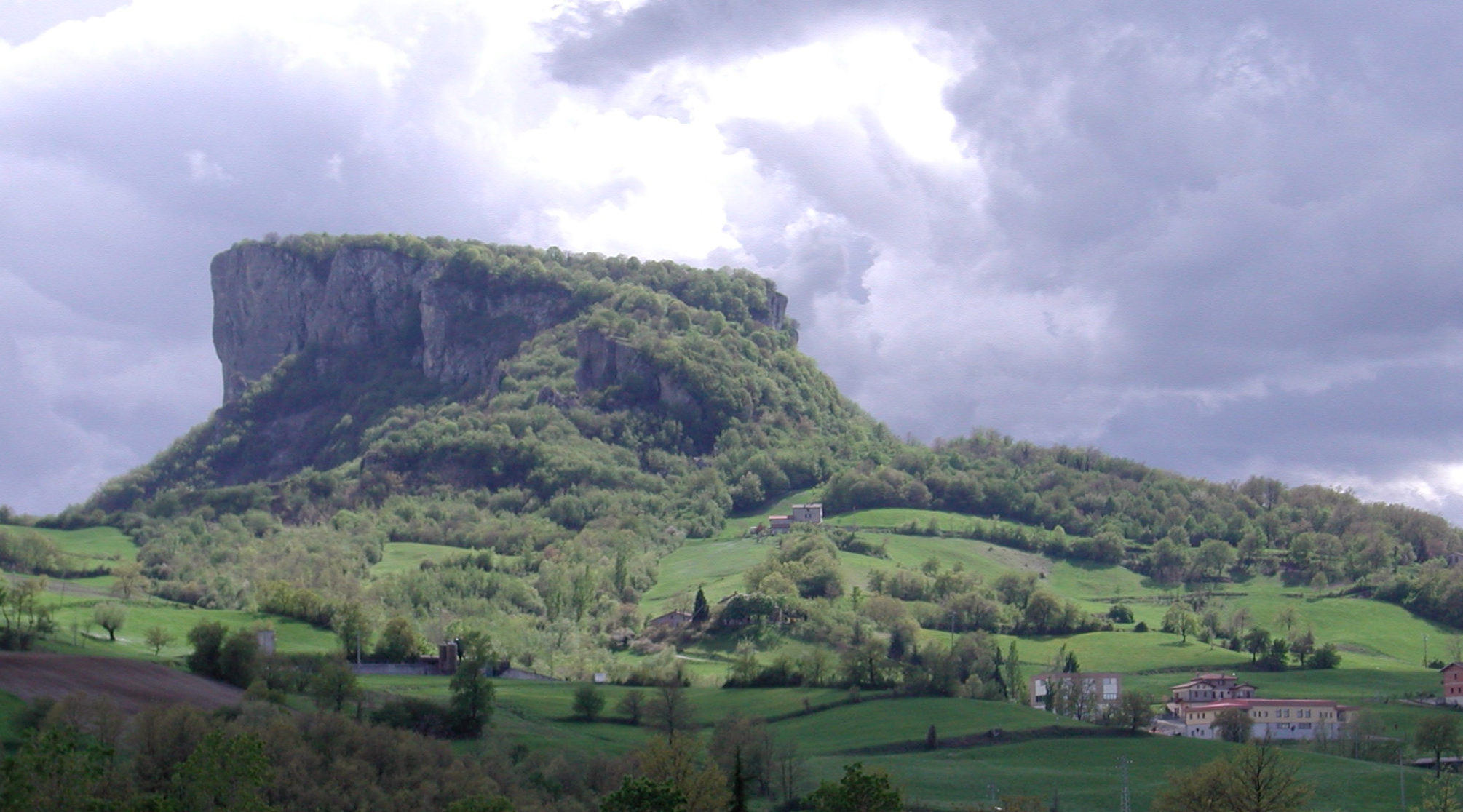
Bismantova (source)
I’d like to visit some day. It may have looked bleaker in Dante’s day:
At the time he saw it, Pietra di Bismantova probably looked even more barren than it does today, because of the intensive deforestation that took place in the surrounding area at the time. In recent decades, the area around the rock has been reforested as a result of the abandonment of local agriculture and a different use of forest resources.
F2: Fridericus II
Posted: March 1, 2026 Filed under: hely's history, Italy, Savoy Leave a commentAn important offscreen character in Dante’s Inferno is Fredrick II, the Holy Roman Emperor (to use an anachronistic term).
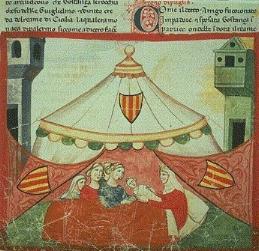
was he really born in the marketplace?
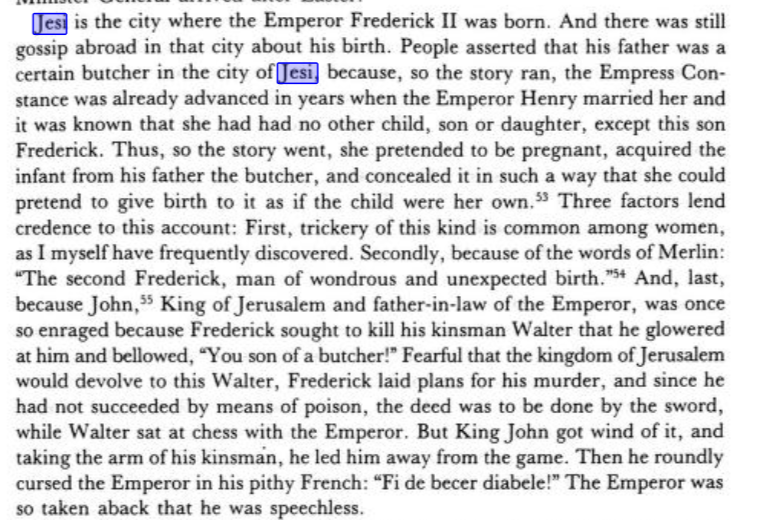
Friderick II (you’ll see why it’s important to spell it that way later) lived from 1194-1250 common era . This was the extent of his domain, in orange and red.
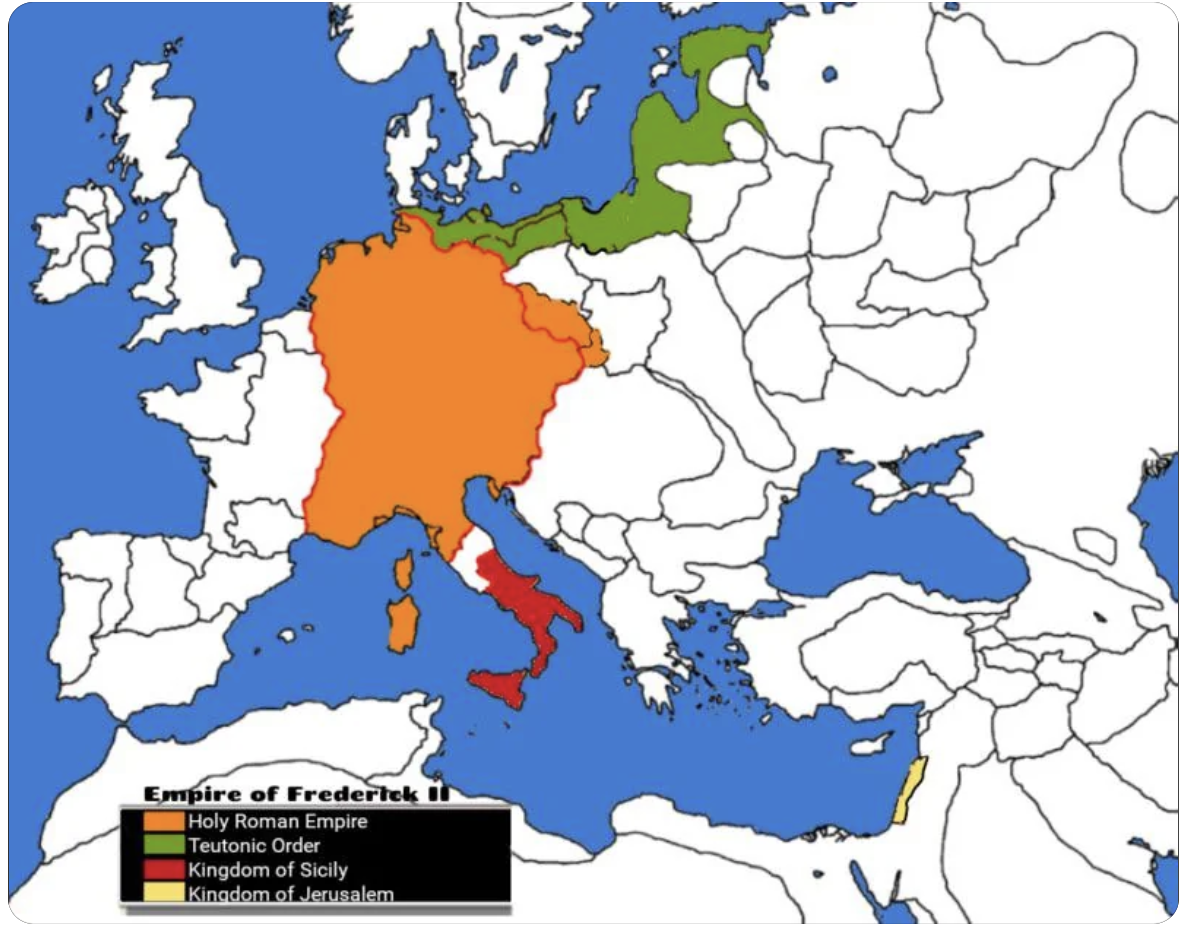
(I got that map from Reddit, you can see that the first commenter is already finding fault, but for our purposes it works).
You can see why Friderick would have conflict with the Pope, who had the lands in white that separated Friderick’s lands from each other. Thus begins (or thus continues) the conflict that tore apart Dante’s Florence, between Guelphs and Ghibellines, supporters of the Pope and supporters of the Emperor, that had such a huge impact on Dante’s life (Dante was Team Pope, but then his own side split into White and Black and he (White) lost and was exiled.)
He knew bird:
Frederick II is the author of the first treatise on the subject of falconry, De Arte Venandi cum Avibus (“The Art of Hunting with Birds”)…
For this book, he drew from sources in the Arabic language. Frederick’s pride in his mastery of the art is illustrated by the story that, when he was ordered to become a subject of the Great Khan (Batu) and receive an office at the Khan’s court, he remarked that he would make a good falconer, for he understood birds very well. He maintained up to fifty falconers at a time in his court, and in his letters he requested Arctic gyrfalcons from Lübeck and even from Greenland. …
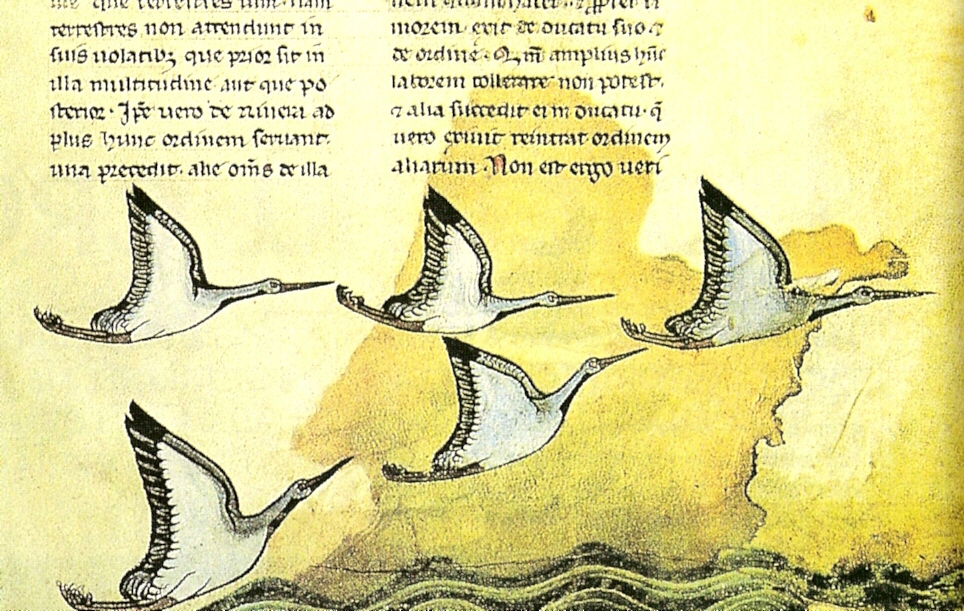
David Attenborough in “Natural Curiosities” notes that Frederick fully understood the migration of some birds at a time when all sorts of now improbable theories were common.
Now here’s something interesting:
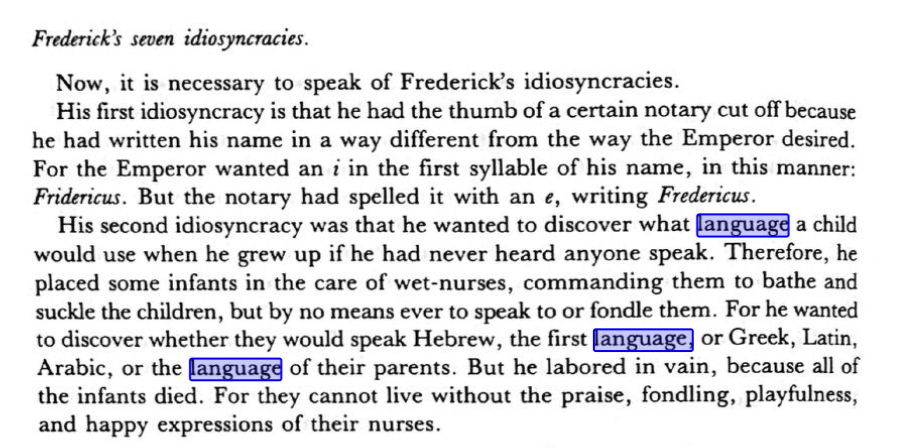
In the language deprivation experiment, young infants were supposedly raised without human interaction in an attempt to determine if there was a natural language that they might demonstrate once their voices matured. It is claimed he was seeking to discover what language would have been imparted unto Adam and Eve by God. Salimbene alleged that Frederick bade “foster-mothers and nurses to suckle and bathe and wash the children, but in no ways to prattle or speak with them; for he would have learnt whether they would speak the Hebrew language (which had been the first), or Greek, or Latin, or Arabic, or perchance the tongue of their parents of whom they had been born. But he laboured in vain, for the children could not live without clappings of the hands, and gestures, and gladness of countenance, and blandishments”.
Our source for that is the Cronica of Salimbene di Adam:
(source)
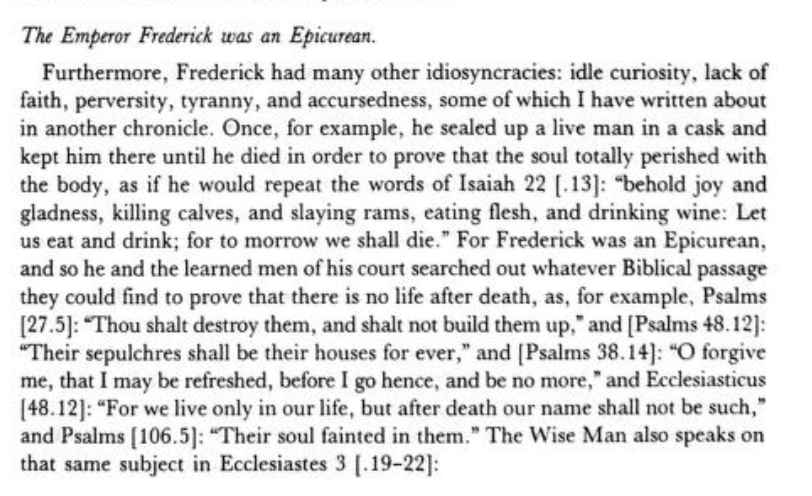
More experiments reported:
As for his appearance?
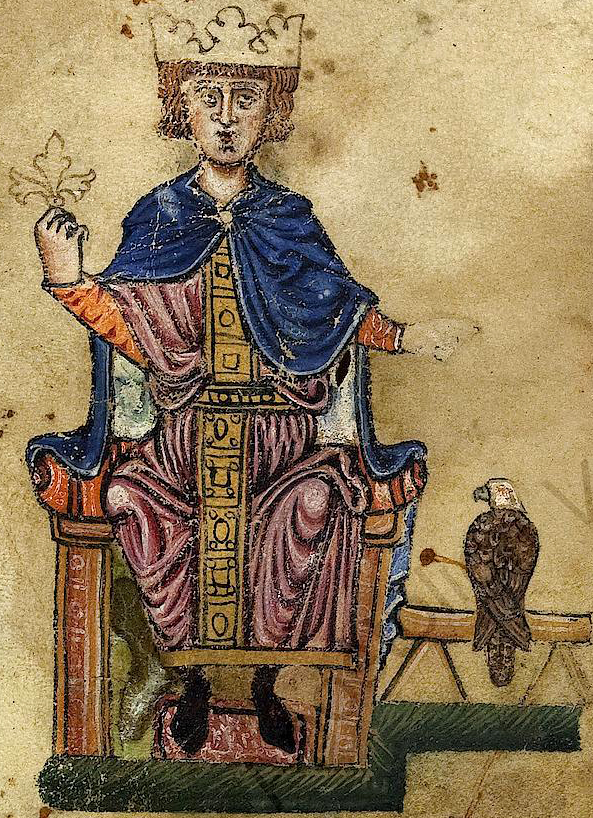
A Damascene chronicler, Sibt ibn al-Jawzi, left a physical description of Frederick based on the testimony of those who had seen the emperor in person in Jerusalem: “The Emperor was covered with red hair, was bald and myopic. Had he been a slave, he would not have fetched 200 dirhams at market.”
It’s very possible we would put this guy today into one of several categories ranging from oddball to neuroatypical. Some clues are he did weird experiments, looked weird, and had a guy’s finger cut off for spelling his name wrong.
Lansing and English, two British historians, argue that medieval Palermo has been overlooked in favour of Paris and London:
One effect of this approach has been to privilege historical winners, [and] aspects of medieval Europe that became important in later centuries, above all the nation state…. Arguably the liveliest cultural innovation in the 13th century was Mediterranean, centered on Frederick II’s polyglot court and administration in Palermo…. Sicily and the Italian South in later centuries suffered a long slide into overtaxed poverty and marginality. Textbook narratives therefore focus not on medieval Palermo, with its Muslim and Jewish bureaucracies and Arabic-speaking monarch, but on the historical winners, Paris and London.
Dante preferred Friderick’s successor, Henry VII.
first time I lol’d at Dante’s Inferno
Posted: February 25, 2026 Filed under: Italy Leave a commentCanto 17:
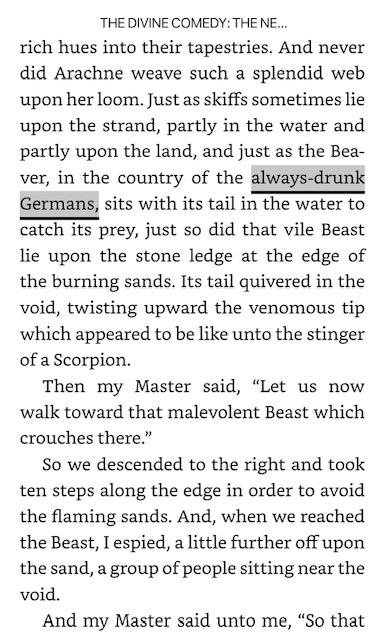
that’s from Gerald Davis translation. John Ciardi gives us:
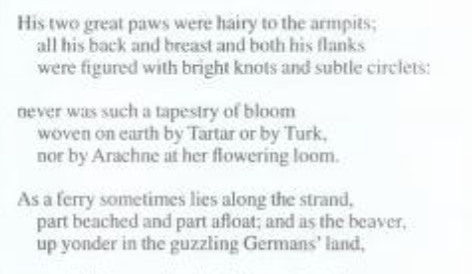
Mandelbaum:

if we just put “Tedeschi lurchi” in Google translate it gives us “German slugs.”
Cheers to Tom B., age fourteen or something, describing the Inferno as “self insertion fan fiction.” It is!
My two year old daughter saw this guy on the cover of John Sinclair’s translation
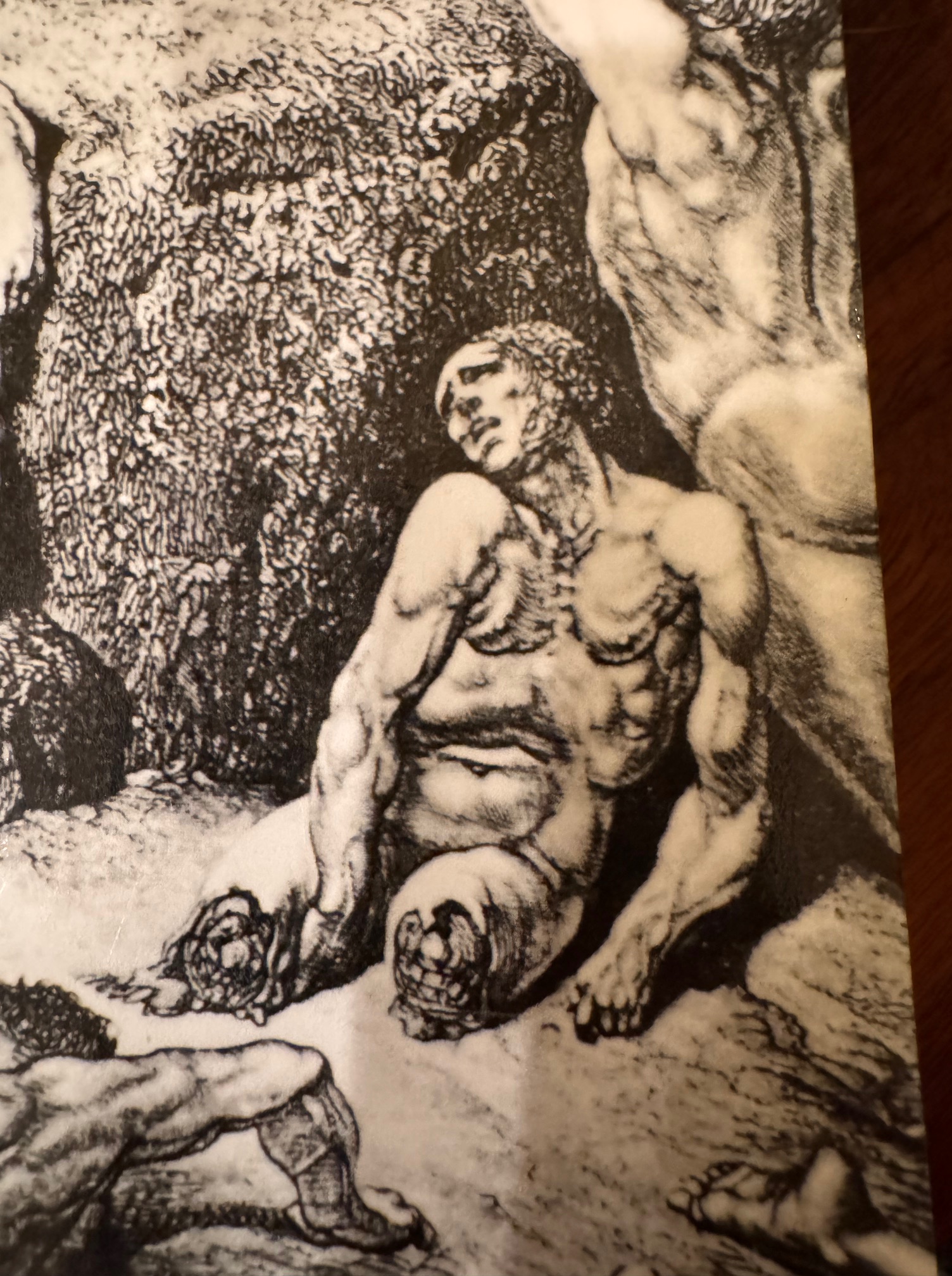
and said
he’s sad. he misses his mommy.
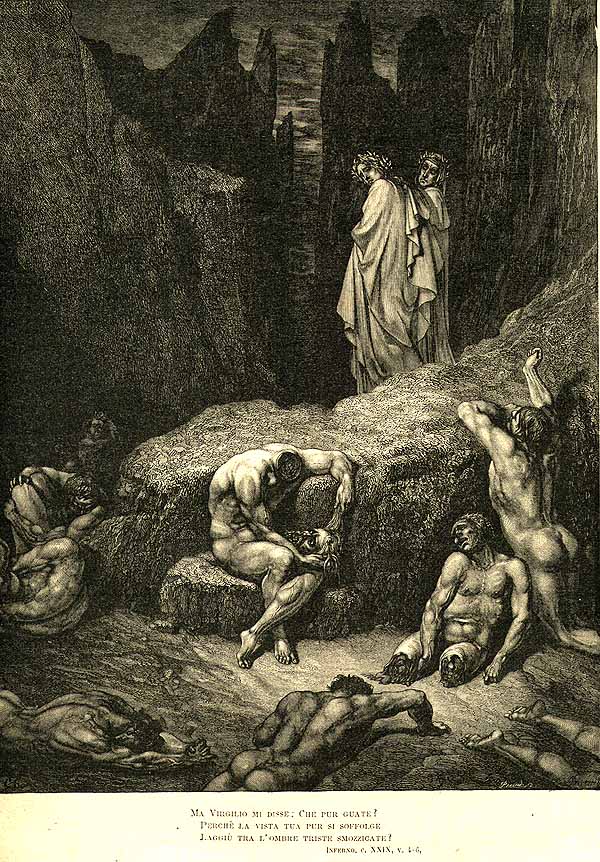
correct, this is from Canto 28, the Schismatics, who are cut apart as they cut families apart.
What Will Trigger The Next Crisis?
Posted: September 9, 2018 Filed under: America Since 1945, business, Italy Leave a comment

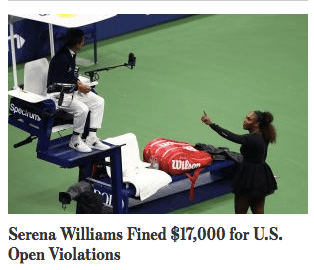

What Will Trigger The Next Crisis? is a subtext of many a Wall Street Journal article, but this week that was the headline on what I found to be an unusually succinct and comprehensible roundup of possible catalysts.
Interest Rates Jump
Bad-Loan Boom
China Cracks
Supply-Chain Disruptions
were four of the possibilities, but the one that caught me was
Italy Dumps The Euro
But Italy may be wavering. Italian bond yields spiked in May after two parties with anti-euro leanings tried to form a new government. The crisis could escalate again once politicians return from holidays. Some 59% of Italians want to keep the common currency, official surveys show—the slimmest majority in the eurozone.
I like the idea that a bunch of Italian politicians coming back from vacation is a global financial crisis waiting to happen.
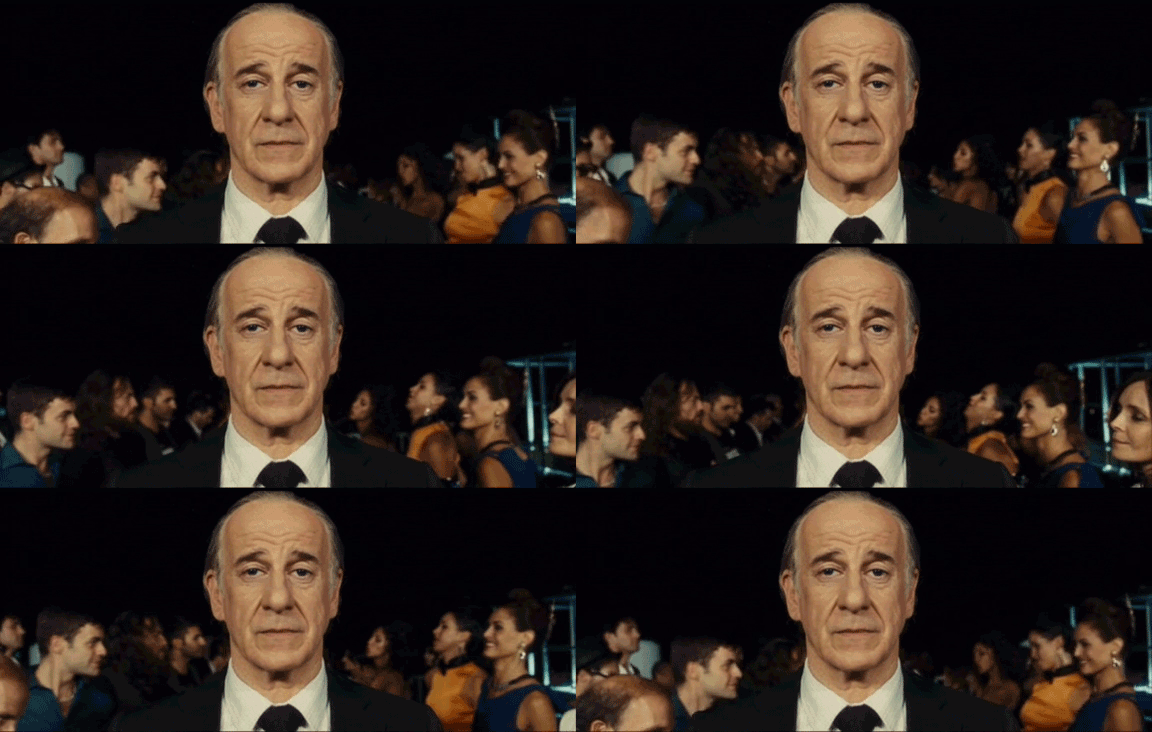
La grande bellezza
In this same issue of the WSJ:

Groovy opening
Posted: May 3, 2016 Filed under: adventures, film, Italy, movies, music Leave a comment
Entrepreneurs in Italy
Posted: September 16, 2015 Filed under: America Since 1945, Italy Leave a comment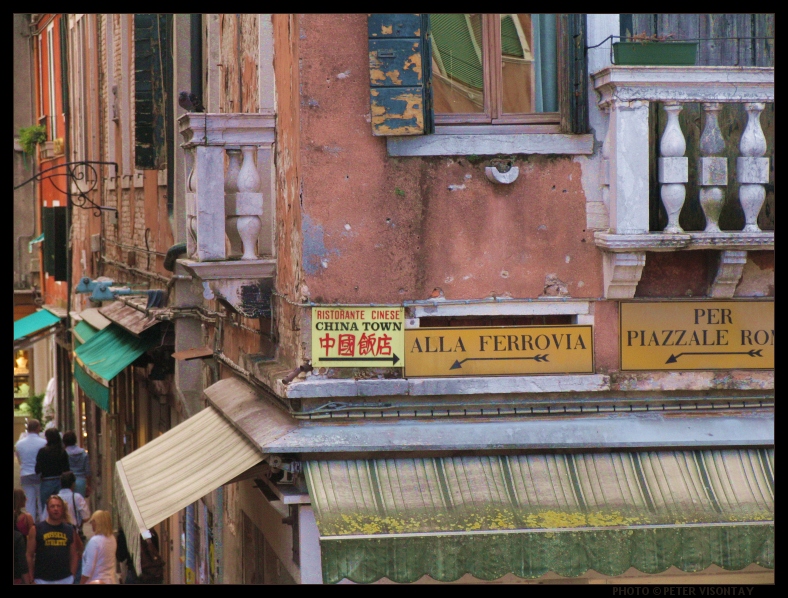
Photo of a Chinese restaurant in Venice by Peter Vistonay found here: http://www.earth-photography.com/Countries/Italy/Italy_Venice_Misc_Signs.html
from this convo between Tyler Cowen and Italian economist Luigi Zingales:
COWEN: Here’s an article from Quartz. Let me read you the headline. Maybe you saw it from a few months ago. “The most common surnames of new entrepreneurs in Italy are Hu, Chen, and Singh.” If you look at Milan, you have to go through 20 names, and at number 20 is the Italian name Colombo for the most common or most frequent names of entrepreneurs.
Is this sustainable culturally, or is this Italy’s future, in essence, to be economically colonized the way parts of Southeast Asia have been by Chinese, Indians, Sikhs, whoever it may be. Maybe Germans.
ZINGALES: One friend of mine was saying that the demise of the Italian firm family structure is the demise of the Italian family. In essence, when you used to have seven kids, one out of seven in the family was smart. You could find him. You could transfer the business within the family with a little bit of meritocracy and selection.
When you’re down to one or two kids, the chance that one is an idiot is pretty large. The result is that you can’t really transfer the business within the family. The biggest problem of Italy is actually fertility, in my view, because we don’t have enough kids. If you don’t have enough kids, you don’t have enough people to transfer. You don’t have enough young people to be dynamic.
Here’s more from Luigi, predicting the coming of Trump and comparing him to Italy’s Berlusconi:
Trump and Berlusconi are remarkably alike. They are both billionaire businessmen who claim that the government should be run like a business. They are both gifted salesmen, able to appeal to the emotions of their fellow citizens. They are both obsessed with their looks, with their hair (or what remains of it), and with sexy women. Their gross manners make them popular, perhaps because people think that if these guys could become billionaires, anyone could. Most important is that both Trump and Berlusconi made their initial fortunes in real estate, an industry where connections and corruption often matter as much as, or more than, talent and hard work. Indeed, while both pretend to stand for free markets, what they really believe in is what most of us would label crony capitalism.
Berlusconi’s policies have been devastating to Italy. He has been prime minister for eight of the last ten years, during which time the Italian per-capita GDP has dropped 4 percent, the debt-to-GDP ratio has increased from 109 percent to 120 percent, and taxes have increased from 41.2 percent to 43.4 percent. Italy’s score in the Heritage Foundation’s Index of Economic Freedom has dropped from 63 to 60.3, and in the World Economic Forum Index of Competitiveness from 4.9 to 4.37. Berlusconi’s tenure has also been devastating for free-market ideas, which now are identified with corruption.
How can such a pro-business prime minister wreak havoc on the economy and on the idea of free markets? Because “pro-business” doesn’t necessarily mean “pro-market.” While the two agendas sometimes coincide—as in the case of protecting property rights—they’re often at odds. Market competition threatens established firms, which often use their political muscle to restrict new entries into their industry, strengthening their positions but putting customers at a disadvantage. A pro-market strategy, by contrast, aims to encourage the best business conditions for everyone. That’s in fact the opposite of what a real-estate tycoon wants: to keep competitors out and enhance the value of his own properties. By capturing (or more precisely, purchasing) the free-market flag in the same way one might acquire a business brand, Berlusconi likely has destroyed the appeal of the free-market ideal in Italy for a generation.
Sunday Reading
Posted: June 21, 2015 Filed under: Italy, writing Leave a comment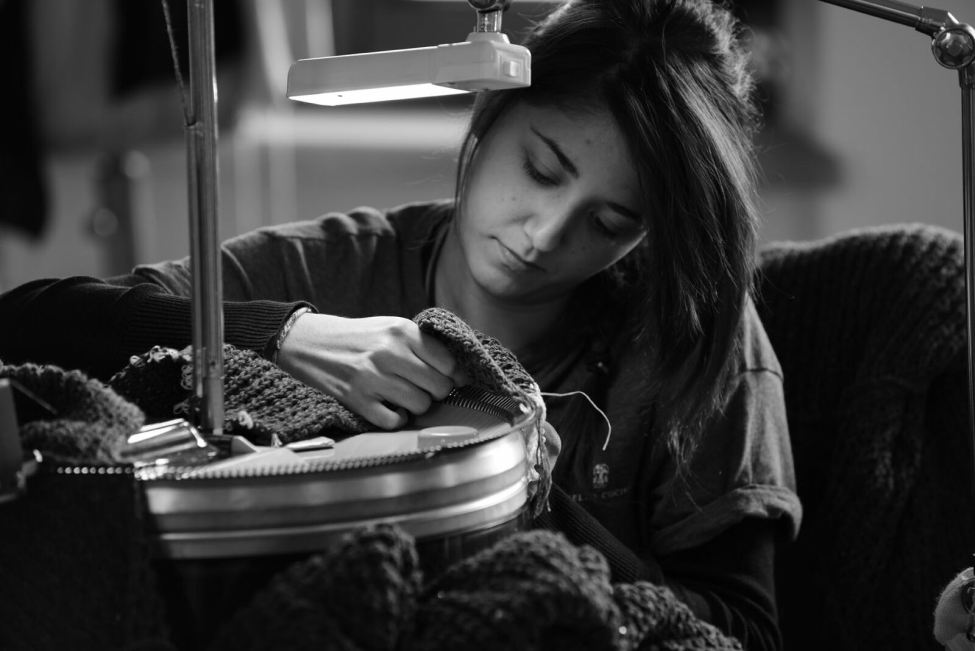
Om Malik: I’ve been reading about you, and I have been fascinated by your progress and more importantly how you have conducted your business. Where did you find the inspiration to follow this path?
Brunello Cucinelli: From the teary eyes of my father. When we were living in the countryside, the atmosphere, the ambiance — life was good. We were just farmers, nothing special. Then he went to work in a factory. He was being humiliated and offended, and he was doing a hard job. He would not complain about the hardship or the tiny wages he received, but what he did say was, “What have I done evil to God to be subject to such humiliation?”
Basically, what is human dignity made of? If we work together, say, and, even with one look, I make you understand that you are worth nothing and I look down on you, I have killed you. But if I give you regards and respect — out of esteem, responsibility is spawned. Then out of responsibility comes creativity, because every human being has an amount of genius in them. Man needs dignity even more than he needs bread.
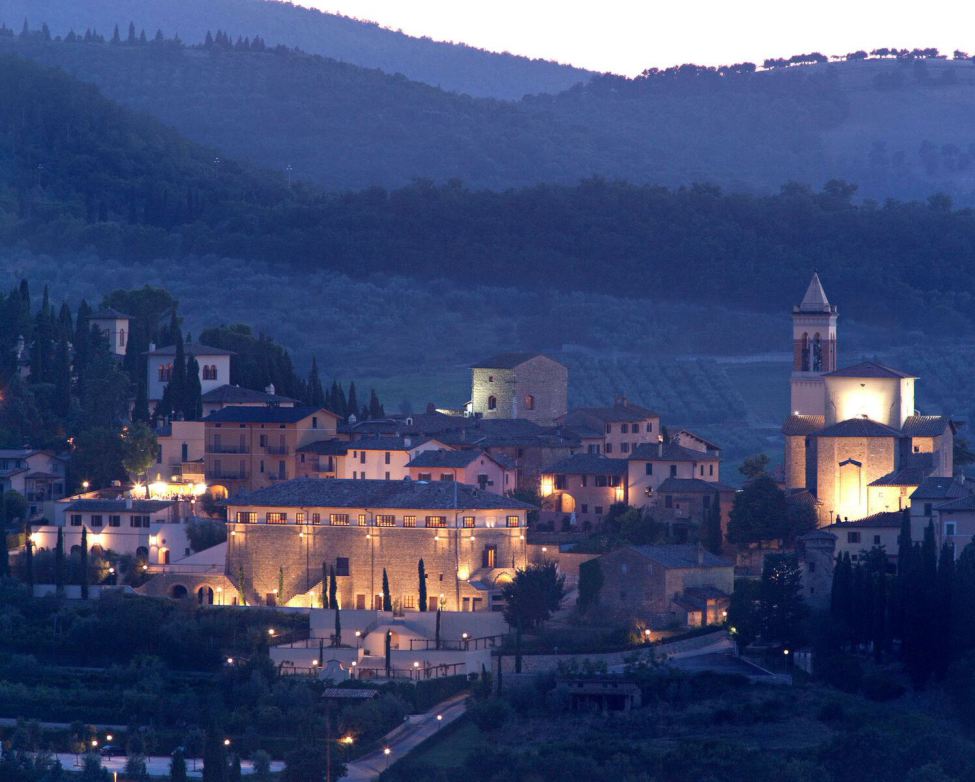
A correspondent sends this one along, subject line: “Most interesting thing I read today.” Fantastic:
Here, no meetings with mobile phones. No one is allowed to bring them into the meeting room. You must look me in the eye. You must know things by heart. You must know all of your business with a 1 to 2 percent error rate. It is also training for your mind. It is also a question of respect, because I have never called someone on a Saturday or a Sunday. No one is allowed to do so. We must discover this, because if individuals rest properly, then it is better.
Do you know the word otium in Latin, meaning, “doing nothing”? The Roman people were all laid back. In all the pictures, they were all laying around. They were doing nothing, just staring. In the winter on a Sunday afternoon, I can spend six hours in front of the fireplace, just looking at the flames and thinking. In the evening, I’m drunk with beautiful thoughts. My wife says to me, “What are you looking at?” I say, “The fire.” We have to take a step backward.

I’m not about to buy a $3,500 sweater but if I was it’d be from this man:
Om: What’s the correlation? All these people you are quoting are very interesting, but why mention them? Also how are they correlated to all these people whose photos you have on the wall here?
Brunello: Those are the ancient thinkers, philosophers: Socrates, Confucius, Constantine, Palladio. These people are the contemporary figures that left me with a different view on the world. Dostoyevsky, Gandhi, Martin Luther King Jr., Kafka, Kennedy and the Pope. At the end of the day, all these great people, what do they focus on? Human dignity. They all talk about being custodians in the world. Hadrian, the emperor said, “I feel responsible for the beauty in the world.”
Can I ask you, how old are you? I am 60 myself.
Om: 48.
Brunello: You are not far away from my mindset.
Jean-Jacques Rousseau was a great enlightened man, but he was the first of the Romantic movement, too. I think that in the last 30 years, we have tried to govern mankind through enlightenment, through the use of reason, our mind. This is no good.
This century is where enlightenment and romanticism must blend. A great idea that is born out of the mind and then goes through the soul — there is no doubt that the outcome is marvelous. If this idea is true, fair, beautiful, there’s no doubt that it is also a good idea. I think this applies to everything.
All words and pictures from this gorgeous website. There’s other great stuff. Take this, from an interview with photographer Vincent Laforet:
Om: When I was a young reporter in India, I had this one photographer friend, Anu Pushkarna. He would take the flattest pictures ever, but he was the bravest guy ever. If there was a riot or some other craziness going on, he was right in the middle of everything. It wasn’t art, but they were real. He would get hit on the head for taking a picture.The same event captured by some of the bigger-name photographers in India like Raghu Rai, the same perspective, it would be like, “Wow.” The pictures were what made the story better.
Vincent: It’s a perfect marriage. It’s like a movie, with film and sound and acting and directing and music. I wish there was more mutual respect between the different professions. I can tell you that the joke amongst war photographers has always been that most war correspondents work from their hotel rooms at the suite at the Ritz-Carlton, whereas the war photographer has to go where the bullets are flying.
AND there’s an interview with my old college nemesis! (not a bad guy, actually pretty impressive, just tragically humorless)
Hey, Readers, send me more stuff like this! I’d love to evolve Helytimes into something more like Wonderful Digest magazine, all sent in by correspondents. Helytimes’ email is helphely@gmail.
Gonna take a break for the summer soon, but send me the most interesting thing you read!
The Duke of Abruzzi
Posted: June 16, 2015 Filed under: heroes, Italy, mountains, photography, Tibet, travel, writing 2 Comments
This one prompted me to pick up a book I’d been hearing about for awhile. Wade Davis has been featured on Helytimes before.
 He is the real deal.

The opening chapter of this book is intense, vivid writing about the British experience on the Western Front during World War I. Thought I’d read enough about that horror show: Robert Graves and Paul Fussell and Geoff Dyer. Maybe the guy who hit me in the guts the hardest was Siegfried Sassoon, in part because of what a groovy idyllic life got catastrophically ruined for him.
But Wade Davis makes it all new again. One paragraph will do:


Also fascinating:


Click here if you want to see a photo of Mallory’s dead body, discovered in 1999, seventy five years after he was lost on Everest. Only halfway through Davis’ book, at the moment I’m deep in Tibet suffering along on the painstaking surveying expeditions.
A character keeps popping like a fox into the story and then disappearing — a rival mountaineer, the Duke Of Abruzzi.

(You can read about Abruzzi, why I’d be interested in a duke from there here.) What a life. Says Wiki:
He had begun to train as a mountaineer in 1892 on Mont Blanc and Monte Rosa (Italian Alps): in 1897 he made the first ascent of Mount Saint Elias (Canada/U.S., 5,489 m). There the expedition searched for a mirage, known as the Silent City of Alaska, that natives and prospectors claimed to see over a glacier. C. W. Thornton, a member of the expedition, wrote: “It required no effort of the imagination to liken it to a city, but was so distinct that it required, instead, faith to believe that it was not in reality a city.”[citation needed]
Another witness wrote in The New York Times: “We could plainly see houses, well-defined streets, and trees. Here and there rose tall spires over huge buildings which appeared to be ancient mosques or cathedrals.”
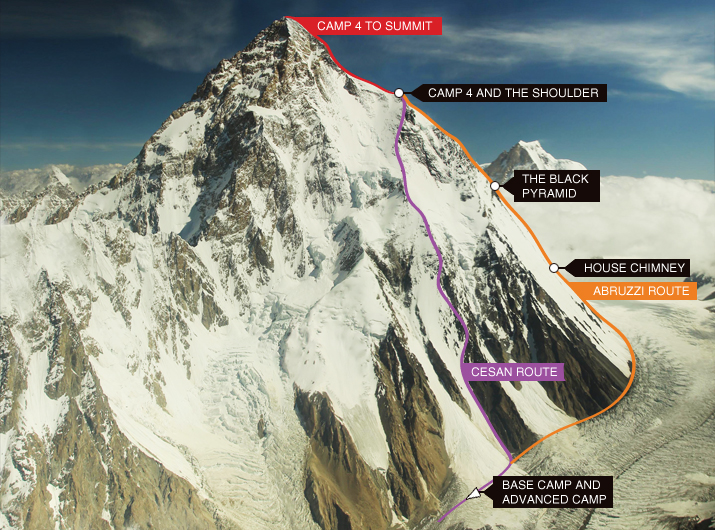
If you’re climbing K2 you’re liable to be on the Abruzzi Spur:
Late in life:
In 1918, the Duke returned to Italian Somaliland. In 1920, he founded the “Village of the Duke of Abruzzi” (Villaggio Duca degli Abruzzi orVillabruzzi) some ninety kilometres north of Mogadishu. It was an agricultural settlement experimenting with new cultivation techniques. By 1926, the colony comprised 16 villages, with 3,000 Somali and 200 Italian (Italian Somalis) inhabitants. Abruzzi raised funds for a number of development projects in the town, including roads, dams, schools, hospitals, a church and a mosque. He died in the village on 18 March 1933. After Italian Somaliland was dissolved, the town was later renamed to Jowhar.

Jowhar found here, I hope user Talya doesn’t mind: http://www.skyscrapercity.com/showthread.php?t=1569979. From wiki: “On May 17, 2009, the Islamist al-Shabab militia took of the town, and imposed draconian rules, including a ban on handshaking between men and women.”
Let’s skip to the best part of any Wikipedia page, “Personal Life:”
In the early years of the twentieth century the Abruzzi was in a relationship with Katherine Hallie “Kitty” Elkins, daughter of the wealthy American senator Stephen Benton Elkins, but the Abruzzi’s cousin King Victor Emmanuel III of Italy refused to grant him permission to marry a commoner. His brother, Emanuele Filiberto, to whom Luigi was very close, convinced him to give up the relationship.[8] His brother later approved of young Antoinette “Amber” Brizzi, the daughter of Quinto Brizzi, one of the largest vineyard owners in northern Italy. In the later years of his life, Abruzzi married a young Somali woman named Faduma Ali.
Here is a picture of the Duke of Abruzzi:

That was taken by Vittorio Sella.
The high quality of Sella’s photography was in part due to his use of 30×40 cm photographic plates, in spite of the difficulty of carrying bulky and fragile equipment into remote places. He had to invent equipment, including modified pack saddles and rucksacks, to allow these particularly large glass plates to be transported safely.[6] His photographs were widely published and exhibited, and highly praised; Ansel Adams, who saw thirty-one that Sella had presented to the US Sierra Club, said they inspired “a definitely religious awe”.
 More on the Duke by Peter Bridges at VQR
Hey again I just yank photos and stuff from books from all over — not sure if that’s like an ok practice but this is a non-profit site, try to credit everyone, the whole point is that maybe you will want to go look at/read the originals.
 Helytimes

