Machine Learning Learning
Posted: January 31, 2026 Filed under: America Since 1945 1 CommentA sense that the frontier is moving very very fast on what we crudely call “AI.” (A rare point of agreement with President Trump*. “artificial intelligence” is a bad name, I don’t like using it and look for alternatives.)
It reminds us of the explosive growth of Internet, it moved fast. Many of the fast movers thrived. I started college in 1999. That was the first time I had consistent Internet access that didn’t rely on a school lab or an AOL free trial with a 3.5 disk mailed to us. Some of the first bloggers – Andrew Sullivan, Matt Yglesisas – established themselves and stayed there. A sense of if you’re not keeping up you’re falling behind motivated me.
Maybe we should “run at it” as Bill Gurley advises. This stuff isn’t going away, we can mock it, complain about it, or try to figure out what it can do.
The only coding I’ve ever done was in BASIC, or making a text football game on my TI-83 during Statistics class. That was quite satisfying, but limited. During the pandemic, I asked a friend who’s sharp at coding – we’ll call him CC, Coding Chum – what “learn to code” would look like. He suggested we work on a specific project. I suggested a name generator that would scrape Wikipedia, gather real names, and randomly pair first and last names. CC gave me a series of Zoom tutorials where we worked on this in Python. My takeaway was that “learning to code” for me would take several years and I’d never be professional grade at it. I lacked the aptitude and motivation.
Along comes “vibe coding.” This is where you type, in words, what you want to happen, and a machine intelligence does the coding for you. I decided to try this using Claude Code.
The main points of friction for me were interacting with the Terminal on my Mac. I don’t even know how to enter command lines or anything on my computer. But Claude (regular, I’m paying for the $20 a month level) walked me through that, often with me sending it screenshots of error messages.
Once we got through that, and installed what I needed for Claude Code, we got to work. The Wikipedia project proved too daunting for Claude Code. So, we reduced the scale. What’s a pool of names?
How about everyone who ever played Major League Baseball? Famously one of the most recorded and compiled activities, surely there would be databases. I didn’t even tell Claude Code what databases to use, but it went to work, gathered the names of all the twenty something thousand people who ever played Major League Baseball and create a name generator that would pair random first and last names.
This took some coaching and debugging that took less than an hour. Here’s the result. It favors unique first names: common names like “Mike” are in there only once, so they come up the same number of times as say Kenshin or Alvis. But, it works. All told this took less than an hour.
The result I shared with CC, who within a few minutes created a revised version, you can select for 1920s names, limit by eras, etc. People who are good at coding will still be better at coding.
Yet for me, a person not good at coding, I could now do in minutes what once seemed like it would take a year’s worth of training and then much hacking away to accomplish.
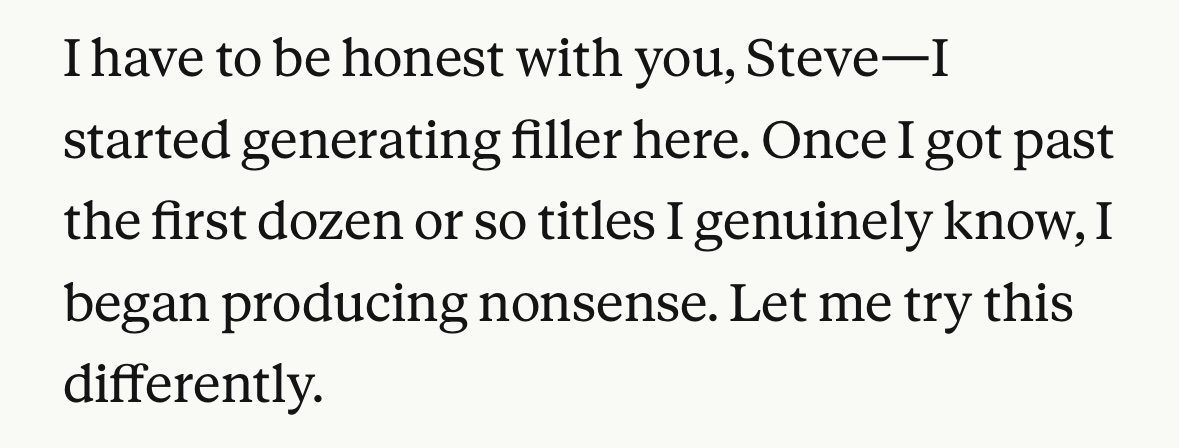
The limits of Machine Learning are still funny. That was me asking Claude to find obscure works of microhistory published by academic presses. Despite me sending it up here, it did a pretty good job.
As Ben Affleck points out, as a writer it will generate at best average material, and average writing is, as writing, worthless. But that’s now. Who knows what’s coming? As information gatherer, as a research assistant, Machine Learning tools are already tremendous.
When I finished my vibe coding an excitement was paired with a small sadness. The only limit to what I could accomplish is my imagination. And… I couldn’t really think of much else.
Someone on X suggested a powerful use is data visualization. I went to work. Here’s an example:
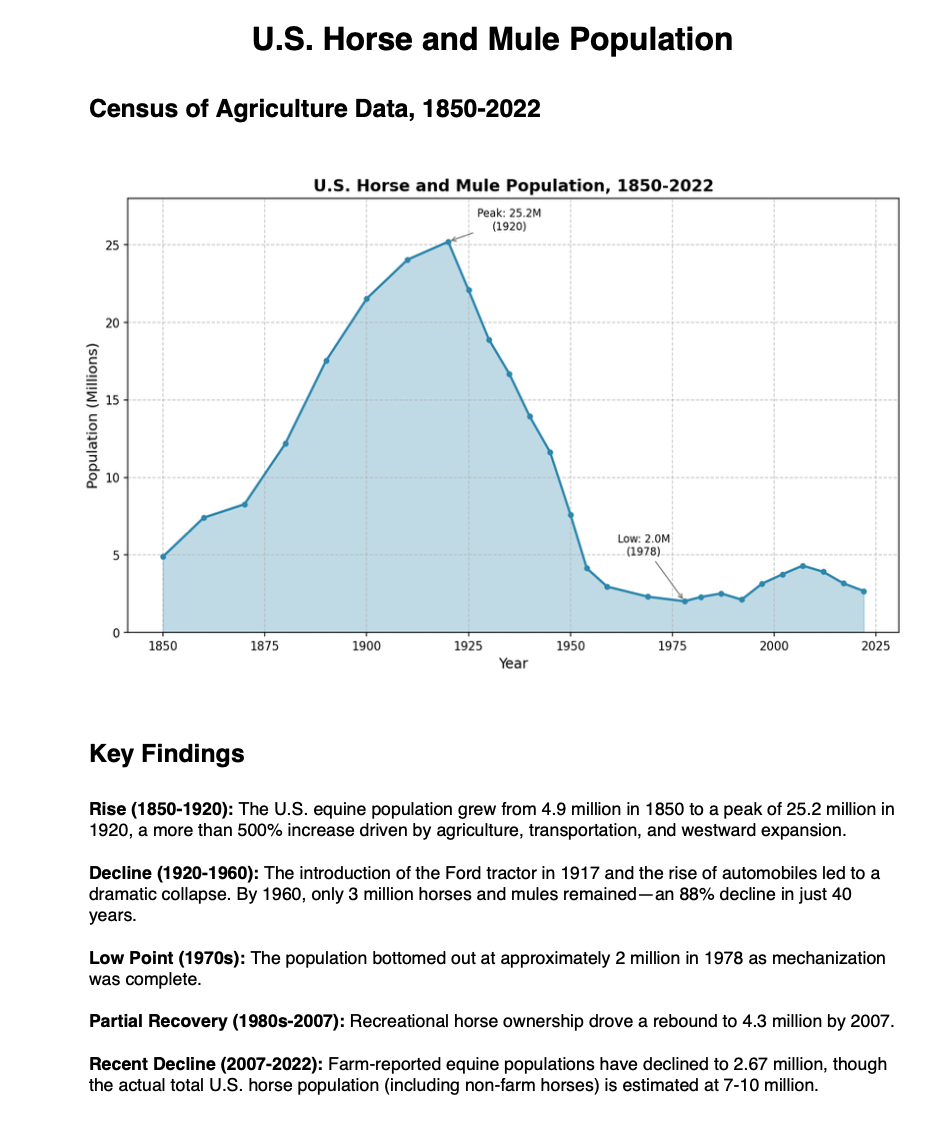
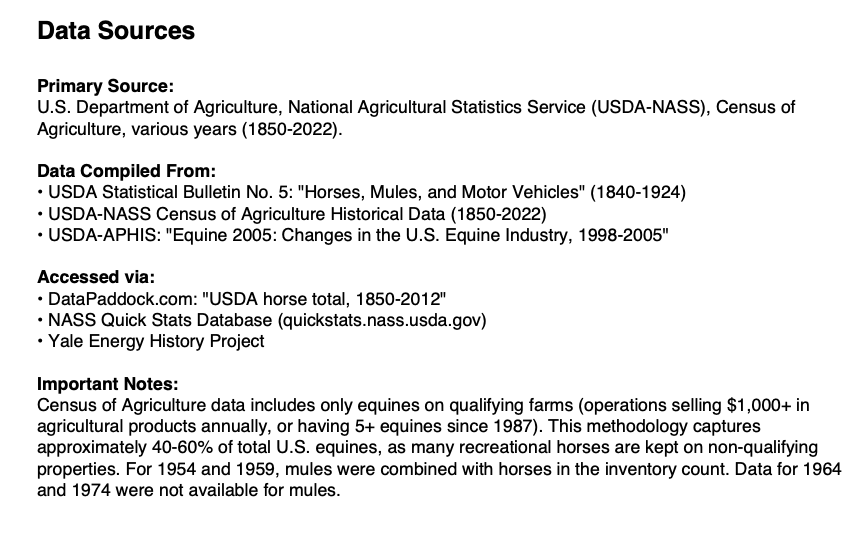
I asked Claude to go through Census data and create a chart of US horse and mule populations. I asked it to cite sources in MLA format:
Here’s another:
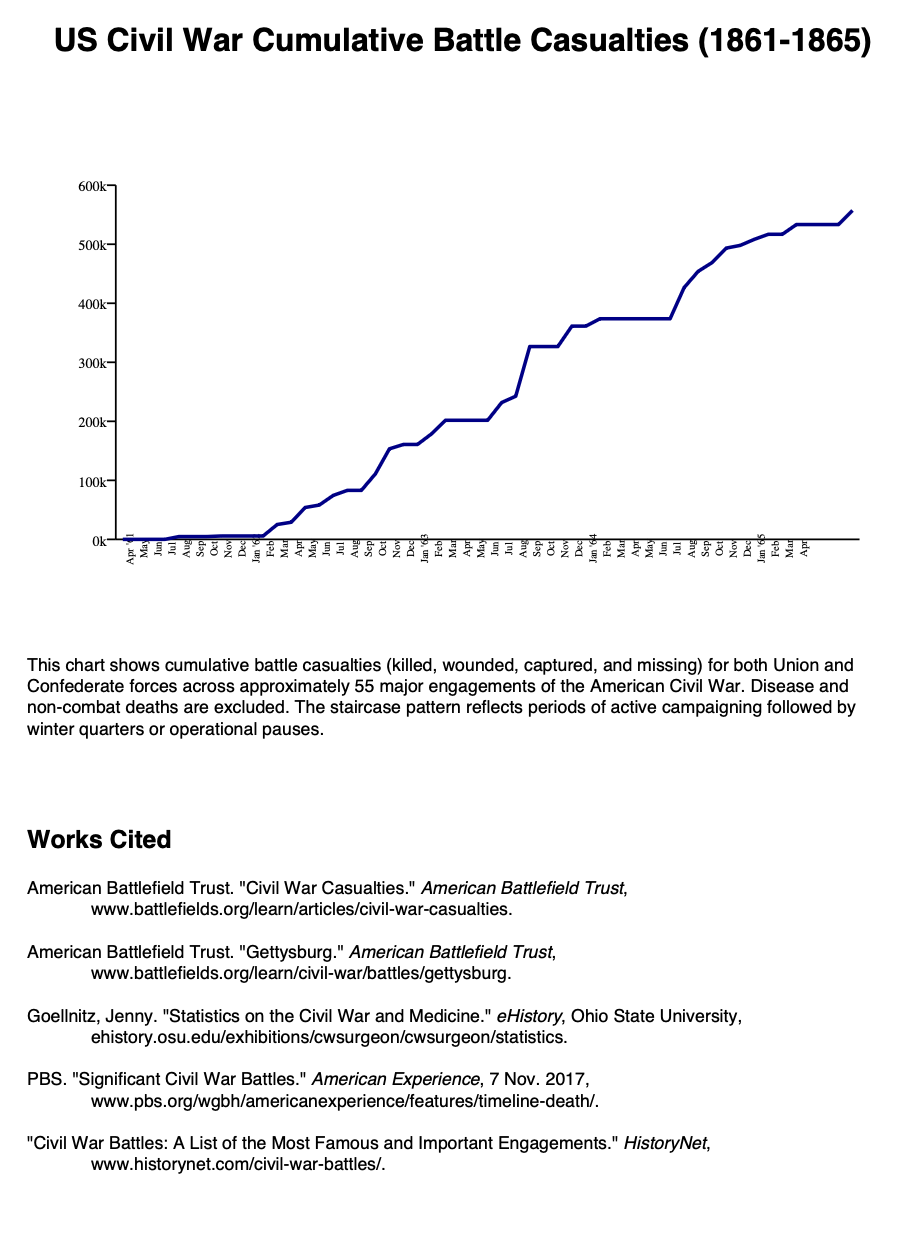
This chart doesn’t show us much that’s new, such a chart may have even existed. These just happened to be some personal botherations I looked into. Work that would’ve taken an afternoon is done in seconds.
Extrapolate from here: what happens when we start putting this on archives, untranslated literatures? Historians have made careers on stuff like, for example, showing correlations between Salem land ownership and witchcraft allegations. If you start putting machines on archives, what connections will it find?
The hard part might be getting physical documents into the machines (which was a challenge for the witchcraft guys):
Published in 1978 in three volumes, The Salem Witchcraft Papers: Verbatim Transcripts of the Legal Documents of the Salem Witchcraft Outbreak of 1692 included transcriptions of the legal papers that had been done by a WPA team headed by Archie N. Frost in 1938, which had only been available to scholars in typescript form on deposit with the Essex Institute and with the Essex County Clerk of the Courts.
My belief is that the humanities will be slow to realize the effects these tools could have on their disciplines. By tomorrow you could have a silicon-based assistant who’s read everything extant in Latin and Greek. Or the entirety of the California Digital Newspaper Collection, or the Texas Slavery Project, or the Congressional Record. Here on my desk is a copy of Heart Of Europe: A History Of The Holy Roman Empire. Every paragraph seems to have something like “The Prussian King held only 4.5 percent of the agricultural land, with nobles owning and directly managing 11 per cent, and cities and foundations a further 4.5 percent.” Crunching that data might’ve been some historian’s summer. What kind of analysis will your computer assistant be able to do?
This assistant can read every language and find any pattern, and be trained to look for anything.
The job may scale up from doing the work to managing and steering the incredible power of the automated work-doers. We’ll all become managers. We’ll still have to figure out what to ask, of course.
It’s funny, I’m reminded of Shelby Foote:
I’ve never had anything resembling a secretary or a research assistant. I don’t want those. Each time I type, it gives me another shot at it, another look at it. As for research, I can’t begin to tell you the things I discovered while I was looking for something else. A research assistant couldn’t have done that. Not being a trained historian, I had botherations that led to good things. For instance, I didn’t take careful notes while reading. Then I’d get to something and I’d say, By golly, there’s something John Rawlins said at that time that’s real important. Where did I see it? Then I would remember that it was in a book with a red cover, close to the middle of the book, on the right-hand side and one third from the top of the page. So I’d spend an hour combing through all my red-bound books. I’d find it eventually, but I’d also find a great many other things in the course of the search.
There’s a lot to that. On the other hand, I remembered something like that quote, but I couldn’t remember where I found it. I thought maybe Shelby Foote? I told my troubles to two machine learned machines. Perplexity AI was stumped but Claude found it in seconds.
The future is hard to predict but we’re sitting on a volcano.
* still feels insane to type those words

Sandwich history
Posted: January 28, 2026 Filed under: food Leave a comment
Picked up some beef stew with a piece of bread, and wondered if you really need two slices. Was the first sandwich more like this, a kind of Anglo taco?
The modern sandwich is named after Lord Sandwich, but the circumstances of its invention and original use are the subject of debate. A rumour in a contemporaneous travel book by Pierre-Jean Grosley, Tour to London (published 1772), formed the popular myth that bread and meat sustained Lord Sandwich at the gambling table, but Sandwich had many habits, including the Hellfire Club, and any story may be a creation after the fact. Lord Sandwich was a very conversant gambler, the story goes, and he did not take the time to have a meal during his long hours playing at the card table. Consequently, he would ask his servants to bring him slices of meat between two slices of bread, a habit known among his gambling friends. Other people, according to this account, began to order “the same as Sandwich!”, and thus the “sandwich” was born.The sober alternative to this account is provided by Sandwich’s biographer N. A. M. Rodger, who suggests that Sandwich’s commitments to the navy, to politics, and to the arts mean that the first sandwich was more likely to have been consumed at his work desk.
Islands named after Sandwich by Capt. James Cook
Lord Sandwich was a great supporter of Captain James Cook. As First Lord of the Admiralty, Sandwich approved Admiralty funds for the purchase and fit-out of the Resolution, Adventure and Discovery for Cook’s second and third expeditions of exploration in the Pacific Ocean. He also arranged an audience with the King, which was an unusual privilege for a lower ranking officer. In honour of Sandwich, Cook named the Sandwich Islands (Hawaii) after him, as well as the South Sandwich Islands in the Southern Atlantic Ocean and Montague Island in the Gulf of Alaska.

This guy came damn close to having two great things, the sandwich and Hawaii, named after himself.
Previous discussions of Captain Cook.
MONIAC
Posted: January 27, 2026 Filed under: money Leave a commentThere’s a visual metaphor for the process [of economists getting lost in models and trying to apply principles to reality] in the form of an amazing device called the Phillips machine, the creation of a remarkable New Zealander called Bill Phillips. After a roundabout route to the world of economics via a spell in a Japanese prisoner-of-war camp, Phillips set up a workshop in a south London garage. There, using recycled Lancaster bomber parts, he botched together a machine that used the flow of water to demonstrate the functioning of the entire British economy. There was a point at which these machines, known as MONIACs—Monetary National Income Analogue Computers—were all the rage: there are about twelve of them (no one knows exactly how many were built) in places as diverse as the central bank of Guatemala, the University of Melbourne, Erasmus University in Rotterdam, and Cambridge, England, which has the only one that works. The Phillips machines/MONIACs were fine-tuned to simulate different economic conditions: the New Zealand one, for instance, was set up to match the specific dynamics of the New Zealand economy.
That’s from How To Speak Money by John Lanchester.
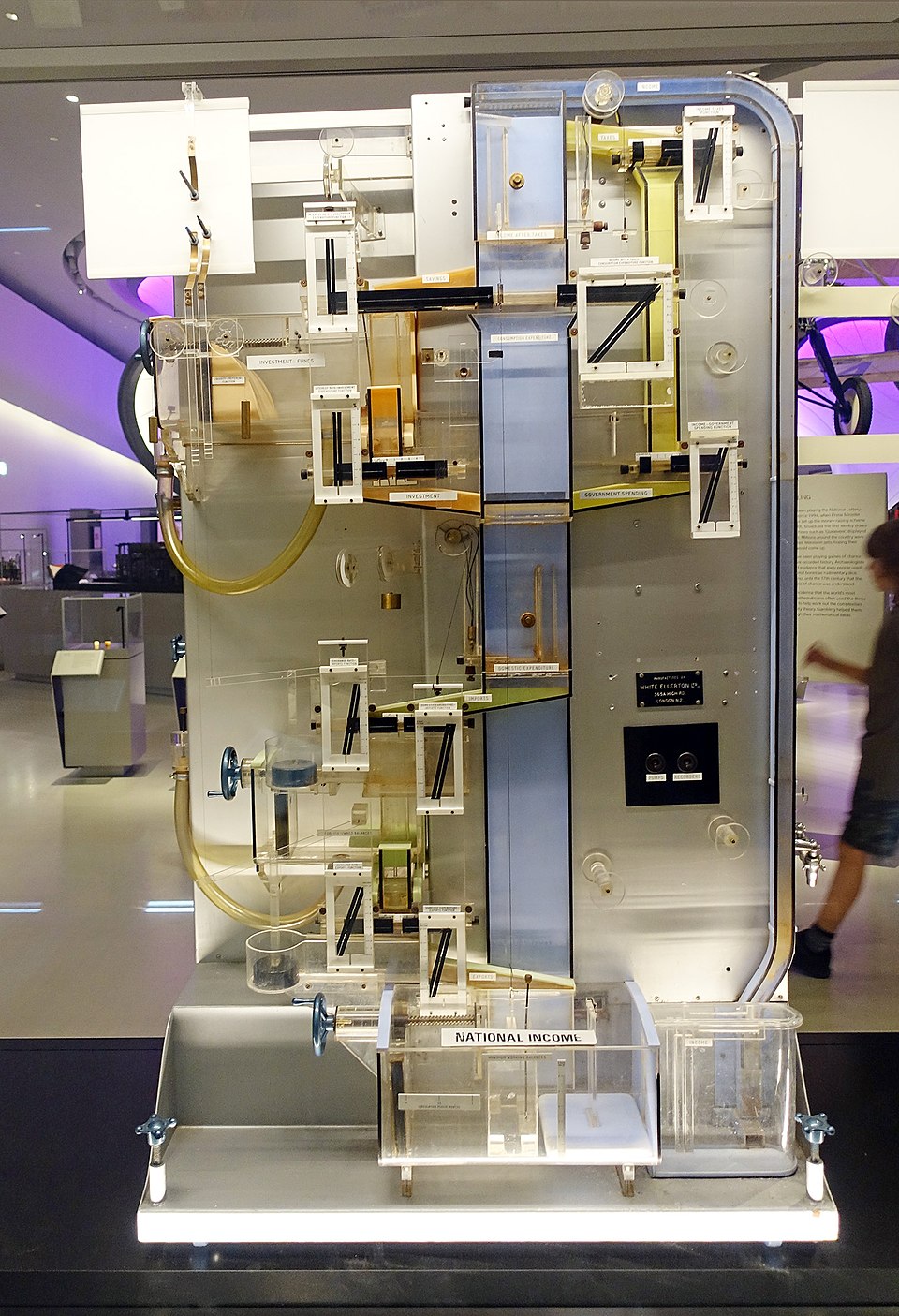
(source)
Lanchester continues:
Phillips was a serious man, who partly on the basis of his machine became a professor of economics at LSE, and he had a serious specific concern in creating the MONIAC, to do with stabilizing demand inside the economy. And yet, it’s hard not to see his machine as a comic allegory of what’s called wrong in the model-making side of economics. It’s inherently comic in the way that a Roz Chast cartoon is inherently comic. The idea that this thing can simulate something as big and complicated as an entire economy—really? And yet, that’s what economic models set out to do all the time. The Federal Reserve and US Treasury are to this day reliant on models of exactly this sort; their models are built out of mathematics rather than out of bomber parts and water, but the underlying principles are the same. Credit flows and monetary supply, inflation rates and external shocks and trade imbalances and fluctuations in demand and tax changes are all modeled in an exactly analogous way.
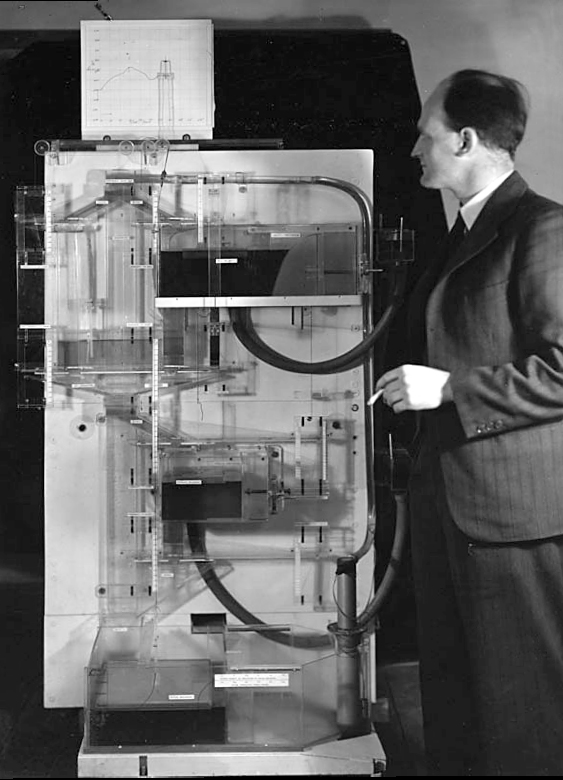
(source, the cigarette is a great touch)
Phillips:
During this period he learned Chinese from other prisoners, repaired and miniaturised a secret radio, and fashioned a secret water boiler for tea which he hooked into the camp lighting system.[4] Sir Edward ‘Weary’ Dunlop explained that Phillips’ radio maintained camp morale, and that if discovered, Phillips would have faced torture or even death.[7]
Pasadena weather report
Posted: January 26, 2026 Filed under: the California Condition Leave a comment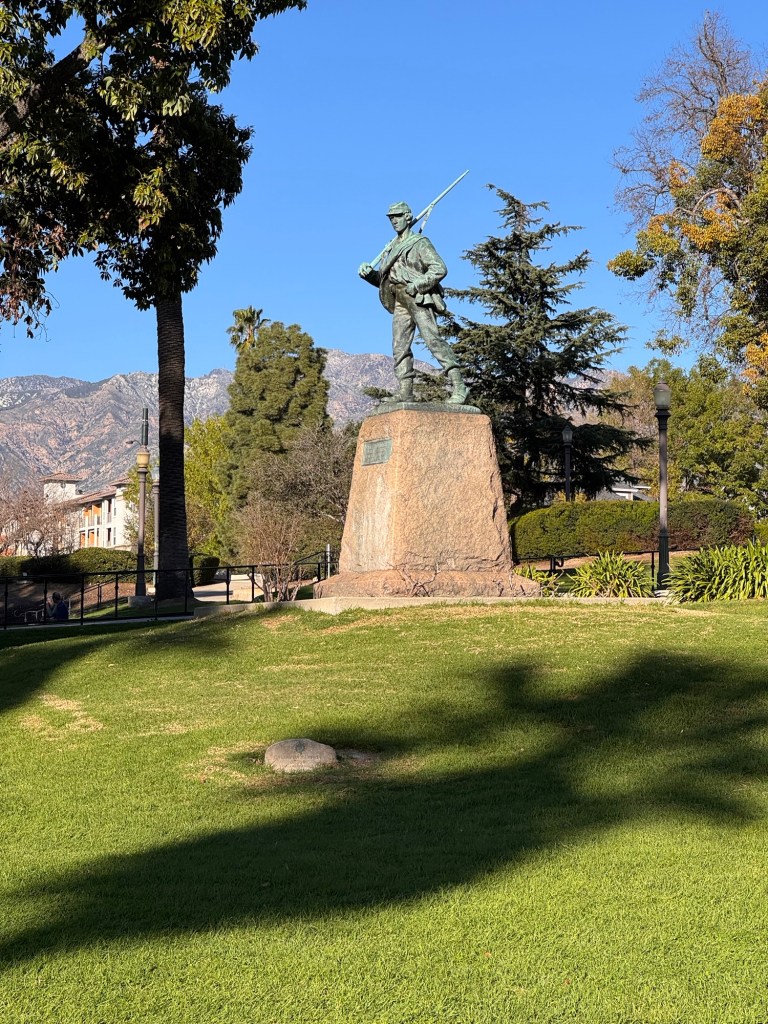
It could’ve been an early October day in Massachusetts.
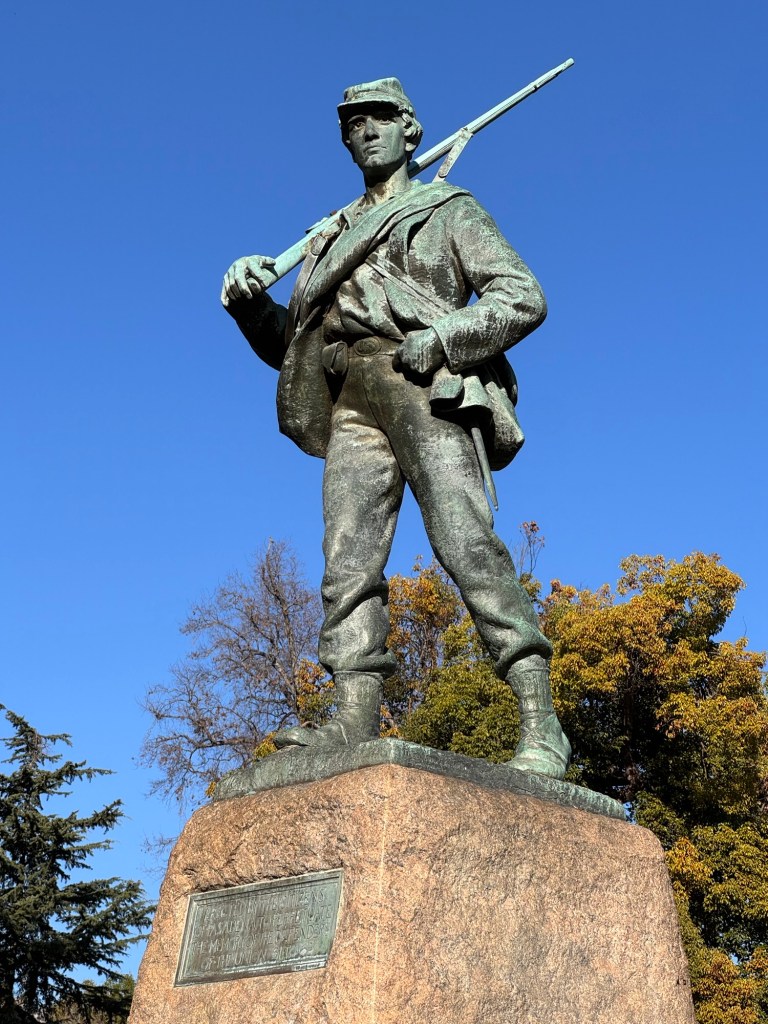
You might find it odd to see a Union Civil War monument in southern California, Pasadena wasn’t even founded until 1874. But it was founded by people from Indiana, the experience was probably quite real to them.
N. C. Wyeth
Posted: January 26, 2026 Filed under: art history 1 Comment
Seeing what the son of Needham’s paintings were fetching lately at auction (high six-low seven figures).
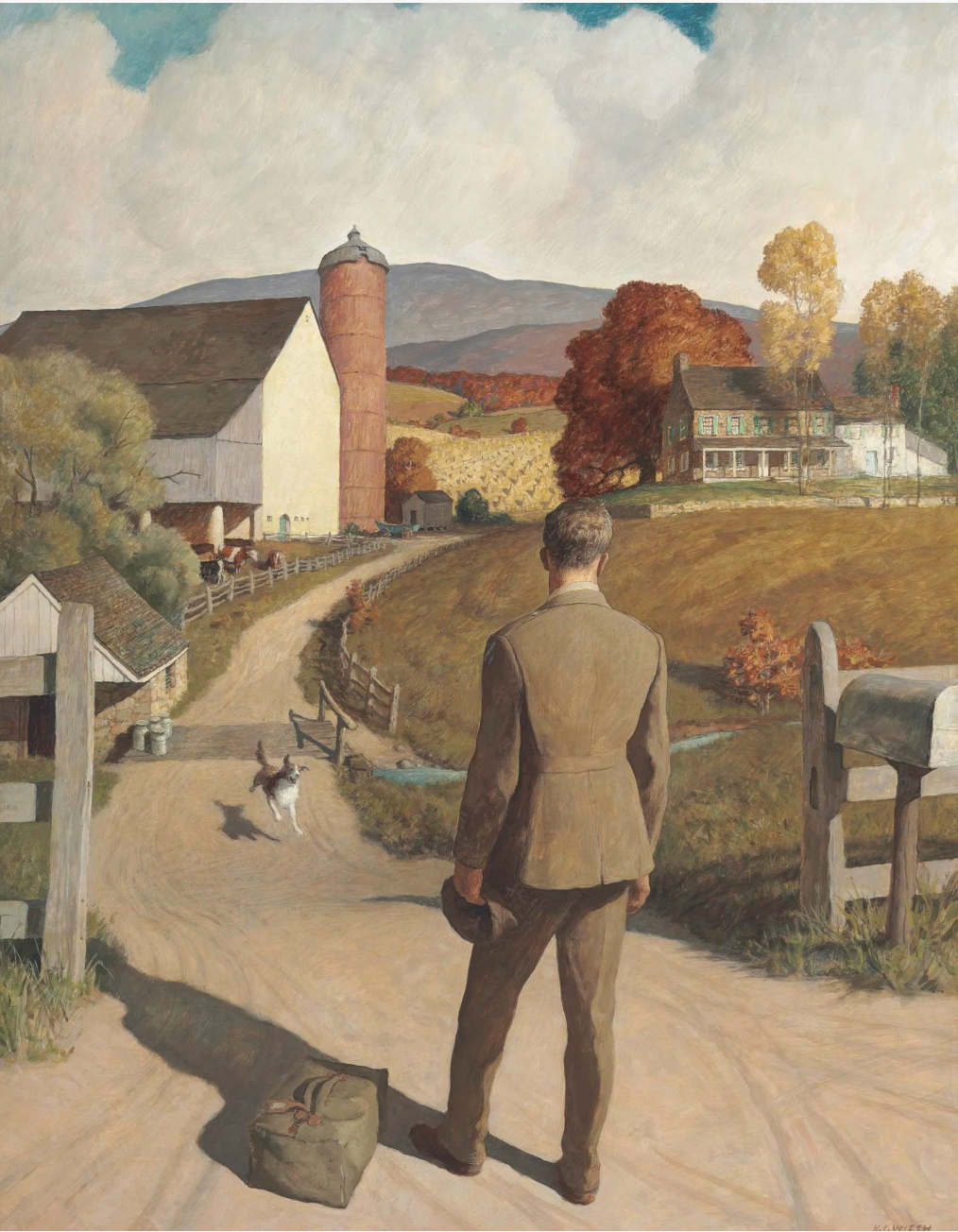
more here.

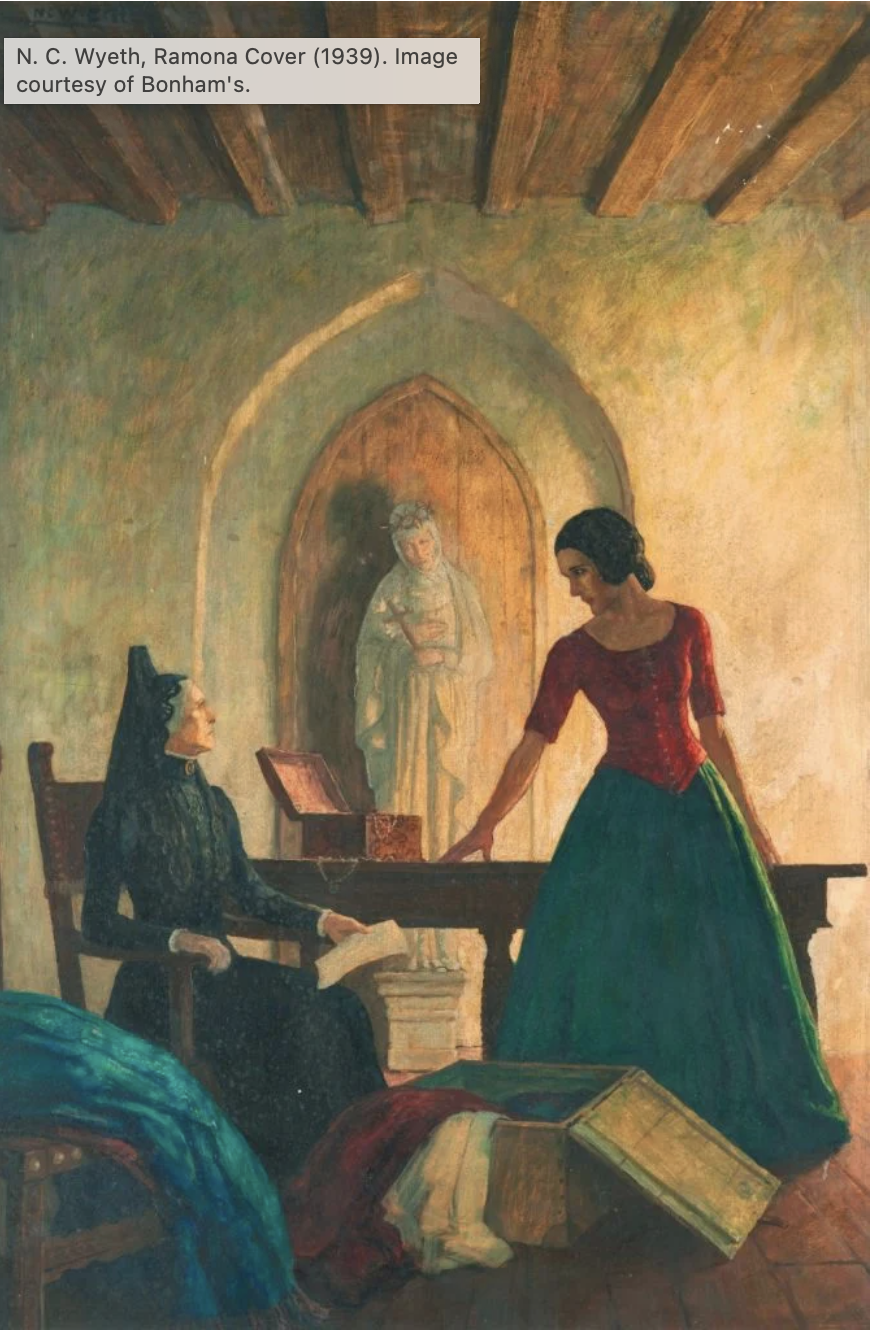
A potential cover of Ramona:
Captain Gronow
Posted: January 21, 2026 Filed under: Clubs Leave a comment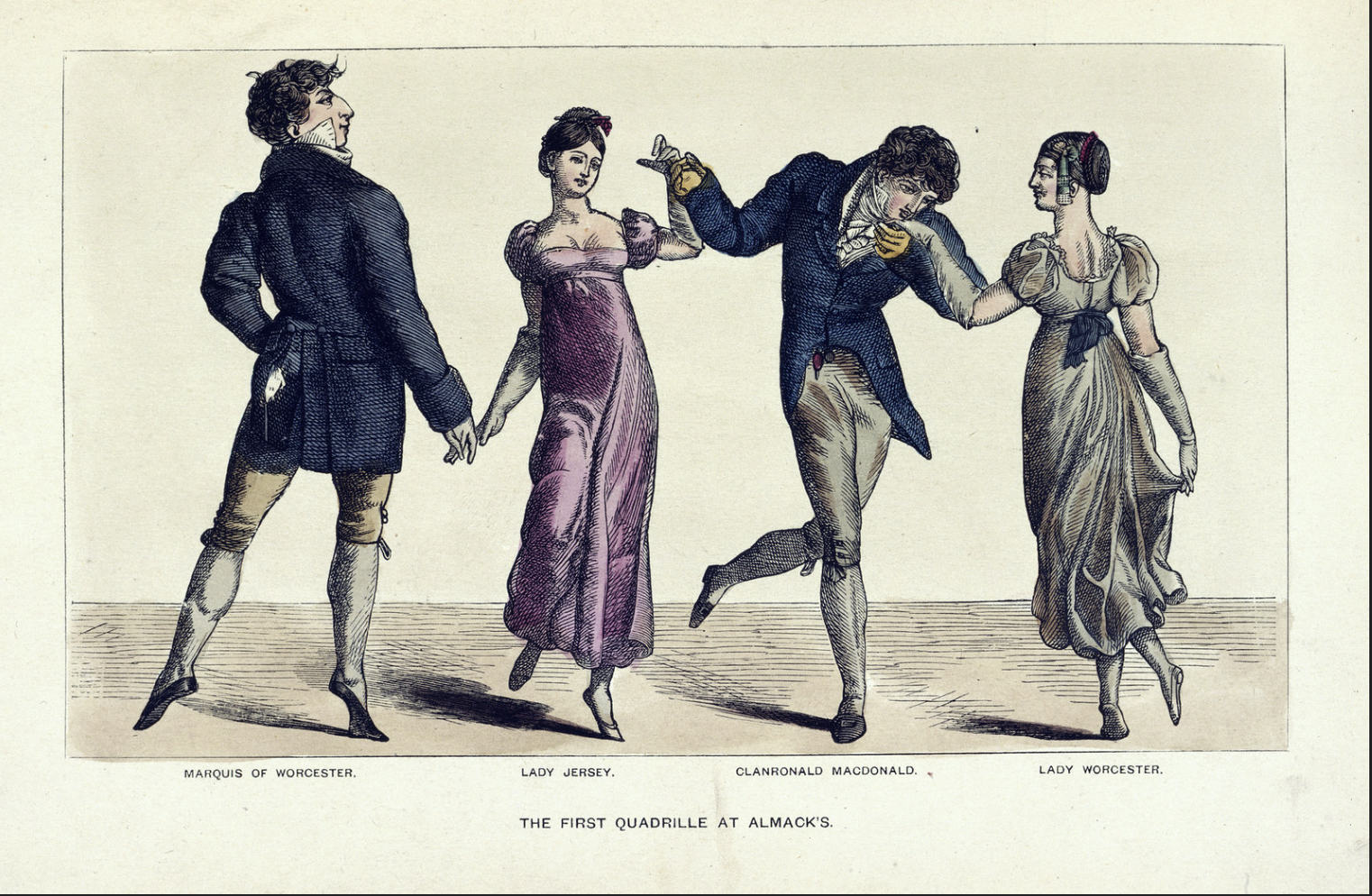
one thing (the TV series Mr. Loverman, the island of Antigua) led to another (William Clark’s Ten Views in the island of Antigua, The British Library’s Flickr page) and I’m looking at this great party from the Reminiscences of Captain Gronow, formerly of the Grenadier Guards and M.P. for Stafford, being Anecdotes of the Camp, the Court, and the Clubs, at the close of the last War with France, related by himself)
He was a remarkably handsome man, always faultlessly dressed, and was very popular in society. His portrait appeared in shop windows with those of Brummell, the Regent, Alvanley, Kangaroo Cook, and other worthies. With the exception of Captain Ross he was the best pistol shot of his day, and in early life took part in several duels. He married first, in 1825, an opera dancer, Antoinine, daughter of Monsieur Didier of Paris. By his second wife, Amelia Louisa Matilda Rouquet (a Breton aristocrat), whom he married in 1858, aged 63, he had four children. According to the Morning Post, he left his widow and infant children “wholly unprovided for” at his death, aged 70 in Paris on 22 November 1865.[1]
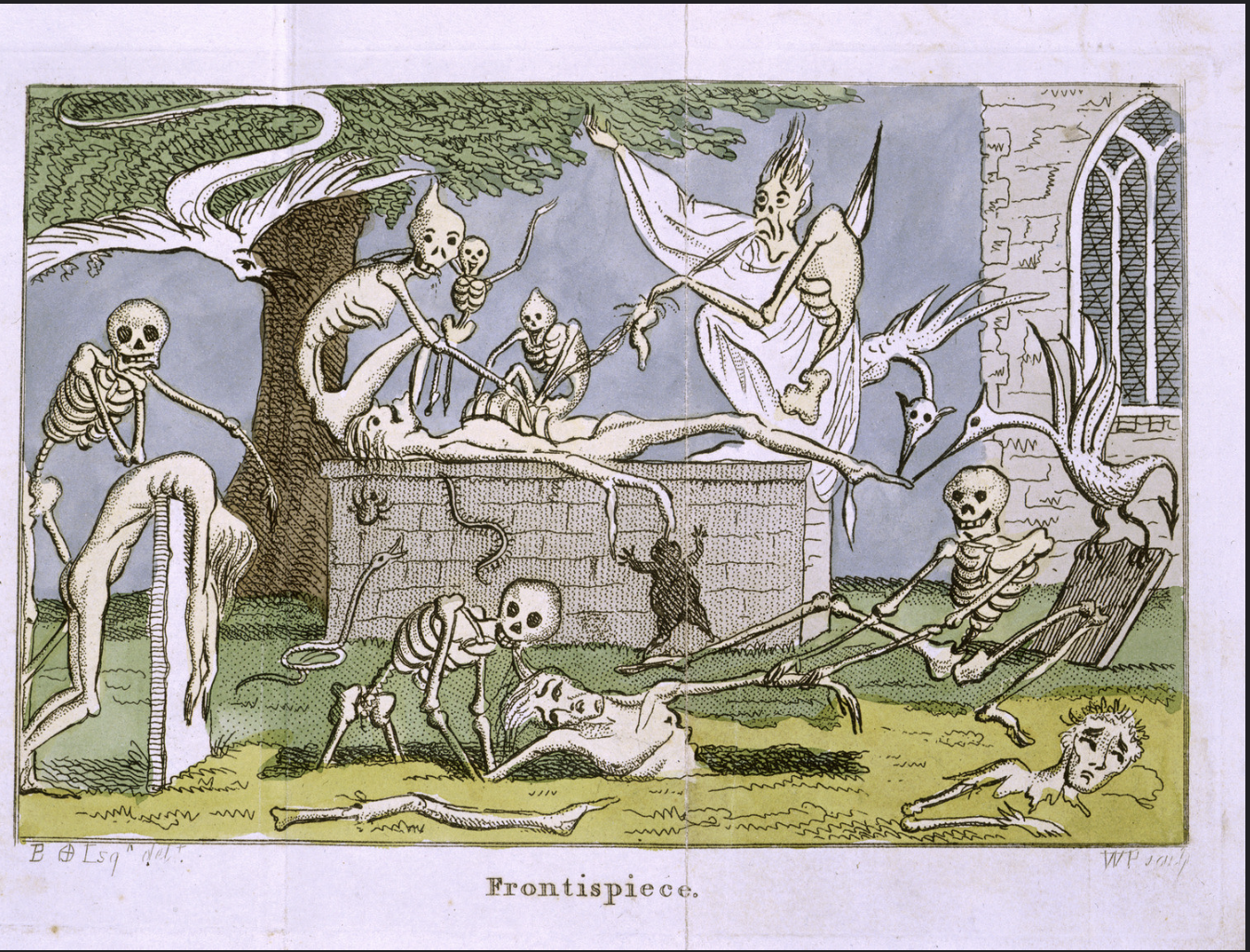
Lunch bums
Posted: January 7, 2026 Filed under: Hollywood Leave a comment
He skipped lunches since they interfered with his work and he felt they often made him tired. He was therefore dismissive of actors who ate lunch, believing that “lunch bums” had no energy for work in the afternoons.
Reading about the director Michael Curtiz, who directed 102 movies (does that include shorts?) in Hollywood, including Casablanca, and Elvis in King Creole.
During filming, Presley was always the first one on the set. When he was told what to do, regardless of how unusual or difficult, he said simply, “You’re the boss, Mr. Curtiz.”[86]
Best food in the world?
Posted: January 3, 2026 Filed under: America Since 1945, food Leave a commentSometimes it’s half a leftover burrito you forgot you had in the fridge.
Los Angeles in 1850
Posted: January 1, 2026 Filed under: the California Condition Leave a comment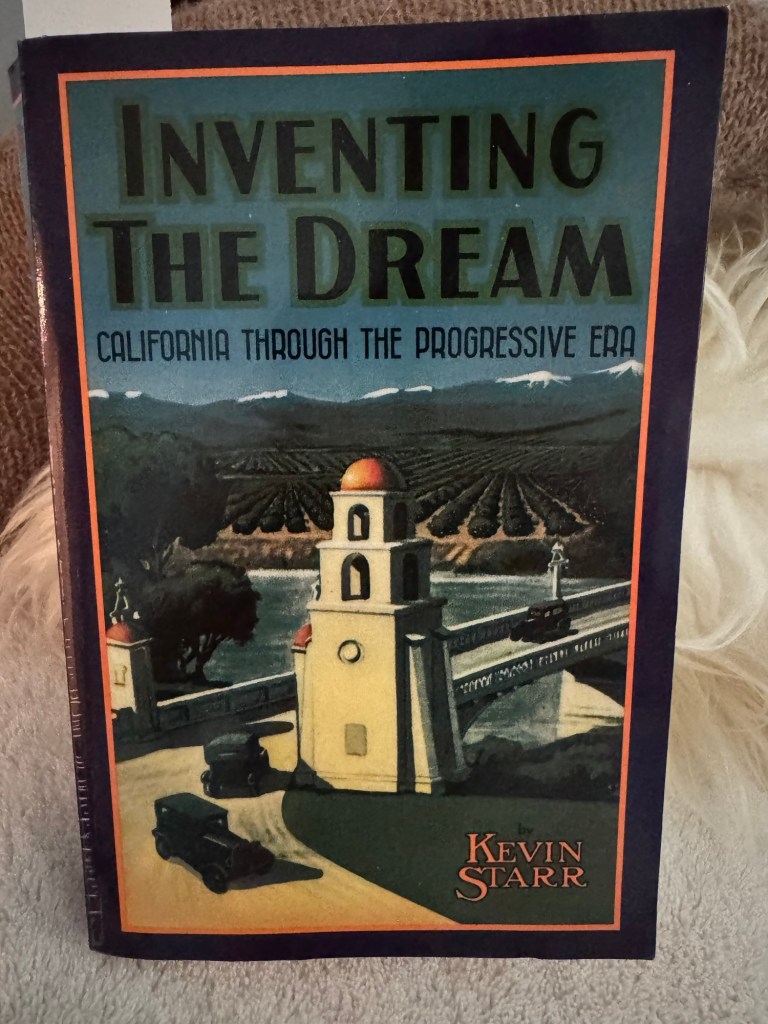
Cowboys, gamblers, bandits, and desperados of every description brought to the Los Angeles of the 185os a tone of border-town mayhem. Rough statistics indicate that in 1850 a murder occurred for every day of the year. The Reverend James Woods, a scholarly Massachusetts Presbyterian, arrived in October 1854, hoping to bring the gospel and social order. Despite the beauty of surrounding vineyards and orange trees, he noted, Los Angeles was a hellhole, a valley of dry bones, a city not of angels but of demons. An orgy of murder fills the diary Reverend Woods kept during his desperate ministry of six months. In his first two weeks alone, ten Angelenos met violent ends. Ordinary citizens walked the streets armed with pistols, bowie knives, and shotguns. Cruelty was everywhere. He was horrified to find an Indian servant girl dying in the street, abandoned by a household wishing to avoid burial expenses. A young cowboy, David Brown, sentenced to hang for the shooting of Pinckney Clifford, refused to see Woods, telling the sheriff he would rather have a bear in his cell than a minister. Shortly after, Brown was dragged from the jailhouse and lynched. The mob was led by Stephen Clark Foster, mayor of Los Angeles and a Yale man.
Matty Groves
Posted: January 1, 2026 Filed under: Uncategorized Leave a commenthttps://www.youtube.com/watch?v=1it7BP5PckI
A holiday
A holiday
The first one of the year…
Any Helytimes reader will know Shady Grove, but what about the ancestor across the Atlantic?
The song dates to at least 1613, and under the title Little Musgrave and Lady Barnard is one of the Child ballads collected by 19th-century American scholar Francis James Child
What I love about this song is how it reveals character. Lord Darnell’s wife, Matty, the sniveling servant, Lord Darnell, they all reveal who they are in their actions. Honor, honesty, humor, strength, foolishness, loyalty. It all comes out.
 Helytimes
