Ulysses, by Hugh Kenner
Posted: June 16, 2026 Filed under: Ireland Leave a comment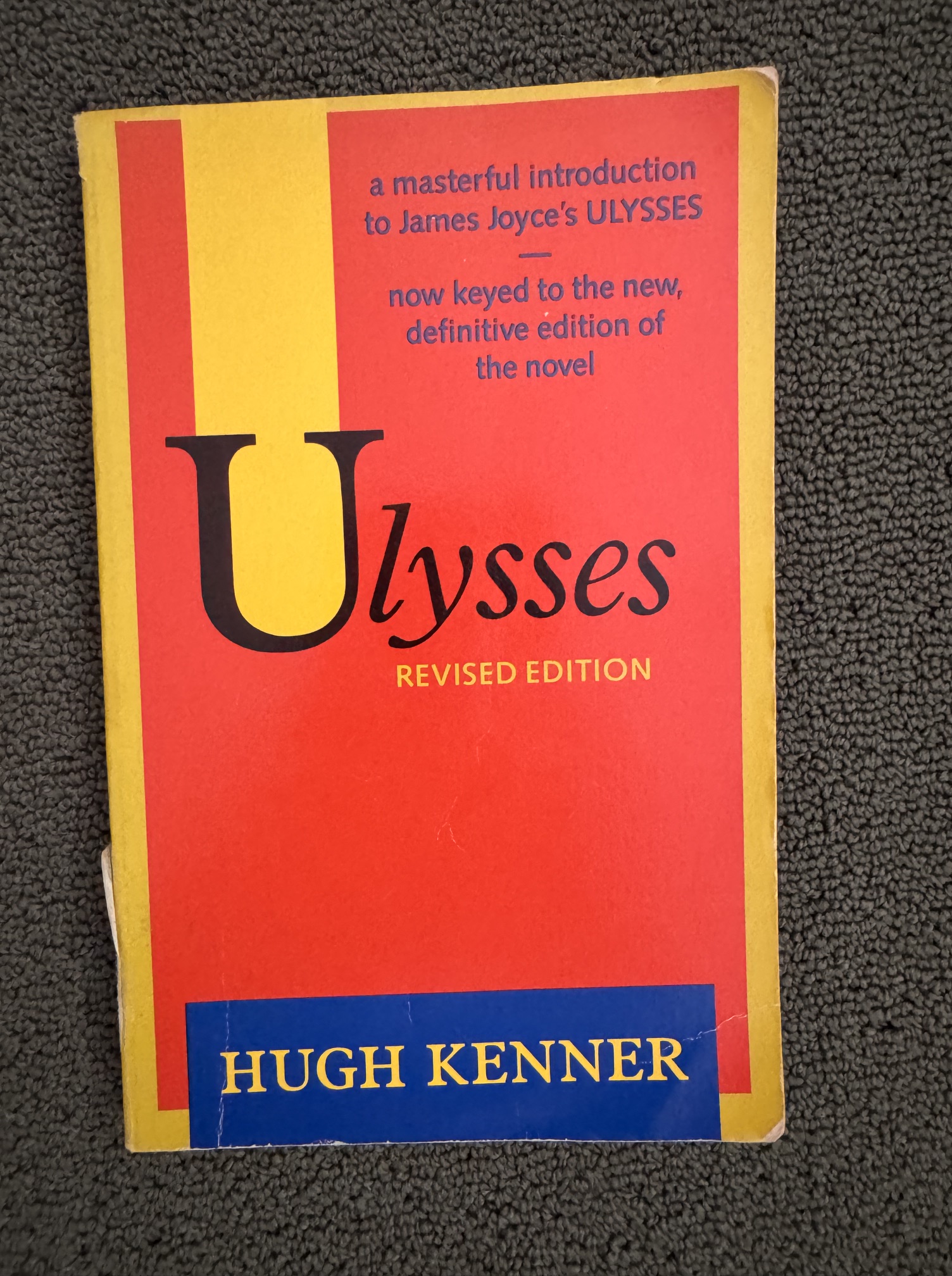
Ulysses, the Book of Bloom, was commenced in Trieste about 1914, written there and in Zurich and Paris during the next seven years, published in Paris, 2 February 1922 on the author’s fortieth birthday, and promplty created what the gutter press loves, a scandal. SCANDAL OF ULYSSES read hoardings for the Sporting Times (‘The Pink ‘Un’) in which one could read that the contents of the book were “enough to make a Hottentot sick.” Hottentots in those days were British subjects.
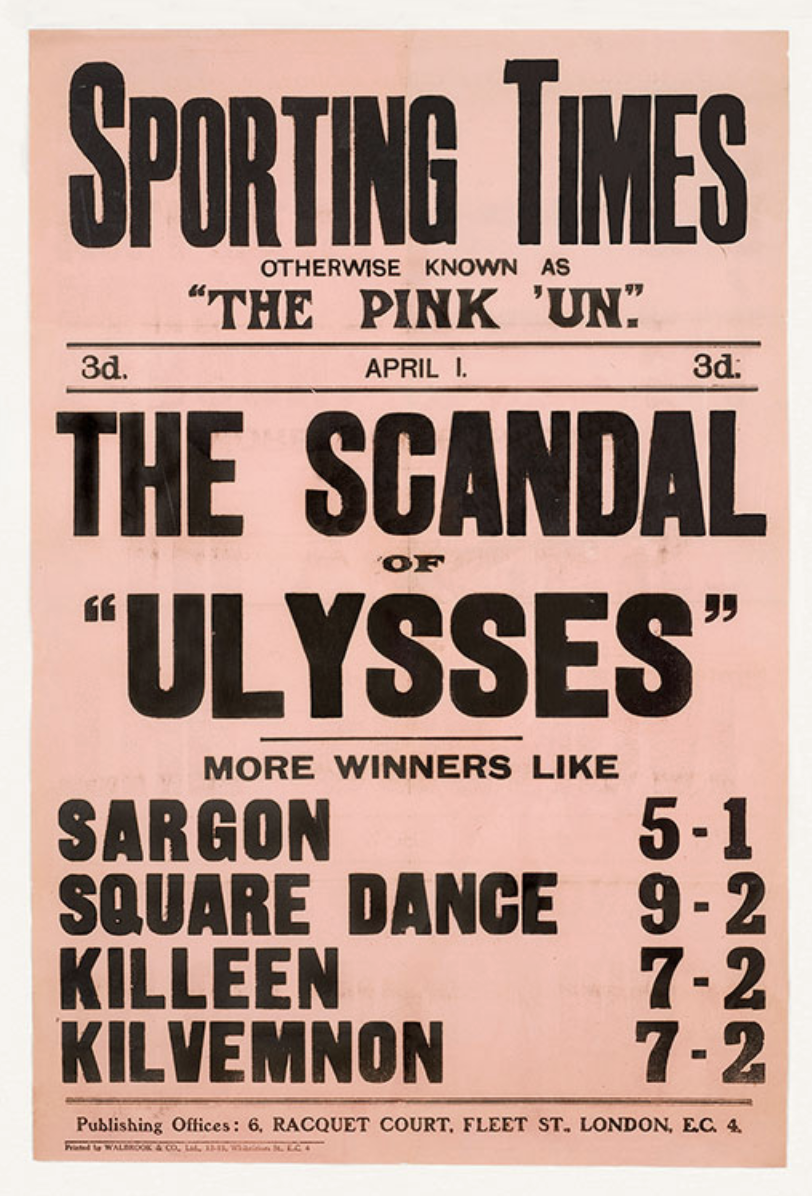
That’s from Hugh Kenner, Ulysses.
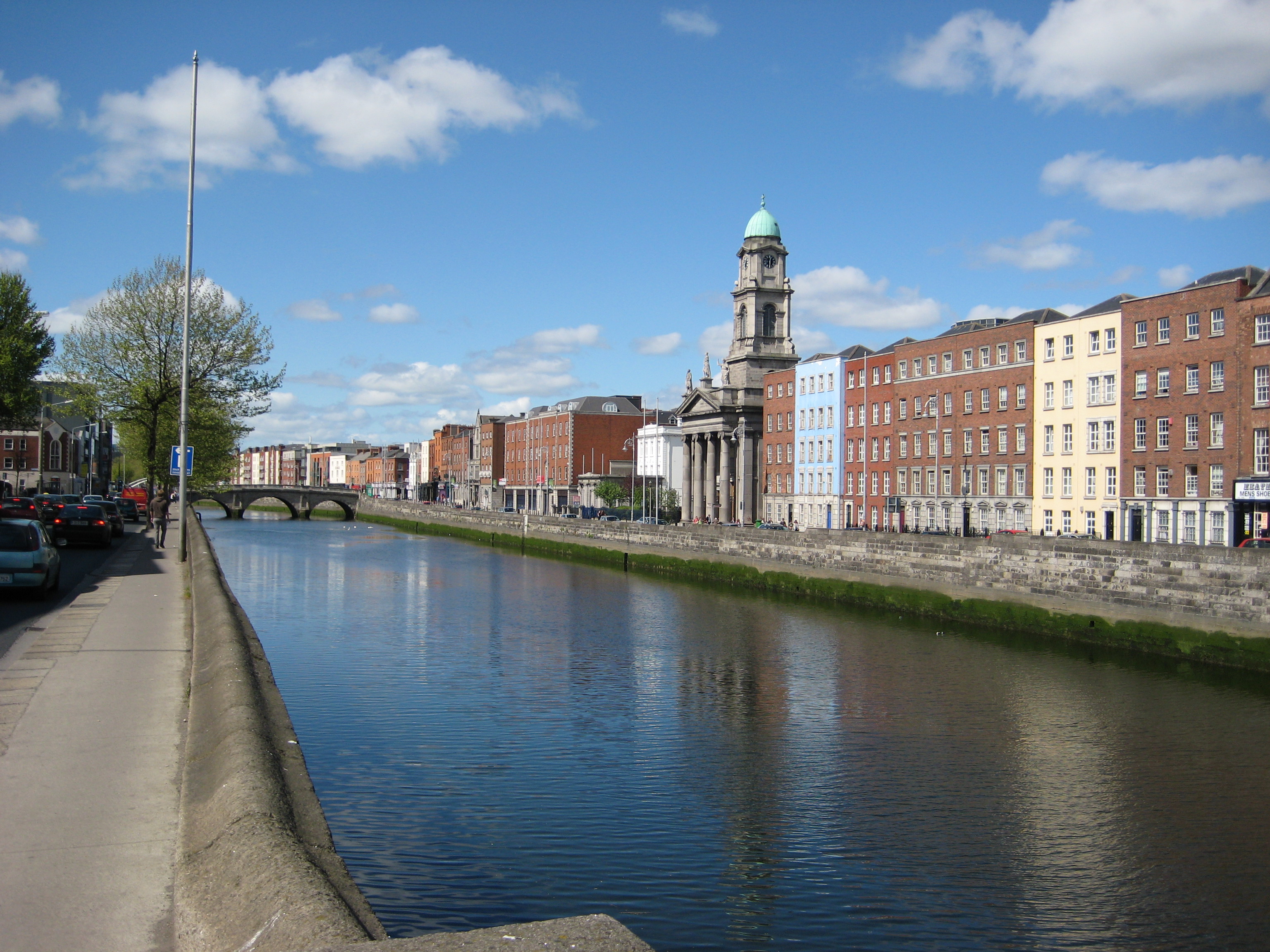
A day in June is very long indeed at 53′ North latitude. In Dublin in 1904, Standard Time and Summer Time still years in the future, local time had the sun rise at 16 June at 3:33 AM and not set until 8:27.
A few years ago, my friends saw Gatz, a production by the theater group Elevator Repair Service that is about eight hours long and brings to life The Great Gatsby:
James Gatz — that was really, or at least legally, his name.One morning in the shabby office of a mysterious small business, an employee finds a copy of The Great Gatsby in the clutter on his desk. He starts to read it out loud and doesn’t stop. At first his coworkers hardly notice. But after a series of strange coincidences, it’s no longer clear whether he’s reading the book or the book is transforming him.
8 hours long and with a cast of 13, Gatz is by far ERS’s most ambitious endeavor yet — not a retelling of the Gatsby story but an enactment of the novel itself. Fitzgerald’s American masterpiece is delivered word for word, startlingly brought to life by a low-rent office staff in the midst of their inscrutable business operations.
an eight hour theater production sounded tough.
but my friends were mesmerized.
The reviews matched:
the most remarkable achievement in theater not only of this year but also of this decade.
—Ben Brantley, The New York Times
So when Elevator Repair Service came to town with Ulysses, I had to check it out:
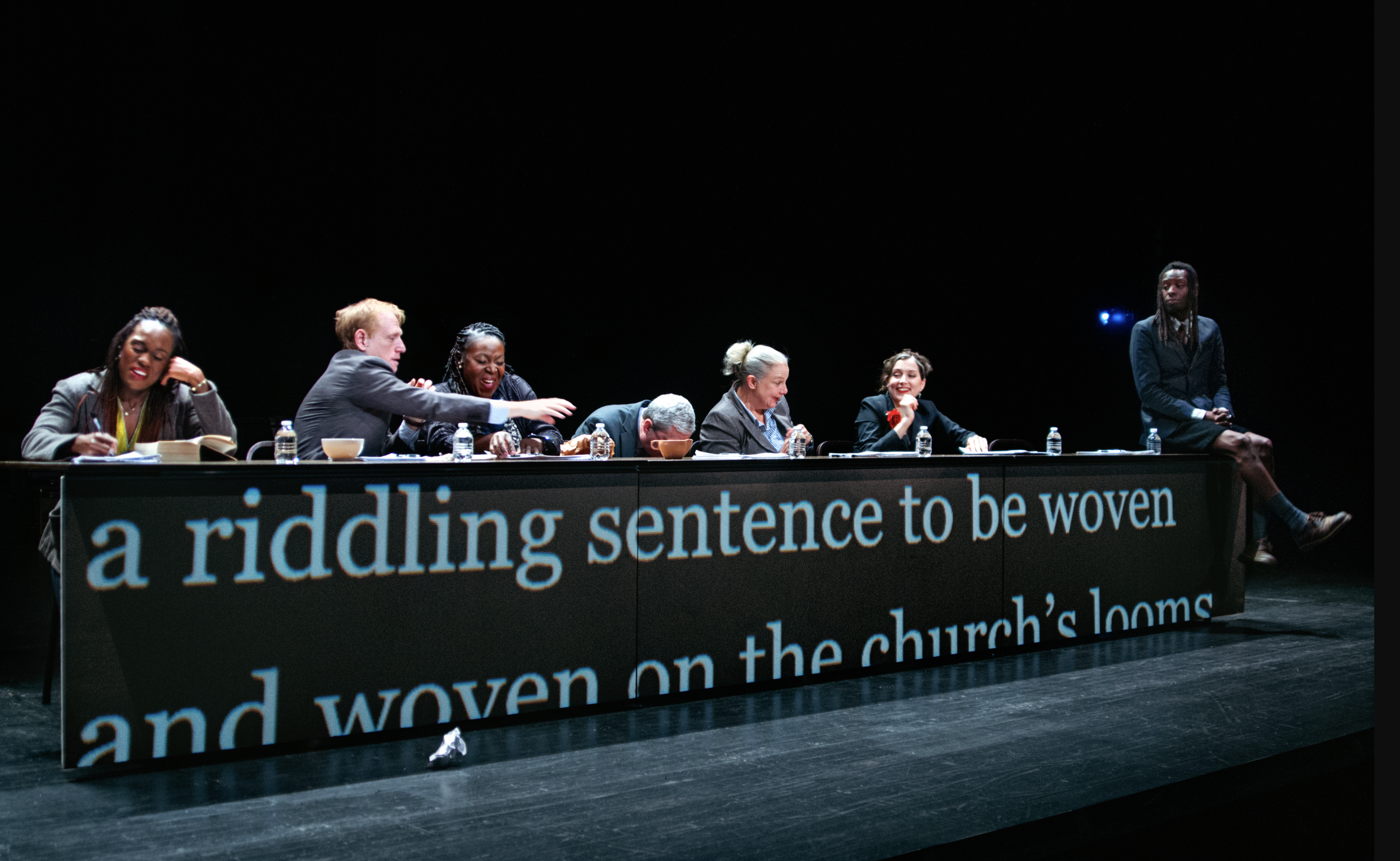
Blessedly, just a couple hours long.
Riotous fun at times although it might be totally incomprehensible if you didn’t know the book?
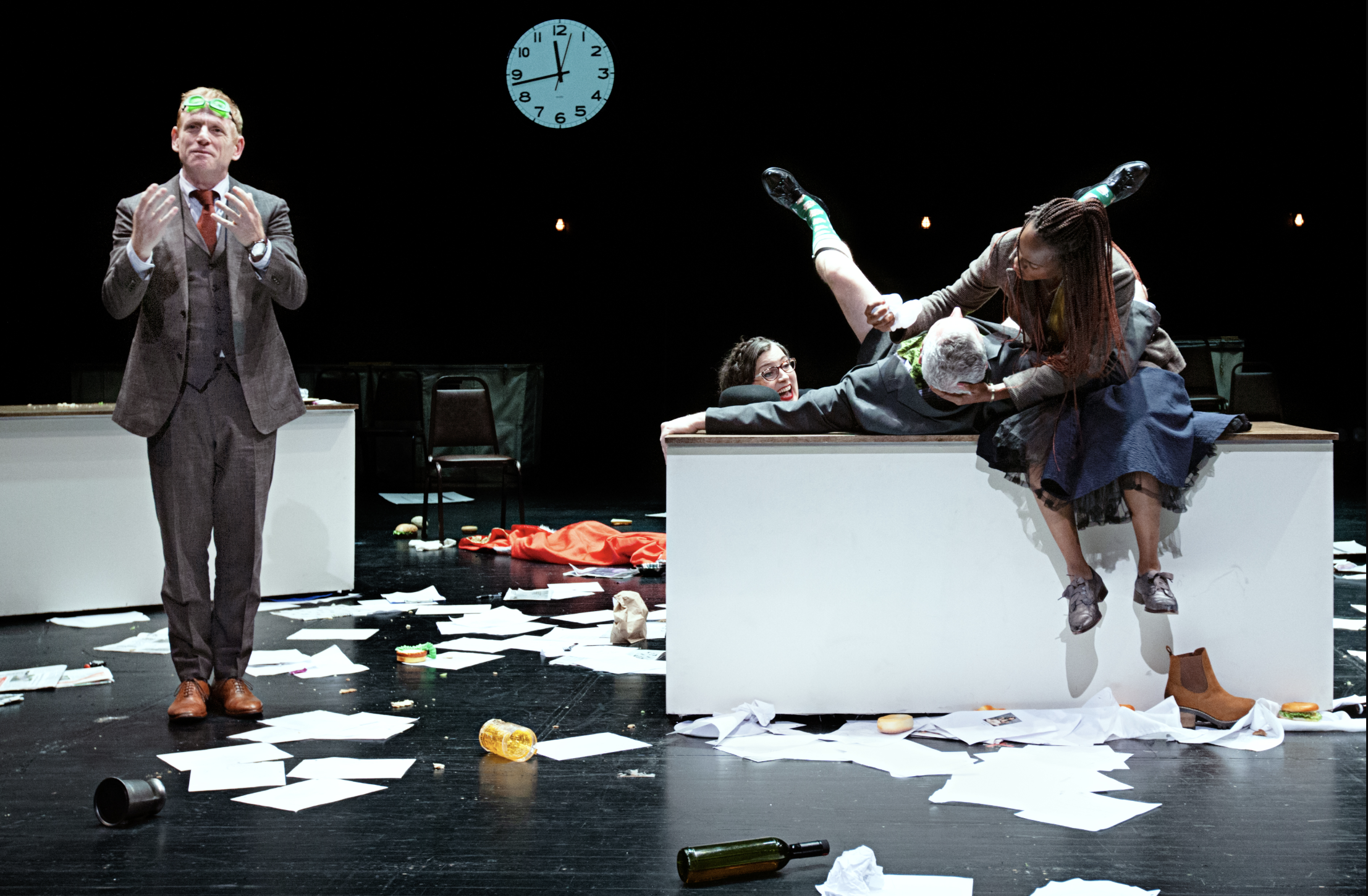
It got Ulysses back on my mind.
Ulysses by James Joyce starts with the living situation of Stephen, a sort of gloomy softboi. Then we pick up with Leopold Bloom, feeding his cat, eating breakfast, and then walking around Dublin trying to think about anything except the fact that this afternoon his wife Molly is gonna have sex with Myles Boylan.
(He gazes ahead, reading on the wall a scrawled chalk legend Wet Dream and a phallic design.) Odd! Molly drawing on the frosted carriagepane at Kingstown. What’s that like? (Gaudy dollwomen loll in the lighted doorways, in window embrasures, smoking birdseye cigarettes. The odour of the sicksweet weed floats towards him in slow round ovalling wreaths.)
BLOOM: (As before.) Rarely smoke, dear. Cigar now and then. Childish device. (Lewdly.) The mouth can be better engaged than with a cylinder of rank weed.
ZOE: Go on. Make a stump speech out of it.
BLOOM: (In workman’s corduroy overalls, black gansy with red floating tie and apache cap.) Mankind is incorrigible. Sir Walter Ralegh brought from the new world that potato and that weed, the one a killer of pestilence by absorption, the other a poisoner of the ear, eye, heart, memory, will, understanding, all. That is to say he brought the poison a hundred years before another person whose name I forget brought the food. Suicide. Lies. All our habits.
Hugh Kenner identifies some issues:
Joyce obeyed a principle Hemingway later enunciated, that a writer’s omissions will show only when he omits things because he doesn’t know them, and he worked out elaborate schemata so as to be able to suppress them. Except for the funeral cortège, with which we ride swaying and rattling clear across the city with frequent indications of time and place (“Are we late?’ asks Martin Cunningham; Paddy Dignam has an appointment with the grave), Joyce only once (10.113) takes us aboard the wheeled conveyances his characters use so freely. An abrupt cessation of action here, an abrupt resumption there – such is his staccato notation: the cut, not the dissolve. The effect, for a reader trained on the Portrait’s suave transitions (where cuts signify the passage of days, or years) is one of calculated disorientation: Where are we now? How did we get here?
Joyce the critic:
Some things were clear to Joyce extremely early. At 22 he wrote to his brother ‘Damned stupid, after reading “The Wild Goose’ in George Moore’s Untilled Field. ‘A lady who has been living for three years on the line between Bray and Dublin is told by her husband that there is a meeting in Dublin at which he must be present. She looks up the table to see the hours of the trains. This on [the Dublin, Wicklow & Wexford Railway] where the trains go regularly; this after three years. Isn’t it rather stupid of Moore.”
Moore, who didn’t live on the DW & WR, would have had to look up that train, but he should have reflected that his character wouldn’t have. The writer should be alert to what his characters would know
Ulysses can be a tough read, this aint exactly Jack Reacher:
But Ulysses is so designed that new readers, given, even, what cannot be postulated, ideal immunity to attention overload, cannot possibly grasp certain elements because of a warp in the order of presentation, and veteran readers will perceive after twenty years new lights going on as a consequence of a question they have only just thought to ask. Such a question would be: Why is Bloom made to advert to the potato just when he does, on a page where there seems no earthly reason for him to remember the potato or for us to be apprised of it? And when we think to ask something happens.
Kenner implores us this is worthy:
For nearly seven years Ulysses was more than a project: it was what James Joyce was doing with the one life at his disposal, and he should be credited with some reflection on the import of this.
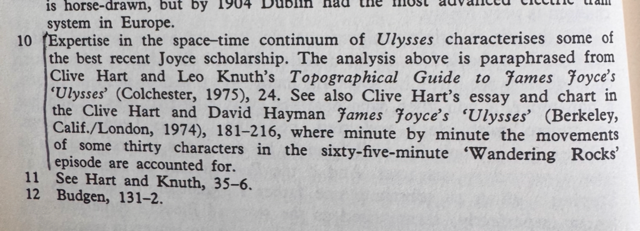
Not to worry, plenty of brainpower has been deployed on this book:
Possible Joyce was frustrated with the reception:
Ezra Pound in old age liked to recall how Joyce had responded to reviews and explications: “If only someone would say the book was so damn’ funny.”
It’s not a laugh riot but there’s fun.
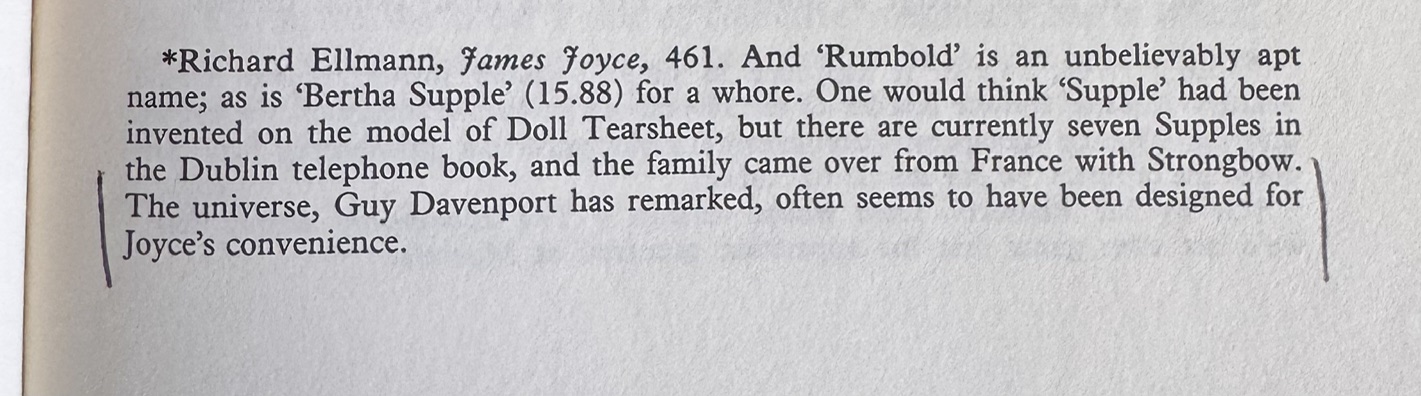
Ulysses came out in 1922, but it’s set in 1904. Eighteen years earlier. Imagine l reading a book today about a guy walking around.., San Francisco? Boston?… in 2008. (Would read).
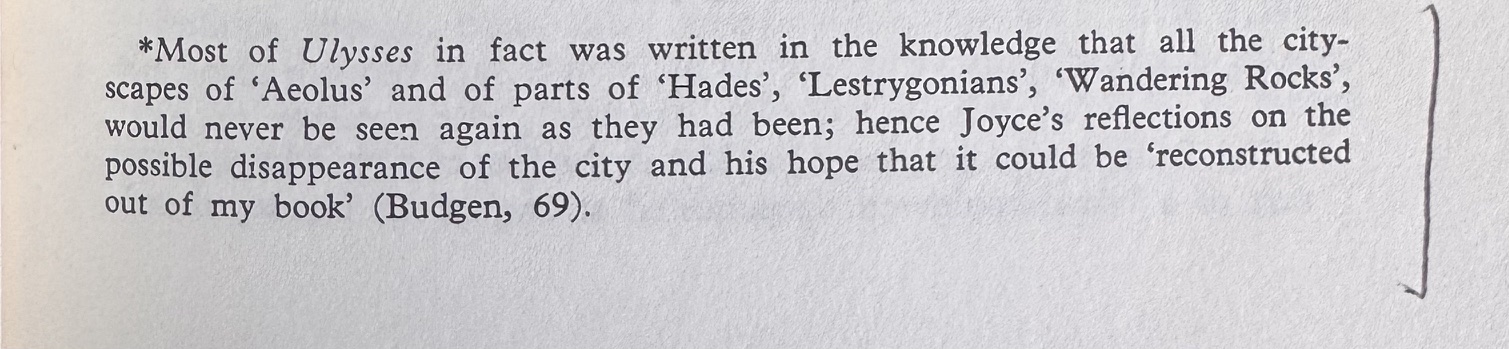
In 1916, between the setting and the publication, many spots in central Dublin were damaged in the Easter Rising and aftermath:
A biography of Joyce biographer Richard Ellmann came out not long ago. From a New Statesman review piece by Lyndall Gordon:
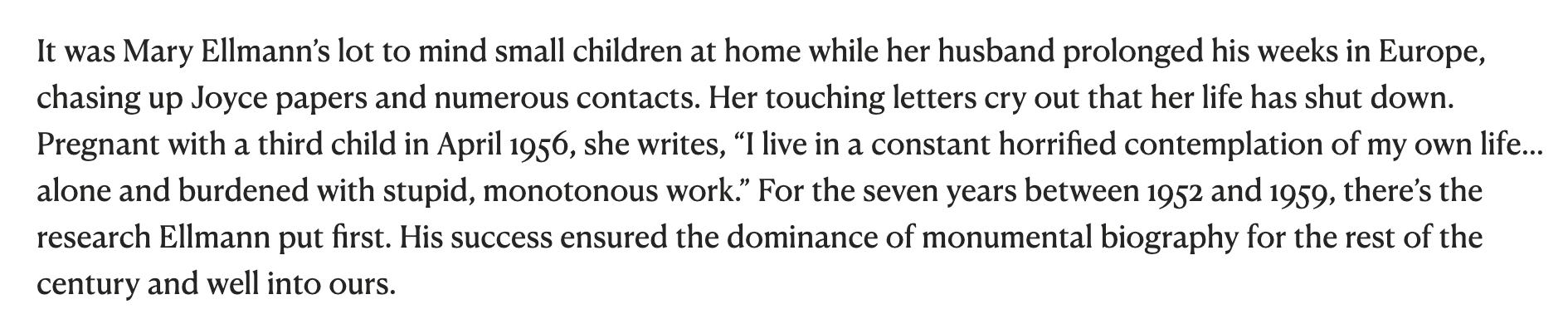
I was struck by the phrase “stupid, monotonous work.”
Even admirers of Ulysses get exhausted:
it sometimes overruns the bounds of art into an arid ingenuity which would make a mystic correspondence do duty for an artistic reason
EO Wilson, source
I picked up Hugh Kenner’s Ulysses looking for an answer to a specific question, about the catechism section, 17, are those real? Like she had sex with all those people?
What did his limbs, when gradually extended, encounter?
New clean bedlinen, additional odours, the presence of a human form, female, hers, the imprint of a human form, male, not his, some crumbs, some flakes of potted meat, recooked, which he removed.
If he had smiled why would he have smiled?
To reflect that each one who enters imagines himself to be the first to enter whereas he is always the last term of a preceding series even if the first term of a succeeding one, each imagining himself to be first, last, only and alone whereas he is neither first nor last nor only nor alone in a series originating in and repeated to infinity.
What preceding series?
Assuming Mulvey to be the first term of his series, Penrose, Bartell d’Arcy, professor Goodwin, Julius Mastiansky, John Henry Menton, Father Bernard Corrigan, a farmer at the Royal Dublin Society’s Horse Show, Maggot O’Reilly, Matthew Dillon, Valentine Blake Dillon (Lord Mayor of Dublin), Christopher Callinan, Lenehan, an Italian organgrinder, an unknown gentleman in the Gaiety Theatre, Benjamin Dollard, Simon Dedalus, Andrew (Pisser) Burke, Joseph Cuffe, Wisdom Hely, Alderman John Hooper, Dr Francis Brady, Father Sebastian of Mount Argus, a bootblack at the General Post Office, Hugh E. (Blazes) Boylan and so each and so on to no last term.
My question is, are those names all Molly Bloom’s actual lovers/roster? or is this Bloom’s imagining?
Kenner has an answer:
This is easily taken as a list of Molly’s lovers other than Bloom, twenty-five of them in all – confirming, as it seems to, impressions we’ve picked up earlier in the book… It was long so taken by critical consensus, and Molly long regarded as a hardened adulteress, a misconception which deprives Bloomsday of its special tang.
Its conceptions were nearly forty years being challenged, and Molly’s character as long a time being refocused… Thus Penrose was a ‘delicate looking student, a priestylooking chap was always squinting in when he passed (8.176; that was 1889 when Molly was nursing Milly, and Penrose nearly caught sight of her breasts; ‘that was his studenting’ is her tart recall (18.575), and we’re safe in concluding she taught him nothing further. Dr Brady (elsewhere described as old: 15.4359) attended her in her confinement (18.575); Fr Sebastian may have been the cleric who sat beside her at the Jews’ Temples Gardens (18.90) or else someone who once heard her confession; gynaecological examination and examination of conscience are intimacies of a sort, but not the sort that contribute to the tale of a hardened adulteress. And so on. No, this list is a list of past occasions for twinges of Bloomian jealousy, and there is no ground for supposing that the hospitality of Molly’s bed has been extended to anyone but her husband and Boylan. No rhetoric affords more pitfalls than that of ‘objectivity.*
Is Molly’s soliloquy itself actually just a Bloom imagination?
I asked Claude:
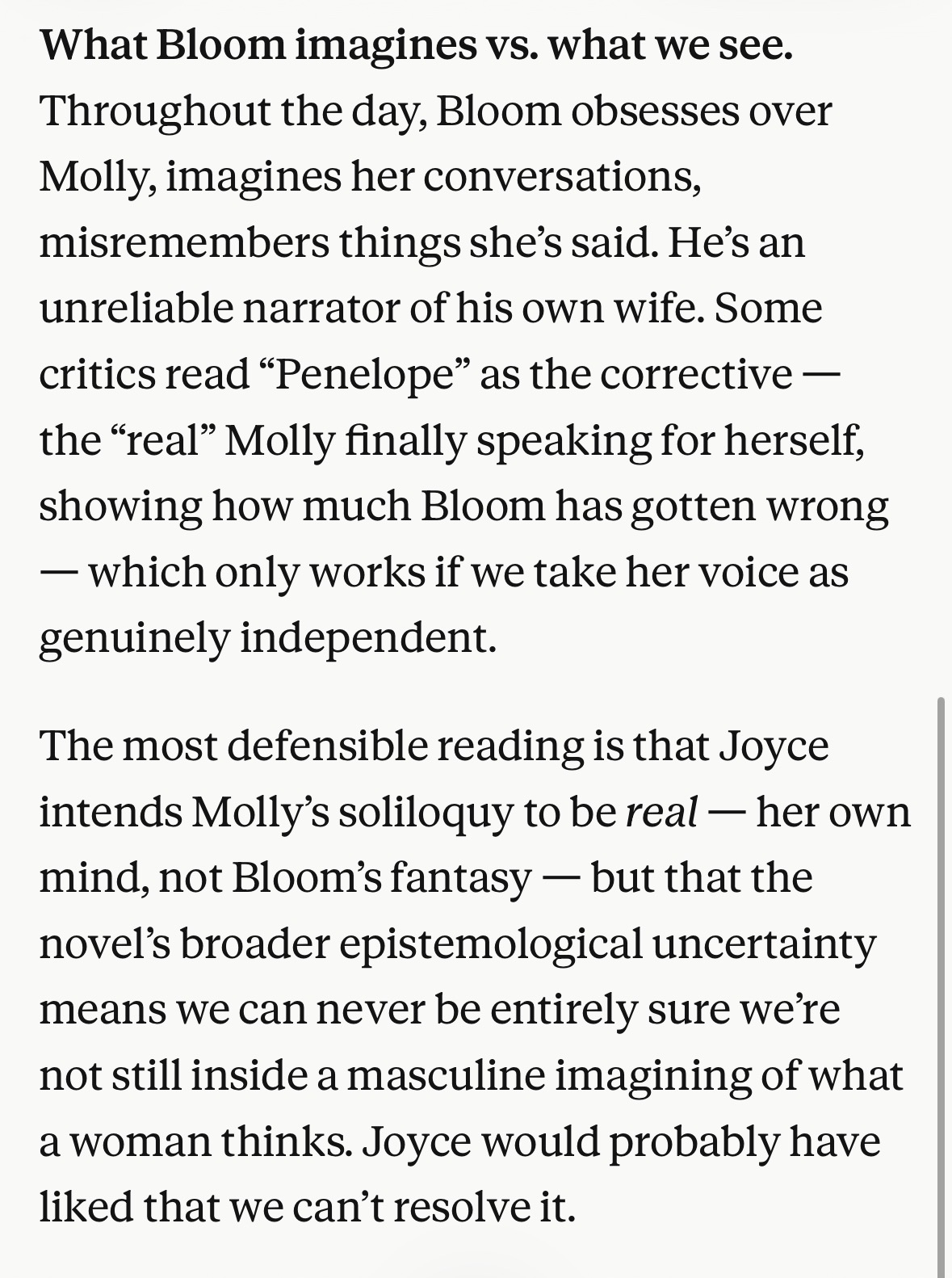
Coy as usual Claude.
Joyce was interested in technology, he helped open one of the first movie theaters in Dublin.
Whether Molly’s soliloquy is all Molly or part Bloom part Molly or all Bloom, really Blooming: that will be a good discussion question for our seminar.
Is the meaning of Ulysses that life is a distracted fog of comedy and allusion and confusion and worry and jealousy, punctuated with a few moments of pure post-nut clarity?