C. Barry Schaefer and Valerie Scott facing each other, conversing, inside Union Pacific business car, heritage fleet, c1970s
Posted: August 25, 2026 Filed under: railroads Leave a comment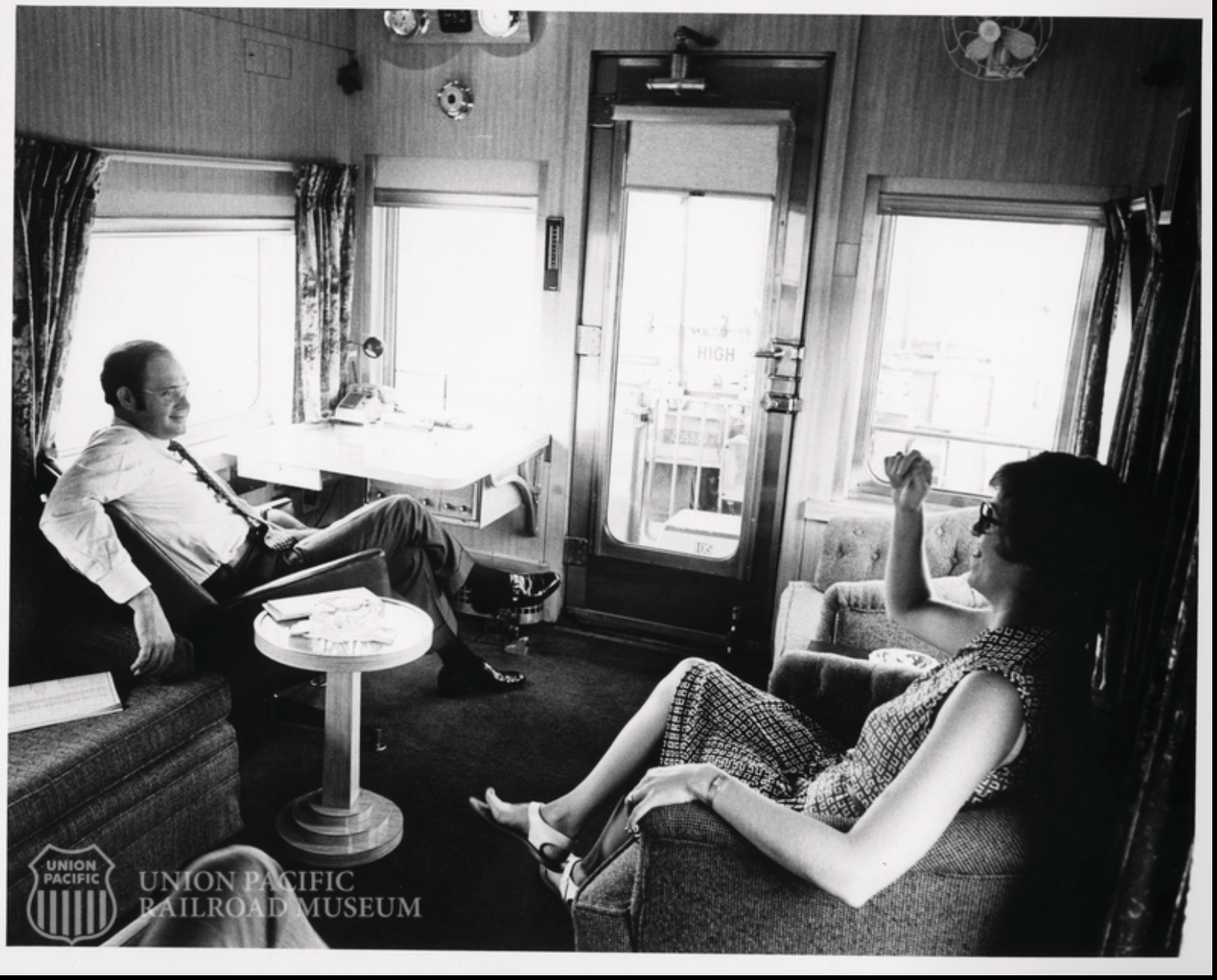
Here Is New York by E. B. White
Posted: August 15, 2026 Filed under: New York Leave a comment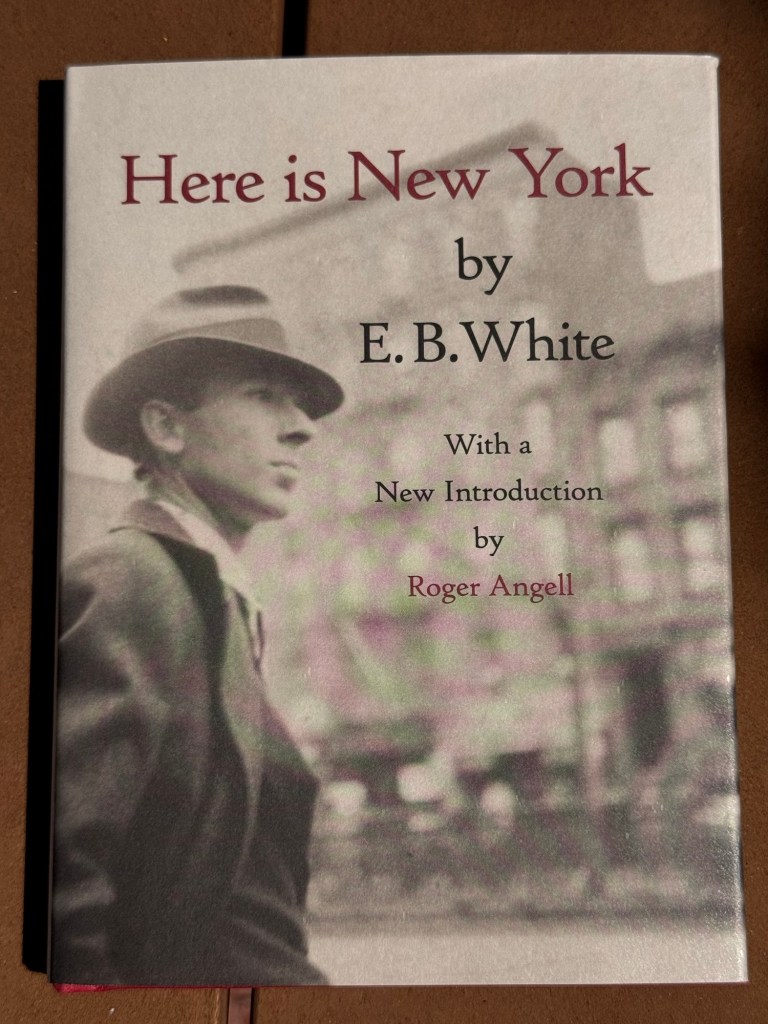
Can you triangulate* where Elwyn Brooks White’s hotel room was?:
I am sitting at the moment in a stifling hotel room in 90-degree heat, halfway down an air shaft, in midtown. No air moves in or out of the room, yet I am curiously affected by emanations from the immediate surroundings. I am twenty-two blocks from where Rudolph Valentino lay in state, eight blocks from where Nathan Hale was executed, five blocks from the publisher’s office where Ernest Hemingway hit Max Eastman on the nose, four miles from where Walt Whitman sat sweating out editorials for the Brooklyn Eagle, thirty-four blocks from the street Willa Cather lived in when she came to New York to write books about Nebraska, one block from where Marceline used to clown on the boards of the Hippodrome, thirty-six blocks from the spot where the historian Joe Gould kicked a radio to pieces in full view of the public, thirteen blocks from where Harry Thaw shot Stanford White, five blocks from where I used to usher at the Metropolitan Opera and only a hundred and twelve blocks from the spot where Clarence Day the Elder was washed of his sins in the Church of the Epiphany (I could continue this list indefinitely); and for that matter I am probably occupying the very room that any number of exalted and somewise memorable characters sat in, some of them on hot, breathless after-noons, Lonely and private and full of their own sense of emanations from without.
Hint: if he stayed at that hotel today he could get Marriott Bonvoy points.
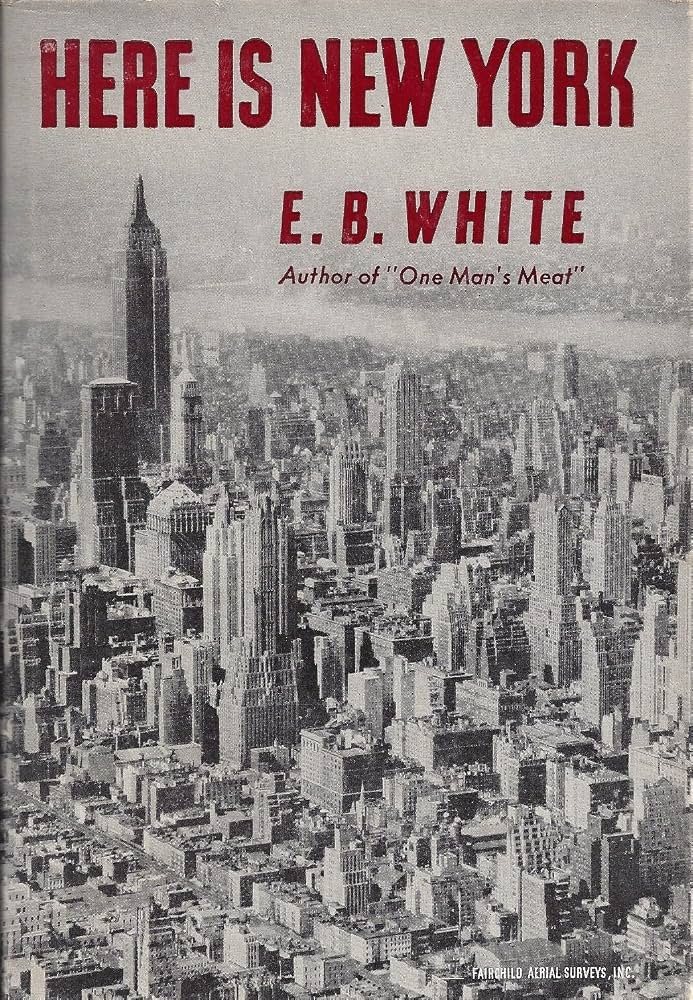
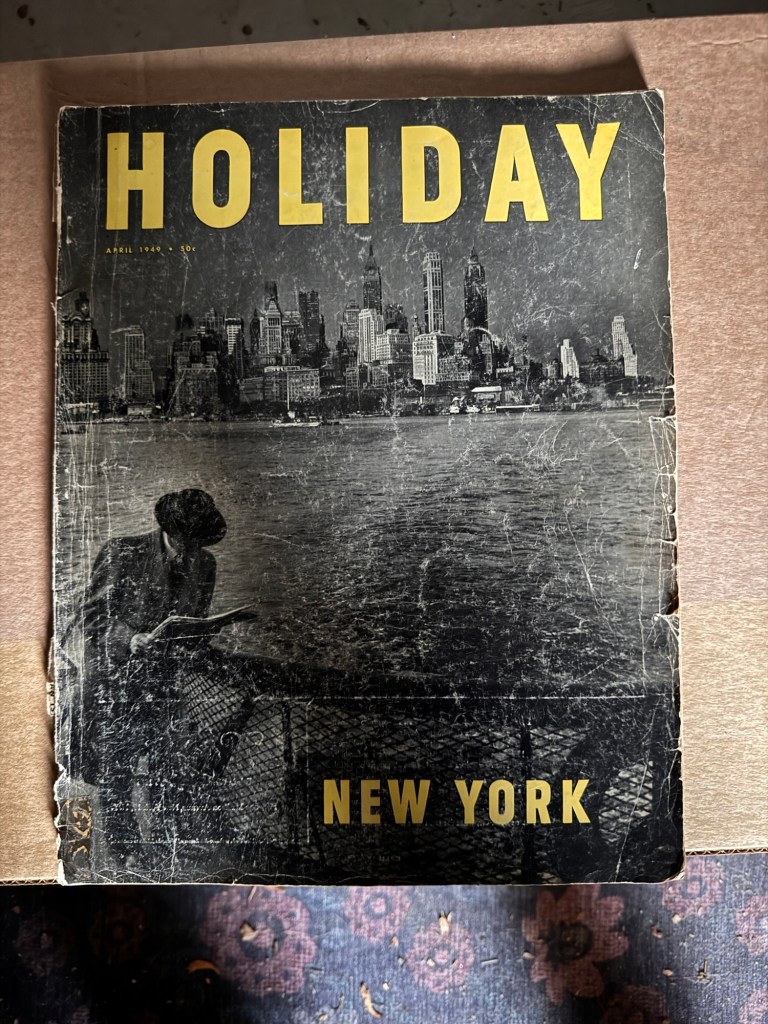
The whole thing is available online but I didn’t mind paying for this handsome volume. This old cover is cool:
It is a miracle that New York works at all. The whole thing is implausible. Every time the residents brush their teeth, millions of gallons of water must be drawn from the Catskills and the hills of Westchester.
When a young man in Manhattan writes a letter to his girl in Brooklyn, the love message gets blown to her through a pneumatic tube-pfft-just like that. The subterranean system of telephone cables, power lines, steam pipes, gas mains and sewer pipes is reason enough to abandon the island to the gods and the weevils. Every time an incision is made in the pavement, the noisy surgeons expose ganglia that are tangled beyond belief. By rights New York should have destroyed itself long ago, from panic or fire or rioting or failure of some vital supply line in its circulatory system or from some deep labyrinthine short circuit.
Long ago the city should have experienced an insoluble traffic snarl at some impossible bottleneck. It should have perished of hunger when food lines failed for a few days. It should have been wiped out by a plague starting in its slums or carried in by ships’ rats. It should have been overwhelmed by the sea that licks at it on every side. The workers in its myriad cells should have succumbed to nerves, from the fearful pall of smoke-fog that drifts over every few days from Jersey, blotting out all light at noon and leaving the high offices suspended, men groping and depressed, and the sense of world’s end. It should have been touched in the head by the August heat and gone off its rocker.
The pneumatic tube mail system is one of those astounding trivia items.
Every facility is inadequate-the hospitals and schools and playgrounds are overcrowded, the express highways are feverish, the unimproved highways and bridges are bottlenecks; there is not enough air and not enough light, and there is usually either too much heat or too little. But the city makes up for its hazards and its deficiencies by supplying its citizens with massive doses of a supplementary vitamin-the sense of belonging to something unique, cosmopolitan, mighty and unparalleled.
To an outlander a stay in New York can be and often is a series of small embarrassments and discomforts and disappointments: not understanding the waiter, not being able to distinguish between a sucker joint and a friendly saloon, riding the wrong subway, being slapped down by a bus driver for asking an innocent question, enduring sleepless nights when the street noises fill the bedroom. Tourists make for New York, particularly in summertime-they swarm all over the Statue of Liberty (where many a resident of the town has never set foot), they invade the Automat, visit radio studios, St. Patrick’s Cathedral, and they window shop. Mostly they have a pretty good time.
But sometimes in New York you run across the disillusioned—a young couple who are obviously visitors, newlyweds perhaps, for whom the bright dream has vanished. The place has been too much for them; they sit languishing in a cheap restaurant over a speechless meal.
Gasping and remembering things:
I am, at the moment of writing this, living not as a neighborhood man in New York but as a transient, or vagrant, in from the country for a few days.
Summertime is a good time to reexamine New York and to receive again the gift of privacy, the jewel of Loneliness. In summer the city contains except for tourists) only die-hards and authentic characters. No casual, spotty dwellers are around, only the real article.
And the town has a somewhat relaxed air, and one can lie in a loincloth, gasping and remembering things.
During the somewhat mawkish* time after 9/11, when people looked for meanings to cling to, I’m sure this paragraph was seen as prophetic:
The subtlest change in New York is something people don’t speak much about but that is in everyone’s mind. The city, for the first time in its long history, is destructible. A single flight of planes no bigger than a wedge of geese can quickly end this island fantasy, burn the towers, crumble the bridges, turn the underground passages into lethal chambers, cremate the mil-lions. The intimation of mortality is part of New York now: in the sound of jets overhead, in the black headlines of the latest edition.
All dwellers in cities must live with the stubborn fact of annihilation; in New York the fact is somewhat more concentrated because of the concentration of the city itself, and because, of all targets, New York has a certain clear priority. In the mind of whatever perverted dreamer might loose the lightning, New York must hold a steady, irresistible charm.
The introduction by Roger Angell is harsh on the city:
If Andy White could visit New York once again (he died in 1985), I think he would want to rush back home to Maine the same afternoon, appalled by its crime and violence, dismayed by the worsening conditions in the inner city and the enormous, widening distance between the city’s impoverished minorities and grossly rich Upper East Siders, and turned off by a sharp diminishment in charm and tone. Fifth Avenue, he would find, has been Trumped, and Broadway Disneyfied. New Yorkers, who once prided themselves on their sophistication, talk eagerly about money and celebrity now, and dress uniformly in black; they’re in great shape but don’t seem to be having much fun. Still, I would urge White to stick around for the weekend (he could stay at my place), and while he was here l’d take him to Central Park, which has never looked better or been more enjoyed.
Maybe Mamdani should bring back the pneumatic tubes.
This essay was first published in Holiday magazine:
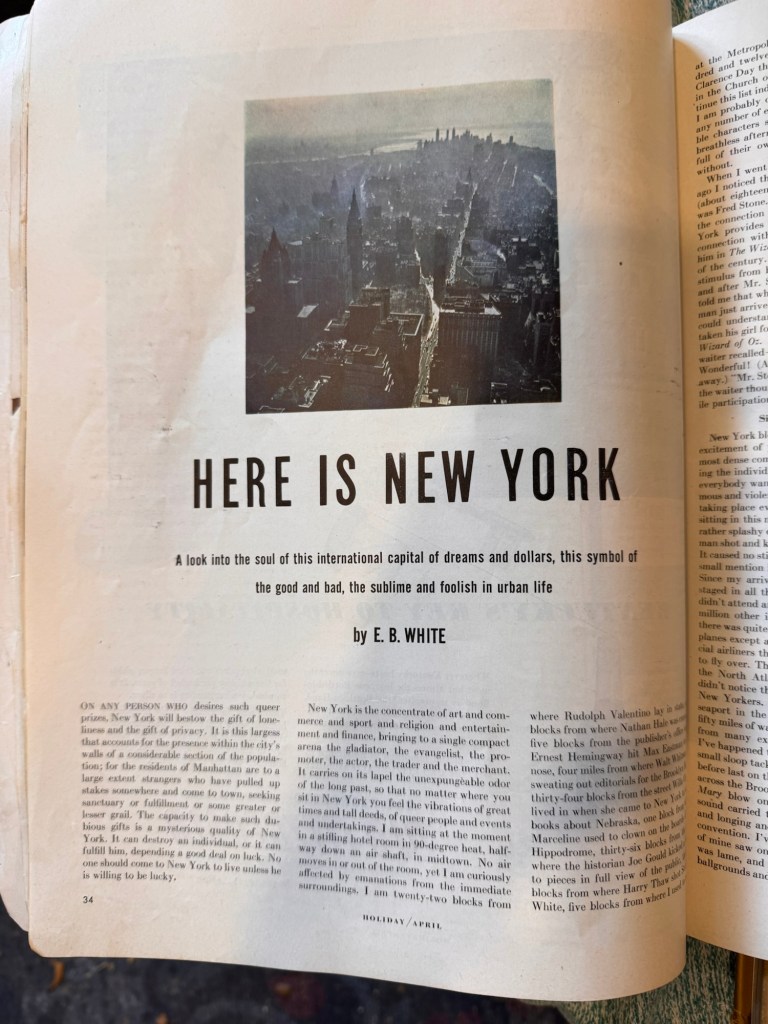
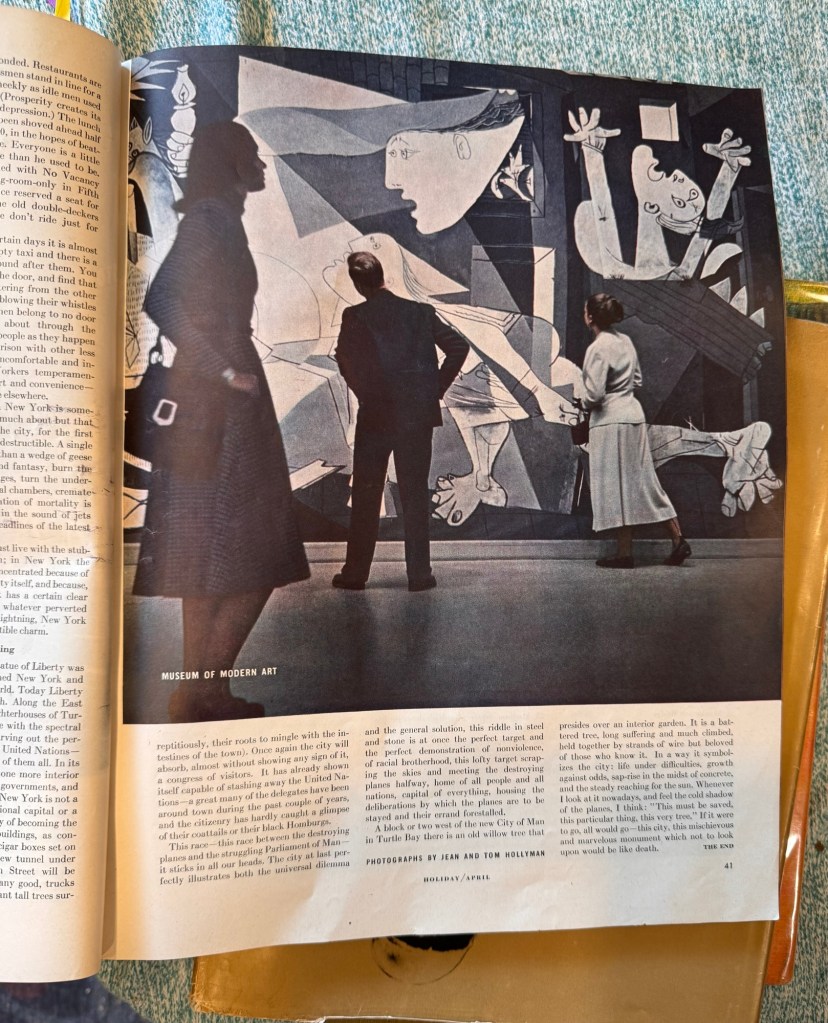
Maybe the second most famous piece published in Holiday is Faulkner’s essay on Mississippi.
*this seemed like exactly the kind of puzzle a computer would be good at, so I fed it to Claude. Despite my clear instruction to not cheat by determining where the text was from, it still did that.
*is that fair to say? people grieve in different ways. but it did seem to me that post-9/11 our collective reaction could reach levels that were sickly sentimental. I mean stuff like this. But maybe I should be more gracious in to how people respond to horrible and shocking events.
Your insular city of the Manhattoes
Posted: August 11, 2026 Filed under: New York Leave a comment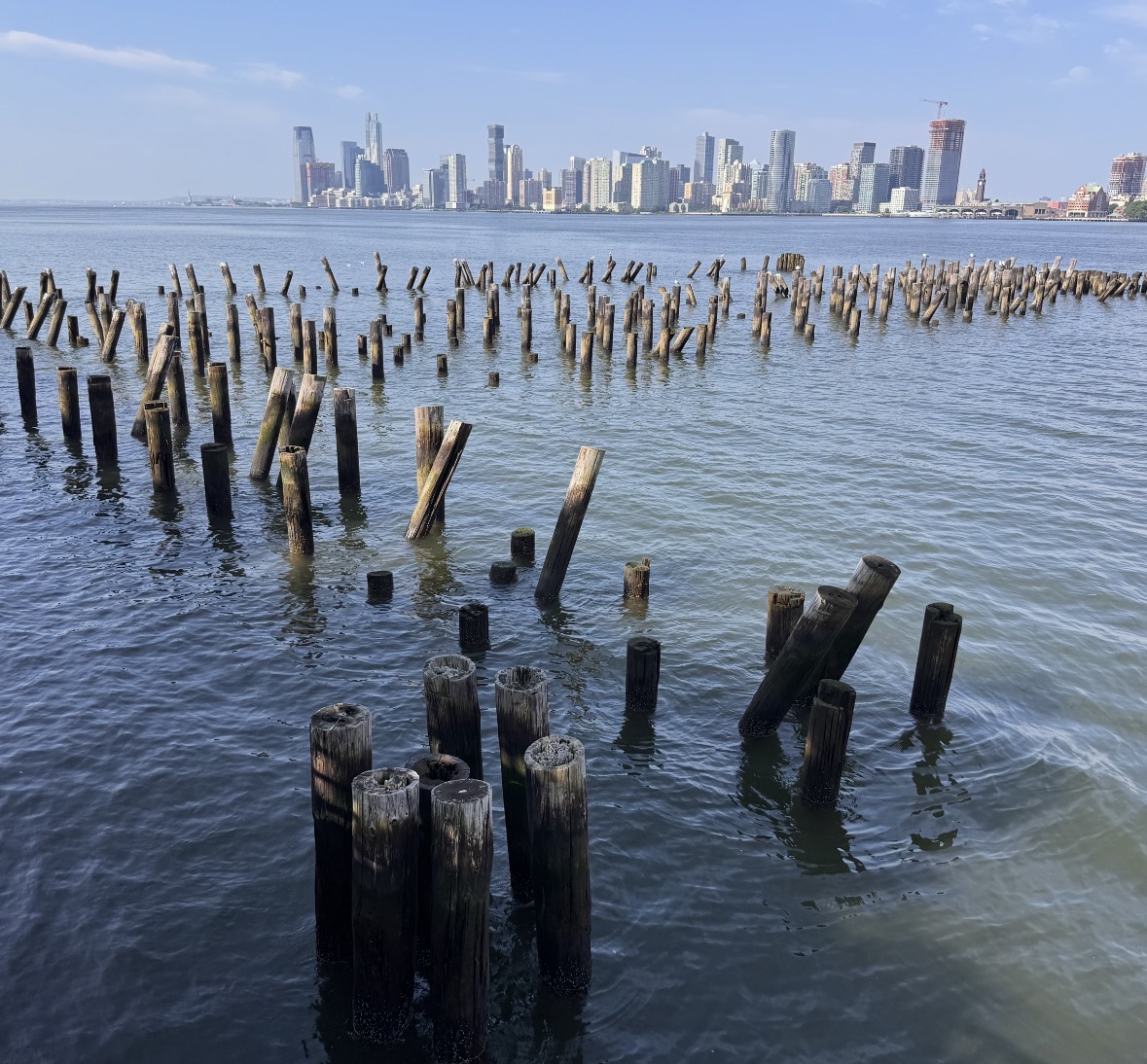
There now is your insular city of the Manhattoes, belted round by wharves as Indian isles by coral reefs- commerce surrounds it with her surf. Right and left, the streets take you waterward. Its extreme downtown is the battery, where that noble mole is washed by waves, and cooled by breezes, which a few hours previous were out of sight of land. Look at the crowds of water-gazers there.
Circumambulate the city of a dreamy Sabbath afternoon. Go from Corlears Hook to Coenties Slip, and from thence, by Whitehall, northward. What do you see?- Posted like silent sentinels all around the town, stand thousands upon thousands of mortal men fixed in ocean reveries. Some leaning against the spiles; some seated upon the pier-heads; some looking over the bulwarks of ships from China; some high aloft in the rigging, as if striving to get a still better seaward peep. But these are all landsmen; of week days pent up in lath and plaster- tied to counters, nailed to benches, clinched to desks. How then is this? Are the green fields gone? What do they here?
But look! here come more crowds, pacing straight for the water, and seemingly bound for a dive. Strange! Nothing will content them but the extremest limit of the land; loitering under the shady lee of yonder warehouses will not suffice. No. They must get just as nigh the water as they possibly can without falling And there they stand- miles of them- leagues. Inlanders all, they come from lanes and alleys, streets avenues- north, east, south, and west. Yet here they all unite. Tell me, does the magnetic virtue of the needles of the compasses of all those ships attract them thither?
Once more. Say you are in the country; in some high land of lakes. Take almost any path you please, and ten to one it carries you down in a dale, and leaves you there by a pool in the stream. There is magic in it. Let the most absent-minded of men be plunged in his deepest reveries- stand that man on his legs, set his feet a-going, and he will infallibly lead you to water, if water there be in all that region. Should you ever be athirst in the great American desert, try this experiment, if your caravan happen to be supplied with a metaphysical professor. Yes, as every one knows, meditation and water are wedded for ever.
The herds of people running in groups by the river was a new phenomenon to me, I don’t recall that from previous (2002-3, 2009) in the insular city. What happened to the loneliness of the long distance runner?
Manhattan ’45 by Jan Morris
Posted: August 1, 2026 Filed under: New York Leave a comment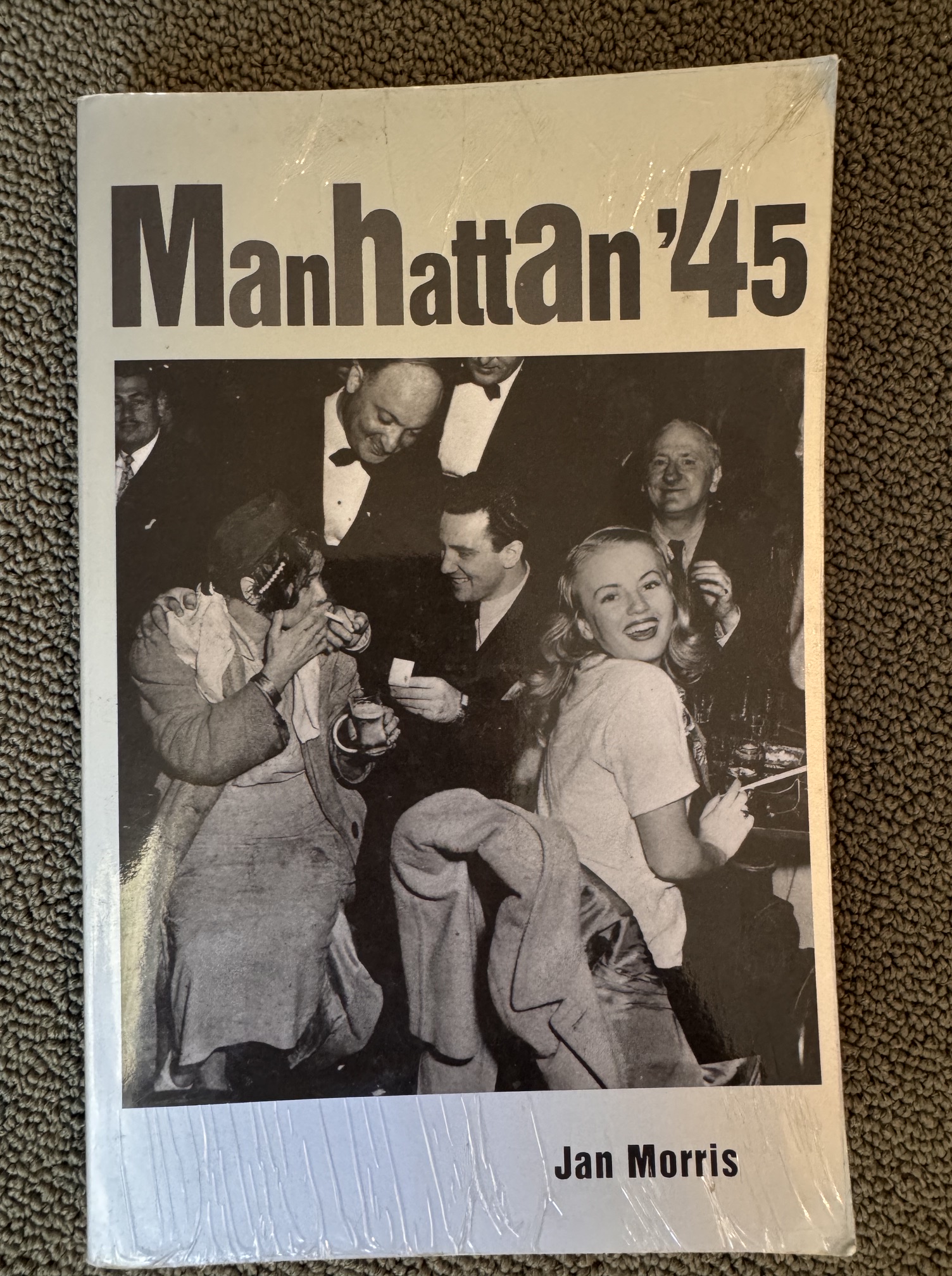
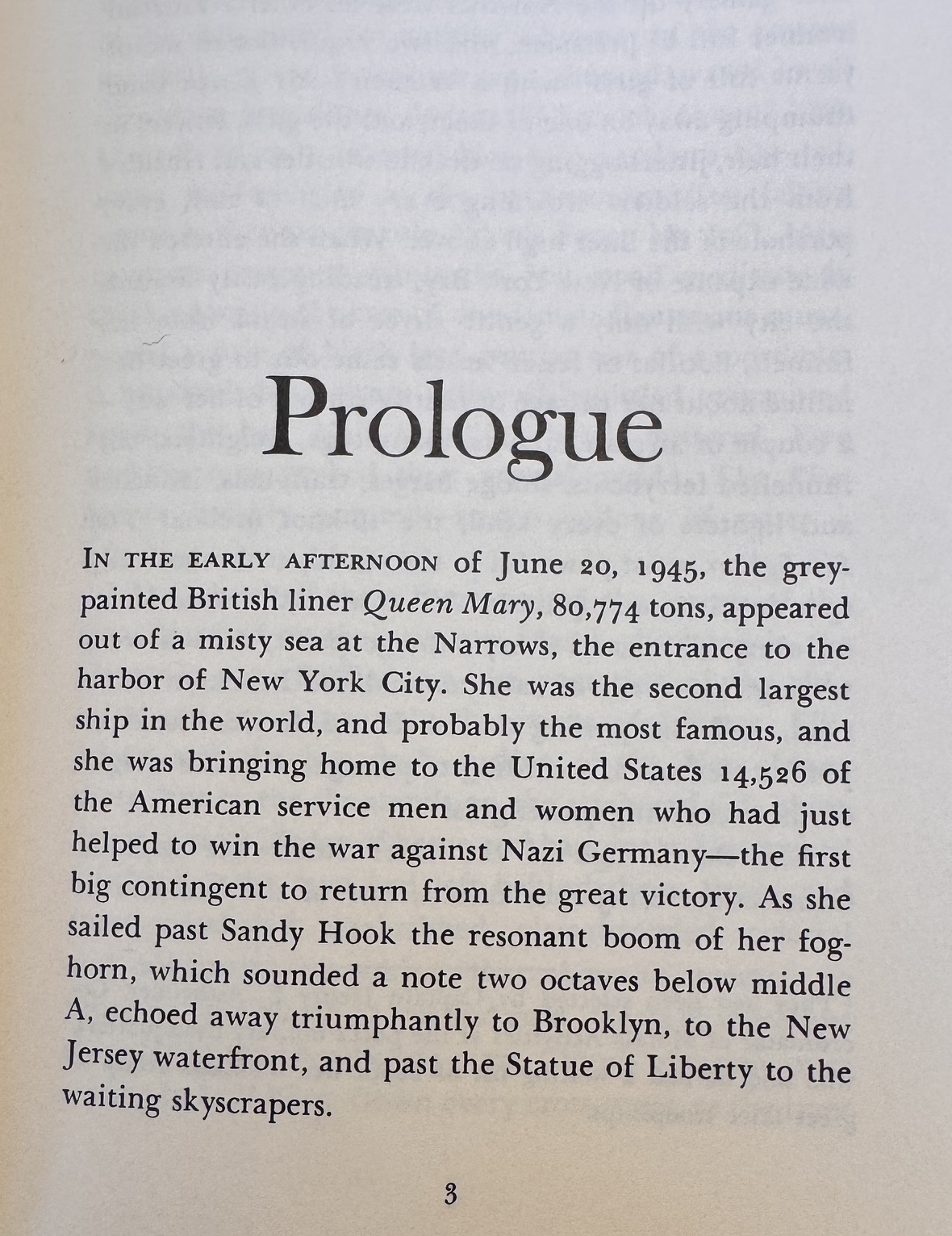
Cheers to either MMW or MLP for putting me onto this one. From a NY Times review, 1987:
JAN MORRIS, one of the very brightest travel writers, gives us here an account of travel to a place the author never visited. That place is Manhattan in 1945. Ms. Morris came close, visiting the island first in 1953 and often thereafter. Yet there remains a difference between having been there and having not quite been there. The difference tantalizes the reader.
Thus, Ms. Morris’s rendition of the city’s 1945 moods conveys what it felt like to live in New York at that time. For much of the detail, Ms. Morris has depended on research at the New-York Historical Society and on conversations with battalions of New York friends who were there. The passages dealing with later times reflect her own reactions and convey what it feels like to travel in the city. Jan Morris is the traveler we would all like to be. World-weary only to the point of being prepared at any moment to explore geography, speech or native behavior in search of a new nugget of understanding that will revive her spirit, she finds it; we probably would not.
”Manhattan ‘45” also gives the reader a short but incisive course on the difficulty of writing history. From 1945 to 1953, the city changed markedly. One can sense Ms. Morris’s gropings for the texture of a reality she can read about but not directly feel. One vital aspect of it she understands profoundly: that in 1945 New York stood at a pinnacle of collective strength that resembled at their peak the power of Venice, Alexandria or Byzantium – all seaports too. Not quite so accurately perceived is that the collective consciousness of power did not overcome individual feelings of weakness at the immense unknown future ahead.
The title, Morris tells us, evokes a cocktail or a gun.
Should they bring back Miss Subway?:
Yet by and large the subway was tolerantly regarded. Nothing too terrible was likely to happen to you down there, even in the middle of the night, and the competition to be “Miss Subways” was one of the town’s better-known distractions—she was elected every eight months by passenger vote, and for three months her picture was displayed in every one of 6700 subway cars, resolutely smiling. People with nowhere to go sometimes used the subway as a temporary home—a nickel would get you in, it was warm and dry, you could stay down there as long as you liked, ride where you wanted, and at its extremities you could get out on a beach somewhere, or in the countryside.
Food has unquestionably improved:
There were some truly exceptional tastes to be ti too, especially in seafoods. Nothing in the world could beat a sott-shelled crab from Chesapeake bay, eaten preferably inside a crusty roll on a street corner down-town. Incomparable oyster stews were prepared at the Grand Central Oyster Bar by Viktor Yesenky and his thirty-six oystermen. Louis Massan’s waterside restaurant on Fulton Street, beside the fish market, offered its customers (sitting at communal tables) five kinds of roe, tongue of cod, sturgeon’s liver, squid stew and the cheeks of cod and salmon.
The trouble began with the dread word gourmet. It was odd but true that the bourgeoisie of Manhattan, the most cosmopolitan city in the world, knew very little about foreign food-the menu at Kirby Allen, a smart restaurant on Madison Avenue serving the carriage trade on cook’s night off, included such items as “Lasagna, a Very Interesting Italian Dish.” Few diners-out took their food at all seriously, and the best-known food guide of the day, Lawton Mackall’s Knife and Fork in New York, was not very urbane either-“eminently okey-dokey” was among its categories of commendation.
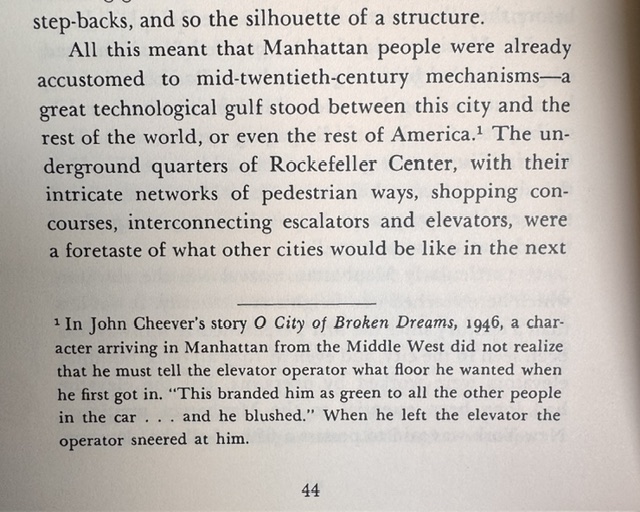
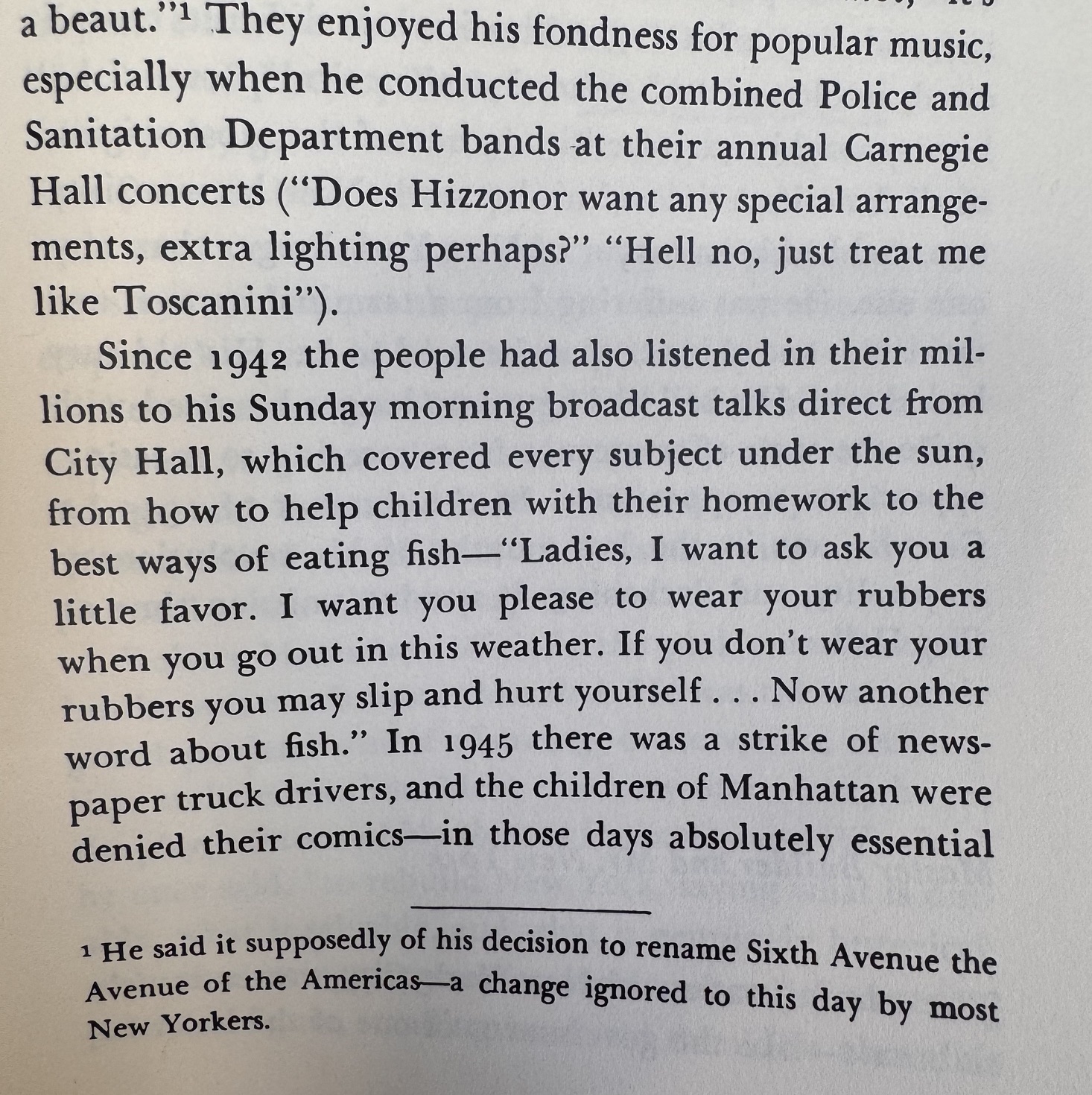
The great mayors have always been social and media characters. La Guardia
No excerpt tops that photo on the cover, a Weegee shot from Sammy’s At The Bowery, 1943. What happened to that woman? Her look is modern and yet a little off. From Weegee Wiki:
Weegee is spuriously credited for answering “f/8 and be there” when asked about his photographic technique. Whether or not he actually said it, the saying has become so widespread in photographic circles as to have become a cliché. Yet other sources, in mentioning his standard technique (f/16, Pressbulb25, focus at 10′), illustrate the probable fiction behind the mention of ‘f/8’. A book written about Weegee, Weegee’s Secrets published in 1953, says:
For the record, Weegee shot the majority of his photos from 6-feet at f/22 and 10-feet at f16. These smaller f/stops provided excellent depth of field. When hunting for photos, Weegee would stalk the streets with his camera set to 10-feet and f/16. This distance was useful for shooting people full-length. He also carried a flashlight for adjusting his camera settings in the dark.
Some of Weegee’s photos, like the juxtaposition of society grandes dames in ermines and tiaras and a glowering street woman at the Metropolitan Opera (The Critic, 1943), were later revealed to have been staged.
My iPhone is fixed between f/1.5 and f/2.8.

