Robert Healy: Nixon was a weird son of a bitch
Posted: October 4, 2026 Filed under: America Since 1945, Kennedy-Nixon Leave a comment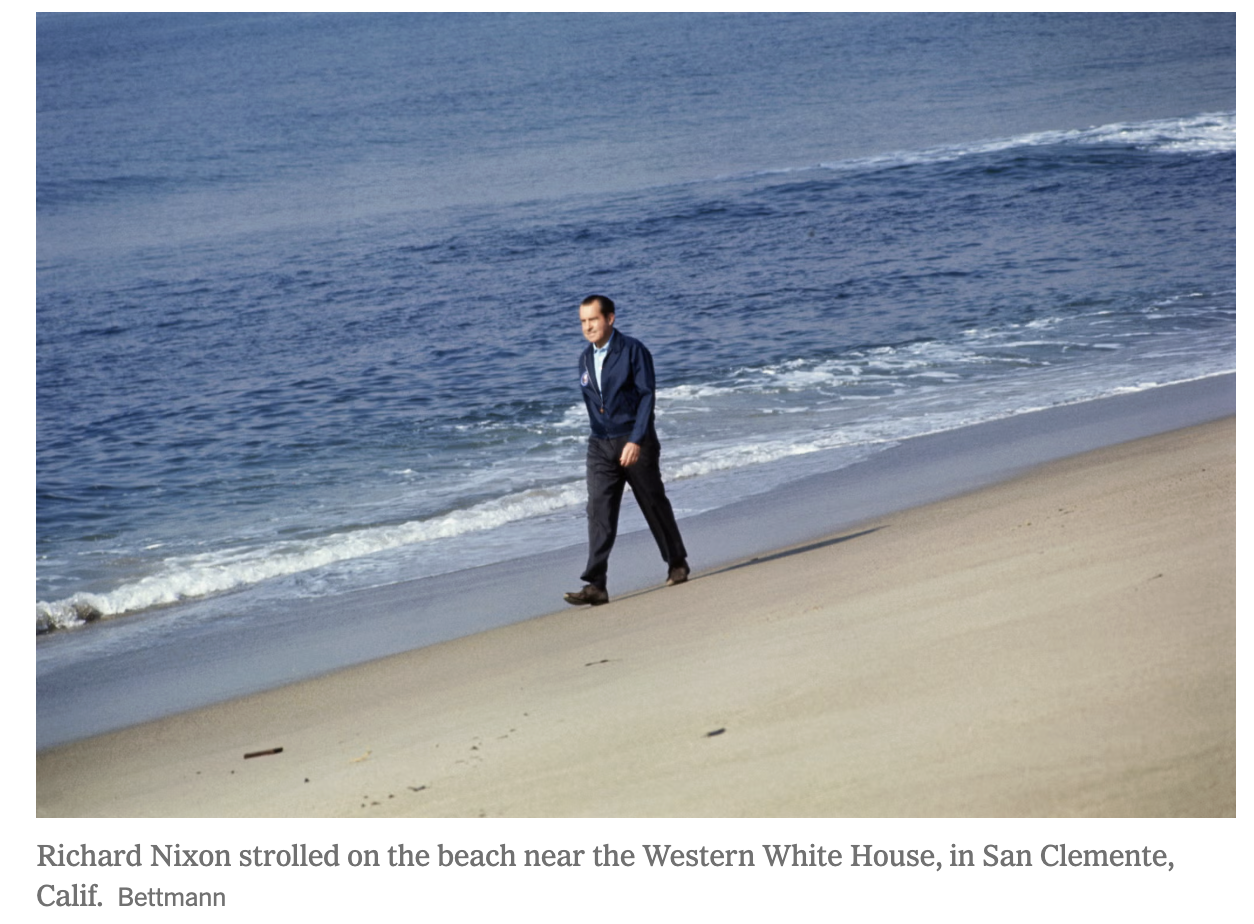
Healy was a reporter for The Boston Globe, who gave an oral history interview, for the Edward M. Kennedy project at UVA’s Miller Center. A phrase from Healy’s interview stuck in my craw and I went looking for it again when San Clemente was on my mind, with storms threatening Nixon’s beach. I post it here to preserve, and also because it’s good dialogue and a good window into America 1945-2001.
Knott
Did you ever hear any reports as to whether Senator Kennedy thought of resigning at the time? Or was that not—
Healy
Oh, I think it definitely was.
Knott
He was.
Healy
Now, I have no firsthand knowledge of that. But was it rumored? Yes.
Knott
Right, yes.
Healy
In fact locally there was talk about who would take his place, but that’s Boston politics, too. You know, it could be a very thin reed. [laughs] Everybody’s available, if you know what I mean.
Knott
Yes, yes.
Healy
But here was a guy who was prepped to be President. That was the impact of the story. Not that Mary Jo’s [Kopechne] death wasn’t—but here was a guy who probably would have been President of the United States.
I’ll tell you another thing that was fascinating to me, and again, Mary’s going to criticize me for talking about myself too much, but it happens to be relevant. I used to get invited to San Clemente by Nixon. I remember at one dinner up there he said—Nixon always gave speeches at dinners, like he wore black socks on the beach. [laughs] Nixon was a weird son of a bitch. But anyway, Nixon says, “We’ve got the entire spectrum of the American press here.” This was out for dinner. There were ten to fourteen editors and of course, who was I with? I was there with the guy from the Arizona Republic. I was there with all the right-wing papers. The Washington Star was there. The Post wasn’t, and the Times wasn’t there.
Once when Teddy was messing around, being talked about recovering from Chappaquiddick and how far he had come and was he thinking about running for President, he sent—You would go to the tarmac in LA where—I was coming from Boston in those days—and Nixon would pick you up in the helicopter. You know, fourteen editors and they’d all come in on the helicopter at roughly the same time, but not me. He would send the helicopter for me to bring me in early—I didn’t know, I had no arrangement—because all he wanted to talk about was Ted Kennedy.
He had a fixation, Nixon did, on the Kennedys. Of course, what the hell? He was looking down the barrel of a gun at Bobby and Jack, and the guy was paranoid anyway and the Kennedys just wiped him out. But I always found that kind of interesting, you know? And the first thing he said to me—I’m there sitting on—with Alexander Haig serving us martinis. Out in San Clemente they had a deck out there. Haig was a light colonel in those days and he was a gofer. I often laugh. I reminded him of the story when he became the White House Chief of Staff. “I’m in charge, you remember?” [laughs]
Knott
Mm-hmm.
Haley
So he was serving us martinis. That’s on the side. Anyway, it’s just funny. Nixon was just—he wanted to know everything about him, everything about Teddy Kennedy. What was he doing? What were people saying in Massachusetts? What were people saying elsewhere? What did I pick up from the Democrats? I probably was—not probably—I wasn’t as forthcoming as I could have been, but on the other hand, I’d fish around a little bit there and give him a nugget or two.
Then I remember I leaked the story to—they take you in, “in the box,” as they say, to San Clemente on the helicopter, and then they take you out the same way so that you couldn’t run into any of the guys. In those days if you were covering the White House you stayed in Santa Barbara. So they take you right back to the plane—
Knott
So you couldn’t talk to any of the other reporters?
Healy
So you wouldn’t talk to any of the other reporters. Lou Cannon was out there at the time. He was the Post guy and Lou and I were pals, so I told Lou, when I was going out there, I said, “This is the way they’ll do it. You give me your phone number and I’ll give you the story.” These were all off the record.
Knott
Yes, OK, right.
Healy
I gave Lou the story and they were, “Bullshit.” They probably knew who did it, because the other guys wouldn’t tell you your coat’s on fire, you know.
Knott
Right, right.
Healy
I mean those right wing, liberal press guys from the Arizona Republic.
Knott
[laughs]
Healy
Literally. I mean the Times wasn’t there, nor was the Post—the entire spectrum. Nixon had a thing about Teddy and it was different from the thing he had about Jack.
Knott
How would you characterize that difference?
Healy
Well, first of all he was President.
Knott
Yes, OK. Yes.
Healy
That was probably the main thing, but the second thing was that Nixon had a thing about Eisenhower and particularly the WASPS in New England, not that the Kennedys were WASPS; they weren’t, but he put Jack in that category.
Knott
Sure, sure.
Healy
Why, I don’t know, but he did. I know that because one time he told me in the ’60s that they were part of the establishment, and I told him that when I was a kid we couldn’t get into the hotels on the Cape because I was Irish, which was true. They used to have restrictive hotels down on the Cape, including the Belmont and Dennison. But anyway, he put Kennedy in that category and I don’t think he put Teddy in that category. In fact, I’ve heard him say that he thought Teddy was not a bad guy. And I think he had done business with him as President.
Knott
Yes.
Healy
So, what the hell, that gives you a leg up, definitely.
Knott
Sure, sure.
Healy
Yes, they take you out on that back porch there and they can show you the world without giving you anything. That’s kind of an interesting aside on Teddy. Teddy’s reaction was—Teddy, the year he ran for—I did a magazine piece. I don’t think you have it either. I don’t see it in the clips. Ward Just, who is a pal of mine, did a piece—some review. I did the whole magazine on Teddy. Who was the other guy that did it for the New York Times? The ABC guy, Mary. Your pal? The ABC television guy.
Mrs. Healy
Frank Reynolds?
Healy
ABC.
Mrs. Healy
Frank—I don’t know who you’re talking about. Did something with the Times?
Healy
Yes, he did it for the Times. He did a piece on Teddy the year Teddy was President, as we used to call it, 1980.
Knott
Yes, right.
Healy
What was the guy’s name?
Mrs. Healy
I have no idea.
Healy
Ward Just wrote a piece comparing the two pieces—
Mrs. Healy
I don’t know.
Healy
—in which he said in the piece something about you could tell Healy knew a lot more about Teddy that he didn’t put in the magazine. [laughs] Anyway, he was a White House guy for ABC for many years and he did that New York Times piece.
I’ll tell you, one of the things that struck me about Teddy was—that year I sat in the back of the car. He had this old Pontiac. Joe Kennedy used to tell his kids, “Don’t ride around in new cars.” So they all had these old shit cans that they used to drive around in, and Teddy had this convertible with a light on the back that was built into—it was a funny light, you know. You don’t have a light in a convertible but he had it built in in the backseat. It was during the period of Carter’s deregulation.
I was doing this magazine piece on Teddy and he had two guys who were—I mean this is the most arcane crap you ever saw in your life. I’m talking about the SEC [Securities and Exchange Commission] and the ICC [Interstate Commerce Commission] and dereg, and all that stuff. You’re talking about the size of a truck, how much weight they have, and all that stuff. Teddy’s in the backseat preparing for one of the debates with Jimmy Carter and I’m in the— no, Teddy’s in the front seat and the two guys, his staff guys who were working on this committee are on either side of me, and I’m sitting in the middle and he’s literally correcting these guys.
Knott
On detail.
Healy
On detail.
Knott
Yes.
Healy
I mean, the most arcane crap you ever saw in your life. I was really impressed, because as you remember, he gave my pal [John] Chancellor that incredible response about, why do you want to be—
Knott
Oh, Roger Mudd?
Healy
Roger Mudd. I’m sorry, yes. “Why do you want to be President?”
Knott
Yes, yes. “What do you think the—”
Healy
And it made him look awful.
Knott
How do you explain that to this guy—?
Healy
I don’t. That’s what I’m saying. I don’t have any answer for that, because first of all, the notion that he would go into a debate without preparation was crazy, was wrong.
Knott
Yes.
Healy
Those guys used to really prepare. I mean, Jack had a formula. I was around Jack at that first debate with Nixon, and he didn’t do that well in that debate. I don’t know if you ever read it but if you read it carefully, what saved him was Nixon hadn’t shaved. [laughs]
Knott
He was sweaty and—
Healy
He was sweaty. And Nixon was sick. He had injured his foot or something.
Knott
He banged his knee on the car door.
Healy
The knee, you’re right—like I am right now. And it was bandaged, yes. But the idea that they wouldn’t prepare was just not the case.
Knott
Sure.
Healy
And the idea that that wouldn’t be the first question you’d have to deal with, you know, with any of these.
Knott
Sure, sure.
Healy
Either that or it says something about softballs. Jack had a notion of, the tougher the guy, the better he loved them.
Knott
The tougher the questioner?
Healy
Yes, the tougher the questioner. And also, Jack had a wonderful sense of the press. I did an NBC special right after he became President, with this guy who wrote the book—he was a big, Jewish fellow who smoked cigars—I’ll think of the name. Anyway, I went over there to get some information from him before I did it. This guy was a Nixon guy and he wrote a tough book on Kennedy, and Jack said to me, “Half of the stuff he uses will be from the Congressional Record, and three-quarters of the stuff in the Congressional Record is pure bullshit and isn’t even accurate,” which is true. You know, just because it appears in the Congressional Record you don’t—but this is the way. So he said to me that time, “The best thing you can do when you go up against this guy is when he throws one of these Congressional Record stories at you on me, don’t ask—just come back with one of yours. Give him the same treatment with Nixon. And don’t answer the question.” What the hell is his name?
Knott
Is this Victor Gold?
Healy
No, no, it wasn’t Gold. I knew Gold pretty well though, yes. This guy never worked for—well, he was on the payroll I’m sure, but in those days there were a lot of guys. Anyway, at the end of the break—we taped it. It was a half-hour show and at the end of the break this guy came over to me and twirled his cigar a little bit and he said, “Hey kid, if you cut out this bullshit, I’ll cut out this bullshit.” [laughs]
Knott
[laughs]
Healy
I tell you that because Jack—well, first of all, Jack grew up in a much tougher world than Teddy. I’m talking about in that era. If you ever want to read something that’s riveting, it’s the Houston appearance before the Baptist ministers in 1960. It’s absolutely riveting and he put them on—he really set them on their ass. I mean, it was really something.
Knott
Yes.
Healy
It was a tough audience and I had been—Ralph Coghlan had been the editor of that big Catholic paper that’s published in St. Louis. I forget the name of it now, but anyway it was the Catholic—I don’t think there is any national journal now in the Catholic—but anyway, Ralph Coghlan. No relation to Father [Charles Edward] Coughlin because Ralph was a real leftie. It was the leftie paper for the Catholic Church, and he did some of the interrogating of Kennedy. I was in the room with him.
Knott
When they were prepping him?
Healy
Before Houston.
Knott
Yes.
Healy
Jack just said, “Bring it on.” The tougher it got, the better he got.
Knott
So you don’t think Teddy had gone through a similar sort of baptism before?
Healy
I don’t think Teddy had ever gone through that baptism, no. I don’t think he had to. That was the problem.
Knott
Right, sure.
Healy
Now, the debate with Eddie McCormack was certainly a tough debate. Don’t think Eddie backed off, and Eddie made it very clear here in Boston that that’s the way it was going to be. He didn’t hold back. If your name was Edward Moore, you’d be out shoveling you-know-what. So, Teddy ran into it occasionally. You know, the George Lodge thing was—George and I covered police headquarters together and I had lunch with him in the last couple of years. He was kind of the gentleman candidate for the Republicans and not too different really with his philosophy than Teddy.
Knott
Yes, right.
Healy
So there were—and then after that—’64 was a joke.
Knott
Right.
Healy
He really never had a tough campaign, not for the Senate.
Knott
Do you know why he took on Carter? Why he would challenge an incumbent President of his own party?
Healy
Yes, I do, I think. We were down—where was that, Mary, in Memphis?
Mrs. Healy
In ’78, the midterm.
Healy
Seventy-eight, yes, the midterm election and he had supported—Well, first of all there was a tribal thing, not that there aren’t tribal things with every candidate for President, but the Carter people—and Mary worked for Jimmy—the Carter people were pretty tribal. I mean they were smart people and they were tough, but they were very tribal.
Mrs. Healy
They were very parochial.
Knott
Georgia?
Healy
Yes, they really were, and Mary worked with the top guys.
Mrs. Healy
I worked early on in the campaign. Volunteer.
Healy
And once she claimed to know me, she was dead. [laughs]
Knott
Is that true?
Mrs. Healy
Yes.
Knott
Really?
Healy
It was funny too.
Mrs. Healy
The Boston Globe wasn’t Jimmy Carter’s favorite paper. I wasn’t that important. I mean I was just a volunteer, but I was a volunteer very early on when there were very few people outside of the Georgians.
Knott
OK.
Healy
Yes, she was from Tennessee. Anyway they were very tribal. They would do silly things, you know. The guy she knew pretty well was a Congressional guy who was pretty good. He was pretty good but he fought an uphill battle.
Mrs. Healy
Frank Moore. But you know, Jimmy Carter was a very ineffectual President and he was not in the Democratic tradition, certainly at that time. He looks like a liberal now.
Knott
Right, right.
Mrs. Healy
And I think—I don’t think it was personal. I think it was philosophical.
Healy
Yes it was, and I think that was the difference. Tip [O’Neill] used to say that they went out of their way to stiff him.
Knott
The Carter folks?
Healy
Yes, and they did it like—
Mrs. Healy
There was a Southern chip.
Healy
The seats, remember the—
Mrs. Healy
There was a Southern chip on their shoulder.

