What is San Diego, Revisited
Posted: July 21, 2026 Filed under: the California Condition Leave a comment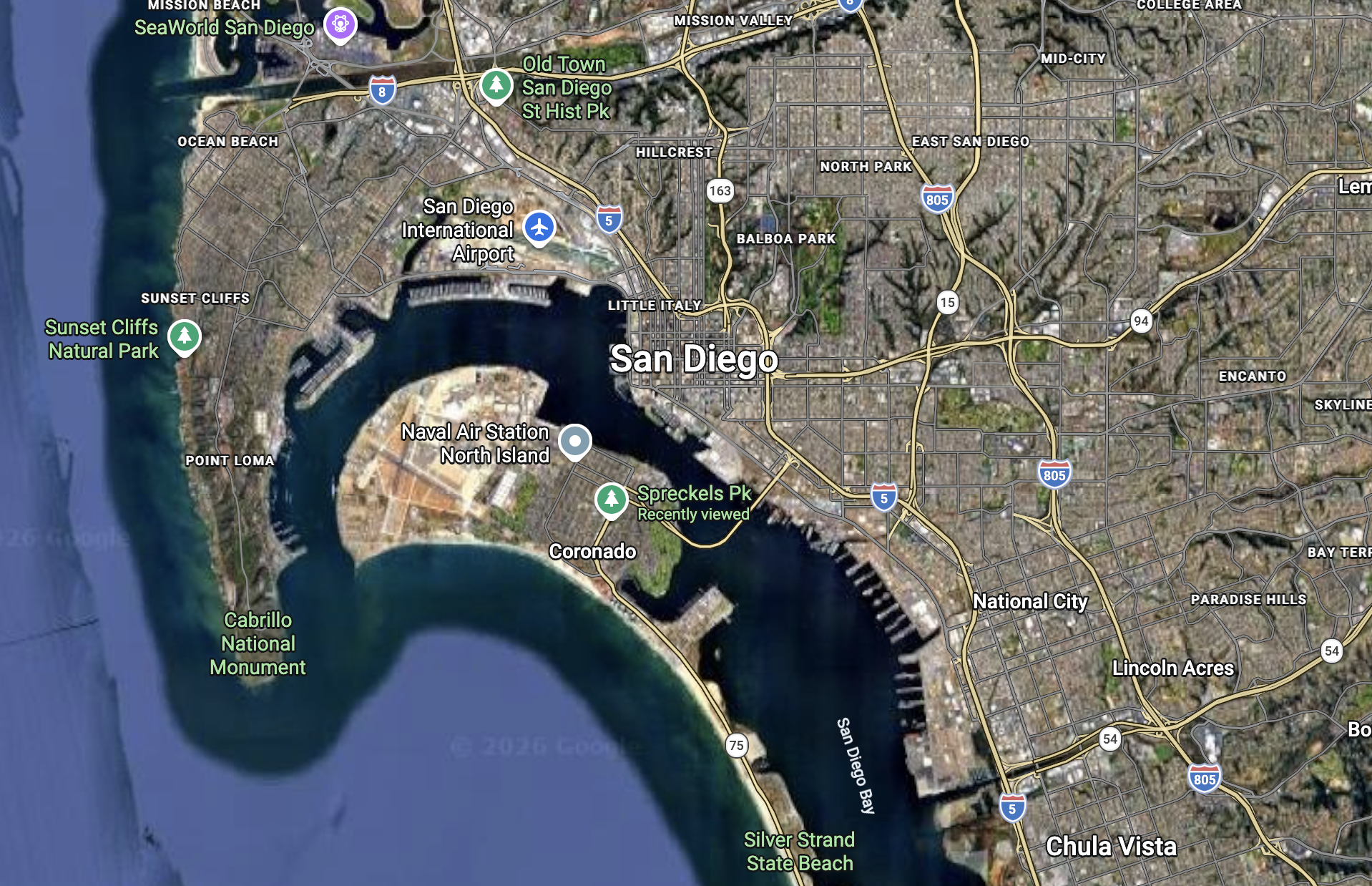
from Cameron Crowe’s memoir:
With San Diego Comic-Con approaching, it’s time to revisit our 2024 question, What Is San Diego?
Perhaps the suffocating banality of official San Diego’s pious “America’s Finest City” mantra has led even those who know better to think that nothing is possible here other than the affectless pleasure that comes from drifting back and forth between the beach and the shops. Or maybe we are too preoccupied by daydreams of tech bros taking over the now-defunct Horton Plaza mall downtown, buying up luxury condos and ushering out the unpleasant hordes of the dispossessed, to think beyond our own marketing. Nonetheless, underneath San Diego’s superficial postcard sunshine, writers have found both grit and genuine transcendence.
Perhaps the city is best captured by the incongruous juxtaposition of the evanescent beauty of the gleaming coast with the muted gray façade of America’s multi-billion dollar killing machine. San Diego is also the sex oozing from the teeming Pacific Beach boardwalk in mid-summer and the lonely deaths of migrants in the unforgiving winter desert. It is a city of lurid scandal and right-wing vigilantism as well as a home for increasingly creative, diverse and progressive communities. San Diego is neither beyond alienation, nor devoid of ecstasy.
San Diego is the Anglo Mission fantasy that evolved from the days of Helen Hunt Jackson’s Ramona and the place where Henry James wrote, “the sense of the shining social and human inane is utter.” San Diego is where Henry Miller was converted to free love and radicalism by famous anarchist Emma Goldman on the way to a Tijuana brothel, and the place where right-wing vigilantes tortured and murdered Wobblies for speaking on soapboxes at the corner of 5th and E. America’s eighth largest city has produced a minor noir tradition and a sizable canon of gay sailor pulp novels.
So says Doug Porter in an excellent roundup, “The Perpetual Limbo of Literary San Diego.”
In 1942, the narrator of Jim Thompson’s seminal noir account of San Diego, Now and On Earth observed that:
San Diego, prior to the establishment of the aircraft factories, was not inappropriately dubbed the “City of the Living Dead.” There were no industries, there was no construction; the town’s one asset was its climate. If you were young and wanted excitement and had a living to make, why, the town wouldn’t want you and you wouldn’t want it. If you were old and had a small income or pension, you couldn’t have found a more attractive place to live (or die) in.
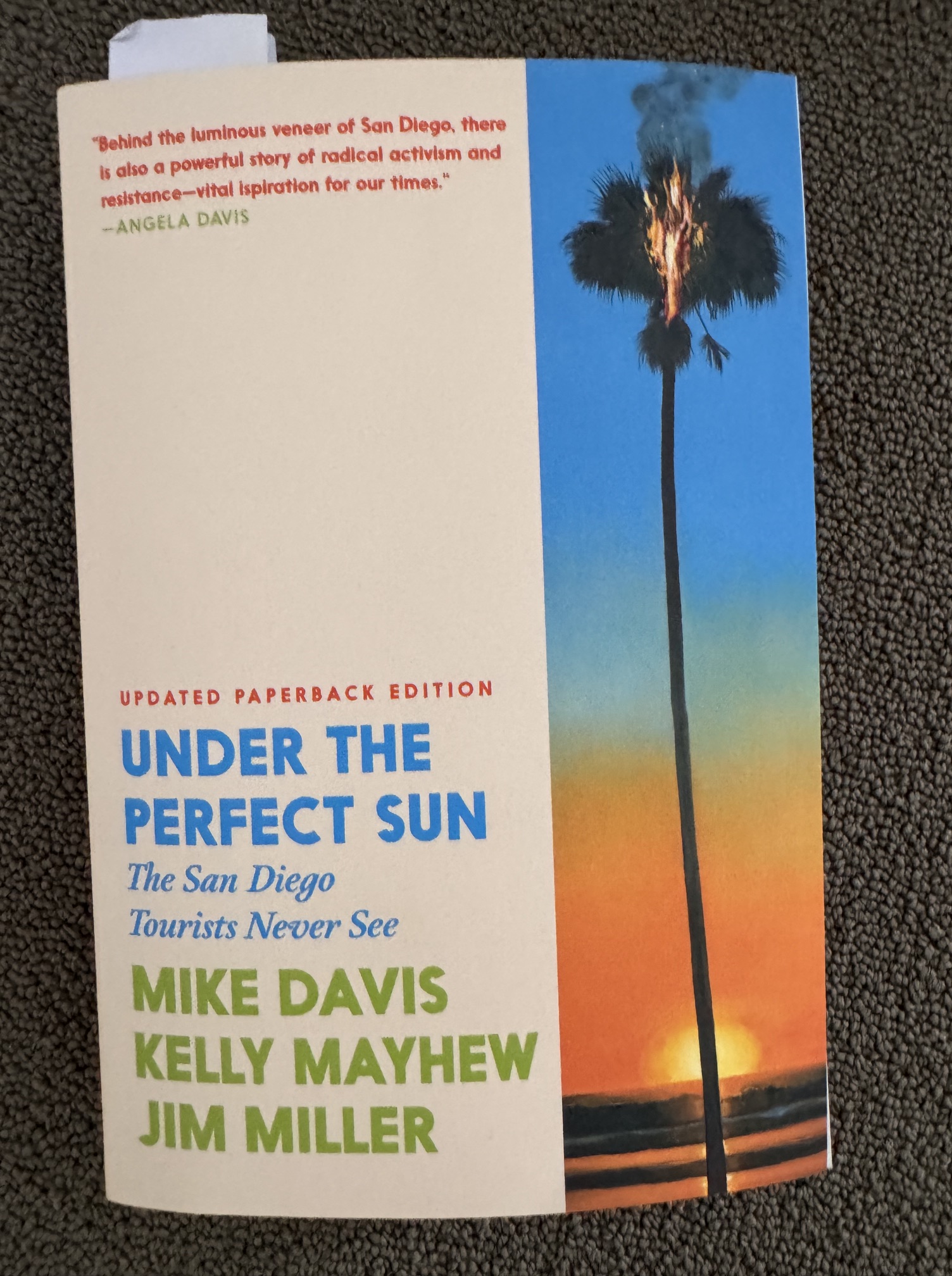
I was looking for more answers to what’s the deal with San Diego – not the tourist portal, but the city that’s home to 1.4 million. What’s the San Diego that I, a tourist, never see? Luckily there’s a book just for me (cheers to reader Jake B for calling my attention to it):
The historian Kevin Starr was asked by Neil Morgan, a Union-Tribune columnist, why San Diego got so little space in Starr’s celebrated Americans and the California Dream, 1850-1915. Starr replied serenely, “From a historian’s point of view, nothing much happened in San Diego before the Second World War.”
Very funny thing for a historian to say. The pre-WW2 San Diego topic Starr does talk about in the book is the 1917 Panama- California Exhibition, the buildings and pavilions designed by Bertram Goodhue.
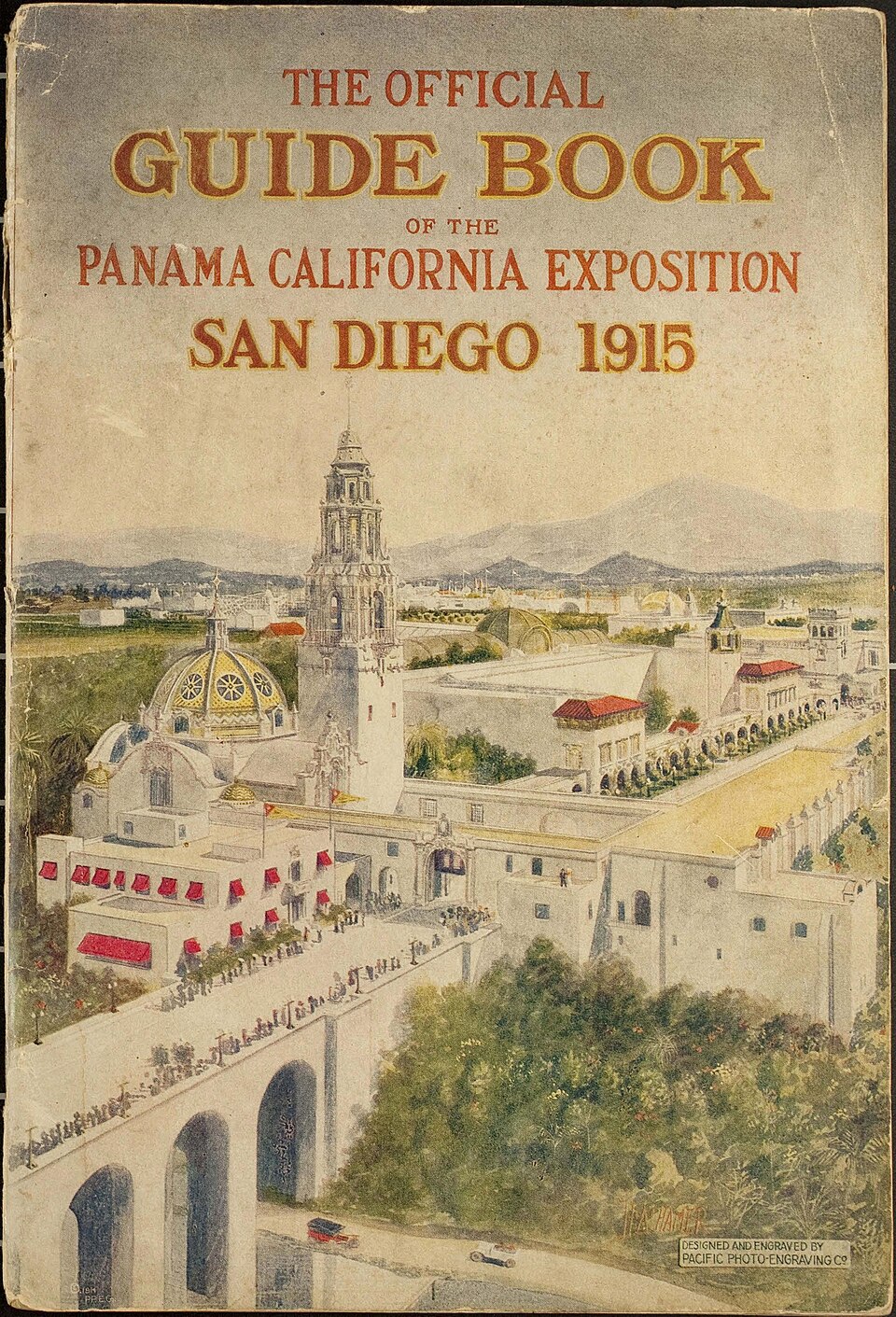
Many of these remain or were rebuilt in San Diego’s Balboa Park. (Goodhue also designed the LA Central Public Library and the Nebraska State Capital).
And what happened at the Second World War that made San Diego pop, historywise? Well, San Diego was converted into a giant military base and aircraft factory, and the city boomed in population.
Under tremendous pressure from Washington, San Diego had reluctantly yielded more than a quarter of its incorporated land area and 70 percent of the undeveloped county to defense plants, training camps, airfields, and bombing ranges. “The city’s landscape had been scraped, leveled and built to meet the demands of the army, the navy and the aircraft industry. Two thousand acres of new land had been added to airports and parade grounds by moving the waterfront a mile out…
But, whatever the price, there was simply not enough housing to meet the soaring levels of demand. In 1941 the population increased by a staggering 50 percent, a decade’s projected growth in a single year.
The result—as investigating congressional committees confirmed in 1941 and again in 1943—was the nation’s worst defense housing crisis.
“Aviation Okies,” as they were called, were often forced to sleep in their autos, abandoned rail cars, all-night movie theaters, or share beds in shifts. Mission Valley, whose Nisei truck farmers were now interned in Arizona, was a vast trailer camp for Consair workers and navy wives…
the county was experiencing a severe drought. In any event, the bewildered city administration of Mayor Benbough, who dropped dead of stress in 1942, was totally overwhelmed by the housing and infrastructural crises. With the city’s business leadership almost paralyzed, Fleet took matters into his own hands To gain Washington’s immediate attention, he telegraphed Secretary of the Navy Frank Knox that a deadly epidemic was imminent because of the sewage in the harbor. Then he spoke directly to FDR, warning the president that further expansion of B-24 production was being jeopardized by the city’s inability to overcome the various bottlenecks. “The situation is now impossible without federal aid,” Fleet said. The White House punctually ordered the navy and other agencies to undertake a crash program of housing and public works.
San Diego became the first of the so-called congested districts, crucial to war production, whose urban development was temporarily taken in hand by the federal government.
San Diego intersects with my own family history here: my grandmother took a train from New Jersey to Camp Pendleton, where she married my grandfather who was waiting to ship out.
This train connection from the east is a key to San Diego’s history. It was slow to arrive. San Diego has great geography for an ocean harbor and bad geography for an eastbound rail connection.
“Physically, as Davis notes (and the canny Kipling realized), San Diego—with its hem of forbidding eastern mountains—is a “cul-de-sac.” Its “intractable geography” frustrated generations of promoters who longed for the direct railroad connection to the east that might have made it a great entrepôt. Rather than becoming the hub of a railroad empire, however, San Diego was doomed to be a sideshow for remote capitalist deities like E. H. Harriman, master of “The Octopus” and Kipling’s model for Cheyne. Rapacious even by the standards of his fellow robber barons, Harriman, who controlled the Union Pacific and Southern Pacific railroads, was the first to envision and almost to accomplish a global transportation network.
According to Davis, the development of North County in San Diego was “retarded” for a generation as a remote consequence of Harriman’s duel with the overmastered Henry Huntington.
By contrast:
Thanks to the San Andreas Fault, which shifts entire mountain ranges, the Los Angeles basin has two great natural gateways to the east—the San Gorgonio and Cajon passes—that were used by Indian raiders in the 183os and 184os before they became the routes of the Southern Pacific (1879) and Santa Fe (1885) railroads. The natural deficiencies of San Pedro Bay were compensated by these generous portals to the east.
You can see the problem on this 1890 railway map:
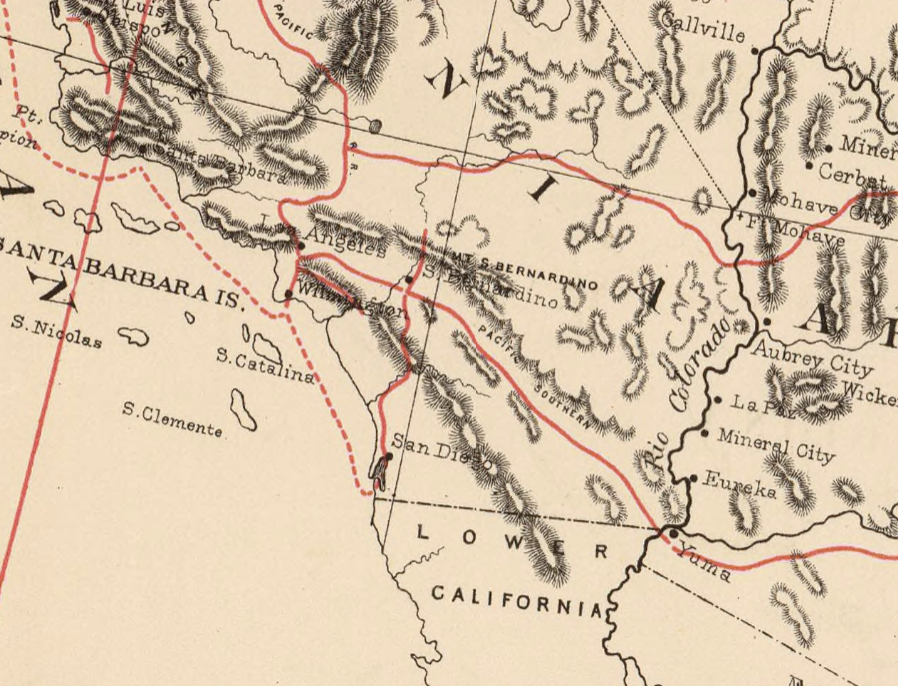
Says Wikipedia’s history of San Diego:
In 1878, San Diego was predicted to become a rival of San Francisco’s trading ports. To prevent that, the manager of Central Pacific Railroad Charles Crocker, decided not to build an extension to San Diego, fearing that it would take too much trade from San Francisco.
LA and San Francisco got railway connections that San Diego didn’t.
The Civil War years brought literally biblical disaster to California south of the Tehachapis. The worst drought of the nineteenth century scorched the grasslands of Los Angeles and San Diego counties into ochre deserts and destroyed the livestock wealth of the region’s mixed Anglo-Californio pioneers. In San Francisco, by contrast, the fabulous fortunes of the city’s Nevada silver colony, the Comstock, as well as the profits from the construction of the Central Pacific Railroad, had created a boom of Medician splendor. After the end of the Civil War, the excess capital of the North soon flowed south to take ownership of the ruined anchos. There was an almost complete turnover of elites as silver barons (like Baldwin and Irvine) and Central Pacific Railroad speculators (like Lankershim and Van Nuys) acquired an empire of former Spanish land grants at rock-bottom prices.
In this environment, Alonzo Horton saw promise.
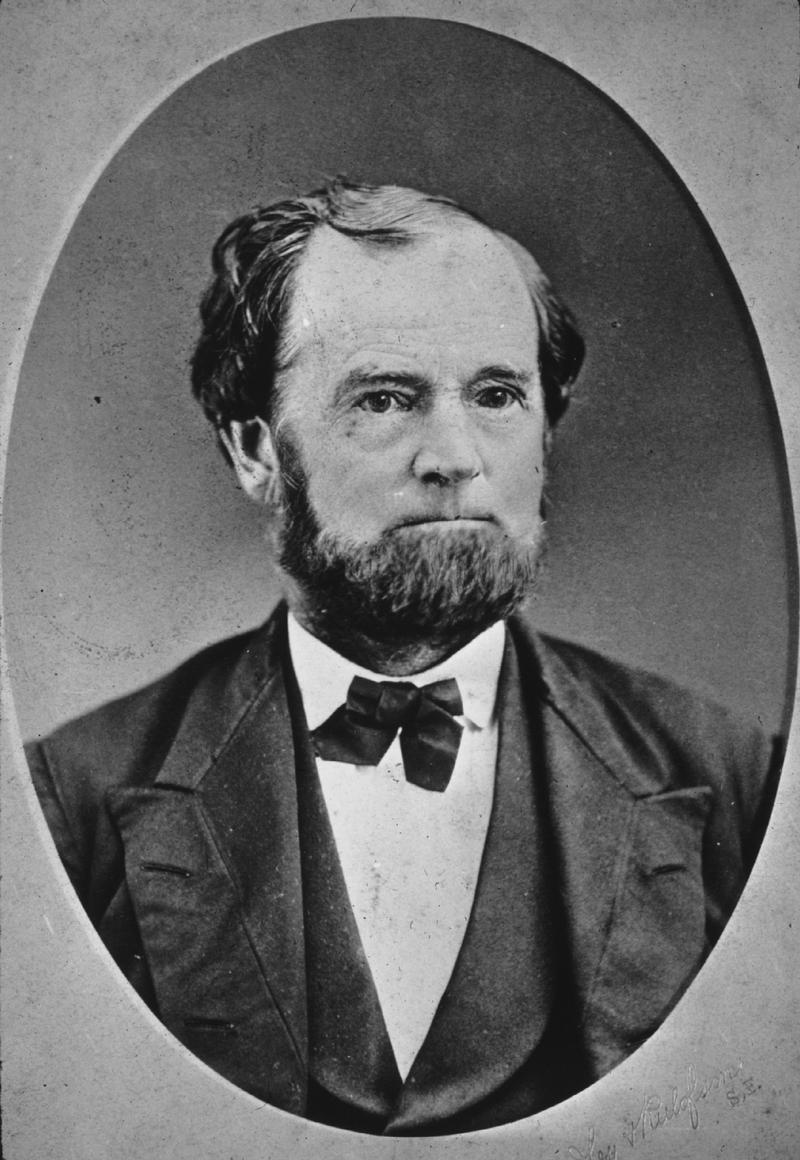
Alznzo came from the east:
when he was 21, he began transporting grain by boat from the Lake Ontario port of Oswego, New York, to Canada… But having developed a cough, and with his family and friends fearing tuberculosis, he was advised to move to the West. At that time, the Western frontier was Wisconsin, and in 1836 he moved to Milwaukee, Wisconsin.
He bought land warrants from veterans of the Mexican-American War, and set out to establish a town in the wilderness:
In 1848 Horton filed his first Warrant in Green Bay, the County seat for Brown County which the area was a part of at that time, for 160 acres of land which is now “Downtown Hortonville”. The price per acre at that time was only $.70. But before he could file he had to take an oath that he had seen and inspected the land and that no other settler resided on the land. To do so meant travelling by foot to inspect the land which was almost all dense woods with no trails. Then he had to go back to Green Bay by foot to file and return again. No easy task as the trip was around 40 miles and the area has many streams and rivers that he needed to cross along the way. After this he became a success at trading land, establishing businesses and cattle.
Hortonville, Wisconsin is still there, it looks pleasant. Alonzo moved on to California. He sold ice in gold field towns, and opened a furniture store in San Francisco. Then he heard about San Diego:
After a lecture about the ports of California, he later recalled his excitement, “I could not sleep at night for thinking about San Diego, and at 2 in the morning, I got up and looked on a map to see where San Diego was, and then went back to bed satisfied. In the morning, I said to my wife, I am going to sell my goods and go to San Diego and build a city.”
He was successful for awhile. He mapped out Horton’s Addition to the Old Town that was once the center of San Diego:
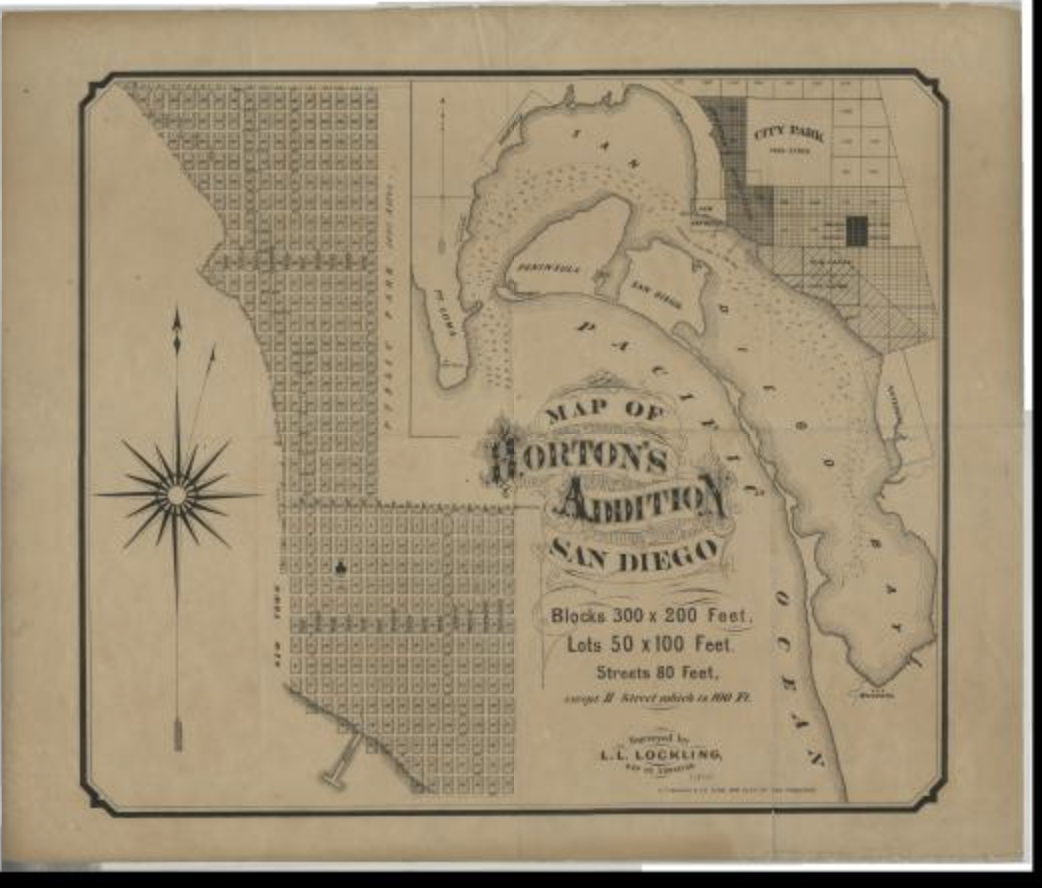
But the dream of the Texas Pacific Railroad reaching San Diego dissolved:
The bursting of the railroad bubble ruined Horton, who for a glorious few months had been selling his twenty-six-cents-an-acre lots for as much as $6,000 each. He was now forced to auction off his wharf and mortgage his hotel (the creditors finally foreclosed on it in 188l).
Simultaneously, New Town’s swollen population of speculators and land investors, who were waiting for the Texas and Pacific to make them instant millionaires, melted away to the far corners. San Diego altogether lost nearly 70 percent of its residents and for the remainder of the 187os was forced to earn a modest living from beekeeping, whaling, and vineyards, with an occasional mining boomlet in the mountains. Once again, in Hubert Bancroft’s acid phrase, the forlorn town “crawled along… like a starved dwarf, wandering among trees laden with fruit beyond his reach.”
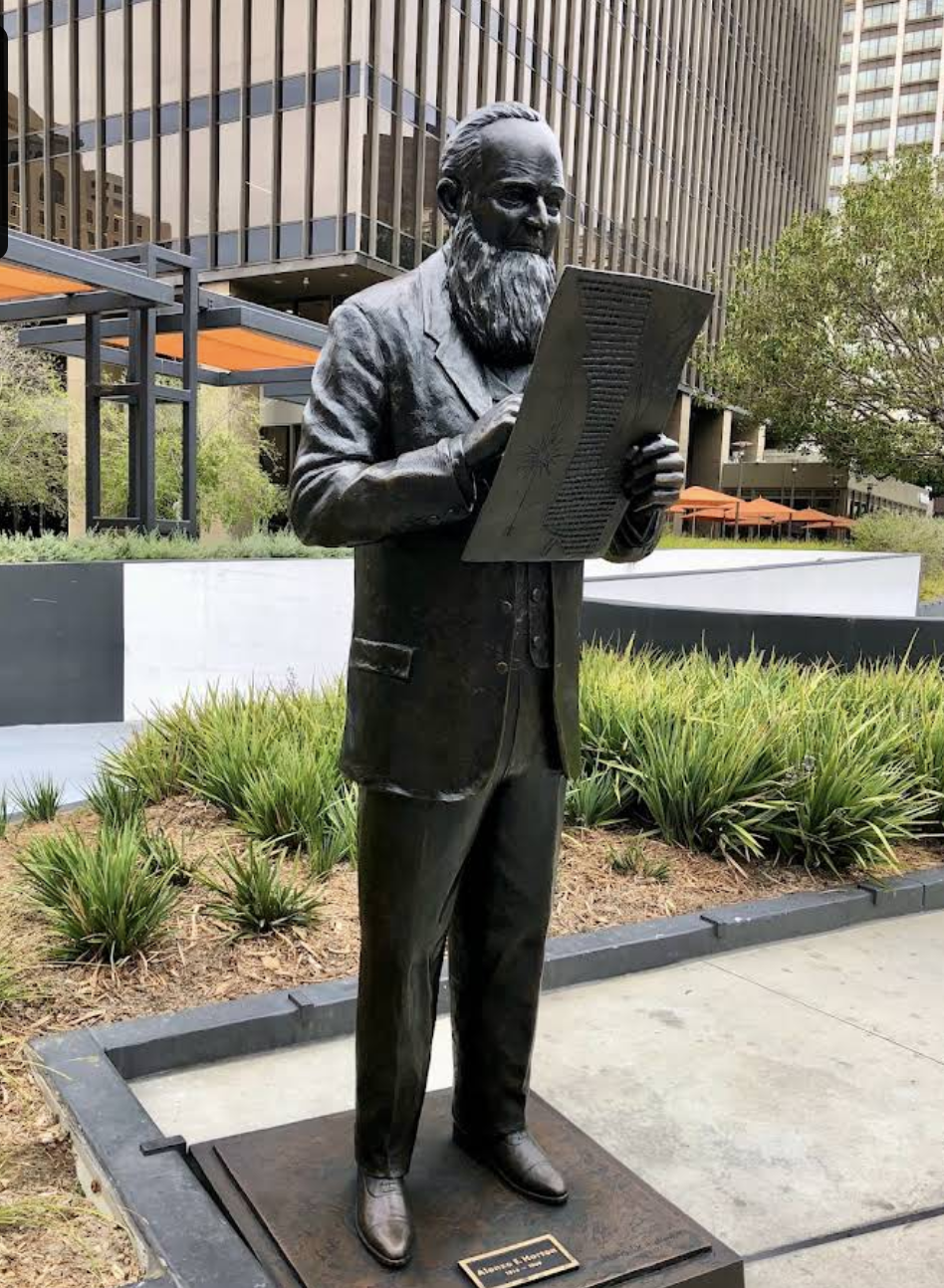
There’s a statue of him in Horton Plaza:
Into this vacuum came John D. Spreckels, son of the sugar king:
Why did I come to San Diego? Why did any of you come? We came because we thought we saw an unusual opportunity here. We believed that everything pointed to this as the logical site for a great city and seaport. In short, we had faith in San Diego’s future. We gave of our time and our strength and our means…to help develop our city, and naturally, our own fortunes. … What is the matter with San Diego? Why is it not the metropolis and seaport that its geographical and other unique advantages entitle it to be? Why does San Diego always just miss the train, somehow?
Spreckels controlled the street cars which he used to sell real estate:

Mike Davis describes him:
John D., who served an apprenticeship managing his father’s Hawaiian empire, inherited this love of conquest as well as a business philosophy based more on the dictums of von Clausewitz than those of Adam Smith. – Indeed, in hindsight, his enemies would later recognize that John D. had conquered San Diego like a Prussian general, systematically overrunning one stronghold after another. His first step, not long after docking the Lurline, was to construct a modern coal wharf at the foot of Broadway. Controlling the city’s supply of imported energy, he was in a superior position to leisurely cherry-pick the best properties.
By 1900, according to one of his principal adversaries, Colonel Ed Fletcher, “Spreckels owned nearly everything of value in San Diego,” and paid fully 1o percent of the county’s property tax assessment. It was a degree of absentee control John D. did not move his residence to San Diego until after the 1906 San Francisco earthquake) unequaled anywhere in California, and editors and publicists had begun to routinely refer to San Diego as a “one-man town” or ” principality.”‘
But even the Promethean energies of Spreckels in consolidating and rationalizing the city’s key infrastructures were of little avail against the depression that gripped San Diego for nearly a generation after 1888. (Even in 1910, its population would still be smaller than it was in 1887). In 1893 John D. had to provide coal on credit to the bankrupt Santa Fe Corporation to prevent it from discontinuing rail service to what Los Angeles papers gleefully referred to as the “ghost town to the south.” Indeed, the 18gos ruthlessly clarified the differential growth potentials of the two southland cities. Although Los Angeles was also knocked flat in 1888, it was back on its feet and growing vigorously by the mid-189os, largely due to its exploitation of hitherto unsuspected mineral wealth.
Why did LA prosper while San Diego struggled?
The most important discovery was that the Los Angeles basin and its inland valleys literally floated on millions of acre-feet of underground water, which, thanks to newfangled electric pumps powered by dams in the foothills, could be used to irrigate thousands of orchards and farms. Los Angeles, as a consequence, quickly became the richest agricultural county in the nation. Its other bonanza was oil, first discovered on the flanks of downtown in the 18gos, then in fantastically rich fields near Long Beach after World War I. Los Angeles, which had always relied on expensive coal imported from Australia and British Columbia, became the Saudi Arabia of the 1920s, with prodigious reserves of cheap fuel for its cars, suburbs, and new branch plants.
San Diego, by contrast, had no oil and precious little ground-water. Nor did it have a large constituency of wealthy citrus growers aggressively pushing for the comprehensive development of the water and power resources of its local mountains. Indeed, by the time that imperial Los Angeles made its famed grab for the water of the Owens Valley, thirsty little San Diego was still embroiled in petty water wars between the Spreckels’s Oray interests and the competing holders of water rights on the San Diego River. Unlike Los Angeles, which could afford to build vast infrastructures in anticipation of future growth, San Diego habitually failed to keep up with current demand.
(Indeed, as we shall see, this historical shortfall in water provision, as well as in sewage treatment, would assume crisis proportions in the 1940s.) Whereas turn-of-the-century Los Angeles seemed to enjoy a virtuous circle of cheaper resources, more abundant capital, and high growth, San Diego stagnated without the capital to develop the necessary resources, or the resources to attract the necessary capital.
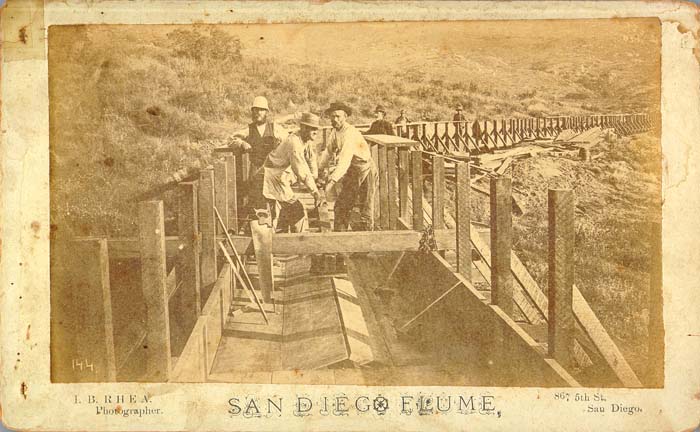
San Diego had to build a wooden flume to bring in water from 35 miles away:
A positive buried in that misfortune?:
Unlike Los Angeles, which had recklessly alienated its public lands, San Diego still possessed forty thousand acres of developable “pueblo land,” fourteen hundred acres of which had been providentially set aside for a great municipal park. With proper planning and good advertising, San Diego might yet become a bigger version of Pasadena, the celebrated town in the Los Angeles foothills that was a winter home for dozens of Midwestern millionaires.
In this boom and bust era was the rise of the Stingeree:
Just when the name Stingaree was first used to describe San Diego’s tenderloin district is unknown. From early newspaper accounts, it is learned there were some buildings on lower Fifth known as Stingaree Row or Stingaree Block. By 1881, however, they had fallen in disrepair and were causing considerable comment. In November of that year the Union reported that Stingaree Row was receiving an application of paint, soap and water; but in 1882 a citizen wrote to the editor complaining that the Stingaree Block was an eyesore to the community and a nuisance of flagrant character. Finally, in 1884, the old Stingaree Block was moved to a lot “near the court house.” It is possible that the name of this disreputable old building was later used to describe the entire area. In any event, the flats along San Diego’s waterfront were infested with Stingarees, a venomous fish with a whiplike tail capable of inflicting severe injury. Obviously those who patronized the Stingaree were likely to “get stung.”
In this era came Wyatt Earp:
Among the gamblers who came to town during the Boom was Wyatt Earp, former lawman and refugee from the gunfight at the O.K. Corral. Earp, while in San Diego, ran three gambling halls, one on Fourth across from the Plaza, and the others near Sixth and E, all in the “respectable” part of town. As a sideline, he acted as a referee for boxing matches. He was listed in the 1888 City Directory as a “Capitalist.”
The Stingaree, described in 1887 by a reporter from the San Diego Union:
Strolling down Fifth in the evening, the ear is rasped by notes from asthmatic pianos, discordant fiddles and drunken voices boisterously singing ribald songs. Noses are offended by garlic, swill and fried meat coming from some chophouse. The eye is pained to see men lying drunk on every corner . . . . it is fully as bad as the Barbary Coast in San Francisco.
No “decent” woman would be seen in that part of town, even in the daytime. The identifiable ladies of the night seldom went beyond the “deadline,” Market Street, except in carriages hired by the Madam to transport her girls, all gussied up and looking very proper, around town to pass out their calling cards, much to the disgust of housewives who peered curiously through lace curtains at their fallen sisters.
On the west side of Fifth. between Island and J, in the middle of the block, was Pete Cassidy’s place, a two story brick building. Behind Cassidy’s, and running through to Fourth behind the Turf, was another compound of cribs, or stables. In the parlance of the Redlight District. stables or bullpens described rows of cribs facing on a courtyard, rather than having entrance from a street. In this compound were at least fifty rooms. Each girl paid $14 a week, plus a percentage of the take, for the privilege of doing business, and often a fee to the procurer who usually was the bouncer or “protector” of the compound.
Over the door of each crib was the name of the occupant, such as Rosie or Dolly. Often a good luck charm, such as a horseshoe tied with a faded ribbon, hung over the door. Inside the rooms on the walls could be seen plaster of Paris angels and cherubs, and often a copy of the Lord’s Prayer. ..
Some of the better brick structures on Fifth housed the “all purpose” girls, those who were employed uptown during the day in dress shops. restaurants and offices, and then “moonlighted” on Saturday night.
The regular inmates of the Stingaree seldom left the district, and so messengers were used to deliver clothing and other necessities from the stores which were out of bounds for the girls. Messenger boys also were kept busy supplying food and liquor to the girls in the compounds. One of the residents, known as Dutch Annie, was an alcoholic, and every morning without fail a messenger was summoned to bring her a bottle.
All that from this excellent 1974 piece by Elizabeth MacPhail in the Journal of San Diego History.
In the Stingaree in 1912 the most exciting event in pre-World War 2 San Diego took place, the Free Speech fight. IWW workers, Wobblies, and other outsider political speakers would give soap box speeches and agitate:
The square block at the corner of Fifth and E Streets was home to more than just debauchery, as it also was the central location for a variety of “soapbox orators” including the Salvation Army, Socialists, Holy Rollers, and the Single Taxers.
Davis/Mayhew/Miller find an interview that gives some context for this movement:
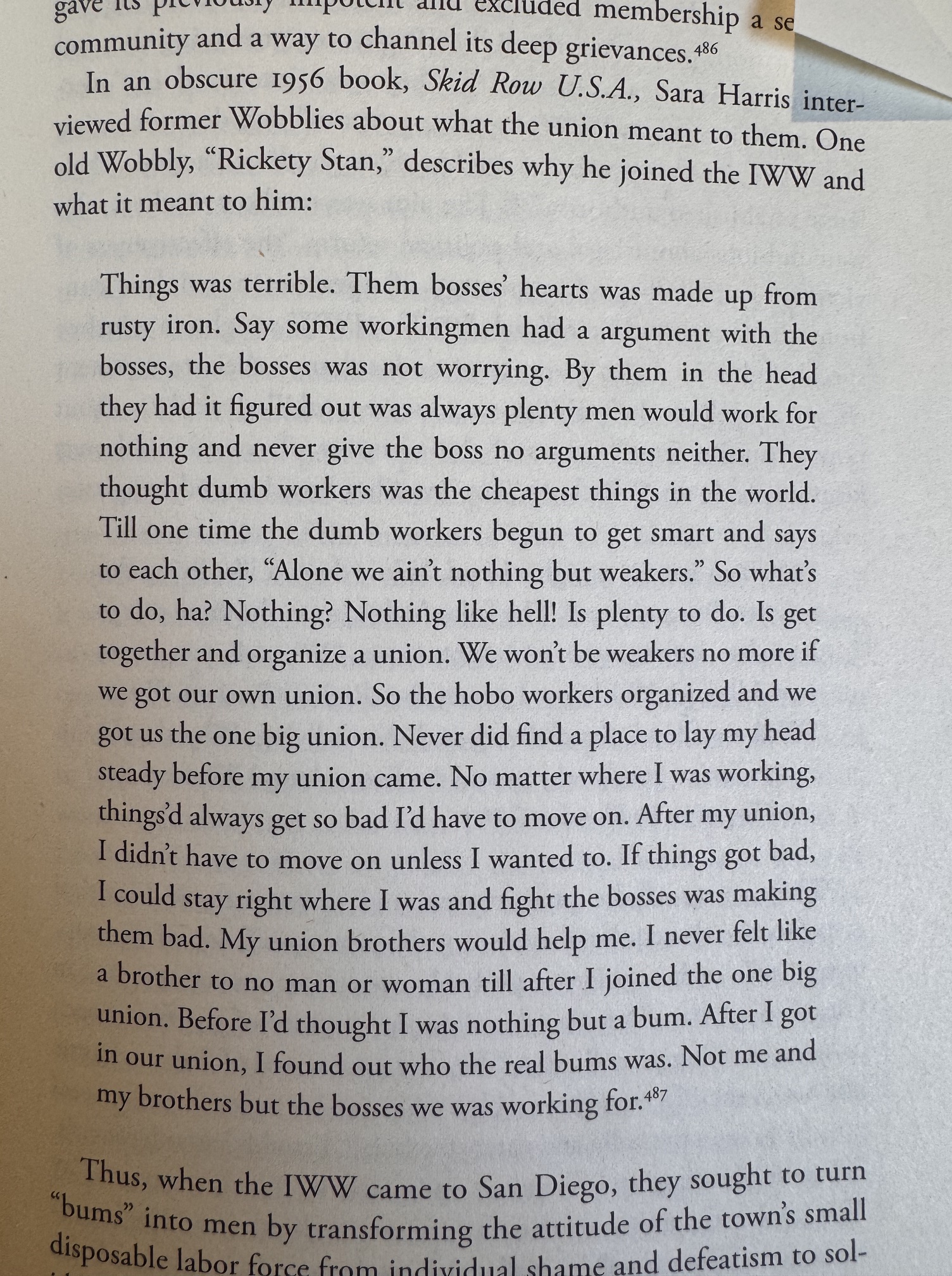
Empowering bums was not popular with the vested interested in the city. The San Diego Common Council passed a ban on soapbox speaking. An ongoing fight over the right to speech broke out. It came to climax in May 1912 when the socialists Emma Goldman and Ben Reitman came to town to speak. It didn’t go great:
Reitman was abducted by vigilantes from his hotel room and tortured. He later recalled,
They tore my clothes off. They knocked me down, and when I lay naked on the ground, they kicked and beat me until I was almost insensible. With a lighted cigar they burned the letters I.W.W. on my buttocks; then they poured a can of tar over my head and, in the absence of feathers, rubbed sage-brush on my body. One of them attempted to push a cane into my rectum. Another twisted my testicles. They forced me to kiss the flag and sing The Star-Spangled Banner. When they tired of the fun, they gave me my underwear for fear we should meet any women. They also gave me back my vest, in order that I might carry my money, railroad ticket, and watch. The rest of my clothes they kept. I was ordered to make a speech, and then they commanded me to run the gauntlet. The Vigilantes lined up, and as I ran past them, each one gave me a blow or a kick. Then they let me go.
In the aftermath, the Stingaree was cleaned up. Prostitutes were rounded up and put on trains, many buildings were razed. The neighborhood kinda languished, with some porno shops for sailors and stuff, until the 1970s, when it was reinvented as The Gaslamp District. This is kind of ersatz historic district, though there are some legit old buildings.
In the WW1 period, the Navy put a significant footprint on San Diego:
After the creation of a full-fledged Pacific battle fleet in 1919, San Diego soon won destroyers (based at Thirty-Second Street in National City) and a submarine base (at Ballast Point), transferred from San Pedro. If the biggest plums, the new battleships and heavy cruisers, went to Pearl Harbor, San Francisco, and Bremerton, it was a blessing in disguise. San Diego’s compensation was an unusual concentration of the navy’s infant, cutting-edge technologies: long-distance radio transmission, carrier aviation, and, later, undersea and amphibious warfare. This was San Diego’s future high-tech economy in embryo.
Moreover, as the bay was gradually deepened, San Diego was able to grab some cruisers and, far more important, the first generation of aircraft carriers, led by the Langley in 1922 and the Saratoga in 1932.
(The sediment dredged for the carriers was used, in turn, to create Lindbergh Field in 1929) In part, this was San Diego’s just reward for its political support of Admiral William Moffett and other leading advocates of naval aviation.
This continued through WW2, as we’ve seen, and then after:
in the mid-1950s the holy grail sought by Wilson and other boosters was homeporting the navys new supercarriers. Without costly dredging of the harbor channel and the construction of new wharf facilities, however, San Diego could not accommodate the huge ships, the most deadly weapons platforms ever constructed. Long Beach, on the other hand, had ample port facilities and was eager to see San Diego demoted to a mere destroyer base. To make matters worse, the navy, which considered all of Kearny Mesa’s airspace as the exclusive preserve of its Miramar-based jets, was angry at a city plan to develop nearby Montgomery Field as a replacement for overcrowded and dangerously situated Lindbergh Field downtown. In the end it was left to the Union to panic voters with the apocalyptic headline, “Navy Says San Diego May Lose Carrier Fleet in Airport Dispute.” Duly intimi dated, the city council scrapped its airport scheme, and, with the help of Vice President Richard Nixon, Congress approved funding in 1958 for a new supercarrier wharf on North Island.’Two years later, San Diego repaid Nixon’s favor by providing him with the margin of votes to narrowly carry California in the 1960 presidential election.
The best book I’ve ever found about San Diego is Max Miller’s I Cover The Waterfront, from 1932, reviewed here. The waterfront in Miller’s time was on a different scale from the aircraft carrier and tourist shop waterfront of today. Says Wikipedia:
The San Diego tuna fleet reached a peak of 160 vessels, and in 1962 employed around forty thousand San Diegans
Incredible. It seems the tuna fleet declined due to foreign competition, Mexican restrictions, and the Marine Mammal Protection Act. Claude estimates the number of people working in commercial fishing in San Diego today to be in the low hundreds. Bumblebee is still headquartered in San Diego.

Don’t worry, there’s darkness below the surface there too.
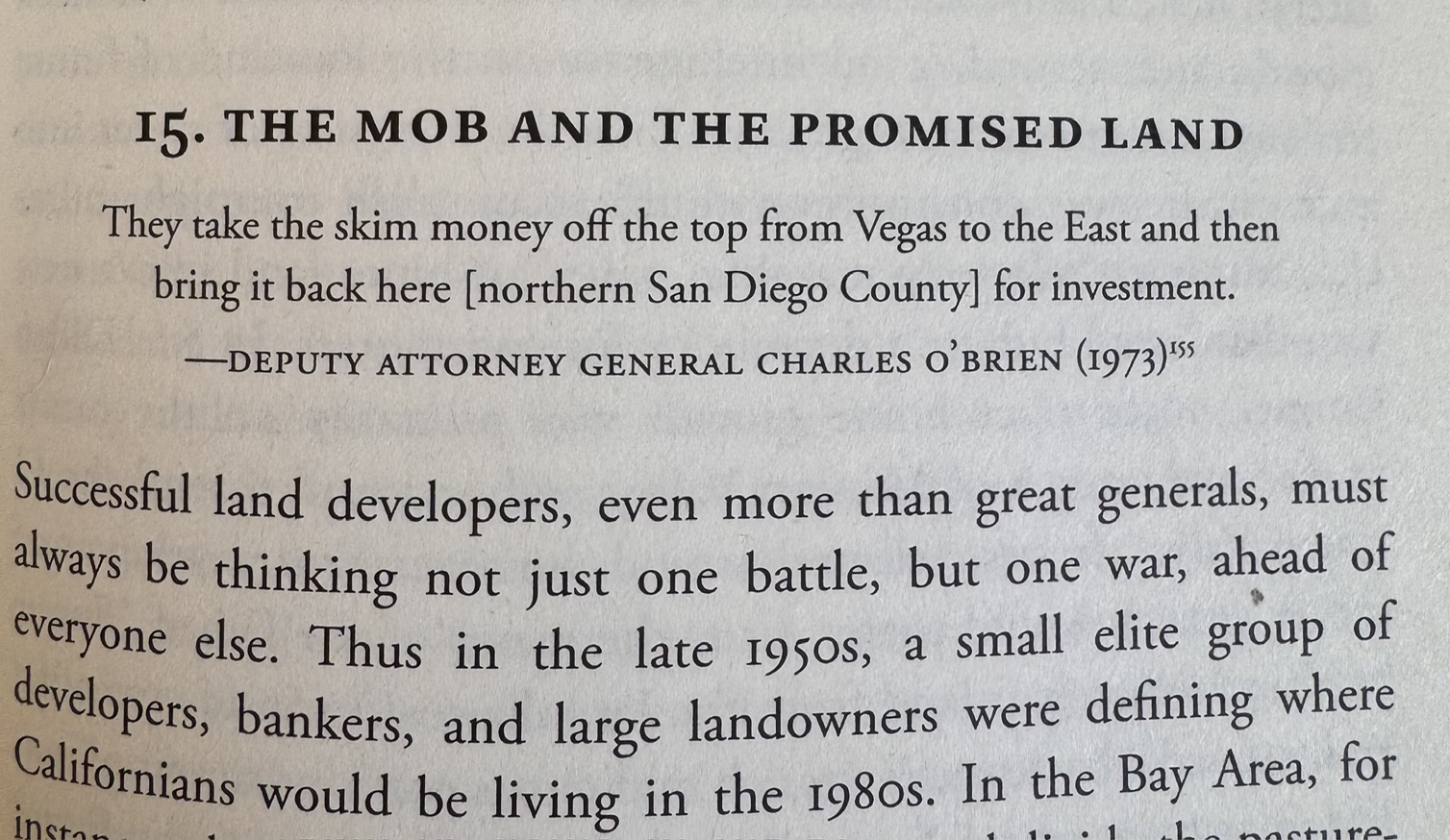
Mike Davis is great on the various power brokers of postwar San Diego: pavement kings who controlled construction, developers and political dealmakers. Your tolerance for local corruption and spiderwebs of dealmaking may vary; any time new developments are happening there are alliances in politics, regulations boxing people out, the people with the connections to lift the delays and move the shovels. Consider Irvin Kahn:
In 1962, Kahn acquired the approximately 14,000 acre Rancho Peñasquitos with financing from Sixty Trust, the employee pension fund of airplane manufacturer Textron, Inc. (Rancho Peñasquitos was one of only a handful of large ranches still operating within the city limits.) Kahn planned to develop the land into a massive $1 billion housing development with a golf course, apartments, single-family tract homes, retirement housing, and shopping centers. Kahn’s broad vision set in motion a series of additional planning processes that created lengthy delays for the project, with the San Diego City Planning Commission voting to delay consideration of Kahn’s subdivision plan for several years until a master plan could be developed for the area. By 1965 the project was in danger of foreclosure and required additional financing. Kahn recruited Louis Lessor’s help in obtaining financing from the Teamsters Pension Fund through Lessor’s relationship with Morris Shenker, who was the gatekeeper for the Pension Fund’s investments. Shenker arrange a $10M mortgage from the Mercantile Trust Company National Association and an additional $3.5M in financing from the Teamsters Pension Fund. In exchange, the Teamsters Pension Fund received a first deed of trust on Rancho Peñasquitos, and a 20% share in the Rancho Peñasquitos development corporation.
Or, to put it more bluntly:
Davis is great on San Diego’s mayor turned California governor, Pete Wilson:
The structural reform, however, that most concerned Wilson was redressing the imbalance of power between the mayor and the city manager. San Diego’s weak mayor-strong council/city manager system did not fit with either Wilson’s personality or his ambitions.
The city charter devoted two full pages to the city manager’s powers but a mere paragraph to the mayor’s. Wilson frequently contrasted the enfeebled status of the mayor with the line authority exercised by county supervisors or, even more tellingly, the sweeping powers of Port Director Don Nay, who was the landlord of Lindbergh Field and all of San Diego’s tideland industries.
When a frontal assault—an unsuccessful 1973 charter reform ini-tiative— failed to provide Wilson with enhanced power, he resorted to stealth He succeeded in forcing the council to accept a new committee system whose proceedings were controlled by a rules committee of which the mayor was chair. No agenda item, as a result, could come before the council without Wilson’s approval. … Finally, he created a fundraising network that allowed him to dominate San Diego’s system (established in 193L) of citywide council runoffs. Council candidates were pared to two finalists by district primaries, but success in the runoff depended upon one’s resources to mount citywide television ad campaigns. Wilson controlled the crucial purse strings.
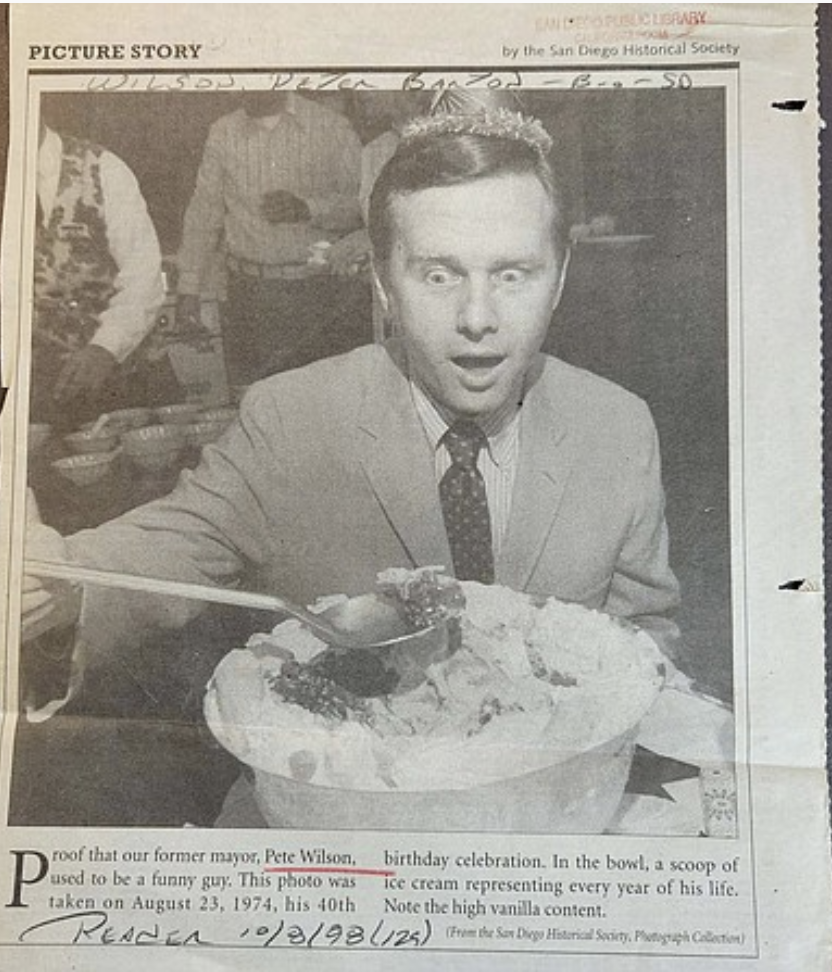
Source – this San Diego Reader piece by Thomas Larson on Wilson, which mostly focuses on Pete as governor, and Prop 187, the anti-immigrant measure that won big at the ballot box, got tied up in the courts, and probably wiped out the Republican Party in California.
The first time I ever visited San Diego I arrived by plane, and I was struck that the airport seemed to be right in the middle of the city. Indeed, the Guinness Book of World Records declares San Diego to have the “most centrally located urban airport.” On subsequent visits I try to arrive by train, to the Santa Fe depot. The rail line runs right by the beach in north San Diego County. There are plans to move it inland, and into a tunnel, which would be less fun. Someday it will fall into the ocean.
That’s a reasonable roundup on the history of San Diego, at least for the weekend tourist. Max Miller’s waterfront and the former Stingaree will host 100,000 Comic-Con visitors this weekend. Let’s give the last word to Doug Porter:
San Diego is one of the most ethnically diverse cities in the United States. It also has one of the largest gaps between the rich and poor in California, a growing unhoused population, and juxtaposes a carefree postcard reality with a massive military industrial complex and a heavily fortified international border. San Diego County goes from the desert to the sea, contains mountains, wild spaces, and the sprawling suburbs which threaten them. In many ways, it is a region on the cutting edge of the Pacific Rim.
here’s a collection of photos of San Diego diners in 1947:
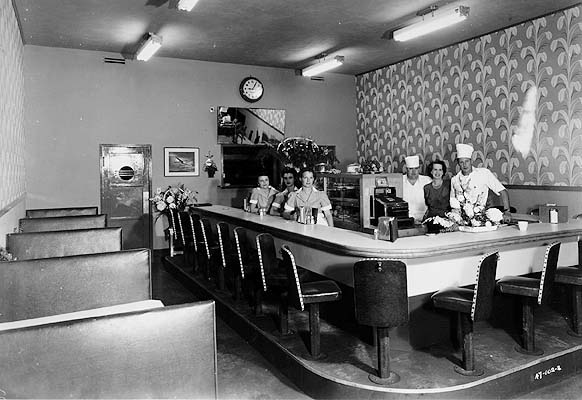
Bet the coffee here hit.
Our Common Side Effects panel will be at San Diego Comic Con this Friday, July 24, 12 p.m. in the Indigo Ballroom.
Common Side Effects Season 2 in Production, Indigo Ballroom. Adult Swim’s award-winning series Common Side Effects goes behind the scenes as co-creators Joe Bennett and Steve Hely give an in-depth look at season 2, currently in production. This panel explores how the new season is being built, from evolving storylines and character arcs to animation, tone, and the creative challenges of expanding the world after season 1. The conversation includes candid discussion, work-in-progress insights, and a rare glimpse into how Common Side Effects enters its next chapter.

