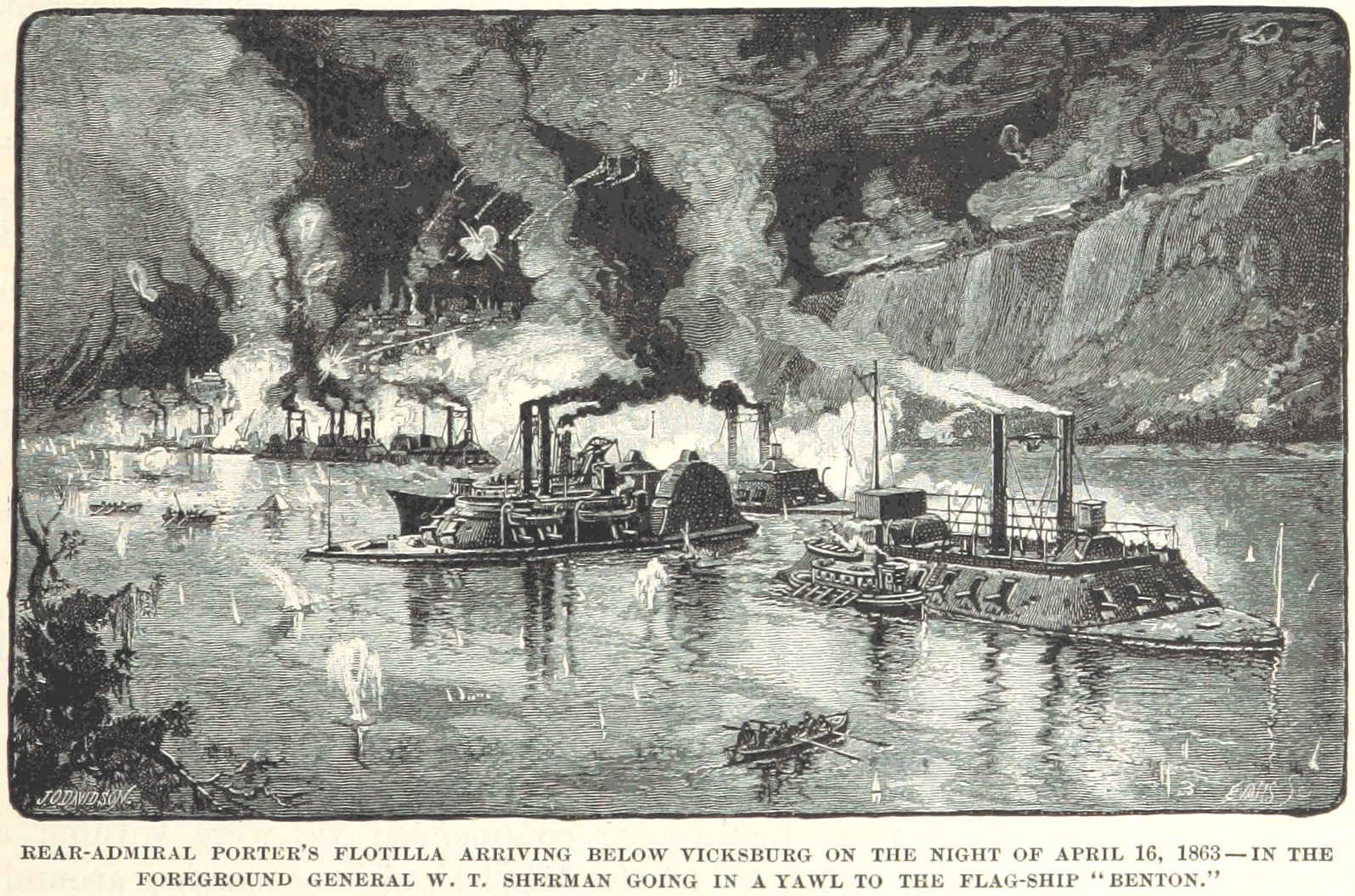
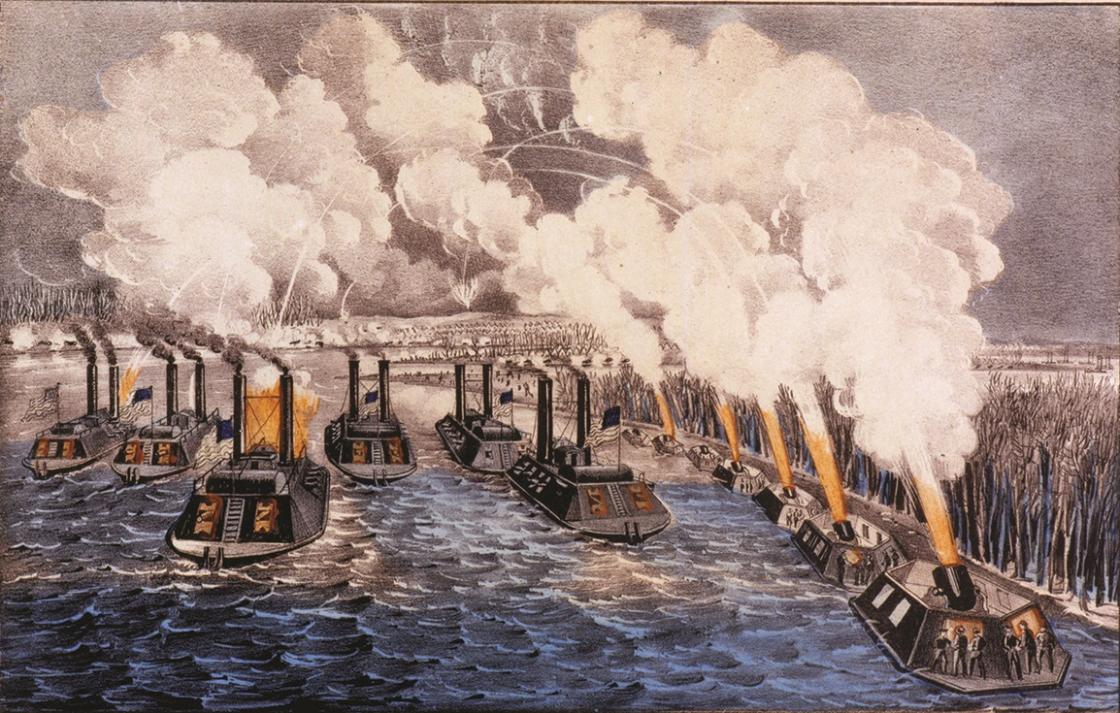
Can you imagine seeing this in color? Fire in the darkness reflecting on the flowing water? The sounds?
Ulysses Grant, who heard the screams of the wounded at Shiloh, Cold Harbor, the Wilderness, a hundred other battlefields, uses the word “sickening” only twice in his Personal Memoirs: once to describe a bullfight he saw in Mexico, and once to describe “the sight of the mangled and dying men which met my eye as I boarded” the USS Benton, a steamship, after a battle on the Mississippi River off Grand Gulf, Louisiana.
It’s incredible. The amazing things about naval engagements are the accounts of men firing eight-inch guns at each other from a range of eight-feet. I’m afraid that is beyond my understanding. But they did it all the time in naval battles. It was a very strange business.
Naval History: Many regimental histories were written for Army units in the Civil War. Why was that apparently not the case for the Navy?
Foote: I really don’t know. No big Navy man even wrote his memoirs, did he? Guns on the Western Waters was one of my main sources. And I use the naval Official Records. But I have found a shortage of naval material.
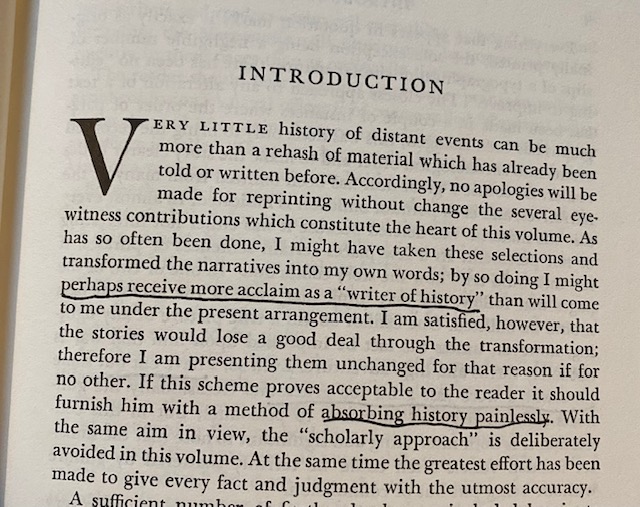
I got so much value out of this book, which I bought used via Amazon. Gosnell was a Lt. Commander in the Navy Reserve. I can find little else about him except possibly this letter?:
Anyway his book is terrific. Here’s how it begins:
The book is indeed mostly firsthand accounts of the river battles along the Mississippi during the War of the Rebellion (fka Civil War).
It’s arguable that all the drama with Lee in Virginia was just a sideshow/violent pageant, that the real war was won and the rebellion ended when the Union seized the Mississippi from New Orleans to Illinois, slicing the Confederacy in half. This was finished by July 4, 1863. When it was done the guy who did it, Grant, was brought east to mop up the operations there.
The best section of Guns On the Western Waters is David Dixon Porter’s story of an expedition along the Yazoo River backwaters, and what he encountered there. Next best is Junius Henri Browne’s tale of a night in a boat passing under the guns of Vicksburg, from his Four Years in Secessia. Gosnell says he’s sometimes edited accounts to make them less graphic, but guys are still trampling around in their shipmate’s brains. These battles were infernal, boilers would explode scalding people, if they didn’t write their memoirs maybe it’s because it was too intense to think about, plus half of them were dead.
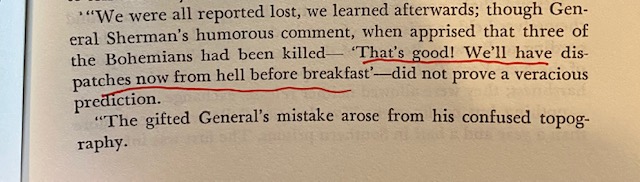
When Grant heard that Junius Henri Browne and his fellow “Bohemians” (a gang of war correspondents who don’t seem super likable) were lost this is what he said:
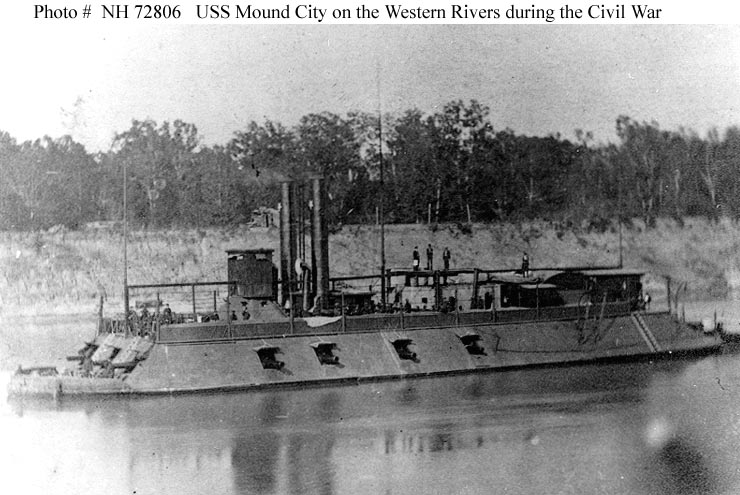
An unsung hero of this era is James Buchanan Eads
who was contracted to construct the City Class ironclads for the war on the Mississippi, and built seven in five months.
The Union was just superior to the Confederacy in building, technology, mechanizing. Arguably Confederate Navy Secretary Stephen Mallory did the best he could with a challenging situation, and for that he has a nice square named after himself at Key West. But throughout the war we just find a more effective machine destroying a feebler competitor.
Eads has a bridge named after him near St. Louis. I said unsung earlier but I guess he’s reasonably sung. And how about his wife, Martha Dillon Eads?:
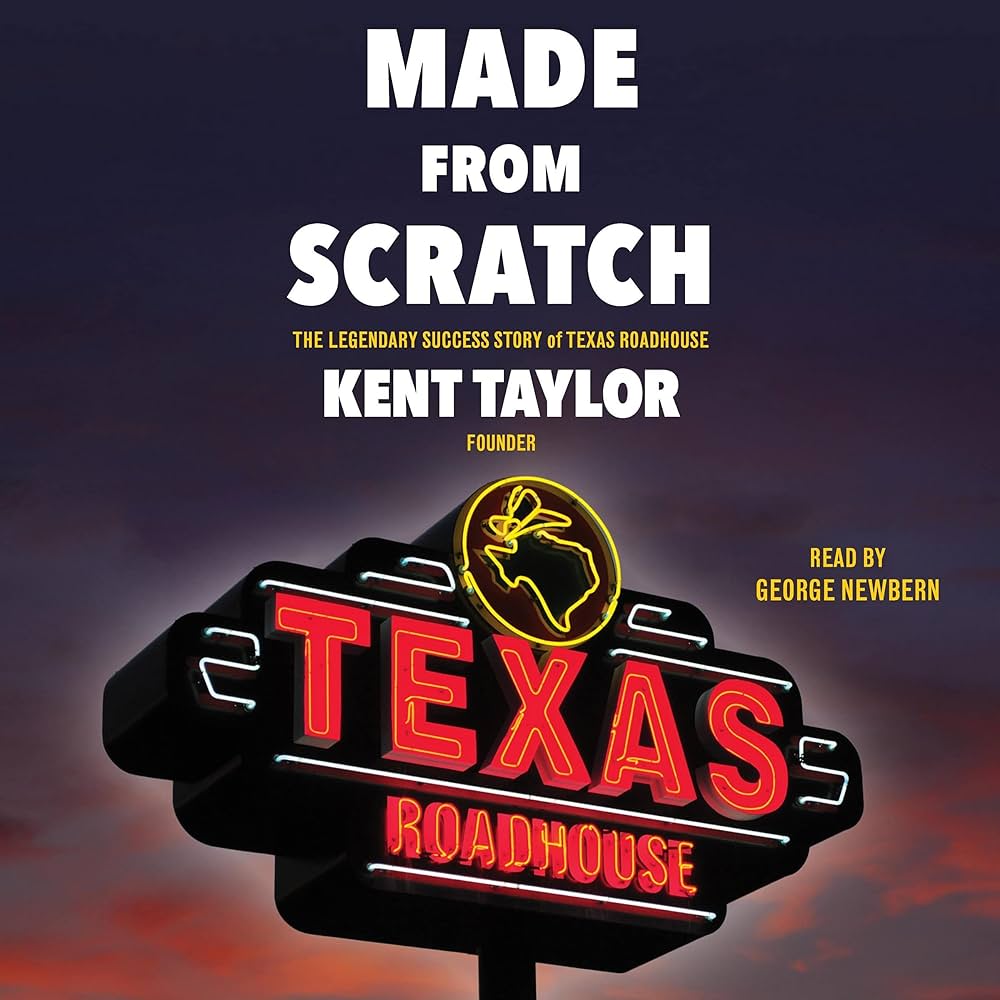
You’ve probably seen a Sysco truck around, they’re a massive wholesale food distribution company. They’re mentioned a few times in Kent Taylor’s book, so I looked into the company. Here’s their CEO:
Kent Taylor was a spectator at the 1971 NCAA cross-country championships:
I will never forget [Steve] Prefontaine powering through that tough hilly course, challenging anyone to catch him as he picked up the pace on each rise, daring all comers to endure pain only he was capable of enduring. Steve won the race, no problem, and wore about him afterward an aura of extreme confidence that captivated me. Still, to this day, I can remember that look, as if he wanted his challengers to bring on whatever they had, and he’d find a way to bring that much more.
Kent Taylor was a skinny kid who was kicked off the football team by a coach who told him he might die out there. He went into track and cross country and drove himself to become better. One summer he trained by running over a thousand miles. He got good enough that with some persistence and luck he got a partial scholarship to UNC. There he ran the steeplechase, obstacle running complete with a water hazard.
Kent Taylor had drive. After college he moved back to Louisville, managed some nightclubs in Cincinnati, managed a Bennigan’s in Dallas for a bit, worked for KFC. What he wanted to do was launch his own concept for a restaurant: Texas Roadhouse.
My initial thought regarding Texas Roadhouse was to combine a rough and somewhat rowdy live music joint with a reasonably priced restaurant featuring steaks and ribs. I wanted to have the same quality of beef that Outback and Longhorn featured at the time, but with price points more similar to Chili’s and Applebee’s. I wanted to target the blue-collar segment of America (my peeps) who would be comfortable with jukebox country music and a casual and lively atmosphere with energetic servers in jeans and T-shirts. In short: Baby, if you want to dress up, then visit somewhere else; but if you want to dress down, we would welcome you with open arms and a warm smile.
Two of his first investors were Dr. Amar Desai and Dr. Mahendra Patel. The concept sparked but there were bumps. Kent opened the second restaurant in Gainesville, Florida 700 miles away from the first one because he had good memories of Gainesville. Three of the first five restaurants failed. But Kent Taylor and the Roadhouse team started to figure it out:
Another idea was to offer free rolls. We played around with giving out popcorn, something for people to munch on immediately, but realized we wanted the smell of rolls to hit our guests when they walked in. If we were going to offer them, though, I wanted to get the recipe perfect. I set my assistant kitchen manager, Rod, to driving all over town to buy as many types of flour and yeast as he could find. We then experimented. Rod and I would try this type of flour with this type of yeast, adding so much water, so much oil, and a dash of sugar and a few other ingredients for good measure. Then we tried again. We also experimented with dozens of variations to proof and bake the rolls. Nothing tasted right. I wanted a fairly sweet roll, but sugar and yeast fight each other, so I needed a flour that would work with both. The process of discovering the best Roadhouse rolls consumed our waking days for three weeks. I’m pretty sure it also consumed Rod’s sleep. He probably dropped off at night counting bags of flour. I was tormenting the poor guy with my relentless pursuit of the perfect roll. Finally, we hit it when we mixed a certain flour with another flour. The mix came together in no time and we created the rolls we use to this day. Our honey cinnamon butter followed a similar process, eventually finding positive results.
Kent had a vision for restaurants that was something like Wagner’s for opera*. He wanted immersive, overpowering. The word Legendary, that’s key. Legendary food, legendary service, legendary margaritas. Texas Roadhouse is full of wood and tin: Kent wanted it loud. Big neon signs on the places are the only advertising. Texas Roadhouses don’t open for lunch** because Kent Taylor envisioned one big, energized shift, almost a performance
We had the chargrills visible to the guests, a meat display case to view our freshly butchered steaks, and you could smell the steaks cooking and the freshly baked bread coming out of the oven. The six senses would come alive for our guests—sight, smell, taste, hearing, and touch. The sixth sense was a feeling of a warm and friendly vibe.
It worked. There are 741 Texas Roadhouse restaurants in 49 countries. The nearest one to LA would be either Rialto or Corona, CA. This makes sense: LA real estate is expensive and Texas Roadhouse knows to their customer every dollar matters. Being involved in the community is part of the business model and the Kent Taylor vision.
On a recent trip down the 10, we stopped at the Rialto location. It was just after opening time (3pm) and there was already a 20 minute wait. It was all there, just as Kent described. Friendly people, country music, wood and tin. The sweet rolls with the cinnamon honey butter are brought to your table as you sit down. Bag of peanuts waiting for you. No server has more than three stations so they’re on top of it. We signed up for the Texas Roadhouse VIP Club beforehand, which merits you a free appetizer: we got rattlesnake bites of course, delicious. Part of the popularity might be the $13.99 Early Dine Menu. You’re getting a steak dinner for under $14. Tried the Legendary Margarita, and it was a lot of fun. By the time we left every seat at the bar was occupied. There were big families, elderly couples, hard-work looking dudes having some cold ones.
Kent Taylor in this book comes through as such a boosterish, positive person that it’s hard to grapple with his end. From The Wall Street Journal, March 2021:
After coming down with a mild case of Covid-19, W. Kent Taylor found himself tormented by tinnitus, a ringing in the ears. It persisted and grew so distracting that the founder and chief executive of the restaurant chain Texas Roadhouse Inc. had trouble reading or concentrating.
Mr. Taylor told one friend he hadn’t been able to sleep more than two hours a night for months.
In early March, he met friends at his home in Naples, Fla., and led them on a yacht cruise in the Bahamas. Some of those friends thought he was finally getting better. Then his tinnitus “came screaming back in his head” last week, said Steve Ortiz, a longtime friend and former colleague.
On Thursday, March 18, Mr. Taylor died by suicide in his hometown of Louisville, KY.
Very sad. But his vision lives on. I predict Texas Roadhouse will continue to succeed as long as they remember the lessons of founder Kent Taylor. He’d seen what happens when you lose that:
The decline of Bennigan’s was another wake-up call to keep our standards sky-high and not slip into corporate-think. Thankfully, our company is run by people who have grown up in actual restaurant operations and many were eyewitnesses to either Chi-Chi’s or Bennigan’s’ demise.
* not that Kent would use this comparison. He preferred: Willie Nelson, Three Doors Down, Keith Urban, Kenny Chesney, Aerosmith, etc. Mentioning who played at which corporate celebrations is a big part of the book
** some of them do open for lunch one day a week, usually Friday or Saturday
Not sure we’ve ever seen the kind of shade on a restaurant as Harriet Agnew provides in the latest Lunch w Financial Times, with Nelson Peltz, at his own restaurant:
It’s the proprietor’s prerogative — Peltz’s 19-year-old investment firm, Trian Partners, owns the building and the Italian restaurant is their de facto canteen. Soon the elevator-style music quietens down and we settle at our table on the outdoor terrace
Peltz declines wine – always a bad sign in Lunch FT:
As we begin our starters — slightly flavourless mozzarella and tomato in need of seasoning, with roasted peppers — Peltz tells the story of Triangle Industries, his focus in the 1980s. Fuelled by the junk bonds of his friend Michael Milken, he and his business partner Peter May built it into the largest packaging company in the world, before selling it. They later bought and lucratively sold the Snapple beverage business.
They talk about Peltz’s campaign to win a contested fight for some board seats at Disney (asked if he would fire Kevin Feige, who masterminded like 60 winning Marvel movies, he doesn’t say yes but expresses displeasure):
By now our main course has arrived: filleted snapper in a gloopy artichoke, mushroom, tomato and white wine sauce, served with sautéed spinach.
In terms of lunch, it doesn’t seem billionaires have it that much better. Here’s a link.
Bloomin Brands (ticker symbol: BLMN) owns Outback Steakhouse and Fleming’s. 50 new Outback Steakhouses opened in Brazil since 2021.
There are 3,427 Chipotles (CMG) in the United States, with 97,660 employees. Here’s Slate recently on Chipotle’s dominance:
But despite that backlash, the fact remains that for a lot of Americans, from San Diego to New Haven and everywhere in between, Chipotle has become effectively synonymous with good Mexican eating. When the Wall Street Journal interviewed Mary Hawkins, the mayor of Madison, Mississippi—one of the tiny population centers Chipotle has in its sights—she said the town had recently polled its citizenry about the brands it would most like to see take up residence on its streets. Chipotle, perhaps unsurprisingly, came in first, and Arellano does not see that trend slowing down.
“It’s like Galactus from Marvel Comics. It’s eating up burrito cultures from across the country,” he said. “Chipotle taught an entire generation of Americans to eat a very specific style of burrito. If they want a burrito, they’re going to want the one they grew up with and neglect the other styles.”
McDonald’s (MCD) of course is the king, with 42,000 stores. Here’s Ian Borden, McDonald’s CFO, being interviewed at a UBS conference:
Dennis Geiger
That’s great. Want to go over to core menu. And you just talked about some of the opportunities at chicken I think in particular. As we think about beef, chicken and coffee and some of the biggest opportunities to kind of further your advantages on core menu anything else to kind of highlight there across those key equities?
Ian Borden
Yes. Sure. Well look I talked about core is critically important. 65% of our global system-wide sales, $17 billion brands across that core categories and I think a few headlines under each of those three. Beef obviously we’re by far the largest player in beef globally. We’ve gained share since 2019 pretty consistently across our markets. I think a couple of the key things from an opportunity standpoint in beef. Best Burger which is just a series of what I’ll call small changes in how we cook and prepare our core beef products that’s been out to about 70 markets. It’s going to be in the rest of the system by end of 2026. It’s driving significant improvements in taste and quality. Taste and quality are the two biggest drivers of consumer visits to our restaurants. So that’s impactful.
The second thing on beef that I think is worth highlighting is the opportunity we see around large burger. And it’s a good example of how I think we are more precisely understanding consumer need and then getting after that consumer need and I’ll call it a one-way approach. So we’ve tried to get after this opportunity for a number of years because we thought the opportunity was about premium burger which was wrong. And we — so we didn’t — we weren’t successful. We now understand what the opportunity is for a large more satiating-type burger. That opportunity is significant. It’s consistent across many of our large markets.
And we have innovated a couple of products that we’re in the process of piloting. We’re going to pilot those products in two or three what we call market zeros. We’re then going to — if those products work we’re then going to scale one solution to that opportunity globally where in the past you would have seen us probably try and get after that opportunity in 20 different markets in 20 different ways and then you don’t have the ability to build a global equity that you can drive at scale. So that’s a little bit about beef.
McDonald’s is essentially a real estate company with a restaurant system they can affix and then turn over to franchisees.
The Darden Group (DRI) owns: Ruth’s Chris Steak House, Eddie V’s and The Capital Grille, Olive Garden Italian Restaurant, LongHorn Steakhouse, Bahama Breeze, Seasons 52, Yard House and Cheddar’s Scratch Kitchen. Until July 28, 2014, Darden also owned Red Lobster. Darden has more than 1,800 restaurant locations and more than 175,000 employees, making it the world’s largest full-service restaurant company. (says Wikipedia). There are 77 Ruth’s Chris and 562 Longhorn Steakhouses.
Brinker (EAT) has Chili’s and Maggiano’s Italian Grill. They’re having a killer year, surprising to me to learn, as the local Maggiano’s is closed and troughs of Italian slop don’t seem in fashion. But my heart still warms at the thought of Chili’s. Norman Brinker was a pioneer of the casual dining space.
Dine (DIN) owns IHOP (1,787 restaurants), Applebee’s (1,654) and Fuzzy’s Taco Shop (137 branches). The local IHOP near me is closing. A few years ago I tried an Applebee’s and was dissatisfied with the experience. I’ve never even seen a Fuzzy’s. As for pancakes, feels like they peaked as a food in like 1880?
Domino’s has 20,197 franchises. Their stock (DPZ) over the last twenty years returned investors something like 2,600% (vs 239% for the S&P 500). The key is the easy to use app.
Restaurant Brands International (QSR) has Burger King, Tim Horton’s, Popeyes, and Firehouse Subs, for a total fo 30,375 franchises. Noted investor and Harvard administration gadfly Bill Ackman has a big position in QSR, as well as Chipotle. In his recent Lex Friedman podcast he noted that some of his biggest wins have been in restaurants.
Shake Shack (SHAK) has expanded very fast, they now have 440 stores. I remember going to the very first branch in the summer of 2009, before starting my new job on 30 Rock. Who was in line behind me but Scott Adsit?!
Texas Roadhouse (TXRH) is booming, returning 738% for investors since founding. The story of founder W. Kent Taylor is worthy of its own post, when I have the time. I listened to a couple podcasts, one with Jerry Morgan, current CEO and one with VP of communications Travis Doster, and they project a “fun with purpose” coherent and vigorous company culture inspired by Kent Taylor’s vision.
Starbucks (SBUX) has 10,628 company owned stores and 18,216 licensed. Personally I consider that a drug dispensary rather than a restaurant.
Wendy’s (WEN) has 7,095 restaurants worldwide. Their new CEO Kirk Tanner made some noise recently with his comments about AI order-taking and flexible pricing, which the company then walked back. It sounded kinda fun to me (what if you could get a deal at an off hour or something) and made for many a meme. Kirk Tanner seems to get in the news a lot: Wendy’s doing drone delivery was a headline on Drudge the other day. Those all seem like distractions or possibly stunts? Wendy’s big play at the moment is expanding into breakfast.
Wingstop (WING) is growing fast: 1,996 restaurants. The stock has doubled in the last year. The people love wings!
Yum Brands (YUM) with KFC, Pizza Hut, Taco Bell, and Habit Burger is on another level. They opened 4,754 new units last year.
Jack in the Box (JACK) swallowed Del Taco a few years ago. Here’s CEO Darin Harris speaking about the culture of servant leadership. I like what I hear!
New York hot dog chain Nathan’s and Chicago hot dog chain Portillo’s are both public companies, NATH and PTLO respectively. I’m not bullish on the future of hot dogs myself. If I were on the board of Nathan’s (I’m not) I’d lean into the hot dog eating contest aspect. That could be completely the wrong way to go, who knows, but they’ve got to take a swing.
I’ve never seen a Kura Sushi, but some investors appear to be optimistic about the technology-enabled Japanese sushi concept – the stock (KRUS) is up 41% this year.
Casey’s (CASY) runs some 2,500 gas station pizza joints in the Midwest. The Casey’s in Corning, Iowa was the only place to eat one Sunday night last summer. It was not bad at all! Iowan amigo Brooks tells me it’s beloved, that you should try the sausage pizza. Not much more is easily available to me on founder Donald Lamberti other than that he is in the National Sprint Car Hall of Fame. “Kind of a monopoly on many, many tiny markets”? A growing business.
Flanigan’s (BDL) is a Florida chain famed for their dolphin sandwich (don’t stress, it’s actually mahi mahi). Why it’s publicly traded doesn’t make sense to me, but there you go. I’ve never been, I collected a firsthand report or two that suggested it’s a real good time, if not necessarily Wall Street’s most ambitious concern.
Some amateur investor types love RCI, aka Rick’s (RICK), a chain of strip clubs, on the thesis that it’s kind of hard to launch a new strip club, as nobody wants ’em in their neighborhood. I’m not sure Bombshells counts as restaurants, but a publicy traded strip club joint with an expressive CEO is a noteworthy indicator.
Anyone been to a Chuy’s (CHUY)?
On May 31, 2001, then President George W. Bush’s twin daughters, Jenna Bush and Barbara Bush, were cited for using fake IDs at the Barton Springs Road Chuy’s, which put Chuy’s in the national spotlight
Next time in Austin maybe. What’s the gameplan for Chuy’s? From their recent earnings call:
As we look ahead, we will continue to do what we do best to provide our guests with fresh, made from scratch food and drinks at an incredible value. Despite weather issues across the country that has impacted the restaurant industry in January, we believe the initiatives we put in place to drive long-term sustainable top line growth and profitability has positioned us well to weather these near-term challenges.
With that, let me provide some update on our growth drivers. Starting with menu innovation. As we mentioned on our last call, we introduced our first barbell approach to the CKO platform during the fourth quarter, and we were very pleased with how well it was received by our guests. In fact, this was our second most successful Chuy’s Knockouts campaign to-date.
Following this success, we were thrilled to introduce to our guests the next CKO iteration in late January with Shrimp & Crab Enchiladas with Lobster Bisque sauce as a higher-priced CKO menu item, along with Macho Nachos and the Cheesy Pig Burrito. Again, early feedback continues to be positive as our CKOs are resonating well with both new and returning guests.
Alongside our exciting CKO offering, we recently added several new menu items to our permanent menu, including reintroducing the Appetizer Plate and adding the Burrito Bowls. If you recall, Burrito Bowls were part of our CKO platform during the second and third quarter of 2023 and this menu
etc etc. Good luck Chuy’s!
And of course, Cheesecake Factory (CAKE), much mocked, but enduring. Ate there the other day with some colleagues. You know what? My Santa Fe Salad was good. What do we think of this?:
Much lunch conversation turned on this.
CAVA is a new Mediterranean restaurant concept from the East Coast. A new one appeared here in LA. I tried it. Their operating system was not perfect (in fairness, think this is a new branch). Kinda salty?
The stock seems to excite investors, possibly because everyone is looking for “the next Chipotle.” Appears to be up 5% just today! I checked in with one of my Vibes Reporters:
i have had cava once. ok but didnt feel the need to go back
Kinda how I felt? The pita chips are fun. I just don’t think Mediterranean food will have quite the appeal of Chipotle.
Sweetgreen (SG) is a salad deal, I’ve tried that one. Somehow, I always feel gross afterwards.
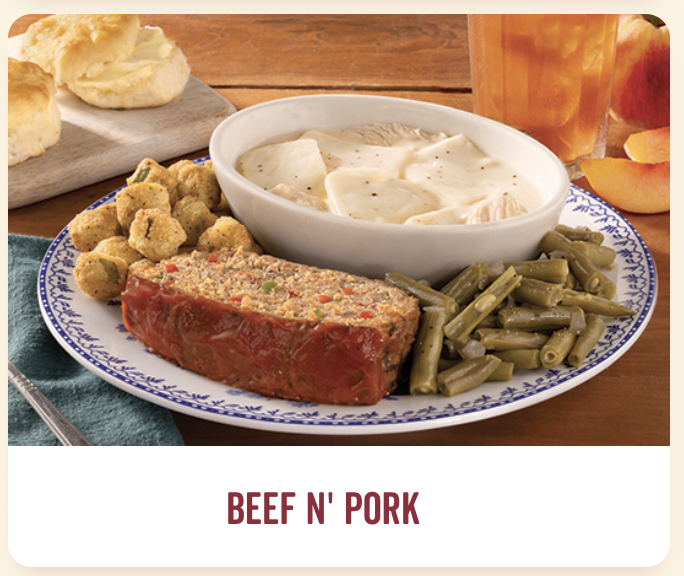
On the other end of the spectrum is Cracker Barrel (CBRL) serving Southern-inspired slop to old people. Valueline reports:
Macroeconomic factors have impacted Cracker Barrel Old Country Store’s sales. Elevated inflation, though now apparently easing, has stressed the company’s customers. Many of these customers are in the 65-and-older demographic, commonly characterized as a fixed-income category. Management is working to bring in more of a younger crowd into Cracker Barrel restaurants and in-location retail shops,
Good luck guys, but this looks to me like the past, not the future:
Then again, Cracker Barrel has (had?) their loyalists:
From 1977 to 2017, married couple Ray and Wilma Yoder drove a combined total of more than 5 million miles (an average of 342 miles per day) to visit 644 Cracker Barrel locations. When the company opened their 645th restaurant, in Tualatin, Oregon, in August 2017 (on Ray Yoder’s 81st birthday), it flew the Yoders out for the grand opening and presented them with custom aprons and rocking chairs, among other gifts.[52][53]
Yoshiharu (YOSH) is a Southern California ramen concept I have yet to try. There’s also Noodles & Company (NDLS). Why is their ticker symbol not NOOD? Missed opportunity. The noodles game seems too competitive to me, talk about low margins.
But then again look at the big winners here: MCD, DPZ, CMG. Burgers, pizza, burritos. You couldn’t come up with businesses with more competition, no barriers to entry. And yet these three systematized delivery and managed quality control in such a way as to create unstoppable empires.
I began this post as I was reading Value Line’s restaurant issue and enjoying contemplating the massive scale of these restaurant chains. As an occasional restaurant consumer I can engage with these places and sense their vibe, it’s a sector I can know in a way I can’t know, say, semiconductors or industrial products. So it’s an engaging, practical and delicious topic for our continued education in business.
So restaurants are different from retail because it’s not as easy to scale. There aren’t a bunch of large cap restaurant chains unlike retail. The franchise model is pretty powerful and what Chipotle has done is pretty powerful, too. But the similarities are like real estate matters, the store experience matters. But in a tight labor market, it’s tough.
And what’s interesting about McDonald’s — I have such an affection for that company. It works everywhere. They have one concept. I think it’s 60% or 70% of their operating income is from rent. They’re a landlord. They control the real estate. The others didn’t, so that’s why they’ve endured. They had a big insight about like let’s own the real estates so our franchisees don’t get whipped around with pricing, and we can co-invest with them in the experience.
And now digitals. The mobile ordering is enhancing the productivity and reducing even those kiosks. That need for labor and in a tight labor market, it’s big. The little guys can’t invest. They have some external dynamics now that are contributing to scale. But it’s really interesting.
Rory Sutherland brought up McDonald’s automated screens on Rick Rubin’s Tetragrammaton podcast. He wondered if they might allow for customers to make certain shameful orders they feel bad about saying to a person. I’ve tried out the automated screens, they work great at getting you your junk, but they make the world a little less human.
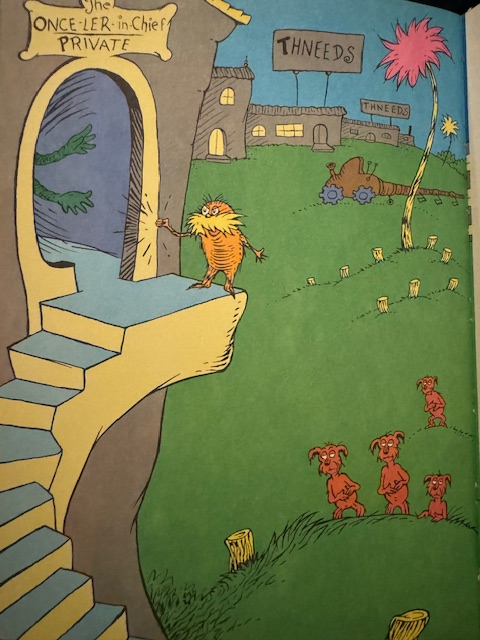
Remember when Eric Schlosser’s book Fast Food Nation came out in 2001? Absolutely everybody was reading it. They made a movie (pretty good! Richard Linklater). Yet here we are, almost twenty five years later, eating more fast food than ever.
I was reading The Lorax to baby and it reminded me of Schlosser.
Here’s a more comprehensive list of restaurant stocks as I’ve skipped a few, notably Denny’s (DENN, slumping), Red Robin (RRGB, hopeless), El Pollo Loco (LOCO, stop trying to make citrus-marinated chicken happen), BJs, a few others.
“Treat” shops such as Krispy Kreme are beyond the scope of this post.
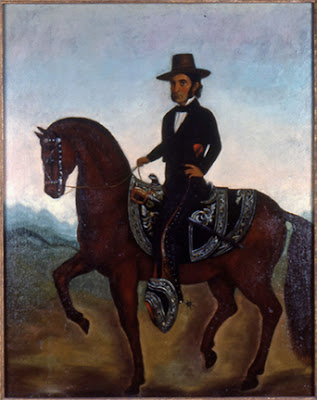
Black Swan was a mare, a horse in Australia whose reputation reached Jose Antonio Andres Sepulveda all the way in California.
The Sepulveda family was Southern California aristocracy, landowners whose holdings ranged from what is now Newport Beach to Santa Monica.
Sepulveda bought Black Swan sight unseen and had her sent to San Francisco:
When the fragile creature stepped off the gangplank in San Francisco in late 1851, along with her traveling companion, a gray gelding named Ito, she was unsteady, gaunt and sickly. Onlookers were not impressed.
Sepulveda turned the horse over to Yankee trainer Bill Brady.
Communicating with his gentle touch instead of force, Brady took her over winding paths, carefully avoiding sharp stones and other hazards that might injure her.
As he waited, Sepulveda hatched a plan that turned into a bonanza. His purse was still fattening with the enormous profits he began reaping three years earlier, when the discovery of gold had driven up the price of beef, and he delighted in racing and gambling.
Sepulveda challenged Pio Pico to pit his stallion Sarco in a race against Black Swan.
[Sepulveda] made sure that a crowd, among them Pico, was in Los Angeles when Brady rode into town on Black Swan. Seeing the mangy and emaciated mare only confirmed Pico’s and his cronies’ opinion that the majestic, cinnamon-colored Sarco was invincible.
Recklessly, Angelenos wagered their life savings on Sarco. Carrillo family members bet their last $400. The total bet in the $50,000 match race: $25,000 each in octagon-shaped gold slugs, in addition to 500 horses, 500 mares, 500 heifers, 500 calves and 500 sheep.
Sepulveda, Brady and Sepulveda’s son-in-law, Tom Mott, had three months to condition Black Swan. While building up her weight, they exercised her with discretion, running her after dark when no one could see her.
Pico and his hard-core betting pals were confident that Sarco was the better horse and therefore needed no training–an unbeatable mount, powerful and ready for a race at any moment.
As the date–March 20, 1852–drew near, the excitement and the bets grew higher. The Avilas and Duartes, who were friends of Sepulveda, bet a “bottle of brandy, two broken horses and $5.” For others just as low on cash, every animal imaginable–cattle, horses, goats, pigs, chickens–was fodder for a wager, along with land and furniture.
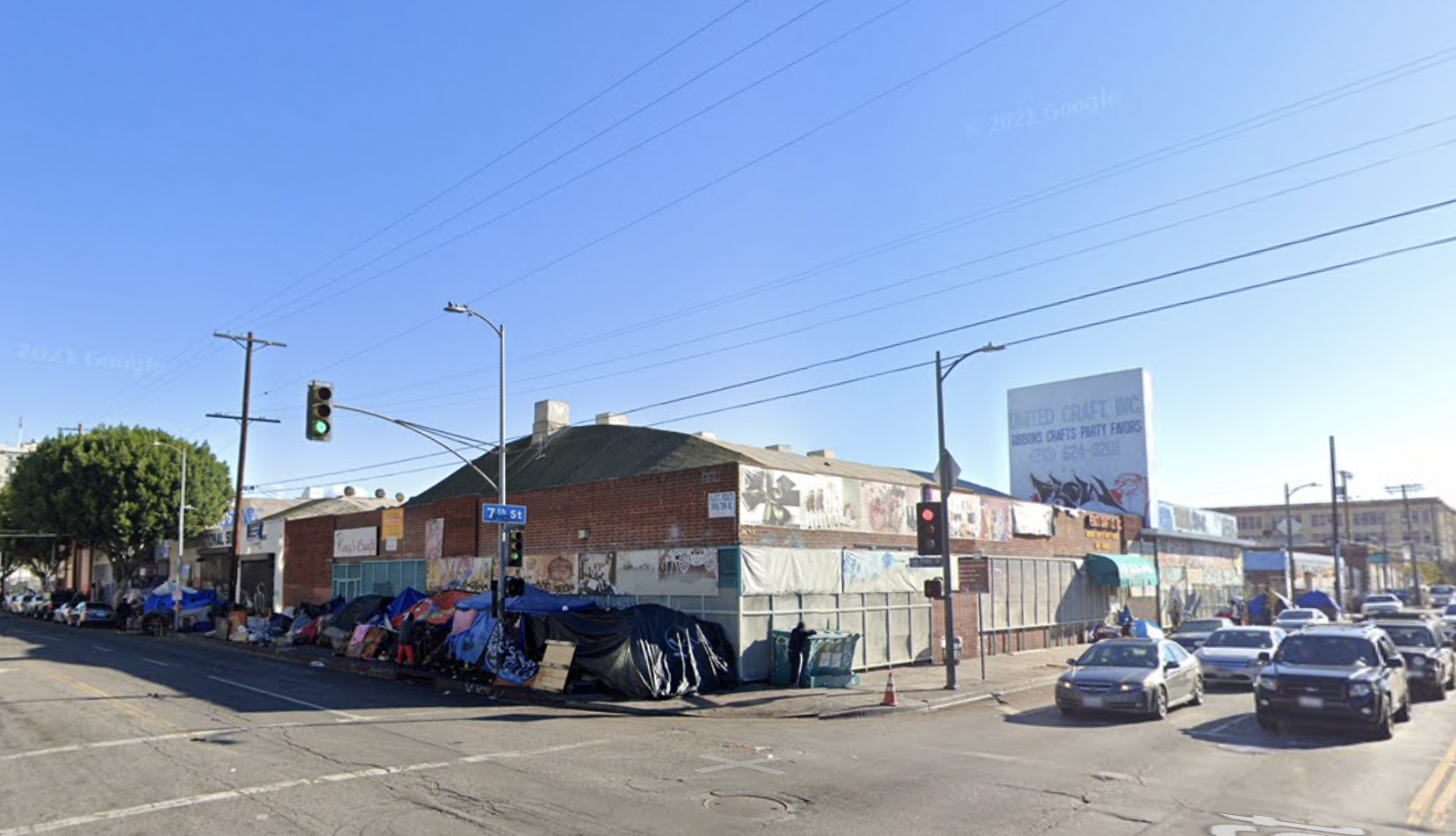
Families from as far away as San Francisco and San Diego arrived for the race, which began at what is now 7th and San Pedro streets.
The track extended 4 1/2 miles south to a wooden stake, where the horses and their riders turned around and headed back to the start.
Springtime mustard plants growing 10 feet tall lined the roadway, making it difficult to see. Bystanders stood in their wagons and climbed trees, gates and rooftops of the occasional house.
As the tension mounted, Sepulveda’s wife, Francisca, arrived in her carriage, holding a fortune in gold coins. Unwrapping her handkerchief, she ostentatiously handed each of her servants and many bystanders a shiny $50 gold piece to bet on the race.
A gasp of astonishment went up when Black Swan appeared, no longer looking like a sickly nag, but sleek with a shiny blue-black mane. Mounted on her back, sitting in a lightweight English saddle, was a small black man, dressed in bright clothing with a small cap turned backward on his head. Atop Sarco sat a hefty Mexican youth in a heavy Western saddle.
…
With so many animals made nervous by the crowds, the starter began the race not with a gunshot but with the cry of “Santiago!”
Sarco jumped out to an early lead, and all those betting on him breathed a sigh of relief. Many leaped to their own horses and followed, tearing through the mustard plants. But the fleet horses soon lost them, and the spectators headed back to watch the finish.
Frenzy gripped the crowd at the halfway mark when Black Swan pulled ahead. Sarco strained every muscle to keep up with the speedy little foreigner.
Nineteen minutes, 20 seconds from start to finish, Black Swan crossed the finish line five lengths ahead. She was bleeding from her nose and flanks from the spurs, and foaming from her mouth.
Racing fans stood around in stunned silence, as others broke down and cried. While Sarco tasted his first defeat, Black Swan, in her moment of triumph, wiped out entire family fortunes. The race contributed to the downfall of Pico, who lost $25,000 and who, more than four decades later, would die penniless.
Sepulveda’s son-in-law and a witness to the race wrote later that not much of it could be seen except for the start and the finish because the wild mustard plants stood ten feet high on both sides of the road. Soon after the race Sepulveda took Black Swan to El Refugio, the elaborate adobe home and acreage he had purchased from Domingo Yorba about 1854. El Refugio was located near present day First and Sullivan Streets in Santa Ana. It has been said the family used to feed the horse sugar from the veranda.
A walk beginning at Seventh and San Pedro might be one of the worst nine mile explorations you could make in LA, that’s the butt end of Skid Row.
For the Unnamed was originally entitled ‘For the Unnamed Black Jockey Who Rode the Winning Steed in the Race Between Pico’s Sarco and Sepulveda’s Black Swan in Los Angeles, in 1852′. That title provided the full narrative in a nutshell: we know the names of the owners of the two horses, we know the horses’ names, the place and date of the race. But apart from his colour, and his victory, we know nothing about the jockey who made the whole thing happen.
(cheers to reader Raj V for putting me on to this tale).
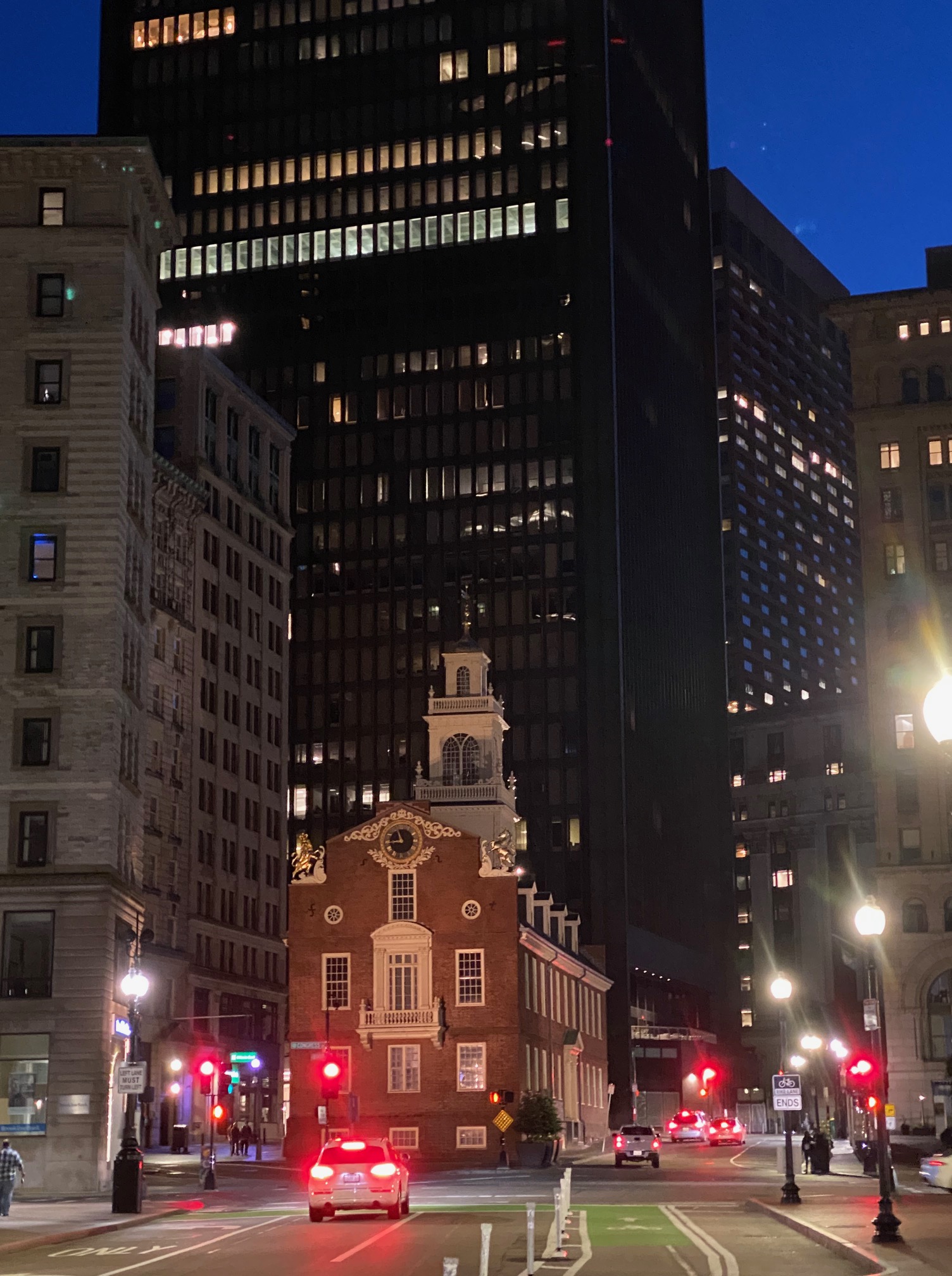
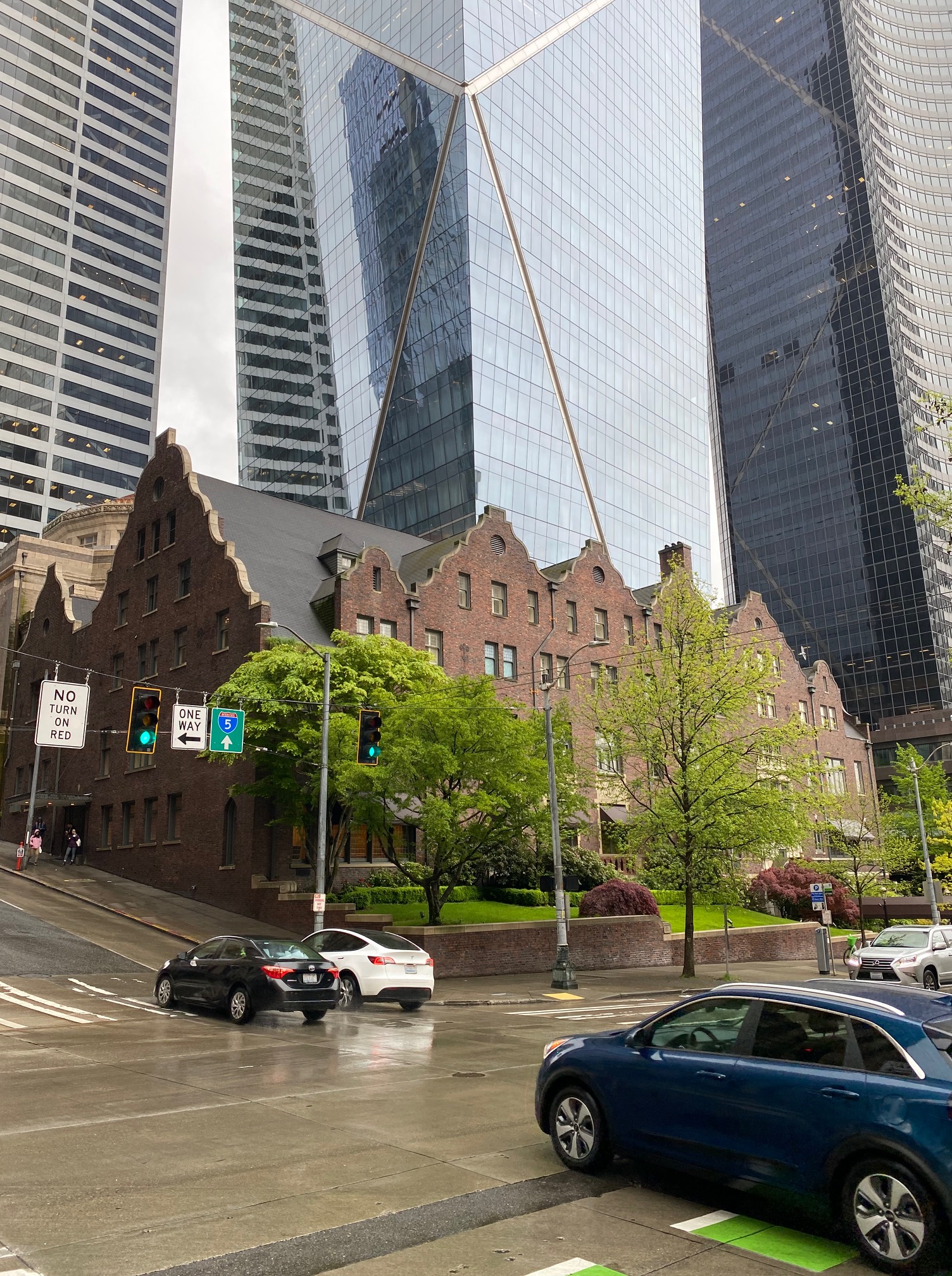
Sometimes I’m struck by how jarring a transition in scale has occurred in human life in the last few hundred years. Sure, there’ve been all kinds of massive changes in information speed, travel speed, etc. But don’t ignore simple scale of size. What was considered a big, grand, monumental building in 1776 is now dwarfed by even a mundane office building. Or take the Rainier Club in Seattle:
We’ve discussed the book of Mark in the past. Probably (?) the oldest gospel, it’s not very long, about 11,000 words. It was written in Greek, which was a second language to many of the people encountering it. So the language is simple. It tells the story of the life, teachings, and death of Jesus. A sort of afterward that was possibly tacked on later adds a bit about the resurrection.
Much to consider, in short. I teamed up with my pal Brett Vanderzee, pastor of The Springs church in Edmond, Oklahoma to discuss this book chapter by chapter in a new podcast. I try to take a look at the book as a narrative/story, and figure out why this story keeps getting told 2,000 years later. Brett comes at it from a deep background in Bible study. Along the way we have a number of interesting guests from the worlds of both Hollywood and Bible scholarship. Join us won’t you?
Available on Apple podcasts and should be up wherever you get podcasts (some listeners report they can’t find it on Spotify, looking into it).
In the book’s preface, Smil writes that most growth processes—“of organisms, artifacts, or complex systems”—can be plotted on a so-called S-shaped, or sigmoid, growth curve, meaning that the rate of change increases slowly at first, then increases rapidly, then levels off. An error that humans make with similarly predictable regularity is to assume that the nearly vertical middle segment of an S-shaped curve can continue at that angle indefinitely (the price of Dutch tulips in the seventeenth century, the price of bitcoin in the twenty-first). One of his conclusions is that the steady, unceasing economic expansion that economists and politicians dream of is not sustainable, and that the relentless pursuit of growth is environmentally disastrous. Smil has often said that he doesn’t make forecasts—“a pathetically and inexorably ever-failing endeavor on any level,” he told me—but predictions of a kind are implicit in much of his work. In “Growth” ’s coda, he writes, “Continuous material growth, based on ever greater extraction of the Earth’s inorganic and organic resources and on increased degradation of the biosphere’s finite stocks and services, is impossible”—a principle that, in various forms, animates almost all his work, beginning with his undergraduate thesis.
In his annual letter Warren Buffett waxes about Burlington Northern and Santa Fe:
Rail is essential to America’s economic future. It is clearly the most efficient way – measured by cost, fuel usage and carbon intensity – of moving heavy materials to distant destinations. Trucking wins for short hauls, but many goods that Americans need must travel to customers many hundreds or even several thousands of miles away. The country can’t run without rail, and the industry’s capital needs will always be huge. Indeed, compared to most American businesses, railroads eat capital.BNSF is the largest of six major rail systems that blanket North America. Our railroad carries its 23,759 miles of main track, 99 tunnels, 13,495 bridges, 7,521 locomotives and assorted other fixed assets at $70 billion on its balance sheet. But my guess is that it would cost at least$500 billion to replicate those assets and decades to complete the job.
…
North America’s rail system moves huge quantities of coal, grain, autos, imported and exported goods, etc. one-way for long distances and those trips often create a revenue problem for back-hauls. Weather conditions are extreme and frequently hamper or even stymie the utilization of track, bridges and equipment. Flooding can be a nightmare. None of this is a surprise. While I sit in an always-comfortable office, railroading is an outdoor activity with many employees working under trying and sometimes dangerous conditions.An evolving problem is that a growing percentage of Americans are not looking for the difficult, and often lonely, employment conditions inherent in some rail operations. Engineers must deal with the fact that among an American population of 335 million, some forlorn or mentally-disturbed Americans are going to elect suicide by lying in front of a 100-car, extraordinarily heavy train that can’t be stopped in less than a mile or more. Would you like to be the helpless engineer? This trauma happens about once a day in North America; it is far more common in Europe and will always be with us.
Wage negotiations in the rail industry can end up in the hands of the President andCongress. Additionally, American railroads arer equired to carry many dangerous products everyday that the industry would much rather avoid. The words “common carrier” define railroad responsibilities.
…
I believe that our vast service territory is second to none and that therefore our margin comparisons can and should improve.I am particularly proud of both BNSF’s contribution to the country and the people who work in sub-zero outdoor jobs in North Dakota and Montana winters to keep America’s commercial arteries open. Railroads don’t get much attention when they are working but, were they unavailable, the void would be noticed immediately throughout America. A century from now, BNSF will continue to be a major asset of the country and ofBerkshire. You can count on that.
love it. The boy from Omaha now owns the railroad.
Did Paul Harvey ever do a tribute to the railroad man the way he did to a farmer? (was Paul Harvey a poet?) (did Dodge’s God Made A Farmer ad work?)
The railroad man gets a tough rap in song and tale.
Are Shocking Blue the best band ever from Den Haag?
Went looking into the idea that even after death Inka nobles clung to power:
People in Andean societies viewed themselves as belonging to family lineages. (Europeans did, too, but lineages were more important in the Andes; the pop-cultural comparison might be The Lord of the Rings, in which characters introduce themselves as “X, son of Y” or “A, of B’s line.”) Royal lineages, called panaqa, were special. Each new emperor was born in one panaqa but created a new one when he took the fringe. To the new panaqa belonged the Inka and his wives and children, along with his retainers and advisers. When the Inka died his panaqa mummified his body. Because the Inka was believed to be an immortal deity, his mummy was treated, logically enough, as if it were still living. Soon after arriving in Qosqo, Pizarro’s companion Miguel de Estete saw a parade of defunct emperors. They were brought out on litters, “seated on their thrones and surrounded by pages and women with flywhisks in their hands, who ministered to them with as much respect as if they had been alive.” Because the royal mummies were not considered dead, their successors obviously could not inherit their wealth. Each Inka’s panaqa retained all of his possessions forever, including his palaces, residences, and shrines; all of his remaining clothes, eating utensils, fingernail parings, and hair clippings; and the tribute from the land he had conquered. In consequence, as Pedro Pizarro realized, “the greater part of the people, treasure, expenses, and vices [in Tawantinsuyu] were under the control of the dead.” The mummies spoke through female mediums who represented the panaqa’s surviving courtiers or their descendants. With almost a dozen immortal emperors jostling for position, high-level Inka society was characterized by ramose political intrigue of a scale that would have delighted the Medici. Emblematically, Wayna Qhapaq could not construct his own villa on Awkaypata—his undead ancestors had used up all the available space. Inka society had a serious mummy problem. After smallpox wiped out much of the political elite, each panaqa tried to move into the vacuum, stoking the passions of the civil war. Different mummies at different times backed different claimants to the Inka throne. After Atawallpa’s victory, his panaqa took the mummy of Thupa Inka from its palace and burned it outside Qosqo—burned it alive, so to speak. And later Atawallpa instructed his men to seize the gold for his ransom as much as possible from the possessions of another enemy panaqa, that of Pachacuti’s mummy.
so says Charles Mann in 1491, required reading. He cites as his sources:
Screenshot
so that’s a weekend sorted.
These Lords had the law and custom of taking that one of their Lords who died and embalming him, wrapping him up in many fine clothes, and to these Lords they allotted all the service which they had had in life, in order that these bundles [mummies] might be served in death as well as they had been in life. Their service of gold and silver was not touched, nor was anything else which they had, nor were those who served them [removed from] the house without being replaced, and provinces were set aside to give them support. The Lord who entered upon a new reign had to take new servants. His vessels had to be of wood and pottery until there was time to make them of gold and silver, and always those who began to reign carried out all this, and it was for this reason that there was so much treasme in this land, because, as I have said, he who succeeded to the kingdom always hastened to make better vessels and houses [than his predecessors]. And as the greater part of the people, treasure, expenses and vices were under the control of the dead, each dead man had allotted to him an important Indian, and likewise an Indian woman, and whatever these wanted they declared it to be the will of the dead one. Whenever they wished to eat, to drink, they said that the dead ones wished to do that same thing. If they wished to go and divert themselves in the houses of other dead folk, they said the same, for it was customary for the dead to visit one another, and they held great dances and orgies, and sometimes they went to the house of the living, and sometimes the living came to their. At the same time as the dead people, many [living], as well men as women came, saying that they wished to serve, and this was not forbidden them by the living, because all were at liberty to serve these [the dead], each one serving the dead person he desired to serve. These dead folk had great number of the chief people [in their service], as well men as women, because they lived very licentiously, the men having the women as concubines, and drinking and eating very lavishly.
Pedro Pizarro goes on to describe a summit with a mummy:
The Marquis sent me [with orders to] go with Don Martin, the interpreter, to speak to this dead man and ask on his [Pizarro’s] behalf that the Indian woman be given to this captain. Then I, who believed that I was going to speak to some living Indian, was taken to a bundle, [like] those of these dead folk, which was seated in a litter, which held him and on one side was the Indian spokesman who spoke for him, and on the other was the Indian woman, both sitting close to the dead man. Then, when we were arrived before the dead one, the interpreter gave the message, and being thus for a short while in suspense and in silence, the Indian man looked at the Indian woman (as I understand it, to find out her wish). Then, after having been thus as I relate it for some time, both the Indians replied to me that it was the will of the Lord the dead one that she go, and so the captain already mentioned carried off the Indian woman, since the Apoo, for thus they called the Marquis, wished it.
Is it not possible they were playing a prank on Pedro Pizarro here? Five hundred years later who can say. It can be agreed the Inca had weird death stuff going on, but you don’t think they were doing weird death stuff in Extremadura, Spain in 1532? The place is littered with pieces of the true cross and the robe Jesus wore at the Last Supper and black Madonnas and churches called like The Holy Blood. They’d been fighting a religious war, the Reconquista, for 700 years.
The Spanish conquest of “Peru” wasn’t an encounter of a normal culture with a weird culture. It was very weird culture x very weird culture. (Weird here defined as strange, difficult to comprehend to us. Not like we’re normal.)
Every fragment of this encounter shatters off in a million weird directions. The truth can never be known. We can only contemplate the few primary sources that survive with awe and wonder.
Consider for example Guaman Poma, Falcon Puma’s book.
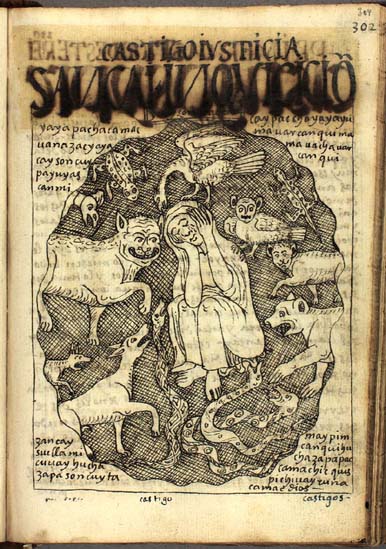
It was discovered in the Royal Danish Library of Copenhagen in 1908. It’s 1,189 pages long and handwritten and illustrated. Richard Pieschman, the scholar who found it, knew it was a big deal but he soon died. It was not available in English until I believe 1980? The 2006 translation selected, translated and annotated by David Frye has a wild introduction. The 2009 University of Texas edition by the late Roland Hamilton is also good, and free to look at here. Frye:
underlinings from the previous owner. Latin American literature began as something strange and stayed that way.
What is striking about Los Angeles after a period away from it is how well it works. The famous freeways work, the supermarkets work (a visit to, say, the Pacific Palisades Gelson’s, where the aisles are wide and the shelves full and checkout is fast and free of attitude, elevates grocery shopping to a form of zazen), the beaches work. The 1984 Olympics were not supposed to work, but they did (daily warnings of gridlock and urban misery gave way during the first week to a county-wide block party, with pink and aquamarine flags fluttering over empty streets, and with parking spaces available, for once, even in Westwood)—not only worked but turned a profit, of almost two hundred and twenty-three million dollars, about which there was no scandal.
My own observation is Los Angeles works less well in 2024 than it did when I arrived in 2004. Maybe that’s the sweetening filter of nostalgia for youth. There are more people living in tents now than there were then. That seems bad. A dreadful indicator. Does the tent-living increase correlate with housing price increase? Haven’t put the graph together but I’d guess yes.
The economists might tell us demand for housing is growing faster than supply, causing prices to go up. The supply (of housing) is hard to make go up. You need to build.
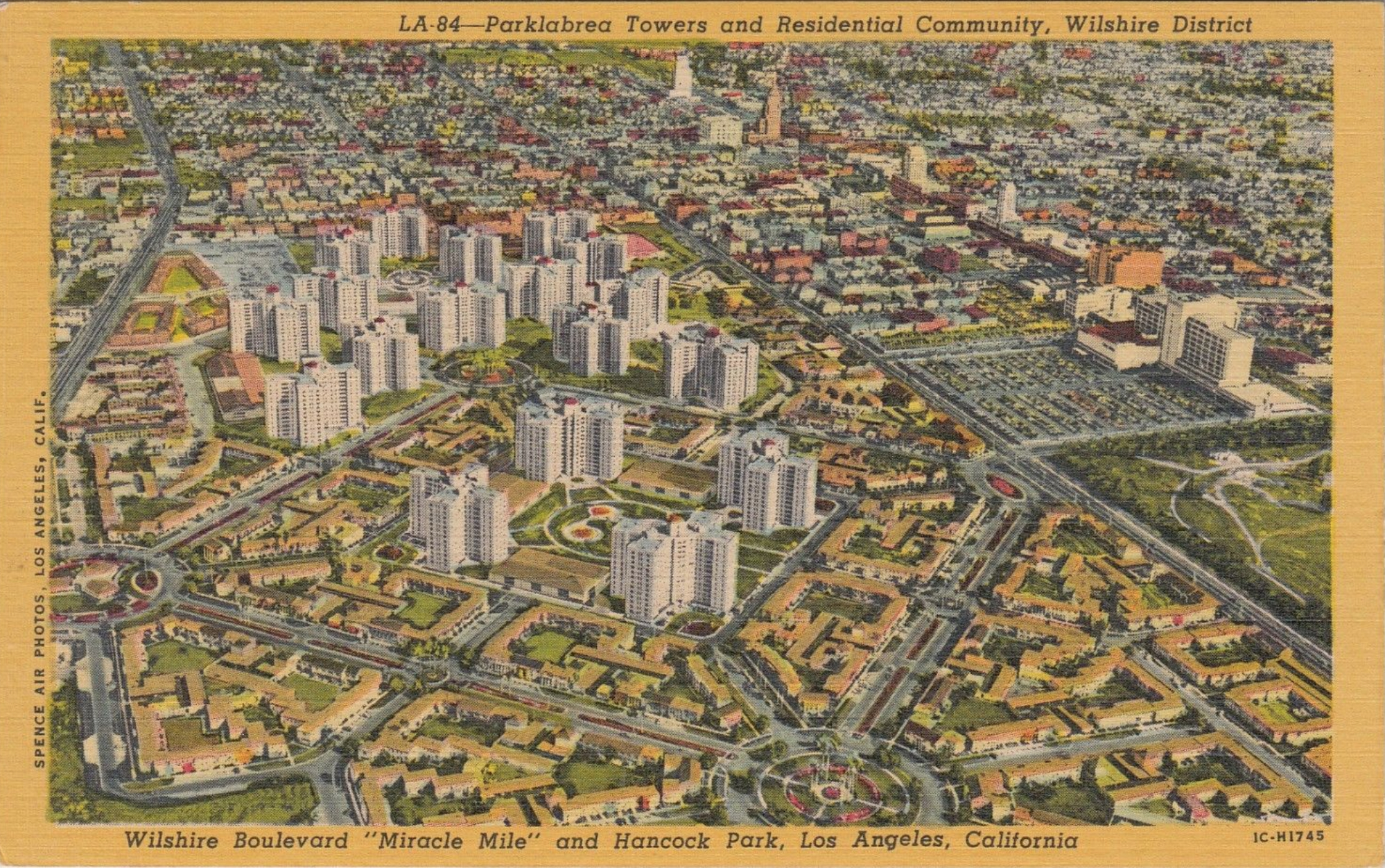
LA used to be a leader in experimental affordable housing projects:
Ed Catmull, when president of Pixar, the animation studio, built good friction into the process of developing films such as Toy Story. “The goal isn’t efficiency, it is to make something good, or even great,” he explained to Sutton and Rao about the way his team worked through multiple versions of the original idea, improving it as the movie developed. Colette Cloosterman-van Eerd of Jumbo, a Dutch grocery store chain, saw the need to offset the drive for more efficiency with good friction. She instituted “slow lanes” that would allow checkout staff to chat to shoppers, particularly senior citizens who valued social interaction more than speed.
from a piece on Stanford BS professors Huggy Rao and Bob Sutton in Financial Times.
In 1851 a group of 300 Mormons from southern Utah purchased a 35,509-acre tract in the San Bernardino Valley, laid out a town, planted trees, and built fine homes which they smothered in rose bushes and clinging plants. In a cooperative venture which became the model for all such efforts in the semi-arid Far West, they brought 4000 acres under irrigation. In 1857 a group of German immigrants gathered in San Francisco and incorporated themselves as the Los Angeles Vineyard Society. Purchasing a tract in Southern California which had once been part of the Rancho San Juan Cajon de Santa Ana, the Germans founded the colony of Anaheim, irrigating the soil and planting the vines of California and the Moselle. “We drove through the clean and well-kept avenues or streets, scenting Rhineland on every side,” wrote a visitor in the 1870’s, “and, indeed, this Anaheim itself is nothing but a bit of Germany dropped down on the Pacific Coast.” At Pasadena he might have scented Indiana and high-seriousness of the American Protestant variety. The excessively severe winter of 1873-74 convinced a number of middle class residents of Indianapolis, many of whom suffered from chronic ailments, that they had better emigrate to Southern California as agriculturalists. Incorporating themselves as the San Gabriel Orange Grove Association, they purchased and subdivided part of the Rancho San Pascual at the western head of the San Gabriel Valley: a superb spot, sheltered by the Sierra Madre and Verdugo Mountains, sunny, fertile, and conveniently near Los Angeles. Cottages were built and vines and fruit trees planted. In 1875, when the community acquired a post office, it called itself Pasadena.
Pasadena really does have the vibe/taste of solid Midwesterners from 1875. Who else would have a Rose Parade where they brag about how much tedious work each float takes?
I assumed that Pasadena was from the Spanish but according to About Pasadena on the city’s website:
The word Pasadena literally means “valley” in the Ojibwa (Chippewa) Indian language, but it has been interpreted to mean “Crown of the Valley” and “Key of the Valley,” hence the adoption of both the crown and the key in the official city seal.
At the town dump recycled magazines were piled in a converted shipping container (is that what it was?) and I’d go through them looking for Sports Illustrateds.
The phrase “jackasses like Dykstra” stuck with me so much I think of it almost every time I consider the dress code at a nice restaurant. With ease I was able to recover the original, from February 1994.
Boorish Behavior Your jocular tone in SCORECARD about Lenny Dykstra’s oafish antics in a restaurant (Jan. 17) calls for a response. Wearing a hat in any restaurant is a statement of social ignorance or, more likely, appalling ego, and the loud swearing in the establishment in suburban Philadelphia reinforces my impression of this lout. Your flip conclusion, in which his $24.9 million contract is mentioned, was inappropriate. There is still such a thing as class, just as there is a lack of it. JOHN KELLEY, Winthrop, Mass.
Isn’t SI the publication that ran Karl Malone’s June 14 POINT AFTER saying Charles Barkley should recognize that he is a role model whether he wants to be or not? So why doesn’t this pious injunction apply to Lenny Dykstra, six million bucks a year or not? One reason that people go to nice restaurants is to get away from jackasses like Dykstra. ROBERT H. PASCHALL, Bishop, Calif.
Is “writing about sports” as a moneymaking prospect dead now? Talking about sports, videos about sports, bigger than ever maybe, but is writing about it over? What does that say about writing?
JAB III used to turkey hunt with Lawton Chiles despite being in opposing parties. According to JAB that paid off during the 2000 Florida recount:
BAKER:
Jeb ran against Lawton Chiles in a very divisive and semidirty race. I had become a good friend of Lawton because I was Treasury Secretary and he was Chairman of the Senate Budget Committee. We did a lot of work together. He was an adversarial Democrat and I was an adversarial Republican, but we both liked to turkey hunt. He would invite me to Florida to hunt turkeys and I would invite him to Texas to hunt turkeys. I would call the turkeys for him and he would shoot them, and he would call them for me and I would shoot them.
One thing that really paid dividends with respect to the Florida recount—I know I’m jumping ahead of you here—Before I’d gotten over there, but it was reinforced after I’d gotten over there, I remembered the types of people that Lawton had appointed to the Florida Supreme Court. I’d probably met some of them. There was a guy named Dexter Douglass—You may remember who that was.
RILEY
He shows up in your book.
BAKER
In my book, yes. He was an advisor to Lawton. He was the guy who told Lawton whom to put on the Florida Supreme Court. He gave him advice about which lawyers to put on. They were all liberal trial lawyers. So when I got to Florida I was of the view, pretty much right off the bat, that if we weren’t able to get this into federal court we had a really tough row to hoe. As it turned out, that was very true. The Florida Supreme Court pulled us out twice, once in the face of a direct order from the United States Supreme Court to review their opinion—They reversed an earlier opinion. So that relationship I had with Lawton Chiles really paid dividends when it was time to go to do the recount.
There was a significant moment in George W. Bush’s governor campaign in Texas that turned on how he handled accidentally killing a killdeer, the wrong kind of bird, during a publicity event on the first day of bird hunting season. Here’s Karl Rove:
Then also, the famous killdeer incident had a big impact, because it showed—Her attitude toward good old boys was condescending. She felt she needed to placate “Bubba” by every September first going dove hunting in East Texas, outside of Dallas. Of course, she was not a hunter, she could care less, but it was a nice show and she’d get a nice picture for the newspapers. Bush went dove hunting and shot a protected bird, a killdeer, and when he discovered that he had done so, after a sharp-eyed television sports reporter noticed that the white markings on the bird meant that it was a killdeer, Bush’s response was not to deny it, but to dispatch a young aide to the game warden’s office to pay the fine immediately.
Then there was the incident where Cheney shot his buddy in the face by accident. Rove:
Rove
On my lease, and that was my lawyer. I was shocked that fact never came out. If you go back to incorporation papers of Rove and Company in 1981, my lawyer, the secretary/treasurer of my corporation, and my landlord is Harry M. Whittington Jr., and that’s the guy Cheney shot. The press corps never figured it out, but could you imagine the headline in the Washington Post? “Cheney Shoots Rove’s Lawyer in Sign of West Wing Tension.”
Riley
Did you get a funny feeling in your stomach when you got that news?
Rove
We could not get Cheney to make it public, and we needed to. It took until the next morning, before Cheney allowed Katharine Armstrong to feed the news to a reporter at the Corpus Christi Caller-Times. The White House press corps was furious with us for having hid this fact from the afternoon and to the next morning.
Why did Cheney’s team bungle releasing that news? Dan Bartlett, W. communications director, explains:
The second one is when he shot Harry Whittington and he shut down all internal communication. We couldn’t get hold of him, couldn’t get hold of his staff. Only learned later that there were some back channel communications with Karl, but they decided that no one in the world would understand or have context for him accidentally shooting somebody while hunting except for one reporter at the Corpus Christi Caller-Times who they couldn’t find because she was on a drunk bender for 12 hours. It took that long to find her.
in 2023 we happened to watch a Dodger Channel / Spectrum Sportsnet LA documentary about the 1988 World Series home run by Kirk Gibson. Probably the most famous moment in post-Brooklyn Dodger history. What impressed though was what Dennis Eckersley had to say. Eckersley threw the pitch Gibson cleared over the right field fence. Here’s what he said about how he handled the postgame interviews:























 Helytimes

