The Forever War
Posted: September 17, 2014 Filed under: America Since 1945 Leave a comment This book should be required reading for American citizens. It’s clear by the end that Dexter Filkins is pretty messed up by the experiences described. I had to finish this book very quickly because I was worried reading it was making me less funny.
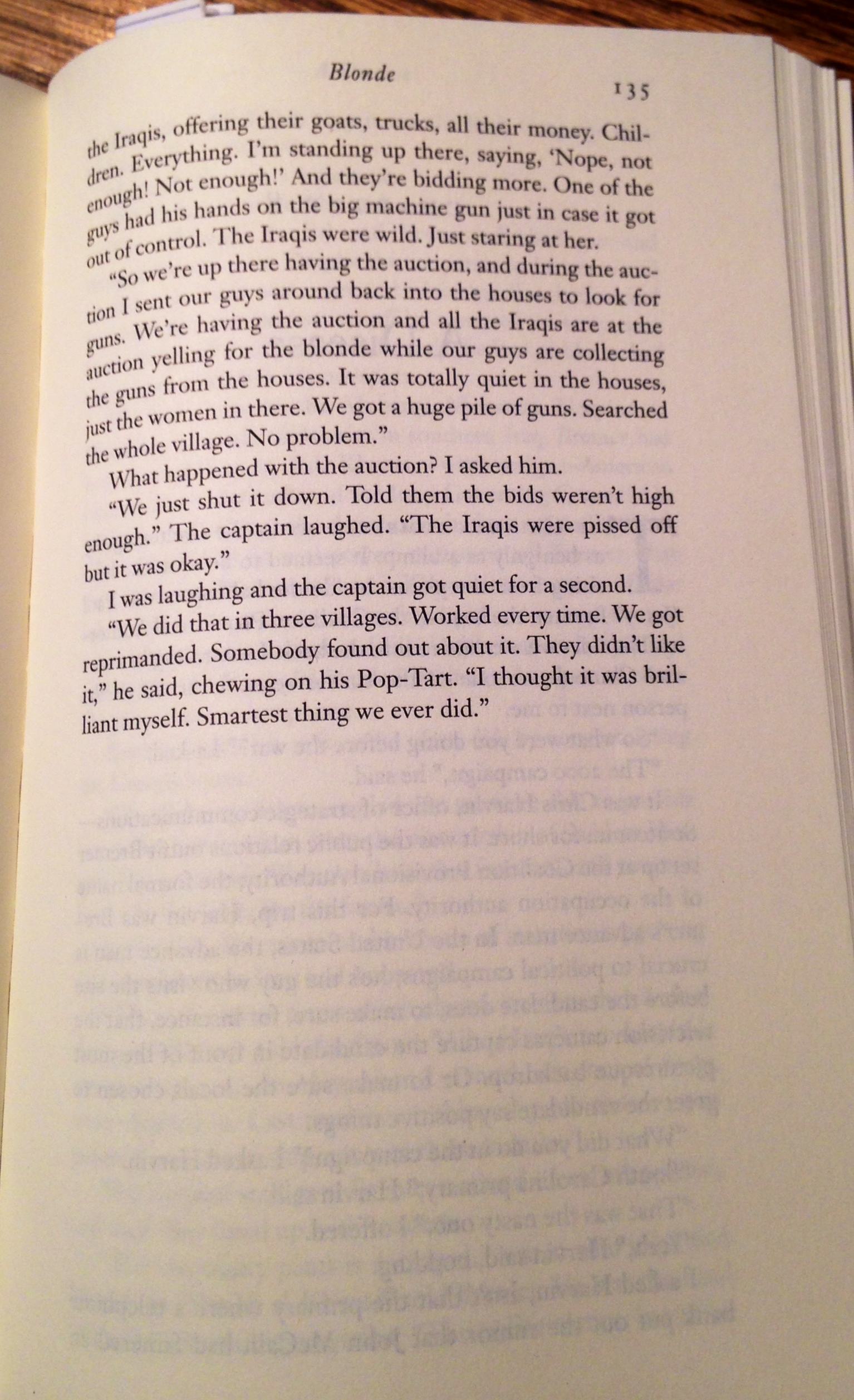
Here is an excerpt that’s one of the easier chapters to read.

As an irony
Posted: September 15, 2014 Filed under: America Since 1945, music 1 Commentfrom Buzzfeed’s fascinating profile of Ryan Adams:
“And I slept. I slept like I never had. I totally crashed in this beautiful way. I let go of all the false ideas of my late twenties and early thirties, this construct of who I was and how I thought I should be. That struggle was over.”
That sounds great! How about this?:
In 1994 he formed Whiskeytown. As Adams would famously declare in the group’s musical manifesto “Faithless Street”: “I started this damn country band, ‘cause punk rock was too hard to sing.” Today Adams says the foundational conceit behind the band was a pose — something his more strident critics accused him of at the time. “There’s this wrong idea about me being identified with things that are Southern or country,” he notes. “I do not fucking like country music and I don’t own any of it. I watched Hee-Haw as a kid with my grandmother, I only like country music as an irony. I liked it when I would get drunk.”
As an irony. Or this:
In the studio Adams plied [Jenny] Lewis with psychological tricks: He told her to write her own Oasis-style anthem, forced her to listen to Creed incessantly before laying down vocals. “I had been stuck in the mud for so long, I needed a person who could push me ahead. The casual, low-stakes environment for me was crucial.”
Meat Mountain insurance
Posted: August 26, 2014 Filed under: America Since 1945 Leave a comment
Arby’s faced a key problem as it moved to attract customers: People thought the restaurant served mainly roast beef. To change that, the company made this poster showing a tall stack of every meat on the menu, from bacon to brisket…
“People started coming in and asking, ‘Can I have that?’” said Christopher Fuller, the company’s vice president of brand and corporate communications. So Arby’s began granting their wish.
The “Meat Mountain,” as it’s called, will not be listed on the menu, but store associates will make it for customers who ask. The price is $10. For that, you get a bun and, from the bottom up:
2 chicken tenders
1.5 oz. of roast turkey
1.5 oz. of ham
1 slice of Swiss cheese
1.5 oz. of corned beef
1.5 oz. brisket
1.5 oz. of Angus steak
1 slice of cheddar cheese
1.5 oz. roast beef
3 half-strips of bacon
Arby’s says the Meat Mountain is so tall that it won’t fit into the traditional clamshell packaging.
(Getting this from Cord Jefferson who got it from WaPo. “Insurance” is a term I believe SDB coined, which I prefer to “ICYMI.”)
The New York Times weighs in
Posted: August 21, 2014 Filed under: America Since 1945 Leave a comment
an amazing document:
“Shake It Off” is not really a dance video. Or perhaps it would be more accurate to say that it is a dance video in the current pop sense — a video that treats dance less as an art in itself than as a cultural signifier. The concept of the video is to put Ms. Swift in the position of a pop star or R&B diva or rapper, fronting backup dancers. The scenarios cycle through genres: ballerinas in “Swan Lake” costumes; a crew of b-boys; emotive contemporary dancers in spandex; a cheerleading squad; Lady Gaga futurists in shiny tracksuits; and yes, a line of ladies jiggling the contents of their cut-off denim shorts…
…The punchlines, as this dance critic was happy to see, are mostly dance jokes. The way that Ms. Swift trips over the crossed legs of the ballerinas and topples while trying to bow deeply in toe shoes is not highly clever or knowing, but it’s funny.(it is??) And the frightened and confused look that she gives the overwrought contemporary dancers earns a dance critic’s immediate empathy. Ms. Swift in “Shake It Off” is like Lucille Ball or Carol Burnett, a heroine triumphing through klutziness. It is probably too generous to interpret the video as a satire of how dance gets used in pop videos, but it certainly is a satire of pop video conventions.
Which brings us to the twerking. The moment when Ms. Swift crawls between the lined-up legs of the twerking ladies, advancing through the colonnades of jiggling flesh as if she were the camera of Busby Berkeley, is very silly. A second later, when Ms. Swift breaks out in giggles, she is laughing at the absurdity of herself in that video genre, but also, I think, at the absurdity of the genre.
With respect to racial politics, it would have been better if the shots of ballerinas had included some darker complexions.
I am laughing at the absurdity of myself for reading this but also, I think, at the absurdity of the genre.
The first trick of the American fascist
Posted: August 18, 2014 Filed under: America Since 1945 Leave a comment
Watching some TV reminded me of this one, from the great VK’s book about driving around the “middle South.”
“The first trick of the American fascist is to drive a wedge between the suffering whites and the suffering blacks of this country. If the American fascist knows one thing, he knows this: there’s hell to pay for him and all his fascist friends whenever the suffering whites and the suffering blacks of this country unite.
That’s why he eggs on the race-baiters. Why he laughs when they succeed. To do this he uses his newspapers, his radio stations. He spouts division, spouts it and hopes the poor and suffering and exploited of America grow confused. He laughs when they are deluded by the old cheap canard, that the great chasm in this country is race and not class. The American fascist prays the black and white working people of this country never realize that united, they have all the power in the land.
– Vivian Kent, The Fatback of America (1948)
(photo of a Portland sympathy protest by Casey Parks of The Oregonian)
Gertie The Dinosaur (1914)
Posted: August 15, 2014 Filed under: America Since 1945 Leave a comment
Listening to the audiobook of Neal Gabler’s bio of Walt Disney (thanks to Ariel Schrag for the suggestion!) reminded me it was time to rewatch this one, by Winsor McCay.
McCay stood barely five feet (150 cm) tall, and felt dominated by his wife, who was nearly as tall as he was. Neither spouse got along well with the other’s mother.
He or she goes up the next day in another plane
Posted: August 12, 2014 Filed under: America Since 1945, heroes, the California Condition Leave a comment
Williams at the 62nd Academy Awards in 1990 with journalist Yola Czaderska-Hayek (from Wiki)
Public* mourning makes me uncomfortable. In the tradition I’m from, which let’s say is some combination of Irish/Italian/New England Catholicism and New England puritanism, the appropriate reaction to death, as I understood it, was somber quiet.
Mourning for celebrities tends to very quickly veer into something personal and showy — “I met him once…” “he/she meant this to me…” — that make me a tiny bit queasy. My gut reaction is that it’s a little selfish or self-aggrandizing, a strange reaction to something which should be humbling, reductive of the self.
I can see the other side too, people feel pain and loss and it’s natural enough to want to express it, so: whatever.
There’s also the comedy instinct to find the exact grey border country between “wildly inappropriate” and “just wrong enough, just teasing enough of taboo, to be exciting and boldly funny.” [I still laugh when I think about the guy who walked into the room where we were watching CNN after 9/11 and – not having heard about 9/11 – the dude walked into the room with both middle fingers up and said “what’s up bitches?” Only to then learn what the thing was that was on TV. An accidental joke.] If you’re gonna try this, though, you better be darn sure it’s funny. (The one or two stabs at this I saw yesterday were not just failures but were revolting and ugly.)
Anyway. I guess that’s it. I’m sad Robin Williams died, and the circumstances are extra sad. He died in Tiburon, CA.
Separate note: unrelated:
Yesterday I was reading Warren Bennis‘ book On Becoming A Leader. Not a great book, I have to say, it doesn’t capture or have the same impact of what it was like to hear Bennis in person. But I found myself thinking about this bit, hours later, it stuck in my craw:
Think what a great batting average is: .400 — which means a great batter fails to get a hit more than half the time. Most of the rest of us are paralyzed by our failures, large and small. We’re so haunted by them, so afraid that we’re going to goof again, that we become fearful of doing anything. When jockeys are thrown, they get back on the horse, because they know if they don’t, their fear may immobilize them. When an F-14 pilot has to eject, he or she goes up the next day in another plane.
(* I guess in this case I mean specifically “Twitter”)
Addiction By Design
Posted: August 11, 2014 Filed under: America Since 1945 Leave a comment
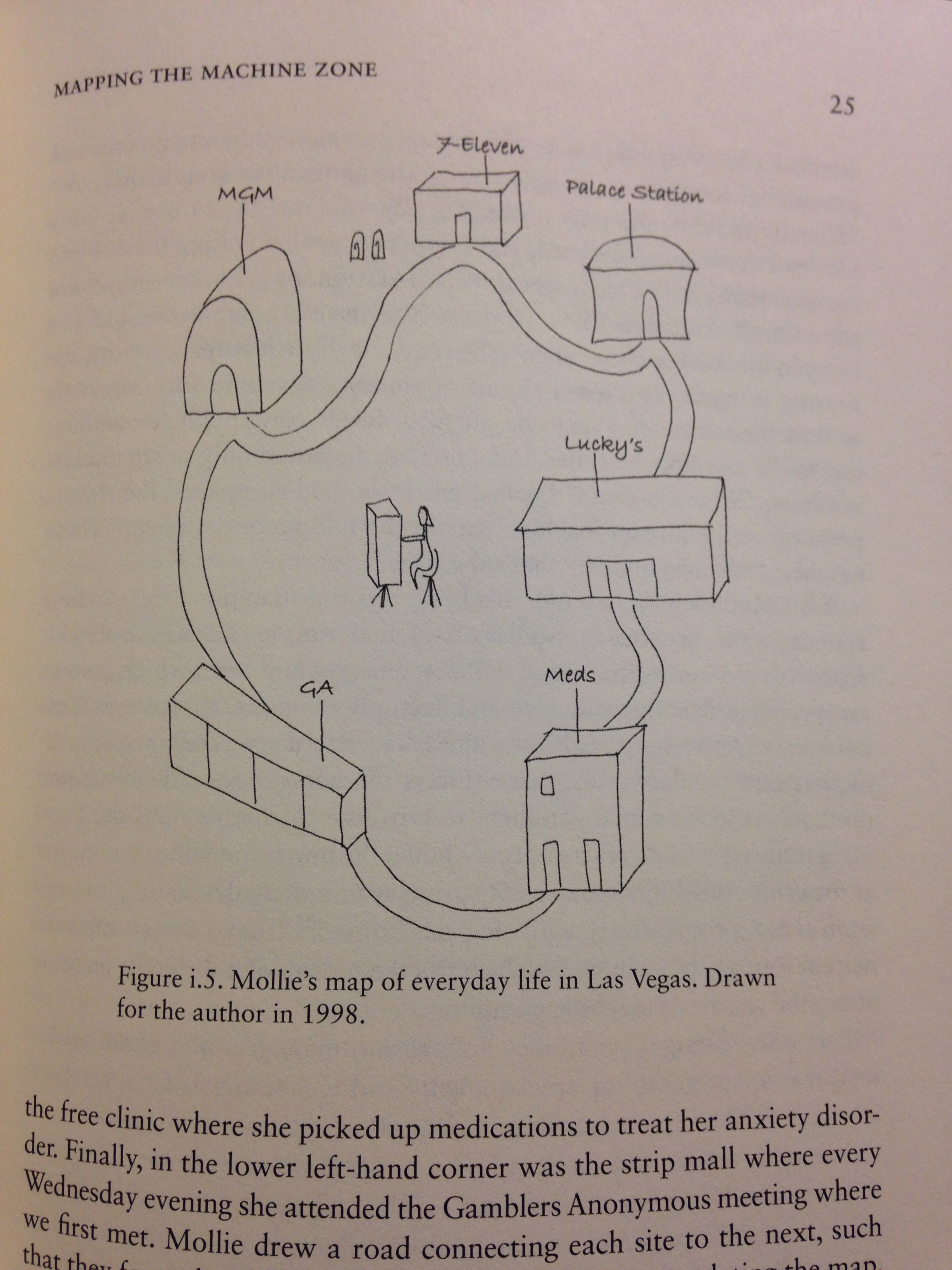
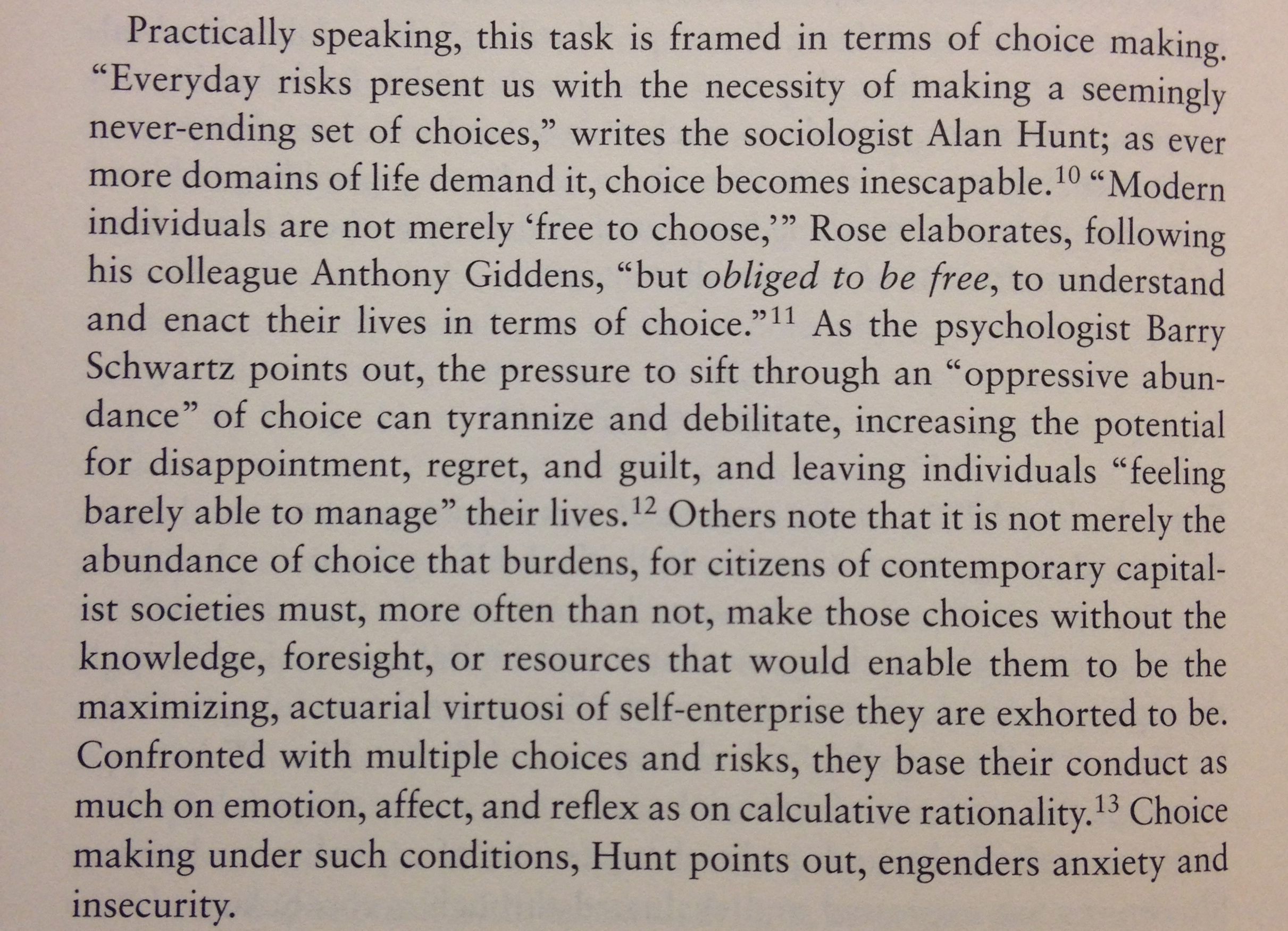
This is a fascinating book about addiction, compulsion, psychology, sociology, the relationship of people and technology.

I heard about it from Tyler Cowen of course. Here are some unauthorized excerpts:
“Sharon”: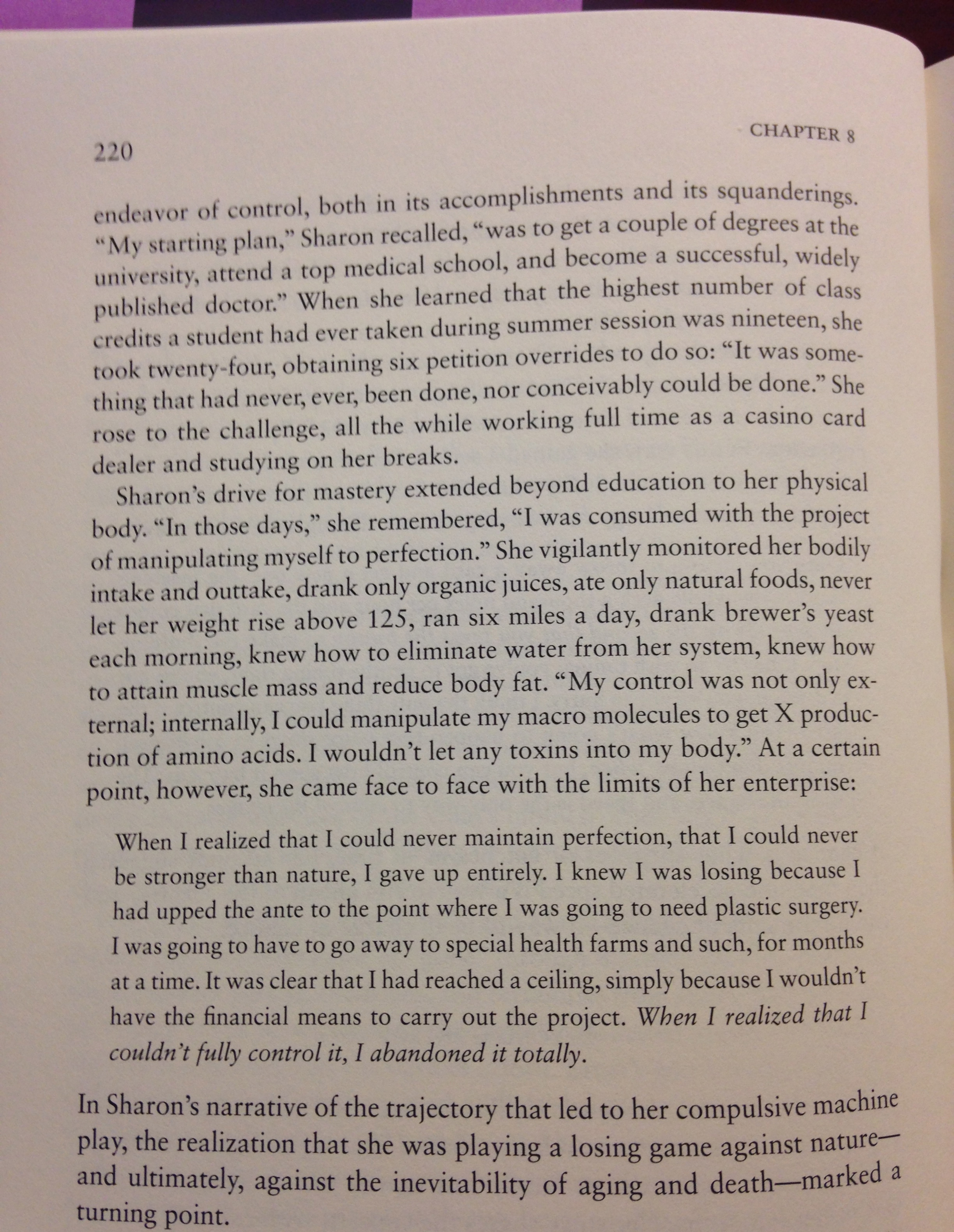
Schull quotes extensively from “Designing Casinos To Dominate The Competition” by Bill Friedman:

I’d love to read that book but it costs $199.
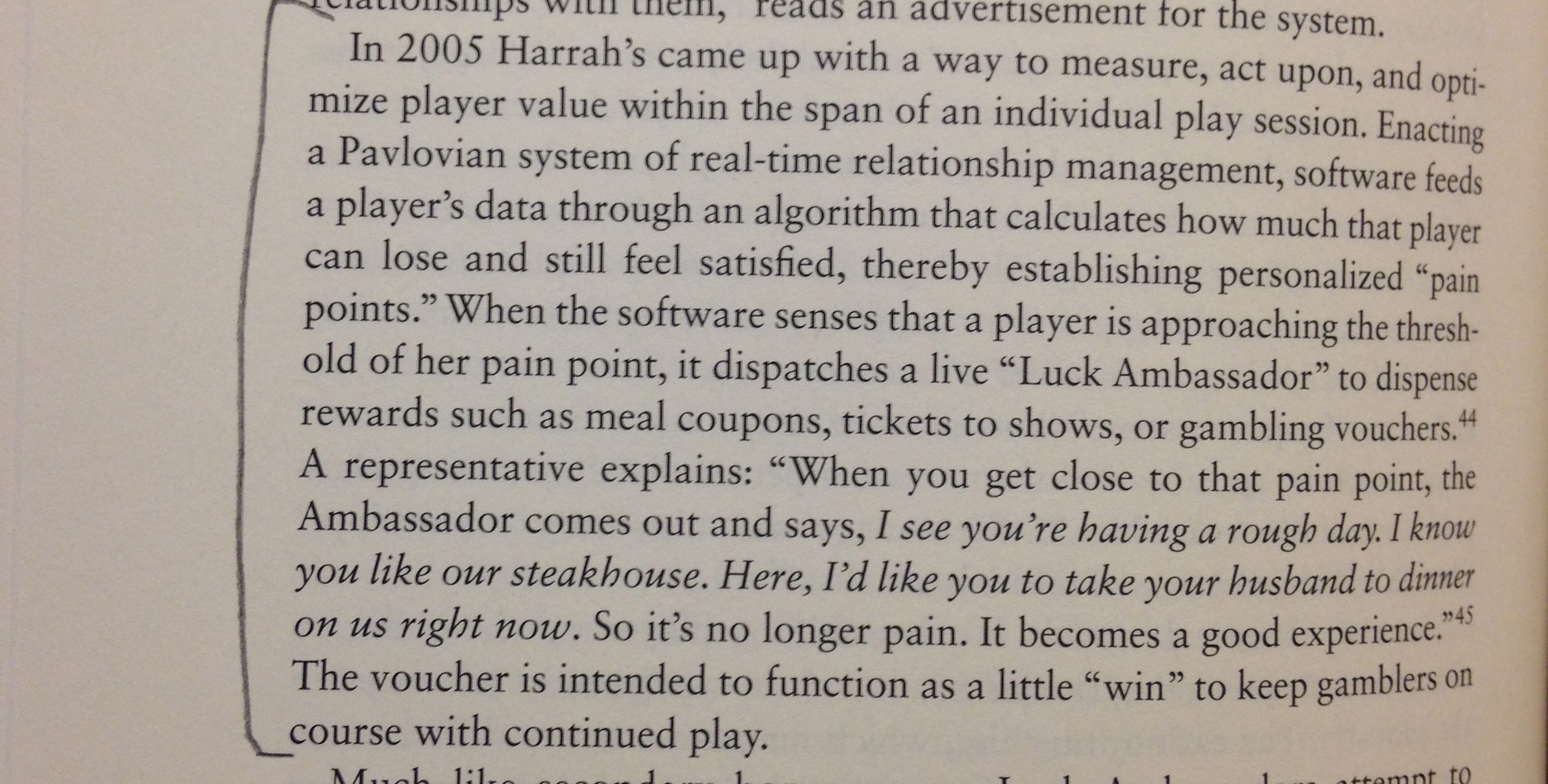

How about this?:
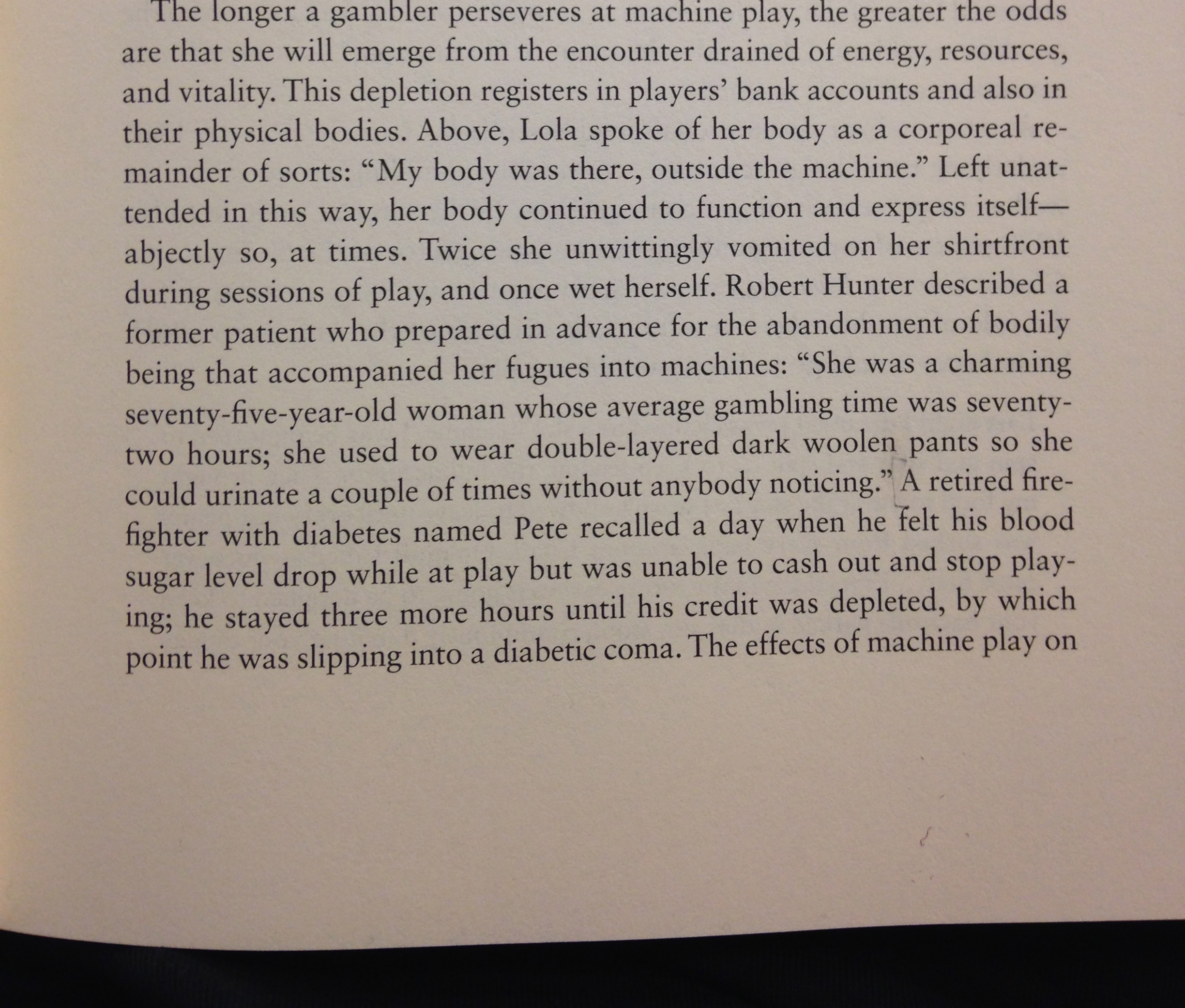
This detail: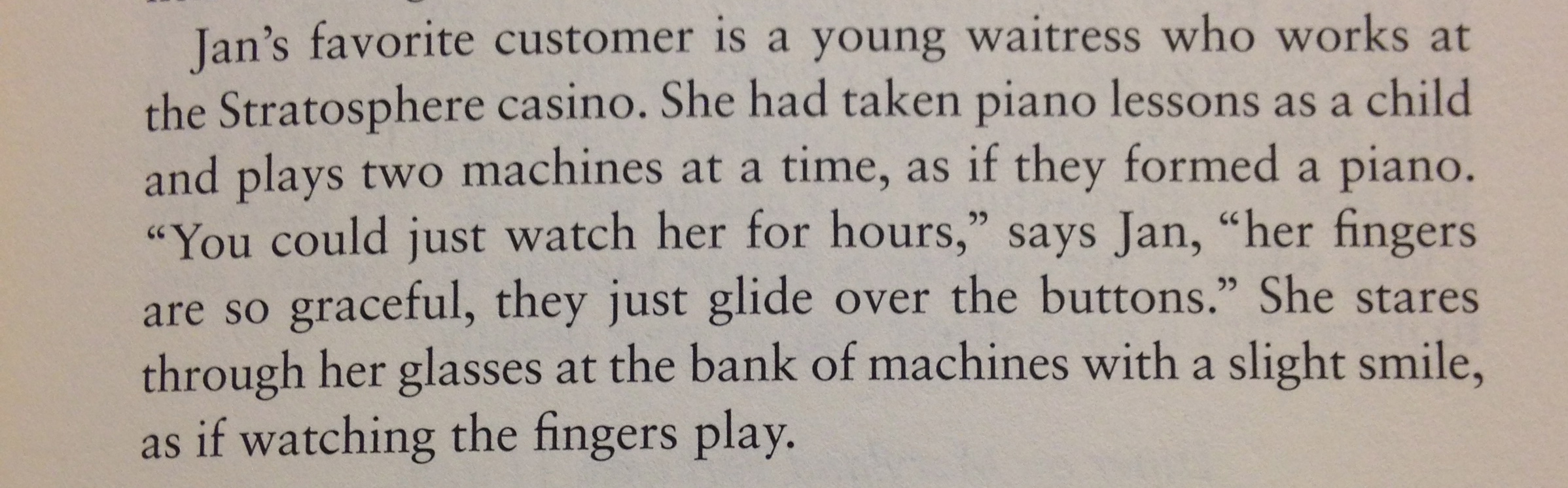
More on the greatest generation
Posted: August 7, 2014 Filed under: America Since 1945 Leave a comment
Yesterday’s post incited an unusual amount of correspondence. More perspective, from Sam Shepard (b. 1943)’s Paris Review interview:
INTERVIEWER
You said the men on your dad’s side of the family were hard drinkers. Is this why the mothers in your plays always seem to be caught in the middle of so much havoc?
SHEPARD
Those Midwestern women from the forties suffered an incredible psychological assault, mainly by men who were disappointed in a way that they didn’t understand. While growing up I saw that assault over and over again, and not only in my own family. These were men who came back from the war, had to settle down, raise a family and send the kids to school—and they just couldn’t handle it. There was something outrageous about it. I still don’t know what it was—maybe living through those adventures in the war and then having to come back to suburbia. Anyway, the women took it on the nose, and it wasn’t like they said, Hey Jack, you know, down the road, I’m leaving. They sat there and took it. I think there was a kind of heroism in those women. They were tough and selfless in a way. What they sacrificed at the hands of those maniacs . . .
INTERVIEWER
What was your dad like?
SHEPARD
He was also a maniac, but in a very quiet way. I had a falling-out with him at a relatively young age by the standards of that era. We were always butting up against each other, never seeing eye-to-eye on anything, and as I got older it escalated into a really bad, violent situation. Eventually I just decided to get out.
INTERVIEWER
Is he alive?
SHEPARD
No, a couple of years ago he was killed coming out of a bar in New Mexico. I saw him the year before he died. Our last meeting slipped into this gear where I knew it was going to turn really nasty. I remember forcing myself, for some reason, not to flip out. I don’t know why I made that decision, but I ended up leaving without coming back at him. He was boozed up, very violent and crazy. After that I didn’t see him for a long time. I did try to track him down; a friend of his told me he got a haircut, a fishing license, and a bottle, and then took off for the Pecos River. That was the last I heard of him before he died. He turned up a year later in New Mexico, with some woman I guess he was running with. They had a big blowout in a bar, and he went out in the street and got run over.
What a life Sam Shepard has had, btw:
His father, Samuel Shepard Rogers, Jr., was a teacher and farmer who served in the United States Army Air Forces as a bomber pilot.

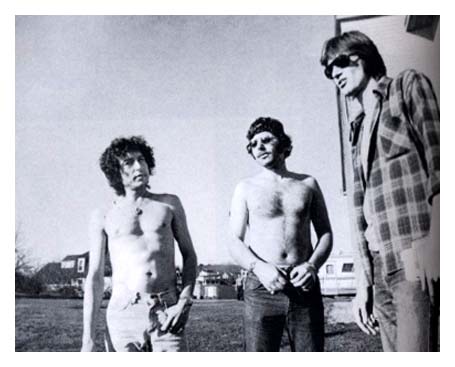
Shepard accompanied Bob Dylan on the Rolling Thunder Revue of 1975 as the ostensible screenwriter of the surrealist Renaldo and Clara (1978) that emerged from the tour; because much of the film was improvised, Shepard’s services were seldom utilized.
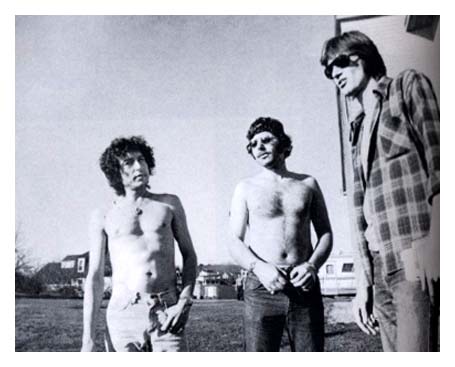
When Shepard first arrived in New York, he roomed with Charlie Mingus Jr., a friend from his high school days and the son of famous jazz musician Charles Mingus. Then he lived with actress Joyce Aaron. From 1969 to 1984 he was married to actress O-Lan Jones, with whom he has one son, Jesse Mojo Shepard (born 1970). In 1970-71, he was involved in an extramarital affair with Patti Smith, who remained unaware of Shepard’s identity as a multiple Obie Award-winning playwright until it was finally divulged to her by Jackie Curtis. According to Smith, “Me and his wife still even liked each other. I mean, it wasn’t like committing adultery in the suburbs or something.”
(top photo from here, middle from here, with Dylan from here)
The greatest generation
Posted: August 6, 2014 Filed under: America Since 1945 2 Comments
Two images I wanted to post that came up re: Warren Bennis, yesterday. This top one, and this one:
Both these pictures I’m getting from here, they’re credited to the National Archives, and I’m prepared to take them at their word.

These pictures, combined with this article in the NYT about the upcoming Brad Pitt movie “Fury” made me think about how the dudes that won World War II weren’t all like, mature men who knew exactly the risks and stakes of what they were doing, and were therefore the greatest heroes anyone has ever conceived of. Most of them were children, doing what they were told, involved in an enterprise that was fucked up and disastrously executed in every way at every turn.
Don’t take my word for it, take the word of a guy who was there:

Or this guy, who was there on the other side:

Fussell (if I remember right) talks about how, once word of the concentration camps got out, and they realized what they’d been fighting, he wasn’t even sure that made it better, he says “it might’ve made it worse.”
(The point I took away from these books is that destroying any myth around them doesn’t make them less cool. It makes them cooler still)
Warren Bennis
Posted: August 5, 2014 Filed under: America Since 1945 Leave a comment
This guy, a professor who specialized in the study of leadership, died the other day.
Once I took a class Warren Bennis co-taught with David Gergen, it was called something like “Art, Culture and The Politics Of Leadership.” I loved the class. I wrote my paper about Robert Sherwood, a playwright famed for “Abe Lincoln In Illinois,” who went on to write speeches for FDR.

Sherwood stood six feet eight inches tall. Dorothy Parker, who was five-feet four-inches, once commented that when she, Sherwood, and Robert Benchley (who was six feet tall) would walk down the street together, they looked like “a walking pipe organ.” When asked at a party how long he had known Sherwood, Robert Benchley stood on a chair, raised his hand to the ceiling, and said, “I knew Bob Sherwood back when he was only this tall.”
(Sometimes the Algonquin Round Table gang seems like they must’ve been pretty insufferable to be around.)
Anyway, I remember something Bennis used to talk about. When Bennis was 19 he was commissioned as a lieutenant in the Army and sent to Europe. It was 1945 — the troops he was sent to command were seasoned veterans already. They’d just survived the Battle Of The Bulge. He was just a kid rookie. Imagine that situation.

What he said happened was, the soldiers in his platoon “taught me how to lead them.”

What a profound thought. Will have to see if it comes up in Bennis’ autobiography:

(Badass thing to name your book).
Bennis also co-authored this book:

which is full of interesting stuff. There’s a story about Walt Disney, after he decided to make a feature length animated movie, the first ever, Snow White And The Seven Dwarfs. Disney gathered 200 or so animators and artists in an auditorium, stood up on stage, and acted out the entire movie for them. The whole thing, two hours. He “did” the witch and stuff, exactly how he wanted it drawn.
That was “visionary leadership,” says Bennis.
That was the same class in which I was made to do improv games with David Gergen.

(pics from “Philip Channing” here wiki here (National Archives) here here (Google search! It’s not like I read Rand Paul forums!))
Plenty to consider
Posted: July 30, 2014 Filed under: America Since 1945 Leave a comment
On the cover of just about any old issue of Life magazine.

I hardly ever even make it inside.

That’s before you even get to the back covers.

Flavor that goes with fun.

These are just issues I bought at random in a big box on eBay for maybe $25?
 (Please continue sending tips on how to photograph old magazines to helphely at gmail. Those from Lydia in Saratoga have been particularly helpful, thanks Lydia!)
Politics
Posted: July 29, 2014 Filed under: America Since 1945 Leave a commentReading this New Yorker profile of Biden threw me back to this YouTube. Master at work:
He loves it.
After [Hillary Clinton] delivered an impassioned endorsement for Obama and Biden at the Democratic National Convention, in 2008, Biden found her backstage, dropped to his knees in gratitude, and kissed her hand.
How about this?:
His friend Ted Kaufman says, “If you ask me who’s the unluckiest person I know personally, who’s had just terrible things happen to him, I’d say Joe Biden. If you asked me who is the luckiest person I know personally, who’s had things happen to him that are just absolutely incredible, I’d say Joe Biden.”
Now here is a lady.
Posted: July 14, 2014 Filed under: America Since 1945, music Leave a comment
Kate McGarrigle.
Her ex-father-in-law was Loudon Wainwright, Jr.:
Wainwright joined the staff of Life magazine and worked in a variety of positions over the years, including covering the Mercury astronauts. He and John Glenn listened to the inauguration speech of John F. Kennedy while riding in Glenn’s car in 1961.
John and Mrs. Glenn:

(from Lily Koppel’s extremely rad blog for her book for her (presumably) rad book The Astronaut Wives Club:

Buying that immediately. Check out the postcard she has up there now.
Loudon’s son and Kate’s ex of course is Loudon III:
The old Australian Crawl.
Happy Bastille Day!

In his later years [Jean-Pierre] Houël published two illustrated treatises on elephants. Drawings of other animals suggest he was preparing to publish further zoological works; however, his death at the age of seventy-eight cut short his plans.
 Helytimes