Losing The War by Lee Sandlin
Posted: January 13, 2015 Filed under: America Since 1945, writing, WW2 1 Comment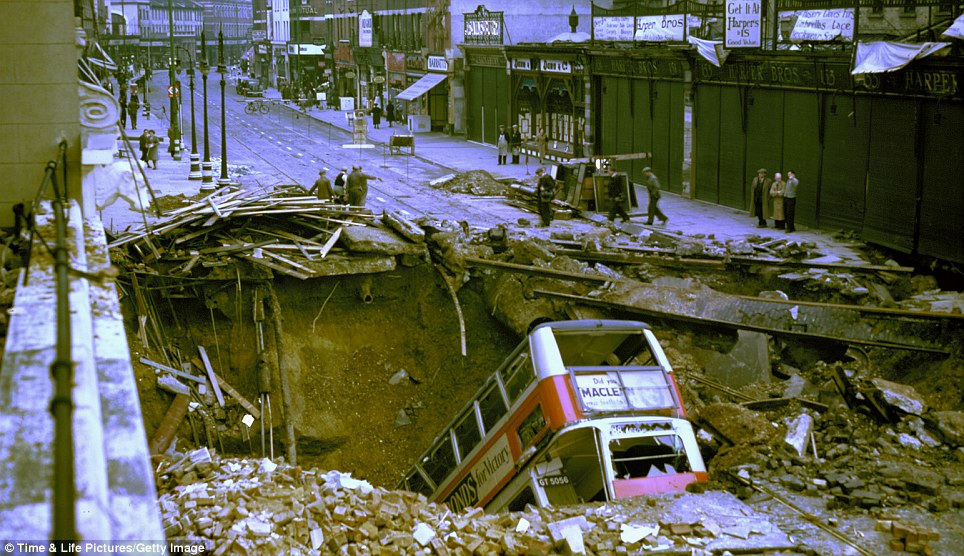
Time/Life photo found here: http://www.dailymail.co.uk/news/article-2016667/Colour-pictures-revealed-London-blitz-Nazi-bombers-World-War-II.html
I don’t know how I came across this essay, which was published in Chicago Review in 1999, but it’s by Lee Sandlin, an author I’d never heard of, and it was one of the best things I read in 2014.
One of the best things I’ve read about World War II ever. Insightful on government, history, human nature, memory, language. Would make this on mandatory reading for citizens, if somebody asked me. Though it’s very long (40 pages), I recommend it to you.
Hard even to pull out favorite parts but let me try:
The Greeks of Homer’s time, for instance, saw war as the one enduring constant underlying the petty affairs of humanity, as routine and all-consuming as the cycle of the seasons: grim and squalid in many ways, but still the essential time when the motives and powers of the gods are most manifest. To the Greeks, peace was nothing but a fluke, an irrelevance, an arbitrary delay brought on when bad weather forced the spring campaign to be canceled, or a back-room deal kept the troops at home until after harvest time. Any of Homer’s heroes would see the peaceful life of the average American as some bizarre aberration, like a garden mysteriously cultivated for decades on the slopes of an avalanche-haunted mountain.

found this here: http://maggiesfarm.anotherdotcom.com/index.php?url=archives/12640-Hitler-in-color.html&serendipity%5Bcview%5D=linear
One of the reasons behind the Japanese attack on Pearl Harbor—apart from the obvious military necessity of taking out the American fleet so that the Japanese military could conquer the western Pacific unopposed—was the unshakable conviction that Americans would collectively fold at the first sign of trouble; one big, nasty attack would be enough to get a negotiated settlement, on whatever terms the Japanese would care to name. In the same way Hitler and his inner circle were blithely sure that America would go to any lengths to stay out of the fight. Hitler’s catastrophic decision to declare war on America three days after Pearl Harbor was made almost in passing, as a diplomatic courtesy to the Japanese. To the end he professed himself baffled that America was in the war at all; he would have thought that if Americans really wanted to fight, they’d join with him against their traditional enemies, the British. But evidently they were too much under the thumb of Roosevelt—whom Hitler was positive was a Jew named Rosenfeldt, part of the same evil cabal that controlled Stalin.
As fanciful as that was, it shows the average wartime grasp of the real motives of the enemy. It was at least on a par with the American Left’s conviction that Hitler was an irrelevant puppet in the hands of the world’s leading industrialists. Throughout the war all sides regarded one another with blank incomprehension: the course of the war was distinguished by a striking absence of one of the favorite sentimental cliches of the battlefield (which was afterward said to have marked World War I)—the touching scene in the trenches where soldiers on opposed sides surreptitiously acknowledge their common humanity. For the soldiers, for the citizens at large, and for all those churning out oceans of propaganda, the enemy was a featureless mass of inscrutable, dishonorable malignity.
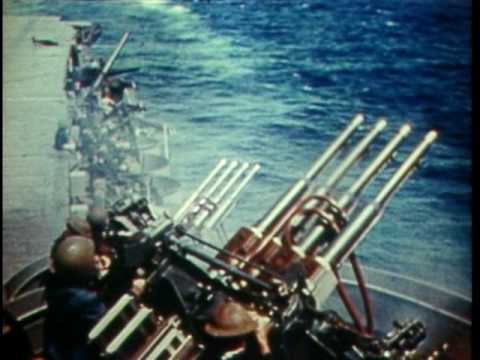
footage from John Ford’s documentary shot during Midway
Here, Lee Sandlin describes the Battle of Midway, drawing on “survivors’ accounts, and from a small library of academic and military histories, ranging in scope and style from Walter Lord’s epic Miracle at Midway to John Keegan’s brilliant tactical analysis in The Price of Admiralty: The Evolution of Naval Warfare”
But the sailors on board the Japanese fleet saw things differently. They didn’t meet any American ships on June 4. That day, as on all the other days of their voyage, they saw nothing from horizon to horizon but the immensity of the Pacific. Somewhere beyond the horizon line, shortly after dawn, Japanese pilots from the carriers had discovered the presence of the American fleet, but for the Japanese sailors, the only indications of anything unusual that morning were two brief flyovers by American fighter squadrons. Both had made ineffectual attacks and flown off again. Coming on toward 10:30 AM, with no further sign of enemy activity anywhere near, the commanders ordered the crews on the aircraft carriers to prepare for the final assault on the island, which wasn’t yet visible on the horizon.
That was when a squadron of American dive-bombers came out of the clouds overhead. They’d got lost earlier that morning and were trying to make their way back to base. In the empty ocean below they spotted a fading wake—one of the Japanese escort ships had been diverted from the convoy to drop a depth charge on a suspected American submarine. The squadron followed it just to see where it might lead. A few minutes later they cleared a cloud deck and discovered themselves directly above the single largest “target of opportunity,” as the military saying goes, that any American bomber had ever been offered.
When we try to imagine what happened next we’re likely to get an image out of Star Wars—daring attack planes, as graceful as swallows, darting among the ponderously churning cannons of some behemoth of a Death Star. But the sci-fi trappings of Star Wars disguise an archaic and sluggish idea of battle. What happened instead was this: the American squadron commander gave the order to attack, the planes came hurtling down from around 12,000 feet and released their bombs, and then they pulled out of their dives and were gone. That was all. Most of the Japanese sailors didn’t even see them.
The aircraft carriers were in a frenzy just then. Dozens of planes were being refueled and rearmed on the hangar decks, and elevators were raising them to the flight decks, where other planes were already revving up for takeoff. The noise was deafening, and the warning sirens were inaudible. Only the sudden, shattering bass thunder of the big guns going off underneath the bedlam alerted the sailors that anything was wrong. That was when they looked up. By then the planes were already soaring out of sight, and the black blobs of the bombs were already descending from the brilliant sky in a languorous glide.
One bomb fell on the flight deck of the Akagi, the flagship of the fleet, and exploded amidships near the elevator. The concussion wave of the blast roared through the open shaft to the hangar deck below, where it detonated a stack of torpedoes. The explosion that followed was so powerful it ruptured the flight deck; a fireball flashed like a volcano through the blast crater and swallowed up the midsection of the ship. Sailors were killed instantly by the fierce heat, by hydrostatic shock from the concussion wave, by flying shards of steel; they were hurled overboard unconscious and drowned. The sailors in the engine room were killed by flames drawn through the ventilating system. Two hundred died in all. Then came more explosions rumbling up from below decks as the fuel reserves ignited. That was when the captain, still frozen in shock and disbelief, collected his wits sufficiently to recognize that the ship had to be abandoned.
Meanwhile another carrier, the Kaga, was hit by a bomb that exploded directly on the hangar deck. The deck was strewn with live artillery shells, and open fuel lines snaked everywhere. Within seconds, explosions were going off in cascading chain reactions, and uncontrollable fuel fires were breaking out all along the length of the ship. Eight hundred sailors died. On the flight deck a fuel truck exploded and began shooting wide fans of ignited fuel in all directions; the captain and the rest of the senior officers, watching in horror from the bridge, were caught in the spray, and they all burned to death.
Less than five minutes had passed since the American planes had first appeared overhead. The Akagi and the Kaga were breaking up. Billowing columns of smoke towered above the horizon line. These attracted another American bomber squadron, which immediately launched an attack on a third aircraft carrier, the Soryu. These bombs were less effective—they set off fuel fires all over the ship, but the desperate crew managed to get them under control. Still, the Soryu was so badly damaged it was helpless. Shortly afterward it was targeted by an American submarine (the same one the escort ship had earlier tried to drop a depth charge on). American subs in those days were a byword for military ineffectiveness; they were notorious for their faulty and unpredictable torpedoes. But the crew of this particular sub had a large stationary target to fire at point-blank. The Soryu was blasted apart by repeated direct hits. Seven hundred sailors died.
The last of the carriers, the Hiryu, managed to escape untouched, but later that afternoon it was located and attacked by another flight of American bombers. One bomb set off an explosion so strong it blew the elevator assembly into the bridge. More than 400 died, and the crippled ship had to be scuttled a few hours later to keep it from being captured.
Now there was nothing left of the Japanese attack force except a scattering of escort ships and the planes still in the air. The pilots were the final casualties of the battle; with the aircraft carriers gone, and with Midway still in American hands, they had nowhere to land. They were doomed to circle helplessly above the sinking debris, the floating bodies, and the burning oil slicks until their fuel ran out.
This was the Battle of Midway. As John Keegan writes, it was “the most stunning and decisive blow in the history of naval warfare.” Its consequences were instant, permanent and devastating. It gutted Japan’s navy and broke its strategy for the Pacific war. The Japanese would never complete their perimeter around their new empire; instead they were thrown back on the defensive, against an increasingly large and better-organized American force, which grew surgingly confident after its spectacular victory. After Midway, as the Japanese scrambled to rebuild their shattered fleet, the Americans went on the attack. In August 1942 they began landing a marine force on the small island of Guadalcanal (it’s in the Solomons, near New Guinea) and inexorably forced a breach in the perimeter in the southern Pacific. From there American forces began fanning out into the outer reaches of the empire, cutting supply lines and isolating the strongest garrisons. From Midway till the end of the war the Japanese didn’t win a single substantial engagement against the Americans. They had “lost the initiative,” as the bland military saying goes, and they never got it back.
But it seems somehow paltry and wrong to call what happened at Midway a “battle.” It had nothing to do with battles the way they were pictured in the popular imagination. There were no last-gasp gestures of transcendent heroism, no brilliant counterstrategies that saved the day. It was more like an industrial accident. It was a clash not between armies, but between TNT and ignited petroleum and drop-forged steel. The thousands who died there weren’t warriors but bystanders—the workers at the factory who happened to draw the shift when the boiler exploded…

Akagi. There’s an interesting note here on this Navy website about why there are so few photos of the Japanese ships: http://www.history.navy.mil/photos/events/wwii-pac/midway/mid-4k.htm
Re: American war reporting:
What were they supposed to say about what they were seeing? At Kasserine American soldiers were blown apart into shreds of flesh scattered among the smoking ruins of exploded tanks. Ernie Pyle called this “disappointing.” Well, why not? There were no other words to describe the thing that had happened there. The truth was, the only language that seemed to register the appalling strangeness of the war was supernatural: the ghost story where nightmarish powers erupt out of nothingness, the glimpse into the occult void where human beings would be destroyed by unearthly forces they couldn’t hope to comprehend. Even the most routine event of the war, the firing of an artillery shell, seemed somehow uncanny. The launch of a shell and its explosive arrival were so far apart in space and time you could hardly believe they were part of the same event, and for those in the middle there was only the creepy whisper of its passage, from nowhere to nowhere, like a rip in the fabric of causality.
On the bureaucracy of the war:
There’s another military phrase: “in harm’s way.” That’s what everybody assumes going to war means—putting yourself in danger. But the truth is that for most soldiers war is no more inherently dangerous than any other line of work. Modern warfare has grown so complicated and requires such immense movements of men and materiel over so vast an expanse of territory that an ever-increasing proportion of every army is given over to supply, tactical support, and logistics. Only about one in five of the soldiers who took part in World War II was in a combat unit (by the time of Vietnam the ratio in the American armed forces was down to around one in seven). The rest were construction workers, accountants, drivers, technicians, cooks, file clerks, repairmen, warehouse managers—the war was essentially a self-contained economic system that swelled up out of nothing and covered the globe.
For most soldiers the dominant memory they had of the war was of that vast structure arching up unimaginably high overhead. It’s no coincidence that two of the most widely read and memorable American novels of the war, Joseph Heller’s Catch-22 and Thomas Pynchon’s Gravity’s Rainbow, are almost wholly about the cosmic scale of the American military’s corporate bureaucracy and mention Hitler and the Nazis only in passing. Actual combat could seem like almost an incidental side product of the immense project of military industrialization. A battle for most soldiers was something that happened up the road, or on the fogbound islands edging the horizon, or in the silhouettes of remote hilltops lit up at night by silent flickering, which they mistook at first for summer lightning. And when reporters traveled through the vast territories under military occupation looking for some evidence of real fighting, what they were more likely to find instead was a scene like what Martha Gellhorn, covering the war for Collier’s, discovered in the depths of the Italian countryside: “The road signs were fantastic….The routes themselves, renamed for this operation, were marked with the symbols of their names, a painted animal or a painted object. There were the code numbers of every outfit, road warnings—bridge blown, crater mines, bad bends—indications of first-aid posts, gasoline dumps, repair stations, prisoner-of-war cages, and finally a marvelous Polish sign urging the troops to notice that this was a malarial area: this sign was a large green death’s-head with a mosquito sitting on it.”
That was the war: omnipresent, weedlike tendrils of contingency and code spreading over a landscape where the battle had long since passed.
It was much the same in the U.S. The bureaucracy of war became an overpowering presence in people’s lives, even though the reality of battle was impossibly remote. Prices were controlled by war-related government departments, nonessential nonmilitary construction required a nightmare of paperwork, food and gas were rationed—any long-distance car travel that wasn’t for war business meant a special hearing before a ration board, and almost every train snaking through the depths of the heartland had been commandeered for classified military transport. The necessities of war even broke up the conventional proprieties of marriage: the universal inevitability of military service meant that young couples got married quickly, sometimes at first meeting—and often only so the women could get the military paycheck and the ration stamps.
The war was the single dominant fact in the world, saturating every radio show and newspaper. Every pennant race was described on the sports pages in the metaphor of battle; every car wreck and hotel fire was compared to the air raids that everyone was still expecting to hit the blacked-out cities on the coasts.
But who was controlling the growth of this fantastic edifice? Nobody could say. People who went to Washington during those years found a desperately overcrowded town caught up in a kind of diffuse bureaucratic riot. New agencies and administrations overflowed from labyrinthine warrens of temporary office space. People came to expect that the simplest problem would lead to hours or days of wandering down featureless corridors, passing door after closed door spattered by uncrackable alphabetic codes: OPA, OWI, OSS. Nor could you expect any help or sympathy once you found the right office: if the swarms of new government workers weren’t focused on the latest crisis in the Pacific, they were distracted by the hopeless task of finding an apartment or a boarding house or a cot in a spare room. Either way, they didn’t give a damn about solving your little squabble about petroleum rationing.
It might have been some consolation to know that people around the world were stuck with exactly the same problems—particularly people on the enemy side. There was a myth (it still persists) that the Nazi state was a model of efficiency; the truth was that it was a bureaucratic shambles. The military functioned well—Hitler gave it a blank check—but civilian life was made a misery by countless competing agencies and new ministries, all claiming absolute power over every detail of German life. Any task, from getting repairs in an apartment building to requisitioning office equipment, required running a gauntlet of contradictory regulations. One historian later described Nazi Germany as “authoritarian anarchy.”
But then everything about the war was ad hoc and provisional. The British set up secret installations in country estates; Stalin had his supreme military headquarters in a commandeered Moscow subway station. Nobody cared about making the system logical, because everything only needed to happen once. Every battle was unrepeatable, every campaign was a special case. The people who were actually making the decisions in the war—for the most part, senior staff officers and civil service workers who hid behind anonymous doors and unsigned briefing papers—lurched from one improvisation to the next, with no sense of how much the limitless powers they were mustering were remaking the world.
But there was one constant. From the summer of 1942 on, the whole Allied war effort, the immensity of its armies and its industries, were focused on a single overriding goal: the destruction of the German army in Europe. Allied strategists had concluded that the global structure of the Axis would fall apart if the main military strength of the German Reich could be broken. But that task looked to be unimaginably difficult. It meant building up an overwhelmingly large army of their own, somehow getting it on the ground in Europe, and confronting the German army at point-blank range. How could this possibly be accomplished? The plan was worked out at endless briefings and diplomatic meetings and strategy sessions held during the first half of 1942. The Soviet Red Army would have to break through the Russian front and move into Germany from the east. Meanwhile, a new Allied army would get across the English Channel and land in France, and the two armies would converge on Berlin.
The plan set the true clock time of the war. No matter what the surface play of battle was in Africa or the South Seas, the underlying dynamic never changed: every hour, every day the Allies were preparing for the invasion of Europe. They were stockpiling thousands of landing craft, tens of thousands of tanks, millions upon millions of rifles and mortars and howitzers, oceans of bullets and bombs and artillery shells—the united power of the American and Russian economies was slowly building up a military force large enough to overrun a continent. The sheer bulk of the armaments involved would have been unimaginable a few years earlier. One number may suggest the scale. Before the war began the entire German Luftwaffe consisted of 4,000 planes; by the time of the Normandy invasion American factories were turning out 4,000 new planes every two weeks.

Kursk tanks, found here: http://www.battleofkursk.org/Battle-of-Kursk-Tanks.html
On how much crazier the Eastern Front was:
In August 1943, for instance, in the hilly countryside around the town of Kursk (about 200 miles south of Moscow), the German and Soviet armies collided in an uncontrolled slaughter: more than four million men and thousands of tanks desperately maneuvered through miles of densely packed minefields and horizon-filling networks of artillery fire. It may have been the single largest battle fought in human history, and it ended—like all the battles on the eastern front—in a draw.

On an uncanny force driving war through history:
In the First Book of Maccabees it’s written that Alexander the Great “made many wars, and won many strongholds, and slew the kings of the earth, and went through to the ends of the earth, and took spoils of many nations, insomuch that the earth was quiet before him.” Uncharacteristically for the Bible, there is no moral judgment offered on the way Alexander chose to pass his time. Maybe this is because there couldn’t be. There are certain people whose lives are so vastly out of scale with the rest of humanity, whether for good or evil, that the conventional verdicts seem foolish. Alexander, like Genghis Khan or Napoleon, was born to be a world wrecker. He single-handedly brought down the timeless empires of pagan antiquity and turned names like Babylon and Persia into exotic, dim legends. His influence was so dramatic and pervasive that people were still talking about him as the dominant force in the world centuries after he was dead. The writers of the Apocrypha knew that he was somehow responsible for the circumstances that led to the Maccabean revolt, even though he’d never set foot in Judea. The Romans knew that their empire was possible only because it was built out of the wreckage Alexander had left behind him in the Middle East. We know that Western civilization is arranged the way it is in large part because Alexander destroyed the civilizations that came before it.
But why had he done it? The author of Maccabees received no divine insight on that score. Nobody did. Even the people who actually knew Alexander were baffled by him. According to all the biographies and versified epics about him that have survived from the ancient world, his friends and subordinates found him almost impossible to read. He never talked about what he wanted or whether there was any conquest that would finally satisfy him; he never revealed the cause of the unappeasable sense of grievance that led him to take on the kings of the earth. Yet his peculiar manner led a lot of people in his entourage to think that he was somehow in touch with divine forces. He frequently had an air of trancelike distraction, as though his brilliant military strategies were dictated by some mysterious inner voice, and he had a habit of staring not quite at people but just over their shoulder, as though he were picking up some ethereal presence in the room invisible to everybody else. But even without these signs, people were bound to think that he was fulfilling a god’s unknowable whims. After all, what he was doing made no sense in human terms: it was global destruction for its own sake, and what mortal could possibly want that?
“Pilots pleased over their victory during the Marshall Islands attack, grin across the tail of an F6F Hellcat on board the USS LEXINGTON, after shooting down 17 out of 20 Japanese planes heading for Tarawa.” Comdr. Edward Steichen, November 1943. 80-G-470985. (ww2_75.jpg, National Archives)

How about this, on the Old Norse vocabulary of war:
Another Viking term was “fey.” People now understand it to mean effeminate. Previously it meant odd, and before that uncanny, fairylike. That was back when fairyland was the most sinister place people could imagine. The Old Norse word meant “doomed.” It was used to refer to an eerie mood that would come over people in battle, a kind of transcendent despair. The state was described vividly by an American reporter, Tom Lea, in the midst of the desperate Battle of Peleliu in the South Pacific. He felt something inside of himself, some instinctive psychic urge to keep himself alive, finally collapse at the sight of one more dead soldier in the ruins of a tropical jungle: “He seemed so quiet and empty and past all the small things a man could love or hate. I suddenly knew I no longer had to defend my beating heart against the stillness of death. There was no defense.”
There was no defense—that’s fey. People go through battle willing the bullet to miss, the shelling to stop, the heart to go on beating—and then they feel something in their soul surrender, and they give in to everything they’ve been most afraid of. It’s like a glimpse of eternity. Whether the battle is lost or won, it will never end; it has wholly taken over the soul. Sometimes men say afterward that the most terrifying moment of any battle is seeing a fey look on the faces of the soldiers standing next to them.
But the fey becomes accessible to civilians in a war too—if the war goes on long enough and its psychic effects become sufficiently pervasive. World War II went on so long that both soldiers and civilians began to think of feyness as a universal condition. They surrendered to that eternity of dread: the inevitable, shattering resumption of an artillery barrage; the implacable cruelty of an occupying army; the panic, never to be overcome despite a thousand false alarms, at an unexpected knock on the door, or a telegram, or the sight out the front window of an unfamiliar car pulling to a halt. They got so used to the war they reached a state of acquiescence, certain they wouldn’t stop being scared until they were dead.
It was in a fey mood that, in the depths of the German invasion, Russian literary scholar Mikhail Bakhtin took the only copy of his life’s work, a study of Goethe, and ripped it up, page by page and day by day, for that unobtainable commodity, cigarette paper.

“USS SHAW exploding during the Japanese raid on Pearl Harbor.” December 7, 1941. 80-G-16871. From the National Archives
A feyness of bureaucracy:
A rational calculation of the odds is a calculation by the logic of peace. War has a different logic. A kind of vast feyness can infect a military bureaucracy when it’s losing a war, a collective slippage of the sense of objective truth in the face of approaching disaster. In the later years of World War II the bureaucracies of the Axis—partially in Germany, almost wholly in Japan—gave up any pretense of realism about their situation. Their armies were fighting all over the world with desperate berserker fury, savagely contesting every inch of terrain, hurling countless suicide raids against Allied battalions (kamikaze attacks on American ships at Okinawa came in waves of a hundred planes at a time)—while the bureaucrats behind the lines gradually retreated into a dreamy paper war where they were on the brink of a triumphant reversal of fortune.
They had the evidence. Officers in the field, unable to face or admit the imminence of defeat, routinely submitted false reports up the chain of command. Commanders up the line were increasingly prone to believe them, or to pretend to believe them. And so, as the final catastrophe approached, strategists in both Berlin and Tokyo could be heard solemnly discussing the immense weight of paper that documented the latest round of imaginary victories, the long-overrun positions that they still claimed to hold, and the Allied armies and fleets that had just been conclusively destroyed—even though the real-world Allied equivalents had crashed through the lines and were advancing toward the homeland.

“Two bewildered old ladies stand amid the leveled ruins of the almshouse which was Home; until Jerry dropped his bombs. Total war knows no bounds. Almshouse bombed Feb. 10, Newbury, Berks., England.” Naccarata, February 11, 1943. 111-SC-178801.
The logic of the end of the war, fall ’44 onward:
That was when the Allies changed their strategy. They set out to make an Axis surrender irrelevant.
From that winter into the next spring the civilians of Germany and Japan were helpless before a new Allied campaign of systematic aerial bombardment. The air forces and air defense systems of the Axis were in ruins by then. Allied planes flew where they pleased, day or night—500 at a time, then 1,000 at a time, indiscriminately dumping avalanches of bombs on every city and town in Axis territory that had a military installation or a railroad yard or a factory. By the end of the winter most of Germany’s industrial base had been bombed repeatedly in saturation attacks; by the end of the following spring Allied firebombing raids had burned more than 60 percent of Japan’s urban surface area to the ground.
…
This is the dreadful logic that comes to control a lot of wars. (The American Civil War is another example.) The losers prolong their agony as much as possible, because they’re convinced the alternative is worse. Meanwhile the winners, who might earlier have accepted a compromise peace, become so maddened by the refusal of their enemies to stop fighting that they see no reason to settle for anything less than absolute victory. In this sense the later course of World War II was typical: it kept on escalating, no matter what the strategic situation was, and it grew progressively more violent and uncontrollable long after the outcome was a foregone conclusion. The difference was that no other war had ever had such deep reserves of violence to draw upon.
The Vikings would have understood it anyway. They didn’t have a word for the prolongation of war long past any rational goal—they just knew that’s what always happened. It’s the subject of their longest and greatest saga, the Brennu-njalasaga, or The Saga of Njal Burned Alive. The saga describes a trivial feud in backcountry Iceland that keeps escalating for reasons nobody can understand or resolve until it engulfs the whole of northern Europe.
[amazing digression on that]
…But another, even stronger pressure worked against those who understood how hopeless the situation really was: they knew that defeat meant accountability.

“Photograph made from B-17 Flying Fortress of the 8th AAF Bomber Command on 31 Dec. when they attacked the vital CAM ball- bearing plant and the nearby Hispano Suiza aircraft engine repair depot in Paris.” France, 1943. 208-EX-249A-27.
Sandlin’s discussion of the decision to drop the atomic bombs is one of the best I’ve ever read. Here’s how he warms up to it:
We forget now just how pervasive the atmosphere of classified activity was, but there was hardly anybody, in all of the war’s military bureaucracies, who could honestly claim to know everything that was going on. The best information—whole Mississippis of debriefings and intelligence assessments and field reports and rumors—went up the line and vanished. And what returned, from some unimaginable bureaucratic firmament, were orders—taciturn, uncommunicative instructions, raining down ceaselessly, specifying mysterious troop movements, baffling supply requisitions, unexplained production quotas, and senseless rationing goals. Everywhere were odd networks of power and covert channels of communication. No matter how well placed you were, you were still excluded from incessant meetings, streams of memos were routed around your office, old friends grew vague when you asked what department they worked in (a “special” department, they always said—nobody liked coming out and saying “secret”). Everybody was doing something hush-hush; nobody blinked at the most imponderable mysteries.
So there was barely a ripple when, in the spring of 1943, all the leading physicists in America disappeared.
The end of the war, in the US:
That was the message that flashed around the world in the summer of 1945: the war is over, the war is over. Huge cheering crowds greeted the announcement in cities across America and Europe. A spectacular clamor of church bells rang out across the heartland. Wails of car horns and sirens soared up from isolated desert towns, mystifying travelers who’d been on the road all night and hadn’t heard the news. People pounded on doors in hushed apartment buildings, they came out from their houses and laughed and cheered and hugged one another, they swarmed in the streets all through the summer night telling strangers how frightened they’d been and how glad they were it had finally ended. No one could stop talking; every new face that appeared in the crowd was an excuse to ask if they’d heard and then start telling their stories all over again.

“Jubilant American soldier hugs motherly English woman and victory smiles light the faces of happy service men and civilians at Piccadilly Circus, London, celebrating Germany’s unconditional surrender.” Pfc. Melvin Weiss, England, May 7, 1945. 111-SC-205398.
Read the whole thing, is my suggestion.

At the White House, President Truman announces Japan’s surrender. Abbie Rowe, Washington, DC, August 14, 1945. 79-AR-508Q.
I was thinking about this article over Christmas, and resolved that in 2015 I would write Lee Sandlin a note telling him how much it blew my head off. Too late, though. Lee Sandlin died on Dec. 14, 2014 – that’s why, I guess, it was reposted and reached me.

Found that photo on his website, which seems like a great memorial to the man. A list of some of his favorite stuff. And from his section “Rationals:”
I’m just a guy who writes about stuff that happened. But at least there’s a long tradition of this kind of writing. My model has always been William Hazlitt, who two hundred years ago wrote essays, reviews, travel writings, memoirs, celebrity profiles, sports reporting — each piece was simply about what happened, and yet each piece, no matter what the subject, reads like an act of total moral engagement. Hazlitt brought everything he knew, and everything he was, to the task of writing about what happened.
And back beyond that, way back, twenty five hundred years ago, the grandest and airiest work of philosophical speculation ever written begins as a plain report of what happened. In fact, it might easily be mistaken for a review:
Yesterday I went down to the Piraeus with Glaucon the Ariston, to make an offering to the Goddess, and also to see their Festival, which they were putting on for the first time this year. I liked the procession, but I think the procession at Thrace is more beautiful…
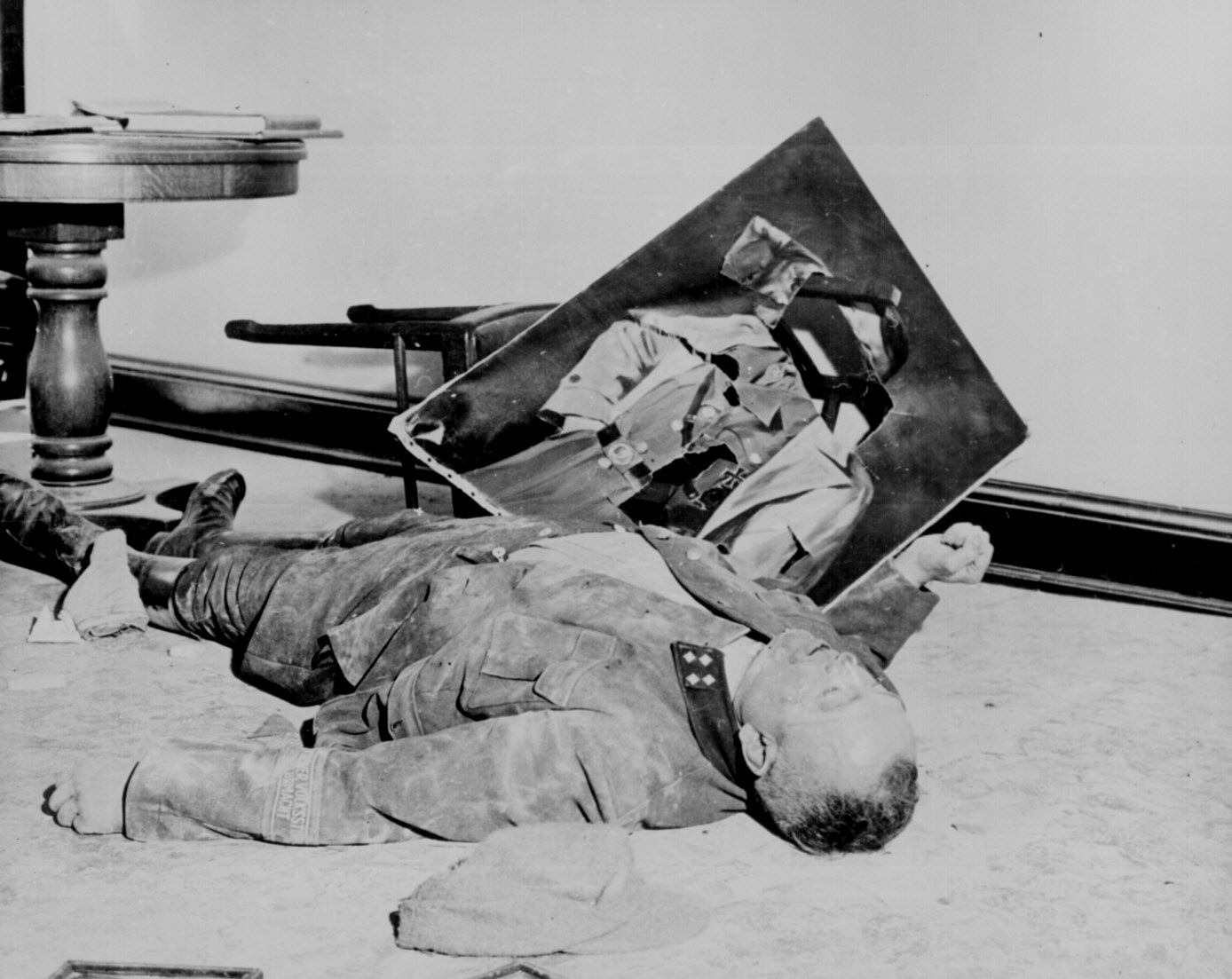
Found most of those photos at the National Archives. Here is a ghastly one of a Nazi general who committed suicide, and here are four more amazing ones:

“Dynamic static. The motion of its props causes an `aura’ to form around this F6F on USS YORKTOWN. Rotating with blades, halo moves aft, giving depth and perspective.” November 1943. 80-G-204747A.

“Marines of the 5th Division inch their way up a slope on Red Beach No. 1 toward Surbachi Yama as the smoke of the battle drifts about them.” Dreyfuss, Iwo Jima, February 19, 1945.

“The Yanks mop up on Bougainville. At night the Japs would infiltrate American lines. At Dawn, the doughboys went out and killed them. This photo shows tank going forward, infantrymen following in its cover.” March 1944. 111-SC-189099.

“Dust storm at this War Relocation Authority center where evacuees of Japanese ancestry are spending the duration.” Dorothea Lange, Manzanar, CA, July 3, 1942. 210-G-10C-839.
Tennessee Williams -> Dr. Feelgood -> Mark Shaw
Posted: January 6, 2015 Filed under: America Since 1945, Florida, Kennedy-Nixon, writing 1 Comment
Tennessee Williams in Key West
Strewn around the apartment of a friend this weekend were a few biographies of Tennessee Williams.
I don’t know much about Tennessee Williams. The most I ever thought about him was when I was briefly in Key West, where there’s some stuff named after him. He jockeys with Hemingway for local literary mascot top honors.
Looking into it, I found this stupefying article about TW in Key West from People Magazine, 1979, entitled “In His Beloved Key West, Tennessee Williams Is Center Stage In A Furor Over Gays.” Tough reading, on the one hand. On the other maybe we can find some optimism in how far things have come?:
Some of Williams’ friends are less sanguine—notably Rader (whom some Key West sympathizers find faintly hysterical on the subject). “It has been terrible,” he said in the aftermath. “Tenn won’t talk about it, but it has been really frightening what’s happening in Key West and in this house. The worst was the night they stood outside his front porch and threw beer cans, shouting, ‘Come on out, faggot.’ When they set off the firecrackers, I remember thinking, ‘God, this is it. We’re under attack. They’ve started shooting.’ ”
Williams’ imperturbability springs both from a matter of principle (he once defined gallantry as “the grace with which one survives appalling experiences”) and from a diminished interest in the Key West gay scene. “I’ve retired from the field of homosexuality at present,” he explains, “because of age. I have no desires—isn’t that strange? I have dreams, but no waking interest.” The thought does not cheer him. “I’ve always found life unsatisfactory,” he says. “It’s unsatisfactory now, especially since I’ve given up sex.” His own problems seem far more pressing to him than the city’s. “I suspect I’ll only live another two years,” says Williams, 68, who tipples white wine from morning on and complains of heart and pancreas disorders. “I’ve been working like a son of a bitch since 1969 to make an artistic comeback. I don’t care about the money, but I can’t give up art—there’s no release short of death. It’s quite painful. I’ll be dictating on my deathbed. I want people to say, ‘Yes, this man is still an artist.’ They haven’t been saying it much lately.”
As a consummate prober of human passions, Williams does have theories on why his adopted hometown is under siege. “There are punks here,” he explains. “That’s because a couple of gay magazines publicized this place as if it were the Fire Island of Florida. It isn’t. One Fire Island is quite enough. But it attracted the wrong sort of people here: the predators who are looking for homosexuals. I think the violence will be gone by next year.”
Other residents seem less willing to wait. The leader of the anti-gay forces, the Reverend Wright, says Anita Bryant has promised to come to Key West to help his crusade. Recalling nostalgically the days when “female impersonators and queers were loaded into a deputy’s automobile and shipped to the county line,” Wright warns: “We’ll either have a revival of our society or the homosexuals will take it over in five years.”
Mamet On Williams
This morning happened to pick up in my garage this book by David Mamet:
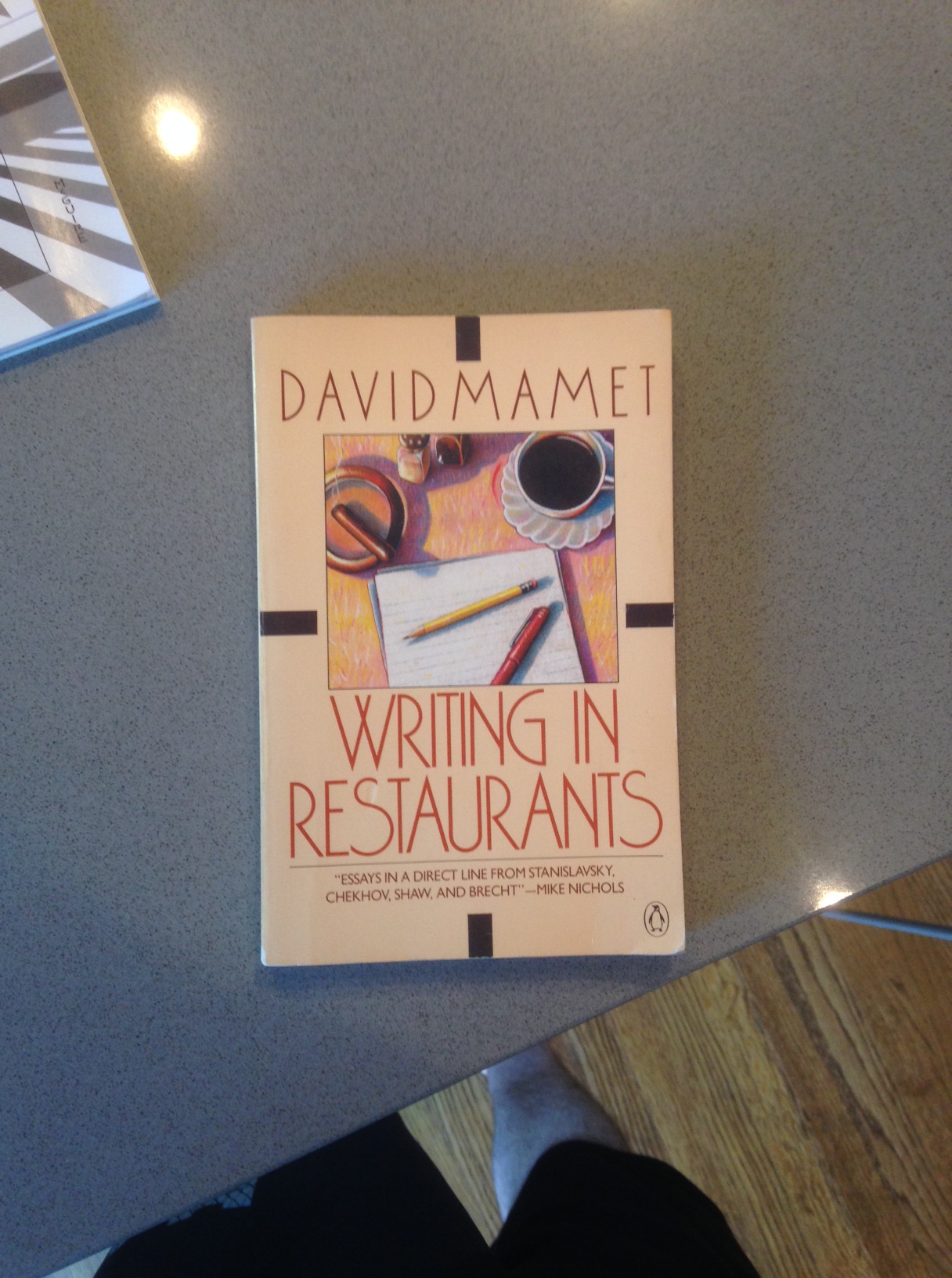
Highly recommend this book as well as Three Uses Of The Knife, True And False: Heresy And Common Sense For The Actor, and On Directing Film by Mamet. All short, all tight, all good. (His subsequent nonfiction seems to me to be a bit… deranged?)
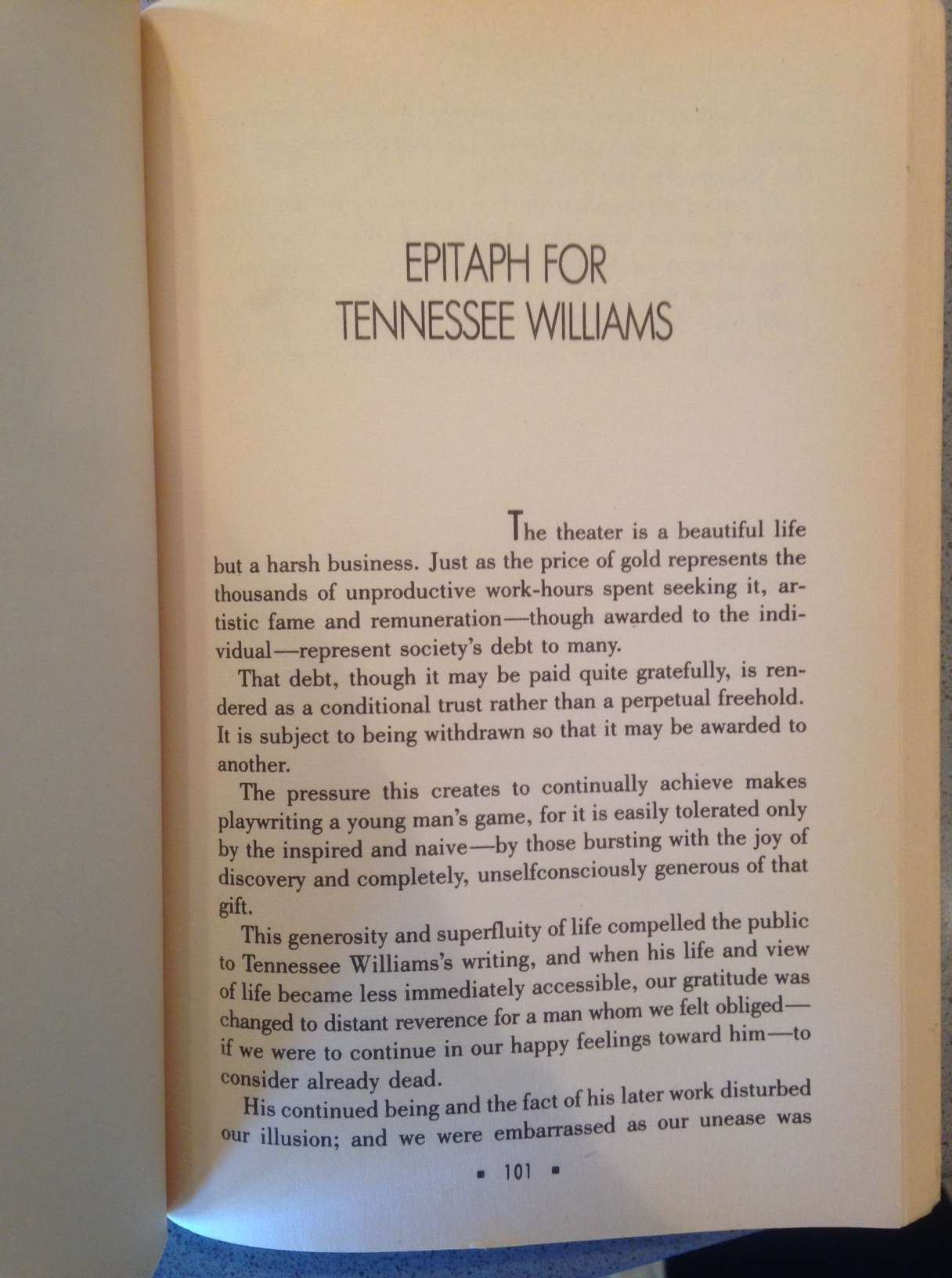
Found this, and thought it was great:

Wikipedia Hole
Reading about Tennessee on Wikipedia, I learn:
As he had feared, in the years following Merlo’s death Williams was plunged into a period of nearly catatonic depression and increasing drug use resulting in several hospitalizations and commitments to mental health facilities. He submitted to injections by Dr. Max Jacobson – known popularly as Dr. Feelgood – who used increasing amounts of amphetamines to overcome his depression and combined these with prescriptions for the sedative Seconal to relieve his insomnia. Williams appeared several times in interviews in a nearly incoherent state, and his reputation both as a playwright and as a public personality suffered.[citation needed] He was never truly able to recoup his earlier success, or to entirely overcome his dependence on prescription drugs.
Let’s learn about Dr. Feelgood, who was also screwing up Elvis and everybody else cool back then:
John F. Kennedy first visited Jacobson in September 1960, shortly before the 1960 presidential election debates.[9] Jacobson was part of the Presidential entourage at the Vienna summit in 1961, where he administered injections to combat severe back pain. Some of the potential side effects included hyperactivity, impaired judgment, nervousness, and wild mood swings. Kennedy, however, was untroubled by FDA reports on the contents of Jacobson’s injections and proclaimed: “I don’t care if it’s horse piss. It works.”[10] Jacobson was used for the most severe bouts of back pain.[11] By May 1962, Jacobson had visited the White House to treat the President thirty-four times.[12][13]
By the late 1960s, Jacobson’s behavior became increasingly erratic as his own amphetamine usage increased. He began working 24-hour days and was seeing up to 30 patients per day. In 1969, one of Jacobson’s clients, former Presidential photographer Mark Shaw, died at the age of 47. An autopsy showed that Shaw had died of “acute and chronic intravenous amphetamine poisoning.”
Well, that takes us to
Mark Shaw
Born Mark Schlossman on the Lower East Side, a pilot on the India/China Hump in World War II, he became a freelance photographer for life:
In 1953, probably because of his fashion experience, Shaw was assigned to photograph the young actress Audrey Hepburn during the filming of Paramount’s Sabrina. Evasive at first, Hepburn became comfortable with Shaw’s presence over a two-week period and allowed him to record many of her casual and private moments.


He married singer Pat Suzuki, “who is best known for her role in the original Broadway production of the musical Flower Drum Song, and her performance of the song “I Enjoy Being a Girl” in the show”:

In 1959, Life chose Shaw to photograph Jacqueline Kennedy while her husband, Senator John F. Kennedy, was running for President.[8] This assignment was the beginning of an enduring working relationship and personal friendship with the Kennedys that would eventually lead to Shaw’s acceptance as the Kennedys’ de facto “family photographer”. He visited them at theWhite House and at Hyannisport; during this time he produced his most famous photographs, portraying the couple and their children in both official and casual settings. In 1964, Shaw published a collection of these images in his book The John F. Kennedys: A Family Album, which was very successful.
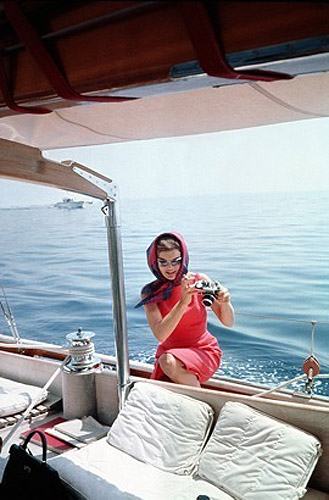

A bunch of even better ones can be found here, at the tragically disorganized website of the Monroe Gallery, they’re stamped “No Reproduction Without Permission” so whatever. Don’t miss this one.
Here’s another famous Jackie Mark photo’d:

And finally:

St. Vincent
Posted: January 5, 2015 Filed under: America Since 1945, music, women 3 Comments
photo by Tod Seelie.
What red-blooded American hasn’t considered suicide?
HIGHEST recommendation to Marc Maron’s interview with St. Vincent. A truly fantastic interview with a person who can’t seem to say anything except in some intriguing, innovative way. Super cool.
A fun twist in my listening experience: I was skipping over the first ten minutes as is my way with WTF Podcast, but because there’s a mini-interview or teaser at the beginning, I listened to about five minutes of Andrea Martin, thinking she was St. Vincent:

Getty images.
A trippy misunderstanding.
One thing St. Vincent said is that, as a kind of resolution, she’s stopped reading the Internet, and she’s found — whether it’s causation or correlation — that she’s been more present, has more interesting conversations with people she comes across.
Unachievable goal for me, but I am gonna continue to think about this, she’s onto something here.
Today I looked at Drudge Report, as I so often do, and was like “what the fuck am I doing looking at this garbage?” Some headlines from Drudge today, punctuation is sic:
Students slam Michelle O lunch rules: Mayo banned
‘SEX SLAVE’ MET QUEEN
PAPER: Unending Anxiety of ‘ICYMI’ World…
Man posts bail — with sneakers…
BABIES WITH ‘THREE PARENTS’ TO BE LEGAL WITHIN WEEKS…
RISE OF THE MACHINES: ROBOTS LEARN WATCHING YOUTUBE!
Al Qaeda warns of new ‘undetectable’ bombs to be used against US…
Egypt defence lawyers challenge police in gay bathhouse case…
Do I need this garbage in my life?
(Hey serious q: if any HelyTimes readers know some best practices for using photos from the internet on your non-profit blog please lemme know. Can’t find a source for that St. Vincent photo, not sure how hard I should try/worry about that)
Donna Douglas Dies
Posted: January 3, 2015 Filed under: actors, America Since 1945, TV 2 Comments
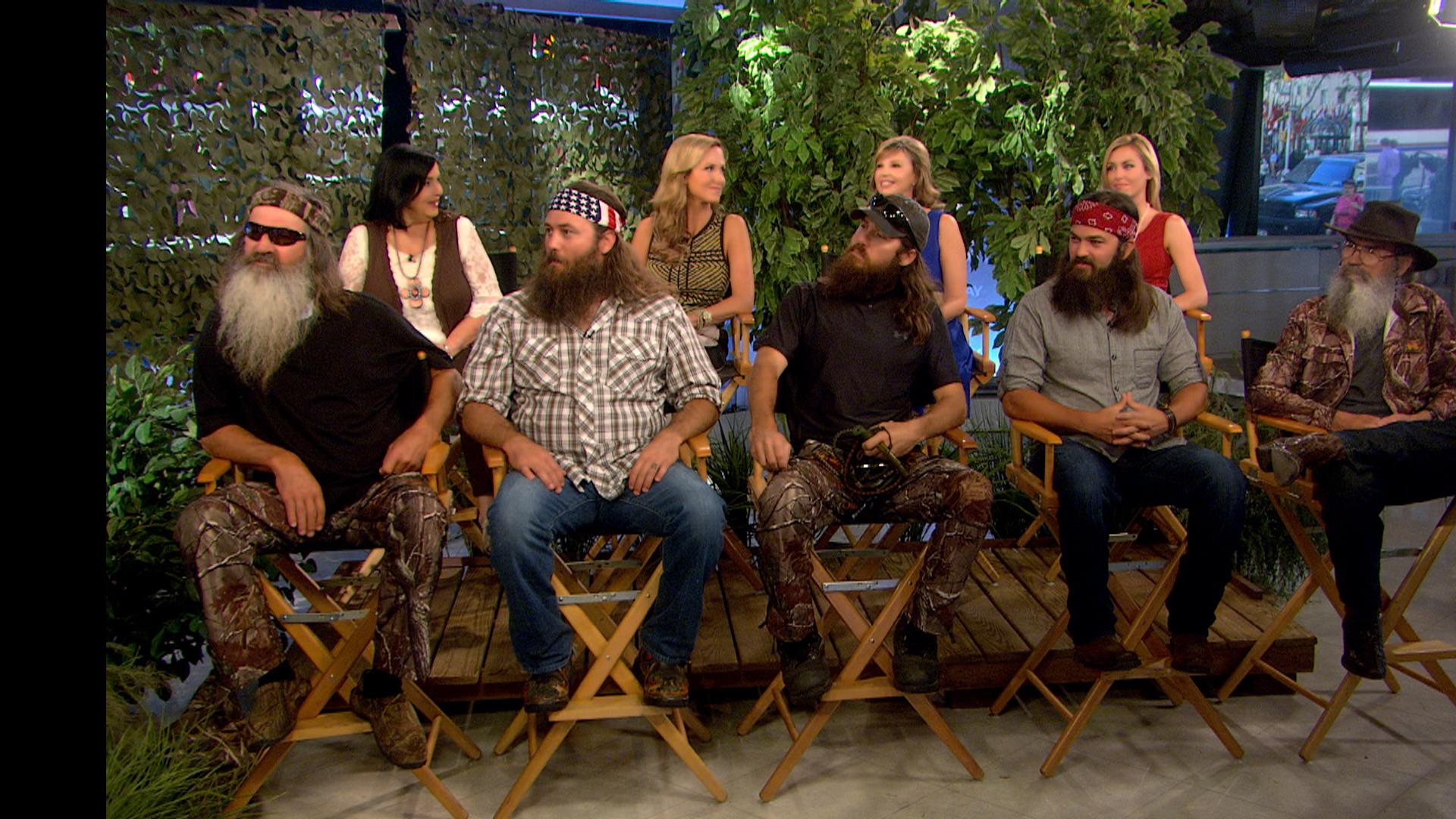
Had a slight crush on Elly May from The Beverly Hillbillies (pictured, left, above) which was on TV somehow in my youth.

The Beverly Hillbillies was more influential than people give it credit for. At one time I looked into remaking it but the rights situation made it unfeasible for me. Also, we might already have that story on TV in other forms. Watching funny rubes who have a lots of money but aren’t “high class” fills a lot of TV hours.
Newer versions though often forget to include a well-meaning, restraining if stodgy character like Mr. Drysdale, the banker:

and his loyal secretarial assistant, Miss Jane Hathaway, whom Wikipedia describes as “the love-starved bird-watching perennial spinster”:
 Here she is enjoying a cigarette… perhaps too much?:
The actress who played Miss Hathaway, Nancy Kulp, seems pretty interesting:
Kulp received a bachelor’s degree in journalism from the Florida State University in 1943, then known as the Florida State College for Women, and she started pursuing a master’s degree in English and French at the University of Miami. Early in the 1940s she worked as a feature writer for the Miami Beach Tropics newspaper, writing profiles of celebrities, including Clark Gable and the Duke and Duchess of Windsor.[6][7]
In 1944 Kulp left the University of Miami to volunteer for service in the US Naval Reserve during World War II. As a member of theWAVES (Women Accepted for Volunteer Emergency Service), Ltjg. Kulp received several decorations, including the American Campaign Medal,
Kulp moved to Hollywood, California, not long after she married Charles Malcolm Dacus (in April 1951), to work in a studio publicitydepartment, where director George Cukor convinced her that she should work in front of a camera.
She later ran for as a Democrat for Congress in Pennsylvania’s 9th District:
To her dismay, Hillbillies co-star Buddy Ebsen called the Shuster campaign and volunteered to make a radio campaign ad in which he called Kulp ” too liberal.” Kulp said of Ebsen, “‘He’s not the kindly old Jed Clampett that you saw on the show… It’s none of his business and he should have stayed out of it.‘ She said she and Ebsen ‘didn’t get along because I found him difficult to work with. But I never would have done something like this to him.'” Garnering 59,449 votes, or just 33.6% to Shuster’s 117,203 votes and 66.4%, she lost.
The life of Raymond Bailey, who played Mr. Drysdale, seems pretty interesting too:
Having no success getting any kind of movie roles, Bailey then went to New York where he had no better success getting roles in theatre. Eventually he became a crewman on a freighter and began sailing to various parts of the world, including China, Japan, the Philippines and the Mediterranean. While docked in Hawaii, he worked on a pineapple plantation, acted at the community theatre and sang on a local radio program.
In 1938, he decided to try Hollywood again. His luck changed for the better when he actually began getting some bit parts in movies, but after the United States entered World War II he joined the Merchant Marine and went back to sea. When the war was over he returned to Hollywood and eventually began getting bigger character roles.
Buddy Ebsen also spent time at sea:
Ebsen served as damage control officer and later as executive officer on the Coast Guard-manned Navyfrigate USS Pocatello, which recorded weather at its “weather station” 1,500 miles west of Seattle, Washington. These patrols consisted of 30 days at sea, followed by 10 days in port at Seattle.
Rest in p Donna D. We’ll always remember you for your classic Twilight Zone episode as well:

(CBS)
Coaches
Posted: January 1, 2015 Filed under: America Since 1945, sports, the California Condition 1 Comment
A Chance Encounter With Pete Carroll
One Sunday afternoon, a few years ago, I was drinking in a bar on Hermosa Beach (I believe but am not certain it was The Poop Deck) when I saw USC Trojans head football coach Pete Carroll ride by the front door on a bike.
He was with a handsome woman, his wife I guessed, and as they rode along saw somebody they appeared to know. Pete and his wife stopped to talk to him.
From where I was in the dark of the bar, the sunlight in the doorway framed Coach Carroll perfectly, it was like the last shot of The Searchers.

We couldn’t hear what Coach was saying. But watching him talk was mesmerizing. Engaged, upbeat, demonstrative: I couldn’t look away. The whole scene was compelling. Who was this chilled out beach boardwalk motivator? What was his life?

The Inner Game
Some time after that I found a copy of The Inner Game Of Tennis by Timothy Gallwey at my friend’s house. The only times I’ve ever played tennis I embarrassed myself, but I like “inner games,” and reading about tennis, so I read it.
The book blasted my head open.
Here is a very crude summary of Gallwey’s ideas as I understood them: when you do something like play tennis, sometimes you can split into a self that’s doing the actions, and a self that’s observing, judging, intellectually assessing: critical. That second self can easily slip into becoming abusive. You screw up a shot and you’re like “dammit, so STUPID!”
When that happens, Gallwey asks, who is yelling at who? What’s going on here?
This struck me re: writing. (Or really, any creative work.)
You’ve got your creator self, and your critical self. You need them both: all one and you’ll write stream of consciousness garbage, all the other and you’ll never write anything. But how do you get them to work together?
Gallwey says: we will improve (and have more fun) when we get these two selves aligned. When the critical self isn’t pissed at the performing self, but instead simply, non-brutally observes what is happening.

She instilled in me a great curiosity about how the world works, along with an overall sense of optimism and possibility. She used to say: “Something good is just about to happen.” I still believe that today.


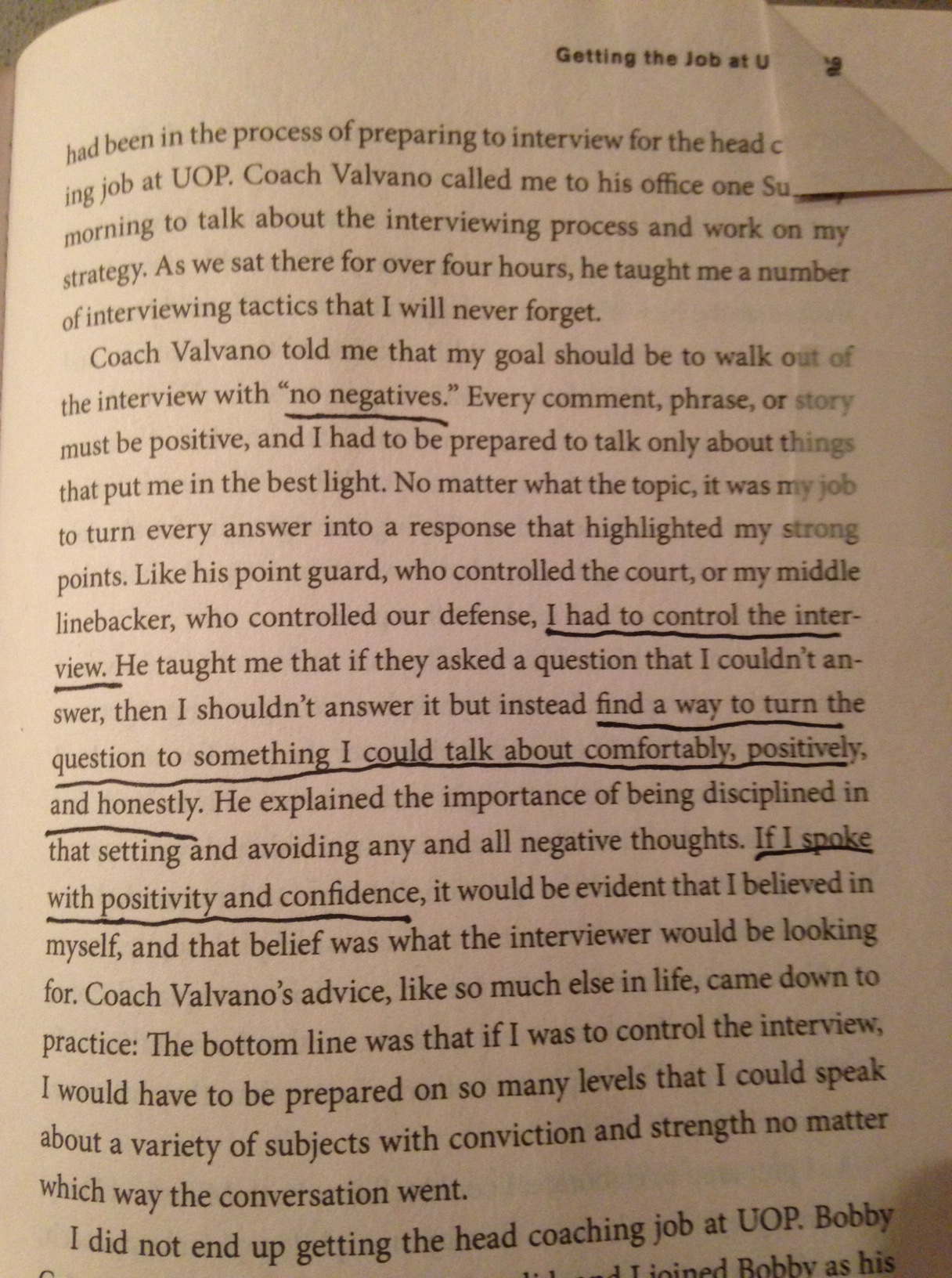
For breakfast, he eats two Little Debbie Oatmeal Creme Pies; for lunch, a salad of iceberg lettuce, turkey, and tomatoes. The regular menu, he says, saves him the time of deciding what to eat each day, and speaks to a broader tendency to habituate his behaviors. Saban comes to this system by instinct rather than by adherence to some productivity guru’s system. When I try to engage him in a discussion of the latest research on habit formation, he hits me with a look his assistants call the bug zapper, for its ability to fry all who encounter it; he has no idea what I’m talking about.




The site of the first Father’s Day on July 5, 1908, originally celebrated in honor of the more than 200 fathers lost in the Monongah Mining disaster several months earlier.
The inability to clear the mine of gases transformed the rescue effort into a recovery effort. Only one man, a Hungarian by the name of John Tomko, was rescued from the mine. The official death toll stood at 362, but it is possible the number is much higher since mining companies at the time did not keep accurate records of their workers.
When they were teenagers, an explosion at the mine where Saban’s grandfather worked killed 78. (His grandfather was spared because he was off-shift.) It was a place where you knew not to complain; someone always had it worse.


Big Nick, the son of Croatian immigrants, also had a sense of fairness unusual for the place and the times. He took heat from some locals for treating black customers the same as whites at his Dairy Queen. And when he learned that an African-American player on the Black Diamonds named Kerry Marbury didn’t have a father around, Big Nick took him in. Marbury, who went on to become a star running back at West Virginia, says he was accepted so completely by the Sabans that he was effectively shielded from racism as a child. “I was very confused when I got out in the world and found out how much prejudice there really was,” he tells me.
Marbury and Saban became close friends as kids, and later, each served as the other’s best man. In the ’80s, after football, Marbury was busted for drugs, and went to prison for two and a half years for probation violation. The day he got out of jail, he said, Saban called and sent money to help him get a fresh start. Marbury went on to get his master’s degree and now serves as an administrator of public safety at a small West Virginia university. “I got where I am all as a result of him caring about me when no one else did.”
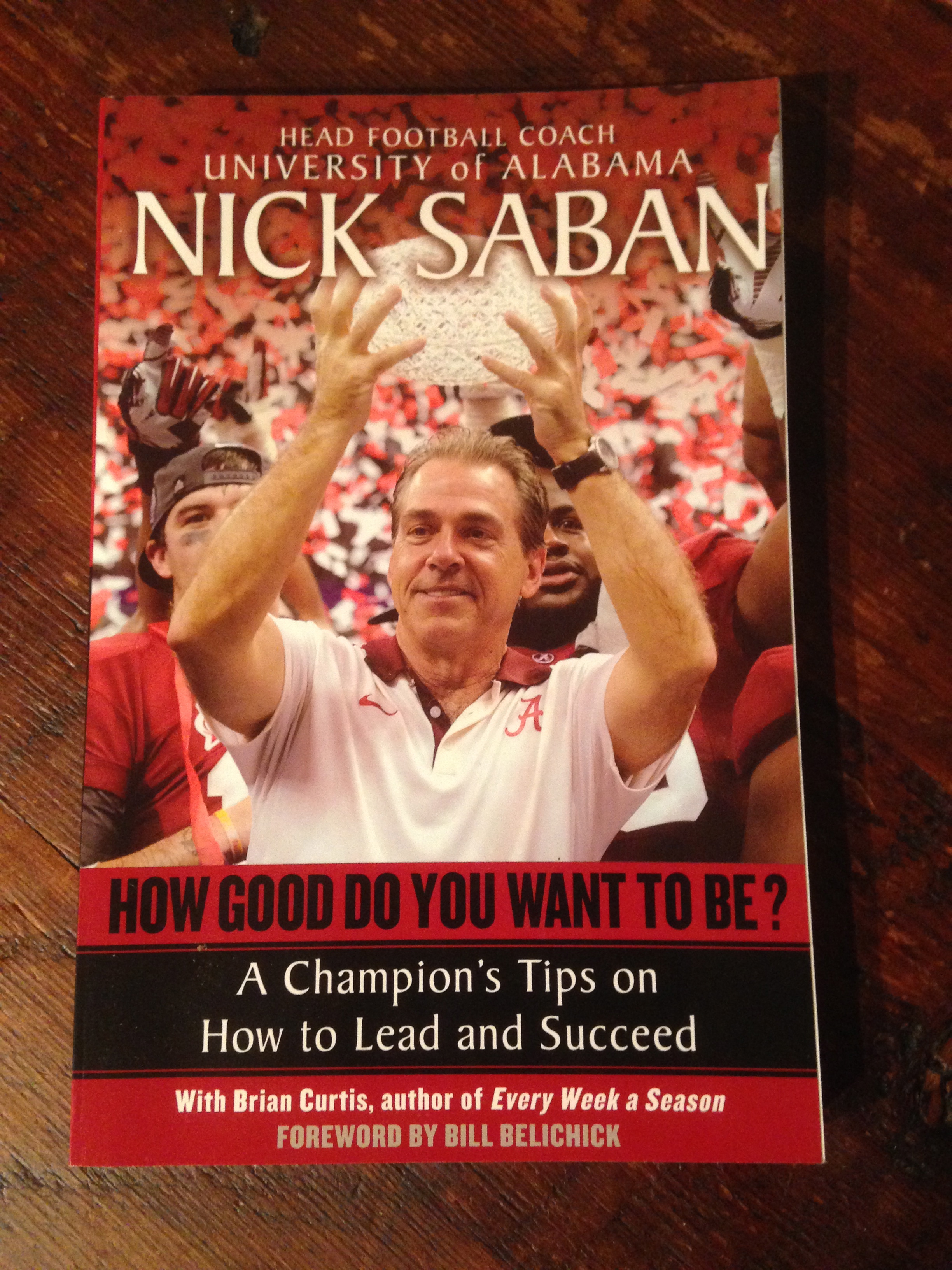
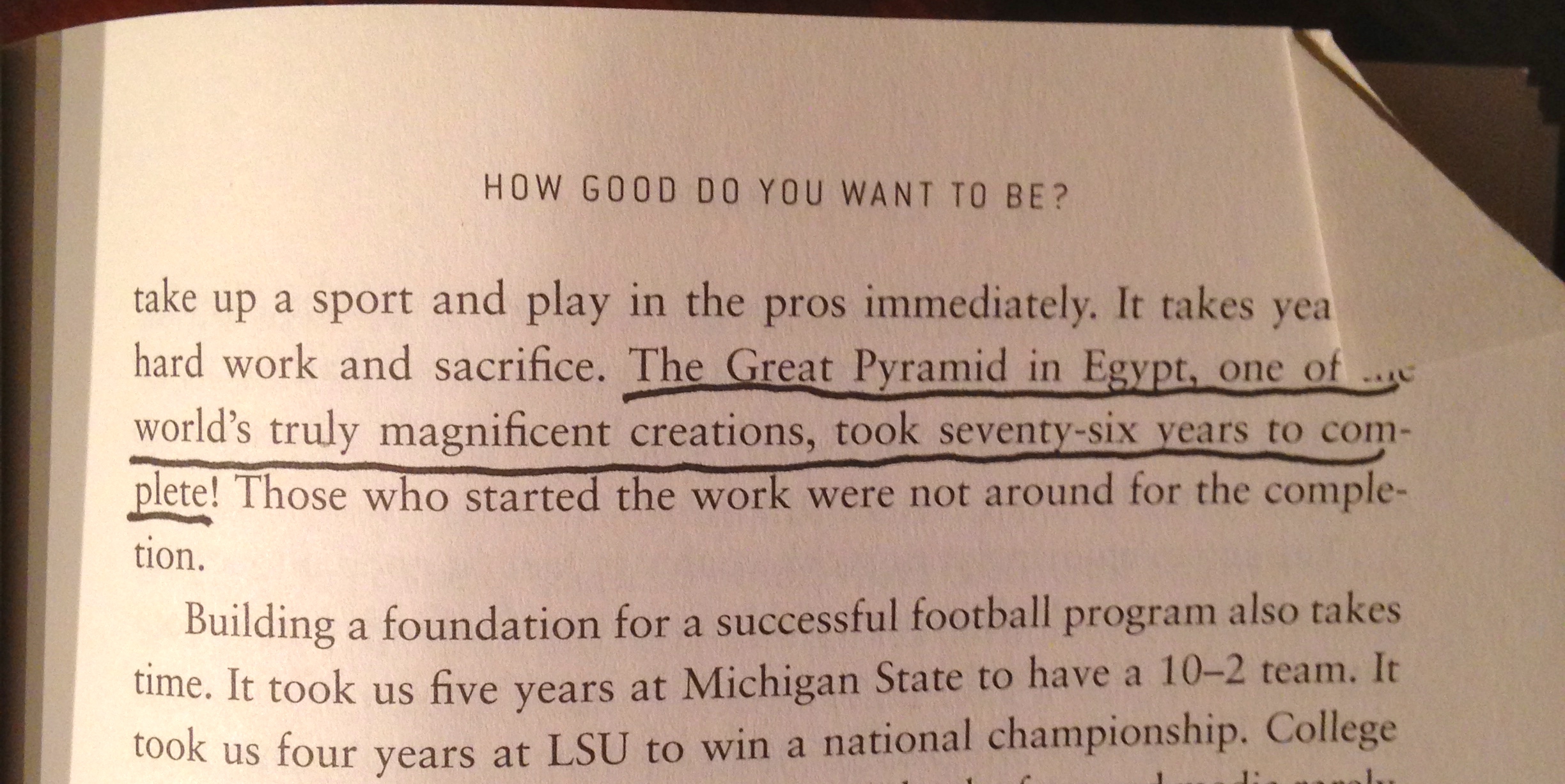
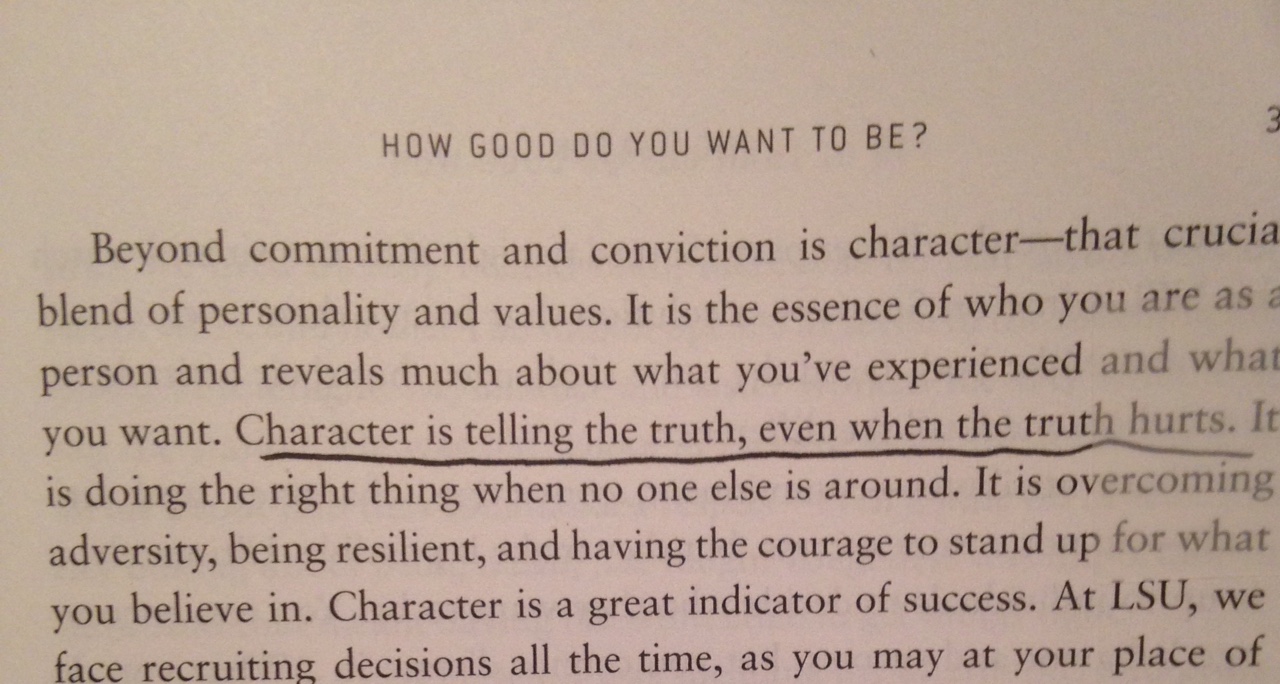
Respect for the man. Feel he is underserved by his book.
But maybe: that’s the point. Pete Carroll’s book is compelling because it’s about a guy wondering if there’s another way to do this, if he can adapt himself and his mentality to football success. He’s excited by the idea, he tells how he came up with it, and he pulls it off.
The point of Saban’s book might be: there is no secret. There is no trick. Discipline, hard work, drilling things again and again until you can do them the right way, focusing on doing everything right and not on results — it ain’t easy but it’s simple.
Good to think about.
Apologies if I made any football errors in this post, don’t let me fool you into thinking I know shit about the game compared to serious fans. With that said, here’s my picks for the BCS:

will defeat:

Alabama will then play:

who will defeat

(Oregon coach Mark Helfrich doesn’t seem that interesting, although it’s cool he’s from Oregon. Unless this actually is his memoir I don’t think I’ll read it. Can’t say I’m all that curious about Urban Meyer either, although it is interesting that both he and Saban are Catholic. Also interesting that Urban Meyer is the only of these coaches to be coaching his alma mater.
I did take a look at this Kindle book:

where the fact that Saban and Meyer both seem to “enjoy” coaching football or at least hate not doing it is described under the chapter heading “Hedonism.” I don’t think that’s an appropriate word for these mens’ lives.
I’d love to read Jimbo Fisher’s memoir. If I didn’t mishear, once watched him say Jameis Winston’s ability to not worry at all about how he’d been charged with sexual assault was a testament to his character.
Fisher earned the nickname Slim Jimbo because of his affinity for meat snacks. He has mentioned in numerous interviews that he wishes to launch an organic beef jerky company after he retires from coaching. The company would feature jerky made from animals native to both the Deep South and his native West Virginia, such as alligator, muskrat, and wild boar.)
Then at the national championship game on Jan. 12:
will defeat
Puzzle: given that this is close to a random guess, although I factored in these odds (plus my feeling from reading Saban’s book) what are the odds I picked this right? 12.5%? I could be proven completely wrong in a few hours.)
In the Super Bowl:


Stumbling in the direction of a solution
Posted: December 30, 2014 Filed under: America Since 1945, New York Leave a comment
Inspector Timothy Dowd, right, at work in July 1977, told reporters that his job as the leader of the special task force hunting the Son of Sam serial killer was “to prepare to be lucky.” Credit Marilynn K. Yee/The New York Times
NY Times obituary of Timothy Dowd, the detective in charge of finding Son Of Sam:
Ms. Begg said in an interview on Monday that her father had disdained television dramas about the police because they were unrealistic about police work — all except one, she said: “Columbo.” That series, especially popular in the 1970s, starred Peter Falk as an untidy, seemingly distracted detective in Los Angeles who solved cases by poking around in a practiced but random fashion and stumbling in the direction of a solution.
“That’s how it’s done,” she said her father explained to her.
In the biggest case of his career, when he finally came face to face with the killer, Inspector Dowd said he knew he would be able to discuss the crimes with him.
“I told him we had never abused him or criticized him in the press, and he agreed,” Inspector Dowd said at the time.
And Mr. Berkowitz’s first words to him?
“Inspector, you finally got me. I guess this is the end of the trail.”
Glamour
Posted: December 29, 2014 Filed under: America Since 1945 Leave a comment
Kids in the midwest only get to see even modest levels of glamour if they happen to be on school trips to one or another of the midwestern cities: K.C., Omaha, St. Louis, the Twin Cities. In some, clearly, this lack of glamour festers. Charles Starkweather, in speaking about his motive for killing all those people, had this to say: “I never ate in a high-class restaurant, I never seen the New York Yankees play, I never been to Los Angeles…”
from:

Roads by Larry McMurtry
Posted: December 28, 2014 Filed under: America Since 1945, the California Condition, travel, writing Leave a comment
I can’t get enough of these Larry McMurtry non-fiction books, as I’ve discussed before and another time and one other time. In this book, McMurtry drives American highways, writing down anything that occurs to him or seems interesting:
The most interesting thing that ever happened to me in southern Oklahoma happened when I was a boy. My backwoods uncle Jeff Dobbs took me deep in the woods, to the cabin of an aged Choctaw preacher, an old man said to have the power to draw out tumors. In his small cabin there were long rows of Mason jars, each containing a tumor that had been drown out. It was dim in the cabin. I couldn’t see what was in the jars very clearly, but it definitely wasn’t string beans or pickled peaches. I was very impressed and not a little frightened. Uncle Jeff knew a few words of Choctaw — listening to him talk to the old man was when I first realized there were languages other than English.
More than fifty years after I peered at them in the gloom of the old preacher’s cabin, the shelves of tumors reappeared in Pretty Boy Floyd, the first of two novels I wrote with Diana Ossana. This time “the cancers,” as they are referred to, appear as decoration in a backwoods honky-tonk.
He muses on how the great travel writers tend be into only one type of landscape (McMurtry’s is the plains):
Charles Doughty lived almost his whole life in a wet country but wrote his great book about the desert – the same deserts would later draw the best out of Wilfred Thesiger, St. John Philby, T. E. Lawrence, Gertrude Bell, and Freya Stark. Aurel Stein, Sven Hedin, Charles Marvin, Mildred Cable and Francesca French (the nuns of the Gobi), Curzon, and Ney Elias returned again and again to central Asia. Humboldt, Alfred Russell Wallace, and Henry Bates took their genius to the Amazon; while Mr. Darwin looked hard wherever he went. Certainly, when it came to those finches in the Galapagos, he looked every bit as hard as Picasso looked at Matisse.

Charles Doughty
But even the ocean interests McMurtry, an epic reader:
My drives across the American land had taken me far enough that I had begun to feel a vague urge to try a different mode of travel. For the past month or so I had been reading the leisurely, tolerant travel books of the English zoologist F. D. Ommanney, a man who knows a lot about fish, and a lot, also, about the world’s oceans and the people who live beside them – particularly the island peoples of the Indian Ocean and the South Pacific. F. D. Ommanney was a fish finder, a man who, in the years after World War II, puttered around in remote oceans attempting to estimate whether a given stretch of ocean contained fish enough to make commercial fishing profitable. I think, though, that what he cared about was the sea, not the fishing. In books such as A Draught of Fishes, The Shoals of Capricorn, Eastern Windows, and South Latitude, he describes his journeys through the seas and islands so appealingly that a landlocked person such as myself begins to feel that he has really been missing something: that is, the world’s oceans, along whose trade routes – invisible highways – the great ships proceed.
The appeal of F. D. Ommanney’s books – fairly popular in the 1950s but mostly forgotten now – is their intimacy with the sea and its ways, and also with the ways of people whose lives are bound to the sea. Conrad and Melville wrote powerfully of the oceans, but their works don’t exactly bring one into an intimacy with the world of waters. In Conrad and also in Melville the sea is too powerful, too often the environment of crisis, to be merely appealing. Though these great writers see the ocean’s beauty they rarely allow the reader to be unaware that this beauty comes with a threat, moral or physical or both.
Ommanney is not a novelist – he is just a man with a deep interest in the natural world, particularly with the world of the ocean; through many travels he preserves a fond curiosity about the lives of peoples of the islands, people who can scarcely imagine a life apart from the sea.

While driving in Arizona, this occurs to McMurtry:
Near Wilcox there’s a famous tourist stop advertising THE THING – in fact an Anasazi mummy.
(actually this article seems to suggest it’s a fake made by a well-known maker of sideshow artifacts)

McMurtry gets going on the Plains Indians wars, and Ranald Mackenzie:
Mackenzie was a highly effective officer, one of the most skilled and determined to fight on the plains frontier. But he was not a happy man. Juste before he was to marry, in 1883, he went crazy and spent the remaining six years of his life in an insane asylum in New York State. Ranald Mackenzie’s insanity is one of the strange, haunting mysteries thrown up by the frontier conflicts. Many pioneer women went crazy, and it was not hard to see why; the women were not necessarily overdelicate, either. The living conditions were just too bleak, too isolating. But the insanity of Ranald Mackenzie, one of the most disciplined and succesful officers to participate in the campaigns of the plains frontier, is evidence that the price of winning the west was not simple and not low, even for the winners, not when one considers that Ranald Mackenzie, the soldier who took the surrender of Quanah Parker and the Kwahadi Comanches, ended his days in a nuthouse, in 1889, not long before the massacre at Wounded Knee.

Wikipedi tells us: “He bought a Texas ranch and was engaged to be married; however, he began to demonstrate odd behavior which was attributed to a fall from a wagon at Fort Sill, Oklahoma, in which he injured his head. Showing signs of mental instability, he was retired from the Army on March 24, 1884 for “general paresis of the insane”.[5]”
The studio executives I would go and talk to about one project or another were seldom even half my age. Now they were only a little more than a third my age. I was in my sixties, the were in their twenties. SOme of them seemed puzzled that an older person would still be writing screenplays. If I happened to mention, by way of illustration, a movie made as long ago as the 1950s – twenty years before any of them were born – they looked blank and, in some cases, a little disdainful. I might as well have been talking about the Dead Sea scrolls. There is always a listener (the executive) and a note taker at these meetings. If I mentioned Touch of Evil or Roman Holiday the note taker would dutifully take a note.
I don’t know why this age gap surprised me. Hollywood, as I said, has always been about beauty and desire, neither of which is entirely comfortable with age. Garbo was not wrong to retire.

Near Acoma, New Mexico:
Coronado came past these pueblos as he sought the cities of gold, which means that the Indians of this region have experienced an unusually long colonial oppresion. Acoma, the sky city built on top of a 365-foot bluff, revolted in 1599 and killed a party of tax collectors sent by Governor Juan de Onate, who proved to be a revengeful man. He overwhelmed the Acomas, took several hundred prisoners, and cut one foot off any male over twenty years old, probably raking in a lot of seventeen- and eighteen-year old feet in the process…
I’ve been to Acoma many times, where the concessionaires are – to put it mildly – not friendly; and I’ve visited, at one time or another, most of the pueblos near Albuquerque. I’m not comfortable there and am even less comfortable in the communities north of Santa Fe. These are all places where the troubles are old and the troubles are deep. The plains below the Sangre de Christo may be supremely attractive visually, as they were to Miss O’Keefe, but socially they are very uncomfortable – the result of that long oppression. North of Santa Fe is where the toughest of the Indians and of the Spaniards survived. It’s not a good place to have a car break down – not if you’re an Anglo.

Nothing will detect and respond to the reality of fear as swiftly as a market
Posted: December 20, 2014 Filed under: America Since 1945, the California Condition Leave a comment
On The Interview, Stephen Carter’s take worth reading:
Despite all the calls for Sony to stand up to the blackmail in the name of artistic freedom, it seems to me that the criticism is misdirected. Nothing will detect and respond to the reality of fear as swiftly as a market, and here the market has spoken. The relevant market actors are moviegoers. Theater owners are guessing that with “The Interview” in their multiplexes, holiday audiences will stay away in droves. From everything.
I’d like to think the owners are mistaken. I’d like to think that were “The Interview” in the theaters, millions of us would flock to the mutiplex and watch a movie — any movie — as an act of protest, to show the world we aren’t afraid. But I can’t say that in predicting the opposite the theater owners have made a wrong call. And if they’re right, so is Sony.
(ht Andrew Sullivan, where the guest editors are doing a great job imo. Journalistic bias: guy who wrote The Interview Dan Stirling is former co-worker/friend, I root for him to get rich from this funny movie.)
Wild
Posted: December 20, 2014 Filed under: America Since 1945, movies, nature, screenwriting, the California Condition, women, writing Leave a comment
Contains WILD spoilers!
1) This movie has a high degree of difficulty.
I read 2/3s of the book Wild – abandoned it before I finished, but I did the same thing with Eat Pray Love and then years later started over and found it very impressive. Perhaps a similar fate awaits Wild & me.
At least two top-notch women I know swear by Tiny Beautiful Things. I like reading interviews with Cheryl Strayed, she seems like the real deal.
In books you can get into somebody’s head. That is their killer advantage, and why I don’t think books are going anywhere anytime soon. You just can’t do that in a movie. Wild the movie does a pretty good job of this, but it’s sort of just doomed, imo. This is a story about a person’s journey from one mental state to another, with most of the work done internally. Very hard to dramatize.
While there are good tricks towards doing that in this movie, it comes up a little short on the radical innovations needed to tell that story in a movie. Nick Hornby wrote the screenplay: a dude who is good at this kind of thing, his books make excellent movies, but maybe a true writer-director could’ve worked the solutions even tighter?
[One particular note: it seemed to me like all the cutaways should’ve cut a few beats earlier. You’re always like, “ok, here we go, we’re about to cutaway to Cheryl’s childhood.”]
2) The story has a motivation problem.
Cheryl decided to do this, herself. No one made her, asked her, even cares if she accomplishes her goal. So when she faces difficulty or problems, it easy to think “well, you’re the one who decided to hike the PCT, dumdum. Why should I care about this?”
In a story, a person sets out to do something and arrives at a win/lose/draw (thanks to John Gardner for articulating that for me). What would count as a win in this story? Getting to Ashland? No, who cares about Ashland, nothing but hippies in Ashland. The goal of this story is: Cheryl restoring herself (whether or not she knows that’s the goal at the start).
But: that’s an internal goal, how will you show it in a movie? It’s easier to answer these questions in a book, where Cheryl can articulate her reasons and get you with her and make you see that this particular journey is important even if nothing tangible’s at stake.
3) Still, pretty good movie.
Despite all that I thought the ending was pretty satisfying. It’s hard to make a pretty good movie. When Reese Witherspoon yells “FUCK YOU BITCH!” I thought that was good acting.
Sometimes I think all the hugely successful actresses [Reese, Anne Hathaway, etc.] are such intense people that when they act like normal people their instinct is to be way too intense. I would argue Julianne Moore might be the best at not doing this. Think how hard that must be: to act intense but not at your full-bore intense because you somehow intuitively understand that your own “full bore” is too strong for the screen. Acting is crazy hard.
Like all criticism should, let this come with a disclaimer: it’s easy to be a critic hard to make a thing, makers > critics x1000!
4) Interesting sex stuff in this movie.
I do remember in the book being jarred by the period of sexual degradation and heroin, hadn’t realized that was part of the tale. It was new territory, I felt, in exploring a woman’s sexual… could we call it addiction? self-punishment? Cheryl’s not not in control at that point, right? But she also isn’t having a great time. It’s fucked up, she knows it’s fucked up. But it’s not fucked up because she’s a slut, it’s fucked up because she’s not being the woman she wants to be (right?).
Whatever, it made me think/was also slightly titillating/made me feel kind of bad for the husband she was compulsively cheating on. What are the nice guy husbands of America to make of Eat Pray Love and Wild, two biggest women’s memoirs of the last ten years, that both start with a woman leaving her nice guy husband for sexual adventuring?
How often in a movie do you see sex that is intended to be not rape but also not fun?
5) The music in this movie is kind of good but also kind of sucks.
That’s my take anyway. What if I told you that in 2014 we were making an epic movie about a woman’s adventure across America? Would you say that scattered samples of Simon & Garfunkel is the best we could do? Fuck no! Why didn’t they get some awesome woman to make a badass score like Eddie Vedder did for the man-equivalent, Into The Wild?
6) There’s a weird shoutout to REI in this movie.
Where Reese calls them to get new boots and is like “you’re my favorite company ever.” Maybe Cheryl really felt that way. I have a bunch of stuff from REI, but sometimes I think their business model is based on making you think going outdoors is more expensive and complicated than it really is to sell you more junk. Which, weirdly: in the same scene where Cheryl learns about REI’s return policy, the dude is like “you don’t need all this shit.”
Former REI CEO Sally Jewell is Secretary of the Interior.

Strikes me as a very Obama kind of pick: on the one hand, kind of hip and modern and innovative, but on the other hand she was still the CEO of a huge corporation.
7) Wild and Eat Pray Love are in long American literary tradition of spiritual narrative.
If I were a grad student at Yale I’d write my Ph. D. on this, trace it all back through Emerson and Puritan religious narratives and captive narratives of 18th century New England and I’d be the smartest boy in the seminar. Since I’m not in grad school though I can make my point in one sentence which is that things that seem radical and new are often just new versions of an old tradition, we’re not so different from the past or as wildly inventive as we think we are, etc.
8) Is this how women go through life? Constantly having to wonder if a random dude is a rapist?
Damn, that might be the most important aspect of Wild, seeing the world through a woman’s eyes, showing that tension of life. When I walk around at 11pm or so in my neighborhood and I see women walking their dogs it always feels very tense. My instinct to somehow indicate I am not a rapist usually just seems to make the problem worse.
ANYWAY: one reason I was excited to see Wild is I’ve been to many of the settings along the Pacific Crest Trail on fishing trips. Here, for example, is a photo of Kennedy Meadows:

Kennedy Meadows is like a plateau high up in the Sierras. To get there you drive up a crazy 27-mile twisty road up from the 395. If you find yourself there, be sure to stop at The Grumpy Bear:

They’re happy to teach you about jerking meat:

Don’t get it confused with the other Kennedy Meadows up in Sonora.
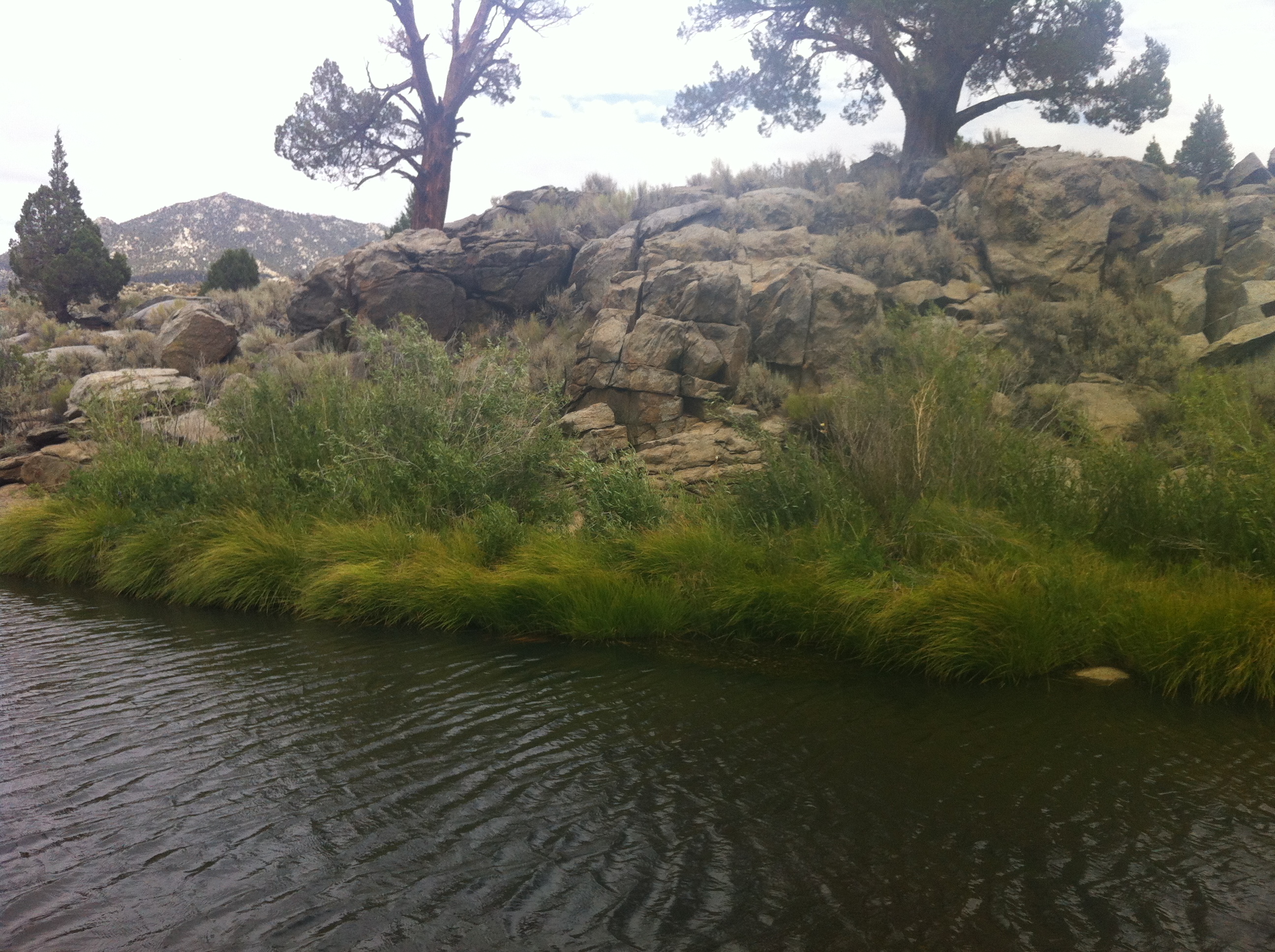
While I was up there I crossed the PCT and wondered if it would be interesting to film a couple seconds of walking on it:
If you’d like to see Wild, but only have ten seconds, my film gets at similar themes but with more nauseating camerawork.
“What Happened When Marissa Mayers Tried To Be Steve Jobs”
Posted: December 18, 2014 Filed under: America Since 1945, business, writing Leave a comment
This article, by Nicholas Carlson in the upcoming NY Times magazine, is one of the best business articles I’ve ever read (note: I don’t read that many business articles).
Here’s where the story really begins:
But as Alibaba’s stock soared, Yahoo’s dropped, an indication that the market seemed to concur with Jackson’s analysis: Yahoo’s core business was worth less than zero dollars.
That’s bad. Next sentences:
A week later, Smith published an open letter calling for Yahoo to divest itself of its Alibaba assets, return the money to its shareholders and then merge with AOL. Redundancies could be eliminated, thousands of people could be fired and two former Internet superpowers would be downsized into a single and steady (if uninspiring) entity that sold ads against its collective online properties — news, blogs and Web products like email, maps and weather. “We trust the board and management will do the right thing for shareholders, even if this may mean accepting AOL as the surviving entity,” Smith wrote.
(Note that “could be fired” — non-business readers like me often gotta remind themselves that in business articles it’s often assumed that firing people is positive.)
The article goes on with punchy, succinct, clear explanations the challenges of tech companies, and specifically the challenge Mayers faced, and I don’t envy her:
Previous Yahoo C.E.O.s had underinvested in mobile-app development, plowing money into advertising technology and web tools instead. A couple of days into the job, Mayer was having lunch at URL’s when an employee walked up to her and introduced himself as Tony. “I’m a mobile engineer,” Tony said. “I’m on the mobile team.”
Mayer responded to Tony, “Great, how big is our mobile team?” After some back and forth, Tony replied that there were “maybe 60” engineers. Mayer was dumbfounded. Facebook, for instance, had a couple of thousand people working on mobile. When she queried the engineering management department, it responded that Yahoo had roughly 100. “Like an actual hundred,” Mayer responded, “or like 60 rounded up to 100 to make me feel better?” The department responded that it was more like 60.
But then it starts to unravel:
Mayer subsequently immersed herself in the redesign. Months into her tenure, she was meeting with Sharma’s team regularly in a conference room that started to look more like a design studio: projectors hung from the ceiling, rendering screens displayed on the wall. All around, dozens of foam core boards were pinned with ideas. Mayer would regularly interrogate designers about the minutest details of display and user experience. By early December, one day before Yahoo Mail was set to release, she convened a meeting at Phish Food, a conference room in the executive building of Yahoo’s campus, to talk about the product’s color. For months, the team had settled on blue and gray. If users were going to read emails on their phones all day long, the thinking went, it was best to choose the most subtly contrasting hues. But now, Mayer explained, she wanted to change the colors to various shades of purple, which she believed better suited Yahoo’s brand.
Well, see, purple sucks? More great detail:
During a breakfast with Anna Wintour, the editor in chief of Vogue, Mayer asked if there might be any partnership opportunities between the magazine and Shine, Yahoo’s site for women. According to Mayer’s own telling of the story to top Yahoo executives, Wintour lookedappalled.
I bet she did!

Reuters photo stolen from NY Post article “Anna Wintour Has A Sense Of Humor Over Drag Parody Show” http://pagesix.com/2014/08/12/anna-wintour-has-sense-of-humor-over-drag-parody-show-about-her/
Bad to worse:
Yahoo Tech would sometimes go weeks without running a single ad.
Don’t know much about this, but that sounds terrible.
This delinquency eventually became a problem outside Yahoo. At a major advertising event in the South of France, Mayer sat for an interview with Martin Sorrell, the C.E.O. of WPP, one of the world’s largest agencies. In front of a filled auditorium, Sorrell asked Mayer why she did not return his emails. Sheryl Sandberg, he said, always got back to him. Later, Mayer was scheduled for dinner with executives from the ad agency IPG. The 8:30 p.m. meal was inconvenient for the firm’s C.E.O., Michael Roth, but he shuffled his calendar so he could accommodate it. Mayer didn’t show up until 10.
Fuck that. Worse:
Mayer’s largest management problem, however, related to the start-up culture she had tried to instill. Early on, she banned working from home. This policy affected only 164 employees, but it was initiated months after she constructed an elaborate nursery in her office suite so that her son, Macallister, and his nanny could accompany her to work each day. Mayer also favored a system of quarterly performance reviews, or Q.P.R.s, that required every Yahoo employee, on every team, be ranked from 1 to 5. The system was meant to encourage hard work and weed out underperformers, but it soon produced the exact opposite. Because only so many 4s and 5s could be allotted, talented people no longer wanted to work together; strategic goals were sacrificed, as employees did not want to change projects and leave themselves open to a lower score.
This got ugly:
During the revamping of Yahoo Mail, for instance, Kathy Savitt, the C.M.O., noted that Vivek Sharma was bothering her. “He just annoys me,” she said during the meeting. “I don’t want to be around him.” Sharma’s rating was reduced. Shortly after Yahoo Mail went live, he departed for Disney. (Savitt disputes this account.)

Then this part is deeply weird:
As concerns with Q.P.R.s escalated, employees asked if an entire F.Y.I. could be devoted to anonymous questions on the topic. One November afternoon, Mayer took the stage at URL’s as hundreds of Yahoo employees packed the cafeteria. Mayer explained that she had sifted through the various questions on the internal network, but she wanted to begin instead with something else. Mayer composed herself and began reading from a book, “Bobbie Had a Nickel,” about a little boy who gets a nickel and considers all the ways he can spend it.
“Bobbie had a nickel all his very own,” Mayer read. “Should he buy some candy or an ice cream cone?”
Mayer paused to show everyone the illustrations of a little boy in red hair and blue shorts choosing between ice cream and candy. “Should he buy a bubble pipe?” she continued. “Or a boat of wood?” At the end of the book, Bobby decides to spend his nickel on a carousel ride. Mayer would later explain that the book symbolized how much she valued her roving experiences thus far at Yahoo. But few in the room seemed to understand the connection.
Strange. But man, what great writing in this article.
Let’s give the last word to Aswath Damodaran:
Aswath Damodaran, a professor at N.Y.U.’s Stern School of Business, has long argued about the danger of companies that try to return to the growth stage of their life cycle. These technology companies, he said, are run by people afflicted with something he calls the Steve Jobs syndrome. “We have created an incentive structure where C.E.O.s want to be stars,” Damodaran explained. “To be a star, you’ve got to be the next Steve Jobs — somebody who has actually grown a company to be a massive, large-market cap company.” But, he went on, “it’s extremely dangerous at companies when you focus on the exception rather than the rule.” He pointed out that “for every Apple, there are a hundred companies that tried to do what Apple did and fell flat on their faces.”

from New York University’s beautifully done website: http://people.stern.nyu.edu/adamodar/
Fist City
Posted: December 16, 2014 Filed under: America Since 1945, music, women Leave a comment
Loretta has such an admirable way of getting right to the point.
Bulletproof
Posted: December 15, 2014 Filed under: America Since 1945, food, the California Condition, Tibet Leave a comment
NYTimes article about “Bulletproof,” a fad/product:
The recipe — a riff on the yak butter tea Mr. Asprey found restorative while hiking in Tibet — calls for low-mold coffee beans; at least two tablespoons of unsalted butter (grass-fed, which is higher in Omega 3s and vitamins); and one to two tablespoons of medium-chain triglyceride (MCT) oil, a type of easily digestible fat.
and this sticks out:
Being Bulletproof means never traveling light. After a MacGyver attempt to make coffee in a Chicago hotel room, Brandon Routh, who plays the superhero The Atom on the CW show “Arrow,” now carries ground beans, containers of clarified butter, a silicone squeeze bottle of MCT oil, plus a hand blender and Aeropress filter.
“My energy levels are through the roof compared to what they used to be,” said Mr. Routh, who learned of the drink at a bachelor party, of all places. He added: “My lines just kind of sink in and they’re there when I need them.”

Here’s the thing about my human brain: Routh’s endorsement will end up “counting,” in my brain, certainly sticking way longer, than any carefully researched, cautiously presented bit of scientific evidence.
Already I’m like “well, who’s to argue with Routh? Why would he lie? Am I so arrogant as to not TRY butter coffee?”
(Separate thing: what is with our infatuation with the spiritual powers of Tibet? A strong case could be made that Tibet is a violent, backwards, cruel theocracy historically run by puppet child-monks under control of death-obsessed masters.)

© Joseph F. Rock / National Geographic Image Collection.
What?
Posted: December 11, 2014 Filed under: America Since 1945 Leave a comment Not well informed on the torture report, so thanks to Andrew Sullivan for calling my attention to this NYT piece:
For all the publicity the Bush administration gave Mr. Padilla, the committee revealed that the government never took his dirty bomb plot seriously. It was based on a satirical Internet article titled “How to Make an H-Bomb,” and the plot involved swinging a bucket full of uranium over one’s head for 45 minutes. One internal C.I.A. email declared that such a plot would most likely kill Mr. Padilla but “would definitely not result in a nuclear explosive device.” Another called Mr. Padilla “a petty criminal” and described the dirty bomb plot as “lore.”
Easy to forget who you’re supposed to be rooting for as you read this thing. The goofy gang that can’t shoot straight or the fiendish torturers who’re hiding the pathetic results of their evil in a tedious bureaucratic report?
Possible to do this and still be an idiot.
Posted: December 10, 2014 Filed under: America Since 1945 Leave a commentFrom Dana Milibank in The Washington Post:
[TNR owner Chris] Hughes is no idiot (he reads Balzac in French)
Yo Monkeytrial!
Posted: December 10, 2014 Filed under: America Since 1945 Leave a comment
This post is in response to my East Coast buddy Monkeytrial, who says:
We haven’t been to the moon in 42 years, and the richest 1 percent of humans own half the world’s assets.
…
I’d like to read a discussion of the psychological implications of growing up in a time of dramatic technological progress (my parents’ generation) versus consumer-focused incrementalism (my own). If any of my zero readers know and could link, much appreciated.
Hmm! Let’s think about the idea that technological progress has slowed from a rapid rate 1940-1970 to a stagnation now.
Is this true?
What does it mean?
I don’t have exactly what Monkeytrial is looking for. But through the glory of the Internet, we can converse via blog.
Some uncooked ideas inspired by him. First, a rec:
Check out Peter Thiel.

If not exactly this, he is obsessed with similar problems. He talks about ’em in his book which I recommend, thought-provoking to the max. Dude is thinking interesting thoughts at a rapid rate:

Even more on Monkeytrial’s theme is this essay, from National Review (I know, I know):
When tracked against the admittedly lofty hopes of the 1950s and 1960s, technological progress has fallen short in many domains. Consider the most literal instance of non-acceleration: We are no longer moving faster. The centuries-long acceleration of travel speeds — from ever-faster sailing ships in the 16th through 18th centuries, to the advent of ever-faster railroads in the 19th century, and ever-faster cars and airplanes in the 20th century — reversed with the decommissioning of the Concorde in 2003, to say nothing of the nightmarish delays caused by strikingly low-tech post-9/11 airport-security systems. Today’s advocates of space jets, lunar vacations, and the manned exploration of the solar system appear to hail from another planet. A faded 1964 Popular Science cover story — “Who’ll Fly You at 2,000 m.p.h.?” — barely recalls the dreams of a bygone age.
Another roundup of Thiel pessimism. This one seems to really nag at him:
The Empire State Building was built in 15 months in 1932. It’s taken 12 years and counting to rebuild the World Trade Center.
(Well, was that an engineering problem, or a political one? I don’t know a ton about New York City politics in the ’30s, but from what I understand, between former governor Al Smith as president of Empire State Inc., FDR as governor, Jimmy Walker as mayor, and James Farley supplying the building materials there was more or less a semi-benevolent mafia running the city.)

Maybe: we work in levels, like an orbiting electron?
Like, maybe we humans make big jumps, and then plateau for awhile? Nothing happened in Europe between 5oo and 1300 AD (let’s say) and then there was the Renaissance. Maybe what DFW’s characters speculate about tennis applies?:
“‘He’s talking about developing the concept of tennis mastery,’ Chu tells the other three. They’re on the floor indian-style, Wayne standing with his back against the door, rotating his head to stretch the neck. ‘His point is that progress towards genuine Show-caliber mastery is slow, frustrating. Humbling. A question of less talent than temperament.’
‘Is this right Mr. Wayne?’
Chu says ‘…that because you proceed toward mastery through a series of plateaus, so there’s like radical improvement up to a certain plateau and then what looks like a stall, on the plateau, with the only way to get off one of the plateaus and climb up to the next one up ahead is with a whole lot of frustrating mindless repetitive practice and patience and hanging in there.’
‘Plateaux,’ Wayne says, looking at the celing and pushing the back of his head isometrically against the door. ‘With an X. Plateaux.’
Maybe: we got scared by the speed of what we were doing.
Nukes, etc.
This caused us to pull back on investment/energy in areas like nuclear engineering where there may have been big if scary advances to make?
Maybe: we were really just plucking low hanging fruit.
The Tyler Cowen theory, that there was a lot of low-hanging economic fruit, esp. in the resource rich United States, and we ate it all up and now it’s gone.
Maybe: globalization happened in one big boom.
Like, it was a closer to a one-time event than an enduring process, and it already happened, between say 1960 and 1989, as China opened, containerization blasted international shipping forward. The revolution is over, we already got the major results in the form of Wal-Mart and so on, now it’s just a matter of economic water shifting across the world until all the glasses (countries) are level, and that’s gonna look like reverse progress from here in the US.
Maybe: it only looks bad here in the US.
Sure, it seems like technological progress has stalled out since 1970~ here in the US, but it sure as hell doesn’t look like that in China, India, dunno parts of Africa, where changes from 1970-now are as rapid as 1945-1970 in the US?
Maybe: tech “progress” isn’t necessarily good.
Maybe the jarring nature of it, the disorienting and alienating effects, level out the material gains? Maybe we’re feeling some kind of technological hangover and we’re all kinda cooling it?
What about social/cultural progress?
Food. I’m eating better every year. The food a person in Los Angeles or New York can access is insanely better than it was in 1970 in terms of variety and quality. Here’s literally the first pic I found when I googled “Food 1970:”
 Sex. Sexual freedom is insane now.
Art. There’s pretty much no limit on what you can do artwise in the Western World – a guy inflated a buttplug in the middle of Paris and the President of France stuck up for him.
Drugs, alternative lifestyles, dressing weird – it’s becoming pretty much a field day. Whether that’s “good” or “bad” is another puzzle but we are “progressing” very rapidly in a direction.
In less ambiguous ways, there’s been massive social progress. We’re getting more inclusive. Here’s a clearly stated example Aisha happened to put on This. today: Shonda Rhimes putting racial/gender/representational progress in sharp terms she receives the Sherry Lansing Award:
Look around this room. It’s filled with women of all colors in Hollywood who are executives and heads of studios and VPs and show creators and directors. There are a lot of women in Hollywood in this room who have the game-changing ability to say yes or no to something.
15 years ago, that would not have been as true. There’d have been maybe a few women in Hollywood who could say yes or no. And a lot of D girls and assistants who were gritting their teeth and working really hard. And for someone like me, if I was very very VERY lucky, there’d have been maybe one small show. One small shot. And that shot would not have involved a leading actress of color, any three dimensional LGBT characters, any women characters with high powered jobs AND families, and no more than two characters of color in any scene at one time — because that only happened in sitcoms.
30 years ago, I’d think maybe there’d be a thousand secretaries fending off their handsy bosses back at the office and about two women in Hollywood in this room. And if I were here, I would serving those two women breakfast.
50 years ago, if women wanted to gather in a room, well it had better be about babies or charity work. And the brown women were in one room over there and the white women were in a room over here.
What if: technological progress – the speed of it, especially – itself aggravated the wealth inequality.
Twitter was created eight years ago. It’s now worth roughly $24 billion. Have people ever, in the history of the world, gotten that rich that fast?
Also: the last period of insane technological progress culminated in a horrifying cataclysm.

from this great website: http://madefromhistory.com/world-war-one/painting/
World War I, where all those terrific machines were turned to gassing and machine-gunning each other. Then, when they were done with that, they ramped up to the next one: twice as cataclysmic (but on the other hand, very fertile for creating more technological progress).

So, maybe we should just count our stars we’re lucky we dodged that and closed out a tech boom peacefully.
And: Why should we expect things to be linear?
Maybe this Thiel idea that technological progress has “stalled” is like the weird thinking of an Asberger’s robot, human history is chaotic and works in undiagnosable, epileptic fits and starts that can’t be rationally charted.
Did the rapidity of change make us (sanely enough) feel more unsettled about predicting the future?
Maybe that itself acted as some kind of check on technological progress? The optimism of a 1960s Popular Mechanics cover

feels dated today.
Anyway, I guess my point is: check out Monkeytrial.
Two Videos
Posted: December 3, 2014 Filed under: America Since 1945, the California Condition Leave a commentI always enjoy when friends and houseguests put me on to interesting videos. INSURANCE as these are old.
Ice Cube celebrates the Eames:
And a remix:
Let it all just drop.
Posted: December 1, 2014 Filed under: America Since 1945 Leave a comment

(can’t find the credit for this photo – the Sept. 25, 2008 meeting)
Incredible ideas in the Chris Rock interview from New York magazine:
When you mentioned Bush, I thought you were going to say something else, which is that he had this “good versus evil” manner of speaking — the Western sheriff who’s come to lay down the law. Obama’s been faulted for not showing anger in public, and for not speaking in simple, declarative Bushisms. Of course, the moment he does do that, he’s accused of being an angry black man.
There’s an advantage that Bush had that Obama doesn’t have. People thinking you’re dumb is an advantage. Obama started as a genius. It’s like,What? I’ve got to keep doing that? That’s hard to do! So it’s not that Obama’s disappointing. It’s just his best album might have been his first album.
What has Obama done wrong?
When Obama first got elected, he should have let it all just drop.
Let what drop?
Just let the country flatline. Let the auto industry die. Don’t bail anybody out. In sports, that’s what any new GM does. They make sure that the catastrophe is on the old management and then they clean up. They don’t try to save old management’s mistakes.
That’s clever. You let it all go to hell.
Let it all go to hell knowing good and well this is on them. That way you can implement. You hire your own coach. You get your own players. He could have got way more done. You know, we’ve all been on planes that had tremendous turbulence, but we forget all about it. Now, if you live through a plane crash, you’ll never forget that. Maybe Obama should have let the plane crash. You get credit for bringing somebody back from the dead. You don’t really get credit for helping a sick person by administering antibiotics.
How about this?
We still have some white people taking the Sarah Palin line about blacks and immigrants alike. They want to “take back the country” — and we know from whom. I find it depressing. The increments of change seem to be so much tinier than we wanted to believe when the Civil Rights Act passed 50 years ago, or when Obama was elected in 2008.
Yeah. The stuff you’re talking about is pockets though. There’s always going to be people that don’t know that the war’s over. I’m more optimistic than you, but maybe it’s because I live the way I do. I just have a great life, so it’s easier for me to say things are great. But not even me. My brothers drive trucks and stock shelves. They live in a much better world than my father did. My mother tells stories of growing up in Andrews, South Carolina, and the black people had to go to the vet to get their teeth pulled out. And you still had to go to the back door, because if the white people knew the vet had used his instruments on black people, they wouldn’t take their pets to the vet. This is not some person I read about. This is my mother.
Or this?:
Tim Cook, the CEO of Apple, just came out as gay.
Which I think is actually bigger than the football player. Because the average person in that locker room is in his 20s. And it’s just not a big deal to be around a gay guy — if you’re in your 20s. Whereas Tim Cook is around these corporate guys. That is the epitome of a boys’ club. That is sexist, racist — the least inclusive group of people you’re ever going to find. Men who have no problem being called owners. Who actually wants to be called an owner, even if you owned a football team? Just the title owner is just so nasty and disgusting.
It does have a kind of antebellum ring.
So Tim Cook came out to those guys. He’s in that club. My God.
What is going ON in DC?
Posted: November 22, 2014 Filed under: America Since 1945, politics Leave a commentI gotta say, I agree with Peggy Noonan that this article in the New York Times, “Reid Is Unapologetic as Aide Steps on Toes, even the President’s,” is upsetting. Here is Ms. Noonan’s summary of its contents:
Assuming the article is factually correct, and it certainly appears to be well reported, the president of the United States phoned the majority leader of the U.S. Senate during a legislative crisis to complain that one of the senator’s staffers is a leaker. Unbeknown to the president, the staffer was listening in on the call and broke in to rebut the president’s accusation.

Credit Stephen Crowley/The New York Times
That’s the staffer there, David Krone.
(What should we make of Harry Reid’s portrait of Twain there? There’s no way Reid is so dumb it didn’t occur to him what Twain would think of that, and him. Is choosing that portrait a sage bit of humor and humility? Or a cheap show at sage humor and humility? Plus bloody bloody Andrew Jackson? anyway there’s no time to sort all that out.)
Says the Times:
For some on Capitol Hill, Mr. Krone is a manipulative megalomaniac. For others, he is a hero who has the financial independence to speak his mind. The one thing that everyone agrees on is that he is different.
(Krone is rich I guess from being a cable TV executive as a young man?). I’m not liking this dude’s tone as presented in the article:
“I don’t remember anything about that,” Mr. Reid said in his chandeliered office on Nov. 13, a few hours after being re-elected leader of the Senate Democrats. “Do you?” he asked, turning to Mr. Krone, who was seated beside him in the “leader’s chair.”
“Umm,” Mr. Krone, who is rarely at a loss for words, said through a frozen smile. A few minutes later, Mr. Krone, dressed impeccably in a bespoke suit, walked a reporter out of the office, and, referring to the president’s call, jocularly exclaimed, “I can’t believe that you know that story!”
Krone’s wife is Alyssa Mastromonaco, former Deputy Chief Of Staff for Operations at the White House:

photo of AM I found on Italian wikipedia.
One day, congressional leaders went to the White House to meet with the president. As they entered, Secret Service agents decided to screen staff members, who usually roll right onto the grounds with their bosses. According to a person familiar with the day’s events, Mr. Krone, incredulous, began shouting. He then called Ms. Mastromonaco, then his fiancée and the administration’s deputy chief of staff for operations, who arrived and apologized. (Mr. Krone said he did not recall the incident and suggested that he might have been misunderstood. “I have a sarcastic sense of humor,” he said.)
Adding to the tumult as the staff members and congressional leaders waited in the White House lobby, Mr. Boehner approached Mr. Reid and, upset by Mr. Reid’s attacks on him on the Senate floor, told him to “go [expletive] yourself.” Mr. Reid replied that he read only what Mr. Krone put in his speeches.
“He says, ‘Blame David,’ ” Mr. Krone recalled, chuckling. “And I was, like, ‘Don’t look at me!’ ”
There’s more weirdness. Apparently the President and First Lady threw a party in honor of Mr. Krone and Miss Mastromonaco’s upcoming wedding, and Krone didn’t go:
Even as his relationship with the administration deteriorated, Mr. Krone set a wedding date with Ms. Mastromonaco for last November. As the big day approached, Mr. Krone’s good friend George E. Norcross III, the Democratic political boss of South Jersey, suggested a golf outing at his Palm Beach, Fla., home before the nuptials. Mr. Krone said his fiancée endorsed the idea, but a week before the trip said, “Don’t get mad, but they are throwing a party for us.” The “they” in question was Mr. Obama and the first lady, Michelle Obama, but Mr. Krone kept his engagement with Mr. Norcross instead. “I’m exactly where I wanted,” he recalled thinking during the Florida trip.
At the White House engagement party, the president spoke of Ms. Mastromonaco’s indispensability and referred to her as a “little sister.” Michelle Obama declared her to be like “part of my family.” The absent groom later admired a photo of the cake served at the party, describing it as “like taller than me.”

(Pete Souza/The White House)
Mastromonaco now works at VICE. Reid, talking about Krone:
Mr. Reid fought back tears as he recalled the time he visited his wife, who had been injured in a car accident, and saw Mr. Krone at her hospital bedside. “David is someone I can say, and it doesn’t affect my manhood at all,” Mr. Reid said, “I love David Krone.”
This Times article has some unusually casual phrasing. For example:
It is hard to imagine now, but Mr. Krone used to have a good relationship with the White House. Smart and insanely hard-working, Mr. Krone, with his direct manner and total empowerment by Mr. Reid, proved a valuable ally in the administration’s early policy lifts.
Anyway: Peggy Noonan is disgusted with all this. She goes on to invoke The West Wing, on which she briefly worked:
The second thing the Horowitz story made me think of is this. I have remarked, and I think others have also, on the broad, deep impact of the television drama “The West Wing.” It spawned a generation of Washington-based television dramas. (Interestingly, they have become increasingly dark.) It also inspired a generation of young people to go to Washington and work in politics. I always thought the show gave young people a sense of the excitement of work, of being a professional and of being part of something that could make things better.
But it also gave them a sense of how things are done in Washington. And here the show’s impact was not entirely beneficial, because people do not—should not—relate to each other in Washington as they do on TV. “The West Wing” was a television show—it was show business—and it had to conform to the rules of drama and entertainment, building tension and inventing situations that wouldn’t really happen in real life.
Once when I briefly worked on the show, there was a scene in which the press secretary confronts the president and tells him off about some issue. Then she turned her back and walked out. I wrote a note to the creator, Aaron Sorkin, and said, Aaron, press secretaries don’t upbraid presidents in this way, and they don’t punctuate their point by turning their backs and storming out. I cannot remember his reply, but it was probably along the lines of, “In TV they do!”
“The West Wing” was so groundbreaking, and had in so many ways such a benign impact. But I wonder if it didn’t give an entire generation the impression that how you do it on a TV drama is how you do it in real life.
And so the president calls the senator and the aide listens in and cuts the president off. And things in Washington are more like a novel than life, but a cheap novel, and more like a TV show than life, but a poor and increasingly dark one.
Over at Gawker they love to call Peggy Noonan things like “doddering” and “an 800 year-old broken record” and “lunatic.” That is not helpful. It only reveals Gawker to be dummies who think they’re smarter than they are, Peggy Noonan is 10x more skillful at writing than anyone at Gawker.
She’s so good at writing/rhetoric/storytelling that she can slick you by assumptions that might not hold up. Here, in this same blog post, she tells the story of hearing of Monica Lewinsky:
At this point I said, “Whoa. Whoa.” Because my instinct was that it wasn’t true, presidents don’t do things like that, this sounds more like a novel than life. Maybe the girl is just someone with an extremely odd and active fantasy life.
But my friends believed the story, and I could tell that they felt a little sorry for me that I didn’t get it.
Which I didn’t. Because no president would act like that. It took days and weeks for me to fully absorb it. And then I got mad, because the people involved in the scandal were acting as vandals and tearing down things it took centuries to build.
My only personal experience of the White House was of two men, Ronald Reagan and George H.W. Bush, for whom such behavior would have been impossible.
If you work for American presidents who are good men, you will inevitably carry forward in your head the assumption that American presidents will be good men. Your expectations will be toward high personal standards and normality. If you started out working for leaders who are not good men, on the other hand, you can go forward with a cynicism and suspicion that are perhaps more appropriate to your era.
Well sure maybe they weren’t getting bjers but Reagan almost certainly was demented and both of them either didn’t know or lied about knowing how military officers in their White House were selling weapons to Islamist revolutionaries and using the money to fund right-wing murderers in Central America.
Maybe that’s worse?
That thing about tearing down things it took centuries to build, tho. I’m with her on that.
Thinking as I go here but: it’s cool and hip and really important sometimes to be “disruptive.”
But: perhaps in my dottage I’m becoming a grumpy old crank, but:
There’s also wisdom in a lower-c “conservative” respect and protective instinct for “things” it took centuries and great sacrifice to build. Things that preserve important, maybe even eternal values. Things like the American Presidency, which has a dignity earned for it by brilliant, inspired men, starting with George Washington, and yeah he owned slaves and that is extremely fucked as even he seems to have known but his greatness is undeniable because he was, seemingly at all times, thinking of something bigger than himself, offering his life to a larger vision that extends all the way to us and beyond.
Among the people that followed George Washington, John Adams, and Thomas Jefferson in that office there was not one who wasn’t deeply weird and full of puzzle and contradiction. There was at least one wicked criminal who deserved to be dumped in an open sewage canal. But taken together they built up and left behind a legacy, a “thing” of brilliance and endurance and dignity and honor and pride that benefits us, protects us, improves and broadens and enriches our lives. That deserves some kind of deep reverence.
Not worshipful reverence, not fanatical reverence. Even Reid knows he’s supposed to remember Twain too. Maybe reverence is the wrong word even. Maybe what it should inspire is humility.
That’s what’s missing here. A guy who interrupts the President and then brags about it to The New York Times isn’t being humble. He’s being an asshole.
Conversations With Kennedy
Posted: November 21, 2014 Filed under: America Since 1945, Kennedy-Nixon Leave a comment Ben Bradlee, then a reporter for Newsweek, and John Kennedy, senator and then president, were good pals. Their wives, Toni and Jackie, were pals as well. This book is full of incredible detail. The night of the 1960 West Virginia primary, Kennedy and Bradlee go to a DC movie theater and see a porn:
This wasn’t the hard-core porn of the seventies, just a nasty little thing called Private Property, starring one Katie Manx as a horny housewife who kept getting raped and seduced by hoodlums. We wondered aloud if the movie was on the Catholic index of forbidden films (it was) and whether or not there were any votes in it either way for Kennedy in allegedly anti-Catholic West Virginia if it were known that he was in attendance. Kennedy’s concentration was absolute zero, as he left every twenty minutes to call Bobby in West Virginia. Each time he returned, he’d whisper “Nothing definite yet,” slouch back into his seat and flick his teeth with the fingernail of the middle finger on his right hand, until he left to call again.
[regrettably a newer actress, “Catie Minx,” makes further research here come to a circuitous end.]
How much did JFK drink?
Normally he sipped at a scotch and water without ice, rarely finishing two before dinner, sipped at a glass of wine during dinner, rarely had a drink after dinner, and he almost never had a drink in the middle of the day.

says an impressed Bradlee. From a footnote:
Kennedy was justly proud of the uncanny ability of the White House telephone operators to find anyone, anywhere, at any time of the day or night. Once, he dared Tony and Jackie and me to come up with a name of someone the operators couldn’t find. Jackie suggested Truman Capote, because he had an unlisted telephone number. Kennedy picked up the telephone and said only “Yes, this is the president. Would you please get me Truman Capote?” – no other identification. Thirty minutes later, Capote was on the line… not from his own unlisted number in Brooklyn Heights, but at the home of a friend in Palm Springs, Calif., who also had an unlisted number.
A recurring theme:
Philosophically, Kennedy worried out loud about the widening gap between the people who can discuss the complicated issues of today with intelligence and knowledge, and those he later referred to as “the conservative community.” It is a theme that fascinates him, and one to which he returns time and time again: a kind of Dialogue of the Deaf, growing and disturbing, between the comparative handful of people truly knowledgeable about the increasingly complex issues our our society, and the great majority who just don’t understand these issues and hide their lack of understanding behind old cliches. (He made an important speech on this subject at Yale University. It was never far from his thoughts.)
How much did JFK swear?:
Jackie’s question, “What is a Charlie-Uncle-Nan-Tare, for heaven’s sake?” [re: reporter Dick Wilson] went unanswered. (Kennedy’s earthy language was a direct result of his experience in the service, as it was for so many men of his generation, whose first serious job was war. Often it had direct Navy roots, as above when he used the signalman’s alphabet. He used “prick” and “fuck” and “nuts” and “bastard” and “son of a bitch” with an ease and comfort that belied his upbringing, and somehow it never seemed offensive, or at least it never seemed offensive to me.)

May 29, 1963, the President’s birthday party, a cruise on the yacht Sequoia down the Potomac:
Kennedy has not gotten the word that the “twist” is passe; any time the band played any other music for more than a few minutes, he passed the word along for more Chubby Checkers [sic]. he was also passing the word all night to the Sequoia’s captain. Apparently through an abundance of caution in case he wasn’t having a good time, Kennedy had ordered the skipper of the Sequoia to bring her back to the dock at 10:30 PM, only to be ordered back out “to sea” – which meant four or five miles down the Potomac. This happened no less than four times. Four times we moored and four times we unmoored. The weather was dreadful most of the evening, as one thunderstorm chased us up and down the river all night, and everyone was more or less drenched. Teddy was the wettest, and on top of everything mysteriously lost one leg of his trousers some time during the night.
September 12, 1963, Kennedy in Newport:
The president arrived thirteen minutes late, timidly carrying a felt hat. I had never seen him wear a hat, but he told us “I’ve got to carry one for a while… they tell me I’m killing the industry.”

November 23, 1963:
The sledgehammer news that President Kennedy had been shot came to me while I was browsing through Brentano’s bookstore on my lunch hour.
Six months earlier, over dinner at the White House:
It’s so hard to answer the question, “What’s he like?” about anyone interesting, with all the contradictions in all of us. “That’s what makes journalism so fascinating,” the president commented, “and biography so interesting… the struggle to answer that single question, “What’s he like?”