Is it OK to love Serial?
Posted: November 20, 2014 Filed under: America Since 1945 Leave a comment
Last week I was driving around the Pacific Northwest.

To pass the time I listened to seven episodes of Serial, the podcast where Sarah Koenig and her team investigate a murder that occurred in 1999 in Baltimore County.

It’s incredibly well-done storytelling. Compelling, entertaining, and now wildly popular. Serial is fun.
But is it ok?
As with all things there’s a backlash. I read this attack, which comes at Sarah for “white privilege,” and it didn’t ring valid at all to me (but then again I ate white privilege mixed in with my chocolate chip pancakes every Saturday morning as a kid).
I can’t get involved in whether this is really Hae’s brother, so let’s forget about that too.
What I’d say makes me a little queasy is the tone. Is it ok to have a great, fun listen as the kids play Nancy Drew about a teenage girl who was strangled and left in the park?
All across American media we turn murders into entertainment. Is this one any worse?
How many murders are depicted on TV in America in a year? A thousand?
I truly dunno. But Serial did make me think of this long, deeply sad article by Eric Schlosser, author of the incredible Fast Food Nation, which is about what happens to the family of a person who gets murdered.
If you like Serial, I give my highest recommendation to Popular Crime: Reflections On The Celebration Of Violence by Bill James. Maybe my favorite book read in the last five years.

Anyway, I was glad to have Serial as I drove around.

Maybe you guys both need to chill?
Posted: November 12, 2014 Filed under: America Since 1945 Leave a comment
Reading Nathan Heller on Stephen Pinker:
American language digests everything, in all directions. (Few other tongues would let you seize a bottle of whisky with chutzpah, drink it with louche abandon, and get down with the party.) And it’s given rise to special innovations. Consider the extra grammatical “aspects” of African-American English, the “be” aspects conveying habitual states, which add descriptive precision and nuance. (Eddie Murphy: “Elvis was forty-two years old, remember, right before he croaked?… His butt be sticking out.”) Problems arise only when vernaculars don’t intersect—when, say, the West Coast twentysomething asks her Bostonian boss to bring “hella” doughnuts to the meeting.
I don’t understand that Eddie Murphy joke. What would happen if you ask edyour Boston boss for hella doughnuts? If he’s cool he’d probably think it was funny . But, even if you’re on the West Coast you probably shouldn’t ask your boss to bring hella doughnuts to a meeting. (If you’re from the West Coast wouldn’t you call them donuts anyway?)
If you’re gonna take a run at Steven Pinker you better come correct.
Just learn how to diagram sentences and then relax, I say.
Crazy detail from this Washington Post story
Posted: November 5, 2014 Filed under: America Since 1945 Leave a commentCREDIT: REUTERS/ERIC THAYER
Minutes after landing at Reagan National Airport one day early this year, many GOP Senate hopefuls found themselves besieged at baggage claim by people with cameras yelling questions at them about abortion and rape.
This was no impromptu news conference but rather Republican staffers in disguise, trying to shock the candidates into realizing the intensity of what lay before them.
Cute, they’re role-playing!
The names of these organizations:
Party honchos tapped former Romney campaign manager Matt Rhoades and star operatives Joe Pounder and Tim Miller to start America Rising, a group dedicated to digging up damaging information on Democrats.
Vote All You Want
Posted: November 4, 2014 Filed under: America Since 1945, politics Leave a comment

If you live in LA County, here are some endorsements based on a very casual roundup from smart people. I have not looked into all this myself but this may be slightly better than voting at random:
Sheila Kuehl for supervisor.
No on 46.
Yes to all judicial reappointments
Dayan Mathai for judge.
1) Interested by this article in The Boston Globe entitled “Vote All You Want. The Secret Government Won’t Change.”
IDEAS: What evidence exists for saying America has a double government?
GLENNON:I was curious why a president such as Barack Obama would embrace the very same national security and counterterrorism policies that he campaigned eloquently against. Why would that president continue those same policies in case after case after case? I initially wrote it based on my own experience and personal knowledge and conversations with dozens of individuals in the military, law enforcement, and intelligence agencies of our government, as well as, of course, officeholders on Capitol Hill and in the courts. And the documented evidence in the book is substantial—there are 800 footnotes in the book.
IDEAS: Why would policy makers hand over the national-security keys to unelected officials?
GLENNON: It hasn’t been a conscious decision….Members of Congress are generalists and need to defer to experts within the national security realm, as elsewhere. They are particularly concerned about being caught out on a limb having made a wrong judgment about national security and tend, therefore, to defer to experts, who tend to exaggerate threats. The courts similarly tend to defer to the expertise of the network that defines national security policy.
The presidency itself is not a top-down institution, as many people in the public believe, headed by a president who gives orders and causes the bureaucracy to click its heels and salute. National security policy actually bubbles up from within the bureaucracy. Many of the more controversial policies, from the mining of Nicaragua’s harbors to the NSA surveillance program, originated within the bureaucracy. John Kerry was not exaggerating when he said that some of those programs are “on autopilot.”
No surprise here to readers of The Wise Men.
2)
Enjoyed reading this Michael Kelly profile of David Gergen from 1993.
A speech-department staff member culled dozens of anecdotes about Nixon from intimates and aides in a lengthy report, with each anecdote indexed according to the character trait it was meant to advertise: Repartee, Courage, Kindness, Strength in Adversity. What is most painfully obvious about these undertakings is how little the anecdotalists had to work with. Exemplifying the President’s talent for Repartee was an account of Nixon silencing a New York businessman who had upbraided him over the Vietnam War by telling the man not to “give me any crap.” Illustrating the President’s Strength in Adversity was a bald little story of how the young Congressman Nixon, falling on an icy sidewalk, still managed to keep his 2-year-old daughter, Tricia, safe in his arms.
In this perfectionist and paranoid atmosphere, Gergen learned the bones of his craft.
He learned the importance of saying the same thing, over and over and over: “Nixon taught us about the art of repetition. He used to tell me, ‘About the time you are writing a line that you have written it so often that you want to throw up, that is the first time the American people will hear it.’ ”
He learned about the gimmicks of phrasing calculated to catch the public ear: “Haldeman used to say that the vast majority of words that issue under a President’s name are just eminently forgettable. What you need to focus on is what’s the line that is going to have a little grab to it.”
He learned the theory of controlled access. If you gave the press only a smidgen of Presidential sight and sound on a given day, reporters would be forced to make their stories out of that smidgen: “Nixon used to go into the press room with a statement that was only 100 words long because he did not want them editing him. He knew if he gave them more than 100 words, they’d pick and choose what to use.”
He learned the endless discipline required to protect the image, which was as evanescent as morning mist: “It went into everything — the speeches, the talking points, the appearances. Haldeman had a rule on appearances: if you wanted to put in a scheduling request for anything the President was going to do in public, your request had to fulfill what we called H.P.L. — Headline, Picture, Lede. You had to say, in writing, what the headline out of the event was going to be, what the lede was going to be and what the picture was going to be.”
And this:
Then, on Jan. 21, 1980, Bush unexpectedly won the Iowa Republican caucus and became the instant front-runner. “The very next day, Gergen called up Baker and said, miracle of miracles, he had managed to clear his schedule and would be able to take the job after all,” Keene says. “When Baker said the job was filled, Gergen came in as a volunteer speech writer.” In the month between the Iowa caucus and the New Hampshire primary, when Bush was the leading Republican candidate, Gergen, according to Keene, “was very visible.”
But on Feb. 26, Bush lost the New Hampshire primary to a resurgent Ronald Reagan. “And Gergen just disappeared completely, I mean right away,” recalls Peter Teeley, Bush’s press secretary at the time. “We never heard from him again until he turned up with Reagan at the Republican convention.”
Even the Reaganites, who benefited from Gergen’s leap, were appalled by the speed of it. “He came to us as soon as it began to seem Bush was going to lose, definitely before Bush pulled out, and quite frankly this made us very suspicious of him,” recalls a former Reagan campaign official. “I mean, there’s jumping ship and there’s jumping ship. This guy was elbowing the women and children aside to get overboard.”
Gergen strongly denies that he showed any undue haste in switching allegiances. “It is not true that I disappeared in the campaign,” he says. “I continued to advise Bush much in the same way I had up to the point he was nominated Vice President.”
Let me note here (as I have elsewhere) that I took a class with David Gergen at the K School. I found him to be a serious but approachable and warm dude, always engaged and present. He did have a habit of ostentatiously taking notes during any guest speaker’s talk, but I took that to be a form of politeness.
I recall him telling a story – it’s possible I read this somewhere but I think I heard him say it – that he had a meeting with Nixon when he was (I believe) leaving law school and about to go into the Navy. Nixon advised him to serve as a regular old line officer on a ship, and not to use his law degree to get into a headquarters job.
Boston Marathon bomber’s friends
Posted: November 3, 2014 Filed under: America Since 1945, Boston, New England Leave a commentA courtroom sketch of Dias Kadyrbayev, who pleaded guilty on Thursday. (Jane Flavell Collins / Associated Press)
On a recent visit home to Massachusetts I was surprised to learn about this story, which I hadn’t been following. After they learned that their friend Dzhokhar Tsarnaev probably did the Boston Marathon bombing, several associates went to his room and rounded up some of his stuff and threw it out.
The New Yorker tells the story with all kinds of vivid details.
The three of them went to Taco Bell, then to Tazhayakov and Kadyrbayev’s apartment, where Kadyrbayev’s girlfriend, Bayan Kumiskali, was about halfway through watching “The Pursuit of Happyness.” Everyone but Tazhayakov got stoned, then they all sat on the couch and watched the second half of the movie, checking for news on their devices.
Can’t help but feel for Azamat Tazhavakov, “who was known as a mama’s boy, even though he was thousands of miles away from home.”
When Tazhayakov awoke early the next morning, he discovered that Dzhokhar Tsarnaev, who was still on the loose, had now been publicly identified as a suspect in the bombing, and that Tamerlan had been killed. Tazhayakov began to panic and smoked marijuana for what may have been the first time in his life.
A VERY bad decision.
Politics roundup
Posted: November 2, 2014 Filed under: America Since 1945 Leave a comment
1) Could anyone reasonably say that this statement is not true:
The South has not always been the friendliest place for African-Americans.
That comment appears the biggest issue in Louisiana’s senate race. MSNBC goes ahead and calls the comment “controversial,” which I guess is “true,” there is a “controversy” about it now, but what a weasel of a word. As always, important to see the comments in context. MSNBC again:
It’s important to emphasize that Landrieu, speaking to NBC’s Chuck Todd, went beyond identity politics. “One of the reasons that the president’s so unpopular is because he put the moratorium on off-shore drilling. remember?” she added. “After Macondo. And our state was furious about that. Now he could have shut down the BP operations but he didn’t, he shut down the whole Gulf. When you shut down the whole Gulf of Mexico it puts a lot of people here at risk and out of business. That’s number one.”
“She’s basically calling the people of Louisiana, she’s calling all of us in the South racist,” Jindal said, demanding an apology. “Here in Louisiana and across the South, we don’t think in terms of black and white, in terms of racial colors — the only colors that matter down here are red, white and blue and … purple and gold as we cheer our LSU Tigers onto victory in college football. It’s not about race.”
2)

(Credit: AP/J. Scott Applewhite)
Granting rare “Must Read” status to this post by the New Yorker’s Amy Davidson about Jeb Bush.
“Several of our boys were pallbearers—maybe all of them—but the one I remember is Jeb,” Barbara Bush wrote in an account, in her memoirs, of her father-in-law’s funeral. Jeb was her second son:
He was a student at the University of Texas, nineteen years old, six feet four inches tall. Remember, this was the early 1970′s. He, of course, did not have a dark suit. He told me not to worry—he’d borrowed one. I should have kept worrying. It was black corduroy. He is the most handsome man (at least according to his mother) and that saved him. Otherwise, he would have looked like a card shark from Las Vegas.
It is a quintessential Bush family moment: an establishment premise streaked with clumsy absurdity, with the participants mysteriously pleased about how it all looks—convinced that their fine qualities have saved them. This was October, 1972, during a period in which Jeb’s older brother, George W. Bush, was in something of a Vegas-card-shark phase. Their grandfather, Prescott Bush, who was being buried that day, had been a banker and Connecticut Senator; their father, George H. W. Bush, had made a good deal of money in the oil business and was serving as Ambassador to the United Nations. George W. had just been rejected by the University of Texas Law School and was drinking too much in all the wrong places, including behind the wheel of a car—maybe best not to remember that. The Bushes have always thought, to an extent that can, frankly, be puzzling for anyone who simply watches his speeches or assesses his record, that Jeb was their child of destiny. When Barbara Bush’s memoir came out, in 1994, after her husband’s one-term Presidency, the family thought that Jeb, not George, would be the next President Bush. The Bushes have never hidden their surprise that it didn’t work out that way, and now, according to multiple press reports, they have again become worked up about the idea that the man in the black corduroy suit can make it to the White House. But why should he?
Felt refreshing to read someone raise the idea “why should Jeb Bush be president?” without assuming I concede he’s the most terrific American around.

3) I’m afraid I also have to grant “Must Read” status to this depressing article:
Hard-Nosed Advice From Veteran Lobbyist: ‘Win Ugly or Lose Pretty’
Richard Berman Energy Industry Talk Secretly Taped…
Mr. Berman offered several pointers from his playbook.
“If you want a video to go viral, have kids or animals,” he said, and then he showed a spot his company had prepared using schoolchildren as participants in a mock union election — to suggest that union bosses do not have real elections.
“Use humor to minimize or marginalize the people on the other side,” he added.
“There is nothing the public likes more than tearing down celebrities and playing up the hypocrisy angle,” his colleague Mr. Hubbard said, citing billboard advertisements planned for Pennsylvania that featured Robert Redford. “Demands green living,” they read. “Flies on private jets.”
Mr. Hubbard also discussed how he had done detailed research on the personal histories of members of the boards of the Sierra Club and the Natural Resources Defense Council to try to find information that could be used to embarrass them.
I guess Richard Berman would have to admire whoever recorded the talk for their “win ugly” strategy. Although it was recorded by an energy executive:
What Mr. Berman did not know — and what could now complicate his task of marginalizing environmental groups that want to impose limits on fracking — is that one of the energy industry executives recorded his remarks and was offended by them.
“That you have to play dirty to win,” said the executive, who provided a copy of the recording and the meeting agenda to The New York Times under the condition that his identity not be revealed. “It just left a bad taste in my mouth.”
What does Berman suggest you do to people operating out of principle?
4) Not granting this full “Must Read” status but it is interesting. Iowa Senate candidate and proud hog-castrater Joni Ernst was recorded talking about Obamacare. Here’s what she said.
“We’re looking at Obamacare right now. Once we start with those benefits in January, how are we going to get people off of those? It’s exponentially harder to remove people once they’ve already been on those programs…we rely on government for absolutely everything. And in the years since I was a small girl up until now into my adulthood with children of my own, we have lost a reliance on not only our own families, but so much of what our churches and private organizations used to do. They used to have wonderful food pantries. They used to provide clothing for those that really needed it. But we have gotten away from that. Now we’re at a point where the government will just give away anything.”
I don’t think this is as crazy an opinion as Jonathan Chait seems to. I bet a lot of Americans would agree with this. If Joni Ernst believes this, that churches and private organizations should provide things like health care, and the government should just stay out of it, she should say that and argue it. I would however agree with Chait and John Le Carre.
That’s the fundamental belief that motivates most, if not all, the conservative opposition: Health care should be a privilege rather than a right. If you can’t afford health insurance on your own, that is not the government’s problem.
I happen to find this belief morally bizarre. People who cannot afford their own insurance either don’t earn much money, or have health risks, or family members with health risks, too expensive to bear.
All of us non-socialists would agree that there ought to be some things rich people get to enjoy that poor people are deprived of. Access to health care is a strange choice of things to deprive the losers of — not least because one of the things you do to “earn” the ability to afford it is not just the normal market value of earning or inheriting a good income, but the usually random value of avoiding serious illness or accident.
Indeed, very few Republicans have the confidence to make the case openly that the inability of some people to afford the cost of their own medical care is their own problem. But that is the belief that sets them apart from major conservative parties across the world, and it is the belief that explains why they have opposed national health insurance every time Democrats have held power, and why they have neglected to create national health insurance every time they have.
Anyway, there are honorable people in politics. If you live in Arkansas’ District 35, let me give my personal endorsement to Clarke Tucker for State Representative. Wish I could vote for him!
The tallest cow in the world
Posted: October 20, 2014 Filed under: America Since 1945, animals Leave a comment
Blosom lives in Illinois and was recently declared the world’s tallest cow.
She says she knew Blosom was special when she was a calf.
I found it a little disappointing, but thanks to Tyler Cowen for the ht. Please send any agricultural oddities to helphely at gmail.
Bear Mystery
Posted: October 8, 2014 Filed under: America Since 1945, New York Leave a comment
Florence Slatkin walking her dog, Paco, on Tuesday next to the spot where she and a friend discovered a dead bear in Central Park. Ms. Slatkin said the bear’s head was resting on a fallen bike. Credit Richard Drew/Associated Press
Alert reader Tia in Manhattan writes:
Very excited for your new podcast. Are you following the Central Park Bear Mystery?
Tia, thanks for writing. Of course I am.
So, a dead bear was found in Central Park. Here are the facts we know, all from the NY Times:
- The state’s Department of Environmental Conservation announced that the results of a necropsy showed that the cause of death was “blunt force injuries consistent with a motor vehicle collision.”
- After revealing the results of the necropsy, Lori Severino, a spokeswoman for the state conservation department, said that the agency still did not know where the bear had come from, only that it was “likely not the park.”
- The Central Park Conservancy, which runs Central Park and provided preliminary information on Monday, had nothing to add on Tuesday. And a spokesman for the Wildlife Conservation Society, which runs the Bronx Zoo, said it was no longer involved and did not wish to comment.
- The New Jersey Department of Environmental Protection, which has been dealing with a surging black bear population, had nothing to say.
- Calls were made to a retired Bronx homicide commander, Vernon Gerberth. “It wouldn’t be a police matter,” he said, “unless the bear was killed by a person, or if somebody was keeping it as a pet and brought it to the park. People are crazy.”
- Dr. Lana Ciarniello, a bear expert in Canada, said that most bear experts in the United States were attending a conference in Greece and would be hard to reach for comment. She could not make the trip, so she was able to offer her thoughts on the mystery.
- She also said that the bear’s gender might have some relevance: “From a biological standpoint, it’s highly unusual for a female bear cub to be so far from her mother. Mother bears make male bear cubs disperse far from her home range to prevent inbreeding, so it would be less unusual if this were a male bear cub.”
- While there was a bear foot found on a lawn in Queens in 2011, bears have not regularly been seen in New York City for decades.
- An entry in the 1916 edition of Valentine’s Manual of Old New York contains an account of bear hunting on Pearl Street from 1678.
Anyway, I hope everyone enjoys The Great Debates! Available here:
https://itunes.apple.com/us/podcast/the-great-debates/id924258984?mt=2
The Great Debates
Posted: October 7, 2014 Filed under: America Since 1945, the California Condition 1 Comment
To HelyTimes readers, the “admirable thousands,”
Let me direct you to something I think you’ll enjoy.
My friend Dave King *, noted Parks & Recreation and Workaholics writer, and I have started a podcast called The Great Debates.
I know what you’re thinking: more podcasts?! But I think we’ve got something worth hearing.
We pick a topic – one of the great issues of the day – and without any preparation we debate it. The debates are moderated by the sonorously voiced Dan Medina.
This podcast is short, each episode is about twelve minutes.
Listeners can then vote – and suggest new debate topics – by emailing greatdebates69@gmail.com.
The podcast is available for download on iTunes or at www.greatdebates69.com.
I’d love it if you reviewed it and rated it highly on iTunes and spread the word.
We have nine episodes in the can and I’d argue they are enjoyable.
Hope you enjoy!
* not to be confused with jazzist Dave King
utterly nonsensical
Posted: October 6, 2014 Filed under: America Since 1945, music Leave a comment
The chorus of the song is wordless, consisting of a repeated chant of “lie-la-lie”. Simon stated that this was originally intended only as a placeholder, but became part of the finished song.
“I didn’t have any words! Then people said it was ‘lie’ but I didn’t really mean that. That it was a lie. But, it’s not a failure of songwriting, because people like that and they put enough meaning into it, and the rest of the song has enough power and emotion, I guess, to make it go, so it’s all right. But for me, every time I sing that part… [softly], I’m a little embarrassed.”
It has sometimes been suggested that the words represent a “sustained attack on Bob Dylan”. Under this interpretation, Dylan is identified by his experience as an amateur boxer, and the “lie-la-lie” chorus represents allegations of Dylan lying about his musical intentions. Biographer Marc Eliot wrote in Paul Simon: A Life, “In hindsight, this seems utterly nonsensical.”
Bob Dylan in turn covered the song on his Self Portrait album, replacing the word “glove” with “blow.” Paul Simon himself has suggested that the lyrics are largely autobiographical, written during a time when he felt he was being unfairly criticized:
“I think I was reading the Bible around that time. That’s where I think phrases such as ‘workman’s wages’ came from, and ‘seeking out the poorer quarters’. That was biblical. I think the song was about me: everybody’s beating me up, and I’m telling you now I’m going to go away if you don’t stop.”[5]
During a New York City concert in October 2010, Paul Simon stopped singing midway through “The Boxer” to tell the story of a woman who stopped him on the street to tell him that she edits the song when singing it to her young child. Simon told the audience that she removed the words “the whores” and altered the song to say, “I get no offers, just a come-on from toy stores on Seventh Avenue.” Simon laughingly commented that he felt that it was “a better line.”[6]
I’ll get right on that!
Posted: October 3, 2014 Filed under: America Since 1945 Leave a comment
The absurdly overwhelming nature of the world is a fun thing to contemplate. One of my favorite demonstrations is when public intellectuals (I guess we’d call them?) on the Internet assign homework. This is from Andrew Sullivan:
Praising Mahoney’s book, Carl Scott advises those unfamiliar with Solzhenitsyn’s work where to start:
Had I to start over again, I’m not sure the order I’d go in, but certainly theGULAG Archipelago first, in the abridged edition, perhaps some of the key essays and speeches next, available in the Solzhenitysn Reader, edited by Ericson and Mahoney, and then onto either In the First Circle, or the first two first “knots” of the super-novel The Red Wheel, namely, the just reissued–in the superior/complete Willetts translations–August 1914 and November 1916. The third of these is one of my very favorite novels, despite the criticism it gets for providing too much history and political commentary alongside its main sections. For In the First Circle and August 1914, make sure you get the newer versions. And somewhere in there, you need to delve into a number of the short stories and poems.
The “abridged edition” is 528 pages long. I MIGHT not make it to the second of the two knots of the super-novel after I read 14.9 ounces about gulags?
Polio and Songwriting
Posted: October 3, 2014 Filed under: America Since 1945, music, the California Condition Leave a commentJoni Mitchell and Neil Young

both got polio in the same 1951 epidemic.

More on that here, with specific reference to Ian Dury. Dury was played by Andy Serkis in the film Sex & Drugs & Rock & Roll:

I learned that Mitchell/Young polio fact, and many other interesting things, from this David Samuels article:
His second discovery was that he could encourage the writing of hits by urging songwriters to follow his nine rules of hit songwriting. While Caren’s rules are not comprehensive or exclusive, it is easy to measure their value by a glance at the dozens of gold and platinum records hanging in his office. He is happy to run down his rules for me. “First, it starts with an expression of ‘Hey,’ ‘Oops,’ ‘Excuse me,’” he begins. “Second is a personal statement: ‘I’m a hustler, baby,’ ‘I wanna love you,’ ‘I need you tonight.’ Third is telling you what to do: ‘Put your hands up,’ ‘Give me all your love,’ ‘Jump.’ Fourth is asking a question: ‘Will you love me tomorrow,’ ‘Where have you been all my life,’ ‘Will the real Slim Shady please stand up.’”
He takes a deep breath, and rattles off another four rules. “Five is logic,” he says, “which could be counting, or could be spelling or phonetics: ‘1-2-3-4, let the bodies hit the floor,’ or ‘Ca-li-fornia is comp-li-cated,’ those kind of things. Six would be catchphrases that roll off the tip of your tongue because you know them: ‘Never say never,’ ‘Rain on my parade.’ Seven would be what we call stutter, like, ‘D-d-don’t stop the beat,’ but it could also be repetition: ‘Will the real Slim Shady please stand up, please stand up, please stand up.’ Eight is going back to logic again, like hot or cold, heaven or hell, head to toe, all those kind of things.”
The ninth rule of hit songwriting is silence. Why? Because most people who are listening to music are actually doing something else, he explains. They are driving a car, or working out, or dancing, or flirting. Silence gives you time to catch up with the lyrics if you are drunk or stoned. If you are singing along, silence gives you time to breathe. “Michael Jackson, his quote was ‘Silence is the greatest thing an entertainer has,’” Caren continues. “‘I got a feeling,’ space-space-space, ‘Do you believe in life after love,’ space-space-space-space-space.”

In addition to writing all the music and lyrics for Nirvana, Kurt Cobain designed the band’s T-shirts and album covers and created shot-by-shot scripts for the band’s videos on MTV, as well as edited the bios and other publicity materials that helped shape the band’s narrative in the rock press. It was all part of his art, or inseparable from his art; it’s what he got paid for. “Rock and roll is a commercial art form, it’s not just about the music, it’s about what you look like, it’s about how you connect with an audience, it’s about the photos that appear in the British trades.” Nirvana’s longtime manager, Danny Goldberg, told me this when I met with him in New York, before I left for the Grammys. Even when Cobain was nodding off on rock-star doses of heroin in the MTV editing suite, Goldberg remembers, he could still identify exactly where the camera should come in and when to cut away. “He had a dark side, but he was so nice to me, you know, it was so out of proportion to anything that I did for him,” he remembered. “He was tremendously intellectually curious, incredibly creative, and had a great sense of humor; he was like a leprechaun or an elf. You’d go to wherever he was living, and he lived in a lot of places, and there’d be like reams of drawings and paintings and poems. He was also a great fan of other artists. He’d always be saying, ‘You’ve got to hear Captain America, you’ve got to hear the Jesus Lizard,’ or whatever those bands were.”

Good story about mathematician Richard Hamming
Posted: October 2, 2014 Filed under: America Since 1945 Leave a comment
who worked as a “human computer” in the development of the atomic bomb:
Shortly before the first field test (you realize that no small scale experiment can be done-either you have a critical mass or you do not), a man asked me to check some arithmetic he had done, and I agreed, thinking to fob it off on some subordinate. When I asked what it was, he said, “It is the probability that the test bomb will ignite the whole atmosphere.” I decided I would check it myself! The next day when he came for the answers I remarked to him, “The arithmetic was apparently correct but I do not know about the formulas for the capture cross sections for oxygen and nitrogen-after all, there could be no experiments at the needed energy levels.” He replied, like a physicist talking to a mathematician, that he wanted me to check the arithmetic not the physics, and left. I said to myself, “What have you done, Hamming, you are involved in risking all of life that is known in the Universe, and you do not know much of an essential part?” I was pacing up and down the corridor when a friend asked me what was bothering me. I told him. His reply was, “Never mind, Hamming, no one will ever blame you.”
Lifting this from Hamming’s wiki page which got it from Hamming’s article “Mathematics On A Distant Planet” and I owe an ht to Mr. Paul Ford’s twitter
Rather seriously deranged
Posted: October 1, 2014 Filed under: America Since 1945 Leave a comment
Lots of good stuff n the Paris Review interview of John Hersey.
This one stuck out, because Patton happened to be on TV:
INTERVIEWER
Was it that natural a move, to go from writing nonfiction to writing fiction?
HERSEY
I guess I’d been thinking from the very beginning, and had been experimenting a little bit in the pieces I did for Life, with the notion that journalism could be enlivened by using the devices of fiction. My principal reading all along had been in fiction, even though I was working for Time on fact pieces. As I said, Malraux, Silone, John Dos Passos of those years, Hemingway, Faulkner, were all writers who had excited me; the kind of skepticism and challenging of the norms that Van Santvoord had put to me had attracted me to writers who were trying to break the molds in various ways. In Sicily I wrote some Life pieces about people there who interested me very much. I couldn’t take their stories in nonfiction beyond the articles I had written; but implicit in what they were like was the possibility of a novel. So I just plunged in. The book almost wrote itself. I was working under pressure of time—I had a month in which to work. I now look back on it as a naive book, and an imperfect one. But the example of Silone, who spent his last years rewriting his novels, has cautioned me against trying to repair A Bell for Adano, to make it better. Silone went around a long curve from left to right, and I think he wanted to take the political errors of his youth out of his early books. But instead he took his youthfulness out of them, and I think damaged them badly. As did Fitzgerald when he tried to straighten out Tender Is the Night. A Bell for Adano, as I see it now, had a value when it came out, flawed as it is, because it presented to the American public, at a time when the war was far from won, the spectacle of an American general who seemed to represent the very things we were fighting against—General Marvin, loosely based on Patton, who was I think rather seriously deranged during the Sicilian campaign.
From wiki:
Carlo D’Este wrote that “it seems virtually inevitable … that Patton experienced some type of brain damage from too many head injuries” from a lifetime of numerous auto- and horse-related accidents, especially one suffered while playing polo in 1936.
If the New Yorker archive is still free, take a read of John Hersey’s account of Lieutenant John Kennedy’s survival after the sinking of PT 109. Kennedy seems to be the only source for the piece?
(photo from the National Archives)
Who is the classiest Derek of all time?
Posted: September 26, 2014 Filed under: America Since 1945, heroes Leave a comment
Or

(I gotta say: “write what you want and put my name at the bottom of it” is a baller quote by DJ)
Facewash
Posted: September 24, 2014 Filed under: America Since 1945 Leave a comment
President Barack Obama wipes his face with a cloth handed to him by White House Butler Von Everett in the Blue Room of the White House following an event with business leaders in the East Room, Jan. 28, 2009. (Official White House Photo by Pete Souza)
Getting teased by FDR and Stalin
Posted: September 23, 2014 Filed under: America Since 1945 Leave a comment
The scene is the Tehran Conference, the first time Churchill, FDR, and Stalin all met.

Sir Archibald Clark Kerr, the UK’s ambassador to the Soviet Union, is telling Lord Moran, who was Churchill’s doctor, how one of the meetings went:

(Imagine joking around with Stalin about how many people were going to be shot.)
Anyway.
Was googling Kerr (not to be confused with the great Clark Kerr of the UC system) – that same year, 1943, he wrote a letter to Lord Pembroke, apparently a well-known bit of hilarious correspondence in UK diplomatic history circles:
“My Dear Reggie,
In these dark days man tends to look for little shafts of light that spill from Heaven. My days are probably darker than yours, and I need, my God I do, all the light I can get. But I am a decent fellow, and I do not want to be mean and selfish about what little brightness is shed upon me from time to time. So I propose to share with you a tiny flash that has illuminated my sombre life and tell you that God has given me a new Turkish colleague whose card tells me that he is called Mustapha Kunt.
We all feel like that, Reggie, now and then, especially when Spring is upon us, but few of us would care to put it on our cards. It takes a Turk to do that.
Sir Archibald Clerk Kerr, H.M. Ambassador”
The Forever War
Posted: September 17, 2014 Filed under: America Since 1945 Leave a comment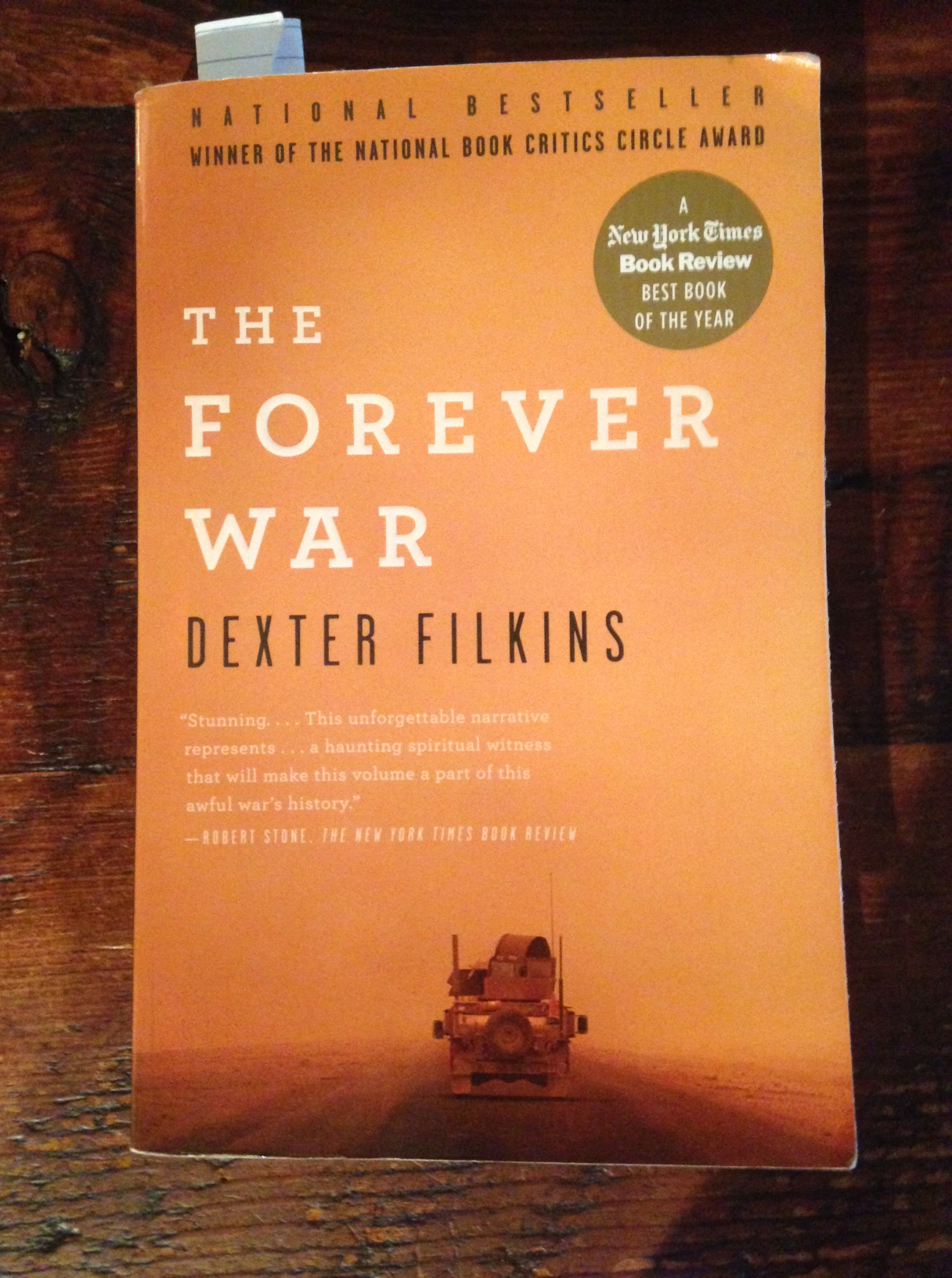 This book should be required reading for American citizens. It’s clear by the end that Dexter Filkins is pretty messed up by the experiences described. I had to finish this book very quickly because I was worried reading it was making me less funny.
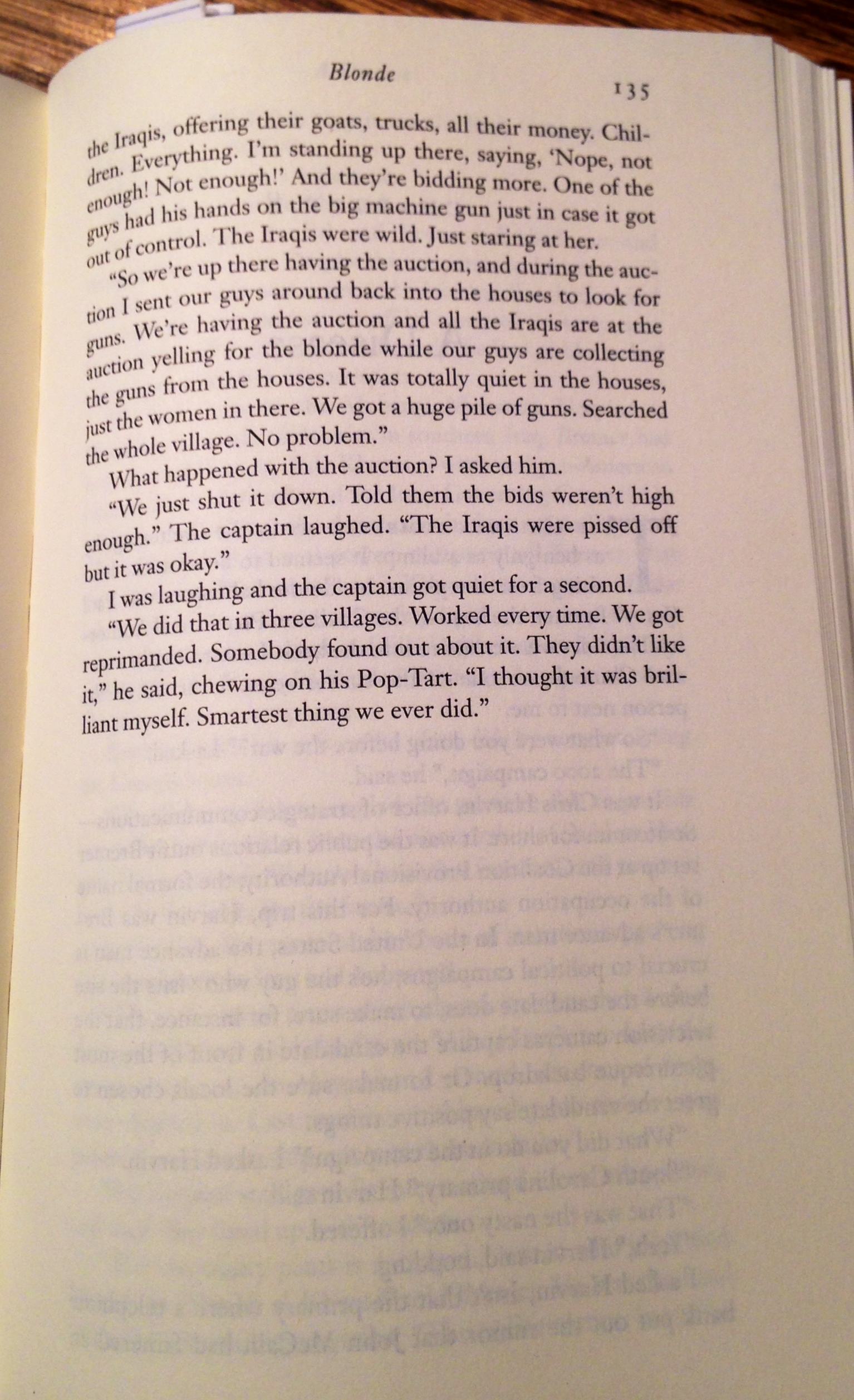
Here is an excerpt that’s one of the easier chapters to read.

As an irony
Posted: September 15, 2014 Filed under: America Since 1945, music 1 Commentfrom Buzzfeed’s fascinating profile of Ryan Adams:
“And I slept. I slept like I never had. I totally crashed in this beautiful way. I let go of all the false ideas of my late twenties and early thirties, this construct of who I was and how I thought I should be. That struggle was over.”
That sounds great! How about this?:
In 1994 he formed Whiskeytown. As Adams would famously declare in the group’s musical manifesto “Faithless Street”: “I started this damn country band, ‘cause punk rock was too hard to sing.” Today Adams says the foundational conceit behind the band was a pose — something his more strident critics accused him of at the time. “There’s this wrong idea about me being identified with things that are Southern or country,” he notes. “I do not fucking like country music and I don’t own any of it. I watched Hee-Haw as a kid with my grandmother, I only like country music as an irony. I liked it when I would get drunk.”
As an irony. Or this:
In the studio Adams plied [Jenny] Lewis with psychological tricks: He told her to write her own Oasis-style anthem, forced her to listen to Creed incessantly before laying down vocals. “I had been stuck in the mud for so long, I needed a person who could push me ahead. The casual, low-stakes environment for me was crucial.”
Meat Mountain insurance
Posted: August 26, 2014 Filed under: America Since 1945 Leave a comment
Arby’s faced a key problem as it moved to attract customers: People thought the restaurant served mainly roast beef. To change that, the company made this poster showing a tall stack of every meat on the menu, from bacon to brisket…
“People started coming in and asking, ‘Can I have that?’” said Christopher Fuller, the company’s vice president of brand and corporate communications. So Arby’s began granting their wish.
The “Meat Mountain,” as it’s called, will not be listed on the menu, but store associates will make it for customers who ask. The price is $10. For that, you get a bun and, from the bottom up:
2 chicken tenders
1.5 oz. of roast turkey
1.5 oz. of ham
1 slice of Swiss cheese
1.5 oz. of corned beef
1.5 oz. brisket
1.5 oz. of Angus steak
1 slice of cheddar cheese
1.5 oz. roast beef
3 half-strips of bacon
Arby’s says the Meat Mountain is so tall that it won’t fit into the traditional clamshell packaging.
(Getting this from Cord Jefferson who got it from WaPo. “Insurance” is a term I believe SDB coined, which I prefer to “ICYMI.”)