San Francisco (and California) Politics
Posted: September 15, 2024 Filed under: California, San Francisco, the California Condition Leave a comment
When former Assembly Speaker Antonio Villaraigosa lost a campaign to become mayor of Los Angeles in June, then-Speaker Robert Hertzberg named him to the California Medical Assistance Commission, where he could earn $99,000 a year, plus benefits, working a few hours each month.
Former Assemblyman Richard Alatorre, D-Los Angeles, who served in the legislature with Senate President Pro Tem John Burton in the 1970s, was out of public office and the target of a federal corruption probe two years ago when Burton placed him on the Unemployment Insurance Appeals Board. His salary: $114,180 a year plus benefits.
from SF Gate, 2002.
Assembly Speaker Willie Brown, continuing his rush to hand out patronage jobs while he retains his powerful post, has given high-paying appointments to his former law associate and a former Alameda County prosecutor who is Brown’s frequent companion.
Brown, exercising his power even as his speakership seems near an end, named attorney Kamala Harris to the California Medical Assistance Commission, a job that pays $72,000 a year.
Harris, a former deputy district attorney in Alameda County, was described by several people at the Capitol as Brown’s girlfriend. In March, San Francisco Chronicle columnist Herb Caen called her “the Speaker’s new steady.” Harris declined to be interviewed Monday and Brown’s spokeswoman did not return phone calls.
Harris accepted the appointment last week after serving six months as Brown’s appointee to the Unemployment Insurance Appeals Board, which pays $97,088 a year. After Harris resigned from the unemployment board last week, Brown replaced her with Philip S. Ryan, a lawyer and longtime friend and business associate.
Last week, Brown also appointed Janet Gotch, wife of retiring Assemblyman Mike Gotch of San Diego, to the $95,000-a-year Integrated Waste Management Board, which oversees garbage disposal in California.
from Los Angeles Times, 1994. In fairness sitting through those hearings is probably very boring!
The story goes that in 2015 Gavin Newsom and Kamala Harris, maybe encouraged by various Democratic fundraisers and power brokers, cut a deal where she would run for Senate and he would run for Governor in 2018:
The early-2015 understanding between the two San Francisco Democrats, both with campaigns managed by the same San Francisco political consulting firm, was this: To avoid a brutal fight over the Senate seat being vacated by the retiring Barbara Boxer, Newsom would stay out of the 2016 Senate race and concentrate on running for governor two years later.
A LA Times article about the story that Gavin Newsom might be unhappy with subsequent developments (it’s not over yet Gavin!) led me to this 2015 article about why San Francisco has produced so many prominent state leaders. It’s a question we’ve pondered before:
There is nothing mysterious about San Francisco’s export of high-profile politicians, nothing like the alchemy of air and water that produces the distinctive tang of its signature sourdough bread.
Simply put, it’s fierce competition, at virtually every level, starting with the leadership of its political clubs and spreading to the lowliest contests for elected office on up to races for the Legislature and Congress.
Where San Diego and Los Angeles lie back, most of their residents scarcely interested in politics, San Francisco leans in: chin out, elbows wide and sharp.
“There is a culture here of fighting over just about everything in the public space,” said Eric Jaye, another of the city’s veteran political strategists, from global issues like the Middle East to protecting the neighborhood coffee shop from an onslaught of franchised beans….
from earlier in the same piece (by Mark Z. Barabak):
San Francisco is the closest thing to an East Coast enclave set along the Pacific, a place, like New York or Boston, where politics is a passion, a sport, something everyday people fuss and fight and scheme over.
As blue (politically) as San Francisco Bay, the city has 27 officially chartered Democratic Party chapters, among them the Raoul Wallenberg Jewish Democratic Club, the Filipino American Democratic Club, the Black Young Democrats of San Francisco and the Harvey Milk LGBT Democratic Club. That works out to roughly one party franchise every few blocks.
There are countless more neighborhood councils, civic associations, interest groups — branches of the Sierra Club, the NAACP and the like — all clamoring for their particular agendas.
“It’s a city where people have always been able to be loud and proud about who they are, not just as individuals but as a group or a community,” said Ace Smith, a Democratic strategist who has decades of experience running San Francisco campaigns.
The result is a kind of hyper-democracy and political forge that has fashioned some of California’s most powerful and enduring elected leaders, in numbers far out of proportion to the city’s relative pint size.
A very short history of California’s politics might go something like this: California wanted to get into the union without going through the territorial stage, so they sorta rushed through a constitutional convention (John Sutter himself was there). In the compromise of 1850, one of the deals involving slave and free states, California got brought in. The US wanted a lock on that gold. During the Civil War California stayed in the Union (barely). After the Civil War, the major power in the state was the railroad barons, the Big Four, who were so powerful that they provoked a progressive, democratic backlash, personified by Hiram Johnson.

(He looks like Dwight Shrute, no?)
Here’s Reagan’s guy Stuart Spencer talking about Hiram:
They didn’t do a lot of candidate work, but they did a lot of what we call proposition work in California. Under the reforms of Hiram Johnson, we were a unique state at that time. We were for years. You could put practically anything on the ballot and have it decided there instead of the legislature.
You can also read Leon Panetta, who began as a Republican but became a prominent Democrat, talking about Hiram:
I was raised in a progressive Republicanism that used to be the case in California. It began with Hiram Johnson. It was a tradition that was carried on by people like Earl Warren and Tom Kuchel, whom I worked for, and Goodwin Knight and others. Because of cross filing, because of the traditions of California.
As a result of all this balloting California politics gets pretty complicated. Our state constitution is 76,930 words long. Novel length. (Although it’s not even close to the length of the longest, which is…. can you guess it?….
Alabama, at over 402,000 words. Gotta look into how that came to be. Seems to be because it makes a lot of specific rules for specific municipalities.)
At the moment we’re a one party state, probably because the second to last Republican governor, Pete Wilson, made his big issue immigration (anti). He actually won big on that, with Proposition 187 in 1994. The voters went for that in a big way, but it then got tied up in the courts, and the next Democratic governor, Grey Davis, stopped pursuing the implementation.
Noting a rapid increase in the number of Latinos voting in California elections, some analysts cite Wilson and the Republican Party’s embrace of Proposition 187 as a cause of the subsequent failure of the party to win statewide elections.
California today is maybe 26% immigrants. The most recent Republican governor was an immigrant. He won after Grey Davis was recalled (a Hiram Johnson reform). We might be tempted to treat that election as a special circumstance, as he was famous movie star Arnold Schwarzenegger, but then again another famous movie star, Ronald Reagan, had been elected governor before. And George Murphy had been elected senator. Do you need a certain glam quality to succeed in California politics?
Two Californians have become president, although only one, Nixon, was born in California. A third Californian and second native born Californian has a real good shot right now. We’re rooting for her!
John Steinbeck on San Francisco
Posted: August 23, 2022 Filed under: San Francisco, Steinbeck, Steinbeck, the California Condition Leave a comment
Thomas Wolf took that one for Wikipedia.
Can you remember anywhere in John Steinbeck’s fiction where he discusses San Francisco? Whole books about Monterey, but does he even mention the place? I couldn’t remember. A friend’s been working on Steinbeck’s letters, he couldn’t think of any mention either.
Turns out Steinbeck does talk about San Francisco in Travels with Charley in Search of America. The chapter begins:
I find it difficult to write about my native place, northern California. It should be easiest, because I knew that strip angled against the Pacific better than any place in the world. But I find it not one thing but many – one printed over another until the whole thing blurs.
He mentions growth:
I remember Salinas, the town of my birth, when it proudly announced four thousand citizens. Now it is eighty thousand and leaping pell mell on in mathematical progression – a hundred thousand in three years and perhaps two hundred thousand in ten, with no end in sight.
(The population of Salinas is, in 2022, 156,77.)
Then he writes some about mobile home parks, and property taxes, concluding:
We have in the past been forced into reluctant change by weather, calamity, and plague. Now the pressure comes from our biologic success as a species.
Then he gets going on San Francisco:
Once I knew the City very well, spent my attic days there, while others were being a lost generation in Paris. I fledged in San Francisco, climbed its hills, splet in its parks, worked on its docks, marched and shouted in its revolts. In a way I felt I owned the City as much as it owned me.
…
A city on hills has it over flat-land places. New York makes its own hills with craning buildings, but this gold and white acropolis rising wave on wave against the blue of the Pacific sky was a stunning thing, a painted thing like a picture of a medieval Italian city which can never have existed.
Steinbeck can’t stay though. He has to hurry on to Monterey to cast his absentee ballot (it’s 1960; he’s voting for John F. Kennedy).
Alice Marble
Posted: August 17, 2022 Filed under: California, San Francisco, the California Condition Leave a comment
(Paul T. submitted this photo to FourSquare)
Several times in walks around San Francisco I’ve stopped at the Alice Marble Tennis Courts, at the top of Russian Hill, for the view from Alcatraz to the bridge.

Alice Marble was a tennis champ of the 1930s and ’40s. Wikipedia informs us:
For a brief time after retirement, she worked on the editorial advisory board of DC Comics and was credited as an associate editor on Wonder Woman. She created the “Wonder Women of History” feature for the comics, which told the stories of prominent women of history in comic form.
In her second autobiography Courting Danger (released after her death in 1990), Marble mentions that, back in the 1940s, she had married Joe Crowley around World War II, a pilot, who was killed in action over Germany. Only days before his death, she miscarried their child following a car accident. After an attempt to kill herself, she recuperated, and in early 1945, agreed to spy for U.S. intelligence. Her mission involved renewing contact with a former lover, a Swiss banker, and obtaining Nazi financial data. The operation ended when a Nazi agent shot her in the back after chasing her while she was trying to escape in a car, but she recovered. Few details of this operation have been corroborated by journalists and authors who tried to investigate this part of her life in the years from the time of her death to the present. No Swiss banker has been discovered, leading to suspicions that this man of mystery might have been a Nazi, someone who Marble may have been trying to avoid having had an association.
Marble greatly contributed to the desegregation of American tennis by writing an editorial in support of Althea Gibson for the July 1, 1950 issue of American Lawn Tennis Magazine. The article read “Miss Gibson is over a very cunningly wrought barrel, and I can only hope to loosen a few of its staves with one lone opinion. If tennis is a game for ladies and gentlemen, it’s also time we acted a little more like gentle-people and less like sanctimonious hypocrites…If Althea Gibson represents a challenge to the present crop of women players, it’s only fair that they should meet that challenge on the courts.”

Female tennis champs of that era are honored all over San Francisco. Alice Marble’s career followed that of Helen Willis Moody, painted by Diego Rivera in his mural inside the former Pacific Stock Exchange. It’s cool that California is still producing world class tennis champs.
The Alice Marble courts are surrounded by George Sterling Park:

Kevin Starr (1973) wrote:
The uncrowned King of Bohemia (so his friends called him), Sterling had been at the center of every artistic circle in the San Francisco Bay Area. Celebrated as the embodiment of the local artistic scene, though forgotten today, Sterling had in his lifetime been linked with the immortals, his name carved on the walls of the Panama-Pacific International Exposition next to the great poets of the past.
Lots of people around George Sterling’s life died of poison, including finally the man himself, who poisoned himself inside the San Francisco clubhouse of the Bohemian Club. Next time I’m up there, I’ll have to stop by the Bohemian Club and see the bronze relief by Jo Mora.
The style of poetry Sterling practiced is no longer really in fashion:
The winds of the Future wait
At the iron walls of her Gate,
And the western ocean breaks in thunder,
And the western stars go slowly under,
And her gaze is ever West
In the dream of her young unrest.
Her sea is a voice that calls,
And her star a voice above,
And her wind a voice on her walls—
My cool, grey city of love.
How did the Bohemian Club go from being a scene of outré artists to having like Richard Nixon as a member? Probably the same way Carmel went from being an out there semi-commune to being a rich person retirement place. And the same way San Francisco was a cool place to drop out in 1965, and is now unaffordable unless you’re making mid six figures programming algorithms.
A lesson from California history: wherever the outcast artists are setting up camp, you’d be wise to buy real estate, and hang onto it for a hundred years. Although maybe that kind of thinking is contrary to the Bohemian Club motto:
Weaving spiders come not here.
San Francisco (and Los Angeles)
Posted: July 15, 2020 Filed under: America Since 1945, California, San Francisco, the California Condition Leave a comment
Earlier this year, you moved to Los Angeles from San Francisco. How is the transition going?
It felt like the opening minute of Randy Newman’s song “I Love L.A.” Looking back on the twentieth century, I recall it was Los Angeles that was always the city of the future, and the city of craft and guilds. Every movie was essentially a six-month startup that brought together know-how and expertise from so many different areas: art, set design, costume, carpentry—and all the weirdly named professions like grips, gaffers, and boom operators. That ethos still lives on in the spirit of the place. With SpaceX and other aerospace companies making headway, I wouldn’t discount Southern California in the race to become the next big creative cluster. Of course, Sacramento may ruin the entire state before that happens. But that’s another story.
Michael Gibson (had never heard of) in City Journal. Gibson wrote a piece for City Journal where he called San Francisco “America’s Havana.” He pointed out inarguable problems with San Francisco, which is a shocking mess.
But, like Havana, San Francisco is also magical. There’s just something about it. Maybe it’s the drastic geography, set on hillsides over a bay that’s both perfect and hidden. The sea air is part of it, for sure, and the lushness of the flora. In both Havana and San Francisco, the very air is magical.
When you read the history of San Francisco, a certain tolerance of criminality always seems to have been part of the mix. Stepping over a druggie passed out on the street wouldn’t’ve been unfamiliar to a resident of Gold Rush-era San Francisco or Barbary Coast San Francisco, or the 1940s San Francisco that inspired all the noir movies.
I’ve had in my files this bit by Lillian Symes from a 1932 Harper’s, reprinted from the archive:

The city of cheap yet superb living:

More:

When I got to LA in 2004, I found the living superb. It was cheaper than New York City, but I’m not sure it could really be called cheap. And it’s gotten less cheap. Readers, where would you say, these days, the living is cheap yet superb?

San Francisco scenes:

What do these buildings have in common?
Posted: October 10, 2016 Filed under: California, money, New York, San Francisco Leave a commentOne Beacon Street, Boston
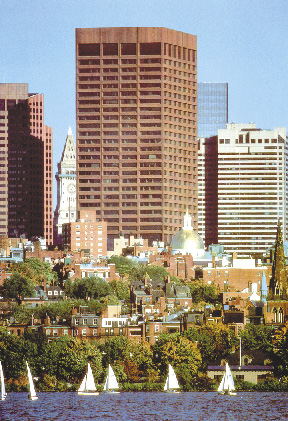
425 Market Street, San Francisco:

11 Times Square, New York:

Along with a lot of other buildings in Boston, New York, San Francisco, Paris, London and elsewhere, they’re all 47% or so owned by the Norwegian people, in the form of their nation’s sovereign wealth fund.
They own a lot of other stuff, too. $21 mill worth of Buffalo Wild Wings, for instance.

And 1.5% of Whole Foods:

In a tiny way, every Norwegian helps Marc Maron, because they own about a million bucks worth of Stamps.com.

San Francisco
Posted: January 7, 2016 Filed under: America Since 1945, assorted, California, San Francisco, the American West, the California Condition, the ocean Leave a comment
Right before Christmas had a chance to visit San Francisco — always great!
In San Francisco you can really feel like you’re halfway in the ocean. 
Finding myself with an idle hour I went to go check out Diego Rivera’s mural Allegory of California over at the City Club in the former Pacific Stock Exchange building. The City Club was all done up for a Christmas party.

Pictures of the mural often leave out the amazing ceiling part:
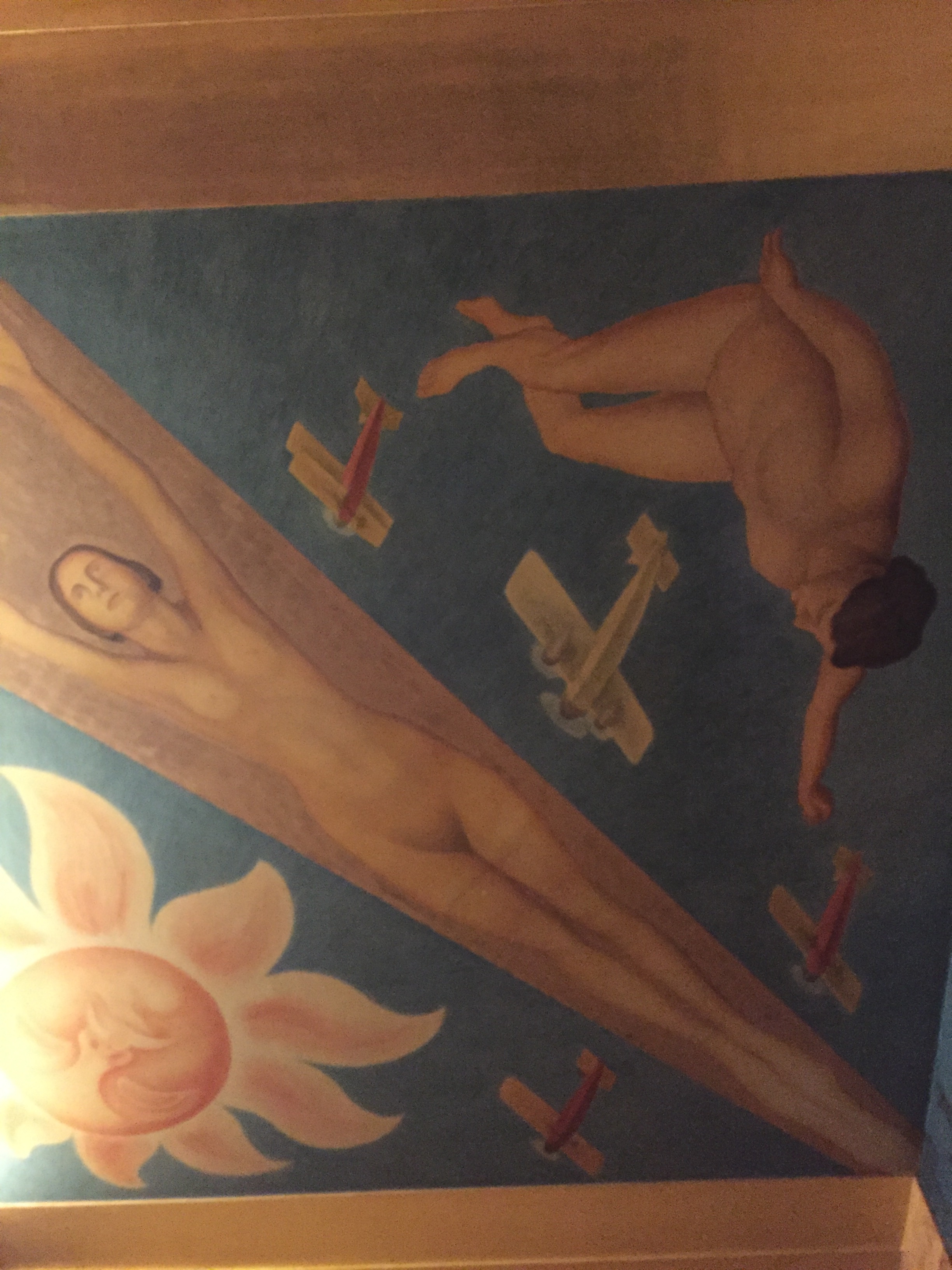
Rivera painted this one in 1931, He modeled the lady on tennis champ Helen Wills Moody, who was at that time one of California’s most famous daughters:

She was a painter herself:
Wills was an artist by avocation. She received a degree in fine arts along with a Phi Beta Kappa key from the University of California, and painted throughout her life. She was delighted to be chosen as the model for Diego Rivera’s two-story mural “The Riches of California,” commissioned for $2,500 in 1930. Wills and the first of her two husbands, the financier Frederick Moody, invited Rivera and his wife, the painter Frieda Kahlo, to a celebratory tea after the mural’s unveiling at the former San Francisco Stock Exchange.
For Wills, who confessed to suffering the intangible pangs of “a restless heart,” tennis and painting were the best antidotes for melancholy. She maintained an artist’s studio at her residences in San Francisco and later in Carmel, once sold 40 paintings for $100 each and illustrated her own articles for The Saturday Evening Post.
Here’s one of her own drawings:
 Lifting that one from San Francisco’s Lost Art Salon. Reader Schoboats calls our attention to a good detail from Wills Moody’s NY Times obit:
Perhaps Wills’s most infamous match, and certainly the one she extolled as the focal point of her playing career, was her only meeting with Lenglen, the queen of the continent, in a much ballyhooed showdown at Cannes in 1926. Lenglen was 26 and tactically superior; Wills was 20 and physically stronger. Lenglen won the raucous encounter, 6-3, 8-6.
There was a prizefight atmosphere, with tickets scalped at a then-shocking rate of $50 each, and an international gallery of spectators that included King Gustaf, a group of stowaway French schoolboys in a eucalyptus tree at one end of the court and Wills’s future husband, Frederick Moody, who introduced himself to her after the match. Wills was fond of noting that although she lost the match, she not only gained perspective on necessary changes to her game, which tended to be without nuance and relied on battering her opponents into submission with repetitious forehand ground strokes, but also gained a husband.

Maybe next time I’m up there I will get to see Making Of A Fresco:

Pacific-Union Club Punch
Posted: April 2, 2012 Filed under: California, how to live, people, San Francisco 1 CommentThis is the Pacific-Union Club, at the top of Nob Hill in San Francisco:

Are you going to tell me you can walk by that building and not think, “I want to make their famous punch!”
For a party of ten. Into a large punch-bowl place ten tablespoonfuls of bar sugar and ten tablespoonfuls of freshly squeezed lime or lemon juice. Add two jiggers of Curaçao and dissolve the whole in about a quart of effervescent water. Add two quarts of champagne and one bottle of good cognac. Stir thoroughly, ice, decorate and serve in thin glassware.
READER: be sure to use regular, orange Curacao, not blue curacao, or your punch will be a revolting green color.
That recipe is from William “Cocktail” Boothby’s 1908 book, The World’s Cocktails and How To Make Them. Let’s take a look at Boothby’s resume, just to make sure he’s for real:
- Minstrel performer.
- Bartender in New York, Chicago, Philadelphia, New Orleans, and Kansas City.
- Bartender at Byron Hot Springs.
- Bartender (or in his terms “presiding deity”) at Hotel Rafael, San Rafael, California, in “the gay days when Baron von Schroeder was making history over there”.
- Bartender at the Silver Palace, San Francisco
- Bartender at the Palace Hotel, San Francisco.
- Saloon owner.
- Assemblyman in California in 1895. The 1908 edition of The World’s Drinks & How To Mix Them begins “To the liquor dealers of San Francisco who unanimously assisted in my election to the Legislature by an unprecedented majority.”
- Soda drink counter supervisor, Olympic Club, during Prohibition
 Helytimes
