Carter’s, congealed electricity, AI and Needham
Posted: January 30, 2025 Filed under: America Since 1945, business, children, New England, Uncategorized Leave a comment
If you have a little kid in the US you will have some clothes from Carter’s. They sell them at Target and Wal-Mart as well as 1,000 or so Carter’s stores, and they cost $8.

Before I had a kid it didn’t occur to me that kids outgrow their clothes so fast they can’t cost too much.
When I see the Carter’s label, I think of my home town.
William Carter founded Carter’s in Needham, Massachusetts in 1865. Textiles were a big business in New England. Two inputs, labor and electricity, were cheap. Labor from excess farm children, and electricity from running streams? That would’ve been the earliest mode, what were they using by 1865? Coal?
One of the biggest buildings in Needham, certainly the longest, is the former Carter’s headquarters, which stretches itself along Highland Avenue. A prominent landmark, it took a long time to walk past.

The story of Carter’s is a global economic story in miniature.

Old Carter mill #2, found here.

The Carter family sold the company in the 1990s. It went public in 2003. In 2005, Carter’s acquired OshKosh B’gosh, a company famous for making children’s overalls. This company started in 1895 in Oshkosh, Wisconsin (the name comes from an Ojibwe word, “The Claw,” that was the name of a local chief).
The term “B’gosh” began being used in 1911, after general manager William Pollock heard the tagline “Oshkosh B’Gosh” in a vaudeville routine in New York.[4] The company formally adopted the name OshKosh B’gosh in 1937.
OshKosh B’Gosh’s Wisconsin plant was closed in 1997. Downsizing of domestic operations and massive outsourcing and manufacturing at Mexican and Honduran subsidiaries saw the domestic manufacturing share drop below 10 percent by the year 2000.
OshKosh B’Gosh was sold to Carter’s, another clothing manufacturer for $312 million
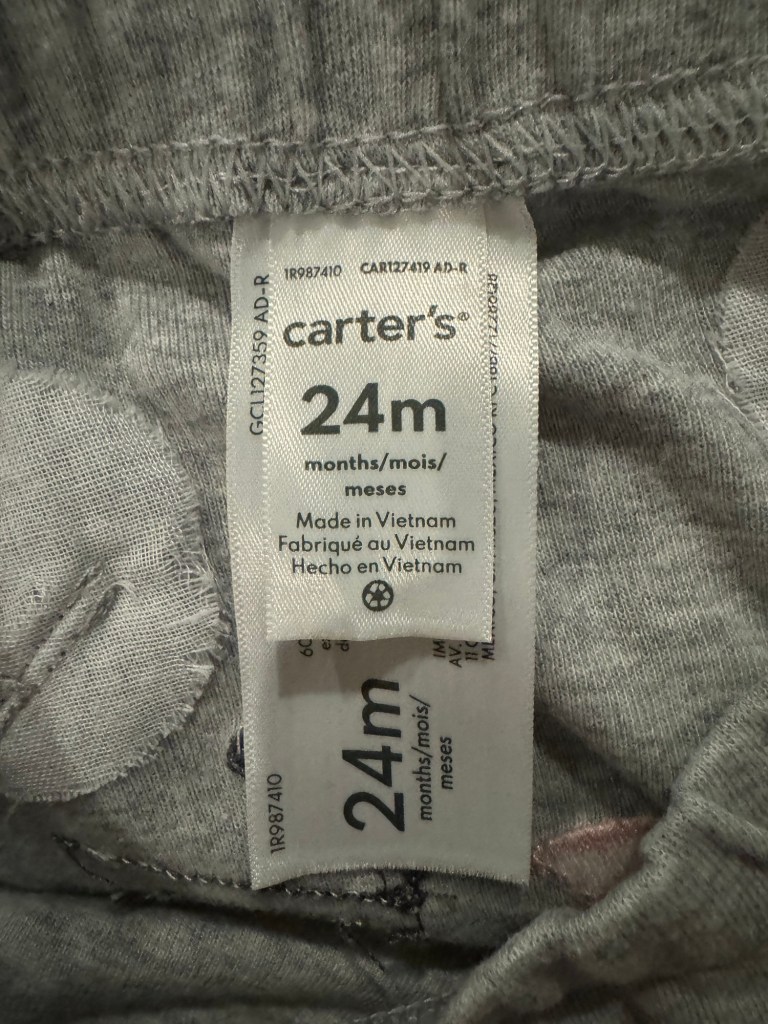
The headquarters of Carter’s moved to Atlanta. Labor and electricity were cheaper in Georgia, Carter’s had been opening mills in the South for awhile. Now the clothes are made overseas. I look at the labels on Carter’s clothes: Bangladesh, India, Cambodia, Vietnam. If you factor in the shipping and the markup how much of that $8 is going to your garment maker in Bangladesh? Then again maybe it’s the best job around, raising Bangladeshis out of poverty, and soon Chittagong will look like Needham.
The former Carter’s headquarters, now vacant, became a facility for elder living. My mom worked there, briefly. Carter’s today is headquarted in the Phipps Tower in Buckhead, Atlanta, which I happened to pass by the other day.
The loss of the mill and the company headquarters was not a crisis for Needham. Needham is very close to Boston, an easy train ride away, and along of the 128 Corridor. There are growth businesses in the area, hospitals, biotech companies, universities. TripAdvisor is based in Needham. Needham is a pleasant town, there are ongoing talks to turn the former Carter’s building into housing. It would be close to public transport and walkable to the library and the Trader Joe’s. That seems to be stalled.
Needham has brain jobs, attached to a dense brain network, while brawn jobs are being shipped overseas. There are many other towns in Massachusetts where the old run down mill is a sad derelict as production moved first south and then overseas. These towns are bleak. Oshkosh, Wisconsin seems ok, but the shipping of steady jobs overseas is of course a major factor in our politics, Ross Perot was talking about it in 1992 and no one did anything about it and now Trump is the president.
A similar story lies in the history of Berkshire Hathaway – the original New Bedford textile mill, not the conglomerate Warren Buffett built on top of it using the same name. Buffett talks about this, I believe this is from the 2022 annual meeting:
CHARLIE MUNGER: Well, I remember when you had a textile mill —
WARREN BUFFETT: Oh, god.
CHARLIE MUNGER: — and it couldn’t —
WARREN BUFFETT: I try to forget it. (Laughs)
CHARLIE MUNGER: — and the textiles are really just congealed electricity, the way modern technology works.
And the TVA rates were 60% lower than the rates in New England. It was an absolutely hopeless hand, and you had the sense to fold it.
WARREN BUFFETT: Twenty-five years later, yeah. (Laughs)
CHARLIE MUNGER: Well, you didn’t pour more money into it.
WARREN BUFFETT: No, that’s right.
CHARLIE MUNGER: And, no — recognizing reality, when it’s really awful, and taking appropriate action, just involves, often, just the most elementary good sense.
How in the hell can you run a textile mill in New England when your competitors are paying way lower power rates?
WARREN BUFFETT: And I’ll tell you another problem with it, too. I mean, the fellow that I put in to run it was a really good guy. I mean, he was 100% honest with me in every way. And he was a decent human being, and he knew textiles.
And if he’d been a jerk, it would have been a lot easier. I would have probably thought differently about it.
But we just stumbled along for a while. And then, you know, we got lucky that Jack Ringwalt decided to sell his insurance company [National Indemnity] and we did this and that.
But I even bought a second textile company in New Hampshire, I mean, I don’t know how many — seven or eight years later.
I’m going to talk some about dumb decisions, maybe after lunch we’ll do it a little.
Congealed electricity, what a phrase. In the 1985 annual letter, Buffett discusses the other input, labor, which was cheaper in the South, and why he kept Berkshire Hathaway running in Massachusetts anyway:
At the time we made our purchase, southern textile plants – largely non-union – were believed to have an important competitive advantage. Most northern textile operations had closed and many people thought we would liquidate our business as well.
We felt, however, that the business would be run much betterby a long-time employee whom. we immediately selected to be president, Ken Chace. In this respect we were 100% correct: Ken
and his recent successor, Garry Morrison, have been excellent managers, every bit the equal of managers at our more profitable businesses.… the domestic textile industry operates in a commodity business, competing in a world market in which substantial excess capacity exists. Much of the trouble we experienced was attributable, both directly and indirectly, to competition from foreign countries whose workers are paid a small fraction of the U.S. minimum wage. But that in no way means that our labor force deserves any blame for our closing. In fact, in comparison with employees of American industry generally, our workers were poorly paid, as has been the case throughout the textile business. In contract negotiations, union leaders and members were sensitive to our disadvantageous cost position and did not push for unrealistic wage increases or unproductive work practices. To the contrary, they tried just as hard as we did to keep us competitive. Even during our liquidation period they performed superbly. (Ironically, we would have been better off financially if our union had behaved unreasonably some years ago; we then would have recognized the impossible future that we faced, promptly closed down, and avoided significant future losses.)
Buffett goes on, if you care to read it, to discuss the dismal spiral faced by another New England textile company, Burlington.
Charlie Munger, in his 1994 USC talk, spoke on the paradoxes here:
For example, when we were in the textile business, which is a terrible commodity business, we were making low-end textiles—which are a real commodity product. And one day, the people came to Warren and said, ‘They’ve invented a new loom that we think will do twice as much work as our old ones.’
And Warren said, ‘Gee, I hope this doesn’t work because if it does, I’m going to close the mill.’ And he meant it.
What was he thinking? He was thinking, ‘It’s a lousy business. We’re earning substandard returns and keeping it open just to be nice to the elderly workers. But we’re not going to put huge amounts of new capital into a lousy business.’
And he knew that the huge productivity increases that would come from a better machine introduced into the production of a commodity product would all go to the benefit of the buyers of the textiles. Nothing was going to stick to our ribs as owners.
That’s such an obvious concept—that there are all kinds of wonderful new inventions that give you nothing as owners except the opportunity to spend a lot more money in a business that’s still going to be lousy. The money still won’t come to you. All of the advantages from great improvements are going to flow through to the customers.”
Is something similar happening with AI? Who will it make rich, and at what cost? To whose ribs will the profits stick?
I’m not sure we could call AI congealed but it is more or less just more and more electricity run through expensive processors. Who will win from that? So far it’s been the makers of the processors, but if DeepSeek shows you don’t need as many of those the game is changed. Personally I’m unimpressed with DeepSeek – try asking it what happened in Tiananmen Square in June 1989.
How does Carter’s itself continue to survive? Target’s own brand, Cat & Jack, is right next door on the shelves. Could another company shove Carter’s aside if they can cut the margins even thinner, get the price down to $7? Here’s what Carter’s CEO Michael Casey has to say in their most recent annual letter:

Hard to build the operational network Carter’s has over 150+ years. There will be a challenge awaiting the next CEO of Carter’s as Michael Casey is retiring. Carter’s stock ($CRI) is pretty beaten up over the past year, down 30%. A possible macro problem for Carter’s is that the number of births in the United States appears to be declining.
It is powerful, when I’m changing my daughter, to contemplate my home town, and global commerce, and the people in Cambodia who made these clothes, and the ways of the world.
Hoover Boys
Posted: August 1, 2017 Filed under: children, heroes, politics, presidents Leave a comment
our Chicago correspondent sends us this find:

The authors:
Trips
Posted: February 4, 2015 Filed under: children, the California Condition 8 Comments
from this New Yorker article by Michael Pollan about psilocybin:
Carhart-Harris doesn’t romanticize psychedelics, and he has little patience for the sort of “magical thinking” and “metaphysics” they promote. In his view, the forms of consciousness that psychedelics unleash are regressions to a more “primitive style of cognition.” Following Freud, he says that the mystical experience—whatever its source—returns us to the psychological condition of the infant, who has yet to develop a sense of himself as a bounded individual. The pinnacle of human development is the achievement of the ego, which imposes order on the anarchy of a primitive mind buffeted by magical thinking. (The developmental psychologist Alison Gopnik has speculated that the way young children perceive the world has much in common with the psychedelic experience. As she puts it, “They’re basically tripping all the time.”)
This article gives a lot of ammo to hippies:
He said that the N.I.M.H would need to see “a path to development” and suspects that “it would be very difficult to get a pharmaceutical company interested in developing this drug, since it cannot be patented.” It’s also unlikely that Big Pharma would have any interest in a drug that is administered only once or twice in the course of treatment. “There’s not a lot of money here when you can be cured with one session,” Bossis pointed out.
Interesting talking about psychoactive drugs in medicine: pretty fast you hit the boundaries of science:
PATIENT: What does this drug do?
DOCTOR: Well, medically, nothing, but it might… make you feel like your ego died and you’ve come into harmony with the great spirit of the cosmos?
We’re at the limit of medicine here, crossing over to religion or at least social anthropology.
If you’re taking mushrooms in a lab in a New York hospital, under medical supervision, that’s gonna affect your experience. If you take them after traveling to southern Mexico, in the house of a curandera, and you’re open to the idea that a curandera might have some kind of power, you’re gonna have another kind of experience:
In 1955, after years spent chasing down reports of the clandestine use of magic mushrooms among indigenous Mexicans, Wasson was introduced to them by María Sabina, a curandera—a healer, or shaman—in southern Mexico. Wasson’s awed first-person account of his psychedelic journey during a nocturnal mushroom ceremony inspired several scientists, including Timothy Leary, a well-regarded psychologist doing personality research at Harvard, to take up the study of psilocybin. After trying magic mushrooms in Cuernavaca, in 1960, Leary conceived the Harvard Psilocybin Project, to study the therapeutic potential of hallucinogens. His involvement with LSD came a few years later.
In the wake of Wasson’s research, Albert Hofmann experimented with magic mushrooms in 1957. “Thirty minutes after my taking the mushrooms, the exterior world began to undergo a strange transformation,” he wrote. “Everything assumed a Mexican character.”
(would they have assumed a “Mexican character” if Hofmann thought they came from Cambodia?)
If you get mushrooms from your college buddy, and the point is to clown around in the park, you’re gonna have another kind of experience. If you’re a true hippie open to the idea that mushroom spores traveled to Earth as a kind of message from some distant galaxy, that’s gonna affect your experience.
What about this context?:
In a double-blind experiment, twenty divinity students received a capsule of white powder right before a Good Friday service at Marsh Chapel, on the Boston University campus; ten contained psilocybin, ten an active placebo (nicotinic acid). Eight of the ten students receiving psilocybin reported a mystical experience, while only one in the control group experienced a feeling of “sacredness” and a “sense of peace.” (Telling the subjects apart was not difficult, rendering the double-blind a somewhat hollow conceit: those on the placebo sat sedately in their pews while the others lay down or wandered around the chapel, muttering things like “God is everywhere” and “Oh, the glory!”) Pahnke concluded that the experiences of eight who received the psilocybin were “indistinguishable from, if not identical with,” the classic mystical experiences reported in the literature by William James, Walter Stace, and others.
That ain’t exactly laboratory conditions – there’s lots going on here. I get that there’s a double-blind, but do you measure: who cared more about Good Friday going in? Who was further along on some kind of spiritual journey?
My own thinking on this much affected by ideas of Helytimes favorite Wade Davis. Got more interested re: ayahuasca. It’s one thing to take ayahuasca at a rented house in Malibu. Another thing to go to the Amazon, where your surroundings are halfway a hallucination before you drink a thing. Big difference how you feel here:

Vs. here:

Old advisor at college, a wonderful eccentric woman, used to say she thought all pre-meds should be anthropology majors.
Merry Christmas
Posted: December 24, 2014 Filed under: children, music, musicals Leave a comment
Esther [Judy Garland] finally gets to meet John properly when he is a guest at the Smiths’ house party, although her chances of romancing him don’t go to plan when, after all the guests are gone and he is helping her turn off the gas lamps throughout the house, he tells her she uses the same perfume as his grandmother and that she has “a mighty strong grip for a girl”…
At the ball, Esther fills up a visiting girl’s (Lucille Ballard, played by June Lockhart) dance card with losers because she thinks Lucille is a rival of Rose’s. But when Lucille turns out to be interested in Lon, Esther switches her dance card with Lucille’s and instead dances herself with the clumsy and awkward partners. After being rescued by Grandpa, she is overwhelmed when John unexpectedly turns up after somehow managing to obtain a tuxedo, and the pair dance together for the rest of the evening. Later on, John proposes to Esther and she accepts.
Esther returns home to an upset Tootie. She is soothed by the poignant “Have Yourself a Merry Little Christmas.” Tootie, however, becomes more upset at the prospect of the family’s move and runs downstairs, out into the cold to destroy the snowmen they have made. Mr. Smith sees his daughter’s upsetting outburst from an upstairs window.
Remember to let your kids smoke a cigarette.
Merry Christmas
Posted: December 25, 2012 Filed under: children, holidays Leave a comment

Martin Amis. Photograph by Xavier Bertral/EPA
from the age of five the [Kingsley] Amis children were allowed to smoke a cigarette on Christmas Day.
(from the great John Lanchester, here)

How to talk to children?
Posted: May 17, 2012 Filed under: children, Steinbeck, writing Leave a comment
At The Hairpin they have an interview with John Steinbeck’s son, re: a letter the dad sent the son that was at Letters of Note recently. Here’s an excerpt:
One of the things my father had going for himself is he talked to children like he talked to adults. Kids loved my father, because he didn’t talk down to them. They asked him a question, he gave a serious answer, he treated them as serious human beings.
My mom did the same thing, when I was young. She used to talk to me, even before I could talk, like I was an adult. I think that’s the right way to go about it.
I think so, too, especially if you expect your children to talk like adults. It’s really quite amazing what children will absorb if you give them the benefit of the doubt to understand that the intelligence is there. They may not be able to verbalize themselves completely, but comprehension is there.
Right.
And if you feel that someone is taking your question seriously, you’ll take the answer seriously, even if you don’t quite understand it all.
I’ve been really appreciating the lively conversation all 12,000-odd of you have been generating in the comments. If you know how to talk to children please discuss.
Bear in mind, though, Thom Steinbeck’s final warning:
Well what do you think it is about this letter that resonated with so many people, though? I mean, it was all across the internet, everyone was passing it along.
You can’t trust the internet for that, they’d pass along a car accident if they thought it was amusing!
(photo: “[Girl next to barn with chicken]” from the Library of Congress.)
 Helytimes