Great comment
Posted: November 2, 2025 Filed under: America Since 1945, Kennedy-Nixon 1 Comment
on our February 2016 post When did JFK’s soul go to Heaven?
Sinner though he was I gotta believe in a God who could redeem and receive JFK.
Glimpses of Robert F. Kennedy (Senior)
Posted: August 25, 2024 Filed under: America Since 1945, Kennedy-Nixon Leave a comment
(source: MO 2021.4.249 at the JFK Library)
from Herb Caen’s column, January 5, 1968:
At 12:45 p.m. on Wednesday, Senator Robert F. Kennedy was standing curbside on Sacramento St. near Montgomery, dripping charisma all over the place. He was chatting with two of his henchmen (Democrats have henchmen, Republicans have aides) and his mere presence had an electrifying effect. Motorists slowed down to gape at him. A chubby, giggling Japanese waitress emerged from a coffee shop to wait, shivering, for an autograph.
An elderly Japanese in a black overcoat asked for one, too (you know how these Easterners stick together). Four men emerging from the Red Knight suddenly stopped, transfixed, to stare at him as they picked their teeth with toothpicks. The Senator glanced at them with a tentative smile. They moved on, still picking their teeth.
“Lunch,” he said, jaywalking toward Jack’s with a young henchman, Peter Edelman. We went upstairs to Private Dining Room One, a one-windowed cubicle barely big enough for three. The Senator-it’s hard to refrain from calling him “Bobby” although his friends call him “Bob” —stared at the buzzer on the wall. “To summon the girls,” I said. He looked nervous till I explained that it USED to be possible to take girls upstairs at Jack’s. “Now then,” I went on, “let’s light up cigars and nominate a Vice-President” (I forgot to tell you, I’m great fun at parties). He smiled a tiny one. The waiter whispered nervously in my ear: “How do I address him?” “Senator,” I whispered back. “Sir,” said the waiter, clearing his throat, “would you like a drink?” The Senator ordered a beer-“Coors.” …
In casual conversation, the celebrated toughness isn’t apparent. In 90 minutes, he made only one bitter remark—while talking about an Air Force decision (made over McNamara’s objec-tions) that cost us nine planes in Vietnam. He went on to the “futil-ity® of bombing North Vietnam, and recalled how, during World War II, German production had actually increased under heavy bombing. “The Air Force,” he snapped, “is never right.”…
We ordered fresh cracked crab. “This is wonderful,” he enthused.
With a glance out the window: “What a beautiful city.” Helping himself to more mayonnaise: “I could sit here all afternoon, eating cracked crab.” He asked about Joe Alioto and (a note of concern here how Eugene McCarthy is doing in California, but he wouldn’t be drawn out on the subject. Hunters Point came up and I mentioned that Eastern newsmen were always saying that our slums are garden spots compared to theirs. He nodded: “It’s better to be poor in San Francisco than rich in New York.”
“If the war is still on when your oldest son reaches the draft age,” I said, “what will you tell him?” He took evasive action. “Well, we’d talk about it, all about it, and then I guess it would be his deci-sion.” Then he told, with apparent approval, an anecdote about a friend of his who had been “a terrific hawk” before he went to Viet-ham and who is now “a terrific dove.” “He has an 18-year-old son,” Kennedy went on, “and he told me ‘If that kid doesn’t burn his draft card, I’ll do it for him!'”
***
We stepped outside and he was immediately engulfed by auto-graph-seekers. “Senator,” somebody called out, “your helicopter is waiting”— just like in the movies, and he drove away with a wave and that shy smile. Would I vote for him for President? Well, a man who likes our cracked crab and thinks it’s better to be poor in San Francisco than rich in New York …
Steve Shapiro took these photos:

They’re sometimes cited as being from RFK’s presidential campaign, but the one above is from a 1966 trip to California, where he did some campaigning with Pat Brown.

That one New York, Senate campaign.
I found them in Shapiro’s book, American Edge.

California again. That must be the Berkeley Greek Theater. Here’s how The New York Times reported on that speech (front page):

Pat Brown lost that election to Ronald Reagan.

From Ted Kennedy’s memoir True Compass:


(source)
from a Miller Center interview with Reagan campaign aide Stuart Spencer in November, 2001:
I did a thing at Annenberg School last week. It’s a journalism school at University of Southern California communications center. Ed Guttman is involved with it. He was one of Bobby’s guys, and he was there that night. I said to Ed, Maybe you don’t want to answer this question, but one thing that’s always in my mind: politically, why did Bobby, once he became Attorney General, decide to go after the people his father had put together to finance some of this effort? It was a lot of the hoods and Chicago guys that he’d done business with when he was a bootlegger. There’s been references to it, but did Bobby not know that this transpired? Or did Bobby say to his dad, The hell with it, this is good politics. The hell with it—I believe this—these are bad people. He went right to the heart of what thirty years before were Joe Kennedy’s business associates.
There are conspiracy theories out there that cost him his life. I don’t know if they’re true or not, but God, that’s a fascinating triangle. He wouldn’t answer the question. He said, I don’t know what you’re talking about. I’ve never seen that before in our life. It’s like you have the support of the National Rifle Association or the National Environmental Council and you get into power and you gut them. I’ve never seen that before. But he went after them tooth and toenail.

(source: https://www.loc.gov/item/98509265/ )
In Cormac McCarthy’s The Passenger, Bobby Western talks to his lawyer, Kline. Kline gets going on the Kennedys (the bold is mine, long but intriguing):
You didnt have some connection with the Kennedys.
No.
I worked with Bobby in Chicago in the early sixties. Briefly. We were working with a guy named Ed Hicks who was trying to get free elections for the Chicago cabdrivers. Basically Kennedy was a mor-alist. Before long he was to have an amazing roster of enemies and he prided himself on knowing who they were and what they were up to. Which he didnt, of course. By the time his brother was shot a couple of years later they were mired up in a concatenation of plots and schemes that will never be sorted out. At the head of the list was killing Castro and if that failed actually invading Cuba. In the end I dont think that would have happened but it’s a sort of bellwether for all the trouble they were in. I always wondered if there might not have been a moment there when Kennedy realized he was dying that he didnt smile with relief. After old man Kennedy had his stroke the Kennedys for some reason felt that it would be all right to go after the Mafia. Ignoring the longstanding deal the old man had cut with them. No idea what they were thinking. All the time Jack is schtupping Sam Giancana’s girl-friend—a lady named Judith Campbell. Although in all fairness-quaint term—I think that Jack saw her first. Or one of his pimps did. Some guy named Sinatra.
What are you going to say about the Kennedys? There’s no one like them. A friend of mine was at a houseparty out on Martha’s Vineyard one evening and when he got to the house Ted Kennedy was greeting people at the door. He was dressed in a bright yellow jumpsuit and he was drunk.
My friend said: That’s quite an outfit you’ve got on there, Senator. And Kennedy said yes, but I can get away with it. My friend-who’s a Washington lawyer-told me that he had never understood the Ken-nedys. He found them baffling. But he said that when he heard those words the scales fell from his eyes. He thought that they were probably engraved on the family crest. However you say it in Latin. Anyway, I’ve never understood why there is no monument anywhere to Mary Jo Kopechne. The girl Ted left to drown in his car after he drove it off a bridge. If it were not for her sacrifice that lunatic would have been President of the United States. My guess is that with the exception of Bobby they were just a pack of psychopaths. I suppose it was Bobby’s hope that he could somehow justify his family. Even though he must have known that was impossible. There wasnt a copper cent in the coffers that funded the whole enterprise that wasnt tainted. And then they all died.
Murdered, for the most part. Maybe not Shakespeare. But not bad Dostoevsky.
Castro was no part of this.
No. In the end as it turned out he wasnt.
When he took over the island he threw Santo Trafficante in jail and told him that he was going to be shot as an enemy of the people. So of course Trafficante just said:
How much? You hear different figures. Forty million. Twenty million. It was probably closer to ten. But Trafficante wasnt happy about it. The Mafia had a long history of running the casinos for Ba-tista. Castro should have treated them bet-ter. The Mafia. He’s lucky to be alive. The odd thing is that Santo ran three casinos in Cuba for another eight or ten years after that. Language is important. People forget that Trafficante’s first language is Spanish.
Anyway, he and Marcello have run the Southeast from Miami to Dallas for years.
And the net worth of this enterprise is staggering. At its height over two billion a year. Bobby Kennedy wouldnt have deported Marcello without Jack’s okay, but by now the whole business was beyond disentanglement. The CIA hated the Ken-nedys and were working at cutting themselves loose from the administration al-together, but the notion that they killed Kennedy is stupid. And if Kennedy was going to take the CIA apart piece by piece as he promised to do he’d have had to start about two administrations sooner. By his time it was way too late. The CIA hated Hoover too and Hoover in turn hated the Kennedys and people just assumed that Hoover was in bed with the Mafia but the truth was the Mafia had endless files of Hoover as a transvestite-dressed in ladies’ underwear-so that was a Mexican standoff that had been in play for years.
There’s more to it of course. But if you said that Bobby had gotten his brother-whom he adored —killed, I would have to say that was pretty much right. The CIA hauled Carlos off to the jungles of Guatemala and flew away waving back at him. Hard to imagine what they were thinking. They left him there-where he held a counterfeit passport-and his lawyer finally showed up and then the two of them were frogmarched off into the jungles of El Salvador and left to fashion new lives for them-selves. Standing there in the heat and the mud and the mosquitoes. Dressed in wool suits. They hiked some twenty miles until they came to a village. And, God be praised, a telephone. When he got back to New Orleans he called a meeting at Churchill Farms-his country place-and he was foaming at the mouth over Bobby Kennedy. He looked at the people in the room-I think there were eight of them-and he said: I’m going to whack the little bastard. And it got very quiet. Everybody knew it was a serious meeting. There was nothing on the table to drink but water.
And finally somebody said: Why dont we whack the big bastard? And that was that.
I’m not sure I understand.
If you killed Bobby then you had a really pissed off JFK to deal with. But if you killed JFK then his brother went pretty quickly from being the Attorney General of the United States to being an unemployed lawyer.
How do you know all this?
Right. The thing about the Kennedys was that they had no way to grasp the in-appeasable war-ethic of the Sicilians. The Kennedys were Irish and they thought that you won by talking. They didnt really even understand that this other thing existed. They used abstractions to make political speeches. The people. Poverty. Ask not what your country blah blah blah.
They didnt understand that there were still people alive who actually believed in things like honor. They’d never heard Joe Bonanno on the subject. That’s what makes Kennedy’s book so preposterous.
Although in all fairness there’s some question as to whether or not he ever even read it. I’m having the chicken grande.
All right.
You want to pick the wine?
Sure.

Michael Herr talking about the Kennedys in Las Vegas in The Big Room;
Because even then his kid brother was around like a mongoose on Benzedrine, watching, keeping tabs and running the connections down to their root-ends, to see exactly who was friends with who, and who to play up, or down, or chop completely. The older brother’s playground was the younger brother’s nightmare. Still, the action was invigorating. It’s possible that more of the New Frontier was inspired here at the Sands than back on the Massachusetts bedrock or looking dreaming out of the office window at the Jefferson Memorial.
One more from Brother Edward:

Thad Cochran
Posted: December 17, 2023 Filed under: America Since 1945, Kennedy-Nixon, Mississippi, New England Leave a comment
Poking around the Edward Kennedy oral history project at The Miller Center I find this interview with former Mississippi senator Thad Cochran.
Cochran was a young Naval officer in Newport when he happened to get an invitation to the Kennedy compound from an Ole Miss coed friend who was working as cook there:
Heininger
What were your impressions of [Ted Kennedy] that very first time you met him in Hyannis Port?
Cochran
Very casual, easy to be with, approachable, good sense of humor, big appetite. He liked chocolate-chip cookies, I know that. He stood there and ate a whole fistful of chocolate-chip cookies, which my friend would make on request. She was apparently good at that.

As a young naval officer here’s what Cochran thought of the buildup to Vietnam:
But then the Vietnam thing came along, and it started getting worse and worse. I didn’t get called back in the Navy to serve in Vietnam, but I was teaching one summer in Newport when the Gulf of Tonkin incident occurred. Just trying to figure that one out and reading about what had happened and looking at a couple of television things of the bombing of the port at—where was it, Haiphong, something like that? I thought, I cannot believe this. What the heck is President Johnson thinking? What is he doing? How are we going to back away from that now, responding to this attack against a merchant ship, as I recall?
Anyway, I began worrying about it. I think, in one of my classes, I even asked the students, the officer candidates about to be officers in the U.S. Navy, would they like to go over to Vietnam and fight over this? Would they like to escalate this another notch? Is there something in our national interest? Of course they were scared to death of it. They didn’t want to say anything, but I think I expressed my view kind of gratuitously, and then later I worried that I was going to get reported for being a belligerent, anti-American Naval officer. I really became angry and frustrated and upset with the way this thing was going, and it just got worse, as everybody knows.
How did he end up in elected office?:
So then I went back to practicing law and just working and enjoying it. I forgot about politics, and then our Congressman unexpectedly announced that he was not going to seek re-election. His wife had some malady, some illness, and the truth was, he was just tired of being up here and wanted to come home. It took everybody by surprise. I’m minding my own business again one day at the house and the phone rings, and it’s the local Young Republican county chairman, Mike Allred, who called and said,
You know, you may laugh but I’m going to ask you a serious question. This is serious. Have you thought about running for Congress to take Charlie Griffin’s place?And I said,Well,and I laughed because I said,You know, I have thought about it. I was surprised to hear that he wasn’t going to run, but I’ve thought about it, and I’ve decided that I’m not interested in running. I’ve got too much family obligation, financial opportunities, the law firm,etc.I think Congressmen were making about $35,000 a year or something like that. There was a rumor it might go up to $40,000. I thought, Well, I have a wife and two young children, and there’s no way in the world I can manage all that, and in Washington, traveling back and forth, etc. But it would be interesting. It’s going to be wide open. It was an interesting political situation. Then he said,
Well, let me ask you this: have you thought about running as a Republican?I laughed again and I said,No, I surely haven’t thought about that.I was just thinking about the context of running as a Democrat, and so I was still thinking of myself as a Democrat in ’72.He said,
Would you meet with the state finance chairman? We’ve been talking about who would be a good candidate for us to get behind and push, and we want to talk to you about it. We really think there’s an opportunity here for you and for our partyand all this. I said,Well, Mike, I’ll be glad to meet and talk to you all, but look, don’t be encouraged that I’m going to do it. But I’m happy to listen to whatever you say. I’d like to know what you all are doing, as a matter of curiosity, how you got off under this and who your prospects are and that kind of thing. I’d like to know that.So I met with them, and they started talking about the fact that they would clear the field. There would not be a chance for anybody to win the nomination if I said I would run. I thought, Golly, you all are really serious and think a lot of your own power. I started thinking about it some more, and I asked my wife what she would think about being married to a United States Congressman, and she said,
I don’t know, which one?[laughs] And that is a true story. I said,Hello. Me.Anyway, a lot of people had that reaction:
What? Are you seriously thinking about this?But everybody that I asked—I started just asking family and close friends, law partners; I just bounced it off of them—I said,What’s your reaction that the Republicans are going to talk to me about running for Congress?I was just amazed at how excited most people got over the idea that I might run for Congress and run as a Republican. That’s unique, and they wouldn’t have thought it because they knew I was not a typical Republican. The whole thing worked out, and I did run, and I did win.
That was ’72. Interesting dynamic in Mississippi that year:
Knott
Were you helped by the fact that [George] McGovern was running as the Democratic nominee that year?Cochran
Yes, indeed. There was no doubt about it. I was also helped by the fact that some of the African-American activists in the district were out to prove to the Democrats that they couldn’t win elections without their support. Charles Evers was one of the most outspoken leaders and had that view. He was the mayor of Fayette, Mississippi, and that was in my Congressional district. He recruited a young minister from Vicksburg, which was the hometown of the Democratic nominee, to run as an Independent, and he ended up getting about 10,000 votes, just enough to deny the Democrat a majority. He had 46,000 or something like that, and I ended up with 48,000 or whatever. I’ve forgotten exactly what the numbers were. The Independent got the rest.
So the whole point was, I was elected, in part—I had to get what I got, and a lot of people who voted for me were Democrats, and some were African Americans who were friends and who thought I would be fair and be a new, fresh face in politics for our state and not be tied to any previous political decisions. I’d be free to vote like I thought I should in the interest of this district. It was about 38 percent black in population, maybe 40 percent, and not only did I win that, but then the challenge was to get re-elected after you’ve made everybody in the Democratic hierarchy mad. I knew they were going to come out with all guns blazing, and they did, but they couldn’t get a candidate. They couldn’t recruit a good candidate. They finally got a candidate but—
Knott
Seventy-four was a rough year for Republicans.
Cochran
It was and, of course, Republicans were getting beat right and left. So when we came back up here to organize after that election in ’74, there weren’t enough Republicans to count. But I was one of them who was here and who was back. Senator Lott, he and I both made it back okay. He was from a more-Republican area: fewer blacks and more supportive of traditional Republican issues.
His opinion on the state of affairs:
Serving in the Senate has gotten to be almost a contact sport, and that’s regrettable, in my view. I would like for it to be more like it was when I first came to the Senate. There was partisanship, right enough, and if you were in the majority, you got to be chairman of all the subcommittees, and none of the Republicans, in my first two years, were chairmen of anything, but that’s fine. That’s the way the House is operated. I’d seen that in the House, and that’s okay. Everybody understands it. But since it’s become so competitive—and the House has too—things are more sharply divided along partisan lines than they ever have been in my memory, and I think the process has suffered. The legislative work product has deteriorated to the point that legislation tends to serve the political interests of one party or the other, and that’s not the way it should be.
Who does he blame?:
I’ve been disappointed in the partisanship that has deteriorated to the point of pure partisanship in court selections, in my opinion, in the last few years, and [Ted Kennedy’s] been a part of that. I’m not fussing at him or complaining about it. It’s just something that has evolved, but all the Democrats seem to line up in unison to badger and embarrass and beat up Republican nominees for the Supreme Court in particular. But it’s extended to other courts, the court of appeals. They all lined up and went after Charles Pickering from my state unfairly, unjustly, without any real reason why he shouldn’t be confirmed to serve on the 5th Circuit Court of Appeals. He had run against me when I ran for the Senate, Pickering had. I defeated him in the Republican primary in 1978. So we haven’t been political allies, but I could see through a lot of the things.
I have a close personal friendship with Pat Leahy and Joe Biden, and I could probably name a few others. I’ve really been aggravated with them all for that reason, and I hope that we’ll see some modification of behavior patterns in the Judiciary Committee. Occasionally they’ll help me with somebody. I’m going to be presenting a candidate for a district court judgeship this afternoon in the committee, and yesterday Pat came up, put his arm around me, and said,
I know you’re for this fellow, [Leslie] Southwick, who is going to be before the committee, and I want you to know you can count on me.Well, I’m glad to hear that.There’s nothing wrong with him. I mean, he’s a totally wonderful person in every way. He’ll be a wonderful district judge.I’m not saying that they make a habit of it, but they’ve picked out some really fine, outstanding people to go after here recently, and there are probably going to be others down the line that they’ll do that. Ted’s part of that, and I think all the Democrats do it. I think that’s unfortunate.
Knott
Are they responding to interest group pressure? Is that your assessment?
Cochran
I think that has something to do with it, but I’m not going to suggest what the motives are or why they’re doing it, but it’s just a fact. It’s pure partisan politics, and it’s brutal, mean-spirited, and I don’t like it.
Heininger
What do you attribute the change to?
Cochran
I don’t know. I guess one reason is we’re so closely divided now. You know, just a few states can swing control of the Senate from one party to the next, and we have been such a closely divided Senate now for the last ten years or so. Everybody understands the power that comes with being in the majority, and I’m sure both parties have taken advantage of the situation and have maybe been unfair in the treatment of members of the minority party, denying them privileges and keeping their amendments from being brought up or trying to manage the schedule to the benefit of one side or the other.
Cochran died in 2019. In the Senate he used Jefferson Davis’s desk.
Boston as Mecca and Medina
Posted: September 30, 2023 Filed under: Boston, Kennedy-Nixon, New England Leave a comment
Globe reporter and editor Martin Nolan, towards the end of his interview for the Miller Center on the life and career of Edward “Ted” Kennedy:
Knott
How would you explain to somebody reading this transcript, hopefully 100 years from now or so—that’s our goal here, to create an historical record that will last. How would you explain the hold of the Kennedys, particularly on the people in Massachusetts, that would allow somebody like Senator Kennedy to have a 44-year career in the United States Senate, as we speak today?
Nolan
In Massachusetts we do indeed revere the past. There’s nothing wrong with that. In the 1970s, during the great energy crisis, a guy I knew, Fred Dutton, was the lobbyist for the Royal Kingdom of Saudi Arabia. He had been another guy doing well by doing good. He came to work for Jack Kennedy in the White House as Assistant Secretary of State and worked for Bobby Kennedy and McGovern and all this. He landed on his Guccis with this job. He says,
Look, there’s this Minister of Petroleum, Sheikh [Zaki] Yamani.Do you remember Sheikh Yamani? He says,He’s coming to town and I’d like him just to get a flavor. Would you like to get an exclusive?Yes, geez, he was the biggest guy going.He takes me to lunch at the Watergate Hotel, just the two of us, wonderful, because I kind of knew the subject. Oil is very important for furnaces in New England. He’s talking about OPEC [Organization of the Petroleum Exporting Countries] and stuff like that. He’s giving me a big Churchill Havana cigar, sitting there like he’s got all day, and he said,
You know, Mr. Nolan, we have oil running under the sands of Saudi Arabia. We have a lot of oil, but it is a finite resource. We all know that,he says.But we have Mecca and Medina and we will never run out of Mecca and Medina.I probably put it in at the bottom, if I put it in at all, because it didn’t relate to the price of oil.But that’s what we have in Boston, Massachusetts. Yes, we’ve got hospitals and universities and all that, but we have history, and you never run out of history. That is the great contribution Jack Kennedy made with Profiles in Courage. He knew that the history he learned just by walking around—I used to take the Harvard fellows on a tour, my little walking political tour. You don’t have to go far; it’s all around the State House. I would show them the statue of William Lloyd Garrison, the liberator. Jack Kennedy had remembered the statue and sent a guy to take the—in his last speech in America he said he wanted to have this before he went on to see Nikita Khrushchev in Vienna. I was covering it at the Commonwealth Armory. It was a great time and he said,
I take with me an inscription on a statue of a distinguished and vigorous New Englander, William Lloyd Garrison: ‘I am in earnest….I will not retreat a single inch and I will be heard.’Another time, Kennedy was walking along—He’s got this apartment over there on Bowdoin Street. This is where Jack Kennedy’s mattress was, I mean, that’s his voting address. Right there at about Spruce Street, James Michael Curley, for the 300th anniversary of the founding of Boston, has this wonderful relief. It’s an Italian sculptor and a Yankee architect and an Irish mayor, and the words are from John Winthrop:
For we must consider that we shall be as a city upon a hill. The eyes of all people are upon us.Reagan took it, as you know. In fact, we were flying in over Dorchester Bay. The Reagan people are smart. You have the local guy go in with the candidate. He said,
Now what is that?I said,Well that’s actually Dorchester Bay, but that’s where the Arbella lay anchored when John Winthrop, you know, the guy with the ‘city on a hill’? Kennedy used that in his speech to the Massachusetts Legislature long before you got it.He said,No kidding, really?I said,January 9, 1961, Governor, ‘For we must consider that we shall be as a city upon a hill. The eyes of all people are upon us.’Kennedy took that and thought that sentiment should be spread to the Massachusetts Legislature. What he meant was, please don’t steal, or don’t steal as much as you have been doing, and they all thought, Ah, isn’t it great that Jack Kennedy was elected? The message went over their heads.You see all that sense of history just living, going back to Honey Fitz and Curley, and these people all had it. He is the essence of a Boston politician. They’re all rooted and it’s a phenomenal thing to have this. We have the myth, Damon and Pythias. There was not a third guy in there, right? Just think of what Edith Hamilton could have done with this, you know? You’ve got one martyred guy and then another martyred guy, and then the third guy turns out to be the greatest United States Senator in history by a measuring of accomplishment, involvement, whatever—what Adam Clymer’s book said. It’s pretty much every issue except the environment, which is not a New England issue, in a way. But there’s no issue that it does not affect. I mean, civil rights, labor law, education, health—what are we missing? Foreign policy? Vietnam.
What a remarkable thing. There’s nothing like it in American history certainly and I’m unaware of another family like that—the primogeniture. One guy dies in the war, the other guy is kind of diffident and not too keen on running, but he runs. He gets killed and then the brother, not too keen on politics, but he runs and he gets killed, and then the guy who’s really good at politics survives.
Primary tensions
Posted: March 3, 2020 Filed under: America Since 1945, Kennedy-Nixon Leave a comment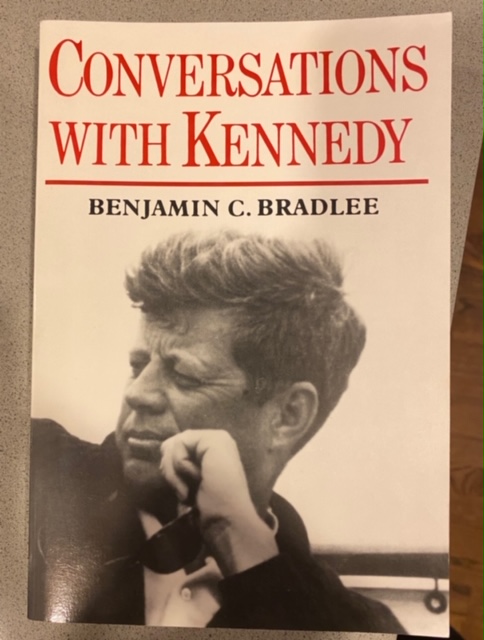
It’s the night of the West Virginia primary, May 10, 1960. Candidate John Kennedy, and Ben Bradlee, then Washington Bureau chief for Newsweek, cut the tension by going to see a porno:
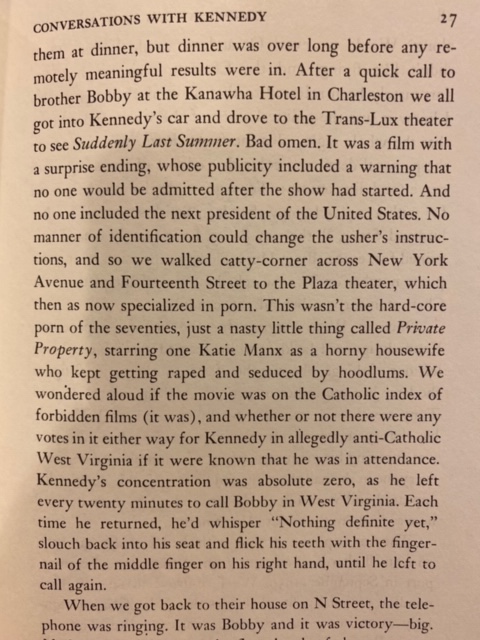
(You can see the trailer here, it does seem like soft stuff by our standards)
Good luck out there voters, I hope your favorite candidate wins!
Jackie smoking pregnant
Posted: April 17, 2016 Filed under: America Since 1945, Kennedy-Nixon, New England, presidents 1 Comment
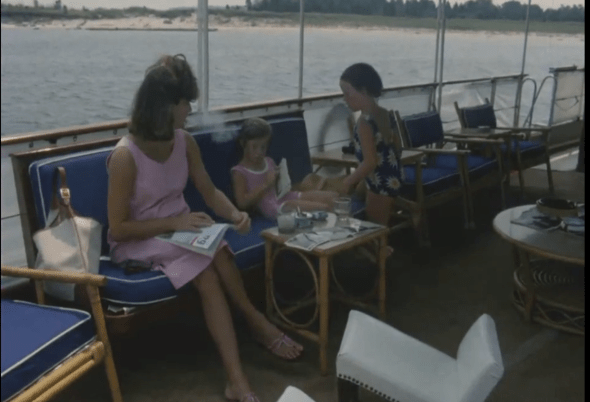
Trying to learn what brand of cigarette Jackie Kennedy smoked (no clear answer) I came across an evocative picture of Jackie Kennedy smoking while visibly pregnant, which you can see here.
I couldn’t and can’t find the source for it. Google Image searching leads me in an endless looparound of Tumblr and Pinterest. Maybe it’s in an old magazine. Maybe some Kennedy guest or family member took it and it got on the Internet somehow. Maybe a British tabloid published it, they go crazy for Kennedy goss.
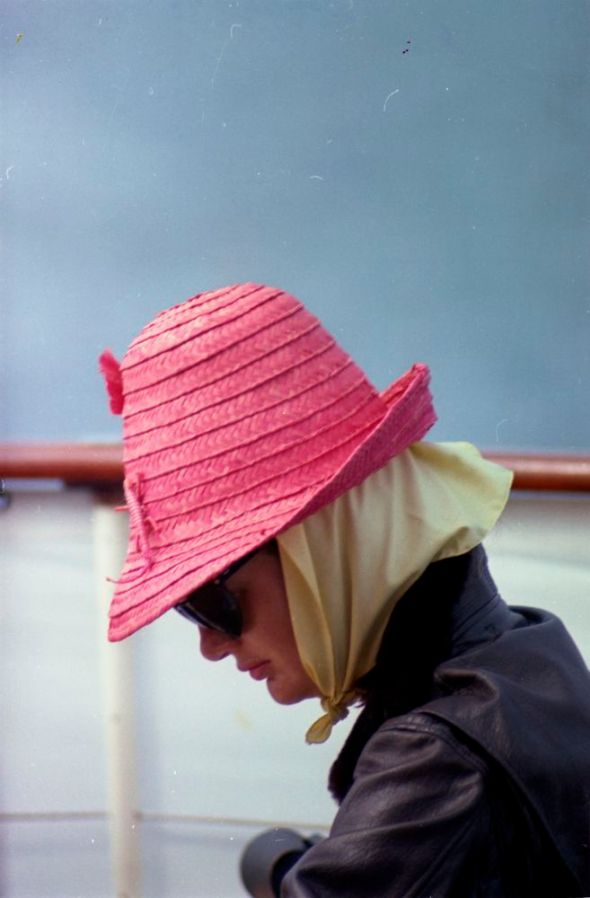
Public domain pic of Jackie, August 31 1963, by Cecil Stoughton, found http://www.jfklibrary.org/Asset-Viewer/Archives/JFKWHP-ST-C283-50-63.aspx
Not mine to “print” I guess on Helytimes — we take sourcing semi-seriously. (But is it that different to link to it?)
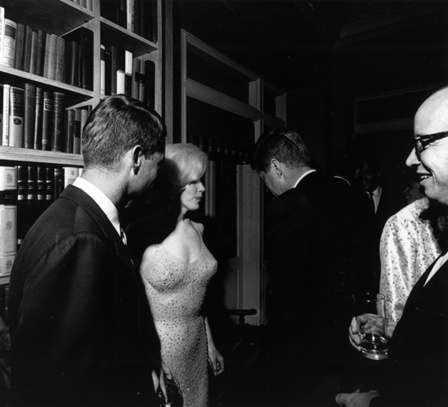
Public domain photo of Robert and John Kennedy with Marilyn Monroe, taken by Cecil Stoughton. Found here: http://www.jfklibrary.org/Asset-Viewer/9jndTasee0CsvxnFg6IWxg.aspx
This home movie footage, on the other hand, is in the public domain and online at the Kennedy Library. Some of these movies feel almost too private, too intimate — you can for instance see our current ambassador to Japan, then age six, jumping on the bed in her swimsuit with (possibly) the future first lady of California?
Here are two clips.
Jackie smokes:
The President’s golf swing:
If you know anything about golf would love to hear takes on JFK’s swing.
Like a Hockney painting
Posted: April 9, 2016 Filed under: America Since 1945, art history, Kennedy-Nixon, the American West Leave a comment
JFK checking out a missile test at White Sands, New Mexico.
Trip to Western States: White Sands Missile Range, New Mexico
Cecil Stoughton. White House Photographs. John F. Kennedy Presidential Library and Museum, Boston
Not to be missed
Posted: February 28, 2016 Filed under: America Since 1945, Kennedy-Nixon, politics Leave a comment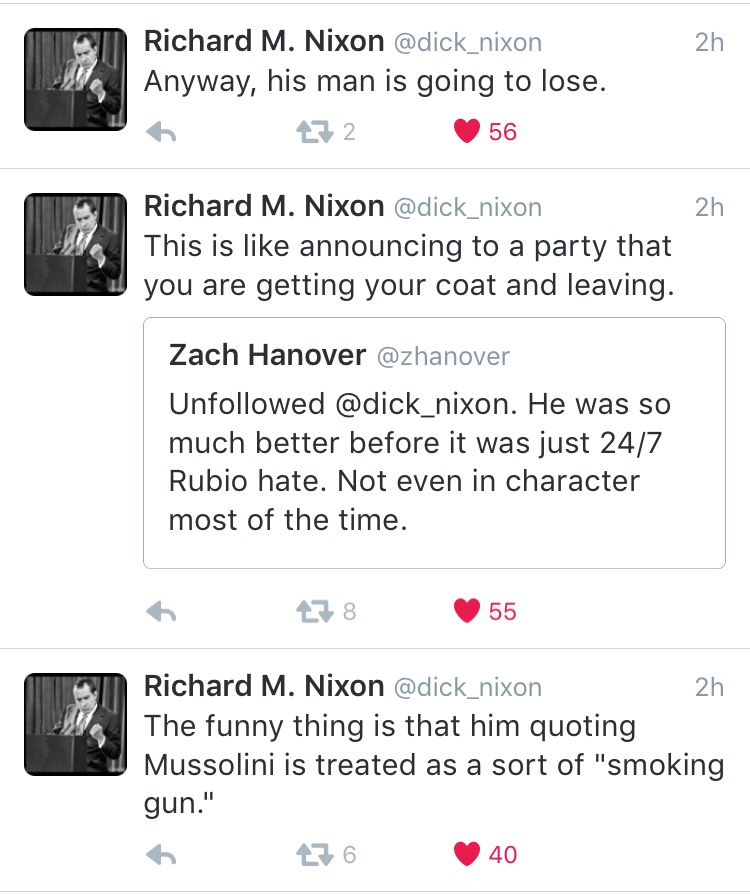
This take from the Dick Nixon Twitter feed is so great.
When did JFK’s soul go to Heaven?
Posted: February 24, 2016 Filed under: America Since 1945, Kennedy-Nixon 1 Comment
Doing some research for a Kennedy-related project, came across this interview with Father Oscar Huber, Dallas priest who ended up giving JFK last rites:
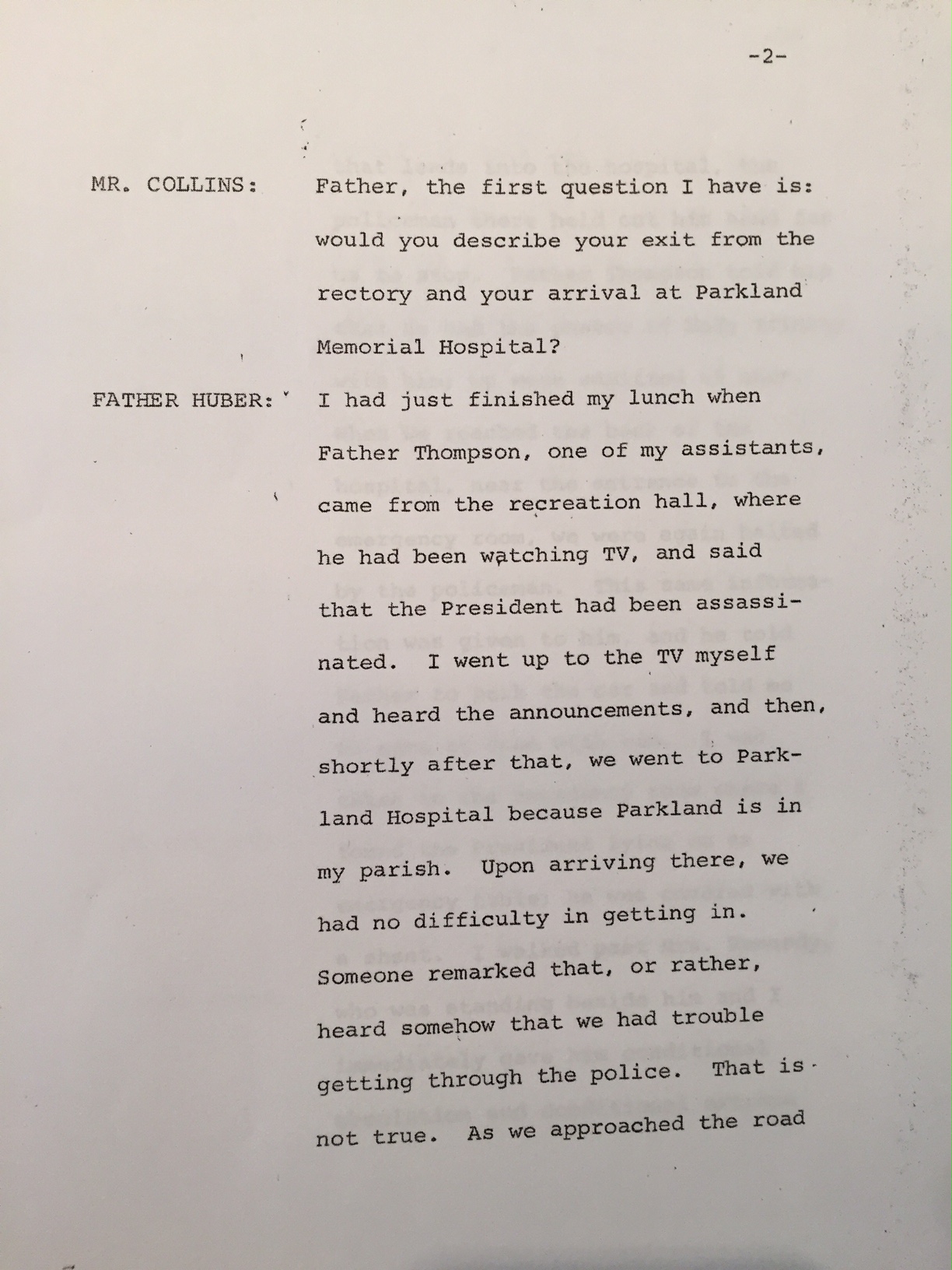
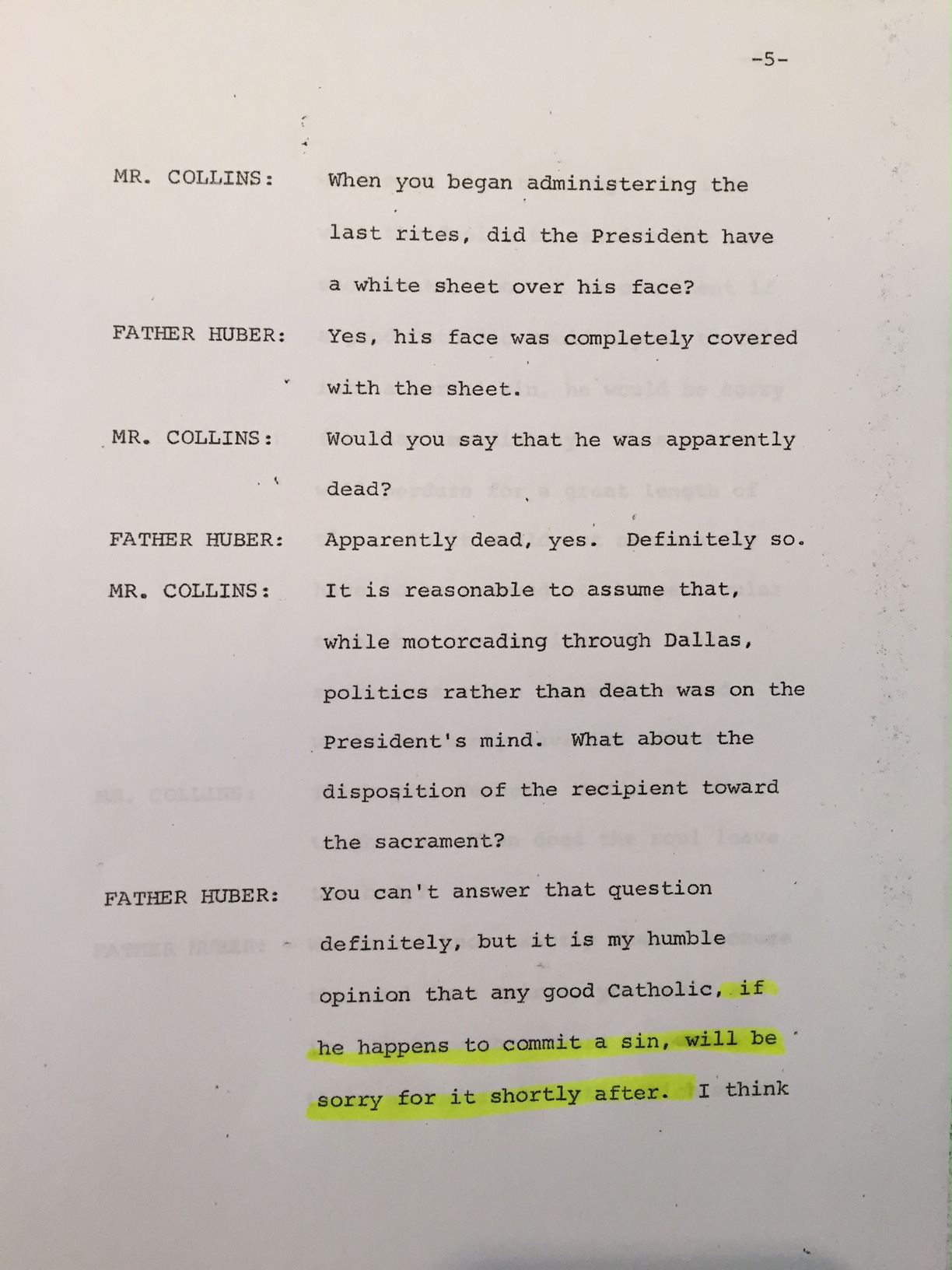
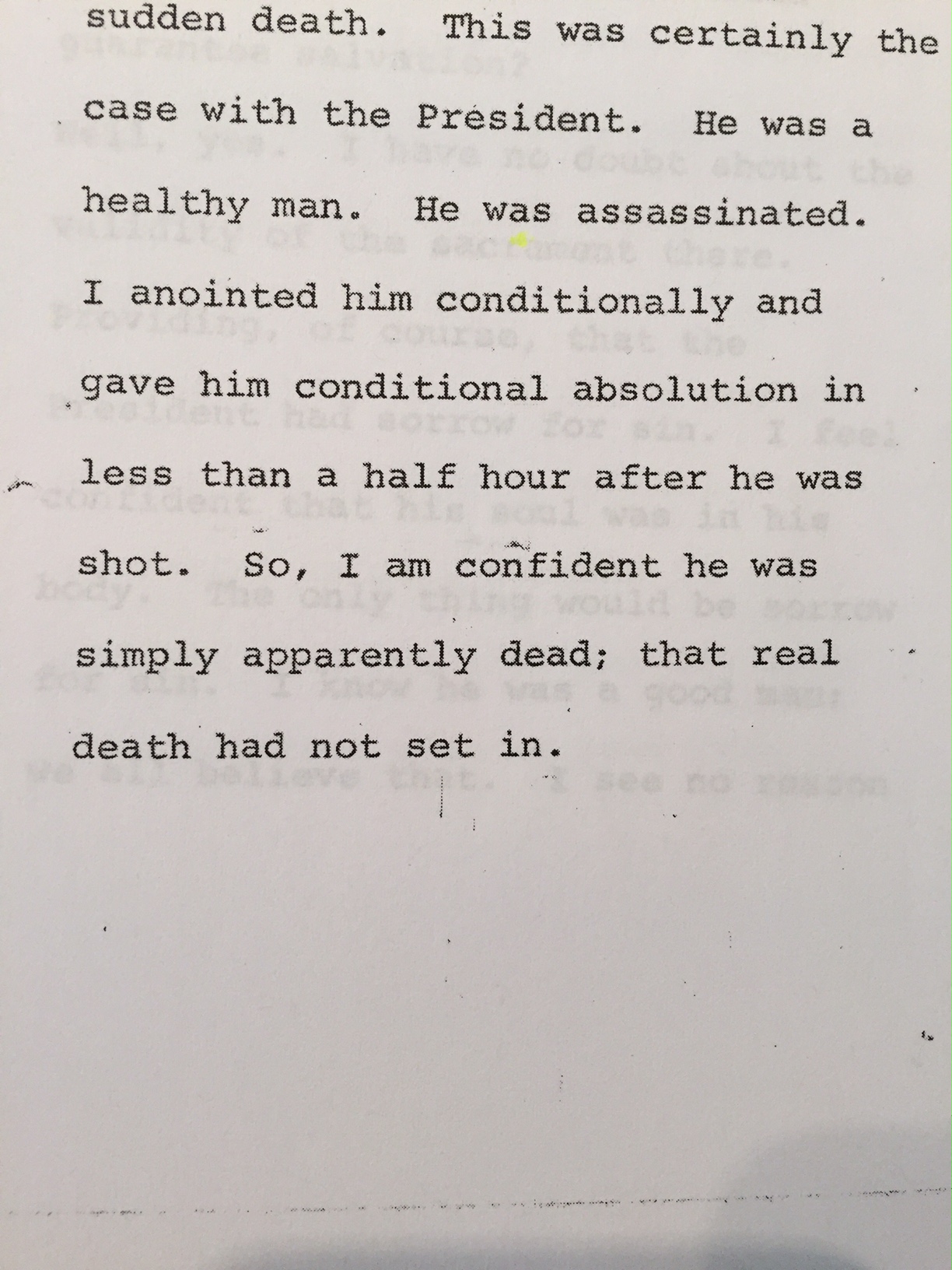
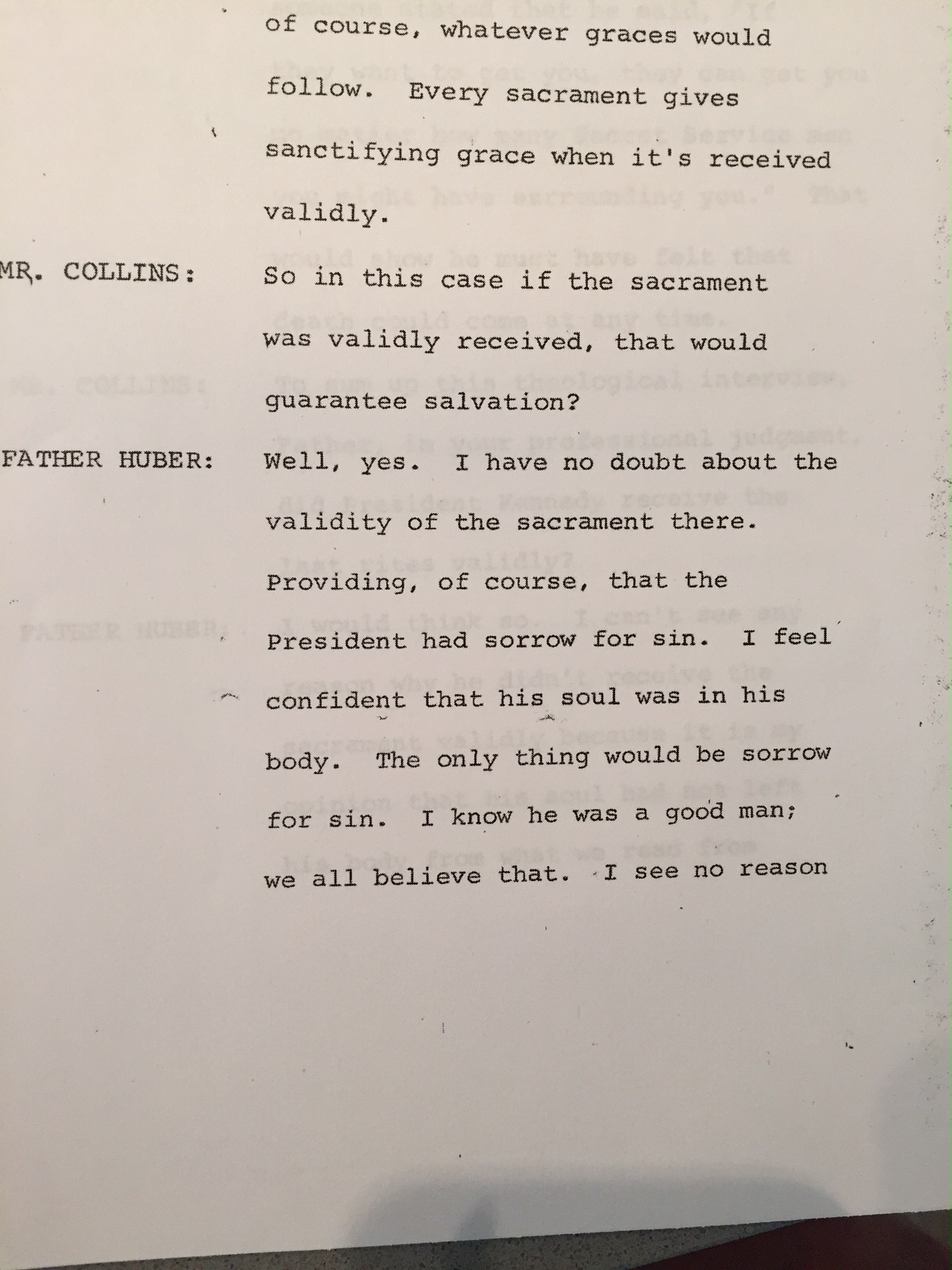
Sounds like he was all good!
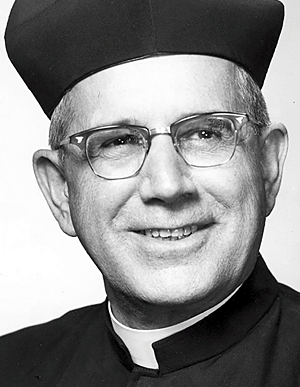
Father Huber pic from The Catholic Spirit: http://thecatholicspirit.com/commentary/this-catholic-life/remembering-president-kennedy-50-years-later-vincentian-pastor-administered-last-rites-presidents-assassination/
I’ve spent hours and hours combing the JFK Oral Histories at the Kennedy Library website, and the best thing I’ve found is this one, from Massachusetts Democratic operative and Harvard prof Samuel Beer, interviewed long after the fact. Here he’s talking about Adlai Stevenson and Kennedy’s lady game:
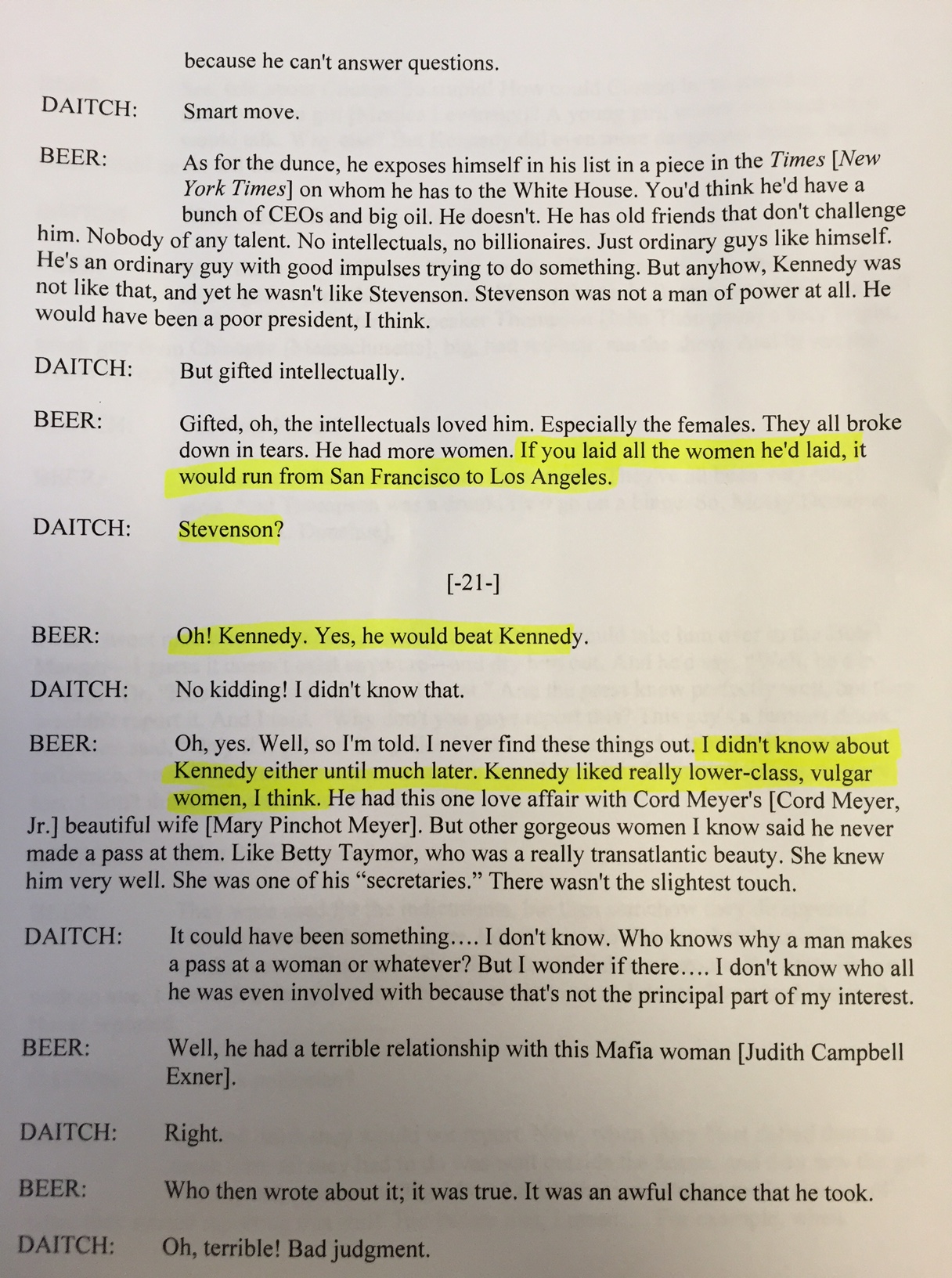
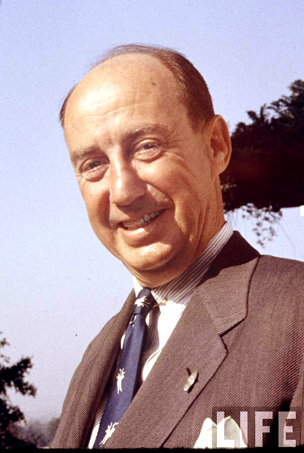
Adlai
The White House Pool
Posted: December 3, 2015 Filed under: America Since 1945, Kennedy-Nixon 2 Comments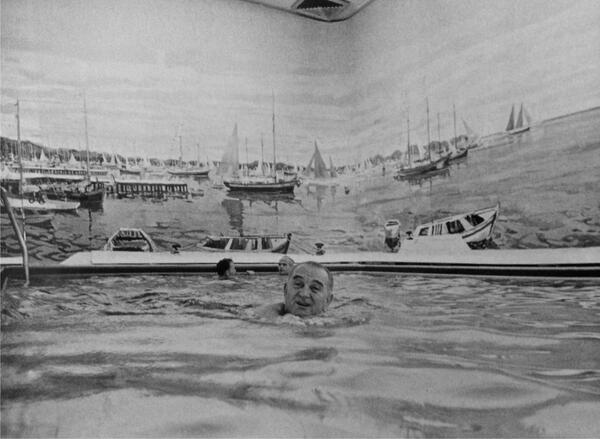
LBJ in the White House pool, from Michael Beschloss Twitter/NARA: https://twitter.com/beschlossdc/status/411277928991707136
There used to be an indoor swimming pool in the West Wing of the White House. From the White House Museum website:
As the men and women of New York opened copies of the New York Daily News on March 14, 1933, they learned of a campaign to raise money for building the president a swimming pool at the White House. The effort was a way to honor President Franklin Roosevelt, a New York native who suffered from the crippling disease, poliomyelitis. The President often swam at therapy pools at his Hyde Park home in New York or at a center in Warm Springs, Georgia.
The campaign was a success, and the workmen gathered around the pool on June 2, 1933 to listen to President Roosevelt, who spoke from his wheelchair and thanked them for their work. The pool was built inside the west gallery between the White House and the West Wing in place of the old laundry rooms, which were moved to the basement of the mansion. Arched ceilings and high rows of half-mooned windows surrounded the rectangular pool. French doors opened into the Rose Garden. The president’s pool was a modern-day showcase of technology, featuring underwater lighting, sterilizers and the latest gadgets. For several years, he used it multiple times a day. Harry Truman swam in it frequently—with his glasses on.
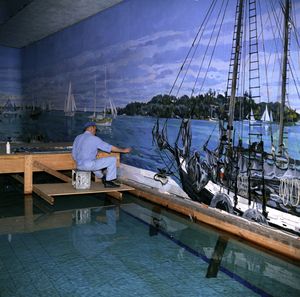
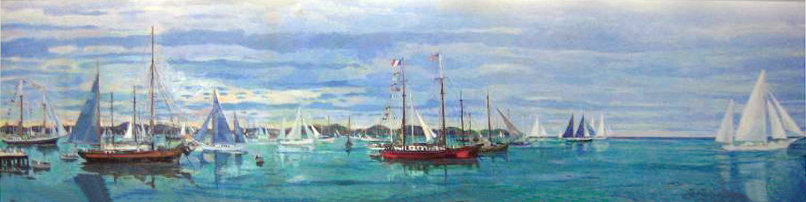
When his son was in the White House, Joe Kennedy paid French artist Bernard Lamotte to paint a mural of sailing scenes and the harbor of Christiansted, St. Croix, US Virgin Islands:

Christiansted, from Wiki
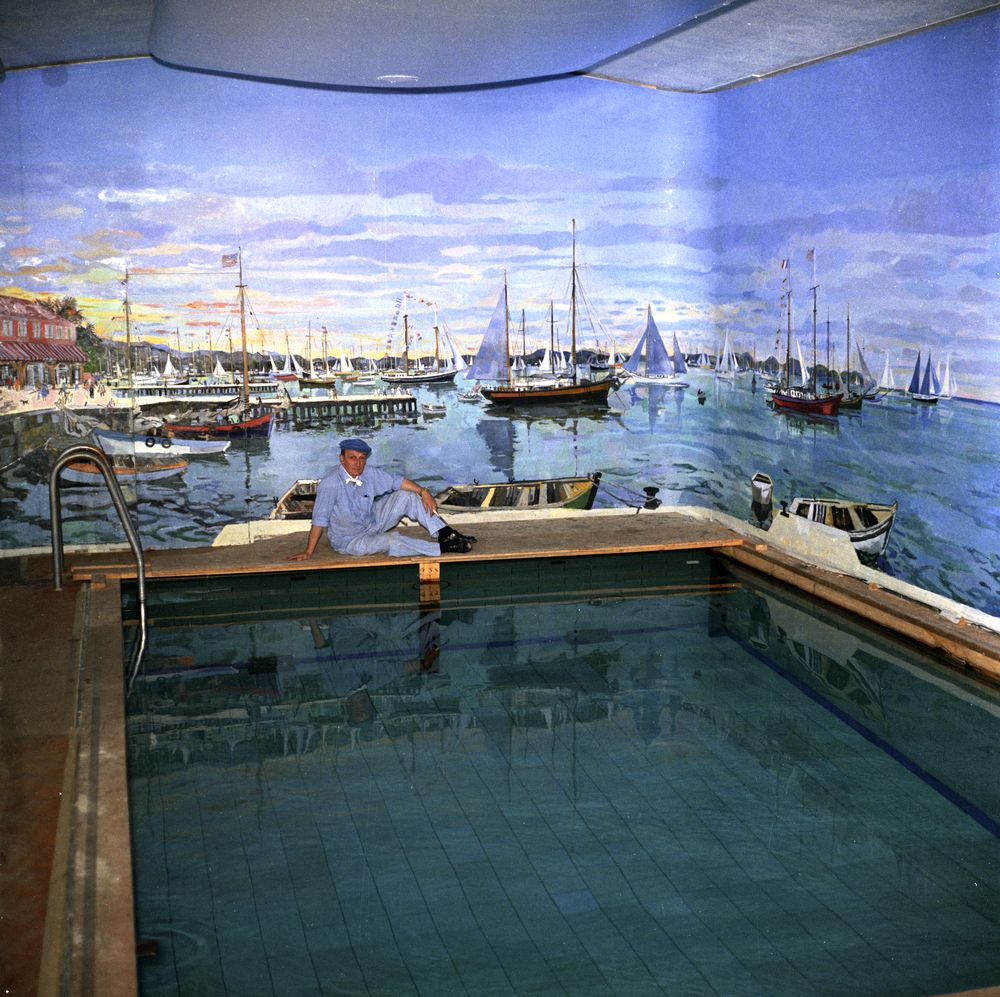
From the JFK Library. http://www.jfklibrary.org/Asset-Viewer/Archives/JFKWHP-1962-06-04-B.aspx
I cannot find a picture of JFK in the pool.
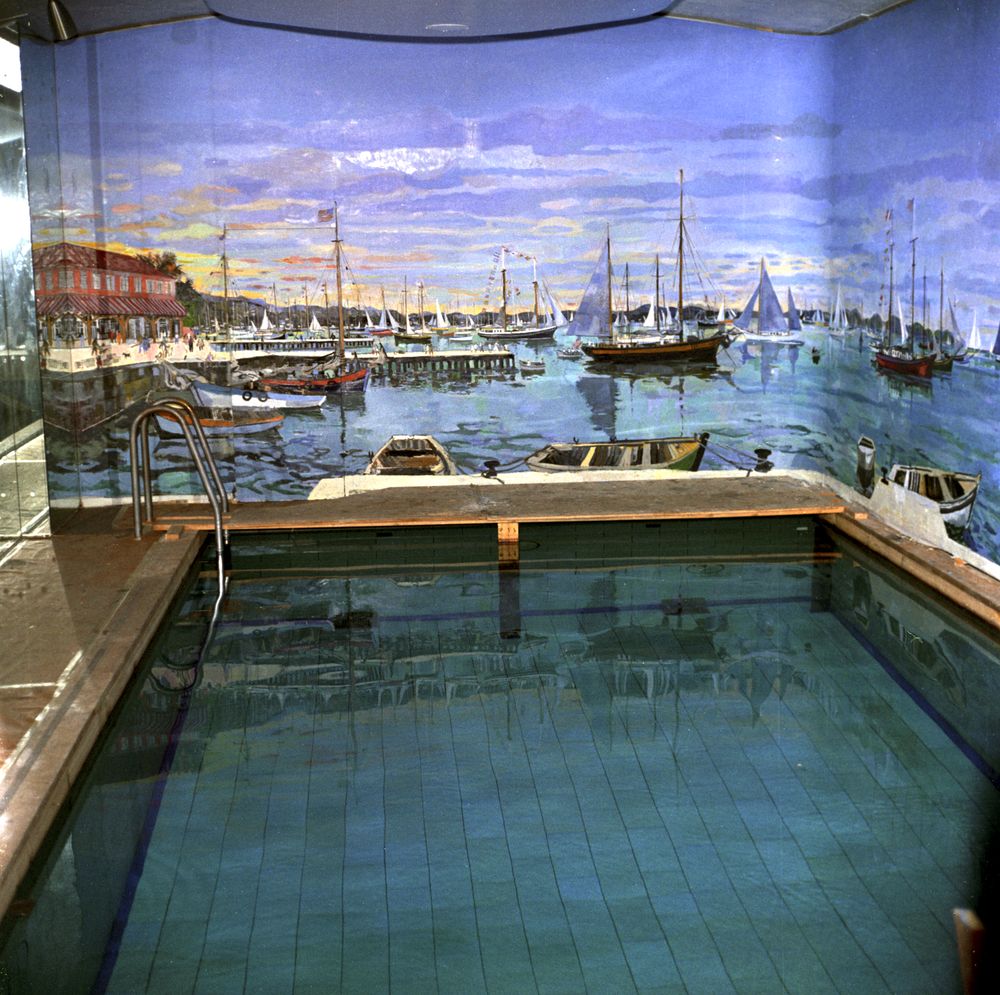
Here’s what the White House Museum says about the pool in the Kennedy years:
John Kennedy sometimes held swimming races with Cabinet members. He liked the pool so much that he made a habit of stopping by at noon, stripping down for a swim, and padding back to his bedroom for lunch and a nap in nothing but a robe. He did the same at the end of the day, dressing again for dinner. As a result, Chief Usher JB West observed, “John F Kennedy wore three separate suits of clothes every day of his White House life.”
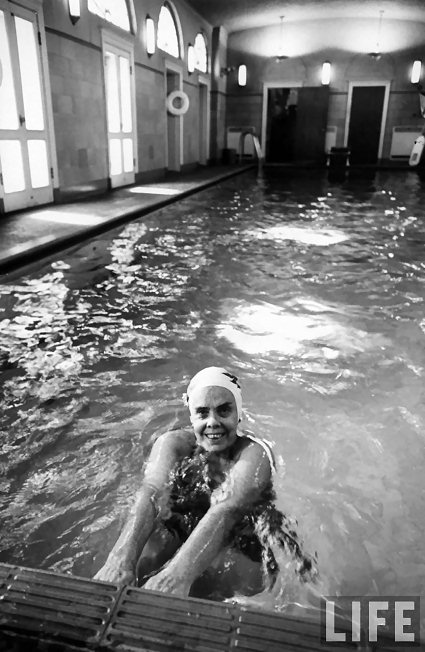
I believe this was pre-mural?
Here is JFK’s sometime doctor Janet Travell in the pool.
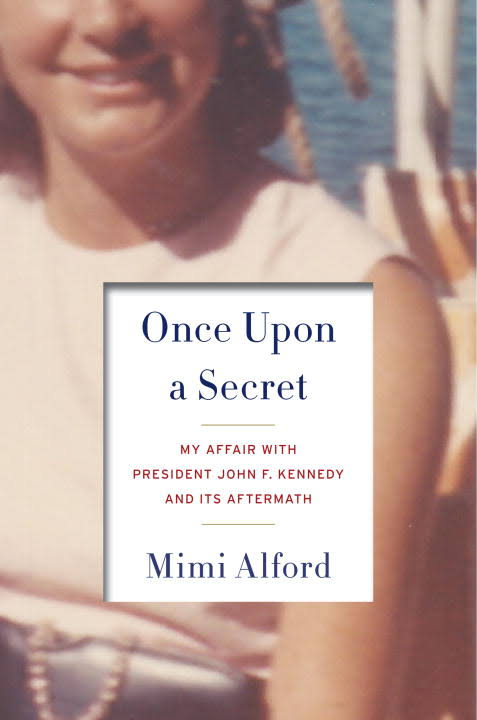
In her book Once Upon a Secret, Mimi Alford describes the pool as like the center of JFK’s sexual life. Frequent poolers, in her memory, were two staffers, one from the President’s Secretary’s office and one from the Press Secretary’s office, with the nicknames Fiddle and Faddle:
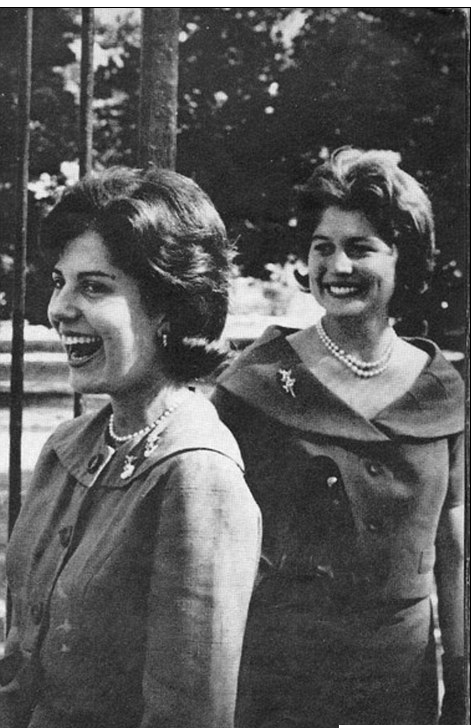
Can’t really sort out the origin of this photo. The Daily Mail cites it as being from “Wikipedia”
A lot of stories about JFK get thrown around as true without a lot of investigating into the source. Who can say now what was happening in the pool? Caitlin Flanagan reviewed Alford’s book here, her takes are always engaging:
The overheated White House swimming pool, painted in a lurid Caribbean theme (its renovation a kinky father-son gift from Joe to Jack), was, according to a number of respected sources (among them Seymour Hersh and three on-the-record Secret Service agents), the locus of endless lunchtime sex parties. Two young secretaries named Priscilla Wear and Jill Cowen—the now infamous Fiddle and Faddle—often left their desks to splash and skinny-dip with Jack, returning to their desks with wet hair so they could go on with their important work of autographing his photographs and wondering how to type. They, like Mimi, were regularly packed along on official trips, apparently so that the president could always get laid if there was any trouble scaring up local talent. Although neither has ever commented on their relationship with Kennedy, their joint interview for the JFK oral-history project is astonishing for the number of trips they casually allude to having taken with him; they were the sex-doll Zeligs of JFK’s foreign diplomacy, their eager faces just out of frame in Berlin, Rome, Ireland, Costa Rica, Mexico, and Nassau, to say nothing of their extensive domestic work in places like Palm Beach and Hyannis Port.
It’s impossible to think Jackie had no idea that any of this was taking place. Once while giving a Paris Match reporter a tour of the White House, she passed by Fiddle’s desk and remarked—acidly, and in French—“This is the girl who supposedly is sleeping with my husband.”
Say what you will about Nixon, he wasn’t frolicking with secretaries in the pool:
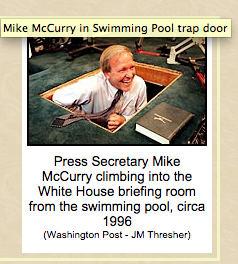
President Richard Nixon arranged for the construction of a press briefing room above the old pool to accommodate the growing demand for television news.
The old mural is now in the Kennedy Museum & Library in Boston:
The single best picture I can find of the pool shows astronaut Edward White throwing his daughter into it:
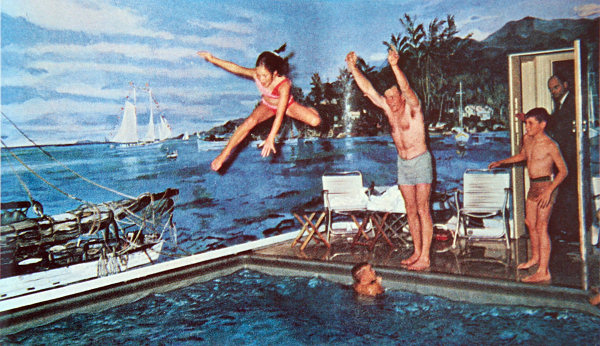
It’s from an old National Geographic. Seven years later White died in the Apollo 1 fire:
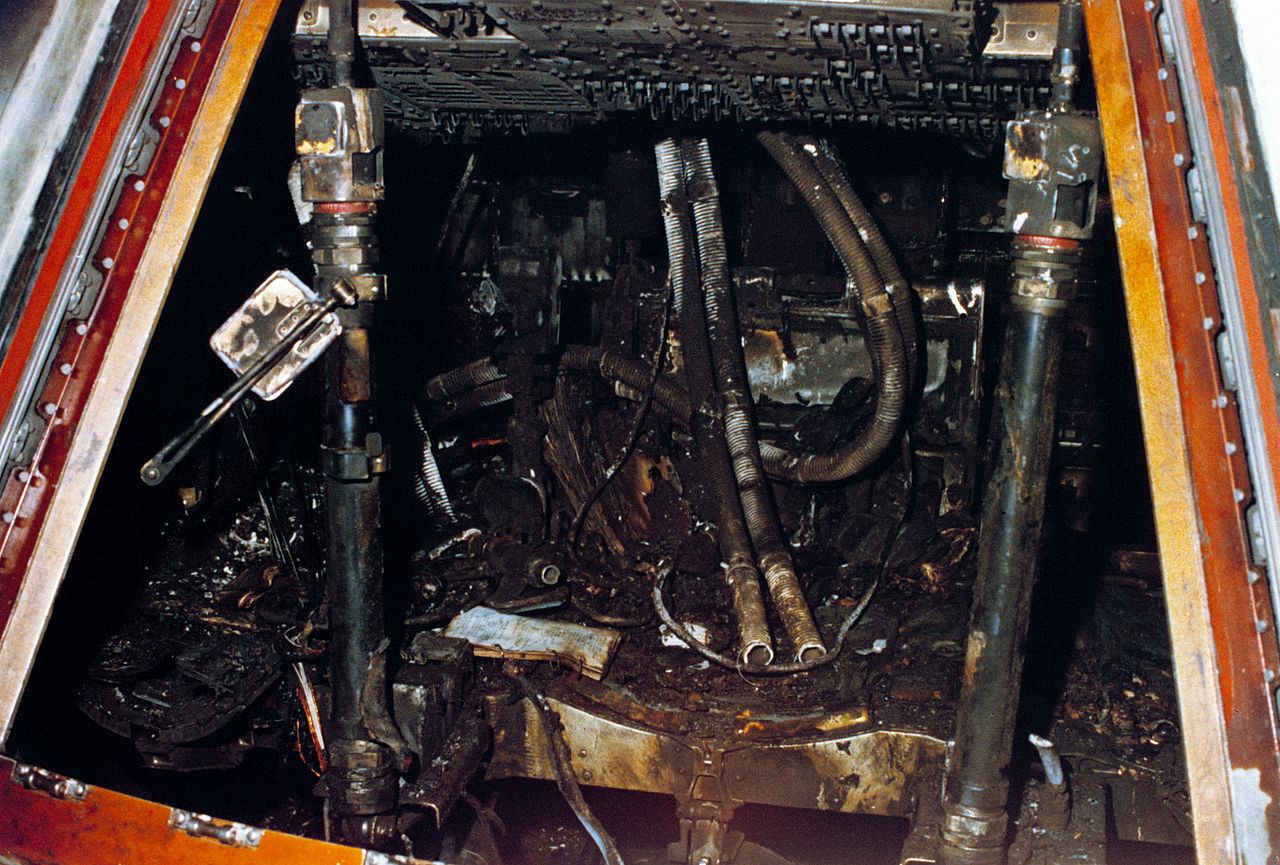

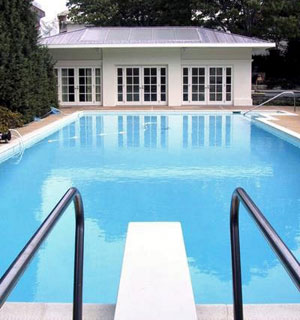
There is still an outdoor pool at the White House.
4,835 words on Ta-Nahesi Coates and Gawker controversy and Donald Trump
Posted: July 17, 2015 Filed under: America Since 1945, animals, Kennedy-Nixon Leave a comment ; ) just kidding! Instead here:
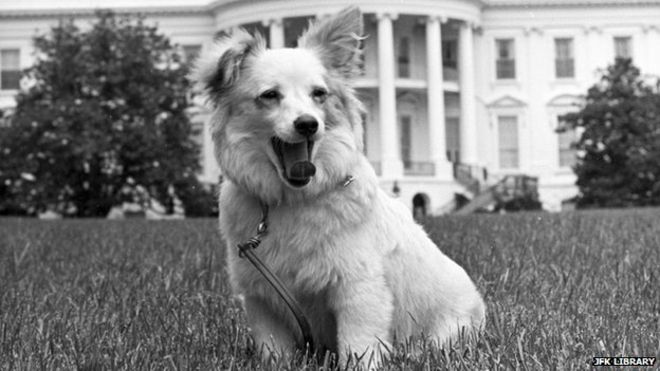
“My mother told a funny story,” says Caroline Kennedy, who is now the US ambassador to Japan, but was once – a little over 50 years ago – a toddler growing up in the White House.
“She was sitting next to Khrushchev at a state dinner in Vienna. She ran out of things to talk about, so she asked about the dog, Strelka, that the Russians had shot into space. During the conversation, my mother asked about Strelka’s puppies.
“A few months later, a puppy arrived and my father had no idea where the dog came from and couldn’t believe my mother had done that.”
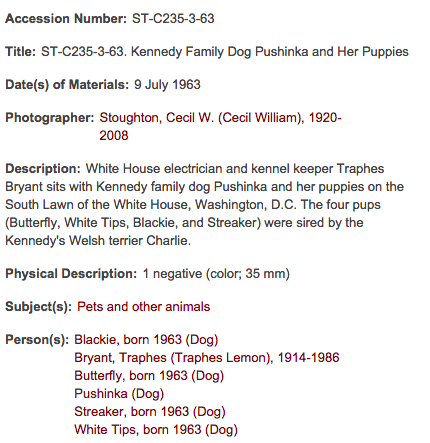
The puppy was Strelka’s daughter, Pushinka, listed on her official registration certificate as a “non-breed” or mongrel.
“Pushinka was cute and fluffy,” says Ambassador Kennedy – in fact the Russian name translates as Fluffy.
(from)
From the Traphes L. Bryant oral history over there at the JFK Library:
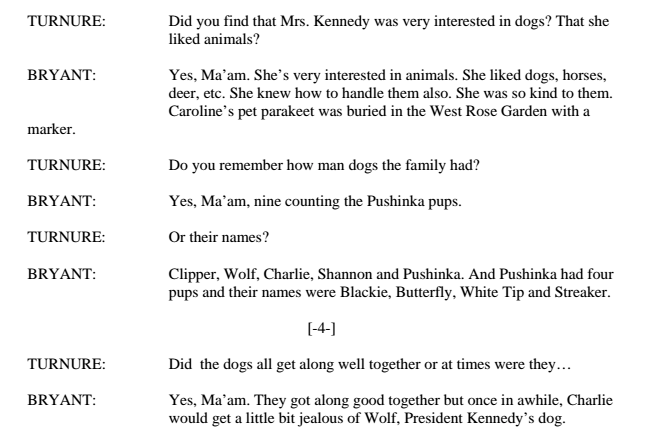 And:
And:
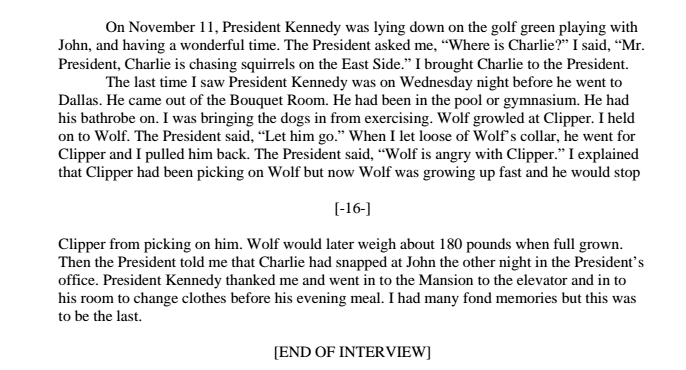
Charlie and Pushinka:
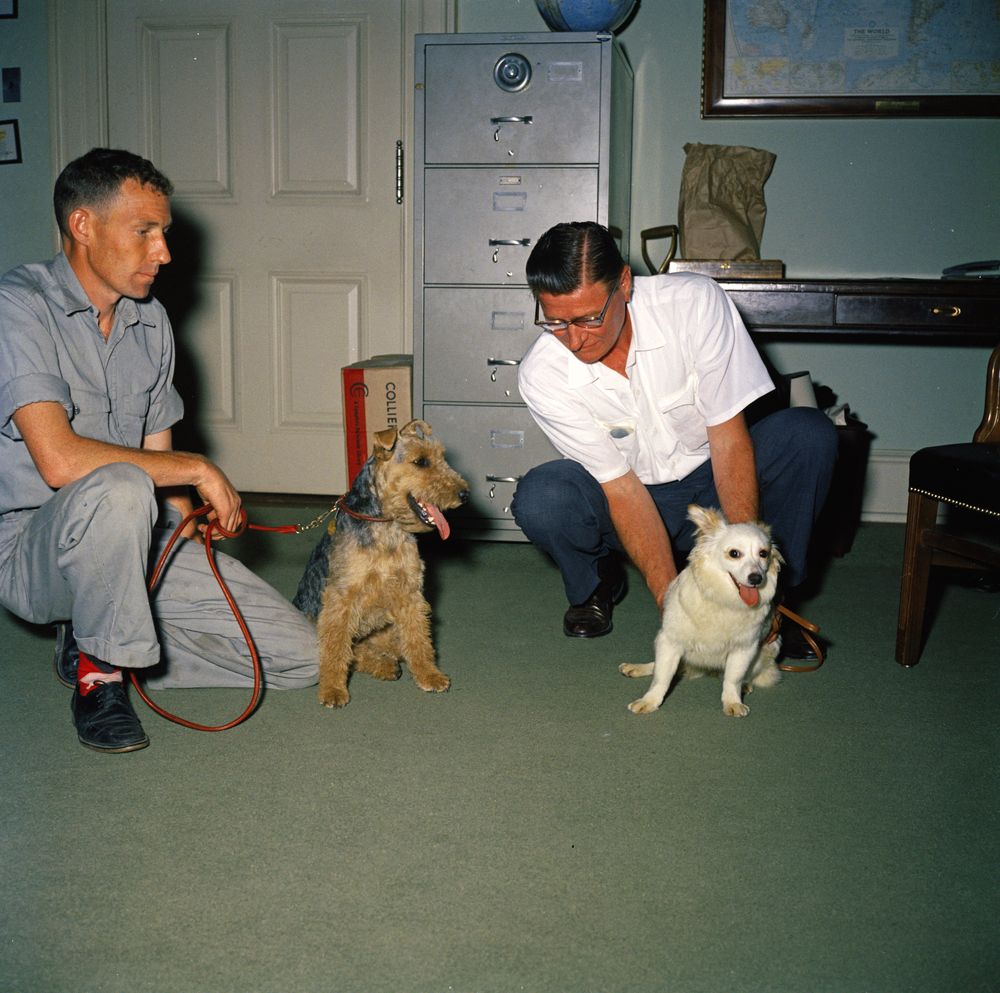
Tennessee Williams -> Dr. Feelgood -> Mark Shaw
Posted: January 6, 2015 Filed under: America Since 1945, Florida, Kennedy-Nixon, writing 1 Comment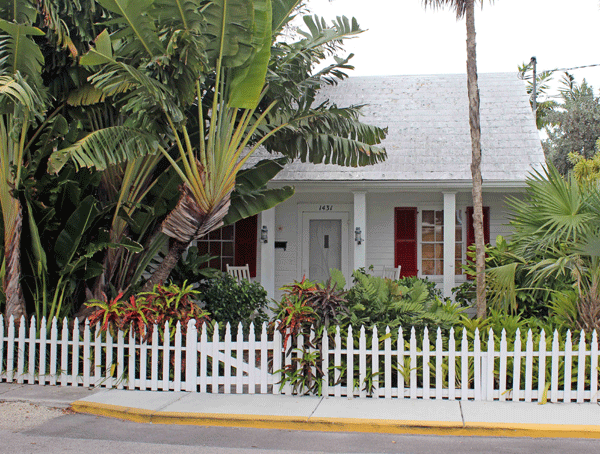
Tennessee Williams in Key West
Strewn around the apartment of a friend this weekend were a few biographies of Tennessee Williams.
I don’t know much about Tennessee Williams. The most I ever thought about him was when I was briefly in Key West, where there’s some stuff named after him. He jockeys with Hemingway for local literary mascot top honors.
Looking into it, I found this stupefying article about TW in Key West from People Magazine, 1979, entitled “In His Beloved Key West, Tennessee Williams Is Center Stage In A Furor Over Gays.” Tough reading, on the one hand. On the other maybe we can find some optimism in how far things have come?:
Some of Williams’ friends are less sanguine—notably Rader (whom some Key West sympathizers find faintly hysterical on the subject). “It has been terrible,” he said in the aftermath. “Tenn won’t talk about it, but it has been really frightening what’s happening in Key West and in this house. The worst was the night they stood outside his front porch and threw beer cans, shouting, ‘Come on out, faggot.’ When they set off the firecrackers, I remember thinking, ‘God, this is it. We’re under attack. They’ve started shooting.’ ”
Williams’ imperturbability springs both from a matter of principle (he once defined gallantry as “the grace with which one survives appalling experiences”) and from a diminished interest in the Key West gay scene. “I’ve retired from the field of homosexuality at present,” he explains, “because of age. I have no desires—isn’t that strange? I have dreams, but no waking interest.” The thought does not cheer him. “I’ve always found life unsatisfactory,” he says. “It’s unsatisfactory now, especially since I’ve given up sex.” His own problems seem far more pressing to him than the city’s. “I suspect I’ll only live another two years,” says Williams, 68, who tipples white wine from morning on and complains of heart and pancreas disorders. “I’ve been working like a son of a bitch since 1969 to make an artistic comeback. I don’t care about the money, but I can’t give up art—there’s no release short of death. It’s quite painful. I’ll be dictating on my deathbed. I want people to say, ‘Yes, this man is still an artist.’ They haven’t been saying it much lately.”
As a consummate prober of human passions, Williams does have theories on why his adopted hometown is under siege. “There are punks here,” he explains. “That’s because a couple of gay magazines publicized this place as if it were the Fire Island of Florida. It isn’t. One Fire Island is quite enough. But it attracted the wrong sort of people here: the predators who are looking for homosexuals. I think the violence will be gone by next year.”
Other residents seem less willing to wait. The leader of the anti-gay forces, the Reverend Wright, says Anita Bryant has promised to come to Key West to help his crusade. Recalling nostalgically the days when “female impersonators and queers were loaded into a deputy’s automobile and shipped to the county line,” Wright warns: “We’ll either have a revival of our society or the homosexuals will take it over in five years.”
Mamet On Williams
This morning happened to pick up in my garage this book by David Mamet:
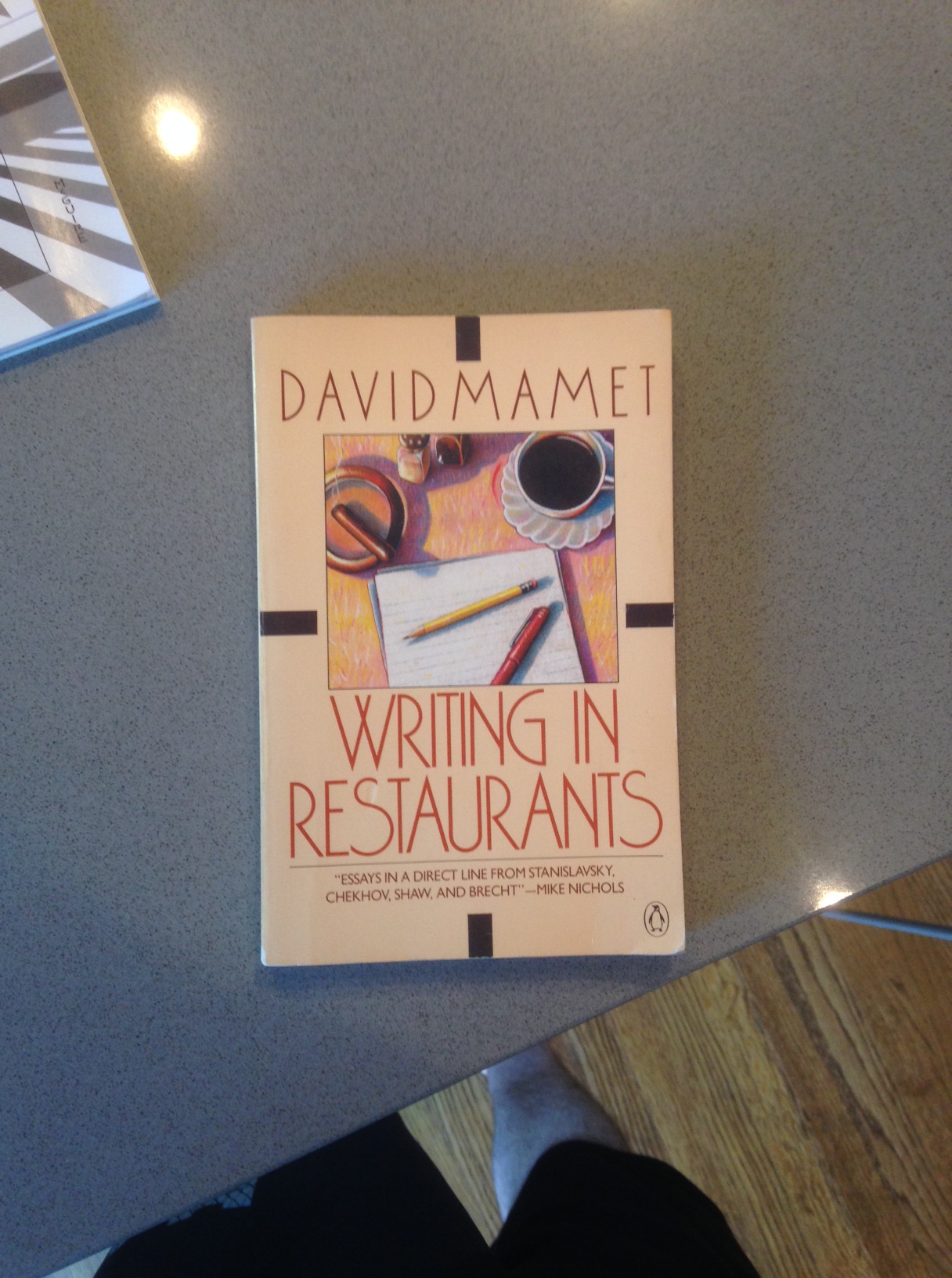
Highly recommend this book as well as Three Uses Of The Knife, True And False: Heresy And Common Sense For The Actor, and On Directing Film by Mamet. All short, all tight, all good. (His subsequent nonfiction seems to me to be a bit… deranged?)
Found this, and thought it was great:
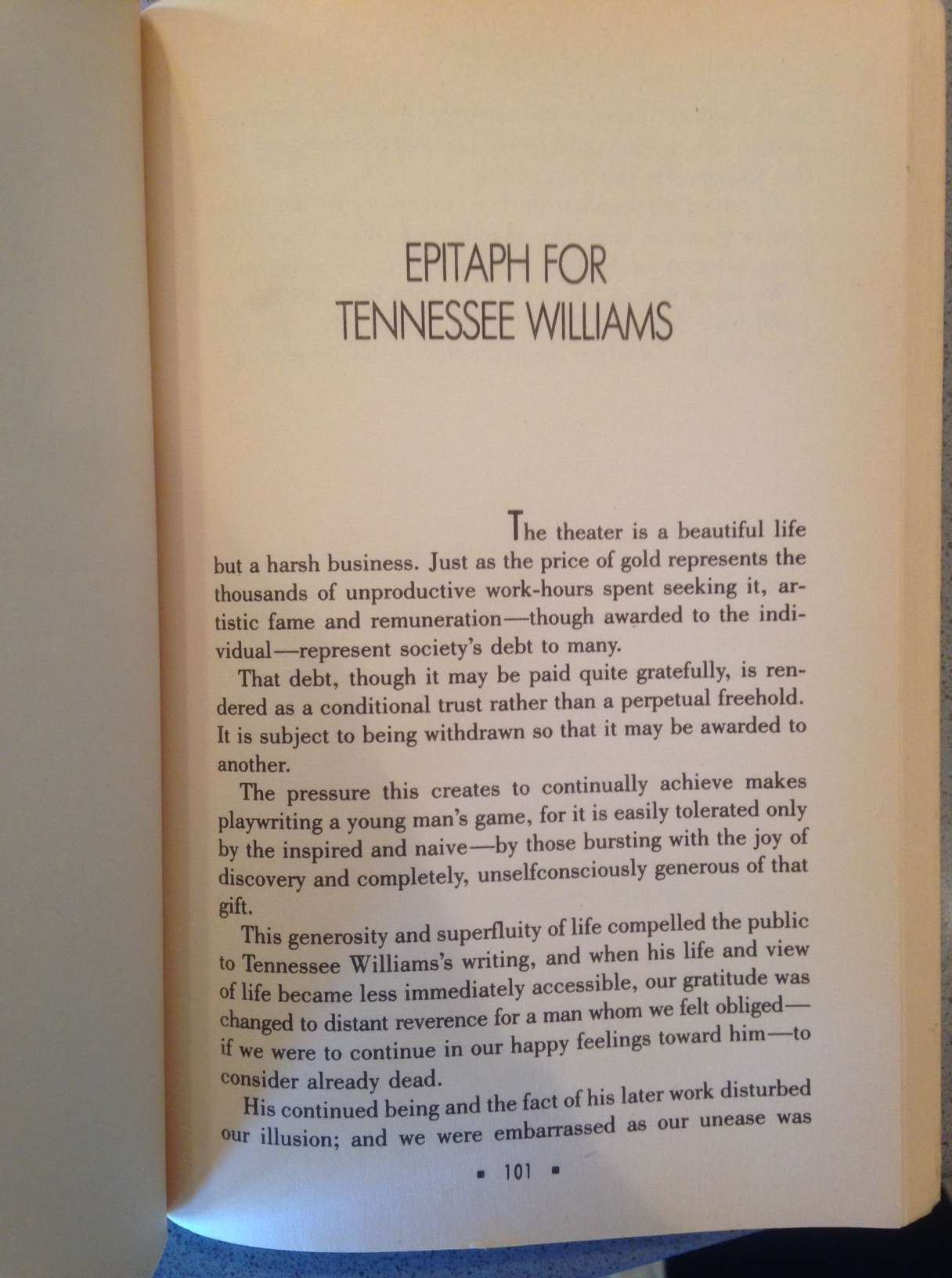

Wikipedia Hole
Reading about Tennessee on Wikipedia, I learn:
As he had feared, in the years following Merlo’s death Williams was plunged into a period of nearly catatonic depression and increasing drug use resulting in several hospitalizations and commitments to mental health facilities. He submitted to injections by Dr. Max Jacobson – known popularly as Dr. Feelgood – who used increasing amounts of amphetamines to overcome his depression and combined these with prescriptions for the sedative Seconal to relieve his insomnia. Williams appeared several times in interviews in a nearly incoherent state, and his reputation both as a playwright and as a public personality suffered.[citation needed] He was never truly able to recoup his earlier success, or to entirely overcome his dependence on prescription drugs.
Let’s learn about Dr. Feelgood, who was also screwing up Elvis and everybody else cool back then:
John F. Kennedy first visited Jacobson in September 1960, shortly before the 1960 presidential election debates.[9] Jacobson was part of the Presidential entourage at the Vienna summit in 1961, where he administered injections to combat severe back pain. Some of the potential side effects included hyperactivity, impaired judgment, nervousness, and wild mood swings. Kennedy, however, was untroubled by FDA reports on the contents of Jacobson’s injections and proclaimed: “I don’t care if it’s horse piss. It works.”[10] Jacobson was used for the most severe bouts of back pain.[11] By May 1962, Jacobson had visited the White House to treat the President thirty-four times.[12][13]
By the late 1960s, Jacobson’s behavior became increasingly erratic as his own amphetamine usage increased. He began working 24-hour days and was seeing up to 30 patients per day. In 1969, one of Jacobson’s clients, former Presidential photographer Mark Shaw, died at the age of 47. An autopsy showed that Shaw had died of “acute and chronic intravenous amphetamine poisoning.”
Well, that takes us to
Mark Shaw
Born Mark Schlossman on the Lower East Side, a pilot on the India/China Hump in World War II, he became a freelance photographer for life:
In 1953, probably because of his fashion experience, Shaw was assigned to photograph the young actress Audrey Hepburn during the filming of Paramount’s Sabrina. Evasive at first, Hepburn became comfortable with Shaw’s presence over a two-week period and allowed him to record many of her casual and private moments.


He married singer Pat Suzuki, “who is best known for her role in the original Broadway production of the musical Flower Drum Song, and her performance of the song “I Enjoy Being a Girl” in the show”:

In 1959, Life chose Shaw to photograph Jacqueline Kennedy while her husband, Senator John F. Kennedy, was running for President.[8] This assignment was the beginning of an enduring working relationship and personal friendship with the Kennedys that would eventually lead to Shaw’s acceptance as the Kennedys’ de facto “family photographer”. He visited them at theWhite House and at Hyannisport; during this time he produced his most famous photographs, portraying the couple and their children in both official and casual settings. In 1964, Shaw published a collection of these images in his book The John F. Kennedys: A Family Album, which was very successful.
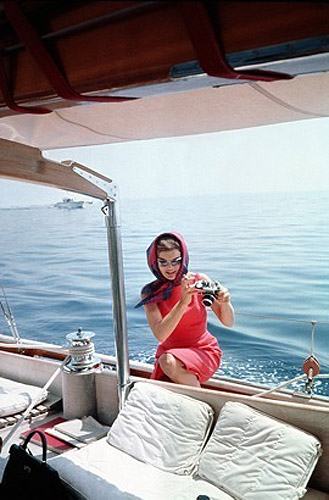

A bunch of even better ones can be found here, at the tragically disorganized website of the Monroe Gallery, they’re stamped “No Reproduction Without Permission” so whatever. Don’t miss this one.
Here’s another famous Jackie Mark photo’d:

And finally:
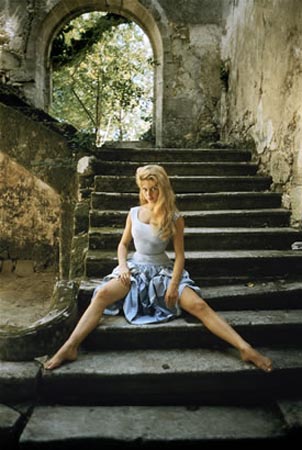
Conversations With Kennedy
Posted: November 21, 2014 Filed under: America Since 1945, Kennedy-Nixon Leave a comment Ben Bradlee, then a reporter for Newsweek, and John Kennedy, senator and then president, were good pals. Their wives, Toni and Jackie, were pals as well. This book is full of incredible detail. The night of the 1960 West Virginia primary, Kennedy and Bradlee go to a DC movie theater and see a porn:
This wasn’t the hard-core porn of the seventies, just a nasty little thing called Private Property, starring one Katie Manx as a horny housewife who kept getting raped and seduced by hoodlums. We wondered aloud if the movie was on the Catholic index of forbidden films (it was) and whether or not there were any votes in it either way for Kennedy in allegedly anti-Catholic West Virginia if it were known that he was in attendance. Kennedy’s concentration was absolute zero, as he left every twenty minutes to call Bobby in West Virginia. Each time he returned, he’d whisper “Nothing definite yet,” slouch back into his seat and flick his teeth with the fingernail of the middle finger on his right hand, until he left to call again.
[regrettably a newer actress, “Catie Minx,” makes further research here come to a circuitous end.]
How much did JFK drink?
Normally he sipped at a scotch and water without ice, rarely finishing two before dinner, sipped at a glass of wine during dinner, rarely had a drink after dinner, and he almost never had a drink in the middle of the day.

says an impressed Bradlee. From a footnote:
Kennedy was justly proud of the uncanny ability of the White House telephone operators to find anyone, anywhere, at any time of the day or night. Once, he dared Tony and Jackie and me to come up with a name of someone the operators couldn’t find. Jackie suggested Truman Capote, because he had an unlisted telephone number. Kennedy picked up the telephone and said only “Yes, this is the president. Would you please get me Truman Capote?” – no other identification. Thirty minutes later, Capote was on the line… not from his own unlisted number in Brooklyn Heights, but at the home of a friend in Palm Springs, Calif., who also had an unlisted number.
A recurring theme:
Philosophically, Kennedy worried out loud about the widening gap between the people who can discuss the complicated issues of today with intelligence and knowledge, and those he later referred to as “the conservative community.” It is a theme that fascinates him, and one to which he returns time and time again: a kind of Dialogue of the Deaf, growing and disturbing, between the comparative handful of people truly knowledgeable about the increasingly complex issues our our society, and the great majority who just don’t understand these issues and hide their lack of understanding behind old cliches. (He made an important speech on this subject at Yale University. It was never far from his thoughts.)
How much did JFK swear?:
Jackie’s question, “What is a Charlie-Uncle-Nan-Tare, for heaven’s sake?” [re: reporter Dick Wilson] went unanswered. (Kennedy’s earthy language was a direct result of his experience in the service, as it was for so many men of his generation, whose first serious job was war. Often it had direct Navy roots, as above when he used the signalman’s alphabet. He used “prick” and “fuck” and “nuts” and “bastard” and “son of a bitch” with an ease and comfort that belied his upbringing, and somehow it never seemed offensive, or at least it never seemed offensive to me.)

May 29, 1963, the President’s birthday party, a cruise on the yacht Sequoia down the Potomac:
Kennedy has not gotten the word that the “twist” is passe; any time the band played any other music for more than a few minutes, he passed the word along for more Chubby Checkers [sic]. he was also passing the word all night to the Sequoia’s captain. Apparently through an abundance of caution in case he wasn’t having a good time, Kennedy had ordered the skipper of the Sequoia to bring her back to the dock at 10:30 PM, only to be ordered back out “to sea” – which meant four or five miles down the Potomac. This happened no less than four times. Four times we moored and four times we unmoored. The weather was dreadful most of the evening, as one thunderstorm chased us up and down the river all night, and everyone was more or less drenched. Teddy was the wettest, and on top of everything mysteriously lost one leg of his trousers some time during the night.
September 12, 1963, Kennedy in Newport:
The president arrived thirteen minutes late, timidly carrying a felt hat. I had never seen him wear a hat, but he told us “I’ve got to carry one for a while… they tell me I’m killing the industry.”

November 23, 1963:
The sledgehammer news that President Kennedy had been shot came to me while I was browsing through Brentano’s bookstore on my lunch hour.
Six months earlier, over dinner at the White House:
It’s so hard to answer the question, “What’s he like?” about anyone interesting, with all the contradictions in all of us. “That’s what makes journalism so fascinating,” the president commented, “and biography so interesting… the struggle to answer that single question, “What’s he like?”
Kennedy Exaggeration
Posted: November 21, 2013 Filed under: Kennedy-Nixon 1 Comment
From The New Yorker blog:
In 1962, the Trillings were invited to the White House for a dinner honoring that year’s Nobel laureates. Jacqueline Kennedy, Trilling wrote, was “a hundred times more beautiful than any photograph had ever indicated”
Start reading about the Kennedys and you’ll never stop.
… the greatest thrill I had in my life was when the President’s wife, Mrs. Kennedy, addressed a corwd of about 600 people at this Michelangelo School when he was running for the senatorship against Lodge, and the gracious lady stood up before the big crowd and the Italian people, the elderly people, were there, didn’t know who she was, and when she opened her mouth and introduced herself in Italian, fluent Italian may I say, as the wife of Senator Kennedy, all pandemonium broke loose in the hall. All the people went over and started to kiss her, and the old women spoke to her as if she was a native of the North End.
So says William DeMarco, JFK’s first campaign manager, in this oral history you can read at the Kennedy Library. DeMarco says this happened during the campaign against Lodge, 1952. Is his memory off? The Kennedys didn’t get married until Sept. ’53.
Things like this come up all the time if you get deep in Kennedyana. How could it not? The basic facts of his life are absurd. While he was president he essentially raped a nineteen year old. He could’ve easily died of various ailments before World War II, during which he ended up stranded on a straight-out-of-cartoon desert island:

Massive insurance but if you haven’t seen Errol Morris’ eight minute documentary The Umbrella Man do yourself a favor.
(Cartoon swiped from here)
Six Crises
Posted: July 15, 2013 Filed under: America, Kennedy-Nixon, politics Leave a comment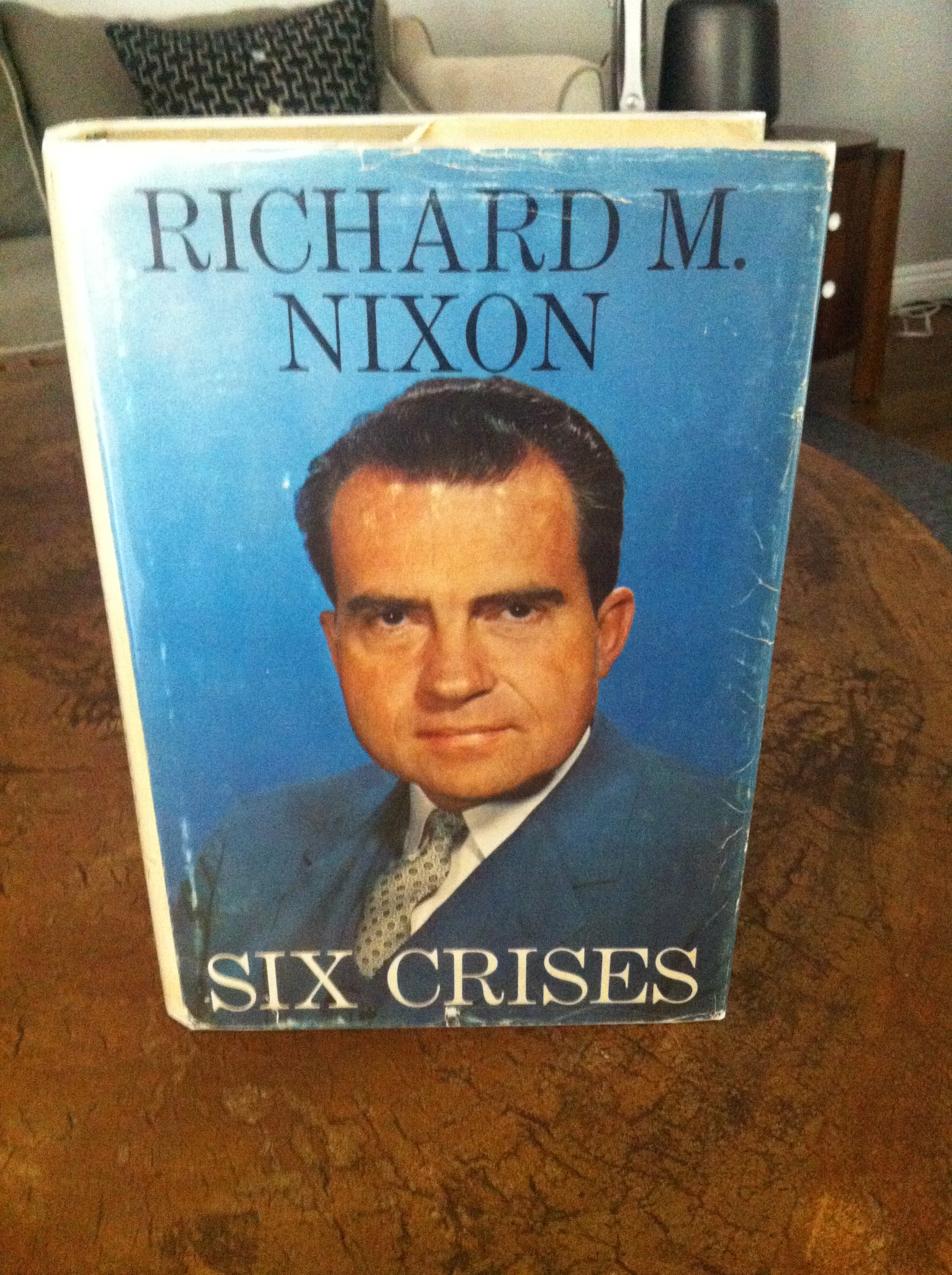
Nixon is talking about his campaign against John F. Kennedy in 1960, and why it is that he did so much better in the second TV debate than in the first:
What, then, were the major reasons for the difference in impact between the two debates?
First, there was a simple but important physical factor – the milkshake prescription had done its work.
 Helytimes
