Lonely California slough
Posted: November 30, 2024 Filed under: the California Condition Leave a comment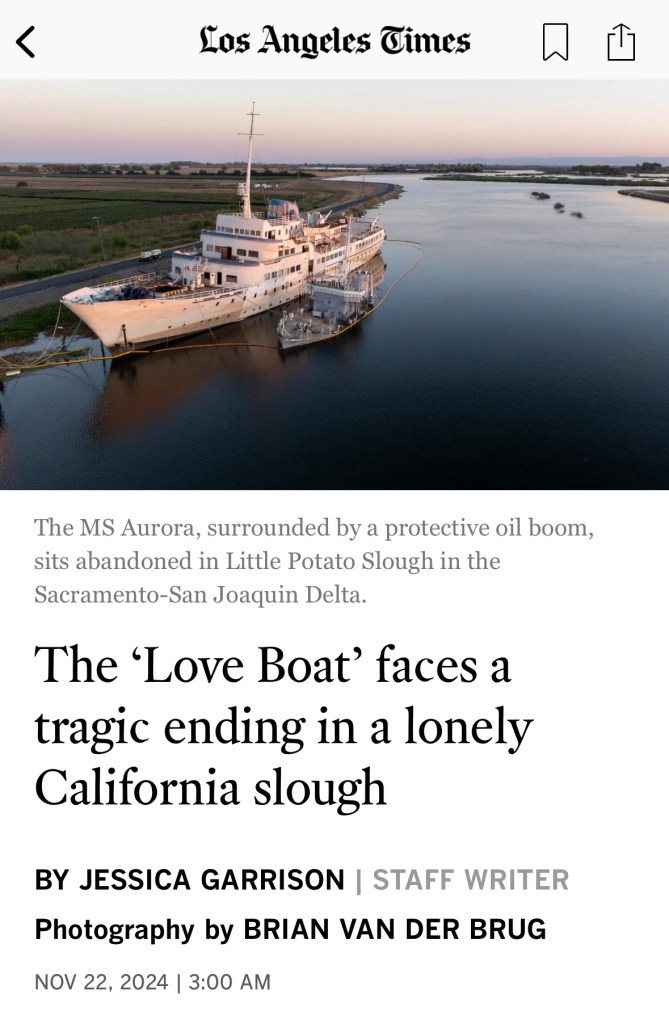
Norms
Posted: November 30, 2024 Filed under: the California Condition, Uncategorized Leave a commentI read that Norms on La Cienega, a classic LA diner, may be replaced by a Raising Cane’s.
This Norm’s is the subject of a famous painting by Ed Ruscha:

I asked different AIs to generate some versions of this painting if it were a Cane’s instead of a Norm’s.


From The LA Times:

Ballot
Posted: October 29, 2024 Filed under: the California Condition 2 Comments
Donald Trump is pure toxicity, he tried half-seriously to end the peaceful transfer of power, he’s beyond unacceptable. We endorse native daughter of the Golden State Kamala Harris and hope that a special Providence continues to look after children, drunks, and the United States.
I put this together for my own use, perhaps it is useful to you, much cribbed from The LA Times. I’ll be voting in person in a few days so feel free to make a strong case I am open to persuasion on city, state and county measures.
Community College, Seat 1: Andra Hoffman
Community College, Seat 3: David Vela
Community College, Seat 5: Nichelle Henderson
Community College: Seat 7: Kelsey Iino
US Rep: Laura Friedman
City Measure DD: Yes
City Measure HH: Yes
City Measure II: Yes
City Measure ER: Yes
City Measure FF: Yes (on the fence here, it’s expensive, but I go with Mayor Bass)
City Measure LL: Yes
Uni Measure US: Yes
District Attorney: Nathan Hochman (both bad options here, voting to express disgust.)
It makes me a little mad that I have to vote for judges. I found this helpful.
Judge No 39: Steve Napolitano
Judge No. 48: Ericka Wiley (I don’t see anything wrong with Renee Rose)
Judge No. 97: Sharon Ransom
Judge No. 135: Steven Yee Mac (nothing wrong with Georgia Huerta)
Judge No. 137: Tracey Blount
County Measure G: Yes
County Measure A: Yes
My inclination is to vote against any state ballot propositions, it’s part of why our state is so wacky, but we exist within a context of everything that came before, so vote we must:
State Measure 2: Yes
State Measure 3: Yes
State Measure 4: Yes
State Measure 5: Yes
State Measure 6: Yes
State Measure 32: No
State Measure 33: No
State Measure 34: Yes (LA Times disagrees here)
State Measure 35: No
State Measure 36: No
(source on that photo)
Slam on California
Posted: September 24, 2024 Filed under: the California Condition Leave a comment
At the end of July 1914, Rupert Brooke, alarmed by the heightening European crisis, wrote to his friend Edward Marsh, “And I’m anxious that England may act rightly.” But what did it mean to “act rightly”? Another letter, a few days later, in which Brooke described an outing into the countryside, hinted in a general way at his own response to this question:
I’m a Warwickshire man. Don’t talk to me of Dartmoor or Snowden or the Thames or the lakes. I know the heart of England. It has a hedgy, warm bountiful dimpled air. Baby fields run up and down the little hills, and all the roads wiggle with pleasure. There’s a spirit of rare homeliness about the houses and the countryside, earthy, unec-centric yet elusive, fresh, meadowy, gaily gentle.. Of California the other States in America have this proverb: “Flowers without scent, birds without song, men without honour, and women without virtue” — and at least three of the four sections of this proverb I know very well to be true. But Warwickshire is the exact opposite of that. Here the flowers smell of heaven; there are no such larks as ours, and no such nightingales; the men pay more than they owe; and the women have very great and wonderful virtue, and that, mind you, no means through the mere absence of trial. In Warwickshire there are butterflies all the year round and a full moon every night…
Shakespeare and I are Warwickshire yokels. What a country!’
Aware of his sentimentality he went on to say, “This is nonsense,”
North Hollywood flooded, 1938
Posted: September 23, 2024 Filed under: the California Condition Leave a comment
I found that here, it’s at the UCLA Digital Collection.
In the early 19th century, the river turned southwest after leaving the Glendale Narrows, where it joined Ballona Creek and discharged into Santa Monica Bay in present Marina del Rey. However, this account is challenged by Col. J. J. Warner, in his Historical Sketch of Los Angeles County:
“…until 1825 it was seldom, if in any year, that the river discharged even during the rainy season its waters into the sea. Instead of having a river way to the sea, the waters spread over the country, filling the depressions in the surface and forming lakes, ponds and marshes. The river water, if any, that reached the ocean drained off from the land at so many places, and in such small volumes, that no channel existed until the flood of 1825, which, by cutting a river way to tide water, drained the marsh land and caused the forests to disappear.”
San Francisco (and California) Politics
Posted: September 15, 2024 Filed under: California, San Francisco, the California Condition Leave a comment
When former Assembly Speaker Antonio Villaraigosa lost a campaign to become mayor of Los Angeles in June, then-Speaker Robert Hertzberg named him to the California Medical Assistance Commission, where he could earn $99,000 a year, plus benefits, working a few hours each month.
Former Assemblyman Richard Alatorre, D-Los Angeles, who served in the legislature with Senate President Pro Tem John Burton in the 1970s, was out of public office and the target of a federal corruption probe two years ago when Burton placed him on the Unemployment Insurance Appeals Board. His salary: $114,180 a year plus benefits.
from SF Gate, 2002.
Assembly Speaker Willie Brown, continuing his rush to hand out patronage jobs while he retains his powerful post, has given high-paying appointments to his former law associate and a former Alameda County prosecutor who is Brown’s frequent companion.
Brown, exercising his power even as his speakership seems near an end, named attorney Kamala Harris to the California Medical Assistance Commission, a job that pays $72,000 a year.
Harris, a former deputy district attorney in Alameda County, was described by several people at the Capitol as Brown’s girlfriend. In March, San Francisco Chronicle columnist Herb Caen called her “the Speaker’s new steady.” Harris declined to be interviewed Monday and Brown’s spokeswoman did not return phone calls.
Harris accepted the appointment last week after serving six months as Brown’s appointee to the Unemployment Insurance Appeals Board, which pays $97,088 a year. After Harris resigned from the unemployment board last week, Brown replaced her with Philip S. Ryan, a lawyer and longtime friend and business associate.
Last week, Brown also appointed Janet Gotch, wife of retiring Assemblyman Mike Gotch of San Diego, to the $95,000-a-year Integrated Waste Management Board, which oversees garbage disposal in California.
from Los Angeles Times, 1994. In fairness sitting through those hearings is probably very boring!
The story goes that in 2015 Gavin Newsom and Kamala Harris, maybe encouraged by various Democratic fundraisers and power brokers, cut a deal where she would run for Senate and he would run for Governor in 2018:
The early-2015 understanding between the two San Francisco Democrats, both with campaigns managed by the same San Francisco political consulting firm, was this: To avoid a brutal fight over the Senate seat being vacated by the retiring Barbara Boxer, Newsom would stay out of the 2016 Senate race and concentrate on running for governor two years later.
A LA Times article about the story that Gavin Newsom might be unhappy with subsequent developments (it’s not over yet Gavin!) led me to this 2015 article about why San Francisco has produced so many prominent state leaders. It’s a question we’ve pondered before:
There is nothing mysterious about San Francisco’s export of high-profile politicians, nothing like the alchemy of air and water that produces the distinctive tang of its signature sourdough bread.
Simply put, it’s fierce competition, at virtually every level, starting with the leadership of its political clubs and spreading to the lowliest contests for elected office on up to races for the Legislature and Congress.
Where San Diego and Los Angeles lie back, most of their residents scarcely interested in politics, San Francisco leans in: chin out, elbows wide and sharp.
“There is a culture here of fighting over just about everything in the public space,” said Eric Jaye, another of the city’s veteran political strategists, from global issues like the Middle East to protecting the neighborhood coffee shop from an onslaught of franchised beans….
from earlier in the same piece (by Mark Z. Barabak):
San Francisco is the closest thing to an East Coast enclave set along the Pacific, a place, like New York or Boston, where politics is a passion, a sport, something everyday people fuss and fight and scheme over.
As blue (politically) as San Francisco Bay, the city has 27 officially chartered Democratic Party chapters, among them the Raoul Wallenberg Jewish Democratic Club, the Filipino American Democratic Club, the Black Young Democrats of San Francisco and the Harvey Milk LGBT Democratic Club. That works out to roughly one party franchise every few blocks.
There are countless more neighborhood councils, civic associations, interest groups — branches of the Sierra Club, the NAACP and the like — all clamoring for their particular agendas.
“It’s a city where people have always been able to be loud and proud about who they are, not just as individuals but as a group or a community,” said Ace Smith, a Democratic strategist who has decades of experience running San Francisco campaigns.
The result is a kind of hyper-democracy and political forge that has fashioned some of California’s most powerful and enduring elected leaders, in numbers far out of proportion to the city’s relative pint size.
A very short history of California’s politics might go something like this: California wanted to get into the union without going through the territorial stage, so they sorta rushed through a constitutional convention (John Sutter himself was there). In the compromise of 1850, one of the deals involving slave and free states, California got brought in. The US wanted a lock on that gold. During the Civil War California stayed in the Union (barely). After the Civil War, the major power in the state was the railroad barons, the Big Four, who were so powerful that they provoked a progressive, democratic backlash, personified by Hiram Johnson.

(He looks like Dwight Shrute, no?)
Here’s Reagan’s guy Stuart Spencer talking about Hiram:
They didn’t do a lot of candidate work, but they did a lot of what we call proposition work in California. Under the reforms of Hiram Johnson, we were a unique state at that time. We were for years. You could put practically anything on the ballot and have it decided there instead of the legislature.
You can also read Leon Panetta, who began as a Republican but became a prominent Democrat, talking about Hiram:
I was raised in a progressive Republicanism that used to be the case in California. It began with Hiram Johnson. It was a tradition that was carried on by people like Earl Warren and Tom Kuchel, whom I worked for, and Goodwin Knight and others. Because of cross filing, because of the traditions of California.
As a result of all this balloting California politics gets pretty complicated. Our state constitution is 76,930 words long. Novel length. (Although it’s not even close to the length of the longest, which is…. can you guess it?….
Alabama, at over 402,000 words. Gotta look into how that came to be. Seems to be because it makes a lot of specific rules for specific municipalities.)
At the moment we’re a one party state, probably because the second to last Republican governor, Pete Wilson, made his big issue immigration (anti). He actually won big on that, with Proposition 187 in 1994. The voters went for that in a big way, but it then got tied up in the courts, and the next Democratic governor, Grey Davis, stopped pursuing the implementation.
Noting a rapid increase in the number of Latinos voting in California elections, some analysts cite Wilson and the Republican Party’s embrace of Proposition 187 as a cause of the subsequent failure of the party to win statewide elections.
California today is maybe 26% immigrants. The most recent Republican governor was an immigrant. He won after Grey Davis was recalled (a Hiram Johnson reform). We might be tempted to treat that election as a special circumstance, as he was famous movie star Arnold Schwarzenegger, but then again another famous movie star, Ronald Reagan, had been elected governor before. And George Murphy had been elected senator. Do you need a certain glam quality to succeed in California politics?
Two Californians have become president, although only one, Nixon, was born in California. A third Californian and second native born Californian has a real good shot right now. We’re rooting for her!
Spantsa / Olive Oatman
Posted: September 14, 2024 Filed under: the American West, the California Condition Leave a comment
OTLTA is a new acronym I’d like to get going. It stands for “one thing led to another.” Here it is in context: OTLA and I’m reading about captivity narratives of the American West. Accounts by white people who were captured or taken in by native tribes.
Captivity narratives are a whole serious category of study for academic historians. I’d fear to get over my skis here. There were commercial and political incentives to make these narratives as lurid as possible. How much to trust any one account is a historical puzzle. But, we love those.
Take for example Olive Oatman. When she was fourteen she was traveling with her family, who were Brewsterites, an splinter group of Mormons. Their intended destination was Yuma, Arizona, on the Colorado River. On Saturday, March 8, 1851, some eighty miles east of Yuma, they encountered some Yavapai people. (Already we need a footnote: were they really Yavapai? There are papers on this topic.) Everyone in the party was killed except Olive and her younger sister Mary Ann.
The Yavapai kept them but eventually traded them to some Mohave people.

Mary Ann did not survive.
After about four years among the Mohave, the post commander at Fort Yuma, on the California side, heard about a white woman living out there and sent word that he’d like her back.

We pick up the rest from Wikipedia:
Inside the fort, Olive was surrounded by cheering people.
Olive’s childhood friend Susan Thompson, whom she befriended again at this time, stated many years later that she believed Olive was “grieving” upon her forced return because she had been married to a Mohave man and had given birth to two boys.
Olive, however, denied rumors during her lifetime that she either had been married to a Mohave or had been sexually mistreated by the Yavapai or Mohave. In Stratton’s book, she declared that “to the honor of these savages let it be said, they never offered the least unchaste abuse to me.” However, her nickname, Spantsa, may have meant “rotten womb” and implied that she was sexually active, although historians have argued that the name could have different meanings.[5]: 73–74 [19]
from Violent Encounters: Interviews on Western Massacres (University of Oklahoma Press), by Deborah and Jon Lawrence, an interview with Margot Mifflin, an associat professor of English at Lehman College of the City University of New York who also directs the Arts and Cultire program at CUNY’s Graduate School of Journalism (“Her interest in tatoo art let to her work on the life of Olive Oatman.”):


History, getting towards the source, remains an engaging pastime.
I’ve been to a lot of California but I’ve never had the chance to visit Winterhaven, where we’d find the site of Fort Yuma. If I’m there I will surely check out the Museum of History in Granite:

Amazing if in four millennia the United States and the French Foreign Legion are remembered in equal proportion.
(User Kirs10 took that photo of the pyramid)
Conversations with Grant
Posted: September 7, 2024 Filed under: the California Condition, War of the Rebellion Leave a comment
After his Presidency Ulysses Grant took an around the world tour with his wife and the diplomat, librarian and scholar John Russell Young, who took notes on the trip and published them in a book.
The trip as recorded by Young is interesting but much of it was written for an audience that would never travel overseas. It was a ponderous, two-volume tome of over 1,300 pages with 800 engraved illustrations.
The good folks at Big Byte Press have taken the juiciest parts and compiled them into Conversations With Grant. (Note that this version does not include the famous conversation with Bismarck). I could spend a while with their various reprints of historical memoirs for Kindle. What a service. Here are some items we learn:
after the end of the Civil War, Grant wanted to keep going and invade Mexico:
“When our war ended,” said General Grant, “I urged upon President Johnson an immediate invasion of Mexico. I am not sure whether I wrote him or not, but I pressed the matter frequently upon Mr. Johnson and Mr. Seward [Secretary of State, William Seward]. You see, Napoleon in Mexico was really a part, and an active part, of the rebellion. His army was as much opposed to us as that of Kirby Smith. Even apart from his desire to establish a monarchy, and overthrow a friendly republic, against which every loyal American revolted, there was the active co-operation between the French and the rebels on the Rio Grande which made it an act of war. I believed then, and I believe now, that we had a just cause of war with Maximilian, and with Napoleon if he supported him—with Napoleon especially, as he was the head of the whole business. We were so placed that we were bound to fight him. I sent Sheridan off to the Rio Grande. I sent him post haste, not giving him time to participate in the farewell review. My plan was to give him a corps, have him cross the Rio Grande, join Juarez, and attack Maximilian. With his corps he could have walked over Mexico. Mr. Johnson seemed to favor my plan, but Mr. Seward was opposed, and his opposition was decisive.” The remark was made that such a move necessarily meant a war with France. “I suppose so,” said the General. “But with the army that we had on both sides at the close of the war, what did we care for Napoleon? Unless Napoleon surrendered his Mexican project, I was for fighting Napoleon. There never was a more just cause for war than what Napoleon gave us. With our army we could do as we pleased. We had a victorious army, trained in four years of war, and we had the whole South to recruit from. I had that in my mind when I proposed the advance on Mexico. I wanted to employ and occupy the Southern army. We had destroyed the career of many of them at home, and I wanted them to go to Mexico. I am not sure now that I was sound in that conclusion. I have thought that their devotion to slavery and their familiarity with the institution would have led them to introduce slavery, or something like it, into Mexico, which would have been a calamity. Still, my plan at the time was to induce the Southern troops to go to Mexico, to go as soldiers under Sheridan, and remain as settlers. I was especially anxious that Kirby Smith with his command should go over. Kirby Smith had not surrendered, and I was not sure that he would not give us trouble before surrendering. Mexico seemed an outlet for the disappointed and dangerous elements in the South, elements brave and warlike and energetic enough, and with their share of the best qualities of the Anglo-Saxon character, but irreconcilable in their hostility to the Union. As our people had saved the Union and meant to keep it, and manage it as we liked, and not as they liked, it seemed to me that the best place for our defeated friends was Mexico. It was better for them and better for us. I tried to make Lee think so when he surrendered. They would have done perhaps as great a work in Mexico as has been done in California.” It was suggested that Mr. Seward’s objection to attack Napoleon was his dread of another war. The General said: “No one dreaded war more than I did. I had more than I wanted. But the war would have been national, and we could have united both sections under one flag. The good results accruing from that would in themselves have compensated for another war, even if it had come, and such a war as it must have been under Sheridan and his army—short, quick, decisive, and assuredly triumphant. We could have marched from the Rio Grande to Mexico without a serious battle.
although he thought the first Mexican War was bad:
I do not think there was ever a more wicked war than that waged by the United States on Mexico. I thought so at the time, when I was a youngster, only I had not moral courage enough to resign.
…The Mexicans are a good people. They live on little and work hard. They suffer from the influence of the Church, which, while I was in Mexico at least, was as bad as could be. The Mexicans were good soldiers, but badly commanded. The country is rich, and if the people could be assured a good government, they would prosper. See what we have made of Texas and California—empires. There are the same materials for new empires in Mexico.
on Napoleon:
Of course the first emperor was a great genius, but one of the most selfish and cruel men in history. Outside of his military skill I do not see a redeeming trait in his character. He abused France for his own ends, and brought incredible disasters upon his country to gratify his selfish ambition I do not think any genius can excuse a crime like that.
He never wanted to go to West Point, or be in the army at all:
was never more delighted at anything,” said the General, “than the close of the war. I never liked service in the army—not as a young officer. I did not want to go to West Point. My appointment was an accident, and my father had to use his authority to make me go. If I could have escaped West Point without bringing myself into disgrace at home, I would have done so. I remember about the time I entered the academy there were debates in Congress over a proposal to abolish West Point. I used to look over the papers, and read the Congress reports with eagerness, to see the progress the bill made, and hoping to hear that the school had been abolished, and that I could go home to my father without being in disgrace. I never went into a battle willingly or with enthusiasm. I was always glad when a battle was over. I never want to command another army. I take no interest in armies. When the Duke of Cambridge asked me to review his troops at Aldershott I told his Royal Highness that the one thing I never wanted to see again was a military parade. When I resigned from the army and went to a farm I was happy.
The Battle of St. Louis was narrowly avoided:
there was some splendid work done in Missouri, and especially in St. Louis, in the earliest days of the war, which people have now almost forgotten. If St. Louis had been captured by the rebels it would have made a vast difference in our war. It would have been a terrible task to have recaptured St. Louis—one of the most difficult that could be given to any military man. Instead of a campaign before Vicksburg, it would have been a campaign before St. Louis.
He loved Oakland, and Yosemite:
The San Francisco that he had known in the early days had vanished, and even the aspect of nature had changed; for the resolute men who are building the metropolis of the Pacific have absorbed the waters and torn down the hills to make their way.
…
Oakland is a suburb of San Francisco, and is certainly one of the most beautiful cities I have seen in my journey around the world.
…
So much has been written about the Yosemite that I venture but one remark: that having seen most of the sights that attract travelers in India, Asia, and Europe, it stands unparalleled as a rapturous vision of beauty and splendor.
He wanted to live in California:
The only promotion that I ever rejoiced in was when I was made major-general in the regular army. I was happy over that, because it made me the junior major-general, and I hoped, when the war was over, that I could live in California. I had been yearning for the opportunity to return to California, and I saw it in that promotion. When I was given a higher command, I was sorry, because it involved a residence in Washington, which, at that time, of all places in the country I disliked, and it dissolved my hopes of a return to the Pacific coast. I came to like Washington, however, when I knew it.
He had some reservations about Lee as a general:
Lee was of a slow, conservative, cautious nature, without imagination or humor, always the same, with grave dignity. I never could see in his achievements what justifies his reputation. The illusion that nothing but heavy odds beat him will not stand the ultimate light of history. I know it is not true. Lee was a good deal of a headquarters general; a desk general, from what I can hear, and from what his officers say. He was almost too old for active service—the best service in the field. At the time of the surrender he was fifty-eight or fifty-nine and I was forty-three. His officers used to say that he posed himself, that he was retiring and exclusive, and that his headquarters were difficult of access. I remember when the commissioners came through our lines to treat, just before the surrender, that one of them remarked on the great difference between our headquarters and Lee’s. I always kept open house at head-quarters, so far as the army was concerned.
On Shiloh:
“No battle,” said General Grant on one occasion, “has been more discussed than Shiloh-none in my career. The correspondents and papers at the time all said that Shiloh was a surprise-that our men were killed over their coffee, and so on.
There was no surprise about it, except,” said the General, with a smile, “perhaps to the newspaper correspondents. We had been skirmishing for two days before we were attacked. At night, when but a small portion of Buell’s army had crossed to the west bank of the Tennessee River, I was so well satisfied with the result, and so certain that I would beat Beauregard, even without Buell’s aid, that I went in person to each division commander and ordered an advance along the line at four in the morning. Shiloh was one of the most important battles in the war. It was there that our Western soldiers first met the enemy in a pitched battle. From that day they never feared to fight the enemy, and never went into action without feeling sure they would win. Shiloh broke the prestige of the Southern Confederacy so far as our Western army was con-cerned. Sherman was the hero of Shiloh.
He really commanded two divisions-his own and McClernand’s-and proved himself to be a consummate soldier. Nothing could be finer than his work at Shiloh, and yet Shiloh was belittled by our Northern people so that many people look at it as a defeat.

Eleven pages a week
Posted: August 24, 2024 Filed under: Hollywood, the California Condition, writing, writing advice from other people Leave a comment
In one of my Hollywood books I read that writers in the studio system were expected to write eleven pages a week.
Eleven pages, seems very reasonable. Especially if we are talking script pages which have a lot of white on them.
Now you may have to write thirty-three pages to produce eleven good ones, but still.
I went looking for where I found this information but I couldn’t locate it in Schatz, Genius of the System, or Friedfrich, City of Nets, or Thomson, The Whole Equation: A History of Hollywood, or Behlmer, Memo from David O. Selznick, or Pirie, Anatomy of the Movies, or Rosen, Hollywood, or Dardis, Some Time in the Sun, or Powdermaker, Hollywood: The Dream Factory or even Solomon, William Faulkner The Screenwriter. Not to say it’s in one of those, I just couldn’t retrieve it.
Using a Google Books search I did find reference to an eleven pages expectation:

That’s in Mark Wheeler, Hollywood: Politics and Society, which I’ve never read.

Cool cover!
If you reliably produce eleven pages a week your odds at some success are high.
Eleven pages a week will be my goal when I return from vacation at the end of August.
(that Faulkner typing pic seems to be from Time-Life Getty Images, found it on Reddit).
Photo shoot
Posted: August 13, 2024 Filed under: the California Condition Leave a comment
observed in LA
I Cover The Waterfront
Posted: August 10, 2024 Filed under: the California Condition Leave a comment
Here’s the opening:
Chapter One: The Damned and the Lost
I have been here so long that even the sea gulls must recognize me. They must pass the word along about me from generation to generation, from egg to egg.
Former friends of mine, members of my old university class, acquaintances my own age, have gone out to earn their 6000 a year. They have become managers, they have become editors, they have become artists. Yet here am I, what I was six years ago, a waterfront reporter.
True, I am called a good waterfront reporter in this city, as if the humiliation were not already great enough in itself. I shudder at the compliment, yet should feel fortunate in a way that so far I have escaped the word veteran. When I am called not only the best waterfront reporter but also the veteran waterfront reporter, then for sure all hope is dissolved. And I need look ahead then, only to that day when the company presents me with a fountain pen and a final check.
I am nearing 28, and should I by accident be invited to a home where literature is discussed, or styles, or Europe, the best I could do would be tocrawl into the backyard. There I could sit tossing pebbles into the fountain until the hostess found me out. If she compelled me to come back into the house and join the conversation, my topics would have to be of swordfishing, or of lobstering, or of hunting sardines in the dark of the moon, or of fleet gunnery practice, or of cotton shipments. The predicament has passed beyond my control. I am one of those creatures who remain permanent, who stay in one place, that successful men on returning home may see for the happiness of comparison. I am of the damned and the lost, and yet I do know more than I did six years ago when I first came here, a graduate in liberal arts.
Six thousand a year. That was 1932, using the BLS inflation calculator that’s $131,821.68 today. Further investigation into the existential mystery of San Diego led me to this one.
Max Miller was waterfront reporter for San Diego’s third best newspaper in the 1930s. He worked out of a studio above the tugboat office. He remembers meeting the passengers from the big ocean liners:

He remembers Charles Lindbergh, before he was famous:

He remembers breaking some tough news:


How that one ends:

I Cover The Waterfront became a song, and a movie apparently not really based on the book.
[Miller] lived most of his life at 5930 Camino de la Costa in La Jolla, just south of Windansea (from his hillside home, he could hear the Point Loma lighthouse foghorn).
Zillow estimates that house would now cost around $16 million.
The San Diego Reader (oxymoron?)has the gossip on Miller:
But Morgan has a different interpretation. “I Cover the Waterfront was widely said among publishers to have been rewritten by a very beautiful literary agent in New York who was in love with Max at the time,” says Morgan. “It was a nasty allegation, but it was a better book than any he wrote subsequently. I tend to believe the rumor of the publishing trade.”
It’s possible. It’s also possible he was traumatized by World War Two. His title for his book about La Jolla, The Town With The Funny Name, doesn’t seem particularly inspired (is it really that funny a name? Right here in California we have Needles, Weedpatch, etc.) Or maybe he just had one good one in him.
Gats
Posted: August 4, 2024 Filed under: food, the California Condition Leave a comment
saw someone on X (formerly “Twitter”) raise the old red flag of The Great Gatsby isn’t that good actually so I took it off the shelf.


That’s how it starts. (Struck me that my edition, the one we read in school I believe, has no introduction foreward or any of that bog you down scholarly junk at the front.* Your enjoyment of classic books will improve we believe if you always skip those and plunge right in. You can always come back later.)
If you’re like me you first read this book in school. It is a great summer book. It’s even set at the seaside.
Been meaning to document some items from Sheilah Graham’s The Real F. Scott Fitzgerald, and perhaps now is the time. Their relationship was tumultuous:
I knew that “Portrait of a Prostitute” was also a drunken commentary. He must have written it on the photograph after the first of our two bad quarrels in 1939 when he was drinking so heavily. We had struggled for his gun, I had slapped him—the first person in his life ever to do so-and as I walked out, I had delivered a harsh exit line, “Shoot yourself, you son of a bitch. I didn’t raise myself from the gutter to waste my life on a drunk like you.”
When they met:
When I first met Scott on July 14, 1937, neither of us was looking for a relationship of such intensity. He had too many other responsibilities. I was engaged to the Marquess of Donegall-who died recently-and planning a New Year’s Eve wedding to be followed by a honeymoon cruise around the world. Part of the unwritten marriage contract was that I would give Don an heir as soon as possible, and a doctor had told him that the swaying of a ship was conducive to pregnancy.
Zelda:
To hold Scott on a string when the engagement was off and to continue to make him jealous, Zelda invented an “engagement” to the famed golfer Bobby Jones. Scott always believed that she had promised to marry Mr. Jones. He told me this with conviction. But when Andrew Turnbull was writing his biography of Scott, he questioned the golfer, who denied even knowing Zelda.
later:
I think their lives also suffered from Zelda’s increasing desperation as to what to do with herself. She had no idea of being a wife shortly after they were married Scott discovered all his dirty shirts piled up in a closet-and, although she tried in the times of sanity, still less of being a mother
Scott’s diet:
When I think now of the abuse that Scott inflicted on himself, it’s a miracle that he lived as long as he did. Aside from his drinking there was, drunk or sober, the incessant smoking and also the reliance, when not drinking, on coffee and dozens and dozens of bottles a day of Coca-Cola. He would line up the Cokes all around the walls of his office at M-G-M and announce, “I’ll drink these up, and when they’re gone I’ll go back to beer.” Dr. Richard Hoffman, who had examined him in New York, told my Beloved Infidel collaborator, Gerold Frank, that Scott drank-both the liquor and the Cokes-be-cause he had the reverse of diabetes, an insufficiency of sugar in the blood. Is this true for all who drink unwisely?
This is when they were healthy:
For the first time for both of us, we were leading average lives, working by day, reading or walking in the evening after the same dinner prepared for us every night by our shared housekeeper, a thin T-bone steak (at 35 cents a pound!), a baked potato, peas, and a grapefruit jelly.
…
I would not have wanted to examine Scott’s inside, with not only all the above but also the strange food that he ate-sometimes just fudge and crab soup, in that order. He was eating a little more in that last year, lots of cookies, candy, and cake to compensate for the sugar in the alcohol.
But there were nice times too:
lunches at the elegant Vendome Restaurant in Hollywood, at the Brown Derby in Hollywood or in Beverly Hills, and our dancing in the evenings, particularly in the first year, at the Trocadero. Scott danced the collegiate style of the time-heads close together, rears at a thirty-three-degree angle.
Looking back, I marvel at what a full, active life we had. We also went away together for weekends, especially in the first two years before Scott was so hard up—to Santa Barbara, La Jolla, Del Monte, Monterey, over the south U.S. border into Mexico, and to the San Francisco Fair. I loved those long drives with Scott, even though he drove at twenty to twenty-five miles an hour.
“Del Monte,” a resort in Monterey that now belongs to the Navy. Monterey on the old roads before the 5 is about 331 miles away. At twenty five miles an hour that trip must’ve taken like thirteen hours. And that’s if you don’t stop every hour for more Cokes.
*in writing that sentence I got to wondering what those obstacles the Germans and their various conscripts) set up on the D-Day beaches were called. You know the ones I’m talking about? Turns out they are called hedgehogs.

What is San Diego?
Posted: July 30, 2024 Filed under: the California Condition Leave a comment
From time to time fortune takes me down the coast to the city of San Diego, and I’m always left a little stumped. What is this place? What is distinctly San Diego? If it has a bent it is slightly to the right, somewhat fratty/military. Top Gun, Navy SEALs. Retirees. IPAs (although those are everywhere now). The California burrito. What else? We’re talking about the eighth most populous city in the United States. Pleasant living is on offer for sure, sunshine and surf. The people that like it love it. But what does it have to show for itself?

Here’s the WPA guide to California on the city, as it was circa 1939:
SAN DIEGO (0-822 alt., 147,995 pop.), the oldest Spanish settlement in California, is in the extreme lower left-hand corner of the United States. Although only 16 miles north of the Mexican boundary, it is completely American. Its landlocked natural harbor is headquarters for the Eleventh Naval District, for marine and coast guard bases, and home port for a fleet of tuna clippers and fishing smacks manned by Portuguese and Italian fishermen.
The city has much of the easygoing spirit of Spanish days, and people dress and live for comfort. Life moves at a modulated pace, particularly because of the large number of retired and elderly persons.
The downtown area, dominated by a group of tall buildings, is small for a city of this size; Broadway, the main artery, runs from the waterfront due east and divides the city into distinct sections. Although liners no longer call at the port Max Miller wrote of in I Cover the Waterfront, freighters and tramp steamers dock here regularly. Tuna clippers bring in big hauls of huge fish, and sport fishing parties return with catches of yellowtail, barracuda, and swordfish. Navy shoreboats run between ships at anchor and the piers.
South of Broadway many plain buildings of the 1870’s and gingerbread structures of the 1890’s are still in use. Markets and grocery stores along Twelfth Avenue display fruit and vegetables in pyramids and cascades. Third, Fourth, and Fifth Avenues have taverns with three-piece jazz bands, shooting galleries, inexpensive movies, hamburger stands, pawn shops, and small hotels.
Balboa Park’s giant green square begins just north of the business district. North and northwest of the park are the newer residential districts, and to the west is Middletown, a narrow segment extending from the bay to the low hills, occupied by Italian fishermen and airplane factory employees. Old Town, site of the original Spanish settlement, is northwest of Middletown. It has some fine adobe buildings, fringed with rose bushes and flowers, but most of the land is occupied by small houses and auto courts.
Most of San Diego’s inhabitants, apart from the shifting Navy personnel, are immigrants or descendants of immigrants from the East and Middle West. Many are retired; ten percent of all retired U. S. Navy officers live in San Diego.
In the Logan Heights district, south and east of downtown along the curved southern shore, sprawl San Diego’s Mexican and Negro communities, with Mexican restaurants vending tamales and tacos, and with chicken palaces and big ovens where Negroes barbecue meat.
About 10,000 Mexicans, most of them clinging to their own language and customs, live in this district; they are employed mainly as day laborers and cannery workers. The 4,500 Negroes are mostly manual or domestic workers. The Japanese colony, of about 1,000 persons, is in this area also; some in huts on stilts over the water. About 5,000 Portuguese fisherman, who live on the bay side of Point Loma, form a distinct group preserving its own customs. Italian fishermen mingle more generally with the community.
The site of San Diego was visited in 1539 by Father Marcos and his followers, from the desert side, in their search for the “Seven Cities of Cibola”; in 1542 by Juan Rodriguez Cabrillo, a Portuguese explorer in the service of Spain, who spent six days in the harbor; and sixty years later by Sebastian Vizaíno, merchant navigator charting the coast for Spain.
In 1769 Governor Portola, with Franciscan friars and soldiers, established a mission and presidio here. The English sloop Discovery, engaged in scientific research, visited San Diego in 1793, and in 1803 the Yankee-owned Lelia Byrd, caught while smuggling otter skins, fought a cannon duel with the battery of Ballast Point.
…
During the Mexican regime, San Diego took on more color. “The beautiful señoritas danced their picturesque dances at the balls which followed bull-fights and cock-fights.” Many Spanish families, on bad terms with the Mexican governor, assisted the Americans in their conquest. After the Treaty of Guadalupe Hidalgo, the town came peacefully under American rule.
In 1850 the present Old Town was incorporated as a city. The site of the present city was called New Town, or “Davis’s Folly” for William Heath Davis, who first built there. Alonzo E. Horton, for whom New Town was named “Horton’s Addition,” profited more than he.
From 1867 to 1872 New Town grew steadily; then a fire wiped out Old Town’s business district, and New Town became the city’s center.
In 1885 the Santa Fe Railroad laid tracks into San Diego and made it a transcontinental terminus. Two years later it had 40,000 residents, but the boom collapsed, and by 1890 there were only 17,000. Since 1910 its population has doubled about every decade.
Aircraft is the only large-scale industrial plant. Fishing and canning San Diego’s 335 factories are mostly small enterprises; Consolidated are basic sources of income. A large lumber mill handles timber rafted in from the Northwest.
San Diego was an open-shop city until the strong wave of unionization in the early thirties; during the bitter “Free Speech Fight” of 1912 radical headquarters were raided and radicals ordered out of town.
Depressions have touched lightly on San Diego.
The colorful fishing fleet days are over, although there are still some 150+ commercial fishing vessels.
San Diego is a place that isn’t “certified,” to borrow from Walker Percy—there are fewer templates or cultural expectations for what your life must be like here, compared to LA or New York, for example. As Armantrout went on to say, “In my mature years I have come to appreciate the blankness of this town. When I step on the street in San Diego, I am not stepping onto a set; I am not stepping into a play, my own or anyone else’s.” In her work, the ersatz dailiness of ordinary life in San Diego—bills, television shows, illness, reading, advertisements, children—is maybe the best portrait of the city one could make, and certainly a guide for maintaining a vibrant life of the mind here.
from this piece on literary San Diego by Patrick Coleman.
Maybe (in fact certainly) I’m overthinking it. San Diego is a normie heaven, and that’s it. We need a city to absorb surplus bro energy and mellow it in the Southern California sun, which object San Diego achieves. To ponder what it might mean is very un-San Diego. Just crack a cold one or pop an edible, put on the game and vibe out.
And what are we even talking about here? New Orleans produces culture and also absurd murder rates. LA is LA but did San Diego have anything on the scale of the 1994 riots or the O.J trial? What is character but atrocity, debacle, chaos sanded by time?

In recent years my visits to San Diego have been for Comic-Con. 130,000 people descend on the San Diego Convention Center (2.6 million square feet) and surrounding blocks. This might seem fringe or marginal, it was at one time, but now we’re talking about the most popular movies in the world, billion dollar corporate products.

a fraction of a fraction of the whole, the scale is difficult to grasp. The size of it humbles the aircraft carriers docked across the bay.
Perhaps it is the very blankness of San Diego that allows the city to absorb Comic Con. You can attend Comic Con without being in “San Diego” in any real way. There’s nice weather, you’re near the water, but essentially you’re in one giant hotel without distinction.
Near the Comic Con zone is a massive Dole shipping and processing facility:

In the past I’ve been impressed with the San Diego Museum of Art, that has a possible Bosch or Bosch workshop.

This year I ventured as far as Little Italy to Vino Carta, where Jeff Fischer was pouring wines. You’re on India Street there and under the landing path of planes to San Diego’s airport, it’s kind of fun as they descend just over your head. On the rec of a local I had some very fine tacos from Tacos El Gordo, a line down the block, Bourdain kind of place. The adobada was recommended but I’m off the pork at the moment.
Recall that towards the end of Cormac McCarthy’s Blood Meridian, the kid ends up in San Diego. Here are some excerpts, which we put down towards the project of assembling a literary anthology of San Diego:
As he was crossing the plaza toward the little mud cabildo he encountered Toadvine and Webster newly released. They were wildlooking and they stank. The three of them went down to the beach and sat looking out at the long gray swells and passing Brown’s bottle among them. They’d none of them seen an ocean before. Brown walked down and held his hand to the sheet of spume that ran up the dark sand. He lifted his hand and tasted the salt on his fingers and he looked downcoast and up and then they went back up the beach toward the town. They spent the afternoon drinking in a lazarous bodega run by a Mexican. Some soldiers came in. An altercation took place. Toadvine was on his feet, swaying. A peacemaker rose from among the soldiers and soon the principals were seated again. But minutes later Brown on his way back from the bar poured a pitcher of aguardiente over a young soldier and set him afire with his cigar. The man ran outside mute save for the whoosh of the flames and the flames were pale blue and then invisible in the sunlight and he fought them in the street like a man beset with bees or madness and then he fell over in the road and burned up. By the time they got to him with a bucket of water he had blackened and shriveled in the mud like an enormous spider. Brown woke in a dark little cell manacled and crazed with thirst.
a bit later:
They reached San Diego in the dead of night and were directed to the alcalde’s house. This man came to the door in nightshirt and stockingcap holding a candle before him. Glanton pushed him back into the parlor and sent his men on to the rear of the house from whence they heard directly a woman’s screams and a few dull slaps and then silence.
…
They left them bound and gagged and rode out to visit the grocer. Three days later the alcalde and the grocer and the alcalde’s wife were found tied and lying in their own excrement in an abandoned hut at the edge of the ocean eight miles south of the settlement. They’d been left a pan of water from which they drank like dogs and they had howled at the booming surf in that wayplace until they were mute as stones. Glanton and his men were two days and nights in the streets crazed with liquor. The sergeant in charge of the small garrison of American troops confronted them in a drinking exchange on the evening of the second day and he and the three men with him were beaten senseless and stripped of their arms. At dawn when the soldiers kicked in the hostel door there was no one in the room.
A return:
It was evening of the following day when they entered San Diego. The expriest turned off to find them a doctor but the kid wandered on through the raw mud streets and out past the houses of hide in their rows and across the gravel strand to the beach. Loose strands of ambercolored kelp lay in a rubbery wrack at the tideline. A dead seal. Beyond the inner bay part of a reef in a thin line like something foundered there on which the sea was teething. He squatted in the sand and watched the sun on the hammered face of the water. Out there island clouds emplaned upon a salmoncolored othersea. Seafowl in silhouette. Down-shore the dull surf boomed. There was a horse standing there staring out upon the darkening waters and a young colt that cavorted and trotted off and came back.
He sat watching while the sun dipped hissing in the swells. The horse stood darkly against the sky. The surf boomed in the dark and the sea’s black hide heaved in the cobbled starlight and the long pale combers loped out of the night and broke along the beach. He rose and turned toward the lights of the town. The tidepools bright as smelterpots among the dark rocks where the phosphorescent seacrabs clambered back. Passing through the salt grass he looked back. The horse had not moved. A ship’s light winked in the swells. The colt stood against the horse with its head down and the horse was watching, out there past men’s knowing, where the stars are drowning and whales ferry their vast souls through the black and seamless sea.

Black Swan vs Sarco
Posted: March 20, 2024 Filed under: horses, the California Condition 1 Comment
(source)
Black Swan was a mare, a horse in Australia whose reputation reached Jose Antonio Andres Sepulveda all the way in California.
The Sepulveda family was Southern California aristocracy, landowners whose holdings ranged from what is now Newport Beach to Santa Monica.
Sepulveda bought Black Swan sight unseen and had her sent to San Francisco:
When the fragile creature stepped off the gangplank in San Francisco in late 1851, along with her traveling companion, a gray gelding named Ito, she was unsteady, gaunt and sickly. Onlookers were not impressed.
Sepulveda turned the horse over to Yankee trainer Bill Brady.
Communicating with his gentle touch instead of force, Brady took her over winding paths, carefully avoiding sharp stones and other hazards that might injure her.
As he waited, Sepulveda hatched a plan that turned into a bonanza. His purse was still fattening with the enormous profits he began reaping three years earlier, when the discovery of gold had driven up the price of beef, and he delighted in racing and gambling.
Sepulveda challenged Pio Pico to pit his stallion Sarco in a race against Black Swan.
[Sepulveda] made sure that a crowd, among them Pico, was in Los Angeles when Brady rode into town on Black Swan. Seeing the mangy and emaciated mare only confirmed Pico’s and his cronies’ opinion that the majestic, cinnamon-colored Sarco was invincible.
Recklessly, Angelenos wagered their life savings on Sarco. Carrillo family members bet their last $400. The total bet in the $50,000 match race: $25,000 each in octagon-shaped gold slugs, in addition to 500 horses, 500 mares, 500 heifers, 500 calves and 500 sheep.
Sepulveda, Brady and Sepulveda’s son-in-law, Tom Mott, had three months to condition Black Swan. While building up her weight, they exercised her with discretion, running her after dark when no one could see her.
Pico and his hard-core betting pals were confident that Sarco was the better horse and therefore needed no training–an unbeatable mount, powerful and ready for a race at any moment.
As the date–March 20, 1852–drew near, the excitement and the bets grew higher. The Avilas and Duartes, who were friends of Sepulveda, bet a “bottle of brandy, two broken horses and $5.” For others just as low on cash, every animal imaginable–cattle, horses, goats, pigs, chickens–was fodder for a wager, along with land and furniture.
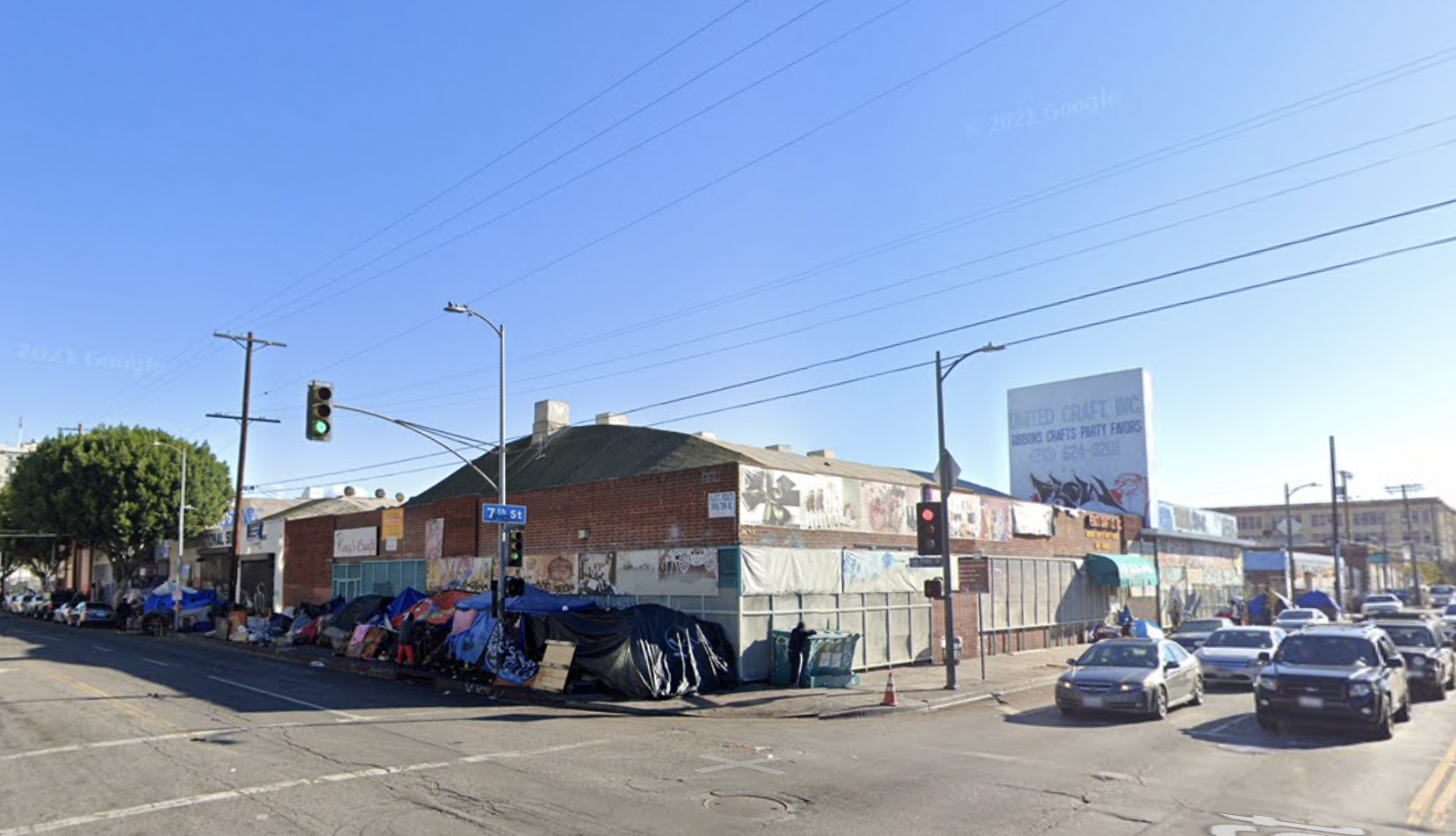
Families from as far away as San Francisco and San Diego arrived for the race, which began at what is now 7th and San Pedro streets.
The track extended 4 1/2 miles south to a wooden stake, where the horses and their riders turned around and headed back to the start.
Springtime mustard plants growing 10 feet tall lined the roadway, making it difficult to see. Bystanders stood in their wagons and climbed trees, gates and rooftops of the occasional house.
As the tension mounted, Sepulveda’s wife, Francisca, arrived in her carriage, holding a fortune in gold coins. Unwrapping her handkerchief, she ostentatiously handed each of her servants and many bystanders a shiny $50 gold piece to bet on the race.
A gasp of astonishment went up when Black Swan appeared, no longer looking like a sickly nag, but sleek with a shiny blue-black mane. Mounted on her back, sitting in a lightweight English saddle, was a small black man, dressed in bright clothing with a small cap turned backward on his head. Atop Sarco sat a hefty Mexican youth in a heavy Western saddle.
…
With so many animals made nervous by the crowds, the starter began the race not with a gunshot but with the cry of “Santiago!”
Sarco jumped out to an early lead, and all those betting on him breathed a sigh of relief. Many leaped to their own horses and followed, tearing through the mustard plants. But the fleet horses soon lost them, and the spectators headed back to watch the finish.
Frenzy gripped the crowd at the halfway mark when Black Swan pulled ahead. Sarco strained every muscle to keep up with the speedy little foreigner.
Nineteen minutes, 20 seconds from start to finish, Black Swan crossed the finish line five lengths ahead. She was bleeding from her nose and flanks from the spurs, and foaming from her mouth.
Racing fans stood around in stunned silence, as others broke down and cried. While Sarco tasted his first defeat, Black Swan, in her moment of triumph, wiped out entire family fortunes. The race contributed to the downfall of Pico, who lost $25,000 and who, more than four decades later, would die penniless.
All that from a 2001 LA Times piece by Cecilia Rasmussen. Not sure her sources, they sound vivid!
The Bowers Museum has a portrait of Sepulveda riding Black Swan:
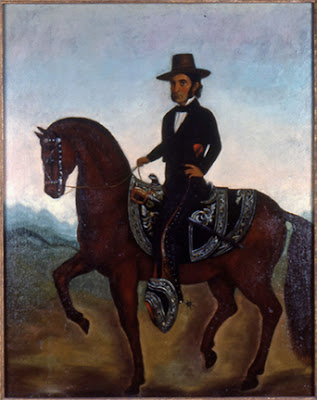
Sepulveda’s son-in-law and a witness to the race wrote later that not much of it could be seen except for the start and the finish because the wild mustard plants stood ten feet high on both sides of the road. Soon after the race Sepulveda took Black Swan to El Refugio, the elaborate adobe home and acreage he had purchased from Domingo Yorba about 1854. El Refugio was located near present day First and Sullivan Streets in Santa Ana. It has been said the family used to feed the horse sugar from the veranda.
A walk beginning at Seventh and San Pedro might be one of the worst nine mile explorations you could make in LA, that’s the butt end of Skid Row.
The poet Fred D’Aguiar took the race as inspiration for a book of poems, For The Unnamed.
For the Unnamed was originally entitled ‘For the Unnamed Black Jockey Who Rode the Winning Steed in the Race Between Pico’s Sarco and Sepulveda’s Black Swan in Los Angeles, in 1852′. That title provided the full narrative in a nutshell: we know the names of the owners of the two horses, we know the horses’ names, the place and date of the race. But apart from his colour, and his victory, we know nothing about the jockey who made the whole thing happen.
(cheers to reader Raj V for putting me on to this tale).
Still true?
Posted: February 3, 2024 Filed under: the California Condition 1 CommentWhat is striking about Los Angeles after a period away from it is how well it works. The famous freeways work, the supermarkets work (a visit to, say, the Pacific Palisades Gelson’s, where the aisles are wide and the shelves full and checkout is fast and free of attitude, elevates grocery shopping to a form of zazen), the beaches work. The 1984 Olympics were not supposed to work, but they did (daily warnings of gridlock and urban misery gave way during the first week to a county-wide block party, with pink and aquamarine flags fluttering over empty streets, and with parking spaces available, for once, even in Westwood)—not only worked but turned a profit, of almost two hundred and twenty-three million dollars, about which there was no scandal.
Saint Joan talking about LA in the August 28, 1988 New Yorker. Will the 2028 Olympics work out the same? I hope so.
My own observation is Los Angeles works less well in 2024 than it did when I arrived in 2004. Maybe that’s the sweetening filter of nostalgia for youth. There are more people living in tents now than there were then. That seems bad. A dreadful indicator. Does the tent-living increase correlate with housing price increase? Haven’t put the graph together but I’d guess yes.
The economists might tell us demand for housing is growing faster than supply, causing prices to go up. The supply (of housing) is hard to make go up. You need to build.
LA used to be a leader in experimental affordable housing projects:
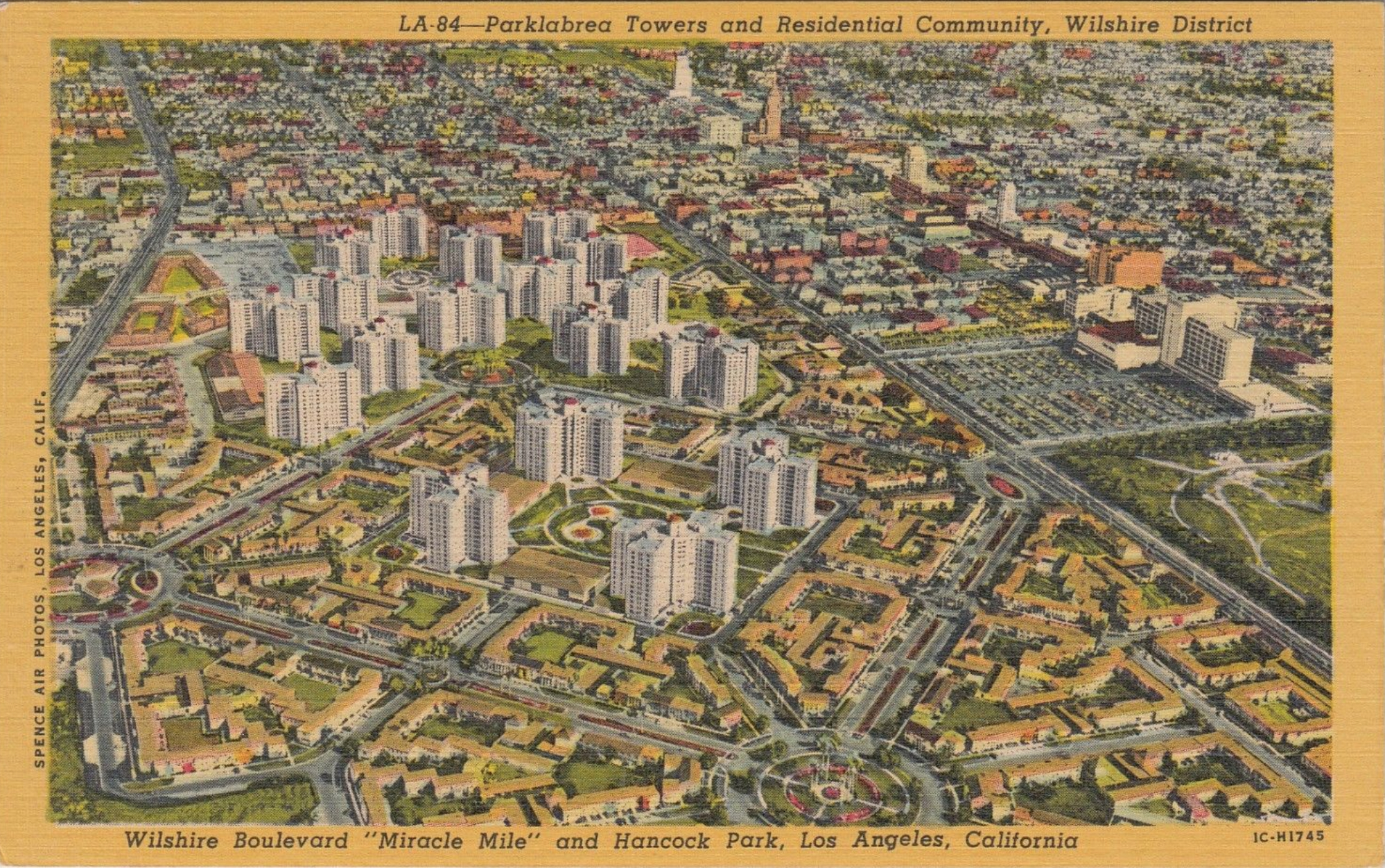
Southern California town origin stories
Posted: January 20, 2024 Filed under: the California Condition Leave a comment
In 1851 a group of 300 Mormons from southern Utah purchased a 35,509-acre tract in the San Bernardino Valley, laid out a town, planted trees, and built fine homes which they smothered in rose bushes and clinging plants. In a cooperative venture which became the model for all such efforts in the semi-arid Far West, they brought 4000 acres under irrigation. In 1857 a group of German immigrants gathered in San Francisco and incorporated themselves as the Los Angeles Vineyard Society. Purchasing a tract in Southern California which had once been part of the Rancho San Juan Cajon de Santa Ana, the Germans founded the colony of Anaheim, irrigating the soil and planting the vines of California and the Moselle. “We drove through the clean and well-kept avenues or streets, scenting Rhineland on every side,” wrote a visitor in the 1870’s, “and, indeed, this Anaheim itself is nothing but a bit of Germany dropped down on the Pacific Coast.” At Pasadena he might have scented Indiana and high-seriousness of the American Protestant variety. The excessively severe winter of 1873-74 convinced a number of middle class residents of Indianapolis, many of whom suffered from chronic ailments, that they had better emigrate to Southern California as agriculturalists. Incorporating themselves as the San Gabriel Orange Grove Association, they purchased and subdivided part of the Rancho San Pascual at the western head of the San Gabriel Valley: a superb spot, sheltered by the Sierra Madre and Verdugo Mountains, sunny, fertile, and conveniently near Los Angeles. Cottages were built and vines and fruit trees planted. In 1875, when the community acquired a post office, it called itself Pasadena.
Pasadena really does have the vibe/taste of solid Midwesterners from 1875. Who else would have a Rose Parade where they brag about how much tedious work each float takes?
I assumed that Pasadena was from the Spanish but according to About Pasadena on the city’s website:
The word Pasadena literally means “valley” in the Ojibwa (Chippewa) Indian language, but it has been interpreted to mean “Crown of the Valley” and “Key of the Valley,” hence the adoption of both the crown and the key in the official city seal.
More on Kevin Starr, a hero of mine.
Eckersley
Posted: January 7, 2024 Filed under: baseball, the California Condition 1 Commentin 2023 we happened to watch a Dodger Channel / Spectrum Sportsnet LA documentary about the 1988 World Series home run by Kirk Gibson. Probably the most famous moment in post-Brooklyn Dodger history. What impressed though was what Dennis Eckersley had to say. Eckersley threw the pitch Gibson cleared over the right field fence. Here’s what he said about how he handled the postgame interviews:
the urge
Posted: December 28, 2023 Filed under: the California Condition Leave a comment
when looking at my 1969 UNP map I bought in a thrift store in Long Beach

to finally connect the line from Mina, NV to Laws, CA.
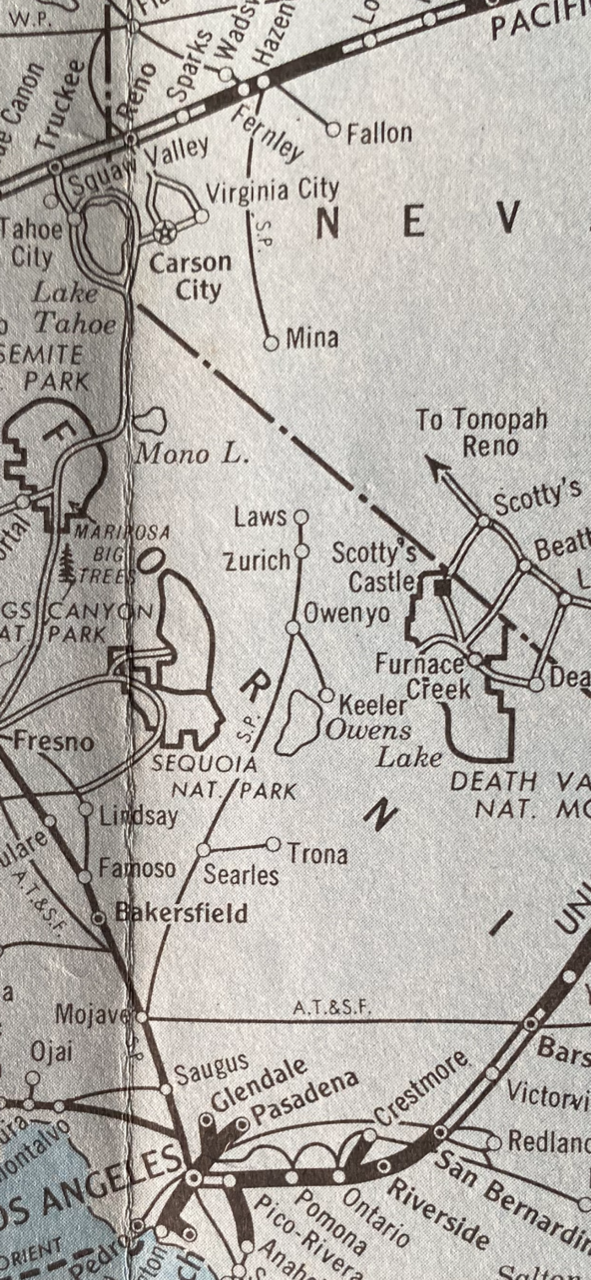
Can you imagine what that would do for the region??
USC-UCLA
Posted: November 18, 2023 Filed under: sports, the California Condition Leave a commentAhead by three scores, taking a knee or running up the middle would have been the humane thing to do, even against those terrible Trojans.
Cade McNown leaned into the huddle and relayed the play. As the clock ticked below 20 seconds, the Bruins quarterback stepped behind center and took the snap. He faked a pitch and took off in the other direction, no one there to protect him.
It was a naked bootleg, and a timeless kick in the rear.
“I mean, I still f— hate Cade McNown,” former USC fullback Petros Papadakis said this week with a hearty laugh.
Enjoyed this LA Times article by Ben Bolch about the 1998 USC-UCLA game. A 1998 time capsule:
Some might say the Bruins were cursed before kickoff. A large swath of the team had wanted to wear black wristbands in protest of Proposition 209, a state constitutional amendment that prohibited affirmative action in state programs and university admissions.
As for Cade McNown:
McNown later worked for UBS in the private wealth group before joining JPMorgan Chase Private Bank. In 2013, McNown joined capital management firm Lourd Murray as a vice president. In 2016, McNown joined Kayne Anderson as a senior managing director. In June 2022, McNown joined The Carlyle Group as a Managing Director and Client Relationship Manager.
Of course. The Carlyle Group is so odd:
In the late 1980s, Carlyle raised capital deal-by-deal to pursue leveraged buyout investments, including a failed takeover battle for Chi-Chi’s.
Chi-Chi’s was a Midwestern sensation that flopped on expansion:
Chi-Chi’s is noted in the Sentinel as specializing in Sonoran food. Sonora, a state in the northwestern region of Mexico, features cuisine known for having “subtle, less spicy seasoning.” For a chain that formed many Americans’ first impression of Mexican food, Chi-Chi’s likely understood the need to ease diners’ palates into the new fare. It was a savvy approach…
Despite having made over $2 million in revenue in its first year, Chi-Chi’s didn’t manage to replicate its Midwest popularity in other regions as it attempted to expand. Multiple locations in New York and the New England region failed, as well as locations in Atlanta, Texas, New Mexico, and San Diego.
Then came the Pittsburgh hepatitis outbreak, which killed at least four people.

Nostaljack took that one for Wikipedia. The last surviving Chi-Chi’s is in Vienna, Austria.
Today USC and UCLA will play in the Rose Bowl. Both teams underperformed expectations this year. Pride will be on the line.
The Retake Room
Posted: November 17, 2023 Filed under: the California Condition Leave a comment
There used to be a bar near the MGM studio in Culver City called The Retake Room. Referenced in some Hollywood history or another, I found these photos of it on Martin Trumbull’s blog, a fantastic resource for now-gone LA places.
 Helytimes
.jpg)
