Pleasantries
Posted: July 26, 2018 Filed under: America Since 1945, the California Condition Leave a comment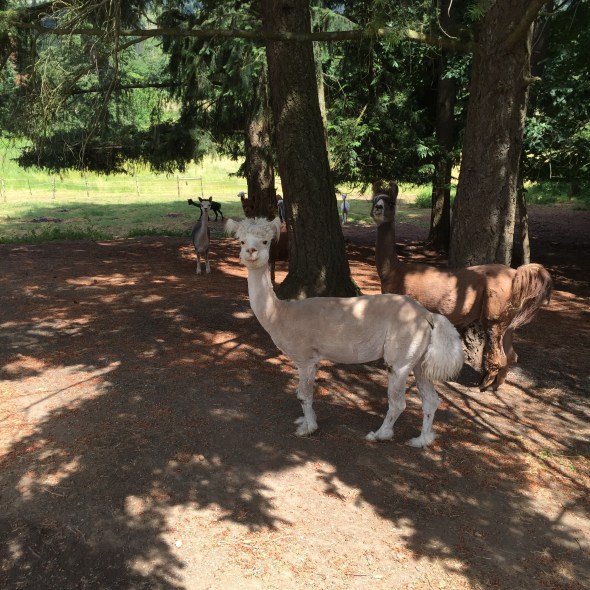
Woke up and felt putting some pleasantness on the Internet could be a service. Pic I took of Caleb and Hana’s alpacas.

Here is a Scottish fold from when I was researching how many famous Internet cats (Maru, Shrampton, Waffles, Taylor Swift’s cats) all have the same common ancestor in Scotland, 1961.
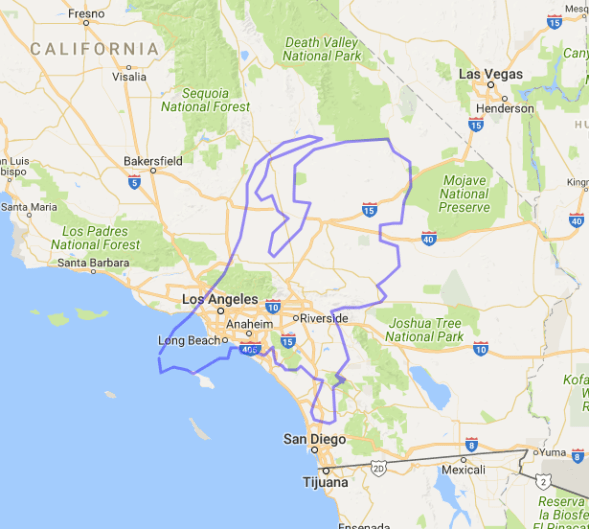
Here’s a comparison of the size of Netherlands to the size of LA, probably from OverlapMap or MapFrappe. I’m not sure if the Netherlands is bigger or smaller than I expected.

Impressed
Posted: July 24, 2018 Filed under: the California Condition Leave a comment
via Curbed. Impressed is such a great word. “It made an impression.”
Is E. M. Forster “wrong”? (or, maybe, are our meanings different than his?)
Posted: July 24, 2018 Filed under: writing 2 Comments
Let us define a plot. We have defined a story as a narrative of events arranged in their time-sequence. A plot is also a narrative of events, the emphasis falling on causality. “The king died and then the queen died” is a story. “The king died, and then the queen died of grief” is a plot.
So says Forster in Aspects of The Novel.
But this is the exact opposite way I feel most professional TV writers talk about this. Shorthanded, “plot” means the events and “story” is the emotional journeys of the characters.
Over here commenter Kenny Chaffin, a writer himself, puts it succinctly:
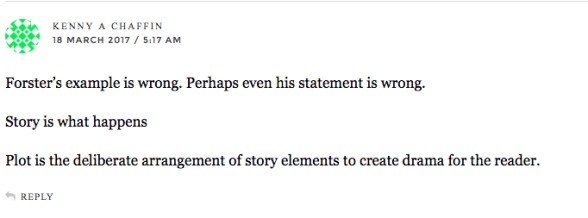
I’m not sure I’d say Forster was wrong, but these words seem to have an inverted meaning in 2018 Hollywood. When you have plot and no story, the audience will be bored.
In The New York Times, there is a casual distance between story and truth
Posted: July 23, 2018 Filed under: the California Condition Leave a comment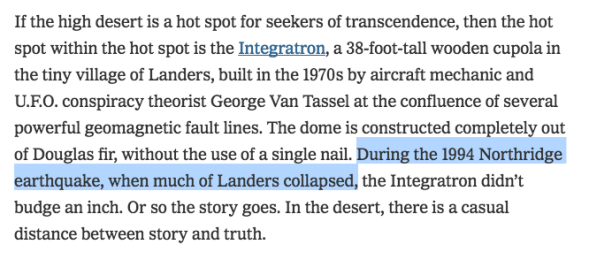
writer of this article says a number of wrong things, including confusing the 1994 Northridge earthquake for the 1992 Landers earthquake. Easy to get a fact wrong, I do it every day, but it’s pretty funny to pair it with a cliché about how people in the desert are always making up stuff.
Weak, weak, weak
Posted: July 23, 2018 Filed under: America Since 1945, politics 2 Comments
The Trump era will end when a Democrat can get in Trump’s face and confidently say this. American politics is not structured for this kinda face to face thing so maybe it won’t be until 2020.
Jump to 3:42 in this director’s cut to see the almost sexual excitement that explodes when Blair drops the word “weak”:
Sherrod Brown is the Dem who physically resembles Blair here the most, imo.
Once a confident Democrat is calling Trump weak to his face, the fight will enter the pattern laid out by Randall Collins:
How does violence sometimes succeed in doing damage? The key is asymmetrical confrontation tension. One side will win if they can get their victim in the zone of high arousal and high incompetence, while keeping their own arousal down to a zone of greater bodily control.
Trump will enter a state of high arousal and high incompetence. Collins continues:
Violence is not so much physical as emotional struggle; whoever achieves emotional domination, can then impose physical domination. That is why most real fights look very nasty; one sides beats up on an opponent at the time they are incapable of resisting.
Unfortch a US president in a state of high arousal and high incompetence has a non-zero chance of ending human life on Earth, so that also must be weighed.
Ayahuasca
Posted: July 23, 2018 Filed under: drugs, Wonder Trail Leave a comment
It was only when I came home from Peru, and started researching Amazonian shamanism, that I realised how different indigenous Amazonians’ conception of ayahuasca-healing can be. Westerners tend to think that emotional problems are caused by issues in our past, which ayahuasca can help us accept and integrate. Indigenous Amazonians (to generalise) are more likely to think emotional problems are caused by sorcery. You are out of sorts because you have been cursed by a secret enemy, or because you’ve offended a spirit. Ayahuasca will help you identify your hidden enemy, remove their curse, and get revenge.
cool article at Aeon by Jules Evans about whether our cultural assumptions are shaping our psychedelic experiences and leading us to misunderstand traditional uses.
More on this topic can be found in:

Interview: John Levenstein
Posted: July 22, 2018 Filed under: writing, writing advice from other people 2 Comments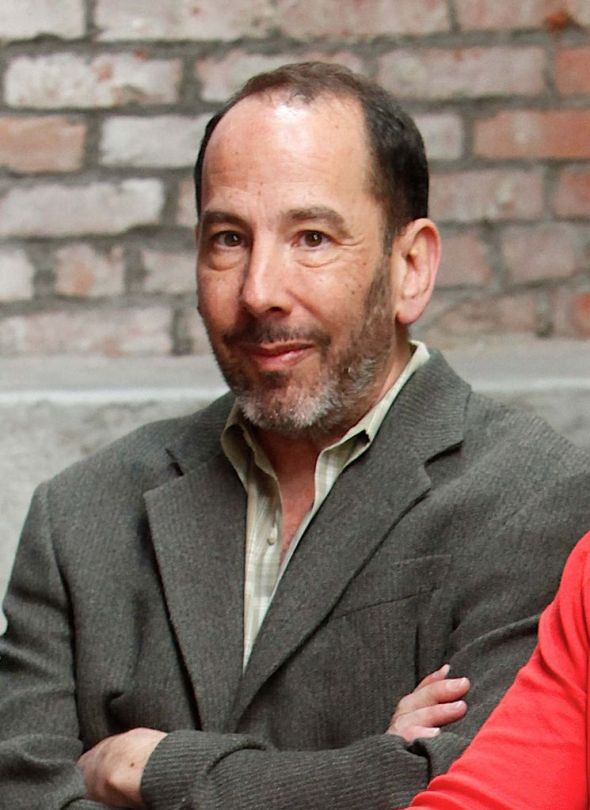
Classical KUSC / soundless WW2 footage
Posted: July 21, 2018 Filed under: film, music, WW2 Leave a commentfound that playing Smithsonian Channel’s The Pacific War In Color while KUSC our local classical station was coming out of my old radio created a cool effect.
not sure why
Posted: July 20, 2018 Filed under: advertising Leave a comment
but I found this ad for Media Group on the Forbes website depressing. (Also “Media Group”?)
something about the affect of the girl in the shopping cart.
where are her friends? for whom is she performing? does she need help? I can see she’s pretending to be happy but also doesn’t truly seem to be having fun.
I guess it got my attention.
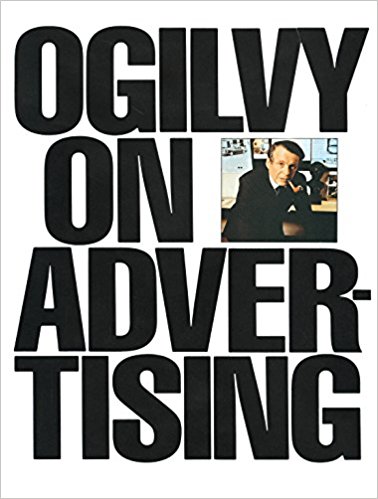
I’d love to discuss it with Ogilvy.
When tyrants tremble sick with fear and hear their death knells ringing
Posted: July 20, 2018 Filed under: America Since 1945, politics Leave a comment
we used to listen to this record when I was a kid.
when friends by shame are undefiled
also a good line.
The first was the 2011 NATO intervention in Libya, which led, ultimately, to the ousting and gruesome lynching of the Libyan dictator, Muammar Qaddafi. Afterward, many people who interacted with Putin noticed how deeply Qaddafi’s death troubled him. He is said to have watched the video of the killing over and over. “The way Qaddafi died made a profound impact on him,” says Jake Sullivan, a former senior State Department official who met repeatedly with senior Russian officials around that time. Another former senior Obama-administration official describes Putin as “obsessed” with Qaddafi’s death
reported Julia Ioffe for the Atlantic in February 2018.
When people had one name
Posted: July 19, 2018 Filed under: history Leave a comment
Thinkin’ about the New Testament bros: Mark, John, James, etc when I came across this from Bob Dylan.
Those songs are just in my genes, and I couldn’t stop them comin’ out. In a reincarnative kind of way, maybe. The songs have got some kind of a pedigree to them. But that pedigree stuff, that only works so far. You can go back to the ten-hundreds, and people only had one name. Nobody’s gonna tell you they’re going to go back further than when people had one name.
(Bob Dylan interview with Jonathan Lethem in Rolling Stone.)
The question, silently: do you really know where you are at this point in time and space and in reality and in existence?
Posted: July 19, 2018 Filed under: America Since 1945, moon Leave a comment(not great image quality there but the audio! from one of my favs:

(avail on FilmStruck streaming, possibly Netflix as well)
Montenegro in the news
Posted: July 18, 2018 Filed under: politics, writing Leave a comment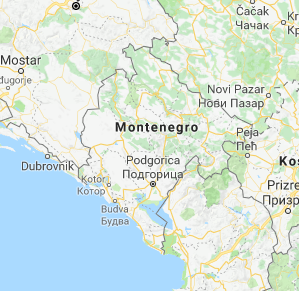
Montenegro in the news:

made me think of:

Gatsby is finally telling his backstory to Nick:
“Then came the war, old sport. It was a great relief and I tried very hard to die but I seemed to bear an enchanted life. I accepted a commission as first lieutenant when it began. In the Argonne Forest I took two machine-gun detachments so far forward that there was a half mile gap on either side of us where the infantry couldn’t advance. We stayed there two days and two nights, a hundred and thirty men with sixteen Lewis guns, and when the infantry came up at last they found the insignia of three German divisions among the piles of dead. I was promoted to be a major and every Allied government gave me a decoration–even Montenegro, little Montenegro down on the Adriatic Sea!”
Little Montenegro! He lifted up the words and nodded at them–with his smile. The smile comprehended Montenegro’s troubled history and sympathized with the brave struggles of the Montenegrin people. It appreciated fully the chain of national circumstances which had elicited this tribute from Montenegro’s warm little heart. My incredulity was submerged in fascination now; it was like skimming hastily through a dozen magazines. He reached in his pocket and a piece of metal, slung on a ribbon, fell into my palm. “That’s the one from Montenegro.” To my astonishment, the thing had an authentic look.
“Orderi di Danilo,” ran the circular legend, “Montenegro, Nicolas Rex.”
“Turn it.”
“Major Jay Gatsby,” I read, “For Valour Extraordinary.”
#teammontenegro
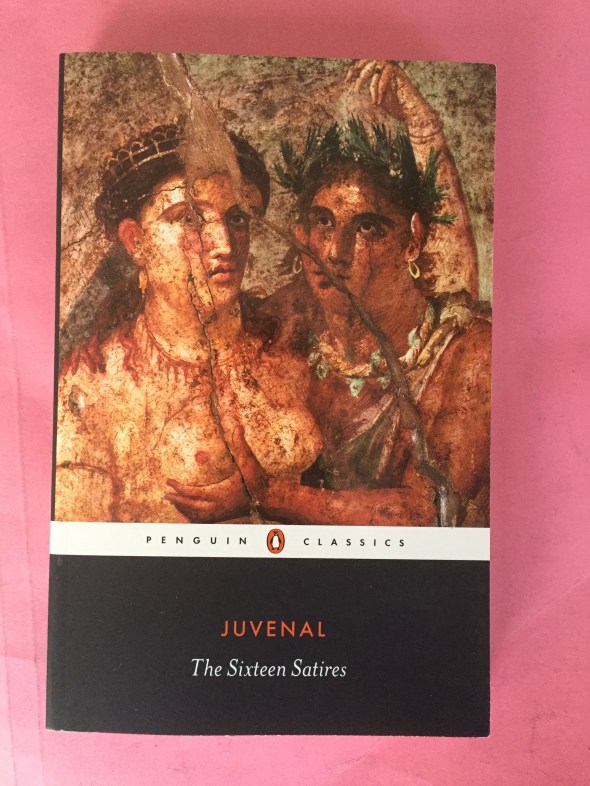
Becoming over time becomes being
Posted: July 16, 2018 Filed under: business, California, war Leave a comment
“The goal is to become HBO faster than HBO can become us,” Netflix’s chief content officer, Ted Sarandos, once famously said.
(source is this Vanity Fair article). The ancient sages and strategists would’ve enjoyed that one. The intersection of becoming and fighting.
The supreme art of war is to subdue the enemy without fighting
Sun Tzu said. Maybe. Can’t vouch for the translation. Elsewhere rendered as:
To subdue the enemy without fighting is the acme of skill.
or:
to defeat the enemy without battle is the whole of my art
Summits with Russia
Posted: July 16, 2018 Filed under: America Since 1945, presidents Leave a comment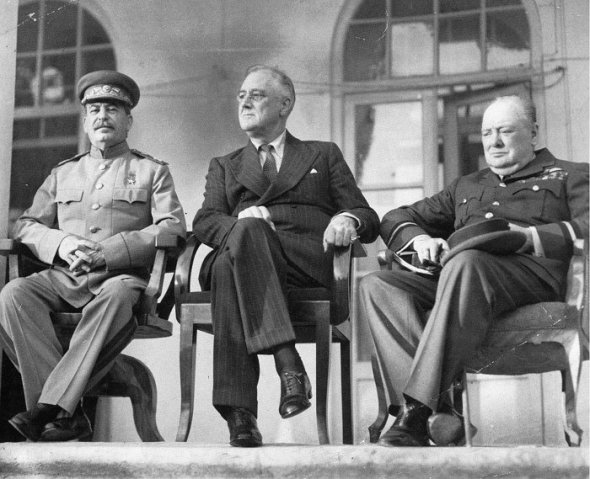
Tehran, 1943. FDR and Stalin joke (?) around with Churchill about the idea of executing German officers:
When they had disposed of Germany, Stalin threw off care; he was, the Ambassador said, in superb form, pulling the P.M.’s [Winston Churchill’s] leg all the evening. I asked the Ambassador:
“Was Stalin’s ragging a cat-like instinct to play with a mouse, or was he just in great spirits now that he had gained his end?”
He did not answer. The P. M. had not, he said, tumbled to Stalin’s game. The Ambassador was full of Stalin’s talk.
Stalin: “Fifty thousand Germans must be killed. Their General Staff must go.”
P.M. (rising and pacing the room): “I will not be a party to any butchery in cold blood. What happens in hot blood is another matter.”
Stalin: “Fifty thousand must be shot.”
The P.M. got very red in the face.
P.M.: “I would rather be taken out now and shot then disgrace my country.”
The President, said the Ambassador, then joined in the fun.
Roosevelt: “I have a compromise to propose. Not fifty thousand, but only forty-nine thousand should be shot.”
The Prime Minister got up and left the room. Stalin followed him, telling him he was only joking. They came back together. Stalin had a broad grin on his face.
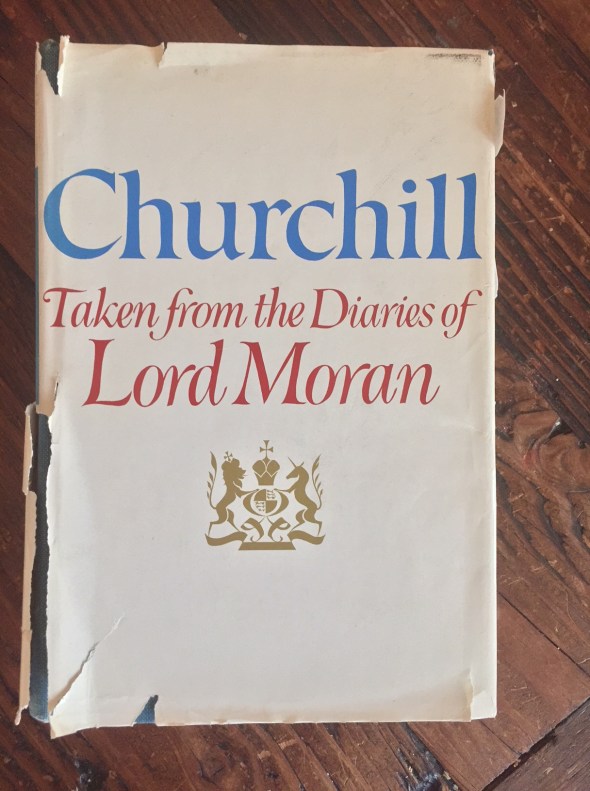
The Ambassador is Sir Archibald Clark Kerr, quoted in:
San Cristóbal
Posted: July 14, 2018 Filed under: America Since 1945, Mexico Leave a comment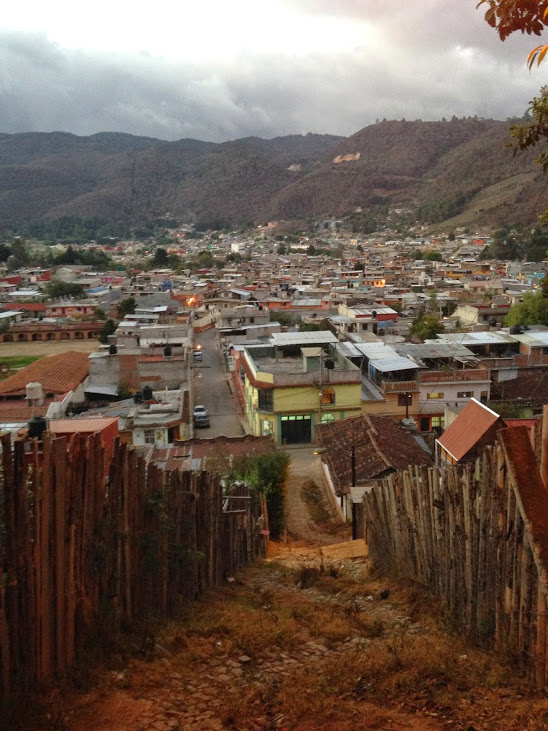
took this one myself.
Visited the town of San Cristóbal while writing this book:
Now I read in the New York Times piece by Oscar Lopez and Andrew Jacobs that the residents don’t have enough water, and so instead are drinking Coke.
Why don’t they have enough water?
Because of the Coke factory.
Buffeted by the dual crises of the diabetes epidemic and the chronic water shortage, residents of San Cristóbal have identified what they believe is the singular culprit: the hulking Coca-Cola factory on the edge of town.
The plant has permits to extract more than 300,000 gallons of water a day as part of a decades-old deal with the federal government that critics say is overly favorable to the plant’s owners.
Bill Clinton in his post presidency used to speak of working with Coca-Cola, which has one of the world’s most effective distribution networks, to bring health care and medicine to remote places in Africa. Thought that was kind of a cool idea, neoliberalism at its best, you know? There was a positive story to tell there, but you gotta wonder who is really steering in the relationship of Coke and politicians.
If you want to read about San Cristóbal and San Juan Chamula and the nearby towns of Chiapas, get my book. A special place, grateful I got to go there.

Woody Guthrie’s birthday
Posted: July 14, 2018 Filed under: America, music Leave a comment

“Woody Guthrie’s childhood home as is appeared in 1979,” from Wikipedia:

source. Walter Smellings, Historic American Buildings Survey.
Man, you go to read Woody Guthrie’s wikipedia page, and next thing you know you’re looking at a photo of a 1911 lynching (warning: upsetting but are we obliged as citizens to look?)
Even the story of the photo of the lynching is haunting:
James Allen, an Atlanta antiques collector, spent years looking for postcards of lynchings for his Without Sanctuary: Lynching Photography in America (2000). “Hundreds of flea markets later,” he wrote, “a trader pulled me aside and in conspiratorial tones offered to sell me a real photo postcard. It was Laura Nelson hanging from a bridge, caught so pitiful and tattered and beyond retrieving—like a paper kite sagged on a utility wire.”
The book accompanied an exhibition of 60 lynching postcards from 1880 to 1960, Witness: Photographs of Lynchings from the Collection of James Allen, which opened at the Roth Horowitz Gallery in New York in January 2000. Allen argued that lynching photographers were more than passive spectators. They positioned and lit the corpses as if they were game birds, he wrote, and the postcards became an important part of the act, emphasizing its political nature.
Allen’s publication of the images encountered a mixed reception. Julia Hotton, a black museum curator in New York, said that, with older blacks especially: “If they hear a white man with a Southern accent is collecting these photos, they get a little skittish.”
All kinds of wild questions considered in this 2000 LA Times / J. R. Moehringer profile of Allen:
The man’s story enhances the beauty of the shack, Allen believes, and its value. The man’s story makes the shack more than a work of folk art; it’s a sort of monument. When Allen sells the shack, along with some furniture and art done by the old man, the asking price will be just under $100,000.
How about Bryan Stevenson’s project?
How did I get here again?
Oh right.
Learning about Woody Guthrie.

 Helytimes

