Acheson on Truman (and Lincoln)
Posted: September 9, 2023 Filed under: America Since 1945 Leave a commentWILSON: Well, I think the question that you’ve answered in great part in your book, that I would like to put a little differently. You indicated that you were working for a remarkable man, Harry Truman.
ACHESON: Oh, yes.
WILSON: And I wonder how much again the contrast between the previous man’s administrative efforts had to do with your obvious admiration and ability to work with Truman?
ACHESON: You mean FDR?
WILSON: Yes. It was so much better.
ACHESON: Truman was straight, above board, straight in line.
Two days ago, Monday, former President Sachar of Brandeis University was here and talked about President Truman. He started off by saying, “Let me read you two or three paragraphs here about Mr. Truman, criticize that.”
And I said, “All right.”
And he began about how with totally inadequate preparation, education, and everything else, Mr. Truman was turning out to be one of the best Presidents, and went on and said, “What do you think of this?”
I said, “I think it’s the goddamndest collection of cliches I ever heard in my life, and none of it is true.”
Well, he said, “You agree that he didn’t have any education.”
I said, “I don’t agree to that at all; he had a remarkable education.” My younger daughter had TB at 19, after she had been in college one month, and just been married and her husband went off to the war, and she spent five years in Saranac and lost her lung; and in the course of that time she spent in bed she read and read and read and talked to all kinds of people. And she’s far better educated than I am. I went to the best school, the best college, the best law school. That isn’t the way you get educated. The point is what enters into your innards.
Suppose somebody sits under John Kenneth Galbraith for three years to get an education; a hell of a waste of time. Mr. Truman read every book in the Independence library, which had about 3,500 to 5,000 volumes including three encyclopedias, and he read them all the way through. He took in a hell of a lot more out of that effort, which he took out of farming when he did it, than he would listening to all of this crap that goes on at Yale and Harvard, and perhaps in other places–Harvard Law School education.
I sit here and talk about his preparation. I would think he did more preparation by being on the County Court or whatever it was called in Jackson County, than he would have being a Justice of the Supreme Court, a hell of a lot more. See how people work, how the thing runs, what makes it tick, what are the important things, what are the unimportant things. And it’s sort of significant comparing to other Presidents. Well, I think I said Washington should have been President. Tom Jefferson I would give a very low rating, too; he was a man of words, and was a poor Governor, a poor Ambassador to France. The only thing as President that he really did that was really worth a damn was the Louisiana Purchase. And that was contrary to everything that he was . . .
MCKINZIE: That he believed in, yes.
ACHESON: Well, he said, “What do you think about Lincoln?”
I said, “The best thing that can be said about Lincoln are the Trumanesque qualities that he had.
“He said, “That’s the damndest thing I ever heard, you usually think it’s the other way, the thing that is good about Truman is the Lincolnesque.”
I said, “That isn’t what he had at all; he didn’t have Lincolnesque qualities. Lincoln had Trumanesque qualities. He did things that were contrary to the baloney that he talked; he didn’t believe his own book. A house divided against itself doesn’t fall if you stand up and fight, the house stands up, and he proved it. All these things–it isn’t true that a drop of blood drawn by the lash has got to be paid for by one drawn by the sword, or that the judgments of the Lord are true and righteous–poetic talk, that’s fool talk. Dr. Johnson said to Boswell, “You can talk foolishly, but don’t think foolishly.”
from Dean Acheson’s oral history at the Truman Library. I was looking for the source of Truman’s “cry-baby” remark re: Oppenheimer, as dramatized in the popular film. There were only three people at that meeting, so how do we know what happened? How does that story come down to us?

from American Prometheus.

The authors cite as their source a memo in the Truman Library:

If any of my readers pass through Independence, Missouri, grab me a photo of that memo in box 201, will ya?
Buffett on Buffett
Posted: September 6, 2023 Filed under: America Since 1945 Leave a commentWarren Buffett said in a written remembrance Tuesday:
Jimmy loved the audience just as much as they loved him. He never lost a fan. Music changed, performing styles changed, but if you liked Jimmy in 1983, you wanted to see him again in 2023. And you wanted to bring your kids.
I never heard him make an unkind remark – either publicly or privately – in the more than 35 years I knew him. He made everybody feel good, particularly me. We weren’t related but in his first call to me, he began with “Cousin Warren?” and I replied “Cousin Jimmy” and that’s the way it stayed.
from WSJ. You know we had to make the cheeseburger in paradise per lyrical recipe (only thing we didn’t have was draft beer but we managed):

We admire Jimmy as a writer and storyteller.
what causes US political polarization?
Posted: September 3, 2023 Filed under: America Since 1945 Leave a commentThe jet airplane?
Smith: It’s interesting to hear Alan Greenspan talk about some of the factors that led to the change. He said one of them, he thinks, is the jet plane. Because now members from the West Coast, instead of bringing their families to live in D.C. – that’s something that you hear over and over again – that, in fact, families were brought to the District.
Rumsfeld: And much less so now. You try to have a gathering for an evening celebration for some purpose and to include members of the House or Senate on a Thursday or Friday or Saturday or Sunday, you don’t get anybody. They’re not here, the overwhelming majority. Unless they live in Virginia or Maryland, they’re not here. That’s one thing. The jet aircraft.
Another thing, I think, is the gerrymandering that has been developed to a fine art in our country. Today there are relatively few Congressional districts that are considered contestable. The threats that members feel tend to be in the Democratic Party from the left, and in the Republican Party the threat comes from the right. That tends to polarize the situation, and you don’t have this pressure, or natural political process that led people to work things out in the middle and to try to fashion compromises that would make sense for the country. So you end up electing people who tend to be most representative of their political party as opposed to their district. That’s, I think, maybe as or even possibly more important than the jet aircraft.
from Donald Rumsfeld’s oral history at the Gerald Ford Library.
Robert Gates offers different answers in his George W. Bush oral history:
Engel
As a person outside of politics through that interim largely, what did you ascribe that to?
Gates
It depends on whether you talk to Republicans or Democrats. [laughter] But it mostly happened in the House. Some people will say that it began with Newt Gingrich going after Jim Wright and the viciousness with which that took place. Others will say that it was the impeachment of Clinton. Others will say the cumulative effect of the Democrats controlling the House for 40-some years and the arrogance with which they did that and then the Republicans’ determination to take revenge when they finally got a majority.
But the thing that really began in the early ’90s was the steady erosion of the numbers—my best examples are in the Senate—of the people—center-left, center-right—that I regarded as bridge builders. David Boren called me in early ’94. He had been invited to become president of Oklahoma [University] and he was wrestling with it. He asked me to come down to his Senate office to talk about it. We talked for an hour. At the end I said, “David, there is an easy solution to your dilemma here. When you’re in your car or on an airplane and daydreaming, are you daydreaming about what you can accomplish at OU [Oklahoma University] or what you can accomplish in the Senate?” He just burst out laughing. He said, “That makes it easy.”
So you lost in fairly short order Bill Cohen, Sam Nunn, David Boren, Bill Bradley, and then over time Jack Danforth, Bob Dole, Nancy Kassebaum, a number of moderate Democrats, of additional Democrats. More and more from both parties, even in the Senate, which is less polarized than the House, all those guys from the center were disappearing. Olympia Snowe is the most recent. It’s not because any of them were in danger of not being reelected. They were just fed up; they were tired and frustrated because there was nothing happening.
Or maybe it all began with C-Span. Ari Fleischer in his W. Bush oral history, he’s talking about his time as a Congressional staffer:
Perry
Could I ask about reaching the public? You said you were learning so much about how it could be done in a noneffective way with the Republicans in the minority in the House. Can you talk about the role of C-SPAN during this time? I’m thinking particularly of Newt Gingrich’s use of that to foment the revolution of ’94.
Fleischer
What a great point. People forget, now with Facebook and Twitter, how revolutionary C-SPAN was and how, in the Senate particularly, it was controversial. “What? A camera in the Senate?”
A group of people in the House minority all of a sudden got this idea that if you delivered a one-minute speech, you could create an audience and you could market that speech. You could do things with the speech that the New York Times would never cover, that your normal mainstream media would never cover, so it became one of the first, if not the first, ways around the mainstream press corps to reach a targeted constituency. I think Republicans in the House came to it out of desperation and a lack of anywhere else to go, so it was good timing for them. If you remember, [Thomas P., Jr.] O’Neill ordered the cameras to pan the empty House chamber, showing that these are just speeches, there is nobody here, this is theater, which probably propelled it even more, because then people started paying attention. “Hey, it is theater; I want to see what the theater is about.”
It’s fascinating. In retrospect, if there is one thing I could change–and this genie is so far out of the bottle I don’t think you could, and I think Mike McCurry would agree with this too–I would no longer televise the White House press briefings. I would take C-SPAN off the air. There is a piece of me that is just–“haunted” goes too far, but if you think about the institutions in Washington that are held in the highest regard, with the most respect by the American people, it’s the Supreme Court, where their deliberations are entirely in secret, with no transparency, and up until 2008 at least, the Federal Reserve. Their deliberations are entirely secret. There is something about the massive exposure that also can coarsen democracy and that’s at work in the House, the Senate, and the White House. The genie is out of the bottle, but it did start with C-SPAN.
fragments from the Bill Clinton oral history at the Miller Center
Posted: August 20, 2023 Filed under: America Since 1945 Leave a comment
The University of Virginia’s Miller Center collects oral histories on recent presidents. Sometimes I go poking around in them and rarely do I come away unrewarded:
Dale Bumpers, US senator from Arkansas, remembers a first encounter:
All politicians consider anybody that has—I don’t know what the precise word is, but any politician who sees another politician with a lot of talent, speaking ability, intelligence, social mores, customs and so on can’t help but worry about the future. On the way home, I said to one of my aides, “I hope I don’t ever have to run against that guy.” We were discussing Clinton’s speech at the Democratic rally in Russellville, Arkansas, on the campus of Arkansas Tech. I had never laid eyes on him, but I had heard quite a bit about him, about how brilliant and charismatic he was. He was handsome. He had a good speaking voice. He had everything that a politician needs.
…
So he stood at the podium without a sign of a note or a prop and talked to the audience. He talked into the microphone but he looked that audience over all the time he was talking. He did everything precisely the way you’re taught to do it if you ever go to a speaking school. It was beautiful. Every sentence followed the other one perfectly. I could not believe that he could deliver a flawless speech like that without a note of any kind. But after it was over some of his staff who were with him were standing at the door handing out copied of the speech. He had written the speech, memorized it, and delivered it from memory. It was roughly, I’d say, three to five minutes, which at most political events is quite long enough.
Charlene Barshefsky, US Trade Representative:
The first time I met Bill Clinton was in the Oval Office to brief him on the Framework talks. The second time was in Tokyo in July of 1993. My kids know the date because I was pulled away from our Fourth of July holiday to go back to Tokyo to finish the talks. I was in Tokyo. We had been negotiating all day. There were a couple of things I wanted that we didn’t yet have and it was 1:30 in the morning, maybe 2:00 in the morning.
Mickey, Warren Christopher, and I went up to the President’s suite at the hotel where we were all staying—the Okura. He was at the dining room table of his suite and he was dressed in khakis and a plaid shirt, looking reasonably rumpled. He was reading a newspaper when we walked in. He barely looked up. To the left was a book, open, facedown—Marcus Aurelius Meditations. To the right, the New York Times crossword puzzle with a pen.
We walked in. He lowered the newspaper—he was wearing his reading glasses—looked up, and said to me,
I’ve been waiting to see you,which took me somewhat aback. I said,Well, here I am.We sat around the table, and he looked at Warren Christopher and said,Chris?and Chris said,The negotiations over the Framework are at a very delicate phase and I thought Charlene should brief you and tell you what she needs.The President nodded and looked at me. The newspaper came up again covering his face. I remained silent and Chris motioned, [whispering]
Go ahead.I thought, Well, all right.Mr. President, this is a complicated topic. We’re at a delicate point. There are a couple of trades I could make. I don’t want to have to make any of them, and so I want to lay out a plan of action.As I’m talking, the hand comes out from behind the newspaper, picks up the book, turns it over and he starts to read the book. About a minute goes by. The book gets put back down. The paper goes back up, he turns the page. A hand comes out to the right, and he fills in a word on the crossword puzzle. This is all true—I am not exaggerating. This is going on, and I’m thinking, I don’t care how smart this guy is, this is a completely disastrous briefing session. I finished what I needed to say, and the newspaper finally came down.
He looked at me, and he said,
I think we have an inconsistency between your briefing two weeks ago and where you are now. Let me see if I can spell it out.And he went through the briefing I had done several weeks earlier in the Oval perfectly. He also went through what I had just said and concluded that there might be an inconsistency in our approach. I explained why there wasn’t. He poked and prodded some with respect to a couple of other points I had made. He had caught the nuance in what I was saying, not only the words in the order in which I had said them. At the end, we agreed on the game plan and we were off and running. We concluded the Framework agreement the next day.I walked out of the room and Warren Christopher and Mickey both burst out laughing and said,
Your expression went from astonishment, to disdain and despair in the beginning of the briefing, to amazement that he could multitask to this degree and miss nothing.
Dee Dee Meyers, press secretary:
Riley
The death penalty situation wasn’t a hang-up?
Myers
No. It was not my favorite thing, but by then I think I was probably convinced that a Democrat couldn’t be anti-death penalty and win a national election.
Freedman
Did that ever come up? Did you ever have a substantive conversation with him about capital punishment?
Myers
Yes, later, but just over time. Flying around, we talked about everything. I told him that that was one place where I disagreed with him. These are just snippets of memory, but I don’t remember him making a big philosophical thing about it. It’s just, “Well, that’s the way it has to be.” I think it was a very practical decision as a politician from Arkansas.
He’s a remarkable human being. He is routinely described by people as the smartest person they’ve ever met. I feel that that’s true. Also he has these shifting abilities. I mentioned earlier that he can talk to a car mechanic one second, a short-order chef the next, and then Stephen Hawking the minute after that. I wanted someone with those skills. I was not aware that he was a prodigy when I was simply someone reading the papers. I was a well-educated person living in Boston but I was not aware that a prodigy occupied the White House.
When I got there I began to become aware of it. I wanted the rest of America to become aware of what I was becoming aware of. I thought we should really maximize these speech opportunities. I’m not sure we ever did. That speech in Memphis that he gave off the top of his head may have been his best speech as a President of the United States. It’s an argument without end. He gave a lot of speeches. Not as many as I would have liked soared, you know, just jumped out at you off the page the way that Memphis one did. But if I talk about every speech in this much detail we’ll be here for 20 hours.
Back to Myers:
Nelson
Would he tease you guys?
Myers
Not about stuff like that. He loved to make people blush about whatever it was. So he would try to find your blush button and then he loved to, gently—
Freedman
For example.
Nelson
Give us some good buttons.
Myers
This woman, Wendy Smith, who was the trip director. He would tease Wendy. “I saw that Secret Service agent looking at you.” Stuff like that, which of course was always true. Wendy was doing everything in her power to get that agent to look at her, but the fact that he would catch her at it—She would blush. Then of course he would always watch, and she would always know that he was watching. Then as soon as he would even look at her she’d blush, because he would see her. He loved that kind of stuff.
Nelson
Did he flirt?
Myers
Yes, definitely.
Nelson
Say more, because that ended up being an important part of his Presidency, the flirtation—
Myers
He flirts with men and with women. I don’t necessarily mean that as a sexual thing.
Nelson
That’s what I meant.
Myers
He’s good, flirting is really about establishing a little bit of intimacy, which he was good at doing.
Nelson
What about the hundred million people at the same time?
Myers
A rope line of a hundred people—He could do that with each person individually and every one of them thought that he or she was the one person the President was going to remember at the end of the day.
Riley
The men and the women?
Myers
The men and the women, yes.
These are compelling reading, cheers to the Miller Center.
James Carville
Posted: August 13, 2023 Filed under: America Since 1945 1 CommentI had never met anyone quite like James. His story is so interesting. He talks openly about how he was a complete failure until he was 40. One time he missed a flight; he was supposed to go down to Texas, I think, to work for [Lloyd] Doggett. He missed his flight and didn’t have enough money to take a cab to the airport to get another flight, and he sat down on the curb with his garment bag and cried. That’s one of the first stories that Carville told me about himself. This is not what I was used to in the braggadocio, swaggering world of political consultants. I didn’t quite know what to make of him.
Dee Dee Meyers in her Miller Center Bill Clinton oral history.
music you and I don’t know
Posted: August 6, 2023 Filed under: America Since 1945 Leave a comment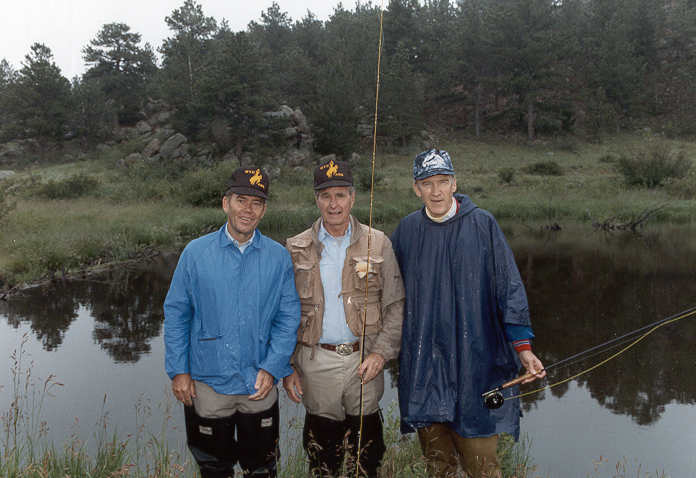
Senator Alan Simpson remembers talking to James Baker III during the 1992 Bush-Clinton election
I did tell him that I thought it was very important that he stay away from the Cigarette boat (a racing water craft) during the campaign, and the golf course, and Jim Baker told him,
At the Democratic convention, they’re playing music that you and I don’t even know—Fleetwood Mac or whatever it was. That was a Cadillac car to George and to me. We’re old farts.
source. And how about this:
Martin
Do you remember what your sense was about Clinton as an early contender? Was he on the map of folks against whom Bush expected to run, or was he predicted in any way?
Simpson
No. Everybody else had quit. There are still guys wringing their hands in the Democratic Party because they didn’t have the guts to step forward. I won’t name them, but there are at least four or five. They would opine,
I’m not going to run against Bush. My God, he’s the most popular guy we’ve ever had. Why throw myself on the fire?Clinton did. I don’t think they realized the intensity of how he would gather the troops. But you want to remember always that people don’t vote for; they vote against. I don’t think anyone won an election because people were for them; they voted against the other guy. That may sound insipid, but it is the way it is.
That whole Simpson oral history is fun to read, what a storyteller.
photo from Wikipedia: Senator Alan Simpson fishing in Wyoming with President George H. W. Bush (center) and Senator Craig Thomas (left)
Is the UK turning American?
Posted: July 29, 2023 Filed under: America Since 1945 1 CommentEven middle-of-the-road liberals in Britain live in a world of Daily Show clips and piled-up copies of the New Yorker. This wasn’t happening a generation ago. And the photo negative of it is a serene incuriousness about the mental life of their own continent. When did something European last penetrate the British cognoscenti? Prime-era Michel Houellebecq? Or the Scandinavian TV dramas? This is a Brexit of the mind.
And of the tongue. “Elton John is living his best life and I’m here for it!” How lost do you have to be as a British adult, how impressionable, to speak like this? Or to say “oftentimes”, “at this point”, “not OK”? There was a fine essay (as it happens, in the New Yorker) about the protean richness of multicultural London slang. How odd that some people in the same city prefer to converse, and tweet, in the register of an Amherst common room.
Janan Ganesh over at FT might be competing with Matt Levine as my most admired columnist. Both of them have the great quality of they’re always joking but you’re not sure how much. “An Amherst common room” so specific! really funny to complain London is sinking to the level of kids at a famously wonderful and hard to get into US college.
Perhaps a great power’s cultural influence, like an ageing gigolo’s charm, is the last thing to go. Long after Britain lost its might, there were people in Hong Kong and Zimbabwe moaning about their servants and describing things as “just not cricket” in a way no one in England had done since 1913. Plus anglais que les anglais, was the phrase for these tragicomic people and their affectations. How things come round. Don’t be more American than the Americans.
The Dead
Posted: July 23, 2023 Filed under: America Since 1945, music Leave a comment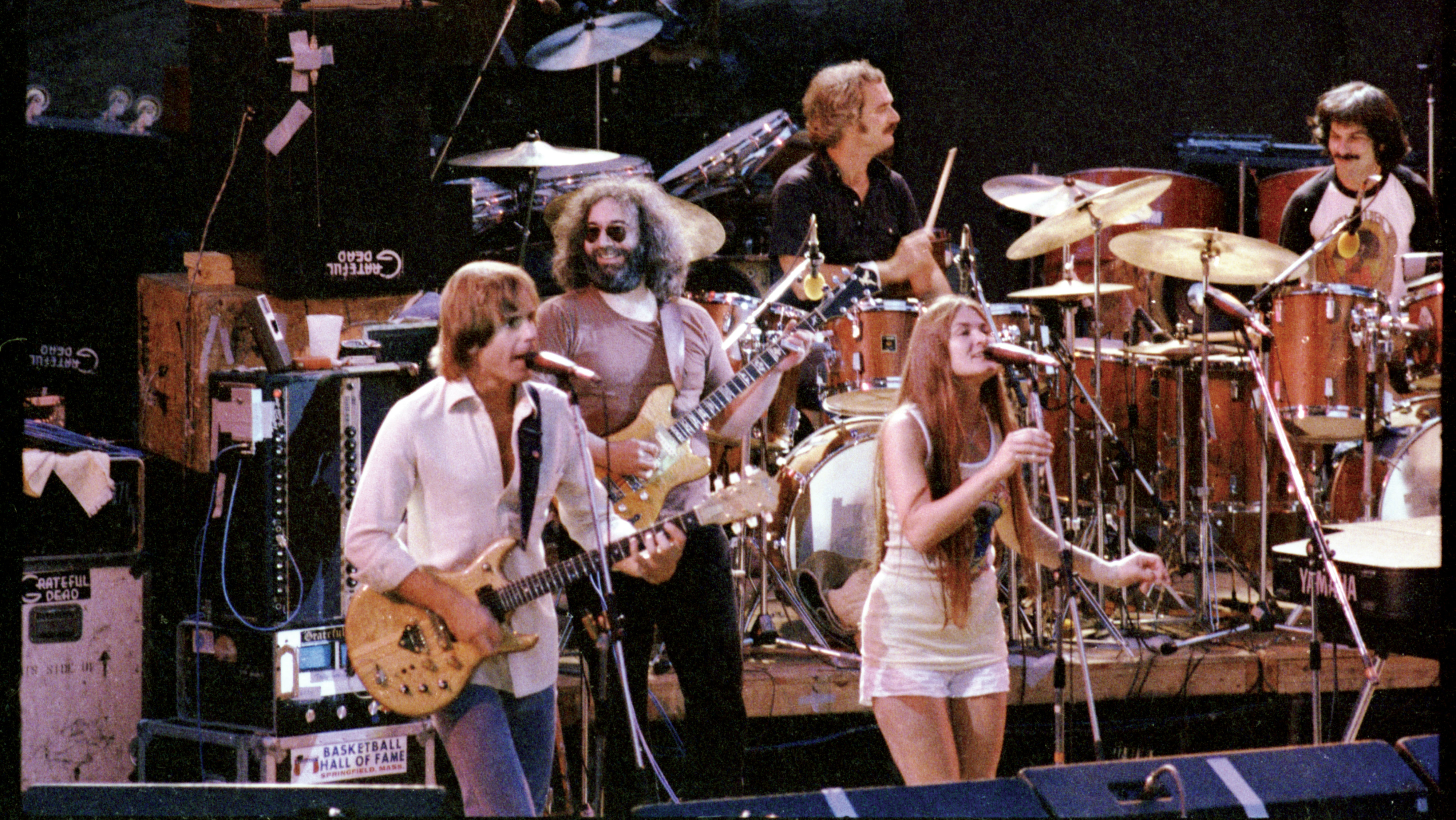
It’s traveling music. I’ve said there’s no Grateful Dead songs that take place at home. These are all people on the move, all the time. The spirit, the world – if you put all these people together and built a town, nobody lives there.
John Mayer, friend of the pod talking about The Grateful Dead on Rick Rubin’s Tetragrammaton podcast.
Was listening to the Dead on Sirius while driving around Colorado. Off the top of my head can think of two Dead songs (“Me and My Uncle,” “I Know You Rider”) that reference Colorado by name.
Source on that photo, borrowed:
Photo by Keith Stieduhar, courtesy of Rhino Records)The Grateful Dead at Red Rocks, 1978.
Hans Bethe
Posted: July 20, 2023 Filed under: America Since 1945 Leave a comment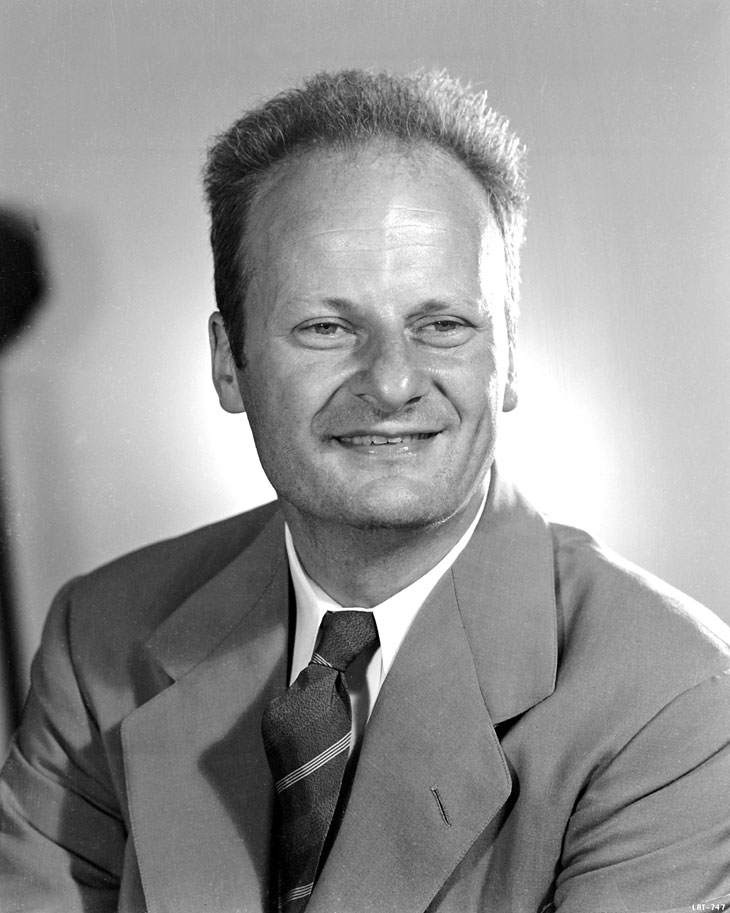
Enrapt listening to Richard Rhodes on Lunar Society podcast (part of the Oppenheimer mania that’s sweeping the land). Rhodes is trying to describe how Oppenheimer could be condescending.
I mean…
says Rhodes, (I paraphrase)
Oppenheimer was condescending to Hans Bethe. And Bethe won a Nobel Prize because he figured out how the sun works.

Credit Sarang on Wikipedia for that beauty.
Think of Bethe, born in Strasbourg. If Germany’s Jewish physicists hadn’t fled it feels likely the Nazis might’ve gotten the atomic bomb first.
JAB III
Posted: June 4, 2023 Filed under: America Since 1945, Texas Leave a comment
James Baker signed memos JAB III but he was really James Baker IV. All the previous Jameses Baker had been powerful lawyers and fixers in Houston, Texas. They had nicknames, more like titles. The Judge, etc. The first James Baker, our James Baker’s great-grandfather, knew Sam Houston. The Bakers played a role in the opening of Houston’s ship channel, enabling the city to outflank and overtake Galveston. (A side benefit of this book is the early pages provide a pretty good history of Houston).
JAB III might’ve ended as another in this line, quiet, forceful, but not a national figure, had he not met a remarkable transplant to Texas named George Herbert Walker Bush. The two of them shared weighty lineages, prep and Ivy League backgrounds. They formed a brotherly relationship, they were doubles tennis partners (club champions, these guys play to win). The rise of one was linked to the rise of the other.
Baker was that way because of who he was and where he came from, and it was his strange luck, and the country’s, that he happened to be ready to leave his hometown and legal career behind at just the moment when the entire Republican elite had been decimated by Richard Nixon’s Watergate disaster.
Secretary of State, Secretary of the Treasury, Under Secretary of Commerce, White House chief of staff for President Ronald Reagan, failed candidate for Attorney General of Texas, Marine officer, Princeton guy, elk killer.
Brokaw told him the key was understanding that Baker was a patient and expert turkey hunter. He would rise before dawn, dress in camouflage, venture out into the Texas heat and then sit there not so much as blinking. “And he waits and waits until he gets the turkey right where he wants it,” Brokaw told Netanyahu, “and then he blows its ass off.”
JAB III’s last major act in American politics* was presiding over the legal team that won the battle that gave George Herbert Walker Bush’s son, W Bush, the presidency. Whether on reflection the outcome of that victory is exactly the future JAB III would’ve wanted we can discuss later.
Cheney was thirty-five years old and, following Donald Rumsfeld’s promotion to defense secretary, had become the youngest man ever to serve as White House chief of staff. With the demeanor of a cool cowboy from Wyoming, the fierce intellect of a Yale dropout-turned-doctoral-candidate, and the discipline of a recovering drinker, Cheney had established himself as a force to be reckoned with in the White House
In 1980 JAB III was Bush’s guy, but Ronald Reagan picked him as his chief of staff. Why? JAB III outmaneuvered people who’d been around Reagan for years. How? That’s why I wanted to read this book. It was written by Peter Baker (no relation) and Susan Glasser, two NY Times reporters who are married. The book is snappy and good, recommend. As an act of service and review we prepared this summary for the busy executive.
Baker was, deep down, neither very versed on matters of policy nor intensely interested in them. As long as it was directionally sound, he was satisfied.” …
It was a classic Baker solution to the problem. As a negotiator, he always looked for ways to satisfy his counterparts’ concerns—or more precisely, ways to let his counterparts publicly demonstrate that their concerns had been addressed—without giving up the substance of what he was trying to secure.
The answers to my questions about how he rose in the Reagan administration were that he was extremely hard working, practical, canny. Reagan advisors Stuart Spencer and Michael Deaver recognized his talent and needed someone to stop a potential civil war among the Reagan team. They convinced Nancy Reagan JAB III was the guy. JAB III would be quick to say Ronald Reagan made his own decisions, but it wouldn’t’ve gotten to Ronald Reagan without Nancy Reagan.
One of JAB III’s main goals as Reagan’s chief of staff was to stop the yahoos around Reagan from getting the US involved in a war in Central America. He succeeded (mostly). Iran-Contra might’ve been avoided if JAB III hadn’t switched jobs, and gone to run the Treasury Department. Iran-Contra was sloppy and JAB III did not tolerate that. He was a scary but admired boss.
He was rich, but not as rich as people thought. When on vacation, he could usually be found shooting quail in South Texas or fishing the Silver Creek near his ranch in Wyoming. He kept a bottle of Chivas Regal in a desk drawer for an afternoon drink when needed. He swore profusely and told dirty jokes. “Did you get laid last night?” he would ask his young advance man, Ed Rogers, each morning when they were on the road together during the Reagan years. It was not a throwaway line. “He’d look me in the eye and want an answer,” Rogers recalled.
When JAB III was a kid his dad (JAB II? Also JAB III?) took him elk hunting, deep in the woods. JAB III came back with the biggest elk as his trophy. You wonder if that’s the turning point. What if the boy JAB had flinched, or said “I don’t want to kill a mammal”?
JAB III had a way of not being present at the moment of blowup. When the 1987 stock crash hit he was on his way to hunt elk with the king of Sweden. He was out of Enron just at the right time. And out of the White House for Iran-Contra, maybe he saw it coming.
And so in his desire to move on and move up, Baker left Reagan with a partner manifestly ill-suited for the job, arguably a disservice to the president he had worked so hard to make successful.
He was a flop as a retail politician, losing the one statewide race he ran in. His power was tremendous. Out of spite for the Houston Chronicle for not endorsing him, he eliminated an exception to a law stopping a nonprofit institution from owning a newspaper, thus ruining Houston Chronicle’s structure (and maybe the newspaper?) More or less singlehandedly he arranged with his worldwide financial counterparts to weaken the US dollar (good for US exporters and making it easier to pay down US debt).
Baker had little interest in Asia, Africa, or South America, nor did he want to become embroiled in the turmoil in South Africa as its system of racial apartheid unraveled in the face of international protests and sanctions. He especially wanted to stay away from the Middle East and the endless failed quest for peace between Israel and the Arabs.
Actually sometimes he is interested in South America:
Sometimes, they would conjure up the other part of their life together, getting back on the tennis court or dreaming up a hunting trip. When they flew in a helicopter over Barranquilla, Colombia, in February for a summit, Baker looked out the window at the landscape below and said to Bush, “This is a place where you and I could shoot some quail.”
In 2000 Baker led W’s legal team in the recount battle. Baker is played (well) by Tom Wilkinson in the film Recount. Ted Cruz was the guy who read the final Supreme Court decision in Bush v. Gore and translated: we win. Brett Kavanaugh was also there.
Baker doesn’t talk down W to these biographers but the ultimate results cannot have been to his satisfaction. Perhaps he tells himself the alternative, a Gore presidency, would’ve been worse. I don’t know. The W administration cannot be said to have ended in US triumph. Not enough JAB III or his ilk? Too much? A lesser grade? JAB III’s patron Cheney was there. JAB III was considered to replace Rumsfeld as Secretary of Defense. Didn’t happen: remember, he’s never there when it blows up.
As this book begins, Baker is considering Trump:

In the end, he voted for him.
A lesson here may be that forceful, smart people may have the illusion they can bend history but the consequences of both their ways and means are unpredictable.
Not sure how actionable a book like this is:
“This is not a man who sat back and read Machiavelli or read the great books about influence and power,” noted David Gergen. “It just came naturally to him.”
But it gives you the feeling of a little more understanding of the workings of the world.
You can also read, for free, online, JAB III’s oral histories with the Miller Center. Even the way he lays out the ground rules in the 2004 interview shows you what you’re dealing with. And the role of Dick Cheney in the rise of JAB comes through too.
Knott
There were some reports—not to get back to Edmund Morris—that the President was never quite the same after this assassination attempt. Did you see any change?
Baker
No. No. President Reagan had a very private but very deep spiritual faith. Remember he said, “I decided after that, that whatever time I had left, I was going to devote to the man upstairs.” Or “He spared me.” I saw that. I saw that reflective spirituality component of his personality, but that’s all. In terms of being less vibrant, less vigorous, less effective? No, I didn’t see it. Ask Fritz Mondale if you think he was adversely affected. [laughter] He wasn’t. That was a blowout election.
* if there’s a flaw in this book, it could’ve used more about Baker’s work in Western Sahara, which apparently ended in frustration when Morocco refused to budge. Maybe that was still ongoing at press time.
Free samples
Posted: May 22, 2023 Filed under: America Since 1945, business 1 CommentI was in See’s Candy the other day, as I am on many a weekend, and it dawned on me that two of the classic Buffett/Munger businesses, Costco and See’s Candy, are places that offer delicious free samples.
Go to a Costco and you’ll likely get a tasty snack or two, go to See’s and you’ll get whatever the day’s sample is (yesterday it was salted dark chocolate caramel).
Buffett and Munger are all about urging people to be rational, and managing their own emotions (“I can’t recall any time in the history of Berkshire that we made an emotional decision”) but a huge part of their success and what makes them interesting is their awareness that some businesses are sort of magical. They’ve got a grip on customers that’s beyond rational, that exists in the worlds of love and nostalgia and strong emotion. Buffett raving about the iphone, for instance:
If you’re an Apple user and somebody offers you $10,000, with the the only proviso [that] they’ll take away your iPhone and you’ll never be able to buy another, you’re not going to take it
If they tell you [that] if you buy another Ford motor car, they’ll give you $10,000 not to do that, [you’ll] take the $10,000 and buy a Chevy instead.
I mean, it’s a wonderful business. We can’t develop a business like that, and so we own a lot of it. And our ownership goes up over time.
Or See’s:
People had “taken a box on Valentine’s Day to some girl and she had kissed him … See’s Candies means getting kissed,” he told business-school students at the University of Florida in 1998. “If we can get that in the minds of people, we can raise prices.”
“If you give a box of See’s chocolates to your girlfriend on a first date and she kisses you … we own you,” the investor said in “Becoming Warren Buffett,” an HBO documentary.
(That U Florida interview is one of my favorite Buffett texts, you can see not just the sunny old grandpa but the rapacious capitalist).
There is an accounting term that attempts to quantify some of this, goodwill, but this quality is not measurable in any exact way. In Munger’s famous talk on The Psychology of Human Misjudgment, he talks about how he didn’t learn about any of this at Caltech or Harvard Law School. Being rational is wise, even a moral duty as Munger often says, but you’ll miss out on human decisionmaking if you don’t look for and acknowledge the power of essentially magical forces at work.
The gap between rationality and the way people actually behave due to romantic attachments, sentimentality, brand loyalty, etc is a source of humor, as well as an opportunity for price increases. Buffett and Munger seem to see both.
One example I can think of where free samples didn’t work: the teriyaki place at the mall. Did you have these? At the mall food court the kid at the teriyaki place would often have a plate of free samples. Yet the one time I tried a full plate it was kind of repulsive. I didn’t finish. Too sweet or something, or just not good at scale.
Coke has no taste memory. You can drink one of these at 9 o’clock, 11 o’clock, 3 o’clock in the afternoon, 5 o’clock. The one at 5 o’clock will taste just as good to you as the one you drank early in the morning. You can’t do that with cream soda, root beer, orange, grape, you name it. All of those things accumulate on you. Most foods and beverages accumulate on you — you get sick of them after a while. There is no taste memory to cola.
So says Buffett, perhaps related to “the teriyaki problem.”
Maybe the free sample method only works with a quality product. Sometimes the samples at Costco are bad. Remember when they used to give a sample at Trader Joe’s? Covid has killed that I guess. It worked on me.
Giving out free samples, in both See’s and Costco’s case, represents a strong investment on serving customers. Giving out free samples is a pain in the butt. A business that has the abundance to consistently deliver is probably confident and well-managed. Is this blog a form of free samples?
I’m all right on that one
Posted: May 11, 2023 Filed under: America Since 1945, business Leave a comment
And there used to be a politician in Nebraska, and if you asked him some really tough question like, you know, how do you stand on abortion, he would look you right in the eye and he’d say, “I’m all right on that one.” And then he’d move next.
very Warren Buffett joke from Warren Buffett.
You know, Tom Murphy, the first time I met him, said two things to me. He said, “You can always tell someone to go to hell tomorrow.” Well, that was great advice then. And think of what great advice it is when you can sit down at a computer and screw your life up forever by telling somebody to go to hell, or something else, in 30 seconds. And you can’t erase it. …
And then the other general piece of advice, I’ve never known anybody that was basically kind that died without friends. And I’ve known plenty of people with money that have died without friends, including their family. But I’ve never known anybody, and you know, I’ve seen a few people, including Tom Murphy Sr. and maybe Jr., who’s here, (LAUGH) but certainly his dad, I never saw him, I watched him for 50 years, I never saw him do an unkind act.
on fun:
And we had as much fun out of deals that didn’t work in a certain sense as the ones that did work. I mean, if you knew you were going to play golf and you were going to hit a hole in one on every hole, you just hit the ball, and it went in the hole that was 300 yards away, or 400 yards away, nobody would play golf.
I mean, part of the fun of the game is the fact that you hit them to the woods. And sometimes you get them out, and sometimes you don’t.
So, we are in the perfect sort of game. And we both enjoy it. And we have a lot of fun together. And we don’t have to do anything we don’t really believe in doing.
On See’s:
And it has limited magic in sort of the adjacent West. It’s gravitational, almost. And then you get to the East. And incidentally, in the East, people prefer dark chocolate to milk chocolate. In the West, people prefer milk chocolate to dark. In the East, you can sell miniatures, and dark — in the West —
I mean, there’s all kinds of crazy things in the world that consumers do.
Talking about Netjets:
CHARLIE MUNGER: I used to come to the Berkshire annual meetings on coach from Los Angeles. And it was full of rich stockholders. And they would clap when I came into the coach section. I really liked that. (LAUGHTER) (APPLAUSE)
(he doesn’t fly that way anymore)
from this CNBC transcript of the afternoon session of the annual meeting. I couldn’t find a transcript of the morning session.
Oppenheimer
Posted: May 8, 2023 Filed under: America Since 1945, writing Leave a commentI watched the new trailer for Christopher Nolan’s Oppenheimer movie. Can it top Cormac McCarthy in three pages in The Passenger?


Good luck!
wrongos
Posted: April 15, 2023 Filed under: America Since 1945 Leave a comment
surprised to find the word “wrongos” passed New Yorker copyedit. That from Margaret Talbot’s review of the new J. Edgar Hoover bio by Beverly Gage.
can’t lose
Posted: April 15, 2023 Filed under: America Since 1945, China 1 Comment
A senior administration official told me that Xi told President Biden at their summit in Bali in November, in essence: I will not be the president of China who loses Taiwan. If you force my hand, there will be war. You don’t understand how important this is to the Chinese people. You’re playing with fire.
This seems like the kind of thinking that got many US presidents into trouble? Truman losing China: did we ever have it? That from Thomas Friedman’s long thing in NYT, ht my dad.
“This is a dangerous situation. I strongly believe that Biden would like to stabilise the China relationship but both Republicans and Democrats in Congress have staked out a very strong line which complicates things for Biden. I have a concern that Congress is underestimating the relative power of China, the permanence of China, and China’s relationship with so many other countries.”
Hank Paulson having lunch with Financial Times. Very strange end to that piece:
Another small-town truism: the bill is as modest as the portions were large. Paulson and I walk around the corner to a private parking lot where he left his car. It is no longer there. “I’ve been towed,” he says, with a hint of panic. “I didn’t expect that.” What can I do to help, I ask. “No, no, you must catch your flight,” he insists. I feel a twinge of guilt glancing back at a stranded Paulson as I am being driven off in my Uber. He will have to bail himself out. I feel partly responsible for his unexpected misfortune.
That lunch at Ciao Baby! in Paulson’s hometown of Barrington, IL. Wikipedia learns us:
On November 27, 1934, a running gun battle between FBI agents and Public Enemy # 1Baby Face Nelson took place in Barrington, resulting in the deaths of Special AgentHerman “Ed” Hollis and Inspector Samuel P. Cowley. Nelson, though shot nine times, escaped the gunfight in Hollis’s car with his wife, Helen Gillis. Nelson succumbed from his wounds at approximately 8 p.m. that evening and was unceremoniously dumped near a cemetery in Niles Center (now Skokie), Illinois.
source on that photo.
How The World Really Works and Natural Gas
Posted: February 19, 2023 Filed under: America, America Since 1945, energy, Uncategorized Leave a comment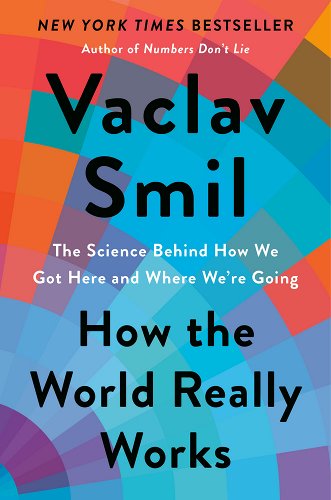
In my ongoing effort to understand how the world really works, I started listening to How the World Really Works by Vaclav Smil. Smil has a cool origin story:
Growing up in a remote mountain town in the Plzeň Region, Smil cut wood daily to keep the home heated. This provided an early lesson in energy efficiency and density.
Now he lives in cozy Manitoba. Great introduction to the man:
“I have never been wrong on these major energy and environmental issues,” he says, “because I have nothing to sell.”
How the World Really Works can be a tough listen at times, because the gist of it is there are no easy answers, anything’s gonna require tradeoffs. One big takeaway: we’re not getting off fossil fuels any time soon. Sometimes though Smil has a rhetorical flourish that’s sort of fun. Much like Paul Johnson’s Birth of the Modern, however, the book is so overwhelming, so full of information that the result can be a glum feeling as I’m reminded of how much I don’t know, how complex everything is, it can be paralyzing. I see I’m in good company feeling this way:
After reading his first Smil book, [Bill] Gates “felt a little beat up. … Am I ever going to be able to understand all of this?” But he ultimately concluded that “I learn more by reading Vaclav Smil than just about anyone else.”

Natural Gas on the other hand I found quite exciting. Methane, ethane, and propane: you can see why Hank Hill loved the stuff. Smil, impartial though he tries to be, seems to have a soft spot of natural gas.
inhabitants of large northern cities hardly ever think about having their gas supply interrupted because such experiences are exeedingly rare.
Where does this wonderful gas come from?
Methane is produced during strictly anaerobic decomposition of organic matter by species of archaea, with Methanobacter, Mathanococcus, Methanoscarina, and Mathothermobacter being the major methanogenic genera
Here’s some methanobacter:

So we’re talking about the released gases over three billion years or so from prehistoric swamps. It might seem crazy that all that gas comes from the breathing out of life forms. And indeed, some have questioned that:
But what if hydrocarbons were of inorganic, rather than biogenic, origin? That was assumed by Dmitri Ivanovich Mendeleev, Russia’s leading nineteenth-century chemist, and that has been an alternative to the biogeneic explanation offered by the so-called Russian-Urkanian hypothesis about the abiogenic formation of oil and gas in abyssal environments. … Porfir’yev (1959, 1974) had also argued that abiogenic formation of giant oil fields is a better explanation of their origins than assuming truly gigantic accumulations of organic material that would be needed to create such structures…
The American Thomas Gold got in on the act. An astrophysicist, he pointed out that methane exists on planets apparently devoid of life, and theorized that methane:
can from by combining hydrogen and carbon under high temperatures and pressures in the outer mantle, and after this mantle-derived methane migrates it is then converted to heavier hydrocarbons in the upper layers of the Earth’s crust
After giving that a fair hearing, Smil says
I will note here half a dozen of major realities that undermine the abiogenic hypothesis
Submanticular squeezing, the exhaust of ancient wetlands, either way, it’s valuable stuff! The invention of liquified natural gas and compressed natural gas are remarkable examples of human ingenuity, and there may be more to come, but Smil, as usual, notes that energy transitions take a long time, and it won’t be soon that we convert all trucks to methane.
[Energy transitions] incremental progress can be accelerated or retarded by specific policies – but only rarely do such measures result in truly revolutionary shifts; energy systems are too complex and generally fairly long-lived and hence too inertial to be rapidly redirected by deliberate action designed to change their fundamentals. Grand plans aimed at their basic redesgn thus have a very low probability of success, and we are left trying to do the best we can to nudge the process in what we think is the best direction – but we still must keep in mind that, in retrospect, we may find such actions not as beneficial as we thought them to be at the beginning.
It’s not that we haven’t tried to occasional big swing. Smil notes about natural gas extracting:
one of the methods that was not just proposed, but actually tried several times in the United States is truly incredible (an adjective used with restraint).
That was the Plowshare Program, where we detonated underground nuclear bombs to try and loosen up natural gas.
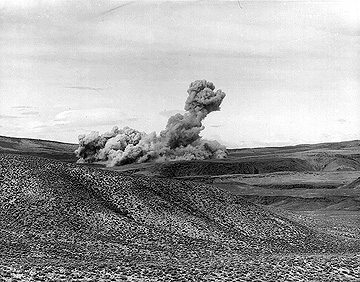
Source on that. Here they are loading up Gasbuggy:
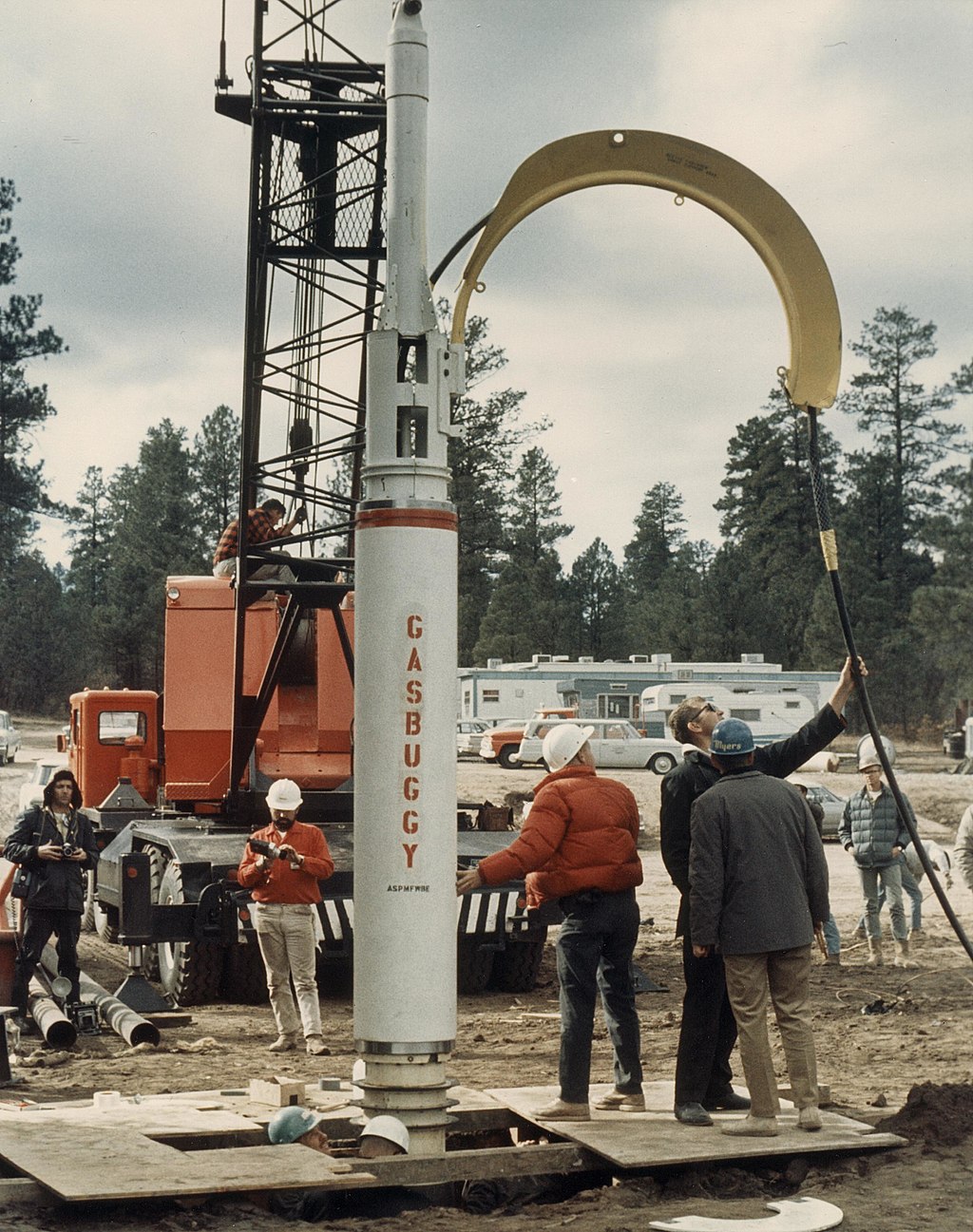
Smil:
Reading this four decades later has only increased the sense of incredulity: how could these frequent detonations be ever justified in net energy terms, and how could regular detonation of powerful nuclear bombs underneath the grassland, fields and forests of the American West be accepted by the public as routine means of producing gas used for heating and cooking?
Didn’t work.
The World’s In a Bad Situation
Posted: October 28, 2022 Filed under: America Since 1945 Leave a commentGrave
Posted: October 6, 2022 Filed under: America Since 1945 Leave a comment
My in-laws took us on a special trip to see this grave, one county away.
Shantyboat life
Posted: September 20, 2022 Filed under: America Since 1945 2 Comments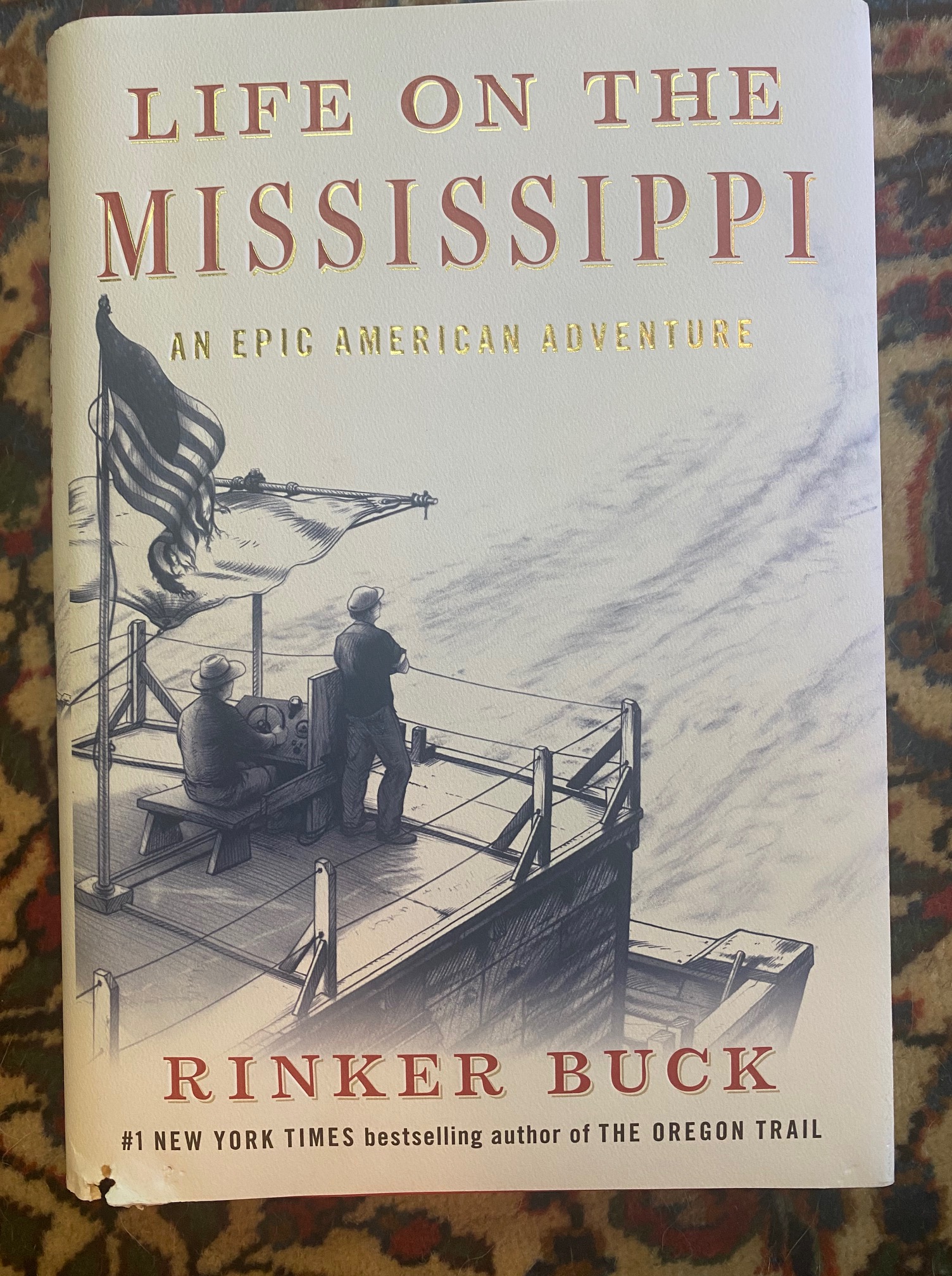
After the devastating Panic of 1893, thousands of abruptly unemployed and now homeless industrial workers, in river towns from Pittsburgh to New Orleans, found that they could cobble together a livable house on top of an abandoned commercial barge down on the waterfront, or build a shantyboat from scratch from the broad selection of cast-off timbers and driftwood lining virtually every mile of riverbank. Each year, hundreds of shanytboat families imply cast off from Memphis or Cincinnati and spent the warm months drifting down river, camping on remote islands, planting gardens or harvesting wild berries… During the Great Depression of the 1930s, the Works Progress Administration estimated that as many as fifty thousand Americans lived on shantyboats.
A version of this lifestyle on the river in Knoxville described in Cormac McCarthy’s Suttree.
Rinker Buck manages to get his shantyboat from Elizabeth, Pennsylvania on the Ohio River all the way to New Orleans. He’s warned that he’s going to die, but in fact he has a mostly peaceful cruise. One problem he notes is that long stretches of the Mississippi are fuel deserts: there are no marinas or places to gas up your boat. He attributes this to a combination of factors, including a decline in recreational boating post the 2008 recession, and the record flooding of 2011.
He’s warned that the Coast Guard will remove his boat if he gets caught on a sandbar and has to leave it for awhile, but after some experience he scoffs at that. No one is bothering to clean up the river or remove obstacles to navigation, gas cans float by, it’s full of trash, old refrigerators, sunken cars, etc.
The Ohio and the Mississippi are nothing but Superfund sites with water running through them.
Really good chapter about Natchez, MS and the new national park project there to commemorate the Forks In the Road slave market. Bleak!
I’m giving this book away if anyone wants it!
Existential problem
Posted: September 19, 2022 Filed under: America Since 1945 Leave a commentOn Meet The Press this week, Chuck and the gang were talking about the Ron DeSantis stunt of sending Venezuelan refugees to Martha’s Vineyard. Chuck pointed out that they were in kind of a bind. This was an obvious stunt, and the point of it was to get people like Chuck Todd to talk about it, instead of say Lindsay Graham’s very unpopular plan for a federal abortion ban. And yet, Chuck said, here we are talking about it. It was as if there were no option: Chuck knew it was a distraction, said it was a distraction, and yet there he was talking about it, lamenting that it was a distraction.
How do we escape this trap? Most people seem to have no problem: they are just not distracted by distractions. They don’t expend energy on this stuff. But that does not appear to be an option for Chuck Todd. One move might be for him (CT) to be a serious enough and strong enough figure to just say (or not say, but show) we’re not paying attention to this. But maybe such a figure could not host Meet The Press. And I shouldn’t be too hard on CT, that’s tough to do. I wouldn’t watch MTP if I didn’t have some affection for Chuck Todd.
Maybe I should just stop watching Meet The Press. But I do find it compelling television: even this absurd dilemma proved thought-provoking. I could conclude that the harm I do by feeding the MtP machine with my attention is worse than the gain from pleasurable feelings of studying its drama and contortions. I’m not there yet. As for the distraction, here I am talking about it.


#/media/File:George_H._W._Bush,_Alan_Simpson,_and_Craig_Thomas.jpg)

.jpg)