For the past couple of years I’ve been working on this animated show I co-created with the great Joe Bennett. Even adjusting for my personal bias, I believe it came together in an amazing way and will be an incredible show. Coming in 2025.
That’s from the June 7 issue of ValueLine. I subscribed after I saw this clip:
Not even sure what year that’s from.
Quality has been on my mind.
Quality … you know what it is, yet you don’t know what it is. But that’s self-contradictory. But some things are better than others, that is, they have more quality. But when you try to say what the quality is, apart from the things that have it, it all goes poof! There’s nothing to talk about. But if you can’t say what Quality is, how do you know what it is, or how do you know that it even exists? If no one knows what it is, then for all practical purposes it doesn’t exist at all. But for all practical purposes it really does exist. What else are the grades based on? Why else would people pay fortunes for some things and throw others in the trash pile? Obviously some things are better than others … but what’s the betterness? … So round and round you go, spinning mental wheels and nowhere finding anyplace to get traction. What the hell is Quality? What is it?
As the guy says in Zen and the Art of Motorcycle Maintenance. At the Smithsonian you can see Pirsig’s motorcycle:
I was at See’s Candy the other day:
Recently I read this book:
There are some interesting case studies (although they skew a bit Euro):
Will AI ever produce something of “quality”? I have yet to see it.
This is from the annual letter of Kanbrick, an investment company run by Warren Buffett protege Tracy Britt Cool:
You’ve maybe heard this Mark Twain quote before. Here’s what bothers me: there’s no evidence Twain ever said this. It’s not anywhere in his writings (easily searchable). Maybe he said it to some person who wrote it down? Well, Quote Investigator can’t find that quote anywhere in print until 1970.
Twain did write this:
NOTE. November, 1903. When I became convinced that the “Jumping Frog” was a Greek story two or three thousand years old, I was sincerely happy, for apparently here was a most striking and satisfactory justification of a favorite theory of mine—to wit, that no occurrence is sole and solitary, but is merely a repetition of a thing which has happened before, and perhaps often.
but that’s not quite the same thing, is it?
Now, you might say, who cares? But, like, Kanbrick’s job is researching, and curiosity, and getting facts right. If Twain made this interesting statement, wouldn’t it be worth finding out to whom he said it? or where he wrote it? and in what context? Even Mark Twain didn’t go around saying aphorisms. He said stuff in a setting. If Kanbrick had gone looking for the context, they wouldn’t have found it. So, they weren’t curious?
Look, let’s let Kanbrick off the hook here, they’re an investment firm. But here’s Ken Burns in a graduation speech at Brandeis University:
We continually superimpose that complex and contradictory human nature over the seemingly random chaos of events, all of our inherent strengths and weaknesses, our greed and generosity, our puritanism and our prurience, our virtue, and our venality parade before our eyes, generation after generation after generation. This often gives us the impression that history repeats itself. It does not. “No event has ever happened twice, it just rhymes,” Mark Twain is supposed to have said. I have spent all of my professional life on the lookout for those rhymes, drawn inexorably to that power of history. I am interested in listening to the many varied voices of a true, honest, complicated past that is unafraid of controversy and tragedy, but equally drawn to those stories and moments that suggest an abiding faith in the human spirit, and particularly the unique role this remarkable and sometimes also dysfunctional republic seems to play in the positive progress of mankind.
Now, Ken Burns at least gives the qualifier “supposed to have said,” but… Ken Burns made a 212 minute long documentary about Mark Twain! He must’ve steeped himself in Mark Twain! Did he not want to check out the context? I would guess that he just found it too good a quote to lose, and Mark Twain too good a source to put it too.
People chalk up quotes to Mark Twain and Churchill and Einstein all the time. That’s sorta just human nature to give these witty remarks to folk heroes famous for wisdom and smarts. The part that bothers is me is that no one, even in annual letters to investors and graduation speeches, was curious enough to be like “what was the context here for this quote I like? What was Twain saying? Where did he say it?”
It’s never been easier to find something like that out, it can be done in a few minutes. In the old days you had to walk to Cambridge and find the bookseller Bartlett, who knew every quote. Eventually Bartlett got tired of the inquiries and published a book, which is now an app.
Perhaps you’re thinking, Steve, who cares? These folks wanted to sauce their speech a little bit, does it matter? Maybe not. But as Mark Twain said, “what’s a personal website for if not working out life’s little irritants?”
Related: did Fitzgerald mean that thing about “no second acts in American lives“? Or did he conclude the exact opposite? (I’ve sometimes wondered if F. meant no second acts in the sense of like a three act Broadway play, like: American lives go right from the first act to the third act.)
continuing a deranged hobby of reading corporate materials for fast food companies. See if you can guess what the acronym C.R.A.V.E.D stands for at $JACK, the corporate parent of Jack In The Box and Del Taco.
To buy time while you think, here is a story about Herb Kelleher, founder of Southwest Airlines, who had a strong, clear mission focus:
There is a great story shared by Chip and Dan Heath in the book “Made to Stick” about the late founder Herb Kelleher. Kelleher once posed a question to someone about their strategy,
“Tracy from marketing comes into your office. She says her surveys indicate that the passengers might enjoy a light entree on the Houston to Las Vegas flight. All we offer is peanuts, and she thinks a nice chicken Caesar salad would be popular. What do you say?”
The person stammered for a moment, so Kelleher responded:
“You say, `Tracy, will adding that chicken Caesar salad make us THE low-fare airline from Houston to Las Vegas? Because if it doesn’t help us become the unchallenged low-fare airline, we’re not serving any damn chicken salad.’
And Jim, when you were a kid, how did you or your teachers or your parents first recognize the abilities that you had?
Simons:
Well, all parents think their kids are a genius, so (laughs) so, but I did get involved with math very early. I loved to keep multiplying by two and see… I finally got up to whatever it is, 1,024, I guess? And so I liked to do that. I remember I was in the car with my father when I was maybe four or five at the most, and he said he had to stop to get gas, and I said, “Why do you have to do that?” And he said, “Well, we could run out of gas if I don’t stop.” And I said to myself and then to him, “Well, you don’t have to run out of gas. You can use half of what you have, and then you can use half of that and then half of that, and you’ll never run out of gas.” (both laugh) Well, it didn’t occur to me that you’d never get anywhere either, but I just kept slicing up what was in the gas tank. And I remember also spending many a night lying in bed thinking, “How do you define the expression, “Pass it on.” That’s an expression, right? Pass it on. How do you define it? How do you explain to someone that he’s supposed to say to someone, the next guy down, et cetera, that wasn’t good enough. I really wanted to figure it out. And one night, I did figure it out, and then when I woke up, I forgot what it was. So (both laugh) but now I remember. But it’s, you know, a strange thing for a kid to do as, I was maybe eight, to think about such a question. So I always liked math.
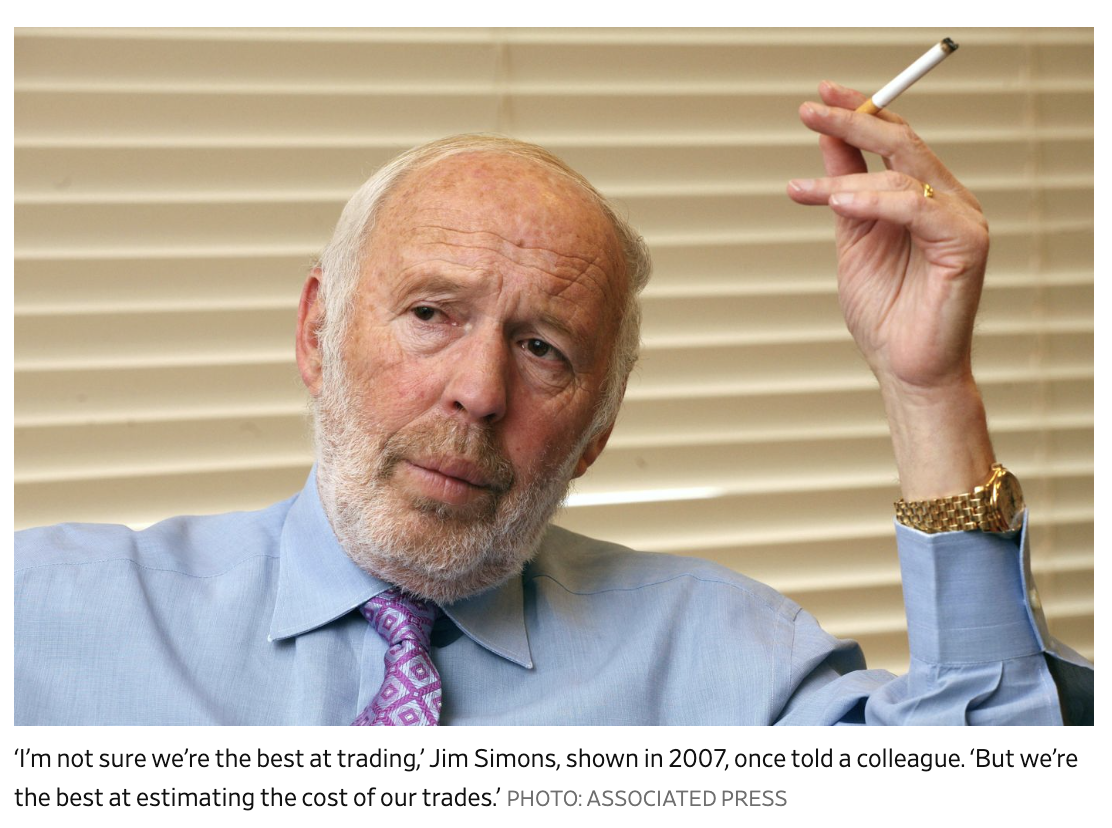
Here’s my source for that. Jim Simons, smoker, figured out a way to turn the markets into a money machine, suffered severe tragedies, gave money to science. (Why are so many brilliants from Brookline? Irish Jewish interaction under the looming mountains of Boston?)
We’d sit on that airplane and watch—one example, the classically brilliant, stupid movie, Dumb and Dumber.
Riley
I love Jim Carrey, but that’s one I haven’t even been able to watch.
Friendly
It’s a hilariously stupid movie, and there’s Clinton sitting there. This is one of the most brilliant people I’ve ever met and he’s sitting there chewing a cigar, playing hearts, watching Dumb and Dumber, laughing hysterically, but then also not getting some of the story line. I mean partly because he’s playing cards, he’s doing a crossword puzzle, talking to somebody, and watching Dumb and Dumber. But there I am trying to describe the plot line of Dumb and Dumber to the President of the United States. This is surreal.
(source: Andrew Friendly interview at The Miller Center)
Then there were silly little things, too, like his crossword puzzles. That seems like a silly thing, but to the extent that there are pop culture clues in crossword puzzles—The Sunday New York Times is the hardest one, because they get harder throughout the week. I never noticed many pop culture references in the Sunday one, but I’m sure the Monday one might have one or two. He loved to watch cheesy movies. We’d be landing in Moscow, but he wanted to see the last minute of Dumb and Dumber before he walked off the plane or something.
Riley
Does that get him charged up, the last minute of Dumb and Dumber?
Goodin
He likes action movies better. All of this is to say he actively cultivated these lifelong friendships. By virtue of who he is and the life he’s led, those friendships are totally across the spectrum of “real people.” He has such capacity to take in everything. He’ll have as much joy talking about the latest biography of [Abraham] Lincoln as he will about the most ridiculous scene in Dumb and Dumber. He has so much real estate in his brain for these people and relationships and knowledge, and he kept himself open to as many channels as possible.
At the town dump recycled magazines were piled in a converted shipping container (is that what it was?) and I’d go through them looking for Sports Illustrateds.
The phrase “jackasses like Dykstra” stuck with me so much I think of it almost every time I consider the dress code at a nice restaurant. With ease I was able to recover the original, from February 1994.
Boorish Behavior Your jocular tone in SCORECARD about Lenny Dykstra’s oafish antics in a restaurant (Jan. 17) calls for a response. Wearing a hat in any restaurant is a statement of social ignorance or, more likely, appalling ego, and the loud swearing in the establishment in suburban Philadelphia reinforces my impression of this lout. Your flip conclusion, in which his $24.9 million contract is mentioned, was inappropriate. There is still such a thing as class, just as there is a lack of it. JOHN KELLEY, Winthrop, Mass.
Isn’t SI the publication that ran Karl Malone’s June 14 POINT AFTER saying Charles Barkley should recognize that he is a role model whether he wants to be or not? So why doesn’t this pious injunction apply to Lenny Dykstra, six million bucks a year or not? One reason that people go to nice restaurants is to get away from jackasses like Dykstra. ROBERT H. PASCHALL, Bishop, Calif.
Is “writing about sports” as a moneymaking prospect dead now? Talking about sports, videos about sports, bigger than ever maybe, but is writing about it over? What does that say about writing?
JAB III used to turkey hunt with Lawton Chiles despite being in opposing parties. According to JAB that paid off during the 2000 Florida recount:
BAKER:
Jeb ran against Lawton Chiles in a very divisive and semidirty race. I had become a good friend of Lawton because I was Treasury Secretary and he was Chairman of the Senate Budget Committee. We did a lot of work together. He was an adversarial Democrat and I was an adversarial Republican, but we both liked to turkey hunt. He would invite me to Florida to hunt turkeys and I would invite him to Texas to hunt turkeys. I would call the turkeys for him and he would shoot them, and he would call them for me and I would shoot them.
One thing that really paid dividends with respect to the Florida recount—I know I’m jumping ahead of you here—Before I’d gotten over there, but it was reinforced after I’d gotten over there, I remembered the types of people that Lawton had appointed to the Florida Supreme Court. I’d probably met some of them. There was a guy named Dexter Douglass—You may remember who that was.
RILEY
He shows up in your book.
BAKER
In my book, yes. He was an advisor to Lawton. He was the guy who told Lawton whom to put on the Florida Supreme Court. He gave him advice about which lawyers to put on. They were all liberal trial lawyers. So when I got to Florida I was of the view, pretty much right off the bat, that if we weren’t able to get this into federal court we had a really tough row to hoe. As it turned out, that was very true. The Florida Supreme Court pulled us out twice, once in the face of a direct order from the United States Supreme Court to review their opinion—They reversed an earlier opinion. So that relationship I had with Lawton Chiles really paid dividends when it was time to go to do the recount.
There was a significant moment in George W. Bush’s governor campaign in Texas that turned on how he handled accidentally killing a killdeer, the wrong kind of bird, during a publicity event on the first day of bird hunting season. Here’s Karl Rove:
Then also, the famous killdeer incident had a big impact, because it showed—Her attitude toward good old boys was condescending. She felt she needed to placate “Bubba” by every September first going dove hunting in East Texas, outside of Dallas. Of course, she was not a hunter, she could care less, but it was a nice show and she’d get a nice picture for the newspapers. Bush went dove hunting and shot a protected bird, a killdeer, and when he discovered that he had done so, after a sharp-eyed television sports reporter noticed that the white markings on the bird meant that it was a killdeer, Bush’s response was not to deny it, but to dispatch a young aide to the game warden’s office to pay the fine immediately.
Then there was the incident where Cheney shot his buddy in the face by accident. Rove:
Rove
On my lease, and that was my lawyer. I was shocked that fact never came out. If you go back to incorporation papers of Rove and Company in 1981, my lawyer, the secretary/treasurer of my corporation, and my landlord is Harry M. Whittington Jr., and that’s the guy Cheney shot. The press corps never figured it out, but could you imagine the headline in the Washington Post? “Cheney Shoots Rove’s Lawyer in Sign of West Wing Tension.”
Riley
Did you get a funny feeling in your stomach when you got that news?
Rove
We could not get Cheney to make it public, and we needed to. It took until the next morning, before Cheney allowed Katharine Armstrong to feed the news to a reporter at the Corpus Christi Caller-Times. The White House press corps was furious with us for having hid this fact from the afternoon and to the next morning.
Why did Cheney’s team bungle releasing that news? Dan Bartlett, W. communications director, explains:
The second one is when he shot Harry Whittington and he shut down all internal communication. We couldn’t get hold of him, couldn’t get hold of his staff. Only learned later that there were some back channel communications with Karl, but they decided that no one in the world would understand or have context for him accidentally shooting somebody while hunting except for one reporter at the Corpus Christi Caller-Times who they couldn’t find because she was on a drunk bender for 12 hours. It took that long to find her.
I admire Tom Whitwell’s annual list of 52 things he learned in the year. Maybe most of what I learned this year were more emotional truths? I could only come up with twenty. You might know all these things, many of them have been known for some time, they’re just items that came across my transom and stuck with me this year.
one of many factors that hurt the Confederacy was their railroads had different gauges. It was President Abraham Lincoln who set the standard US railroad gauge (4 ft 8 1/2 in) when he made that standard for the Transcontinental Railroad. (do we buy the just-so story about Roman chariots?)
during the decade ending in 2021 the US Treasury took in $32.3 trillion in taxes and spent $43.9 trillion
the USA detonated 35 nuclear weapons on itself between 1957 and 1977 to see if that would be a good way to drill for oil, construct canals, and do other peacetime projects
Louis B. Mayer used to don diving equipment to collect scrap metal in Boston Harbor
the average Australian spends US $871 on horse racing a year. (Can this be true? My source is Harness Racing Update. It’s possible ADW computer teams are churning in ways that skew the figures. )
(that’s not a fact, just a memorable kind of statement I found on Brian Wilson’s Wikipedia page.)
Between 1640 and 1652, Ireland lost between 15% and 20% of her population due to war and war-related starvation. (Source.)
Los Angeles is home to more Native Americans and Alaskan Natives than any other county in the USA. (Source.)
Kenneth Adams 1934 murals for the University of New Mexico library are now covered because some find them offensive.
the price paid to a winkte among the Sioux for naming a child was a horse.
Dopaminergic medications for Parkinson’s disease have been associated with extreme risk taking, and pathological gambling.
This is what Dick Cheney and his team thought they’d be working on when they went into work on 9/11/2001:
In 2022 the murder rate in New Orleans was about 7x what it was in Los Angeles. (Source. The murder rate in New Orleans is off the charts. There were 280 murders in New Orleans in 2022, that’s more than in all of Germany.)
Cochran was a young Naval officer in Newport when he happened to get an invitation to the Kennedy compound from an Ole Miss coed friend who was working as cook there:
Heininger
What were your impressions of [Ted Kennedy] that very first time you met him in Hyannis Port?
Cochran
Very casual, easy to be with, approachable, good sense of humor, big appetite. He liked chocolate-chip cookies, I know that. He stood there and ate a whole fistful of chocolate-chip cookies, which my friend would make on request. She was apparently good at that.
As a young naval officer here’s what Cochran thought of the buildup to Vietnam:
But then the Vietnam thing came along, and it started getting worse and worse. I didn’t get called back in the Navy to serve in Vietnam, but I was teaching one summer in Newport when the Gulf of Tonkin incident occurred. Just trying to figure that one out and reading about what had happened and looking at a couple of television things of the bombing of the port at—where was it, Haiphong, something like that? I thought, I cannot believe this. What the heck is President Johnson thinking? What is he doing? How are we going to back away from that now, responding to this attack against a merchant ship, as I recall?
Anyway, I began worrying about it. I think, in one of my classes, I even asked the students, the officer candidates about to be officers in the U.S. Navy, would they like to go over to Vietnam and fight over this? Would they like to escalate this another notch? Is there something in our national interest? Of course they were scared to death of it. They didn’t want to say anything, but I think I expressed my view kind of gratuitously, and then later I worried that I was going to get reported for being a belligerent, anti-American Naval officer. I really became angry and frustrated and upset with the way this thing was going, and it just got worse, as everybody knows.
How did he end up in elected office?:
So then I went back to practicing law and just working and enjoying it. I forgot about politics, and then our Congressman unexpectedly announced that he was not going to seek re-election. His wife had some malady, some illness, and the truth was, he was just tired of being up here and wanted to come home. It took everybody by surprise. I’m minding my own business again one day at the house and the phone rings, and it’s the local Young Republican county chairman, Mike Allred, who called and said, You know, you may laugh but I’m going to ask you a serious question. This is serious. Have you thought about running for Congress to take Charlie Griffin’s place? And I said, Well, and I laughed because I said, You know, I have thought about it. I was surprised to hear that he wasn’t going to run, but I’ve thought about it, and I’ve decided that I’m not interested in running. I’ve got too much family obligation, financial opportunities, the law firm, etc.
I think Congressmen were making about $35,000 a year or something like that. There was a rumor it might go up to $40,000. I thought, Well, I have a wife and two young children, and there’s no way in the world I can manage all that, and in Washington, traveling back and forth, etc. But it would be interesting. It’s going to be wide open. It was an interesting political situation. Then he said, Well, let me ask you this: have you thought about running as a Republican? I laughed again and I said, No, I surely haven’t thought about that. I was just thinking about the context of running as a Democrat, and so I was still thinking of myself as a Democrat in ’72.
He said, Would you meet with the state finance chairman? We’ve been talking about who would be a good candidate for us to get behind and push, and we want to talk to you about it. We really think there’s an opportunity here for you and for our party and all this. I said, Well, Mike, I’ll be glad to meet and talk to you all, but look, don’t be encouraged that I’m going to do it. But I’m happy to listen to whatever you say. I’d like to know what you all are doing, as a matter of curiosity, how you got off under this and who your prospects are and that kind of thing. I’d like to know that.
So I met with them, and they started talking about the fact that they would clear the field. There would not be a chance for anybody to win the nomination if I said I would run. I thought, Golly, you all are really serious and think a lot of your own power. I started thinking about it some more, and I asked my wife what she would think about being married to a United States Congressman, and she said, I don’t know, which one? [laughs] And that is a true story. I said, Hello. Me.
Anyway, a lot of people had that reaction: What? Are you seriously thinking about this? But everybody that I asked—I started just asking family and close friends, law partners; I just bounced it off of them—I said, What’s your reaction that the Republicans are going to talk to me about running for Congress? I was just amazed at how excited most people got over the idea that I might run for Congress and run as a Republican. That’s unique, and they wouldn’t have thought it because they knew I was not a typical Republican. The whole thing worked out, and I did run, and I did win.
That was ’72. Interesting dynamic in Mississippi that year:
Knott
Were you helped by the fact that [George] McGovern was running as the Democratic nominee that year?Cochran
Yes, indeed. There was no doubt about it. I was also helped by the fact that some of the African-American activists in the district were out to prove to the Democrats that they couldn’t win elections without their support. Charles Evers was one of the most outspoken leaders and had that view. He was the mayor of Fayette, Mississippi, and that was in my Congressional district. He recruited a young minister from Vicksburg, which was the hometown of the Democratic nominee, to run as an Independent, and he ended up getting about 10,000 votes, just enough to deny the Democrat a majority. He had 46,000 or something like that, and I ended up with 48,000 or whatever. I’ve forgotten exactly what the numbers were. The Independent got the rest.
So the whole point was, I was elected, in part—I had to get what I got, and a lot of people who voted for me were Democrats, and some were African Americans who were friends and who thought I would be fair and be a new, fresh face in politics for our state and not be tied to any previous political decisions. I’d be free to vote like I thought I should in the interest of this district. It was about 38 percent black in population, maybe 40 percent, and not only did I win that, but then the challenge was to get re-elected after you’ve made everybody in the Democratic hierarchy mad. I knew they were going to come out with all guns blazing, and they did, but they couldn’t get a candidate. They couldn’t recruit a good candidate. They finally got a candidate but—
Knott
Seventy-four was a rough year for Republicans.
Cochran
It was and, of course, Republicans were getting beat right and left. So when we came back up here to organize after that election in ’74, there weren’t enough Republicans to count. But I was one of them who was here and who was back. Senator Lott, he and I both made it back okay. He was from a more-Republican area: fewer blacks and more supportive of traditional Republican issues.
His opinion on the state of affairs:
Serving in the Senate has gotten to be almost a contact sport, and that’s regrettable, in my view. I would like for it to be more like it was when I first came to the Senate. There was partisanship, right enough, and if you were in the majority, you got to be chairman of all the subcommittees, and none of the Republicans, in my first two years, were chairmen of anything, but that’s fine. That’s the way the House is operated. I’d seen that in the House, and that’s okay. Everybody understands it. But since it’s become so competitive—and the House has too—things are more sharply divided along partisan lines than they ever have been in my memory, and I think the process has suffered. The legislative work product has deteriorated to the point that legislation tends to serve the political interests of one party or the other, and that’s not the way it should be.
Who does he blame?:
I’ve been disappointed in the partisanship that has deteriorated to the point of pure partisanship in court selections, in my opinion, in the last few years, and [Ted Kennedy’s] been a part of that. I’m not fussing at him or complaining about it. It’s just something that has evolved, but all the Democrats seem to line up in unison to badger and embarrass and beat up Republican nominees for the Supreme Court in particular. But it’s extended to other courts, the court of appeals. They all lined up and went after Charles Pickering from my state unfairly, unjustly, without any real reason why he shouldn’t be confirmed to serve on the 5th Circuit Court of Appeals. He had run against me when I ran for the Senate, Pickering had. I defeated him in the Republican primary in 1978. So we haven’t been political allies, but I could see through a lot of the things.
I have a close personal friendship with Pat Leahy and Joe Biden, and I could probably name a few others. I’ve really been aggravated with them all for that reason, and I hope that we’ll see some modification of behavior patterns in the Judiciary Committee. Occasionally they’ll help me with somebody. I’m going to be presenting a candidate for a district court judgeship this afternoon in the committee, and yesterday Pat came up, put his arm around me, and said, I know you’re for this fellow, [Leslie] Southwick, who is going to be before the committee, and I want you to know you can count on me.Well, I’m glad to hear that. There’s nothing wrong with him. I mean, he’s a totally wonderful person in every way. He’ll be a wonderful district judge.
I’m not saying that they make a habit of it, but they’ve picked out some really fine, outstanding people to go after here recently, and there are probably going to be others down the line that they’ll do that. Ted’s part of that, and I think all the Democrats do it. I think that’s unfortunate.
Knott
Are they responding to interest group pressure? Is that your assessment?
Cochran
I think that has something to do with it, but I’m not going to suggest what the motives are or why they’re doing it, but it’s just a fact. It’s pure partisan politics, and it’s brutal, mean-spirited, and I don’t like it.
Heininger
What do you attribute the change to?
Cochran
I don’t know. I guess one reason is we’re so closely divided now. You know, just a few states can swing control of the Senate from one party to the next, and we have been such a closely divided Senate now for the last ten years or so. Everybody understands the power that comes with being in the majority, and I’m sure both parties have taken advantage of the situation and have maybe been unfair in the treatment of members of the minority party, denying them privileges and keeping their amendments from being brought up or trying to manage the schedule to the benefit of one side or the other.
Cochran died in 2019. In the Senate he used Jefferson Davis’s desk.
A former Navy mechanic named Doug Rose helped to popularize meltdowns after he created a dragster using a jet engine from a scrapyard. According to his widow, Jeanne, he conducted his first fire show around 1968 with a car he named the Green Mamba. Over the years, he honed his craft until he could torch a half-dozen vehicles at once. “Doug’s objective was to please the people,” she said.
WSJ also has a photographic review of how McDonald’s is revamping her burgers.
We’re not convinced. Yesterday stopped at the Yucaipa In-N-Out. Two cheeseburgers, fries, medium soda, side of pickles and free hot peppers for $12.50. Is there a better deal in America? Of course when you drive by Harris Ranch you get a tough look and smell of the system that makes that possible.
BECKY QUICK: What kind of things would you recognize that they– that they were doing wrong?
CHARLIE MUNGER: Oh. They had some crazy idea. For instance, my Latin teacher was maladjusted, but one who was a devoted follower of Sigmund Freud. And I recognized that Sigmund Freud was –when I first read him when I was in high school. And, of course, it was an odd little boy whose Latin teacher is teaching him Freud. But that was – she was peculiar and so was I. And, of course, when I read – I bought the complete writings of Sigmund Freud from the area library. It was one big book. And I went through it very laboriously. And I realized he was a goddamn lunatic. And so I decided I wasn’t gonna learn that from my Latin teacher. I had some very unusual teachers. The best teacher I had in my life was Lon Fuller. Well, he was the best contracts teacher in any law school. And contracts is the best subject in every law school, at least I think it is. Because it integrates so beautifully with the new doctrine of an economics that came along with Adam Smith and all those people.
I had Dall-E generate some images of boy Charlie Munger reading the complete works of Sigmund Freud:
Chairman Mao: The trade between our two countries at present is very pitiful. It is gradually increasing. You know China is a very poor country. We don‘t have much. What we have in excess is women. (Laughter)
Dr. Kissinger: There are no quotas for those or tariffs.
Chairman Mao: So if you want them we can give a few of those to you, some tens of thousands. (Laughter)
Prime Minister Chou: Of course, on a voluntary basis.
Chairman Mao: Let them go to your place. They will create disasters. That way you can lessen our burdens. (Laughter)
from a transcript of a conversation, Feb. 17 1973. Although who can say what they really said? A few months later:
Chairman Mao: Let’s discuss the issue of Taiwan. The question of the U.S. relations with us should be separate from that of our relations with Taiwan.
The Secretary: In principle….
Chairman Mao: So long as you sever the diplomatic relations with Taiwan, then it is possible for our two countries to solve the issue of diplomatic relations. That is to say like we did with Japan. As for the question of our relations with Taiwan, that is quite complex. I do not believe in a peaceful transition. (To the Foreign Minister) Do you believe in it?
The Secretary: Do I? He asked the Foreign Minister.
Chairman Mao: I’m asking him (the Foreign Minister). (Prime Minister Chou said something that was not translated.)
They are a bunch of counterrevolutionaries. How could they cooperate with us? I say that we can do without Taiwan for the time being, and let’ it come after one hundred years. Do not take matters on this world so rapidly. Why is there need to be in such great haste? It is only such an island with a population of a dozen or more million.
Strange. Game (power addicted psycho) recognize game I guess.
“Like Warren, I had a considerable passion to get rich,” Munger told Roger Lowenstein for Buffett: The Making of an American Capitalist, published in 1995. “Not because I wanted Ferraris — I wanted independence. I desperately wanted it. I thought it was undignified to have to send invoices to other people.”
Munger never stopped preaching old-fashioned virtues. Two of his favorite words were assiduity and equanimity.
He liked the first, he said in a speech in 2007, because “it means sit down on your ass until you do it.” He often said that the key to investing success was doing nothing for years, even decades, waiting to buy with “aggression” when bargains finally materialized.
He liked the second because it reflected his philosophy of investing and of life. Every investor, Munger said frequently, should be able to react with equanimity to a 50% loss in the stock market every few decades.
Munger on horse race betting, from his most famous (or second most famous?) speech:
How do you get to be one of those who is a winner—in a relative sense—instead of a loser? Here again, look at the pari-mutuel system. I had dinner last night by absolute accident with the president of Santa Anita. He says that there are two or three betters who have a credit arrangement with them, now that they have off-track betting, who are actually beating the house. They’re sending money out net after the full handle—a lot of it to Las Vegas, by the way—to people who are actually winning slightly, net, after paying the full handle. They’re that shrewd about something with as much unpredictability as horse racing. And the one thing that all those winning betters in the whole history of people who’ve beaten the pari-mutuel system have is quite simple. They bet very seldom. It’s not given to human beings to have such talent that they can just know everything about everything all the time. But it is given to human beings who work hard at it—who look and sift the world for a mispriced bet—that they can occasionally find one. And the wise ones bet heavily when the world offers them that opportunity. They bet big when they have the odds. And the rest of the time, they don’t. It’s just that simple. That is a very simple concept. And to me it’s obviously right—based on experience not only from the pari-mutuel system, but everywhere else.”
One day Warren Buffett and Charlie Munger visited the set of The Office to film a comedy video for the Berkshire Hathaway annual meeting. Everyone swarmed around Buffett but nobody really knew Munger. When the lunch break came I had the opportunity to take my plate and sit right down across from him.
From reading his Wikipedia page that morning I’d learned that Charlie Munger had been a weatherman during World War II, so I asked him about that. “It was kind of a humdrum job,” he said, modest. “A lot of people had humdrum jobs in the war.” His job was hand-drawing weather maps to predict the best times to fly planes across the Bering Strait to our Soviet allies in such a way that the engines wouldn’t ice up and kill the pilots. It seems like that might teach you something about probability and decision-making under uncertainty.
We talked about Clifton’s Cafeteria in downtown LA. He expressed admiration for that institution.
In 1931, Clinton leased a “distressed” cafeteria location at 618 South Olive Street in Los Angeles and founded what his customers referred to as “The Cafeteria of the Golden Rule”. Patrons were obliged to pay only what they felt was fair, according to a neon sign that flashed “PAY WHAT YOU WISH.” The cafeteria, at the western terminus of U.S. Route 66, was notable for serving people of all races, and was included in The Negro Motorist Green Book.
The conversation itself wasn’t that profound, but it launched me on a project of learning about more about Munger and his thinking that’s really changed my life.
“You don’t have a lot of envy.
You don’t have a lot of resentment.
You don’t overspend your income.
You stay cheerful in spite of your troubles.
(this from a guy whose first child died of leukemia).
You deal with reliable people.
And you do what you’re supposed to do.
And all these simple rules work so well to make your life better. And they’re so trite.”
His prescription is logical, he says.
“Staying cheerful” is “a wise thing to do,” Munger told Quick, adding that in order to do so, you have to let go of negative feelings.
“And can you be cheerful when you’re absolutely mired in deep hatred and resentment? Of course you can’t. So why would you take it on?” Munger said.
from 2019. (Struck by a resemblance to the mantra Liam Clancy gave Bob Dylan: “no fear, no meanness, no envy.”) He was committed to being rational, and he was witty, he expressed a lot of wisdom in a fast and punchy way. You could listen to him talk for a long time and not get bored. (And he could talk for a long time too.)
(not sure what year he said that, might be more like $1 million today)
Munger holding forth in February, 2022 with a rare stock pick:
But I would argue that if I was investing money for some sovereign wealth fund or some pension fund with a 30,40, 50-year time horizon I buy Costco at the current price.
Here’s Costco vs. S&P 500 over that timeline:
(although my guy was talking 30-50 years.)
Posting about Munger has led to some interesting real life connections. The Mungerheads search out every scrap on the man. They’re interesting people to talk to, and you usually learn something
“I’ve mellowed because I consider it counterproductive to hate as much as both parties now hate, and I have disciplined myself,” Munger said. “I now regard all politicians higher than I used to. I did that as a matter of self-preservation.” He said that he had re-read “The Decline and Fall of the Roman Empire,” and it made him “feel a lot better about the current political scene. We’re way ahead of the Romans at the end.”
That’s a pretty low bar, I pointed out.
“It’s very helpful — I suggest you try it,” Munger replied. “Politicians are never so bad that you don’t live to want them back. There will come a time when the people who hate Trump will wish that he was back
Free Samples, from 2023, a look at a commonality in Buffett-Munger businesses.
CHARLIE MUNGER: I used to come to the Berkshire annual meetings on coach from Los Angeles. And it was full of rich stockholders. And they would clap when I came into the coach section. I really liked that. (LAUGHTER) (APPLAUSE)
Obviously, you’ve got to be able to handle numbers and quantities—basic arithmetic. And the great useful model, after compound interest, is the elementary math of permutations and combinations. And that was taught in my day in the sophomore year in high school. I suppose by now in great private schools, it’s probably down to the eighth grade or so.
It’s very simple algebra. It was all worked out in the course of about one year between Pascal and Fermat. They worked it out casually in a series of letters.
Doris Kearns Goodwin on FDR’s power of persuasion:
At the Democratic Convention in 1936, Roosevelt answered the attacks in dramatic form. He admitted he had not kept his pledge. He admitted that he had made some mistakes in the early years. But then he quoted the famous line: “Better,” he said, “the occasional faults of a government guided by a spirit of charity and compassion than the constant omissions of a government frozen in the ice of its own indifference.” As he was making his way up to the podium to that “Rendezvous with Destiny” speech, leaning on the arms of his son and a Secret Service agent, his braces locked in place to make it seem as if he could walk (he really could not on his own power), he reached over to shake the hand of a poet. He immediately lost his balance and fell to the floor, his braces unlocked, his speech sprawled about him. He said to the people around him, “Get me up in shape.” They dusted him off, picked him up almost like a rag doll, put his braces back in place, and helped him up to the podium. He then somehow managed to deliver that extraordinary speech.
There weren’t that many fireside chats:
He delivered only thirty fireside chats in his entire twelve years as president, which meant only two or three a year. He understood something our modern presidents do not: that less is more, and that if you go before the public only when you have something dramatic to say, something they need to hear, they will listen. Indeed, over 80 percent of the adult radio audience consistently listened to his fireside chats.
FDR truly swayed public opinion towards what he wanted:
And somehow, through his ability to communicate, he educated and molded public opinion. At the start of this process, the people were wholly against the idea of any involvement with Britain. By the time the debate finished in the Congress and the Lend-Lease Act was passed, the majority opinion in the country was for the lend-lease program. That is what presidential leadership should and must be about. Not reflecting public opinion polls, taking focus groups to figure out what the people are thinking at that moment, and then simply telling them what they’re thinking, but rather moving the nation forward to where you believe its collective energy needs to go.
Life in the FDR White House during WWII:
He became a part of an intimate circle of friends who were also living in the family quarters of the White House during the war, including Franklin’s secretary, Missy Lehand, who had started working for him in 1920, loved him the rest of her life, and was his hostess when Eleanor was on the road; Franklin’s closest adviser, Harry Hopkins, who came one night for dinner, slept over, and didn’t leave until the war was coming to an end; Eleanor’s closest friend, a former reporter named Lorena Hickock; and a beautiful princess from Norway, in exile in America during the war, who visited on the weekends.
Michael Beschloss on Eisenhower:
To hold down the arms race as much as possible, he worked out a wonderful tacit agreement with Soviet premier Nikita Khrushchev. Khrushchev wanted to build up his economy. He didn’t want to spend a lot of money on the Soviet military because he wanted to start feeding people and recover from the devastation of World War II. But he knew that to cover this he would have to give speeches in public that said quite the opposite. So Khrushchev would deliver himself of such memorable lines as, “We Soviets are cranking out missiles like sausages, and we will bury you because our defense structure is pulling ahead of the United States.” Eisenhower dealt with this much as an adult deals with a small boy who is lightly punching him in the stomach. He figured that leaving Khrushchev’s boasts unanswered was a pretty small price to pay if it meant that Khrushchev would not spend much money building up his military. The result was that the arms race was about as slow during the 1950s as it could have been, and Eisenhower was well on the way to creating an atmosphere of communication. Had the U-2 not fallen down in i960 and had the presidential campaign taken place in a more peaceful atmosphere, I think you would have seen John Kennedy and Richard Nixon competing on the basis of who could increase the opening to the Soviets that Eisenhower had created.
Eisenhower pursued almost an opposite strategy to Reagan re: the USSR.
On one of the tapes LBJ made of his private conversations as president, you hear Johnson in 1964. He knows that the key to getting his civil rights bill passed will be Everett Dirksen of Illinois, Republican leader of the Senate. He calls Dirksen, whom he’s known for twenty years, and essentially says, “Ev, I know you have some doubts about this bill, but if you decide to support it, a hundred years from now every American schoolchild will know two names—Abraham Lincoln and Everett Dirksen.” Dirksen liked the sound of that.
I don’t think that worked. I’ll quiz the next American schoolchild I encounter.
On JFK:
What’s more, he had been seeking the presidency for so long that he had only vague instincts about where he wanted to take the country. He did want to do something in civil rights. In the i960 campaign, he promised to end discrimination “with the stroke of a pen.” On health care, education, the minimum wage, and other social issues, he was a mainstream Democrat. He hoped to get the country through eight years without a nuclear holocaust and to improve things with the Soviets, if possible. He wanted a nuclear test ban treaty.
Bay of Pigs:
People at the time often said Eisenhower was responsible for the Bay of Pigs, since it was Eisenhower’s plan to take Cuba back from Castro. I think that has a hard time surviving scrutiny. Eisenhower would not necessarily have approved the invasion’s going forward, and he would not necessarily have run it the same way. His son once asked him, “Is there a possibility that if you had been president, the Bay of Pigs would have happened?” Ike reminded him of Normandy and said, “I don’t run no bad invasions.”
Then Robert Caro comes to the plate with some classics:
Trying to understand why this relationship developed, I asked some of Roosevelt’s assistants. One of them, Jim Rowe, said to me, ‘You have to understand: Franklin Roosevelt was a political genius. When he talked about politics, he was talking at a level at which very few people could follow him and understand what he was really saying. But from the first time that Roosevelt talked to Lyndon Johnson, he saw that Johnson understood everything]! ^ was talking about.”
This young congressman may have been unsophisticated about some things, but about politics—about power—he was sophisticated enough at that early age to understand one of the great masters. Roosevelt was so impressed, in fact, that once he said to Interior Secretary Harold Ickes, “That’s the kind of uninhibited young politician I might have been—if only I hadn’t gone to Harvard.” Roosevelt made a prediction, also to Ickes. He said, ‘You know, in the next generation or two, the balance of power in the United States is going to shift to the South and West, and this kid, Lyndon Johnson, could be the first southern president.”
Hill Country:
It was also hard for me to understand the terrible poverty in the Hill Country. There was no money in Johnson City. One of Lyndon’s best friends once carried a dozen eggs to Marble Falls, 22 miles over the hills. He had to ride very slowly so they wouldn’t break; he carried them in a box in front of him. The ride took all day. And for those eggs he received one dime.
Hill Country women:
asked these women—elderly now—what life had been like without electricity. They would say, “Well, you’re a city boy. You don’t know how heavy a bucket of water is, do you?” The wells were now unused and covered with boards, but they would push the boards aside. They’d get out an old bucket, often with the rope still attached, and they’d drop it down in the well and say, “Now, pull it up.” And of course it was very heavy. They would show me how they put the rope over the windlass and then over their shoulders. They would throw the whole weight of their bodies into it, pulling it step by step while leaning so far that they were almost horizontal. And these farm wives had yokes like cattle yokes so they could carry two buckets ofwateratatime. They would say, “Do you see how round-shouldered I am? Do you see how bent I am?” Now in fact I had noticed that these women, who were in their sixties or seventies, did seem more stooped than city women of the same age, but I hadn’t understood why. One woman said to me, “I swore I wouldn’t be bent like my mother, and then I got married, and the babies came, and I had to start bringing in the water, and I knew I would look exactly like my mother.”
LBJ effectively nagged FDR until he got a dam built and then transmission lines extended that would electrify Hill Country:
This one man had changed the lives of 200,000 people. He brought them into the twentieth century. I understood what Tommy Corcoran meant when he said, “That kid was the best congressman for a district that ever was.”
Ben Bradlee on Nixon:
When he was detached, Nixon could see with great subtlety the implication of actions. The story about Chicago mayor Richard Daley delivering enough graveyard votes for Kennedy to win one of the narrowest victories in the history of presidential politics is well known. Some say that Nixon made a very statesmanlike, unselfish decision in not protesting voting irregularities. He felt, they suggest, that it could weaken the country to have no one clearly in charge while the dispute went on. But as someone who covered the story closely—I was the reporter who quoted Daley’s remark to JFK on election night: “With a little luck and the help of a few close friends, we’re gonna win. We’re gonna take Illinois”—I am not so sure of Nixon’s altruism. What actually happened was this: Nixon sent William P. Rogers, who would later become his attorney general, to check on the situation. Rogers reported back that however many votes were cast illegally by Democrats in Chicago and Cook County, just as many were probably cast illegally by Republicans in downstate Illinois. I am almost certain that Nixon would have found it irresistible to protest the illegal votes had it not been for the fact that his own party might have been doing the same thing. He made a political decision: The risk was too great. He certainly had the power to protest, but for not entirely statesmanlike reasons chose not to use it.
Edmund Morris in his lecture gives some of the clearest takes on Reagan I’ve seen him deliver:
In the last weeks of 1988, toward the end of his presidency, he let me spend two complete days with him. I dogged his footsteps from the moment he stepped out of the elevator in the morning till the moment he went back upstairs. Within hours I was a basket case, simply because I discovered that to be a president, even just to stand behind him and watch him deal with everything that comes toward him, is to be constantly besieged by supplications, emotional challenges, problems, catastrophes, whines. For example, that first morning I’m waiting outside the elevator in the White House with his personal aide, Jim Kuhn. The doors open, out comes Ronald Reagan giving off waves of cologne, looking as usual like a million bucks, and Jim says to him, “Well, Mr. President, your first appointment this morning is going to be a Louisiana state trooper. You’re going to be meeting him as we go through the Conservatory en route to the Oval Office. This guy had his eyes shot out in the course of duty a year ago. He’s here to receive an award from you and get photographed, and he’s brought his wife and his daughter. You’ll have to spend a few minutes with him, just a grip-and-grin, and then we’re going on to your senior staff meeting.” So around the corner we go, and I’m following behind Reagan’s well-tailored back, and there is this state trooper, eyes shot out, aware of the fact that the president is coming—he could hear our footsteps. And there’s his wife, coruscating with happiness. It’s the biggest moment of their lives. There, too, is their little girl. Reagan walks up, introduces himself to the trooper, gives him the double handshake—the hand over the hand, the magic touch of flesh—and expertly turns him so the guy understands they are going to be photographed. The photograph is taken, a nice word or two is exchanged with his wife. It lasted about thirty-five seconds. On to the Oval Office. By the way, Reagan said to me as we walked along, ‘You know the biblical saying about an eye for an eye and a tooth for a tooth? I sure would like to get both eyes of the bastard that shot that policeman.” In other words, he was as moved as I was. But he had magnificently concealed it. A president has to deal with this kind of thing all day, every day, for four or eight years. He therefore has to be the kind of person who is expert at controlling emotion, at not showing too much of it—containing himself; otherwise, he is going to be sucked dry in no time at all and lose his ability to function in public.
(Also an origin story to why he wrote about Theodore Roosevelt:)
Theodore Roosevelt was also a man of overwhelming force—a cutter-down of trees in the metaphorical sense. He was famously aggressive. There was nothing he loved more than to decimate wildlife. I first became aware of him as a small boy in Kenya, when the city of Nairobi, where I was born, published its civic history. The book contained a photograph of this American president with a pith helmet and mustache and clicking teeth and spectacles. He had come to Kenya from the White House in 1910 and proceeded to shoot every living thing in the landscape. I remember as a ten-year-old boy looking at this picture of this man and, as small boys do, saying to myself, “He looks as though he is fun. I’d like to spend time with that guy.” I was conscious even as a child not only of the sweetness of his personality but of this feeling of force that a smudgy old photograph could not obscure.
Reagan’s voice:
Now, Reagan’s voice, which was a large part of Reagan’s power, was indeed beautiful. Even in his teenage years it was unusual, a light, very fluid baritone, quick and silvery. It had a fuzzy husk to it, rather like peach fuzz. And there was something sensually appealing about it—so much so that people got physical pleasure out of listening to Reagan talk.
…
Dutch Reagan was an extremely successful sportscaster. His mellifluous voice beamed out over Iowa and Illinois and the central states, first from WOC-Davenport and then from WHO-Des Moines. It beamed to such a beguiling extent that Hugh Sidey, the presidential correspondent of Life magazine, once told me, ‘You know, I was a Dust Bowl brat in the early 1930s, living in Iowa. I used to hear Dutch Reagan’s voice coming through our loudspeaker, and I don’t remember anything he said, but that voice persuaded me that although life was terrible at the moment, somehow things were going to get better.” He said, “I cannot describe the quality of the voice; it just filled me with optimism.” And we saw this come to pass when Reagan eventually became president and filled us almost overnight with a sense of well-being and purposeful-ness.
A revealing visit to the ranch:
It perplexed me for at least a year until I was sitting with Reagan on the patio of his beloved Rancho del Cielo, “Ranch in the Sky,” in southern California. He had given me a tour of this surpassingly ordinary little house, a cabin that he’d put together practically with his own hands. It had phony tile flooring, an ugly ceiling, horse pictures hanging crooked, a Louis L’Amour novel by his bedside. He takes me out onto the patio and we sit down at a leather table pocked with food stains, beneath a flypaper with dead flies on it, looking out over the valley, and he says, “Isn’t it beautiful?” and I said, ‘Yes, Mr. President, it is very nice.” But you know, it was not naturally beautiful. It was a long, manicured—that’s the only word I can think of—manicured valley, open in the central part, but rising on both sides to a ridge that overlooked the Pacific. And all the madrona trees and live oaks that encircled this valley had been manicured to such an extent—I’m not talking topiary now, I’m just talking about trimming limbs and taking off dead leaves and undergrowth—had been pruned to such an extent that it was not quite real. It looked like a Grant Wood landscape. It was too clean.
The impossibility of changing Reagan’s mind:
Michael Deaver told me that once in 1973, when Reagan was still governor, they were talking to him across a table about the enforced resignation of Vice President Spiro Agnew, who had had to step down for taking bribes and corruption in office. Reagan was saying, ‘You know, it’s really tough what they did to Agnew. I always liked that guy. It was very unfair what happened to him.” And Deaver said, “Governor, he took money in office. The guy was a sleazebag. He had to be thrown out.” Reagan was playing with a heavy bunch of keys when Deaver said this. He hauled back and threw the keys smack into Deaver’s chest—koodoomp! He was angry at being confronted with evidence that conflicted with his sentiments.
David Maraniss on Clinton:
And yet when you look at what he used his power for—at his achievements, particularly in domestic policy—I think a strong argument can be made that they are largely moderate Republican programs. The North American Free Trade Agreement (NAFTA), the balanced budget, and welfare reform are the central programs that have passed, largely through a coalition of President Clinton and the Republicans in Congress. That’s where his power went.
You mentioned watching a lot of TV. What’s the best show of the past 15 years? Breaking Bad. I knew it was great from the first scene you see him wearing jockey shorts. I thought it was amazingly brave since they look so geeky.
Do you think if you had been born at a later time you would have wanted to work as a TV showrunner? No. Too much time for too little payoff. I don’t mean in terms of money. Also, showrunning is a thing where you have to work with tons of different people. You have to schmooze people, you have to talk to network people. I don’t want to do any of that.
I can give you an Atwater anecdote. After Atwater became chairman, I went down to his office one day, he was RNC [Republican National Committee] chairman and I walk in and the television is on and there are two guys in a ring wrestling on television. I say, Atwater, why are you watching that stuff? That’s fixed. He said, What do you mean? I said, You’re watching wrestling. He said, I’m not watching wrestling. I said, You’ve got two half naked guys in a ring, groping each other, that’s called wrestling. He said, I’m not watching wrestling. I said, What are you doing?He said, See the audience? That’s the swing vote in November. And he really believed that the wrestling audience and the stock car racing audience epitomized the swing vote in America. And this is a guy that understood, maybe only Bill Clinton understands as well as he did. And maybe only the three of us believed in see me, touch me, feel me politics as much as Lee. But he understood completely what we were doing in New Hampshire and really just reinforced everything.
Is it your judgment that if Lee had lived, that he would have made a difference in anything?
Rove
Yes. I think if Lee had lived, 41 would have been reelected and 43’s rise would have been impossible.
Milkis
Because of his political feel?
Rove
Lee’s political feel would have caused him to say, in ’91, you’ve got to be careful about this, and he would have. Even if Bush 41 had said I’m going forward with this, he would have found a way to better handle the campaign than it ultimately was handled. Talk about a dysfunctional campaign. In preparing for 2004, I went back and talked to [Michael] Deaver and Baker and everybody else who played a significant role in the reelect campaign, and the ’91, ’92 Bush effort is too late, too disorganized, no clarity of structure, no clarity of message, and a candidate who allowed himself to come across as distant and disinterested. The campaign ill-served the man.
Just one question before lunch about Lee Atwater. He’s such a colorful figure.
McBride
Yes, a great guy.
Perry
What were your thoughts about him?
McBride
I loved Lee Atwater. He was completely missed in ’92. I think that’s one of the key factors. The President missed him personally. I’m not sure we really know how much we missed him politically. I think he had a great deal of influence over the selection of Dan Quayle, ████ ███████ ███████ ███ ███ ███ ████ ████ ███ █████ ██████████ ███ he had influence in the sense that he helped the Vice President to imagine the baby boom generation as important to go after. That was a transformational idea for the Vice President. ███ ███ ████ ███ █████████ ███ ████ ███ ██ ██████ ███████ ██ ████ ███ ██████ █████ ████ █████████ ███ ███ ████ ██ █████ ████ ████ █████ ███████
There is a lot we can discuss about Lee Atwater, but what I noticed after Mr. Bush became President was that Lee would come to visit the President—I think he was RNC chair at the time. He would come into the Oval Office and just sort of let the President have it on some issue. You’re wrong on this, you need this, this, or this. Lee would get literally thrown out of the office, Get out of here. Forget it. The President would call Lee up later and say, You know, you’re right. Let’s figure this out.
Lee had a great deal of influence over the President (the Vice President)—on him, not over him—and had the ability to speak very directly and very frankly, which is something many Presidents miss. Most Presidents don’t have that, and I think increasingly George Bush didn’t have it after Lee’s death, particularly on the politics. He had more of that with [Brent] Scowcroft but that’s a different issue. But in the politics it was missing, and it was completely absent in ’92. Lee would have made a difference, I’m sure.
Riley
That was an odd pairing, wasn’t it? I mean generationally, temperamentally?
McBride
Yes. He was W’s age, his son’s age. Temperamentally he was a funny guy, in many respects outlandish, really, Lee Atwater was. But George Bush had the ability to recognize that he was helped by many points of view, many perspectives. He wasn’t of the mind in all things that if it’s not like me, if it’s not comfortable, that it must be wrong. I think that’s what Lee demonstrated.
Now, he had to earn his trust. He won the primary, got through the primaries. Lee had built the South Carolina strategy as the road to Super Tuesday. Lee had been the architect of that. He had demonstrated success, so that trust was built. Generationally he was very different on so many levels. Lee wasn’t afraid to just tell it like he saw it. That is a challenge for many Presidents. Without that, you can start to believe your own stuff, and that’s where they run into trouble, and we ran into trouble in ’92 as a result of that.
Riley
Okay, why don’t we break for lunch.
Craig Fuller, chief of staff to HW Bush when he was VP:
In some ways has become almost a legendary figure, at least amongst politicos. Could you talk a little bit about Lee Atwater, his attributes?Fuller
He was just a remarkable individual in touch with what was on the minds of people. Exactly how he got there was sometimes a mystery to me. There would be times in the campaign, for example, and even the run-up to the campaign, where he wouldn’t feel right about our message or what we were doing. He’d just go off to California or go spend some time talking to people and try to listen to what they were thinking about. He’d read the kind of newspapers they sell at the check-out counter at supermarkets, to see what people are tuning into and paying attention to.
Yet with all these quirks of personality, he was a really brilliant strategist. He really did understand how extraordinarily vital South Carolina was going to be. When I mentioned earlier that we came from different regions—I mean, pretty remarkably, Vice President Bush had assembled Lee Atwater from South Carolina, Bob Teeter from Michigan, Roger Ailes from New York, Fuller from California, Mosbacher from Texas. Our life experiences had tied us all to different regions, and all those regions that covered the country were, needless to say, important. Lee certainly moved well beyond just a strategist for the South, but he certainly was good at that.
He also had a remarkable candor about what was helping Vice President Bush and what was hurting him. He was probably, by any measure, more outspoken and certainly more irreverent than I was. Definitely told better jokes than I did. So he was somebody that the Vice President just simply enjoyed being around. Lee knew this, so it’s not telling stories that he wasn’t aware of. He would at times drive the Vice President crazy. He would appear in print with something the Vice President would be upset about, and yet mostly it was me who would call Lee and say, Okay, we’ve got a little problem, Lee.
I know, I know. Is he mad at me? What’s the man saying? He’d always say, What’s the man saying?Well,I’d say, He’s not very happy, but don’t worry. Come on over for lunch. He’d say, What should I say at lunch?Just ignore it.
So as I said, I started my mornings getting, Have you seen what’s in the newspaper? from the Vice President. By lunch, it was Lee and stories about this Senator or that Congressman, and it all went away. It was very good for George Bush. I think that if you could point at one thing—others have suggested this, not just me—if you could point at one thing that was distinctly different in the reelection campaign, it was the absence of Lee Atwater, who really didn’t allow any of us to get lost in the inside the beltwaythinking. He was just constantly forcing us to look at realities.
It’s 1990. Bill Clinton is planning his presidential run. But he has a problem. He has to get reelected as governor of Arkansas.
In 1990, Clinton has a very difficult primary. He’s clearly wanting to look toward running for the Presidency. He’s now been in office—I think it’s ten years. I can’t remember the exact number of years, but he was in the fifth term. Anyway, the justification for another term was hard to figure. He had a difficult primary and he was running against a former Democrat in the general. It was a real question as to whether he could, indeed, lose. Obviously, if he lost the Governor’s race, his presidential ambitions were done.
I figured out a rationale that centered around not going back. It’s not important to your overall narrative, but it was focused on things he had done, including sex education, which surprised everybody, that sex education was popular in Arkansas. The Republican running was against all this and many of the education reforms.
Turn the clock back became the symbol, and it was all around the idea of, rather than him having a new agenda for his eleventh year in office—whatever it was—it was focused on not allowing the clock to be turned back on a modern Arkansas. It was effective and he won the election.
Cut to 1992, the New Hampshire primary. The Gennifer Flowers story breaks. Greenberg describes the situation:
It was James’ decision that everybody get to New Hampshire, and that we have to throw every resource—
Anyway, James at this point says, Everybody in New Hampshire.
Riley
Is that because you want to have resources to deploy there, or because there is an efficiency in having all the heads in one place to figure out how to deal with this?
Greenberg
There’s a sense that this entire candidacy could crash in a second. If we don’t do everything conceivable to save it, it’s gone. And so, enough of these conference calls all over America. Everybody get to New Hampshire.
George Stephanopoulos called me. It was early in the morning and he said, “Why don’t you meet us? Why don’t you come to the airport? The governor wants you to come . . . thinks that something’s going to break today about some woman.” And I said, “Aw, shit, every day something’s going to break about some woman.” You know what I mean? I was not at all fired up about getting on a plane in January. And he said, “I think you’d better come.”
So I went. As the incoming started coming, they were out campaigning. I was in between. They were trying to tell Mrs. Clinton, who was in Georgia at the time, that the story was going to break. . . . From then until the primary, the dominant memory I have is fatigue–just being so tired and not sleeping. And the story broke, and of course they had the sort of press conference, the Gennifer Flowers press conference and the stuttering John thing. . . .
Right after that, we went on a tour down south. . . . My dominant memory in all of that is being tired. We had an event in Boston, Massachusetts. . . . I know what it feels like if you’re at a soccer game and you lose control. The media throng there was so intense that I got pinned. Maybe it was three seconds; I don’t want to exaggerate it. But I didn’t have any control. I thought I was going to be crushed. I was just sort of lifted off my feet. There was this radio guy with a little tape recorder and a mike, and he was screaming and he was crawling over the top of the crowd. And I was sitting there, and my arms were pinned, and I couldn’t move my legs. Like I said, for two or three seconds, I panicked that it was out of control–that I wasn’t just going to lose the election, but I was going to lose my life–as they say, I was going to be “taking a dirt nap” pretty soon.
The day that Mandy Grunwald went on Nightline, you had a strategy session. What was the strategy?
I think the “cash for trash,” was the sort of main thing. . . .
Who came up with the phrase “cash for trash?”
I wish I could say it was me, but I honestly don’t know.
In your book, you said it actually was Bill Clinton.
Okay, then it was. . . . The book supercedes my memory.
What was the strategy, and who came up with it?
The strategy was to say that there was a lot of money that was passing hands here. It was all odd that this was coming up around 10 days before the election. The strategy was pretty obvious, and I think the strategy worked pretty good.
When Mandy went on Nightline that night and you all were watching, what was the reaction in the campaign?
“Attagirl! Way to go!” It was good. We had pretty good points to make, and people really resent it. At one event in New Hampshire, someone there asked the question, and it was actually a journalist who sort of posed–they didn’t identify themselves — and there was a time when I thought the crowd could have turned physical.
Against the reporter?
Yes, against the reporter. If you did focus groups, if you did events, if you did anything, there was a real backlash to the whole thing
When Governor and Mrs. Clinton went on 60 Minutes, you had prepared an extensive memo for that interview. What were you trying to accomplish?
In that environment, if you let the story take its own course, it was going to be bad for you. You had to get in the middle of the story. Governor Clinton, myself, and most of the people in the campaign all shared this one thing — we were not just going to let people do what they wanted to do. If they were going to give us a chance to get on there, by God, we were going to get on there. We were going to get in the middle of it. There’s a lot of times when people have a strategy to say, “We’re just not going to participate in that sort of witch hunt here,” or something like that. That doesn’t work for very long in presidential races in the United States.
You have to fight back.
You’ve got to fight back. Yes, sir. And our strategy from day one was to contest it at every point, and to have them out there… The best person to explain what happened … was then-Governor Clinton and Mrs. Clinton. And that’s why we did the 60 Minutes thing, because it was the biggest deal out there. You had to show that you were out there, taking it on.
You mentioned Jacques Chirac at lunch. I don’t know if you want to tell the story about that.
Kuhn
Oh yes. When Mitterrand was President, Chirac was Prime Minister. Prime Minister of France is a very limited role, but he was there for a meeting at the White House. It was a small plenary session in the Cabinet room. I recall afterwards that Chirac came into the Oval Office just to spend some brief time with the President alone. Photos were taken in the Oval Office and then it was just the two of them. I happened to be in there and was about to leave so they could spend some time together. And Chirac pulls a pack of cigarettes out of his pocket and just lights up a cigarette in the Oval Office like it’s an everyday thing. I had never seen anybody smoke in the Oval Office before. At that time I don’t even think people were smoking in the West Wing. I think they had stopped that, staff-wise.
President Reagan wasn’t at all upset that he lit up, he was fine with that. His big concern was, what do we do for an ashtray? Like, Jim, we’ve got to find—he’s looking frantically and I’m looking because we want to be hospitable. We couldn’t find anything. Finally we found, there was a nice Herend dish on the coffee table that was there and never got used for anything. I thought, well, why not? We’re going to make this a practical piece now, and gave it to him. That Herend dish just became an ashtray. But it was funny, he just fired that cigarette up like—he didn’t offer Reagan one because he knew he didn’t smoke. That was an old fashioned thing to do in the old days.
tales from the Reagan oral histories at UVA’s Miller Center, that is James Kuhn.