Lunch bums
Posted: January 7, 2026 Filed under: Hollywood Leave a comment
He skipped lunches since they interfered with his work and he felt they often made him tired. He was therefore dismissive of actors who ate lunch, believing that “lunch bums” had no energy for work in the afternoons.
Reading about the director Michael Curtiz, who directed 102 movies (does that include shorts?) in Hollywood, including Casablanca, and Elvis in King Creole.
During filming, Presley was always the first one on the set. When he was told what to do, regardless of how unusual or difficult, he said simply, “You’re the boss, Mr. Curtiz.”[86]
More McConaughey: Want To Be Here
Posted: October 28, 2025 Filed under: advice, Hollywood Leave a comment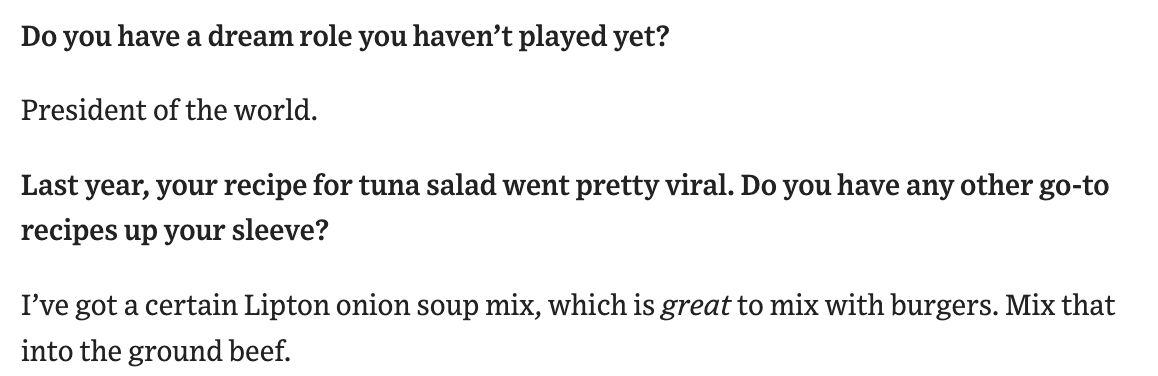
in WSJ.

in Singju Post
I always repeat this, but one of the coolest and simplest things I heard early on. I was onThe Jay Leno Show, my first talk show. He comes by the green room. He goes, “You nervous?” I go, “Yeah, a little bit.” He goes, “Look, I got simple advice, how to make this work.” I go what? He goes, “Just want to be here.” It’s always stuck with me: You just want to be there. All of a sudden the clock goes faster. You look back, you enjoy what you did more.
in Paper Magazine.
His Dallas Buyers Club diet:

That’s in Greenlights.
A striking aspect of Greenlights is how few of the stories take place on movie sets. For example, in this one paragraph he blows past the making of six different movies.
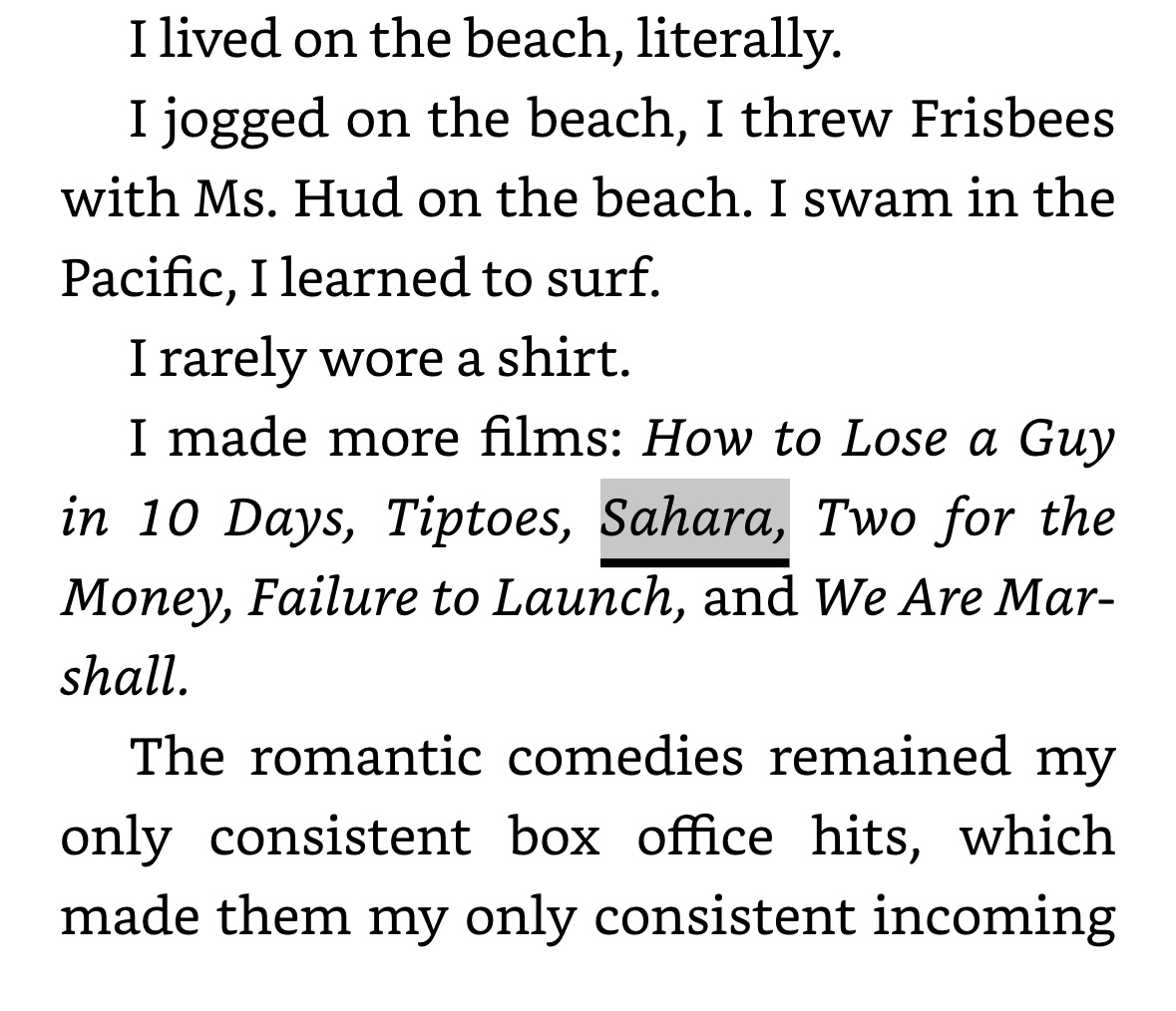
The actual making of movies may not be that interesting.
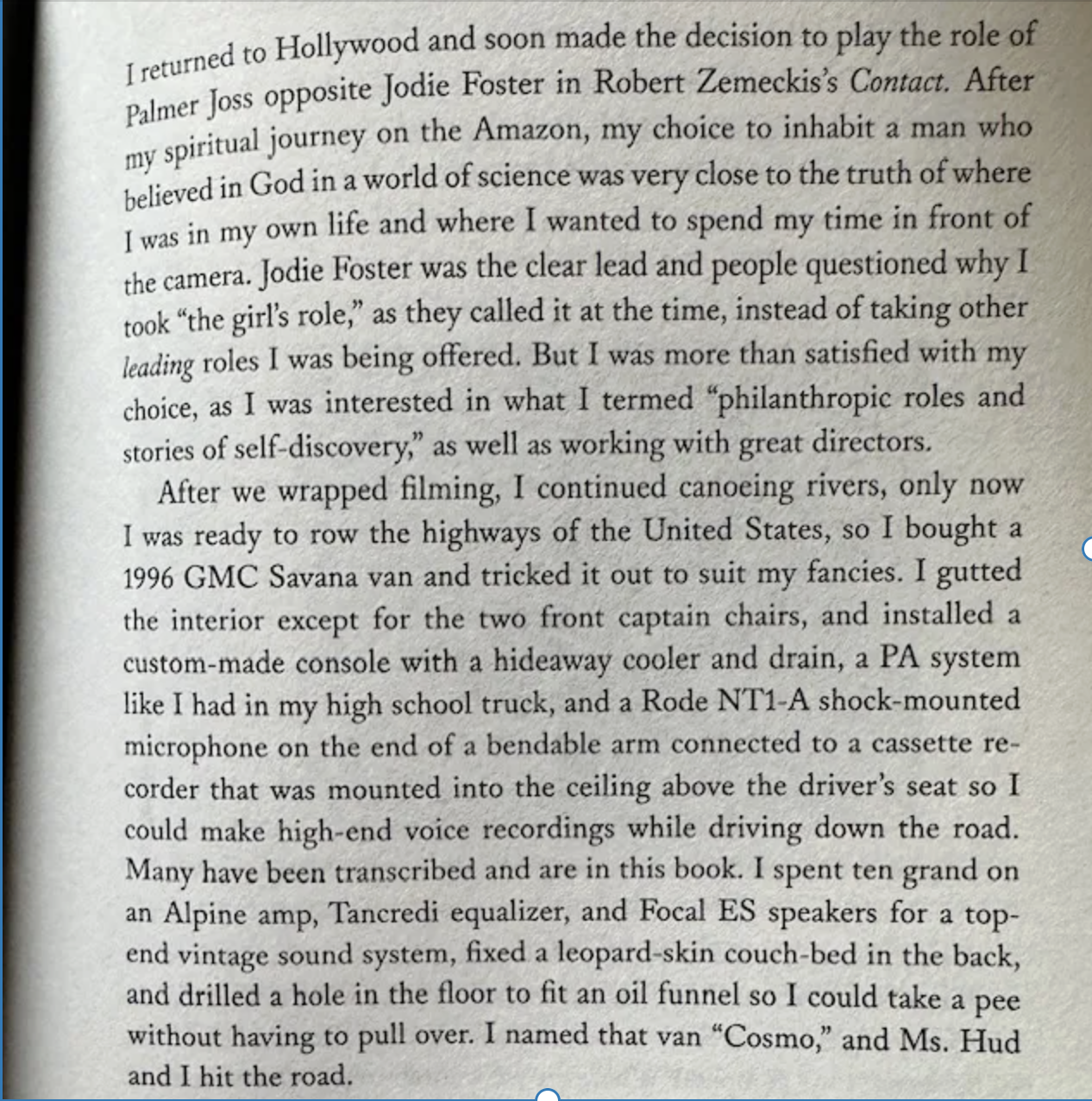
Greenlights is best received as an audiobook, as that’s how McConaughey composed it, talking into a microphone while driving:
Movieland by Jerome Charyn
Posted: October 25, 2025 Filed under: Hollywood Leave a comment
I remember something Charles Laughton told Tyrone Power once upon a time. Be careful. If Power, the movie star, wanted to act on stage, he would have to shed a particular demon. He might be an actor reading his lines, but he would “also be the monster, made up of all the characters [Power had played on the screen.” And Power would have to dispose of that monster by breathing and looking like a man. Perhaps. But the monster would still be behind every move. That mingling of time, roles half-remembered
About Louis B. Mayer and Fritz Lang’s M:
Where’s the love interest? Louis B. Mayer would have asked. What about the happy ending? Hollywood would hire Fritz Lang and Peter Lorre, the director and the star of M, a movie about a child murderer that turns in upon itself, like an amazing corkscrew, as Lorre, with an “M” marked on his back, tries to explain his own demons to the underworld of Berlin, who’ve captured Lorre and sentenced him to death, because his very existence has threatened their own profitable relationship with the police. M is a kind of Brechtian opera without song.
But Lorre’s cry to the underworld screams in our ear, forces us to examine who the hell we are. It’s not designed to comfort us in the dark. Lorre’s chubby, childlike face seems to make monsters of us all. We partake of his death. We convict him, as we convict ourselves.
Mayer never read scripts. But the idea of such a movie would have enraged him. He’d have demanded that a pair of lovers be thrown into the pot. Some police inspector, played by Richard Dix (borrowed from RKO for such a minor vehicle), and a queen of the underworld who reforms herself and marries Dix, while the murderer is shoved into the background. But whatever the limits of MGM, all its sugared life on screen, only Mayer’s Hollywood could have conceived Casablanca and Gone With the Wind.
Its message was that no one in America need be exempt from love. The newsboy could marry the millionairess if only he was industrious enough, and looked a little like Gable. Nothing got in the way of romance. In The Last Tycoon, F. Scott Fitzgerald has his film producer Monroe Stahr explain the basic melody of any motion picture. “We’ve got an hour and twenty-five minutes on the screen-you show a woman being unfaithful to a man for one-third of that time and you’ve given the impression that she’s one-third whore.”
Thalberg:
MGM was only a little giant, not to be compared with Paramount, which had De Mille and Gloria Swanson and Clara Bow, or United Artists, formed in 1919 by Chaplin, Mary and Doug, and D. W. Griffith, or that enormous acreage Irving left behind with Uncle Carl at Universal City. It was Hollywood, after all, and film companies could come and go, like those pirates who’d arrived in California, running from Edison’s people. Mayer wasn’t as even-tempered as Uncle Carl, and no one thought the Boy Wonder would survive very long with the junkman. But Irving had matured in movie-land. He was twenty-four. He’d given up woolen underwear and become a fixer. He could patch up any film. He was the producer-magician who could sense a structural flaw and locate the melody of a given scene. The Thalberg legend began to grow. “Of this slim, slight, nervous man it was said he lived in a motion picture theater all his waking hours and knew instincitively whether the shadows on screen would please the public.”
On Fitzgergald’s Love of the Last Tycoon:
Stahr was a popularist of the imagination, a tender of dream-scapes. He could assume only one condition, that he “take people’s own favorite folklore and dress it up and give it back to them. Anything beyond that is sugar.”
But Fitzgerald himself understood the power of that dream-scape, the magic behind the hollow walls. “Under the moon the back lot was thirty acres of fairyland-not because the locations really looked like African jungles and French châteaux and schooners at anchor and Broadway by night, but because they looked like the torn picture books of childhood, like fragments of stories dancing in an open fire.”
The fire of Plato’s cave.
On Raymond Chandler:
He was a very formal man, bound by the strict codes of Dulwich College. Chandler wouldn’t walk into the street without a jacket and a tie, but he was also a Bedouin in his ways, often moving once or twice a year. He had over seventy different addresses in Southern California. And he was an alcoholic. He lost his job in the middle of the Depression because of the drinking he did. And the failed poet started writing fiction for the pulp magazines. “I had to learn American just like a foreign language.”
He saw himself as “a man without a country,” neither English nor American, but some kind of cultural half-breed caught in the crazy quilt of Southern California, where men and women had to reinvent their lives. And Chandler, a good Dulwich boy who longed for tradition, had come to a place without a past, where whole peoples had to define themselves against the deserts, mountains, valleys, seas, and citrus groves.
Chandler was one more anonymous soul who’d become “a plots. y writer with a touch of magic and a bad feeling about His apprenticeship wasn’t easy. He didn’t publish his first novel until he was fifty-one. And even after Philip Marlowe was world-famous, Chandler grumbled about his own status in the United States. English intellectuals idolized him, adored his work, and Chandler “tried to explain to them that I was just a He was a very formal man, bound by the strict codes of Dul-wich College. Chandler wouldn’t walk into the street without a jacket and a tie, but he was also a Bedouin in his ways, often moving once or twice a year. He had over seventy different addresses in Southern California. And he was an alcoholic. He lost his job in the middle of the Depression because of the drinking he did. And the failed poet started writing fiction for the pulp magazines. “I had to learn American just like a foreign language.”
He saw himself as “a man without a country,” neither English nor American, but some kind of cultural half-breed caught in the crazy quilt of Southern California, where men and women had to reinvent their lives. And Chandler, a good Dulwich boy who longed for tradition, had come to a place without a past, where whole peoples had to define themselves against the deserts, mountains, valleys, seas, and citrus groves.
Chandler was one more anonymous soul who’d become “a plots. y writer with a touch of magic and a bad feeling about His apprenticeship wasn’t easy. He didn’t publish his first novel until he was fifty-one. And even after Philip Marlowe was world-famous, Chandler grumbled about his own status in the United States.
…
He understood that film was “not al transplanted literary or dramatic art … it is much closer to music, in the sense that its finest effects can be independent of precise meaning, that its transitions can be more eloquent than its high-lit scenes, and that its dissolves and camera movements, which cannot be censored, are often far more emotionally effective than its plots, which can.”
Eleven pages a week
Posted: August 24, 2024 Filed under: Hollywood, the California Condition, writing, writing advice from other people Leave a comment
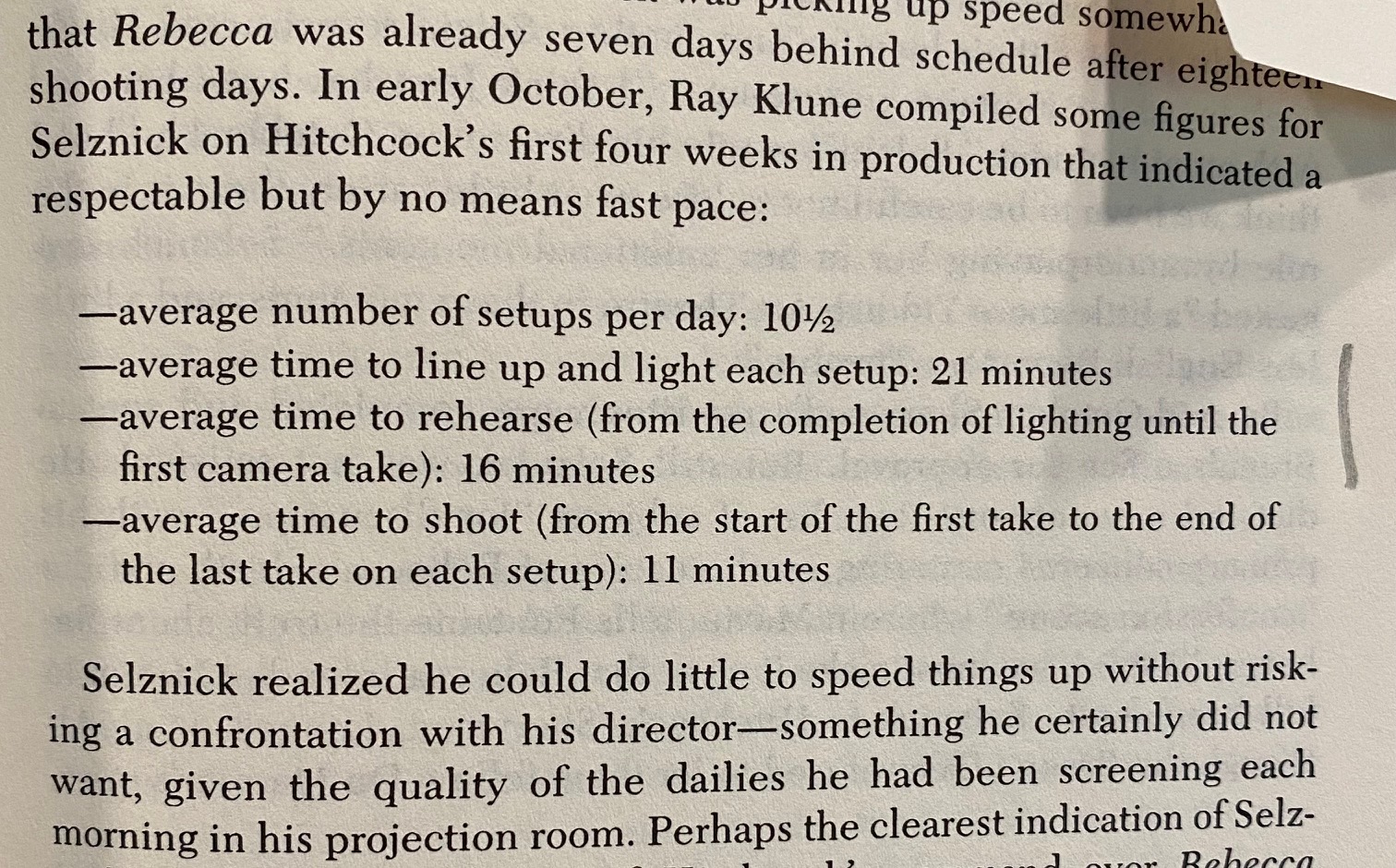
In one of my Hollywood books I read that writers in the studio system were expected to write eleven pages a week.
Eleven pages, seems very reasonable. Especially if we are talking script pages which have a lot of white on them.
Now you may have to write thirty-three pages to produce eleven good ones, but still.
I went looking for where I found this information but I couldn’t locate it in Schatz, Genius of the System, or Friedfrich, City of Nets, or Thomson, The Whole Equation: A History of Hollywood, or Behlmer, Memo from David O. Selznick, or Pirie, Anatomy of the Movies, or Rosen, Hollywood, or Dardis, Some Time in the Sun, or Powdermaker, Hollywood: The Dream Factory or even Solomon, William Faulkner The Screenwriter. Not to say it’s in one of those, I just couldn’t retrieve it.
Using a Google Books search I did find reference to an eleven pages expectation:

That’s in Mark Wheeler, Hollywood: Politics and Society, which I’ve never read.

Cool cover!
If you reliably produce eleven pages a week your odds at some success are high.
Eleven pages a week will be my goal when I return from vacation at the end of August.
(that Faulkner typing pic seems to be from Time-Life Getty Images, found it on Reddit).
Bluebeard’s Castle by Anna Biller
Posted: September 2, 2023 Filed under: Hollywood, Steinbeck, writing Leave a comment
Anna Biller is herself an exciting, energetic book reviewer. See for example her review of John Steinbeck’s The Grapes of Wrath, or her other Goodreads reviews. So we’ll try to bring you the same as we review her upcoming novel, Bluebeard’s Castle.

We requested a review copy because we’re Anna Biller fans after watching the 2016 film The Love Witch. This movie can be called a cult classic. A term like that and what it says is the sort of concept Biller herself might interrogate in one of the essays on her website.
The great thing about The Love Witch is that it’s totally unique. Who else is doing this? What’s another movie like this? It’s amazing that a movie like that exists. You can feel this is a project from someone with a singular vision. The Love Witch is striking, funny, odd, with a style that’s both homage and sendup of sort of 60s-70s Vincent Price era glam horror? After seeing it we followed Anna Biller on Twitter, where she mixes it up, mostly about film, in a fun way. Really though our way in is the director’s longer pieces of writing, like this account of the awfulness of working in a Honolulu hostess bar.

Bluebeard’s Castle is exactly what it purports to be, a retelling of the Bluebeard fairy tale/story/case study. But it’s more, a kind of play on the whole idea of the gothic novel, done with enthusiasm. A striking feature of it is that while it’s specific (we learn what people eat:
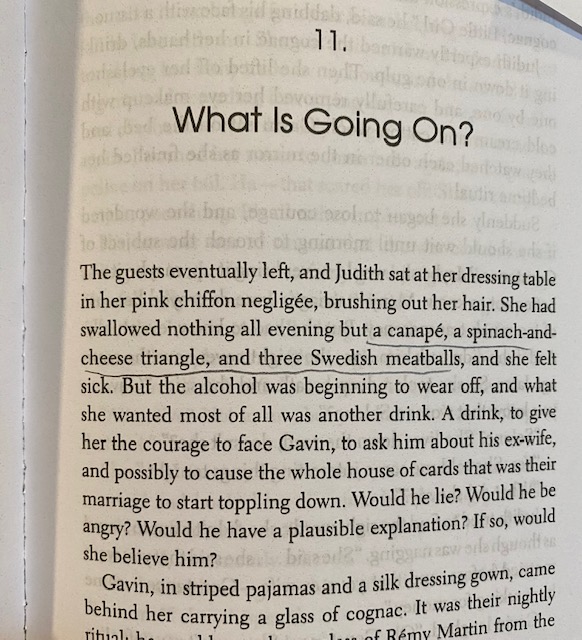
) the story also plays in a dreamlike timelessness.
Very cool and thrilling, even just on the sentence level. Nothing here is as it seems.
A+, excited to see the reaction when this book is released on October 10, 2023. Great for Halloween.
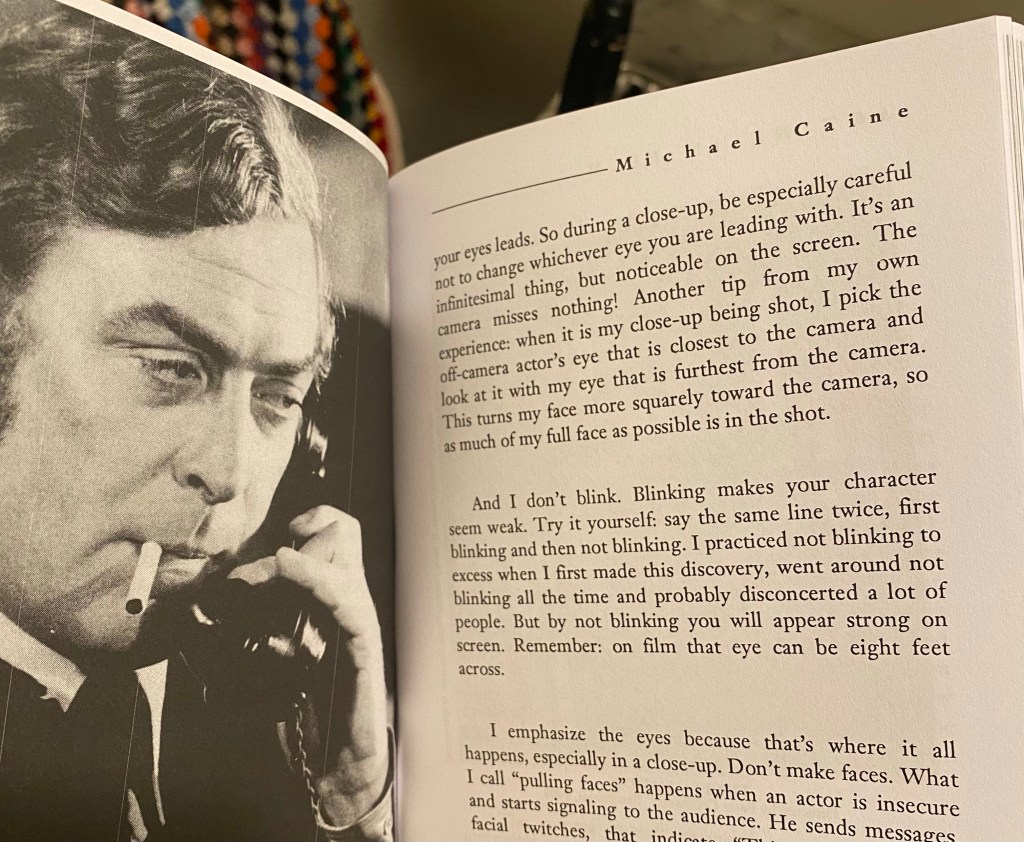
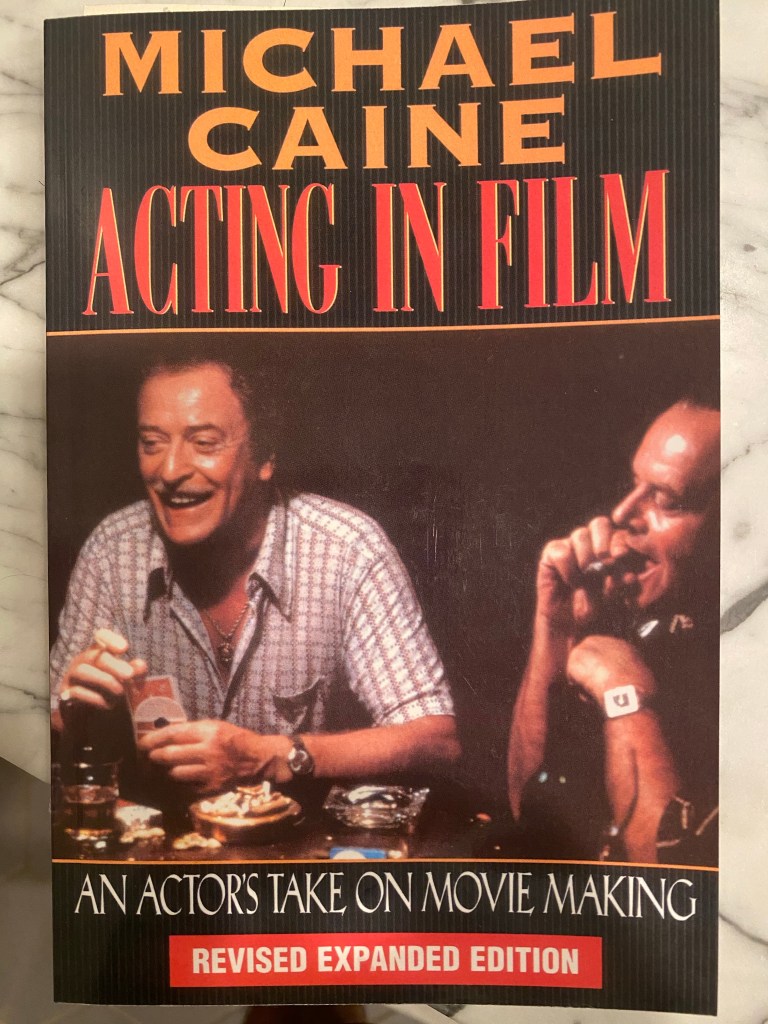
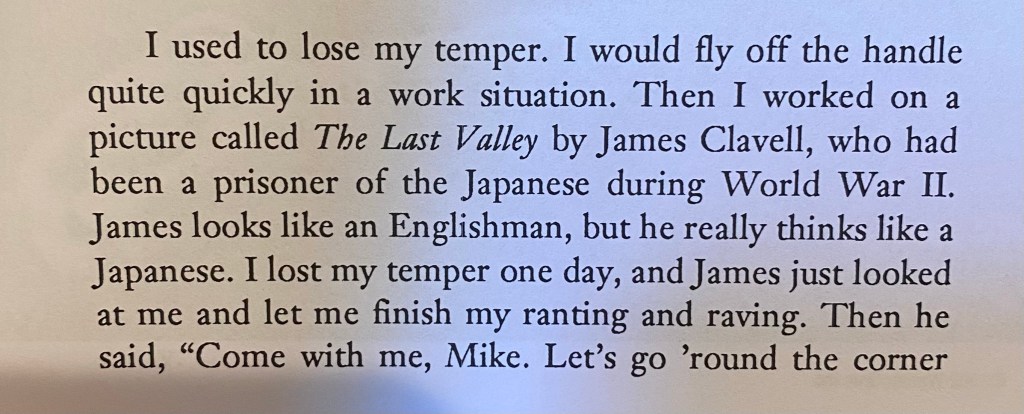

Scrapbasket
Posted: March 5, 2023 Filed under: Hollywood, writing Leave a comment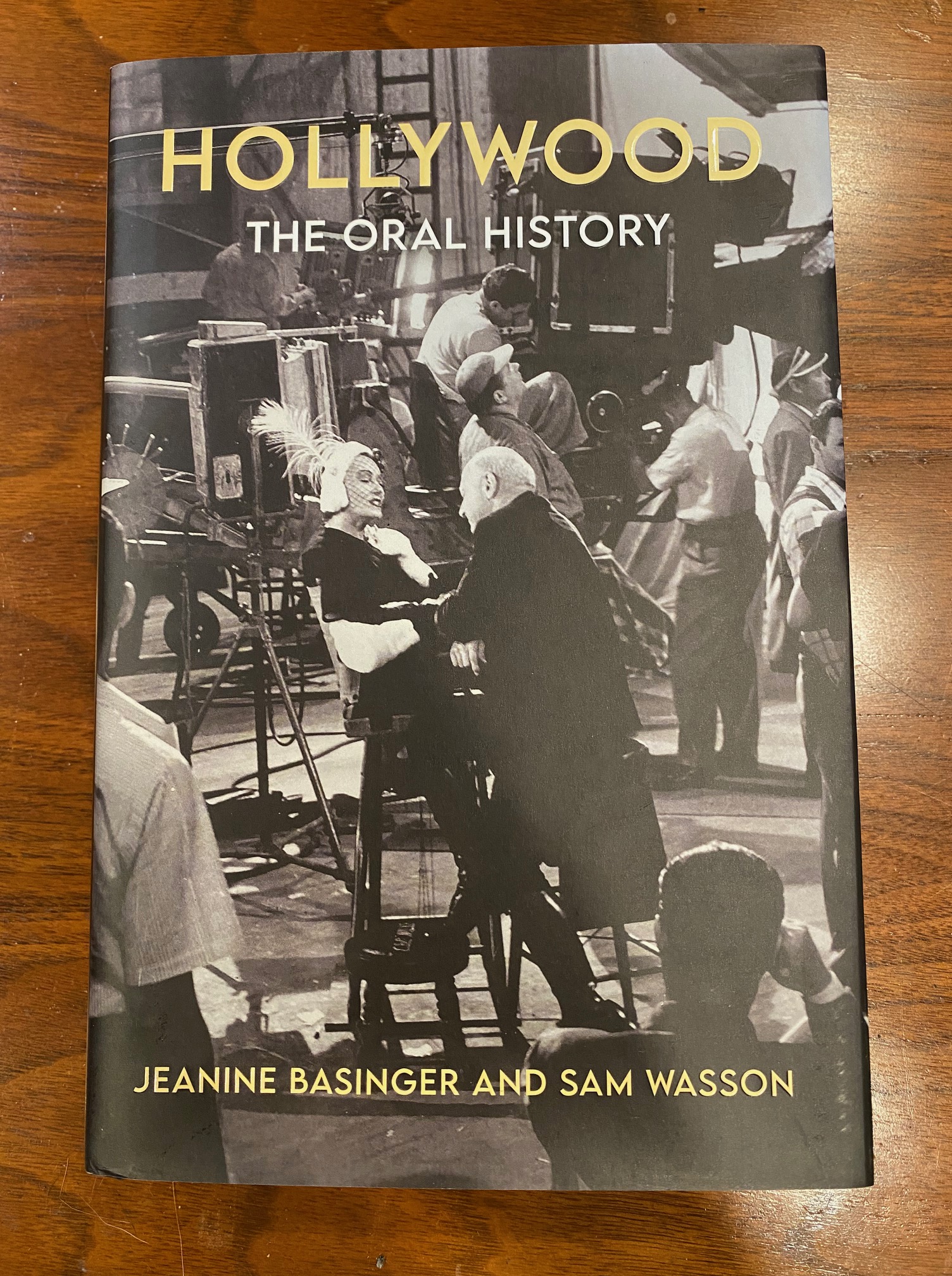
I’ve been reading.

and:

Did some deep reading about the history of Hollywood actually. Louis B. Mayer used to don diving equipment and salvage scrap metal in Boston Harbor:

That from:

Then he got the rights to show Birth of a Nation, and saw a magical new business. (He 4xed on the BoaN deal).


Keeping studios and theaters separate has been an ongoing war in the history of Hollywood. With streaming we are in a situation where they are once again the same.
Mayer:

In one of my Hollywood histories I found it documented that (iirc) a studio writer was expected to produce eleven pages a week, which seems like a reasonable number. However on re-searching I couldn’t find what book this was from. Maybe Genius of the System?

The exports of Saint Helena form a pleasing chart. The geography of Saint Helena is wild.

Would love to visit. Remembering Saturdays in my early mid teens when I would go to Globe Traveler Bookstore and read Lonely Planet books about practical travel to exotic places. Greenland, etc. How could a business that gave shelf space in downtown Boston to a travel book to Greenland stay? It couldn’t I guess, but the world might be poorer for it, Boston anyway, more sanded down.

I like the look of the mayor of East Palestine, Ohio. Following the train derailment with great interest. Recalling Sturgill Simpson, appearing on Trillbillies podcast, talking about how he used to work at a UNP yard. This is from memory but I believe it’s an accurate quote:
a train derailment is big boy pants

This one, a rec from Prof James, is a mind-expander:

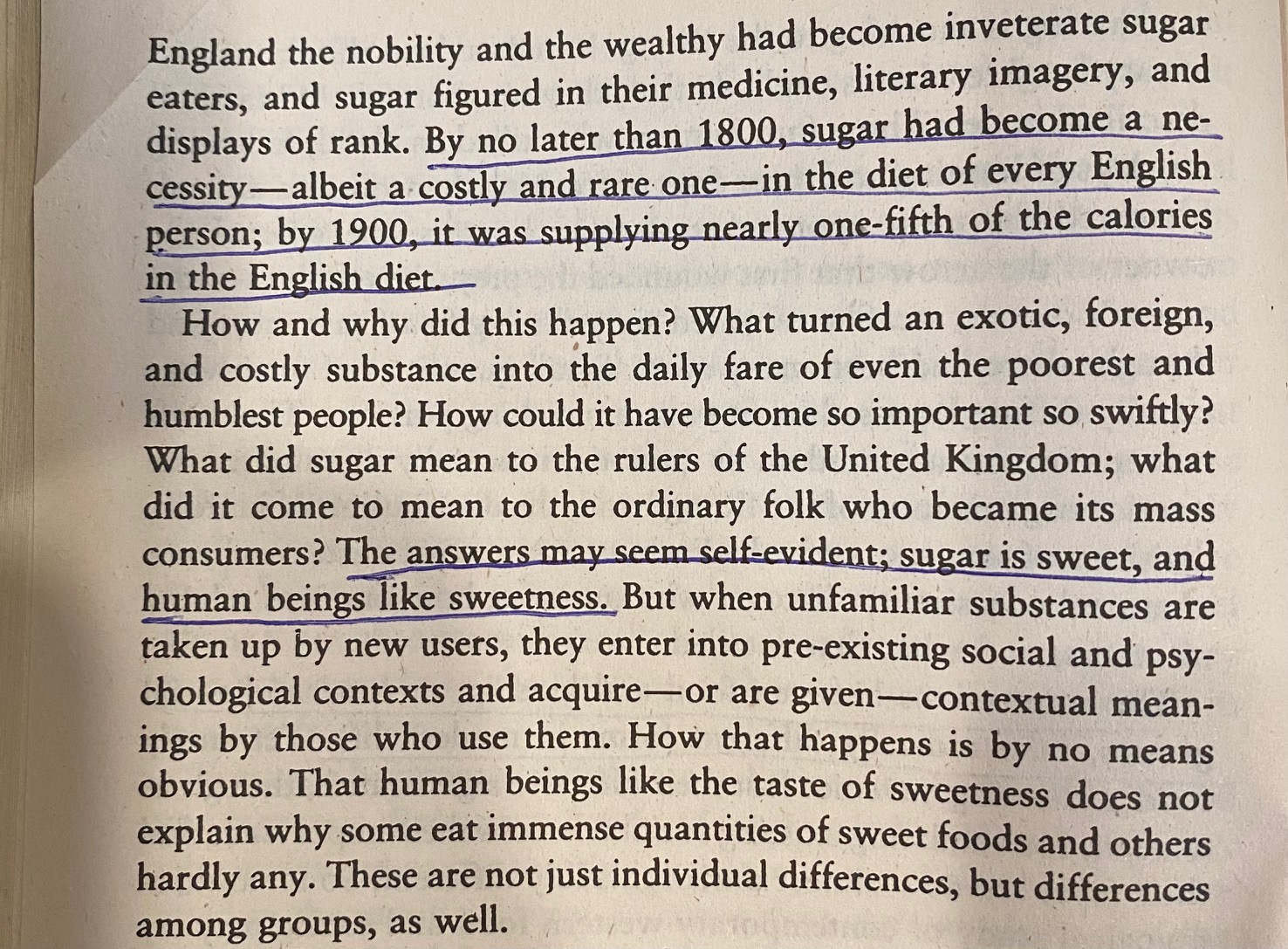
The extent to which the demand for sugar drove slavery is troubling to consider.

Book of poems, or stories, or both. They’re really good! The cover:

Surah 109, Al-Kafirun, The Unbelievers, is one of the shortest in the Quran, you can read or listen to it here. Thomas Cleary renders it thus:

Worth listening to it recited. The tales of crowded buses in the Muslim world that calm when someone puts on a tape of Quran recitation interest me.
Ten Commandments for Studio Readers, from Thalberg
Posted: September 6, 2022 Filed under: Hollywood, writing Leave a comment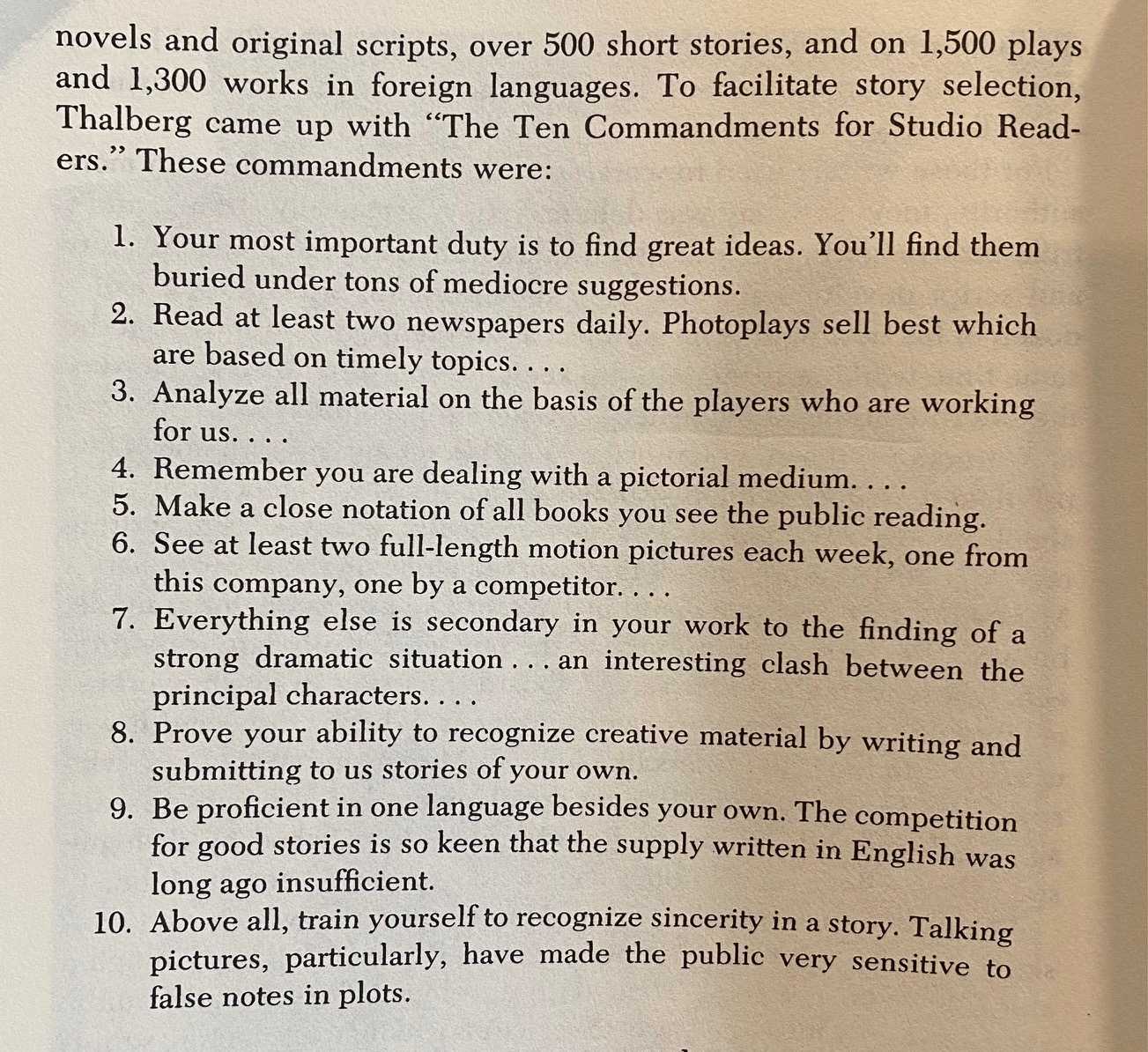
from The Genius of the System, Thomas Schatz.
The Golden West: Hollywood Stories, by Daniel Fuchs
Posted: August 14, 2022 Filed under: Hollywood, the California Condition, writing, writing advice from other people Leave a comment
Critics and bystanders who concern themselves with the plight of the Hollywood screenwriter don’t know the real grief that goes with the job. The worst is the dreariness in the dead sunny afternoons when you consider the misses, the scripts you’ve labored on and had high hopes for and that wind up on the shelf, when you think of the mountains of failed screenplays on the shelf at the different movie companies…
brother, I hear you, but also c’mon, it beats working for a living.
An old-timer in the business, a sweet soul of other days, drops into my room. “Don’t be upset,” he says, seeing my face. “They’re not shooting the picture tomorrow. Something will turn up. You’ll revise.” I ask him what in his opinion there is to write, what does he think will make a good picture. He casts back in his mind to ancient successes, on Broadway and on film, and tries to help me out. “Well, to me, for an example – now this might sometimes come in handy – it’s when a person is trying to do something to another person, and the second fellow all the time is trying to do it to him, and they both of them don’t know.” Another man has once told me the secret of motion picture construction: “A good story, for the houses, it’s when the ticket buyer, if he should walk into the theater in the middle of the picture – he shouldn’t get confused but know pretty soon what’s going on.” “The highest form of art is a man and a woman dancing together,” still a third man has told me.
Betty Perske
Posted: August 10, 2022 Filed under: America Since 1945, Hollywood Leave a commentIt’s a famous and apparently true story that Howard Hawks cast Lauren Bacall (birth name Betty Perske) in To Have and Have Not opposite Humphrey Bogart, after his wife Slim saw her on the cover of the March 1943 issue of Harper’s Bazaar. The cover was shot in Kodachrome under the eye of Diana Vreeland.
Wikipedia, in the article on photographer Louise Dahl-Wolfe, editorializes:
The young woman looks either waiting to go inside to donate or about to leave the Red Cross blood donor room. The expression on her face is nonchalant with a suggestion that she does not attend the blood donation clinic regularly. Her eyes are empty. She may be disappointed or sad or helpless just as any other American woman knowing the reality is no one can escape. The audience can sense the uncertainty in the air of the time from her expression.

[Bacall’s] final role was in 2014 as a guest voice appearance in the Family Guy episode “Mom’s the Word.”[73]
source:
Mike Judge on The Three Stooges
Posted: August 7, 2022 Filed under: comedy, Hollywood Leave a comment.
You brought back a wilder, more anarchic comedy with “Beavis and Butt-Head” in the nineties. At the time, it reminded me of the ferocity of the Three Stooges and other early filmed comedy.
Yeah. It had disappeared for a while. I think for a lot of us—the old folks—there was a time when we were kids, in the seventies or eighties, and the Three Stooges would come on late at night on some weird channel, and it just seemed amazing. I’m a huge Three Stooges fan. It’s interesting to me that when film first had sound, it didn’t take long for people to realize that possibly the best use of that technology was just somebody smacking another person in the head. I’m always arguing with sound mixers about this, because now they layer all the sounds, and it’s funnier when it’s one pure, distinct sound like the Three Stooges had, which is probably just some guy sitting there with a coconut or smacking something. Those sounds are hard to beat. But they now have the ability to layer twenty different sounds, and it ends up being one big, mushy, meaningless, loud sound.
interviewed in The New Yorker.
anyone remember the Three Stooges Nintendo game?

How about this:
Did working dreary jobs help you when it came to writing comedy?
Puts it in perspective. There’s so much material I’ve got from working so many jobs. A lot of the writers that I’ve worked with, same thing. It usually ends up being a good experience.
I remember there was a book I grabbed at a bookstore a long time ago, “Ernest Hemingway on Writing,” and I expected him to be, like, “You’ve got to suffer,” and this and that. But one thing that stood out was something he wrote to F. Scott Fitzgerald: “The good parts of a book may be only something a writer is lucky enough to overhear or it may be the wreck of his whole damn life—and one is as good as the other.” I think that’s a pretty honest thing for him to admit. I remember conversations pretty well. Can’t remember people’s names, but I remember their life story and other details.
They don’t know you’re lying.
Posted: August 7, 2022 Filed under: Hollywood Leave a commentThey didn’t know what it took to sell tickets to young people, and I remember Francis Coppola saying to me, “Just go in there and tell them you know the answer. Just tell them. They don’t know. They don’t know you’re lying. You walk in there and you say, “This is your lucky day because you want to make money in movies, and I want to make money in movies, and I know how to get money.”
Paul Schrader talking about the studios in the early ’70s.
A whole dozen or fifteen filmmakers came in that gap with that sort of braggadocio, and they got empowered, and some of them actually did make money.
from Rock Me On The Water: 1974 The Year Los Angeles Transformed Movies, Music, Television and Politics by Ronald Brownstein, which we got at Chevalier Books on Larchmont.
Where is Hollywood?
Posted: August 3, 2022 Filed under: Hollywood, the California Condition Leave a comment
Hollywood and Highland, 1907. Source.
There was a municipality called Hollywood. It existed from 1903 to 1910. This Hollywood gave up its independence to Los Angeles in exchange for water. Los Angeles was about to arrange for a steady supply via William Mulholland’s Los Angeles Aqueduct, and thirsty Hollywood needed in. (Will this happen to other cities? Countries?)
What is the definition of Hollywood? Here is a map that appears to show the old municipality, I found it on Pinterest (barf) and cannot trace it to a source, this is the closest I get:

Here’s how the LA Times defines Hollywood:

Also seems to be a dead link, I found it here.
AboutHollywood.com tells us this:
Although it is not the typical practice of the City of Los Angeles to establish specific boundaries for districts or neighborhoods, Hollywood is a recent exception. On February 16, 2005, Assembly Members Goldberg and Koretz introduced a bill to require the State to keep specific records on Hollywood as though it were independent. For this to be done, the boundaries were defined. This bill was unanimously supported by the Hollywood Chamber of Commerce and the LA City Council. Assembly Bill 588 was approved by the Governor on August 28, 2006, and now the district of Hollywood has official borders. The border is shown at the right, and can be loosely described as the area east of Beverly Hills and West Hollywood, south of Mulholland Dr., Laurel Canyon, Cahuenga Blvd. and Barham Blvd., and the cities of Burbank and Glendale, north of Melrose Avenue, and west of the Golden State Freeway and Hyperion Avenue.
But how to explain this sign, found on Melrose and Flores (the southwest corner, in fact!) which would push the boundary of Hollywood further west than anyone is prepared to acknowledge?

Kate Corbaley, Storyteller
Posted: July 29, 2022 Filed under: actors, Hollywood, screenwriting, the California Condition, writing Leave a commentAnother staff writer with a rather unconventional but valued talent was Kate Corbaley. At $150 a week, Corbaley was one of the few staffers whose salary was in the same range as Selznick’s…
Her specialty was not in editorial but rather as Louis Mayer’s preferred “storyteller.” Mayer was not a learned or highly literate man, and he rarely read story properties, scripts, or even synopses. He preferred to have someone simply tell him the story and he found Mrs. Corbaley’s narrational skills suited him. She never received a writing credit on an MGM picture, but many in the company considered her crucial to Mayer’s interest in stories being considered for purchase or production at any given time.
That’s from Thomas Schatz, The Genius of the System: Hollywood Filmmaking in the Studio Era.
Corbaley’s brother was Admiral S. C. Hooper, “the father of naval radio,” if The New York Times is to be believed. What a family of communicators!
Storytelling is a current obsession in business. A few days ago I searched “storyteller” under Jobs on LinkedIn and found 35,831 results. Amazon, Microsoft, and Pinterest are all hiring some version of “storyteller,” as are Under Armor, Eataly and “X, the Moonshot Factory.” The accounting firm Deloitte is hiring Financial and Strategic Storytellers (multiple listings, financial and strategic storytellers are sought in San Diego, Miami, Chicago, Charlotte, Tampa, Las Vegas, and Phoenix).
Cool job.
It’s reported in City of Nets: A Portrait of Hollywood in the 1940s that one afternoon in May, 1936, Kate Corbaley summarized a novel that was already perceived as hot property. She told Louis B. Mayer
a new story about a tempestuous southern girl named Scarlett O’Hara.
Mayer wasn’t sure what to think, so he sent for Irving Thalberg, who declared:
Forget it, Louis. No Civil War picture ever made a nickel.
(This seems improbable: in 1936 Birth of A Nation would’ve held the record as one of if not the biggest movie of all time? Must track this tale to its source, will report.)
Genius of the system
Posted: July 15, 2022 Filed under: America Since 1945, Hollywood, the California Condition Leave a comment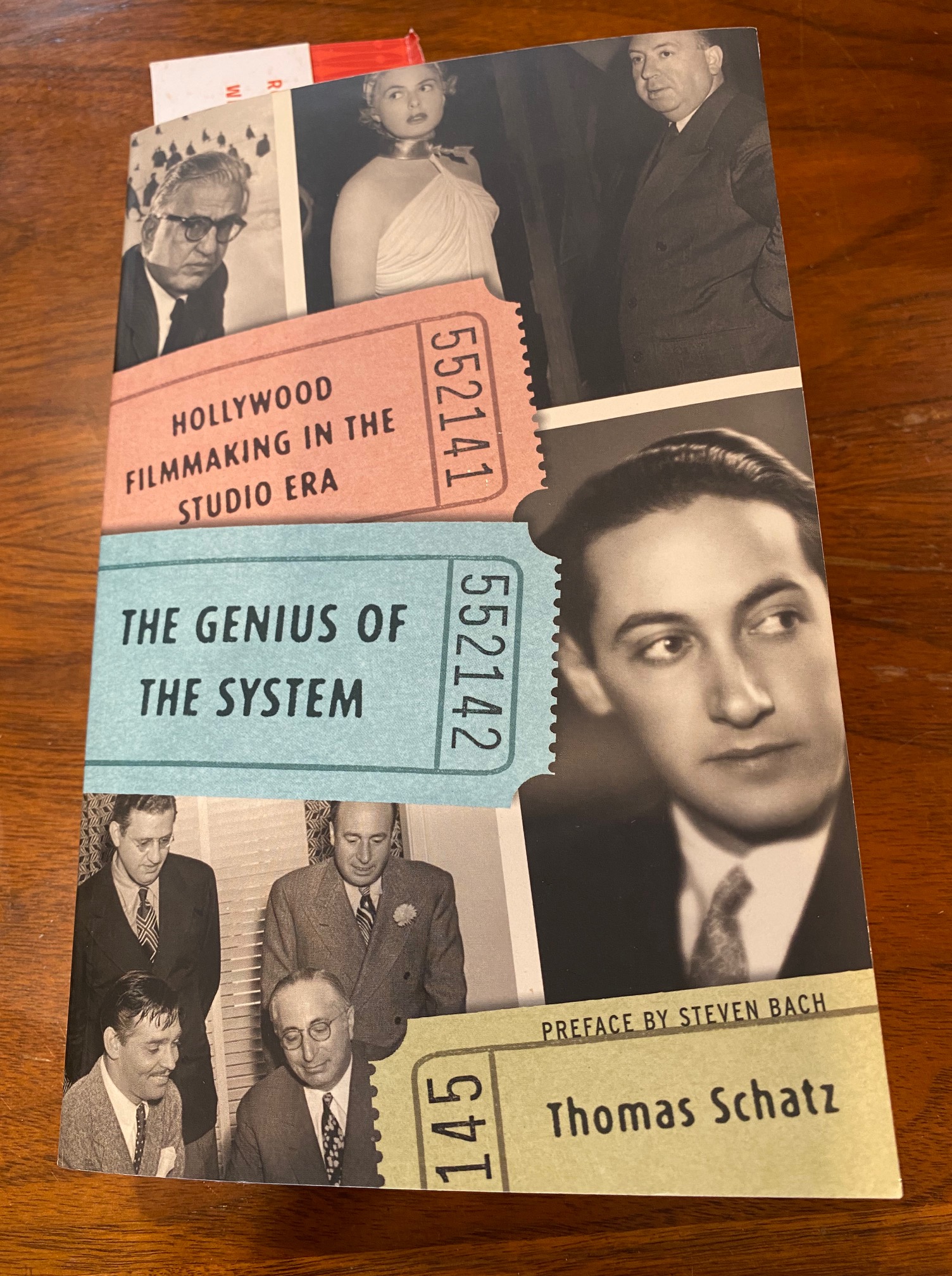
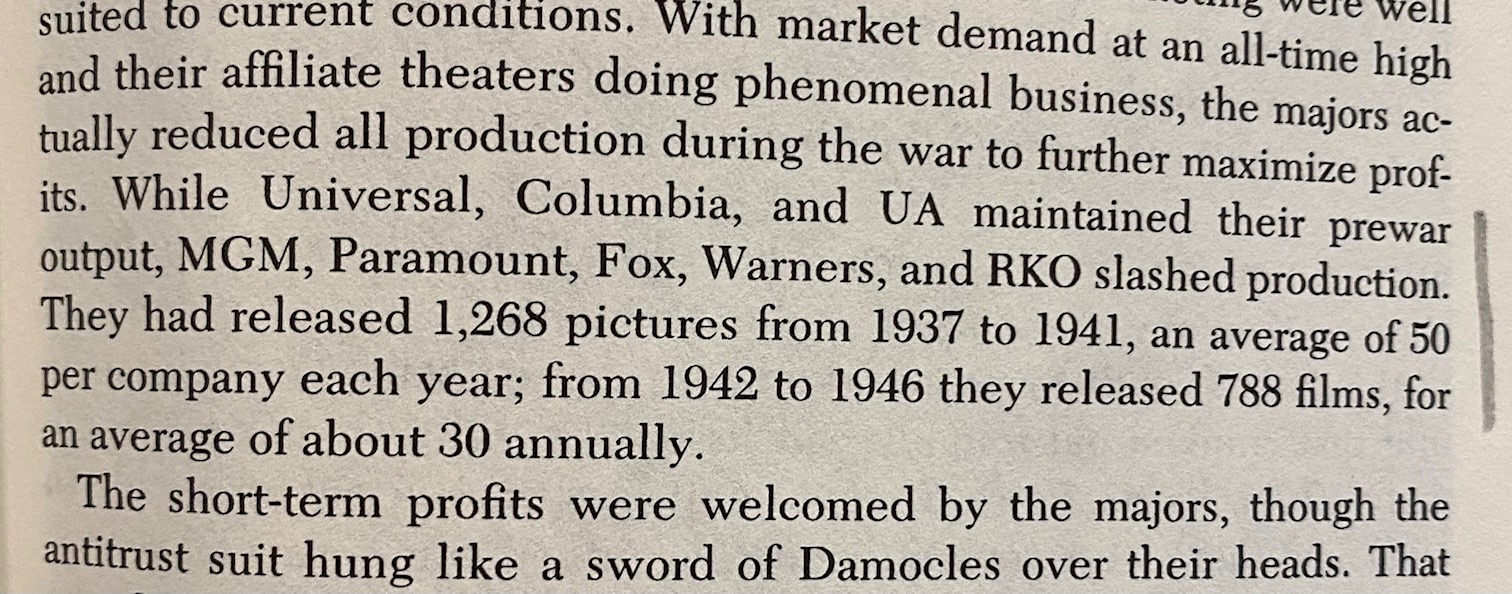
The sheer number of movies Hollywood cranked out during the peak of the studio system is wild. In 1936, for example, Paramount released 69 movies, RKO had 39, Fox had 50 movies, MGM put out 48 movies, Warner 56, Universal 34.
This was the factory-like story production processes Faulkner was working under.
Thomas Schatz’s book The Genius of the System is of daunting thickness, but it’s very readable, and I like the thesis: despite the factory nature and control by the money guys rather than the directors, real style and art was achieved.
Auterism itself would not be worth bothering with if it hadn’t been so influential, effectively stalling film history and criticism in a prolonged stage of adolescent romanticism. But the closer we look at Hollywood’s relations of power and hierarchy of authority during the studio era, at its division of labor and assembly-line production process, the less sense it makes to assess filmmaking or film style in terms of the individual director – or any individual, for that matter.
Should we look at the old studio system trying to find cases where a rare director snuck art past the suits? Or should we look at it and see a miraculous time, when thousands of artists and craftspeople came together for a brief period to create the collective dreams of a nation?
Schatz gives a good short summary of his work and the rise and fall of the studio system in this 1989 Fresh Air interview.
In The Offer, Paramount +’s show about the making of Paramount Pictures’ The Godfather, you can see dramatized some of the problems from the end of the true studio system days. The show was shot on the Paramount lot, doubling as the Paramount lot from 1971. There’s a studio, but when they start a movie, they start from scratch. Casting, finding the right people for technical roles, chain of command, getting a workflow going, dealing with the unions, the mob: all these are begun anew for each production. Poor Al Ruddy has to solve each problem fresh. Robert Evans is there, but he’s no Thalberg, with central command over all the gears in the machine. When the movie’s, it’s over. Everything resets. In the year The Godfather came out, Paramount put out sixteen pictures.
Sometimes companies manage to recreate the cohesion of the studio system. Take Pixar, for example, or the Marvel movies. How about Hallmark movies? Individual directors and producers can have runs like this too: Selznick was doing it by 1935. But at nowhere like the studio scale.
Studios had specialties, flavors: MGM had musicals, Universal had monster movies, Warner Brothers had gangster pictures. In 2022, do the streamers have anything like this? I know what BritBox is.
Even on our startup model, plenty of dreams get produced. Movies might be uncountable, how many are there? 403? How many scripted TV shows are there? 532?
Gracenote, a Nielsen company, listed more than 817,000 unique program titles across U.S. traditional TV and streaming services, with many of those titles featuring hundreds of individual episodes and chapters. Back in December 2019, there were just over 646,000 unique program titles.
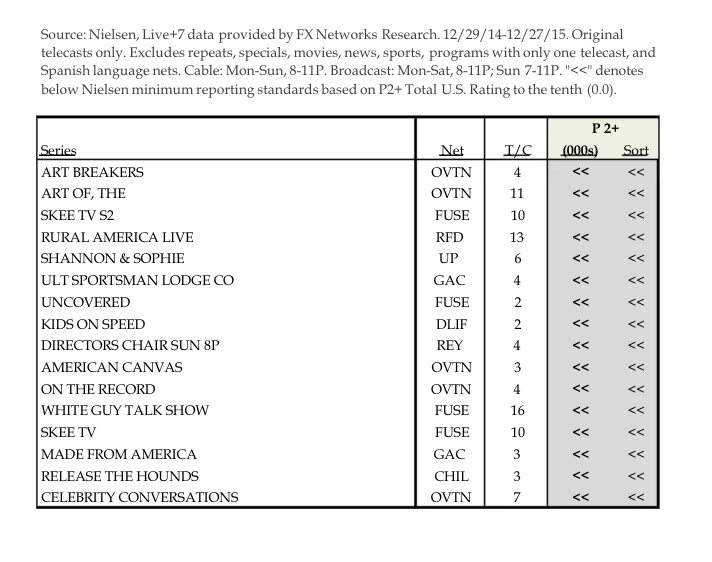
So says Nielsen’s State of Play report. I found this Hollywood Reporter piece citing an FX report from 2016 that lists all 1,400 primetime shows, starting with Big Bang Theory and ending with:
The Paramount decree in 1948 stopped the studios from owning the theaters. One of many blows, along with TV, shifting lifestyles, etc that forced change on the system. But we’ve re-evolved back around on vertical integration. Disney, for example, is a studio yet owns its own distribution: Disney +. Is that a violation of the Paramount decree? Let’s look into it:
As part of a 2019 review of its ongoing decrees, the Department of Justice issued a two-year sunsetting notice for the Paramount Decree in August 2020, believing the antitrust restriction was no longer necessary as the old model could never be recreated in contemporary settings.
Oh!
Didion on Hollywood/gambling
Posted: December 27, 2021 Filed under: Hollywood Leave a commentThe place makes everyone a gambler. Its spirit is speedy, obsessive, immaterial. The action itself is the art form, and is described in aesthetic terms: “A very imaginative deal,” they say, or, “He writes the most creative deals in the business.” There is in Hollywood, as in all cultures in which gambling is the central activity, a lowered sexual energy, an inability to devote more than token attention to the preoccupations of the society outside. The action is everything, more consuming than sex, more immediate than politics; more important always than the acquisition of money, which is never, for the gambler, the true point of the exercise.
I think about this one all the time. Source. Nobody was tougher on “critics.”
To recognize that the picture is but the by-product of the action is to make rather more arduous the task of maintaining one’s self-image as (Kauffmann’s own job definition) “a critic of new works.” Making judgments on films is in many ways so peculiarly vaporous an occupation that the only question is why, beyond the obvious opportunities for a few lecture fees and a little careerism at a dispiritingly self-limiting level, anyone does it in the first place.
and:
Perhaps the difficulty of knowing who made which choices in a picture makes this airiness so expedient that it eventually infects any writer who makes a career of reviewing; perhaps the initial error is in making a career of it. Reviewing motion pictures, like reviewing new cars, may or may not be a useful consumer service (since people respond to a lighted screen in a dark room in the same secret and powerfully irrational way they respond to most sensory stimuli, I tend to think most of it beside the point, but never mind that); the review of pictures has been, as well, a traditional diversion for writers whose actual work is somewhere else. Some 400 mornings spent at press screenings in the late 1930s were, for Graham Greene, an “escape,” a way of life “adopted quite voluntarily from a sense of fun.” Perhaps it is only when one inflates this sense of fun into (Kauffmann again) “a continuing relation with an art” that one passes so headily beyond the reality principle.
Marilyn Monroe’s best ever
Posted: October 18, 2020 Filed under: Hollywood, sexuality Leave a commentThey trade sex stories. Capote tells of a homosexual fling he had with Errol Flynn. Marilyn: “It’s not as if you told me anything new. I’ve always known Errol zigzagged. I have a masseur, he’s practically my sister, and he was Tyrone Power’s masseur, and he told me all about the things Errol and Ty Power were doing…. So let’s hear your best experience. Along those lines.”
Capote: “The best? The most memorable? Suppose you answer the question first.”
Marilyn: “And I drive hard bargains! Ha! (Swallowing champagne) Joe’s not bad. He can hit home runs. If that’s all it takes, we’d still be married. I still love him, though. He’s genuine.”
Capote: “Husbands don’t count. Not in this game.”
Marilyn (nibbling her nail, really thinking): “Well, I met a man, he’s related to Gary Cooper somehow. A stockbroker, and nothing much to look at– sixty-five, and he wears those very thick glasses. Thick as jellyfish. I can’t say what it was, but–”
Capote: “You can stop right there. I’ve heard all about him from other girls… He’s Rocky Cooper’s stepfather. He’s supposed to be sensational.”
Marilyn: “He is. Okay, smart-ass. Your turn.”
That, from Truman Capote’s Music for Chameleons, quoted in this fantastic post about Marilyn’s social networks by the always interesting Randall Collins, frequent Helytimes subject.
Who was this mysterious man?

Veronica “Rocky” Cooper. From her Wikipedia:
Veronica Balfe was born to Veronica Gibbons and Harry Balfe, Jr. Following her parents’ divorce, she lived in Paris with her mother. Balfe did not see her father for many years, but kept in touch with her grandfather, who owned a ranch in California. Balfe saw her father a few years before his death in the 1950s. Her mother married Paul Shields, a successful Wall Street financier.
An avid sportswoman, Balfe was known to her friends by the nickname, “Rocky.” [1]

Aside from that and this, the man seems to slip through the internet. But what else do you need to know, really?
Always the possibility that Truman Capote made all this up for whatever reason.
Conversations with Faulkner
Posted: September 7, 2020 Filed under: America Since 1945, Hollywood, Mississippi, writing, writing advice from other people Leave a comment
Alcohol was his salve against a modern world he saw as a conspiracy of mediocrity on its ruling levels. Life was most bearable, he repeated, at its simplest: fishing, hunting, talking biggity in a cane chair on a board sidewalk, or horse-trading, gossiping.
Bill spoke rarely about writing, but when he did he said he had no method, no formula. He started with some local event, a well-known face, a sudden reaction to a joke or an incident. “And just let the story carry itself. I walk along behind and write down what happens.”
Origin story:
Q: Sir, I would like to know exactly what it was that inspired you to become a writer.
A: Well, I probably was born with the liking for inventing stories. I took it up in 1920. I lived in New Orleans, I was working for a bootlegger. He had a launch that I would take down the Pontchartrain into the gulf to an island where the run, the green rum, would be brought up from Cuba and buried, and we would dig it up and bring it back to New Orleans, and he would make scotch or gin or whatever he wanted. He had the bottles labeled and everything. And I would get a hundred dollars a trip for that, and I didn’t need much money, so I would get along until I ran out of money again. And I met Sherwood Anderson by chance, and we took to each other from the first. I’d meet him in the afternoon, we would walk and he would talk and I would listen. In the evening we would go somewhere to a speakeasy and drink, and he would talk and I would listen. The next morning he would say, “Well I have to work in the morning,” so I wouldn’t see him until the next afternoon. And I thought if that’s the sort of life writers lead, that’s the life for me. So I wrote a book and, as soon as I started, I found out it was fun. And I hand’t seen him and Mrs. Anderson for some time until I met her on the street, and she said, “Are you mad at us?” and I said, “No, ma’am, I’m writing a book,” and she said, “Good Lord!” I saw her again, still having fun writing the book, and she said, “Do you want Sherwood to see your book when you finish it?” and I said, “Well, I hadn’t thought about it.” She said, “Well, he will make a trade with you; if he don’t have to read that book, he will tell his publisher to take it.” I said, “Done!” So I finished the book and he told Liveright to take it and Liveright took it. And that was how I became a writer – that was the mechanics of it.
Stephen Longstreet reports on Faulkner in Hollywood, specifically To Have and Have Not:
Several other writers contributed, but Bill turned out the most pages, even if they were not all used. This made Bill a problem child.
The unofficial Writers’ Guild strawboss on the lot came to me.
“Faulkner is turning out too many pages. He sits up all night sometimes writing and turns in fifty to sixty pages in the morning. Try and speak to him.”
Showbiz
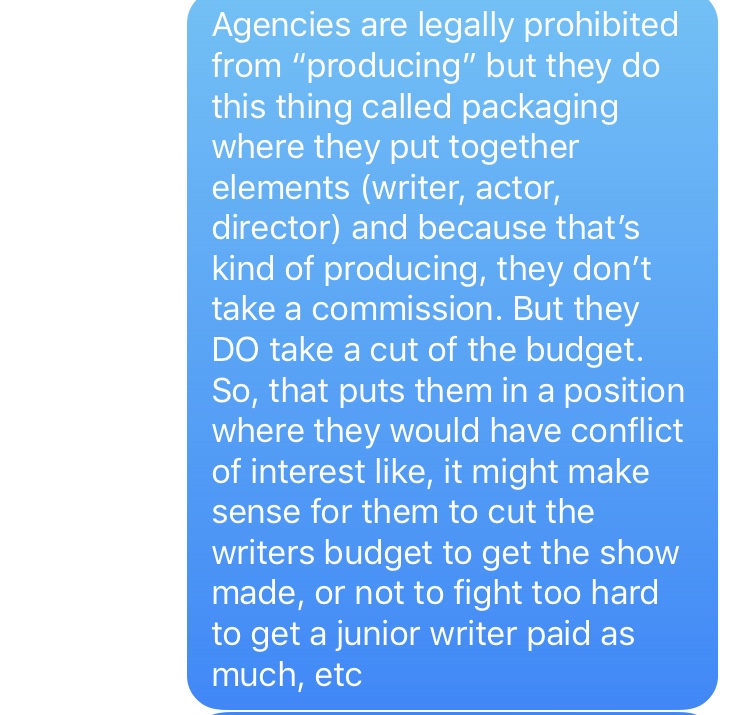
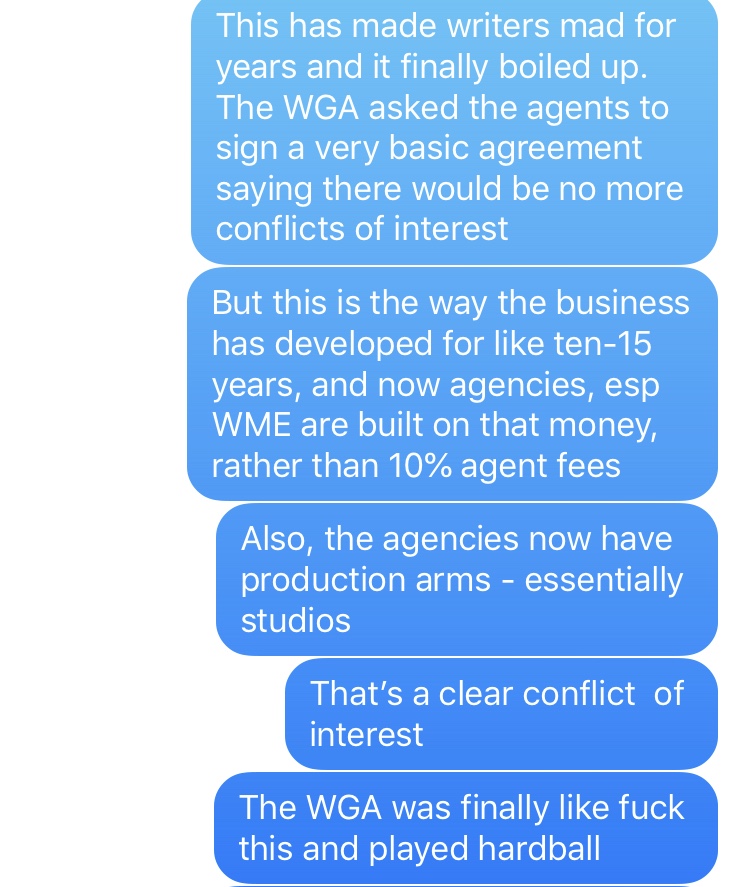
Posted: April 15, 2019 Filed under: Hollywood, the California Condition Leave a commenta non-industry friend asked me to summarize the current dispute between the WGA and the ATA. I did my best:
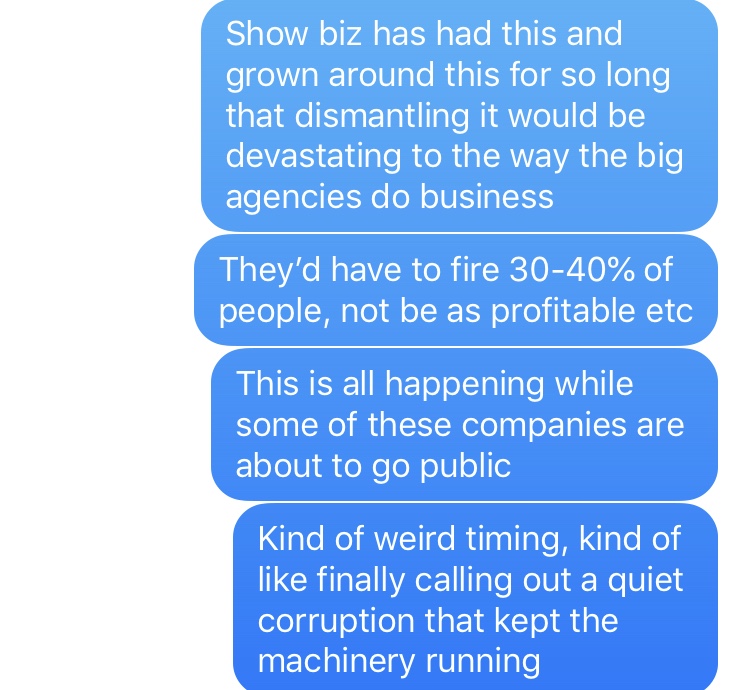
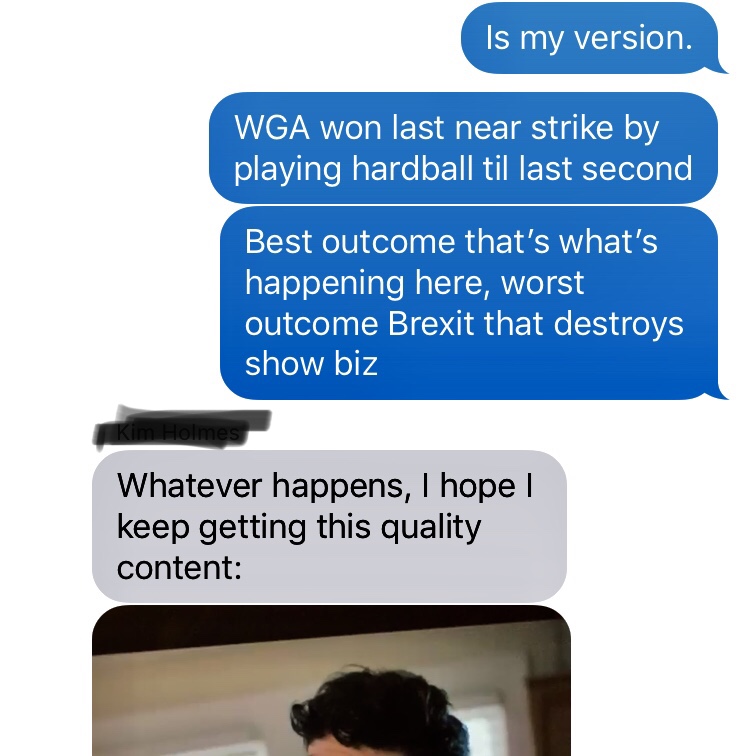
Anyway. We welcome comment!

Should we boycott The Beverly Hills Hotel?
Posted: April 3, 2019 Filed under: Hollywood, the California Condition 1 Comment
George Clooney says yes. The reason why is because this hotel, along with nine other fancy hotels, the Bel-Air here and some in London and France, are owned by the Sultan of Brunei. Clooney:
At the head of it all is the Sultan of Brunei who is one of the richest men in the world. The Big Kahuna. He owns the Brunei Investment Agency and they in turn own some pretty spectacular hotels.
A couple of years ago two of those hotels in Los Angeles, The Bel-Air and The Beverly Hills Hotel were boycotted by many of us for Brunei’s treatment of the gay community. It was effective to a point. We cancelled a big fundraiser for the Motion Picture Retirement Home that we’d hosted at the Beverly Hills Hotel for years. Lots of individuals and companies did the same. But like all good intentions when the white heat of outrage moves on to the hundred other reasons to be outraged, the focus dies down and slowly these hotels get back to the business of business.
But now there’s a new law going into place in Brunei. Says Clooney:
The date April 3rd has held a unique place in our history over the years. Theologians and astronomers will tell you that Christ was crucified on that date.
(what?)
On April 3rd Harry Truman signed the Marshall Plan, arguably the greatest postwar intervention in the history of man. The first portable cellphone call was made on April 3rd. Marlon Brando was born on that day.
But this April 3rd will hold its own place in history. On this particular April 3rd the nation of Brunei will begin stoning and whipping to death any of its citizens that are proved to be gay. Let that sink in. In the onslaught of news where we see the world backsliding into authoritarianism this stands alone.
Here’s the thing though. The last execution of any kind in Brunei was in 1957.
It’s not like they’re stoning people all the time. The 1957 execution actually happened while Brunei was a UK protectorate.
Meanwhile, in Saudi Arabia, four years ago:
In 2014, a 24-year-old Saudi Arabian man was sentenced to three years detention and 450 lashes after a Medina court found him guilty of “promoting the vice and practice of homosexuality”, after he was caught using Twitter to arrange dates with other men.[18]
A year ago, in Hollywood:
On Wednesday night, M.B.S. was welcomed to a Hollywood dinner hosted by producer Brian Grazer and his wife Veronica, alongside William Morris Endeavor boss Ari Emanuel, who is finalizing a deal with M.B.S. for a $400 million stake in Emanuel’s talent agency. The guest list was saturated with executives, including Amazon’s Jeff Bezos, Disney’s Bob Iger, Patriots owner Robert Kraft, and Snapchat’s Evan Spiegel, as well as tech entrepreneur Kobe Bryant, whom the prince reportedly made a special request to meet. Having traded his traditional ceremonial garb for a suit, M.B.S. kibitzed with former Trump aide Dina Powell and Vice co-founder Shane Smith; discussed the exploding use of Snapchat in Saudi Arabia; and asked Kobe how he got his Oscar. Topics that were deemed off-limits included the 32-year-old’s bombing campaign in Yemen, which has killed thousands of civilians; his abduction of Lebanon’s prime minister, Saad Hariri, in November; and the decidedly un-Hollywood-like repression of independent media and journalists, one of whom was recently imprisoned for five years for “insulting” the royal court.
And guess what? The Four Seasons

is 45% owned by the Kingdom Holding Company of Saudi Arabia!
For whatever reason, Brunei likes to fantasize, pretend, and profess to having Sharia law. Hollywood likes to judge them for that, while obviously not being serious about caring about human rights in countries where it’s more important to do business and whose hotels it would be more inconvenient to boycott.
One of the easiest things in the world is to point out hypocrisy. I think George Clooney is cool. But why are we always picking on poor Brunei? Because it’s easy?
What we’re pretending to be mad about, what we’re pretending to do about it, what Brunei is pretending their punishments are: it’s all make-believe.
I will boycott the Beverly Hills Hotel I guess. But I’ll be sad about it because I think it’s a beautiful, cool landmark. I especially like the Fountain Coffee Room.

I predict in a few years we will once again forget about our mission to improve things in Brunei.
 Helytimes

