Story about what it was like to live in a house with John Quincy Adams
Posted: August 25, 2015 Filed under: Boston, New England, politics 3 Comments
John Quincy Adams isn’t our most cinematic president, but Anthony Hopkins does a grand old job playing him in Amistad.
(Never forget that McConaughey was in Amistad, by the way:
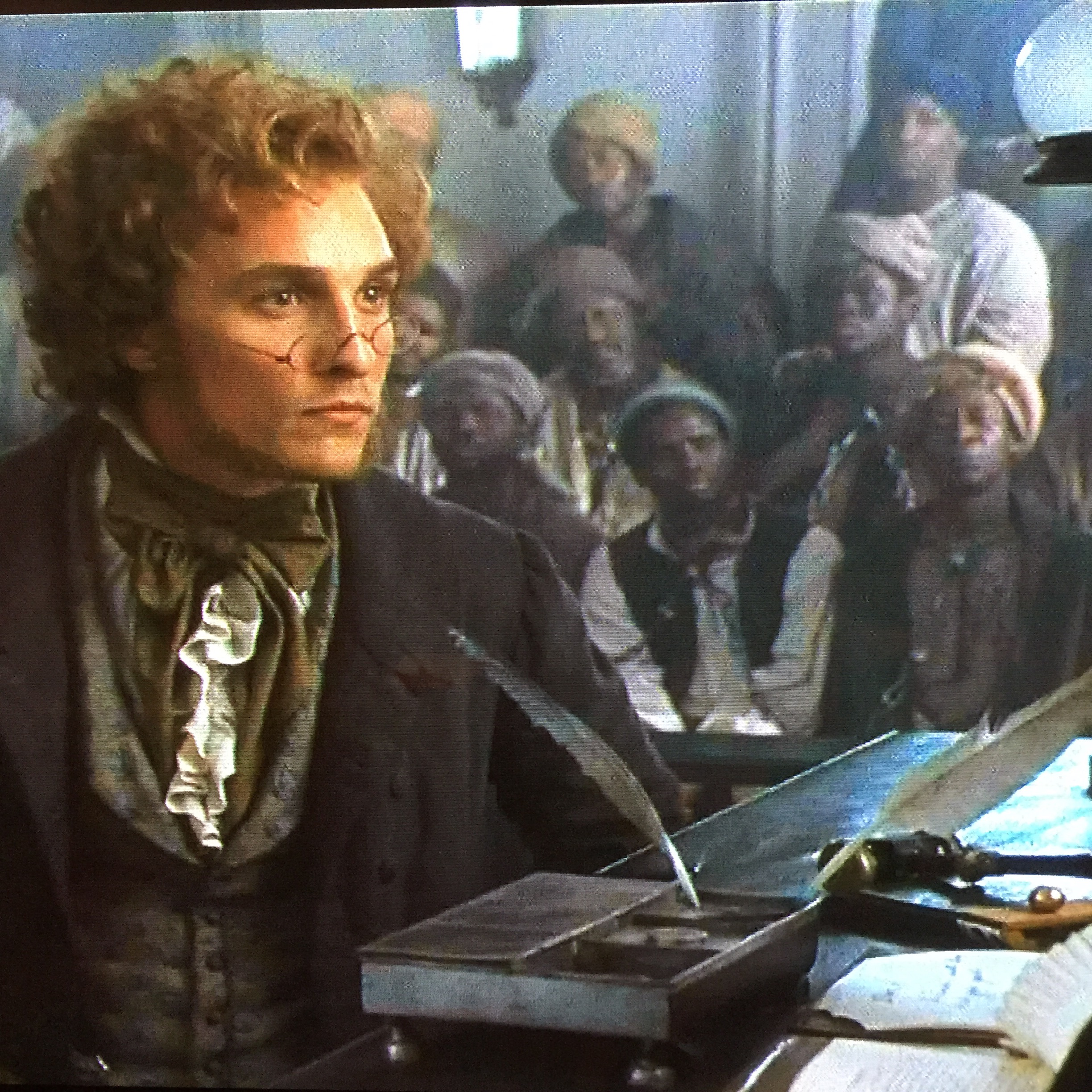
)
Now, if you ask me (nobody did) Amistad doesn’t totally nail it as a movie, because the courtroom battle, instead of being about the rightness or wrongness of slavery, ends up coming down to like some points of international and maritime law. But there’s a great speech by JQA, seen here starting at minute 1:30, about telling a story:
Recently I picked up recently Paul Johnson’s The Birth Of The Modern, a book I’d been seeing on distinguished bookshelves for years, with that great cover art by CDF:

What an absolute boss of a book, one of the highest interesting-information-per-page books I’ve ever come across. How did Paul Johnson write it, on top of everything else he was up to? From PJ’s Wikipedia page:
The following year, he attacked Ian Fleming’s James Bondnovel Dr No and in 1964 he warned of “The Menace of Beatlism” in an article contemporarily described as being “rather exaggerated” by Henry Fairlie in The Spectator.
Johnson started out as kind of a lefty it appears, but he’d end up working for Margaret Thatcher:
“‘I was instantly drawn to her,’ he recalls. ‘I’d known Margaret at Oxford. She was not a party person. She was an individual who made up her own mind. People would say that she was much influenced by Karl Popper or Frederick Hayek. The result was that Thatcher followed three guiding principles: truthfulness, honesty and never borrowing money.'”
Speaking of not a party person, Johnson has a great description the odd couple times that were had when John Quincy Adams, John Calhoun, and James Ashton Bayard went to negotiate the treaty that would end the War Of 1812.
Seems JQA could come off as a bit of a pill:


Imagine referring your bros to Martens, Book vii, chapter 55, section 3!
Poor guy. JQ was probably just trying to live up to his dad, who was no slouch either. Van Wyck Brooks sums up Adams The First in a footnote in The Flowering Of New England:

They don’t make ’em like they used to.
Nicklawler.com
Posted: July 29, 2015 Filed under: Boston, New England Leave a comment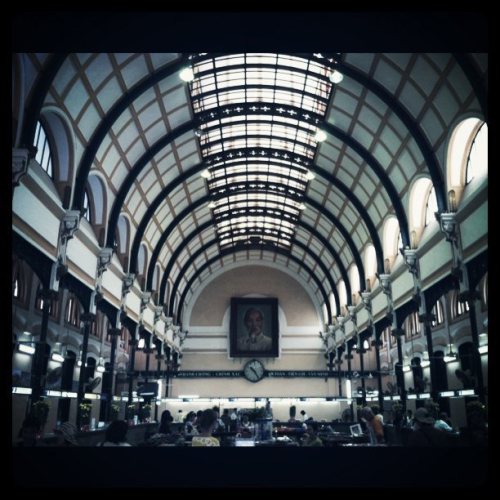
Nick’s photo of Saigon Central Post Office
My high school bud Nick has a blog, similar minimalist layout style to this one and the OG master Bookbinderlocal455.
A lot of posts are his photos from Asia.
But there are also several posts about investing that I found so interesting I read them several times and sent them to others. Here’s a few samples.
From this post, “The Brooklyn Investor: The Greatest Investment Book Ever Written“:
“Any time you extend your bankroll so far that if you lost, it would really distress you, you probably will lose. It’s tough to play your best under that much pressure.”
This is exactly what Joel Greenblatt said in an essay soon after the financial crisis. He was talking about how many people thought the error in their investment was that they didn’t foresee the crisis and so didn’t sell stocks before the collapse. Greenblatt insisted that this couldn’t be done anyway and that the real error was that these people simply owned too much stocks. If you own so much stock that a 50% decline is going to scare you and make you sell out at precisely the wrong moment (and as Greenblatt says, and Brunson says in this book, you are almost guaranteed to sell out at the bottom), then you owned too much stock to begin with. Greenblatt said the mistake wasn’t that they didn’t sell before the crisis, but that they sold in panic at the bottom. This was the error. So the key defense against inevitable (and unpredictable) bear markets is to not extend yourself so much that it will distress you when the markets do fall (and they will). Buffett says that if it would upset you if a stock you bought declined by 50%, then you simply shouldn’t be investing in stocks. As I like to say all the time, more money is probably lost every year in trying to avoid losing money in the stock market than actual losses in the stock market! via The Brooklyn Investor: The Greatest Investment Book Ever Written.
Profoundly interesting quote. Sub out the word “your bankroll” for, say, “yourself” and does it apply to other situations, like championship tennis?
Thought “What are questions?” was also a great post, on the great Clay Christensen
So was “Everybody Gets What They Want,” a cold-eyed suggestion about whether people are subconsciously manifesting / The Secret-ing themselves:

Check it out. Nick also found some good old photos of Boston:
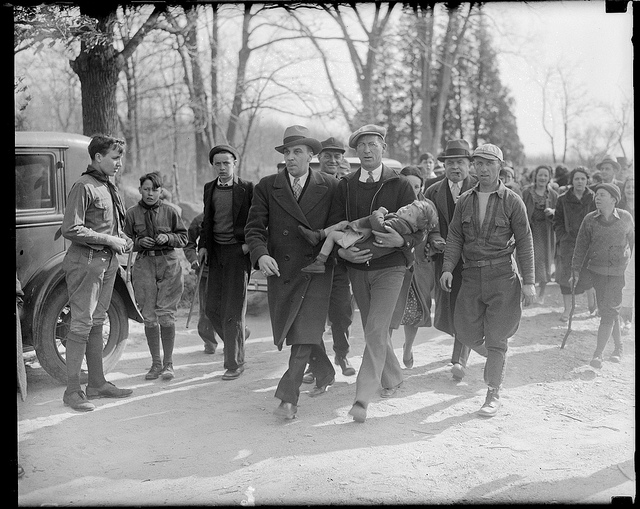
Kid lost, and then found from Crime/Police: Miscellaneous
Also, you can enjoy this:
Boston Marathon bomber’s friends
Posted: November 3, 2014 Filed under: America Since 1945, Boston, New England Leave a commentA courtroom sketch of Dias Kadyrbayev, who pleaded guilty on Thursday. (Jane Flavell Collins / Associated Press)
On a recent visit home to Massachusetts I was surprised to learn about this story, which I hadn’t been following. After they learned that their friend Dzhokhar Tsarnaev probably did the Boston Marathon bombing, several associates went to his room and rounded up some of his stuff and threw it out.
The New Yorker tells the story with all kinds of vivid details.
The three of them went to Taco Bell, then to Tazhayakov and Kadyrbayev’s apartment, where Kadyrbayev’s girlfriend, Bayan Kumiskali, was about halfway through watching “The Pursuit of Happyness.” Everyone but Tazhayakov got stoned, then they all sat on the couch and watched the second half of the movie, checking for news on their devices.
Can’t help but feel for Azamat Tazhavakov, “who was known as a mama’s boy, even though he was thousands of miles away from home.”
When Tazhayakov awoke early the next morning, he discovered that Dzhokhar Tsarnaev, who was still on the loose, had now been publicly identified as a suspect in the bombing, and that Tamerlan had been killed. Tazhayakov began to panic and smoked marijuana for what may have been the first time in his life.
A VERY bad decision.
Obama
Posted: February 18, 2013 Filed under: America, Boston, Chicago, heroes, New England, politics, the California Condition, writing Leave a comment
James Fallows calls my attention to this article, from Chicago Magazine in 2007, about then-Senatorial candidate Obama’s Democratic convention speech.
The best bits, for the busy executive:
Obama composed the first draft in longhand on a yellow legal pad, mostly in Springfield, where the state senate was in overtime over a budget impasse. Wary of missing important votes, Obama stayed close to the Capitol, which wasn’t exactly conducive to writing. “There were times that he would go into the men’s room at the Capitol because he wanted some quiet,” says Axelrod. Once, state senator Jeff Schoenberg walked into the men’s lounge and found Obama sitting on a stool along the marble countertop near the sinks, reworking the speech. “It was a classic Lifemagazine moment,” says Schoenberg, who snapped a picture of Obama with his cell-phone camera.
(Photo not included, regrettably.) Kerry’s folks made Obama take out a line:
After the rehearsal ended, Obama was furious. “That fucker is trying to steal a line from my speech,” he griped to Axelrod in the car on the way back to their hotel, according to another campaign aide who was there but asked to remain anonymous. Axelrod says he does not recollect exactly what Obama said to him. “He was unhappy about it, yeah,” he says, but adds that Obama soon cooled down. “Ultimately, his feeling was: They had given him this great opportunity; who was he to quibble over one line?”
And:
On Tuesday, the day of his speech, Obama was up before 6 a.m. He gobbled down a vegetable omelet en route to the FleetCenter for back-to-back-to-back live interviews with the network morning shows. Next, he rushed off to speak at the Illinois delegation breakfast and then to a rally sponsored by the League of Conservation Voters. Afterwards, he returned to the arena for another hour of TV interviews. There was barely time for lunch, a turkey sandwich that he ate in the SUV while being interviewed by a group of reporters.
Always, always tell me what everyone ate.

(both photos from Chicago Magazine, uncredited. Michelle’s skeptical face in that first photo!)
Joke about Boston, from Van Wyck Brooks
Posted: March 30, 2012 Filed under: books, Boston, New England, Van Wyck Brooks Leave a comment
From The Flowering of New England:
One of [Boston publisher James T.] Fields’s jokes was about the Boston man who read Shakespeare late in life but found him far beyond his expectation. “There are not twenty men in Boston who could have written those plays,” he said.
VWB also tells us about John Bartlett, who was just a guy in Cambridge you went to when you needed to know who said something, until he finally went ahead and published his Familiar Quotations.
Van Wyck Brooks on: Emerson
Posted: March 30, 2012 Filed under: books, Boston, heroes, New England Leave a comment
More excellence from The Flowering of New England
…generations later, when people spoke of Emerson’s “education,” they put the word in quotation-marks – it was not that he did not know his Greek and Latin, but that he was never systematic. He had read, both then and later, for “lustres” mainly. He had drifted first to Florida and then to Europe, and finally settled at Concord…As for the lectures that Emerson was giving in Boston, on great men, history, the present age, the famous lawyer, Jeremiah Mason, when he was asked if he could understand them, replied, “No, but my daughters can.”
To the outer eye, at least, Emerson’s life was an aimless jumble. He had ignored all the obvious chances, rejected the palpable prizes, followed none of the rules of common sense. Was he pursuing some star of his own? No one else could see it. In later years, looking back, Emerson’s friends, remembering him, thought of those quiet brown colts, unrecognized even by the trainers, that outstrip all the others on the race-course. He had had few doubts himself. He had edged along sideways towards everything that was good in his life, but he felt that he was born for victory…
Scott Prior
Posted: March 24, 2012 Filed under: art, Boston, MFA Boston, museum, New England, painting, pictures 1 Comment
This guy is good at painting, right? Am I crazy?
His “Nanny and Rose” used to hang in the lobby of the MFA and whenever I saw it as a kid I was like, oh that guy must be the best painter in the world.

But nobody ever talks about him.
Images from his website.
Van Wyck Brooks on: Elizabeth Peabody.
Posted: March 22, 2012 Filed under: Boston, Future Mrs. Hely, New England, people, Van Wyck Brooks Leave a comment
Van Wyck Brooks clearly has a little crush on Miss Elizabeth Peabody, “the founder of the American kindergarten.” More from The Flowering of New England.
As for Miss Peabody’s future, one could see it already. One pictured her, forty years hence, drowsing in her chair on the lecture-platform or plodding through the slush of a Boston winter, her bonnet askew, her white hair falling loose, bearing still, amid the snow and ice, the banner of education. If, perchance, you lifted her out of a snowdrift, into which she had stumbled absent-mindedly, she would exclaim, between her gasps, “I am glad to see you! Can you tell me which is the best Chinese gramar?” Or she would give you the news about Sarah Winnemucka. “Now Sarah Winnemucka” – this was the maligned Indian princess who was collecting money to educate her tribe. Or she would ask if you had read your Stallo. She took down every lecture she heard, although she seldom wrote what people said: most of her reports were “impressions.” *
* “I saw it,” Miss Peabody said, when she walked into a tree and bruised her nose. “I saw it, but did not realize it.”
 Helytimes