Sienese Painting
Posted: August 30, 2021 Filed under: Uncategorized 2 Comments
Saw this in the window of the Carpinteria library’s used bookshop and had to have it. Maybe the best $2 I ever spent?
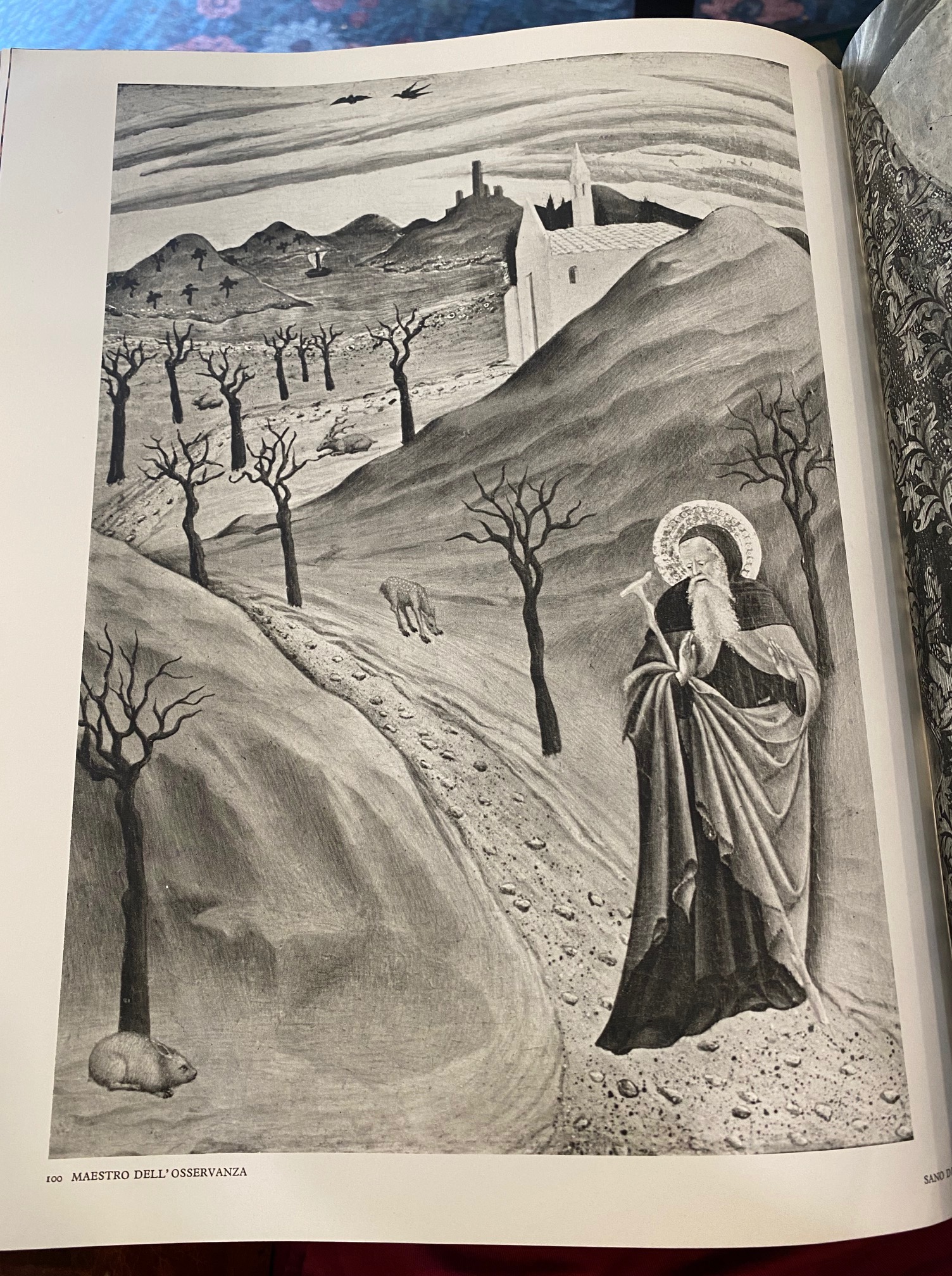
Had to see that one in color.

Says the Met:
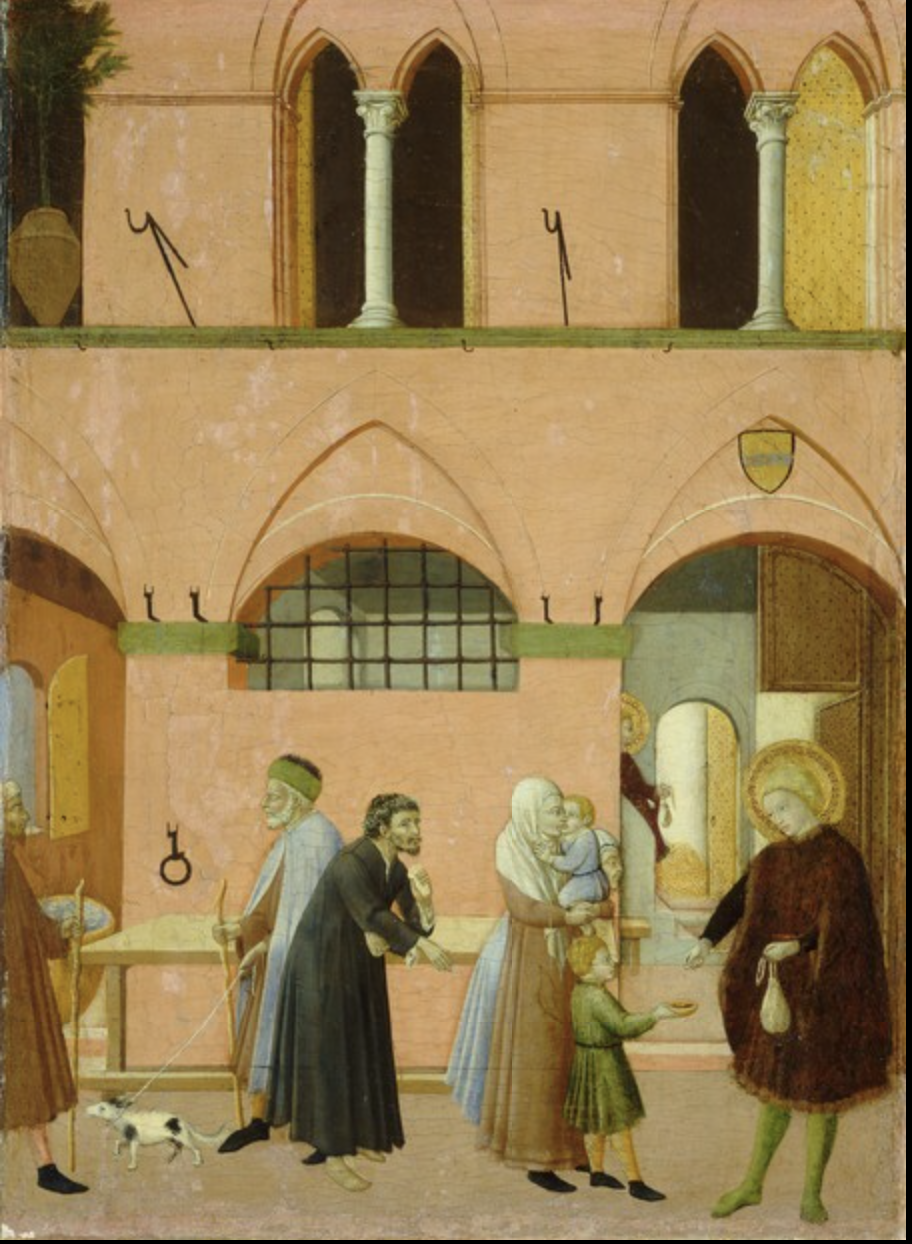
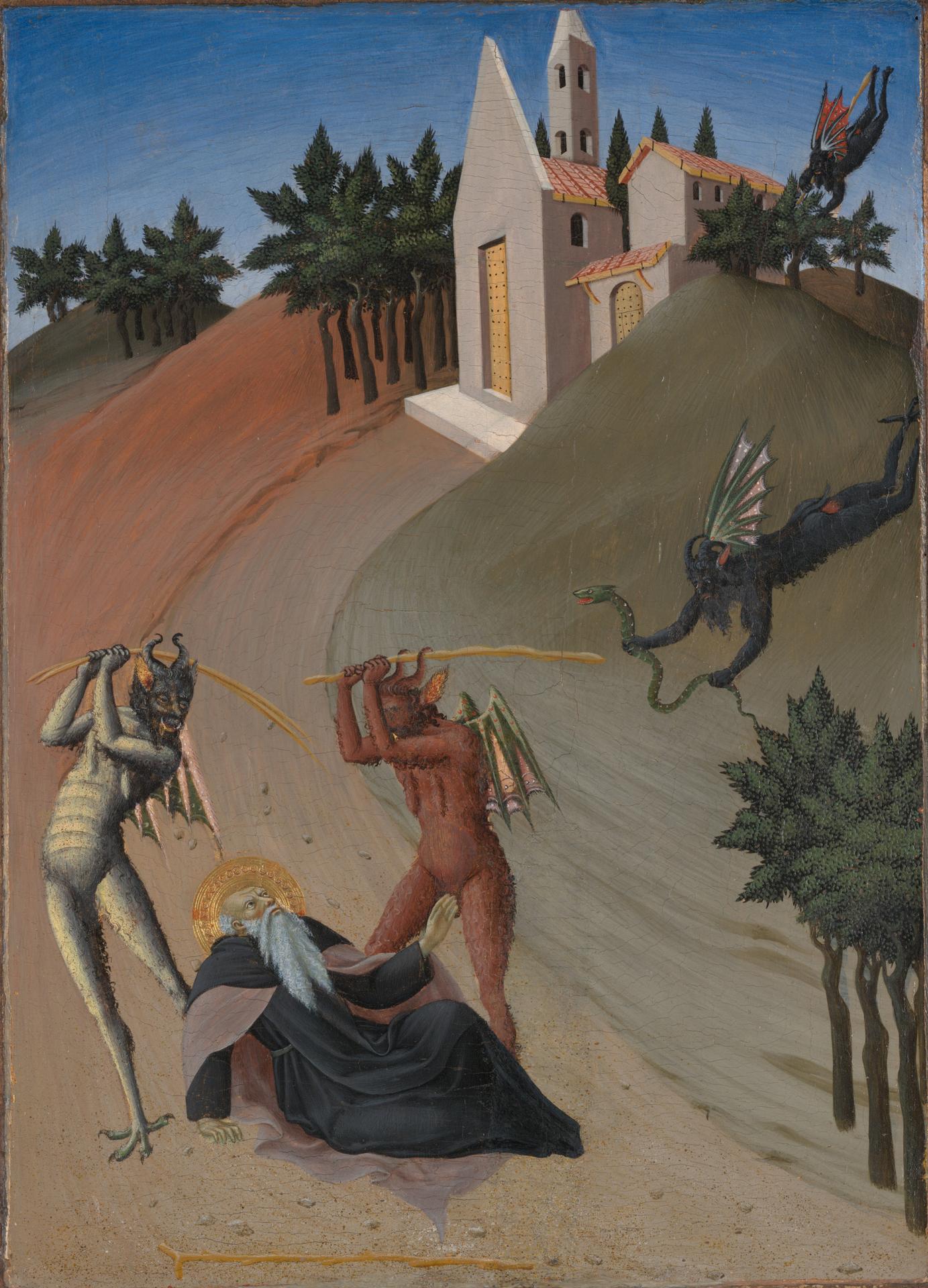
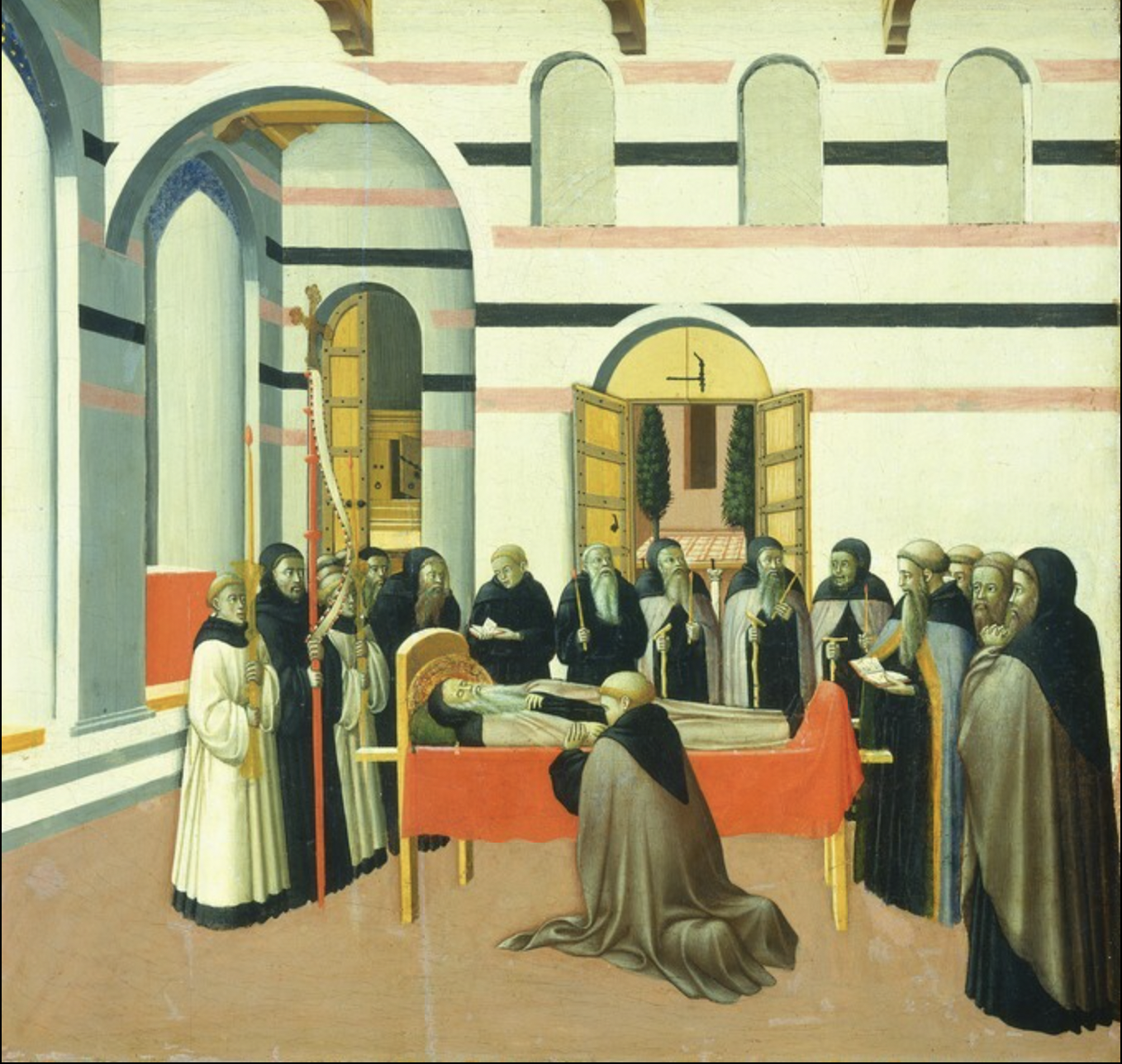
This panel is the sixth in a series of eight that includes Saint Anthony at Mass (Gemäldegalerie, SMPK, Berlin); Saint Anthony Distributing His Wealth and Saint Anthony Blessed by an Old Hermit (both National Gallery of Art, Washington, D.C.); Saint Anthony Tempted by the Devil in the Guise of a Woman and Saint Anthony Beaten by Devils (both Yale University Art Gallery, New Haven); and Journey and Meeting of Saint Anthony with Saint Paul the Hermit and Funeral of Saint Anthony (both National Gallery of Art, Washington, D.C.).
at Mass:

(That is only a detail, next time in Berlin I will investigate).
Distributing his wealth:
Tempted by a devil in the guise of a woman:

Beaten by devils:
Meeting Paul:

Funeral:
There is some contention in the historical art community over which Sienese masters were directly responsible for which paintings. Scenes from the life of St. Anthony of Egypt have been questioned as Sassetta’s own work, and critics such as Donald Bruce believe that near-equals, such as the Griselda master also deserve attention for their achievements in art of this time period.
I agree. Sassetta did his own St. Anth beaten by Devils:

It was commissioned by the Wool Merchants Guild for the Carmelites in Siena to use in their Feast of Corpus Domini.
The Wool Merchants Guild.
Recall
Posted: August 24, 2021 Filed under: Uncategorized Leave a comment
Like Communist China, California is a one party state. The party is the Democratic party. The Democratic party has 60 out of the 79 Assembly seats, 30 out of the 39 Senate seats. Both our senators are in the Democratic party. The last time a Senate seat opened up, with the retirement of Barbara Boxer (D), the Democratic Party more or less met and decided Kamala Harris, the state attorney general and former San Francisco DA, would get that, and Gavin Newsom, the mayor of San Francisco, would get to be governor after Jerry Brown (D), who had been governor off and on, and whose father Pat (D) was also governor, finally retired. This corrupt bargain angered other state Democratic wannabe stars, like former LA Mayor Antonio Villaraigosa, but that’s the breaks.
Why does San Francisco hold such a disproportionate weight vs Los Angeles in our state’s politics? I’m not sure, maybe because the fundraisers up there are particularly influential, or because every LA politician gets caught in some kind of scandal, or maybe because who would want to leave Los Angeles to go to Sacramento? It’s not exactly an upgrade.
We did have Governor Arnold Schwarzenegger (R), who won in a recall election. He was a Republican, but with an admirable pragmatism he established a working relationship with the Democratic leaders in the legislatures and governed more or less as a centrist. Some Hayes or Matt Stoller types may quibble with that interpretation of recent California history, but that’s how it felt.
When a case like Schwarzenegger emerges, a popular independentish candidate not developed in a party machine, it can create some of the more effective governance in the country. Jesse Ventura in Minnesota another example, the electorate more or less content with the outcomes which reflect something like the average opinions rather than any cobbled together set of party priorities. Although I guess Trump would also be an example of this, and I don’t think anyone can claim his presidency was especially effective, nor did it bring about widespread contentment. The leading insurgent candidate this time seems to be Larry Elder, is a Republican-aligned radio host. I had not heard of him until the election, so I do not think he is quite famous enough to prevail, but we’ll see.
Gavin Newsom, our current governor, is a pretty boy wine seller and restauranteur from the San Francisco area who hung around with the Getty boys and apparently pleased the rich people of San Francisco enough that they made him mayor. Now he is the governor. During the tough statewide shutdown triggered by the pandemic, a shutdown that caused many businesses to suffer and many to die, Gavin Newsom could not resist going to a dinner at French Laundry, which is one of the most expensive and indulgent restaurants in the world. The dinner at French Laundry was also, it turned out, the birthday party of a lobbyist. His behavior is so preposterous and embarrassing Gavin Newsom is lucky he isn’t getting tarred and feathered and run out of California on a rail.
But, instead of tar and feather and a rail, we are having a recall election.
I just voted in the recall. I voted NO, not because I like Gavin Newsom, but because the alternatives are horrible, and because I think recalls are a huge waste of time and money. If Newsom just barely survives, escaping by the skin of his teeth, that would be a pleasing outcome for me.
No one can really gin up much passion for Gavin Newsom at the moment without sounding ridiculous. The arguments on behalf of the anti recall campaign are so deflating as to be comical.
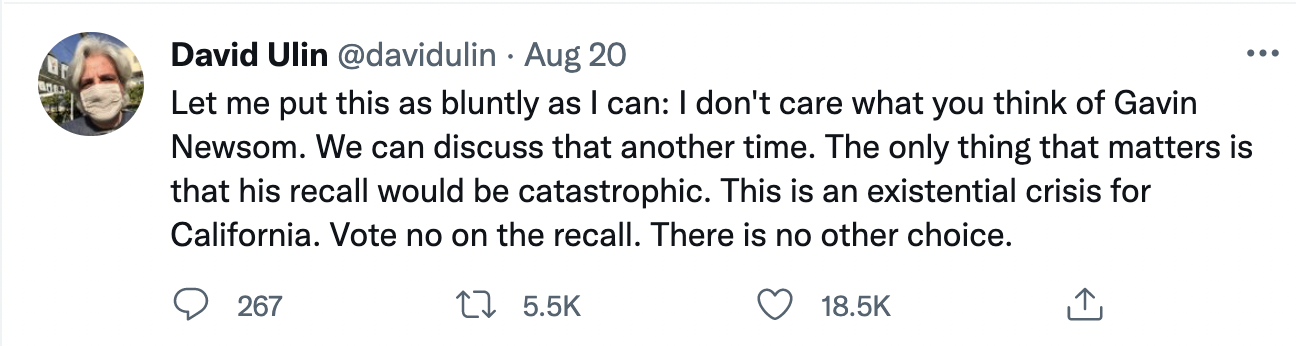
Catastrophic? There are multiple fires bigger than cities burning in our state, and in our biggest cities there are many enormous tent encampments of unhoused people. How much worse can it get?
How many elections are going to be existential? All of them, from now on? That is too stressful!
One of our senators here in California, Diane Feinstein, is 88 years old (you read that right). An age where she shouldn’t be allowed to drive a car let alone be a senator. It’s not openly discussed, but it is closedly discussed, that she is demented and can’t remember who is who, let alone details about complex legislation. So, an argument for Newsom has emerged that’s like, “you must keep our terrible governor so that he can appoint the replacement for our demented senator!”

For me, this argument is not merely uninspiring, it’s so depressing a concept that you have to laugh that here’s what we’ve come to. If that’s why the election is important, then it’s difficult to believe that your participation is important. This is in California, a state that’s gifted at producing world class talent! How did we end up with this?
It’s important not to just be a cynic here. I have spoken with people who have encountered Gavin Newsom and came to like him, the gist being that it seemed like he was listening to them. The job of governing California is not easy, under the conditions of the pandemic choices had to be made that would make people very unhappy. If you don’t like your options in public life, you have no one to blame but yourself. Let’s give some credit to the man in the arena, even if he appears to be a shiny faced self-dealing psychopath.
The ballot is kind of weird. You vote yes or no on whether Newsom should be recalled, and then you also can vote on one of 46 candidates to replace Newsom if he is recalled.
The recall ballot will ask two questions: 1) do you want to recall Governor Newsom? and 2) If the governor is recalled, who do you want to replace him
The candidates include actress / Corvette driver Angelyne and trans woman/ vehicular manslaughterer Caitlyn Jenner.

The Truth Squad Palm Card the California Democratic Party makes available tells you to vote NO, but then doesn’t tell you which of the other candidates to vote for. There’s been some online discussion of what to do about that, with some fanatics arguing you shouldn’t bother voting for a possible replacement candidate, because it might be confusing (to your own mind?)
In the last recall election, the Democrats had a backstop candidate, Cruz Bustamante, and the possibility of replacing Gray Davis with that guy apparently lured some Democratically inclined voters to vote for the recall. Thus, the Democratic Party doesn’t even want you considering the possibility Newsom would be recalled.
Since it is very possible Newsom will be recalled, and since some of the possible replacements are terrible, I felt I should vote for one of the replacement candidates. After sparse research, I chose Brandon Ross. Here is an interview with him where he says nothing I really object to:
Q: Why should Gov. Gavin Newsom be recalled?
A: I don’t necessarily think Gov. Newsome should be recalled. He was elected by a more than 3-2 margin over his challenger in the last election and he hasn’t done enough wrong to warrant being recalled. He has made some mistakes, but this is essentially a Republican effort to overturn the results of the last election because the party did not like the outcome.
His life story is interesting:
Dr. Ross attended the University of California, Davis, and graduated summa cum laude with a degree in Genetics. He would go on to medical school and become a doctor while simultaneously attaining his Masters in Public Health and his Masters in Business Administration.
Following graduation, he established a thriving cosmetic surgery center; everything seemed as though it was falling into place.
But after a serious back injury, Ross grew dependent on narcotics to manage his pain. The need for relief would soon devolve into opiate addiction, which led him to some of the darkest moments in his life.
As a result of his addiction, he lost a successful marriage, his family, and a thriving career.
But that wasn’t the end of the story. In 2014, Dr. Ross entered a recovery program that helped him turn his life around.
After getting clean, Dr. Ross graduated from law school and rebuilt his medical practice better than it was before. He also regained custody of his children, rebuilt his family, and is leading a fulfilling life. He now runs a charity that offers free cosmetic surgery to children dealing with trauma and radiation treatments for brain tumors.
I think the chance of Newsom being recalled and Dr. Brandon Ross being elected is close to 0%.
People telling me how to vote on one thing after another and how important it all is has gotten to be grating. I won’t be doing that here, I am merely telling my own ballot journey.
Good luck to everyone involved!
Wildfire news
Posted: August 10, 2021 Filed under: Uncategorized 1 Comment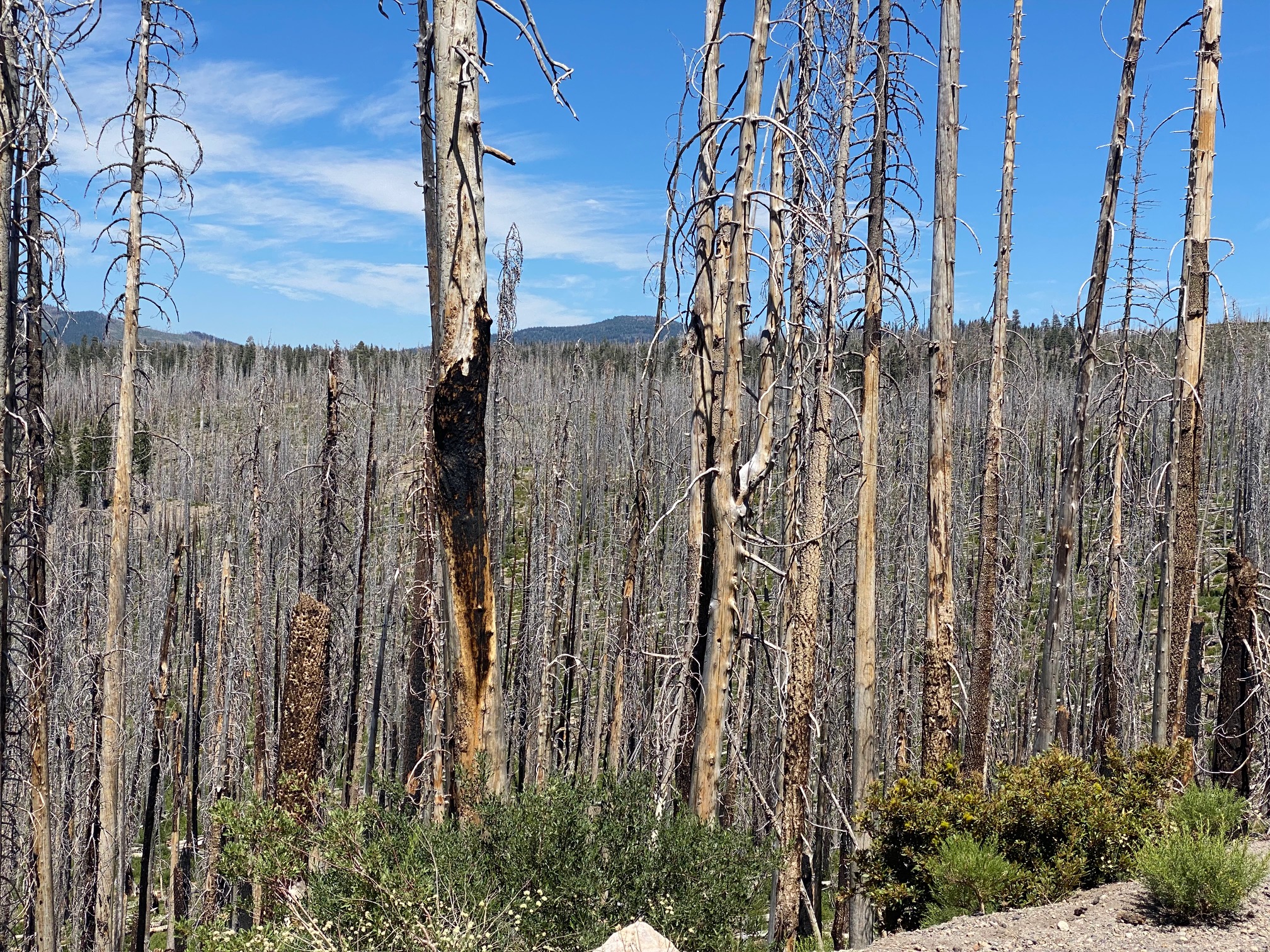
I don’t want to be all fire content all the time, the Helytimes reader comes here looking for a little uplift, but since my drive through far northern California I’ve been absorbed by the great burning that’s begun. The scale of the fires and the fires to come are massive.
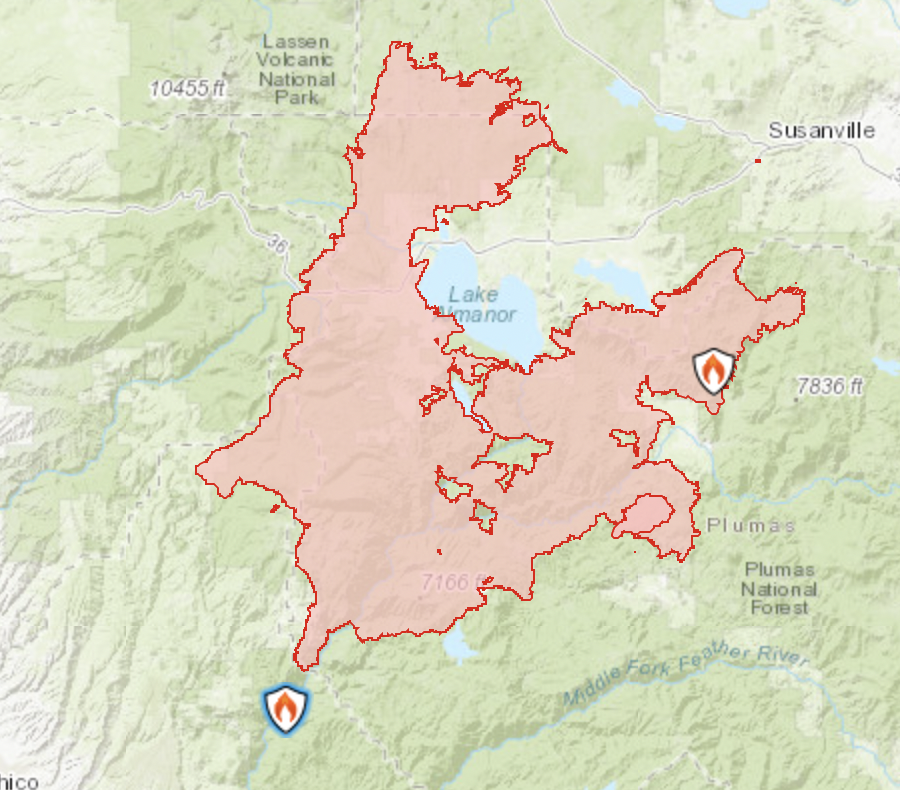
As I write this the Dixie fire is something like 760 square miles, bigger in size by far than any city in California. The Dixie fire is almost as big as Orange County. That doesn’t mean it’s all roaring flames, but a smoldering area bigger than Los Angeles is quite wild to ponder.
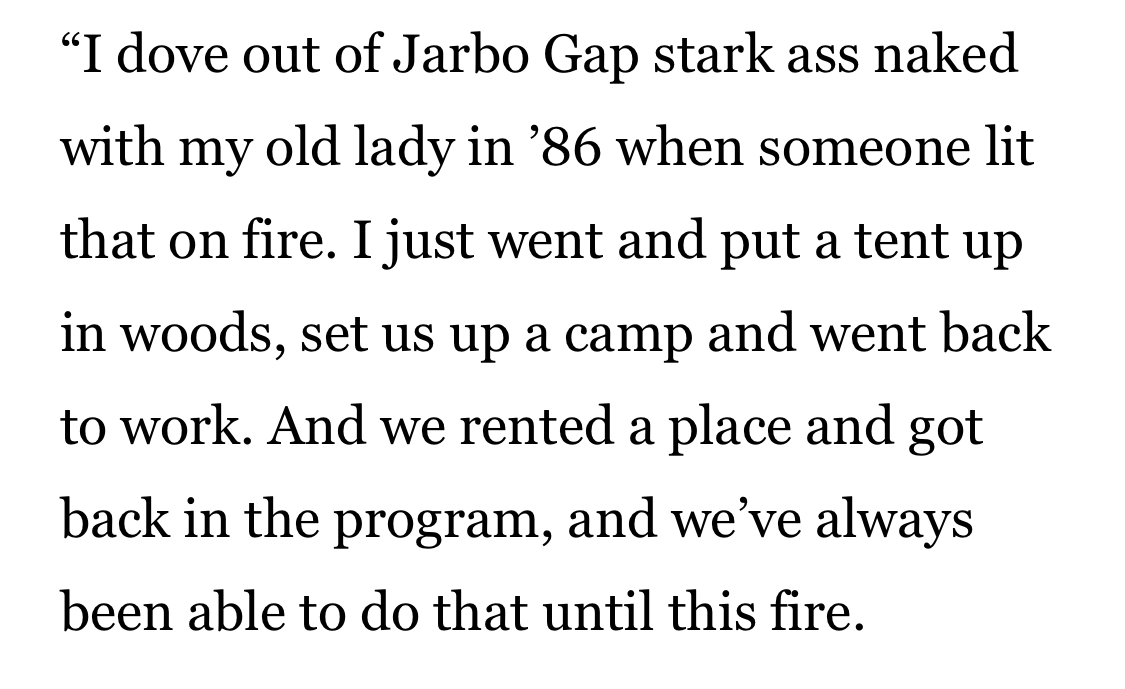
Good first sentence for a novel there. Mike Nimz, quoted by Joe Mozingo in this LA Times piece on refugees from the Camp fire, the one that destroyed the town of Paradise in 2018.
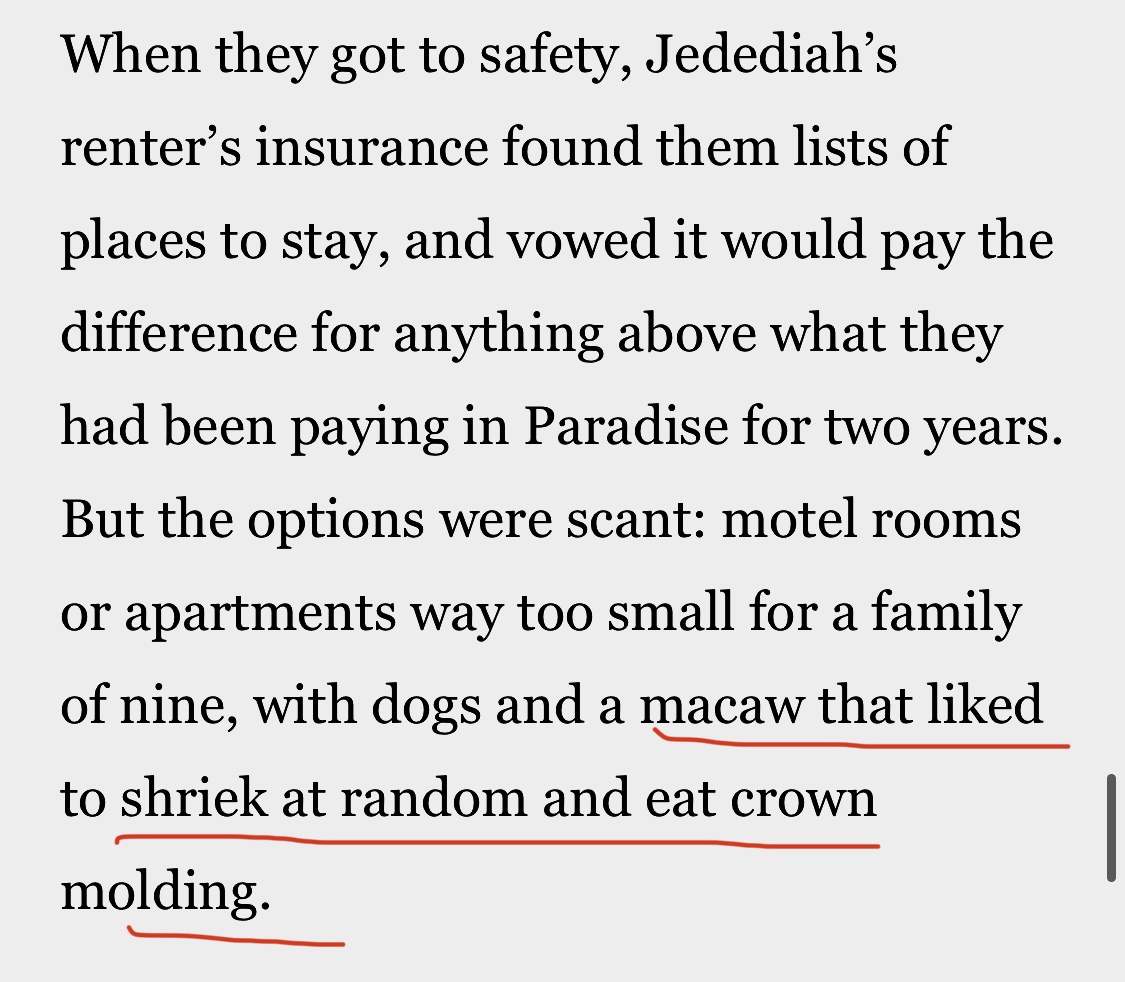
That’s a tough situation right there. Supposedly the population of Chico, CA grew by something like 20,000 in the wake of the Camp fire.
(I kind of dug the town of Chico. College town, good bookstore. Downtown has some life to it, or did on the particular July Tuesday morning I cruised in. Sierra Nevada is not my go-to beer but respect. I have a suspicion people sometimes lump Chico in with Chino, a less appealing town).
I drove through Paradise on my travels. There was what looked like a brand new, prefab Best Western set up, and some trailers and construction activity on the cleared foundations. A few stray signs over missing buildings.

Now this is looking on the bright side:
And although the thick layer of smoke hovering over the fire is expected to dissipate Monday, McKeague said clearer skies actually expose the fire to more dangerous heat from the sun, which could lead to increased fire activity.
“It was actually helpful,” he said of the thick smoke. “It sort of held a cap that blocked some of the sunlight.”
That from: “As Dixie fire nears half a million acres, containment is still weeks away” by Hayley Smith in LATimes (no relation to American Dad!’s Hayley Smith).

1:90
Posted: July 30, 2021 Filed under: Uncategorized Leave a commentFor Christ sake write and don’t worry about what the boys will say nor whether it will be a masterpiece nor what. I write one page of masterpiece to ninety one pages of shit. I try to put the shit in the wastebasket. You feel you have to publish crap to make money to live and let live.
from a letter Hemingway wrote F. Scott Fitz re Tender Is The Night. I was looking for a different Fitzgerald letter, where he calls self-pity “SP,” the great thing to be avoided.
Blunt
Posted: July 30, 2021 Filed under: Uncategorized Leave a commentDESANTIS DONOR DRAMA — Back in May,we wrote about concerns among some Republican insiders that Florida Gov. RON DESANTIS’ political operation isn’t ready for prime time (a.k.a. a presidential campaign) due to a lack of loyalists on staff. Now, we’re hearing from donors who feel like they’re not getting the proper treatment from the governor.
A GOP source told our own Daniel Lippman that last month, about 20 other big-time donors flew to D.C. from California and Florida for a DeSantis fundraiser hosted by former RNC chief and Mississippi Gov. HALEY BARBOUR — only to be stiffed by DeSantis during his Washington fundraising swing June 23.
After waiting about an hour for the governor to show up to the late-afternoon affair, the donors were told DeSantis wouldn’t make it. As a consolation prize, they were offered a later time slot: dinner with the governor at The Oceanaire in Penn Quarter. They again waited for DeSantis, and at 8 p.m. were told the dinner was off.
Among the political chattering class, DeSantis’ dislike of gladhanding has led some to refer to him as a “porcupine.” After a Republican Governors Association panel in Aspen last week, when panelists including Govs. LARRY HOGAN, PETE RICKETTS, DOUG BURGUM and TATE REEVES took to the floor to shake hands with activists and donors, DeSantis made a backdoor exit, according to attendees.
For his part, DeSantis’ office and top allies say he’s too busy running Florida to deal with the politicking.
“Gov. DeSantis had a full plate of meetings at the RGA, a panel and the Governors Only meeting,” said HELEN AGUIRRE FERRE, executive director of the Republican Party of Florida. “No one should be surprised that Gov. DeSantis is pretty busy, Florida is the third largest state in the nation, and he spends most of his time on state business.”
That’s all well and good, but if DeSantis is serious about his presidential ambitions — and we have no reason to believe he isn’t — donors suggest that he’d be well-advised to show a little less porcupine and a bit more golden retriever.
This is from today’s Politico Playbook, a politics dirt sheet. I don’t like Ron DeSantis, but isn’t it good if he’s ignoring donors? Something gnarly about Politico reflecting the take of “a GOP source,” maybe a DeSantis rival or a jilted donor or donor-worker-for, saying this guy can’t be serious about being president because he doesn’t pay enough attention to small groups of rich people who want “the proper treatment.” Maybe Playbook just calls it like it is, don’t like it, go vote Bernie, see where that gets ya.
Big buck of this lick
Posted: July 29, 2021 Filed under: Uncategorized Leave a comment
On a misunderstanding one time between Lincoln and William Grigsby, Grigsby flared so mad he challenged Abe to a fight. Abe looked at Grigsby, smiled and said the fight ought to be with John D. Johnston, Abe’s stepbrother. The day was set, each man with his seconds. The two fighters, stripped to the waist, mauled at each other with bare knuckles. A crowd formed a ring and stood cheering, yelling, hissing, and after a while saw Johnston getting the worst of it. The ring of the crowd was broken when Abe shouldered his way through, stepped out, took hold of Grigsby and threw him out of the center of the fight ring. Then, so they said, Abe Lincoln called out, “I’m the big buck of this lick,” and his eyes sweeping the circle of the crowd he challenged, “If any of you want to try it, come on and whet your horns.” Wild fist-fighting came and for months around the store in Gentryville they argued about which gang whipped the other.
That’s from Carl Sandburg’s Lincoln: The Prairie Years.
As a young boy growing up in Galesburg, Illinois, Carl Sandburg often listened to stories of old-timers who had known Abraham Lincoln.
so says the NPS.
I was listening to Rick Rubin, music producer and massive wrestling fan, on Marc Maron. Re: President Trump, and wrestling as politics, Rubin said something like:
It’s always been wrestling. Now we know!
Needles
Posted: July 25, 2021 Filed under: Uncategorized Leave a comment
One of America’s hottest cities is down to one water well. What happens if the taps go dry?
Thought this was an interesting story, by Ralph Vartabedian, reposted on Yahoo News and then to Drudge. it’s about Needles, California, famously home to Snoopy’s brother Spike.

What’s interesting, as you can see in the photo, is that the Colorado River runs right by Needles. The Colorado forged the Grand Canyon, it’s one of the great rivers of the world. A great quantity of water, but claims on it by different states, and the taking of the water by the USA before it gets to Mexico are famously a source of controversy and dispute. The river is mercurial, and powerful.

I thought one of the more memorable parts of Into The Wild (the book) was about McCandless trying to paddle to the Colorado’s end, into a messy maze of marshland and silt that dissolves into the Gulf of California / Sea of Cortez.

A town running out of water while a river runs through is a very 21st century kind of problem, feels like.
In related river news:
A lack of rainfall in South American farming regions has left the Paraná River too shallow for fully loaded boats to pass from Argentina’s interior to Atlantic shipping lanes, contributing to high prices for soybeans and corn. Flooding in Germany last week forced the closure of a plant owned by Aurubis AG , a major metal producer and recycler, as copper prices hover around all-time highs.
from “Western Wildfires Are Hitting Lumber Prices” by Ryan Dezember in WSJ.
I realize this is “bad news,” which I try to avoid here on Helytimes, there being plenty of giddy bad news tellers and everybody has heard that the climate is being weird. But the good news is: these stories of compounding effects and complex systems are interesting!
The murder of Jane Stanford
Posted: July 23, 2021 Filed under: Uncategorized Leave a comment
On Saturday, January 14, 1905, at her Nob Hill mansion, wealthy widow Jane Stanford took a sip of mineral water that didn’t taste right. She vomited up the water and had her secretary, Bertha Berner, taste it. The secretary agreed it tasted strange, so they sent it to the pharmacy to be analyzed. A few weeks later, the report came in: the mineral water had been poisoned with a lethal dose of strychnine.
Who would want Jane Stanford dead? Well, maybe a lot of people. Her late husband was Leland Stanford, one of the “Big Four” founders* of the Central Pacific Railroad and a former governor of California, a tough customer for sure. Together the Stanfords founded Stanford University in honor of their son, Leland Jr., who died young. When Leland Senior died, Jane ended up in a long running squabble with the university’s president, David Starr Jordan.

After the attempted poisoning, Jane Stanford fired her maid and decided to get out of San Francisco. She sailed to Hawaii. Soon after arriving at the Moana Hotel in Honolulu, she asked for a bicarbonate of soda to settle her stomach. Bertha Berner prepared it for her and gave it to her. Jane Stanford drank it. A few hours later she cried out that she’d been poisoned. The hotel physician was summoned and tried to help her:
As Humphris tried to administer a solution of bromine and chloral hydrate, Mrs. Stanford, now in anguish, exclaimed, ‘My jaws are stiff. This is a horrible death to die.’ Whereupon she was seized by a tetanic spasm that progressed relentlessly to a state of severe rigidity: her jaws clamped shut, her thighs opened widely, her feet twisted inwards, her fingers and thumbs clenched into tight fists, and her head drew back. Finally, her respiration ceased. Stanford was dead from strychnine poisoning.

I quote from Wikipedia:
After hearing three days of testimony, the coroner’s jury concluded in less than two minutes that she had died of strychnine “introduced into a bottle of bicarbonate of soda with felonious intent by some person or persons to this jury unknown.” The testimony revealed that the bottle in question had been purchased in California (after Richmond had been let go), had been accessible to anyone in Stanford’s residence during the period when her party was packing, and had not been used until the night of her death.
After the death, David Starr Jordan, the president of Stanford, turned up in Hawaii and def acted fishy. He hired a local doctor and tried to prove that Mrs. Stanford wasn’t poisoned. Which, like, shouldn’t you be running your university?
Jordan’s motives for involvement in the case are uncertain, but he had written to the new president of Stanford’s board of trustees, offered several alternate explanations for Jane Stanford’s death, and suggested to select whichever would be most suitable. The university leadership may have believed that avoiding the appearance of scandal was of overriding importance. The coverup evidently succeeded to the extent that the likelihood that she was murdered was largely overlooked by historians and commentators until the 1980s.
The coverup worked! I mentioned this story to my friend MLW who’s affiliated with Stanford, and she’d never heard it. I’d never heard it either until I read about it in this terrific book, The King and Queen of Malibu, by friend of the blog David K. Randall:

Randall’s book is about Frederick and May Rindge, who owned almost all of what’s now Malibu in the late 19th century. May was a distant relative of Jane Stanford. The Rindges had their own share of enemies among the squatters, travelers, and developers of the pretty wild California of that era. I loved this part about the boundaries of the old ranchos of California:
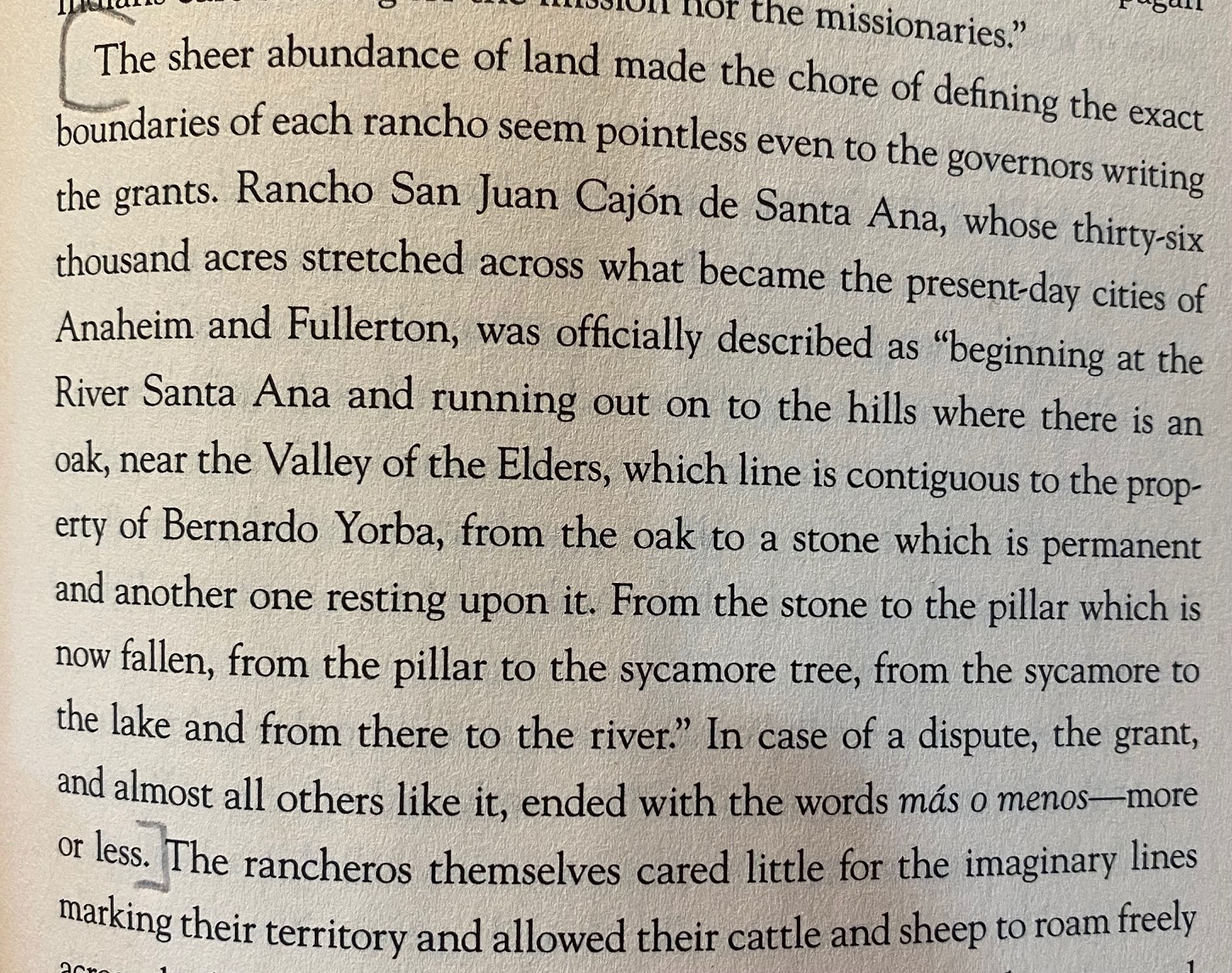
In the Rindge days, the only way to cross Malibu was along the beach at low tide, until the Rindges put up gates, one at Las Flores Canyon and one at Point Dume, the eastern and western boundaries of their ranch. This pissed everybody off. After her husband’s death, May Rindge tried, and failed, to keep the Pacific Coast Highway from being built across what had once been her family’s idyllic ranch. Randall’s book functions as a great introduction to the history of Los Angeles as it transitioned from a distant outpost to a train and car-based metropolis that grew, fast.
As for Jane Stanford, her murder was never solved. David Starr Jordan lived on to promote his views of eugenics until his death, on campus, in 1933.
I’ll tell you who was never mixed up in anything like this:

* of the Big Four, two have names that live on in institutions in California: Leland Stanford has Stanford U, Collis Huntington has Huntington Library and Huntington Beach (both actually named after Collis’ nephew, Henry, but still), and Mark Hopkins at least has the Mark Hopkins Hotel in San Francisco. In fact, Stanford, Huntington, and Hopkins all have stuff named after them around Nob Hill. But you don’t hear much about Charles Crocker. Seems like he was a bit of a petty bitch? I learn from Wikipedia that he is great-great-grandfather to Rhode Island Senator Sheldon Whitehouse.
Soobleej Kaub Hawj
Posted: July 22, 2021 Filed under: Uncategorized Leave a commentThat’s the name of a 35 year old Hmong man shot and killed by law enforcement in Siskiyou County, far northern CA, on June 28.
The victim, identified as Soobleej Kaub Hawj of Kansas City, Kansas, allegedly pointed a gun at officers on the evening of June 28 when he turned the wrong way at a checkpoint on Highway A-12 near Weed. His family was following behind in a second vehicle.
State game wardens, members of the Etna Police Department and county sheriff deputies were all on the scene when Hawj was killed.
There was a mandatory evacuation order in place at the time due to the Lava wildfire. Hawj was killed at a checkpoint related to that, is my understanding.
Despite this headline, “Shooting of Hmong American man during Lava Fire draws nationwide attention,” in the Siskiyou Daily News, I hadn’t heard about this at all, and probably wouldn’t have had I not driven by a protest at the Siskiyou County courthouse in Yreka, CA on Sunday, July 11.
I probably still wouldn’t have known what the protest was about – it was over 100 degrees in Yreka, I’d had a long day of smoky driving, and I wasn’t energized to turn freelance citizen journalist – if Siskiyou County didn’t have a quality local daily newspaper.
And I probably still wouldn’t have known about it were it not for a hunger strike by Zurg Xiong:
Saturday’s vigil will take place at the Siskiyou County Courthouse, where a local Hmong American resident has been staging a hunger strike for the past 10 days to spotlight Hawj’s death.
“I will continue this hunger strike until talks are made or until I die,” said Zurg Xiong, who lives in the Mt. Shasta Vista Subdivision, has been on a hunger strike since July 6 and has been demonstrating in front of the courthouse in Yreka since Sunday.
In this case, a hunger strike as a tactic to bring attention to an issue has worked.
The bigger context:
Tensions have been escalating between Siskiyou County’s Hmong population and county officials since local authorities in May passed an ordinance limiting where water trucks can drive in an effort to curtail illegal marijuana grows. A second ordinance requires a permit to transport water on certain roads where illegal grows are known to proliferate.
Drought, water, wildfire, climate catastrophe, police violence, immigration, racial tensions, this story seems to exist at an intersection of the biggest, most explosive issues in the USA right now, and yet I don’t think I would’ve heard about it had I not almost literally stumbled across it.
“Hard news” isn’t usually my beat here at Helytimes, but “the California condition” for sure is, and I found it an interesting case of what does or doesn’t become widespread “news.”
Update: looks like the local Republican congressman has chosen to inflame the issue. I can appreciate the anger on both sides, illegal grows are very destructive.
How Quentin Tarantino got into Hollywood
Posted: July 21, 2021 Filed under: film, movies Leave a commentThought this was interesting, from this Deadline interview with Mike Fleming. Luck + preparation?:
How I eventually got into the industry to some degree was, my friend Scott Spiegel was going to write something for the director, William Lustig, who did Maniac, Maniac Cop. He wanted to bring me in to help him, and Lustig looked at me and said, “Who is this f*cking guy?” And so, he gave them my script for True Romance, just as an audition piece. He read it, and he really, really liked it and couldn’t quite get it out of his head. He had a deal with Cinetel at the time, and so he showed it to the people there and bought it. They were going to make it, with William Lustig. But then the woman who was the head of development at Cinetel, Caitlin Knell — who really helped me out in getting started in my career — she was really good friends with Tony Scott because she used to be his assistant. She knew I was a big fan of his. So she invited me to the set of The Last Boy Scout, and I was able to watch filming for a little bit, and she took me to Tony’s birthday party. I was in heaven. I was only just a year out of the video store. And apparently, I made such a nice impression on Tony that he was like, “Who is this kid?” She said, “The boy’s a really good writer, I’m working with him on this thing at Cinetel.” And he goes, ‘Well, send me a couple of his scripts. Let me read them. He seems like a nice guy. I mean, he really likes me, so he’s obviously got good taste. Send me a couple of his scripts.”
She sent him True Romance and Reservoir Dogs. He read them, and he called Cat in a month and goes, “I want to make it. I want to make Reservoir Dogs. Let’s do it right now.” She was, “Well, OK. That one he won’t give you. That one he looks like he could make himself.” Tony says, “OK, OK, I’ll do the other one.” And then it became a situation where Cinetel was going to make it, but then Tony wanted to make it. I go, “Well, get it away from Cinetel, or pay them off or whatever or make it for them.” He said, “OK,” and that’s how it happened.
Chan Chan
Posted: July 17, 2021 Filed under: Caribbean, Cuba Leave a comment
There was a time (1998?) when you’d hear the album Buena Vista Social Club all the time. If you travel along the tourist trail of Central America you will not go far without hearing it again.
The first song on the album is called Chan Chan. Here are the lyrics:
Lyrically, the song is set on the beach and revolves around two central characters called Juanica and Chan Chan.The most complete explanation says: ‘The song relates the story of a man and a woman (Chan Chan and Juanica) who are building a house, and go to the beach to get some sand. Chan Chan collects the sand and puts it on the jibe (a sieve for sand). Juanica shakes it, and to do so she shakes herself, making Chan Chan embarrassed. […] The origin of this tale is a farmer song learnt by Compay Segundo when he was twelve years old.’
The most recognizable part of the song is its chorus, whose lyrics are as follows:
| De Alto Cedro voy para MarcanéLlego a Cueto voy para Mayarí | From Alto Cedro I go to MarcanéI get to Cueto, then head for Mayarí |
The four mentioned locations (Alto Cedro, Marcané, Cueto and Mayarí) are towns near each other in the Holguín Province on the east side of Cuba
I like that the song is sort of a set of directions. You can think of the song as being “here are directions to see a girl who moves her butt like a cement mixer.”
Cuba in the news again.
Bark beetle
Posted: July 12, 2021 Filed under: the California Condition Leave a comment
In years of drought, when trees in the forests of Oregon and northern California don’t get enough moisture, they don’t create the sap they need to prevent attacks of tiny bark beetles. The bark beetles kill trees, leaving the forest littered with dead trees, ideal conditions for a huge fire.
The beetle is a tiny insect, about the size of a match head, but the sheer numbers pose a risk to the forest, officials say. They lay much of the bark beetle problem on forests that have become too overgrown with small trees and brush.
And ironically, it’s decades of aggressive fire suppression that has left forests dense and overcrowded, according to the forest service.
A hundred years ago, low intensity fires regularly burned through the forests, keeping stands of trees thinned out, and prevented them from becoming too thick.
Because smaller trees were regularly thinned out by fire, the trees that remained were larger and spaced farther apart.
A hundred years ago, a forest would have typically 20 or 30 trees per acre, Hamilton said. Nowadays, though, it is not uncommon to have 800 to 1,000 smaller trees an acre, he said.
When a drought comes along, like the current one, too many trees are competing for too little moisture and the trees’ natural defense against bark beetles breaks down, he said.
When trees are healthy and they get plenty of moisture, they exude sticky sap to ward off the bugs and protect themselves.
But when trees lack water they can’t produce enough sap, and the beetles move in and damage trees until they die, Hamilton said.
“When bark beetles’ population is at epidemic levels they can still attack and overcome even healthy trees,” according to Cal Fire.
That’s from “Drought and bark beetle kill millions of trees, increase wildfire risk in North State forests” by Damon Arthur for the Redding Record Searchlight / Siskiyou Daily News.
The number of dead trees are staggering. Millions of trees:
The 2019 forest service aerial survey of tree mortality shows the Klamath National Forest, with large swaths of land in Siskiyou County, was the forest hit hardest in the state, with an estimated 1.8 million dead trees.
Here is a breakdown by county of tree mortality in the North State, according to the survey:
- Siskiyou: 2.8 million trees on 406,000 acres
- Trinity: 1 million trees on 150,000 acres
- Shasta: 305,000 trees on 115,000 acres
- Tehama: 318,000 trees on 67,000 acres
Yesterday I drove from Redmond, Oregon down here to Siskiyou County, a four hour drive, about two hours of it through smoke from a distant fire, (the Bootleg fire?), and through burnt forest, ranging from singed to totally black smoking ashscape, and still more through trees that looked dry and gnarled and unwell and ready to burn. It was over 90 degrees most of the way, dry, staying hot until 8 or 9 pm at night. A fire crew was cutting down a big old tree by the side of Highway 97, and not far beyond that was the ruins of a motel that had been burned to the ground, except for a sign, “MOTEL.”
Burnt over forest country makes me think of the start of Hemingway’s “Big Two-Hearted River”:
The train went on up the track out of sight, around one of the hills of burnt timber. Nick sat down on the bundle of canvas and bedding the baggage man had pitched out of the door of the baggage car. There was no town, nothing but the rails and the burned-over country. The thirteen saloons that had lined the one street of Seney had not left a trace. The foundations of the Mansion House hotel stuck up above the ground. The stone was chipped and split by the fire. It was all that was left of the town of Seney. Even the surface had been burned off the ground.
Nick looked at the burned-over stretch of hillside, where he had expected to find the scattered houses of the town and then walked down the railroad track to the bridge over the river. The river was there. It swirled against the log spires of the bridge. Nick looked down into the clear, brown water, colored from the pebbly bottom, and watched the trout keeping themselves steady in the current with wavering fins. As he watched them they changed their again by quick angles, only to hold steady in the fast water again. Nick watched them a long time.
The Big Room
Posted: June 26, 2021 Filed under: America Since 1945, painting, the American West 2 Comments
Michael Herr wrote Dispatches, he wrote a novel about Walter Winchell, he wrote a short book (an expanded article) about Stanley Kubrick, he collaborated on the screenplays for Apocalypse Now and Full Metal Jacket.
He also wrote the text for The Big Room, a collection of portraits by Belgian artist Guy Peellaert, centered around Las Vegas. Short essays about Howard Hughes, Milton Berle, Judy Garland, Marilyn Monroe, Frank Sinatra, FDR, Richard Nixon, Bugsy Siegel, Nat King Cole, Colonel Tom Parker, Martin & Lewis, more.
When they talk about luck in Las Vegas, it’s just the way they have there of talking about time. Luck is the local obsession, while time itself is a sore subject in the big rooms and casinos. It’s a corny old gag about Las Vegas, the temporal city if there ever was one, trying to camouflage the hours and retard the dawn, when everybody knows that if you’re feeling lucky you’re really feeling time in its rawest form, and if you’re not feeling lucky, they’ve got a clock at the bus station. For a speedy town like Vegas, having no time on the walls can only accelerate the process by which jellyfish turn into barracuda, grinders and dumpers become a single player, the big winners and big losers exchange wardrobes, while everyone gets ready for the next roll. The whole city’s a clock. The hotels change credit lines as fast and often as they change the sheets, and for a lot of the same reasons. The winners and the losers all have identical marks on them, bruised and chewed over by Las Vegas mitosis, with consolation prizes for anybody left who’s not already inconsolable. Don’t laugh, people. It could happen to you.

It’s fantastic.
The big room is not a clearing that anyone should charge into blindly, unarmed. The way in is hard, as dangerous as the approach to King Solomon’s Mines, and obscure as a tomb. In fact, many a headliner has had good reason to compare the room to the tomb, having experienced for themselves the non-contradiction that once you’ve made it here, it’s all over for you.
funny description
Posted: June 10, 2021 Filed under: the California Condition 2 CommentsAfter he wrote My Face for the World to See Hayes decided, counterintuitively, to move permanently to Los Angeles, the city he had described as looking ‘as hell might with a good electrician’.
and a classic:
In a novel published in 1968, The End of Me, Hayes’s disillusionment is projected onto the main character, Asher, a failing screenwriter. Asher tells a joke about a man who goes into a butcher’s shop and sees two signs. One reads ‘writers’ brains: 19 cents a pound’; the other: ‘producers’ brains: 79 cents a pound’:
‘Now you are supposed to ask me,’ I said patiently, ‘why producers’ brains cost 79 cents a pound and writers’ brains cost 19 cents a pound?’ … “Well,” the butcher said, “do you know how many producers you have to kill to get a pound of brains?”’
Lucie Elven on Alfred Hayes in LRB.
The fix is in
Posted: June 5, 2021 Filed under: boxing Leave a comment
I haven’t been following boxing but I don’t like anything about the Floyd Mayweather / Logan Paul fight, except maybe the pleasure of an obnoxious person getting hurt, and I don’t like to cultivate that taste in myself. This is not a sporting event, it’s an exhibition. The prescripted outcome isn’t known to me but I suspect it’s known to others as well.
“The fix is in,” in other words. Looking into the origin of the term I find, among other things, a spay and neuter clinic in Wisconsin.
Some time ago I got pretty interested in boxing both as a workout routine and spectacle. In both it was rewarding. The world of writing about boxing is wonderful: AJ Liebling, Joyce Carol Oates. The Fight is the only Norman Mailer book I ever finished, I suspect it may be his best. I found a copy in a youth hostel in Ireland and ate it up. Of course When We Were Kings is unreal on the same tale, a story so good you could hear it told many times and not get bored. Best of all might be Pierce Egan.
The quality Egan most admires is “bottom”:

Boxiana is worth getting just for the fitness regimens.

That’s for a pedestrian, one who competed in long walking competitions like a thousand miles in a thousand hours, that kind of thing.

Once I contemplated going for an MA at Cambridge on the topic of Pierce Egan, but then I realized that would be a most un-Pierce Egan thing to do.
During my boxing period I got a press pass, maybe after pitching an idea to Slate, for the second fight of Manny Pacquiao against Morales. In my memory, I wrote the article, and Slate didn’t publish it, but that may be inaccurate. What I remember is seeing Freddie Roach at the press conference. Impressive man. Dedham kid. He spoke of his own fighting career, and said he was never the same boxer after he’d been knocked out.
Having attended a Pacquiao fight made me a superstar among the Filipino sailors when I sailed on the Hanjin Athens cargo ship from Long Beach to Shanghai.
Here is a chart I made tracing back boxers into the past by who fought who. Having shaken the hand of former heavyweight champ Lennox Lewis, I wanted to see how far I could get back. Looks like I made it to Jem Mace,

Forgive the poor quality photo, the original is somewhere.
I wondered if I could connect all the way to Cribb vs. Molineaux:

(that print is at the Met, which I think may be in error, or at least in conflict, with the WBA about how many rounds this fight went. I’ll mention it at the ball.)
That fight went 44 rounds (rounds were shorter in those days. Egan has accounts of 100+ round fights). From a WBA writeup by Robert Ecksel:
The morning of the championship, Molineaux ate a boiled chicken, an apple pie, and drank a half-gallon of beer.
Was the fix in on that one?
SPOLER ALERT! Ecksel again:

Preakness
Posted: May 24, 2021 Filed under: horses Leave a comment
On October 25, 1870, the racehorse Preakness won the inaugural running of the Dixie Stakes (now called the Dinner Party Stakes), on the opening day of Pimlico Race Course in Baltimore. Three years later, they named a new race after Preakness. The Preakness Stakes ran just the other day, it was exciting.
As for Preakness the horse?
After his retirement from racing, he was sold in England to stand at stud. He later became temperamental, as did his new owner, the Duke of Hamilton. After an altercation where Preakness refused to obey the Duke during a breeding session, he retrieved a gun and killed the colt, leading to a public outcry. As a result, there was a reform in the laws regarding the treatment of animals.
Poor Preakness. The Duke looks like a cad.

A description of Hamilton pertaining to this period in his life has this description of him to offer:“At Christchurch, he went in for boxing, as he went in later for horse-racing, yachting and other amusements… He was full bodied, of a rudely ruddy complexion, had a powerful neck, and seemed strong enough to fell an ox with his fist… He had a frankness of speech bordering on rudeness”.
Killing a champion horse seems like the most notable thing he ever did.
Loved William Finnegan’s article about horse racing (can it survive?) in the May 24, 2021 The New Yorker. Horses given Lasix can lose 20-30 pounds of urine.
Horses usually give birth in the middle of the night, which makes sense since that’s when they are less likely to be disturbed by predators. But foals need to be able to move with the herd at daybreak.
What about this scam that the Stronach Group, owners of Pimlico, pulled on Maryland’s taxpayers?
… the company wanted to move the Preakness to Laurel Park, a racino in the suburbs. Baltimore officials were aghast at losing the race, which has been running since 1873, and the state ultimately agreed to invest nearly four hundred million dollars in Pimlico and Laurel Park. Stronach committed to leaving the Preakness where it was, having offloaded the risk onto the State of Maryland.
Belinda Stronach, a fascinating character. Served in Canada’s Parliament for two different parties, “just friends” with Bill Clinton, her second husband was Norwegian speed skating legend Johan Olav Kloss, she defeated her father in a lawsuit to claim his assets.

Finnegan suggests that “sealing” the track at Santa Anita too frequently after the dump of 2019 rainfall here in southern California may have contributed to the number of horse deaths at the track, a loss we mourned at the time.
One of the attractions of Santa Anita is that it’s a time capsule, of another California:
Alexander grew up down the street, in Pasadena, and he knew the track in its heyday, in the fifties. “When I was growing up, horse racing was pretty much the only game in town,” he said. “No Dodgers, no Lakers, just the Rams. But I was already a Dodgers fan, because of Jackie Robinson. We were both from Pasadena.”
Had a chance to take in some racing at Santa Anita a couple weeks ago, and had a corned beef sandwich on rye with mustard, horseradish and pickles that I found exquisite both in taste and in antiquitude.

It’s hard to see a growing future for horse racing. Finnegan notes that “in the past two decades, the over-all national betting handle at racetracks has fallen by nearly fifty per cent.” Although at Santa Anita over 2020, even while spectators were kept out, the handle was up from the previous year.
ran out of gas
Posted: May 19, 2021 Filed under: Uncategorized Leave a comment
(happened to come upon that one while reading about trial lawyers)
Warrior of Capestrano
Posted: May 16, 2021 Filed under: the California Condition Leave a comment
The Warrior of Capestrano is a tall limestone statue of a Picene warrior, dated to around the 6th century BC. The statue stands at around 2.09 m. It was discovered accidentally in 1934 by a labourer ploughing the field in the Italian town of Capestrano, along with a female statue in civilian attire, called Lady of Capestrano.
Imagine you’re just ploughing your field and you come across this thing. (Or was that a cover story for a band of tomb raiders?). 6th century BC, long before Rome. An inscription apparently found in the extinct South Picene language:
“Makupri koram opsút aninis rakinevíi pomp[úne]í” (“Aninis had this statue made most excellently for Rakinewis, the Pomp[onian]”).

Capestrano is a town in Abruzzo:

I’ve been near there, 40km away or so.
You’ll find a description of a visit to the farm of a distant relative in my book, co-authored with Vali, The Ridiculous Race.
Among those with ancestral roots in this region are myself and Madonna, whose father’s folks are said to be from Pacentro.

The claim on Madonna’s roots was told to me in Abruzzo by a distant relative with some combination of local pride and disgust for Madonna’s life and art, a very contradictory, Italian Catholic reaction to something provocative and famed.
The fortified mountain towns of that region suggest a long stretch of history when “Italy” was a crazy war of all against all, with an Appalachian geography. (And temperament? Somewhere in my notes I have a draft proof that the Italians are the original Scotch Irish).
Capestrano was home to the saint John of Capestrano, Giovanni da Capestrano:
Famous as a preacher, theologian, and inquisitor, he earned himself the nickname ‘the Soldier Saint’ when in 1456 at age 70 he led a crusade against the invading Ottoman Empire at the siege of Belgrade

Though John’s ferocity can’t be questioned, his theology and record don’t seem favorable to contemporary standards.
Like Bernardine, he strongly emphasized devotion to the Holy Name of Jesus
The section of his Wikipedia page entitled “Anti-Jewish Incitement” gives much we can’t approve of. He died of plauge.
The spirit of Giovanni da Capestrano was brought to California by Spanish Franciscan missionaries, who founded the mission of San Juan Capistrano. We had a chance to visit there recently.

The mission does deliver in the charm department in part because of the semi-ruined quality of the place. One of the first efforts at a grand stone church collapsed in an earthquake, killing forty-two people attending Mass inside. You’d think this would suggest maybe the missionaries line to God was not direct, or at the very least, instead of stacking heavy rocks, they should switch to a vernacular architecture:

But no. The California missions seem like they used to be more of a draw. The popular novel Ramona, early movies, Zorro, plein air painters, early preservationist movements, all these seem to have flowed around, drawn inspiration from and contributed to the appeal of the missions in popular imagination.

This one was a hit (?) for The Ink Spots in 1949, maybe marking the peak:
Maybe Madonna should cover it?
I don’t think this is what an airline would use to advertise SoCal today?

One incident I didn’t learn about at the site, but have now found looking at Wikipedia: in 1818 the French-born Argentine sea captain Hipólito Bouchard and his guys raided the mission. I guess it makes sense the mission doesn’t want to emphasize that, it must’ve been a sad day. Plus they don’t want to scare the current tourists.

The Lady of Capestrano:

How much would you pay for this painting?
Posted: May 12, 2021 Filed under: art history Leave a comment
Proust (in comic form)
Posted: May 12, 2021 Filed under: Uncategorized Leave a comment
A graphic novel, in several volumes, of In Search of Lost Time. I feel like I heard about this when it first came out in 2015, but I must’ve been preoccupied.
I was supposed to read some of this in college, in a class I really liked, Joyce and Modernism, but I could never “get into it.” Now, in this form, I’m reading it in a different way and I find some of it to be awesome and really moving.

Some of it is, look, let’s admit it can be ridiculous:

Maybe the key to unlocking it, for me anyway, is that Proust’s world, pre-WWI France, can feel as distant as 11th century Japan. We have to approach this as something very strange, but the power is in recognizing ourselves in it.
Last Proust post (prost) was about Edmund White’s short biography of Proust, recommended by Larry McMurtry to me, and now by me to you.
More or less posting this in lieu of just texting about it to MMW and Vali.
 Helytimes


#/media/File:John_Harvard_statue.jpg)


