The burners
Posted: November 3, 2021 Filed under: desert, Fate Leave a comment
What if our purpose, humanity’s purpose, is to burn up the Earth? To take all the burnable materials and burn them up, fast as we can, and reduce the planet to ash, or to a hot burning volcanic rock with a carbon-filled atmosphere, like Venus?

If you took a step back, looked at all the species on Earth, and tried to conclude what the function of our species, in particular, could be, you might conclude we are the burners. We’re the only species that uses fire. We’ve been using it for let’s say 1.5 mill – 100,000 years. A blip in geological time. We’ve gotten amazing at it, astonishingly advanced, to the point that we can bend fire to our will, dredge up ancient organic matter and refine it and put it to light. We can even invert the heating power of fire. When we want to cool ourselves, we turn a dial that sends signals that leads to the burning of coal, oil, gas. In our dim conscious minds we may be thinking “we’re making ourselves comfortable,” but perhaps on a deeper level we’re fulfilling our galactic mission to burn up planet Earth. Most of us only rarely deal with fire fire, outside of the occasional campfire or fireplace fire (which by the way we are drawn to and love). We don’t even need to. We’ve gotten so good at fire that every house has a refrigerator in it that works from something, somewhere, down the wires and at the end of the pipelines, burning.
Maybe burning is our function, the way the carrying away of dead matter is a function of ants.
What if the use and control of fire goes together with consciousness? As soon as a species becomes conscious, anywhere in the universe, they turn to the passion of burning. Quickly (within a few million years or so) they extinguish themselves and their planet and return it to glowing gas, rock, and dust? From a consciousness perspective, this seems sad, because everything we care about, our history, our arts, it’ll all be “extinguished” (to use a word that resonates with our burner culture, signifying loss). But we already know on a long enough scale it’s all temporary.
What if the light of consciousness is meant to burn hot and then extinguish itself, as stars do in their own time?
Couldn’t that be kind of beautiful? Sure, in the late stages of speciatic consciousness maybe we’d come to contemplate this end, even worry about it or attempt to wish it away. But perhaps after that stage, then we’ll reach a kind of smiling acceptance. In this scenario, all the fuss about climate change and so on is just the panic of an anxious toddler learning about death for the first time. It’s natural to be upset, but we need to progress through it and get back to burning up the Earth as quickly as possible.
Perhaps then Exxon executives, wildcatting frackers, really all of us as consumers and burners, are spiritually whole, leading purpose-driven lives that will lead soon to our ultimate fulfillment, if we can just accept that’s what we’re doing. The more we’re burning and consuming, the better. That’s why we keep doing it, even if neurotically we scream to ourselves that we have to do something about it.
Maybe traveling some rotten stretch of interstate you spy blackened stacks, raveling smoke, and wonder, What’s burning? We ought to ask the same each time we step into a comfortably warmed or cooled room, each time we click on a reading lamp or plug in a phone.
writes Joe Wilkins in a thoughtful essay in High Country News. More or less every article in that publication these days is about burning: natural gas drilling, abandoned oil wells, literal fires, or the first, second, third order effects of burning: changing rivers, drying forests, altered farming patterns. But maybe the fire we fear as demonic is calling to us for a reason.
San Luis Obispo
Posted: November 1, 2021 Filed under: the California Condition Leave a comment
A couple years had passed since I’d last taken the train up to SLO. The town appears to be prospering. The Thursday night farmers market and Halloween festivities were full of happy faces, the farm produce looked amazing, the grilled meats smelled good. There are multiple stores that sell like soaps and globes and mugs and scarves. And places called like

The creek runs right through town. A fantasy would be to open a Japanese style inn alongside it, in about 300 years you might have a decent ryokan. Kids were on campus at Cal Poly, they looked healthy and vital. School pride there feels abundant, and it’s my sense that the learning there is practical and focused. Is the more famous Cal Poly alum Ozzie Smith or Weird Al Yankovich?
The Central Coast cadence of chill can be overheard everywhere, over pale ale and pinball at Lincoln Market for sure. Del Monte Cafe, La Loconda, Big Sky Cafe, Mistura all make my list. Dr Burnsteins Ice Cream Lab unfortunately somewhat disappoints. The “lab” theme is simply not maniacal enough.
Several California towns I’ve visited in the last year have a hollowed out feel, the main streets shells, but San Luis Obispo feels alive. I’ve never failed to feel good after a journey there. A small house in town will run you $600k at least, and there are not many available. In previous October visits the weather’s been brisk, but this time the air was quite toasty. Three or four visits over a few years is not a fair sample size, so I wouldn’t consider this science, but I feel the climate is changing.
Bought these at Phoenix Books, where I’ve never failed to score:


The Garden Street Inn has been taken over by Hilton, but not to worry, it’s still weird and the staff are still friendly and the rooms retain their individual themes (not on Madonna Inn level, just small touches).
Any traveler on Amtrak should expect a two hour or so delay somewhere along the line, and at least one semi deranged fellow passenger, but the Coast Starlight still can’t be beat for oceanside leisure travel. For lunch I had a baked potato with vegan chili, cheese, and half a bottle of Dark Harvest cab, tell me where you can have a better lunch at 50 mph.

The mission in SLO is one of the more inviting California missions in its architecture, in my opinion. The town was named for St. Louis of Toulouse. Three hundred years after, the mission of converting California to Catholicism must be declared a failed project but the lingering relics of the medieval Spanish priests are significant and still impress.

“The solidity of justice,” my dad commented on my photos of the county courthouse.

Culture notes
Posted: October 27, 2021 Filed under: America Since 1945, art history Leave a comment- I didn’t think Dave Chappelle’s most recent special, The Closer, was his best, although there were some funny jokes in it (on JK Rowling: “this woman sold so many books The Bible got nervous”). The tone was off, or something. Dave Chappelle is a contender for GOAT standup comedian, and also man who’s made impressive choices with significant amounts of money on the line. But I like observing that myself; when he reminds me of these things multiple times in his own special, I find it diminishes the value, akin Matthew 6:2 or the kidney donation lady.
I was texting a friend who had not seen it about the special, and he wrote me something like “what is the obsession with trans people? Why doesn’t he just stop?” In a way the special is Chappelle’s answer to this question, with the conclusion “maybe I will just stop.” If you watch the special, you will see Dave himself describe the feeling of being attacked, harassed, and threatened, which is the same feeling his most extreme critics point to as a reason for being careful about material like this.
Language as spell, as magic, words as having power to cause real harm and violence, to even be violence in themselves, is a belief that is growing over my lifetime. Could that have something to do with a blending of what were once more isolated dialects into a great shared language that incorporates more people, with more divergent opinions and backgrounds? The way English was forming around Shakespeare’s time from like Kentish and Pictish and East Anglian and whatever, blended with Norman French and pieces of Gaelic and Latin all the rest? Such an expansion will not be without confusion.
In 2016 I remember going to the source of a news item that was inspiring controversy, a Department of Education memo on Transgender Students. Here is the Notice of Language Assistance that prefaces the letter:

We’re already in a language mess and we’re not even on page one. I’m not used to reading federal Department of Education documents, I assume this is kind of boilerplate, and well-intentioned. Page 1 of the letter is an attempt to clarify terminology:

An important part of the issue is getting the language right, which will not be easy, language being notoriously tricky and fluid. But if language has the violent power we imbue to it, getting it wrong is very dangerous, like miscasting a spell!

- Sun & Sea at the Geffen Contemporary at MOCA was great! An immersive exhibit / opera? I visit Lithuanian Wikipedia to learn about the creators, Rugilė Barzdžiukaitė, Vaiva Graintė, Lina Lapelytė,




I was pleased with my burger from Burger She Wrote, although I don’t understand the pun. It’s not like the place is Jessica Fletcher themed or anything. Is it a play on how all burgers are murder?

Politics, Oct 2021
Posted: October 25, 2021 Filed under: America Since 1945, politics Leave a comment- On Youngkin and Trump: “You can’t run ads telling me you’re a regular ol’ hoops-playing, dish-washing, fleece-wearing guy, but quietly cultivate support from those who seek to tear down our democracy.”
Uh, you absolutely can, it’s the entire playbook. Whether you should is another question, but I don’t even think you can argue it doesn’t work.
- On fatigue among Dems: “I know a lot of people are tired of politics right now. We don’t have time to be tired. What is required is sustained effort.”
I don’t think “sustained effort from you!” is a winning message for a political campaign. Often I spot sustained effort from my elected officials, but I don’t know what the effort is towards? Most often it seems towards “not doing anything that would upset existing power structures but while avoiding the appearance of giving up, while also fundraising,” which must be exhausting indeed, and is no doubt effortful, but is not effective at improving outcomes.
Anyway, that was former President Barack Obama yesterday in the Virginia governors race, where Terry McAuliffe, a guy who was a Democratic party functionary for like 30 years, who was chairman of Hillary Clinton’s 2008 presidential campaign, and already was governor of Virginia, is running on a program of… change? Keep doing the same stuff? The alternative is worse? Seems like the third, but I haven’t been on the ground in Virginia for a couple years.
Any Virginians with takes please weigh in.
Miles Davis
Posted: October 25, 2021 Filed under: America Since 1945, music Leave a comment
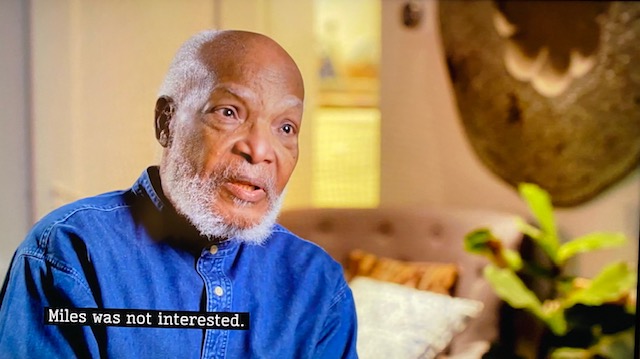


from the American Masters doc Miles Davis: Birth of the Cool
Kansas
Posted: October 24, 2021 Filed under: America Since 1945 Leave a commentFragments sad, frightening, and warm in this story “In Trying Times, a Kansas Community Faced Down Its Fear of Outsiders,” by Michael M. Phillips and Dante Chinni for Wall Street Journal. It began when a woman with Colorado plates showed up and tried to buy all the town’s toilet paper. Concerned residents, worried about just who could come up I-70, formed a protection group.
Worried about its image, the group went public early this year, posting a mission statement at the Dairy Queen, feed stores and the Pit Stop gas station.
“Gove County Emergency Response Group works to help maintain peace in Gove County,” the flier said. “By educating citizens in our area of preparedness and self-defense; inviting citizens of all backgrounds and races to stand unified against lawlessness in times of disaster and civil unrest; and building strong relationships with law enforcement through cooperative community efforts.”
Concerns:
A group of women who jokingly called themselves the Enlightened Ladies Club caught wind and were suspicious. They leaned liberal for the most part in conservative Gove County and sometimes dined together to share views. “We were anticipating some sort of vigilante group,” said Patrice Ostmeyer, who works part time at the public library.
Something Rockwellian in this photo by Christopher Smith:

Some real excellence in some of these text-image-scrolling blends that the NYT, WSJ, and Bloomberg in particular seem to have mastered.
Colin Powell
Posted: October 21, 2021 Filed under: America Since 1945 Leave a commentI forget if I found this story on my own in Powell’s memoir My American Life, or if it was called to my attention:

in any case it stuck with me. How about this, from an Atlantic interview, 2004, with PJ O’Rourke:
SECRETARY POWELL: I knew Elvis.
P. J. O’ROURKE: Really?
SECRETARY POWELL: I met him when he was in the Army. I was a lieutenant; he was a sergeant.He was in the neighboring regiment—or combat command, as we called it—in the Third Armored Division in Germany.We were in the training area one day and I was driving my jeep around and suddenly came upon this unit from the other outfit and there he was. And so I went over and shook hands.He was a good soldier. You never would have thought he was anything but a soldier. He had a pimple on his face and everything else. He was not a big star. He was just another soldier.
P. J. O’ROURKE: I’ll be darned. Well, good for him.To change the subject completely, is there symbolic or psychological significance to your fondness for Volvos?
SECRETARY POWELL: No. They just came into my life when my kids needed a car in college and they refused to drive their grandfather’s Chevy Belair. They wanted something sporty; I wanted something safe. They wanted something distinctive; I wanted something safe.I came upon this ’77 Volvo and gave it to my son who took it to college. It was a pretty interesting car. I bought another one, an older one. I play with sophisticated non-zero-sum things all week long. On weekends, if I really want to relax—and I don’t anymore, I can’t relax because I’m too busy here—but there was nothing that was greater fun for me or more relaxing than a zero-sum problem with the car. It’s not running? You put on a new distributor cap and it either runs or it doesn’t. And so the joy for me was to take—drag—home a car. I mean literally drag it home. My driver and I would do it. We’ve been known to go through Alexandria with a Volvo on a rope dragging it home. People started calling and giving them to me. They heard about me. I was Chairman of the Joint Chiefs of Staff. “I’ll give you a Volvo on a rope.” The rope broke one day coming through the gate at Ft. Myer, with the MPs waving the Chairman through. We coasted until we could get another rope.We used to do this all the time. Bring them to the house and Sergeant Pearson, now Mr. Pearson, and I would take them apart. We had extra engines, we had extra radiators, had extra transmissions.
One meal a day
Posted: October 21, 2021 Filed under: food Leave a commentCOWEN: To close, two questions about you. You’re famous for eating only one meal a day. Do you still do that?
MCCHRYSTAL: I do.
COWEN: Okay. The question is, what’s the meal?
MCCHRYSTAL: It’s dinner.
COWEN: What do you prefer to eat for the one meal, if you have your way?
MCCHRYSTAL: I’m not a foodie; I’m basic. I like salad, but I like a very basic dinner. I like a lot of chicken. If you take me to a fancy restaurant and you try to serve me fancy food, I’ll eat it because it’s my one meal a day, but the reality is, it’s completely lost on me. I just don’t get any satisfaction. It’s very basic food in significant quantities at night.
intrigued by this diet described by Stanley McChrystal to Tyler Cowen. I believe I heard elsewhere that McChrystal supplements this with dry pretzels.
Technical Analysis
Posted: October 16, 2021 Filed under: Uncategorized Leave a comment
Picking up the morning racing paper like Hemingway, I spot an interesting* item:
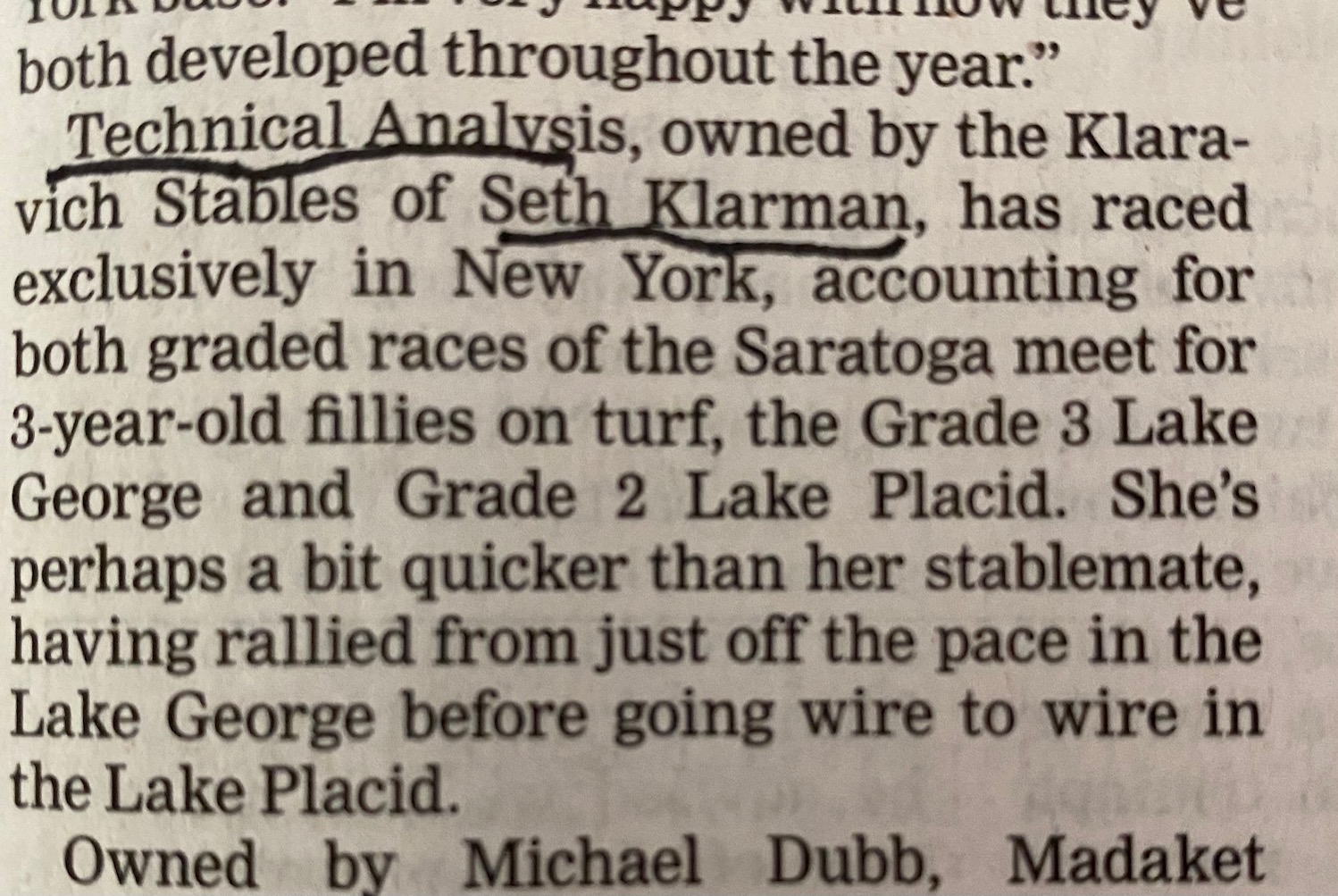
* interesting to maybe four or five people? Seth Klarman is a famed value investor and billionaire, author of Margin of Safety, a used copy of which will run you upwards of $800, or you can go to the Central Branch of the LA Public Library and read it for free. Apparently he’s been in the horse game for some time with a not too shabby record.
Asked how much different investing in a thoroughbred is to investing in a stock, mutual fund or company, Klarman said, “In my regular life, I’m a long-term investor, so we make patient, long-term investments on behalf of our clients. This is gambling, this is a risky undertaking. This is not at all like what I do the rest of my life, but it does provide one of the highest levels of excitement that a person can have.”
source for that
I put out the word to a few people I thought might be interested:
I’ve kept the correspondent here anonymous but trust me when I tell you: I believe he is being genuine!

My examination leads me to believe there is no “margin of safety” wagering on this horse, your safest bet in my opinion might be 10, Closing Remarks, to show, but where’s the fun in that? Analysts seem to think Aidan O’Brien can turn around Empress Josephine after just a week’s race – he’s done it before – but I dunno, I’d be tired!
Update: Technical Analysis came in 2nd, so if you’d made a “margin of safety” place or show bet, you would’ve done well: $2 to place paid $4.20, $2 to show paid $3.80. Seth Klarman, teaching us even through horses!
Hemingway at the track
Posted: October 15, 2021 Filed under: horses Leave a comment
I thought I would go down and buy a morning racing paper. There was no quarter too poor to have at least one copy of a racing paper but you had to buy it early on a day like this. I found one in the rue Descartes at the corner of the Place Contrescarpe. The goats were going down the rue Descartes and I breathed the air in and walked back fast to climb the stairs and get my work done. I had been tempted to stay out and follow the goats down the early morning street. But before I started again I looked at the paper. They were running at Enghien, the small, pretty and larcenous track that was the home of the outsider.
So that day after I had finished work we would go racing. Some money had come from the Toronto paper that I did newspaper work for and we wanted a long shot if we could find one. My wife had a horse one time at Auteuil named Chèvre d’Or that was a hundred and twenty to one and leading by twenty lengths when he fell at the last jump with enough savings on him to —-. We tried never to think to do what. We were ahead on that year but Chèvre d’Or would have —. We didn’t think about Chèvre d’Or.
from “A Moveable Feast.” We see here in Hemingway an example of the psychology that leads to the well–documented “favorite-longshot bias” at the track.
They still run at Enghien:
The next chapter is called “The End of an Avocation”:
We went racing together many more times that year and other years after I had worked in the early mornings, and Hadley enjoyed it and sometimes she loved it. But it was not the climbs in the high mountain meadows above the last forest, nor nights coming home to the chalet, nor was it climbing with Chink, our best friend, over a high pass into a new country. It was not really racing either. It was gambling on horses. But we called it racing.
Racing never came between us, only people could do that; but for a long time it stayed close to us like a demanding friend. That was a generous way to speak of it. I, the one who was so righteous about people and their destructiveness, tolerated this one that was the falsest, most beautiful, most exciting, vicious, and demanding because she could be profitable. To make it profitable was more than a full-time job and I had no time for that. But I justified it to myself because I wrote it. Though in the end, when everything I had written was lost, there was only one racing story that was out in the mails that survived.
It looks like Hemingway wrote a sort of tone poem about the track for the Toronto Star in 1923.
If anyone has Bergson’s On Laugher in the original French…
Posted: October 5, 2021 Filed under: comedy Leave a comment
I’d like to know what word translator Cloudesley Brereton rendered as “merry-andrew.”

The book is dense with a lot of references to French plays I don’t know, but two points worth thinking on: Bergson says notice something comic in the mechanical, when a mechanical process overrides how we should react. He gives the example of a man who stumbles in the street.
Perhaps there was a stone on the road. He should have altered his pace or avoided the obstacle. Instead of that, through lack of elasticity, through absentmindedness and a kind of physical obstinacy, as a result, in fact, of rigidity or of momentum, the muscles continued to perform the same movement when the circumstances of the case called fro something else. This is the reason of the man’s fall, and also of the people’s laughter.
Wile E. Coyote still running over the canyon came to mind, although Bergson died before he could see that. If we review comic characters, a misguided rigidity does seem to come up a lot. Consider Sheldon.
Bergson notes our vanity is a common source for comedy, and comedy may serve to correct for vanity.
most boring job in the world?
Posted: September 26, 2021 Filed under: Uncategorized Leave a commentDid The Sopranos glamorise mob life? “If you think that was glamour, you need a psychiatrist! It’s the most boring job in the world — sitting round reading the racing form all day.”
Steven Van Zandt talking to Financial Times. When I first watched Sopranos, I was absolutely drawn to Tony’s lifestyle, of just sort of driving around all day, accepting snacks. Further viewings and a deeper consideration of my character and the burdens make me think I wouldn’t trade gigs with Tony, but still, something appealing.
Also of interest:
Then David Chase approached him to play the lead in The Sopranos. At that stage, “it was a completely different show . . . a live-action Simpsons”, Chase has said. In the end, HBO vetoed someone with no acting experience as protagonist, but Chase incorporated Van Zandt into the show as Dante, a character the guitarist had himself created in a treatment for an earlier project.
FT can’t help but editorialize:
He mixes shrewd political judgment (in April, four months before the fall of Kabul, he tweeted that the US leaving Afghanistan was “a huge mistake”) with left-field ideas (such as mandatory martial-arts training for girls from kindergarten age to reduce sexual assaults).
Left-field doesn’t mean bad, FT!
a stupid man
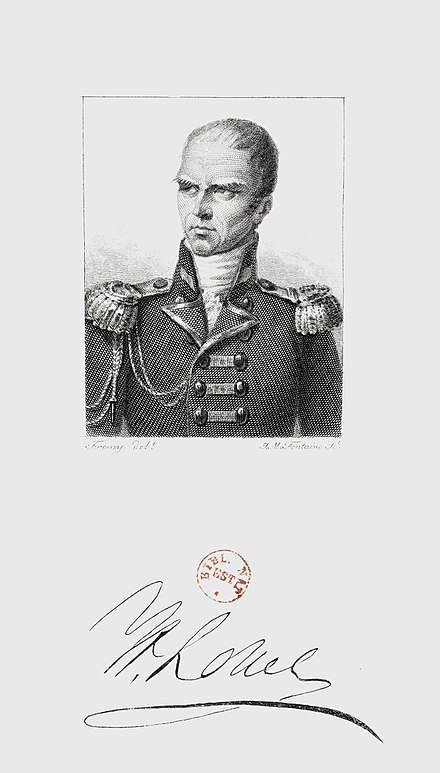
Posted: September 24, 2021 Filed under: history Leave a commentField Marshal The 1st Duke of Wellington later said that he was “a very bad choice; he was a man wanting in education and judgment. He was a stupid man. He knew nothing at all of the world, and like all men who knew nothing of the world, he was suspicious and jealous.”
that’s re: Hudson Lowe, Napoleon’s jailer on St. Helena. This sketch doesn’t make him appear a delight to be around:
Wittgenstein on Dublin architecture
Posted: September 23, 2021 Filed under: Ireland Leave a comment
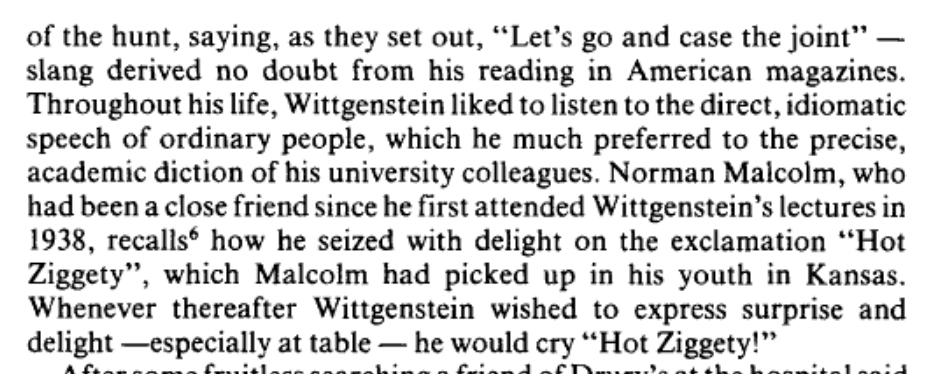
Of Dublin’s Georgian architecture, the streetscapes and squares of the city, he said: “The people who built these houses had the good taste to know that they had nothing very important to say; and therefore they did not attempt to express anything”. One thinks of the final sentence of the Tractatus, “what we cannot speak about we must pass over in silence.”
Got that from “Wittgenstein in Ireland: An Account of His Various Visits from 1934 to 1949” by George Hetherington in Irish University Review. Also of note:
Ludwig Wittgenstein
Posted: September 21, 2021 Filed under: crazy, Ireland, language Leave a commentBorn in Vienna to a very wealthy family, his father was a friend of Andrew Carnegie and had a near monopoly on steel in the Austro-Hungarian empire. Three of his four brothers would commit suicide, the fourth would lose an arm in World War I but still manage to become a concert pianist using only his left hand. His sister Margaret was a patient of Sigmund Freud’s and would later be painted by Klimt.
Ludwig went to the same elementary school as Adolf Hitler. There’s no clear evidence they met, although they were only two grades apart and it is possible but by no means agreed upon that the two as boys appear in the same school picture.
After studying in Berlin Ludwig worked on designing plane propellers with jet engines, he got a patent on one, but became frustrated. He spent some time “experimenting with kites at the Kite-Flying Upper Atmosphere Station near Glossop in Derbyshire.” He went to Cambridge in the UK where he pestered Bertrand Russell. John Maynard Keynes invited him to the join the Apostles, the gay-skewing secret society. Ludwig wasn’t that into it.
In 1913 his father died and Ludwig became one of the richest men in Europe. He moved to a remote village in Norway.

Eventually he found this place too busy.
When the Great War broke out, Ludwig volunteered for the Austro-Hungarian army, though he probably could’ve gotten out of it for health reasons. He served on a ship, was wounded in an explosion, became an officer directing artillery from no-man’s land, won several medals for bravery. He was there during the Brusilov offensive, where somewhere between 200,000 and 567,000 of his comrades were killed. He kept notes during the war:
The meaning of life, i.e. the meaning of the world, we can call God.
And connect with this the comparison of God to a father.
To pray is to think about the meaning of life.
In summer 1918 he took leave and went back to Vienna where his family had many house.
It was there in August 1918 that he completed the Tractatus, which he submitted with the title Der Satz (German: proposition, sentence, phrase, set, but also “leap”) to the publishers Jahoda and Siegel.
He went back to the front, this time to Italy, where he was captured and spent nine months in an Italian prison camp. After the war he gave away his huge inheritance to his siblings, and went to train to become an elementary school teacher. He became a teacher in a mountain village in Austria.
In 1921 the Tractatus was published. Here is the first sentence:
Die Welt ist alles, was der Fall ist.
Plug that into Google Translate, or use the standard translation, and you will get:
The world is everything that is the case.
Does that comma matter? Should it be:
The world is everything, that is the case
Or, in the Ogden translation, the first English version, approved by LW? Although he didn’t really speak English at the time?:
The world is all that is the case.
What about “case”? I have no background in German but looking up the word Fall it seems to also have connotations of drop, fall, instance.
That’s as far as I’ve gotten in the Tractatus. It doesn’t get easier from there:
The world is everything that is the case.[1]
1.1 The world is the totality of facts, not of things.
1.11 The world is determined by the facts, and by these being all the facts.
1.12 For the totality of facts determines both what is the case, and also all that is not the case.
1.13 The facts in logical space are the world.
1.2 The world divides into facts.
1.21 Any one can either be the case or not be the case, and everything else remain the same.
The decimal figures as numbers of the separate propositions indicate the logical importance of the propositions, the emphasis laid upon them in my exposition. The propositions n.1, n.2, n.3, etc., are comments on proposition No. n; the propositions n.m1, n.m2, etc., are comments on the proposition
Here’s my source. I have not decompressed all 75 pages.
This book will perhaps only be understood by those who have themselves already thought the thoughts which are expressed in it—or similar thoughts. It is therefore not a text-book. Its object would be attained if there were one person who read it with understanding and to whom it afforded pleasure.
As LW himself says.
After several years as an apparently terrifying rural elementary school teacher Ludwig hit a slow-witted kid on the head so hard he collapsed. In trouble, Ludwig resigned his position. He worked for a while as a gardener at a monastery. He designed a house in Vienna:

It took him a year to design the door handles, and another to design the radiators
He made some long confessions to friends, about things like white lies. He went back to Cambridge for awhile. He would relax by watching Westerns in the front row of the movie theater. Invited by the President of Ireland, Eamon De Valera, himself a former math teacher, to come over there, he did. He went back to the UK and during World War II he worked in a hospital.
He started working at Guy’s shortly afterwards as a dispensary porter, delivering drugs from the pharmacy to the wards where he apparently advised the patients not to take them.
After the war there was another Irish period, along Killary:
The nearest shop/post office was 10 miles away. He had to do his own housework and saw nobody except Tom Mulkerrins, who brought him his milk and kept him supplied with turf and conversation. He used the kitchen table mostly to work on, writing his aphoristic sentences on slips of paper and taking great pains to arrange them in the correct order. He did little cooking and almost all his food came out of tins. He spent hours watching seabirds and talking to them in German. The Mortimers, who were his next nearest neighbours, thought he was mad, perhaps because he wanted them to shoot their dog, whose barking disturbed him.
(source on that).
Realizing in 2012 I took a walk along Killary Harbour (it’s a fjord) not far from where he was holed up, it looks like this:

You can walk seven miles without seeing a person, easy. It’s along Killary Harbour too that Martin McDonough set The Beauty Queen of Leenane, a masterpiece of comic cruelty. I’d be curious what Wittgenstein thought of that play.
Ludwig took a trip to the USA, he went back to the UK, he was diagnosed with prostrate cancer, he died in 1951.
Just trying to wrap my head around the basic facts of this guy’s deal, prompted by this New Statesman article on the 100th of the Tractatus.
Say what you will, this guy was something!
if I ever have to direct a movie of one of Cormac McCarthy’s books
Posted: September 19, 2021 Filed under: horses Leave a commentor really any movie with significant horse action, I’m going to try to copy the way the shadows work around 1:22 in last year’s Breeders Cup Turf.
This is an interesting race. The favorite was Magical, shipped from Ireland, trained by Aidan O’Brien. The Irish are great trainers of turf horses, going back long before Stewball. Local Louisville boy Brad Cox had Arklow. Tarnawa, also from Ireland, was a four year old filly* – a girl racing against boys, past the age when females are usually still able to compete with their brothers. Channel Maker had run this race three times, finishing twelfth, eleventh, and seventh and was coming in strong.
*when exactly a filly becomes a mare is not a subject I’m prepared to opine on.
Games
Posted: September 15, 2021 Filed under: gambling Leave a commentWhen the US Congress put forward a bill in 1969 suggesting that cigarette advertisements be banned from television, people expected American tobacco companies to be furious. After all, this was an industry that had spent over $300 million promoting their products the previous year… So, what did they choose to do? Pretty much nothing.
Far from hurting tobacco companies’ profits, the ban actually worked in the companies’ favor. For years the firms had been trapped in an absurd game. Television advertising had little effect on whether people smoked, which in theory made it a waste of money. If the firms had all got together and stopped their promotions, profits would almost certainly have increased. However, ads did have an impact on which brand people smoked. So, if all the firms stopped their publicity, and one of them started advertising again, that company would steal customers from all the others.
Whatever their competitors did, it was always best for a firm to advertise. By doing so, it would either take market share from companies that didn’t promote their products or avoid losing customers to firms that did. Although everyone would save money by cooperating, each individual firm would always benefit by advertising, which meant all the companies inevitably ended up in the same position, putting out advertisements to hinder the other firms. Economists refer to such a situation – where each person is making the best decision possible given the choices made by others – as a “Nash equilibrium.”
… Congress finally banned tobacco ads from television in January 1971. One year later, the total spent on cigarette advertising had fallen by over 25 percent. Yet tobacco revenues held steady. Thanks to the government, the equilibrium had been broken.
That is from The Perfect Bet: How Science and Math are Taking the Luck Out of Gambling by Adam Kucharski, a very readable book full of insights. It’s mostly about cases of physicists and mathematicians who have “beaten” (more often found slight edges) in roulette, poker, horse race betting, and sports gambling.
Kucharski is Sir Henry Dale Fellow in the Department of Infectious Disease Epidemiology at the London School of Hygiene & Tropical Medicine. Now there’s a job!
guy walks into a psychiatrist’s office
Posted: September 13, 2021 Filed under: Uncategorized Leave a commentHe says Doc, you gotta help me. I’m in a funk. I was shaken by witnessing the compounding drought and fire catastrophe across California. The very forest is unhealthy, the trees are shriveled and dead, there is fire on an almost unfathomable scale and there’s more to come. The streets of the hollowed out towns are full of twitchy, upsetting people in distress, scary to encounter and no doubt themselves caught up in a living nightmare. In my own home town, there are ragged tent encampments all over the place, it makes your heart sink to see them, things are not going in the right direction.
Doc says go on.
Not only that, the guy says, but my wonderful mom just died. She was brave about it but she had so much more living to do. Now the voice that meant love to me since I was born is gone forever, it’s a hole, a rip in the fabric that will never be repaired.
Doc says uh-huh.
Human relations seem warped, the guy says, maybe permanently. Everyone’s beaten down and disoriented by interacting through screens. I hear defeat in the voices of people I once knew to be great boosters and enthusiasts. “Meetings” feel like some elaborate form of pretend no one has the energy for anymore. “What are we even doing?” is like a mantra, I keep hearing it. There’s alienation and directionless anger everywhere.
Right, says the Doc, I see.
I don’t want to be a Whiny Winston, Doc. In many ways I’m absurdly blessed, returning to gratitude is always a good idea. It’s not my nature to be a downer. Ever since I was a kid the people I love have relied on me for cheer and laughter and uplift. But honesty is important too. I look around, and what I see everywhere is dis-ease. I don’t know what to do, I don’t know where to turn.
Doc says, you’re in luck. I’ve got the solution. There’s this great blog called Helytimes. The guy who runs it wrote all these funny books and worked on these funny TV shows, he has a couple funny podcasts, he’s terrific. On the blog he finds wonderful art and interesting stories, the funny, the strange, the curious, just the other day he had one about Sienese painting, it was great. You’re gonna love it. It’ll cheer you right up to know there’s a guy like this out there.
Guy says, ok, thanks Doc, I’ll check it out.
same
Posted: September 8, 2021 Filed under: Canada Leave a comment“The country is grouchy and wants someone to tell them when normal comes back,” said Chad Rogers, a Conservative adviser and founding partner at Crestview Strategy.
from this Bloomberg piece on Canada’s election, “Trudeau Has 12 Days to Salvage His Career After Election Blunder,” by Theophilis Argitis. The blunder was calling an election at all, hoping to consolidate in the wake of a “successful” pandemic. That didn’t work. I wouldn’t want to be a prettyboy politician at the moment, Newsom or Trudeau, it’s not the mood.
If you’re an American and you haven’t seen Erin O’Toole yet, then first picture “Erin O’Toole” and then look up a picture of the Conservative leader.
Race track scenes
Posted: August 31, 2021 Filed under: Uncategorized 3 Comments


Trained down to Del Mar to see last year’s Kentucky Derby winner* Medina Spirit race against Rock Your World, who beat him at the Santa Anita Derby. Although there were other horses in the field, the story here was the match race between these two. At stake, in addition to the $100,000, was the integrity of Medina Spirit and trainer Bob Baffert, since the horse tested positive for the steroid betamethasone after the Derby.
The great race tracks of southern California were both built during the 1930s, when horse racing as a spectator sport was at peak popularity.
On August 12, 1938, the Del Mar Thoroughbred Club hosted a $25,000 winner-take-all match race between Charles S. Howard’s Seabiscuit and the Binglin Stable’s colt, Ligaroti. In an era when horse racing ranked second in popularity with Americans to Major League Baseball, the match race was much written and talked about and was the first nationwide broadcast of a Thoroughbred race by NBC radio. In the race, Seabiscuit was ridden by jockey George Woolf and Ligaroti by Noel Richardson. In front of a record crowd that helped make the fledgling Del Mar race track a success, Seabiscuit won by a nose.
Horse racing as a sport, historical artifact, aesthetic, distraction, subject for a stylized form of writing, and opportunity for pondering how the brain turns a combination of near-randomness and excessive information into narratives has a strong appeal.

Cheers to Mac McBride and his team for letting me into the press room. A true gentleman.
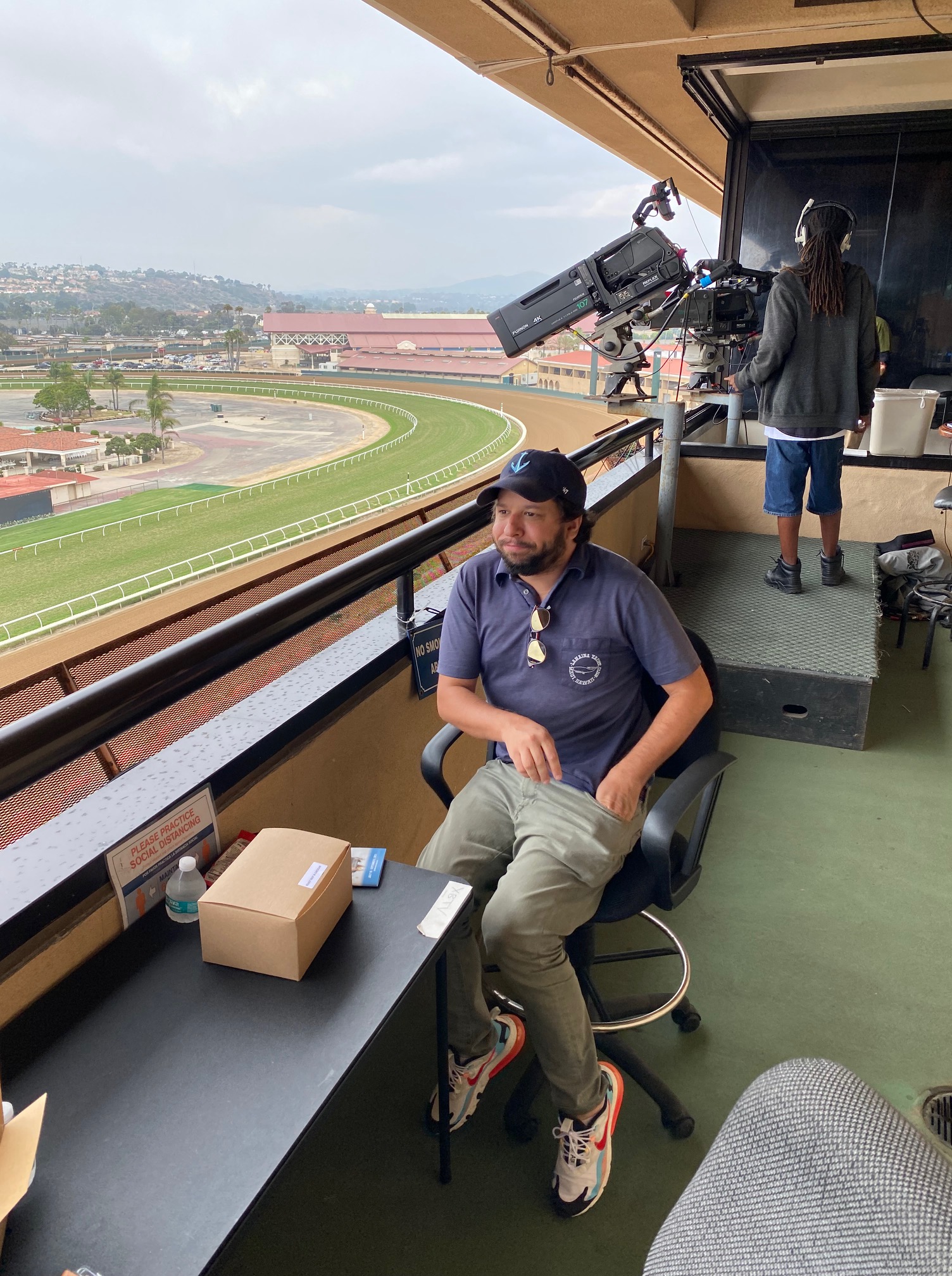
Good company.

I’ve never had anyone criticize the quality of the writing on Helytimes, though they sometimes disagreed with me or noted a piece of sloppy copyediting. I did once however get a complaint about the quality of my photography. It’s true, I don’t think I have any particular talent for photography, but I do think I have a gift for being in the right place.

After an objection in the race was resolved with no changes to the results, there was a guy down at the rail screaming “YES! YES! YES!” Although he had just received good news, the intensity of his relief suggested he’d probably wagered more than is wise on the outcome of three year old animals running around a track. A visit to the racetrack will invariably turn up both intriguing and appealing characters as well as cautionary tales.

Outcome of the race:
You know who was good at horse racing scenes? Jack Yeats:

 Helytimes


