The Lonely City and The Trip To Echo Spring by Olivia Laing
Posted: September 6, 2020 Filed under: America Since 1945, writing Leave a comment
This book was great. A kind of roaming meditation on the special poignancy of urban loneliness, which is so strange and powerful because, of course, you’re around other people, even in your solitude. Also a kind of biography of Edward Hopper, Andy Warhol, Henry Darger, and David Wojnarowicz. (The last one I was least familiar with.)
After his mother died, Andy Warhol told people she was shopping at Bloomingdales.
Even the typeface and layout of this book is pleasing. Henry Darger’s frustrations:

A conversation with Warhol’s nephew:
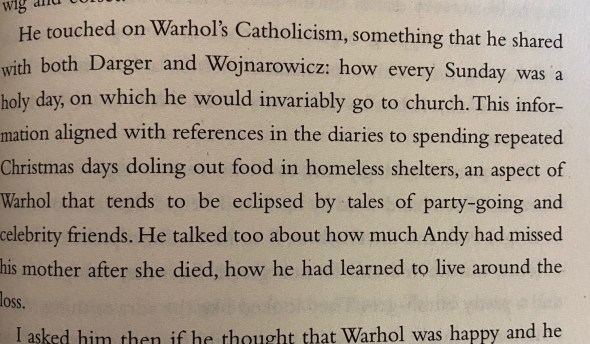
As a young person I lived in New York City, and can remember from time to time feeling loneliness there. A loneliness that was almost pleasurable. Of course this comes nowhere close to the form of loneliness you might feel if you were gay and alone and dying of plague. But I felt I could connect to the feeling explored here. Laing blends her own sensations through in a way that creates something special.
When I think about loneliness in New York, the work of art that comes quickest to mind might be Nico’s These Days. I listen and I’m like yes, that’s the feeling.

This one didn’t quite come off as much for me, maybe because I read it second, or maybe just because drinking is sort of just a sorry, depressive subject. A drunk when he’s drunk just isn’t that interesting. Laing herself (if I read the book right) isn’t an alcoholic, or even a beyond-standard English level drinker, although she discusses a history in an alcoholic household. But I didn’t feel the personal connection in quite the way I did with loneliness.

Writing in the mornings and swimming and indulging yourself in the afternoons – ideal lifestyle?
Hemingway is put on a “low alcohol diet (five ounces of whiskey and one glass of wine a day, a letter reports.”
Tennessee Williams:
in 1957 Tennessee went into psychoanalysis, and also spent a spell in what he described as a “plush-lined loony-bin” – drying out, or trying to. The seriousness with which he approached this endeavour can be gauged from his notebooks, in which he confesses day after day to “drinking a bit more than my quota.” One laconic itemisation includes: “Two Scotches at bar. 3 drinks in morning. A daiquiri at Dirty Dick’s, 3 glasses of red wine at lunch at 3 of wine at dinner – Also two Seconals so far, and a green tranquilizer whose name I do not know and a yellow one I think is called reseperine or something like that.”
The therapist was also trying to cure him of homosexuality.
I liked the parts were Laing describes the wonderful Amtrak tradition of shared tables in the dining car.
A different version of this book could’ve been called Drunk Writers and sold as like a novelty book at Urban Outfitters. Do they still sell books at Urban Outfitters?
The drinker/writer Laing profiles who I knew least about was John Berryman:

Ordered a copy.

Might have to move on to To The River, about Virginia Woolf and the river Ouse.
Some iconic haircuts on Olivia Laing.
Herds
Posted: September 4, 2020 Filed under: America Since 1945, animals, history Leave a commentLong ago, when I was a young cowboy, I witnessed a herd reaction in a real herd – about one hundred cattle that some cowboys and I were moving from one pasture to another along a small asphalt farm-to-market road. It was mid-afternoon in mid-summer. Men, horses, and cattle were all drowsy, the herd just barely plodding along, until one cow happened to drag her hoof on the rough asphalt, making a loud rasping sound. In an instant that sleepy herd was in full flight, and our horses too. A single sound on a summer afternoon produced a short but violent stampede. The cattle and horses ran full-out for perhaps one hundred yards. It was the only stampede I was ever in, and a dragging hoof caused it.
from:

by frequent Helytimes subject Larry McMurtry. You had me at “Long ago, when I was a young cowboy.”
Oh What A Slaughter isn’t a fun book exactly, but it’s about the most friendly and conversational book you could probably find about massacres. The style of McMurtry’s non-fiction is so casual, you could argue it’s lazy or bad,
As I have several times said, massacres will out, and this one did in spades.
he says on page 80, for instance. I suspect it takes work or great practice to sound this relaxed. The book reads like the story of an old friend, even humorous at times. There’s great trust in the reader.
One point McMurtry returns to an ruminates on as a cause or at least precursor to these scenes of frenzied violence is apprehension. People get spooked. Why did a heavily armed US Army unit watching over – actually disarming – some detained Indians at Wounded Knee suddenly unleash?
The Ghost Dance might have had some kind of millennial implications, but it was just a dance helped by some poor Indians – and Indians, like the whites themselves, had always danced.
McMurtry says. Yeah, but it put the 7th Cavalry on edge, and they weren’t disciplined and controlled enough. The microsociologist Randall Collins, speaking of fights and violence generally, might’ve diagnosed what likely happened next:
Violence is not so much physical as emotional struggle; whoever achieves emotional domination, can then impose physical domination. That is why most real fights look very nasty; one sides beats up on an opponent at the time they are incapable of resisting. At the extreme, this happens in the big victories of military combat, where the troops on one side become paralyzed in the zone of 200 heartbeats per minute, massacred by victors in the 140 heartbeat range. This kind of asymmetry is especially dangerous, when the dominant side is also in the middle ranges of arousal; at 160 BPM or so, they are acting with only semi-conscious bodily control. Adrenaline is the flight-or-fight hormone; when the opponent signals weakness, shows fear, paralysis, or turns their back, this can turn into what I have called a forward panic, and the French officer Ardant du Picq called “flight to the front.” Here the attackers rush forward towards an unresisting enemy, firing uncontrollably. It has the pattern of hot rush, piling on, and overkill. Most outrageous incidents of police violence against unarmed or unresisting targets are forward panics, now publicized in our era of bullet counts and ubiquitous videos.
Conversations With series from the University Press of Mississippi
Posted: August 31, 2020 Filed under: advice, America Since 1945, Mississippi, writing, writing advice from other people Leave a comment This is one my favorite books, I’m serious. Shelby Foote is a great interview, obviously, just watch his interviews with Ken Burns. (“Ken, you made me a millionaire,” Shelby reports telling Burns after the series aired.) You may not want to read the whole of Shelby’s three volume Civil War, it can get carried away with the lyrical, and following the geography can be a challenge. But the flavor of it, some of the most vivid moments, and anecdotes, come through in these collected conversations with inquirers over the years.
“You’ve got to remember that the Civil War was as big as life,” he explains. “That’s why no historian has ever done it justice, or ever will. But that’s the glory of it. Take me: I was raised up believing Yankees were a bunch of thieves. But it’s absolutely incredible that a people could fight a Civil War and have so few atrocities.
“Sherman marched with 60,000 men slap across Georgia, then straight up though the Carolinas, burning, looting, doing everything in the world – but I don’t know of a single case of rape. That’s amazing because hatreds run high in civil wars…
There were still a lot of antique virtues around them. Jackson once told a colonel to advance his regiment across a field being riddled by bullets. When the officer protested that nobody could survive out there, Jackson told him he always took care of his wounded and buried his dead. The colonel led his troops into the field.”
Finally treated myself to a few more of these editions. These books are casual and comfortable. They’re collections of interviews from panels, newspapers, magazines, literary journals, conference discussions. Physically they’re just the right size, the printing is quality and the typeface is appealing.
Why not start with another Mississippian, someone Foote had quite a few conversations with himself?
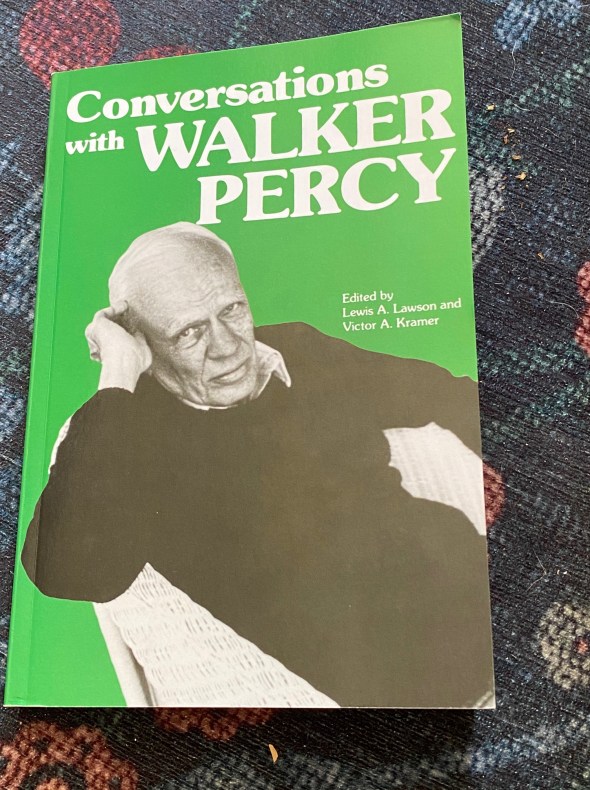
Wow, Walker Percy could converse. 
Later, different interview:
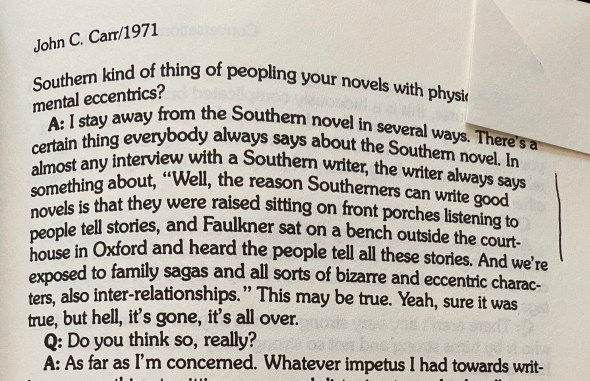
Do we dare attempt conversation with the father of them all?

I’ve long found interviews with Faulkner, even stray details from the life of Faulkner, to be more compelling than his fiction. Maybe it’s the appealing lifestyle: courtly freedom, hunting, fishing, and all the whiskey you can handle. The life of an unbothered country squire, preserving a great tradition, going to Hollywood from time to time, turning the places of your boyhood into a world mythology.
We’ll have more to say about the Conversations with Faulkner, deserves its own post! Maybe Percy gets to the heart of it in one of his interviews:
Q: Did you serve a long apprenticeship in becoming a writer?
Percy: Well, I wrote a couple of bad novels which no one wanted to buy. And I can’t imagine anyboy doing anything else. Yes it was a long apprenticeship with some frustration. But I was lucky with the third one, The Moviegoer; so, it wasn’t so bad, I guess.
Q: Had you rather be a writer than a doctor?
Percy: Let’s just say I was the happiest doctor who ever got tuberculosis and was able to quit it. It gave me an excuse to do what I wanted to do. I guess I’m like Faulkner in that respect. You know Faulkner lived for awhile in the French Quarter of New Orleans where he met Sherwood Anderson, and Faulkner used to say if anybody could live like that and get away with it he wanted to live the same way.

There’s one of these for you, I’m sure. They also have Comic Artists and Filmmakers.

only one subject with whom I myself had a conversation
For the advanced student:

Chasing The Light by Oliver Stone
Posted: August 10, 2020 Filed under: America Since 1945, film, movies Leave a comment 1969. Young Oliver Stone, back from Vietnam, kind of lost in his life, having barely escaped prison time for a drug charge in San Diego, enrolls at NYU’s School of the Arts, undergrad. He makes a short film in 16mm with some 8mm color intercuts, about a young veteran, played by himself, who wanders New York, and throws a bag full of his photographs off the Staten Island ferry, with a voiceover of some lines from Celine’s Journey to the End of Night.
He shows it to his class. The professor is Martin Scorsese.
When the film ended after some eleven taut minutes and the projector was turned off, I steeled myself in the silence for the usual sarcasm consistent with our class’s Chinese Cultural Revolution “auto-critique,” in which no one was spared. What would my classmates say about this?
No one had yet spoken. Words become very important in moments like this. And Scorsese simply jumped all the discussion when he said, “Well – this is a filmmaker.” I’ll never forget that. “Why? Because it’s personal. You feel like the person who’s making it is living it,” he explained. “That’s why you gotta keep it close to you, make it yours.” No one bitched, not even the usual critiques of my weird mix, sound problems, nothing. In a sense, this was my coming out. It was the first affirmation I’d had in… years. This would be my diploma.
This book covers the first forty years of Stone’s life, with much of it centered on the making of Salvador, Platoon, and Scarface, after experiences in Vietnam and jail.
The movies of Stone’s later career – The Doors, JFK, W, Nixon – are the ones that mean the most to me, and those aren’t covered in this book. But I was still pretty compelled by it, surprised by the sensitive, easily wounded young man who emerges, experienced in violence but capable of great tenderness. Struggling with his father’s expectations, his socialite mother. His fast rise in Hollywood, frustrations and joys, and the druggy swirl that almost undoes it all, like when he gave a rambling Golden Globe acceptance speech after “a few hits of coke, a quaalude or two, several glasses of wine.” (Video of the speech since scrubbed from YouTube, unfortch).
How about Peter Guber pitching what became Midnight Express:
Make a little money for college. Innocent kid basically, knows nothing, first trip outside the country right? They beat the shit out of him! Everything in the world happens to him – and then he escapes from this island prison on a rowboat…. that’s right! A rowboat, believe it or not. Gets back to the mainland, then runs through a minefield across the Turkish border into Greece – right? Unbelievable! Great story! Tension – like you wrote Platoon. Every single second, you want to feel that tension!
The people in the next booth
Posted: August 9, 2020 Filed under: America Since 1945, writing advice from other people Leave a commentMAMET
I never try to make it hard for the audience. I may not succeed, but . . . Vakhtangov, who was a disciple of Stanislavsky, was asked at one point why his films were so successful, and he said, Because I never for one moment forget about the audience. I try to adopt that as an absolute tenet. I mean, if I’m not writing for the audience, if I’m not writing to make it easier for them, then who the hell am I doing it for? And the way you make it easier is by following those tenets: cutting, building to a climax, leaving out exposition, and always progressing toward the single goal of the protagonist. They’re very stringent rules, but they are, in my estimation and experience, what makes it easier for the audience.
INTERVIEWER
What else? Are there other rules?
MAMET
Get into the scene late, get out of the scene early.
INTERVIEWER
Why? So that something’s already happened?
MAMET
Yes. That’s how Glengarry got started. I was listening to conversations in the next booth and I thought, My God, there’s nothing more fascinating than the people in the next booth. You start in the middle of the conversation and wonder, What the hell are they talking about? And you listen heavily. So I worked a bunch of these scenes with people using extremely arcane language—kind of the canting language of the real-estate crowd, which I understood, having been involved with them—and I thought, Well, if it fascinates me, it will probably fascinate them too. If not, they can put me in jail.
from The Paris Review of course.
Really missing overhearing the people in the next booth these days. Feeling the loss of the scuttlebutt. The collective vibecheck you get from what the people you overhear in the coffeeshop, see in the elevator at work. The tide is out on that kind of info, the shared hum. When it comes back in, perceptions will change. Understandings will be recalibrated. Was wondering how this in particular with the stock market, which moves with this mood. We may find out soon!
Forty year old men in movies
Posted: August 2, 2020 Filed under: movies 1 Comment
I’ve been on this planet for forty years, and I’m no closer to understanding a single thing.

says Charlie Kaufman in Adaptation.

Forty years old, and I’ve never done a single thing I’m proud of.
says Harvey Milk, early in Milk. It’s his fortieth birthday when we meet him:
The film then flashes back to New York City in 1970, the eve of Milk’s 40th birthday and his first meeting with his much younger lover, Scott Smith.

Ray Kinsella in Field of Dreams tells us he’s thirty-six:
Annie and I got married in June of ’74. Dad died that fall. A few years later, Karin was born. She smelled weird, but we loved her anyway. Then Annie got the crazy idea that she could talk me into buying a farm. I’m thirty-six years old, I love my family, I love baseball, and I’m about to become a farmer. And until I heard the Voice, I’d never done a crazy thing in my whole life.*
but that was in 1989, when, believe it or not, life expectancy was 3.89 years shorter.
Then of course there’s:

and

What’s going on here? Is it because forty years old is about when (male) directors get the chance to make movies like this?
Are there movies about explicitly forty year old women? None leap to mind.
There are several movies about a ~ thirty year old woman’s crisis. Bridget Jones, My Best Friend’s Wedding – but I can’t think of forty year old women appearing with such clear declaration.
Could it be the actors? This is when make actors tend to be developed in their craft, at the peak of their power, empowered to wrestle with material they choose.
Is forty when a man straddles a divide between the freedom of youth and the responsibilities of adulthood? He MUST make some choice? Does that choice make for a movie?
Maybe it’s simpler than all that.
Let’s say you just turned 40. Obviously, 40 is just a number, but in many ways, it’s a milestone. Though people are living longer these days into the 80s and 90s, still age 40 is considered the halfway mark.
(That’s from this article on Seeking Alpha.)
Maybe it’s just the halfway mark. When you get to halftime you ask, how am I doing? “Make adjustments,” as the football coaches always say.
In the middle of the journey of our life
I found myself in a dark forest,
for the straight way was lost.
Not a bad way to start a story. (Dante’s Inferno, Canto I, translated by Google)
* Ray Kinsella says that before he heard the Voice, he’d “never done a crazy thing in my entire life.” But earlier in the same speech he tells us:
I marched, I smoked some grass, I tried to like sitar music,
Sounds like a guy who’s at least experimental (or is he saying he did all the cliché things of any ’60s college student?).
Ray also says that (along with Annie) he bought a farm in Iowa, the “idea” of which was, his words, “crazy.”
I think Ray protests a little too much here. I think he is the type who would at least consider a crazy thing. Perhaps that openness is part of why the Voice chose him.
One Two Three Four: The Beatles In Time by Craig Brown
Posted: July 26, 2020 Filed under: books, music, writing Leave a comment
1966. The Beatles return from the US, having played what will be their “last proper concert,” Candlestick Park, San Francisco, August 29. They have some time off.
For the first time in years, the four of them were able to take a break from being Beatles. With three months free, they could do what they liked. Ringo chose to relax at home with his wife and new baby. John went to Europe to play Private Gripweed in Richard Lester’s film How I Won The War. George flew to Bombay to study yoga and to be taught to play the sitar by Ravi Shankar. This left Paul to his own devices.
For a while he hangs out in London, where he’s surely the most famous person. It gets a tiresome, really. Paul gets the idea of going incognito. He arranges a fake mustache, and fake glasses, and slicks his hair back with Vasoline. He has an Aston Martin DB6 shipped to France, and across the Channel he goes. He drives around France for a bit, relaxing in Paris, sitting in cafes unrecognized. From his hotel window he shoots experimental film of cars passing a gendarme. On he goes.
Upon reaching Bordeaux, he felt a hankering for the night life. Still in disguise, he turned up at a local discothèque, but was refused entry. “I looked like old jerko. ‘No, no monsieur, non’ – you schmuck, we can’t let you in.” So he went back to his hotel and took off his scruffy overcoat, his moustache and his glasses. Then he returned to the disco where he was welcomed with open arms.
I absolutely hoovered up this book. I’ve read a bunch of Beatles books in the last few years: Rob Sheffield’s Dreaming The Beatles, the gossipy The Love You Make by Peter Brown and Steven Gaines, You Never Give Me Your Money by Peter Doggett, about the Beatles post Beatles. This last one may have been the most compelling, even though much of it is patient unraveling of complex business and tax situations (plus anecdotes about decadence.) A tragedy about the years the Beatles spent suing each other. Maybe because how a person handles that kind of stress – the stress of tedious meetings – is more revealing, the personalities really came to life.
You’d think I’d be bored of the Beatles. The facts of the history don’t even interest me that much, and I doubt there’s a Beatles song on my top 100 most played. I’m not that much of a Beatles fan, to be honest, not compared to the psychos. (A funny bit in this book is Craig Brown, saying he’s spent a few years in deep on Beatles books and lore, acknowledging he’s barely scratched the surface of like, people who know every version of the lineup of the Quarrymen.)
We don’t need a recounting of the basic beats of the plot of the Beatles. We know.
Craig Brown goes so far beyond that. He assumes you know the rough outlines, and somehow he breathes new life into these old bones. He makes moments pop. Specimens of time, how far can we go to recapturing them? That’s the real question of this book.
Brown will take an incident – the day Bob Dylan turned the Beatles on to marijuana, for instance – and turn it over from every angle, consider every account. How do we know what we know? Who’s telling us? What was their agenda? How much can they be trusted? The historigraphy, you might say. At the same time, he puts us right there as Brian Epstein looks at himself in the mirror, repeating a single word over and over.
Take Pete Best. You probably know that story, the original drummer, they replaced him with Ringo. The cruelty of how that went down, how the Beatles treated him, shocks here in Brown’s retelling. I didn’t know, for instance, that in 1967 Pete Best tried to kill himself. Brown takes us thereL
He locks the door, blocks any air gaps, places a pillow on the floor in front of the gas fire, and turns on the gas. He is fading way when his brother Rory arrives, smells gas, batters the door down and, screaming “Bloody idiot!” saves his life.
If you want to know what happened to the comedians who had to perform in between the Beatles’ sets on Ed Sullivan, this is the book for you.
Can I reprint all of Chapter 30?

Seems like I’m just approximating picking this book up in a bookshop. What harm in that?
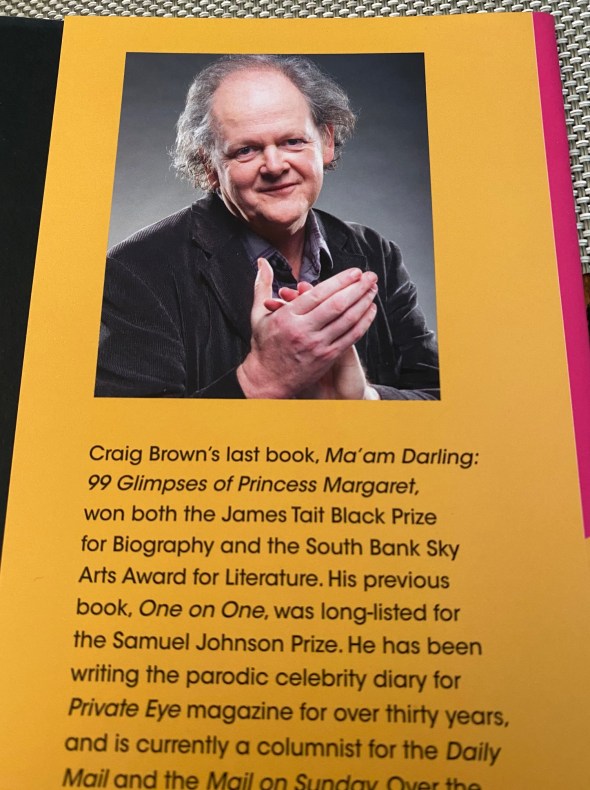
Craig Brown: going on my Role Models and Inspirations board. In a random, unrelated search I learn that he is aunt by marriage to Florence Welch, of Florence + The Machine. That’s the kind of connection Craig Brown would track down and work over for any possible meaning. Maybe there’s something there, maybe he’d discard it to the flotsam of chance, who knows. The point is he’d track it down.
Brown’s 99 Glimpses of Princess Margaret is great too, if you’re into The Crown type stuff.

Meat – Plants – Stuffing
Posted: July 25, 2020 Filed under: food 1 Comment
Rainer Z illustrated “lettuce” for Wikipedia with this photo
I’ve created a new taxonomy of food, I believe it is correct.
There are three types of food:
- meat
- plant
- stuffing
All foods can be fit into these categories.
Questions:
Yes, what is bread?
Bread is stuffing, obviously.
Potatoes are a plant, aren’t–
Let me stop you right there, potatoes are stuffing. Fries are stuffing, chips are stuffing, mashed potatoes are stuffing. Potatoes in all forms are stuffing, you know this.
And corn?
All corn is stuffing. Most American stuffing comes in the form of compressed corn.
What are carrots?
Carrots are plant. Boiled, mushy carrots approach stuffing, this is because you’ve beaten out of them their plant nature. The highest forms of cooking retain the true nature of the meat or plant. The cooking and preparations of stuffing take wider forms.
What is cheese?
All dairy is stuffing, again, you know this in your heart.
What about ice cream? Ice cream is its own thing.
I’m willing to accept those who create a mental category called “ice,” “ices,” or “ice cream” which includes Popsicles, sherbets, etc. I think you’re being dishonest with yourself though if you don’t accept that ice cream is a form of stuffing, however joyful and harmless.
What about fish?
Hmm ok I guess we were including fish with meat but I will allow fish as its own category. There are four types of food,
- meat
- plant
- fish
- stuffing.
What is soup?
Vegetable soup? Plant. If there’s a potato in there, that’s stuffing. Corn of any kind is stuffing.
OK what is miso soup?
That is a liquid.
Wait a —
There is a category called “spice,” if you insist miso soup could be a spice, along with salt, bbq sauce, gravy etc, things we eat that are not in the three food categories.
What is a tomato?
Some call it spice, and we respect that, but it is plant.
What about the cheese on a pizza?
Stuffing, as is the crust. Pizza is a stuffing food, even if it contains some plant (tomato, if you believe tomato to be a plant not a spice).

Evan Amos photographed “Chicken McNuggets“
What is a McDonald’s Chicken Nugget*?
Great question, let’s say the answer together on three, one, two, three, stuffing, you said stuffing didn’t you? Because it is stuffing.
For that matter, some low-quality burgers are in fact not meat but stuffing. I’d suggest even a 100% beef burger, if made from corn-fed, lot-processed beef, is stuffing. And the cheese is stuffing, and the bun is stuffing. That’s why it’s so important to get lettuce on there, so at least you get plant.
In what proportion should I eat these foods?
Look, that’s up to you, I’m not here to dictate diets which I think are VERY personal and person-specific. But we do feel that being honest about this taxonomy, saying to yourself “this is stuffing, I’m eating stuffing,” keeping track of how much of each category you eat, may be helpful towards establishing nourishing and sustaining and sustainable food habits.
What’s an apple?
Plant.
Apple pie?
Stuffing. The vanilla ice cream scoop is possibly “ice cream,” its at the very least a different kind of stuffing, but we don’t let ourselves get sidetracked into subcategories. Short answer, stuffing.
(I’ve got him now, watch this:) Excuse me, what about apple pie?
Stuffing, please leave.
What about my beloved bivalves, oysters and clams?
Those are meat, or if you insist, fish. Lobster is stuffing, as is any crab whose carapace is larger than a quarter.
What about like a chip, but it’s made out of lettuce? Some kind of Veggie Crisp?
Plant covered in stuffing.
I don’t think I have any more questions, thank you.
You’re welcome, please enjoy these categories and spread them widely.
UPDATES:
The comments roll in:
Fish is meat and lobster is fish.
Agree that fish is meat. Lobster is stuffing. A lobster eats meat (fish) or stuffing (waste, carrion, etc) and turns it into more stuffing. It does not magically turn stuffing into fish. Unfortunately, by the way, would be great if it did!
(Getting some pushback on this. Maybe lobster is meat)
What is a chickpea?
Stuffing! Look, there’s nothing wrong with many stuffings, especially natural stuffings. They have an important place in any diet! My favorite food is spaghetti, a stuffing! (with tomato sauce, a spice/plant).
Hello! Some questions from @ccheever and me: what about eggs (hard boiled or sunny-side up no stuffing/frills)? What about tofu (also by itself), which could fit any of the 3 categories?
Hi Helen! Eggs are… meat! Once it becomes an omelette, an egg is stuffing. Tofu is stuffing!
What about nuts?
Nuts are stuffing.
Ok one more: cauliflower. Seems like the stuffing of vegetables.
Plant.
What about mushrooms?
This is a tricky one. Fungi is special. But I will say 90% of mushrooms are served as stuffing.
* Bourdain had many funny takes on the McNugget, here’s one from a 2014 interview with Kam Williams, Baltimore Black:
AB: I think it’s very hard to make an argument that a Chicken McNugget is either chicken or a nugget? If you’re eating unwholesome, street food in a country where they have to make do with whatever scraps are left to them, at least you know what it is, and generally have some sense of where it came from. Whereas a McNugget, to my way of thinking, is a Frankenfood whose name doesn’t necessarily reflect what it is. I’m still not sure what it is. Listen, Kam, when drunk, I will eat a McNugget. It’s not the worst tasting thing in the world, but it’s one of the things I’m least likely to eat, because I choose not to.
Ray Dalio
Posted: July 25, 2020 Filed under: business Leave a commentIn a “Principles” app that takes its name and lessons from a bestselling memoir by Mr. Dalio, this week’s case study on meaningful work and relationships features a video from a 2013 “Family Reunion” for employees who had been at Bridgewater for at least a decade.
“Every one of these people here is, you know, my family,” Mr. Dalio said in the video. “I’ve watched them grow up, like, coming out of college and watching them get married and have their kids. You know, I didn’t behave any different to the people I work with than with my kids.”
Some of the employees who appeared in the video were among those laid off this month, said people familiar with the matter.
from Friday’s Wall Street Journal piece, “Bridgewater Associates Lays Off Several Dozen Employees,” by Juliet Chung.
Ray Dalio is a beloved figure here at Helytimes. If you’ve read Principles, this behavior is not inconsistent, I’m sure he told these employees that to achieve success they must first face and accept harsh realities.
Scrapbasket
Posted: July 19, 2020 Filed under: America Since 1945, art history Leave a comment
Some local street art (by Bandit?). Since painted over I believe. At least I can’t find it.

Photo I took in William Faulkner’s house, Rowan Oak, Oxford, MS.

from this WSJ commentary by Kate Bachelder Odell about leadership failures in the US Navy.

“Soldiers bathing, North Anna River, Va.–ruins of railroad bridge in background,” by Timothy O’Sullivan. May 1864. The work of Timothy O’Sullivan has my attention. Follow his photos on the Library of Congress and you’ll travel in time.

by Alexander Hope.
Original Caption: Subway train on the Brooklyn Bridge in Manhattan, New York. The problem of how to move people and goods is ultimately bound up with the quality of life everywhere. The lands adjacent to the Bight, rivers flowing into it, and bays and estuaries edging it have direct upon the environment of the coastal water. The New York, New Jersey metropolitan region is one of the most congested in the world, 05/1974.

Just thought this was funny.
San Francisco (and Los Angeles)
Posted: July 15, 2020 Filed under: America Since 1945, California, San Francisco, the California Condition Leave a comment
Earlier this year, you moved to Los Angeles from San Francisco. How is the transition going?
It felt like the opening minute of Randy Newman’s song “I Love L.A.” Looking back on the twentieth century, I recall it was Los Angeles that was always the city of the future, and the city of craft and guilds. Every movie was essentially a six-month startup that brought together know-how and expertise from so many different areas: art, set design, costume, carpentry—and all the weirdly named professions like grips, gaffers, and boom operators. That ethos still lives on in the spirit of the place. With SpaceX and other aerospace companies making headway, I wouldn’t discount Southern California in the race to become the next big creative cluster. Of course, Sacramento may ruin the entire state before that happens. But that’s another story.
Michael Gibson (had never heard of) in City Journal. Gibson wrote a piece for City Journal where he called San Francisco “America’s Havana.” He pointed out inarguable problems with San Francisco, which is a shocking mess.
But, like Havana, San Francisco is also magical. There’s just something about it. Maybe it’s the drastic geography, set on hillsides over a bay that’s both perfect and hidden. The sea air is part of it, for sure, and the lushness of the flora. In both Havana and San Francisco, the very air is magical.
When you read the history of San Francisco, a certain tolerance of criminality always seems to have been part of the mix. Stepping over a druggie passed out on the street wouldn’t’ve been unfamiliar to a resident of Gold Rush-era San Francisco or Barbary Coast San Francisco, or the 1940s San Francisco that inspired all the noir movies.
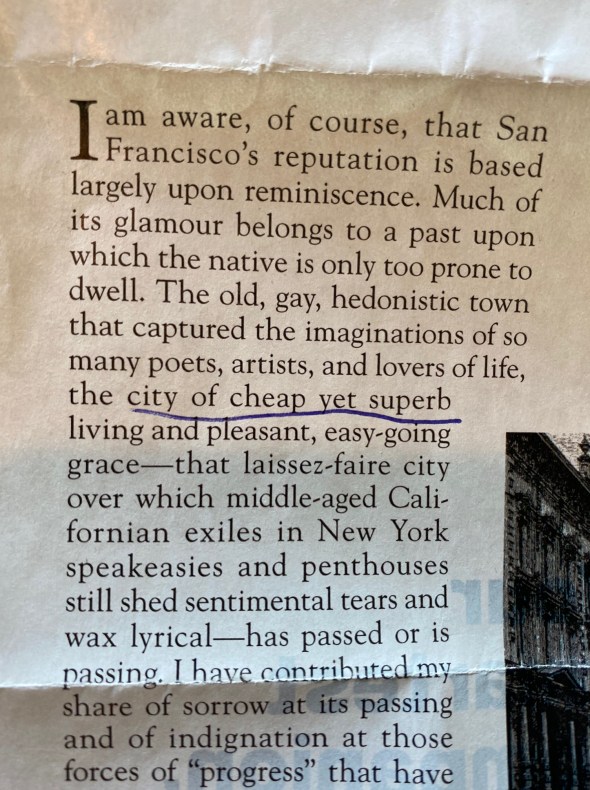
I’ve had in my files this bit by Lillian Symes from a 1932 Harper’s, reprinted from the archive:

The city of cheap yet superb living:
More:

When I got to LA in 2004, I found the living superb. It was cheaper than New York City, but I’m not sure it could really be called cheap. And it’s gotten less cheap. Readers, where would you say, these days, the living is cheap yet superb?
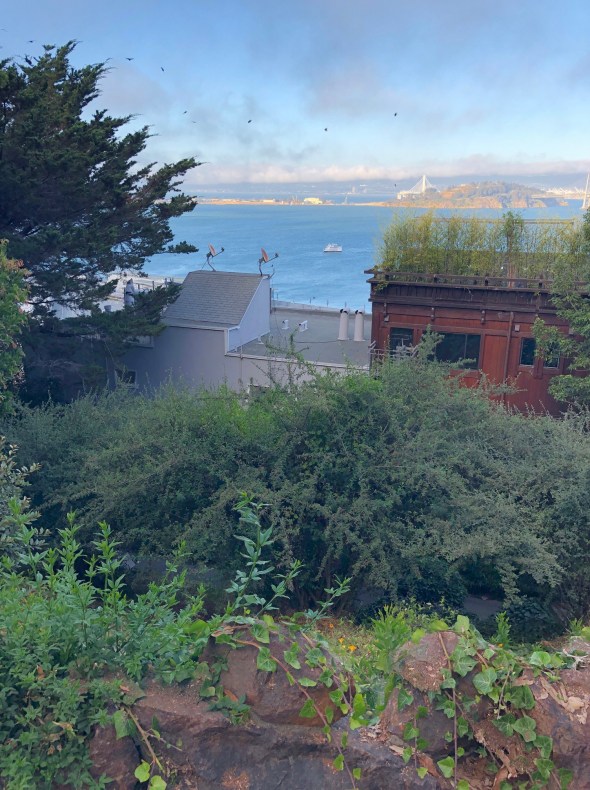
San Francisco scenes:

I’m no expert on our 21st President
Posted: July 14, 2020 Filed under: America, presidents Leave a comment
but somehow get the sense that Chester Alan Arthur did his best. I guess signing the Chinese Exclusion Act would be the ugliest mark on his record. He tried to stop it!
Valparaiso
Posted: July 13, 2020 Filed under: Wonder Trail Leave a comment
Went back to watch one of my all time favorites. Read more about Valparaiso in my book!
All right, good for him
Posted: July 10, 2020 Filed under: music Leave a comment
Willie Nelson in Vulture. And:
I read that you and Snoop Dogg were doing a new song. Is he also a fan of Willie’s Reserve?
Oh yeah. I was over in Amsterdam one time and I called him. I said, “Come on, Snoop. This is where you and me need to be.” We had a heck of a good time.

Pickett’s Charge: A microhistory of the final attack at Gettysburg, July 3, 1863 by George R. Stewart
Posted: July 3, 2020 Filed under: history Leave a comment
Forget where I came across a mention of George R. Stewart’s microhistory of Pickett’s Charge. could’ve been anywhere. The idea of a microhistory intrigued so I got a used copy.
How about the career of George R. Stewart? Man: An Autobiography. Genius.
If we grant – as many would be ready to do – that the Civil War furnishes the great dramatic episode of the history of the United States, and that Gettysburg provides the climax of the war, then the climax of the climax, the central moment of our history, must be Pickett’s Charge.
Thus to hold, indeed, is not to maintain that a different result, there by the clump of trees and the angle in the stone wall, would of itself have reversed the course of the war and decisively altered history.
Stewart takes you there, to the clump of trees and the angle in the stone wall. If you want to know where Hancock was at approximately 3:30 pm that day, and from where Longstreet watched what he knew was likely a doomed advance, this is the book for you.
The task at hand is to make sense out of what must’ve been absolute insanity, deafening, smoky confusion for the participants. Consider the 19th Massachusetts, around 3:50 pm:
The men were jammed in to an average of six deep. When a man had loaded, he pushed his way to the front to fire. Sometimes he had to dodge around to get a place through which to point his musket, and in the confusion men might be shot from the rear. With men firing from everywhere the noise of the discharges was deafening.
Sometimes the lines even surged together, and there was a sudden swinging of clubbed muskets. In one of these encounters, Private De Castro of the 19th knocked down the color-bearer of the 14th Virginia, he himself using the staff of the Massachusetts state colors as a club. He seized the Virginia flag, brought it back, and thrust it into the hands of his colonel.
Some of the events seem almost mystical to the modern reader. The wounded Confederate general Armistead falls at the Union lines:
Armistead had been heard, in some lull of the musketry, calling for help, “as the son of a widow.” This we must take to be the code of some secret society; at least, the words gained immediate response. Some of the men of the 72nd Pennsylvania requested permission of their officer to go to his aid, and carried him behind the Union lines.
As a wounded general, even though of the wrong side, he was granted much attention and every courtesy. A surgeon, Henry H. Bingham, soon arrived, but could only inform Armistead that he was dying. Bingham promised to deliver any personal effects that the general might desire forwarded to his family.
Armistead was, according to Bingham, a man “seriously wounded, completely exhausted, and seemingly broken spirited.” The words that he then spoke were destined to become a small storm-center of controversy: “Say to General Hancock for me, that I have done him, and you all, a grievous injury, which I shall always regret.” He was then carried to the hospital.
Attitudes were at play which seem hard for us to access. Stewart:
Horrors there were in plenty – men struck in the eyes, through the intestines, in the genitals. Men were carried away maimed for life, and at least one wounded man drew his revolver and shot himself. But to write of Gettysburg in terms of the Somme or of Monte Cassino would be a painful falsification of history. Nothing is more striking in the sources generally than the absence of gloom. The armies suffered casualties such as few modern armies have endured, but the men did not seem to feel sorry for themselves. Did some primitive spirit of combat sustain them? Or a romantic sense of glory? Or an intense patriotism? Or was it a more imminent hint of immortality, as when a private of Brown’s battery died in a religious ecstasy?
One of Stewart’s great sources is the records of a trial, twenty-five years after the battle, which resulted from a dispute between the Gettysburg Battlefield Memorial Association and the Survivors’ Association of the 72nd Pennsylvania about where on the battlefield they were permitted to put their statue:
Some of the testimony is of a remarkable poignancy, even though the heat of battle was so many years in the past. We have the boiling over of pride in the regiment:
Q. Did you see any Massachusetts or New York regiment come down and run over the Seventy-second?
A. I would like to see somebody say so! I would like to meet the man who said it!
We have the vivid personal memory:
Q. Where did you find the bodies in the angle; I mean of the Seventy-second people in the angle?
A. The most I can remember was one by the name of Metz belonging to my company – him and me were great chums – and he fell across the stone wall. He fell crossways across the stone wall.
As for Pickett himself?
He himself realized that his conduct during the afternoon had been such that he would be accused of cowardice . . . His career really ended at Five Forks, April 1, 1865, when he again lost most of his division. On this occasion, while his men were being crushed, Pickett was behind the lines and out of touch, enjoying a shad-bake. These were the last days of the war, and the scandal was somewhat hushed up. But Pickett thereafter had only some fragmentary regiments, and he was relieved of his command the day before the surrender. Lee, seeing him at Appomattox, remarked, “I thought that man was no longer with the army.”
(Should we rename the fort named after this guy?)
You needn’t bother adding this volume to your library unless you’re a fairly serious student of the battle, but it’s impressive to observe Stewart’s achievement, and to think on these events.
If I have a criticism of this book it’s that Stewart is so entertaining he can make all this seem like sort of just a violent field day. To clear up that impression real fast, one can look at any of a number of grim photographs Timothy O’Sullivan took that day, and after, photographs which still shock. This one, “Dead Horses of Bigelow’s Battery,” for instance.
How Lee took the devastating day:
Summoned to receive orders, [General John D. Imboden] found the commander so exhausted that he could scarcely dismount from his horse. Shocked by this weariness and by the sadness of the face, Imboden ventured to remark, when Lee stood silent, “General, this has been a hard day on you.”
Lee looked up, and then spoke mournfully, “Yes, it has been a sad, sad day to us.” After another lingering silence, Lee commented on the gallantry of Pickett’s men, and then after another pause, he cried out, in a loud voice, in a tone almost of agony, “Too bad! Too bad! Oh! TOO BAD!”
Life is moving
Posted: June 23, 2020 Filed under: America Since 1945, screenwriting, the theater Leave a comment
In the Moscow Art Theatre, in Tel Aviv in the Habimah, productions have been kept going for forty years or more: I have seen a faithful revival of Vakhtangov’s twenties’ staging of Princess Turandot; I have seen Stranislavsky’s own work, perfectly preserved: but none of these had more than antiquarian interest, none had the vitality of new invention. At Stratford where we worry that we don’t play our repertoire long enough to milk its full box office value, we now discss this quite empirically: about five years, we agree, is the most a particular staging can live. It is not only the hair-styles, costumes and make-up that look dated. All the different elements of staging – the shorthands of behaviour that stand for certain emotions; gestures, gesticulations and tones of voice – are all fluctuating on an invisible stock exchange all the time. Life is moving, influences are playing on actor and audience, and other plays, other arts, the cinema, television, current events, join in the constant rewriting of history and the amending of the daily truth. In fashion houses someone will thump a table and say “boots are definitely in”: this is an existential fact. A living theatre that thinks it can stand aloof from anything so trivial as fashion will wilt. In the theatre, every form once born is mortal; every form must be reconceived, and its new conception will bear the marks of all the influences that surround it. In this sense, the theatre is relativity. Yet a great theatre is not a fashion house; perpetual elements do recur and certain fundamental issues underlie all dramatic activity. The deadly trap is to divide the eternal truths from the superficial variations; this is a subtle form of snobbery and it is fatal.
This made me hmmm as I consider what to think about the exiling of comedy now felt to be unacceptably hurtful.
Rubber bullet and non-lethal projectile collecting
Posted: June 22, 2020 Filed under: America Since 1945, the California Condition Leave a comment
Sunday morning four weeks ago on the streets of the Beverly – Fairfax district was a bonanza for us collectors of non-lethal shells and projectiles.

The Honus Wagner card of this kind of collection is the LAPD stamped bean bag shell
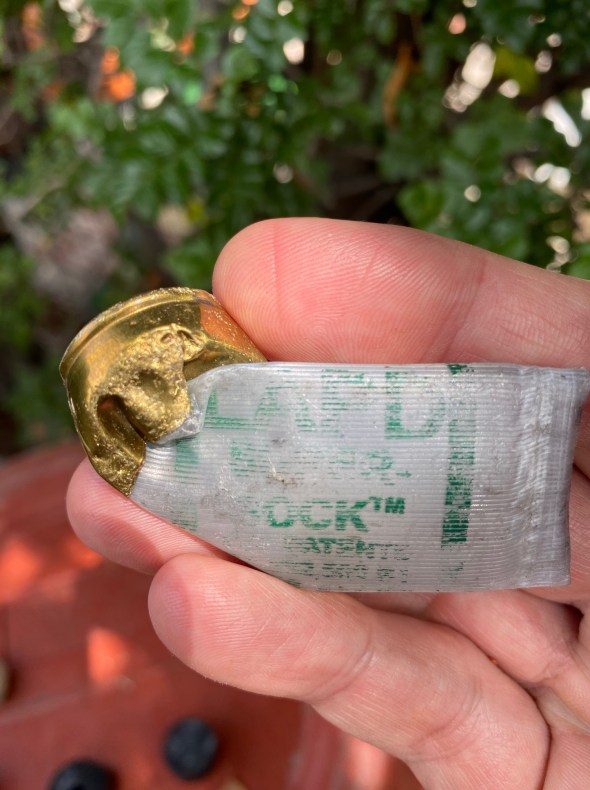
A key guide for the hobbyist is the LAPD’s equipment page.


I hope I don’t have any more opportunities to add to my collection.
(Always remember the scene in The Last Castle (2001) where James Gandolfini, a military history buff, hears Redford, a real veteran, assess his collection of Civil War bullets and Minié balls: “it’s just something that caused some poor bastard a whole lotta pain.”
Couple real good scenes in that movie. When Redford teaches Ruffalo the meaning of a salute!)
How to read a Racing Form // Belmont Stakes value picks
Posted: June 20, 2020 Filed under: America Since 1945, horses, sports Leave a comment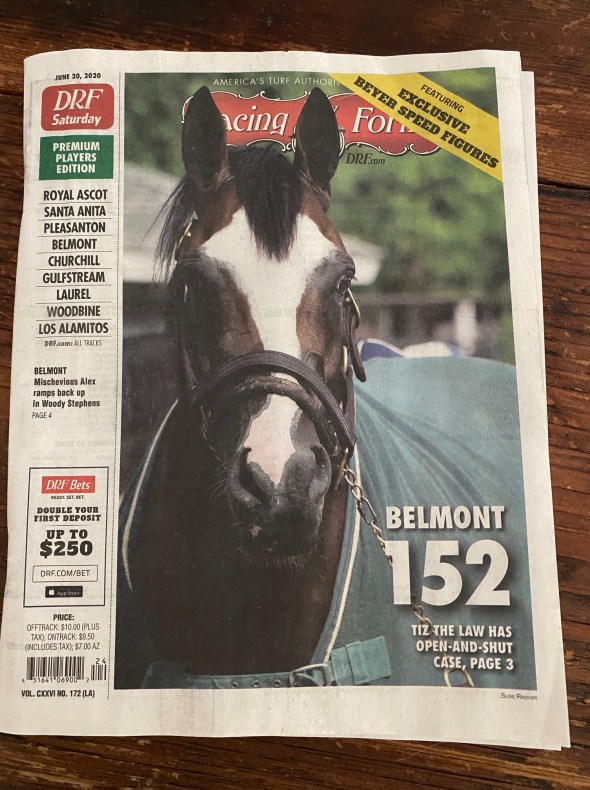
Every time I’m in Las Vegas I pass through the sports book and pick up a few racing sheets. I’ve never been able to make much out of them, but the life of the full-time degenerate who’s eating a hot dog and watching the 3rd at Gulfstream or Louisiana Downs is somehow attractive. Why is that? What is it about this that’s appealing? The songs and legends are part of it, for sure. I’ve always found sitting in the stands at Santa Anita an appealing afternoon. Less so since news of the frequent horse deaths.
Santa Anita is running right now, without spectators.
“I love to go back to Paris,” Hemingway said, his eyes still fixed on the road. “Am going in the back door and have no interviews and no publicity and never get a haircut, like in the old days. Want to go to cafés where I know no one but one waiter and his replacement, see all the new pictures and the old ones, go to the bike races and the fights, and see the new riders and fighters. Find good, cheap restaurants where you can keep your own napkin. Walk over all the town and see where we made our mistakes and where we had our few bright ideas. And learn the form and try and pick winners in the blue, smoky afternoons, and then go out the next day to play them at Auteuil and Enghien.”
“Papa is a good handicapper,” Mrs. Hemingway said.
“When I know the form,” he said.
from the Lillian Ross New Yorker profile of Hemingway.
How do you “learn the form”?
I chanced recently across this academic paper, Sports Betting As a New Asset Class, by Lovjit Thukral and Pedro Vergel. It addresses the possible money-making potential of a strategy of “laying the favorite.”
The authors take a simple betting strategy based on Horse races in the UK and invest consistently on laying (betting on the event not to occur) the 4 favourite horses (with the lowest odds) in each race. They find the following:
(1) this type of horse racing strategy provide uncorrelated returns to the market;
(2) the strategy outperforms the Credit Suisse Hedge fund Index and S&P 500 Total returns on average for the last 6 years.
Can this be so? A quick investigation reveals that “laying the favorite” in this way doesn’t seem to be a commonplace option in US horse betting. I don’t think this strategy would be financially viable here.
This talk of laying favorites reminded me of my friend Beth Raymer’s book, Lay The Favorite: A Memoir of Gambling.
The book was made into a 2012 film starring Bruce Willis and Catherine Zeta-Jones.
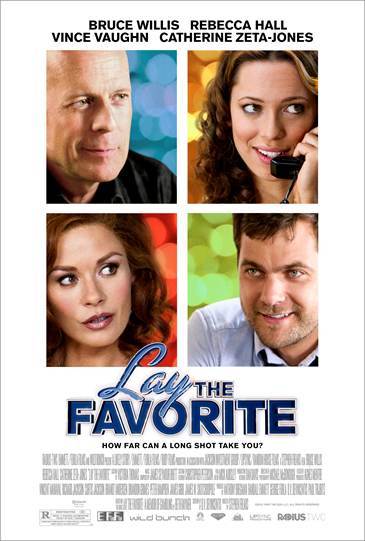
In the book, Raymer describes learning from the professional gambler and line-setter Dink:

Studying to find value — into it! I resolved to learn how to read a Racing Form, and try to glean some information from it that might give an edge.
Using the very helpful resources provided by the late Neil Benoit’s Getting Out Of The Gate website, which has a Racing 101-401 course, I was able to grasp the basics. This resource at Art of Manliness was also quite helpful, and there’s a Wikihow about racing forms, but it’s Benoit who really gave us a gift.
I’d like to try and summarize my learnings for you, to save you the time in case you’re interested, and because the easiest way to really learn something is to try and teach it.
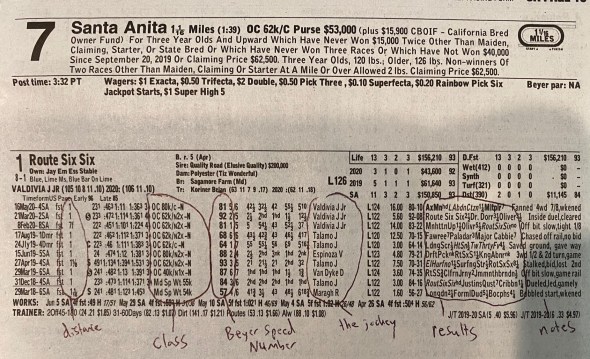
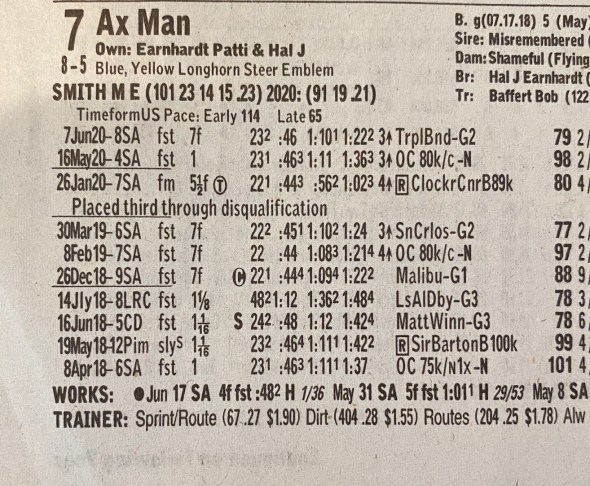
Let’s take as our example the first horse, Route Six Six, in the 7th race tomorrow (Saturday, June 20) at Santa Anita.
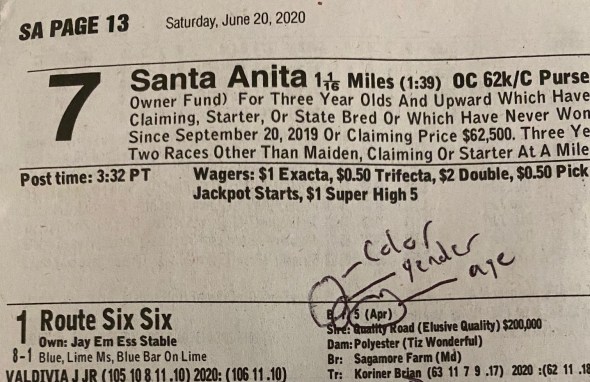
Up top we’ve got some basic info about the horse, like who owns her (f=filly), and her mom (Dam) and dad (Sire).
Personally, and this is based on zero study, but I suspect there’s all together too much focus on breeding in horses. It feels distracting and possibly irrelevant, like when the old-time scouts in Moneyball are focused on how hot a player’s girlfriend is. It just feels old-fashioned and unstatistical. But then again, since I haven’t run any statistical studies, this belief of mine is based on zero evidence as well.
You know what I want to find out from a racing form? One thing. How fast is this horse?
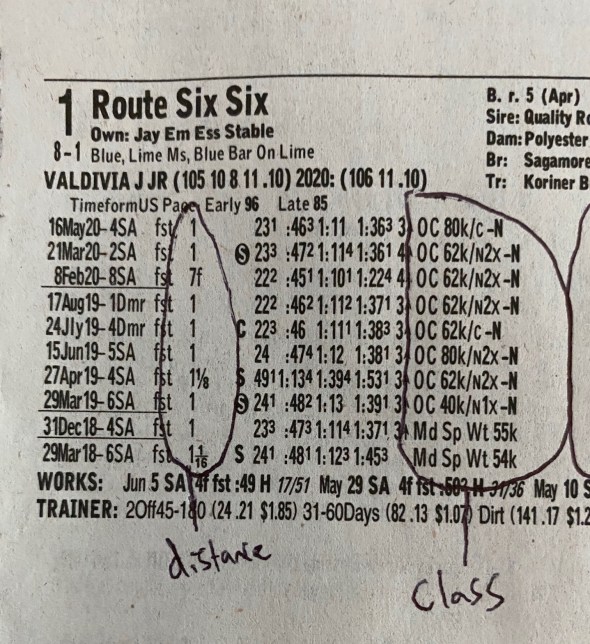
1) elimination of horses that seem unsuited to the distance of the race2) elimination of horses that do not seem in sufficiently sharp condition3) elimination of horses that seem outclassed4) elimination of horses at a serious disadvantage on today’s footing or in light of track biases

Beyer figures are a whole thing
Beyer took a stack of old Daily Racing Forms and did the laborious math by hand, sifting through years of data, applying the analytical skills he had developed as a games-playing child. “‘Six furlongs in 1:13 equals seven furlongs in 1:26 and a fifth’ was my E=MC2,” Beyer says, laughing. By 1972 he had managed to construct a reliable speed chart that incorporated the important element of track variance, a measure of track speed and bias, which was previously calculated by an antiquated–and, in most cases, inaccurate–system. Beyer devised a highly specific, sophisticated method for determining track variances, a method that accounted for the times turned in by different types of horses.
By combining his newly minted speed ratings with his fresh perspective on track speed, the young columnist invented the Beyer Speed Figures.
Interestingly, Beyer come up with his numbers specifically because so much of racing thinking at that time was centered around class:
“The orthodoxy back then said that ‘class’ was the measure of a race,” Beyer says, while making hieroglyphic notations in the margins of his race program. “For instance, if a $10,000 claimer was running against a slower $200,000 claimer, the assumption was that the slower but ‘classier’ horse would win. I was looking for a way to verify–or contradict–that assumption.”
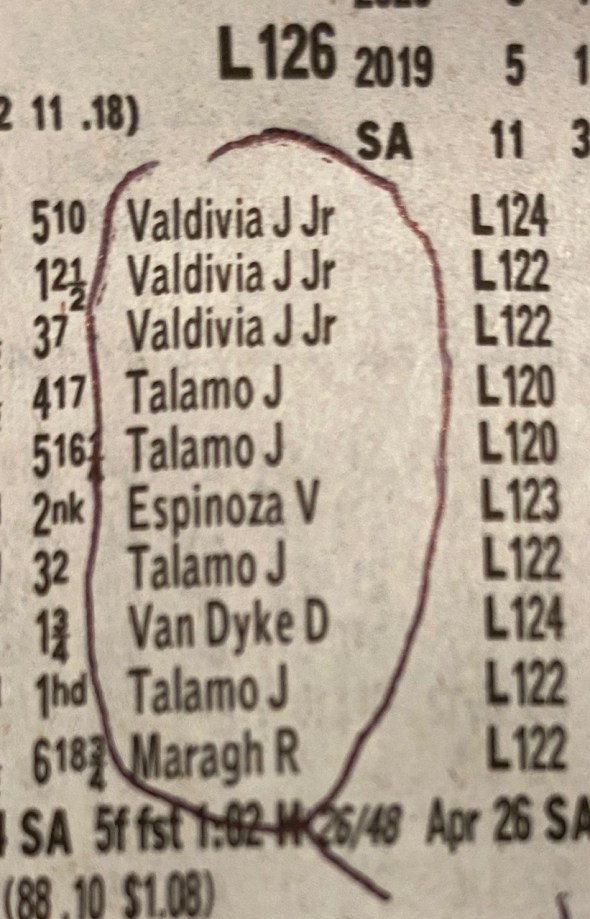
Don’t bet the horse, bet the jockey
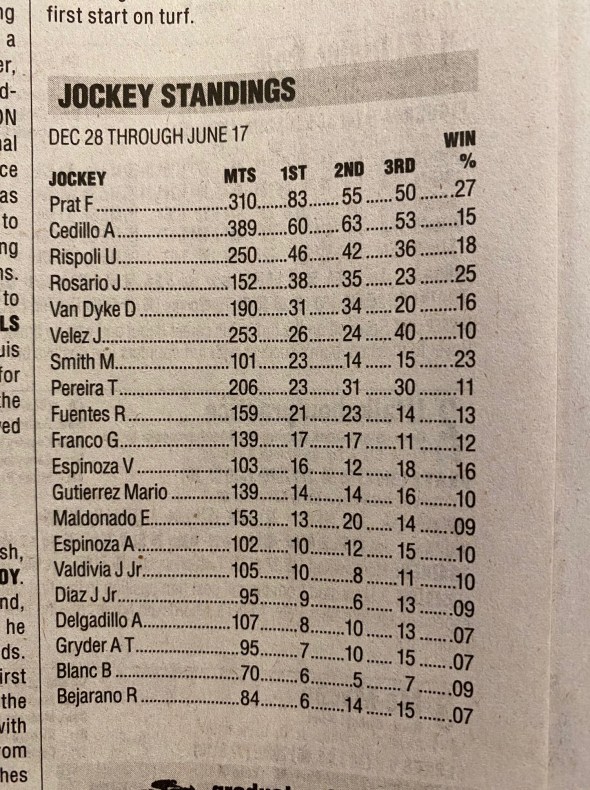
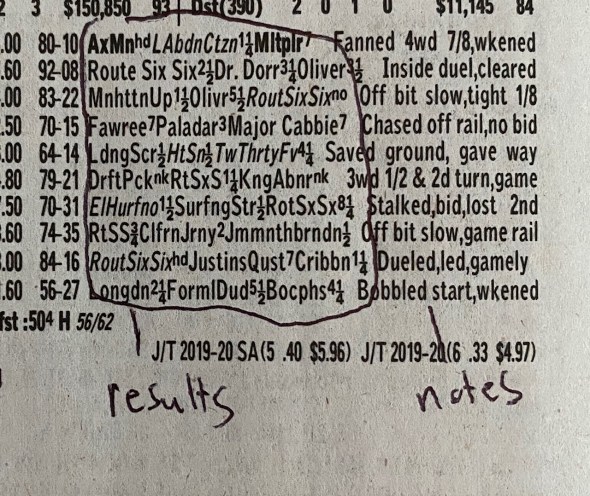
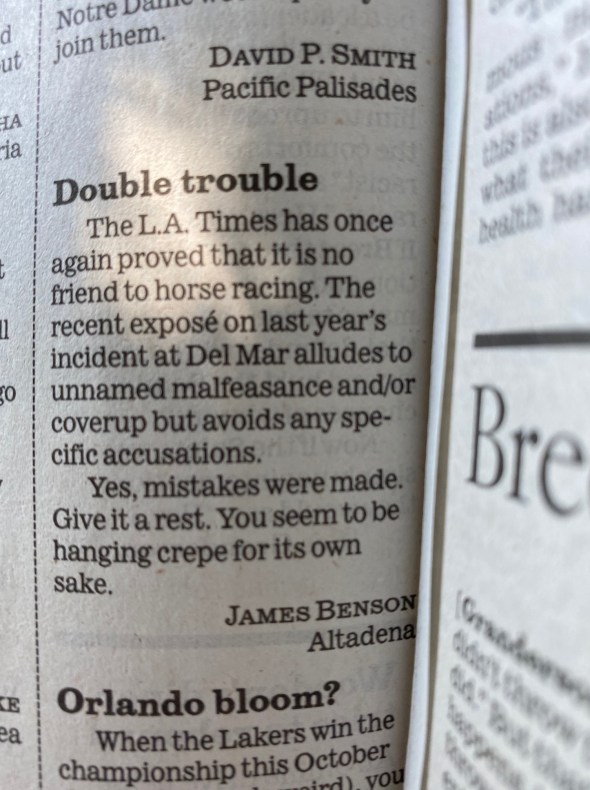
Benson has had it with this hanging crepe for its own sake!
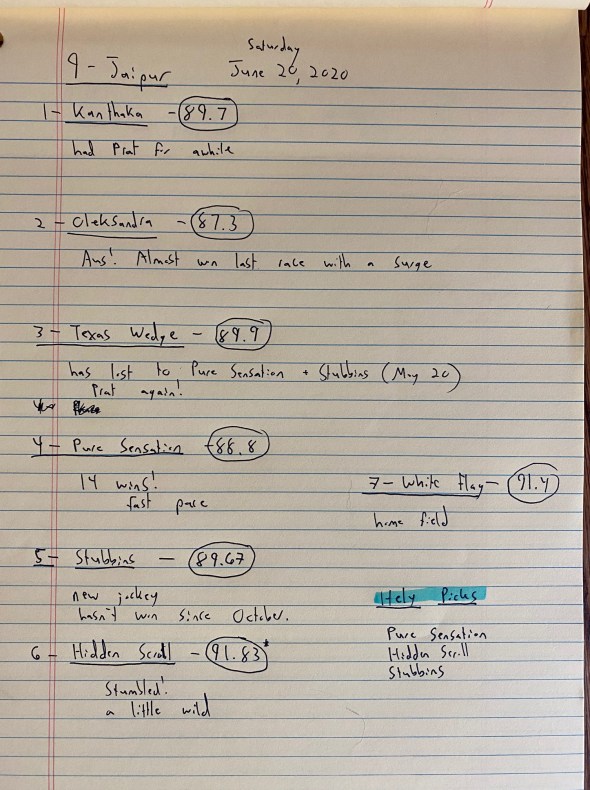
Jaipur Addendum!
Readers, I just idly checked out the 9th race at Belmont today, the Jaipur. Will be televised on NBC. I noticed Hidden Scroll, a very fast horse, had something aberrant in his last race:
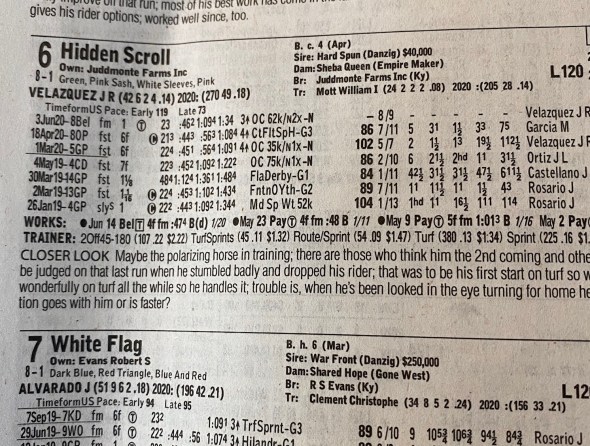
What’s that about? Here we see the pleasures and oddness of the Racing Form as compressed storytelling:
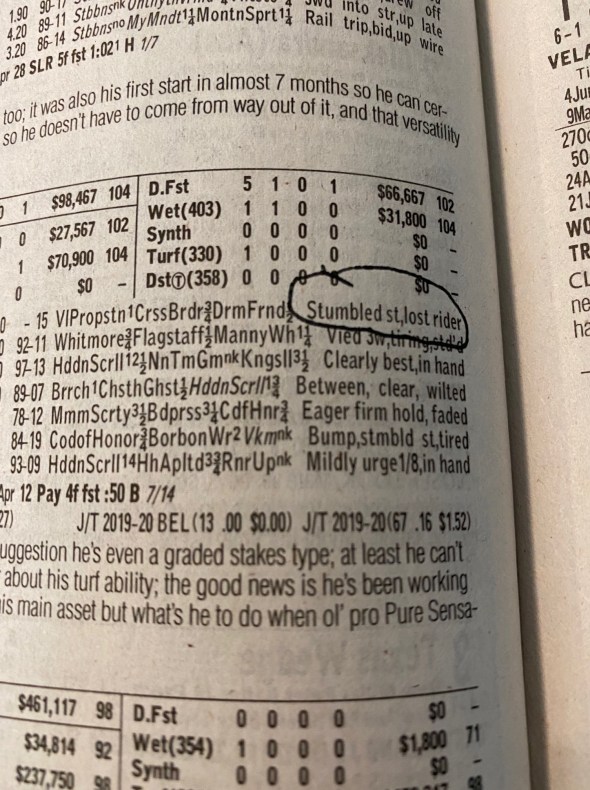
What?
Luckily in this glorious age of YouTube what Hidden Scroll did in his last race, this might be the craziest thing in a horse race I’ve ever seen:
Motherfucking horse nearly broke his own neck, lost his jockey, and still almost won! He’ll have the same jockey (JR Velazquez) today! That should be a very interesting race.
Bloomsday
Posted: June 16, 2020 Filed under: Ireland Leave a comment
Today. Bloom sees a walking advertisement for his former employer:
A procession of whitesmocked men marched slowly towards him along the gutter, scarlet sashes across their boards. Bargains. Like that priest they are this morning: we have sinned: we have suffered. He read the scarlet letters on their five tall white hats: H. E. L. Y. S. Wisdom Hely’s. Y lagging behind drew a chunk of bread from under his foreboard, crammed it into his mouth and munched as he walked. Our staple food. Three bob a day, walking along the gutters, street after street. Just keep skin and bone together, bread and skilly. They are not Boyl: no: M’Glade’s men. Doesn’t bring in any business either. I suggested to him about a transparent show cart with two smart girls sitting inside writing letters, copybooks, envelopes, blotting paper. I bet that would have caught on. Smart girls writing something catch the eye at once. Everyone dying to know what she’s writing.

