Henry Adams on Harvard in 1800
Posted: October 23, 2025 Filed under: New England Leave a comment
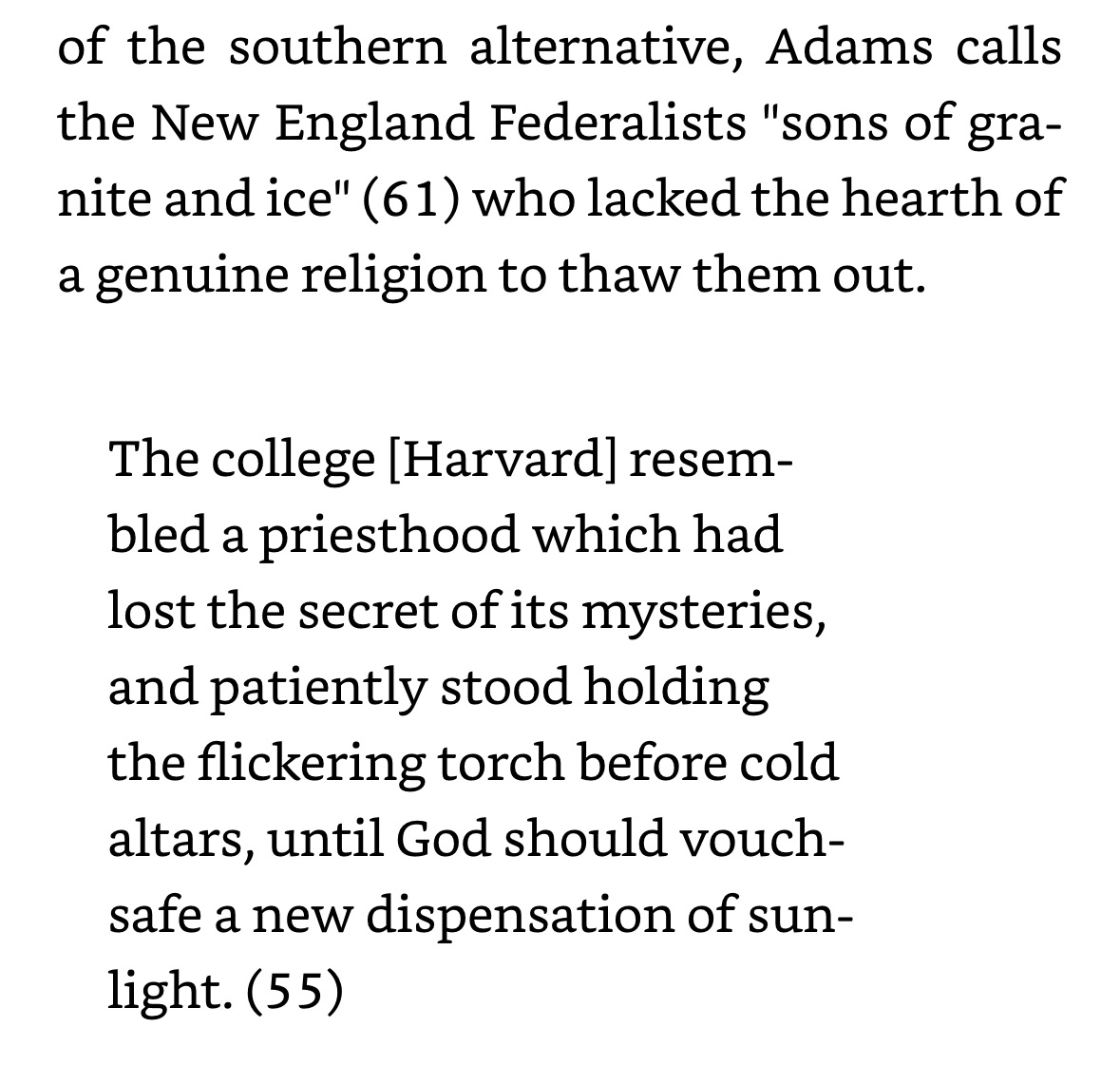
from Garry Wills, Henry Adams and the Making of America, a must for Adams-heads.
The Hunter Gracchus by Guy Davenport
Posted: October 20, 2025 Filed under: America Since 1945, New England Leave a comment

Revisited this one after seeing some footage from The Testament of Ann Lee.


Hoedown
Posted: October 18, 2025 Filed under: music Leave a commentIn October 1937, in the town of Saylersville in Magoffin County, Kentucky, Alan Lomax recorded William Hamilton Stepp playing a fiddle tune called “Bonaparte’s Retreat,” or as he identifies it in the recording, “the Bonaparte.”
Some years later, Aaron Copland found a transcript of the recording in a book:
Composer Aaron Copland, who was commissioned by choreographer Agnes De Mille to score the ballet in 1942, probably did not hear the original field recording before adapting it. Instead, he likely learned the tune from the book Our Singing Country (1941), which presented transcriptions of John and Alan Lomax’s field recordings prepared by the composer and musicologist Ruth Crawford Seeger. According to Jabbour, “when Aaron Copland was looking for a suitable musical theme for the ‘Hoedown’ section of his ballet Rodeo (first produced in 1942), his eye was caught by the version in the Lomax book, and he adopted it almost [note] for note as the principal theme.”
(source)
In 1972, Emerson Lake & Palmer recorded an electronic version:
Some years after that, in 1993, I heard the tune on TV in a “Beef: It’s What’s For Dinner” commercial. They play “Hoedown” from Copland’s Rodeo all the time on KUSC.
I note all this because I’m interested in transmissions from the past to the present. Fiddle tune -> recording -> transcription -> orchestral score -> recording -> TV commercial is an cool lineage.
Columbus Day
Posted: October 13, 2025 Filed under: America Leave a comment
Many people are unaware that Columbus made not just one voyage but four; others are surprised to learn that he was brought back in chains after the third voyage. Even fewer know that his ultimate goal, the purpose behind the enterprise, was Jerusalem! The 26 December 1492 entry in his journal of the first voyage, hereafter referred to as the Diario, 3 written in the Caribbean, leaves little doubt. He says he wanted to find enough gold and the almost equally valuable spices “in such quantity that the sovereigns… will undertake and prepare to go conquer the Holy Sepulchre; for thus I urged Your Highnesses to spend all the profits of this my enterprise on the conquest of Jerusalem” (Diario 1492[1988: 291, my emphasis]).4 This statement implies that it was not the first time Columbus had mentioned the motivation for his undertaking, nor was it to be the last.5 Columbus wanted to launch a new Crusade to take back the Holy Land from the infidels (the Muslims). This desire was not merely to reclaim the land of the Bible and the place where Jesus had walked; it was part of the much larger and widespread, apocalyptic scenario in which Columbus and many of his contemporaries believed.
That from an article by Carol Delaney of Stanford, “Columbus’s Ultimate Goal: Jerusalem.”
Columbus knew from Marco Polo that there was a Great Khan somewhere to the west/east, and that this Khan had requested emissaries from the Pope. So possibly the Khan could be an ally against the Muslims.
In case he should encounter the Great Khan or other emperors, kings, or princes, it was deemed appropriate for Columbus to carry letters of greeting from the sovereigns (with space left blank for the addressee) and to take along as an interpreter Luis de Torres, a converso who knew Hebrew, Chaldean, and some Arabic. It was highly unlikely that anyone in Spain knew Mongolian or Chinese, but since ‘it was supposed that Arabic was the mother of all languages’ (Morison 1942, vol. I: 187), it was assumed that Arabic would suffice.”
Columbus and the other conquistador types commissioned by the King and Queen of Spain must be seen in the conquest of the Reconquista, the 700 year effort to drive Islam from Iberia. Cortes, for example, was a religious fanatic, who used the Spanish word “moscas” or mosques to describe the temples he found in the land of the Aztecs.
(Ridley Scott gets at some of this in 1492: Year of Discovery. My mom at least wanted to walk out of this movie once it gets to the torturing. Sigourney Weaver plays Queen Isabella.)
Delaney expands from Columbus’s religiosity to some bigtime thoughts on how we, today, may not be able to grasp what “religion” meant to someone like Columbus:
The modern understanding of religion did not fully emerge until the late nineteenth century when scholars began to attach “-ism” to make substantives out of adjectives—Buddhism rather than Buddhist, Hinduism rather than Hindu—thus making a ‘religion’ by separating out the spiritual elements from a whole way of life or culture that included ethnicity, language, food, dress, and other practices (see Smith 1962; Rawlings 2002). In reality, however, science, technology, and religion can be and are easily and seamlessly combined. For example, I found Turkish villagers, while mostly illiterate and uneducated, could discuss, understand, make, use, and fix a variety of modern machines and equipment including automobiles, telephones, and television sets; they could talk about international and national politics with more sophistication than most Americans, and they understood the economic networks with which their lives were entangled. They would appear to have a thoroughly modern consciousness. But staying long, getting to know them, and “pushing the envelope,” revealed to me how, at a much deeper level, they lived within a completely Islamic cosmology or worldview. That worldview encompassed their lives, it was the context within which they lived, and it provided answers to the perennial questions: who are we, why are we here, where are we going? It also affected the way they dressed, the food they ate, their practices of personal hygiene, the way they moved, and their spatial and temporal orientations (see Delaney 1991). It was inseparable from the rest of their lives, not something they practiced only on Fridays, the Muslim holy day, or by keeping the fast of Ramadan. Though they evinced varying degrees of devoutness, secularism was not an option. They believed their views were self-evident to any thinking person and they could not understand why I could not accept Islam and, in their terms, submit and become Muslim. Islam, to them, is not one religion among others; it is “Religion.” It is the one true religion given in the beginning to Abraham, and Muhammad was merely a prophet recalling people to that original faith. They had heard of Christianity, of course, and questioned me about it. But to them it was not a separate, equally valid religion, but rather a distortion of the one true word, the one true faith.
Just so did Columbus and his contemporaries view the sectas of the Jews and Muslims. His statement about freeing the Indians from error shows that religion was not a matter of choice but of right or wrong—there was only one right way. Indeed, they really had no conception of alternatives. The Reformation had not yet begun, and Judaism and Islam were seen not as different religions but as erroneous, heretical sects
Like a good anthropologist she quotes Clifford Geertz:
The anthropological critique of this position has been insistent: “[T]he image of a constant human nature independent of time, place, and circumstance, of studies and professions, transient fashions and temporary opinions, may be an illusion, that what man is may be so entangled with where he is, who he is, and what he believes that it is inseparable from them” (Geertz 1973: 35). In other words, there is no backstage where we can go to find the generic human; humans are formed within specific cultures. This does not mean that cultures are totally closed or that there is no overlap; one can learn another culture—that is, indeed, what anthropologists do during fieldwork. But if we are to understand Columbus (or anyone else), we must attempt insofar as is possible to reconstruct the world in which he lived. While some historians writing about Columbus appear to do this, they still, in my reading, project a modern consciousness onto him, leaving the impression that the time and place are merely “transient fashions.”
Delaney includes a great map, which I steal:

Since I was a kid the tone around Columbus has been a lot less “In fourteen hundred ninety two, Columbus sailed the ocean blue” and more he was a genocidal colonialist. But applying our concepts in moral judgment of these figures of the past seems not that far from Columbus applying his concepts to the native people he discovered. Then again, evolving our conceptions and adjusting our heroes as we go seems healthy, right?
Photograph of a Marine Giving Water to a Kitten on Tarawa
Posted: October 11, 2025 Filed under: America Since 1945 1 Comment
perusing the National Archives Record Group 38 as one does and found this.

Also:

This looks like a boring job
Posted: October 11, 2025 Filed under: Uncategorized Leave a comment
although who knows, maybe it was hypnotic. from Lewis Hine’s photographs for the WPA
Macadamia, macadam, tarmac, MacAdam, and McAdam
Posted: September 23, 2025 Filed under: Australia Leave a comment
The macadamia nut was named after John Macadam, Scotch-Australian academic. The nut is native to northeastern Australia, but famously cultivated in Hawaii, for example by Roseanne Barr, whose farm is for sale.

Macadam, a road surface of layers of crushed stones, was named after John Loudon McAdam, a Scottish engineer.
When you add tar to macadam, you get “tarmac.”
While the specific tarmac pavement is not common in some countries today, many people use the word to refer to generic paved areas at airports, especially the apron near airport terminals, although these areas are often made of concrete.
Idle bit of history/etymology I picked up after eating a macadamia nut.
Redondo Beach Submarine Canyon
Posted: September 10, 2025 Filed under: the California Condition Leave a comment
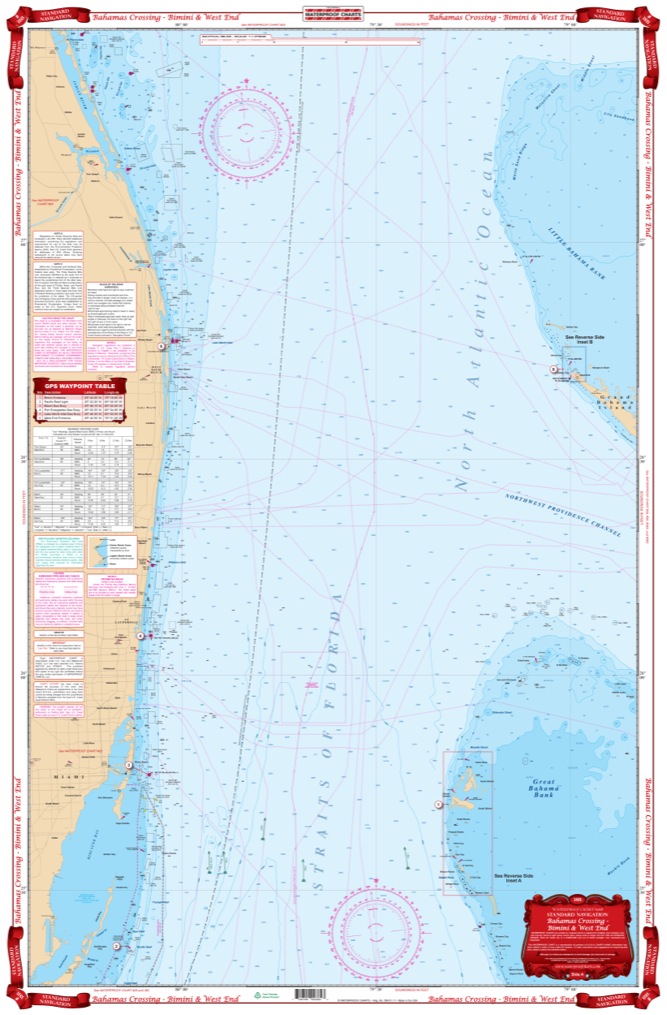
I noticed this deep canyon on my Raven map of southern California. You can see it on Google maps.

Here’s what to expect when you dive the canyon:
After a short swim you drop down to a 25-30 foot sand bottom and move west. As you reach a depth of about 35 feet, you’ll start down a rather steep slope to about 75-80 feet, which quickly drops to below 100 feet and then to the abyss. This is the Redondo Submarine Canyon.
While the sand leading out to the canyon edge has a lot of marine life, most divers like the deep mud flats. Long before “muck diving” became popular with photographers at some fancy tropical resorts, southern California divers were visiting sand and mud flats at local submarine canyons. Just as with these resort destinations, our muck has much to offer in the critter department.
Look for small creatures like a camouflaged octopus or brightly colored nudibranchs, which can be spotted year-round. In late fall through winter months, lucky night divers can witness market squid mating in massive numbers. It’s been described as a blizzard of frantic activity. After the mating the seafloor will be carpeted in large clusters of white egg cases — and dead or dying adult squid, who kick the bucket shortly after they do the deed.
Whether it is squid season or not, this place is an excellent night dive with a lot of small animals to be seen.
One creature that can be found on nearly every dive, day or night, is the massive sheep crab. Its clumsy motions are comical to observe but watch out for the claws! Their pinch is insanely strong. The sheep crabs here are the biggest you’ll find anywhere along our coast. Some of them measure three feet across!
The city of Redondo Beach has two webcams to soothe in troubled times:
https://www.youtube.com/live/Ni7v-aIa3bw
https://www.youtube.com/live/2kbj3LqB_20
Tender memories of Mom
Posted: September 6, 2025 Filed under: family Leave a commentAround age eight or nine, romping in the woods beyond the end of our street, and by the brook, around the pond and the abandoned Girl Scout camp was a big part of my time.
I would collect sticks in the woods, sticks that resembled guns or swords or sticks that were good for poking in the mud of the pond. I kept my collection of sticks behind a rhododendron bush that was just to the left as you approached our front porch.
Some of the sticks were falling apart, abandoned sticks had accumulated as newer, fresher sticks were gained. The pile of sticks, if you thought about the appearance and presentation of the house, was an issue.
One day Mom came to me in a calm, gentle moment and said, “Stephen,” (she was the only person who called me Stephen) “can we have a conversation about your sticks?”
The way she put it. We made a compromise where I kept the most important sticks. Every time we saw each other I felt fairly dealt with on the matter of sticks.
Many times around age nine (dropping off and picking up my sister at a class?) Mom and I walked in the Museum of Fine Arts in Boston. I was drawn to the giant statue of Mycerinus (who wouldn’t be?) Forever after, whenever the MFA came up, sometimes for no reason at all, my mom would invoke the magical name of Mycerinus.
(Kind of resentful they’ve made his name Menkaure, less melodious. How did a guy who died 4500 years ago get renamed in the last 30?)

Sometimes in adulthood I’d tell my mom about sending something off, to a publisher or a studio or something. Several times Mom said something like, “it must be so hard to let something go.”
Only later did it occur to me she might’ve been trying to share something about herself.

(source)

not for all the cars in China
Posted: August 17, 2025 Filed under: China 1 Commentwild stat:
For example, in 1990 there were just half a million cars in China. By 2024 there were 435mn, many of them electric.
from FT on Dan Wang’s new book.
Transmitter
Posted: August 5, 2025 Filed under: New York Leave a comment
(source)
I lived two and a half years in New York City but I didn’t know much about Greenpoint. A brief visit for a special occasion brought me to this corner of Brooklyn.
Stayed at Franklin Guest House where my first floor room was surprisingly spacious, a narrow mini apartment with a kitchenette. Would recommend although I couldn’t call it charming. ($269 a night or so).
Lunch at Acre:

(this photo I borrow from Kelvin Shum)
Visited Tula House where they gave me some good advice on arid plants
Trip to High Valley Books (appointment only, message them on Instagram)

Chopped cheese at Deli Point.

(this photo from Kristiana Noel, obviously not my bracelet, but that approximates my sandwich)
Best was visiting WYNC Transmitter Park, where you get a view of Manhattan I wasn’t used to.

Cheers to Schofield for identifying this clock tower building:

which Perplexity AI failed to do even with coaching.
It’s the Consolidated Edison Building.
The ornamentation at the tower’s peak included urns and obelisks, which were normally associated with funereal aspects, and was modeled after the Mausoleum at Halicarnassus. These decorations memorialize Con Ed workers killed in World War I. The tower section was topped by a “Tower of Light” designed to look like a miniature temple.
If I’d had the time would’ve liked to see the Monitor monument in McGolrick Park

The USS Monitor was built at Continental Iron Works.

I thought of Greenpoint as being a fairly inexpensive part of north Brooklyn but an apartment’s gonna run you from $885,000 (zero bedroom one bath) to four million dollars or so.

Bill Burr on mid
Posted: July 31, 2025 Filed under: Uncategorized Leave a commentI like sitting in the crowd. Like when I go to a sporting event, I want to get good seats, but the closer you sit, the quieter it gets and the less fun it gets. It’s the most fucked-up thing. Unless it’s like an NBA game where before they had a DJ play the whole time. I remember I saw the Lakers play the Knicks, and Comedy Central had courtside seats; I sat there, and you could hear the shit they were talking to each other. That was fucking amazing. But everything else, the closer you get, the more money people have, the less fun it gets. So I was always, like, mezzanine level. I don’t want to be up there with binoculars and super-fucking-shit-faced people, but I like the mid — when the alcohol intake, the view, everything looks like mid. Whatever the second-color-row seats are, that’s what I like.
from this Vulture interview.
20th Century Man
Posted: July 21, 2025 Filed under: Hemingway Leave a comment
from Archibald MacLeish’s tribute poem after he died:
Veteran out of the wars before he was twenty:
Famous at twenty-five: thirty a master –
Whittled a style for his time from a walnut stick
In a carpenter’s loft in a street of that April city.
Ernest Hemingway was born on July 21, 1899. Thus it’s easy to match his life against the century. Whatever year it is, he’s roughly that age.
At 17 he’s a cub reporter for The Kansas City Star, covering police stuff, murders, the morgue:
The clichés in Hemingway’s news stories-under “the glare of the surgeon’s light, he dangles on a little thread of life, while the physicians struggle grimly”-were redeemed by a passage on the forms of violence in a big city: “It’s razor wounds in the African belt and slugging in the wet block. In Little Italy they prefer the sawed-off shotgun. We can almost tell what part of the city a man is from just by seeing how they did him up”
At 18 he’s close up to the Great War:
Hemingway’s experience at Fossalta led him to divide men into those who had been wounded and those who had not. … Though he was never a soldier (Proust spent more time in the army than Hemingway), he had the combatant’s hatred of the safe staff officer and believed you could not judge a man until you had seen him in action
(didn’t Proust spend infinitely more time in the army? Hemingway wasn’t in the army, he was a volunteer with the American Red Cross)
Giovanni Cecchin speculates that despite Gamble’s favorable report of 1918, Hemingway’s heroism was not mentioned in Charles Bakewell’s Story of the American Red Cross in Italy (1920) because the authorities felt he had unnecessarily exposed himself to danger.
He grew up fast:
As Charles Fenton has pointed out, Hemingway was exceptionally precocious in his personal and professional life. He was a reporter and a wounded war hero at nineteen; had an unhappy love affair at twenty; married at twenty-two; became a European correspondent at twentythree; was a father at twenty-four. His first, thin book, Three Stories and Ten Poems-which included the “unprintable” “Up in Michigan,” “My Old Man” and “Out of Season” (all of which had been sent out to editors when Hadley lost the manuscripts)-was dedicated to Hadley and published in August 1923, when he was twenty-four. When he left.Toronto his apprenticeship was over, and he was now a professional if not a widely recognized author.
At 25, a nightmare group trip:
But when Duff told Hemingway that his sexual magnetism tested her self-control, he could scarcely control himself in the wild atmosphere of Pamplona. Hadley stopped talking to Duff, and wept with jealousy and humiliation when Hemingway courted her rival. But Duff, despite her notorious promiscuity and her strong attraction to Hemingway, had her own standards of morality. “We can’t do it,” she told him. “You can’t hurt people.” She would not run off with him, even if she wanted to, because of Hadley and the baby
Here’s Edmund Wilson in The Wound and The Bow:

At 26-27 he set the style in New York and Paris. Around then he became a father and got a divorce.
Hemingway’s adult life was characterized by emotional turmoil, constant travel, frequent illness and accidents. The timid and nearsighted Dos Passos, who often accompanied Hemingway on skiing and fishing trips, observed: “I never knew an athletic vigorous man who spent so much time in bed as Ernest did.” There were both physical and psychological reasons for Hemingway’s numerous accidents. He was a huge, clumsy man with defective vision in one eye and very slow reflexes. He had a bad temper, behaved recklessly and irrationally, drank heavily and was frequently out of control. He deliberately placed himself in risky situations in driving, boxing, skiing, fishing, hunting and war.
By his early 30s he’s moving to Key West, where he could write half the day and fish and hang out the other half. The money from his first hit book went to his ex, but his new wife was very rich. The $8,000 house a wedding gift from her Uncle Gus:
His exaggerations, lies and heroic image were related to the traditions and myths of frontier humor that had inspired his youthful works. But he not only helped to create myths about himself, he also seemed to believe them.
He felt he could write only about what he had actually experienced and his literary credo was to tell it as it was. But he combined scrupulous honesty in his fiction with a tendency to distort and rewrite the story of his life
At 34:
after Hemingway completed Winner Take Nothing he fulfilled his ambition, expressed in The Sun Also Rises, of “going to British East Africa to shoot.” In 1933 Uncle Gus gave him $25,000 to pay for the African safari, and Hemingway asked MacLeish and Strater to be his guests. Both refused the invitation, fearing that Hemingway’s fierce competitiveness would turn the holiday into a daily struggle for superiority. They agreed with Damon Runyon’s remark about Hemingway:
“Few men can stand the strain of relaxing with him over an extended period.”
During the Depression, Jeffrey Meyers tells us, 80% of the people in Key West were on relief and the county itself went bankrupt.
At 35 Hemingway boated a bunch of supplies up to help after the Labor Day Hurricane, which killed maybe 400 plus people, many of them laborers. The dead bodies were a health hazard.
Late 30s, early 40s:
Leicester said that during the late 1930s in Key West, his brother was drinking about seventeen Scotch and sodas a day. Hemingway always made the adolescent association between heavy drinking and masculinity, and boasted in February 1940: “Started out on absinthe, drank a bottle of good red wine with dinner, shifted to vodka in town before the pelota game and then battened it down with whiskeys and sodas until 3 a.m.” While fishing in Cuba, he would take a bottle of champagne to bed and empty it by morning. During World War Two, according to Buck Lanham, he was a “massive drinker. Bottle at bedside, drank all day.
In his late 30s he’s a reporter in the Spanish Civil War, having an affair with the woman that would become wife #3. From his Spanish experience by age 40 he wrote For Whom The Bell Tolls, a book that sold like gangbusters. Before this time, I don’t think he could’ve afforded his lifestyle on his writing alone. Hadley (wife #1) had a trust fund and Pauline (wife #2) was very rich.
He seemed to mature in reverse. Early 40s:
Yet even Durán could not tolerate the boorish behavior that tested the limits of their friendship. … At Durán’s birthday party in Havana, he behaved as Fitzgerald had done at the Murphys’ party in 1926. He got drunk, pushed salad down the back of an embassy nonentity and threw steak across the table (which inspired friends to follow his example).
At 42 he’s avoiding going to the war in Europe, instead he has this plan for his fishing boat:
Hemingway’s idea was that the Pilar, fully manned and heavily armed, but disguised as a fishing boat, would attract the attention of a German submarine. The sub would signal the Pilar to come alongside (as they frequently did in 1942) in order to requisition supplies of fresh water and food. As the sub approached, Hemingway’s men would machine-gun the crew on deck while a jai alai player threw a small bomb into the conning tower. The Marine colonel John Thomason, who had advised Hemingway on his Men at War anthology and was Chief of Naval Intelligence for Central America, realistically objected: “‘Suppose he stands off and blows you and the Pilar out of the water?’
… ‘If he does that,’ replied Ernest, ‘then we’ve had it. But there’s a good chance he won’t shoot. Why should a submarine risk attracting attention when the skipper can send sailors aboard and scuttle us by opening the seacocks? He’ll be curious about fishermen in wartime. He’ll want to know what kind of profiteers are trying to tag a marlin in the Gulf Stream with a war on.”
Hemingway managed to convince Thomason and Braden that this was a serious project and they gave him what he wanted: a radio, a collapsible rubber boat, machine guns, grenades, bombs and Don Saxon, a volunteer Marine master sergeant
finally he did get over to Europe, possibly because wife #3 Martha Gellhorn was outshining him. There the war was like a frolic to him:
Hemingway claimed to have killed a great many Germans and certainly killed a few of them. On August 3, 1944, at Villedieu-les-Poêles in Normandy, he threw grenades down a cellar where Nazi troops were supposed to be hiding, but did not check to see if they were actually there. He may have wanted to take credit for this doubtful enterprise without confronting the fragmented remains of his victims. On November 22, armed with a machine gun, he definitely killed some Germans who attacked Lanham’s headquarters in the Hürtgenwald.
In 1950 he’s bragging to Lillian Ross:
He mentioned a war writer who, he said, was apparently thinking of himself as Tolstoy, but who’d be able to play Tolstoy only on the Bryn Mawr field-hockey team. “He never hears a shot fired in anger, and he sets out to beat who? Tolstoy, an artillery officer who fought at Sevastopol, who knew his stuff, who was a hell of a man anywhere you put him—bed, bar, in an empty room where he had to think. I started out very quiet and I beat Mr. Turgenev. Then I trained hard and I beat Mr. de Maupassant. I’ve fought two draws with Mr. Stendhal, and I think I had an edge in the last one. But nobody’s going to get me in any ring with Mr. Tolstoy unless I’m crazy or I keep getting better.”
Reviewers did not agree:
Across the River was condemned by all serious critics when it first appeared, in September 1950, and is still considered Hemingway’s worst novel. A few writers, like John O’Hara, praised the book out of loyalty to Hemingway or his past reputation; but Cyril Connolly, Morton Dauwen Zabel, Northrop Frye, Joseph Warren Beach, Alfred Kazin, Evelyn Waugh and Isaac Rosenfeld all agreed with Maxwell Geismar’s critique of Hemingway’s ideas and his negative evaluation in the Saturday Review of Literature:
This is an unfortunate novel and unpleasant to review for anyone who respects Hemingway’s talent and achievement. It is not only Hemingway’s worst novel; it is a synthesis of everything that is bad in his previous work and throws a doubtful light on the future
At 52 he has another success, but is it even good?:
In the highly acclaimed Old Man and the Sea, Hemingway either deceived himself about the profundity of his art or expressed his contempt for Life, Scribner’s, the reading public, the critics and religion by writing an ironic and mock-serious fable that gave them exactly what they wanted and expected. The story offered moral uplift, provided a pretense of culture, was admired by everyone-and earned him a fortune. In May 1952
The last really good thing he wrote was a memoir of his youth in Paris that would only be published after his death. It’s full of lies, brags, and gossip about famous writers and artists of the time. This is where he claims Scott Fitzgerald had him check his penis for size. The best parts of it are so good.
He might’ve lived to 1968, seen the moon landing, hippies, LSD. He could’ve made further, into the 70s, even the 80s, he might’ve heard disco music. Seen Ronald Reagan get inaugurated. But that’s not what happened.
Meyers has an appendix that’s a list of Hemingway’s injuries that’s almost comic?

The most chilling part of the excellent Ken Burns documentary might be this clip of Hemingway giving an interview for NBC after he won the Nobel Prize. This is after he used his head to batter open the stuck door of a burning plane in Butiaba in 1954. The second of his two plane crashes that week.
What an artist. After Meyers I read Mary Dearborn’s which is also great.

C’mon this is cool
Posted: July 18, 2025 Filed under: the California Condition Leave a comment
Zane makes The New York Times.
I don’t care for the word “snub.” from Etymology Online:

If you’re a Television Academy member, please consider voting for COMMON SIDE EFFECTS in the category Outstanding Animated Program.
If you’re not a Television Academy member, consider becoming one! The TV Academy is not like the Academy of Motion Picture Arts. You don’t have to be asked to join. You can join if you have a couple TV credits and $225. That’s who votes on the Emmys.
Bless you.
Hang Yourself Brave Crillon
Posted: July 14, 2025 Filed under: France, Hemingway Leave a comment
From Jeffrey Meyers, Hemingway: A Biography:
Like most people who were drawn by Hemingway’s magnetic personality and valued him more as a companion than as a writer, Lanham found it amusing and exciting to be with him and to be known to have been with him. (The general is remembered today not for his military career but for his friendship with Hem-ingway.) While Hemingway was at the Ritz during the first week of September with Mary, Lanham, echoing Henry IV’s taunt to the Duke of Crillon after a victory at Arques, sent him a provocative message. “Go hang yourself, brave Hemingstein. We have fought at Landrecies and you were not there.”
This was (as Lanham knew) an irresistible challenge, and Hemingway immediately hastened northeast from Paris to Landrecies and Le Cateau (where Dorman-Smith and the British army had retreated after the bad show at Mons in the Great War). “The countryside through which Hemingway travelled in order to reach my command post,” wrote Lanham, who had summoned him there, “was alive with Germans who had been by-passed. All of these people were trying frantically to get back to Germany proper and the Siegfried Line. He was very lucky indeed to have made this trip without being killed.”
Boys will be boys (Hemingway was 44).
Had to look up Henry IV’s taunt to Crillon:
Hang yourself, brave Crillon; we fought at Arques and you were not there
According to Oxford Essential Quotations (4th Ed.) that’s the “traditional form given by Voltaire to [the original] in a letter from Henri to Crillon, 20 September 1597; Henri’s actual words, as given in Lettres missives de Henri IV, Collection des documents inédits de l’histoire de Francevol. 4 (1847) were
My good man, Crillon, hang yourself for not having been at my side last Monday at the greatest event that’s ever been seen and perhaps ever will be seen’
Boldface mine. You can feel the bro-ness, it’s giving Ben Affleck and Adam Driver in The Last Duel.
How did Hemingway and Lanham both know this?

(source). Maybe it was in the boys’ books of the day.
(Frequent readers of this site will recall that Pendu/Pender/PennDu language games&names in French reveal the origin of Cezanne’s House of the Hanged Man.)
All four of Henry IV’s Oxford quotes bang, his most famous might be
Paris is worth a mass
The origin story in that:
On 25 July 1593, with the encouragement of his mistress, Gabrielle d’Estrées, Henry permanently renounced Protestantism and converted to Catholicism to secure his hold on the French crown, thereby earning the resentment of the Huguenots and his ally Elizabeth I of England. He was said to have declared that Paris vaut bien une messe (“Paris is well worth a Mass”), although the attribution is doubtful.

That’s apparently Gabrielle on the left, some interpretation.
Here’s Henri IV at Arques:

Some pretty pictures and intriguing backstory of Arques-la-Bataille on the “Normandy Then and Now” website:

John Henry Twachtman painted the river there in 1885:

That’s in the Met.
Henri’s greatest event that had ever been wasn’t the only battle in the are
Just outside the town is the World War I Commonwealth War Graves Commission cemetery, designed by J R Truelove, the final resting place of 377 men of the Chinese, West Indies, and South African Native Labour Corps.
As for Landrecies, it’s Wikipedia page doesn’t even mention the Second World War, but notes:
It was the site of a skirmish between the British I Corps under Douglas Haig and the German First Army on 25 August 1914, that resulted in the death of Archer Windsor-Clive, the first first-class cricketer to fall in World War I.
Some day I’d like to do a little road trip through here:

Almost every town here has a famous siege or battle. Finish in Bruges. Or maybe Brussels, see The Royal Museum for Central Africa (they don’t know what to do with that inheritance). Or maybe Ghent. I’d like to see the altarpiece:

At St. Bavo’s Cathedral:

(Source)
Good map of France
Posted: July 12, 2025 Filed under: France, Uncategorized Leave a comment
At Trois Mec here in LA. 1789 boundaries, you can see that Savoy is still part of Italy here.
Cezanne’s view of Lake Annecy
Posted: June 28, 2025 Filed under: France, Hemingway Leave a commentfollowing up on Cezanne posting.
1896:

2025:

Think this is pretty much the spot. Does seem like he truncated/compressed the view. That’s the art!
The site is now the wonderful-seeming hotel Auberge du Père Bise (it’ll run you $500 something a night). The two Michelin starred – “worth a detour” – Jean Sulpice restaurant attached.
Across the lake there is the Chateau de Duignt.

Shit even as I was taking this I was like I can’t even take the photo even close to as good as Cezanne painted it!
[Cezanne] struggled with what he considered an overly charming setting, which contrasted with the rugged landscape of his native Provence.
says The Courtland.
Cézanne described this mountain lake near the French border with Switzerland as a scene one might expect to find in ‘the albums of young lady travellers’
says Art UK.
For me, I like the place! Was ok with the overly charming setting.
Cheers to the Annecy Animation Festival, full of gratitude and happy to be there.

Good essay by Jeffrey Meyers on Hemingway x Cezanne.
Islands In The Stream, (Hemingway, 1970) x Islands In The Stream, (B. Gibb, M. Gibb, R. Gibb, 1983)
Posted: June 21, 2025 Filed under: Uncategorized 1 Comment
A man named Thomas Hudson, who was a good painter, lived there in that house and worked there and on the island the greater part of the year. After one has lived in those latitudes long enough the changes of the seasons become as important there as anywhere else and Thomas Hudson, who loved the island, did not want to miss any spring, nor summer, nor any fall or winter.
Sometimes the summers were too hot when the wind dropped in August or when the trade winds sometimes failed in June and July. Hurricanes, too, might come in September and October and even in early November and there could be freak tropical storms any time from June on. But the true hurricane months have fine weather when there are no storms.
Thomas Hudson had studied tropical storms for many years and he could tell from the sky when there was a tropical disturbance long before his barometer showed its presence. He knew how to plot storms and the precautions that should be taken against them. He knew too what it was to live through a hurricane with the other people of the island and the bond that the hurricane made between all people who had been through it. He also knew that hurricanes could be so bad that nothing could live through them. He always thought, though, that if there was ever one that bad he would like to be there for it and go with the house if she went.
The house felt almost as much like a ship as a house. Placed there to ride out storms, it was built into the island as though it were a part of it; but you saw the sea from all the windows and there was good cross ventilation so that you slept cool on the hottest nights. The house was painted white to be cool in the summer and it could be seen from a long way out in the Gulf Stream. It was the highest thing on the island except for the long planting of tall casuarina trees that were the first thing you saw as you raised the island out of the sea. Soon after you saw the dark blur of casuarina trees above the line of the sea, you would see the white bulk of the house. Then, as you came closer, you raised the whole length of the island with the coconut palms, the clapboarded houses, the white line of the beach, and the of the South Island stretching beyond it. Thomas Hudson never saw the house, there on that island, but that the sight of her made him happy. He always thought of the house as her exactly as he would have thought of a ship. In the winter, when the northers blew and it was really cold, the house was warm and comfortable because it had the only fireplace on the island.
It was a big open fireplace and Thomas Hudson burned driftwood in it.
He had a big pile of driftwood stacked against the south wall of the house. It was whitened by the sun and sand-scoured by the wind and he would become fond of different pieces so that he would hate to burn them. But there was always more driftwood along the beach after the big storms and he found it was fun to burn even the pieces he was fond of. He knew the sea would sculpt more, and on a cold night he would sit in the big chair in front of the fire, reading by the lamp that stood on the heavy plank table and look up while he was reading to hear the northwester blowing outside and the crashing of the surf and watch the great, bleached pieces of driftwood burning.
Sometimes he would put the lamp out and lie on the rug on the floor and watch the edges of color that the sea salt and the sand in the wood made in the flame as they burned. On the floor his eyes were even with the line of the burning wood and he could see the line of the flame when it left the wood and it made him both sad and happy. All wood that burned affected him in this way. But burning driftwood did something to him that he could not define. He thought that it was probably wrong to burn it when he was so fond of it; but he felt no guilt about it.
(Bold mine.)
This book knocked me sideways.
After enjoying Across The River and Into the Trees, I wondered if I should try this. It doesn’t get discussed much. It was published posthumously, ten years after Hemingway’s death. Apparently Mary Hemingway found it and brought it to Scribner’s. For a craftsman like Hemingway you’ve got to be suspicious of anything he himself didn’t consider finished.

This post by a Redditor was all I needed to push me into ordering a good UK edition with an appealing cover.
Hemingway began the novel–as Carlos Baker relates in his excellent biography–at a low point of fortune. It was 1950 and “Across the River and Into the Trees” had just taken a critical beating. In December he began something new; it was to be a series of three books called “The Sea When Young,” “The Sea When Absent” and “The Sea in Being.” The work gathered momentum during the first half of 1951–Hemingway was writing enthusiastically and well–but an odd thing happened to his general scheme. It was conceived as a linked series of three independent novellas concerned with three different eras in the life of Thomas Hudson, an American marine painter. The first takes place on the island of Bimini, the second in wartime Cuba and the third follows Hudson through to his death at sea in an isolated action of World War II. But another concept intruded, and Hemingway added a fourth part, only to find that it had taken on an independent life of its own quite unrelated to Hudson. In 1952, he published this story as “The Old Man and the Sea,” and it was apparently this diversion, plus various travels in the following years, that kept him from a return to the final polishing he had intended for the novel now titled “Islands in the Stream.”
That’s from the Oct. 1970 New York Times review by Robie McCauley. I won’t link to it and I’d encourage you not to read it because it gives away several turns of plot that hit this reader in surprising and unexpected ways.
The book can be pretty shaggy. Many pages of conversations in bars, about forty pages about trying to catch a swordfish, etc. There’s a fight scene where Roger, Thomas Hudson’s friend, who is a writer, beats the hell out of a yacht guy. The yacht guy had a pretty reasonable complaint is this reader’s opinion, and the beating is unpleasant. Even Roger comes to view it as an ugly event. But when the boys arrive, Thomas Hudson’s mood improves, and the book becomes warm and loving in a way unusual in a Hemingway book.
It’s about a father. Most Hemingway main character/stand ins are pointedly unattached. In the short stories we get a father, but through the eyes of Nick, the son, a boy.
In this book we’re seeing the world through a father who is getting a visit from his kids. Two from one mother, one from another. Thomas has all kinds of feelings and regrets about the situation.
Most of the book (drinking, fishing) really tells a story of avoiding, masking, remembering, processing.
The drinking is preposterous. Regularly Thomas is like “a drink? It’s breakfast. I’ll just have a bottle of beer.” (Heineken)
The kids, who are like twelve-sixteen years old, say stuff like
My friend Mr. Joyce has words and expressions I’d never even heard of. I’ll bet nobody could outswear him in any language.
maybe just as setup for Dad to tell stories about Mr. (James) Joyce. But… don’t you want to hear those?
Well, so what? Maybe Hemingway’s kids talked like that.
Hemingway’s whole fictional project is a kind of exaggerated autobiography. He really got somewhere with Islands In The Stream, a new level of vulnerability couched in braggadocio. His fourth wife published it, even though the main character’s worst regret might be losing his first wife.
-—
The song Islands in the Stream was written by The Bee-Gees. They had it in mind for Diana Ross. Barry Gibb says that in this interview. Many places, including Wikipedia, say the title of the song came from the Hemingway novel published thirteen years previous. I can find no firsthand source where Barry Gibb states that or makes that connection. But the phrase “islands in the stream” doesn’t seem to have existed before Hemingway’s book was published. Some sources link it to the John Donne poem from which EH got another title: “for whom the bell tolls.”
The song ended up with Dolly Parton and Kenny Rodgers, and was released on Kenny Rogers’ album Eyes That See In The Dark.

Baby when I met you it was peace I know
I set out to get you with a fine tooth comb
Wow.
Be careful, the song sticks. It knocked “Total Eclipse of the Heart” out of number one on the Billboard Hot 100. 1983 was quite a year on the Billboard Hot 100: “Islands In The Stream” was knocked off by Lionel Ritchie, “All Night Long.”
Which Islands in the Stream the greater work of art with this title?
Talk about apples and oranges. Or, better, limes and coconuts.
There’s a cocktail recipe contained in the novel: Gordon’s gin, coconut water, lime juice, a dash of Angostura bitters for color. I made a few last night. Jess’s review: “I could drink this all day.”

(source)
Granger seen anew
Posted: June 18, 2025 Filed under: Texas, War of the Rebellion Leave a comment
With Juneteenth coming up we once again turn our thoughts to Gordon Granger. It was he who issued the famous General Order #3 at Galveston in 1865 (better late than never):
The people are informed that in accordance with a Proclamation from the Executive of the United States, all slaves are free.
The newly freed were slammed pretty fast into capitalism:
The freed are advised to remain at their present homes, and work for wages. They are informed that they will not be allowed to collect at military posts; and that they will not be supported in idleness either there or elsewhere.
Geez, not even a small vacation?
We’ve covered Granger before – Grant didn’t like him. But in Charles Dana’s Recollections of the Civil War we came across some new (to us) material that brought the man to life:

After Chickamauga:
Our troops were as immovable as the rocks they stood on. Longstreet hurled against them repeatedly the dense columns which had routed Davis and Sheridan in the early afternoon, but every onset was repulsed with dreadful slaughter. Falling first on one and then another point of our lines, for hours the rebels vainly sought to break them. Thomas seemed to have filled every soldier with his own unconquerable firmness, and Granger, his hat torn by bullets, raged like a lion wherever the combat was hottest with the electrical courage of a Ney. When night fell, this body of heroes stood on the same ground they had occupied in the morning, their spirit unbroken, but their numbers greatly diminished.
Later, in the same campaign, Granger can’t stop firing a cannon personally:
The enemy kept firing shells at us, I remember, from the ridge opposite. They had got the range so well that the shells burst pretty near the top of the elevation where we were, and when we saw them coming we would duck-that is, everybody did except Generals Grant and Thomas and Gordon Granger. It was not according to their dignity to go down on their marrow bones. While we were there Granger got a cannon—how he got it I do not know-and he would load it with the help of one soldier and fire it himself over at the ridge. I recollect that Rawlins was very much disgusted at the guerilla operations of Granger, and induced Grant to order him to join his troops elsewhere.
As we thought we perceived, soon after noon, that the enemy had sent a great mass of their troops to crush Sherman, Grant gave orders at two o’clock for an assault upon the left of their lines; but owing to the fault of Granger, who was boyishly intent upon firing his gun instead of commanding his corps, Grant’s order was not transmitted to the division commanders until he repeated it an hour later.
He can’t stop driving Grant nuts:
The enemy was now divided. Bragg was flying toward Rome and Atlanta, and Longstreet was in East Tennessee besieging Burnside. Our victorious army was between them. The first thought was, of course, to relieve Burnside, and Grant ordered Granger with the Fourth Corps instantly forward to his aid, taking pains to write Granger a personal letter, explaining the exigencies of the case and the imperative need of energy.
It had no effect, however, in hastening the movement, and a day or two later Grant ordered Sherman to assume command of all the forces operating from the south to save Knoxville. Grant became imbued with a strong prejudice against Granger from this circumstance.
 Helytimes
#/media/File:Massachusetts_Hall,_Harvard_University.JPG)

.jpg)