Lately Andrew Sullivan has had a lot of sentences like this:
Posted: October 6, 2012 Filed under: writing Leave a commentCostica Bradatan explains why we’re moved by self-immolation:
Rob Dunn celebrates the celestial beauty of plants:
Gina Barreca locates literature’s odd place in the history of shoplifting:
“small as a whorehouse beer”
Posted: September 28, 2012 Filed under: America, writing Leave a comment
from the Paris Review interview with James M. Cain:
INTERVIEWER
Were there other signs [that you were going to be a writer]?
CAIN
Well, when I went to Baltimore to work for the gas company, the first of the meaningless jobs I held when I was just out of college, I kept going down to this whorehouse on Saturday nights. I never did go upstairs, though twice I wanted to. One night I met this girl who was awful pretty, and she had pretty legs. I badly wanted to go upstairs with her, but I was afraid because of the disease which I imagined she had. (In Paris during the war I bumped into a girl, and I was horribly lonely, didn’t particularly crave her physically, but she approached me, and asked me to spend the night, and I’m glad I didn’t because I think she would have had my wallet with everything else.) But during this six months I worked for the gas company, I kept going down to that area around Josephine Street. At one of these places you could buy a bottle of beer for fifty cents. “Small as a whorehouse beer” was an expression then. They’d serve them up in glasses so small that thimbles were twice as big. For that fifty cents you were welcome to do anything, downstairs—get along with the girls, stick around—I was just eighteen years old. I listened a lot downstairs. Upstairs was another matter. I was a potential customer, of course. I guess the things you didn’t do . . .
It seems like there’s more to the story, but the interview moves on. Later Cain claims that Alice In Wonderland is the greatest novel in the English language.

Cain on Chandler’s The Big Sleep:
That book about a bald, old man with two nympho daughters. That’s all right. I kept reading. Then it turned out the old man raises orchids. That’s too good.
More Robert Lowell, by popular request
Posted: September 21, 2012 Filed under: New England, writing Leave a comment
The old South Boston Aquarium stands
in a Sahara of snow now.
Its broken windows are boarded.
The bronze weathervane cod has lost half its scales.
The airy tanks are dry.
Once my nose crawled like a snail on the glass;
my hand tingled
to burst the bubbles
drifting from the noses of the cowed, compliant fish.
My hand draws back.
I often sigh still for the dark downward and vegetating kingdom
of the fish and reptile.
The Old South Boston Aquarium:

A girdle of orange, Puritan-pumpkin colored girders
braces the tingling Statehouse,
shaking over the excavations, as it faces Colonel Shaw
and his bell-cheeked Negro infantry
on St. Gaudens’ shaking Civil War relief,
propped by a plank splint against the garage’s earthquake.
Two months after marching through Boston,
half the regiment was dead; at the dedication,
William James could almost hear the bronze Negroes breathe.
Their monument sticks like a fishbone
in the city’s throat.
Its Colonel is as lean as a compass-needle.
He has an angry wrenlike vigilance,
a greyhound’s gentle tautness;
he seems to wince at pleasure,
and suffocate for privacy.

Good story from Robert Lowell
Posted: September 20, 2012 Filed under: America, New England, writing Leave a comment
LOWELL
I met Ford [Maddox Ford] at a cocktail party in Boston and went to dinner with him at the Athens Olympia. He was going to visit the [Allen] Tates, and said, “Come and see me down there, we’re all going to Tennessee.” So I drove down. He hadn’t arrived, so I got to know the Tates quite well before his appearance.
INTERVIEWER
Staying in a pup tent.
LOWELL
It’s a terrible piece of youthful callousness. They had one Negro woman who came in and helped, but Mrs. Tate was doing all the housekeeping. She had three guests and her own family, and was doing the cooking and writing a novel. And this young man arrived, quite ardent and eccentric. I think I suggested that maybe I’d stay with them. And they said, “We really haven’t any room, you’d have to pitch a tent on the lawn.” So I went to Sears, Roebuck and got a tent and rigged it on their lawn. The Tates were too polite to tell me that what they’d said had been just a figure of speech. I stayed two months in my tent and ate with the Tates.

(That’s a Colemans pup tent. Here’s a photo of the Athens Olympia restaurant, now closed, from the MIT Libraries flickr.)
This is all from Robert Lowell’s Paris Review interview, which ends with this:
INTERVIEWER
Don’t you think a large part of it is getting the right details, symbolic or not, around which to wind the poem tight and tighter?
LOWELL
Some bit of scenery or something you’ve felt. Almost the whole problem of writing poetry is to bring it back to what you really feel, and that takes an awful lot of maneuvering. You may feel the doorknob more strongly than some big personal event, and the doorknob will open into something that you can use as your own. A lot of poetry seems to me very good in the tradition but just doesn’t move me very much because it doesn’t have personal vibrance to it. I probably exaggerate the value of it, but it’s precious to me. Some little image, some detail you’ve noticed—you’re writing about a little country shop, just describing it, and your poem ends up with an existentialist account of your experience. But it’s the shop that started it off. You didn’t know why it meant a lot to you. Often images and often the sense of the beginning and end of a poem are all you have—some journey to be gone through between those things; you know that, but you don’t know the details. And that’s marvelous; then you feel the poem will come out. It’s a terrible struggle, because what you really feel hasn’t got the form, it’s not what you can put down in a poem. And the poem you’re equipped to write concerns nothing that you care very much about or have much to say on. Then the great moment comes when there’s enough resolution of your technical equipment, your way of constructing things, and what you can make a poem out of, to hit something you really want to say. You may not know you have it to say.
Jeff Bezos citing Warren Buffett
Posted: September 15, 2012 Filed under: advice, writing Leave a comment
From this old Fast Company article (worth reading). Bezos is talking about getting investors who understand Amazon is playing a long-term strategy. But of course it goes beyond:
“With respect to investors, there’s a great Warren Buffettism,” he says. “You can hold a rock concert and that can be successful, and you can hold a ballet and that can be successful, but don’t hold a rock concert and advertise it as a ballet.”
I saw my own future!
Posted: August 22, 2012 Filed under: New England, writing Leave a comment
(I should be so lucky. E. B. White, via Letters of Note)
John le Carré
Posted: August 21, 2012 Filed under: writing Leave a comment
INTERVIEWER
It has been said the book [Tailor of Panama] mirrors what you feel about England at the moment.
LE CARRÉ
While abroad, I don’t want to talk gloomily about my country. I’ve become interested recently not in the macro-interpretation of my country, but the micro-interpretation. I live in a tiny, desolate part of England, where the real effects of what I see as terrible misgovernment—central misgovernment—can be felt in detail upon agriculture, fishing, communication, and transport, all of those things. My definition of a decent society is one that first of all takes care of its losers, and protects its weak. What I see in my country, progressively over these years, is that the rich have got richer, the poor have got poorer. The rich have become indifferent through a philosophy of greed, and the poorer have become hopeless because they’re not properly cared for. That’s actually something that is happening in many Western societies. Your own, I am told, is not free from it.
(Paris Review again, picture I found here credited to Jonathan Player of Rex Features)
Selling the Aga Cooker
Posted: August 14, 2012 Filed under: heroes, writing Leave a commentHere’s Swedish inventor Gustaf Dalen:

Gustaf Dalen lost his sight in an explosion while developing his earlier invention, a porous substrate for storing gases, Agamassan. Forced to stay at home, Dalen discovered that his wife was exhausted by cooking. Although blind, he set out to develop a new stove that was capable of a range of culinary techniques and easy to use.
His invention was the AGA cooker:

In the 1920s these were sold, door to door, in the UK. And the greatest AGA cooker salesman of all was David Ogilvy:

His success at this marked him out to his employer, who asked him to write an instruction manual, The Theory and Practice of Selling the AGA cooker, for the other salesmen. Thirty years later, Fortune magazine editors called it the finest sales instruction manual ever written.
I went looking for this manual, and found it at Patrick Lannigan’s blog. I make sure to link because Patrick Lannigan reports that “I’d have to say my number one obsession is playing with Google rankings.” I wish him well.
Anyway, Ogilvy has some good writing and interesting advice:
Salesmen are only too often unpopular people in Aga-worthy houses.. Show straight away that you are not of the so-called canvasser variety. Never bully, get into an argument, show resentment, or lose your temper. Do not talk about “your husband” – “Mr. Smith” is less impertinent.
Never talk down or show superior knowledge. Never appeal to a prospect’s pity because the more prosperous you appear the more she is likely to be impressed with you and to believe in you and your Aga.
The worst fault a salesman can commit is to be a bore. Foster any attempt to talk about other things; the longer you stay the better you get to know the prospect, and the more you will be trusted. Pretend to be vastly interested in any subject the prospect shows an interest in. The more she talks the better, and if you can make her laugh you are several points up. If she argues a lot, do not give the impression of knowing all the answers by heart and always being one up on her. She will think you are too smart by half, and mistrust your integrity. Find out as soon as possible in the conversation how much she already knows about Aga; it will give you the correct angle of approach. Perhaps the most important thing of all is to avoid standardisation in your sales talk. If you find yourself on fine day saying the same things to a bishop and a trapezist, you are done for.
When the prospect tries to bring the interview to a close, go gracefully. It can only hurt to be kicked out. Learn to recognise a really valid reason for the prospect being unable to order (there are mighty few such reasons). With these reservations you cannot be too tenacious or too persevering. The good salesman combines the tenacity of a bull dog with the manners of a spaniel. If you have any charm, ooze it.
The more prospects you talk to, the more sales you expose yourself to, the more orders you will get. But never mistake the quantity of calls for quality of salesmanship.
Later, in the “Attack” section:
Learn to recognise vegetarians on sight. It is painful indeed to gush over roasting and grilling to a drooping face which has not enjoyed the pleasures of a beefsteak for years.
From the section “Wise-cracking”:
The longer you talk to a prospect, the better, and you will not do this if you’re a bore. Pepper your talk with anecdote and jokes. Accumulate a repertoire of illustration. Above all, laugh till you cry every time the prospect makes the joke about the Aga Khan. A deadly serious demonstration is bound to fail. If you can’t make a lady laugh, you certainly cannot maker buy.
David Ogilvy might be better than Mystery.

Finis Mitchell
Posted: July 23, 2012 Filed under: adventures, heroes, mountains, writing Leave a commentOne thing led to another and I got to reading about Finis Mitchell:

In 1906, as a young boy, Finis came to the Wind River Range [in Wyoming] with his father in a boxcar along with the rest of his family… Not bowing down to the fierce obstacles wielded by a stark and barren land with winters lasting 9 months a year, Finis spent the next 7 years carefully carrying five-gallon cans of water and wild trout on horseback over steep rugged trails to more than 300 remote Wyoming lakes. Due to the glacial topography of the upper mountains, these lakes had no native populations of fish. These isolated lakes, which had never seen a trout before, began to team with these newcomers. Miraculously, as though knowing the way, these fish migrated to over 700 more lakes in the upper mountains. With his life-long friend and wife Emma, he carved a life in this unknown wilderness.
Here’s a photo, from this Forest Service website, of Finis and Emma:

During the Depression, he and his wife stocked lakes in the Wind River Range with over 2.5 million trout. He served in the Wyoming House of Representatives from 1955 to 1958. At the age of 67 he retired from his job as a railroad foreman and dedicated himself full-time to exploring and writing about the Wind River Range of mountains…
…At the age of 73, while on a glacier, he twisted his knee in a snow-covered crevasse. He hacked crude crutches out of pine wood and hobbled 18 miles to find a doctor, and was able to resume climbing until the age of 84, when further injury to the knee from a fall put an end to his solo climbing career.
Here’s a quote from Finis:
A mountain is the best medicine for a troubled mind. Seldom does man ponder his own insignificance. He thinks he is master of all things. He thinks the world is his without bonds. Nothing could be farther from the truth. Only when he tramps the mountains alone, communing with nature, observing other insignificant creatures about him, to come and go as he will, does he awaken to his own short-lived presence on earth.
The Wind River Range:

Finis Mitchell is of course not to be confused with Finesse Mitchell:

David Milch quote of the day
Posted: July 23, 2012 Filed under: writing 2 Comments“Recur, now, to Kierkegaard’s formulation and think of the Super Bowl as an expression of the self resting transparently in the spirit which gave it rise. Not impossible, right?”
Another thing I remembered about Larry McMurtry
Posted: July 17, 2012 Filed under: writing Leave a commentduring the Q&A after the “Brokeback Mountain” screening, someone mentioned that the movie risked being labelled “the gay cowboy movie.” McMurtry, with a tone of baffled wonderment at the world’s foolishness, said “they’re not cowboys! They’re itinerant ranch hands!”
Larry McMurtry, Walter Benjamin At The Dairy Queen
Posted: July 16, 2012 Filed under: writing 1 Comment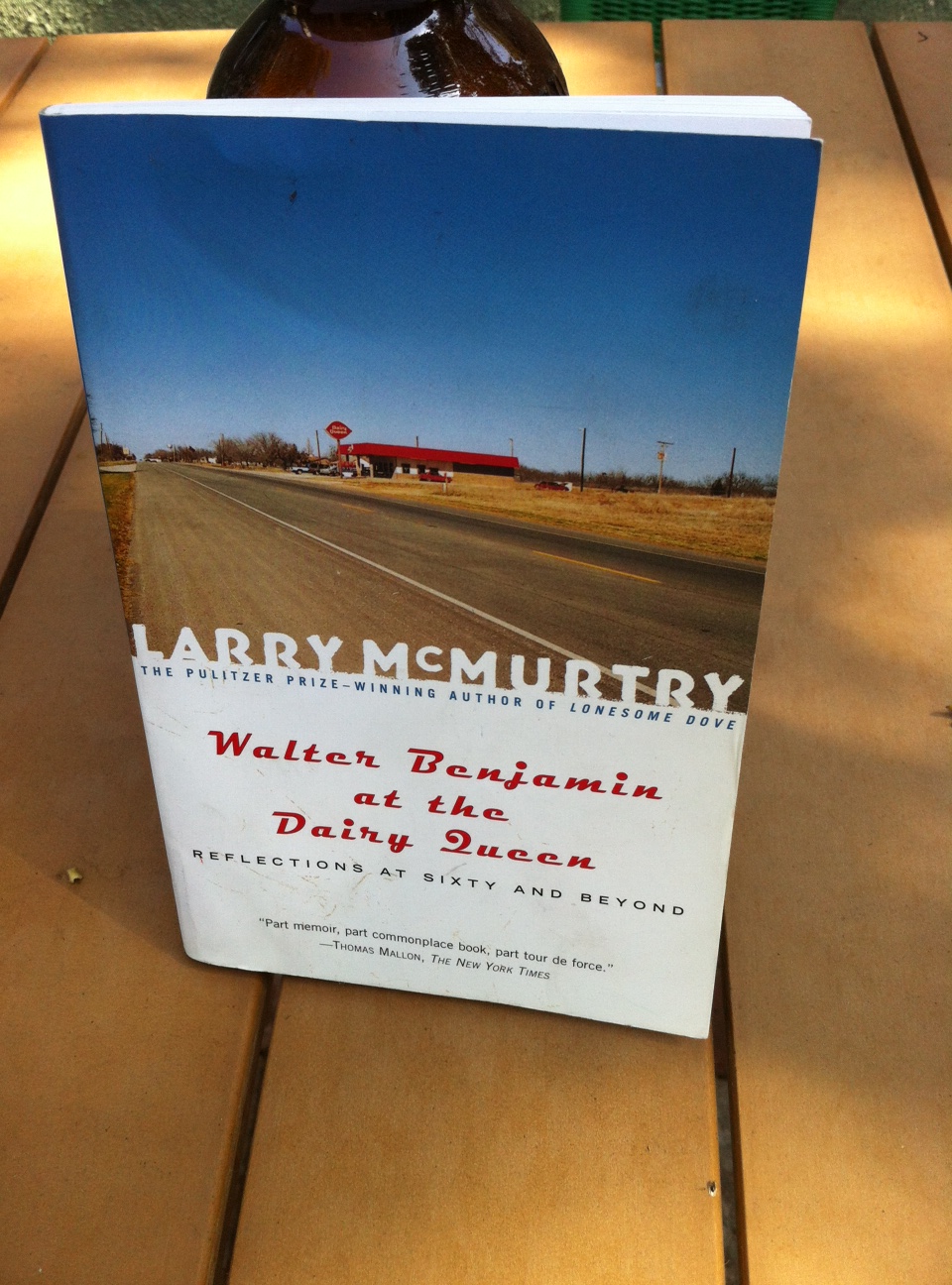
I hate having to say the title of this book when I recommend it. But it is a good read. Larry McMurtry says he was drinking a lime Dr. Pepper (“easily obtainable by anyone willing to buy a lime and a Dr. Pepper”) and reading Walter Benjamin’s essay “The Storyteller,” and then he decided to write this book to work out his subsequent thoughts.
The subtitle is “Reflections At Sixty And Beyond.” It is sort of about the idea of storytelling and oral history, but mostly it seems to be McMurty’s meandering but fascinating musings and memories centered around this fact:
[I] am one of the few writers who can still claim to have had prolonged and intimate contact with first-generation American pioneers, men and women who came to a nearly absolute emptiness and began the filling of it themselves
Here is a good part:
In a tent (later a shack) not far south of our ranch house, in post oak scrub near the West Fork of the Trinity River, lived a woman who had (reportedly) been traded for a whole winter’s catch of skunk hides, the exchange occurring when she was about thirteen. The man who had her (by what right I don’t know) stopped to spend the night in the camp of a skunk trapper, who immediately took a fancy to the girl – such a fancy, indeed, that he offered his winter’s catch for her. The traveler took the hides and left the girl, who lived to bear the trapper many children; she stayed down near West Fork for the rest of her life. When, as an old woman, she would occasionally need to go to town for some reason, she simply walked out to the nearest dirt road and stood, in silence, until some passerby picked her up and took her where she was going. This passerby was often my father, though sometimes it was the school but I rode in. I rode to town with the old woman – once worth more than fifty skunk hides- many times but I never heard her speak a single word.
I saw McMurtry speak once at a screening of “Brokeback Mountain,” which he co-wrote. Someone asked him his writing process. He said that he wakes up in the morning and goes to the typewriter and writes three pages. As soon as he gets to the bottom of page three, even if he’s in the middle of a sentence, he stops. Usually, he said, he’s done by about 8am, and then he spends the day doing whatever – I remember him mentioning he might take a walk in the desert. He also said that found it very important to work every single day, and that the build-up of “momentum” was essential to finishing a book.
Anyway, this walk-in-the-desert lifestyle appealed to me. In another book (Film Flam) McMurtry says he only writes for two hours a day, and suggests that the idea of writers struggling really hard with their work may be a misguided one.
This Is Our Youth, by Kenneth Lonergan
Posted: July 10, 2012 Filed under: writing Leave a comment
This is how the character Jessica is described in the stage directions:
She is a fairly cheerful but very nervous girl, whose self-taught method of coping with her nervousness consists of seeking out the nearest available oasis of self-assurance and entrenching herself there with a watchful defensiveness that sweeps away anything that might threaten to dislodge her, including her own chances at happiness and the opportunity of gaining a wider perspective on the world that might eventually make her less nervous to begin with.
Wonderful sentence
Posted: July 9, 2012 Filed under: history, wikipedia, writing Leave a commentfrom wikipedia’s article about British radio personality C. E. M. Joad:
He involved himself in psychical research, traveling to the Harz Mountains to help [Harry] Price to test whether the ‘Bloksberg Tryst’ would turn a male goat into a handsome prince at the behest of a maiden pure in heart (it did not)
I mean, even just this summary of Joad is pretty great:
Cyril Edwin Mitchinson Joad (August 12, 1891 – April 9, 1953) was an English philosopher and broadcasting personality. He is most famous for his appearance on The Brains Trust, an extremely popular BBC Radio wartime discussion programme. He managed to popularise philosophy and became a celebrity, before his downfall in the Train Ticket Scandal of 1948.
Let’s learn about Joad’s romantic life, while we’re at it:
He described sexual desire as “a buzzing bluebottle that needed to be swatted promptly before it distracted a man of intellect from higher things.” He believed that female minds lacked objectivity, and he had no interest in talking to women who would not go to bed with him. By now Joad was “short and rotund, with bright little eyes, round, rosy cheeks, and a stiff, bristly beard.” He dressed in shabby clothing as a test: if people sneered at this they were too petty to merit acquaintance.
I dunno, you tell me if you think he’s looker enough to pull that off, ladies:

Now, the sad part of the story is that I can find out nothing else about the cartoonist “Griff” who apparently drew this cartoon. It is from Courier Magazine, Vol 5 No 1, 1945. That’s all I got!
Hamburgers
Posted: June 26, 2012 Filed under: California, writing Leave a comment
Like the film, the hamburger is a non-California invention that has achieved a kind of symbolic apotheosis in Los Angeles; symbolic, that is, of the way fantasy can lord it over function in Southern California. The purely functional hamburger, as delivered across the counter of say, the Gipsy Wagon on the UCLA campus, the Surf-Boarder at Hermosa Beach or any McDonald’s or Jack-In-The Box outlet anywhere, is a pretty well-balanced meal that he who runs (surfs, drives, studies) can eat with one hand; not only the ground beef but all the sauce, cheese, shredded lettuce, and other garnishes are firmly gripped between two halves of the bun.
But the fantastic hamburger as served on a platter at a sit-down restaurant is something else again. Its component parts have been carefully opened up and separated out into an assemblage of functional and symbolic elements, or alternatively, a fantasia on functional themes. The two halves of the bun lie face up with the ground beef on one and, sometimes, the cheese on the other. Around and alongside on the platter are the lettuce leaves, gherkins, onion rings, fried potatoes, paper cups of relish or coleslaw, pineapple rings, and much more besides, because the invention of new varieties of hamburger is a major Angeleno culinary art. Assembled with proper care it can be a work of visual art as well; indeed, it must be considered as visual art first and foremost, since some components are present in too small a quantity generally to make a significant gustatory as opposed to visual contribution – for instance, the seemingly mandatory ring of red-dyed apple, which does a lot for the eye as a foil to the general greenery of the salads, but precious little for the palate.
Reyner Banham was writing in 1971. I have a used addition, in which someone (I like to imagine a foreign student) has underlined the word “hamburger.”
Dick Wolf
Posted: June 26, 2012 Filed under: TV, writing Leave a commentMany amazing things in this book:

I have to thank the Chennai office for recommending it. Two of the more amazing quotes come from Dick Wolf:
Dick Wolf: Most dramas make my skin itch because they give you personal stuff with a soup ladle. When you go into work and look around your office, how many of your colleagues’ apartments have you been in? Ours is a workplace show. All we’re interested in is what happens in the eight or ten hours when the characters are actually at work.
There’s also no time. That’s why there are no establishing shots, no driving shots, no people walking into buildings. Each half of the show is the equivalent to a normal hour cop show or legal show. You’re essentially doing an hour’s worth of content in half the time.
I grew up on N. Y. P. D., the original, and Naked City. Naked City is much more the prototype for Law & Order than anything else on TV. The best pictures about conflict are the ones that almost look like news. Like The Battle of Algiers.
Later, Dick Wolf weighs in on the contractual disputes at Friends. The Friends cast all banded together to negotiate their contracts, and the result was they got huge amounts of money. Dick Wolf would’ve handled it differently:
Dick Wolf: When they made the Friends deal, the $100,000 apiece [per episode] deal, I was pretty upset. What I would have done was come out the first day, say I was disappointed the cast had chosen to negotiate in the press, and I had the unpleasant news that Matt LeBlanc wouldn’t be on the show next year. I guarantee that you’d never have gotten to a second name.

More from amazing John Muir
Posted: June 25, 2012 Filed under: adventures, New England, writing Leave a comment
Of the people of the States that I have now passed, I best like the Georgians. They have charming manners, and their dwellings are mostly larger and better than those of adjacent States. However costly or ornamental their homes or their manners, they do not, like those of the New Englander, appear as the fruits of intense painful sacrifice and training, but are entirely divested of artificial weights and measures, and seem to pervade and twine about their characters as spontaneous growths with the durability and charm of living nature.
In particular, Georgians, even the commonest, have a most charmingly cordial way of saying to strangers, as they proceed on their journey, “I wish you well, sir.”

Movie review found on Google News
Posted: June 24, 2012 Filed under: writing Leave a commentPixar’s ‘Brave’ has fine heroine, functional story
School’d
Posted: June 20, 2012 Filed under: adventures, writing Leave a comment
In 1867, 29 year old John Muir decided to walk from Indiana to the Gulf of Mexico, making botanical observations. In the Cumberland Mountains of Tennessee, he knocks on the door of a farmhouse:
My knock on the door was answered by a bright, good-natured, good-looking little woman, who in reply to my request for a night’s lodging and food, said “Oh, I guess so. I think you can stay. Come in and I’ll call my husband.” “But I must first warn you,” I said, “that I have nothing smaller to offer you than a five-dollar bill for my entertainment. I don’t want you to think that I am trying to impose on your hospitality.”
She then called her husband, a blacksmith, who was at work at his forge. He came out, hammer in hand, bare-breasted, sweaty, begrimed, and covered with shaggy black hair. In reply to his wife’s statement, that this young man wished to stop over night, he quickly replied, “That’s all right; tell him to go into the house.” He was turning to go back to his shop, when his wife added, “But he says he hasn’t any change to pay. He has nothing smaller than a five-dollar bill.” Hesitating only a moment, he turned on his heel and said, “Tell him to go into the house. A man that comes right out like that beforehand is welcome to eat my bread.”
When he came in after his hard day’s work and sat down to dinner, he solemnly asked a blessing on the frugal meal, consisting solely of corn bread and bacon. Then, looking across the table at me, he said, “Young man, what are you doing down here?” I replied that I was looking at plants. “Plants? What kind of plants?” I said, “Oh, all kinds; grass, weeds, flowers, trees, mosses, ferns – almost everything that grows is interesting to me.”
“Well, young man,” he queried, “you mean to say that you are not employed by the Government on some private business?” “No, I said, “I am not employed by any one except just myself. I love all kinds of plants, and I came down here to these Southern States to get acquainted with as many of them as possible.”
“You look like a strong-minded man,” he replied, “and surely you are able to do something better than wander over the country and look at weeds and blossoms. These are hard times, and real work is required of every man that is able. Picking up blossoms doesn’t seem to be a man’s work at all in any kind of times.”
To this I replied, “You are a believer in the Bible, are you not?” “Oh, yes.” “Well, you know Solomon was a strong-minded man, and he is generally believed to have been the very wisest man the world ever saw, and yet he considered it was worth while to study plants; not only to go and pick them up as I am doing, but to study them; and you know we are told that he wrote a book about plants, not only of the great cedars of Lebanon, but of little bits of things growing in the cracks of the walls.
“Therefore, you see that Solomon differed very much more from you than from me in this matter. I’ll warrant you he had many a long ramble in the mountains of Judea, and had he been a Yankee he would likely have visited every weed in the land. And again, do you not remember that Christ told his disciples to ‘consider the lilies how they grow,’ and compared their beauty with Solomon in all his glory? Now, whose advice am I to take, yours or Christ’s? Christ says, ‘Consider the lilies.’ You say, ‘Don’t consider them. It isn’t worth while for any strong-minded man.'”
What do you think happens next?
a) The blacksmith beats up John Muir
or
b) “This evidently satisfied him, and he acknowledged that he had never thought of blossoms in that way before.”
Feufollet – Au Fond du Lac
Posted: May 21, 2012 Filed under: Louisiana, music, Vivien Kent, writing Leave a commentIn the Cajun people of Louisiana writers find what writers always find in the remote peoples of the world: pride of race, a healthy love of pleasure, a gift for spinning sorrow into beauty, ruddy confidence, a balance and a rhythm of life that seems enviable to the alienated wanderer. I have gone to their parishes myself on several auto trips.
In the wrong mood I find their men crude and ribald. But their women are at every age attractive. A girl of 13 or 14 from the Acadian parishes can be almost impossible to look at in her beauty and passion. Look her in the eye and it can stop you cold. You will think on her for days. Many of the older women spend the rest of their lives in the consequences of their first sexual blossoming.
Of their men I will say this: in a tight situation they are heroic. None can argue they bleed life.
But above all it is this, you can feel it in their humor, in their food, in their music, in their religion, in their stories: they don’t treat life as though it’s too damned important. Sad, beautiful, sorrowful, happy: it’s something, good and bad, take it as it comes, do your damnest.
– Vivien Kent, How To Travel (1947)
[HT our Virginia Beach office via Garden & Gun magazine. As of last reading, all the comments on this video were perfectly nice (“she was my substitute teacher in 4th grade!”)]
 Helytimes
