What was up with European witch trials in the Middle Ages?
Posted: October 22, 2014 Filed under: history, writing Leave a commentThis tweet by Chris Schleicher:

got me to thinking. What with plagues and beheadings and barbarians, droughts and wars and rumors of wars and all, it can feel like end times. But there’s nothing new there, people have pretty much always thought it was end times. In 2 Thessalonians Paul has to calm down the panicky Thessalonians that the second coming hasn’t already happened – he’s like guys, I promise, you’ll hear about it.
A good book on this subject is In Pursuit Of The Millennium:

The Pursuit of the Millennium: Revolutionary Millenarians and Mystical Anarchists of the Middle Ages (1957, revised and expanded in 1970) isNorman Cohn’s study of millenariancult movements.
Covering a wide span of time, Cohn’s book discusses topics such as anti-Semitism and the Crusades, in addition to such sects as the Brethren of the Free Spirit, flagellants, the Anabaptists, and the Ranters. The Pursuit of the Millennium concludes with a discussion of the theocratic king John of Leiden, who took over the city of Münster in 1534.
(You can, apparently, still see the cage where they left John’s body on the steeple of St. Lambert’s in Münster)

Germany is twisted. Anyway: read Cohn in high school because I was interested in what kind of weird and creepy cults emerged from the bubonic plague. Cohn doesn’t have a ton on that, if I remember, but he does have lots of interesting stuff about flagellating cults of penitents and so forth. And he talks about the Children’s Crusade, a deeply sad event which is all the more intriguing because of how hard it is to sort out.
ANYWAY: went to wikipedia Cohn, and learned about another topic he was into: witch trials. In this book:

Cohn tries to sort out what the hell was going on with medieval witch trials.
Within the book, Cohn argues that there never were any Devil-worshiping witches in Early Modern Europe, and that all of those persecuted for being so were innocent. In this he specifically rejects the Witch-cult hypothesis put forward by English scholar Margaret Murray, which argued that there really had been a witch-cult religion which had been pre-Christian in origin. Cohn notes that accusations of worshiping a beast-headed deity, eating children and committing incest were not new to the witches of Late Medieval and Early Modern Europe, but had originally been leveled at Jews in the first century and then at Christians in the second, before being reused against Christian heretical sects like the Waldensians and the Knights Templar during the Late Medieval.
Now, the Margaret Murray hole is a great one to go down. Basically, her argument was that there was a pre-Christian folk religion in England that worshipped a horned fertility god, and that witch hunts were Christian efforts to stamp this out.

Amazing book cover.
Murray’s is a great, exciting idea and it still can put a twinkle in the eye of deep English folk hippies. But the prevailing historical view started to go at it:
In his 1962 work A Razor for a Goat, Rose asserted that Murray’s books on the witch-cult “contain an incredible number of minor errors of fact or of calculation and several inconsistencies of reasoning.”[75] He accepted that her case “could, perhaps, still be proved by somebody else, though I very much doubt it.”[75]Highlighting that there is a gap of about a thousand years between the Christianisation of Britain and the start of the witch trials there, he asserts that there is no evidence for the existence of the witch-cult anywhere in the intervening period.
That last part seems like the best argument to me – if there was a horn-god religion, why didn’t we hear about it before the 1400s? But, of course, there were ancient pre-Christian religions in Britain:

In keeping with what was by then the prevailing academic view, [Ronald Hutton’s boo] disputed the widely held idea that ancient paganism had survived into the contemporary and had been revived by the Pagan movement. In turn, it proved somewhat controversial among some sectors of the Pagan community, with two prominent members of the Goddess movement, Asphodel Long and Max Dashu publishing criticisms of it.
The Murray “witch-cult hypothesis” was talking about Britain, but people picked up on it elsewhere:
During the 1930s and 1940s, Heinrich Himmler organised a branch of the SS to undertake the largest survey of witch-hunt trial records in Europe ever taken, with the dual aim of using it as anti-Christian propaganda, to claim that the inquisition had been a repression of an indigenous Völkisch Norse-Germanic nature religion, and as evidence for reconstructing that religion.
Ultimately it seems like your more serious British historians, going through more and more documents, picking away at Murray, found it didn’t hold up. But that still leaves us with the question of what the fuck was going on with witch trials?

Down in Italy in the ’60s, Carlo Ginzberg started looking into benandanti:
The benandanti (“Good Walkers”) were members of an agrarian visionary tradition in the Friuli district of Northeastern Italy during the 16th and 17th centuries. The benandanti claimed to travel out of their bodies while asleep to struggle against malevolent witches (streghe) in order to ensure good crops for the season to come. Between 1575 and 1675, in the midst of the Early Modern witch trials, a number of benandanti were accused of being heretics or witches under the Roman Inquisition, and their beliefs assimilated to Satanism.
He suggested that these guys were in line with “shamanistic” traditions which anthropologists note all over the world. Over in Hungary, Éva Pócs started getting into a similar idea:

But man, some people weren’t into it:
Writing in the journal Anthropos, T.O. Beidelman lamented that despite the huge amount of source material that Pócs had to work with, “No account whatsoever is provided to set these witch-hunts and trials (and thus the data at hand) into any kind of historical, cultural, or social contexts. We gain no idea of just what kind of materials may be found in these accounts, who transcribed them, or how these transcriptions may or may not relate to what actually occurred and just who believed what.” He argues that Pócs “displays little sense of proper historical procedures” in her method, and that she also “has little concern for any anthropological, sociological, or psychology theory”, remarking that ultimately the work is “essentially [a] folkloristic, neo-Frazerian account content to describe a large aggregation of terms, beliefs, and practices mainly with the aims of comparing them to materials from elsewhere in Europe… and of tracing the possible origins of such ideas and customs to earlier beliefs and customs of the pre-Christian or even prehistoric past.” He furthermore criticised the style of writing, claiming that it was “rambling and discursive”, to the extent that it became “the most serious weakness of this volume”. He similarly criticises the translation into English, asserting that it “reads poorly”.
Da-yum.
(Let me pause here to note I’m just digesting all this from wikipedia, Helytimes’ greatest friend, and haven’t read these books).
They got into the shaman idea in Germany, too:

Anyway, back in England, Emma Wilby at the University of Exeter picked up on this “shamanic” idea:
she has published two books examining witchcraft and the cunning folk of this period. In these, she has identified what she considers to be shamanic elements within the popular beliefs that were held in this place and time, which she believes influenced magical thought and the concept of the witch.
Wilby started digging into on something interesting, the confession of a witch named Isobel Gowdie, who was arrested around 1662, but apparently confessed without being tortured:
Wilby herself was able to obtain copies of the trial records, which had been presumed lost for two centuries, from which she concluded that Gowdie had been involved in some form of shamanic visionary trances.

Isobel sounds like an interesting lady:
A young housewife living at Auldearn, Highland, Scotland, her confession painted a wild word-picture about the deeds of her coven. They were claimed to have the ability to transform themselves into animals; to turn into a hare, she would say:
- I shall go into a hare,
- With sorrow and sych and meickle care;
- And I shall go in the Devil’s name,
- Ay while I come home again.
(sych: such; meickle: great)
To change back, she would say:
-
Hare, hare, God send thee care.
-
I am in a hare’s likeness now,
-
But I shall be in a woman’s likeness even now.
 What was going on here? Were these people psychotic? Is a word like that even useful or transferable across centuries and cultures? Was there some kind of folk shamanism that stayed alive all over Europe through the Middle Ages? Is that so different from what Margaret Murray was saying?
I don’t have time to sort it all out, but I’m glad somebody’s on it.
I’m just talking about Europe, too – the Salem witch trials are a whole different ballgame. There you can get into theories about West Indian psychotropic hallucinogens, real estate dynamics, wild ergot poisoning, social politics, post-Indian wars PTSD, proto-feminism and fear of adolescent girls’ sexuality, and so on forever down the worm hole.
I guess my point is, 1) history is interesting and 2) dope book cover from Margaret Murray.
There’s hope for all of us!
Posted: October 21, 2014 Filed under: history Leave a comment
It is easy to forget, but on the eve of the Russian Revolution, Stalin was in his late 30s and had nothing to show for his life. He had “no money, no permanent residence, and no profession other than punditry,” meaning that he wrote articles for illegal newspapers. He certainly had no training in statecraft, and no experience managing anything at all. The Bolshevik coup d’état of 1917 brought him and his comrades their first, glorious taste of success. Their unlikely revolution—the result of Lenin’s high-risk gambles—validated their obscure and fanatical ideology. More to the point, it brought them personal security, fame, and power they had never before known.
from here.
The tallest cow in the world
Posted: October 20, 2014 Filed under: America Since 1945, animals Leave a comment
Blosom lives in Illinois and was recently declared the world’s tallest cow.
She says she knew Blosom was special when she was a calf.
I found it a little disappointing, but thanks to Tyler Cowen for the ht. Please send any agricultural oddities to helphely at gmail.
Bear Mystery
Posted: October 8, 2014 Filed under: America Since 1945, New York Leave a comment
Florence Slatkin walking her dog, Paco, on Tuesday next to the spot where she and a friend discovered a dead bear in Central Park. Ms. Slatkin said the bear’s head was resting on a fallen bike. Credit Richard Drew/Associated Press
Alert reader Tia in Manhattan writes:
Very excited for your new podcast. Are you following the Central Park Bear Mystery?
Tia, thanks for writing. Of course I am.
So, a dead bear was found in Central Park. Here are the facts we know, all from the NY Times:
- The state’s Department of Environmental Conservation announced that the results of a necropsy showed that the cause of death was “blunt force injuries consistent with a motor vehicle collision.”
- After revealing the results of the necropsy, Lori Severino, a spokeswoman for the state conservation department, said that the agency still did not know where the bear had come from, only that it was “likely not the park.”
- The Central Park Conservancy, which runs Central Park and provided preliminary information on Monday, had nothing to add on Tuesday. And a spokesman for the Wildlife Conservation Society, which runs the Bronx Zoo, said it was no longer involved and did not wish to comment.
- The New Jersey Department of Environmental Protection, which has been dealing with a surging black bear population, had nothing to say.
- Calls were made to a retired Bronx homicide commander, Vernon Gerberth. “It wouldn’t be a police matter,” he said, “unless the bear was killed by a person, or if somebody was keeping it as a pet and brought it to the park. People are crazy.”
- Dr. Lana Ciarniello, a bear expert in Canada, said that most bear experts in the United States were attending a conference in Greece and would be hard to reach for comment. She could not make the trip, so she was able to offer her thoughts on the mystery.
- She also said that the bear’s gender might have some relevance: “From a biological standpoint, it’s highly unusual for a female bear cub to be so far from her mother. Mother bears make male bear cubs disperse far from her home range to prevent inbreeding, so it would be less unusual if this were a male bear cub.”
- While there was a bear foot found on a lawn in Queens in 2011, bears have not regularly been seen in New York City for decades.
- An entry in the 1916 edition of Valentine’s Manual of Old New York contains an account of bear hunting on Pearl Street from 1678.
Anyway, I hope everyone enjoys The Great Debates! Available here:
https://itunes.apple.com/us/podcast/the-great-debates/id924258984?mt=2
a touching farewell
Posted: October 8, 2014 Filed under: Uncategorized Leave a comment
from this Vulture article about the passing of actress Sarah Goldberg:
Barry Watson, who played her boyfriend on 7th Heaven, tweeted his condolences Tuesday, writing: “#RIP Sarah. I will miss you always. Love Ya! B.”
The Great Debates
Posted: October 7, 2014 Filed under: America Since 1945, the California Condition 1 Comment
To HelyTimes readers, the “admirable thousands,”
Let me direct you to something I think you’ll enjoy.
My friend Dave King *, noted Parks & Recreation and Workaholics writer, and I have started a podcast called The Great Debates.
I know what you’re thinking: more podcasts?! But I think we’ve got something worth hearing.
We pick a topic – one of the great issues of the day – and without any preparation we debate it. The debates are moderated by the sonorously voiced Dan Medina.
This podcast is short, each episode is about twelve minutes.
Listeners can then vote – and suggest new debate topics – by emailing greatdebates69@gmail.com.
The podcast is available for download on iTunes or at www.greatdebates69.com.
I’d love it if you reviewed it and rated it highly on iTunes and spread the word.
We have nine episodes in the can and I’d argue they are enjoyable.
Hope you enjoy!
* not to be confused with jazzist Dave King
utterly nonsensical
Posted: October 6, 2014 Filed under: America Since 1945, music Leave a comment
The chorus of the song is wordless, consisting of a repeated chant of “lie-la-lie”. Simon stated that this was originally intended only as a placeholder, but became part of the finished song.
“I didn’t have any words! Then people said it was ‘lie’ but I didn’t really mean that. That it was a lie. But, it’s not a failure of songwriting, because people like that and they put enough meaning into it, and the rest of the song has enough power and emotion, I guess, to make it go, so it’s all right. But for me, every time I sing that part… [softly], I’m a little embarrassed.”
It has sometimes been suggested that the words represent a “sustained attack on Bob Dylan”. Under this interpretation, Dylan is identified by his experience as an amateur boxer, and the “lie-la-lie” chorus represents allegations of Dylan lying about his musical intentions. Biographer Marc Eliot wrote in Paul Simon: A Life, “In hindsight, this seems utterly nonsensical.”
Bob Dylan in turn covered the song on his Self Portrait album, replacing the word “glove” with “blow.” Paul Simon himself has suggested that the lyrics are largely autobiographical, written during a time when he felt he was being unfairly criticized:
“I think I was reading the Bible around that time. That’s where I think phrases such as ‘workman’s wages’ came from, and ‘seeking out the poorer quarters’. That was biblical. I think the song was about me: everybody’s beating me up, and I’m telling you now I’m going to go away if you don’t stop.”[5]
During a New York City concert in October 2010, Paul Simon stopped singing midway through “The Boxer” to tell the story of a woman who stopped him on the street to tell him that she edits the song when singing it to her young child. Simon told the audience that she removed the words “the whores” and altered the song to say, “I get no offers, just a come-on from toy stores on Seventh Avenue.” Simon laughingly commented that he felt that it was “a better line.”[6]
His big white belly was moving up and down
Posted: October 5, 2014 Filed under: heroes Leave a comment
page one of:

I’ll get right on that!
Posted: October 3, 2014 Filed under: America Since 1945 Leave a comment
The absurdly overwhelming nature of the world is a fun thing to contemplate. One of my favorite demonstrations is when public intellectuals (I guess we’d call them?) on the Internet assign homework. This is from Andrew Sullivan:
Praising Mahoney’s book, Carl Scott advises those unfamiliar with Solzhenitsyn’s work where to start:
Had I to start over again, I’m not sure the order I’d go in, but certainly theGULAG Archipelago first, in the abridged edition, perhaps some of the key essays and speeches next, available in the Solzhenitysn Reader, edited by Ericson and Mahoney, and then onto either In the First Circle, or the first two first “knots” of the super-novel The Red Wheel, namely, the just reissued–in the superior/complete Willetts translations–August 1914 and November 1916. The third of these is one of my very favorite novels, despite the criticism it gets for providing too much history and political commentary alongside its main sections. For In the First Circle and August 1914, make sure you get the newer versions. And somewhere in there, you need to delve into a number of the short stories and poems.
The “abridged edition” is 528 pages long. I MIGHT not make it to the second of the two knots of the super-novel after I read 14.9 ounces about gulags?
Polio and Songwriting
Posted: October 3, 2014 Filed under: America Since 1945, music, the California Condition Leave a commentJoni Mitchell and Neil Young

both got polio in the same 1951 epidemic.

More on that here, with specific reference to Ian Dury. Dury was played by Andy Serkis in the film Sex & Drugs & Rock & Roll:

I learned that Mitchell/Young polio fact, and many other interesting things, from this David Samuels article:
His second discovery was that he could encourage the writing of hits by urging songwriters to follow his nine rules of hit songwriting. While Caren’s rules are not comprehensive or exclusive, it is easy to measure their value by a glance at the dozens of gold and platinum records hanging in his office. He is happy to run down his rules for me. “First, it starts with an expression of ‘Hey,’ ‘Oops,’ ‘Excuse me,’” he begins. “Second is a personal statement: ‘I’m a hustler, baby,’ ‘I wanna love you,’ ‘I need you tonight.’ Third is telling you what to do: ‘Put your hands up,’ ‘Give me all your love,’ ‘Jump.’ Fourth is asking a question: ‘Will you love me tomorrow,’ ‘Where have you been all my life,’ ‘Will the real Slim Shady please stand up.’”
He takes a deep breath, and rattles off another four rules. “Five is logic,” he says, “which could be counting, or could be spelling or phonetics: ‘1-2-3-4, let the bodies hit the floor,’ or ‘Ca-li-fornia is comp-li-cated,’ those kind of things. Six would be catchphrases that roll off the tip of your tongue because you know them: ‘Never say never,’ ‘Rain on my parade.’ Seven would be what we call stutter, like, ‘D-d-don’t stop the beat,’ but it could also be repetition: ‘Will the real Slim Shady please stand up, please stand up, please stand up.’ Eight is going back to logic again, like hot or cold, heaven or hell, head to toe, all those kind of things.”
The ninth rule of hit songwriting is silence. Why? Because most people who are listening to music are actually doing something else, he explains. They are driving a car, or working out, or dancing, or flirting. Silence gives you time to catch up with the lyrics if you are drunk or stoned. If you are singing along, silence gives you time to breathe. “Michael Jackson, his quote was ‘Silence is the greatest thing an entertainer has,’” Caren continues. “‘I got a feeling,’ space-space-space, ‘Do you believe in life after love,’ space-space-space-space-space.”

In addition to writing all the music and lyrics for Nirvana, Kurt Cobain designed the band’s T-shirts and album covers and created shot-by-shot scripts for the band’s videos on MTV, as well as edited the bios and other publicity materials that helped shape the band’s narrative in the rock press. It was all part of his art, or inseparable from his art; it’s what he got paid for. “Rock and roll is a commercial art form, it’s not just about the music, it’s about what you look like, it’s about how you connect with an audience, it’s about the photos that appear in the British trades.” Nirvana’s longtime manager, Danny Goldberg, told me this when I met with him in New York, before I left for the Grammys. Even when Cobain was nodding off on rock-star doses of heroin in the MTV editing suite, Goldberg remembers, he could still identify exactly where the camera should come in and when to cut away. “He had a dark side, but he was so nice to me, you know, it was so out of proportion to anything that I did for him,” he remembered. “He was tremendously intellectually curious, incredibly creative, and had a great sense of humor; he was like a leprechaun or an elf. You’d go to wherever he was living, and he lived in a lot of places, and there’d be like reams of drawings and paintings and poems. He was also a great fan of other artists. He’d always be saying, ‘You’ve got to hear Captain America, you’ve got to hear the Jesus Lizard,’ or whatever those bands were.”

Good story about mathematician Richard Hamming
Posted: October 2, 2014 Filed under: America Since 1945 Leave a comment
who worked as a “human computer” in the development of the atomic bomb:
Shortly before the first field test (you realize that no small scale experiment can be done-either you have a critical mass or you do not), a man asked me to check some arithmetic he had done, and I agreed, thinking to fob it off on some subordinate. When I asked what it was, he said, “It is the probability that the test bomb will ignite the whole atmosphere.” I decided I would check it myself! The next day when he came for the answers I remarked to him, “The arithmetic was apparently correct but I do not know about the formulas for the capture cross sections for oxygen and nitrogen-after all, there could be no experiments at the needed energy levels.” He replied, like a physicist talking to a mathematician, that he wanted me to check the arithmetic not the physics, and left. I said to myself, “What have you done, Hamming, you are involved in risking all of life that is known in the Universe, and you do not know much of an essential part?” I was pacing up and down the corridor when a friend asked me what was bothering me. I told him. His reply was, “Never mind, Hamming, no one will ever blame you.”
Lifting this from Hamming’s wiki page which got it from Hamming’s article “Mathematics On A Distant Planet” and I owe an ht to Mr. Paul Ford’s twitter
Tove Jansson in 1956
Posted: October 1, 2014 Filed under: heroes Leave a comment
from the Moomins creator’s wikipedia page.
Aged 14, she wrote and illustrated her first picture book “Sara och Pelle och näckens bläckfiskar” (“Sara and Pelle and the Water Sprite’s Octopuses”)
Rather seriously deranged
Posted: October 1, 2014 Filed under: America Since 1945 Leave a comment
Lots of good stuff n the Paris Review interview of John Hersey.
This one stuck out, because Patton happened to be on TV:
INTERVIEWER
Was it that natural a move, to go from writing nonfiction to writing fiction?
HERSEY
I guess I’d been thinking from the very beginning, and had been experimenting a little bit in the pieces I did for Life, with the notion that journalism could be enlivened by using the devices of fiction. My principal reading all along had been in fiction, even though I was working for Time on fact pieces. As I said, Malraux, Silone, John Dos Passos of those years, Hemingway, Faulkner, were all writers who had excited me; the kind of skepticism and challenging of the norms that Van Santvoord had put to me had attracted me to writers who were trying to break the molds in various ways. In Sicily I wrote some Life pieces about people there who interested me very much. I couldn’t take their stories in nonfiction beyond the articles I had written; but implicit in what they were like was the possibility of a novel. So I just plunged in. The book almost wrote itself. I was working under pressure of time—I had a month in which to work. I now look back on it as a naive book, and an imperfect one. But the example of Silone, who spent his last years rewriting his novels, has cautioned me against trying to repair A Bell for Adano, to make it better. Silone went around a long curve from left to right, and I think he wanted to take the political errors of his youth out of his early books. But instead he took his youthfulness out of them, and I think damaged them badly. As did Fitzgerald when he tried to straighten out Tender Is the Night. A Bell for Adano, as I see it now, had a value when it came out, flawed as it is, because it presented to the American public, at a time when the war was far from won, the spectacle of an American general who seemed to represent the very things we were fighting against—General Marvin, loosely based on Patton, who was I think rather seriously deranged during the Sicilian campaign.
From wiki:
Carlo D’Este wrote that “it seems virtually inevitable … that Patton experienced some type of brain damage from too many head injuries” from a lifetime of numerous auto- and horse-related accidents, especially one suffered while playing polo in 1936.
If the New Yorker archive is still free, take a read of John Hersey’s account of Lieutenant John Kennedy’s survival after the sinking of PT 109. Kennedy seems to be the only source for the piece?
(photo from the National Archives)
Oh Werner
Posted: September 30, 2014 Filed under: film Leave a comment
“It takes me 5 days to write a screenplay,” said Werner. “If you’re spending more than two weeks on it something’s wrong.
And:
“If you don’t have a deal in two days, you won’t have a deal in two years”
From here.
The Woman Who Walked 10,000 Miles In Three Years
Posted: September 29, 2014 Filed under: heroes Leave a comment
Crazy story in the NY Times Magazine (insurance):
For that trip, Marquis lined up her first sponsor, the North Face. She doesn’t think she impressed the company by her pitch. She believes it gave her a few backpacks, a couple of tents and some clothes because, she said, “when I told them what I was going to do, they thought, We can’t let that little thing go out without gear.” To supplement the inadequate supply of noodles she could carry, Marquis brought a slingshot, a blow gun, some wire to make snares and a net for catching insects. In the warm months, Marquis ate goannas, geckos and bearded dragons. In the cold months, when the reptiles hid, she subsisted on an Aboriginal standby, witchetty grubs — white, caterpillar-size moth larvae that live in the roots of Mulga trees. (Raw, Marquis said, they taste like unsweetened condensed milk; seared in hot sand, they crisp up nicely.) Throughout, Marquis tried to minimize human contact. She hid her femininity with loose clothes, big sunglasses, hair piled up in a hat. When water was scarce, she collected condensation, either by digging a deep hole and lining the cool bottom with plastic or by tying a tarp around a bush. If those techniques didn’t yield enough liquid — and they rarely did — she drank snake blood. At night Marquis slept close to the trunks of trees, touching the bark in a way that she describes as “almost carnal.” She fell in love with a particular twisted and wind-bent Western myall tree on Australia’s Nullarbor Plain.
I went to look for a picture of the Nullarbor Plain:

that’s a highly populated stretch.
About that picture of Marquis:
A self-portrait that Sarah Marquis took (her camera was on a cart filled with gear) north of Mongolia, during the first month of her trek across Asia and Australia.
Umm…………………………….. hasn’t she heard of Uber?
Who is the classiest Derek of all time?
Posted: September 26, 2014 Filed under: America Since 1945, heroes Leave a comment
Or

(I gotta say: “write what you want and put my name at the bottom of it” is a baller quote by DJ)
Gingham Style
Posted: September 25, 2014 Filed under: Uncategorized Leave a commentdon’t know why but got to wondering if anyone made a parody called “Gingham Style”
Yes, of course they did. Not really recommended:
36.262 is somehow the exact saddest number of views this could have.
Facewash
Posted: September 24, 2014 Filed under: America Since 1945 Leave a comment
President Barack Obama wipes his face with a cloth handed to him by White House Butler Von Everett in the Blue Room of the White House following an event with business leaders in the East Room, Jan. 28, 2009. (Official White House Photo by Pete Souza)
Getting teased by FDR and Stalin
Posted: September 23, 2014 Filed under: America Since 1945 Leave a comment
The scene is the Tehran Conference, the first time Churchill, FDR, and Stalin all met.

Sir Archibald Clark Kerr, the UK’s ambassador to the Soviet Union, is telling Lord Moran, who was Churchill’s doctor, how one of the meetings went:

(Imagine joking around with Stalin about how many people were going to be shot.)
Anyway.
Was googling Kerr (not to be confused with the great Clark Kerr of the UC system) – that same year, 1943, he wrote a letter to Lord Pembroke, apparently a well-known bit of hilarious correspondence in UK diplomatic history circles:
“My Dear Reggie,
In these dark days man tends to look for little shafts of light that spill from Heaven. My days are probably darker than yours, and I need, my God I do, all the light I can get. But I am a decent fellow, and I do not want to be mean and selfish about what little brightness is shed upon me from time to time. So I propose to share with you a tiny flash that has illuminated my sombre life and tell you that God has given me a new Turkish colleague whose card tells me that he is called Mustapha Kunt.
We all feel like that, Reggie, now and then, especially when Spring is upon us, but few of us would care to put it on our cards. It takes a Turk to do that.
Sir Archibald Clerk Kerr, H.M. Ambassador”
The Forever War
Posted: September 17, 2014 Filed under: America Since 1945 Leave a comment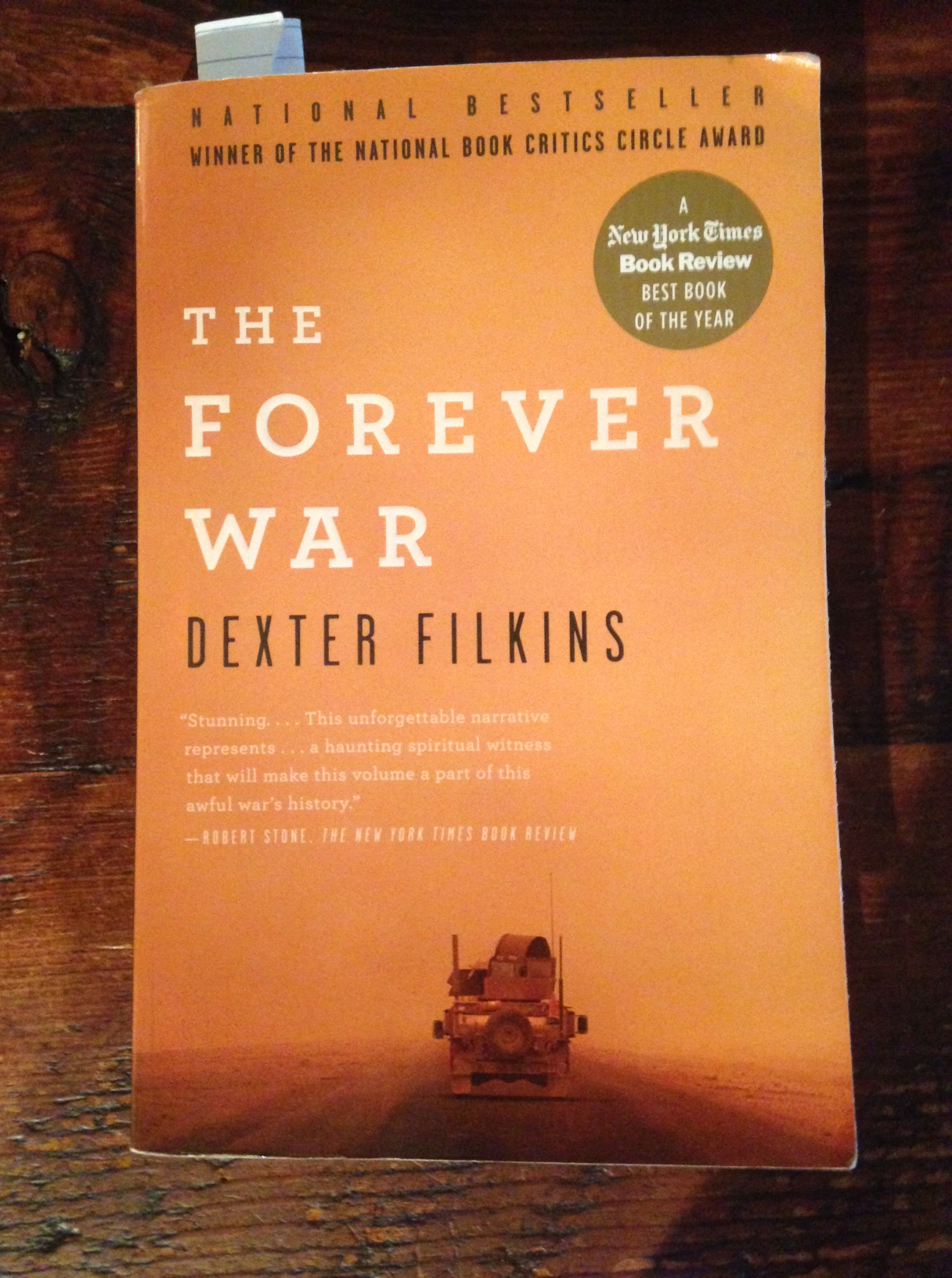 This book should be required reading for American citizens. It’s clear by the end that Dexter Filkins is pretty messed up by the experiences described. I had to finish this book very quickly because I was worried reading it was making me less funny.
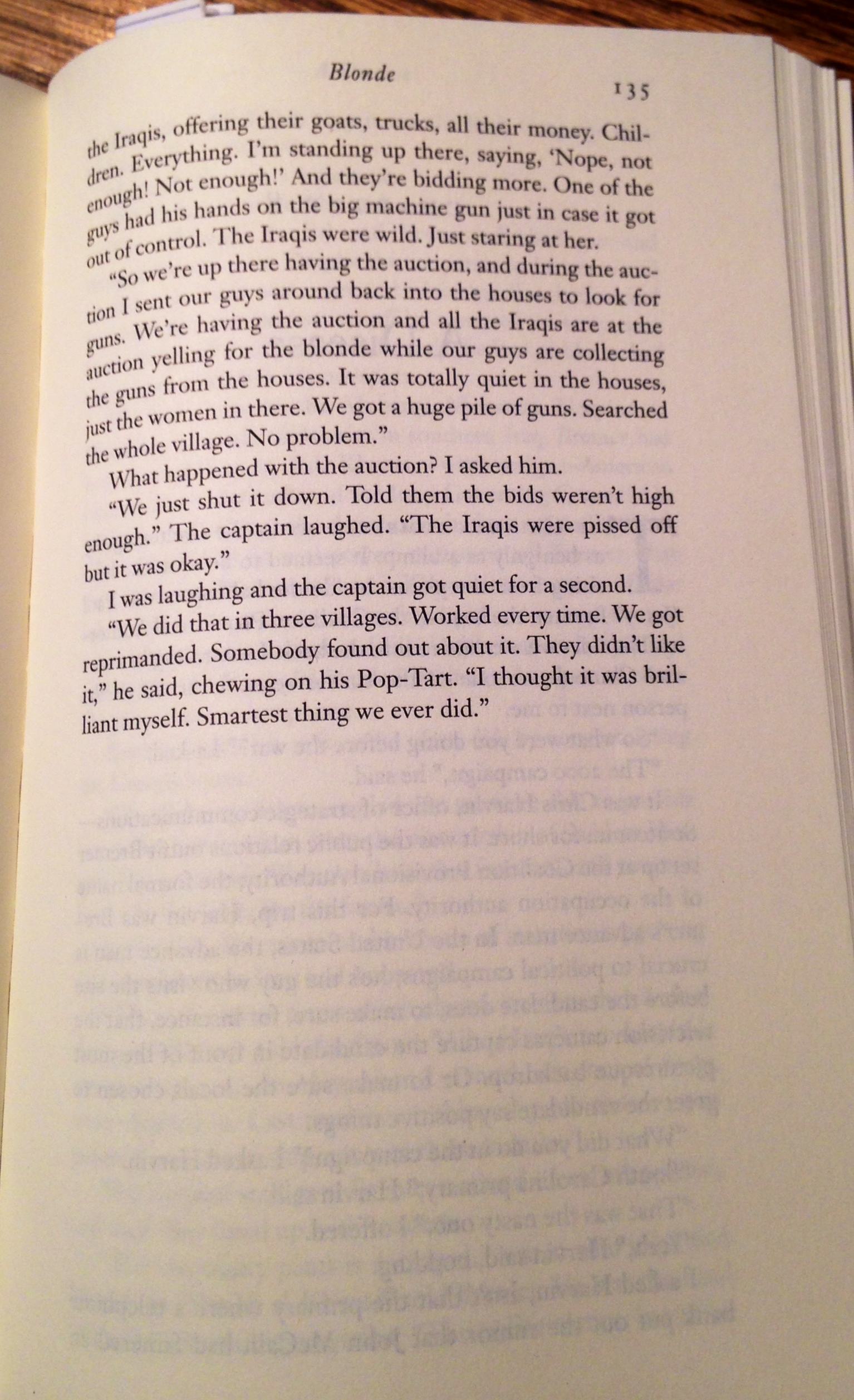
Here is an excerpt that’s one of the easier chapters to read.

 Helytimes
