Statue Storm!
Posted: October 16, 2012 Filed under: painting, pictures Leave a comment
“Oh SHIT!” I thought, as I lay in bed last night. “I’ve forgotten! What was the consequence of the ‘Letters from the Segovia Woods,’ written by Philip II of Spain to Margaret of Parma in 1565-66, wherein Philip rejected requests to abolish the laws against heresy in the Spanish Netherlands?!”
It’s a wonder I got to sleep at all, but I did. All night I was haunted, however, by dreams of Dutch Calvinists smashing Catholic art. My dreams looked like this:

When I woke up, it was with a smile.
“Of course,” I remembered. “The Letters from the Segovia Woods led to the ‘Beeldenstorm’ – the ‘statue storm’ – wherein angry Dutch Protestants destroyed Catholic iconography. Then the Duke of Alba shows up to repress the uprising, etc. etc., the 80 Years War is ON.”
Here, from the relevant Wikipedia page, is Bruegel the Elder’s painting The Preaching Of John The Baptist:

Who’s that looking back at us? Bruegel himself? I dunno, but here’s the kind of detail you’d get to see if you were at the Szépmûvészeti Múzeum, Budapest:

Hurricane, Bahamas (1898)
Posted: October 15, 2012 Filed under: painting, pictures Leave a comment
Winslow. Not on display at the Met.
Proto-Human
Posted: October 15, 2012 Filed under: writing Leave a commentRemembered a story I heard once that Columbus on one of his later expeditions brought along speakers of Hebrew and Arabic, in the hopes that they might be able to communicate with North Americans in some version of the “original language.” Found myself on the wikipedia page for “Proto-Human language.”
A fairly large number of words have been tentatively traced back to the ancestor language, based on the occurrence of similar sound-and-meaning forms in languages across the globe. The best-known such vocabulary list is that of John Bengtson and Merritt Ruhlen (1994), who identify 27 “global etymologies”.
Source: Ruhlen 1994b:103. The symbol V stands for “a vowel whose precise character is unknown” (ib. 105).
Based on these correspondences, Merritt Ruhlen (1994b:105) lists these roots for the ancestor language:
- ku = ‘who’
- ma = ‘what’
- pal = ‘two’
- akwa = ‘water’
- tik = ‘finger’
- kanV = ‘arm’
- boko = ‘arm’
- buŋku = ‘knee’
- sum = ‘hair’
- putV = ‘vulva’
- čuna = ‘nose, smell’
To summarize some further reading: these findings are controversial.
Una’s Tits
Posted: October 12, 2012 Filed under: mountains Leave a comment
Una’s Tits, also known as Cape Renard Tower, are two towers of basalt, each topped by a cap of ice, guarding the northern entrance to the Lemaire Channel on the Antarctic Peninsula… they are officially named “Una’s Tits” and are identified as such on navigation charts.
Una was a woman living in Stanley, Falkland Islands who was working for what is now the British Antarctic Survey.
Flickr user Liam Quinn says this about Una:
named after the Falklands office secretary who would have been one of the last women seen by British Antarctic staff around 1950.
Three diligent minutes of internet searching leaves me without a last name, and I think I prefer it that way.
Photo from wikipedia, via this great category.
I did not know
Posted: October 11, 2012 Filed under: the California Condition Leave a commentthat there is a middle school in LA named after Johnnie Cochran:

(let me stress once again that if I don’t source a photo, it’s from Wikipedia or I took it myself. This one’s from Wiki)
Photos of Antarctica from The Atlantic
Posted: October 10, 2012 Filed under: adventures, photography 1 Comment
That snow’s not dirty – those are penguins. On South Georgia Island, a Norwegian whalers’ church:

See ’em big.
Charles Rennie Mackintosh
Posted: October 10, 2012 Filed under: California, painting, pictures Leave a commentGet a load of this dandy:

Born in Glasgow the year Seward bought Alaska from the Russians, one of twelve children, he became an architect. He designed this house which wasn’t built until 1996:

He had this idea for Liverpool Cathedral:

But they built this instead:

(Giles Gilbert Scott, the winning architect, was 22)
Frustrated with architecture, Rennie became a painter:

The fort in Port-Vendres, France? Or a mad vision of the PCH between Big Sur and San Francisco?
The Lighthouse, Glasgow:

Died 1928.
(Cathedral plan from here, everything else from Wikipedia per usual)
Photos by Sze Tsung Leong
Posted: October 9, 2012 Filed under: photography, pictures Leave a comment
ht bldgblog’s twitter. STL’s website.

Top is China, bottom is Quito, Ecuador.
Karen Russells
Posted: October 8, 2012 Filed under: writing 1 Comment
Have not read Swamplandia! or St. Lucy’s Home For Girls Who Were Raised By Wolves – on title alone both sound excellent – but I did enjoy Karen Russell’s article about Spanish bullfighter Juan Jose Padilla, seen here before a bull gored out his left eye:
Pepe doesn’t think he will ever recover from his son’s accident.
“I thought that I had killed him,” he says in a raw voice. “I thought that I had murdered my son. I was the one who encouraged him in this profession….”
Pepe Padilla has raised three toreros. (Oscar, the middle son, retired as a banderillero the day after Juan Jose’s goring and now runs a chain of pet-supply stores.) Pepe coached his sons after school, caping cows with them in the green hills around Jerez. He once dreamed of being a matador himself. As a teenager, he was a novillero, a matador in training. “But I was a coward,” he says, smiling. “Not like my Juan.”
Today, Pepe is a charmer in his sixties with uncorrected teeth, gold jewelry wreathed by silver chest hair, and one droopy eyelid. For decades he worked as a baker in Jerez, sleeping three or four hours, heading back out before dawn to support his seven children. (Seven children! Franco years, he grins, shaking his head. Everything scarce and hard-won, including condoms.)
So I went on twitter to see if Karen Russell was on there. She is not, but there are 50+ other Karen Russells. Here are some of the twitter biographies of these other Karen Russells:
Country girl at heart who loves her kids (fifth grader & my Navy girl), husband (the judge) and my animals (horses and dog). Life is Good!!!!
I’m a public relations professor, but in my spare time I read mysteries (and sometimes watch on film).
Lives in Fife. Ex Army, Qualified Veterinary Nurse. Doesn’t suffer fools.
Mom of 4 boys, blogger, addicted to Young Adult books, Facebook, and twitter.
23 & a sweet down-to-earth TX girl ! I work as a Paralegal in Downtown Houston!
Married 40 something mum working in OT, diagnosed in may 2011 with severe inflammatory arthritis,learning to accept life changes 🙂
Born, live and work in the best place in the world…. Yorkshire!!!
Christian, mom of three, wife, I make videos of various Christian topics
A curious lover of life who never tires of trivial facts or useful knowledge.
Mother of one, forgiven sinner, lover of classic rock, reader of mysteries, rider of motorcycles, and sometime knitter.
Accountancy student at Glasgow Uni, flute player, Scout Leader, and master of procrastination.
i am a mom to 3 special need boys
registered nurse, church pianist
engaged to a woman who has taught me to be a better woman and mother. so that makes me the luckiest woman in this world.
A feisty free spirit that has low tolerance for stupidity and loves to bake. I also love my grands
im 47 yrs old seperated from my husband i have four sons two are in the army and now my 16 yr old is thinking of joining.i was born in north london.
love spendin time with family n friends,love my job not many can say that haha, have two georgous children who are my world
NICKELBACK!!!
Nutty 40 something that loves horse riding, badminton, hockey and watching pretty much all sport, am an Arsenal supporter, have 2 daughters & grumpy husband.
I teach mathematics
Lately Andrew Sullivan has had a lot of sentences like this:
Posted: October 6, 2012 Filed under: writing Leave a commentCostica Bradatan explains why we’re moved by self-immolation:
Rob Dunn celebrates the celestial beauty of plants:
Gina Barreca locates literature’s odd place in the history of shoplifting:
The Organ Recital, Henry Lerolle
Posted: October 4, 2012 Filed under: film, painting Leave a comment
at The Met.
There is literally nothing interesting on LeRolle’s wikipedia page, so we turn to a tidbit sent recently from our Greenville office. Our correspondent there found this on the wikipedia page for the movie “It’s A Mad, Mad, Mad, Mad World.”
“(Director Stanley) Kramer considered adding a fifth ‘mad’ to the title before deciding that it would be redundant but noted in interviews that he later regretted it.”

Hunza
Posted: October 1, 2012 Filed under: adventures Leave a commentThe Hunza Valley is a mountainous valley in the Gilgit–Baltistan region of Pakistan.

Healthy living advocate J.I. Rodale wrote a book called The Healthy Hunzas in 1955 that asserted that the Hunzas, noted for their longevity and many centenarians, were long-lived because of their consumption of healthy organic foods such as dried apricots and almonds, as well as them getting plenty of fresh air and exercise. He often mentioned them in his Prevention magazine as exemplary of the benefits of leading a healthy live style.
Dr. John Clark stayed among the Hunza people for 20 months and in his book Hunza – Lost Kingdom of the Himalayas[19] writes: “I wish also to express my regrets to those travelers whose impressions have been contradicted by my experience. On my first trip through Hunza, I acquired almost all the misconceptions they did: The Healthy Hunzas, the Democratic Court, The Land Where There Are No Poor, and the rest—and only long-continued living in Hunza revealed the actual situations”. Regarding the misconception about Hunza people’s health, John Clark also writes that most of patients had malaria, dysentery, worms, trachoma, and other things easily diagnosed and quickly treated; in his first two trips he treated 5,684 patients.
Furthermore, Clark reports that Hunza do not measure their age solely by calendar (metaphorically speaking, as he also said there were no calendars), but also by personal estimation of wisdom, leading to notions of typical lifespans of 120 or greater.

Children Playing On The Beach At Guernsey
Posted: September 29, 2012 Filed under: pictures Leave a comment
Guernsey is one of the UK’s Channel Islands, sitting there out in the ocean on the way to France. Here it is seen from the air:

And that’s Renoir’s “Children On The Beach At Guernsey,” which you can see bigger here or here:

(That’s the Barnes Foundation in Philly). But wait, here also is another picture of that same name?

With less prominent children? What is Renoir up to? Forgetting how to draw kids, looks like. That second one’s in a private collection.
In 1883, Renoir spent the summer in Guernsey, creating fifteen paintings in little over a month. Most of these feature Moulin Huet, a bay in Saint Martin’s, Guernsey. Guernsey is one of the Channel Islands in the English Channel, and it has a varied landscape that includes beaches, cliffs and bays. These paintings were the subject of a set of commemorative postage stamps issued by the Bailiwick of Guernsey in 1983.
“small as a whorehouse beer”
Posted: September 28, 2012 Filed under: America, writing Leave a comment
from the Paris Review interview with James M. Cain:
INTERVIEWER
Were there other signs [that you were going to be a writer]?
CAIN
Well, when I went to Baltimore to work for the gas company, the first of the meaningless jobs I held when I was just out of college, I kept going down to this whorehouse on Saturday nights. I never did go upstairs, though twice I wanted to. One night I met this girl who was awful pretty, and she had pretty legs. I badly wanted to go upstairs with her, but I was afraid because of the disease which I imagined she had. (In Paris during the war I bumped into a girl, and I was horribly lonely, didn’t particularly crave her physically, but she approached me, and asked me to spend the night, and I’m glad I didn’t because I think she would have had my wallet with everything else.) But during this six months I worked for the gas company, I kept going down to that area around Josephine Street. At one of these places you could buy a bottle of beer for fifty cents. “Small as a whorehouse beer” was an expression then. They’d serve them up in glasses so small that thimbles were twice as big. For that fifty cents you were welcome to do anything, downstairs—get along with the girls, stick around—I was just eighteen years old. I listened a lot downstairs. Upstairs was another matter. I was a potential customer, of course. I guess the things you didn’t do . . .
It seems like there’s more to the story, but the interview moves on. Later Cain claims that Alice In Wonderland is the greatest novel in the English language.

Cain on Chandler’s The Big Sleep:
That book about a bald, old man with two nympho daughters. That’s all right. I kept reading. Then it turned out the old man raises orchids. That’s too good.
The Field of Blackbirds
Posted: September 27, 2012 Filed under: California Leave a comment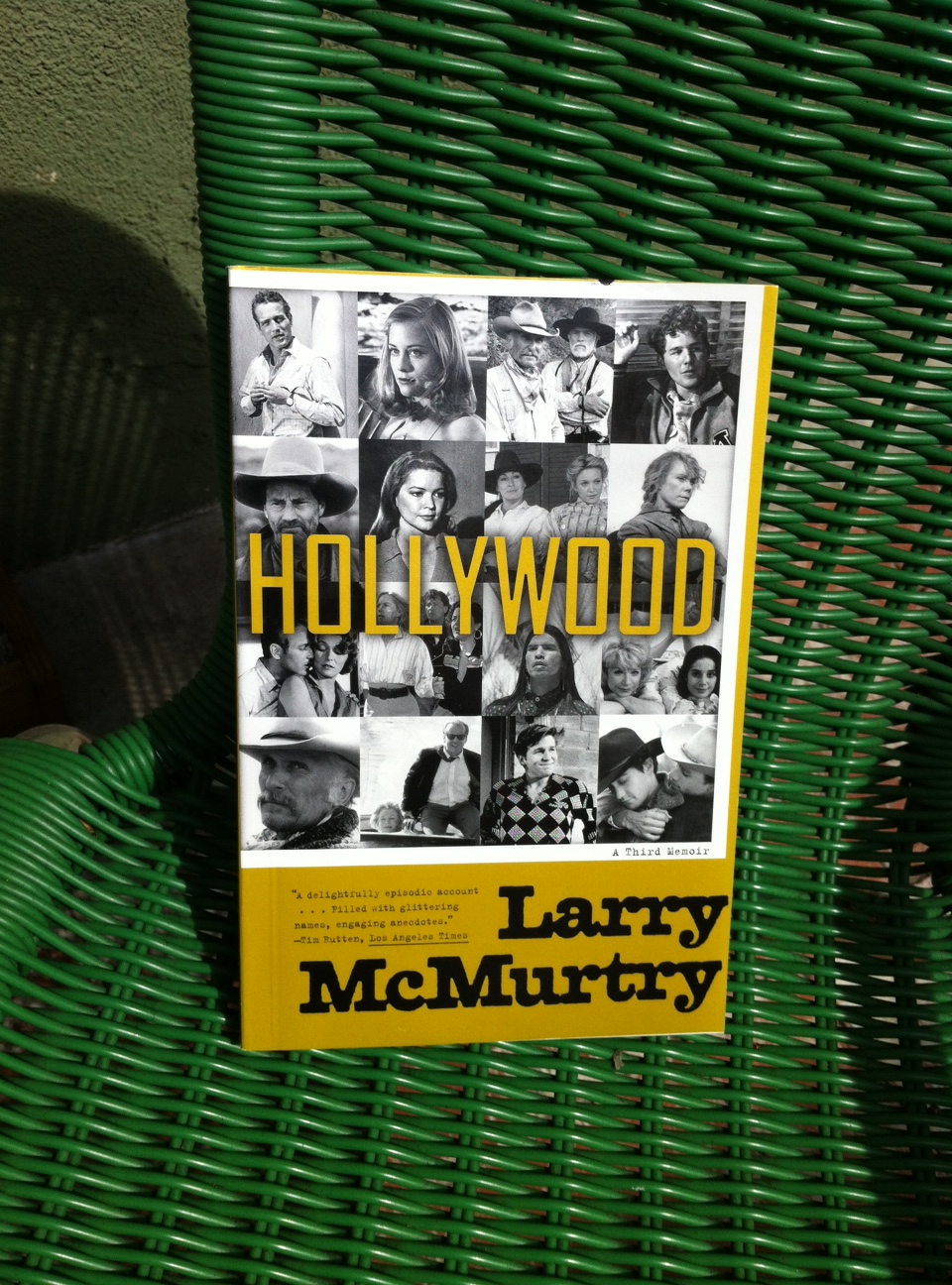
Larry McMurtry in Hollywood: A Third Memoir describes Peter Bogdanovich at the 1972 Oscars:
he sat in his tux looking like a Serbian martyr – the only survivor of the Field of Blackbirds, perhaps.
The Field of Blackbirds refers to the Battle of Kosovo of 1389, which was indeed a bad time for everyone involved. The Prince of Serbia at the time was Lazar Hrebeljanović. Here he is with wife Milicia:

The Ottoman Empire, meanwhile, was led by Mulad I:

The Ottomans decided to invade Serbia, and the two armies met on the Field of Blackbirds:

Wikipedia describes the grim scene:
The bulk of both armies were wiped out in the battle.
Both Mulad and Lazar were killed.
The Ottomans conquered Serbia, and Milicia had to send her youngest daughter Olivera to the harem of the new Ottoman Sultan, Mulad’s son, Bayezid I.

Before the battle Prince Lazar issued the “Kosovo Curse”:
Whoever is a Serb and of Serb birth,
And of Serb blood and heritage,
And comes not to the Battle of Kosovo,
May he never have the progeny his heart desires,
Neither son nor daughter!
May nothing grow that his hand sows,
Neither red wine nor white wheat!
And let him be cursed from all ages to all ages!
Today it’s inscribed on a pillar at the battlefield:

Peter Bogdanovich:

Photo of Greenland
Posted: September 26, 2012 Filed under: photography, pictures, world Leave a commentFrom this NY Times slideshow, credited to Andrew Testa:

Marc Isambard Brunel
Posted: September 25, 2012 Filed under: family, heroes, Irish traditional music Leave a comment
Marc Isambard Brunel was Isambard Kingdom’s father. He was born in France and served as a naval cadet, during which service he built a quadrant for himself.
During his stay in Rouen, Brunel had met Sophia Kingdom, a young Englishwoman who was an orphan and was working as a governess. Unfortunately he was forced to leave her behind when he fled to Le Havre [because of the French Revolution] and boarded the American ship Liberty, bound for New York…
…Sophia Kingdom remained in Rouen and during the Reign of Terror, she was arrested as an English spy and daily expected to be executed.
Meanwhile, in New York, Marc was sick with worry:
In 1798, during a dinner conversation, Brunel learnt of the difficulties that the Royal Navy had in obtaining the 100,000 pulley blocks that it required each year to fit out its ships. Each of these was being made by hand. Brunel quickly produced an outline design of a machine that would automate the production of pulley blocks. He decided to sail to England and put his invention before the Admiralty. He sailed for England on 7 February 1799 with a letter of introduction to the Navy Minister

Back in London, Marc was joyfully reunited with the now-freed Sophia. They had a son, Isambard Kingdom. Marc went to work on an idea for a tunnel under the Thames.

Marc’s helper in this project was 18 year old Isambard.
I’m stealing all this from Marc’s wikipedia page, which in turn seems to be stolen from a book called The Greater Genius? by one Harold Bagust. Q: is that the perfect name for the biography of a father?
A good way to remember the Brunels is the lyrics of Irish traditional song “The Humours of Whiskey,” found here.
Come guess me this riddle, what beats pipe and fiddle,
What’s hotter than mustard and milder than cream?
What best wets your whistle, what’s clearer than crystal,
What’s sweeter than honey and stronger than steam?
What’ll make the lame walk, what’ll make the dumb talk,
What’s the elixir of life and philosopher’s stone?
And what helped Mr. Brunel to dig the Thames Tunnel?
Wasn’t it whiskey from old Inishowen?

Isambard Kingdom Brunel
Posted: September 24, 2012 Filed under: heroes, photography Leave a comment
In 1843, while performing a conjuring trick for the amusement of his children, Brunel accidentally inhaled a half-sovereign coin, which became lodged in his windpipe. A special pair of forceps failed to remove it, as did a machine devised by Brunel to shake it loose. At the suggestion of his father, Brunel was strapped to a board and turned upside-down, and the coin was jerked free.
Everybody do your LSD* today
Posted: September 22, 2012 Filed under: running Leave a comment
* long slow distance. Picture of Steve Prefontaine from this tribute page.
 Helytimes
