Vincent Thomas Bridge
Posted: August 20, 2012 Filed under: California Leave a comment
On October 26, 1990, 1964 Olympic diving bronze medalist Larry Andreasen was killed jumping from the west tower of the bridge in an attempt to set a diving record.
Wandering vs. staying put
Posted: August 20, 2012 Filed under: adventures Leave a comment

[TOBIAS] WOLFF
I had an idea of myself as someone free and unencumbered, and virtuous for being so. Of course, one cannot live like this— I can’t, anyway. And in fact, I find that all the best things in my life have come about precisely through the things that hold me in place: family, work, routine, everything that contradicts my old idea of the good life. For years I lived mostly out of a backpack, traveling light and living cheap, often bestowing my mendicant presence on my brother, Geoffrey, and his wife, Priscilla, on my patient friends. But, you know, it seems as time goes on that the deepest good for me as man and writer is to be found in ordinary life. It’s the gravity of daily obligations and habit, the connections you have to your friends and your work, your family, your place— even the compromises that are required of you to get through this life. The compromises don’t diminish us, they humanize us—it’s the people who won’t, or who think they don’t, who end up monsters in this world. I’m not talking about dishonesty, I’m talking about having some give, sometimes letting go of things that you aren’t inclined to let go of, that you may even have attached the name of principle to, to justify your fear of bending.
(Tobias in the Paris Review, picture from the collection of the blogger)
Automatic Dumper, Jack Delano, 1943
Posted: August 15, 2012 Filed under: California, pictures Leave a comment
from Library of Congress
Selling the Aga Cooker
Posted: August 14, 2012 Filed under: heroes, writing Leave a commentHere’s Swedish inventor Gustaf Dalen:

Gustaf Dalen lost his sight in an explosion while developing his earlier invention, a porous substrate for storing gases, Agamassan. Forced to stay at home, Dalen discovered that his wife was exhausted by cooking. Although blind, he set out to develop a new stove that was capable of a range of culinary techniques and easy to use.
His invention was the AGA cooker:

In the 1920s these were sold, door to door, in the UK. And the greatest AGA cooker salesman of all was David Ogilvy:

His success at this marked him out to his employer, who asked him to write an instruction manual, The Theory and Practice of Selling the AGA cooker, for the other salesmen. Thirty years later, Fortune magazine editors called it the finest sales instruction manual ever written.
I went looking for this manual, and found it at Patrick Lannigan’s blog. I make sure to link because Patrick Lannigan reports that “I’d have to say my number one obsession is playing with Google rankings.” I wish him well.
Anyway, Ogilvy has some good writing and interesting advice:
Salesmen are only too often unpopular people in Aga-worthy houses.. Show straight away that you are not of the so-called canvasser variety. Never bully, get into an argument, show resentment, or lose your temper. Do not talk about “your husband” – “Mr. Smith” is less impertinent.
Never talk down or show superior knowledge. Never appeal to a prospect’s pity because the more prosperous you appear the more she is likely to be impressed with you and to believe in you and your Aga.
The worst fault a salesman can commit is to be a bore. Foster any attempt to talk about other things; the longer you stay the better you get to know the prospect, and the more you will be trusted. Pretend to be vastly interested in any subject the prospect shows an interest in. The more she talks the better, and if you can make her laugh you are several points up. If she argues a lot, do not give the impression of knowing all the answers by heart and always being one up on her. She will think you are too smart by half, and mistrust your integrity. Find out as soon as possible in the conversation how much she already knows about Aga; it will give you the correct angle of approach. Perhaps the most important thing of all is to avoid standardisation in your sales talk. If you find yourself on fine day saying the same things to a bishop and a trapezist, you are done for.
When the prospect tries to bring the interview to a close, go gracefully. It can only hurt to be kicked out. Learn to recognise a really valid reason for the prospect being unable to order (there are mighty few such reasons). With these reservations you cannot be too tenacious or too persevering. The good salesman combines the tenacity of a bull dog with the manners of a spaniel. If you have any charm, ooze it.
The more prospects you talk to, the more sales you expose yourself to, the more orders you will get. But never mistake the quantity of calls for quality of salesmanship.
Later, in the “Attack” section:
Learn to recognise vegetarians on sight. It is painful indeed to gush over roasting and grilling to a drooping face which has not enjoyed the pleasures of a beefsteak for years.
From the section “Wise-cracking”:
The longer you talk to a prospect, the better, and you will not do this if you’re a bore. Pepper your talk with anecdote and jokes. Accumulate a repertoire of illustration. Above all, laugh till you cry every time the prospect makes the joke about the Aga Khan. A deadly serious demonstration is bound to fail. If you can’t make a lady laugh, you certainly cannot maker buy.
David Ogilvy might be better than Mystery.

The Los Angeles Basin
Posted: August 13, 2012 Filed under: California Leave a comment
(wikipedia via Landsat)

Bob Ross
Posted: August 7, 2012 Filed under: art, painting 2 CommentsAfter enjoying this video:
I did a typically cursory investigation into his backstory:
Ross enlisted in the U.S. Air Force at age 18 after graduating from Elizabeth Forward High School in Elizabeth, Pennsylvania and was living in Florida early in his military career when the Air Force transferred him to Eielson AFB (in Alaska), where he first saw the snow and mountains that later became recurring themes in his artwork; he developed his quick-painting technique in order to be able to create art for sale in brief daily work breaks. Having held military positions that required him to be, in his own words, “mean” and “tough”, “the guy who makes you scrub the latrine, the guy who makes you make your bed, the guy who screams at you for being late to work”, Ross decided that if he ever moved on from the military, “it wasn’t going to be that way any more”, “vowing never to scream again.”
The sexual indeterminates at Oxford, how Randolph Churchill got pants’d, and the White Rajahs of Sarawak: a Wikipedia journey
Posted: August 6, 2012 Filed under: wikipedia 2 CommentsIf you read much about England between the world wars, sooner or later you’ll start hearing about the “King And Country Debate.” So I went to reading about it on Wikipedia:
The King and Country debate was a discussion at the Oxford Union debating society on 9 February 1933 on the motion: “That this House will in no circumstances fight for its King and Country”. It was passed by 275 votes to 153, and became one of the most famous and notorious debates conducted in the Union.
Here’s a picture of the Oxford Union debate chamber:

C. E. M. Joad argued on the side of the ayes:
Joad delivered what was described as a “tour de force of pacifist rhetoric”. He claimed that the motion really meant “that this House will never commit murder on a huge scale whenever the Government decided it should do so”, and argued that although limited wars might have been justified in the past, the scale of destruction now possible with modern weapons meant that war had become unthinkable.
And this apparently carried the day:
When the motion was put, President Frank Hardie declared it carried by 275 votes to 153.
Hard to imagine a college debate being a big deal, but this one was:
A Fellow of Pembroke College, Oxford at the time, R. B. McCallum, claimed that the “sensation created when this resolution was passed was tremendous. It received world-wide publicity…. Throughout England people, especially elderly people, were thoroughly shocked.”
The Daily Express said of it: “There is no question but that the woozy-minded Communists, the practical jokers, and the sexual indeterminates of Oxford have scored a great success in the publicity that has followed this victory…. Even the plea of immaturity, or the irresistible passion of the undergraduate for posing, cannot excuse such a contemptible and indecent action as the passing of that resolution”.
A Daily Express reporter claimed to have found the Mayor of Oxford, Alderman C. H. Brown, and his wife sitting in front of the fire reading their bibles, with Brown claiming “I say that as mayor of a city that fathers a university of such foreign communistic sentiments, I am ashamed”. Cambridge University was reported to have threatened to pull out of that year’s Boat Race because of “incompatibility of temperament.”
Winston Churchill condemned the motion in a speech on 17 February, 1933 to the Anti-Socialist and Anti-Communist Union as “That abject, squalid, shameless avowal… It is a very disquieting and disgusting symptom”:
My mind turns across the narrow waters of Channel and the North Sea, where great nations stand determined to defend their national glories or national existence with their lives. I think of Germany, with its splendid clear-eyed youths marching forward on all the roads of the Reich singing their ancient songs, demanding to be conscripted into an army; eagerly seeking the most terrible weapons of war; burning to suffer and die for their fatherland. I think of Italy, with her ardent Fascisti, her renowned Chief, and stern sense of national duty. I think of France, anxious, peace-loving, pacifist to the core, but armed to the teeth and determined to survive as a great nation in the world. One can almost feel the curl of contempt upon the lips of the manhood of all these people when they read this message sent out by Oxford University in the name of young England.
Particularly upset over the King and Country debate was Winston Churchill’s son, young Randolph (seen here on the left, with his father and son):

Three weeks after the associated pacifist resolution was passed, [Randolph] Churchill proposed a resolution at the Oxford Union to delete the “King and Country” motion from the Union’s records but this was defeated by 750 votes to 138 in a rowdy debate (one which was better attended than the original debate), where Churchill was met by a barrage of hisses and stink bombs. A bodyguard of Oxford Conservatives and police escorted Churchill back to his hotel after the debate. Sir Edward Heath records in his memoirs that Churchill was then chased around Oxford by undergraduates who intended to debag him (i.e. humiliate him by removing his trousers), and was then fined by the police for being illegally parked.
Possible these guys weren’t entirely overreacting:
Benito Mussolini was particularly struck by the sentiment expressed by the undergraduates and became convinced that the Joad declaration proved that Britain was a “frightened, flabby old woman”. While considering whether to take British threats seriously while embarking on his Abyssinia adventure Mussolini often referred to Joad declaration on why he didn’t cave into British demands. Sir Winston Churchill would after the war write how Japan and Germany too took note of the Joad resolution which altered their way of thinking about Britain as a “decadent, degenerate … and swayed many [of their] calculations.”
Anyway. It all made me curious about who had done the debating.
The proposer of the resolution at the King and Country debate was one Kenelm H. Digby, and how could anyone fail to be curious about what became of him? Well, it turns out he moved to Sarawak in Borneo, where he worked for the White Rajah as a legal advisor.
“Who were the White Rajahs of Sarawak?” you sensibly ask.
Side trip: The White Rajahs of Sarawak
The first one was James Brooke:

who bought himself a ship, helped kill some rebels who were bothering the Sultan of Brunei, and was awarded in return the province of Sarawak.

Brooke spent his career fighting pirates and local warlords. Wikipedia offers some insight into his love life:
Throughout his life, Brooke’s principal emotional bonds were with adolescent boys, though his biographer and contemporary Spenser St. John gives an account of his love for and brief engagement to the daughter of a Bath clergyman.
And he got a plant named in his honor:

His son Charles took over after him, and then his grandson Vyner:

The Daily Telegraph described him as “a cloud-living Old Wykehamist, … one of the few monarchs left in the world who could still say l’Etat, c’est moi.” Similarly, his Who’s Who entry read thus: “Has led several expeditions into the far interior of the country to punish headhunters; understands the management of natives; rules over a population of 500,000 souls and a country” 40,000 square miles (100,000 km2) in extent.
That was Kenelm Digby’s boss.
Back to Kenelm Digby:
When the Japanese invaded Sarawak, they interned everybody. Digby survived three and half years at the Lingang internment camp, which was no easy place:

Plus he was separated from the woman he loved:
Digby met his wife-to-be Mutal Fielding on a P&O liner on the way back to Kuching in 1940, and they became engaged in Singapore in 1941. Mutal lived in Hong Kong, and before they could be married the war intervened. Mutal was interned at Stanley Internment Camp… Digby and Mutal were finally reunited in November 1945 in Southampton, when Digby arrived home on HMS Ranchi…The Digbys were married on 21 February 1946 at Sherfield English near Romsey in Hampshire, before returning to Sarawak.
Sounds like a touching story. Someone wrote a book about it:

Digby looks like he got the better end of the deal, if you ask me.
The end of Digby’s wikipedia page is poignant:
For Digby, the fall-out from the Oxford debate of 1933 lasted through many decades. A lifelong socialist but never a communist, Digby’s suspected communism made him unpopular with the authorities in Sarawak and brought his career there to a premature end, and he was rarely briefed by solicitors when working as a lawyer in the UK. After his death, [his wife] Mutal commented: “That Oxford Union motion haunted him. It dogged him wherever he went.”

Americans
Posted: August 1, 2012 Filed under: America Leave a comment1) Kaley Cuoco:

As a child, Cuoco was once a nationally-ranked amateur tennis player, a sport she took up when she was three years old but had to give up in 1992, when she was six.
2) Darius Rucker:

He also likes the film Stir Crazy, which he has seen more than 100 times.

“The Seven Sleepers of Ephesus Discovered by Alexander the Great”, Folio from a Falnama (Book of Omens)
Posted: July 31, 2012 Filed under: painting, pictures Leave a comment
from the Met. If you don’t know about the Seven Sleepers of Ephesus then fool there’s no helping you.
The Met claims it came from Qazvin, Iran. What does Qazvin look like, I wonder? In 1921 it looked like this:

from the Life Magazine set of photos entitled “A Squirrel’s Guide To Fashion”
Posted: July 27, 2012 Filed under: photography, pictures Leave a comment
Life’s website explains:
In the early 1940s, LIFE magazine reported that a woman named Mrs. Mark Bullis of Washington, D.C., had adopted a squirrel “before his eyes were open, when his mother died and left him in a tree” in the Bullis’ back yard.
“Most squirrels,” LIFE noted (with a striking lack of evidence), “are lively and inquisitive animals who like to do tricks when they have an audience.”
They do? At any rate, LIFE went on to observe that the squirrel, dubbed Tommy Tucker by the Bullis family, “is a very subdued little animal who has never had a chance to jump around in a big tree.”
“Mrs. Bullis’ main interest in Tommy,” LIFE continued, “is in dressing him up in 30 specially made costumes. Tommy has a coat and hat for going to market, a silk pleated dress for company, a Red Cross uniform for visiting the hospital.”
And so it begins … a series of at-once touching and creepy photographs by LIFE’s Nina Leen, chronicling the quiet adventures and sartorial splendor of Tommy Tucker the squirrel.

Pick your motto!
Posted: July 25, 2012 Filed under: Clubs, London Leave a comment
Wikipedia helpfully provides a list of London’s livery companies and their mottos:
The Livery Companies are listed in alphabetical order, rather than by precedence. Note that most are double entendres or puns about their Company’s purpose.
- Worshipful Society of Apothecaries: Opiferque Per Orbem Dicor (I Am Called a Bringer of Help Throughout the World)
- Worshipful Company of Armourers and Brasiers: We Are One
- Worshipful Company of Bakers: Praise God For All
- Worshipful Company of Barbers: De Praescientia Dei (From the Foreknowledge of God)
- Worshipful Company of Basketmakers: Let Us Love One Another
- Worshipful Company of Blacksmiths: By Hammer and Hand All Arts Do Stand
- Worshipful Company of Bowyers: Crécy, Poitiers, Agincourt
- Worshipful Company of Brewers: In God Is All Our Trust
- Worshipful Company of Broderers: Omnia De Super (All From Above)
- Worshipful Company of Butchers: Omnia Subiecisti Sub Pedibus, Oves Et Boves (Thou Hast Put All Things Under Man’s Feet, All Sheep and Oxen)
- Worshipful Company of Carmen: Scite, Cite, Certo (Skilfully, Swiftly, Surely)
- Worshipful Company of Carpenters: Honour God
- Worshipful Company of Chartered Accountants in England and Wales: True and Fair
- Worshipful Company of Chartered Secretaries and Administrators: Service with Integrity
- Worshipful Company of Clockmakers: Tempus Rerum Imperatur (Time is the Commander of All Things)
- Worshipful Company of Clothworkers: My Trust Is in God Alone
- Worshipful Company of Coachmakers and Coach Harness Makers: Surgit Post Nubila Phoebus (The Sun Rises After The Clouds)
- Worshipful Company of Cooks: Vulnerati Non Victi (Wounded Not Conquered)
- Worshipful Company of Coopers: Love as Brethren
- Worshipful Company of Cordwainers: Corio et Arte (Leather and Art)
- Worshipful Company of Curriers: Spes Nostra Deus (Our Hope is in God)
- Worshipful Company of Cutlers: Pour Parvenir A Bonne Foy (To Succeed Through Good Faith)
- Worshipful Company of Distillers: Drop as Rain, Distil as Dew.
- Worshipful Company of Drapers: Unto God Only Be Honour and Glory
- Worshipful Company of Dyers: Da Gloriam Deo (Give Glory to God)
- Worshipful Company of Engineers: Certare Ingenio (Use Skills to the Best of One’s Abilities)
- Worshipful Company of Fanmakers: Arts and Trade United
- Worshipful Company of Farriers: Vi et Virtute (By Strength and by Virtue)
- Worshipful Company of Feltmakers: Decus et Tutamen (An Ornament and a Safeguard)
- Worshipful Company of Fishmongers: Al Worship Be To God Only (‘Al’ is spelt with one ‘l’)
- Worshipful Company of Fletchers: True and Sure
- Worshipful Company of Founders: God, The Only Founder
- Worshipful Company of Framework Knitters: Speed, Strength and Truth United
- Worshipful Company of Fruiterers: Deus Dat Incrementum (God Gives the Increase)
- Worshipful Company of Gardeners: In The Sweat Of Thy Brows Shalt Thou Eate Thy Bread
- Worshipful Company of Girdlers: Give Thanks To God
- Worshipful Company of Glass Sellers: Discordia Frangimur (Discord Weakens)
- Worshipful Company of Glaziers and Painters of Glass: Lucem Tuam Da Nobis Deo (O God, Give Us Your Light)
- Worshipful Company of Glovers: True Hands and Warm Hearts
- Worshipful Company of Gold and Silver Wyre Drawers: Amicitiam Trahit Amor (Love Draws Friendship)
- Worshipful Company of Goldsmiths: Justitia Virtutem Regina (Justice and Virtue are Queen)
- Worshipful Company of Grocers: God Grant Grace
- Worshipful Company of Haberdashers: Serve and Obey
- Worshipful Company of Horners: (no motto known of)
- Worshipful Company of Information Technologists: Cito (swiftly)
- Worshipful Company of Innholders: Hinc Spes Affulget (Hence Hope Shines Forth)
- Worshipful Company of Ironmongers: God Is Our Strength
- Worshipful Company of Joiners and Ceilers: Join Loyalty With Liberty
- Worshipful Company of Leathersellers: Soli Deo Honor et Gloria (Honour and Glory to God Alone)
- Worshipful Company of Loriners: (Note – this Company has no motto)
- Worshipful Company of Makers of Playing Cards: Corde Recto Elati Omnes (With an Upright Heart All Are Exalted)
- Worshipful Company of Management Consultants: Change through Wisdom
- Worshipful Company of Masons: God is our Guide
- Worshipful Company of Mercers: Honor Deo (Honour God)
- Worshipful Company of Merchant Taylors: Concordia Parvae Res Crescunt (In Harmony Small Things Grow)
- Worshipful Company of Musicians: Preserve Harmony
- Worshipful Company of Needlemakers: They Sewed Fig Leaves Together And Made Themselves Aprons
- Worshipful Company of Painter-Stainers: Amor Queat Obedientiam (Love Can Compel Obedience)
- Worshipful Company of Pattenmakers: Recipiunt Foeminae Sustentacula Nobis (Women Receive Support From Us)
- Worshipful Company of Paviors: God Can Raise To Abraham Children of Stone
- Worshipful Company of Pewterers: In God is all my Trust
- Worshipful Company of Plaisterers: Let Brotherly Love Continue
- Worshipful Company of Plumbers: Justicia Et Pax (Justice and Peace)
- Worshipful Company of Poulters: Remember Your Oath
- Worshipful Company of Saddlers: Hold Fast, Sit Sure; Our Trust Is In God
- Worshipful Company of Salters: Sal Sapit Omnia (“Salt seasons everything”; implies that “Wit improves discourse”)
- Worshipful Company of Scriveners: Littera Scripta Manet (The Written Word Remains)
- Worshipful Company of Shipwrights: Within the Ark Safe Forever
- Worshipful Company of Skinners: To God Only Be All Glory
- Worshipful Company of Spectacle Makers: A Blessing to the Aged
- Worshipful Company of Stationers and Newspaper Makers: Verbum Domini Manet in Eternum (The Word of the Lord Endures Forever)
- Worshipful Company of Tallow Chandlers: Ecce Agnus Dei Qui Tollit Peccata Mundi (Behold the Lamb of God, Who Takes Away the Sins of the World)
- Worshipful Company of Tin Plate Workers alias Wire Workers: Amore Sitis Uniti (Be United In Love)
- Worshipful Company of Tobacco Pipe Makers and Tobacco Blenders: Producat Terra (Out of the Earth)
- Worshipful Company of Turners: By Faith I Obteigne
- Worshipful Company of Tylers and Bricklayers: In God Is All Our Trust
- Worshipful Company of Upholders: Sustine Bona (Uphold the Good)
- Worshipful Company of Vintners: Vinum Exhilarat Animum (Wine Cheers the Mind)
- Worshipful Company of Water Conservators : Nulla vita sine aqua (No life without water)
- Worshipful Company of Wax Chandlers: Truth is the Light
- Worshipful Company of Weavers: Weave Truth With Trust
- Worshipful Company of Wheelwrights: God Grant Unity
- Worshipful Company of Woolmen: Lana Spes Nostra (Wool Is Our Hope)
- Worshipful Company of World Traders: Commerce and honest friendship with all
h/t our Chestnut Hill office, which got us started with an article about Doggett’s Badge & Coat. Good detail:
While anything remotely related to sports is being smothered with news coverage these days in Olympics-saturated London, there were very few here in the way of news media and spectators. This was just as well, as the young victor of the six-man rowing race, a 23-year-old named Merlin Dwan, was a bit far along in his celebration.
“You’re way too late,” a friend warned a reporter, as the sole camera crew on site attempted fruitlessly to conduct an interview.
Picture above is of Fishmongers’ Hall.
Finis Mitchell
Posted: July 23, 2012 Filed under: adventures, heroes, mountains, writing Leave a commentOne thing led to another and I got to reading about Finis Mitchell:

In 1906, as a young boy, Finis came to the Wind River Range [in Wyoming] with his father in a boxcar along with the rest of his family… Not bowing down to the fierce obstacles wielded by a stark and barren land with winters lasting 9 months a year, Finis spent the next 7 years carefully carrying five-gallon cans of water and wild trout on horseback over steep rugged trails to more than 300 remote Wyoming lakes. Due to the glacial topography of the upper mountains, these lakes had no native populations of fish. These isolated lakes, which had never seen a trout before, began to team with these newcomers. Miraculously, as though knowing the way, these fish migrated to over 700 more lakes in the upper mountains. With his life-long friend and wife Emma, he carved a life in this unknown wilderness.
Here’s a photo, from this Forest Service website, of Finis and Emma:

During the Depression, he and his wife stocked lakes in the Wind River Range with over 2.5 million trout. He served in the Wyoming House of Representatives from 1955 to 1958. At the age of 67 he retired from his job as a railroad foreman and dedicated himself full-time to exploring and writing about the Wind River Range of mountains…
…At the age of 73, while on a glacier, he twisted his knee in a snow-covered crevasse. He hacked crude crutches out of pine wood and hobbled 18 miles to find a doctor, and was able to resume climbing until the age of 84, when further injury to the knee from a fall put an end to his solo climbing career.
Here’s a quote from Finis:
A mountain is the best medicine for a troubled mind. Seldom does man ponder his own insignificance. He thinks he is master of all things. He thinks the world is his without bonds. Nothing could be farther from the truth. Only when he tramps the mountains alone, communing with nature, observing other insignificant creatures about him, to come and go as he will, does he awaken to his own short-lived presence on earth.
The Wind River Range:

Finis Mitchell is of course not to be confused with Finesse Mitchell:

David Milch quote of the day
Posted: July 23, 2012 Filed under: writing 2 Comments“Recur, now, to Kierkegaard’s formulation and think of the Super Bowl as an expression of the self resting transparently in the spirit which gave it rise. Not impossible, right?”
Request
Posted: July 19, 2012 Filed under: adventures, Ireland, mysteries, photography Leave a commentNow that my readership has doubled 10,000, I would like to ask for everyone’s help. Summer before last, in the legendary harsh Twelve Bens wilderness of western Ireland I met these people, and took this lovely picture. I would like the Internet’s help in sending the picture to the photographed heroes. Their names are Rob and Lou, and they live in Belfast. Lou at one time worked in the schools of Kankakee, Illinois. Those are all the clues I can provide.

Early Treatment of Psychiatric Disorders
Posted: July 18, 2012 Filed under: painting Leave a comment“Early color illustration of psychiatric treatment disorders,” says wikipedia, re:

Another thing I remembered about Larry McMurtry
Posted: July 17, 2012 Filed under: writing Leave a commentduring the Q&A after the “Brokeback Mountain” screening, someone mentioned that the movie risked being labelled “the gay cowboy movie.” McMurtry, with a tone of baffled wonderment at the world’s foolishness, said “they’re not cowboys! They’re itinerant ranch hands!”
Le Bal des Ardents
Posted: July 17, 2012 Filed under: history, painting, wikipedia Leave a commentWikipedia recently had an incredibly interesting article of the day, about a disastrous court entertainment that occurred in Paris in 1383. I recommend this article, and the related article on the “glass delusion“, but if you’re short on time this picture pretty much tells the whole story:

Larry McMurtry, Walter Benjamin At The Dairy Queen
Posted: July 16, 2012 Filed under: writing 1 Comment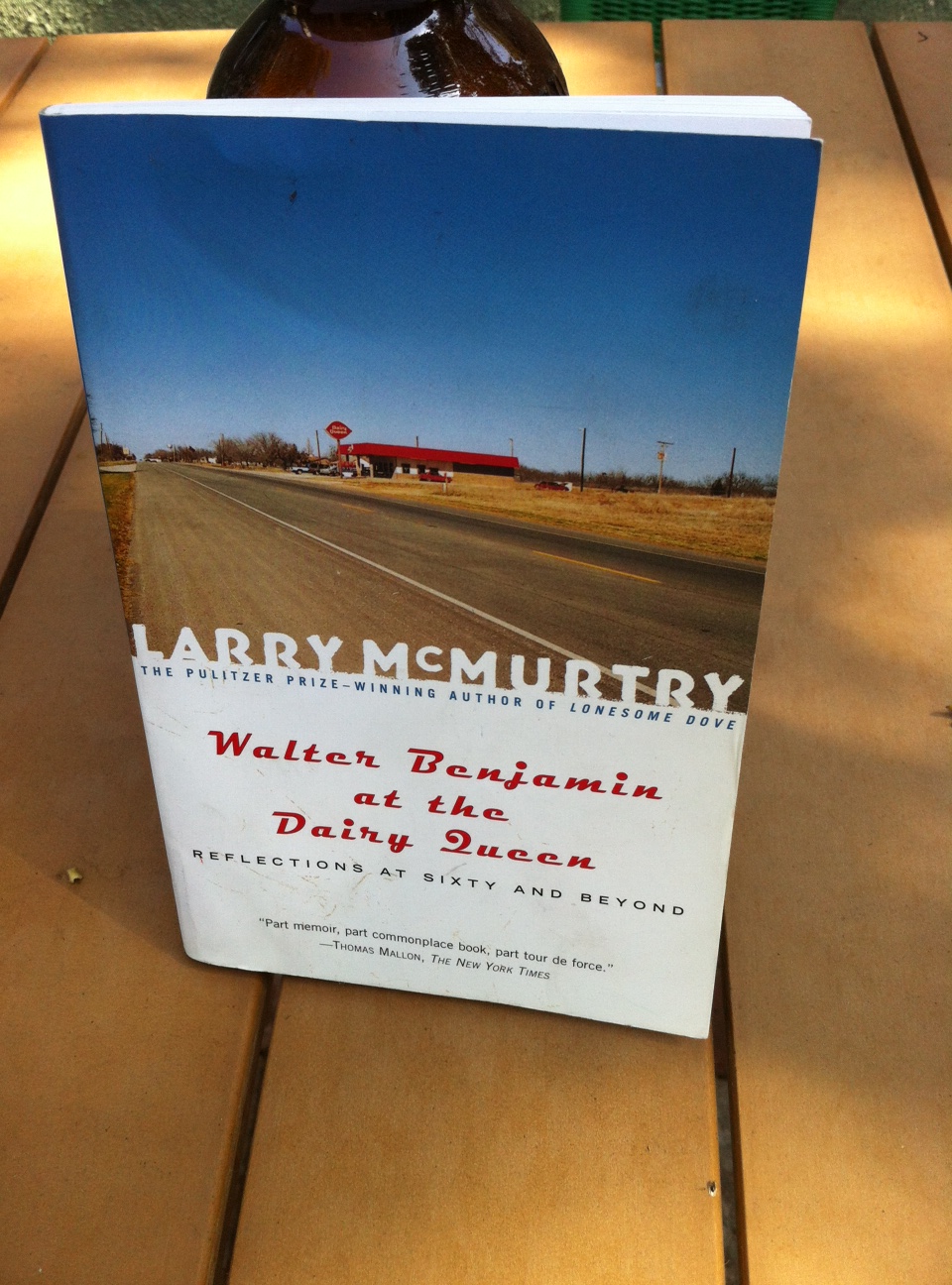
I hate having to say the title of this book when I recommend it. But it is a good read. Larry McMurtry says he was drinking a lime Dr. Pepper (“easily obtainable by anyone willing to buy a lime and a Dr. Pepper”) and reading Walter Benjamin’s essay “The Storyteller,” and then he decided to write this book to work out his subsequent thoughts.
The subtitle is “Reflections At Sixty And Beyond.” It is sort of about the idea of storytelling and oral history, but mostly it seems to be McMurty’s meandering but fascinating musings and memories centered around this fact:
[I] am one of the few writers who can still claim to have had prolonged and intimate contact with first-generation American pioneers, men and women who came to a nearly absolute emptiness and began the filling of it themselves
Here is a good part:
In a tent (later a shack) not far south of our ranch house, in post oak scrub near the West Fork of the Trinity River, lived a woman who had (reportedly) been traded for a whole winter’s catch of skunk hides, the exchange occurring when she was about thirteen. The man who had her (by what right I don’t know) stopped to spend the night in the camp of a skunk trapper, who immediately took a fancy to the girl – such a fancy, indeed, that he offered his winter’s catch for her. The traveler took the hides and left the girl, who lived to bear the trapper many children; she stayed down near West Fork for the rest of her life. When, as an old woman, she would occasionally need to go to town for some reason, she simply walked out to the nearest dirt road and stood, in silence, until some passerby picked her up and took her where she was going. This passerby was often my father, though sometimes it was the school but I rode in. I rode to town with the old woman – once worth more than fifty skunk hides- many times but I never heard her speak a single word.
I saw McMurtry speak once at a screening of “Brokeback Mountain,” which he co-wrote. Someone asked him his writing process. He said that he wakes up in the morning and goes to the typewriter and writes three pages. As soon as he gets to the bottom of page three, even if he’s in the middle of a sentence, he stops. Usually, he said, he’s done by about 8am, and then he spends the day doing whatever – I remember him mentioning he might take a walk in the desert. He also said that found it very important to work every single day, and that the build-up of “momentum” was essential to finishing a book.
Anyway, this walk-in-the-desert lifestyle appealed to me. In another book (Film Flam) McMurtry says he only writes for two hours a day, and suggests that the idea of writers struggling really hard with their work may be a misguided one.
 Helytimes