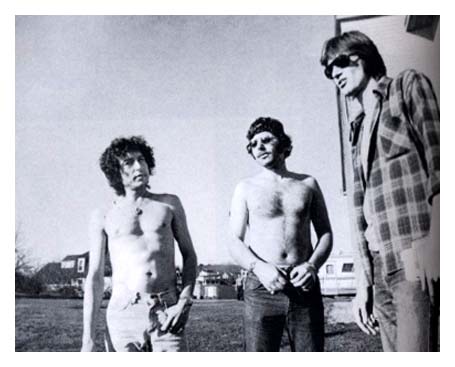
Interesting rumor
Posted: August 20, 2014 Filed under: heroes, villains Leave a commentgoing around: that this guy:

and this guy:

are brothers.
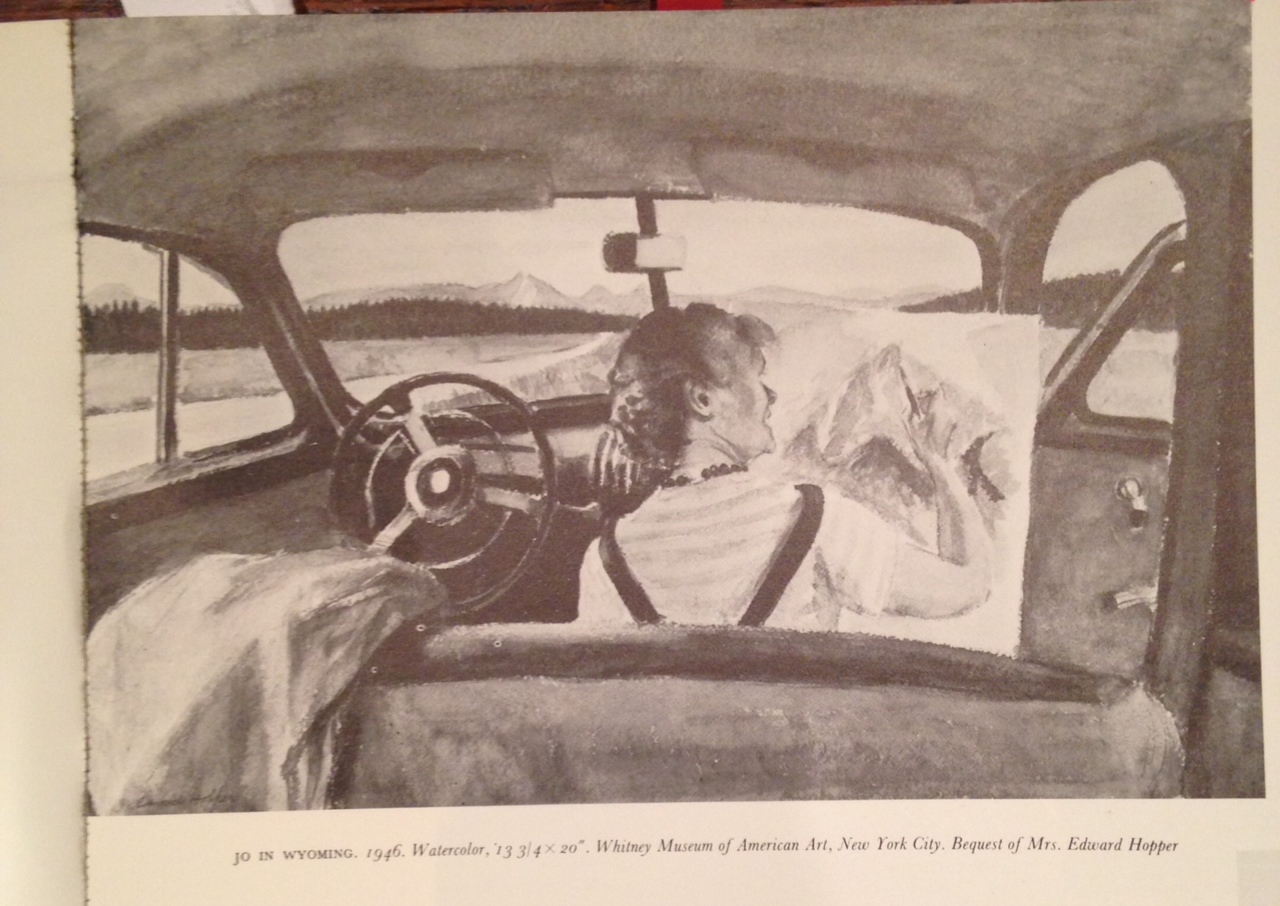
Jo In Wyoming
Posted: August 19, 2014 Filed under: art history Leave a comment
Man, I thought I knew about and was casually “into” Edward Hopper, but I didn’t get even a tenth of it until I picked up a used copy of this book at Phoenix Books in SLO.
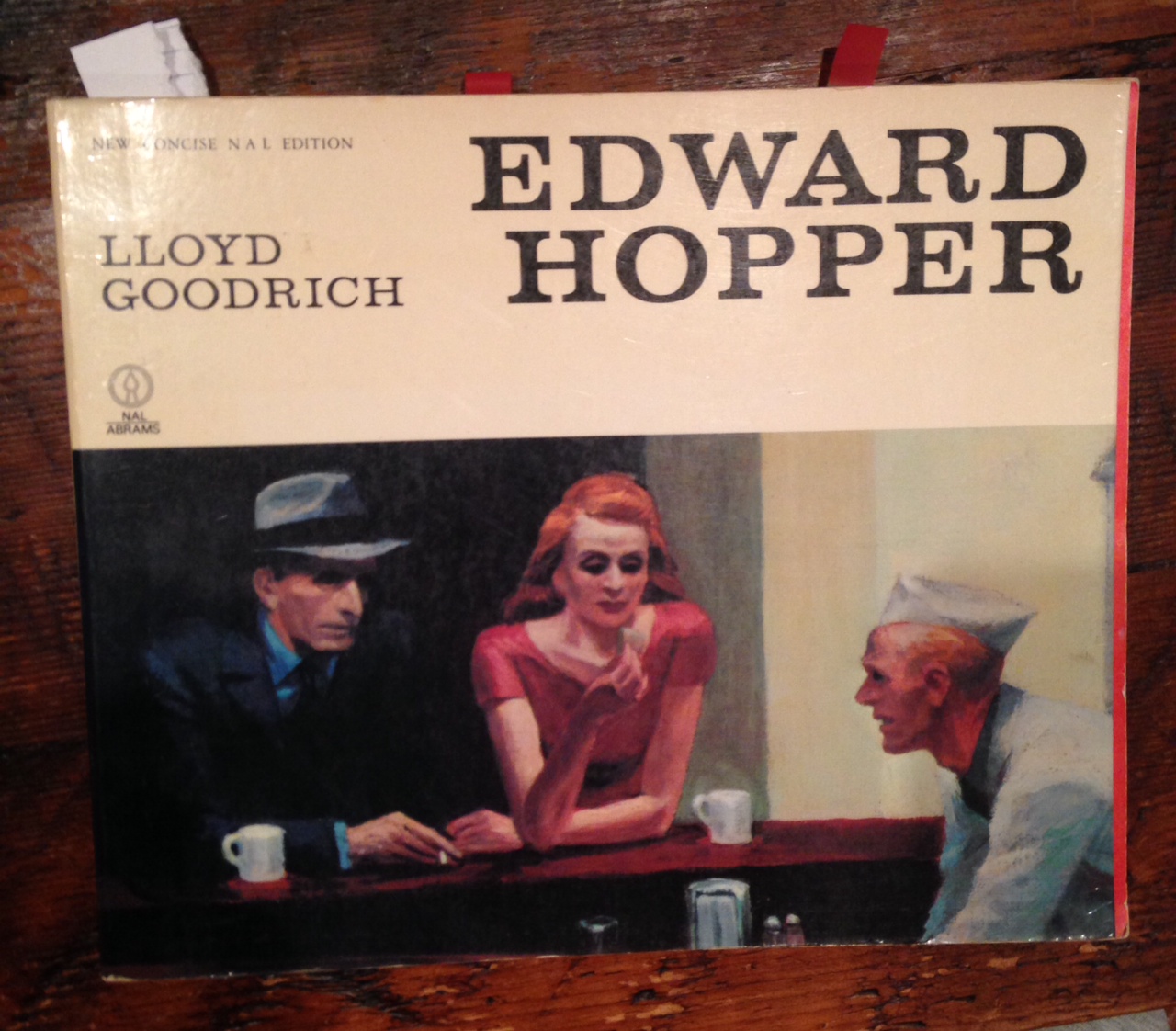
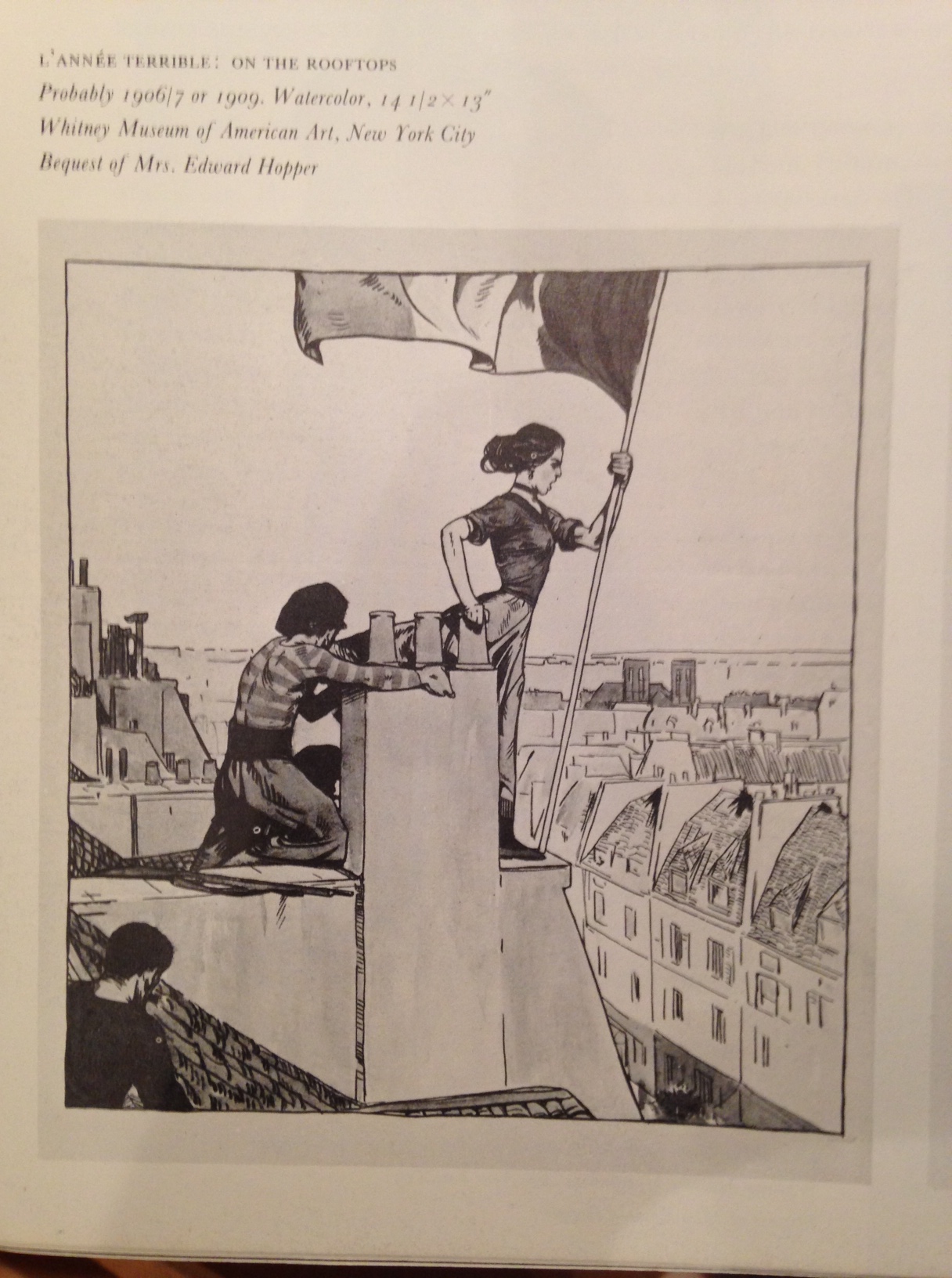
Hopper went to Paris when he was twenty-four, and a few more times before he was thirty. After that he never crossed the Atlantic again.
When he was 42 he married Jo Hopper, whom he’d known for at least ten years.

The austere way of life the Hoppers had chosen seemed to suit both of them completely. They were not unsociable, and they had plenty of friends, old and new; but neither were they gregarious. Hopper had no small talk; he was famous for his monumental silences… When he did speak, his words were the product of long meditation.
Jo Hopper on the other hand, was as articulate as he was laconic, with a lively sense of humor. (She once remarked that “sometimes talking with Eddie is just like dropping a stone in a well, except that it doesn’t thump when it hits bottom.”)
For the six months of they year they lived in New York, Edward Hopper worked like a machine. He’d go down his studio like a banker, work nine to five or so, never go out.
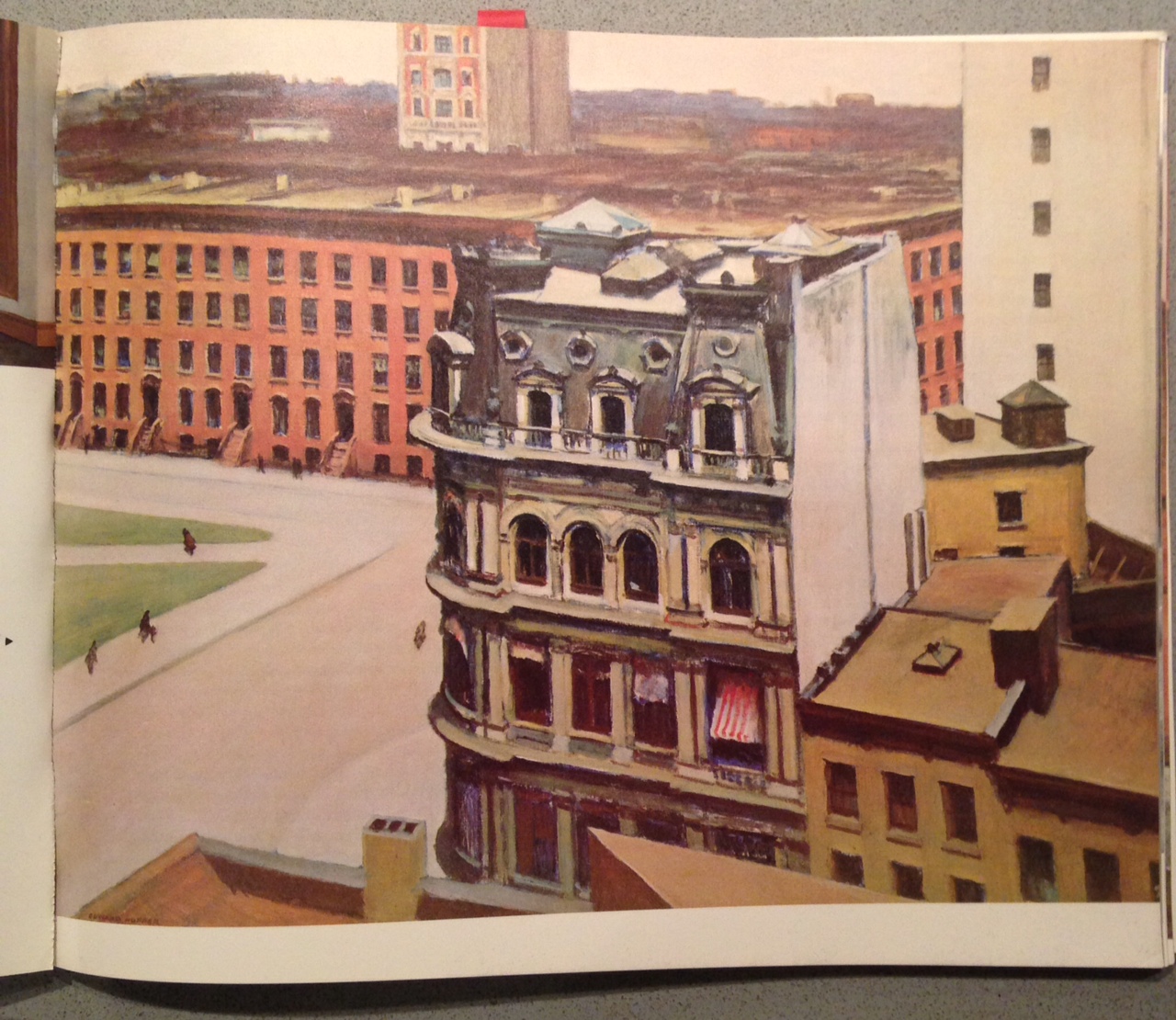
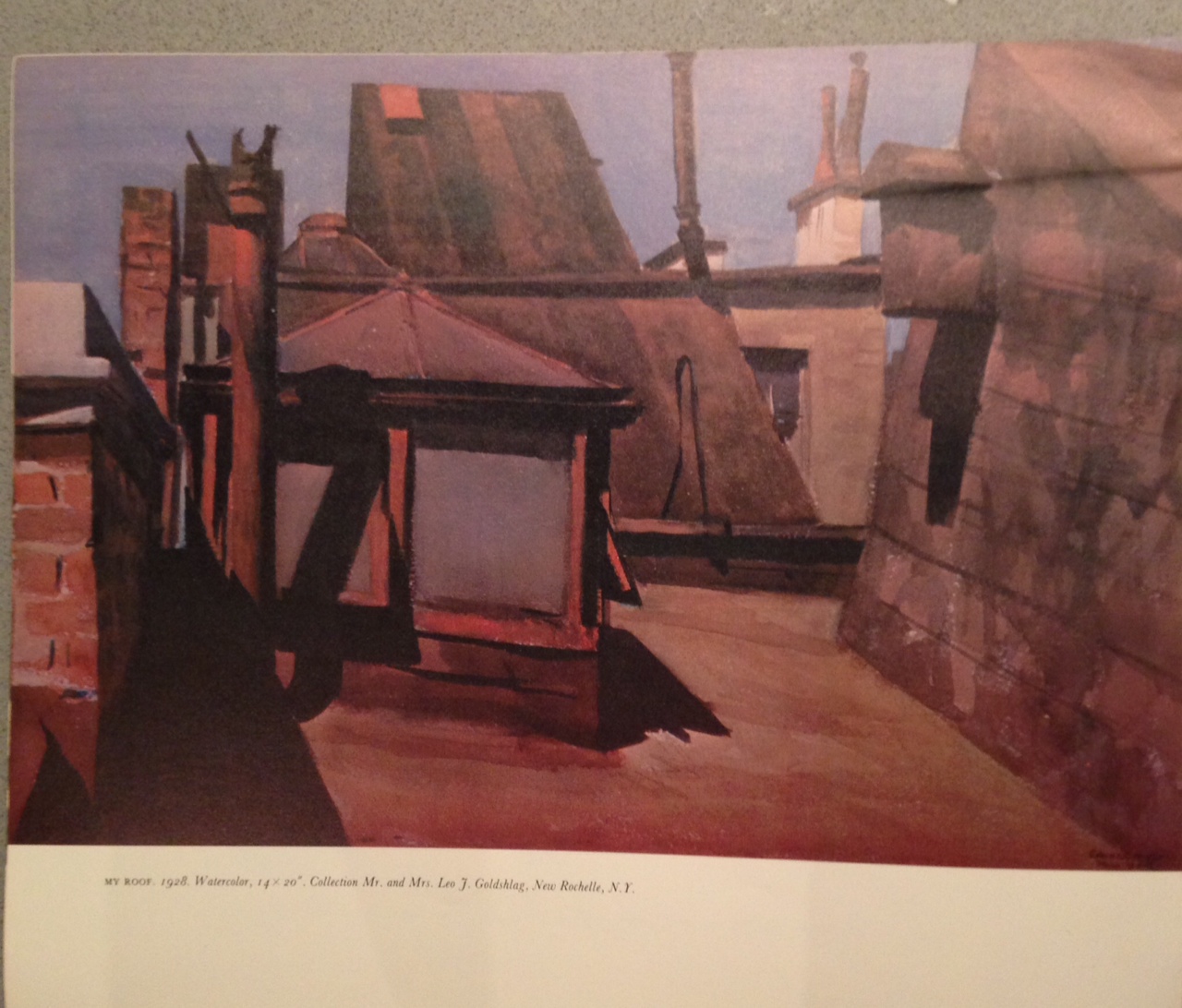
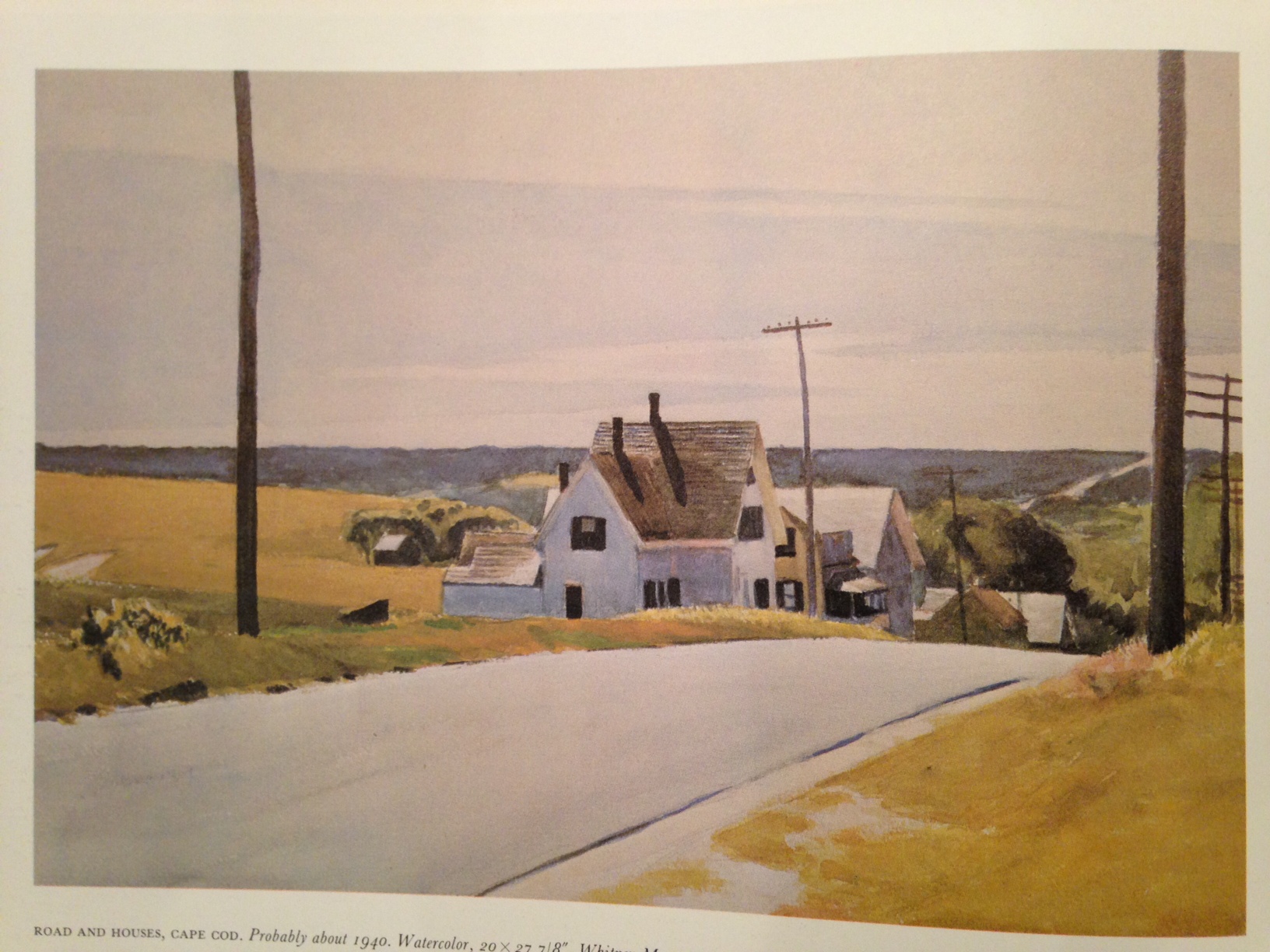
In the summers they’d travel.
A sad thing that happened to Jo when she was in her thirties, and she’d lost her job with the New York public schools because she caught influenza:
Penniless and homeless, she found temporary shelter thanks to an old sexton at the Church of the Ascension who had helped her after seeing her weeping in the church.

“Summer Interior”
Some sources suggest Edward and Jo fought all the time. Others say sure, they fought, but they were each other’s best friends and best helpers. Josephine’s diaries are in a private collection. Wiki:
Since about 1924–25, i.e. almost immediately after their marriage, Jo became her husband’s only model. It was also Jo who thought up the names for a number of her husband’s paintings, including one of the most famous oils, Nighthawks.
Though very interested in the American Civil War and Mathew Brady’s battlefield photographs, Hopper made only two historical paintings. Both depicted soldiers on their way to Gettysburg. Also rare among his themes are paintings showing action.

[Jo] reflected on her relative good fortune that [Edward’s] only vices were drinking too much coffee in the Automat and “doing word puzzles in the Evening Sun.”

Hopper’s last picture is called Two Comedians:
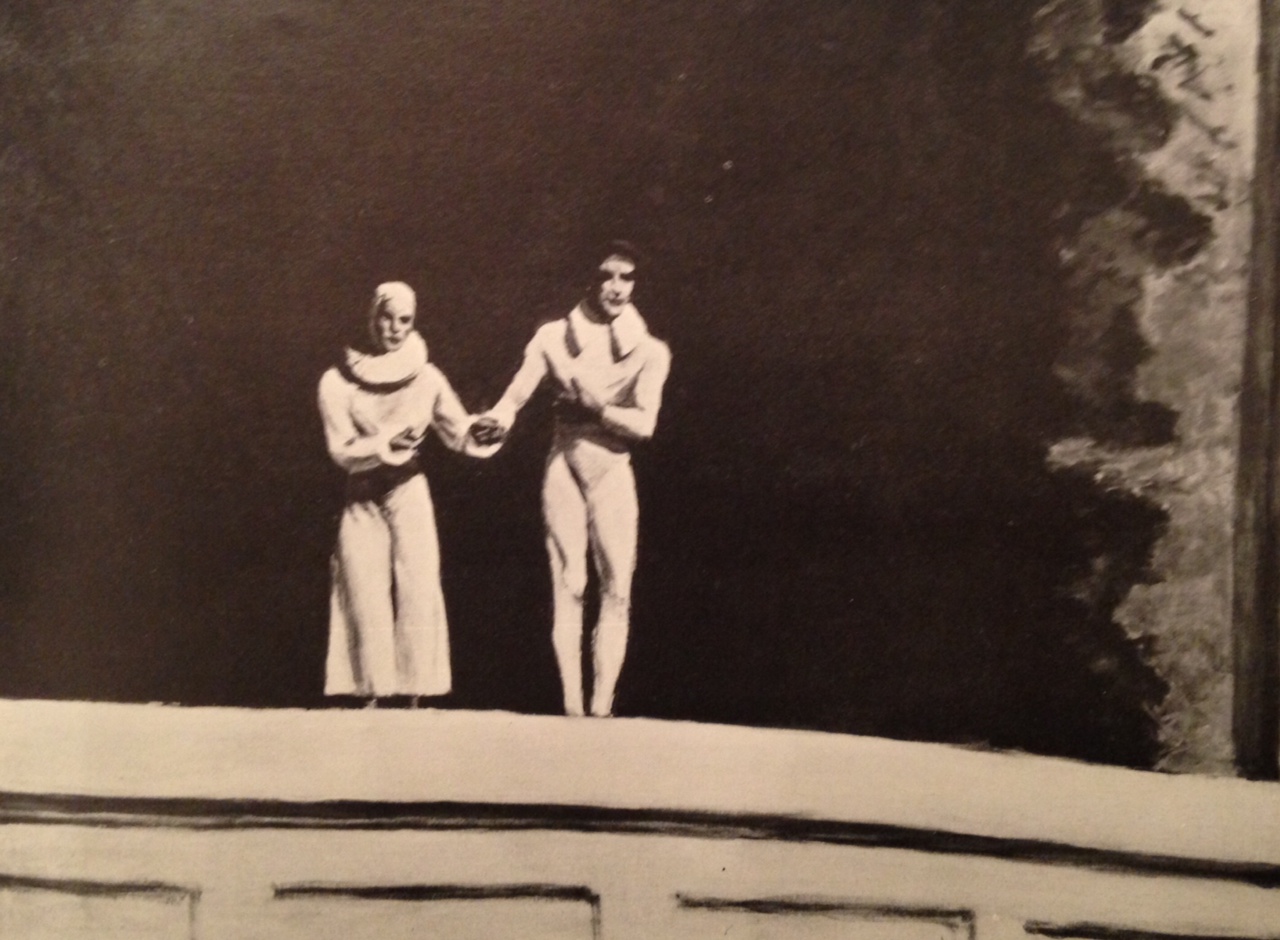
Jo Hopper confirmed that her husband intended the figures to suggest their taking their life’s last bows together as husband and wife.
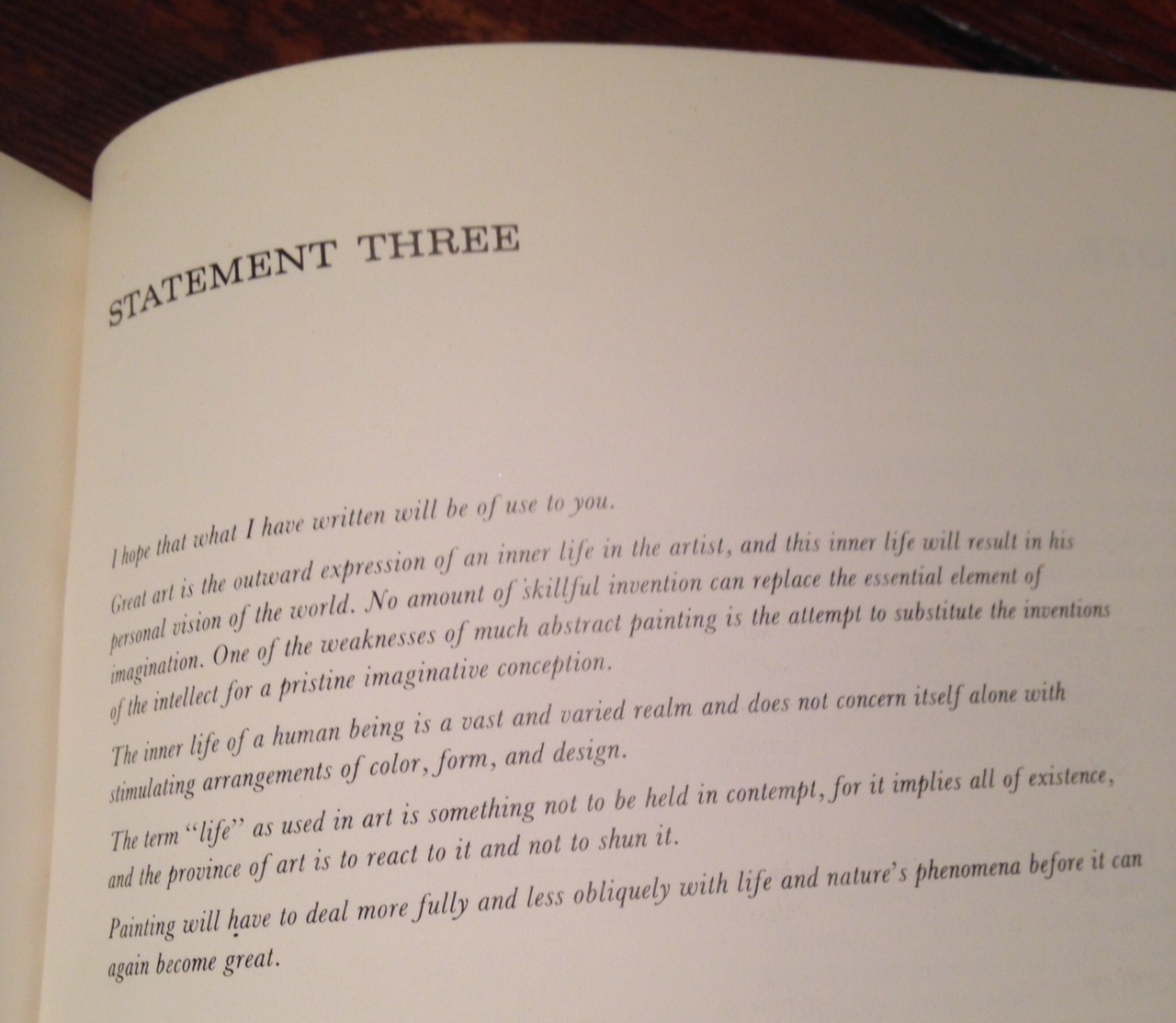
Let’s let the man himself have the last word:
The first trick of the American fascist
Posted: August 18, 2014 Filed under: America Since 1945 Leave a comment
Watching some TV reminded me of this one, from the great VK’s book about driving around the “middle South.”
“The first trick of the American fascist is to drive a wedge between the suffering whites and the suffering blacks of this country. If the American fascist knows one thing, he knows this: there’s hell to pay for him and all his fascist friends whenever the suffering whites and the suffering blacks of this country unite.
That’s why he eggs on the race-baiters. Why he laughs when they succeed. To do this he uses his newspapers, his radio stations. He spouts division, spouts it and hopes the poor and suffering and exploited of America grow confused. He laughs when they are deluded by the old cheap canard, that the great chasm in this country is race and not class. The American fascist prays the black and white working people of this country never realize that united, they have all the power in the land.
– Vivian Kent, The Fatback of America (1948)
(photo of a Portland sympathy protest by Casey Parks of The Oregonian)
Gertie The Dinosaur (1914)
Posted: August 15, 2014 Filed under: America Since 1945 Leave a comment
Listening to the audiobook of Neal Gabler’s bio of Walt Disney (thanks to Ariel Schrag for the suggestion!) reminded me it was time to rewatch this one, by Winsor McCay.
McCay stood barely five feet (150 cm) tall, and felt dominated by his wife, who was nearly as tall as he was. Neither spouse got along well with the other’s mother.
Old shoes
Posted: August 13, 2014 Filed under: painting Leave a comment
As he gave drawing instructions to his friend and fellow artist James Edward Kelly (1855-1933), [Winslow] Homer once said, “You should practice drawing old shoes and getting their character…”
I knew there was a Homer quote about old shoes, and when I went looking for it found it in an “About The Cover” column for Emerging Infectious Diseases, a journal published by the CDC, written by the excellently named Polyxeni Potter:
Since 1995, the Centers for Disease Control and Prevention has published Emerging Infectious Diseases, a public health journal that endeavors to improve scientific understanding of disease emergence, prevention, and elimination.
Widely known for its leading research in infectious disease, EID is also recognized for its unique aesthetic, which brings together visual art from across periods and, through prose, makes it relatable to the journal’s science-minded readership.
In Art in Science: Selections from Emerging Infectious Diseases, the journal’s highly popular fine-art covers are contextualized with essays that address how the featured art relates to science, and to us all. Through the combined covers and essays, the journal’s contents — topics such as infections, contagions, disease emergence, antimicrobial resistance — find larger context amid topics such as poverty and war, the hazards of global travel, natural disasters, and human-animal interactions.

In May 1908 Homer suffered temporary impairment of his speech and muscular control as the effects of a mild stroke; on June 4 he wrote his brother Charles that “I can paint as well as ever. I think my pictures better for having one eye in the pot and one eye up a chimney— a new departure in the art world.” By July 18 he was able to write that he had regained his abilities with the exception of tying “my neck tie in the way that I have done for the past 20 years….Every four or five days I try to do it but….it has been of no use.” Although he never completely recovered, Homer was well enough to attempt a major work, and it is probably Right and Left that he referred to in a letter to his brother Charles dated December 8, 1908: “I am painting when it is light enough on a most surprising picture”.
He or she goes up the next day in another plane
Posted: August 12, 2014 Filed under: America Since 1945, heroes, the California Condition Leave a comment
Williams at the 62nd Academy Awards in 1990 with journalist Yola Czaderska-Hayek (from Wiki)
Public* mourning makes me uncomfortable. In the tradition I’m from, which let’s say is some combination of Irish/Italian/New England Catholicism and New England puritanism, the appropriate reaction to death, as I understood it, was somber quiet.
Mourning for celebrities tends to very quickly veer into something personal and showy — “I met him once…” “he/she meant this to me…” — that make me a tiny bit queasy. My gut reaction is that it’s a little selfish or self-aggrandizing, a strange reaction to something which should be humbling, reductive of the self.
I can see the other side too, people feel pain and loss and it’s natural enough to want to express it, so: whatever.
There’s also the comedy instinct to find the exact grey border country between “wildly inappropriate” and “just wrong enough, just teasing enough of taboo, to be exciting and boldly funny.” [I still laugh when I think about the guy who walked into the room where we were watching CNN after 9/11 and – not having heard about 9/11 – the dude walked into the room with both middle fingers up and said “what’s up bitches?” Only to then learn what the thing was that was on TV. An accidental joke.] If you’re gonna try this, though, you better be darn sure it’s funny. (The one or two stabs at this I saw yesterday were not just failures but were revolting and ugly.)
Anyway. I guess that’s it. I’m sad Robin Williams died, and the circumstances are extra sad. He died in Tiburon, CA.
Separate note: unrelated:
Yesterday I was reading Warren Bennis‘ book On Becoming A Leader. Not a great book, I have to say, it doesn’t capture or have the same impact of what it was like to hear Bennis in person. But I found myself thinking about this bit, hours later, it stuck in my craw:
Think what a great batting average is: .400 — which means a great batter fails to get a hit more than half the time. Most of the rest of us are paralyzed by our failures, large and small. We’re so haunted by them, so afraid that we’re going to goof again, that we become fearful of doing anything. When jockeys are thrown, they get back on the horse, because they know if they don’t, their fear may immobilize them. When an F-14 pilot has to eject, he or she goes up the next day in another plane.
(* I guess in this case I mean specifically “Twitter”)
Addiction By Design
Posted: August 11, 2014 Filed under: America Since 1945 Leave a comment
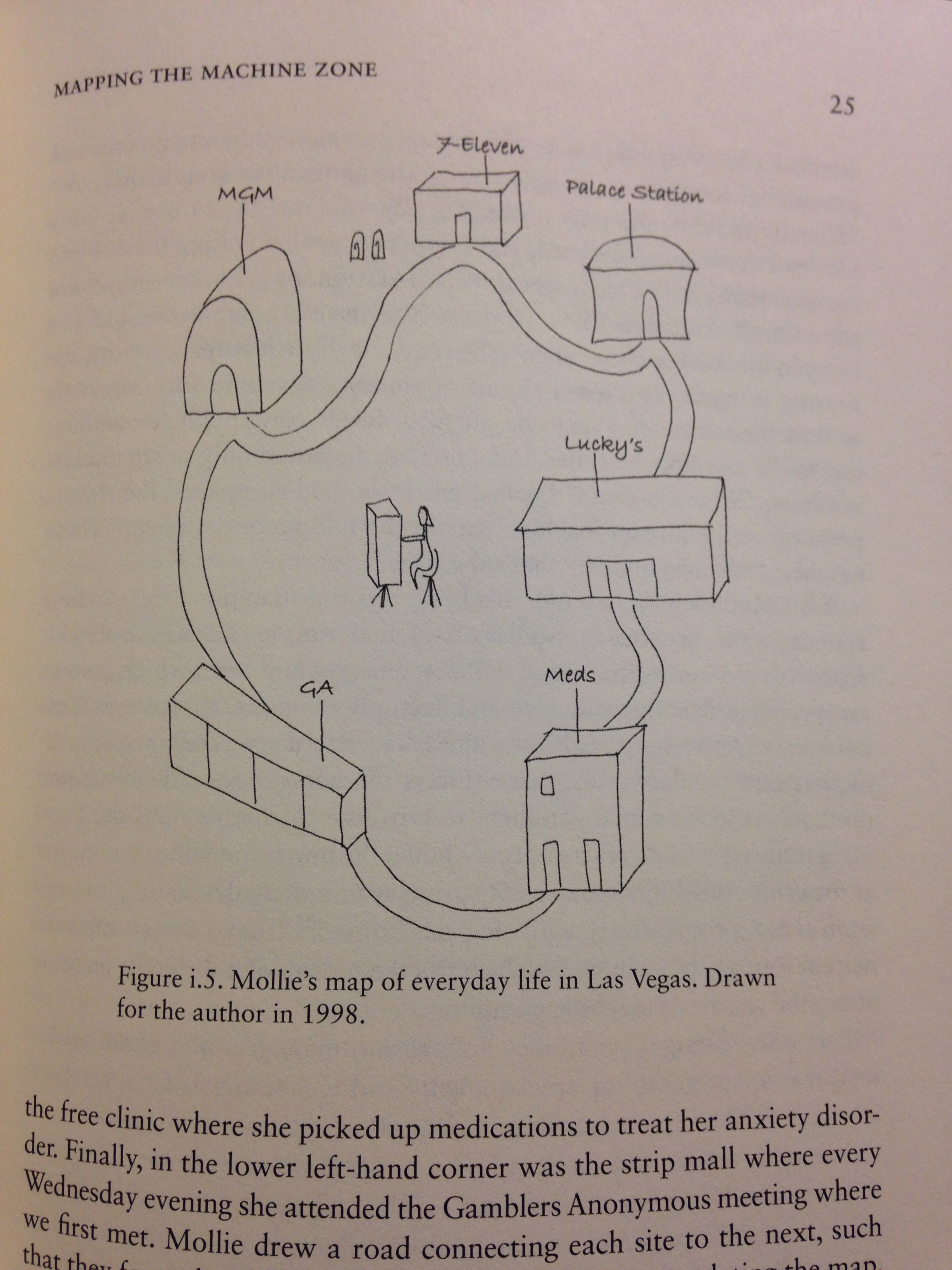
This is a fascinating book about addiction, compulsion, psychology, sociology, the relationship of people and technology.

I heard about it from Tyler Cowen of course. Here are some unauthorized excerpts:
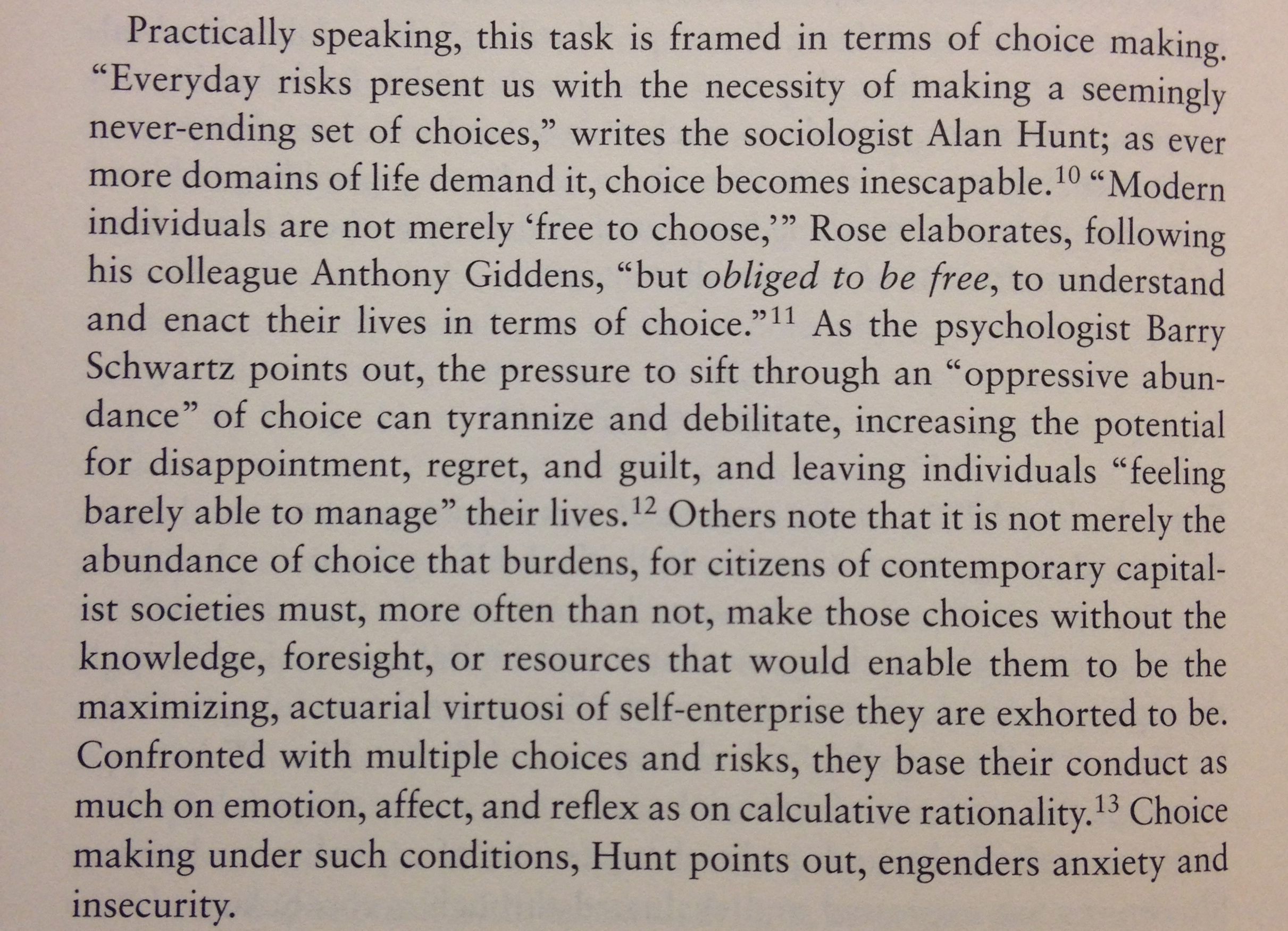
“Sharon”:
Schull quotes extensively from “Designing Casinos To Dominate The Competition” by Bill Friedman:

I’d love to read that book but it costs $199.
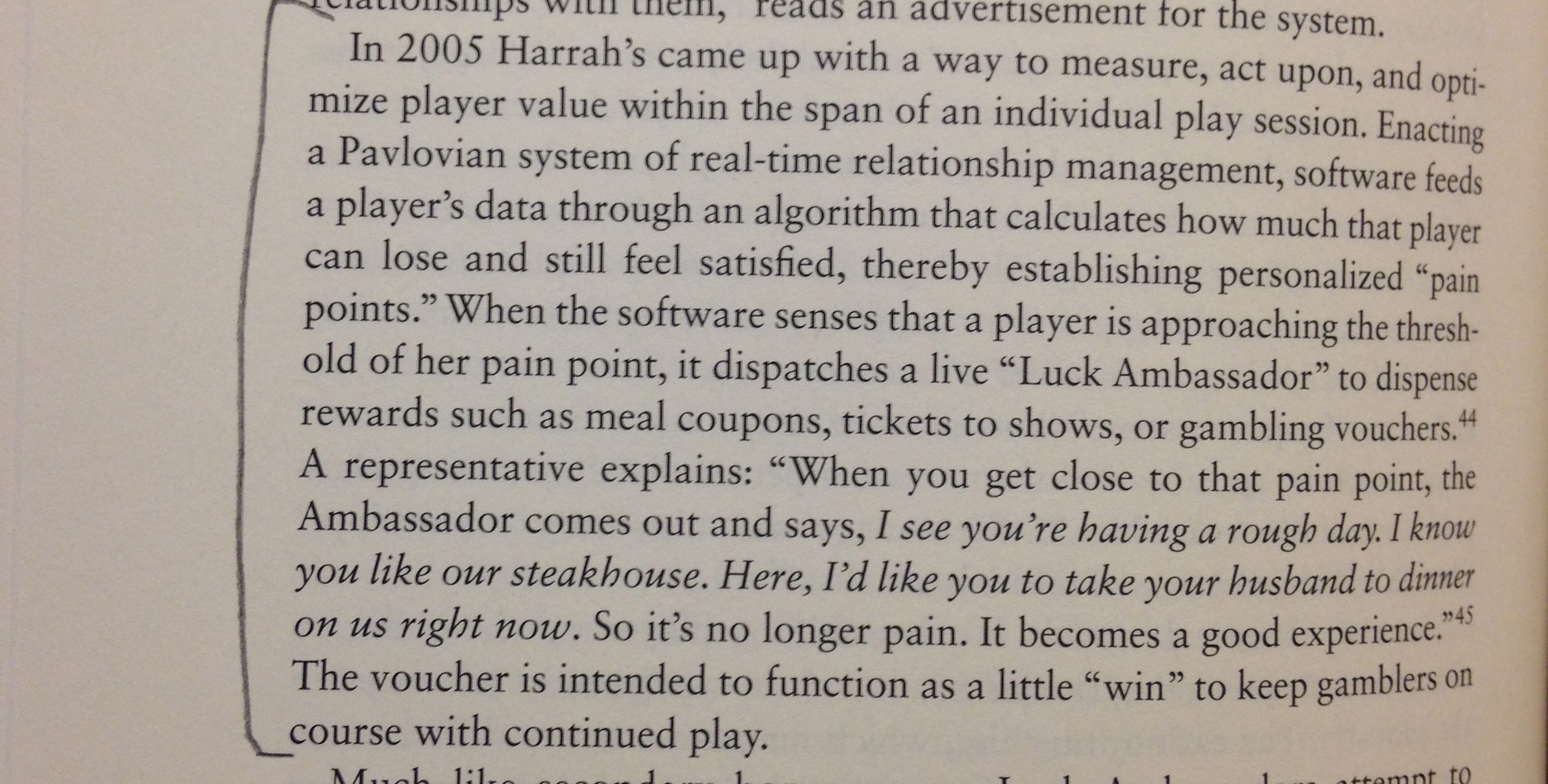

How about this?:
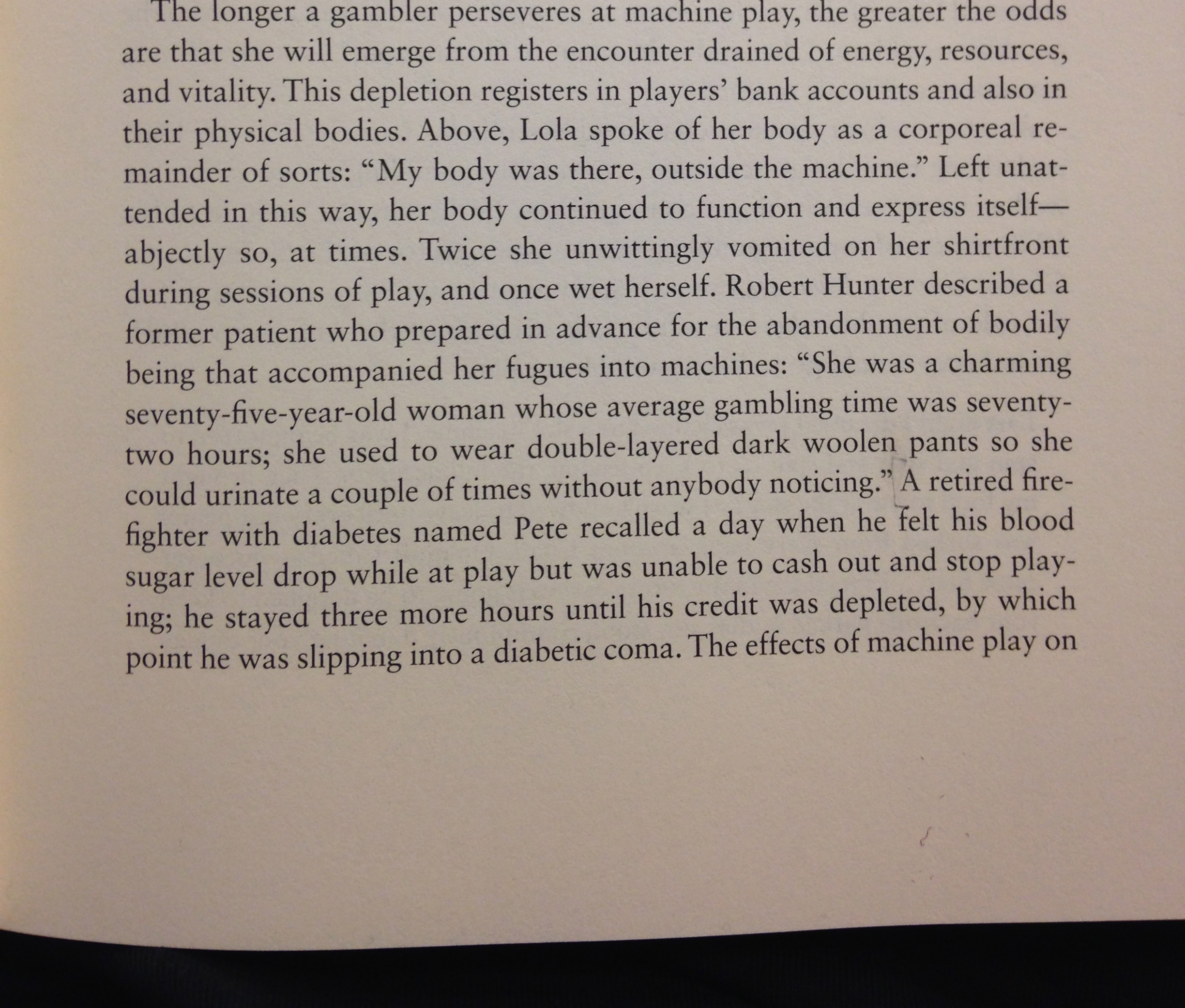
This detail: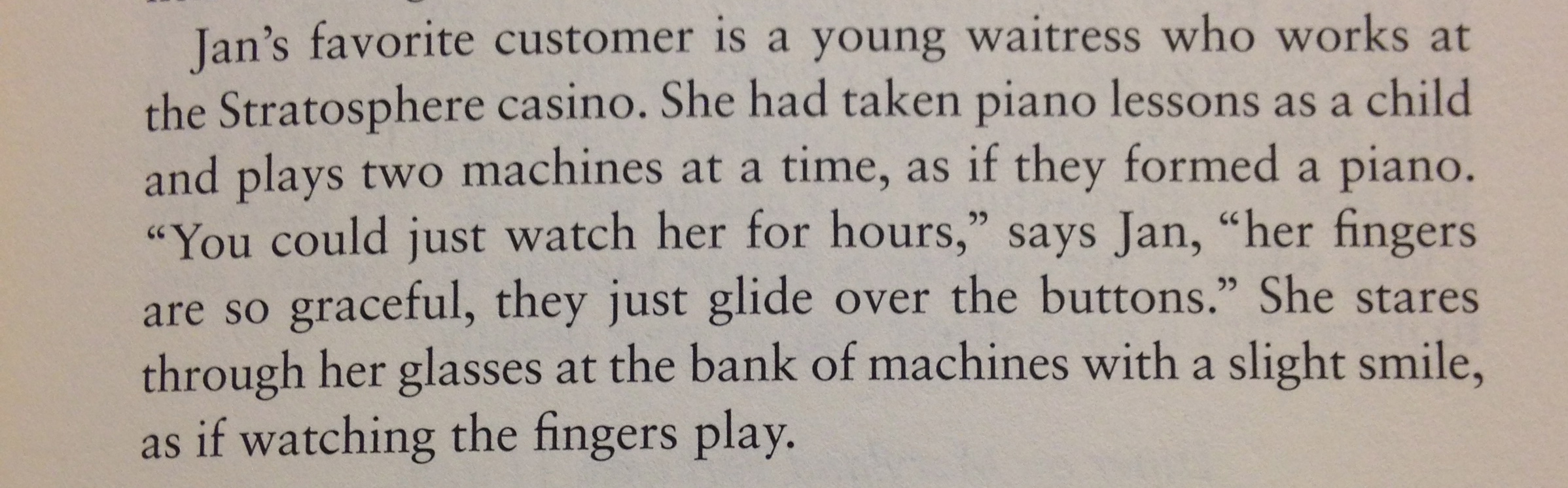
When it comes to the pinch
Posted: August 8, 2014 Filed under: writing Leave a comment
Was thinking about this Orwell quote:
When it comes to the pinch, human beings are heroic.
did my Google legwork, and found it came from an essay about the postcard artist Donald McGill. Here’s more:
Society has always to demand a little more from human beings than it will get in practice. It has to demand faultless discipline and self-sacrifice, it must expect its subjects to work hard, pay their taxes, and be faithful to their wives, it must assume that men think it glorious to die on the battlefield and women want to wear themselves out with child-bearing. The whole of what one may call official literature is founded on such assumptions. I never read the proclamations of generals before battle, the speeches of fuhrers and prime ministers, the solidarity songs of public schools and Left Wing political parties, national anthems, Temperance tracts, papal encyclicals and sermons against gambling and contraception, without seeming to hear in the background a chorus of raspberries from all the millions of common men to whom these high sentiments make no appeal. Nevertheless the high sentiments always win in the end, leaders who offer blood, toil, tears, and sweat always get more out of their followers than those who offer safety and a good time. When it comes to the pinch, human beings are heroic. Women face childbed and the scrubbing brush, revolutionaries keep their mouths shut in the torture chamber, battleships go down with their guns still firing when their decks are awash. It is only that the other element in man, the lazy, cowardly, debt-bilking adulterer who is inside all of us, can never be suppressed altogether and needs a hearing occasionally.
The comic post cards are one expression of his point of view…
The whole essay is a terrific thing to read about life and comedy, we trust most HelyTimes readers will savor that over the weekend. For Friday, let’s enjoy this McGill postcard, which was apparently listed in the 1973 Guinness book as the most sold postcard ever:
McGill was born in London in 1875. He lost a foot in a school rugby accident…
Approaching 80, McGill fell foul of several local censorship committees which culminated in a major trial inLincoln on 15 July 1954 for breaking the Obscene Publications Act 1857. He was found guilty and fined £50 with £25 costs. The wider result was a devastating blow to the saucy postcard industry.


(found those here thanks to a tumblr search)
More on the greatest generation
Posted: August 7, 2014 Filed under: America Since 1945 Leave a comment
Yesterday’s post incited an unusual amount of correspondence. More perspective, from Sam Shepard (b. 1943)’s Paris Review interview:
INTERVIEWER
You said the men on your dad’s side of the family were hard drinkers. Is this why the mothers in your plays always seem to be caught in the middle of so much havoc?
SHEPARD
Those Midwestern women from the forties suffered an incredible psychological assault, mainly by men who were disappointed in a way that they didn’t understand. While growing up I saw that assault over and over again, and not only in my own family. These were men who came back from the war, had to settle down, raise a family and send the kids to school—and they just couldn’t handle it. There was something outrageous about it. I still don’t know what it was—maybe living through those adventures in the war and then having to come back to suburbia. Anyway, the women took it on the nose, and it wasn’t like they said, Hey Jack, you know, down the road, I’m leaving. They sat there and took it. I think there was a kind of heroism in those women. They were tough and selfless in a way. What they sacrificed at the hands of those maniacs . . .
INTERVIEWER
What was your dad like?
SHEPARD
He was also a maniac, but in a very quiet way. I had a falling-out with him at a relatively young age by the standards of that era. We were always butting up against each other, never seeing eye-to-eye on anything, and as I got older it escalated into a really bad, violent situation. Eventually I just decided to get out.
INTERVIEWER
Is he alive?
SHEPARD
No, a couple of years ago he was killed coming out of a bar in New Mexico. I saw him the year before he died. Our last meeting slipped into this gear where I knew it was going to turn really nasty. I remember forcing myself, for some reason, not to flip out. I don’t know why I made that decision, but I ended up leaving without coming back at him. He was boozed up, very violent and crazy. After that I didn’t see him for a long time. I did try to track him down; a friend of his told me he got a haircut, a fishing license, and a bottle, and then took off for the Pecos River. That was the last I heard of him before he died. He turned up a year later in New Mexico, with some woman I guess he was running with. They had a big blowout in a bar, and he went out in the street and got run over.
What a life Sam Shepard has had, btw:
His father, Samuel Shepard Rogers, Jr., was a teacher and farmer who served in the United States Army Air Forces as a bomber pilot.

Shepard accompanied Bob Dylan on the Rolling Thunder Revue of 1975 as the ostensible screenwriter of the surrealist Renaldo and Clara (1978) that emerged from the tour; because much of the film was improvised, Shepard’s services were seldom utilized.
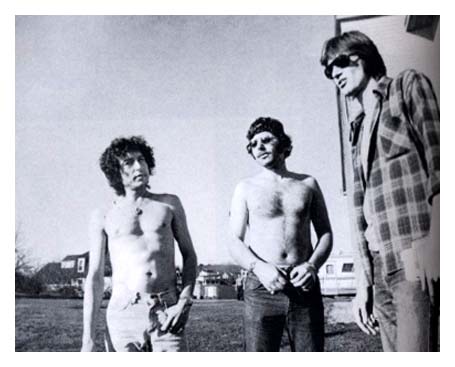
When Shepard first arrived in New York, he roomed with Charlie Mingus Jr., a friend from his high school days and the son of famous jazz musician Charles Mingus. Then he lived with actress Joyce Aaron. From 1969 to 1984 he was married to actress O-Lan Jones, with whom he has one son, Jesse Mojo Shepard (born 1970). In 1970-71, he was involved in an extramarital affair with Patti Smith, who remained unaware of Shepard’s identity as a multiple Obie Award-winning playwright until it was finally divulged to her by Jackie Curtis. According to Smith, “Me and his wife still even liked each other. I mean, it wasn’t like committing adultery in the suburbs or something.”
(top photo from here, middle from here, with Dylan from here)
The greatest generation
Posted: August 6, 2014 Filed under: America Since 1945 2 Comments
Two images I wanted to post that came up re: Warren Bennis, yesterday. This top one, and this one:
Both these pictures I’m getting from here, they’re credited to the National Archives, and I’m prepared to take them at their word.

These pictures, combined with this article in the NYT about the upcoming Brad Pitt movie “Fury” made me think about how the dudes that won World War II weren’t all like, mature men who knew exactly the risks and stakes of what they were doing, and were therefore the greatest heroes anyone has ever conceived of. Most of them were children, doing what they were told, involved in an enterprise that was fucked up and disastrously executed in every way at every turn.
Don’t take my word for it, take the word of a guy who was there:

Or this guy, who was there on the other side:

Fussell (if I remember right) talks about how, once word of the concentration camps got out, and they realized what they’d been fighting, he wasn’t even sure that made it better, he says “it might’ve made it worse.”
(The point I took away from these books is that destroying any myth around them doesn’t make them less cool. It makes them cooler still)
Warren Bennis
Posted: August 5, 2014 Filed under: America Since 1945 Leave a comment
This guy, a professor who specialized in the study of leadership, died the other day.
Once I took a class Warren Bennis co-taught with David Gergen, it was called something like “Art, Culture and The Politics Of Leadership.” I loved the class. I wrote my paper about Robert Sherwood, a playwright famed for “Abe Lincoln In Illinois,” who went on to write speeches for FDR.

Sherwood stood six feet eight inches tall. Dorothy Parker, who was five-feet four-inches, once commented that when she, Sherwood, and Robert Benchley (who was six feet tall) would walk down the street together, they looked like “a walking pipe organ.” When asked at a party how long he had known Sherwood, Robert Benchley stood on a chair, raised his hand to the ceiling, and said, “I knew Bob Sherwood back when he was only this tall.”
(Sometimes the Algonquin Round Table gang seems like they must’ve been pretty insufferable to be around.)
Anyway, I remember something Bennis used to talk about. When Bennis was 19 he was commissioned as a lieutenant in the Army and sent to Europe. It was 1945 — the troops he was sent to command were seasoned veterans already. They’d just survived the Battle Of The Bulge. He was just a kid rookie. Imagine that situation.

What he said happened was, the soldiers in his platoon “taught me how to lead them.”

What a profound thought. Will have to see if it comes up in Bennis’ autobiography:

(Badass thing to name your book).
Bennis also co-authored this book:

which is full of interesting stuff. There’s a story about Walt Disney, after he decided to make a feature length animated movie, the first ever, Snow White And The Seven Dwarfs. Disney gathered 200 or so animators and artists in an auditorium, stood up on stage, and acted out the entire movie for them. The whole thing, two hours. He “did” the witch and stuff, exactly how he wanted it drawn.
That was “visionary leadership,” says Bennis.
That was the same class in which I was made to do improv games with David Gergen.

(pics from “Philip Channing” here wiki here (National Archives) here here (Google search! It’s not like I read Rand Paul forums!))
This video is insane.
Posted: August 4, 2014 Filed under: adventures, South America Leave a comment
From The Guardian:
Indigenous tribesmen living deep in the Peruvian rainforest have emerged into the outside world to seek help, after suffering a murderous attack by probable drug traffickers.
The contact took place across the border in Brazil and was recorded in a video released on Friday. The tribesmen caught a serious respiratory disease after contact, a major killer of isolated indigenous people, but have since recovered.
There’s a long version and a short version:
http://www.theguardian.com/world/video/2014/aug/01/amazon-tribe-first-contact-video
I found this video chilling and intense and fascinating.
The reporting in the article however is deeply frustrating. What language are these people speaking? When is this from, exactly? How did this come about? What’s up with the guy with the dreads?
Anyway, here’s some footage of a much less remote part of the Amazon shot by the blogger:
What I was trying to capture was the spooky creak of the metal boat.

Granville Redmond
Posted: August 1, 2014 Filed under: the California Condition Leave a comment
Granville Richard Seymour Redmond was born in Philadelphia,Pennsylvania on March 9, 1871 to a hearing family. He contracted Scarlet Fever at around 2½ to the age of 3; when he recovered, he was found to be deaf.
Granville attended the California School for the Deaf in Berkeley from 1879 to 1890 where his artistic talents were recognized and encouraged. There his teacher Theophilus d’Estrella taught him painting, drawing and pantomime.

While living in Los Angeles, he became friends with Charles Chaplin, who admired the natural expressiveness of a deaf person usingAmerican Sign Language. Chaplin asked Redmond to help him develop the techniques Chaplin later used in his silent films. Chaplin, impressed with Redmond’s skill, gave Redmond a studio on the movie lot, collected his paintings, and sponsored him in silent acting roles, including the sculptor in City Lights. Chaplin told a writer for The Silent Worker of a Redmond painting, “I could look at it for hours. It means so many things” and Chaplin’s famous The Dance of the Oceana Rolls was Redmond inspired.
During this time Redmond did not neglect his painting.

Reminds me of Liz’s awesome art. (I believe she too studied pantomime).
Granville lived for awhile in Tiburon, CA:

What’s that, Tiburon Wikipedia page? “See also Blackie The Horse“? If you say so:
Blackie was a swaybacked horse who, for twenty-eight years, was a well-known fixture in Tiburon, California. He not only stood in the same spot in a pasture at the corner of Tiburon Boulevard and Trestle Glen Road, rarely moving, day after day, but he faced in the same direction, becoming the local mascot of several generations.
On October 1, 1938, Blackie made history by swimming across the San Francisco Bay from the Marin County side to San Francisco’s Crissy Field. He swam it in 23 minutes and 15 seconds, winning a $1,000 bet for his then owner, Shorty Roberts.

Ainslie
Posted: July 31, 2014 Filed under: Ireland Leave a commentSomething put me in mind of this book the other day.

I never made it all the way through, but it’s fun to take off the shelf. I’m told by turf types this book is considered pretty good if slightly outdated as knowledge, but who cares? It’s fun to read because Ainslie has wonderful style as a writer:

Anyway, reminded me of a lyric from an Irish song I thought I remembered.
Turns out I was wrong?

Maybe this song never existed? Possible it did once exist, or better yet still does, as unGoogleable Irish ephemera, and I really did hear it once. Or something like it, something close, and between my drunkenness when I heard it and the singer’s when he sang it there was a miscommunication.
Or maybe I was just thinking of this:
Plenty to consider
Posted: July 30, 2014 Filed under: America Since 1945 Leave a comment
On the cover of just about any old issue of Life magazine.

I hardly ever even make it inside.

That’s before you even get to the back covers.
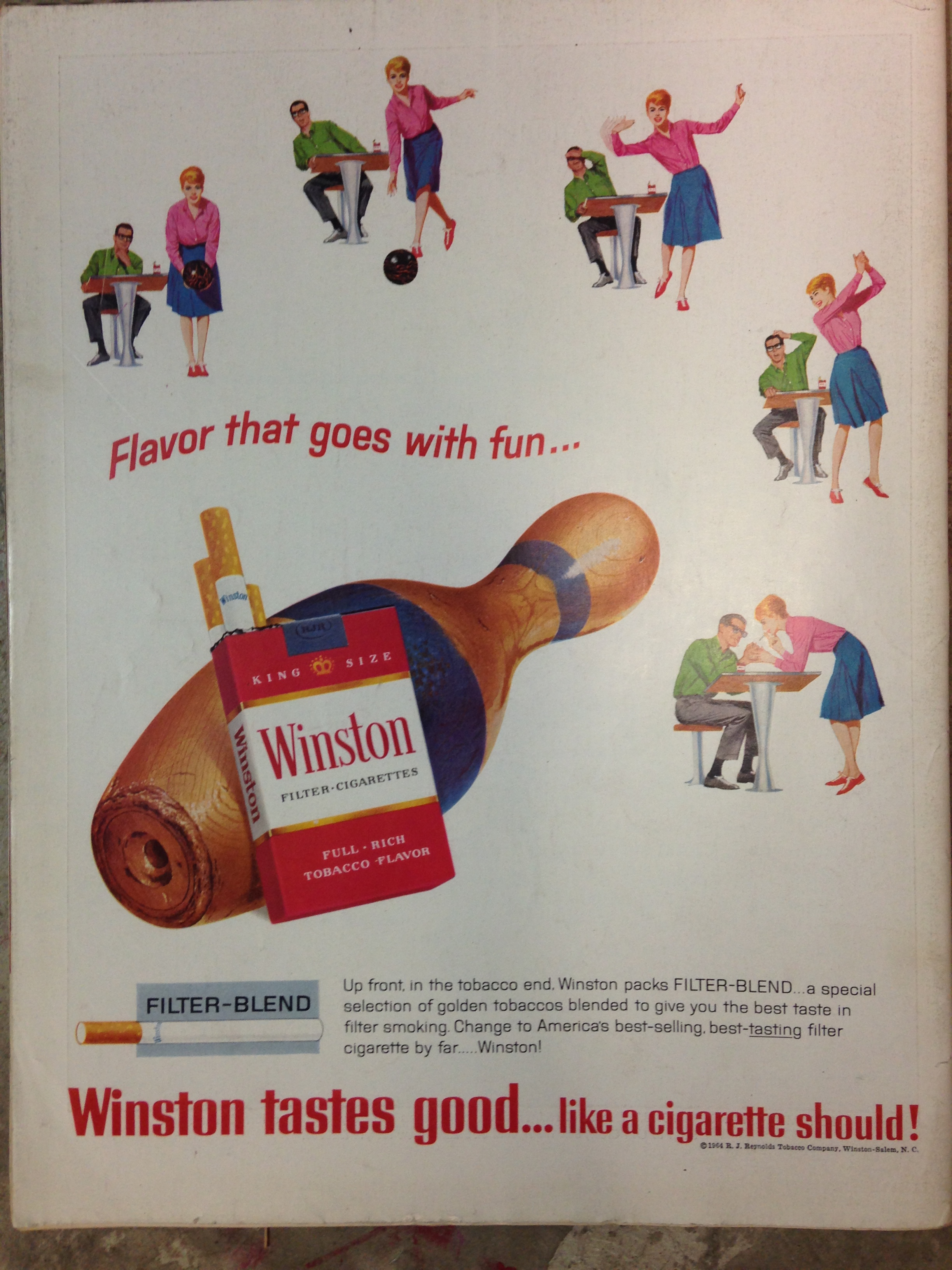
Flavor that goes with fun.

These are just issues I bought at random in a big box on eBay for maybe $25?
 (Please continue sending tips on how to photograph old magazines to helphely at gmail. Those from Lydia in Saratoga have been particularly helpful, thanks Lydia!)
Politics
Posted: July 29, 2014 Filed under: America Since 1945 Leave a commentReading this New Yorker profile of Biden threw me back to this YouTube. Master at work:
He loves it.
After [Hillary Clinton] delivered an impassioned endorsement for Obama and Biden at the Democratic National Convention, in 2008, Biden found her backstage, dropped to his knees in gratitude, and kissed her hand.
How about this?:
His friend Ted Kaufman says, “If you ask me who’s the unluckiest person I know personally, who’s had just terrible things happen to him, I’d say Joe Biden. If you asked me who is the luckiest person I know personally, who’s had things happen to him that are just absolutely incredible, I’d say Joe Biden.”
I should’ve known
Posted: July 28, 2014 Filed under: writing 1 Comment
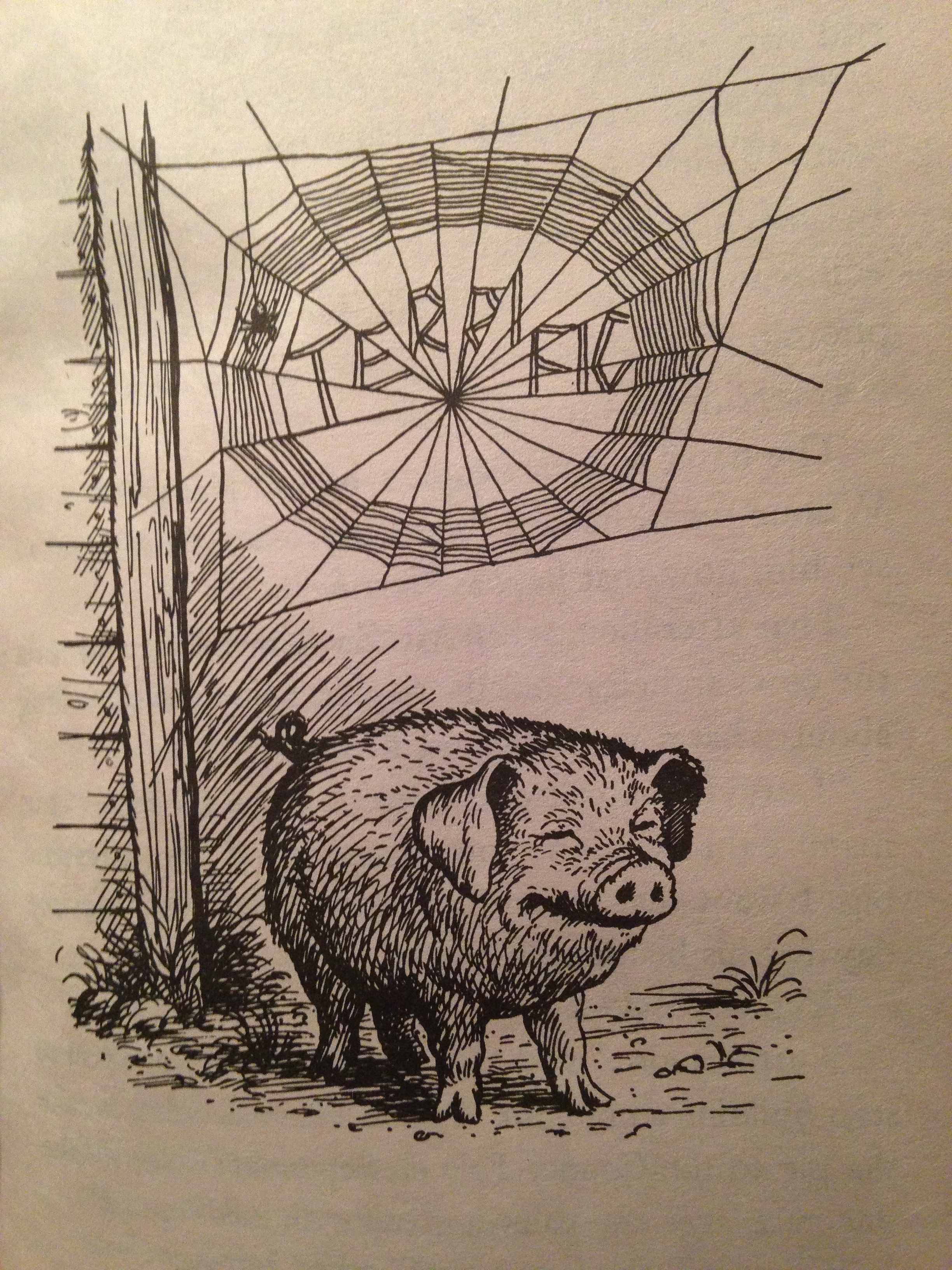
I’d find something poignant when I bought a used copy of Charlotte’s Web.

How about Wilbur’s plan for his day?
His plans for the day went something like this:
Breakfast at six-thirty. Skim milk, crusts, middlings, bits of doughnuts, wheat cakes with drops of maple syrup sticking to them, potato skins, leftover custard pudding with raisins, and bits of Shredded Wheat.
Breakfast would be finished at seven.
From seven to eight, Wilbur planned to have a talk with Templeton, the rat that lived under his trough. Talking with Templeton was not the most interesting occupation in the world but it was better than nothing.
From eight to nine, Wilbur planned to take a nap outdoors in the sun.
From nine to eleven he planned to dig a hole, or trench, and possibly find something good to eat buried in the dirt.
From eleven to twelve he planned to stand still and watch flies on the boards, watch bees in the clover, and watch swallows in the air.
Twelve o’clock – lunchtime. Middlings, warm water, apple parings, meat gravy, carrot scrapings, meat scraps, stale hominy, and the wrapper off a package of cheese. Lunch would be over at one.
From one to two, WIlbur planned to sleep.
From two to three, he planned to scratch itchy places by rubbing against the fence.
From three to four, he planned to stand perfectly still and think of what it was like to be alive, and to wait for Fern.
At four would come supper. Skim milk, provender, leftover sandwich from Lurvy’s lunchbox, prune skins, a morsel fo this, a bit of that, fried potatoes, marmalade drippings, a little more of this, a little more of that, a piece of baked apple, a scrap of upsidedown cake.
Wilbur had gone to sleep thinking about these plans. He awoke at six and saw the rain, and it seemed as though he couldn’t bear it.
The LA Natural History Museum
Posted: July 23, 2014 Filed under: the California Condition Leave a commentWorth paying a visit just to see this model of downtown LA as it was in the ’30s:
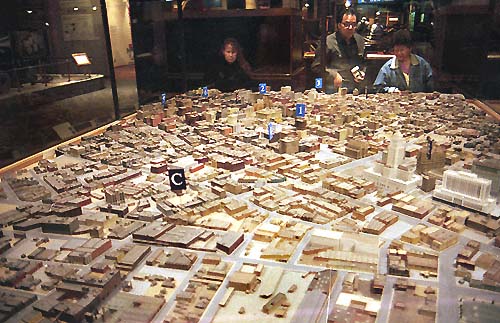
That great photo from poster “Citizen” at Archinect
While I was down in that part of the city, I saw a most interesting sight: two sports fans, standing outside the gates of the Coliseum, waiting for summer to end and college football season to start:

While there, don’t miss the sculptures of Naked Woman And Man As Athlete:
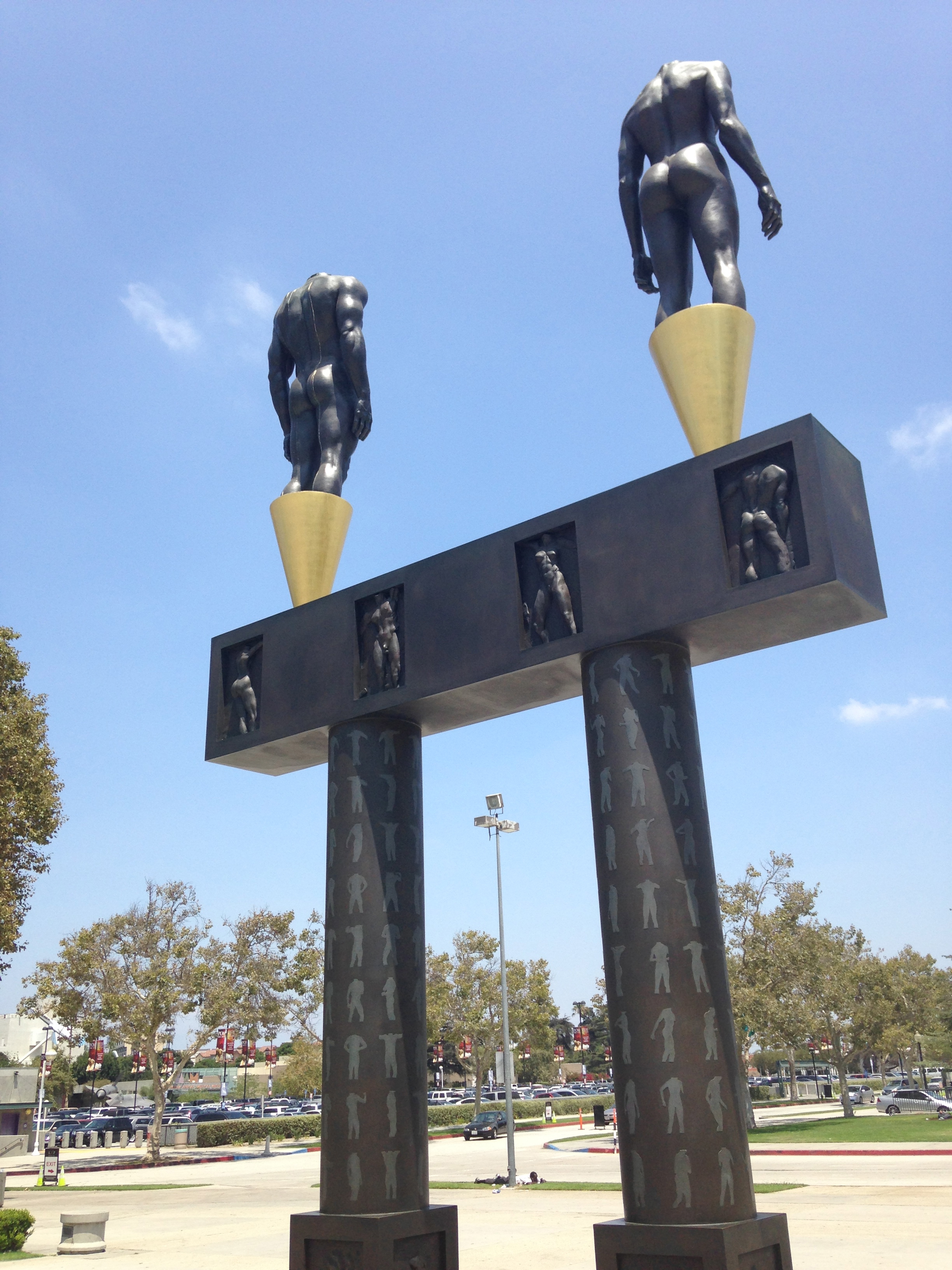
The Coliseum “served as the site of the field hockey, gymnastics, the show jumping part of the equestrian, and the track and field events along with the opening and closing ceremonies.”

The 1932 Summer Olympics, officially known as the Games of the X Olympiad, was a major world wide multi-athletic event which was celebrated in 1932 in Los Angeles, California, United States. No other cities made a bid to host these Olympics. Held during the worldwide Great Depression, many nations and athletes were unable to pay for the trip to Los Angeles. Fewer than half the participants of the 1928 Summer Olympics in Amsterdam returned to compete in 1932. Even U.S. President Herbert Hoover skipped the event.
The organizing committee put no record of the finances of the Games in their report, though contemporary newspapers reported that the Games had made a profit of US$1,000,000.
An indispensable volume no home should be without
Posted: July 22, 2014 Filed under: books Leave a comment

Nevis
Posted: July 21, 2014 Filed under: America Leave a comment
Everybody knows Alexander Hamilton was born there, but did you know this?
United States Supreme Court Justice Stephen Breyer has a vacation home on Nevis. In February 2012 he was robbed in his home at machete-point.
 Helytimes