What the guy at the nursery said to me when I bought a book about cactus identification:
Posted: June 23, 2014 Filed under: the California Condition 1 Comment
I knew someone would want to study the cacti.
Three messages from writers I admire
Posted: June 22, 2014 Filed under: writing Leave a comment1) George Saunders, from a Chipotle bag.
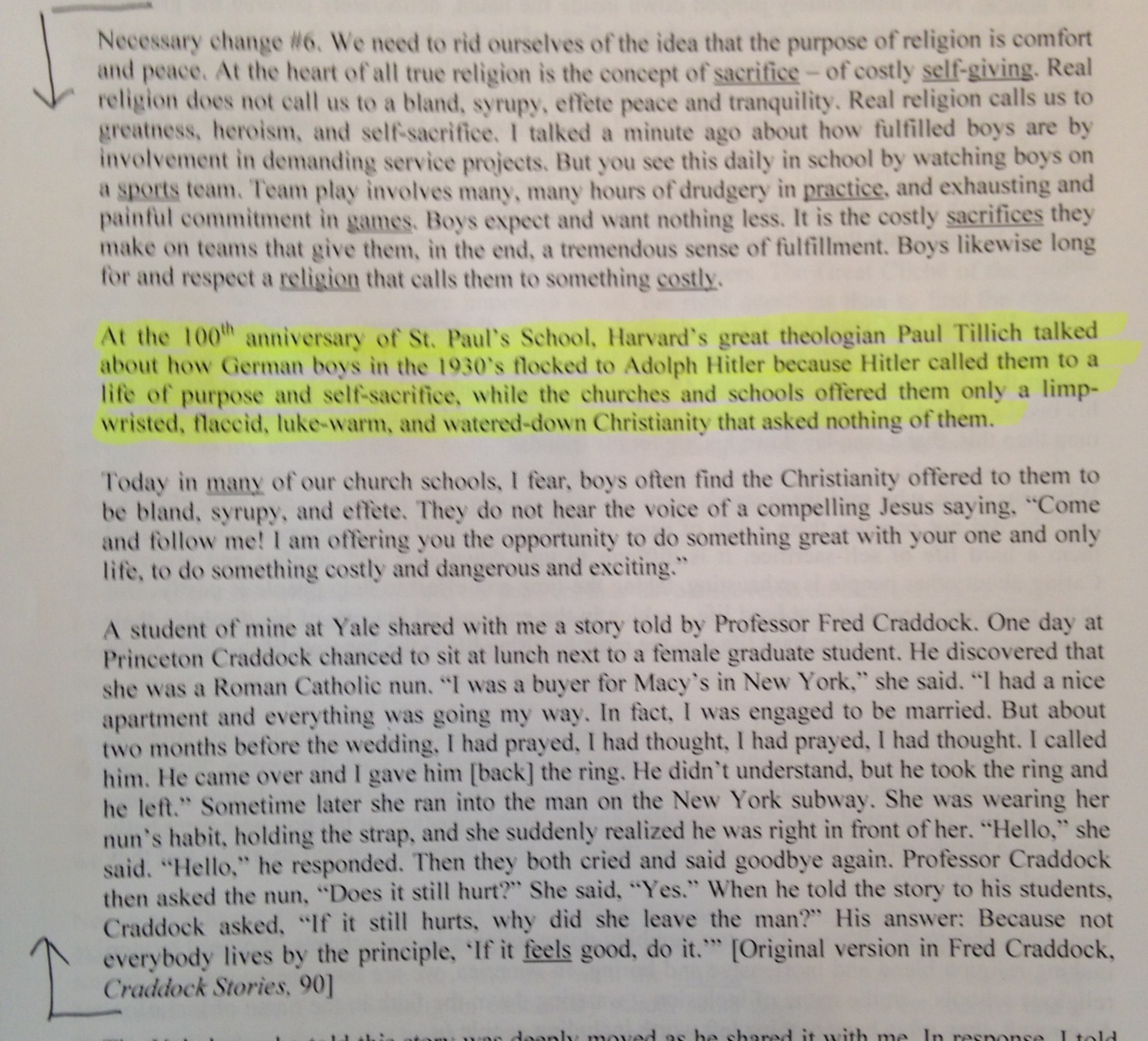
 2) Rev. F. Washington Jarvis, speaking at the International Boys’ School Conference in Hawkes Bay, New Zealand in 2009:
3) Cormac McCarthy, in The New York Times magazine, April 19, 1992.
“There’s no such thing as life without bloodshed,” McCarthy says philosophically. “I think the notion that the species can be improved in some way, that everyone could live in harmony, is a really dangerous idea. Those who are afflicted with this notion are the first ones to give up their souls, their freedom. Your desire that it be that way will enslave you and make your life vacuous.”
“Ben Dougan”
Posted: June 20, 2014 Filed under: TV Leave a comment
Really enjoyed tuning in to Late Show With David Letterman the other night. No HelyTimes reader should miss the above clip.
I hadn’t watched the show in awhile: it brings back visceral memories of eating moist takeout on the 14th floor of the Ed Sullivan Theater, watching the taping alone on a little TV in my office.
Watching the show again I thought came closer to understanding the show than I ever did then. David Letterman and Paul Schaffer operate in some shared inbetween land of irony and genuine, earnest love for the thing they’re being ironic about. It’s like they’re making a parody of a TV show, but a parody that comes from an almost painful longing. Paul is more joyful.
Consider this, from a 1984 Playboy interview with DL:
Playboy: Paul Shaffer’s comical character provides a nice counterpoint to your cynicism. Was that something designed, or did it just happen?
Letterman: Paul was originally hired solely for the music. We wanted old R&B stuff and good, solid rock ‘n’ roll—the kind of music you never hear on TV talk shows. But while we were talking with him, we were reminded of all the wonderful things he had done on Saturday Night Live,playing Don Kirshner and Marvin Hamlisch. And he is a very, very funny guy. So we just naturally began utilizing more and more of his talents.
Playboy: But where did that character come from?
Letterman: From Paul, who really does love showbiz kitsch. It’s his hobby. He records The Jerry Lewis Labor Day Telethon and plays back Jerry introducing Chad Everett 100 times in a row. On vacations, he goes to Las Vegas and listens to lounge comics and lounge piano players and memorizes their clichés. It’s not that he’s making fun of it; he’s fascinated by it.
Playboy: What you say makes us wonder if the character he plays really is a character.
Letterman: When people come up to me on the street, probably the most asked question is “Is Paul Shaffer for real?” What he does is an extension of an aspect of his personality. So it would not be inaccurate to say, “Yeah, that’s him.” But he’s also a very nice man; a sweet, sensitive human being. See? Maybe it is impossible to describe Paul without lapsing into those stupid showbiz clichés. You know him, you love him, you can’t live without him.
Another interesting thing from that interview:
Playboy: Your college years were 1965 through 1969, the anti-Vietnam war protest era. Were you involved in the radical politics of that time?
Letterman: Ball State was pretty much isolated from all of that. I’m not sure why, since Kent State was not far off or too different. And I was not what you would call politicized. While other campuses were staging major demonstrations, our biggest worry was “How are we gonna get beer for the big dance?” I was hardly aware of the Vietnam war until a friend of mine flunked out and was drafted and [snaps fingers] was dead like that. One day, here’s a guy setting fire to the housemother’s panty hose, and the next day, he’s gone. That got my attention.
It’s no wonder DFW thought so much about Letterman. I’m not gonna try and articulate something that stumped that dude.
A shame this above clip cuts off before a callback about Ben Dougan’s nose for a free lunch. That was pure joy.
Lone Pine
Posted: June 19, 2014 Filed under: the California Condition Leave a comment
Man, next time I’m up in Lone Pine, I’m gonna see if I can buy local writer Llewelyn Kent a cup of coffee.
From an interview with him in Eastern Sierra Review*:
ESR: You’ve been in various emergency-type situations–
L. Kent: Yah, you could call ’em that.
ESR: What’s one lesson these experiences have taught you.
L. Kent: To keep calm. Sounds easy, it isn’t. It’s hard and I can’t say I learned it perfectly. But I did learn, pretty quick: the worse things are, the calmer you ought to be. Just remembering that is useful.

* possible I am the only subscriber south of, say, Mojave. Although someone claimed they saw a copy at Skylight.
Happy belated Bloomsday, ya’ll
Posted: June 17, 2014 Filed under: writing Leave a comment
A puzzle I turn over in my head sometimes is whether it’s worth someone’s time to read Ulysses. Depends how much time you have, I guess.
I remember reading once that you can’t really begin to approach this book unless you can speak English, Old English, Irish, Greek, and Latin, and you’d probably best know Hebrew too.

My favorite part, from Episode 8, Lestrygonians. Bloom sees a walking advertisement for his former employer:
A procession of whitesmocked men marched slowly towards him along the gutter, scarlet sashes across their boards. Bargains. Like that priest they are this morning: we have sinned: we have suffered. He read the scarlet letters on their five tall white hats: H. E. L. Y. S. Wisdom Hely’s. Y lagging behind drew a chunk of bread from under his foreboard, crammed it into his mouth and munched as he walked. Our staple food. Three bob a day, walking along the gutters, street after street. Just keep skin and bone together, bread and skilly. They are not Boyl: no: M’Glade’s men. Doesn’t bring in any business either. I suggested to him about a transparent show cart with two smart girls sitting inside writing letters, copybooks, envelopes, blotting paper. I bet that would have caught on. Smart girls writing something catch the eye at once. Everyone dying to know what she’s writing.
The Fault In Our Stars
Posted: June 16, 2014 Filed under: movies Leave a comment
Man, I’ll give it up to this movie.
They nailed this movie. Just crushed it.
If there’s a problem with this movie, it’s that the character August “Gus” Whippledorp sucks. Shailene Woodley blasts the poor dude playing him off the screen.
On the other hand, Shailene Woodley is so good at acting that you buy she loves him, so the problem solves itself.
The name of the guy who directed this movie is Josh Boone. Jesus Christ, of course it is. The confidence, the earnestness – “Josh Boone.” This is the Josh Boone of movies.
At one point in this movie, the main characters are in Amsterdam. (Won’t apologize for that spoiler). A shitty thing happens. So the kind woman decides to cheer up our main characters by suggesting they all go to see the Anne Frank House.
I saw this movie in the UTA screening room at 12:45pm (thanks Halps!). The audience was mostly UTA assistants I guess, 24 year olds in their suits. You could hear audible, heaving sobs. Just weeping and struggling to breath through sobs. People were losing it worse than at any funeral I’ve ever been to.
(Someone at CAA is gonna read this and think “signs of weakness at UTA… time to pounce?”)
You Don’t Know What It’s Like
Posted: June 13, 2014 Filed under: music Leave a comment

Some good stuff in this Rolling Stone I picked up.

And:

How about this, from an interview with Carlos Santana?

I bet!
From another article, about the history of concert festivals:

This article was sad:

They wrote this one for Otis Redding, who died before he could record it.
Quiet swagger
Posted: June 12, 2014 Filed under: heroes 1 CommentDesus and Mero referred to Kevin Durant as “swaggerless” a couple times. Don’t know shit about Kevin Durant but I thought that was a funny phrase. Mentioned it to Seattle office, who said, “if you think Kevin Durant is swaggerless you should watch his MVP acceptance speech. Quiet swagger.”
This is indeed an incredible speech.
“Never change who you are.”
“God directed our paths to work together.”
Jump to 23:36 if you’re pressed for time.
Man.
He got me.
Music
Posted: June 10, 2014 Filed under: music Leave a comment
Here’s a piece of advice for anyone who lives in Los Angeles: never, ever drive to Las Vegas. Somewhere around Barstow you will realize the wisdom in this. If Fate demands you appear in Las Vegas, you gotta fly. If the marginal savings are important to you, you shouldn’t be going to Las Vegas.
(I guess maybe drive if you’re smuggling a trunkload of illegal drugs.)

When it comes to airplanes I am Team Window Seat. You stare out at the weird American landscape for an hour? It’s better than the best ride at Disneyland. The best ride at California Adventure just simulates being in an airplane over California.
But of course you need a good album to listen to.
The other day I put out requests for good music on Twitter and got many wonderful and thoughtful responses.
A band that kept coming up is War On Drugs.
Had only kind of heard of these dudes. But my memory was jogged. I realized I went to high school with the singer of this band. If I remember right he was a very good, decent, and funny dude. I can’t remember if he was on the cross-country team or not; I think so? Regardless this would be a good album to listen to on a November ride to the New England Class C Championships.
Another suggestion I got pretty into is “What Did You Expect From The Vaccines?” by The Vaccines:
One of the most passionate responses came in from New York’s Tom Ceraulo, and I turn it over to him:
Okay so Old ’97s MOST MESSED UP (my favorite album by a band I’ve been a fan of forever, going to see them tonight and I’m particularly excited to hear the new stuff), Joe Henry’s INVISIBLE HOUR (consistently terrific songwriting & spare, lived-in arrangements that let the songs breathe), and Sturgill Simpson’s METAMODERN SOUNDS IN COUNTRY MUSIC (an amazing dose of bona fide outlaw country with some genuinely exciting twists – produced by Dave Cobb, who produced Jason Isbell’s stunning SOUTHEASTERN from last year) are great, as I mentioned. Some others:The War on Drugs – LOST IN THE DREAM (might be the best album of the year, I can’t stop listening to it)Hamilton Leithauser – BLACK HOURS (the former frontman of the Walkmen)Bob Mould – BEAUTY & RUIN (another loud rock album from Bob with the super talented and ever-entertaining Jon Wurster on drums)Sharon Van Etten – ARE WE THERE (heart/gut-wrenching beauty from a Brooklyn singer-songwriter who keeps getting better)Willie Watson – FOLK SINGER VOL. 1 (did you see the Showtime documentary on the Inside Llewyn Davis concert? He’s the guy who did Midnight Special – produced by Dave Rawlings)Joseph Arthur – LOU (quiet and tasteful collection of Lou Reed covers)Lykke Li – I NEVER LEARN (a beautiful breakup record, epic in sound if not length)Damon Albarn – EVERYDAY ROBOTS (I think people would prefer if he put out a Blur record but I quite like this)Rosanne Cash – THE RIVER AND THE THREAD (beautiful new Rosanne songs, beautiful production by John Leventhal)I could go on (The Hold Steady, Woods, Lake Street Dive…) but I won’t because I have to run to the show. Oh, and if you like jazz I might have some more to give you. Most people hate jazz though. Or think they do.

(photo of Barstow from Trainweb.org)
Rock & Ice
Posted: June 9, 2014 Filed under: mountains, South America Leave a comment
In Puerto Natales, Chile, I came across some issues of a magazine called Rock & Ice.

I looked at two issues, from eighteen years apart. Both had incredible stories.
Take, for example, the story about Basque mountaineer Edurne Pasaban, the first woman to climb all fourteen eight-thousand foot mountains in the world (the first one she did was Everest).

What about her affair with her mentor, Silvio Mondinelli?

Ladies, do not let your man attempt Kangchenjunga with this minx.

There was another great story about Hans Kraus, King of the Gunks, who as a boy in Switzerland had James Joyce as an English tutor:

“Ya,” says Kraus, whose sharp wit is still expressed with a thick Austrian accent. “But he didn’t do a goot chob, dit he?”
As a young doctor Kraus adapted remedies he learned from circus performers. Later he lunched with President Eisenhower. From wiki:
Kraus’s medical records show that by the time of Kennedy’s death in Dallas, using exercise, Kraus had virtually cured Kennedy of his lifelong back pain.Kraus’s White House medical records also contain several entries about Kennedy’s back corset, which Kennedy had worn since Harvard. As Kraus wrote in the medical records, Kraus had grown convinced that the corset was impeding Kennedy’s recovery and that Kennedy needed permanently to stop wearing it. Finally, in October 1963, Kennedy told Kraus that he would stop wearing his corset permanently in January 1964. Several leading presidential historians, including James Reston and Robert Dallek, have theorized that Kennedy might have survived Dallas if he had not been wearing his corset.


Local Politics
Posted: June 3, 2014 Filed under: politics Leave a comment
Attention any HelyTimes readers living in LA County:
This is genuine: I’m pretty uninformed about local politics, but I know someone who is. He’s a guy I would vote for if I could.
It’s this man, Johnny Abbot. Johnny Abbott assures me:

I trust this man and will be taking his endorsements to the ballot box:


The Atlantic can be silly sometimes.
Posted: June 2, 2014 Filed under: TV Leave a comment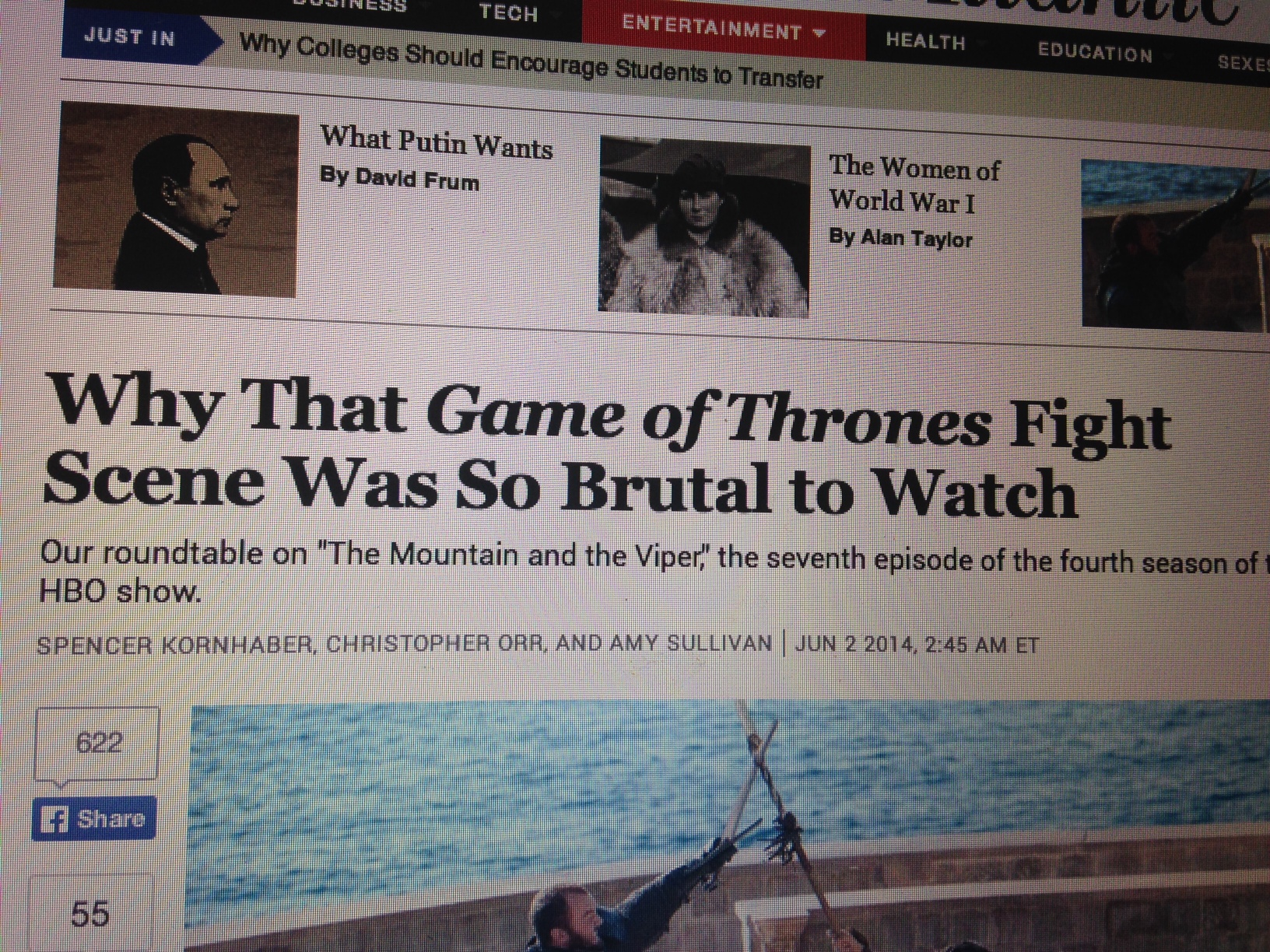 Um, cause a guy’s head got eggsploded?
Fight scene on last night’s Game Of Thrones*
Posted: June 2, 2014 Filed under: writing Leave a comment
Still at best a distant number two in “upsetting fight scenes on HBO serials,” falling well behind to Deadwood, season 3 episode 5.
HelyTimes will always be in the tank for Milch. Milch on (parentheticals) in scripts:

Taking it as always to it’s conclusion…
One more bonus Milch:

* what a bunch of wimps we are about “spoilers.” All-time favorite Mindy Kaling rant is about how whining about spoilers is disgusting and unmanly. Take your spoilers with courage and dignity.
Mailbag
Posted: June 1, 2014 Filed under: South America Leave a comment
Martha from Port Washington writes,
Dear Helytimes,
I know you were on a long trip recently. (What can I say? “The private is public now, isn’t it wonderful?” – Andy Warhol.) Just clue in an innocent reader: was the most interesting place you went?
Well Martha, first of all thank you for reading. No apology necessary, I know how it is.
Truth is, it”d take me a long time to think that through.
Here’s one that comes to mind that I can easily illustrate with photographs: the Amazon.
On the way back up (or down?) river to Iquitos, Peru, my guide took me to this weird kind of zoo. It was just a cabin where two unenergetic guys were sitting around. They had some weak, old seeming animals around.
They had some good birds.


They asked me if I wanted to hold the sloth, but he seemed to have enough problems.
Am I allowed to say this?
Posted: May 29, 2014 Filed under: America Leave a commentAgainst my better judgment I watched a few minutes of the UCSB shooter’s video.
He seemed gay to me.
Is that a thing that can or should be discussed? Even if for no other reason than to suggest that the pathology of killers might be much weirder and more complicated than we might like to think? (Because don’t we all crave easily comprehended narratives? Especially when something this awful happens?)
Can I not say it because it’s offensive to say a despicable person “seems” gay when what I mean is just I’m making a guess, a hunch based on no actual evidence, based only on a subjective perception, so subconscious I can’t even articulate it? And thus it’s skewed somehow, I can’t even know in which ways, by cultural biases, assumptions, and cruel stereotypes?
I don’t know.
Whenever I go to the source document of a story I discover or at least begin to perceive some complexity that has not survived the filtering down to me.
In this case, let me do it for you. Let me save you an unpleasant experience and bring back the information that my perception, watching a few minutes of this guy, was that his sexual conflicts and confusions may not have been what he said they were, that he might have been deluded and confused sexually beyond just the ways he claimed he was.
Sometimes the adventure gets out of hand
Posted: May 29, 2014 Filed under: heroes Leave a comment
Always interested in stories how people keep their minds together in solitary confinement. Here is a good one from a NY Times obituary today, of Robert J. Flynn, “who spent five and a half years in a Communist Chinese prison during the Vietnam War, almost always in solitary confinement, after he was shot down on a bombing mission.”

“I’d think of my family,” he said. “I’d plan parties, birthdays, anniversaries for everyone. And I would imagine that Kathy bought some land in Alaska and gold was discovered there. And I had the biggest gold mine going. I had all kinds of people working for me — people I knew. And I ran a big imaginary corporation. That’s what I did.”
And gee whiz what a great quote at the end:
“I wouldn’t want to do it again,” he told The News Journal in recalling his captivity. “But it was part of the experience of my life. Life is sort of an adventure. Sometimes, the adventure gets out of hand.”
(that’s him on the right, from UPI/NYT. Corporate flow chart from GMP Hawaii.)
Words
Posted: May 29, 2014 Filed under: writing Leave a comment
This New Yorker blog review of Patricia Lockwood‘s book reads like delightful nonsense to me. It reminds me of writing bullshit papers for English classes.
Take this sentence
Lockwood is famous—more than thirty thousand people follow her on Twitter—but the source of her fame is almost entirely owing to her tweets and not to her poetry.
1) Does that count as “famous”? I have no idea what famous is anymore. My cousin Mike has fifty-seven thousand followers, is he famous? Coffee Dad has 125,000 followers, is he famous?
2) “Lockwood is famous – look at how many Twitter followers she has – but the source of those Twitter followers is almost entirely owing to her tweets and not to a thing that is not her tweets.”
3) isn’t her whole point, the whole reason to write an article about her, that the separation between her tweets and her poetry is kinda porous?
Dianne Feinstein
Posted: May 28, 2014 Filed under: America Leave a commentHelytimes isn’t usually the place for politics. But we’re easing back in here after a long hiatus, and something this morning got my engines a li’l fired.
A perfectly nice person who’s my friend on Facebook posted this:

Now I’m a sane person who values his time. Not gonna comment on some guy’s Facebook post certainly.
But this one did get me steamed.
I don’t know what specific quote this is referring to, if any, where Dianne Feinstein maybe claimed she’s a gun expert because she looked at lots of pictures of guns. No source is cited except a link to the “Cold Dead Hands Guitars, Guns And Posters Giveaway Contest.”
This isn’t the first time I’ve seen Dianne Feinstein specifically mentioned as a villain to anti-gun control folks.
What got me steamed is that Dianne Feinstein is a terrible, terrible target to pick – pardon the metaphor – in an anti-gun control crusade.
I know hardly anything about Dianne Feinstein.
Except, one of the few things I know about her is that SHE SURVIVED A WORKPLACE GUN MASSACRE.
On November 27, 1978, disgruntled* ex-City Board of Supervisors member Dan White went to San Francisco City Hall and shot the Mayor, George Moscone twice in the chest and then twice in the head. Then he went over and shot Supervisor Harvey Milk.
From a San Francisco Gate article on the anniversary of the shootings:
[Feinstein’s] office was on the other side of City Hall. She heard a door slam in Milk’s office, heard shots, saw the killer run out, went in herself and found Harvey Milk’s body. “I put my finger to see if there was any pulse, and it went in a bullet hole in his chest,” she said the other day. “I think of it as if it were yesterday. I remember Harvey’s body, his blood on me. I see it all.”**
With the Mayor now dead, Dianne Feinstein, president of the Board of Supervisors, became the acting mayor.
Here she is that day, around 2:30:
That’s how she became mayor. You might say it was the major event in her political life. In fact, if you truly hated Dianne Feinstein, then maybe you should become a gun control advocate, maybe if there’d been more gun control she would’ve just stayed as a San Francisco local politician.
Oh, also, separate incidents: some people once shot out the windows of Dianne Feinstein’s beach house (she’s super rich) and one time somebody put a bomb outside Dianne Feinstein’s window. San Francisco was pretty weird in the 1970s. With all that weirdness in the air, you know what Dianne Feinstein did? Dianne Feinstein used to carry a pistol in her purse for safety.***
What makes you an expert on guns? Shooting a lot of guns? Knowing a lot about the mechanics, makes, models and varieties of guns? Yes, that’s a kind of expertise.
But I dunno, in my opinion if you survive a gun massacre you get a little bit of cred on the issue of gun massacres.
My point is I wish there were some easily digestible and sharable video in which Dianne Feinstein herself made this point in such a clear, pointed manner, shutting down some chump for reals, slamming somebody who is obviously ignorant of her history with guns and gun massacres. But I can’t find it.
Maybe my point is I wish The West Wing was still on, so Toby or Josh or best yet Leo could sum this up in a much punchier, pithier way than I ever could.
Anyway.
Helytimes will return to regular broadcasting as soon as possible! Here’s a picture of a church in the Atacama desert of Chile, no filtah.

* “You always hear about ‘disgruntled.’ Is anyone ever ‘gruntled’?” – Seinfeld maybe? Or did I make this one up?
** the account of this event on this wikipedia page seems to be slightly inconsistent with the cited source, Randy Shilts’ book The Mayor Of Castro Street.
*** Mayor of Castro Street p. 207
Gabo
Posted: April 21, 2014 Filed under: Uncategorized Leave a comment
Happened to be in Colombia when I learned Gabriel Garcia Marquez died. I had just finished reading One Hundred Years Of Solitude. It was a bit of a slog to read, I felt, although impressive as a human achievement. Possibly its greatness had already been absorbed into later stuff I’ve consumed; always important to view these things in context. In the supplementary material in my edition there’s a story that GGM sent the first eighty pages to Octavio Paz, who declared (I’m picturing this at a dinner party) “I have just read eighty pages by a master.”
I liked this story, from Wiki:
Since García Márquez was eighteen, he had wanted to write a novel based on his grandparents’ house where he grew up. However, he struggled with finding an appropriate tone and put off the idea until one day the answer hit him while driving his family to Acapulco. He turned the car around and the family returned home so he could begin writing. He sold his car so his family would have money to live on while he wrote, but writing the novel took far longer than he expected, and he wrote every day for eighteen months. His wife had to ask for food on credit from their butcher and their baker as well as nine months of rent on credit from their landlord. Fortunately, when the book was finally published in 1967 it became his most commercially successful novel, One Hundred Years of Solitude, which sold more than 30 million copies.
I bet his kids are still pissed about that vacation.
A couple nights later I was drinking with two Colombian university students, and I asked them about Marquez. They both expressed the same opinion. They were disappointed in him. They said that his hometown was one of the poorest places in Colombia. That with all his wealth and success he’s done very little for Colombia, “fucking off to Mexico” as they put it.

My own favorite Marquez short story is called “The Earless One.” It has kind of a Twilight Zone feel.
What happens is a gambler in Mexico City meets an adventurer heading to the Amazon. He offers him a wager of one hundred thousand pesos if he can travel through Latin America overland without once hearing the song “Chan Chan” as recorded by the Buena Vista Social Club. The adventurer accepts.
A week later the gambler received a postcard: “I have not heard it.” He’s surprised: it’s nearly impossible not to hear this song every single day. But he remains calm. A week later another postcard: “Still I have not heard it.” The gambler begins to be concerned. Another week, another card: “I have not heard it still.” The gambler is shocked – how can this be?
Finally, he receives a package. He finds inside a note: “I have not heard it, nor will I.” And inside? The adventurer’s bloody ears.
It turns out he deafened himself – the only way to win this absurd bet.
I’m told this is a metaphor for Colombian politics.
What city am I in?
Posted: April 17, 2014 Filed under: Uncategorized | Tags: wiht Leave a comment
Important work has taken us on the road. Can you guess where?
Send answers to helphely at gmail.com
Lucky winners will receive a copy of The Story Of New York.

 Helytimes