Is it OK to love Serial?
Posted: November 20, 2014 Filed under: America Since 1945 Leave a comment
Last week I was driving around the Pacific Northwest.

To pass the time I listened to seven episodes of Serial, the podcast where Sarah Koenig and her team investigate a murder that occurred in 1999 in Baltimore County.

It’s incredibly well-done storytelling. Compelling, entertaining, and now wildly popular. Serial is fun.
But is it ok?
As with all things there’s a backlash. I read this attack, which comes at Sarah for “white privilege,” and it didn’t ring valid at all to me (but then again I ate white privilege mixed in with my chocolate chip pancakes every Saturday morning as a kid).
I can’t get involved in whether this is really Hae’s brother, so let’s forget about that too.
What I’d say makes me a little queasy is the tone. Is it ok to have a great, fun listen as the kids play Nancy Drew about a teenage girl who was strangled and left in the park?
All across American media we turn murders into entertainment. Is this one any worse?
How many murders are depicted on TV in America in a year? A thousand?
I truly dunno. But Serial did make me think of this long, deeply sad article by Eric Schlosser, author of the incredible Fast Food Nation, which is about what happens to the family of a person who gets murdered.
If you like Serial, I give my highest recommendation to Popular Crime: Reflections On The Celebration Of Violence by Bill James. Maybe my favorite book read in the last five years.

Anyway, I was glad to have Serial as I drove around.

Where does LA tap water come from?
Posted: November 19, 2014 Filed under: the California Condition Leave a comment
Where does LA’s water come from?
Although the exact percentages can change dramatically from one year to the next, generally L.A. gets about half of its water from Northern California and the Colorado River, 10 percent from local groundwater sources, and a third from the Owens Valley
says this helpful post on KCRW’s blog. (Only adds up to 93%, which is worrisome.)

The Owens Valley looks like this:

photo taken at great risk of injury/snakebite by helytimes
That’s the Owens River, and it feeds into Owens Lake. If Owens Lake sounds nice to you, terrific, apparently it was, once. There are accounts of clear water, and great ducks that swam there, ducks exploded in yellow fat when shot. Here’s what Owens Lake looks like now:

Photograph taken on 5 April 2009 by Charles W. Hull and posted on DVInfo.
Here’s another picture of beautiful Owens Lake:

Here it is on my Raven Map of California:

It’s crazy how far away it is from LA:

How did LA get this water?:
Eager to find water for the growing metropolis, Los Angeles had agents pose as farmers and ranchers to buy water and land rights in the valley.
People in the Owens Valley are still pissed about this water thievery. Here is my bud in front of an LA DWP sign sternly claiming this watery spot some 196 miles from downtown LA:

If you can’t read the graffiti it says “Fuck LA and the horse it rode in on.”
But, progress. That quote comes from this LA Times article I happened to pick up.

LA has sucked the Owens Lake so dry that the big problem there now is dust. The old way they used to suppress the dust, was, weirdly, flooding. Now they’re switching to a new method:
It involves using tractors to turn moist lake bed clay into furrows and basketball-sized clods of dirt. The clods will bottle up the dust for years before breaking down, at which point the process will be repeated.
This is way better, apparently:
The new process, which starts in December, is expected to save nearly 3 billion gallons of water its first year, rising to nearly 10 billion gallons three years later. Most of that water will be put back into the aqueduct.
So, good on LA Mayor Eric Garcetti. But the real hero here seems to be Ted Schade, the Great Basin Unified Air Pollution Control District enforcement officer:
City officials singled out Schade for praise Friday. Garcetti described him as “a truly great environmentalist.”
The comments marked a reversal by a city that just a few years ago made him the target of a barrage of DWP lawsuits, including one accusing him of issuing unreasonable and unlawful orders. The city asked to have him barred from presiding over decisions affecting the city.
Ron Nichols, DWP general manager at the time, said in a statement then that “our water consumer will no longer be victimized by an unaccountable regulator.”
Schade was abandoned by many Owens Valley community leaders and environmental activists who feared that standing up in his defense would risk retribution from DWP.
That federal court lawsuit was dismissed a year later.
This week, Schade, 57, stood on a berm in a portion of the dry lake recently tilled to test the effectiveness of the new dust suppression method.
“I’ve been at war with the DWP for 24 years, two months and 15 days,” he said. “The fighting is over, and the path forward is clear. So, I’m resigning in December. My job here is done.”
Ted Schade, enforcement officer for the agency in charge of Owens Valley’s air quality, is a longtime nemesis of the DWP. But L.A. Mayor Eric Garcetti, in announcing the new agreement, praised him as “a truly great environmentalist.” (Don Kelsen / Los Angeles Times)
Cool dude, sounds like.
Owens Lake isn’t even the biggest massive dried up lake in California. That honor (?) belongs to Tulare Lake.

from an 1871 Southern Pacific railroad map in the Historical Atlas Of California.
Tulare Lake was the largest freshwater lake west of the Mississippi River and the second largest freshwater lake entirely in the United States, based upon surface area. The lake dried up after its tributary rivers were diverted for agricultural irrigation and municipal water uses.
That’s way up in the tule country. And don’t even get me started on the Salton Sea, which I guess is the reverse of a shrinking lake.
Here’s another pic from the Owens Valley:

Let’s hope they have snow like that again.
spaghetti [reblog]
Posted: November 17, 2014 Filed under: Uncategorized Leave a commentreblog from Bookbinderlocal455.com:
from the essential guide to hysterectomy:
Without a doubt, the most common question about anatomy involves the mystery of the empty space. Women are really concerned about what’s going to happen to the void left by the uterus. Picture this. If you have a bowl of spaghetti with a large meatball in the middle and a few smaller meatballs on the side, and then someone removes the large meatball, the space the meatball formerly occupied is replaced by the spaghetti. No one would know that the meatball was ever there.
Koalas and shirtfronting
Posted: November 16, 2014 Filed under: Australia Leave a comment
If you don’t follow Australia as closely as we do here at Helytimes, you may have missed a good scandal.
Thirty-eight Australians were killed when Malaysia Airlines 17 was shot down over the Ukraine in July. In anticipation of encounters with Vladimir Putin in Beijing and then Australia for the G20 summit, Australia’s prime minister Tony Abbott said (on a pretty bland TV interview it appears, hard to find the all important context) he would “shirtfront” Putin:
“I am going to shirtfront Mr Putin – you bet I am – I am going to be saying to Mr Putin Australians were murdered, they were murdered by Russian backed rebels,” Abbott said.
Urban Dictionary tells us shirtfront is:
A brutal shoulder charge in Australian rules football (AFL) where a player instead of tackling an opponent, bumps them forcefully in the chest. Often leads to heavy concussions due to incidental contact to the head.
Australian English is a barroom language. It is not a language for a woman.

AFP Photo / Andrew Taylo

can’t find the photographer, I found it here: http://rt.com/news/205855-g20-abbott-putin-koala/
There’s even a sub-scandal about a sarcastic news segment that aired about the shirtfronting (you can watch it here – I think it’s been inaccurately described as a “skit”). The perpetrators have been sentenced to Australia’s cruelest punishment:
The ABC is being urged to have a “long, hard think” about a skit it aired mocking the Prime Minister’s threat to shirtfront the Russian President over the MH17 tragedy with Julie Bishop warning it had the potential to devastate the families of the victims.
(Australia you know I love you baby)
Maybe you guys both need to chill?
Posted: November 12, 2014 Filed under: America Since 1945 Leave a comment
Reading Nathan Heller on Stephen Pinker:
American language digests everything, in all directions. (Few other tongues would let you seize a bottle of whisky with chutzpah, drink it with louche abandon, and get down with the party.) And it’s given rise to special innovations. Consider the extra grammatical “aspects” of African-American English, the “be” aspects conveying habitual states, which add descriptive precision and nuance. (Eddie Murphy: “Elvis was forty-two years old, remember, right before he croaked?… His butt be sticking out.”) Problems arise only when vernaculars don’t intersect—when, say, the West Coast twentysomething asks her Bostonian boss to bring “hella” doughnuts to the meeting.
I don’t understand that Eddie Murphy joke. What would happen if you ask edyour Boston boss for hella doughnuts? If he’s cool he’d probably think it was funny . But, even if you’re on the West Coast you probably shouldn’t ask your boss to bring hella doughnuts to a meeting. (If you’re from the West Coast wouldn’t you call them donuts anyway?)
If you’re gonna take a run at Steven Pinker you better come correct.
Just learn how to diagram sentences and then relax, I say.
Crazy detail from this Washington Post story
Posted: November 5, 2014 Filed under: America Since 1945 Leave a commentCREDIT: REUTERS/ERIC THAYER
Minutes after landing at Reagan National Airport one day early this year, many GOP Senate hopefuls found themselves besieged at baggage claim by people with cameras yelling questions at them about abortion and rape.
This was no impromptu news conference but rather Republican staffers in disguise, trying to shock the candidates into realizing the intensity of what lay before them.
Cute, they’re role-playing!
The names of these organizations:
Party honchos tapped former Romney campaign manager Matt Rhoades and star operatives Joe Pounder and Tim Miller to start America Rising, a group dedicated to digging up damaging information on Democrats.
Vote All You Want
Posted: November 4, 2014 Filed under: America Since 1945, politics Leave a comment

If you live in LA County, here are some endorsements based on a very casual roundup from smart people. I have not looked into all this myself but this may be slightly better than voting at random:
Sheila Kuehl for supervisor.
No on 46.
Yes to all judicial reappointments
Dayan Mathai for judge.
1) Interested by this article in The Boston Globe entitled “Vote All You Want. The Secret Government Won’t Change.”
IDEAS: What evidence exists for saying America has a double government?
GLENNON:I was curious why a president such as Barack Obama would embrace the very same national security and counterterrorism policies that he campaigned eloquently against. Why would that president continue those same policies in case after case after case? I initially wrote it based on my own experience and personal knowledge and conversations with dozens of individuals in the military, law enforcement, and intelligence agencies of our government, as well as, of course, officeholders on Capitol Hill and in the courts. And the documented evidence in the book is substantial—there are 800 footnotes in the book.
IDEAS: Why would policy makers hand over the national-security keys to unelected officials?
GLENNON: It hasn’t been a conscious decision….Members of Congress are generalists and need to defer to experts within the national security realm, as elsewhere. They are particularly concerned about being caught out on a limb having made a wrong judgment about national security and tend, therefore, to defer to experts, who tend to exaggerate threats. The courts similarly tend to defer to the expertise of the network that defines national security policy.
The presidency itself is not a top-down institution, as many people in the public believe, headed by a president who gives orders and causes the bureaucracy to click its heels and salute. National security policy actually bubbles up from within the bureaucracy. Many of the more controversial policies, from the mining of Nicaragua’s harbors to the NSA surveillance program, originated within the bureaucracy. John Kerry was not exaggerating when he said that some of those programs are “on autopilot.”
No surprise here to readers of The Wise Men.
2)
Enjoyed reading this Michael Kelly profile of David Gergen from 1993.
A speech-department staff member culled dozens of anecdotes about Nixon from intimates and aides in a lengthy report, with each anecdote indexed according to the character trait it was meant to advertise: Repartee, Courage, Kindness, Strength in Adversity. What is most painfully obvious about these undertakings is how little the anecdotalists had to work with. Exemplifying the President’s talent for Repartee was an account of Nixon silencing a New York businessman who had upbraided him over the Vietnam War by telling the man not to “give me any crap.” Illustrating the President’s Strength in Adversity was a bald little story of how the young Congressman Nixon, falling on an icy sidewalk, still managed to keep his 2-year-old daughter, Tricia, safe in his arms.
In this perfectionist and paranoid atmosphere, Gergen learned the bones of his craft.
He learned the importance of saying the same thing, over and over and over: “Nixon taught us about the art of repetition. He used to tell me, ‘About the time you are writing a line that you have written it so often that you want to throw up, that is the first time the American people will hear it.’ ”
He learned about the gimmicks of phrasing calculated to catch the public ear: “Haldeman used to say that the vast majority of words that issue under a President’s name are just eminently forgettable. What you need to focus on is what’s the line that is going to have a little grab to it.”
He learned the theory of controlled access. If you gave the press only a smidgen of Presidential sight and sound on a given day, reporters would be forced to make their stories out of that smidgen: “Nixon used to go into the press room with a statement that was only 100 words long because he did not want them editing him. He knew if he gave them more than 100 words, they’d pick and choose what to use.”
He learned the endless discipline required to protect the image, which was as evanescent as morning mist: “It went into everything — the speeches, the talking points, the appearances. Haldeman had a rule on appearances: if you wanted to put in a scheduling request for anything the President was going to do in public, your request had to fulfill what we called H.P.L. — Headline, Picture, Lede. You had to say, in writing, what the headline out of the event was going to be, what the lede was going to be and what the picture was going to be.”
And this:
Then, on Jan. 21, 1980, Bush unexpectedly won the Iowa Republican caucus and became the instant front-runner. “The very next day, Gergen called up Baker and said, miracle of miracles, he had managed to clear his schedule and would be able to take the job after all,” Keene says. “When Baker said the job was filled, Gergen came in as a volunteer speech writer.” In the month between the Iowa caucus and the New Hampshire primary, when Bush was the leading Republican candidate, Gergen, according to Keene, “was very visible.”
But on Feb. 26, Bush lost the New Hampshire primary to a resurgent Ronald Reagan. “And Gergen just disappeared completely, I mean right away,” recalls Peter Teeley, Bush’s press secretary at the time. “We never heard from him again until he turned up with Reagan at the Republican convention.”
Even the Reaganites, who benefited from Gergen’s leap, were appalled by the speed of it. “He came to us as soon as it began to seem Bush was going to lose, definitely before Bush pulled out, and quite frankly this made us very suspicious of him,” recalls a former Reagan campaign official. “I mean, there’s jumping ship and there’s jumping ship. This guy was elbowing the women and children aside to get overboard.”
Gergen strongly denies that he showed any undue haste in switching allegiances. “It is not true that I disappeared in the campaign,” he says. “I continued to advise Bush much in the same way I had up to the point he was nominated Vice President.”
Let me note here (as I have elsewhere) that I took a class with David Gergen at the K School. I found him to be a serious but approachable and warm dude, always engaged and present. He did have a habit of ostentatiously taking notes during any guest speaker’s talk, but I took that to be a form of politeness.
I recall him telling a story – it’s possible I read this somewhere but I think I heard him say it – that he had a meeting with Nixon when he was (I believe) leaving law school and about to go into the Navy. Nixon advised him to serve as a regular old line officer on a ship, and not to use his law degree to get into a headquarters job.
Boston Marathon bomber’s friends
Posted: November 3, 2014 Filed under: America Since 1945, Boston, New England Leave a commentA courtroom sketch of Dias Kadyrbayev, who pleaded guilty on Thursday. (Jane Flavell Collins / Associated Press)
On a recent visit home to Massachusetts I was surprised to learn about this story, which I hadn’t been following. After they learned that their friend Dzhokhar Tsarnaev probably did the Boston Marathon bombing, several associates went to his room and rounded up some of his stuff and threw it out.
The New Yorker tells the story with all kinds of vivid details.
The three of them went to Taco Bell, then to Tazhayakov and Kadyrbayev’s apartment, where Kadyrbayev’s girlfriend, Bayan Kumiskali, was about halfway through watching “The Pursuit of Happyness.” Everyone but Tazhayakov got stoned, then they all sat on the couch and watched the second half of the movie, checking for news on their devices.
Can’t help but feel for Azamat Tazhavakov, “who was known as a mama’s boy, even though he was thousands of miles away from home.”
When Tazhayakov awoke early the next morning, he discovered that Dzhokhar Tsarnaev, who was still on the loose, had now been publicly identified as a suspect in the bombing, and that Tamerlan had been killed. Tazhayakov began to panic and smoked marijuana for what may have been the first time in his life.
A VERY bad decision.
Politics roundup
Posted: November 2, 2014 Filed under: America Since 1945 Leave a comment
1) Could anyone reasonably say that this statement is not true:
The South has not always been the friendliest place for African-Americans.
That comment appears the biggest issue in Louisiana’s senate race. MSNBC goes ahead and calls the comment “controversial,” which I guess is “true,” there is a “controversy” about it now, but what a weasel of a word. As always, important to see the comments in context. MSNBC again:
It’s important to emphasize that Landrieu, speaking to NBC’s Chuck Todd, went beyond identity politics. “One of the reasons that the president’s so unpopular is because he put the moratorium on off-shore drilling. remember?” she added. “After Macondo. And our state was furious about that. Now he could have shut down the BP operations but he didn’t, he shut down the whole Gulf. When you shut down the whole Gulf of Mexico it puts a lot of people here at risk and out of business. That’s number one.”
“She’s basically calling the people of Louisiana, she’s calling all of us in the South racist,” Jindal said, demanding an apology. “Here in Louisiana and across the South, we don’t think in terms of black and white, in terms of racial colors — the only colors that matter down here are red, white and blue and … purple and gold as we cheer our LSU Tigers onto victory in college football. It’s not about race.”
2)

(Credit: AP/J. Scott Applewhite)
Granting rare “Must Read” status to this post by the New Yorker’s Amy Davidson about Jeb Bush.
“Several of our boys were pallbearers—maybe all of them—but the one I remember is Jeb,” Barbara Bush wrote in an account, in her memoirs, of her father-in-law’s funeral. Jeb was her second son:
He was a student at the University of Texas, nineteen years old, six feet four inches tall. Remember, this was the early 1970′s. He, of course, did not have a dark suit. He told me not to worry—he’d borrowed one. I should have kept worrying. It was black corduroy. He is the most handsome man (at least according to his mother) and that saved him. Otherwise, he would have looked like a card shark from Las Vegas.
It is a quintessential Bush family moment: an establishment premise streaked with clumsy absurdity, with the participants mysteriously pleased about how it all looks—convinced that their fine qualities have saved them. This was October, 1972, during a period in which Jeb’s older brother, George W. Bush, was in something of a Vegas-card-shark phase. Their grandfather, Prescott Bush, who was being buried that day, had been a banker and Connecticut Senator; their father, George H. W. Bush, had made a good deal of money in the oil business and was serving as Ambassador to the United Nations. George W. had just been rejected by the University of Texas Law School and was drinking too much in all the wrong places, including behind the wheel of a car—maybe best not to remember that. The Bushes have always thought, to an extent that can, frankly, be puzzling for anyone who simply watches his speeches or assesses his record, that Jeb was their child of destiny. When Barbara Bush’s memoir came out, in 1994, after her husband’s one-term Presidency, the family thought that Jeb, not George, would be the next President Bush. The Bushes have never hidden their surprise that it didn’t work out that way, and now, according to multiple press reports, they have again become worked up about the idea that the man in the black corduroy suit can make it to the White House. But why should he?
Felt refreshing to read someone raise the idea “why should Jeb Bush be president?” without assuming I concede he’s the most terrific American around.

3) I’m afraid I also have to grant “Must Read” status to this depressing article:
Hard-Nosed Advice From Veteran Lobbyist: ‘Win Ugly or Lose Pretty’
Richard Berman Energy Industry Talk Secretly Taped…
Mr. Berman offered several pointers from his playbook.
“If you want a video to go viral, have kids or animals,” he said, and then he showed a spot his company had prepared using schoolchildren as participants in a mock union election — to suggest that union bosses do not have real elections.
“Use humor to minimize or marginalize the people on the other side,” he added.
“There is nothing the public likes more than tearing down celebrities and playing up the hypocrisy angle,” his colleague Mr. Hubbard said, citing billboard advertisements planned for Pennsylvania that featured Robert Redford. “Demands green living,” they read. “Flies on private jets.”
Mr. Hubbard also discussed how he had done detailed research on the personal histories of members of the boards of the Sierra Club and the Natural Resources Defense Council to try to find information that could be used to embarrass them.
I guess Richard Berman would have to admire whoever recorded the talk for their “win ugly” strategy. Although it was recorded by an energy executive:
What Mr. Berman did not know — and what could now complicate his task of marginalizing environmental groups that want to impose limits on fracking — is that one of the energy industry executives recorded his remarks and was offended by them.
“That you have to play dirty to win,” said the executive, who provided a copy of the recording and the meeting agenda to The New York Times under the condition that his identity not be revealed. “It just left a bad taste in my mouth.”
What does Berman suggest you do to people operating out of principle?
4) Not granting this full “Must Read” status but it is interesting. Iowa Senate candidate and proud hog-castrater Joni Ernst was recorded talking about Obamacare. Here’s what she said.
“We’re looking at Obamacare right now. Once we start with those benefits in January, how are we going to get people off of those? It’s exponentially harder to remove people once they’ve already been on those programs…we rely on government for absolutely everything. And in the years since I was a small girl up until now into my adulthood with children of my own, we have lost a reliance on not only our own families, but so much of what our churches and private organizations used to do. They used to have wonderful food pantries. They used to provide clothing for those that really needed it. But we have gotten away from that. Now we’re at a point where the government will just give away anything.”
I don’t think this is as crazy an opinion as Jonathan Chait seems to. I bet a lot of Americans would agree with this. If Joni Ernst believes this, that churches and private organizations should provide things like health care, and the government should just stay out of it, she should say that and argue it. I would however agree with Chait and John Le Carre.
That’s the fundamental belief that motivates most, if not all, the conservative opposition: Health care should be a privilege rather than a right. If you can’t afford health insurance on your own, that is not the government’s problem.
I happen to find this belief morally bizarre. People who cannot afford their own insurance either don’t earn much money, or have health risks, or family members with health risks, too expensive to bear.
All of us non-socialists would agree that there ought to be some things rich people get to enjoy that poor people are deprived of. Access to health care is a strange choice of things to deprive the losers of — not least because one of the things you do to “earn” the ability to afford it is not just the normal market value of earning or inheriting a good income, but the usually random value of avoiding serious illness or accident.
Indeed, very few Republicans have the confidence to make the case openly that the inability of some people to afford the cost of their own medical care is their own problem. But that is the belief that sets them apart from major conservative parties across the world, and it is the belief that explains why they have opposed national health insurance every time Democrats have held power, and why they have neglected to create national health insurance every time they have.
Anyway, there are honorable people in politics. If you live in Arkansas’ District 35, let me give my personal endorsement to Clarke Tucker for State Representative. Wish I could vote for him!
Cool thing I learned from the Jian Ghomeshi scandal
Posted: October 31, 2014 Filed under: Canada Leave a comment
Lucy from Trailer Park Boys is now a captain in the Royal Canadian Air Force.

(background if you don’t follow Canadian public radio – a story worth reading about troubling sex/power stuff, thanks to KB Jr. for calling it to our attention)
The story of Cahokia
Posted: October 29, 2014 Filed under: adventures, America, history, UNESCO 2 Comments
Anyone who traveled up the Mississippi in 1100 A.D. would have seen it looming in the distance: a four-level earthen mound bigger than the Great Pyramid of Giza. Around it like echoes were as many as 120 smaller mounds, some topped by tall wooden palisades, which were in turn ringed by a network of irrigation and transportation canals; carefully located fields of maize; and hundreds of wooden homes with mud-and-straw plastered floors and high-peaked, deeply thatched roofs like those on traditional Japanese farms.
Located near the confluence of the Missouri, Illinois, and Mississippi Rivers, the Indian city of Cahokia was a busy port. Canoes flitted like hummingbirds across its waterfront: traders bringing copper and mother-of-pearl from faraway places; hunting parties bringing such rare treats as buffalo and elk; emissaries and soldiers in long vessels bristling with weaponry; workers ferrying wood from upstream for the ever hungry cookfires; the ubiquitous fishers with their nets and clubs. Covering five square miles and housing at least fifteen hundred people, Cahokia was the biggest concentration of people north of the Rio Grande until the 18th century.
That is from the great Charles C. Mann’s 1491: New Revelations Of The Americas Before Columbus.

I can’t recommend this book highly enough. Every American should read it.
Cahokia is very close to St. Louis – it’s about thirty miles away between what’s now East St. Louis and Collinsville, IL.

I wanted to visit, but I didn’t have a car. I explained the predicament to the Ethiopian taxi driver who picked me up at the airport. I asked him if he’d pick me up, take me there, wait an hour and take me back. So the next morning he took me out there. He and I visited the Cahokia Mounds Interpretive Center and Museum together. We watched the award-winning 17 minute movie. Cahokia Mounds is one of only 22 UNESCO World Heritage Sites in the US, and they do a nice job.
“It was very interesting,” agreed the cab driver.

The idea that native Americans built cities was and remains a challenging ideas to different views of what life was like here before 1492. It fights with both 19th century views of Indians as primitive savages, and later ideas that they were chilled out wanderers in perfect harmony with nature.
How many people lived at Cahokia?
6,000, say some archaeologists, 40,000 say others. Charles Mann is really good at sorting through competing views of numbers, and if he says 1500 I’m prepared to believe him. In the grandest view, the museum’s view, at one time Cahokia looked like this:

and like this:

How did Cahokia emerge?
Cahokia archaeology is wildly controversial. But it seems like there’s more or less consensus that Cahokia grew up around the year 1000 in a “big bang.” Here’s Mann:
As the millennium approached, the American Bottom had a resident population of several thousand. Then, without much apparent warning, there was, according to the archaeologist Timothy R. Pauketat of the University of Illinois at Urbana-Champaign, what has been called a “Big Bang” – a few decades of tumultuous change.
To his way of thinking, the Big Bang occurred after a single ambitious person seized power, perhaps in a coup. Although his reign may have begun idealistically, Cahokia quickly became an autocracy; in an Ozymandic extension of his ego, the supreme leader set in motion the construction projects.
Don’t worry: there’s lots of arguing already:
[William] Woods [of U. Kansas, who spent 20 years excavating the mounds] disagrees with what he calls the “proto-Stalinist work camp” scenario. Nobody was forced to erect Monks Mound, he says. Despite the intermittent displays of coercion, he says, Cahokians put it up “because they wanted to.”
Who knows? Julian Jaynes might say that these people just started building because the two hemispheres of their brain weren’t yet in alignment so they heard voices like schizophrenics:

But that’s a topic for another day.
At the Cahokia gift shop, I picked up a copy of Pauketat’s book:

It’s terrific, just the right length. Pauketat says:
Civilizations can rise and fall, to adapt Margaret Mead’s famous quotation, as a result of the actions of a small group of people combined with the inaction of many others. Making sense of these actions and inacations can be a difficult task for archaeologists, who must distinguish between how people lived and how they wanted to be perceived as living. Cahokia’s big bang is a case study in how people can combine to great historical change.
OK, groovy – but why did this happen around the year 1000? If I can jump ahead in Pauketat’s story: This combination of the cultural power of immigrants and the economic base of Old Cahokia [don’t worry about that], with its access to large amounts of easy-to-farm river bottom, was a recipe for explosive growth. That explosion might have been sparked early one morning in 1054.
On that morning, recorded by a Chinese astrologer as July 4, a brilliant new luminary appeared in the sky. It was a “guest star,” a supernova, a visitor in the constellation Taurus, visible today with a high-powered telescope as the Crab Nebula. One of only fifty supernovas ever recorded – only three in our own Milky Way galaxy* – this nuclear detonation was the last gasp of a dying star. The inaudible explosion discharged a billion times more energy than the small star had previously emitted, and that morning a brilliant beacon – four times brighter than Venus – appeared in the daylight adjacent to a crescent moon…
Whatever i might have meant to the native peoples, a New Mexican Mimbres valley potter commemorated the celestial event by painting a pot with a star ad the foot of a crescent-shaped rabbit, a representation of the rabbit many indigenous North Americans believed resided in the moon. Ancient rock art in Arizona also appears to illustrate the supernova, as do petrogylphs in Missouri, which show the moon and supernova astride rabbit tracks. And in Chaco Canyon, New Mexico, a map of the night sky in July 1054 was painted on the sandstone cliffs above a palatial-sized, multi-story Great House called Penasco Blanco, under construction at about the same time in the middle of the eleventh century. The pictograph shows the exploding star next to a crescent moon and a human hand, the later possibly representing a group of stars still known among Plains Indians today as the Hand constellation. Also in Chaco Canyon, construction began around this time on a massive new kiva, an underground ceremonial building, now called Casa Rinconada, just south of the largest Great House, Pueblo Bonito.
Pause for a sec. This is a sexy theory: a supernova creates a new star, and everyone goes into a religious building frenzy. But let’s take a look at the Penasco Blanco petroglyph. Here is is, in a photo by Ron Lussier:

Could it be that we’re stretching things a BIT here? That star/moon pattern appears in other petrogylphs that weren’t from the 1054 period.
Anyway, here’s some things we do know about Cahokia:
They had human sacrifices.
Pakutet, talking about Cahokia’s “Mound 72”:
Over the next four summers, Fowler’s crew turned up pit after pit and row after row of human skeletons in other parts of the mound. The lengths and widths of the pits were precisely suited to contain exactly the number of bodies interred within them. The excavation of the largest pit was supervised by Al Meyer, who noticed the telltale signs of a tomb originally lined with logs (which had since disintegrated) as he dug around the pit’s margins downward to the bottom. At the bottom were the remains of fifty-three sacrificed women, fifty-two of whom were young (most between the ages of fifteen and twenty-five). The fifty-third individual was an “elderly” (thirtyish) female, whom Meyer thought of as “the matron,” sparking the notion that she had been the elder wife of some man’s harem. Since there were no skeletal indications of how the women had died, it is likely that they were poisoned or strangled or that their throats had been slit…
Nearby were:
the bodies of thirty-nine men and women who had, without a doubt, been executed on the spot. In the dispassionate language of a forensic report, Rose describes: […]
Evidence of violence also distinguishes these burials from the other mass graves. Three individuals had been decapitated prior to being thrown into the pit. The heads were thrown in before the burials were covered. Another male appears to have been incompletely decapitated

They played a game called chunkey.
Man, read about Cahokia and you are gonna hear a lot about chunkey. It was a game where you rolled a stone, and then tried to hit it with a spear. It doesn’t sound like a big deal, but it’s all over what little art we have from the Mississippian culture. Pakutet has a lot more patience than me for the differences in various chunkey stones found at Mississippian sites:

Anthropologists seem to think that this was the same game native Americans were playing seven centuries later when whites first saw them. Said Swiss painter Rudolf Kurz, who was traveling around:
they bet high; here you may see a savage come and bring all his skins, stake them and lose them, next his pipe, his beads, trinkets and ornaments; at last his blankets and other garments, and even all their arms, and after all that is is not uncommon for them to go home, borrow a gun and shoot themselves; an instance of this happened in 1771 at East Yasoo a short time before my arrival.

Rudolf Kurz
I’m telling you, the guys who get into Cahokia get deep into chunkey:
Emerson took the next step. He worked with a geologist and an archaeometric specialist to develop, with the aid of the National Science Foundation, a new short-wave, infrared-light-beam method of measuring the mineral composition of rock. Their device is called a Portable Infrared Mineral Analyzer (PIMA for short) and has the advantage of being able to precisely measure a specimen’s mineralogy without damaging it. Functioning like a ray gun, the PIMA is powerful enough to determine where the Chunkey Player pipe and two dozen other Cahokia-style objects were made. Between 2000 and 2003, Emerson and his team published their results: the red stone sculptures were made not from bauxite but from a raw material called flintclay, which could have been obtained only at a single source of stone originating from an outcrop as close as twenty miles west of Cahokia.
I gotta say, chunkey does not seem that fun to me that I can understand why they were shooting themselves over it seven centuries after it was invented but I’ve never tried it.
They had massive feasts.
Based on the sheer density of excavated remains, individual feasts that took place over the course of just a few days would have involved killing, butchering, and carting in as many as thirty-nine hundred deer, the use of up to seventy-nine hundred pots, and enough smoking tobacco to produce more than a million charred tobacco seeds.
I have no idea how much tobacco that is. A lot? Worth noting that Charles Mann points out that the tobacco back then was way stronger, possibly even slightly hallucinogenic.
Now as I’m reviewing Pakutet’s book I can’t help but be impressed by how much he likes archaeology. here he is talking about a site that wasn’t even very important, it was basically twelve huts from poor people who lived miles away from Cahokia Central:
The trash itself was impressive, in both amount and type.
Imagine spending years digging up people’s trash from a thousand years ago so you could make discoveries like “THEY ATE DOGS!” and “THEY ATE MOSTLY CORN”!
At Cahokia Mounds Interpretive Center they make a big deal out of “borrow pits,” places where they took the dirt to make the mounds. Borrow pits? It’s like: “dude, do you mean holes?”
God bless you, archaeologists. Some of the characters he describes were pretty wild:
[Preston] Holder also joined the armed forces. He signed up with the navy and was sent to fight the Japanese. Years later, he would tell stories about his time as a coast watcher on a small island in the Pacific. The Japanese had established an airbase on one side of the island, he was stationed on the opposite side, and the people of Espiritu Santo, who had practiced head-hunting before the war, were trapped in between. Holder, intrepid archaeologist that he was, apparently convinced the natives to revive their traditional practice, and they began taking heads again, this time preying on the unsuspecting Japanese troops. Holder’s unusual ploy demoralized the Japanese, and when American forces finally retook the island in 1945, the Japanese were all too ready to surrender.

They were into a mythological birdman.

That was the only Birdman image I saw at the Interpretive Center, but artist Herb Roe has painted a more fanciful depiction of the Birdman supposedly crucial to the Mississippian culture or “Southeastern Ceremonial Complex.”

Now, what don’t we know about Cahokia?
What happened to them?
Nobody knows, seems to have collapsed around 1250.
Did they have any connection to the big cities that sprang up in Mexico?
There’s no evidence of it, really, unless you realllllllly stretch the birdman idea. Some of the archaeologists got into the idea that the 52 human sacrifices has something to do with the Mayan calendar, but c’mon bros.
I find the idea of a pre-Columbian city in the what’s now United States fascinating, and the tantalizing, inevitably frustrating effort to sort out what was going on in a place that left no record is a cool mystery. As usual, the history about the history is as good as the history. Here we have archaeologists spending five years digging in the mud of Illinois to try and figure out why people 1000 years ago dug in the mud of Illinois.
On the other hand, what we’re talking about is some piles of dirt.
Anyway, glad someone’s working on it.
By the way, for more on the Southeastern Ceremonial Complex, check out this great essay by John Jeremiah Sullivan.
Unicorn Tapestries
Posted: October 27, 2014 Filed under: adventures, art history Leave a comment
The first time I went to Paris I went to the Musee de Cluny and spent a long time trying to make sense out of the unicorn tapestries.

The lady stands in front of a tent, across the top of which is written “À Mon Seul Désir“, an obscure motto, variously interpretable as “my one/sole desire”, “according to my desire alone”; “by my will alone”, “love desires only beauty of soul”, “to calm passion”

I heard an interview once with Joseph Campbell where he talks about being a 23 (or so) year old student in Paris – must’ve been 1925 or so. He was there to study Provençal and medieval French. He says one day he sat down on the steps of the Musee de Cluny and thought to himself, “what the fuck [I’m paraphrasing] am I doing learning Provençal? I don’t even know how to make a decent meal for myself!”
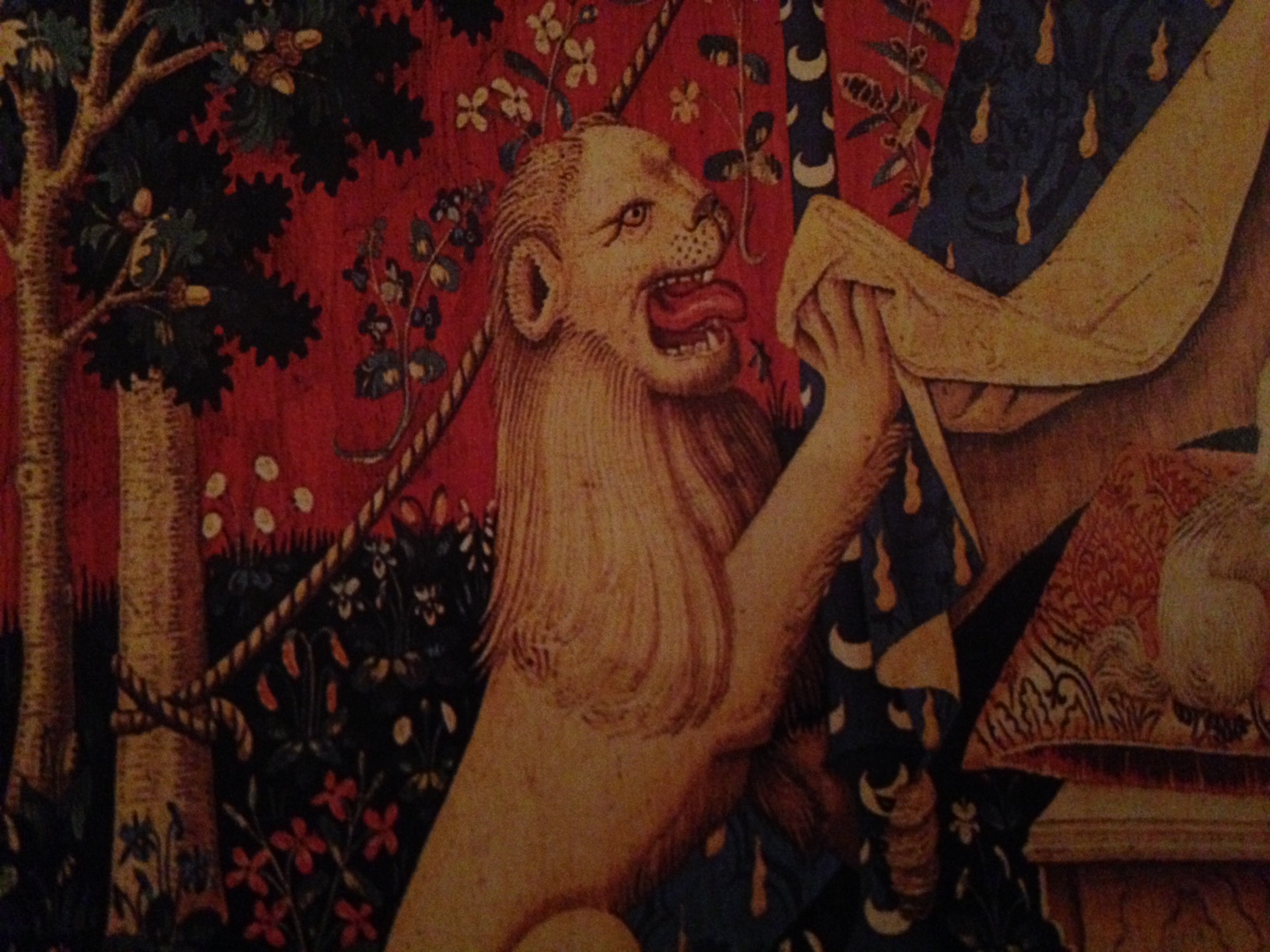
The tapestries were rediscovered in 1841 by Prosper Mérimée in Boussac castle where they had been suffering damage from their storage conditions.

The next time I went to Paris I didn’t waste my time staring at 16th century tapestries. I partied all night with Chris McK and his friends at some underground club or someplace and in the morning Durbin and I scalped tickets to the French Open.
What was up with European witch trials in the Middle Ages?
Posted: October 22, 2014 Filed under: history, writing Leave a commentThis tweet by Chris Schleicher:

got me to thinking. What with plagues and beheadings and barbarians, droughts and wars and rumors of wars and all, it can feel like end times. But there’s nothing new there, people have pretty much always thought it was end times. In 2 Thessalonians Paul has to calm down the panicky Thessalonians that the second coming hasn’t already happened – he’s like guys, I promise, you’ll hear about it.
A good book on this subject is In Pursuit Of The Millennium:

The Pursuit of the Millennium: Revolutionary Millenarians and Mystical Anarchists of the Middle Ages (1957, revised and expanded in 1970) isNorman Cohn’s study of millenariancult movements.
Covering a wide span of time, Cohn’s book discusses topics such as anti-Semitism and the Crusades, in addition to such sects as the Brethren of the Free Spirit, flagellants, the Anabaptists, and the Ranters. The Pursuit of the Millennium concludes with a discussion of the theocratic king John of Leiden, who took over the city of Münster in 1534.
(You can, apparently, still see the cage where they left John’s body on the steeple of St. Lambert’s in Münster)

Germany is twisted. Anyway: read Cohn in high school because I was interested in what kind of weird and creepy cults emerged from the bubonic plague. Cohn doesn’t have a ton on that, if I remember, but he does have lots of interesting stuff about flagellating cults of penitents and so forth. And he talks about the Children’s Crusade, a deeply sad event which is all the more intriguing because of how hard it is to sort out.
ANYWAY: went to wikipedia Cohn, and learned about another topic he was into: witch trials. In this book:

Cohn tries to sort out what the hell was going on with medieval witch trials.
Within the book, Cohn argues that there never were any Devil-worshiping witches in Early Modern Europe, and that all of those persecuted for being so were innocent. In this he specifically rejects the Witch-cult hypothesis put forward by English scholar Margaret Murray, which argued that there really had been a witch-cult religion which had been pre-Christian in origin. Cohn notes that accusations of worshiping a beast-headed deity, eating children and committing incest were not new to the witches of Late Medieval and Early Modern Europe, but had originally been leveled at Jews in the first century and then at Christians in the second, before being reused against Christian heretical sects like the Waldensians and the Knights Templar during the Late Medieval.
Now, the Margaret Murray hole is a great one to go down. Basically, her argument was that there was a pre-Christian folk religion in England that worshipped a horned fertility god, and that witch hunts were Christian efforts to stamp this out.

Amazing book cover.
Murray’s is a great, exciting idea and it still can put a twinkle in the eye of deep English folk hippies. But the prevailing historical view started to go at it:
In his 1962 work A Razor for a Goat, Rose asserted that Murray’s books on the witch-cult “contain an incredible number of minor errors of fact or of calculation and several inconsistencies of reasoning.”[75] He accepted that her case “could, perhaps, still be proved by somebody else, though I very much doubt it.”[75]Highlighting that there is a gap of about a thousand years between the Christianisation of Britain and the start of the witch trials there, he asserts that there is no evidence for the existence of the witch-cult anywhere in the intervening period.
That last part seems like the best argument to me – if there was a horn-god religion, why didn’t we hear about it before the 1400s? But, of course, there were ancient pre-Christian religions in Britain:

In keeping with what was by then the prevailing academic view, [Ronald Hutton’s boo] disputed the widely held idea that ancient paganism had survived into the contemporary and had been revived by the Pagan movement. In turn, it proved somewhat controversial among some sectors of the Pagan community, with two prominent members of the Goddess movement, Asphodel Long and Max Dashu publishing criticisms of it.
The Murray “witch-cult hypothesis” was talking about Britain, but people picked up on it elsewhere:
During the 1930s and 1940s, Heinrich Himmler organised a branch of the SS to undertake the largest survey of witch-hunt trial records in Europe ever taken, with the dual aim of using it as anti-Christian propaganda, to claim that the inquisition had been a repression of an indigenous Völkisch Norse-Germanic nature religion, and as evidence for reconstructing that religion.
Ultimately it seems like your more serious British historians, going through more and more documents, picking away at Murray, found it didn’t hold up. But that still leaves us with the question of what the fuck was going on with witch trials?

Down in Italy in the ’60s, Carlo Ginzberg started looking into benandanti:
The benandanti (“Good Walkers”) were members of an agrarian visionary tradition in the Friuli district of Northeastern Italy during the 16th and 17th centuries. The benandanti claimed to travel out of their bodies while asleep to struggle against malevolent witches (streghe) in order to ensure good crops for the season to come. Between 1575 and 1675, in the midst of the Early Modern witch trials, a number of benandanti were accused of being heretics or witches under the Roman Inquisition, and their beliefs assimilated to Satanism.
He suggested that these guys were in line with “shamanistic” traditions which anthropologists note all over the world. Over in Hungary, Éva Pócs started getting into a similar idea:

But man, some people weren’t into it:
Writing in the journal Anthropos, T.O. Beidelman lamented that despite the huge amount of source material that Pócs had to work with, “No account whatsoever is provided to set these witch-hunts and trials (and thus the data at hand) into any kind of historical, cultural, or social contexts. We gain no idea of just what kind of materials may be found in these accounts, who transcribed them, or how these transcriptions may or may not relate to what actually occurred and just who believed what.” He argues that Pócs “displays little sense of proper historical procedures” in her method, and that she also “has little concern for any anthropological, sociological, or psychology theory”, remarking that ultimately the work is “essentially [a] folkloristic, neo-Frazerian account content to describe a large aggregation of terms, beliefs, and practices mainly with the aims of comparing them to materials from elsewhere in Europe… and of tracing the possible origins of such ideas and customs to earlier beliefs and customs of the pre-Christian or even prehistoric past.” He furthermore criticised the style of writing, claiming that it was “rambling and discursive”, to the extent that it became “the most serious weakness of this volume”. He similarly criticises the translation into English, asserting that it “reads poorly”.
Da-yum.
(Let me pause here to note I’m just digesting all this from wikipedia, Helytimes’ greatest friend, and haven’t read these books).
They got into the shaman idea in Germany, too:

Anyway, back in England, Emma Wilby at the University of Exeter picked up on this “shamanic” idea:
she has published two books examining witchcraft and the cunning folk of this period. In these, she has identified what she considers to be shamanic elements within the popular beliefs that were held in this place and time, which she believes influenced magical thought and the concept of the witch.
Wilby started digging into on something interesting, the confession of a witch named Isobel Gowdie, who was arrested around 1662, but apparently confessed without being tortured:
Wilby herself was able to obtain copies of the trial records, which had been presumed lost for two centuries, from which she concluded that Gowdie had been involved in some form of shamanic visionary trances.

Isobel sounds like an interesting lady:
A young housewife living at Auldearn, Highland, Scotland, her confession painted a wild word-picture about the deeds of her coven. They were claimed to have the ability to transform themselves into animals; to turn into a hare, she would say:
- I shall go into a hare,
- With sorrow and sych and meickle care;
- And I shall go in the Devil’s name,
- Ay while I come home again.
(sych: such; meickle: great)
To change back, she would say:
-
Hare, hare, God send thee care.
-
I am in a hare’s likeness now,
-
But I shall be in a woman’s likeness even now.
 What was going on here? Were these people psychotic? Is a word like that even useful or transferable across centuries and cultures? Was there some kind of folk shamanism that stayed alive all over Europe through the Middle Ages? Is that so different from what Margaret Murray was saying?
I don’t have time to sort it all out, but I’m glad somebody’s on it.
I’m just talking about Europe, too – the Salem witch trials are a whole different ballgame. There you can get into theories about West Indian psychotropic hallucinogens, real estate dynamics, wild ergot poisoning, social politics, post-Indian wars PTSD, proto-feminism and fear of adolescent girls’ sexuality, and so on forever down the worm hole.
I guess my point is, 1) history is interesting and 2) dope book cover from Margaret Murray.
There’s hope for all of us!
Posted: October 21, 2014 Filed under: history Leave a comment
It is easy to forget, but on the eve of the Russian Revolution, Stalin was in his late 30s and had nothing to show for his life. He had “no money, no permanent residence, and no profession other than punditry,” meaning that he wrote articles for illegal newspapers. He certainly had no training in statecraft, and no experience managing anything at all. The Bolshevik coup d’état of 1917 brought him and his comrades their first, glorious taste of success. Their unlikely revolution—the result of Lenin’s high-risk gambles—validated their obscure and fanatical ideology. More to the point, it brought them personal security, fame, and power they had never before known.
from here.
The tallest cow in the world
Posted: October 20, 2014 Filed under: America Since 1945, animals Leave a comment
Blosom lives in Illinois and was recently declared the world’s tallest cow.
She says she knew Blosom was special when she was a calf.
I found it a little disappointing, but thanks to Tyler Cowen for the ht. Please send any agricultural oddities to helphely at gmail.
Bear Mystery
Posted: October 8, 2014 Filed under: America Since 1945, New York Leave a comment
Florence Slatkin walking her dog, Paco, on Tuesday next to the spot where she and a friend discovered a dead bear in Central Park. Ms. Slatkin said the bear’s head was resting on a fallen bike. Credit Richard Drew/Associated Press
Alert reader Tia in Manhattan writes:
Very excited for your new podcast. Are you following the Central Park Bear Mystery?
Tia, thanks for writing. Of course I am.
So, a dead bear was found in Central Park. Here are the facts we know, all from the NY Times:
- The state’s Department of Environmental Conservation announced that the results of a necropsy showed that the cause of death was “blunt force injuries consistent with a motor vehicle collision.”
- After revealing the results of the necropsy, Lori Severino, a spokeswoman for the state conservation department, said that the agency still did not know where the bear had come from, only that it was “likely not the park.”
- The Central Park Conservancy, which runs Central Park and provided preliminary information on Monday, had nothing to add on Tuesday. And a spokesman for the Wildlife Conservation Society, which runs the Bronx Zoo, said it was no longer involved and did not wish to comment.
- The New Jersey Department of Environmental Protection, which has been dealing with a surging black bear population, had nothing to say.
- Calls were made to a retired Bronx homicide commander, Vernon Gerberth. “It wouldn’t be a police matter,” he said, “unless the bear was killed by a person, or if somebody was keeping it as a pet and brought it to the park. People are crazy.”
- Dr. Lana Ciarniello, a bear expert in Canada, said that most bear experts in the United States were attending a conference in Greece and would be hard to reach for comment. She could not make the trip, so she was able to offer her thoughts on the mystery.
- She also said that the bear’s gender might have some relevance: “From a biological standpoint, it’s highly unusual for a female bear cub to be so far from her mother. Mother bears make male bear cubs disperse far from her home range to prevent inbreeding, so it would be less unusual if this were a male bear cub.”
- While there was a bear foot found on a lawn in Queens in 2011, bears have not regularly been seen in New York City for decades.
- An entry in the 1916 edition of Valentine’s Manual of Old New York contains an account of bear hunting on Pearl Street from 1678.
Anyway, I hope everyone enjoys The Great Debates! Available here:
https://itunes.apple.com/us/podcast/the-great-debates/id924258984?mt=2
a touching farewell
Posted: October 8, 2014 Filed under: Uncategorized Leave a comment
from this Vulture article about the passing of actress Sarah Goldberg:
Barry Watson, who played her boyfriend on 7th Heaven, tweeted his condolences Tuesday, writing: “#RIP Sarah. I will miss you always. Love Ya! B.”
The Great Debates
Posted: October 7, 2014 Filed under: America Since 1945, the California Condition 1 Comment
To HelyTimes readers, the “admirable thousands,”
Let me direct you to something I think you’ll enjoy.
My friend Dave King *, noted Parks & Recreation and Workaholics writer, and I have started a podcast called The Great Debates.
I know what you’re thinking: more podcasts?! But I think we’ve got something worth hearing.
We pick a topic – one of the great issues of the day – and without any preparation we debate it. The debates are moderated by the sonorously voiced Dan Medina.
This podcast is short, each episode is about twelve minutes.
Listeners can then vote – and suggest new debate topics – by emailing greatdebates69@gmail.com.
The podcast is available for download on iTunes or at www.greatdebates69.com.
I’d love it if you reviewed it and rated it highly on iTunes and spread the word.
We have nine episodes in the can and I’d argue they are enjoyable.
Hope you enjoy!
* not to be confused with jazzist Dave King
utterly nonsensical
Posted: October 6, 2014 Filed under: America Since 1945, music Leave a comment
The chorus of the song is wordless, consisting of a repeated chant of “lie-la-lie”. Simon stated that this was originally intended only as a placeholder, but became part of the finished song.
“I didn’t have any words! Then people said it was ‘lie’ but I didn’t really mean that. That it was a lie. But, it’s not a failure of songwriting, because people like that and they put enough meaning into it, and the rest of the song has enough power and emotion, I guess, to make it go, so it’s all right. But for me, every time I sing that part… [softly], I’m a little embarrassed.”
It has sometimes been suggested that the words represent a “sustained attack on Bob Dylan”. Under this interpretation, Dylan is identified by his experience as an amateur boxer, and the “lie-la-lie” chorus represents allegations of Dylan lying about his musical intentions. Biographer Marc Eliot wrote in Paul Simon: A Life, “In hindsight, this seems utterly nonsensical.”
Bob Dylan in turn covered the song on his Self Portrait album, replacing the word “glove” with “blow.” Paul Simon himself has suggested that the lyrics are largely autobiographical, written during a time when he felt he was being unfairly criticized:
“I think I was reading the Bible around that time. That’s where I think phrases such as ‘workman’s wages’ came from, and ‘seeking out the poorer quarters’. That was biblical. I think the song was about me: everybody’s beating me up, and I’m telling you now I’m going to go away if you don’t stop.”[5]
During a New York City concert in October 2010, Paul Simon stopped singing midway through “The Boxer” to tell the story of a woman who stopped him on the street to tell him that she edits the song when singing it to her young child. Simon told the audience that she removed the words “the whores” and altered the song to say, “I get no offers, just a come-on from toy stores on Seventh Avenue.” Simon laughingly commented that he felt that it was “a better line.”[6]
His big white belly was moving up and down
Posted: October 5, 2014 Filed under: heroes Leave a comment
page one of: