You, happy Austria, marry!
Posted: June 21, 2026 Filed under: Savoy Leave a comment
Traveling to the former Habsburg lands. What was the deal with these guys?
Origins:
As far back as we can trace, the Habsburg family was illustrious. In the 10th century, its progenitors carved out a medley of discontinuous lordships and manors in the region of the Upper Rhine, ranging across Alsace, the Black Forest, and what is now northern Switzerland. Around 1030, the earliest Habsburg of whom we have a definite record, Radbot (c.985-1045), founded the Benedictine abbey at Muri in the Swiss Aargau. Muri served over several centuries as the family’s place of burial. About the same time, Radbot built a stone fort called Habsburg some 30 kilometres away from Muri.
The name probably means Castle by the Ford, but is usually given the grander rendering of Castle of the Hawk. It was by the title of Habsburg that Radbot’s descendants were generally known.
The family had various forged documents that connected them to Julius Caesar and beyond:
By virtue of this and other similar deceptions (including a charter purportedly written by the Roman emperor, Nero), the Habsburgs ‘discovered’ that they were entitled to the rank of archduke. It was by this spoof title that all senior members of the dynasty subsequently styled themselves, in honour of which they wore a cloak trimmed with ermine and a coronet.
The story behind the forgeries rests on politics and ambition. In the 1lth and 12th centuries, Radbot and the first Habsburgs had sought to carve out a principality in the region of Switzerland and the Upper Rhine. They were, however, unable to consolidate their disparate properties into a unified block, for the region was intersected by too many rival lordships, cities, and confederacies.
One thing the early Habsburgs did have was money, for they controlled the Alpine toll stations which stood between the upland pastures and the cities of the valleys. In the hope that his family’s wealth might be deployed to bring order to the Holy Roman Empire, the German princes elected Rudolf of Habsburg as king in 1273. He did not disappoint them, deploying his armies against the robber-knights whose Rhineland castles impeded merchants and commerce.
One key to their success: using their daughters:
The Habsburgs were striking in the way that they used daughters not only as political pawns but also as political players, administering parts of the dynasty’s possessions.
Not that it was great to be a Habsburg daughter, you probably had to marry some prince you didn’t like, maybe more than one.
Meanwhile, Charles’s younger brother, Ferdinand, for whom Maximilian had engineered marriage into the Polish Jagiello line, acquired in 1526 the crowns of Hungary and Bohemia, following the death in battle of his Jagiello brother-in-law, Louis. In the space of just half a century, therefore, the two Habsburg brothers, Charles and Ferdinand, had through Maximilian’s marriage schemes taken over half of Europe, and they had done so more or less peacefully. Only in Hungary was there any concerted resistance. As an adage put it at the time, ‘Let others fight, you Happy Austria marry.’
It’s hard to understand the period from the end of the Roman Empire until at least the 20th century if you can’t comprehend that Christianity did really matter to people. There were sinners and cynical operators but there were people at both the top and the bottom who really believed and acted on their belief.
Dynastic ambition was only one factor that guided the Habsburg rulers. Indeed, on occasions the policies they pursued were potentially damaging and even ruinous to the dynasty’s interests and survival. These other guiding principles and determinants of policy included the conviction that as Holy Roman Emperors the Habsburg rulers had an obligation to defend the Catholic Church and to promote its spiritual interests, which included the promotion of peace.
How this worked (or didn’t):
They also embraced the belief that government was a trust and that rulership implied duties to subjects. Although rarely doubting the divine providence that vindicated their power and ordained the secular hierarchy on which they stood at the apex, the Habsburg emperors took their obligations to their subjects seriously. Right through to the 20th century, their mornings were typically occupied by audiences at which up to a hundred petitioners queued to ask the sovereign for his help or advice, or (which was more usual) to thank him in person for some kindness shown.
There were two problems with the cultivation of good government.
The first was the problem of distance, which meant that Habsburg rulers might demonstrate their personal rule and fatherly concern only to a few. Country folk from Lower Austria might thus travel to Vienna to have a private word with the emperor about their daughters’ marriages, but this was scarcely possible for most Habsburg subjects. The old adage of Spanish colonial rule, ‘If death came from Madrid, we would be immortal, was a fitting verdict on the problems of communication that beset Habsburg rule more generally.
How did we get here?:
In 1437, the Emperor Sigismund, son of Charles IV of Luxemburg, died without heir. Meanwhile, the various cadet lines of the Habsburgs either expired or faltered, leaving children as heirs. In 1438, the electors chose as king Albert of Habsburg, the late Emperor Sigismund’s son-in-law. Upon Albert’s death the next year, they appointed as successor his second cousin, Frederick of Styria, who was now the senior member of the dynasty.
Frederick was chosen by the electors because there was no one else available for the role of king. Nevertheless, he looked the part, for he was tall and muscular, with long blond hair-characteristics that he had inherited from his Polish mother, Cymburga, a woman of prodigious beauty and physical strength, who could reputedly drive nails into oak tables with her bare fist. Frederick ruled as king of Germany from 1440 and, following his coronation in Rome, as emperor from 1452 until his death in 1493.
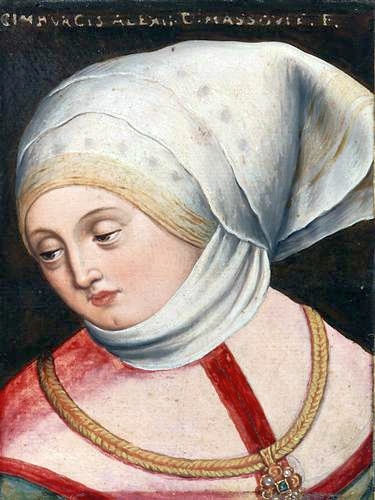
That nails in oak claim sounds like a seven almonds story: a joke or quip that is taken too literally and enters the historical record.
Historians have not looked kindly upon Frederick III, too readily following the later description of him as the ‘arch-sleepyhead or averring by reference to the Austrian poet Rilke that his main achievement was to have reigned in adversity for so long: Who speaks of victory, when to endure is all?’ An even harsher verdict blames Frederick for Germany’s later misfortunes. Instead of busying himself with the Holy Roman Empire and trying to bring order to its politics, Frederick withdrew to provincial Wiener Neustadt and occupied himself with Habsburg family affairs.
Where all this led:
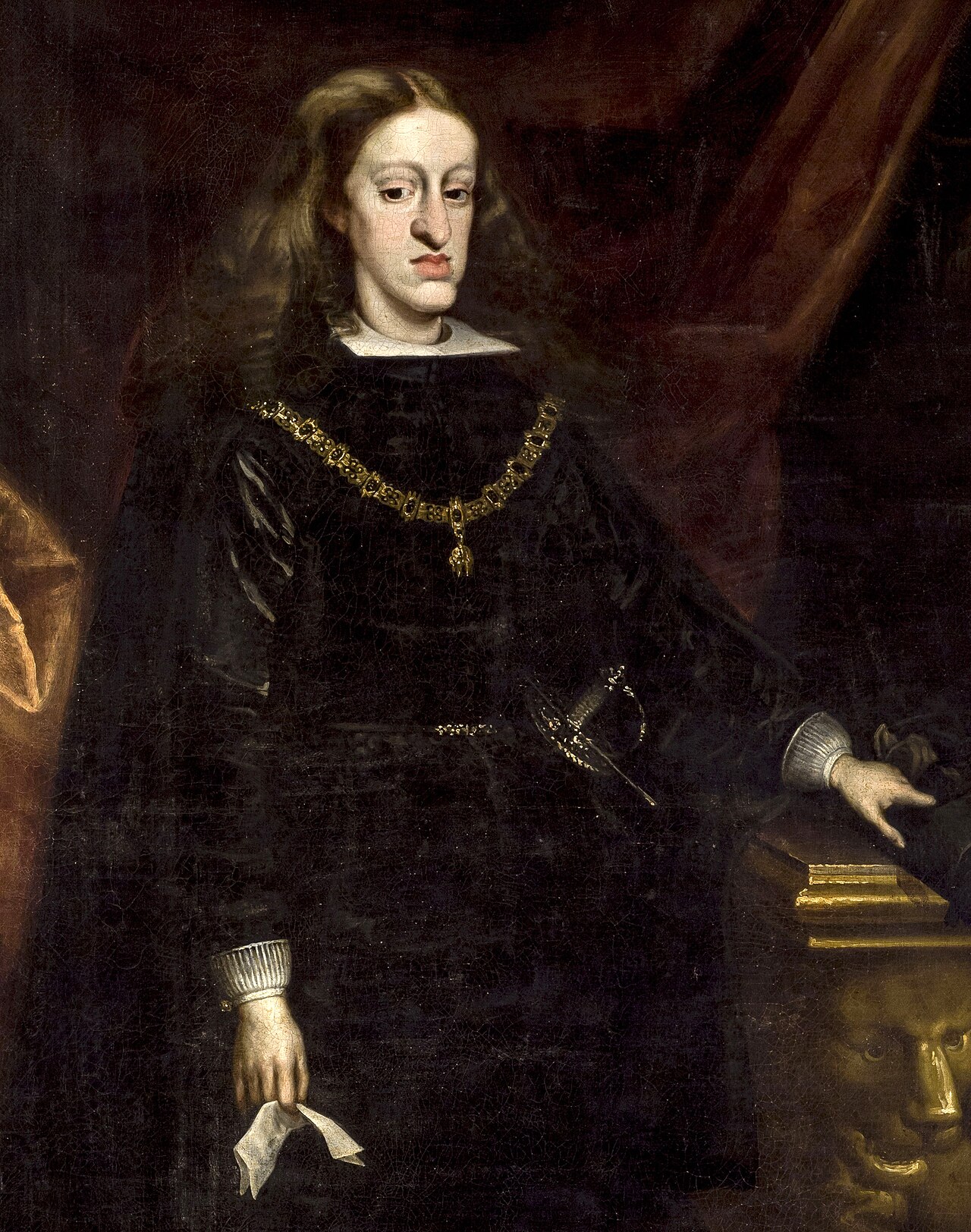
[The Habsburg dynasty] held to a mythologized history that taught it to expect greatness. It was tenacious in acquiring lands, kingdoms, and titles, either by war or by marriage. Its members were, moreover, bound together both biologically and by the distribution of power and honours. The branches of the dynasty thus regularly intermarried, to such an extent that Charles II of Spain (1665-1700) had only two-thirds the normal number of great-and great-great-grandparents.
Inbreeding between cousins and uncles caused the prognathism for which the Habsburgs were famous and was most pronounced in Charles II (Figure 2).