Top Ten HelyTimes Posts Of The Year
Posted: December 26, 2016 Filed under: heroes, Wonder Trail Leave a comment
Watching the America’s Cup Race. Mrs. Kennedy, President Kennedy, others. Off Newport, RI, aboard the USS Joseph P. Kennedy, Jr. by Robert Knudsen
By reader vote, these were considered
The Top Ten Helytimes Posts Of The Year

10) Shorter History Of Australia
about Geoffrey Blainey’s book on how that country became what it is, and their national cry Cooo-EEE!

9) Jo Mora and Mora Update
about how the Uruguayan-Californian artist influenced almost a century of design
8) Travel Tips From Bill and Tony
Conversations between Tony Blair and Bill Clinton

7) San Francisco
A visit to that famed city and the Diego Rivera murals hidden around it

6) Khipus
On Incan rope counting systems and their decipherment

5) Jackie Smoking Pregnant
An investigation into a photo of the former first lady

4) Twenty Greatest Australian Accomplishments of All Time
This was by far our most popular post by views

3) Death Valley Days
A trip to the national park, and its place in our national consciousness

2) Lady Xoc
About the Mayan queen of the 8th century
The definitive winner for the year?:

1) Boyd, Trump, and OODA Loops
A review of writing by and about fighter pilot John Boyd, who offers a way into DT’s thinking.

Honorable mentions:
a brief look at Sanders and Trump
about you know who, comparing him to Tim Ferriss.
a big wild roundup.
on how a Swiss chocolatier came to own freshwater springs in Southern California
about the Vietnam War correspondent, Kubrick pal and Zen Buddhist
on the work of Randall Collins, an underappreciated hero
A Description of Distant Roads,
extracts from a 1769 description of California,
a dispatch from rainy New Zealand,
and a personal favorite,
about Willa Cather, Walt Whitman, and America.
The most popular post of the year
by views, was
American Historical Figure Who Reminds Me Of Trump
Thanks for reading Helytimes. We really appreciate all our readers. We write it just out of graphomania and a compulsion to work out, catalog and channel puzzles, curiosities and questions of interest. It’s wonderful to know there are people who enjoy the results.
You can email us anytime at helphely at gmail. Let us know what you think.
All the best for 2017.
Buy this book on Amazon or at your local indie bookstore:

sent by reader Katrina
One last chance?
Posted: December 16, 2016 Filed under: America Since 1945, heroes, politics, presidents, the California Condition Leave a comment
stirred the pot the other day with this tweet.
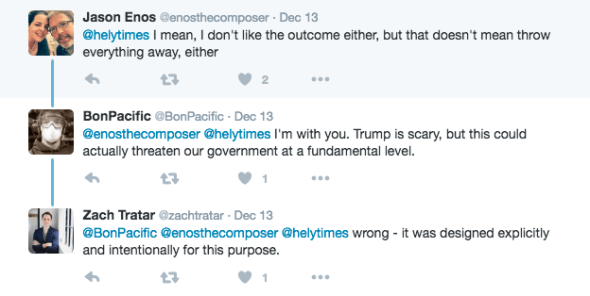


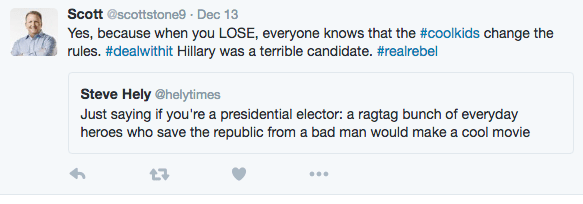
I mean, I like being lumped in with the #coolkids.
When I tweeted that, I meant what I said: it would be a cool movie. The Electoral College members are mostly, as I understand it, a bunch of ordinary schmoes. 99 times out of a hundred their job is rubber stamping, a comical bit of leftover political inanity.
But what if, one day, it wasn’t so easy?
What if, one day, these ordinary citizens were called upon to make a tough choice.
A choice that would bring them right into the line of fire.
A choice that would change history.
The idea of Trump in the White House makes me sick. 61,900,651 Americans disagree, obvs. An Electoral College revolt is a crazy fantasy. But I enjoy thinking about it!
What is right and wrong for the Electoral College to do?
Says the National Archives:
There is no Constitutional provision or Federal law that requires Electors to vote according to the results of the popular vote in their states. Some states, however, require Electors to cast their votes according to the popular vote. These pledges fall into two categories—Electors bound by state law and those bound by pledges to political parties.
The U.S. Supreme Court has held that the Constitution does not require that Electors be completely free to act as they choose and therefore, political parties may extract pledges from electors to vote for the parties’ nominees. Some state laws provide that so-called “faithless Electors” may be subject to fines or may be disqualified for casting an invalid vote and be replaced by a substitute elector. The Supreme Court has not specifically ruled on the question of whether pledges and penalties for failure to vote as pledged may be enforced under the Constitution. No Elector has ever been prosecuted for failing to vote as pledged.
Today, it is rare for Electors to disregard the popular vote by casting their electoral vote for someone other than their party’s candidate. Electors generally hold a leadership position in their party or were chosen to recognize years of loyal service to the party. Throughout our history as a nation, more than 99 percent of Electors have voted as pledged.
The National Association of Secretaries of State (NASS) has compiled a brief summary of state laws about the various procedures, which vary from state to state, for selecting slates of potential electors and for conducting the meeting of the electors. The document, Summary: State Laws Regarding Presidential Electors, can be downloaded from the NASS website.

From the NASS website, here’s how it goes down in my home state of California:
Whenever a political party submits to the Secretary of State its certified list of nominees for electors of President and Vice President of the United States, the Secretary of State shall notify each candidate for elector of his or her nomination by the party. The electors chosen shall assemble at the State Capitol at 2 o’clock in the afternoon on the first Monday after the second Wednesday in December next following their election. In case of the death or absence of any elector chosen, or if the number of electors is deficient for any other reason, the electors then present shall elect, from the citizens of the state, as many persons as will supply the deficiency. The electors, when convened, if both candidates are alive, shall vote by ballot for that person for President and that person for Vice President of the United States, who are, respectively, the candidates of the political party which they represent, one of whom, at least, is not an inhabitant of this state.
That seems pretty standard. In some states they meet in the governor’s office or the office of the secretary of state. In Massachusetts they will meet in the Governor’s office:

Barry Chin for The Boston Globe, found here.
Here’s what the good ol’ Constitution says about the EC.

Now, what is the point of all this? If you’ve read at all about the EC, you will know that Hamilton made the case for it in Federalist 68, which you can read a summary of here or the real thing here.

You’ve probably seen this quote:
Talents for low intrigue, and the little arts of popularity, may alone suffice to elevate a man to the first honors in a single State; but it will require other talents, and a different kind of merit, to establish him in the esteem and confidence of the whole Union, or of so considerable a portion of it as would be necessary to make him a successful candidate for the distinguished office of President of the United States
But to me, the more interesting one is this one:
Nothing was more to be desired than that every practicable obstacle should be opposed to cabal, intrigue, and corruption. These most deadly adversaries of republican government might naturally have been expected to make their approaches from more than one querter, but chiefly from the desire in foreign powers to gain an improper ascendant in our councils.
Wow!
Now, I hear the argument that the cool kids are always changing the rules. I don’t think I agree with the logic of this petition, which is half “Hillary won the popular vote” (who cares, that’s not the rules we were playing by) and half “Trump is unfit to serve.”
The Trump being unfit to serve bit was up to the voters. Seems very dangerous to me for the Electoral College to start making that call. That is some wonked aristocratic bullshit that the Constitution maybe intended, but which the Constitution as practiced and understood has moved away from?
But if it were proven Trump colluded with a foreign power, then I think hell yeah! If you believe, as I do, that the Constitution is a genius mechanism full of checks and failsafes, isn’t the Electoral College designed exactly to be one last chance for good old-fashioned citizens to stop a presidential candidate who allowed a foreign power to gain an improper ascendant in our councils?
I don’t think we have the proof that Trump did that. But I think the Electors are totally within their rights to think about it and decide what to do.
In closing my feelings are well summarized by Ben White:

Thoughts of a Philosophical Fighter Pilot
Posted: November 20, 2016 Filed under: actors, America Since 1945, heroes, Vietnam Leave a comment
Remember this guy? For some reason or another I bought this pamphlet of a speech he gave at King’s College, London, November 1993:

Stockdale was a 38 year old naval aviator when he got sent to Stanford for two years of study. He was pretty bored until a professor handed him a copy of The Enchiridion, a collection of the teachings of Epictetus.

What does Epictetus teach?

He taught how to play the game of life with perspective:

an A-4
Five years later, this is what happened to Stockdale:

Stockdale was wrong about how long he’d be there. He was there for 7 1/2 years, much of it in solitary confinement:

How did he spend his time? Well, for one thing he constructed a sliderule in his mind from equations tapped to him in code through a concrete wall::


A bigger collection of Stockdale’s speeches and essays:

where he distills what he learned through his prison experience down to “one all-purpose idea, plus a few corollaries”:

What he has to say about public virtue is distressing as I watch the future president:

A badass:
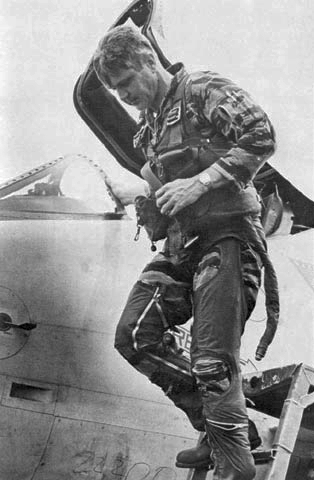
Recommend Courage Under Fire, which costs five bucks or $3.85 on Kindle. Thoughts Of A Philosophical Fighter Pilot is for the serious Stockdale student.
I think you can appreciate the greatness of Stockdale and also find this funny:
http://www.nbc.com/saturday-night-live/video/joyride-with-perot/n10313
Coverage of another philosophical fighter pilot, John Boyd, here.
http://www.hulu.com/watch/4123
Trump at Gettysburg
Posted: October 30, 2016 Filed under: heroes, history, presidents Leave a comment
Pickett’s Charge from a position on the Confederate line looking toward the Union lines, Ziegler’s Grove on the left, clump of trees on right, painting by Edwin Forbes

Disgusted afresh with this one, from NY Mag: “Final Days: Trump’s advisers are working hard to plan their own futures while riding out the roller-coaster end of the campaign.” by Gabriel Sherman.
I mean, this is what happened at Gettysburg:

An American president should not visit that place without some sober thought about how it came to be that 7,058 people murdered each other there in three days (perhaps our worst ever mass shooting?)
Starting to seem like Trump has never read

Or even Shelby:

Has he not at least had Sam Waterstone read him the Gettysburg Address?:
The whole point of the Gettysburg Address, he might’ve reminded himself, was that we can’t let all this horror have no meaning, we must use it to remind ourselves of how we got here, what is good about us, what values we must work for.
UGH! I’m with Ken Burns.
Also what about this:

I know everybody deserves a lawyer, but is it not a tad revolting that Ailes lawyer is Dukakis’ former campaign manager?

Maybe there’s more to the story, but this seems, from my distance, like an easy example of a valueless incestuous intertwined gaggle of political and media elites who care about nothing but staying in the game.
I’m sure in defeat Trump will have all the dignity of Lee:

He was engaged in rallying and in encouraging the broken troops, and was riding about a little in front of the wood, quite alone–the whole of his Staff being engaged in a similar manner further to the rear. His face, which is always placid and cheeful, did not show signs of the slightest disappointment, care, or annoyance; a he was addressing to every soldier he met a few words of encouragement, such as, “All this will come right in the end: we’ll talk it over afterwards; but, in the mean time, all good men must rally. We want all good and true men just now,” &c. He spoke to all the wounded men that passed him, and the slightly wounded he exhorted “to bind up their hurts and take up a musket” in this emergency. Very few failed to answer his appeal, and I saw many badly wounded men take off their hats and cheer him. He said to me, “This has been a sad day for us, Colonel–a sad day; but we can’t expect always to gain victories.” He was also kind enough to advise me to get into some more sheltered position, as the shells were bursting round us with considerable frequency.
from the account of Fremantle, who was there, a version less dramatic than this one:
Ngiao Marsh
Posted: September 1, 2016 Filed under: heroes, women, writing Leave a comment
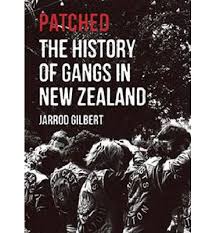
In New Zealand I got invited to participate in the Great New Zealand Crime Debate, which was a blast. I was on a team with Christchurch lawyer Kathryn Dalziel and sociologist Jarrod Gilbert, who got badly beaten several times while writing this book:
My job it turned out was to roast the members of the other team, namely New Zealand broadcaster Paula Penfold (who was lovely and a good sport):

Anyway, afterwards they had the Ngiao Marsh Crime Awards. Who was Ngiao Marsh?

She was a New Zealand writer of detective stories, mostly starring Roderick Alleyn. Some of the covers of her books are great:


Says Wiki:
Marsh never married and had no children. She enjoyed close companionships with women, including her lifelong friend Sylvia Fox, but denied being lesbian, according to biographer Joanne Drayton. ‘I think Ngaio Marsh wanted the freedom of being who she was in a world, especially in a New Zealand that was still very conformist in its judgments of what constituted ‘decent jokers, good Sheilas, and ‘weirdos’’,’ Roy Vaughan wrote after meeting her on a P&O Liner.
It sounds like her mysteries, which revolve around poison on darts and that kind of thing, are exactly what Raymond Chandler was ranting against in his essay “The Simple Art Of Murder“:
This, the classic detective story, has learned nothing and forgotten nothing. It is the story you will find almost any week in the big shiny magazines, handsomely illustrated, and paying due deference to virginal love and the right kind of luxury goods. Perhaps the tempo has become a trifle faster, and the dialogue a little more glib. There are more frozen daiquiris and stingers ordered, and fewer glasses of crusty old port; more clothes by Vogue, and décors by the House Beautiful, more chic, but not more truth. We spend more time in Miami hotels and Cape Cod summer colonies and go not so often down by the old gray sundial in the Elizabethan garden. But fundamentally it is the same careful grouping of suspects, the same utterly incomprehensible trick of how somebody stabbed Mrs. Pottington Postlethwaite III with the solid platinum poignard just as she flatted on the top note of the Bell Song from Lakmé in the presence of fifteen ill-assorted guests; the same ingenue in fur-trimmed pajamas screaming in the night to make the company pop in and out of doors and ball up the timetable; the same moody silence next day as they sit around sipping Singapore slings and sneering at each other, while the flat-feet crawl to and fro under the Persian rugs, with their derby hats on.

Chandler calls for something a little harder edged:
The realist in murder writes of a world in which gangsters can rule nations and almost rule cities, in which hotels and apartment houses and celebrated restaurants are owned by men who made their money out of brothels, in which a screen star can be the fingerman for a mob, and the nice man down the hall is a boss of the numbers racket; a world where a judge with a cellar full of bootleg liquor can send a man to jail for having a pint in his pocket, where the mayor of your town may have condoned murder as an instrument of moneymaking, where no man can walk down a dark street in safety because law and order are things we talk about but refrain from practising; a world where you may witness a hold-up in broad daylight and see who did it, but you will fade quickly back into the crowd rather than tell anyone, because the hold-up men may have friends with long guns, or the police may not like your testimony, and in any case the shyster for the defense will be allowed to abuse and vilify you in open court, before a jury of selected morons, without any but the most perfunctory interference from a political judge.
It is not a very fragrant world, but it is the world you live in, and certain writers with tough minds and a cool spirit of detachment can make very interesting and even amusing patterns out of it. It is not funny that a man should be killed, but it is sometimes funny that he should be killed for so little, and that his death should be the coin of what we call civilization. All this still is not quite enough.
In everything that can be called art there is a quality of redemption. It may be pure tragedy, if it is high tragedy, and it may be pity and irony, and it may be the raucous laughter of the strong man. But down these mean streets a man must go who is not himself mean, who is neither tarnished nor afraid. The detective in this kind of story must be such a man. He is the hero, he is everything. He must be a complete man and a common man and yet an unusual man. He must be, to use a rather weathered phrase, a man of honor, by instinct, by inevitability, without thought of it, and certainly without saying it. He must be the best man in his world and a good enough man for any world. I do not care much about his private life; he is neither a eunuch nor a satyr; I think he might seduce a duchess and I am quite sure he would not spoil a virgin; if he is a man of honor in one thing, he is that in all things. He is a relatively poor man, or he would not be a detective at all. He is a common man or he could not go among common people. He has a sense of character, or he would not know his job. He will take no man’s money dishonestly and no man’s insolence without a due and dispassionate revenge. He is a lonely man and his pride is that you will treat him as a proud man or be very sorry you ever saw him. He talks as the man of his age talks, that is, with rude wit, a lively sense of the grotesque, a disgust for sham, and a contempt for pettiness. The story is his adventure in search of a hidden truth, and it would be no adventure if it did not happen to a man fit for adventure. He has a range of awareness that startles you, but it belongs to him by right, because it belongs to the world he lives in.
If there were enough like him, I think the world would be a very safe place to live in, and yet not too dull to be worth living in.
Wow. The world’s big enough for both kinds of mystery I guess.
This year’s award was won by Paul Cleave:

For his book Trust No One:

Michael Herr
Posted: June 24, 2016 Filed under: America Since 1945, heroes, war Leave a comment

If you read Dispatches and you weren’t obsessed with learning everything you possibly could about Michael Herr, we are different!
Read it AGAIN just recently after reading Mary Karr yank out its gears and examine them in her:

Also recommended.
Just a sample of Dispatches:


What about?:
In my search for info on Herr I read this 1990 profile for the LA Times by Paul Ciotti:
Friends of friends invited him to dinner. Strangers wanted to meet him. Once, Herr recalls, he got a phone call from a guy who said he was standing in a phone booth in Nebraska in the middle of the night. “I could hear the wind blowing. He hadn’t read the book.” The caller said, “Time magazine says this. What does this mean?” Herr reversed the question: “What do you think it means?” “Oh, ho! Now that you’re rich and famous you don’t want to talk to people like me.”
:
One inspiration was Ernest Hemingway. “When I was a kid, I was obsessed with him and made some pathetic teen-age attempts to imitate him in my life. And I reinvented myself as this outdoorsman, hard-drinking and everything with it. I dare say that influence put my foot on the trail to Vietnam. Which is why that book is about acting out fantasy as much as anything.
“I had always wanted to go to war. I wanted to write a book. It was something I had to do. The networks kept referring to this as a TV war, which I didn’t believe it was. I sent a proposal to Harold Hayes. I was to write a monthly column, but once I got over there I realized this was not the way to approach the story. I wired Hayes. He said, ‘You do what you want to do. Have fun. Be careful.’ “
What do we make of this?:
What sets Herr’s book apart is the authoritative sense he conveys of the terror, ennui and ecstasy of what it felt like to be there. In a chapter about the siege of Khe Sanh, he offers a long series of conversations between two friends, a huge, gentle black Marine named Day Tripper and a little naive white Marine named Mayhew. The exchanges ring so true that one wonders, simply on a journalistic level, how he ever managed to record them.
He smiles. “They are totally fictional characters.”
They are ?
“Oh, yeah. A lot of ‘Dispatches’ is fictional. I’ve said this a lot of times. I have told people over the years that there are fictional aspects to ‘Dispatches,’ and they look betrayed. They look heartbroken, as if it isn’t true anymore. I never thought of ‘Dispatches’ as journalism. In France they published it as a novel.”
But, Herr says, “I always carried a notebook. I had this idea–I remember endlessly writing down dialogues. It was all I was really there to do. Very few lines were literally invented. A lot of lines are put into mouths of composite characters. Sometimes I tell a story as if I was present when I wasn’t, (which wasn’t difficult)–I was so immersed in that talk, so full of it and so steeped in it. A lot of the journalistic stuff I got wrong.”
My hunt for more Herr led me to this Dutch (?) documentary, First Kill, interviews with vets interspersed with film of contemporary Vietnam. Herr is interviewd first at minute 27:40 or so.
The story he tells starting around 40:20. Jeez.
I forget where I learned that Herr was living in upstate New York or sumplace, practicing a rigorous Buddhism. My trail on him brought me to this book:


What to make of this Buddhist-type idea:


On the lighter side: there’s great stuff too in Michael Herr’s book about Kubrick:


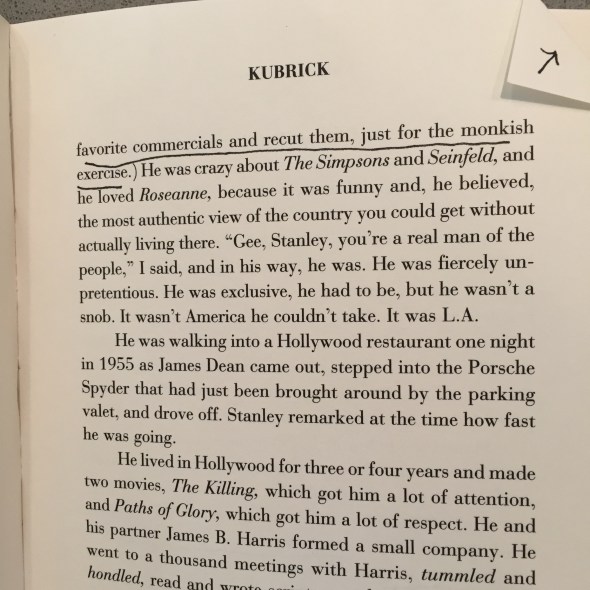
He’d tape his favorite commercials and recut them, just for the monkish exercise.
RIP.

Off We Go
Posted: May 15, 2016 Filed under: America Since 1945, explorers, heroes, history, people, the California Condition Leave a comment
Captain Ted W. Lawson of the Ruptured Duck
Watching Trumbo –> reading about 30 Seconds Over Tokyo
Before I knew it I was looking at the US Air Force’s photo archive specifically photos tagged “history.”

Several of the mission’s 16 B-25B bombers are lined up on the deck of the USS Hornet (CV-8). In the foreground is tail No. 40-2261, which was mission plane No. 7, piloted by 2nd Lt. Ted W. Lawson. The next plane is tail No. 40-2242, mission plane No. 8, piloted by Capt. Edward J. York. Both aircraft attacked targets in the Tokyo area. Lt. Lawson later wrote the book “Thirty Seconds over Tokyo.”
Note searchlight at left. (U.S. Navy photo)
Aviation history has never been a passion of mine but let’s just browse some of the highlights. Pearl Harbor:

A report entitled “7 December 1941: The Air Force Story” compiled by the Pacific Air Forces Office of History obtained this photo of Wheeler Air Field taken by a Japanese Empire pilot to record the battle damage to the U.S. Air Forces Dec. 7, 1941.
Homeward bound:

Newly freed prisoners of war celebrate as their C-141A aircraft lifts off from Hanoi, North Vietnam, on Feb. 12, 1973, during Operation Homecoming. The mission included 54 C-141 flights between Feb. 12 and April 4, 1973, returning 591 POWs to American soil. (U.S. Air Force photo)
Captain Mary T. Klinker:

Capt. Klinker was 27-years-old when she died April 4, 1975 when the first aircraft supporting Operation Babylife crashed. Klinker was the last nurse and the only member of the Air Force Nurse Corps to be killed in Vietnam. Capt. Mary T. Klinker was posthumously awarded the Airman’s Medal for Heroism and the Meritorious Service Medal.
Father and son:

Staff Sgt. Shaun Meadows shares a laugh with his son after completing his jump June 14, 2010. Sergeant Meadows is assigned to the 22nd Special Tactics Squadron at Joint Base Lewis-McChord, Wash. (U.S. Air Force photo/Airman Leah Young)
Fire retardant:

Approximately 3,000 gallons of fire retardant is deployed Oct. 25 over the Poomacha fire in North San Diego County, Calif. The C-130 Hercules and crew are assigned to the 302nd Airlift Wing from Peterson Air Force Base, Colo. The aircraft launched from Channel Islands Air National Guard Station, Calif. (U.S. Air Force photo/Tech. Sgt. Roy A. Santana)
Water:

On June 21, 1921, U.S. Army Air Service pilots bombed the captured German battleship Ostfriesland to demonstrate the effectiveness of aerial bombing on warships. At the time, the ship was one of the world’s largest war vessels.
An explosion 95 years ago:

An MB-2 hits its target, the obsolete battleship USS Alabama during tests. On Sep. 27, 1921, still operating with Mitchell’s provisional air brigade, the group’s MB-2 aircraft bombed and sank the ex-U.S. Navy battleship Alabama (BB-08) in Tangier Bay, Chesapeake Bay, Md.
Basic:

Basic cadets from the first Air Force Academy class line up for physical training here, the temporary location for the academy while permanent facilities were being constructed in Colorado Springs. (U.S. Air Force photo)
The Starlifter:

1970’s — MARCH 1978 — 3/4 front view of a C-141 Starlifter assigned to the 710th Military Airlift Squadron (AFRES), 60th Military Airlift Wing, in flight over the San Francisco Bay en route to Travis AFB, CA. (Photo by Ken Hackman)
How about Betty Gillies?:

Mrs. Betty Gillies was the first woman pilot to be “flight checked” and accepted by the Women’s Auxiliary Ferring Squadron. Mrs. Gillies 33 years of age, has been flying since 1928 and received her commercial license in 1930. She has logged in excess of 1400 hours flying time and is qualified to fly single and multi-engined aircraft. Mrs. Gillies is a member of the Aviation Country Club of Hicksville L.I. and is a charter member of ’99, an international club of women flyers formed by Amelia Earhardt in 1929. (U.S. Air Force photo)
Cool. Here is My Girl, 1945.

1940’s — A North American P-51 takes off from Iwo Jima, in the Bonin Islands. From this hard-won base our fighters escorted the B-29s on bombing missions to Japan, and also attacked the Empire on their own. (U.S. Air Force photo)
Goddard:

EARLY YEARS — Robert H. Goddard besides 1926 liquid- fueled rocket. The rocket is on top, receiving its fuel by two lines from the tank at the bottom. Goddard’s rockets made little impression upon government officials at the time. (U.S. Air Force photo)
That must be in New England someplace, believe it is near Auburn, MA:

Look, I’m not saying these Air Force photos are any Record Group 80: Series: General Photographic File of the Navy, 1939-1945, the Air Force wasn’t around yet. But some of them are great. I mean:
Dr. John Paul Stapp, the fastest man on Earth:

1950’s — Dr. John Paul Stapp was not only the “fastest human on earth;” he was the quickest to stop. In 1954, America’s original Rocketman attained a then-world record land speed of 632 mph, going from a standstill to a speed faster than a .45 bullet in five seconds on an especially-designed rocket sled, and then screeched to a dead stop in 1.4 seconds, sustaining more than 40g’s of thrust, all in the interest of safety.
The Hop A Long to the Rescue:

1950’s — An UH-19B Chickasaw at the Air Force Museum. Courtesy photo.
Can’t help but think of:

Connecting:

1960s — U.S. Air Force Sgt. Suzann K. Harry, of Wildwood, N.J., operates a switchboard in the underground command post at Strategic Air Command headquarters, Offutt Air Force Base, Neb., in 1967. (U.S. Air Force photo)
Tyler Cowen is a king
Posted: April 22, 2016 Filed under: heroes, music Leave a comment
I think his “dirty little secret,” if you will forgive the pun, is that once you get past the first album he wasn’t much of a true Dionysian, but rather a playful polyglot who assumed various poses. Most of all I was impressed by his urge to create, and how strong and how internal that drive seems to have been.
A+ to this book
Posted: March 31, 2016 Filed under: books, heroes Leave a comment
Unauthorized excerpt:

Lot of the feel of David Markson’s books, Boyland’s copies of which I read all in one fall in NYC.
This novel contains much information and true stories in it, which I always enjoy:


This was so interesting was that I looked into more about Komarov:

He successfully re-entered the Earth’s atmosphere on his 19th orbit, but the module’s drogue and main braking parachute failed to deploy correctly and the module crashed into the ground, killing Komarov. According to the 1998 bookStarman, by Jamie Doran and Piers Bizony, as Komarov sped towards his death, U.S. listening posts in Turkey picked up transmissions of him crying in rage, “cursing the people who had put him inside a botched spaceship.”

As always, the more you read about the story the more interesting it gets. Did they really hear his screams?
Komorov is one of the people honored in the Fallen Astronaut memorial left on the moon by David Scott on the Apollo 15 mission.

If you’re looking for that it’s over on the Hadley Rille:

According to NASA, the origin of lunar sinuous rilles remains controversial.[1] The Hadley Rille is a 1.5 km wide and over 300 m deep sinuous rille. It is thought to be a giant conduit that carried lava from an eruptive vent far to the south. Topographic information obtained from the Apollo 15 photographs supports this possibility; however, many puzzles about the rille remain.
No! We do it like this.
Posted: March 23, 2016 Filed under: heroes Leave a comment

So much that is amazing in this RuPaul interview in NY Mag, but this jumps out:
Is there anyone who interests you in pop culture right now?
The only person who interests me in pop culture right now is Judge Judy. That’s it. Because of the realness — she has kept the story of mankind. There’s a certain decorum and civility that keeps our society together, and it has crumbled so much in the past, really, 20 years. But when you watch her during that hour in the afternoon, she has remembered it and is saying, “No! We do it like this.” And I love it! She remembers the rules of civility. Because if you’ve gotten to the point where you need to go to court to figure out what to do, then you’ve lost your right to be cocky. You need someone. You need a mediator. And she’s that person.

Would they like each other?
Posted: March 21, 2016 Filed under: heroes, war, writing Leave a comment
Before you say look at this fucking hipster re: Saki, remember that he was a lance sergeant in the Royal Fusiliers. Last words before he was killed by a sniper?:
Put that bloody cigarette out!
There is no grave for him, just the Thiepval monument, he is literally one of the missing of the Somme:

Shoutout to Stephen King’s 11/22/63

which sent me to Saki’s “The Open Window.”

King is such a boss. First line of his about the author:

Buzz Aldrin at The Oakwood
Posted: March 6, 2016 Filed under: America Since 1945, heroes, the California Condition Leave a comment
for years my fav trivia about The Oakwood Apartments here in Greater Los Angeles is that Buzz Aldrin used to live there.

learned it from his memoir, Magnificent Desolation, which chronicles his difficulties with alcoholism and depression after his return to Earth and troubled stint running the test pilot school at Edwards Air Force Base here in SoCal:

I mean, how you gonna come back from:


I mean, there were some good times:


Buzz did live in the Oakwood — the one in Woodlawn Hills, not the one on the Cahuenga Pass that every Hollywood person has driven past a thousand times:


His lifestyle:

(I’ve described this story to many male friends who often look off to the distance wistfully and say “that sounds great”)

Once had the chance to shake Buzz’s hand when he was on 30 Rock. What a true hero.
All Roads
Posted: January 15, 2016 Filed under: America Since 1945, heroes, music, the California Condition, war Leave a comment
Happening to watch half of Jarhead on TV (Saarsgaard so good! *) leads to reading screenwriter William Broyles Jr.’s Wiki page, which leads to reading his essay “Why Men Love War”:
A lieutenant colonel I knew, a true intellectual, was put in charge of civil affairs, the work we did helping the Vietnamese grow rice and otherwise improve their lives. He was a sensitive man who kept a journal and seemed far better equipped for winning hearts and minds than for combat command. But he got one, and I remember flying out to visit his fire base the night after it had been attacked by an NVA sapper unit. Most of the combat troops I had been out on an operation, so this colonel mustered a motley crew of clerks and cooks and drove the sappers off, chasing them across tile rice paddies and killing dozens of these elite enemy troops by the light of flares. That morning, as they were surveying what they had done and loading the dead NVA–all naked and covered with grease and mud so they could penetrate the barbed wire–on mechanical mules like so much garbage, there was a look of beatific contentment on tile colonel’s face that I had not seen except in charismatic churches. It was the look of a person transported into ecstasy.
And I–what did I do, confronted with this beastly scene? I smiled back. ‘as filled with bliss as he was. That was another of the times I stood on the edge of my humanity, looked into the pit, and loved what I saw there. I had surrendered to an aesthetic that was divorced from that crucial quality of empathy that lets us feel the sufferings of others. And I saw a terrible beauty there. War is not simply the spirit of ugliness, although it is certainly that, the devil’s work. But to give the devil his due,it is also an affair of great and seductive beauty.
Which leads me to decide to finally read Chris Hedges’ book War Is A Force That Gives Us Meaning:
Chris Hedges was a graduate student in divinity at Harvard before he went to war. He spent fifteen years as a war correspondent for the Dallas Morning News, theChristian Science Monitor, and the New York Times, reporting on conflicts in El Salvador, Bosnia, Kosovo, and Iraq.
While on Amazon their robot recommends to me Ernst Jünger’s Storm Of Steel —

that’s a pass for now, but I will check out Ernst’s Wiki page:
Throughout the war, Jünger kept a diary, which would become the basis of his 1920 Storm of Steel. He spent his free time reading the works of Nietzsche, Schopenhauer, Ariosto andKubin, besides entomological journals he was sent from home. During 1917, he was collecting beetles in the trenches and while on patrol, 149 specimens between 2 January and 27 July, which he listed under the title of Fauna coleopterologica douchyensis (“Coleopterological fauna of the Douchy region”).

a leatherhead beetle in Death Valley illustrates the wiki page on coleopterology
which leads me to the wiki page for Wandervogel:
Wandervogel is the name adopted by a popular movement of German youth groups from 1896 onward. The name can be translated as rambling, hiking, or wandering bird (differing in meaning from “Zugvogel” or migratory bird) and the ethos is to shake off the restrictions of society and get back to nature and freedom.
which leads us both to the Japanese pastime of sawanobori, which looks semi-fun:

a bit silly but in the best way
and to History Of The Hippie Movement, subsection “Nature Boys Of Southern California” and thus to Nat King Cole’s song Nature Boy:
which has maybe the longest wiki page of any of these, culminating in
The song was a central theme in Luhrmann’s Moulin Rouge! “Nature Boy” was initially arranged as a techno song with singer David Bowie’s vocals, before being sent to the group Massive Attack, whose remix was used in the film’s closing credits. Bowie described the rendition as “slinky and mysterious”, adding that Robert ‘3D’ Del Naja from the group had “put together a riveting piece of work,” and that Bowie was “totally pleased with the end result.”
And just like that we’re back to Bowie.
*Saarsgaard on Catholicism:
In an interview with the New York Times, Sarsgaard stated that he followed Catholicism, saying: “I like the death-cult aspect of Catholicism. Every religion is interested in death, but Catholicism takes it to a particularly high level. […] Seriously, in Catholicism, you’re supposed to love your enemy. That really impressed me as a kid, and it has helped me as an actor. […] The way that I view the characters I play is part of my religious upbringing. To abandon curiosity in all personalities, good or bad, is to give up hope in humanity.”
Kuncho is alive!
Posted: October 9, 2015 Filed under: heroes Leave a commentA humorous email from my high school:
Wolfe on Status
Posted: September 29, 2015 Filed under: America Since 1945, heroes Leave a comment
Reading this Jefferson Lecture from 2006, delivered by Tom Wolfe:
Within the ranks of the rich, including the “owners of the means of production,” there inevitably developed an inner circle known as Society. Such groups always believed themselves to be graced with “status honor,” as Weber called it. Status honor existed quite apart from such gross matters as raw wealth and power. Family background, education, manners, dress, cultivation, style of life–these, the ineffable things, were what granted you your exalted place in Society.
Military officer corps are rife with inner circles aloof from the official and all-too-political hierarchy of generals, admirals, and the rest. I went to work on a book called The Right Stuff thinking it would be a story of space exploration. In no time at all, I happened upon something far more fascinating. The astronauts were but part of an invisible, and deadly, competitive pyramid within an inner circle of American military fighter pilots and test pilots, and they were by no means at the apex. I characterized this pyramid as a ziggurat, because it consisted of innumerable and ever more deadly steps a fighter pilot had to climb to reach the top. The competition demanded an uncritical willingness to face danger, to face death, not once but daily, if required, not only in combat but also in the routine performance of his duties–without ever showing fear–in behalf of a noble cause, the protection of his nation. There were more ways to die in a routine takeoff of a supersonic jet fighter of the F-series than most mortals could possibly imagine. At the time, a Navy pilot flying for twenty years, an average career span, stood a 23 percent chance of dying in an accident and a 56 percent chance of having to eject at some point, which meant being shot out of the plane like a human rocket by a charge of dynamite under his seat, smashing into what was known as the “wall” of air outside, which could tear the flesh off your face, and descending by parachute. The figures did not include death or ejection in combat, since they were not considered accidental. According to Korean War lore, a Navy fighter pilot began shouting out over the combat radio network, “I’ve got a Mig at zero! A Mig at zero! I’ve got a Mig at zero!” A Mig at zero meant a Soviet supersonic fighter plane was squarely on his tail and could blow him out of the sky at any moment. Another voice, according to legend, broke in and said, “Shut up and die like an aviator.” Such “chatter,” such useless talk on the radio during combat, was forbidden. The term “aviator” was the final, exquisite touch of status sensitivity. Navy pilots always called themselves aviators. Marine and Air Force fliers were merely pilots. The reward for reaching the top of the ziggurat was not money, not power, not even military rank. The reward was status honor, the reputation of being a warrior with ultimate skill and courage–a word, by the way, strictly taboo among the pilots themselves. The same notion of status honor motivates virtually every police and fire fighting force in the world.
Badass.

source: https://veneremurcernui.wordpress.com/2014/07/10/flightline-friday-returns-f-84h-thunderscreech/
In the related interview, Wolfe gets going on fashion:
Cole: Why is fashion important? What does it tell us?
Wolfe: Every man and every woman is equally fixated on fashion. Men who would bridle at that suggestion are usually men who want to fit in in whatever milieu they want to be in. They do not want to stand out in any way, shape, or form. That’s just as true in the stands at the stock car races as it might be at Sullivan and Cromwell, the law firm.
Somebody like myself, perhaps, stands out on purpose with just minor variations on the conventional. My suits are conventionally cut. They just happen to be white. The same with shoes, everything else.
I feel it’s to a writer’s advantage, since he sells a mass-produced product called a book, to catch attention any way he can. This is not shared by my fellow writers, you understand. But you’ll notice how few writers are willing to appear on the back of a book with a necktie on. That’s a bohemian fashion that’s supposed to show one way or another you’re thumbing your nose at convention. Then it becomes a convention itself. If I saw one more writer with an open shirt, the wind blowing through his hair, I was going to stop buying books. They’ve calmed down a little bit, but still the tie is anathema.
Ironically, if you read a book such as The Intellectuals on the Road to Class Power, about the arts in Czechoslovakia under a Communist regime, the writers in the Writers’ Union were dressed like businessmen. They were on top. If you were in the Writers’ Union, your books were published automatically, even if no one read them. And I’ve just been reading Huizinga’s The Autumn of the Middle Ages.
Cole: That’s a very great book, I think.
Wolfe: The attention to status detail and dress is absolutely fascinating. I forget the French nobleman who was found guilty of a capital crime, who insisted on arriving in his full regalia–an ermine-trimmed coat and the works–for his beheading. He just wasn’t going to show up looking like a common, vulgar victim. I liked that.
To this day, I think it hasn’t changed. It’s just more covert now. Style is always a window into what a person thinks of his place in the world or what he wants his place to be in the world.
Balzac often would start off chapters with a description of a room and the types of furniture. He might point out that the curtains on the windows were not really damask. They were half cotton. He would give you a whole picture of the inhabitants just through his status details.
And Saint-Beuve, who I guess was the leading French critic of the day, said, if this man Balzac is so obsessed with furniture, why doesn’t he own a shop and spare us these tedious novels. [Laughter]
Tissot, who has become my favorite painter the more of his work that I see, is a great example of that. For a long time, Tissot was written off as a sort of fashionista. He was in love with the look of women’s clothes. But I think now he’s being perceived as a great painter.
Cole: He’s a much more nuanced painter, I think, than people give him credit for.
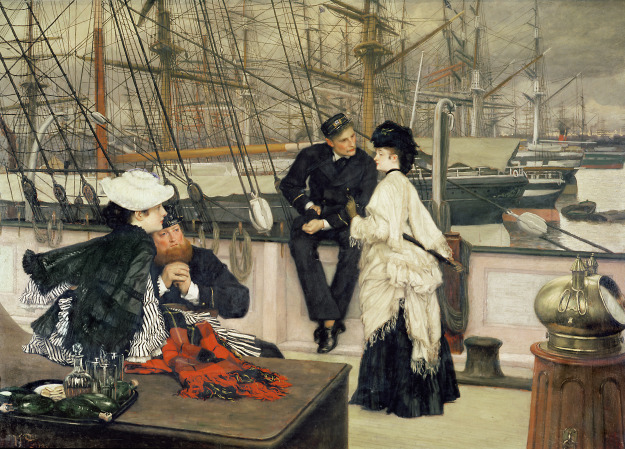
The Captain and the Mate, 1873 (oil on canvas) by Tissot.
Later the interview turns to architecture, and Wolfe gives a shout to Edward Durell Stone’s US Embassy in New Delhi:


McKinley
Posted: August 31, 2015 Filed under: heroes, mountains, presidents Leave a comment
What with the news being abuzz with Mount McKinley fuss, really enjoyed this, from former Army Ranger Andrew Exum’s Twitter:

Here it is:


Professor James McHugh sends us a good one
Posted: August 13, 2015 Filed under: heroes, writing Leave a comment
Just a modest little book. That’s from The Diary of Abraham De La Pryme, the Yorkshire Antiquary. Prof. McHugh suggested reading pages 20-29, which I did and enjoyed. Some highlights:

And how about this?:


Newton
Coming soon: a review of a book about cricket!
FDR
Posted: August 5, 2015 Filed under: America Since 1945, heroes, history, politics Leave a comment
No man should run for president until life has driven him to his knees a few times.
Who does young FDR look like?
 Helytimes