
C’mon this is cool
Posted: July 18, 2025 Filed under: the California Condition Leave a comment
Zane makes The New York Times.
I don’t care for the word “snub.” from Etymology Online:

If you’re a Television Academy member, please consider voting for COMMON SIDE EFFECTS in the category Outstanding Animated Program.
If you’re not a Television Academy member, consider becoming one! The TV Academy is not like the Academy of Motion Picture Arts. You don’t have to be asked to join. You can join if you have a couple TV credits and $225. That’s who votes on the Emmys.
Bless you.
Jedediah Smith Lunch
Posted: May 31, 2025 Filed under: the American West, the California Condition Leave a comment
Thinking of hosting an event where we eat the lunch Jedediah Smith has at the San Gabriel mission, California around November 7 in 1826:
At 11 O Clock [am] the Father came and invited us to dinner. We accompanied him to the office adjoining the dining room and after taking a glass of Gin and some bread and cheese we seated ourselves at the table which was furnished with Mutton Beef Chickens Potatoes Beans and Peas cooked in different ways. Wine in abundance made our reverend fathers appeared to me quite merry.
Gin, bread, cheese, mutton, beef, chicken, potatoes, beans, peas, wine in abundance, at eleven in the morning. (In fairness Jed has been up since sunup).
Smith notes that he enjoyed his meals at San Gabriel because it had been a long time since he’d sat at a table (he’d come overland through the Rockies and across the Mojave Desert). His first view of the mission:
Arrived in view of a building of ancient and castle-like appearance.

(from Wikipedia)
At that time what Smith calls “the village of the angels” was a minor outlying place. Smith records that the people of the village of the angels were master horsemen, and he describes their method. Those sensitive to animal suffering may wish to skip:
My guide informed me that the inhabitants of the village and of the vicinity collect whenever they consider the country overstocked and build a large and strong pen with a small entrance and two wings extending from the entrance some distance to the right and left. Then mounting their swiftest horses they scour the country and surrounding large bands they drive them into the enclosure by hundreds. They will there perhaps Larse a few of the handsomest and take them out of the pack. A horse selected in this manner is immediately thrown down and altered blindfolded saddled and haltered (for the Californians always commenc with the halter). The horse is then allowed to get up and a man is mounted. when he is firmly fixed in his seat and the halter in his hand an assistant takes off the blind the several men on horseback with handkerchiefs to frighten and some with whips to whip raise the yell and away they go. The poor horse having been so severely punished and frightened does not think of founcing but dashes off at no slow rate for a trial of his speed. After running until he is exhausted and finding he cannot get rid of his enemies he gives up. He is then kept tied for 2 or 3 days saddled and rode occasionally and if he proves docile he is tied by the neck to a tame horse until he becomes attached to the company and then turned Loose. But if a horse from the moment he is taken from the pen proves refractory they do not trouble themselves with him long but release him from his bondage by thrusting a knife to his heart. Cruel as this fate may seem it is a mercy compared to that of the hundreds left in the pack for they are shut up to die a death most lingering and most horrible, enclosed within a narrow space without the possibility of escape and without a morsel to eat they gradually loose their strength and sink to the ground making at time vain efforts to regain their feet and when at last all powerful hunger has left them but the strength to raise their heads from the dust with which they are soon to mingle: their eyes that are becoming dim with the approach of death may catch a glimpse of green and wide spread pastures and winding streams while they are perishing from want. one by one they die and at length the last and most powerful sinks down among his companions to the plain. No man of feeling can think of such a scene without surprise indignation and pity. Pity for the noblest of animals dying from want in the midst of fertile fields. Indignation and surprise that men are so barbarous and unfeeling. A fact so disgraceful to the Californians was not credited from a single narrator but has since been corroborated.
Perhaps worth considering here that Smith was writing in a tradition of Anglo/Protestant anti-Spanishism. Still. I’m prepared to believe Los Angeles has some history of horse crime to answer for.
The real center of power at this time, where Jedediah is eventually sent to answer to the governor, is San Diego. Smith says San Diego is “much decayed.” In a footnote, editor George R. Brooks says:
Smith was not alone in his opinion that things at San Diego were somewhat rundown. “Of all the places we had visited since our coming to California, excepting San Pedro, which is entirely deserted, the presidio at San Diego was the saddest. It is built on the slope of a barren hill, and has no regular form; it is a collection of houses whose appearance is made still more gloomy by the dark color of the bricks, roughly made, of which they are built.
The fine appearance of [the mission] loses much on nearing it; because the buildings, though well arranged, are low and badly kept up. A digusting slovenliness prevails in the padres’ dwelling.” (Carter, “Duhaut-Cilly,” 218-19).
Smith’s memoir has an interesting backstory, it’s a “found in an attic a hundred years later” kinda tale. My edition was published in 1977. I wonder if Cormac McCarthy had this at hand when writing the San Diego parts of Blood Meridian. I betcha he did.
25.5 Hours (and three hundred years) in Santa Barbara (and Santa Barbara County)
Posted: May 18, 2025 Filed under: the California Condition 1 Comment(this is an excerpt from my book California Getaway, which will be published by Universiteit Utrecht Press in their Amerikaanse avonturenseries, spring 2029*)
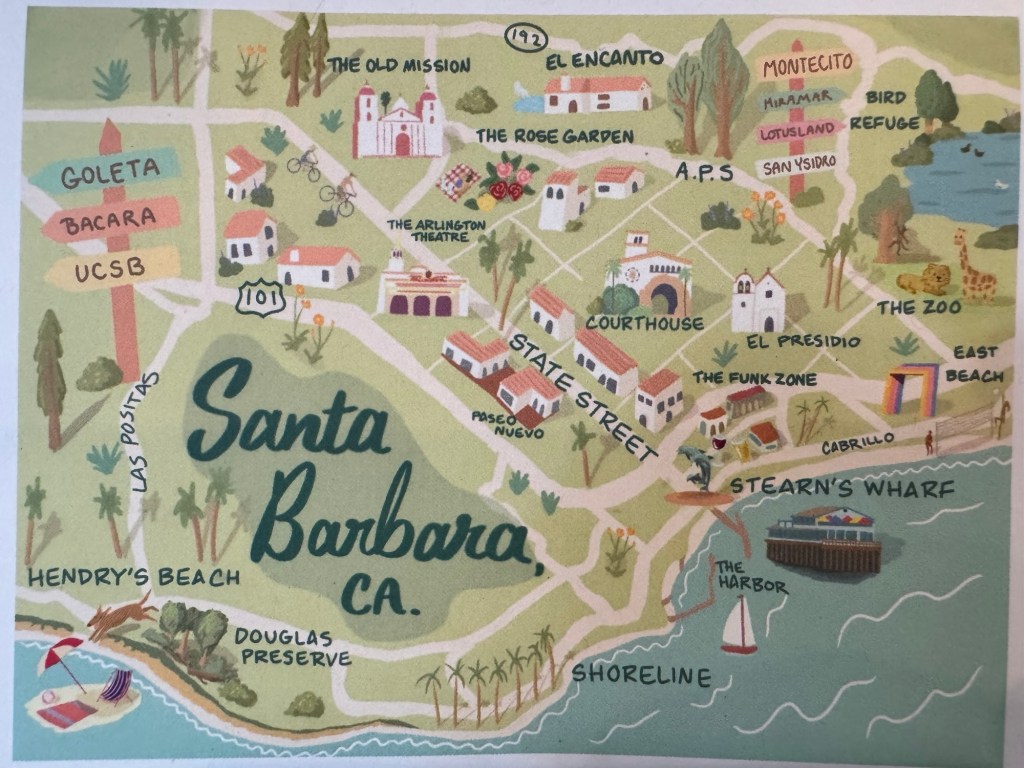
Santa Barbara is divided by both the 101 Highway and the Union Pacific railroad tracks, shared by Amtrak, which run close together. This carves out an area squeezed along the waterfront called “the Funk Zone.” Funky in the sense of curious, unusual, quirky, and the funky taste and smell of unrefined wines. (Not funky in the sense of the African-American music genre: Santa Barbara is barely over 1% black. This may be part of why it was tolerated for there to be a restaurant named Sambo’s right on the beach until the year 2020).
In the Funk Zone a good place for sandwiches is Tamar.

The Coast Starlight bound for Seattle leaves grand, deco Union Station at 9:51am and pulls into Santa Barbara at 12:15pm. That’s assuming it’s on time, not a safe assumption, and assuming the tracks don’t get washed away by the waves. They’re awful close, one day it will happen. You’ll pass the industrial workings of LA, the Big Thunder Mountain country by Santa Susanna, then down into vegetable farms of almost obscene bounty, and then past the surf corner at Rincon, and the world’s safest beach at Carpinteria, and into Santa Barbara.
There’s always at least one college student, one European, and at least one mystery case on the long distance Amtraks.
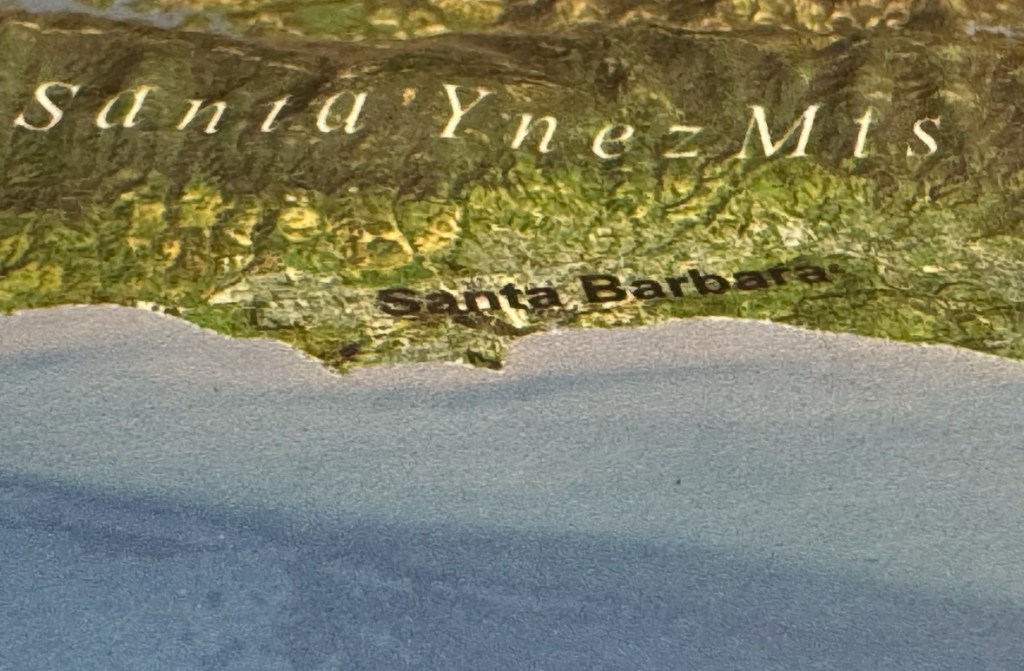
Walkable, Mediterranean climate, remarkable architecture, a fishing port that’s also a farm market town, a collection point for the freshest produce and the wildest most experimental and interesting wines? Oh, it’s also a college town? The catch? The median home price is around two point five million dollars.
Welcome to Santa Barbara.
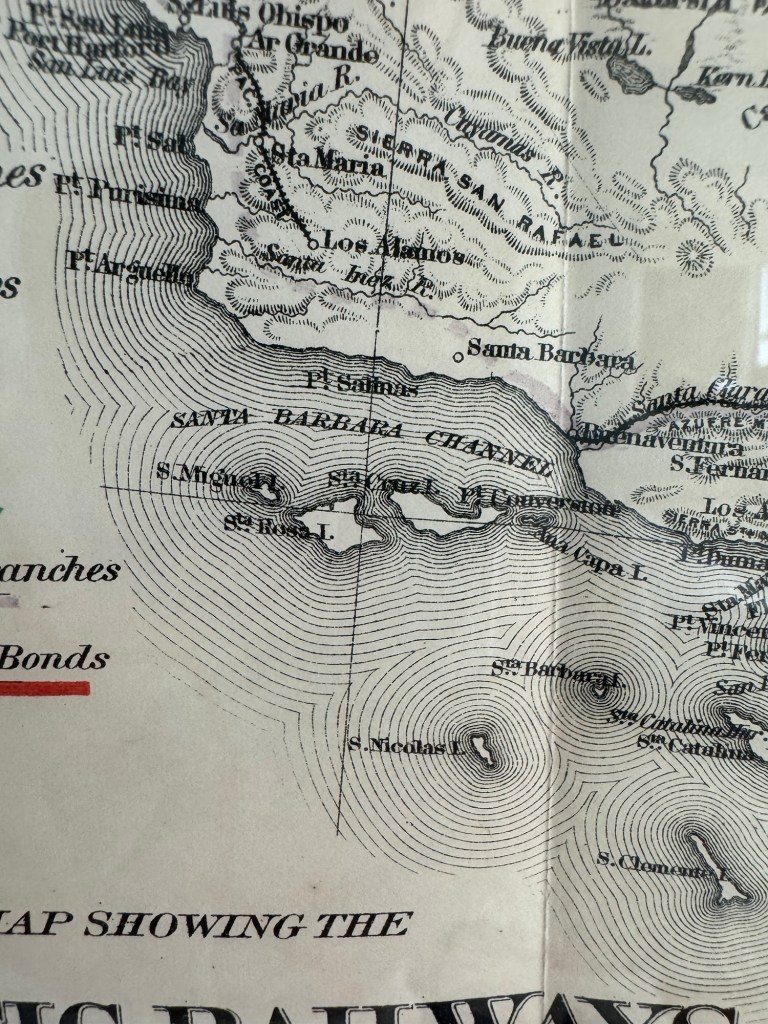
Mountains wall it on the north. On the south is the Santa Barbara Channel, shielded by the Channel Islands and full of fish and urchins. Squid is biggest catch, in dollars. The Chumash were feasting long here before the mission Spanish showed up driving herds of cattle. The archaeological riches found in what’s now Ambassador Park suggest that place was once a burial ground or a gathering place or both. (You hear the word “ceremonial” thrown around with the ancient peoples. What are our ceremonies? Going on vacation?)
The place was visited by Cabrillo and Vizcaino and who knows what other pirates and mariners before the mission was established in 1786. Richard Dana visited in 1834, went to a fandango, and was impressed, attracted, and repulsed by the exotic lifestyle of the rancheros. John Fremont’s expedition captured the city for the USA in 1846. The neat story about William Foxen leading him to the San Marcos Pass is repeated on a historical marker and in the WPA Guide, but the Santa Barbara historian Walker “Two Guns” Tompkins, who switched to history after writing a bunch of Westerns, says there’s no evidence of this. Imagine how remote Santa Barbara must’ve been from Mexico City by then.
In his Crown Journeys guide to New Orleans Roy Blount says,
I’ll bet I have been up in N. O. at every hour in every season
A good boast: he’s qualified.
I can’t make either claim about Santa Barbara. I suspect it’s pretty dead in the late to early hours. One day I’ll stay up all night and find out. Over about twenty years I have visited about 1.5 times a year.
On my first visits I found the town dramatic in geography but kinda sleepy. The big houses on the slopes were dramatic, and a wharf is always pleasing. If I stayed overnight I’d stay at one of the beach hotels and eat at Tupelo Junction or In n Out or La Super Rica, Julia Child’s favorite.

Long before many figured it out, [Julia Child] recognized that our pleasant climate, historical farming culture, and ranch-to-plate cuisine were conspiring together to elevate the American Riviera…
(source)
“The climate and the atmosphere [of Santa Barbara] recall the French Riviera between Marseille and Nice,” wrote Julia. “Very often, being there on the Riviera, where we used to have a little house, I’d… say, ‘Well, I’d just as soon be in Santa Barbara.’”
That from Edible Santa Barbara piece on JC. She actually lived in the next door woodsy microclimate of Montecito, which we’ll consider a separate topic.
Santa Barbara does have a touch of Julia Child about it: rich, pleasant, fancy, sorta stuffy? She retired there. A place to retire, if things went great.
But in the past few years on a couple visits to Santa Barbara I’ve seen two big changes that perk the place up, for the day tripper anyway. One is the Funk Zone Boom.
From a 2011 Santa Barbara Independent article on Funk Zone history by Ethan Stewart:
The Funk Zone was “funky” and functional long before the nickname was ever coined. In the mid 1900s and earlier, what we now call the Funk Zone was the industrial, marine, and manufacturing part of town. The Lockheed Corporation was born there, one of Santa Barbara’s first grain mills and feed stores was there (memorialized to this day by the tall, monolithic building at the ocean end of Gray Avenue), the Castagnolas used the area as ground zero for their fishing empire, and Radon Boats rose to prominence on Funk Zone soil, to name a few.
Activists, artists, and planners debated what to do with this area:
Controversial to this day, the city’s decision was ultimately to adopt a code that requires things in the Funk Zone to either be tourist-serving in nature, mixed-use residential/commercial units, or marine-oriented light manufacturing. In short, everything in the Funk Zone will eventually fall into one of these categories.
Fourteen years after that article, it appears that for better or worse the plan worked. The Funk Zone is less funky and strange than it used to be, and possibly worse for residents, especially those who don’t measure their riches in money. But for the tripper the Funk Zone is now full of wonderful places to consume. The multiple buildings of the Hotel Californian, mission style but built in 2025, dominate a block.
The other big change that perks up Santa Barbara came out of COVID: they closed down State Street to cars. Now there’s a walkable, bikeable avenue you can take from the wharf almost all the way to the mission.
Along the way you’ll pass some terrific buildings. Even the post office and the US Bankruptcy Court are magnificent.
Santa Barbara has progressed, yet in many respects the city of a hundred years ago foreshadowed the city of today. In 1842, Sir George Simpson, an English traveler, wrote: “Among the settlements, Santa Bárbara possessed the double advantage of being the oldest [sic] and the most aristocratic.” Few would rise to dispute that point today. The city still refrains from the commonplace. Her beaches and festivals never are vulgarized by catch-penny devices. Santa Barbara exemplifies the truth of the statement that life without beauty is but half lived.
Nowhere in the State has a higher standard been set and the achievements of this municipality are an incentive to city planners everywhere.
Santa Barbara is old. It was a native Canaliño village when the Spanish settled there, and as such, it was ancient even then. Superimposing European culture on the primitive Indian people was a hasty process, as historical time is reckoned. Where once existed the conical huts of the native Indians, now rise the urban structures of twentieth-century industry. Where once the campfires of Canaliños lighted the landscape at night, now blazing neon signs brighten the avenues of commerce. Where once natives stalked game in the underbrush, now chain-store clerks weigh out sliced meat behind delicatessen counters.
For Santa Barbara is as new as she is old. Preserving some of the most pleasant aspects of her Spanish traditions, reviving some of the customs of her earliest settlers, she is, nevertheless, as American as Council Bluffs, Iowa.
So says the 1941 WPA Guide to the city, which sums it up:
Santa Barbara’s chief business is simply being Santa Barbara.

Santa Barbara knew it had something special going on. The Harvard man turned California booster Charles Fletcher Lummis gave a speech, “Stand Fast Santa Barbara,” in 1923.
Beauty and sane sentiment are Good Business as well as good ethics. Carelessness, ugliness, blind materialism are Bad Business. The worst curse that could befall Santa Barbara would be the craze of GET BIG! Why big? Run down to Los Angeles for a few days — see that madhouse! You’d hate to live there!
…It is up to you to save Santa Barbara’s romance and save California’s romance for Santa Barbara. I would like to see Santa Barbara set her mark as the most beautiful, the most artistic, the most distinguished and the most famous little city on our Pacific Coast. It can be, if it will, for it has all the makings.“
Two years later, a big earthquake struck Santa Barbara:
The twin towers of Mission Santa Barbara collapsed, and eighty-five percent of the commercial buildings downtown were destroyed or badly damaged. A failed dam in the foothills released forty-five million gallons of water, and a gas company engineer became a hero when he shut off the city’s gas supply and prevented fires like those that destroyed San Francisco following the 1906 earthquake.
Perfect timing. The architects were ready: Lionel Pries, William Mooser, George Washington Smith. In the wake of the destruction the city’s Community Arts Association pushed the whole city to adopt rules for a unified architectural scheme. The strong willed Pearl Chase, born in Boston, seems like she was a key figure here. Chase Palm Park by the beach is named for her.

Pearl Chase: another Julia Child type?
If the earthquake had happened in 1915, or 1935, or 1945, I’m not sure the will would’ve been there to create such a Santa Fe-style strict code for unified building. Funny how history works out. Chance and random is absolutely an element, along with the forceful personalities. There’s a lesson here in never letting a good crisis go to waste. If there were a movement with a vision and a political will, LA could do something incredible with rebuilding Palisades and Altadena. Instead it seems we’re limping along directionless.
The result of the Santa Barbara revitalization is what you see and you see it everywhere. Santa Barbara is a theme park of itself. The Hotel Californian, where we stayed, was built in 2015, a new Funk Zone construction, but keeps to the white walls/red roof mission style aesthetic.
After lunch we tasted some wines at Kunin tasting room. Our pourer was knowledgable but not overbearing. He pointed out that Santa Barbara isn’t the biggest city in Santa Barbara County. That’s Santa Maria, with 109,987 residents. Santa Barbara, tucked in a corner of the county, has a mere 86,499, comparable to Elgin, Illinois or Newton, Massachusetts.
Santa Barbara isn’t very big, as California cities go. Here are some cities in California that have more people: Hemet, Manteca, Citrus Heights, Tracy, Norwalk, Hesperia, Rialto, Jurupa Valley, Menifee, Temecula, Thousand Oaks. Santa Barbara is #94 in the latest California city population rankings, just ahead of Lake Forest and Leandro. Think it’s fair to say that it punches above its weight in cultural resonance.
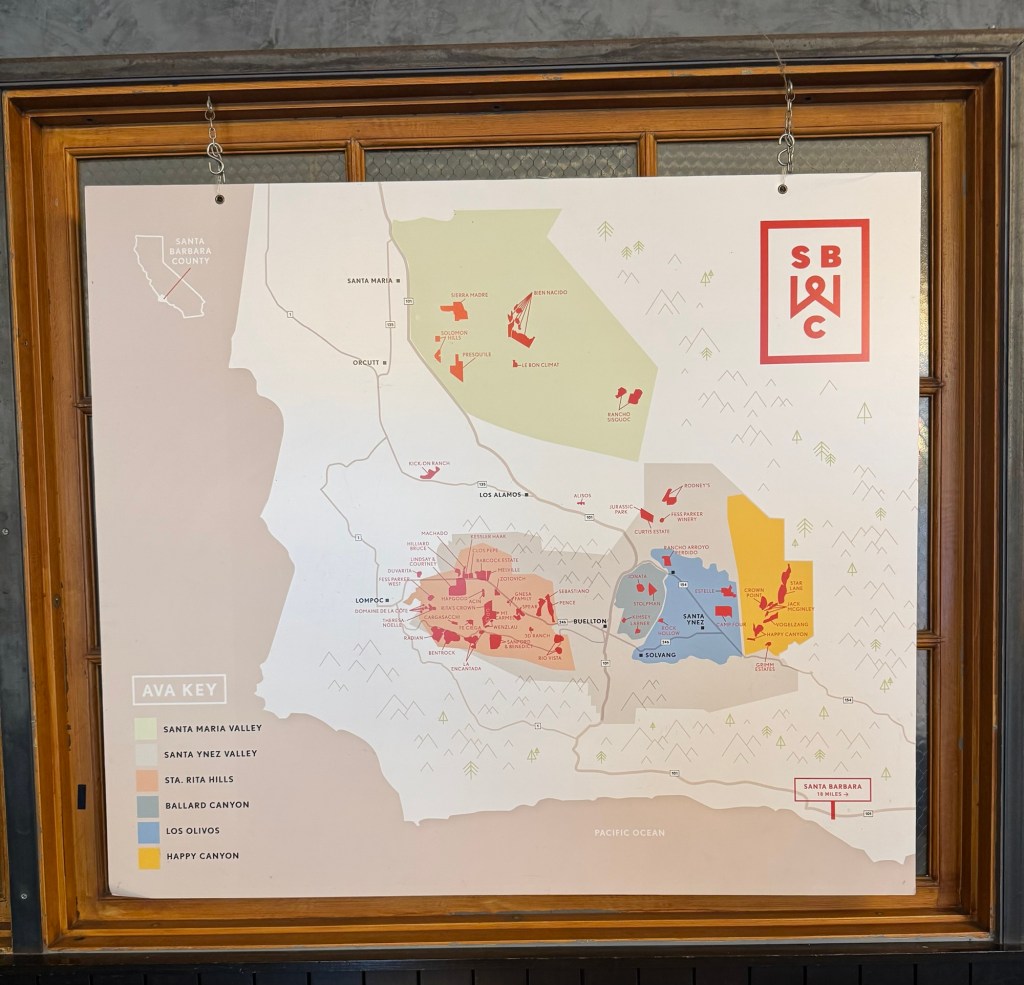
Santa Barbara County is vast: 2,745 square miles. If you smooshed down all the mountains and made it flat it would be even bigger. About a third of that is national forest. The population is small: 441,257 residents. Compare that to Norfolk County, MA, which has 727,473 over 441 square miles, and it doesn’t feel exactly crowded. Santa Barbara County thus is remote. Our wine server got to talking about the Santa Barbara Highlands region, where he said there are many beautiful vineyards, but no tasting rooms, and he recommended packing our own food.

After a siesta and a hot tub soak on the roof of the Californian, dinner was at Holdren’s. Cold martinis, cowboy steak, local red wine, brown leather booths, a classic. Pretty popping for a Tuesday. Sometime I’ll have to try the tasting menu at Barbareño, where the food is inspired by local history and tradition.
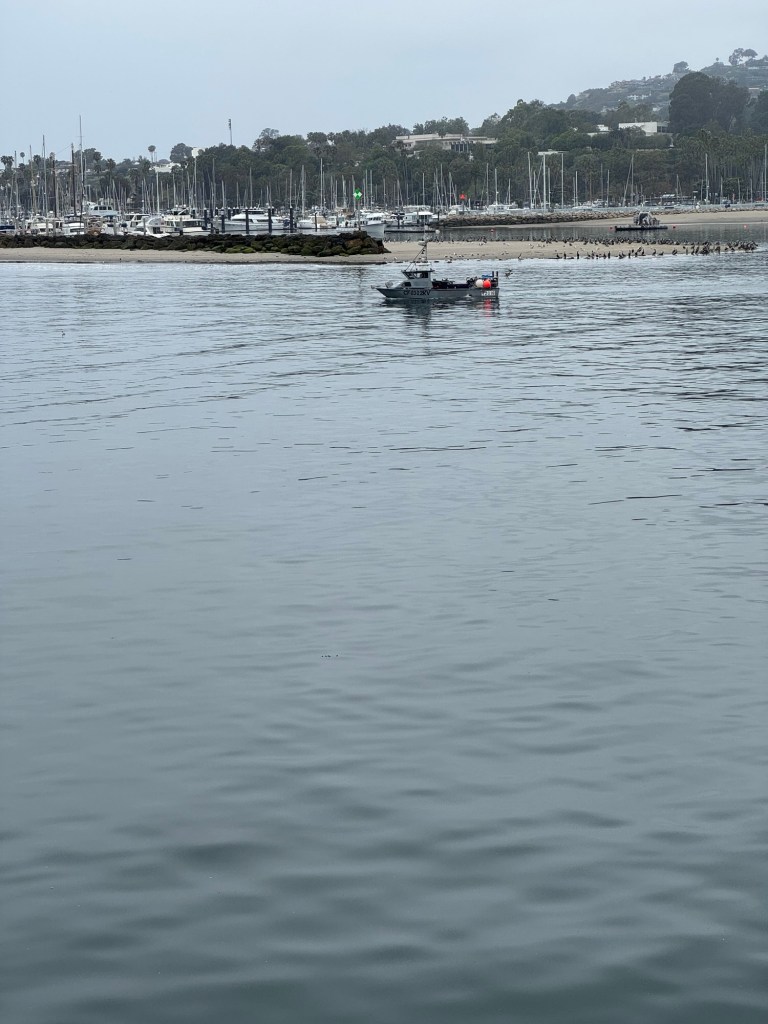
(Always funny to see a fishing boat leaving at like 9:15 am. Aren’t you supposed to be up at at ‘em?)
The next morning, after Helena Avenue Bakery (A+, bakery from a dream) treats we rode the janky hotel bikes up to the mission, just challenge enough along carless State Street with a brief residential detour. The ride’s uphill, revealing another feature of Santa Barbara. The city is tiled slightly to the south, opening to the ocean. This creates, in my opinion, the effect that Santa Barbara can seem “too sunny,” even though it has about the same number of sunny days as LA, and not infrequent Pacific fog. North of the equator the sun just hits harder when a place is south-facing.
These days the mission and the mission period tends to be more associated with the word “genocide” and the crummy outcomes for Mission Indians rather than with romance and grandeur. It wasn’t that long ago they were a draw, consider this old United Airways poster:

That’s Queen of the Missions Santa Barbara right there, apparently circa 1952. These days I don’t think you sell California that way. “Old churches” are like the last thing you’d go see – you’re coming for Star Wars Land and $24 smoothies!
The rose garden is the star of the mission

and the old washing basin.
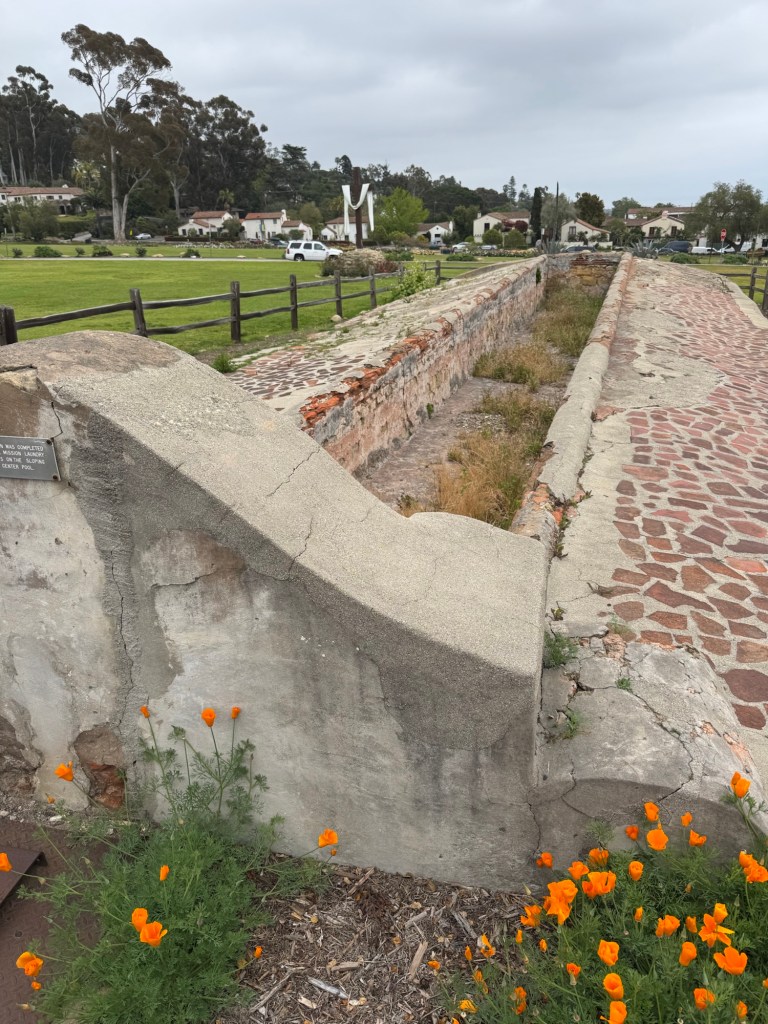
Then it’s downhill, along Garden Street, past the splendid five and six million dollar houses, maintained in style, and to Alice Keck Memorial Garden.

(Wikipedia’s Summerzz took that one.)
Alice Keck was the daughter of William Keck, a Daniel Plainview-grade oil man:
Starting as a penniless roustabout, he rose in the 1920s to found the Superior Oil Company. He pioneered deep offshore drilling, was first to find commercial deposits in the Gulf of Mexico, and practically ran the oil-rich nation of Venezuela. Even in his later years, when a drilling rig brought up a slimy core, old man Keck sniffed and tasted the rock to gauge the prospect.
another:
William Keck then became one of the first oilmen to move his business to Houston, which at the time was not much more than an inadequately drained malarial swamp… William Keck was known throughout the company he had created as “the Old Man”, and people called him that until the day he died. His character was strong and some said it was mean. His political views were fiercely conservative, but he was nimble and innovative when it came to doing business.
(sources for those. Who would guess a book about diamond spikes in the Canadian tundra would be quoted in an article about a California oil man?)
Mean or not, his name lives on in various charitable projects all over Southern California, like Keck Medicine at USC. His company Superior, was swallowed by Mobil which was swallowed by Exxon.
As you cruise down and look out over the water, you can still see oil wells in the Channel. Some of them are in various states of being dismantled, which is a whole project.
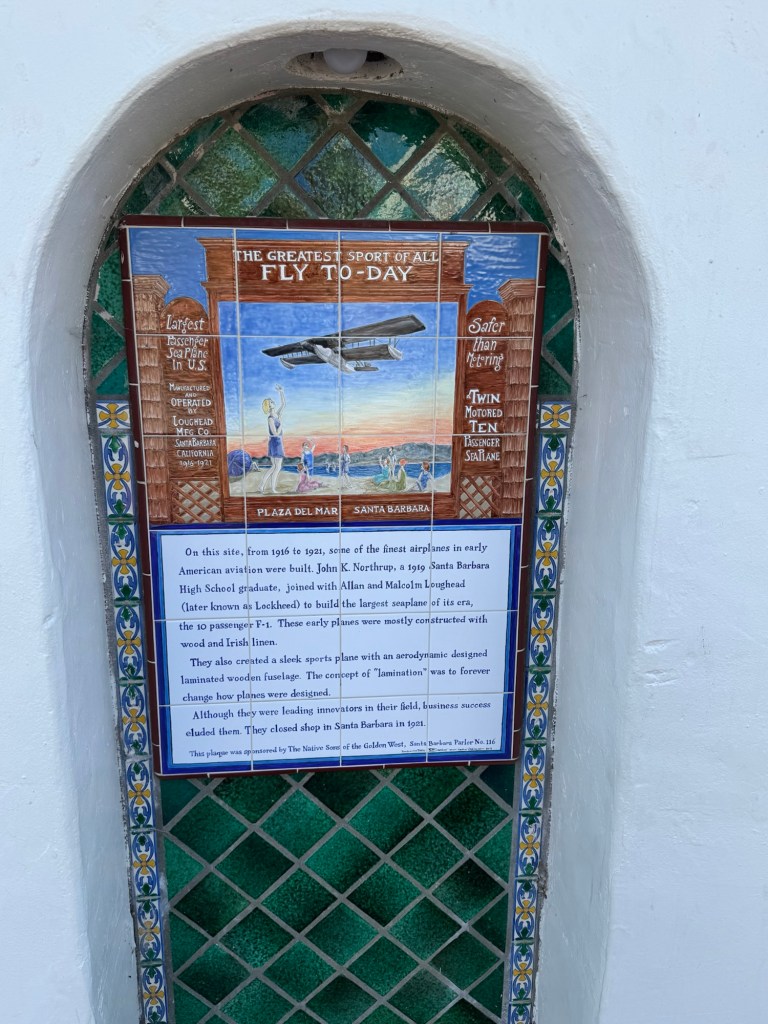
Both Northrop and Lockheed/Loughead were from here? Too big, topic for another day. Were I Pynchon I’d stop here and spend ten years on a 700 page novel about how Santa Barbara is a node of post-Cold War evil?
Before our return we scored some burritos for the train at IV Food Co-Op Downtown Market, and took some oysters and a dry white wine at Bluewater Grill. The server there, from Alabama, used to work in Taos, and gave me some ski reports from across the Rocky Mountain West. She seemed to be part of the class of lovely young people who turn up working at the affluent resort towns of the world. While in Bolivia I met a Chilean who said he’d spent a year in Santa Barbara. “What were you doing,” I asked, “studying?” “No,” he said, “just surfing and skating.” Santa Barbara seems like Heaven for that, if you can make the numbers math out. You’d probably have to live over in the student ghetto lands of Isla Vista, which is arguably a slum, but in a sorta student flophouse way. I have explored over there, though not on this trip, there is indeed something grim about it, but that’s not true Santa Barbara, and not what we’re talking about today.
Geneva’s the only person I know who grew up in Santa Barbara, and whatever she gets paid to write these days we can’t afford it! So we’ll have to do without firsthand accounts from native Santa Barbareños.

With that we were at the old Southern Pacific station for the 1:45pm Pacific Surfliner back to Los Angeles, refreshed and tired, energized and inspired.
This is just the daytripper’s view of Santa Barbara. Someone could make the case I’m missing “the real Santa Barbara,” I’m sure I am. There was a fatal stabbing there the other day, for example. But that’s not what I’m into. I’m after what makes Santa Barbara Santa Barbara. I want to put the place in context for myself, and for you, and to make those 25 hours last a little longer.

The Found Image Press finds these old postcards and reprints them, but without any context, or dates
* fictional
Juicy headline
Posted: February 23, 2025 Filed under: America Since 1945, the California Condition Leave a comment
Picked up a copy of Los Angeles Daily Journal, Orange County Edition, and was intrigued by this story. The evidence seems lopsided:
Anaheim police officers arrested Ferguson at his home in August 2023 after receiving a report of a shooting. Ferguson told officers at the scene and his court clerk via text that he shot his wife, Sheryl, after the couple returned home from dinner, according to affidavits filed in 2023 by Orange County District Attorney Todd Spitzer’s office.
Seeking more information I found this:
The couple’s adult son called 911 to report the shooting. A court filing from prosecutors states Ferguson texted his court clerk and bailiff minutes after the killing: “I just lost it. I just shot my wife. I won’t be in tomorrow. I will be in custody. I’m so sorry.”
…
Earlier that day, Ferguson had been drinking when he argued with his wife about finances during dinner at a local restaurant and later while watching “Breaking Bad” at home with their adult son, said prosecutor Seton Hunt. At one point in the evening, Ferguson made a gun hand gesture toward her, and she later chided him to point a real one at her, Hunt said.
Ferguson proceeded to do so and pulled the trigger, Hunt said.
Just a strange little story in California. Reminded of Hemingway in A Moveable Feast while he’s on a road trip with Scott Fitzgerald:
While waiting for the waiter to bring the various things I sat and read a paper and finished one of the bottles of Macon that had been uncorked at the last stop. There are always some splendid crimes in the newspapers that you follow from day to day, when you live in France. These crimes read like continued stories and it is necessary to have read the opening chapters, since there are no summaries provided as there are in American serial stories and, anyway, no serial is as good in an American periodical unless you have read the all-important first chapter. When you are traveling through France the papers are disappointing because you miss the continuity of the different crimes, affaires, or scandales, and you miss much of the pleasure to be derived from reading about them in a cafe. Tonight I would have much preferred to be in a café where I might read the morning editions of the Paris papers and watch the people and drink something a little more authoritative than the Macon in preparation for dinner. But I was riding herd on Scott so I enjoyed myself where I was.
In the same paper:

I found this phrase vivid:
“We had a phrase in dependency: ‘Clear is kind,” she said. “If you’re clear about what you’re doing, why you’re doing it, and what orders mean, people are more likely to comply.”
Common Side Effects, Sunday Feb 2 11:30pm on Cartoon Network, streaming on MAX Feb 3
Posted: January 31, 2025 Filed under: America Since 1945, drugs, the California Condition Leave a comment
Our attitude towards critics is influenced by the Duke of Wellington, who supposedly didn’t let his troops cheer for him because that meant they could also boo him.
While he is said to have disapproved of soldiers cheering as “too nearly an expression of opinion”,[247] Wellington nevertheless cared for his men
(He did call them the scum of the earth but w/e).
But hey, these reviews are terrific and we must celebrate our wins in a business full of heartbreak. Making a TV show is so difficult and time consuming, Resistance fights the work of art at every stage, very blessed to have worked with this amazing team on this project.
Here is The New York Times. And we’ll take this one:

A treat and a half says Margaret Lyons!

Here’s a funny one, a pharma ad embedded right in there:

(I don’t think the reporter here edited his AI transcript.) Neil Postman would’ve predicted if you made a TV show satirizing pharmaceuticals they would use it to sell pharmaceuticals. In Amusing Ourselves to Death he predicted The Daily Show.
Anyhoo watch, stream, and spread the word, we’ll return to amateur history and digestions here on Helytimes as time permits! I’ve been meeting to write up the Atlanta Cyclorama, where Van Gogh bought his paints and the role of the aluminum tube in art history, Lester Hiatt’s Arguments About Aborigines, Dan Levy’s Maxims For Thinking Analytically, Randall Collins Violence, the Santa Barbara Channel, and more!

The Chumash people of the region have traditionally known Point Conception as the “Western Gate”, through which the souls of the dead could pass between the mortal world and the heavenly paradise of Similaqsa.[4]
It is called Humqaq (“The Raven Comes”) in the Chumashan languages.

Gizmodo interview
Posted: January 25, 2025 Filed under: America Since 1945, the California Condition Leave a comment
As Matt at the office put it, they came out SWINGING with Luigi as the first question:

I declare the event both “upsetting” but also “cool”? Maybe I do need media training. Here’s a link.
Here’s what matters:

Streaming next day on MAX. Is it still called HBO Max in Australia? I know they’ve got Max in Europe and LatAm.
Occurs to me this site has been lax on one of our missions, reporting news from Helys around the world. There’s just too much!
Stuart Spencer (1927-2025)
Posted: January 14, 2025 Filed under: America Since 1945, presidents, the California Condition 2 Comments
I read in The LA Times that Stuart Spencer died. His Miller Center Oral History interview is one of the most vivid on the rise of Ronald Reagan, California, politics in general:
After many discussions with [Reagan], we realized this guy was a basic conservative. He was obsessed with one thing, the communist threat. He has conservative tendencies on other issues, but he can be practical.
When you look at the 1960s, that’s a pretty good position to be in, philosophically and ideologically. Plus, we realized pretty early on that the guy had a real core value system. Most people in my business don’t like to talk about that, but you know something? The best candidates have a core value system. Either party, win or lose, those are still the best candidates. They don’t lose because of their core value system. They lose because of some other activity that happens out there. But the best candidates to deal with, and to work with, are those who have that. A lot of them have it and a lot of them don’t, but Reagan had it.
The power players of Southern California:
Holmes Tuttle was a man of great . . . He was a car dealer, a Ford dealer in southern California and he also had some agencies in Tucson, I think. Holmes was a guy that came from Oklahoma on a freight car. He had no money and he started working—I don’t think he finished high school—for a car dealership, washing cars, cleaning cars. He’s a man of tremendous energy, tremendous drive and strong feelings—which most successful businessmen have—about how the world should be run, how the country should be run as well as how their business should be run and how your business should be run. They’re always tough and strong that way. That was Holmes’ background.
In the southern California—I won’t say California because we have two segments, north and south—framework of the late ’30s and the ’40s, there were movies made about a group. I can’t remember what they were called, but there were 30 of them. In this group were the owner and publisher of the L.A. Times, the [Harry] Chandler family top business guys, Asa Call of what is now known as Pacific Insurance. It was Pacific Mutual Insurance then, a local company. Now it’s a national company. Henry Salvatori, the big oil guy; Holmes; Herbert Hoover, Jr.; the Automotive Club of Southern California; that type of people, they ran southern California. They had the money. They had the mouth, the paper. They ran it. [William Randolph] Hearst was a secondary player. He had a paper, but he was secondary player. He wasn’t in the group. Hearst was more global.
These guys worried about everything south of the Tehachapi Mountains. That’s all they worried about. They worried about water. They worried about developments. They’ve made movies about that. Most of it’s true. The Southern Pacific was the big power player, but these guys were trying to upset the powers of the Southern Pacific to a degree. Holmes Tuttle came out of that power struggle, that power group.
He was a guy who would work hard. Asa Call was the brains. Holmes was the Stu Spencer, the guy that went out and made it happen. He was aggressive and he played a role. He started playing a role in the political process in the ’50s, post Earl Warren. None of these guys were involved with Earl Warren to any degree. But after Earl Warren and Nixon, they were players there. They never were in love with Nixon, but they were pragmatic. The Chandlers were in love with Nixon, and a few others, but with these bunch of guys, Ace would like Nixon. Holmes was the new conservative and Nixon was a different old conservative.
There were little differences there. Holmes emerged in the new conservative element and was heavily involved in the Goldwater campaign of ’64. Of course that’s a whole ’nother story. When Nixon went down the tube all of a sudden—it was lying there latent in the Goldwater movement and they were waiting for Nixon to get beat and when he did [sound effect]—here they were up in your face.
Reagan was the first legitimate person that Holmes was absolutely, totally, in synch with, and who he totally loved.
On Ron and Nancy:
Here’s an important point in my story. We met with the Reagans. The Reagans are a team politically. He would have never made the governorship without her. He would have never been victorious in the presidential race without her. They went into everything as a team.
It was a great love affair, is a great love affair. Early on I thought it was a lot of Hollywood stuff. I really did. I could give you anecdotes of her taking him to the train when he had to go to Phoenix because they didn’t fly in those days, or to Flagstaff to do the filming of the last segments of that western he was doing. We’d be in Union Station in L.A. at nine o’clock at night. They’re standing there kissing good-bye and it goes on and it goes on and it goes on. I’m embarrassed and I’m saying,
Wow.It was just like a scene out of Hollywood in the 1930s, late ’30s, ’40s. I tell you that, but then I tell you now twenty-five, thirty, forty years later, whatever it is, it was a love affair. It was not Hollywood.At that time I thought, oh, boy. It’s not only a partnership, it’s a great love affair. She was in every meeting that Bill and I were at with Reagan, discussing things, us asking questions, with him asking us questions. The curve of her involvement over the years was interesting because she was in her 40s then probably. She always lied about her age so I can’t tell you exactly, but she was somewhere around 45, I’d guess. She was quiet. With those big eyes of hers, she’d be watching you. Every now and then she’d ask a question, but not too often.
As time went on—I’m talking about years—she grew more and more vocal. But she was on a learning curve politically. She learned. She’s a very smart politician. She thinks very well politically. She thinks much more politically than he thinks. I think it’s important that Ronald Reagan and Nancy Reagan were the team that went to the Governor’s office and that went to the White House. They did it together. They always turned inward toward each other in times of crisis. She evolved a role out of it, her role. No one else will say this, but I say this: she was the personnel director.
She didn’t have anything to do with policy. She’d say something every now and then and he’d look at her and say,
Hey, Mommy, that’s my role.She’d shut up. But when it came to who is the Chief of Staff, who is the political director, who is the press secretary, she had input because he didn’t like personnel decisions. Take the best example, Taft Schreiber, who was his agent out at Universal for years, and Lew Wasserman. After we signed on, Taft was in this group of finance guys and he said to me,Kid, we’ve got to have lunch.I had lunch with Taft and he proceeded to tell me,
You’re going to have to fire a lot of people.I said,What do you mean?He said,Ron—meaning Reagan—has never fired anybody in his life.He said,I’ve fired hundreds of people. He’s never fired anybody.I laughed. I said to myself, Taft’s overstating the case. Taft was right. I fired a lot of people after that.Reagan hated personnel problems. He hated to see differences of opinion among his staff. His line was,
Come on, boys. Go out and settle this and then come back.You’re going to have a lot of that in politics. You’re going to have a lot of that in government. That’s what makes the wheels go round. It doesn’t mean that they’re not friends or anything. They have differences of opinion, but Reagan didn’t like that too much, especially over the minutia, and it usually happens over the minutia.
The sum total of Reagan:
The sum total of him is simply this: here’s a man who had a basic belief, who thought America was a wonderful, great country. I don’t think you can go back through 43 Presidents and find a President of the United States who came from as much poverty as Reagan came from; income-wise, dysfunctional families. I can’t quite remember where [Harry] Truman came from, but you’re not going to find one.
This guy came from an alcoholic family, no money, no nothing. He was a kid who was a dreamer. He dreamed dreams and dreamed big dreams and went out to fulfill those dreams with his life and he did it. As he moved down his career and got really involved in the ideological side of the political spectrum, which is where he started, he had real concerns about all this leaving us because of communism.
You look back—some of it sounds a little silly—but at the time there was perceived all kinds of threats, all over the world about communism moving into Asia, moving into Africa. That was the driving force behind his political participations. It was the only thing that he really thought about in depth, intellectualized, thought about what you can do, what you can’t do, how you can do it.
With everything else, from welfare to taxation, he went through the motions. Now, this is me talking, but every night when he went to bed, he was thinking of some way of getting [Leonid Ilyich] Brezhnev or somebody in the corner. He told me this prior to the beginning of the presidency. Because I asked questions like, What the hell do you want this job for?
I’d get the speech and the program on communism. He could quote me numbers, figures. He’d say, We’ve got to build our defenses until they’re scary. Their economy is going down and it’s going to get worse. I’m simplifying our discussion. He watched and he fought for defense. God, he fought for defense. He cut here, he cut there for more defense. He took a lot of heat for it. All the time he delivered, in his mind, the message to Russia, we’re not going to back off. We’ll out-bomb you. We’ll out-do everything to you.
His backside knew that we have the resources, this country has the resources and the Russians don’t. If they try to keep up with us defensively, they’re going to be in poverty. They’re going to be economically dead and an economically dead country can only do one of two things, either spring the bomb or come to the table. He was willing to roll those dice because he absolutely had an utter fear of the consequences of nuclear warfare.
Again he was lucky. He couldn’t deal with Brezhnev. He was over the hill and out of it. [Yuri Vladimirovich] Andropov was gone, dead. Reagan lucked out. In comes this guy [Mikhail] Gorbachev who was smart enough to see the trend in his own country. He started talking with Reagan about cutting a deal. That’s what it got down to. In that context Reagan was very benevolent. He was willing to give up a lot. If this guy was serious and willing to go down this road, he was willing to give up things to get the job done, which was to get rid of the cold war. To him the cold war was the threat of nuclear holocaust in this country and other countries.
That was a dream that he had before he was in the presidency. These words I’m giving you and interpreting for you were given to me prior to his election to the presidency. If you do a lot of research, you’ll see that he was always asking questions of the intelligence people, What’s the state of the economy in Russia? He must’ve had a Dow Jones bottom line in his mind—what he thought it was going to take to do it—because he always knew how many nukes we had and where they were. He was really into this.
Young
Does that mean that Reagan was a visionary?
Spencer
I don’t know. He was a dreamer. He was a dreamer. He dreamed that he was going to be the best sportscaster in America, that he was going to be one of the better actors in Hollywood. You know he got tired of playing the bad guy alongside Errol Flynn, who got the women all the time. But he still dreamed big dreams. That’s the way he was.
On Reagan’s interpersonal style:
Young
He was good at communications obviously. How was he at working the room with politicians?
Spencer
Terrible. Ronald Reagan is a shy person. People don’t understand this. He was not an introvert. Nixon was almost an introvert and paranoid. That’s a bad combination. Reagan was shy. People who I met through the years said to me,
I saw President Reagan at this,orI saw President Reagan one-on-one, two or three people in the Oval Office,or something. He never talked about anything substantive. He just told jokes.Ronald Reagan used his humor and his ability to break the ice. He wasn’t comfortable with you and you coming in the Oval Office with strangers and talking.
Number one, he’s not going to tell you about what he’s doing. He doesn’t think it’s any of your damn business. Secondly, he’s not comfortable and so he uses his humor. He can do dialects. I mean the Jewish dialect, a gay dialect. He can tell an Irish ethnic joke. The guy was just unbelievably good at it and he’d break the ice with it. You’d listen to him. But if you were that type of person, you’d walk out of there and you’d say,
What the hell were we talking about? He didn’t tell me anything.“
The Reagans had very few friends:
The Reagans never had a lot of friends. I cannot sit here today and tell you of a good, close, personal friend. They had each other and a lot of acquaintances. Maybe Robert Taylor was, maybe Jimmy Stewart was, some of those people. Maybe Charlie Wick and his wife, but other than that, I don’t know of any that they had. The Tuttles? They were not what you’d call close friends of theirs. They did things together but . . . it was he and Nancy.
An aside on Jimmy Carter:
The primary campaign for Jimmy Carter, 1976, was one of the best campaigns I’ve ever seen in my lifetime. They did an outstanding job. The guy in January was nine per cent in the polls in terms of his name ID. He ends up getting the nomination. Lots of things had to go right for them. Lots of breaks they had to get, breaks that they didn’t create, but they got them.
All that considered, the primary campaign was just an outstanding one. It was a lot of Jimmy Carter’s effort. He worked his tail off. Things kept setting up for him. The Kennedys kept vacillating and going this way and that. Everything kept setting up for him. They ran an outstanding campaign.
They had problems in ’80 because issues caught up with them. Their governance was not as good as their ability to run, which happens. I attribute most of it to his micromanagement. All of the Reagan people learned a lot from watching that because we had the opposite. [laughs]
The whole thing is great, on Bush, Dan Quayle, Clinton, Thatcher, it’s like 129 pages long.
Two items to note from the obituary, by Mark A. Barabak:

and:

Spencer voted third party in 2016, for Joe Biden in 2020 and for Kamala Harris in 2024.
Some final advice from Spencer:
Finally I gave some major paper interview. It was on the plane. Marilyn [Quayle] was there and Dan Quayle was there. I was here and the press guy was here. The press guy starts out kind of warm and fuzzy and he says,
Who are your favorite authors?He looks at Marilyn, and he says,Who are my favorite authors?Oh, God.The second question is something about music. My position is, if you really haven’t thought about it in your own life, about who your favorite authors are, you can always say [Ernest] Hemingway. There are some names out there that you can use. If it’s music, you can say the Grateful Dead. Say anything you want to and think about it afterwards.
I was wrong, I like this guy better.
Did not love this vibe
Posted: January 13, 2025 Filed under: the California Condition Leave a comment
Nor
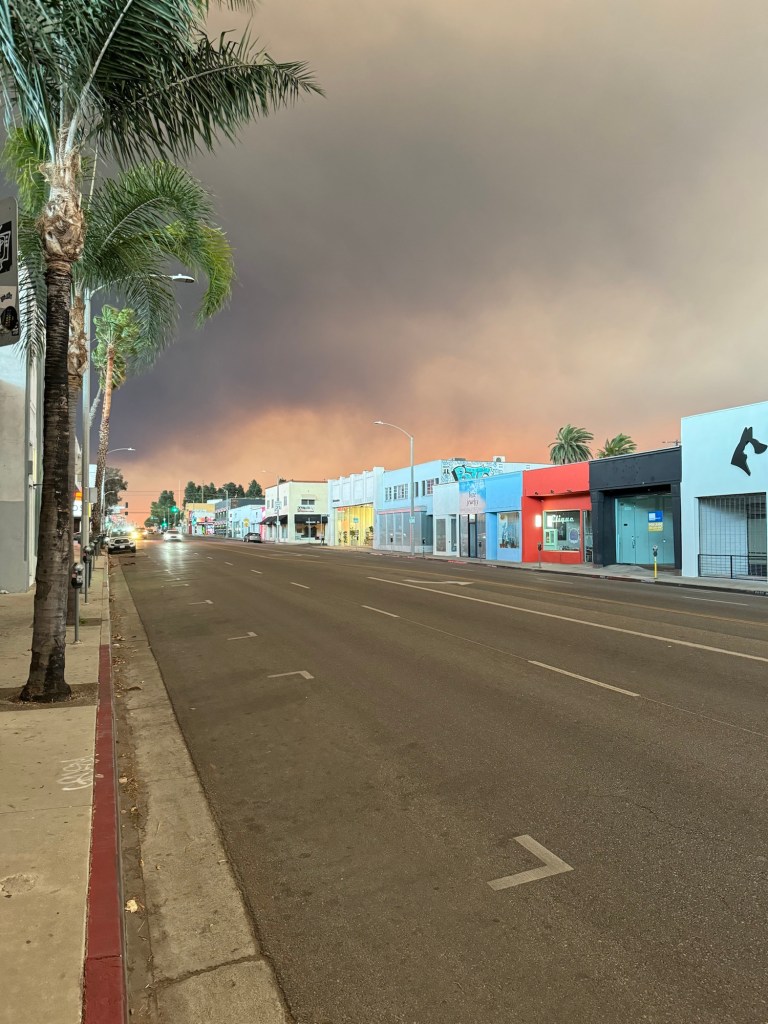
Today the air is perfect! There is the National Weather Service declaring the PDS however:

Edge case
Posted: January 11, 2025 Filed under: the California Condition Leave a commentJust after 5:30 pm Thursday, on a walk, with daughter strapped to me, relieved the worst is over. We round the corner to Fairfax and see Runyon Canyon on fire.
Like a volcano erupting. It looks like Vesuvius I thought, and then I realized I’d never seen Vesuvius except in illustrations. Maybe painted in the wall of an Italian restaurant? Or is that Mount Etna? Was I thinking of my dad describing Mount Etna?
I’d been on a smoking volcano in Guatemala (or was it Nicaragua? We roasted marshmallows) but had I ever seen one glowing?
The plaster casts of dead people in Pompeii, those I had seen, in National Geographic probably. I did not wish to become one. Time to pack.
The LA as I understood it as a youth in Massachusetts, the sense of LA, before I’d ever been there: convertibles palm trees swimming pools, soulless, “shallow.” Frequent natural disasters. The LA riots, the LA Lakers, both were viewed in Boston with fear, confusion, distress, upset, disquiet.
Imagine my surprise when I moved there for a job and loved it. It was like the famous story from Hockney:

The Los Angeles basin is so blessed, sunny almost every day, warm, rarely too hot. The beach, the mountains. When I arrived it was cheap, believe my rent was $900 for my own comfy place, walkable to LACMA and the tar pits and the movies, many bars and more restaurants and food stands than I could try. And the people! You could ask someone what they were up to and they’d say I’m developing.
California is on the edge, edge of the country, edge of the continent, edge of what’s acceptable, edge of politics, technology, edge of destruction. It’s all moving. You can’t expect it to stay.
The deadliest natural disasters in LA history are floods. The St Francis dam disaster, if you count that as “natural.” Six hundred some people washed to sea. The 1938 flood. The river’s in that ugly concrete basin to keep floods contained. Last couple winters when the atmospheric rivers came there were many days when you could see why.
Back from my walk we watched the TV news. TV news: that’s a way to see LA and a way LA sees itself. The scale of LA first showed itself to me when I watched TV news and saw OJ’s Bronco.
Everybody’s been telling each other to stay safe. Stay safe! It’s like, ok! But what can you do? It’s like asking “how was your flight?”
Later that night I observed dense traffic on Fairfax as evacuees drove south. Though it was close to “bumper to bumper” there was no honking and it seemed like very little unpleasantness. Tension, sure, but people weren’t taking it out on each other. Reminded of Orwell’s quote: when it comes to the pinch, human beings are heroic. There are scattered tales of looters and opportunistic thieves on TV, but almost everyone is looking for ways to be helpful.

What’s the play? We must watch ourselves that capitalism doesn’t zombify our humanity like a cordyseps on an ant. (Also: “almost inevitable”? bad writing and thinking. Also inaccurate LA is HUGE it’s not gonna ALL burn down).
Nithya was ahead, warning about the wind event. See here for more on the local spooky winds. There’s a whole literature. It consists of a couple lines of Chandler reprinted by Didion (LA literary history in a nutshell).
Some remarks in the news etc make me wonder if everyone comprehends the scale of Los Angeles. It’s quite vast. The Palisades Fire and the Altadena fire are about twenty five miles apart, on a straight line, for example. Here’s Massachusetts overlaid on Los Angeles:

(Is that helpful?) I guess my point is there’s like one fire that’s in like East Boston and one that’s in like Framingham. The Sunset fire, my Vesuvius, now out, would be in I dunno Newton? Very different experiences that in the news may be lumped together as “LA.” Reminded me of when Bronson of Scarsdale, NY was in Tennessee and people asked him if 9/11 affected him. Yes, but it’s not like next door.

This is a faulty comparison as almost all of both the Palisades and Eaton fires are happening in national forest/recreation area or other wildlands, not built up areas.
Three good friends have lost their homes in Palisades. I was impressed with their reactions. Stoic humor. Cool. Several friends and friendlies have lost homes in Altadena. Displacement high, anxiety high, lots of friends in hotels or friends’ houses or had to leave for a scary night and come back. Dogs in hotels, people evacuating horses. Overall disturbance and on-edge-itude are at high. On Monday the biggest problem in LA was housing. Now there are 10,000 fewer places to live and +10,000 (?) more homeless people.

Smoke east, smoke west. Inhaling smoke from wildfires is bad for you, I’ve seen the studies. Burnt houses and cars and asbestos and drywall, melted Emmys. Imagine the horrible particulates. Walking around was giving me a small headache. But what’s the point in reading scary articles, I gotta breathe something.
You know when you light a candle? Most of the smoke and scent comes when you blow it out.

West down Melrose, towards Palisades fire.
Friends dear and distant have reached out, from Australia and Sweden and Japan and Texas, New York, Massachusetts. We’re fine for now. Resisting leaving town. That feels like abandoning ship. If we were gonna leave we would take a treasured painting of a dog, Johnathan. Taking Johnathan off the wall felt like taking down the American flag.
It keeps seeming over and people have written their eulogies, but we consider this an update from the ongoing catastrophe/circus/intermittent paradise that is LA!
Here’s one by Piranesi, from the Fantastic Ruins show :

Lonely California slough
Posted: November 30, 2024 Filed under: the California Condition Leave a comment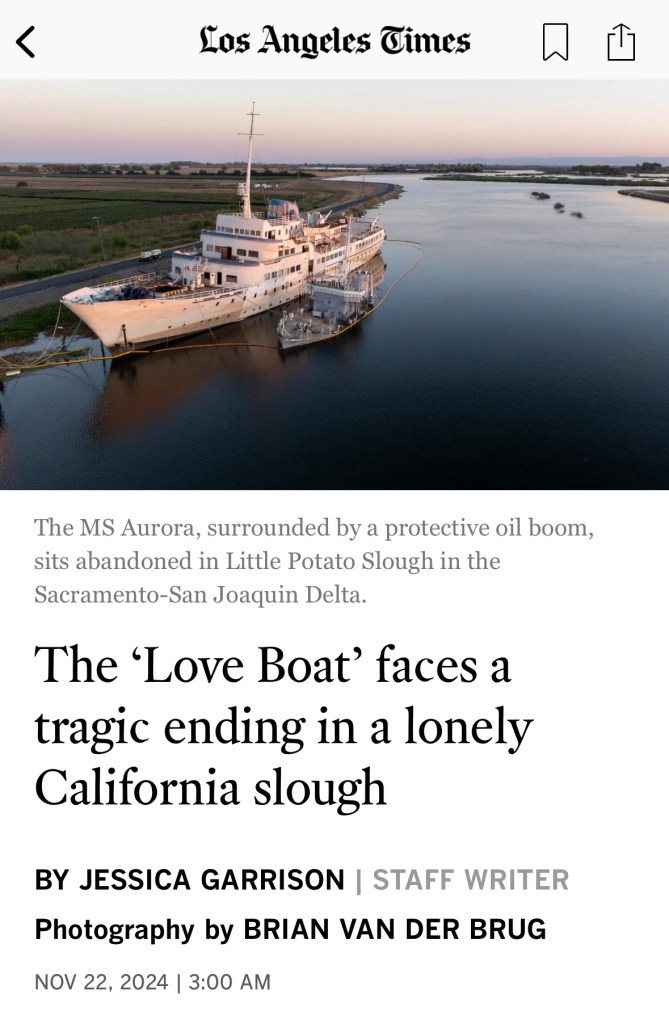
Norms
Posted: November 30, 2024 Filed under: the California Condition, Uncategorized Leave a commentI read that Norms on La Cienega, a classic LA diner, may be replaced by a Raising Cane’s.
This Norm’s is the subject of a famous painting by Ed Ruscha:

I asked different AIs to generate some versions of this painting if it were a Cane’s instead of a Norm’s.


From The LA Times:

Ballot
Posted: October 29, 2024 Filed under: the California Condition 2 Comments
Donald Trump is pure toxicity, he tried half-seriously to end the peaceful transfer of power, he’s beyond unacceptable. We endorse native daughter of the Golden State Kamala Harris and hope that a special Providence continues to look after children, drunks, and the United States.
I put this together for my own use, perhaps it is useful to you, much cribbed from The LA Times. I’ll be voting in person in a few days so feel free to make a strong case I am open to persuasion on city, state and county measures.
Community College, Seat 1: Andra Hoffman
Community College, Seat 3: David Vela
Community College, Seat 5: Nichelle Henderson
Community College: Seat 7: Kelsey Iino
US Rep: Laura Friedman
City Measure DD: Yes
City Measure HH: Yes
City Measure II: Yes
City Measure ER: Yes
City Measure FF: Yes (on the fence here, it’s expensive, but I go with Mayor Bass)
City Measure LL: Yes
Uni Measure US: Yes
District Attorney: Nathan Hochman (both bad options here, voting to express disgust.)
It makes me a little mad that I have to vote for judges. I found this helpful.
Judge No 39: Steve Napolitano
Judge No. 48: Ericka Wiley (I don’t see anything wrong with Renee Rose)
Judge No. 97: Sharon Ransom
Judge No. 135: Steven Yee Mac (nothing wrong with Georgia Huerta)
Judge No. 137: Tracey Blount
County Measure G: Yes
County Measure A: Yes
My inclination is to vote against any state ballot propositions, it’s part of why our state is so wacky, but we exist within a context of everything that came before, so vote we must:
State Measure 2: Yes
State Measure 3: Yes
State Measure 4: Yes
State Measure 5: Yes
State Measure 6: Yes
State Measure 32: No
State Measure 33: No
State Measure 34: Yes (LA Times disagrees here)
State Measure 35: No
State Measure 36: No
(source on that photo)
Slam on California
Posted: September 24, 2024 Filed under: the California Condition Leave a comment
At the end of July 1914, Rupert Brooke, alarmed by the heightening European crisis, wrote to his friend Edward Marsh, “And I’m anxious that England may act rightly.” But what did it mean to “act rightly”? Another letter, a few days later, in which Brooke described an outing into the countryside, hinted in a general way at his own response to this question:
I’m a Warwickshire man. Don’t talk to me of Dartmoor or Snowden or the Thames or the lakes. I know the heart of England. It has a hedgy, warm bountiful dimpled air. Baby fields run up and down the little hills, and all the roads wiggle with pleasure. There’s a spirit of rare homeliness about the houses and the countryside, earthy, unec-centric yet elusive, fresh, meadowy, gaily gentle.. Of California the other States in America have this proverb: “Flowers without scent, birds without song, men without honour, and women without virtue” — and at least three of the four sections of this proverb I know very well to be true. But Warwickshire is the exact opposite of that. Here the flowers smell of heaven; there are no such larks as ours, and no such nightingales; the men pay more than they owe; and the women have very great and wonderful virtue, and that, mind you, no means through the mere absence of trial. In Warwickshire there are butterflies all the year round and a full moon every night…
Shakespeare and I are Warwickshire yokels. What a country!’
Aware of his sentimentality he went on to say, “This is nonsense,”
North Hollywood flooded, 1938
Posted: September 23, 2024 Filed under: the California Condition Leave a comment
I found that here, it’s at the UCLA Digital Collection.
In the early 19th century, the river turned southwest after leaving the Glendale Narrows, where it joined Ballona Creek and discharged into Santa Monica Bay in present Marina del Rey. However, this account is challenged by Col. J. J. Warner, in his Historical Sketch of Los Angeles County:
“…until 1825 it was seldom, if in any year, that the river discharged even during the rainy season its waters into the sea. Instead of having a river way to the sea, the waters spread over the country, filling the depressions in the surface and forming lakes, ponds and marshes. The river water, if any, that reached the ocean drained off from the land at so many places, and in such small volumes, that no channel existed until the flood of 1825, which, by cutting a river way to tide water, drained the marsh land and caused the forests to disappear.”
San Francisco (and California) Politics
Posted: September 15, 2024 Filed under: California, San Francisco, the California Condition Leave a comment
When former Assembly Speaker Antonio Villaraigosa lost a campaign to become mayor of Los Angeles in June, then-Speaker Robert Hertzberg named him to the California Medical Assistance Commission, where he could earn $99,000 a year, plus benefits, working a few hours each month.
Former Assemblyman Richard Alatorre, D-Los Angeles, who served in the legislature with Senate President Pro Tem John Burton in the 1970s, was out of public office and the target of a federal corruption probe two years ago when Burton placed him on the Unemployment Insurance Appeals Board. His salary: $114,180 a year plus benefits.
from SF Gate, 2002.
Assembly Speaker Willie Brown, continuing his rush to hand out patronage jobs while he retains his powerful post, has given high-paying appointments to his former law associate and a former Alameda County prosecutor who is Brown’s frequent companion.
Brown, exercising his power even as his speakership seems near an end, named attorney Kamala Harris to the California Medical Assistance Commission, a job that pays $72,000 a year.
Harris, a former deputy district attorney in Alameda County, was described by several people at the Capitol as Brown’s girlfriend. In March, San Francisco Chronicle columnist Herb Caen called her “the Speaker’s new steady.” Harris declined to be interviewed Monday and Brown’s spokeswoman did not return phone calls.
Harris accepted the appointment last week after serving six months as Brown’s appointee to the Unemployment Insurance Appeals Board, which pays $97,088 a year. After Harris resigned from the unemployment board last week, Brown replaced her with Philip S. Ryan, a lawyer and longtime friend and business associate.
Last week, Brown also appointed Janet Gotch, wife of retiring Assemblyman Mike Gotch of San Diego, to the $95,000-a-year Integrated Waste Management Board, which oversees garbage disposal in California.
from Los Angeles Times, 1994. In fairness sitting through those hearings is probably very boring!
The story goes that in 2015 Gavin Newsom and Kamala Harris, maybe encouraged by various Democratic fundraisers and power brokers, cut a deal where she would run for Senate and he would run for Governor in 2018:
The early-2015 understanding between the two San Francisco Democrats, both with campaigns managed by the same San Francisco political consulting firm, was this: To avoid a brutal fight over the Senate seat being vacated by the retiring Barbara Boxer, Newsom would stay out of the 2016 Senate race and concentrate on running for governor two years later.
A LA Times article about the story that Gavin Newsom might be unhappy with subsequent developments (it’s not over yet Gavin!) led me to this 2015 article about why San Francisco has produced so many prominent state leaders. It’s a question we’ve pondered before:
There is nothing mysterious about San Francisco’s export of high-profile politicians, nothing like the alchemy of air and water that produces the distinctive tang of its signature sourdough bread.
Simply put, it’s fierce competition, at virtually every level, starting with the leadership of its political clubs and spreading to the lowliest contests for elected office on up to races for the Legislature and Congress.
Where San Diego and Los Angeles lie back, most of their residents scarcely interested in politics, San Francisco leans in: chin out, elbows wide and sharp.
“There is a culture here of fighting over just about everything in the public space,” said Eric Jaye, another of the city’s veteran political strategists, from global issues like the Middle East to protecting the neighborhood coffee shop from an onslaught of franchised beans….
from earlier in the same piece (by Mark Z. Barabak):
San Francisco is the closest thing to an East Coast enclave set along the Pacific, a place, like New York or Boston, where politics is a passion, a sport, something everyday people fuss and fight and scheme over.
As blue (politically) as San Francisco Bay, the city has 27 officially chartered Democratic Party chapters, among them the Raoul Wallenberg Jewish Democratic Club, the Filipino American Democratic Club, the Black Young Democrats of San Francisco and the Harvey Milk LGBT Democratic Club. That works out to roughly one party franchise every few blocks.
There are countless more neighborhood councils, civic associations, interest groups — branches of the Sierra Club, the NAACP and the like — all clamoring for their particular agendas.
“It’s a city where people have always been able to be loud and proud about who they are, not just as individuals but as a group or a community,” said Ace Smith, a Democratic strategist who has decades of experience running San Francisco campaigns.
The result is a kind of hyper-democracy and political forge that has fashioned some of California’s most powerful and enduring elected leaders, in numbers far out of proportion to the city’s relative pint size.
A very short history of California’s politics might go something like this: California wanted to get into the union without going through the territorial stage, so they sorta rushed through a constitutional convention (John Sutter himself was there). In the compromise of 1850, one of the deals involving slave and free states, California got brought in. The US wanted a lock on that gold. During the Civil War California stayed in the Union (barely). After the Civil War, the major power in the state was the railroad barons, the Big Four, who were so powerful that they provoked a progressive, democratic backlash, personified by Hiram Johnson.

(He looks like Dwight Shrute, no?)
Here’s Reagan’s guy Stuart Spencer talking about Hiram:
They didn’t do a lot of candidate work, but they did a lot of what we call proposition work in California. Under the reforms of Hiram Johnson, we were a unique state at that time. We were for years. You could put practically anything on the ballot and have it decided there instead of the legislature.
You can also read Leon Panetta, who began as a Republican but became a prominent Democrat, talking about Hiram:
I was raised in a progressive Republicanism that used to be the case in California. It began with Hiram Johnson. It was a tradition that was carried on by people like Earl Warren and Tom Kuchel, whom I worked for, and Goodwin Knight and others. Because of cross filing, because of the traditions of California.
As a result of all this balloting California politics gets pretty complicated. Our state constitution is 76,930 words long. Novel length. (Although it’s not even close to the length of the longest, which is…. can you guess it?….
Alabama, at over 402,000 words. Gotta look into how that came to be. Seems to be because it makes a lot of specific rules for specific municipalities.)
At the moment we’re a one party state, probably because the second to last Republican governor, Pete Wilson, made his big issue immigration (anti). He actually won big on that, with Proposition 187 in 1994. The voters went for that in a big way, but it then got tied up in the courts, and the next Democratic governor, Grey Davis, stopped pursuing the implementation.
Noting a rapid increase in the number of Latinos voting in California elections, some analysts cite Wilson and the Republican Party’s embrace of Proposition 187 as a cause of the subsequent failure of the party to win statewide elections.
California today is maybe 26% immigrants. The most recent Republican governor was an immigrant. He won after Grey Davis was recalled (a Hiram Johnson reform). We might be tempted to treat that election as a special circumstance, as he was famous movie star Arnold Schwarzenegger, but then again another famous movie star, Ronald Reagan, had been elected governor before. And George Murphy had been elected senator. Do you need a certain glam quality to succeed in California politics?
Two Californians have become president, although only one, Nixon, was born in California. A third Californian and second native born Californian has a real good shot right now. We’re rooting for her!
Spantsa / Olive Oatman
Posted: September 14, 2024 Filed under: the American West, the California Condition Leave a comment
OTLTA is a new acronym I’d like to get going. It stands for “one thing led to another.” Here it is in context: OTLA and I’m reading about captivity narratives of the American West. Accounts by white people who were captured or taken in by native tribes.
Captivity narratives are a whole serious category of study for academic historians. I’d fear to get over my skis here. There were commercial and political incentives to make these narratives as lurid as possible. How much to trust any one account is a historical puzzle. But, we love those.
Take for example Olive Oatman. When she was fourteen she was traveling with her family, who were Brewsterites, an splinter group of Mormons. Their intended destination was Yuma, Arizona, on the Colorado River. On Saturday, March 8, 1851, some eighty miles east of Yuma, they encountered some Yavapai people. (Already we need a footnote: were they really Yavapai? There are papers on this topic.) Everyone in the party was killed except Olive and her younger sister Mary Ann.
The Yavapai kept them but eventually traded them to some Mohave people.

Mary Ann did not survive.
After about four years among the Mohave, the post commander at Fort Yuma, on the California side, heard about a white woman living out there and sent word that he’d like her back.

We pick up the rest from Wikipedia:
Inside the fort, Olive was surrounded by cheering people.
Olive’s childhood friend Susan Thompson, whom she befriended again at this time, stated many years later that she believed Olive was “grieving” upon her forced return because she had been married to a Mohave man and had given birth to two boys.
Olive, however, denied rumors during her lifetime that she either had been married to a Mohave or had been sexually mistreated by the Yavapai or Mohave. In Stratton’s book, she declared that “to the honor of these savages let it be said, they never offered the least unchaste abuse to me.” However, her nickname, Spantsa, may have meant “rotten womb” and implied that she was sexually active, although historians have argued that the name could have different meanings.[5]: 73–74 [19]
from Violent Encounters: Interviews on Western Massacres (University of Oklahoma Press), by Deborah and Jon Lawrence, an interview with Margot Mifflin, an associat professor of English at Lehman College of the City University of New York who also directs the Arts and Cultire program at CUNY’s Graduate School of Journalism (“Her interest in tatoo art let to her work on the life of Olive Oatman.”):


History, getting towards the source, remains an engaging pastime.
I’ve been to a lot of California but I’ve never had the chance to visit Winterhaven, where we’d find the site of Fort Yuma. If I’m there I will surely check out the Museum of History in Granite:

Amazing if in four millennia the United States and the French Foreign Legion are remembered in equal proportion.
(User Kirs10 took that photo of the pyramid)
Conversations with Grant
Posted: September 7, 2024 Filed under: the California Condition, War of the Rebellion Leave a comment
After his Presidency Ulysses Grant took an around the world tour with his wife and the diplomat, librarian and scholar John Russell Young, who took notes on the trip and published them in a book.
The trip as recorded by Young is interesting but much of it was written for an audience that would never travel overseas. It was a ponderous, two-volume tome of over 1,300 pages with 800 engraved illustrations.
The good folks at Big Byte Press have taken the juiciest parts and compiled them into Conversations With Grant. (Note that this version does not include the famous conversation with Bismarck). I could spend a while with their various reprints of historical memoirs for Kindle. What a service. Here are some items we learn:
after the end of the Civil War, Grant wanted to keep going and invade Mexico:
“When our war ended,” said General Grant, “I urged upon President Johnson an immediate invasion of Mexico. I am not sure whether I wrote him or not, but I pressed the matter frequently upon Mr. Johnson and Mr. Seward [Secretary of State, William Seward]. You see, Napoleon in Mexico was really a part, and an active part, of the rebellion. His army was as much opposed to us as that of Kirby Smith. Even apart from his desire to establish a monarchy, and overthrow a friendly republic, against which every loyal American revolted, there was the active co-operation between the French and the rebels on the Rio Grande which made it an act of war. I believed then, and I believe now, that we had a just cause of war with Maximilian, and with Napoleon if he supported him—with Napoleon especially, as he was the head of the whole business. We were so placed that we were bound to fight him. I sent Sheridan off to the Rio Grande. I sent him post haste, not giving him time to participate in the farewell review. My plan was to give him a corps, have him cross the Rio Grande, join Juarez, and attack Maximilian. With his corps he could have walked over Mexico. Mr. Johnson seemed to favor my plan, but Mr. Seward was opposed, and his opposition was decisive.” The remark was made that such a move necessarily meant a war with France. “I suppose so,” said the General. “But with the army that we had on both sides at the close of the war, what did we care for Napoleon? Unless Napoleon surrendered his Mexican project, I was for fighting Napoleon. There never was a more just cause for war than what Napoleon gave us. With our army we could do as we pleased. We had a victorious army, trained in four years of war, and we had the whole South to recruit from. I had that in my mind when I proposed the advance on Mexico. I wanted to employ and occupy the Southern army. We had destroyed the career of many of them at home, and I wanted them to go to Mexico. I am not sure now that I was sound in that conclusion. I have thought that their devotion to slavery and their familiarity with the institution would have led them to introduce slavery, or something like it, into Mexico, which would have been a calamity. Still, my plan at the time was to induce the Southern troops to go to Mexico, to go as soldiers under Sheridan, and remain as settlers. I was especially anxious that Kirby Smith with his command should go over. Kirby Smith had not surrendered, and I was not sure that he would not give us trouble before surrendering. Mexico seemed an outlet for the disappointed and dangerous elements in the South, elements brave and warlike and energetic enough, and with their share of the best qualities of the Anglo-Saxon character, but irreconcilable in their hostility to the Union. As our people had saved the Union and meant to keep it, and manage it as we liked, and not as they liked, it seemed to me that the best place for our defeated friends was Mexico. It was better for them and better for us. I tried to make Lee think so when he surrendered. They would have done perhaps as great a work in Mexico as has been done in California.” It was suggested that Mr. Seward’s objection to attack Napoleon was his dread of another war. The General said: “No one dreaded war more than I did. I had more than I wanted. But the war would have been national, and we could have united both sections under one flag. The good results accruing from that would in themselves have compensated for another war, even if it had come, and such a war as it must have been under Sheridan and his army—short, quick, decisive, and assuredly triumphant. We could have marched from the Rio Grande to Mexico without a serious battle.
although he thought the first Mexican War was bad:
I do not think there was ever a more wicked war than that waged by the United States on Mexico. I thought so at the time, when I was a youngster, only I had not moral courage enough to resign.
…The Mexicans are a good people. They live on little and work hard. They suffer from the influence of the Church, which, while I was in Mexico at least, was as bad as could be. The Mexicans were good soldiers, but badly commanded. The country is rich, and if the people could be assured a good government, they would prosper. See what we have made of Texas and California—empires. There are the same materials for new empires in Mexico.
on Napoleon:
Of course the first emperor was a great genius, but one of the most selfish and cruel men in history. Outside of his military skill I do not see a redeeming trait in his character. He abused France for his own ends, and brought incredible disasters upon his country to gratify his selfish ambition I do not think any genius can excuse a crime like that.
He never wanted to go to West Point, or be in the army at all:
was never more delighted at anything,” said the General, “than the close of the war. I never liked service in the army—not as a young officer. I did not want to go to West Point. My appointment was an accident, and my father had to use his authority to make me go. If I could have escaped West Point without bringing myself into disgrace at home, I would have done so. I remember about the time I entered the academy there were debates in Congress over a proposal to abolish West Point. I used to look over the papers, and read the Congress reports with eagerness, to see the progress the bill made, and hoping to hear that the school had been abolished, and that I could go home to my father without being in disgrace. I never went into a battle willingly or with enthusiasm. I was always glad when a battle was over. I never want to command another army. I take no interest in armies. When the Duke of Cambridge asked me to review his troops at Aldershott I told his Royal Highness that the one thing I never wanted to see again was a military parade. When I resigned from the army and went to a farm I was happy.
The Battle of St. Louis was narrowly avoided:
there was some splendid work done in Missouri, and especially in St. Louis, in the earliest days of the war, which people have now almost forgotten. If St. Louis had been captured by the rebels it would have made a vast difference in our war. It would have been a terrible task to have recaptured St. Louis—one of the most difficult that could be given to any military man. Instead of a campaign before Vicksburg, it would have been a campaign before St. Louis.
He loved Oakland, and Yosemite:
The San Francisco that he had known in the early days had vanished, and even the aspect of nature had changed; for the resolute men who are building the metropolis of the Pacific have absorbed the waters and torn down the hills to make their way.
…
Oakland is a suburb of San Francisco, and is certainly one of the most beautiful cities I have seen in my journey around the world.
…
So much has been written about the Yosemite that I venture but one remark: that having seen most of the sights that attract travelers in India, Asia, and Europe, it stands unparalleled as a rapturous vision of beauty and splendor.
He wanted to live in California:
The only promotion that I ever rejoiced in was when I was made major-general in the regular army. I was happy over that, because it made me the junior major-general, and I hoped, when the war was over, that I could live in California. I had been yearning for the opportunity to return to California, and I saw it in that promotion. When I was given a higher command, I was sorry, because it involved a residence in Washington, which, at that time, of all places in the country I disliked, and it dissolved my hopes of a return to the Pacific coast. I came to like Washington, however, when I knew it.
He had some reservations about Lee as a general:
Lee was of a slow, conservative, cautious nature, without imagination or humor, always the same, with grave dignity. I never could see in his achievements what justifies his reputation. The illusion that nothing but heavy odds beat him will not stand the ultimate light of history. I know it is not true. Lee was a good deal of a headquarters general; a desk general, from what I can hear, and from what his officers say. He was almost too old for active service—the best service in the field. At the time of the surrender he was fifty-eight or fifty-nine and I was forty-three. His officers used to say that he posed himself, that he was retiring and exclusive, and that his headquarters were difficult of access. I remember when the commissioners came through our lines to treat, just before the surrender, that one of them remarked on the great difference between our headquarters and Lee’s. I always kept open house at head-quarters, so far as the army was concerned.
On Shiloh:
“No battle,” said General Grant on one occasion, “has been more discussed than Shiloh-none in my career. The correspondents and papers at the time all said that Shiloh was a surprise-that our men were killed over their coffee, and so on.
There was no surprise about it, except,” said the General, with a smile, “perhaps to the newspaper correspondents. We had been skirmishing for two days before we were attacked. At night, when but a small portion of Buell’s army had crossed to the west bank of the Tennessee River, I was so well satisfied with the result, and so certain that I would beat Beauregard, even without Buell’s aid, that I went in person to each division commander and ordered an advance along the line at four in the morning. Shiloh was one of the most important battles in the war. It was there that our Western soldiers first met the enemy in a pitched battle. From that day they never feared to fight the enemy, and never went into action without feeling sure they would win. Shiloh broke the prestige of the Southern Confederacy so far as our Western army was con-cerned. Sherman was the hero of Shiloh.
He really commanded two divisions-his own and McClernand’s-and proved himself to be a consummate soldier. Nothing could be finer than his work at Shiloh, and yet Shiloh was belittled by our Northern people so that many people look at it as a defeat.

Eleven pages a week
Posted: August 24, 2024 Filed under: Hollywood, the California Condition, writing, writing advice from other people Leave a comment
In one of my Hollywood books I read that writers in the studio system were expected to write eleven pages a week.
Eleven pages, seems very reasonable. Especially if we are talking script pages which have a lot of white on them.
Now you may have to write thirty-three pages to produce eleven good ones, but still.
I went looking for where I found this information but I couldn’t locate it in Schatz, Genius of the System, or Friedfrich, City of Nets, or Thomson, The Whole Equation: A History of Hollywood, or Behlmer, Memo from David O. Selznick, or Pirie, Anatomy of the Movies, or Rosen, Hollywood, or Dardis, Some Time in the Sun, or Powdermaker, Hollywood: The Dream Factory or even Solomon, William Faulkner The Screenwriter. Not to say it’s in one of those, I just couldn’t retrieve it.
Using a Google Books search I did find reference to an eleven pages expectation:

That’s in Mark Wheeler, Hollywood: Politics and Society, which I’ve never read.

Cool cover!
If you reliably produce eleven pages a week your odds at some success are high.
Eleven pages a week will be my goal when I return from vacation at the end of August.
(that Faulkner typing pic seems to be from Time-Life Getty Images, found it on Reddit).
Photo shoot
Posted: August 13, 2024 Filed under: the California Condition Leave a comment
observed in LA


.jpg)
