Genius of the system
Posted: July 15, 2022 Filed under: America Since 1945, Hollywood, the California Condition Leave a comment
The sheer number of movies Hollywood cranked out during the peak of the studio system is wild. In 1936, for example, Paramount released 69 movies, RKO had 39, Fox had 50 movies, MGM put out 48 movies, Warner 56, Universal 34.
This was the factory-like story production processes Faulkner was working under.
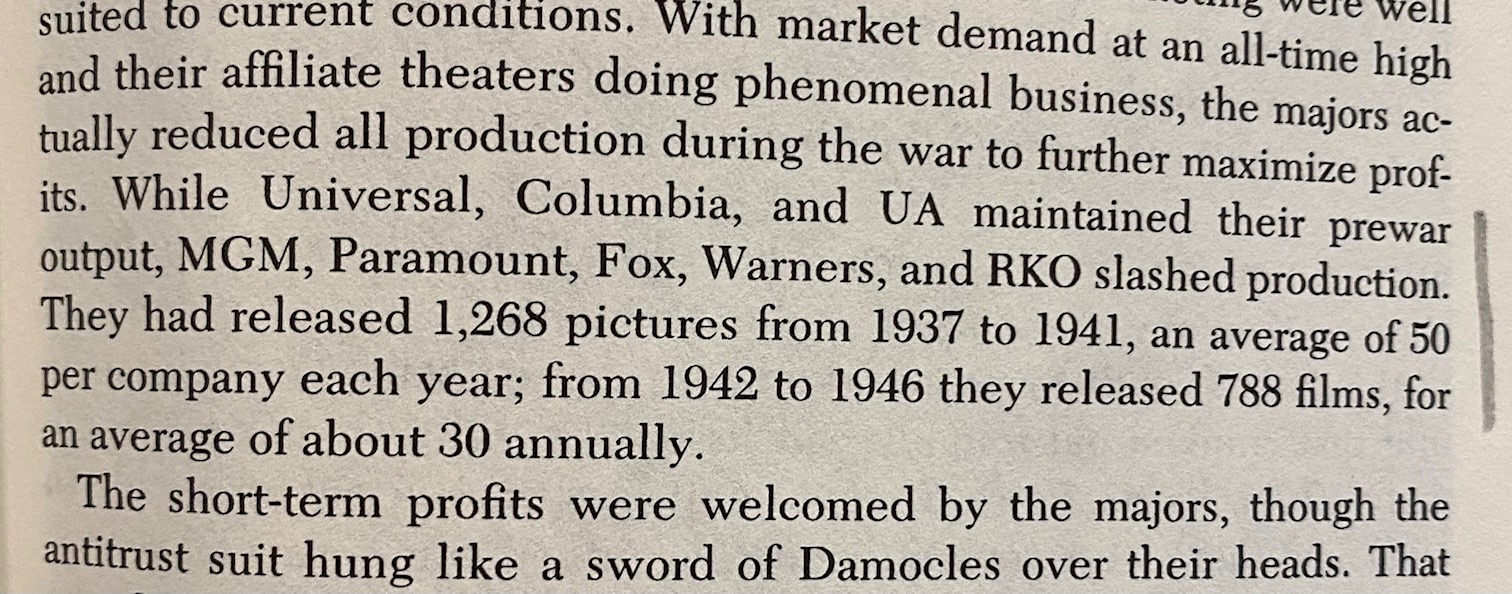
Thomas Schatz’s book The Genius of the System is of daunting thickness, but it’s very readable, and I like the thesis: despite the factory nature and control by the money guys rather than the directors, real style and art was achieved.
Auterism itself would not be worth bothering with if it hadn’t been so influential, effectively stalling film history and criticism in a prolonged stage of adolescent romanticism. But the closer we look at Hollywood’s relations of power and hierarchy of authority during the studio era, at its division of labor and assembly-line production process, the less sense it makes to assess filmmaking or film style in terms of the individual director – or any individual, for that matter.
Should we look at the old studio system trying to find cases where a rare director snuck art past the suits? Or should we look at it and see a miraculous time, when thousands of artists and craftspeople came together for a brief period to create the collective dreams of a nation?
Schatz gives a good short summary of his work and the rise and fall of the studio system in this 1989 Fresh Air interview.
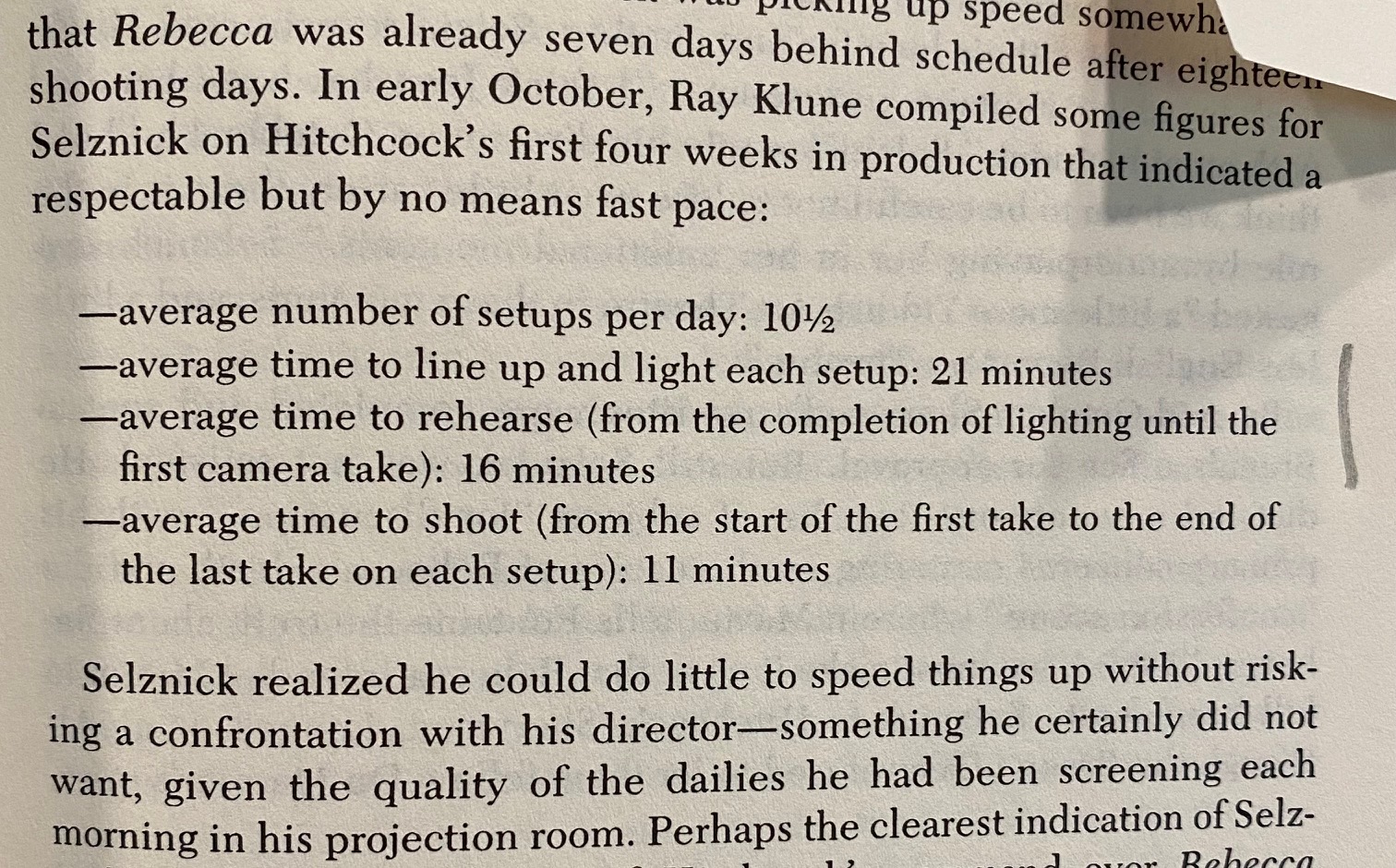
In The Offer, Paramount +’s show about the making of Paramount Pictures’ The Godfather, you can see dramatized some of the problems from the end of the true studio system days. The show was shot on the Paramount lot, doubling as the Paramount lot from 1971. There’s a studio, but when they start a movie, they start from scratch. Casting, finding the right people for technical roles, chain of command, getting a workflow going, dealing with the unions, the mob: all these are begun anew for each production. Poor Al Ruddy has to solve each problem fresh. Robert Evans is there, but he’s no Thalberg, with central command over all the gears in the machine. When the movie’s, it’s over. Everything resets. In the year The Godfather came out, Paramount put out sixteen pictures.
Sometimes companies manage to recreate the cohesion of the studio system. Take Pixar, for example, or the Marvel movies. How about Hallmark movies? Individual directors and producers can have runs like this too: Selznick was doing it by 1935. But at nowhere like the studio scale.
Studios had specialties, flavors: MGM had musicals, Universal had monster movies, Warner Brothers had gangster pictures. In 2022, do the streamers have anything like this? I know what BritBox is.
Even on our startup model, plenty of dreams get produced. Movies might be uncountable, how many are there? 403? How many scripted TV shows are there? 532?
Gracenote, a Nielsen company, listed more than 817,000 unique program titles across U.S. traditional TV and streaming services, with many of those titles featuring hundreds of individual episodes and chapters. Back in December 2019, there were just over 646,000 unique program titles.
So says Nielsen’s State of Play report. I found this Hollywood Reporter piece citing an FX report from 2016 that lists all 1,400 primetime shows, starting with Big Bang Theory and ending with:

The Paramount decree in 1948 stopped the studios from owning the theaters. One of many blows, along with TV, shifting lifestyles, etc that forced change on the system. But we’ve re-evolved back around on vertical integration. Disney, for example, is a studio yet owns its own distribution: Disney +. Is that a violation of the Paramount decree? Let’s look into it:
As part of a 2019 review of its ongoing decrees, the Department of Justice issued a two-year sunsetting notice for the Paramount Decree in August 2020, believing the antitrust restriction was no longer necessary as the old model could never be recreated in contemporary settings.
Oh!
Dead pool
Posted: July 5, 2022 Filed under: the American West, the California Condition Leave a comment
from a June 20, 2022 LA Times piece, “As water crisis worsens on Colorado River, an urgent call for Western states to ‘act now’” by Ian James.
I must admit that as catastrophic as it would be, kind of curious to see how the dead pool would play out. Would they have to shut down Las Vegas?

Meanwhile in Lake Mead, they keep discovering weird stuff as the water level sinks. There was the dead body found in a barrel:
Investigators are dating the crime to the late 1970s or early ’80s, with KLAS quoting Las Vegas Lt. Ray Spencer as saying, “The victim’s clothes and shoes were sold at Kmart in the mid-to-late 1970s.”
Who were the forensic fashion investigators who put that together? Human ingenuity is remarkable, maybe with that kind of brainpower and creativity we’ll solve the southwestern water crisis before we deadpool.
Mishopshnow
Posted: July 3, 2022 Filed under: the California Condition Leave a comment
land acknowledgments can ring hollow, but who wouldn’t support returning some California places to their native names? For example Carpinteria could revert to the name the Chumash apparently gave it.

A Climate for Health and Wealth
Santa Barbara, 1834
Posted: July 2, 2022 Filed under: the California Condition Leave a comment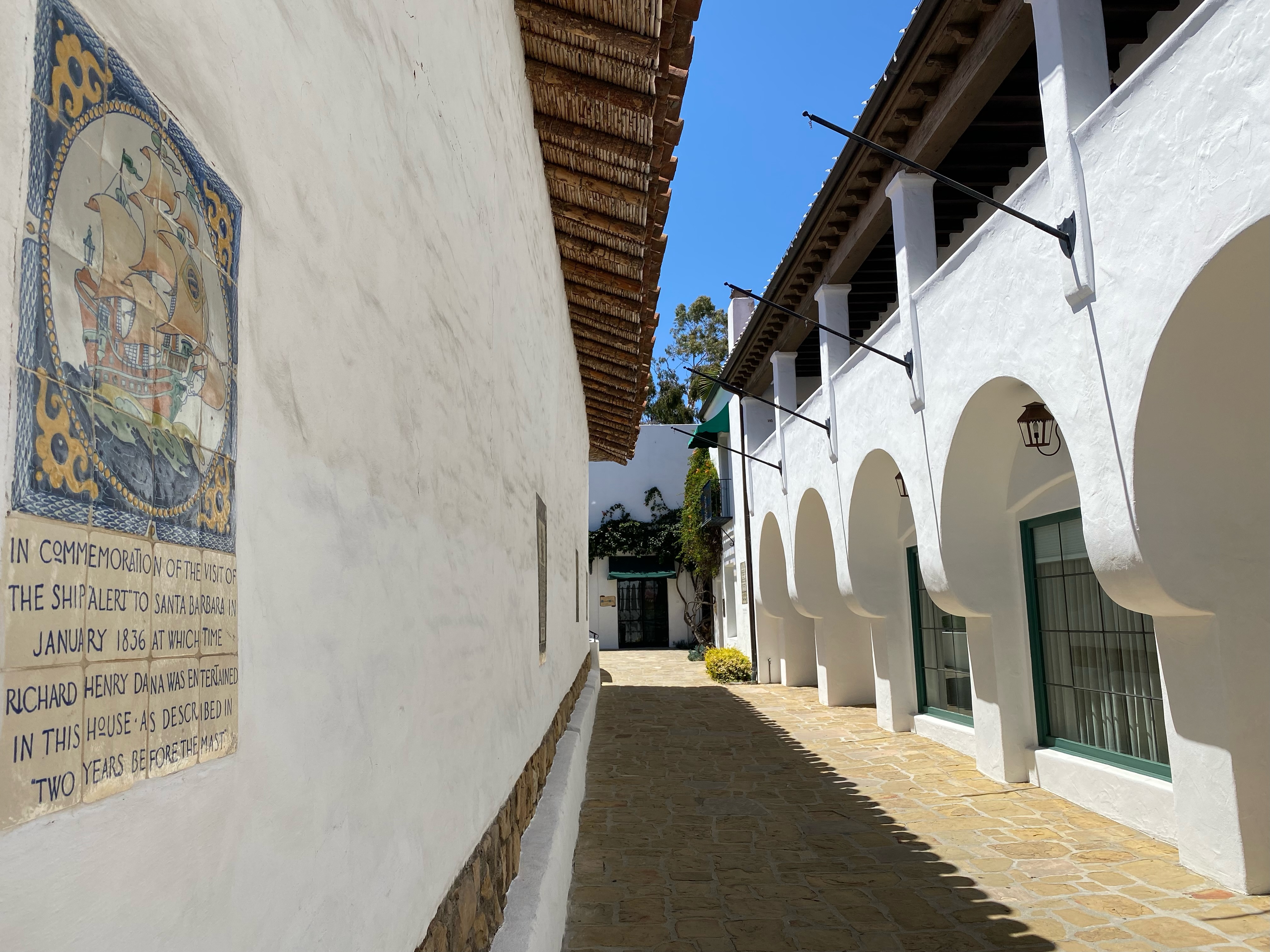
Strolling through El Paseo in Santa Barbara, I saw this on the wall and got to thinking about Dana.
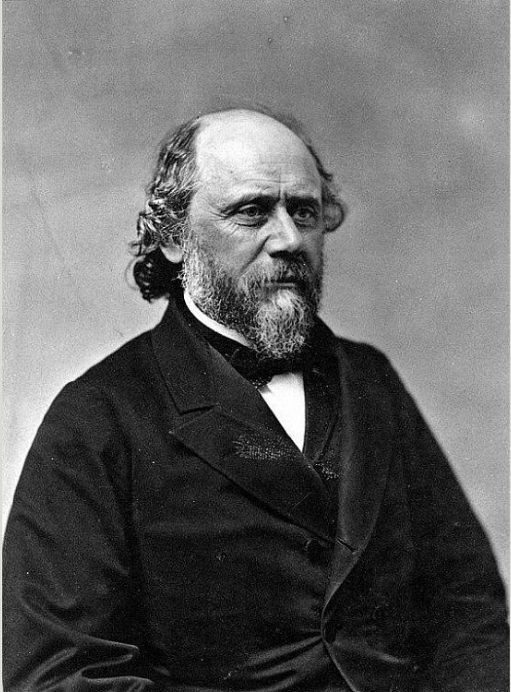
The year was 1834. Richard Henry Dana Jr was a Harvard student who caught the measles and then noticed he was losing his eyesight. Thinking it might be good for him, he left school and enlisted as a sailor on a trip around Cape Horn to California.
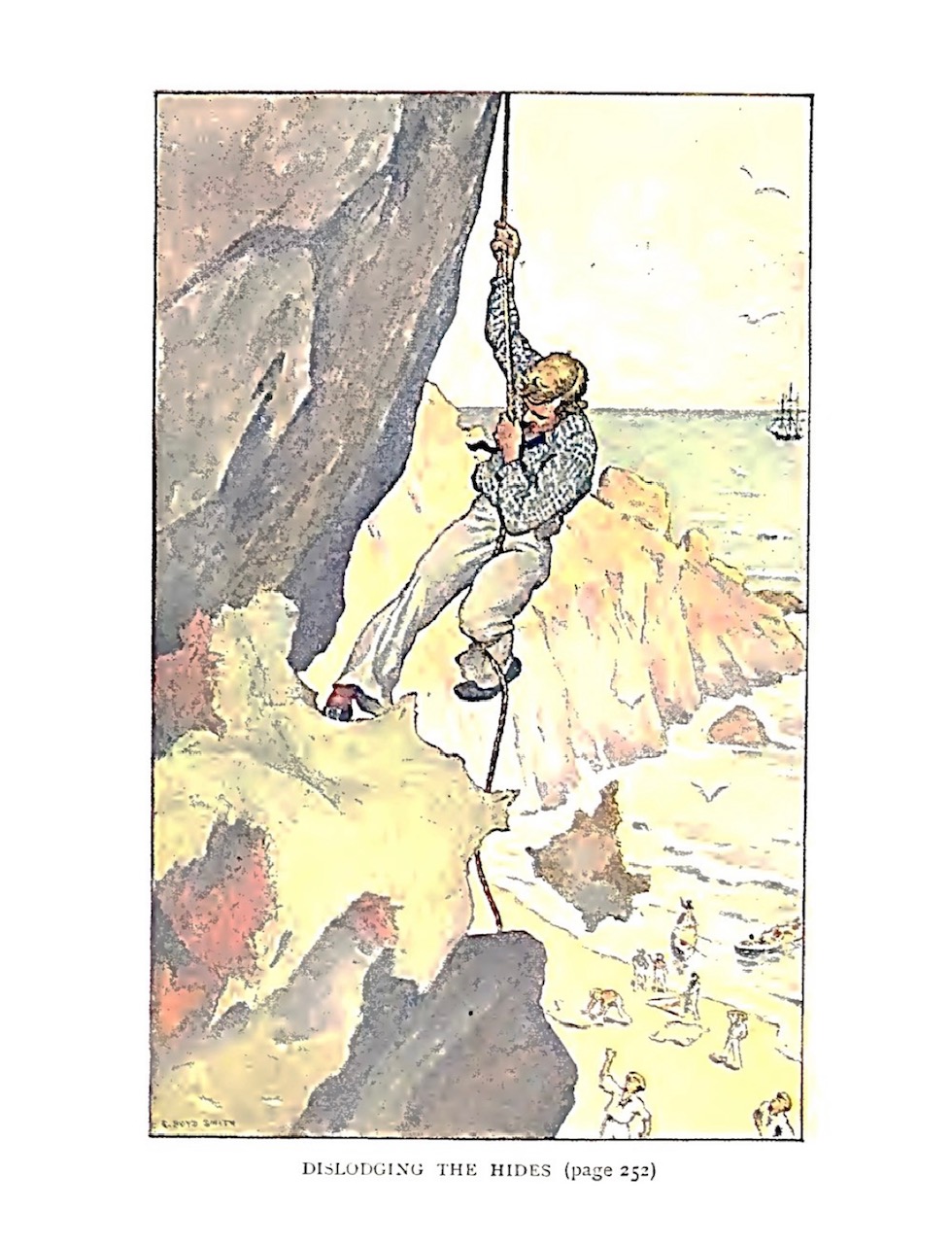
The ship’s trade was in buying up cow hides from the ranches of Mexican California:
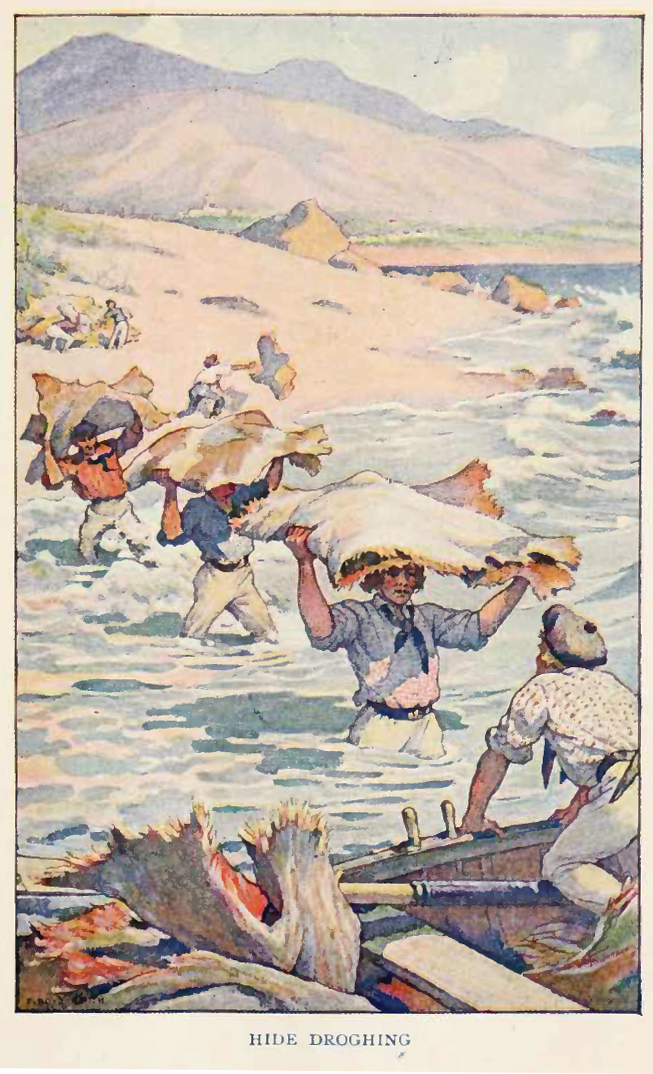
(from illustrations for a 1911 edition. Wikipedia credits this one to Sidney Chase but I think it’s by E. Boyd Smith.)
At one point, finding themselves at the top of a cliff, threw the hides down to the ocean over the edge. The site where this occurred is now Dana Point, California.
Dana doesn’t have much to say about Los Angeles, although he spent some miserable time doing hard work in San Pedro. Here he is on Santa Barbara, where he had a chance to get a slice of life:
In the middle of this crescent, directly opposite the anchoring ground, lie the mission and town of Santa Barbara, on a low, flat plain, but little above the level of the sea, covered with grass, though entirely without trees, and surrounded on three sides by an amphitheatre of mountains, which slant off to the distance of fifteen or twenty miles. The mission stands a little back of the town, and is a large building, or rather a collection of buildings, in the centre of which is a high tower, with a belfry of five bells; and the whole, being plastered, makes quite a show at a distance, and is the mark by which vessels come to anchor. The town lies a little nearer to the beach—about half a mile from it—and is composed of one-story houses built of brown clay—some of them plastered—with red tiles on the roofs. I should judge that there were about an hundred of them; and in the midst of them stands the Presidio, or fort, built of the same materials, and apparently but little stronger. The town is certainly finely situated, with a bay in front, and an amphitheatre of hills behind. The only thing which diminishes its beauty is, that the hills have no large trees upon them, they having been all burnt by a great fire which swept them off about a dozen years before, and they had not yet grown up again. The fire was described to me by an inhabitant, as having been a very terrible and magnificent sight. The air of the whole valley was so heated that the people were obliged to leave the town and take up their quarters for several days upon the beach.
He goes ashore:
We were then pulled ashore in the stern of the boat, and, with orders to be on the beach at sundown, we took our way for the town. There, everything wore the appearance of a holyday. The people were all dressed in their best; the men riding about on horseback among the houses, and the women sitting on carpets before the doors. Under the piazza of a “pulperia,” two men were seated, decked out with knots of ribbons and bouquets, and playing the violin and the Spanish guitar. These are the only instruments, with the exception of the drums and trumpets at Monterey that I ever heard in California; and I suspect they play upon no others, for at a great fandango at which I was afterwards present, and where they mustered all the music they could find, there were three violins and two guitars, and no other instrument. As it was now too near the middle of the day to see any dancing and hearing that a bull was expected down from the country, to be baited in the presidio square, in the course of an hour or two we took a stroll among the houses. Inquiring for an American who, we had been told, had married in the place, and kept a shop, we were directed to a long, low building, at the end of which was a door, with a sign over it, in Spanish. Entering the shop, we found no one in it, and the whole had an empty, deserted appearance. In a few minutes the man made his appearance, and apologized for having nothing to entertain us with, saying that he had had a fandango at his house the night before, and the people had eaten and drunk up everything.
“Oh yes!” said I, “Easter holydays?”
“No!” said he, with a singular expression to his face; “I had a little daughter die the other day, and that’s the custom of the country.”
Here I felt a little strangely, not knowing what to say, or whether to offer consolation or no, and was beginning to retire, when he opened a side door and told us to walk in. Here I was no less astonished; for I found a large room, filled with young girls, from three or four years of age up to fifteen and sixteen, dressed all in white, with wreaths of flowers on their heads, and bouquets in their hands. Following our conductor through all these girls, who were playing about in high spirits, we came to a table, at the end of the room, covered with a white cloth, on which lay a coffin, about three feet long, with the body of his child. The coffin was lined on the outside with white cloth, and on the inside with white satin, and was strewed with flowers. Through an open door we saw, in another room, a few elderly people in common dresses; while the benches and tables thrown up in a corner, and the stained walls, gave evident signs of the last night’s “high go.” Feeling, like Garrick, between tragedy and comedy, an uncertainty of purpose and a little awkwardness, I asked the man when the funeral would take place, and being told that it would move toward the mission in about an hour, took my leave.
A funeral procession, a cockfight, a horse race:
Here was as peculiar a sight as we had seen before in the house; the one looking as much like a funeral procession as the other did like a house of mourning. The little coffin was borne by eight girls, who were continually relieved by others, running forward from the procession and taking their places. Behind it came a straggling company of girls, dressed as before, in white and flowers, and including, I should suppose by their numbers, nearly all the girls between five and fifteen in the place. They played along on the way, frequently stopping and running all together to talk to some one, or to pick up a flower, and then running on again to overtake the coffin. There were a few elderly women in common colors; and a herd of young men and boys, some on foot and others mounted, followed them, or walked or rode by their side, frequently interrupting them by jokes and questions. But the most singular thing of all was, that two men walked, one on each side of the coffin, carrying muskets in their hands, which they continually loaded, and fired into the air. Whether this was to keep off the evil spirits or not, I do not know. It was the only interpretation that I could put upon it.
As we drew near the mission, we saw the great gate thrown open, and the pádre standing on the steps, with a crucifix in hand. The mission is a large and deserted-looking place, the out-buildings going to ruin, and everything giving one the impression of decayed grandeur. A large stone fountain threw out pure water, from four mouths, into a basin, before the church door; and we were on the point of riding up to let our horses drink, when it occurred to us that it might be consecrated, and we forbore. Just at this moment, the bells set up their harsh, discordant clang; and the procession moved into the court. I was anxious to follow, and see the ceremony, but the horse of one of my companions had become frightened, and was tearing off toward the town; and having thrown his rider, and got one of his feet caught in the saddle, which had slipped, was fast dragging and ripping it to pieces. Knowing that my shipmate could not speak a word of Spanish, and fearing that he would get into difficulty, I was obliged to leave the ceremony and ride after him. I soon overtook him, trudging along, swearing at the horse, and carrying the remains of the saddle, which he had picked up on the road. Going to the owner of the horse, we made a settlement with him, and found him surprisingly liberal. All parts of the saddle were brought back, and, being capable of repair, he was satisfied with six reáls. We thought it would have been a few dollars. We pointed to the horse, which was now half way up one of the mountains; but he shook his head, saying, “No importe!” and giving us to understand that he had plenty more.
Having returned to the town, we saw a great crowd collected in the square before the principal pulperia, and riding up, found that all these people—men, women, and children—had been drawn together by a couple of bantam cocks. The cocks were in full tilt, springing into one another, and the people were as eager, laughing and shouting, as though the combatants had been men. There had been a disappointment about the bull; he had broken his bail, and taken himself off, and it was too late to get another; so the people were obliged to put up with a cock-fight. One of the bantams having been knocked in the head, and had an eye put out, he gave in, and two monstrous prize-cocks were brought on. These were the object of the whole affair; the two bantams having been merely served up as a first course, to collect the people together. Two fellows came into the ring holding the cocks in their arms, and stroking them, and running about on all fours, encouraging and setting them on. Bets ran high, and, like most other contests, it remained for some time undecided. They both showed great pluck, and fought probably better and longer than their masters would have done. Whether, in the end, it was the white or the red that beat, I do not recollect; but, whichever it was, he strutted off with the true veni-vidi-vici look, leaving the other lying panting on his beam-ends.
This matter having been settled, we heard some talk about “caballos” and “carrera” and seeing the people all streaming off in one direction, we followed, and came upon a level piece of ground, just out of the town, which was used as a race-course. Here the crowd soon became thick again; the ground was marked off; the judges stationed; and the horses led up to one end. Two fine-looking old gentlemen—Don Carlos and Don Domingo, so called—held the stakes, and all was now ready. We waited some time, during which we could just see the horses twisting round and turning, until, at length, there was a shout along the lines, and on they came—heads stretched out and eyes starting;—working all over, both man and beast. The steeds came by us like a couple of chain-shot—neck and neck; and now we could see nothing but their backs, and their hind hoofs flying in the air. As fast as the horses passed, the crowd broke up behind them, and ran to the goal. When we got there, we found the horses returning on a slow walk, having run far beyond the mark, and heard that the long, bony one had come in head and shoulders before the other. The riders were light-built men; had handkerchiefs tied round their heads; and were bare-armed and bare-legged. The horses were noble-looking beasts, not so sleek and combed as our Boston stable-horses, but with fine limbs, and spirited eyes. After this had been settled, and fully talked over, the crowd scattered again and flocked back to the town.
Returning to the large pulperia, we found the violin and guitar screaming and twanging away under the piazza, where they had been all day. As it was now sundown, there began to be some dancing. The Italian sailors danced, and one of our crew exhibited himself in a sort of West India shuffle, much to the amusement of the bystanders, who cried out, “Bravo!” “Otra vez!” and “Vivan los marineros!” but the dancing did not become general, as the women and the “gente de razón” had not yet made their appearance. We wished very much to stay and see the style of dancing; but, although we had had our own way during the day, yet we were, after all, but ‘foremast Jacks; and having been ordered to be on the beach by sundown, did not venture to be more than an hour behind the time; so we took our way down
A return:
Santa Barbara looked very much as it did when I left it five months before: the long sand beach, with the heavy rollers, breaking upon it in a continual roar, and the little town, imbedded on the plain, girt by its amphitheatre of mountains. Day after day, the sun shone clear and bright upon the wide bay and the red roofs of the houses; everything being as still as death, the people really hardly seeming to earn their sun-light. Daylight actually seemed thrown away upon them.
He attends a wedding:
The great amusement of the evening,—which I suppose was owing to its being carnival—was the breaking of eggs filled with cologne, or other essences, upon the heads of the company. One end of the egg is broken and the inside taken out, then it is partly filled with cologne, and the whole sealed up. The women bring a great number of these secretly about them, and the amusement is to break one upon the head of a gentleman when his back is turned. He is bound in gallantry to find out the lady and return the compliment, though it must not be done if the person sees you. A tall, stately Don, with immense grey whiskers, and a look of great importance, was standing before me, when I felt a light hand on my shoulder, and turning round, saw Donna Angustia, (whom we all knew, as she had been up to Monterey, and down again, in the Alert,) with her finger upon her lip, motioning me gently aside. I stepped back a little, when she went up behind the Don, and with one hand knocked off his huge sombrero, and at the same instant, with the other, broke the egg upon his head, and springing behind me, was out of sight in a moment. The Don turned slowly round, the cologne, running down his face, and over his clothes, and a loud laugh breaking out from every quarter. He looked round in vain, for some time, until the direction of so many laughing eyes showed him the fair offender. She was his niece, and a great favorite with him, so old Don Domingo had to join in the laugh. A great many such tricks were played, and many a war of sharp manoeuvering was carried on between couples of the younger people, and at every successful exploit a general laugh was raised.
Another singular custom I was for some time at a loss about. A pretty young girl was dancing, named, after what would appear to us the sacrilegious custom of the country—Espiritu Santo, when a young man went behind her and placed his hat directly upon her head, letting it fall down over her eyes, and sprang back among the crowd. She danced for some time with the hat on, when she threw it off, which called forth a general shout; and the young man was obliged to go out upon the floor and pick it up. Some of the ladies, upon whose heads hats had been placed, threw them off at once, and a few kept them on throughout the dance, and took them off at the end, and held them out in their hands, when the owner stepped out, bowed, and took it from them. I soon began to suspect the meaning of the thing, and was afterward told that it was a compliment, and an offer to become the lady’s gallant for the rest of the evening, and to wait upon her home. If the hat was thrown off, the offer was refused, and the gentleman was obliged to pick up his hat amid a general laugh. Much amusement was caused sometimes by gentlemen putting hats on the ladies’ heads, without permitting them to see whom it was done by. This obliged them to throw them off, or keep them on at a venture, and when they came to discover the owner, the laugh was often turned upon them.
Twenty-four years later, 1859, he returns:
Santa Barbara has gained but little. I should not know, from anything I saw, that she was now a seaport of the United States, a part of the enterprising Yankee nation, and not still a lifeless Mexican town. At the same old house, where Señor Noriego lived, on the piazza in front of the court-yard, where was the gay scene of the marriage of our agent, Mr. Robinson, to Doña Anita, where Don Juan Bandini and Doña Augustia danced, Don Pablo de la Guerra received me in a courtly fashion. I passed the day with the family, and in walking about the place; and ate the old dinner with its accompaniments of frijoles, native olives and grapes, and native wines. In due time I paid my respects to Doña Augustia, and notwithstanding what Wilson told me, I could hardly believe that after twenty-four years there would still be so much of the enchanting woman about her.
A visit to Los Angeles:
The Pueblo de los Angeles I found a large and flourishing town of about twenty thousand inhabitants, with brick sidewalks, and blocks of stone or brick houses. The three principal traders when we were here for hides in the Pilgrim and Alert are still among the chief traders of the place,—Stearns, Temple, and Warner, the two former being reputed very rich.
There used to be a replica of Dana’s ship, the Pilgrim, in Dana Point, CA, but I’m just now learning it keeled over and sank in 2020!
Sorry these excerpts are kinda long, I just wanted to have all of Dana’s thoughts on Santa Barbara in one place.
How is this a house?
Posted: June 30, 2022 Filed under: the California Condition 1 Comment
Seen in Malibu not long ago.
Vintage
Posted: June 24, 2022 Filed under: the California Condition Leave a comment
just one of those vintage sunsets
Unusual view of a seagull
Posted: June 19, 2022 Filed under: the California Condition Leave a comment
Cattle as weapon of invasion
Posted: June 16, 2022 Filed under: the California Condition Leave a comment

thought that was a well-articulated historical insight, from a writeup about the Cuyama Valley by Judith Dale in the Lompoc Record.
That picture of cows I found at the California Bureau of Livestock Identification.
amply gooey
Posted: June 13, 2022 Filed under: food, the California Condition Leave a comment
food writing is wild. That’s from a LA Times piece suggesting places to pick up a picnic before a concert at the Hollywood Bowl. You’re bringing a smashburger to see Dudamel? I guess I must respect it!
The Price of Gas
Posted: June 12, 2022 Filed under: America Since 1945, business, the California Condition Leave a comment
It’s so high! How can people do anything? Yet shouldn’t we want the price of gas to be high, so we don’t cook up the planet quite as fast? Though, won’t the high prices cause estimates and spreadsheets and algorithms across the oil and gas companies to be adjusted? When the calculations are revised, it suddenly makes sense to drill more and deeper and in crazier ways in more chaotic countries? They’ll capitalize new and more projects, dredging up our oil faster than ever.
Is this merely the boom and bust cycle we all must toil under, written many times over in the history of every boomtown and oil craze? From Nantucket to Houston to the Bakken to Bakersfield to Alaska we are told this story. Above LA looms the Getty, named for a man whose father left Minnesota for a boom in Bartlesville, Oklahoma. The son took the lesson and was early in on Saudi Arabia. To get to the Getty from here you’d have to cross Doheny, he of Teapot Dome. But look, you saw the oil wells when you came in from the airport (in a car), and if you looked out the window of your plane as you landed at LAX you saw the diesel tankers and maybe even an oil tanker filling up at the offshore spigot. You get the idea.

Not so long ago I watched the documentary version of The Prize in small chunks, just before bed. Though the content can be bracing it is soothingly narrated by Donald Sutherland, and there is something relaxing about seeing how the pieces fit together. Finding the doc compelling I read Daniel Yergin’s original book, which is full of great characters and strange scenes:
In early March 1983 the oil ministers and their retinues hurriedly convened, ironically in London, the home court of their leading non-OPEC competitor, Great Britain. They met at the Intercontinental Hotel at Hyde Park Corner, for what turned out to be twelve interminable, frustrating days – an experience that would leave some of them with an allergic reaction whenever, in future years, they set foot inside the hotel.
and:
Later in the day, Silva Herzog was glumly eating a hamburger at the Mexican embassy, preparing to leave, when a call came from the United States Treasury saying that the $100 million fee had been rescinded. The Americans could not risk a collapse. Who knew what the effects would be on Monday? And with that, the Mexican Weekend concluded, with the first part of the emergency package now in place.
Some takeaways of value:
- it’s not just the getting of the oil. It’s the refining. Rockefeller controlled the refining, and the shipping, and eventually everything
- one of Rockefeller’s killer qualities: he was a visionary accountant. Can there be such a thing? Yes. Rockefeller.
- The Great War, later World War One, was a gamechange for oil. Railroads had been key in the US Civil War, but in World War One, the tank and the truck, oil powered vehicles, proved to be the crucial transport. Churchill, head of the Admiralty at the time, switched the Royal Navy to oil from coal. At the end of the war, the destruction of the Ottoman Empire left the British and French in control of oil fields in Mesopotamia.
- both on the Eastern Front and in the Pacific in World War Two, oil was the key strategic factor. Really everywhere, but those offer clear examples. Decisions on how to invade the Soviet Union were based on gaining control of oil fields before the German forces ran out of oil. The Japanese navy’s decisions were bounded by limits on oil. The fleet had to be stationed near Singapore. The “Marianas turkey shoot” was a result of decisions made based on saving oil. There was not enough oil not only for active operations, but for pilot training.
How about this?:
When [J. Paul] Getty died in 1976, age eighty-three, the eulogy at his funeral was delivered by the Duke of Bedford. “When I think of Paul,” said the Duke, “I think of money.”
Many people and groups of people have attempted to control oil, but it’s unpredictable. Sometimes the board gets reshuffled: North Sea oil fields, Saudi, Alaska. The North Sea oil fields saved the UK economy. Or did it ruin the UK economy? It saved Margaret Thatcher. You can’t send ships and helicopters to the coast of Argentina if you don’t have oil.
Look how rich Norway is. It doesn’t have to be this way, Norway used to be poor, that’s why Rose on Golden Girls is from St. Olaf.
Obama’s presidency coincided with a huge boom in US oil extraction. Is “coincided” the right word? Was it a coincidence? What’s at work here?
A character worth some study: Marcus Samuel. (Shell, the first oil tanker, Lord Mayor of London).

It was called Shell because his Iraqi Jewish family used to import and sell seashells. (That’s the story, anyway.)
Here’s a solid summary of The Prize.
Recall that Moby-Dick is about the oil business, and Ahab like Daniel Plainview is an oilman.
Wonders of Fresno
Posted: June 11, 2022 Filed under: the California Condition 1 Comment
People don’t believe me when I tell them how big Fresno, California is. Fresno has a population of 542,107 in the 2020 Census, making it much bigger than either Pittsburgh or New Orleans. If you want to play metro area, Fresno is still bigger than Omaha, and clocks in at over one million.
I haven’t examined Fresno thoroughly but I’ve spent a night there and got a sense. There is one sight that you shouldn’t go to see, but if you’re there, you should check out. It’s the Forestiere Underground Gardens.
Forestiere was an Italian immigrant who knew something about growing orange trees, but found Fresno a little too hot, so he built himself an underground living space, garden, work of art and devotion.

How about:

Also recommend: buy some olive oil at the Fresno State farm store.
Ghost of a Taco Bell
Posted: May 27, 2022 Filed under: the California Condition Leave a comment
Each man’s death diminishes me,
For I am involved in mankind.
Therefore, send not to know
For whom the bell tolls,
It tolls for thee.
Laguna Beach
Posted: May 27, 2022 Filed under: the California Condition Leave a comment
“This has to be as good as the south of France,” I said, although I’ve never been to the south of France. Laura, who’s been to Cannes, told me it was pretty comparable, the one thing missing was a cobblestone road up to a market that’s been there for hundreds of years. That does sound good, but on the other hand, Laguna Beach is right down the road.
Soviet memorial, West Hollywood
Posted: February 25, 2022 Filed under: the California Condition, WW2 Leave a comment
The only monument to soldiers of the former Soviet Union on US soil* is in West Hollywood.

The monument was and is controversial.
Out for a walk the other day we spotted this at the Russian language library:

How many of those are left?
* haven’t confirmed this myself and wouldn’t be shocked if there’s another example. I’m pretty sure there are at least like US-Soviet friendship memorials from WW2, or memorial stones/plaques given in tribute to the alliance of that time, or commemorating units that coordinated on the Siberian airlifts, at the Punchbowl in Hawaii for instance.
Supreme
Posted: February 18, 2022 Filed under: the California Condition Leave a comment
James Jebbia, founder of Supreme, has said that the red box logo with “Supreme” in white Futura Heavy Oblique was taken from the work of Barbara Kruger. Kruger herself commented on this issue on the occasion of a recent lawsuit between Supreme and a women’s street clothing brand that used the Supreme logo to make a “Supreme Bitch” logo that was printed on T-shirts and hats. In response, Kruger said, “What a ridiculous clusterfuck of totally uncool jokers. I make my work about this kind of sadly foolish farce. I’m waiting for all of them to sue me for copyright infringement.
Emphasis mine. Reading up on the streetwear brand whose store is a center of gravity in the Melrose/Fairfax region of LA.
Oroville
Posted: December 2, 2021 Filed under: Steinbeck, the California Condition Leave a comment
In August, the state had to take the hydroelectric power plant at Lake Oroville, the second-biggest reservoir in California, off line for the first time since it was built in 1967 because the water level in the lake was too low.
“California Will Curtail Water to Farms and Cities Next Year as Drought Worsens” by Michael B Marois over in Bloomberg. Imagine taking a power plant offline. Who makes that call? Did the engineers kind of enjoy the challenge?
The shutdown isn’t even what’s referred to when we talk about the Oroville Dam Crisis. Had a chance to drive through Oroville last summer, there are many beautiful old houses, and the downtown has a lost in time feel. If you want to see what Steinbeck’s California might’ve been like, Oroville might be a better main street time capsule than Salinas.
On August 7, 1881, pioneer Jack Crum was allegedly stomped to death by local bully Tom Noacks in Chico, California. The young Noacks was feared by the locals of Butte County, not only because of his size and strength, but allegedly because he was mentally unbalanced and enjoyed punching oxen in the head.
Noacks was arrested and jailed in the Chico jail. Once word got out that the old pioneer had been murdered, the authorities moved Noacks to the Butte County county jail in Oroville for his safety. Crum’s friends, knowing that Noacks was in the county jail, made their way to Oroville with rope in hand. Knocking on the jail door, the men told the jailer that they had a prisoner from the town of Biggs, California. Once inside the jail, they overpowered the jailer and dragged Noacks from his cell. They took Noacks to Crum’s former farm and hanged him from an old cottonwood tree. Nobody was ever prosecuted for the lynching.
Marines vs ravens
Posted: November 22, 2021 Filed under: the California Condition Leave a commentfrom the Hi-Desert Star, Nov 18, 2021:
Members of the public have been invited to comment on an environmental assessment of plans to kill thousands of ravens at the Marine Corps Air Ground Combat Center and five other military installations in the California desert.
The assessment, examines two alternative plans, the first calling for a continued use of primarily non-lethal raven management actions, including flushing of individuals, increasing levels of stress and disrupting of nesting opportunities.
That’s the first plan, stress out the ravens. The second plan?
The second calls for the lethal removal of 11,830 to 13,293 ravens initially and 1,477 to 1,715 ravens annually.
The reasoning?
“The overpopulation of ravens in both the built and undeveloped areas of the California desert has had several detrimental impacts on the DoD installations within the region,” the report states.
“For instance, increased raven numbers result in higher incidences of predation on juvenile desert tortoises. The desert tortoise is the only federally listed species that occurs within the boundaries of all six DoD installations in the California desert, and the DoD is legally obligated by federal law to ensure the species is protected.
“Ravens are also causing property damage and pose a human health hazard in the built environment, particularly in and around areas where vehicles and aircraft are parked and where DoD personnel must work directly underneath high-use roosting sites.”
I’d be careful here, ravens are pretty smart. The crow can be a nuisance bird for sure (although also said to be quite smart) but the raven I would be hesitant to mess with. They have powers.
Out and about
Posted: November 20, 2021 Filed under: the California Condition Leave a comment
Ships waiting to dock at Port of LA – Long Beach, seen from Seal Beach. The whole world is backed up! Seal Beach is an interesting town. Most of the acreage is used to store ammunition for the US Navy, and yet there’s a Whole Foods and a Peloton store. On Electric Avenue you can see what remains of the old streetcar route. It could’ve looked like New Orleans down there. Maybe the vastness of LA could never have supported the length of streetcar routes required, but you can’t help but mourn.

After viewing the vessels, we went for pho at Pho 79 in Little Saigon. Fantastic, cheap, a great richness of flavor, although was it really more than 20% better than my local pho place? Still, some people live for that 20%.

Las Vegas remains itself. Mask enforcement in casinos is diligent, to my surprise. Back in May it was a maskless wilderness, but Delta seems to have put the fear out there. We were present in the Bellagio sportsbook for one of the more wrenching communal emotions you can feel in a sportsbook, when a team (the Chicago Bears, in this case) covers the spread (against Pittsburgh) but fails to win. Thus Pittsburgh fans/bettors disappointed, Bears fans disappointed and bettors mildly satisfied? A mingling of disappointment and emotional anticlimax, felt in the air.
At least one occasion of dudes attempting to start the “Let’s Go Brandon” chant in the bathroom. Permission to be obnoxious was always an appeal of Las Vegas I suppose, but it does seem like obnoxiousness in general is on the rise.

It was a great pleasure to attend the Pro Bull Riding World Finals. I was not bored! Brave dudes: the safety team/ bullfighters who lure away the bull after the rider is thrown. I had the opportunity to ask one of these dudes what I should do in the event I had to fill in for him: “don’t run in straight lines. Four legs is gonna outrun two.” Sometimes these guys have to cut out a cowboy who’s caught under a rope. Doing knifework on a bucking bull, not an easy job. They’re brave like the banderilleros in a traditional Spanish bullfight, who also don’t get enough credit.
So far as I could tell, despite rumors of testicle electrocuting, no real harm is done to the bulls. It’s the humans who are getting damaged. Eli Vastbinder won the final round despite a dislocated shoulder and several broken ribs.
Human/bull sport has a long history, I was reminded of the bull leapers depicted in the Great Palace of Knossos, 1450 or so BCE.

Two Ports
Posted: November 10, 2021 Filed under: Louisiana, the California Condition, the ocean Leave a comment
I was checking on some ships and saw them traveling through the ship channel in Port Sulfur, Louisiana.
The town is 8 feet (2.4 m) above sea level and had not flooded during Hurricane Betsy nor Hurricane Camille. Before Hurricane Katrina and Hurricane Rita about 3,000 people lived in Port Sulphur. Nevertheless, during Hurricane Katrina, the federal levees failed and around 22 feet (6.7 m) of water engulfed the town. Almost all single-family homes in the town were destroyed, many of which were moved off their foundations by as much as 100 feet. In the months following Katrina, some residents moved back to Port Sulphur in trailers and modular homes provided by the Federal Emergency Management Agency. But many residents relocated to other parts of Louisiana, the Southeast, and Texas.
The New York Times has been all over the case of the precarious communities of Plaquemines Parish. I’d like to visit sometime. Would I feel weird staying at Woodland Plantation? Yes, but I’m prepared to do it in my role as a journalist.

Here’s the Subway in Port Sulphur. Get a sandwich and sit on that levee watching the ships go by?
A port closer to home, Port Hueneme, came up in some recent discussion of the huge backup at Port of Los Angeles / Long Beach.

I learn that 3.3 billion bananas come through Port Hueneme each year. One of these days I’m gonna go up there and get a banana right off the boat.
San Luis Obispo
Posted: November 1, 2021 Filed under: the California Condition Leave a comment
A couple years had passed since I’d last taken the train up to SLO. The town appears to be prospering. The Thursday night farmers market and Halloween festivities were full of happy faces, the farm produce looked amazing, the grilled meats smelled good. There are multiple stores that sell like soaps and globes and mugs and scarves. And places called like

The creek runs right through town. A fantasy would be to open a Japanese style inn alongside it, in about 300 years you might have a decent ryokan. Kids were on campus at Cal Poly, they looked healthy and vital. School pride there feels abundant, and it’s my sense that the learning there is practical and focused. Is the more famous Cal Poly alum Ozzie Smith or Weird Al Yankovich?
The Central Coast cadence of chill can be overheard everywhere, over pale ale and pinball at Lincoln Market for sure. Del Monte Cafe, La Loconda, Big Sky Cafe, Mistura all make my list. Dr Burnsteins Ice Cream Lab unfortunately somewhat disappoints. The “lab” theme is simply not maniacal enough.
Several California towns I’ve visited in the last year have a hollowed out feel, the main streets shells, but San Luis Obispo feels alive. I’ve never failed to feel good after a journey there. A small house in town will run you $600k at least, and there are not many available. In previous October visits the weather’s been brisk, but this time the air was quite toasty. Three or four visits over a few years is not a fair sample size, so I wouldn’t consider this science, but I feel the climate is changing.
Bought these at Phoenix Books, where I’ve never failed to score:


The Garden Street Inn has been taken over by Hilton, but not to worry, it’s still weird and the staff are still friendly and the rooms retain their individual themes (not on Madonna Inn level, just small touches).
Any traveler on Amtrak should expect a two hour or so delay somewhere along the line, and at least one semi deranged fellow passenger, but the Coast Starlight still can’t be beat for oceanside leisure travel. For lunch I had a baked potato with vegan chili, cheese, and half a bottle of Dark Harvest cab, tell me where you can have a better lunch at 50 mph.

The mission in SLO is one of the more inviting California missions in its architecture, in my opinion. The town was named for St. Louis of Toulouse. Three hundred years after, the mission of converting California to Catholicism must be declared a failed project but the lingering relics of the medieval Spanish priests are significant and still impress.

“The solidity of justice,” my dad commented on my photos of the county courthouse.

 Helytimes
