Across The River and Into The Trees, Ernest Hemingway (1950)
Posted: May 3, 2025 Filed under: Hemingway 4 Comments
The Colonel is talking to his driver, Jackson:
“That’s Torcello directly opposite us,” the Colonel pointed. “That’s where the people lived that were driven off the mainland by the Visigoths. They built that church you see there with the square tower. There were thirty thousand people lived there once and they built that church to honor their Lord and to worship him. Then, after they built it, the mouth of the Sile River silted up or a big flood changed it, and all that land we came through just now got flooded and started to breed mosquitoes and malaria hit them. They all started to die, so the elders got together and decided they should pull out to a healthy place that would be defensible with boats, and where the Visigoths and the Lombards and the other bandits couldn’t get at them, because these bandits had no sea-power. The Torcello boys were all great boatmen.
So they took the stones of all their houses in barges, like that one we just saw, and they built Venice.” He stopped. “Am I boring you, Jackson?”
“No, sir. I had no idea who pioneered Venice.”
“It was the boys from Torcello. They were very tough and they had very good taste in building. They came from a little place up the coast called Caorle. But they drew on all the people from the towns and the farms behind when the Visigoths over-ran them. It was a Torcello boy who was running arms into Alexandria, who located the body of St.
Mark and smuggled it out under a load of fresh pork so the infidel customs guards wouldn’t check him. This boy brought the remains of St. Mark to Venice, and he’s their patron saint and they have a cathedral there to him. But by that time, they were trading so far to the east that the architecture is pretty Byzantine for my taste. They never built any better than at the start there in Torcello. That’s Torcello there.”
…
That’s my town. There’s plenty more I could show you, but I think we probably ought to roll now. But take one good look at it. This is where you can see how it all happened.
But nobody ever looks at it from here.”
“It’s a beautiful view. Thank you, sir.”
“O.K.,” the Colonel said. “Let’s roll,”
This book takes place over three days. On day one, this is what the Colonel drinks (with page numbers):

So that’s five or six double martinis, three additional cocktails, and maybe two bottles of wine for the Colonel before bedtime.
This is not one of Hemingway’s more popular books. In Farewell To Arms, Sun Also Rises, and For Whom The Bell Tolls, the main character is young, cool, brave, competent, about as awesome a guy as you can think up. The Colonel, when we meet him, is calling his boatman a jerk. And he’s old (50) and busted up. He used to be a general but lost that rank. His mind is on pain, the past.
The Austrian attacks were ill-coordinated, but they were constant and exasperated and you first had the heavy bombardment which was supposed to put you out of business, and then, when it lifted, you checked your positions and counted the people. But you had no time to care for wounded, since you knew that the attack was coming immediately, and then you killed the men who came wading across the marshes, holding their rifles above the water and coming as slow as men wade, waist deep.
If they did not lift the shelling when it started, the Colonel, then a lieutenant, often thought, I do not know what we would be able to do. But they always lifted it and moved it back ahead of the attack. They went by the book.
If we had lost the old Piave and were on the Sile they would move it back to the second and third lines; although such lines were quite untenable, and they should have brought all their guns up very close and whammed it in all the time they attacked and until they breached us. But thank God, some high fool always controls it, the Colonel thought, and they did it piecemeal.
All that winter, with a bad sore throat, he had killed men who came, wearing the stick bombs hooked up on a harness under their shoulders with the heavy, calf hide packs and the bucket helmets. They were the enemy.
But he never hated them; nor could have any feeling about them. He commanded with an old sock around his throat, which had been dipped in turpentine, and they broke down the attacks with rifle fire and with the machine guns which still existed, or were usable, after the bombardment. He taught his people to shoot, really, which is a rare ability in continental troops, and to be able to look at the enemy when they came, and, because there was always a dead moment when the shooting was free, they became very good at it.
But you always had to count and count fast after the bombardment to know how many shooters you would have. He was hit three times that winter, but they were all gift wounds; small wounds in the flesh of the body without breaking bone, and he had become quite confident of his personal immortality since he knew he should have been killed in the heavy artillery bombardment that always preceded the attacks. Finally he did get hit properly and for good. No one of his other wounds had ever done to him what the first big one did. I suppose it is just the loss of the immortality, he thought. Well, in a way, that is quite a lot to lose.
The Colonel visits a place where he wounded fighting with the Italian army in the first World War – Fossalta. It’s the same place Hemingway himself was wounded while serving as a Red Cross volunteer. You could read The Colonel as being how Frederick Henry from Farewell to Arms turned out. This is almost a sequel.
The Colonel has a nineteen year old countess who loves him, but it’s accepted they can have no future together. This book is gloomy. We’re in a postwar Italy with bomb craters and ex-Fascists. In Hemingway’s other books lots of people die, but they weren’t Americans. The romance and European sexiness of Hemingway’s early books is gone. The Colonel recounts military ugliness, death, ordering men to die on orders:
The first day there, we lost the three battalion commanders.
One killed in the first twenty minutes and the other two hit later. This is only a statistic to a journalist. But good battalion commanders have never yet grown on trees; not even Christmas trees which was the basic tree of that woods. I do not know how many times we lost company commanders how many times over. But I could look it up.
They aren’t made, nor grown, as fast as a crop of potatoes is either. We got a certain amount of replacements but I can remember thinking that it would be simpler, and more effective, to shoot them in the area where they detrucked, than to have to try to bring them back from where they would be killed and bury them. It takes men to bring them back, and gasoline, and men to bury them. These men might just as well be fighting and get killed too.
Does it seem plausible that a beautiful nineteen year old Venetian countess would want to spend her time prodding a 51 year old US Army Colonel to tell her war stories? Bear in mind he’s an alcoholic grouch. It COULD be that’s more of a middle-aged guy’s fantasy? The countess doesn’t seem like a fully realized character to me. But so what? We’re still dealing with one of the best to ever do it here, there are amazing scenes and passages and moments that come to life.
Hemingway spoke about this book, as yet unpublished, in The New Yorker profile by Lillian Ross from 1950. That profile, you’ll recall, opens with Ross meeting Hemingway at Idlewild airport after a flight from Havana. When she arrives he’s got a fellow passenger in a headlock:
[Hemingway] crooked the arm around the briefcase into a tight hug and said that it contained the unfinished manuscript of his new book, “Across the River and into the Trees.” He crooked the arm around the wiry little man into a tight hug and said he had been his seat companion on the flight. The man’s name, as I got it in a mumbled introduction, was Myers, and he was returning from a business trip to Cuba. Myers made a slight attempt to dislodge himself from the embrace, but Hemingway held on to him affectionately.
“He read book all way up on plane,” Hemingway said. He spoke with a perceptible Midwestern accent, despite the Indian talk. “He like book, I think,” he added, giving Myers a little shake and beaming down at him.
“Whew!” said Myers.
“Book too much for him,” Hemingway said. “Book start slow, then increase in pace till it becomes impossible to stand. I bring emotion up to where you can’t stand it, then we level off, so we won’t have to provide oxygen tents for the readers. Book is like engine. We have to slack her off gradually.”
“Whew!” said Myers.
Hemingway released him. “Not trying for no-hit game in book,” he said. “Going to win maybe twelve to nothing or maybe twelve to eleven.”
Myers looked puzzled.
“She’s better book than ‘Farewell,’ ” Hemingway said. “I think this is best one, but you are always prejudiced, I guess. Especially if you want to be champion.” He shook Myers’ hand. “Much thanks for reading book,” he said.
Ross asks him his own opinion on the book:
“What do you think?” he said after a moment. “You don’t expect me to write ‘The Farewell to Arms Boys in Addis Ababa,’ do you? Or ‘The Farewell to Arms Boys Take a Gunboat’?” The book is about the command level in the Second World War. “I am not interested in the G.I. who wasn’t one,” he said, suddenly angry again. “Or the injustices done to me, with a capital ‘M.’ I am interested in the goddam sad science of war.” The new novel has a good deal of profanity in it. “That’s because in war they talk profane, although I always try to talk gently,” he said, sounding like a man who is trying to believe what he is saying. “I think I’ve got ‘Farewell’ beat in this one,” he went on. He touched his briefcase. “It hasn’t got the youth and the ignorance.” Then he asked wearily, “How do you like it now, gentlemen?”
The parts about the command level in the Second World War are most interesting. Here’s a small section:
“Tell me about when you were a General.”
“Oh, that,” he said and motioned to the Gran Maestro to bring champagne. It was Roederer Brut ’42 and he loved it.
“When you are a general you live in a trailer and your Chief of Staff lives in a trailer, and you have bourbon whisky when other people do not have it. Your G’s live in the C.P. I’d tell you what G’s are, but it would bore you. I’d tell you about GI, G2, G3, G4, Gs and on the other side there is always Kraut-6. But it would bore you. On the other hand, you have a map covered with plastic material, and on this you have three regiments composed of three battalions each. It is all marked in colored pencil.
“You have boundary lines so that when the battalions cross their boundaries they will not then fight each other.
Each battalion is composed of five companies. All should be good, but some are good, and some are not so good.
Also you have divisional artillery and a battalion of tanks and many spare parts. You live by co-ordinates.”
He paused while the Gran Maestro poured the Roederer Brut ’42.
“From Corps,” he translated, unlovingly, cuerpo d’Ar-mata, “they tell you what you must do, and then you decide how to do it. You dictate the orders or, most often, you give them by telephone. You ream out people you respect, to make them do what you know is fairly impossi-ble, but is ordered. Also, you have to think hard, stay awake late and get up early.”
“And you won’t write about this? Not even to please me?”
[The Colonel, once a general, goes on at some length about why he couldn’t possibly write any of this down.]
I can’t say the book is about the command level of WW2. The book is about Venice, being wounded, hurt, pain, wine, hotels, memory, impending death, regret, doomed love, being fifty-one. The Colonel keeps telling himself not to be morbid.
How Hemingway wrote it, from the Ross profile:
Hemingway poured himself another glass of champagne. He always wrote in longhand, he said, but he recently bought a tape recorder and was trying to get up the courage to use it. “I’d like to learn talk machine,” he said. “You just tell talk machine anything you want and get secretary to type it out.” He writes without facility, except for dialogue. “When the people are talking, I can hardly write it fast enough or keep up with it, but with an almost unbearable high manifold pleasure.
In his New York Times review of Across The River and Into the Trees, John O’Hara scolded The New Yorker for the profile’s emphasis on Hemingway’s drinking. O’Hara’s review boils down to “this may not be his best but it’s Hemingway.” I agree!
The title of the book comes from the dying words of Stonewall Jackson, recounted in the book. Here is the version reported by Stonewall Jackson’s medical officer, Hunter McGuire:
A few moments before he died he cried out in his delirium, “Order A. P. Hill to prepare for action ! Pass the infantry to the front rapidly! Tell Major Hawks ,” then stopped, leaving the sentence unfinished. Presently a smile of ineffable sweetness spread itself over his pale face, and he cried quietly and with an expression as if of relief, “Let us cross over the river and rest under the shade of the trees “; and then, without pain or the least struggle, his spirit passed from earth to the God who gave it.
The best parts of ATRAITT were a tribute to Venice:
I ought to live here. On retirement pay I could make it all right. No Gritti Palace. A room in a house like that and the tides and the boats going by. I could read in the mornings and walk around town before lunch and go every day to see the Tintorettos at the Accademia and to the Scuola San Rocco and eat in good cheap joints behind the market, on, maybe, the woman that ran the house would cook in the evenings.
I think it would be better to have lunch out and get some exercise walking. It’s a good town to walk in. I guess the best, probably. I never walked in it that it wasn’t fun. I could learn it really well, he thought, and then I’d have that.
It’s a strange, tricky town and to walk from any part to any other given part of it is better than working cross-word puzzles. It’s one of the few things to our credit that we never smacked it, and to their credit that they respected it.
I liked too the part where they eat a lobster:
Just then the lobster was served.
It was tender, with the peculiar slippery grace of that kicking muscle which is the tail, and the claws were excel-lent; neither too thin, nor too fat.
“A lobster fills with the moon,” the Colonel told the girl.
“When the moon is dark he is not worth eating.”
“I didn’t know that.”
“I think it may be because, with the full moon, he feeds all night. Or maybe it is that the full moon brings him feed.”
“They come from the Dalmatian coast do they not?”
“Yes,” the Colonel said. “That’s your rich coast in fish.”
Another good part is when the Colonel eats a thin slice of sausage and then some clams at the market.
They made this book into a film in 2022. It seems challenging to me, most of the story takes place in the Colonel’s head, not much happens, except some conversations, and like we said, gloomy. There are two duck hunts, a car ride, a long dinner, and a wandering in Venice, but that’s about it for action in the present time. Still, from the trailer it looks like Lieb Schreiber found something in the role:
Some sources on the last words of Stonewall Jackson:
Valipolcella/Valipolcello comes up a lot, wine, from this region:

Photo credit to NuKeglus on Wikipedia.
Husbands and wives
Posted: April 29, 2025 Filed under: family Leave a commentTwo illustrations from PD Eastman.


Can’t run baseball
Posted: April 21, 2025 Filed under: baseball Leave a comment
found in this book at a beach rental house.

The House of Savoy
Posted: April 19, 2025 Filed under: France Leave a comment
I expect to be at the Annecy Animation Festival in Annecy, France this year, a great treat. If you’ll be there, hmu. As prep I’m reading about the history of that region, known as Savoy.
The land we call Savoie had a curious destiny: a land of empire in the Middle Ages, but divided from the outset between the call of the Rhône valley and that of the Po valley. Over the centuries, it was the cradle of a dynasty of French language and culture, but the fortunes of its history made it the mother of Italian unity, fighting at different times against the Dauphiné, against the Valais, against the Calvinist Geneva, against the Milan, and succeeding despite these incessant wars, It was for a long time a bone of contention between France and the Holy Roman Empire, then between France and Spain, and finally between France and Austria, and is now a link between the two friendly countries that occupy both sides of the Alps.
— André Chamson, Archives de l’ancien duché de Savoie (source.) From the same article:
Pre-Christian Alpine traditions date from this period (Austria, Switzerland, Savoy, Northern Italy, Slovenia), whose characters – Krampus, Berchta (Perchten), wild man – are part of an endangered, folklorized cultural heritage, on the verge of extinction due to the disappearance of traditional ways of life that have been preserved for longer in the Alps.

Bercha/Perchta
Humbert Whitehands was called that because his hands were as white as snow. Or because he was honest in his dealings, his hands were white. Or it’s a misunderstanding, it came from white walls, an easy confusion in sloppy Latin.
Charles Previté-Orton was a scholar of the early house of Savoy:

And he weighs in on what we can know from the years around 1000, and our sources:

He does seem to have put in the work. You can read his Early History of the House of Savoy online if you so choose.
It seems we can agree that Humbert I was granted the lands that became Savoy for his loyalty to Holy Roman Emperor Conrad II. There followed various Amadeuses and Humberts, until we get to Thomas, the Eagle of Savoy.
In 1195, Thomas ambushed the party of Count William I of Geneva, which was escorting the count’s daughter, Margaret of Geneva, to France for her intended wedding to King Philip II of France. Thomas carried off Margaret and married her himself.
So says Wikipedia. But Eugene L. Cox, who published a couple of books about the House of Savoy, isn’t so sure:
How much truth there is in this story we shall probably never know, except that Thomas did marry Guillaume’s daughter and in due course found himself faced with the very serious problem of providing suitably for his numerous offspring.

(Side note but if you’re at Wellesley College why not see if you can get the Eugene L. Cox Fellowship? $10,000 to go poke around some castles or something.)
Thomas’s children were married off and scattered into various religious and secular posts (the distinction not being very clear at the time) all over Europe. As a result, the family had wide influence. Cox:
the Savoyards did play a remarkable variety of roles on the international scene, sometimes as adventurers and sometimes as members of a kind of one-family “United Nations” working to assist in the pacification of international conflicts. Thanks partly to the labors of their father and, more literally, to the labors of their sister Béatrice, the countess of Provence whose four daughters all became European queens, the uncles from the Alps could by their presence alone convert a diplomatic conference into a family reunion, a fact which may have contributed to the settlement of some of the more emotional issues in which they were involved. As friends and ambassadors of kings and popes, as men with homes in many lands and connections that stretched from Scotland and Flanders to Sicily and Rome, the Savoyards furnish a very unusual illustration of medieval “universalism,” yet they were not men without a country. No matter how far afield their enterprises may have taken them, all of the eagles kept an eye on the Alpine homeland. Whenever they could, they contributed to the advancement of family interests in Savoy, and all but one returned to the Alps to end his days.
One of Thomas’s granddaughters, Eleanor of Provence, married the king of England. So many of her family came with her that an area of London became known as Savoy, thus the Savoy Hotel, which gave its name to a Harlem ballroom, and thus Stompin at the Savoy.
Eventually after Thomas there was the Green Count, Amadeus VI:

(source)
and then the Red Count, Amadeus VII, and then Amadeus VIII, the Peaceful, who was elevated to duke status.

He became a pope, or an anti-pope, depending on who you ask.
Léon Menabrea sums up the period with these words: “Little by little, the petty feudatories faded away; a star grew and blazed in the middle of the feudal firmament: the star of the House of Savoy“.

(source)
At this time the Annecy region was not part of Savoy, it was run by the Counts of Geneva. Robert of Geneva, one of the last counts, was elected the first of the French antipopes at Avignon. When he died, sonless, the title Count of Geneva went to Humbert VII, who then died, and the title went to Odo, who sold the region to Amadeus VIII for 45,000 gold florins. Why did Odo need florins so bad? I don’t know. French Wikipedia doesn’t elaborate. Odo wasn’t really expecting to become count of Geneva. How much was 45,000 gold florins? Let’s ask Perplexity AI:
The Florentine gold florin in the late 14th and early 15th centuries was a high-value coin used mainly for large transactions, not everyday purchases. Its value in modern terms is hard to pin down exactly, but estimates based on gold content, purchasing power, and historical wages offer some perspective:
- The gold content (about 3.5 grams) would be worth roughly $187 USD today based on current gold prices
- In terms of purchasing power, a florin could buy about 1/12 of a metric ton of wheat in the 1330s, which would equate to about $28–$30 USD in modern wheat prices1.
- In the 15th century, annual salaries for skilled professionals in Florence ranged from 14 to 100 florins, and a city residence might cost 200 florins, with elite palaces valued at 3,500 florins.
- The florin was worth between 65 and 140 soldi (a silver coin) during this period, and was used for major transactions, dowries, and international trade rather than daily expenses
In summary, a single gold florin represented a significant sum—roughly equivalent to several hundred modern US dollars, or more, depending on the comparison method
Not a bad deal. Call it 45 million dollars, and you get a bustling town with canals and a flowing river and big lake and a lot of nice land.
The trade didn’t include the city of Geneva, which was ruled by the bishops of Geneva.
In Peter Wilson’s history of the Holy Roman Empire, of which Savoy was a part, he mentions the following:
The rapid development of cartography from the fifteenth century made a profound impact by providing a ready image of territorially defined political power. Maps now showed political boundaries as well as natural features and towns. The members of the House of Savoy celebrated its elevation to ducal rank in 1416 with a huge cake in the shape of their territory.
Would’ve loved to have a slice of that.
Eventually, during the French Revolution, revolutionary troops took Annecy back, but the House of Savoy was going strong. You can follow the line of the House through battles, marriages, regents, half-brothers, etc to Victor Amadeus II, who, as a result of some complicated negotiations after the War of the Spanish Succession, ended up as King of Sicily. From this lofty job he was demoted to King of Sardinia.
In a set of trades and turnarounds, the actual land of Savoy ended up officially as part of France, while the House of Savoy, led by Victor Emmanuel II, became the royal family of the newly united Italy.

The story of what happened thereafter is entertainingly told in Robert Katz’s book The Fall of the House of Savoy, which is full of mistresses and cunning ministers and morganatic marriages.

One of these books where even the footnotes are good:

From this turbulence the House of Savoy ended up on top, and they survived World War One, but it was not to last.
Victor Emanuel III messed it up:
He remained silent on the domestic political abuses of Fascist Italy
sadly relevant to our time. Mussolini took over, and we all know how that ended. VEIII ended up in exile in Egypt. Umberto II, his son, spent years in exile in Portugal. He died in Geneva.
Umberto’s son Vittorio Emanuel led a seedy life, including shooting a 19 year old kid in a strange yacht incident, and going to jail on charges of organizing prostitutes for casino patrons. Here he is in happier times, watching the launch of Apollo 11:

source. His son was on Italian Dancing With the Stars, and granddaughter, Vittoria, is of course an influencer.

Thus, the house of Savoy.
I look forward to returning to this lovely part of the world!

You can beat a race, but you can’t beat the races
Posted: April 18, 2025 Filed under: business Leave a comment
Alex Morris has published a compilation of Buffett and Munger remarks at annual meetings. This allowed me to add to my file of times the two have talked about horse race betting and the lessons to be learned there.
Munger’s quote, in his Worldly Wisdom speech, is the bluntest of all:
How do you get to be one of those who is a winner—in a relative sense—instead of a loser? Here again, look at the pari-mutuel system. I had dinner last night by absolute accident with the president of Santa Anita. He says that there are two or three betters who have a credit arrangement with them, now that they have off-track betting, who are actually beating the house. They’re sending money out net after the full handle—a lot of it to Las Vegas, by the way—to people who are actually winning slightly, net, after paying the full handle. They’re that shrewd about something with as much unpredictability as horse racing. And the one thing that all those winning betters in the whole history of people who’ve beaten the pari-mutuel system have is quite simple. They bet very seldom. It’s not given to human beings to have such talent that they can just know everything about everything all the time. But it is given to human beings who work hard at it—who look and sift the world for a mispriced bet—that they can occasionally find one. And the wise ones bet heavily when the world offers them that opportunity. They bet big when they have the odds. And the rest of the time, they don’t. It’s just that simple. That is a very simple concept. And to me it’s obviously right—based on experience not only from the pari-mutuel system, but everywhere else.”
I noted professional horseplayer Inside The Pylons saying something related on his Bet With The Best podcast appearance:
Like you have no chance doing stuff like that long term. So you only bet the races where you think are good betting races.
But when you look at nine to nine or 10 races, Santa Anita, I mean, jeez, even if you’re sharp, I mean, if you bet more than three races a day, you’re a sicko I mean, there’s just so many bad races.
This theme recurs in the Morris compilation:
2003 MEETING (02:36:36) *
WB: “The beauty of the investment game, what really makes it great, is that you don’t have to be right on everything. You don’t have to be right on 20%, 10%, or even 5% of the companies in the world. You only have to get one good idea every year or two. I used to be very interested in horse handicapping, and the old story was you could beat a race but you can’t beat the races … If somebody gave me all five hundred stocks in the S&P and I had to make some prediction about how they would behave relative to the market over the next couple years, I don’t know how I would do. But maybe I could find one where I’m 90% sure I’m right. It’s an enormous advantage in stocks: You only have to be right on a very, very few things as long as you never make big mistakes.”
ACTIVE MANAGEMENT AND PROFESSIONAL INVESTORS
1997 MEETING (01:21:40)
WB: “Money managers, in aggregate, have underperformed index funds. It’s the nature of the game. They simply cannot overperform, in aggregate. There are too many of them managing too big a portion of the pool. It’s for the same reason that the crowd could not come out here to Ak-Sar-Ben [racetrack] and make money, in aggregate, because there’s a bite taken out of every dollar that was invested in the pari-mutuel machines. People who invest their dollars elsewhere through money managers in aggregate cannot do as well as they could do by themselves in an index fund. They say you can’t get something for nothing. But the truth is money managers, in aggregate, have gotten something for nothing; they’ve gotten a lot for nothing. And the corollary is investors have paid something for nothing. That doesn’t mean people are evil.
FROM POOR INVESTMENTS
1995 MEETING (01:01:17)
WB: “A very important principle in investing is that you don’t have to make it back the way you lost it. In fact, it’s usually a mistake to try and make it back the way that you lost it.”
CM: “That’s the reason so many people are ruined by gambling; they get behind and then they feel they have to get it back the way they lost it. It’s a deep part of human nature. It’s very smart just to lick it by will; little phrases like that are very useful.”
WB: “One of the important things in stocks is that the stock does not know you own it. You have all these feelings about it; you remember what you paid and you remember who told you about it, all these little things. And it doesn’t give a damn, it just sits there. If a stock is at $50 when somebody’s paid $100, they feel terrible. Meanwhile, somebody else who paid $10 feels wonderful. It has no impact whatsoever. As Charlie says, gambling is the classic example. Someone goes out and gets into a mathematically disadvantageous game. They start losing it, and they think they’ve got to make it back, not only the way they lost it, but that night. It’s a great mistake.”
Some other words of interest: On ValueLine:
PATIENCE (WATCHING FOR HISTORIC FINANCIAL DATA)
1995 MEETING (03:54:41)
CM: “I think the one set of numbers that are the best quick guide to measuring one business against another are the Value Line numbers. That stuff on the log scale paper going back fifteen years, that is the best one-shot description of a lot of big businesses that exists. I can’t imagine anybody being in the investment business involving common stocks without that on their shelf.”
WB: “And, if you have in your head how all of that looks in different businesses and industries, then you’ve got a backdrop against which to measure. If you’d never watched a baseball game and never seen a statistic on it, you wouldn’t know whether a .3o0 hitter was a good hitter or not. You have to have some kind of a mosaic there that you’re thinking is implanted against, in effect. And the Value Line figures, if you ripple through that, you’ll have a pretty good idea of what’s happened over time in American business.”
CM: “I would like to have that material going all the way back; they cut it off at fifteen years back. I wish I had that in the office, but I don’t.”
WB: “I saved the old ones. We tend to go back. If I’m buying Coca-Cola, I’ll go back and read the Fortune articles from the 193os on it. I like a lot of historical background on things, just to get it in my head how the business has evolved over time, and what’s been permanent and what hasn’t been permanent, and all of that. I probably do that more for fun than for actual decision-making. We’re trying to buy businesses we want to own forever, and if you’re thinking that way you might as well look back a way and see what it’s been like to own them forever.”
The way you learn about businesses is by absorbing information about them, thinking, deciding what counts and what doesn’t count, relating one thing to another. That’s the job. And you can’t get that by looking at a bunch of little numbers on a chart bobbing up and down or reading market commentary and periodicals or anything of the sort. That just won’t do it. You’ve got to understand the businesses. That’s where it begins and ends.”
SCUTTLEBUTT (ON-THE-GROUND RESEARCH)
1998 MEETING (04:27:09)
WB: “One advantage of allocating capital is that an awful lot of what you do is cumulative in nature, so you get continuing benefits out of things you’ve done earlier. By now, I’m fairly familiar with most of the businesses that might qualify for investment at Berkshire. But when I started out, and for a long time, I used to do a lot of what Phil Fisher described, the scuttlebutt method …
“The general premise of why you’re interested in something should be 80% of it.
You don’t want to be chasing down every idea that way; you should have a strong presumption. You should be like a basketball coach who runs into a seven-footer on the street. You’re interested to start with; now you have to find out if you can keep him in school, if he’s coordinated, and all that sort of thing. That’s the scuttlebutt aspect of it. But as you’re acquiring knowledge about industries in general, and companies specifically, there really isn’t anything like first doing some reading about them, and then getting out and talking to competitors, customers, suppliers, ex-employees, current employees, whatever it may be. You will learn a lot. But it should be the last 10% or 20%. You don’t want to get too impressed by that, because you really want to start with a business where you think the economics are good, where they look like seven-footers, and then you want to go out with a scuttlebutt approach to possibly reject your original hypothesis. Or maybe, if you confirm it, do it even more strongly.
“I did that with American Express back in the 1g6os; essentially the scuttlebutt approach so reinforced my feeling about it that I kept buying more and more as I went along. If you talk to a bunch of people in an industry and you ask them
STOCK SELECTION
1998 MEETING (03:02:34)
WB: “The criteria for selecting a stock is really the criteria for looking at a business. We are looking for a business we can understand. They sell a product that we think we understand, or we understand the nature of the competition and what could go wrong with it over time. And then we try to figure out whether the economics, the earnings power, over the next five, ten, or fifteen years is likely to be good and getting better, or poor and getting worse. Then we try to decide whether we’re getting in with people that we feel comfortable being in with. And then we try to decide what’s an appropriate price for what we’ve seen up to that point in the business.
“What we do is simple, but it is not necessarily easy. The checklist that we go through in our minds is not very complicated. Knowing what you don’t know is important; knowing the future is impossible in many cases, and difficult in others. We’re looking for the ones that are relatively easy. Then you have to find it at a price that’s interesting to you, and that’s very difficult for us now (although there have been periods in the past where it’s been a total cinch).
“That’s what goes through our mind. If you were thinking of buying a gas station, dry cleaner, or convenience store to invest your life savings in and to run as a business, you’d think about the competitive position and what it would look like five to ten years from now, and how you were going to run it, or who was going
Cape Grim Air Archive
Posted: April 11, 2025 Filed under: Australia Leave a comment
Here is Cape Grim, on the northwestern coast of Tasmania, where they collect and test the Earth’s air:
The Cape Grim Baseline Atmospheric Pollution Station (CGBAPS) commenced operation in early 1976, fulfilling an Australian government commitment to participate in the WMO (World Meteorological Organization) recommended network of global background atmospheric stations, focussed on observing the long-term drivers of climate change and ozone depletion, in particular carbon dioxide (CO2), chlorofluorocarbons (CFCs), surface ozone (O3) and aerosols. Cape Grim was chosen as a site representative of the mid-latitudes of the Southern Hemisphere and complimented NOAA’s Southern Hemisphere sites at Cape Matatula, American Samoa (tropical Pacific) and at the South Pole.
(source). They also maintain an archive of Earth air, going back to 1976:

More info here. Maybe for my birthday they’d let me breathe 1979 air. ht to Professor McHugh who’s always sending us wonders.
Helytimes Prize for Sandwich Journalism
Posted: April 9, 2025 Filed under: food Leave a comment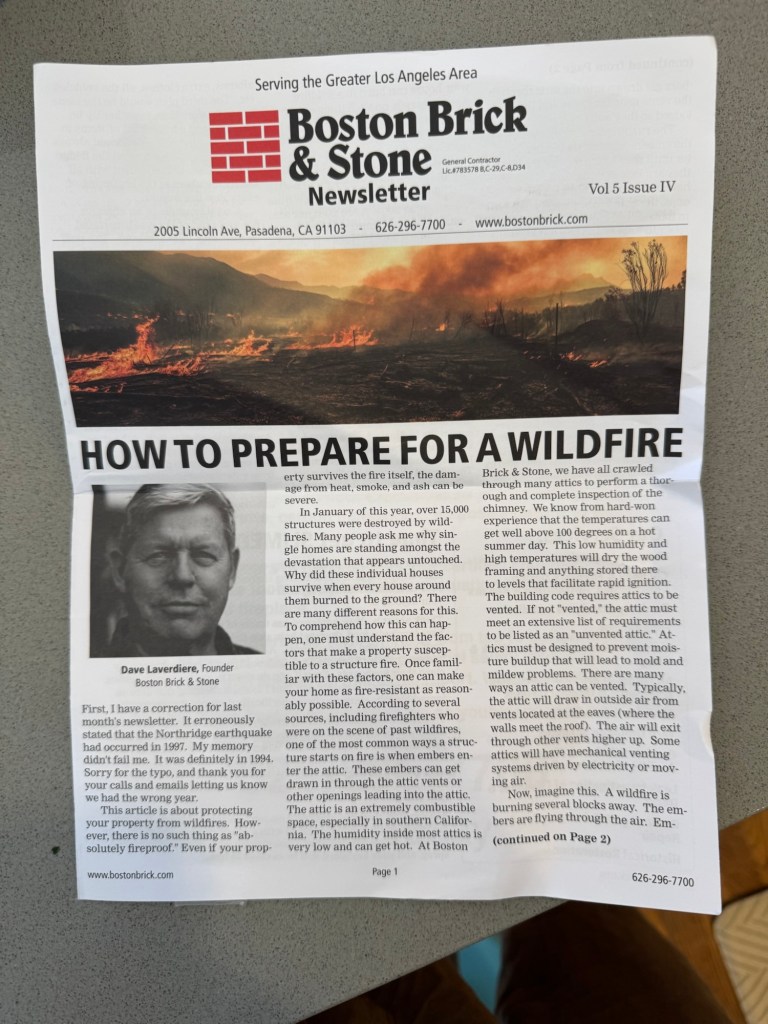
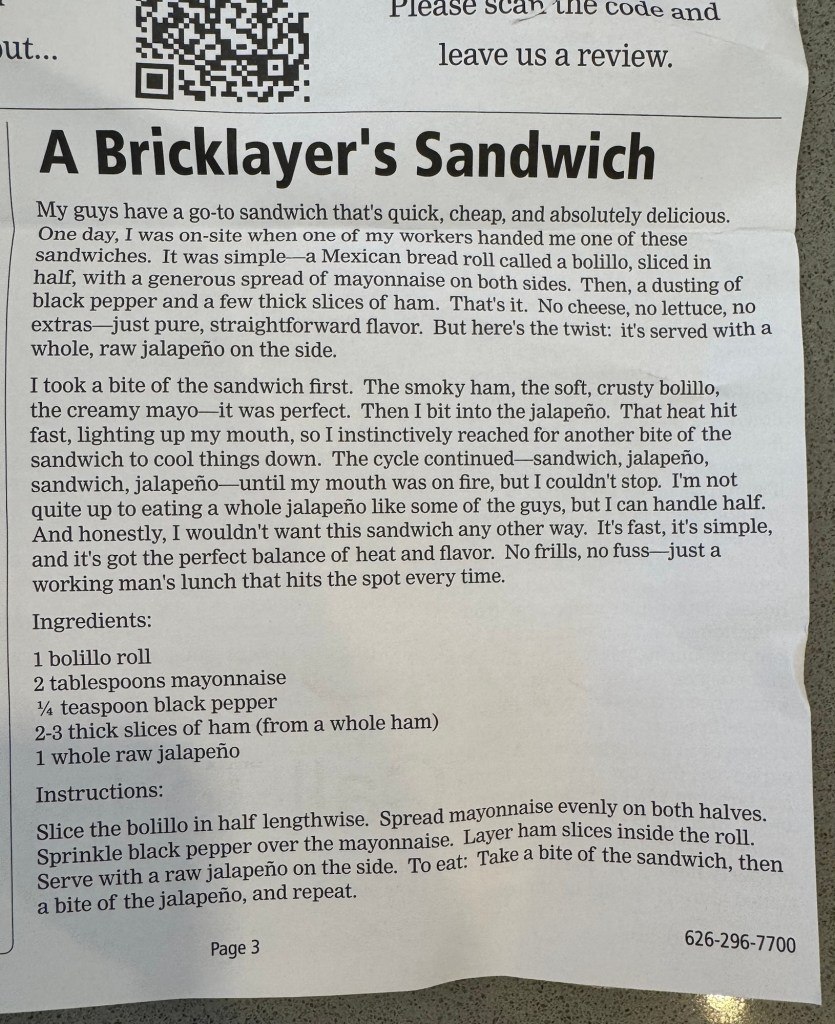
The Boston Brick & Stone newsletter is interesting marketing, and honestly one of my favorite periodicals. I’m awarding it a Helytimes Prize for Sandwich Journalism for this feature, “A Bricklayer’s Sandwich.”
“Buy when there’s blood in the streets”
Posted: April 6, 2025 Filed under: advice, business 3 Comments
On the famous quote sometimes attributed to Nathan Rothschild
His four brothers helped co-ordinate activities across the continent, and the family developed a network of agents, shippers and couriers to transport gold—and information—across Europe. This private intelligence service enabled Nathan to receive in London the news of Wellington’s victory at the Battle of Waterloo a full day ahead of the government’s official messengers.[2] He is famously quoted as saying “Buy when there’s blood in the streets”, though the original quote is believed to have appended “even if the blood is your own”. The quote refers to his contrarian investing strategy that he is well known for adhering to as to buy assets when the financial markets are crashing and panicking investors are selling. The quote has a tremendous impact today on value investing and modern businesspeople and investors alike when buying assets in down markets when investment opportunities arise.[3][4][5]
The first part of this concerning the Battle of Waterloo has already been adequately dealt with. The second part of this seems equally dubious, and I can’t find a good source for it. You can find this “buy when there is blood in the streets” quote in many modern business books, but they hardly count as a reliable source for a biography of Nathan Rothschild. The earliest sources I’ve found so far date from 1907/8 – for example Thomas Gibson’s Market Letters for 1907 contains the following supposed conversation:
“Buy Rentes,” advised Rothschild.
“But the streets of Paris are running with blood.”
“That is why you can buy Rentes so cheap.”
Grateful to Wikipedia editor Franz for getting to the bottom of that quote.
The first time I heard Cass McCombs was in a car in Queensland, Australia. The aux cord wasn’t working properly, so the vocals weren’t coming through, just the instrumentals. For awhile I was like “who is this genius that just plays rhythmic patterns?!” It was cool either way!
People drop this quote every time there’s a stock market downturn. But it sounds like Rothschild was speaking of a time when blood was literally running in the streets.
Based
Posted: April 3, 2025 Filed under: America Since 1945 Leave a comment
from THR’s White Lotus oral history.
Great coat of arms
Posted: April 3, 2025 Filed under: France Leave a comment
reading about Dauphiné, was wondering why this region of France was called that, and of course it’s because Guigues IV had a dolphin on his coat of arms.
Glimpses of Abraham Lincoln: awaiting election results with Charles Dana
Posted: April 3, 2025 Filed under: presidents, WOR Leave a comment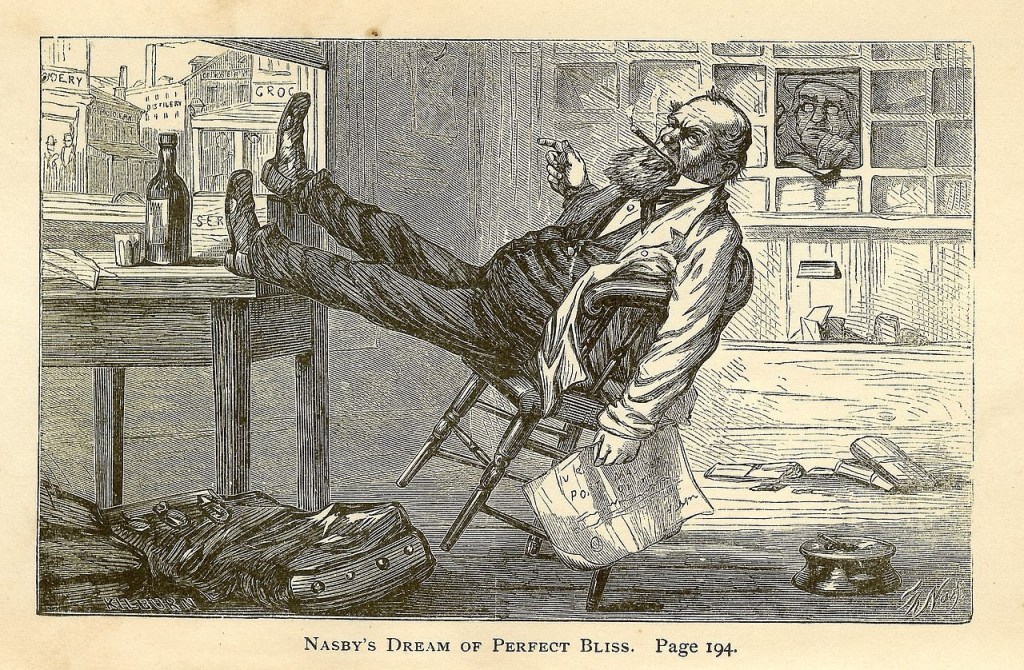
Charles Dana, former journalist and assistant secretary of war was with Abraham Lincoln as he awaited results of the election of 1864:
All the power and influence of the War Department, then something enormous from the vast expenditure and extensive relations of the war, was employed to secure the re-election of Mr. Lincoln. The political struggle was most intense, and the interest taken in it, both in the White House and in the War Department, was almost painful. After the arduous toil of the canvass, there was naturally a great suspense of feeling until the result of the voting should be ascertained. On November 8th, election day, I went over to the War Department about half past eight o’clock in the evening, and found the President and Mr. Stanton together in the Secretary’s office. General Eckert, who then had charge of the telegraph department of the War Office, was coming in constantly with telegrams containing election returns. Mr. Stanton would read them, and the President would look at them and comment upon them. Presently there came a lull in the returns, and Mr. Lincoln called me to a place by his side.
“Dana,” said he, “have you ever read any of the writings of Petroleum V. Nasby?”
“No, sir,” I said; “I have only looked at some of them, and they seemed to be quite funny.”
“Well,” said he, “let me read you a specimen”;
“let me read you a specimen”;
and, pulling out a thin yellow-covered pamphlet from his breast pocket, he began to read aloud. Mr. Stanton viewed these proceedings with great impatience, as I could see, but Mr. Lincoln paid no attention to that.
He would read a page or a story, pause to consider new election telegram, and then open the book again and go ahead with a new passage. Finally, Mr. Chase came in, and presently somebody else, and then the reading was interrupted.
Mr. Stanton went to the door and beckoned me into the next room. I shall never forget the fire of his indignation at what seemed to him to be mere nonsense.
The idea that when the safety of the republic was thus at issue, when the control of an empire was to be determined by a few figures brought in by the telegraph, the leader, the man most deeply concerned, not merely for himself but for his country, could turn aside to read such balderdash and to laugh at such frivolous jests was, to his mind, repugnant, even damnable. He could not understand, apparently, that it was by the relief which these jests afforded to the strain of mind under which Lincoln had so long been living, and to the natural gloom of a melancholy and desponding temperament-this was Mr. Lincoln’s prevailing characteristic-that the safety and sanity of his intelligence were maintained and preserved.
Petroleum Naseby was a character, a cowardly Copperhead who supported the Confederacy but didn’t want to do anything about it, invented by David Ross Locke.
In his day Locke was up there with Josh Billings and Mark Twain.
Val Kilmer
Posted: April 2, 2025 Filed under: actors 1 CommentCan’t forget him doing his one man show as Mark Twain at the Hollywood Cemetery. Afterwards he stayed on stage while he was taking his elaborate makeup off and asked the audience if they uncomfortable with him saying the n word so much.
The Doors, Tombstone, Heat, Spartan… he wasn’t just pretending, he was in it.
Kilmer briefly considered running for Governor of New Mexico in 2010, but decided against it.
What if?
Hely’s Grave
Posted: March 22, 2025 Filed under: Australia Leave a comment
Hely’s Grave is a heritage-listed grave at 559 Pacific Highway, Wyoming, Central Coast, New South Wales, Australia. It was designed by John Verge and built in 1836.
Hely’s Grave is the resting place of Frederick Augustus Hely, born in County Tyrone, Ireland, who ended up as superintendent of convicts in New South Wales in 1823. Was that a good job or a bad one? It must’ve been the equivalent of moving to the moon.
John Verge, the architect who designed this grave, also designed Hely’s house, Wyoming Cottage, which still stands and looks nice:

(Source)
Why did John Verge move to Australia? He was having success in London it seems. This may be a clue:
Verge’s marriage eventually failed and, in 1828, he migrated to Sydney, New South Wales, Australia, with his son George Philip, intending to take up a land grant.
His architectural legacy remains all over the Sydney area, I should like to go on a tour some day.
Frederick Hely’s son Hovendon Hely had an interesting career:
He took part in the 1846-47 expedition of Ludwig Leichhardt but was accused by Leichhardt of indolence, disloyalty and “disgusting” behaviour.
Interesting. More details are revealed by The Australian Dictionary of Biography:
Although described by Ludwig Leichhardt as a ‘likeable idler’, Hely joined his unsuccessful expedition of 1846-47. Leichhardt later accused him of disloyalty and dereliction of duty, after Hely and his relation, John Frederick Mann, had also disgusted Leichhardt ‘with their bawdy filthy conversations or with their constant harping on fine eating and drinking’.
Wonderful. “Likeable idler” is my dream job.
Ludwig Leichhardt, a German naturalist, had a curious nature.

His first expedition spanned a lot of northern Australia:

It was not without casualties. A vivid and blunt memorial to John Gilbert is on the wall of St. James Church in Sydney:

“Speared by the blacks.”
A second expedition doesn’t seem to have been much more successful:
Members of the party nearly mutinied after learning that Leichhardt had failed to bring along a medical kit. Faced with failure, Leichhardt seems to have suffered a nervous breakdown, and Aboriginal guide Harry Brown effectively took over as leader of the party, taking them successfully back to the Darling Downs.
Nevertheless Leichhardt kept at it. He tried another expedition and got malaria, survived, and went for one more. On this expedition, he went missing. Who was send to find him but Hovendon Hely:
In December 1851 Hely was appointed head of the official search for Leichhardt after the original appointee had drowned, but revealed little imaginative leadership. According to the Empire in 1864, the expedition ‘established nothing whatever’.
The fate of Leichhardt continues to inspire investigation, there are a number of intriguing clues like a brass plate and a letter recording an aboriginal oral history:

As for Hovendon Hely, he survived and had six sons and a daughter. Many Helys remain in Australia, among them both judges and murderers. So far as I know none of these Helys can be counted as relatives in any meaningful way, but any doorway into Australian history is welcome, and any explorations of that bizarre land are usually rewarded (as long as you don’t get speared).
If any of my Australian correspondents are available for a bit of field work, I’d like to learn why Hely’s Grave is reported by Google Maps as permanently closed. It’s a bit of a trek, an hour six minutes drive from the Park Hyatt Sydney. But on the plus side it’s across the street from a Hungry Jack’s

Carolina Whopper on me for anyone who reports.
Turned Inside Out: Recollections of a Private Soldier in the Army of the Potomac by Frank Wilkeson
Posted: March 15, 2025 Filed under: WOR 1 Comment
This is one of the most vivid books I’ve ever read. It’s cinematic. It describes the journey of a teenage boy from upstate New York into hell. A harrowing journey in a series of scenes that get more and more intense. It’s like watching 1917 or something.
(Trigger warning: sad)
The war fever seized me in 1863. All the summer and fall I had fretted and burned to be off. That winter, and before I was sixteen years old, I ran away from my father’s high-lying Hudson River Valley farm. I went to Albany and enlisted in the Eleventh New York Battery, then at the front in Virginia, and was promptly sent out to a penitentiary building. There, to my utter astonishment, I found eight hundred or one thousand ruffians, closely guarded by heavy lines of sentinels, who paced to and fro, day and night, rifle in hand, to keep them from running away. When I entered the barracks these recruits gathered around me and asked, “How much bounty did you get?” “How many times have you jumped the bounty?” I answered that I had not bargained for any bounty, that I had never jumped a bounty, and that I had enlisted to go to the front and fight. I was instantly assailed with abuse. Irreclaimable blackguards, thieves, and ruffians gathered in a boisterous circle around me and called me foul names. I was robbed while in these barracks of all I possessed—a pipe, a piece of tobacco and a knife.
I remained in this nasty prison for a month. I became thoroughly acquainted with my com-rades. A recruit’s social standing in the barracks was determined by the acts of villany he had performed, supplemented by the number of times he had jumped the bounty. The social standing of a hard-faced, crafty pickpocket, who had jumped the bounty in say half a dozen cities, was assured.
The first people he sees killed are three men attempting to desert as they march down State Street in Albany. They take a steamboat to New York, where a guard kills another man trying to desert. Then they’re put on another steamboat:
Money was plentiful and whiskey entered through the steamer’s ports, and the guards drove a profitable business in selling canteens full of whiskey at $5 each. Promptly the hold was transformed into a floating hell. The air grew denser and denser with tobacco smoke.
Drunken men staggered to and fro. They yelled and sung and danced, and then they fought and fought again. Rings were formed, and within them men pounded each other fiercely. They rolled on the slimy floor and howled and swore and bit and gouged, and the delighted spectators cheered them to redouble their efforts. Out of these fights others sprang into life, and from these still others. The noise was horrible. The wharf became crowded with men eager to know what was going on in the vessel. A tug was sent for, and we were towed into the river, and there the anchors were dropped. Guards ran in on us and beat men with clubbed rifles, and were in turn attacked.
We drove them out of the hold. The hatch at the head of the stairs was closed and locked. The recruits were maddened with whiskey. Dozens of men ran a muck, striking every one they came to, and being struck and kicked and stamped on in return. The ventilation hatches were surrounded by stern-faced sentinels, who gazed into the gloom below and warned us not to try to get out by climbing through the hatches.
Men sprang high in the air and clutched the hatch railings, and had their hands smashed with musket butts. Sentinels paced to and fro along the vessel’s deck, and called loudly to all row-boats to keep off or they would be fired upon. They did not intend that any fresh supplies of whiskey should be brought to us. The prisoners in this floating hell were then told to “go it,” and they went it. We had been searched for arms before we entered the barracks at Albany. The more decent and quiet of us had no means of killing the drunken brutes who pressed on us. There was not a club or a knife or an iron bolt that we could lay our hands to. I fought, and got licked; fought again, and won; and for the third time faced my man, and got knocked stiff in two seconds. It was a scene to make a devil howl with delight.
They reach Alexandria, and then are put on a train to the Union winter camp at Brandy Station. Five more deserters are shot along the way. In the spring, Wilkeson is marched into Virginia. Along the road they pass the bones of unburied dead left from the battle of Chancellorsville.
As we sat silently smoking and listening to the story, an infantry soldier who had, unobserved by us, been prying into the shallow grave he sat on with his bayonet, suddenly rolled a skull on the ground before us, and said in a deep, low voice: “That is what you are all coming to, and some of you will start toward it tomorrow.” It was growing late, and this uncanny remark broke up the group, most of the men going to their regimental camps.
I found this book in a strange way. I was trying to sort out Grant’s Overland Campaign. Here’s an informative video of the strategic level. You can read Grant’s memoirs and many histories and accounts from officers. But what was it like? At Spotsylvania Courthouse, at the Mule Shoe Salient, there was a 22 hour hand to hand scrum, thousands of people killed in like a one square mile bit of earthworks. Did anyone survive to tell about that? In the course of investigating I did find these Australian guys recreating the battle with miniatures:


Their work is amazing.

I’d been playing around with testing various AIs on historical questions. I asked Claude:
What are some notable firsthand account of the fighting at mule shoe salient in the us civil war?
Claude came back with a numbered list of seven sources. Six were officers’ memoirs or official reports, and one was Frank Wilkeson’s “Recollections of a Private Soldier.”

Wilkeson wasn’t actually at the “mule shoe” I don’t think, but close enough. Strangely, on other occasions, Claude has completely made up sources that don’t exist. I go to check them and find they’re nothing, I tell Claude “hey can you give me more information about this, I can’t find it” and Claude says “I apologize, you’re right, I was mistaken.” Weird.
Anyway Frank Wilkeson is very real, his book was reprinted by University of Nebraska Press in 1997. The original title, Recollections of A Private Soldier in the Army of the Potomac, is so boring that it possibly caused this book to be ignored. The new title, Turned Inside Out, refers to how the pockets of the dead would all be turned out by battlefield ghouls and robbers of the dead.
At one point Wilkeson actually sees Grant:
One of my comrades spoke to me across the gun, saying: “Grant and Meade are over there,” nodding his head to indicate the direction in which I was to look. I turned my head and saw Grant and Meade sitting on the ground under a large tree. Both of them were watching the fight which was going on in the pasture field. Occasionally they turned their glasses to the distant wood, above which small clouds of white smoke marked the bursting shells and the extent of the battle. Across the woods that lay behind the pasture, and behind the bare ridge that formed the horizon, and well within the Confederate lines, a dense column of dust arose, its head slowly moving to our left. I saw Meade call Grant’s attention to this dust column, which was raised either by a column of Confederate infantry or by a wagon train. We ceased firing, and sat on the ground around the guns watching our general, and the preparations that were being made for another charge.
Grant had a cigar in his mouth. His face was immovable and expressionless.
His eyes lacked lustre.
He sat quietly and watched the scene as though he was an uninterested spectator. Meade was nervous, and his hand constantly sought his face, which it stroked. Staff officers rode furiously up and down the hill carrying orders and information. The infantry below us in the ravine formed for another charge. Then they started on the run for the Confederate earthworks, cheering loudly the while. We sprang to our guns and began firing rapidly over their heads at the edge of the woods. It was a fine display of accurate artillery practice, but, as the Confederates lay behind thick earth-works, and were veterans not to be shaken by shelling the outside of a dirt bank behind which they lay secure, the fire resulted in emptying our limber chests, and in the remarkable discovery that three-inch percussion shells could not be relied upon to perform the work of a steam shovel. Our infantry advanced swiftly, but not with the vim they had displayed a week previous; and when they got within close rifle range of the works, they were struck by a storm of rifle-balls and canister that smashed the front line to flinders. They broke for cover, leaving the ground thickly strewed with dead and dying men. The second line of battle did not attempt to make an assault, but returned to the ravine. Grant’s face never changed its expression. He sat impassive and smoked steadily, and watched the short-lived battle and decided defeat without displaying emotion. Meade betrayed great anxiety. The fight over, the generals arose and walked back to their horses, mounted and rode briskly away, followed by their staff. No troops cheered them. None evinced the slightest enthusiasm.
The enlisted men looked curiously at Grant, and after he had disappeared they talked of him, and of the dead and wounded men who lay in the pasture field; and all of them said just what they thought, as was the wont of American volunteers. This was the only time that I saw either Grant or Meade under fire during the campaign, and then they were with. in range of rifled cannon only.
For a “you are there” quality of the War of the Rebellion – what Wilkeson calls “the suppression of the slaveholders’ revolt” – I’m not sure this book can be matched by anything I’m aware of except Ambrose Bierce and Sam Watkins. The power here is the scenes.
Before noon we came to the village of Bowling Green, where many pretty girls stood at cottage windows or doors, and even as close to the despised Yankees as the garden gates, and looked scornfully at us as we marched through the pretty town to kill their fathers and broth-ers. There was one very attractive girl, black-eyed and curly-haired, and clad in a scanty calico gown, who stood by a well in a house yard. She looked so neat, so fresh, so ladylike and pretty, that I ran through the open gate and asked her if I might fill my canteen with water from the well. And she, the haughty Virginia maiden, refused to notice me. She calmly looked through me and over me, and never by the slightest sign acknowledged my presence; but I filled my canteen, and drank her health. I liked her spirit.
Everybody who knows their Civil War history knows that a key moment was when Grant, after a disastrous first fight with Lee’s Army of Northern Virginia at the Wilderness, advanced instead of retreating like every previous Army of the Potomac commander. But Wilkeson’s there, man.
” Here we go,” said a Yankee private; “here we go, marching for the Rapidan, and the protection afforded by that river. Now, when we get to the Chancellorsville House, if we turn to the left, we are whipped at least so say Grant and Meade. And if we turn toward the river, the bounty-jumpers will break and run, and there will be a panic.”
“Suppose we turn to the right, what then?”
I asked.
“That will mean fighting, and fighting on the line the Confederates have selected and in-trenched. But it will indicate the purpose of Grant to fight,” he replied.
Then he told me that the news in his Sixth Corps brigade was that Meade had strongly advised Grant to turn back and recross the Rapidan, and that this advice was inspired by the loss of Shaler’s and Seymour’s brigades on the evening of the previous day. This was the first time I heard this rumor, but I heard it fifty times before I slept that night. The enlisted men, one and all, believed it, and I then believed the rumor to be authentic, and I believe it to-day. None of the enlisted men had any confidence in Meade as a tenacious, aggressive fighter. They had seen him allow the Confederates to escape destruction after Get-tysburg, and many of them openly ridiculed him and his alleged military ability.
Grant’s military standing with the enlisted men this day hung on the direction we turned at the Chancellorsville House. If to the left, he was to be rated with Meade and Hooker and Burnside and Pope-the generals who preceded him. At the Chancellorsville House we turned to the right. Instantly all of us heard a sigh of relief. Our spirits rose. We marched free. The men began to sing. The enlisted men understood the flanking movement. That night we were happy.
The site of the turn:

as it was:

James McPherson notes in the introduction, Shelby Foote and Bruce Catton took some of the best stuff from Wilkeson.
The most intense chapter of Wilkeson’s book is called “How Men Die In Battle.” You can read it here if you like. Here’s an excerpt (warning: intense, sad):
Near Spottsylvania I saw, as my battery was moving into action, a group of wounded men lying in the shade cast by some large oak trees. All of these men’s faces were gray. They silently looked at us as we marched past them. One wounded man, a blond giant of about forty years, was smoking a short briar-wood pipe. He had a firm grip on the pipe-stem. I asked him what he was doing. “Having my last smoke, young fellow,” he replied. His dauntless blue eyes met mine, and he bravely tried to smile. I saw that he was dying fast. Another of these wounded men was trying to read a letter. He was too weak to hold it, or maybe his sight was clouded. He thrust it unread into the breast pocket of his blouse, and lay back with a moan. This group of wounded men numbered fifteen or twenty. At the time, I thought that all of them were fatally wounded, and that there was no use in the surgeons wasting time on them, when men who could be saved were clamoring for their skillful attention. None of these soldiers cried aloud, none called on wife, or mother, or father. They lay on the ground, pale-faced, and with set jaws, waiting for their end. They moaned and groaned as they suffered, but none of them flunked. When my battery returned from the front, five or six hours afterward, almost all of these men were dead. Long before the campaign was over I concluded that dying soldiers seldom called on those who were dearest to them, seldom conjured their Northern on Southern homes, until they became delirious. Then, when their minds wandered, and fluttered at the approach of freedom, they babbled of their homes. Some were boys again, and were fishing in Northern trout streams. Some were generals leading their men to victory. Some were with their wives and children. Some wandered over their family’s homestead; but all, with rare exceptions, were delirious..
so I guess that’s what it was like.
In looking for info on the original Chancellor House I find this:
In the early 20th century, Susan Chancellor would often stop by for unannounced visits to the re-built house, much to the chagrin of a young girl who lived there with her family. “It was odd that she never knocked,” 89-year-old Hallie Rowley Sale told the Fredericksburg Free-Lance Star in 2003. “It was like she still thought of it as her home. We would hear a door open. And the next thing we knew, Mrs. Chancellor would be leading a group of people through the house.”
Movie idea
Posted: March 13, 2025 Filed under: film Leave a comment
Mikey Madison

is Dolley Madison.
Aaron Burr set her up with James Madison. A haunted photograph of her late in life.

More Conversations with Walker Percy
Posted: March 5, 2025 Filed under: Uncategorized Leave a comment
Vauthier: Mr. Percy, could we return to the question of time, and could you address the general problem of time in The Moviegoer?
Percy: Time? Well, at the end of the Mardi Gras season, the last scene and the last day of The Moviegoer is Ash Wednesday, so there’s a certain relevance here of the time of the action. The celebration of Mardi Gras is in New Orleans the biggest festival of the year with six weeks of parades and six weeks of parties. It ends with Ash Wednesday which is generally more or less ignored by most people who take part in Mardi Gras.
The role of the writer:
E.O.: Considering this very complicated contemporary scene, what is, to you, the role of a writer today?
W.P.: The role of a writer. Well, it seems to be, for me anyway, to affirm people, to affirm the reader. The general culture of the time is very scientific, one might call it “scientistic” on the one hand, and simply aesthetically oriented, on the other. This does not satisfy a certain reader. So, the reader is left in the state of confusion. The contemporary state of a young American man or woman is that he or she has more of the world’s affluence than any other people on this earth and yet he is more dissatisfied, more restless. He experiences some sense of loss which he cannot understand. For him, the traditional religion does not have the answer. So the role of my kind of writer is to speak to this person about this whole area of experience that he’s at or she’s at. This is what you feel, this is how you feel now. My original example in “The Message in the Bottle” is that you take a commuter, the man on the train. He has everything, he succeeded. He lives in Greenwich, Connecticut. He’s making a hundred thousand dollars a year, and he comes into New York every day. He’s moved into a better house, to a better country club, has a very nice wife and nice kids. He is riding on this train and he wonders: what am I doing? He can open a newspaper, and he can see a column which says something about the mid-life crisis. He can read some popular advice from a popular psychologist who would say why you have your mid-life crisis. But this doesn’t satisfy him. He picks up a book by an American writer, John Marquand, which is about a man like himself, a commuter on the train who has the same sense of loss. So, I say that there is a tremendous difference between a man on the train who is in a certain predicament and the same man on the same train with the same predicament who is reading a book about a man on the train. The role of a writer is very modest. It’s to identify the predicament. The letters I get are from people who say: I didn’t know anybody who talked like that, I know what you mean, you have described my predicament. I get letters from the businessmen (the men on the train), from young men, and from young women, and they’re excited because I’ve named the predicament.
That doesn’t sound like much, that’s a very modest contribution but it’s very important. You see, I agree with Kierkegaard. He said: “I’m not an apostle, it’s not for me to bring the good news. Even if I brought the good news, nobody would believe it.” But the role of a novelist, or an artist, for that matter, is to tell the truth, and to convey a kind of knowledge which cannot be conveyed by science, or psychology, or newspapers.
E.O.: Is this edifying?
W.P.: Edifying. You’ve picked up all the bad words. Well, “edify-ing” is a perfectly good word, but it has very bad connotations in English. Well, in the largest sense, it is edifying, because it’s helpful, it creates hope. At its best it’s affirming, it affirms the reader in the way he or she is. It offers an openness and some hope. And that’s about all a novelist can do.
How about this:
Interviewer: It is clear that once we are dealing with a “post-religious technological society,” transcendence is possible for the self by science or art but not by religion. Where does this leave the heroes of your novels with their metaphysical yearnings-Binx, Barrett, More, Lance?
Percy: I would have to question your premise, i.e., the death of relig-ion. The word itself, religion, is all but moribund, true, smelling of dust and wax-though of course in its denotative sense it is accurate enough.
I have referred to the age as “post-Christian” but it does not follow from this that there are not Christians or that they are wrong. Possibly the age is wrong. Catholics —who are the only Christians I can speak for-still believe that God entered history as a man, founded a church and will come again. This is not the best of times for the Catholic Church, but it has seen and survived worse. I see the religious “transcendence” you speak of as curiously paradoxical. Thus it is only by a movement, “transcendence,” toward God that these characters, Binx et al., become themselves, not abstracted like scientists but fully incarnate beings in the world. Kierkegaard put it more succinctly: the self only becomes itself when it becomes itself transparently before God.
From a profile:
He spent most of a decade writing two never-published novels, though now he swears he never felt discouraged “There was never a moment when I doubted what I wanted to do. It was always writing.” In the mid-1950’s, he began The Moviegoer. “I can remember sitting on that back porch of that little shotgun cottage in New Orleans with a little rank patio grown up behind it, after two failed novels. I didn’t feel bad. I felt all right.
“And it crossed my mind, what if I did something that American writers never do, which seems to be the custom in France: Namely, that when someone writes about ideas, they can translate the same ideas to fiction and plays, like Mauriac, Malraux, Sartre. So it just occurred to me, why not take these ideas I’d been trying to write about, in psychiatry and philosophy, and translate them into a fictional setting in New Orleans, where I was living. So I was just sitting out there, and I started writing.
How he starts:
“My novels start off, almost naturally, with somebody in a predicament and somebody trying to get out of it or embark on some sort of search, some sort of wanderings,” Percy says.
Permission to fail:
Visitor: Some people would rather not face their ordeals. What then?
Percy: I have a theory that what terrifies people most of all is failing to live up to something or other. This terror is the result of television shows, movies, and bad books where things always work out. Even in tragic movies, things are rounded off pretty well; people suffer nervous breakdowns in style and form. But, after all, whenever a movie is filmed, serious moviemakers collect 40 or 50 outtakes or failures, scenes that didn’t work, before they get one that works. So what the audience sees is the one that works. We should approach life that way.
We should give ourselves permission to fail.
My opinion? More Conversations with Walker Percy is even better than Conversations with Walker Percy!
Professor Longhair
Posted: March 4, 2025 Filed under: America Since 1945, music, New Orleans Leave a comment
Mardi Gras has me thinking about Professor Longhair. In his memoir Rhythm and Blues Jerry Wexler tells a story about Ahmet Ertegun finding the Professor:
I’d started noticing Atlantic’s early releases with Professor Long-hair’s “Hey Now Baby,” “Hey Little Girl,” and “Mardi Gras in New Orleans.” Fess—as the Professor was called—was a revelation for me, my first taste of the music being served up in Louisiana in the late forties.
There were traces of Jelly Roll Morton’s habanera-Cuban tango influence in his piano style, but the overall effect was startlingly original, a jambalaya Caribbean Creole rumba with a solid blues bottom.
In a foreshadowing of trips I myself would later take to New Orleans, Ahmet described the first of his many ethnomusicological expeditions. “Herb and I went down there to see our distributor and look for talent. Someone mentioned Professor Longhair, a musical shaman who played in a style all his own. We asked around and finally found ourselves taking a ferry boat to the other side of the Mississippi, to Algiers, where a white taxi driver would deliver us only as far as an open field. ‘You’re on your own,’ he said, pointing to the lights of a distant village. ‘I ain’t going into that n***ertown.’ Abandoned, we trudged across the field, lit only by the light of a crescent moon. The closer we came, the more distinct the sound of distant music—some big rocking band, the rhythm exciting us and pushing us on. Finally we came upon a nightclub—or, rather, a shack—which, like an animated cartoon, appeared to be expanding and deflating with the pulsation of the beat. The man at the door was skeptical. What did these two white men want? ‘We’re from Life magazine,’ I lied.
Inside, people scattered, thinking we were police. And instead of a full band, I saw only a single musician—Professor Longhair—playing these weird, wide harmonies, using the piano as both keyboard and bass drum, pounding a kick plate to keep time and singing in the open-throated style of the blues shouters of old. “ ‘My God,’ I said to Herb, ‘we’ve discovered a primitive genius.’ “Afterwards, I introduced myself. ‘You won’t believe this,’ I said to the Professor, ‘but I want to record you.’ “ ‘You won’t believe this,’ he answered, ‘but I just signed with Mercury.’
Ahmet recorded him anyway—“ I am many men with many names who play under many styles,” Fess used to say—and jewels from that first session remain in the Atlantic catalogue today, over four decades later.”
(source on that photo) Previous coverage of New Orleans.
The Fate of John Sedgwick
Posted: March 2, 2025 Filed under: photography, WOR Leave a comment
Of General John Sedgwick, Grant wrote:
I had known him in Mexico when both of us were lieutenants, and when our service gave no indication that either of us would ever be equal to the command of a brigade. He stood very high in the army, however, as an officer and a man. He was brave and conscientious. His ambition was not great, and he seemed to dread responsibility. He was willing to do any amount of battling, but always wanted some one else to direct. He declined the command of the Army of the Potomac once, if not oftener.
and
he was never at fault when serious work was to be done
I was reading up on Timothy O’Sullivan, a somewhat mysterious character, and his haunting photographs:
On May 5, [Timothy] O’Sullivan and his camera were at the Wilderness where men fought in a virgin forest of oak and pine, choked with underbrush.
It was so thick the troops moved in single line, the powder smoke so heavy, that men stumbled blindly into enemy lines. Two days later OSullivan was with Grant, moving toward Spotsylvania, where on May 8, Grant and Lee faced each other again. One of the last pictures OSullivan made before the battle began was of his old friend General Sedgwick, who liked to describe himself as “practical as distinguished from the theoretical soldier,” standing on the steps of a house surrounded by his staff. A short time later Sedgwick would be killed, as he told a soldier dodging Rebel bullets not to worry, “they could not shoot an elephant at that distance.” The words had just fallen from his lips when he fell, killed by a sharpshooter.
That from James D. Horan, Timothy O’Sullivan: America’s Forgotten Photographer.
A firsthand account of the end of Sedgwick, from Martin McMahon, who was Sedgwick’s chief of staff:
After this brigade, by Sedgwick’s direction, had been withdrawn through a little opening to the left of the pieces of artillery, the general, who had watched the operation, resumed his seat on the hard-tack box and commenced talking about members of his staff in very complimentary terms.
He was an inveterate tease, and I at once suspected that he had some joke on the staff which he was leading up to. He was interrupted in his comments by observing that the troops, who during this time had been filing from the left into the rifle-pits, had come to a halt and were lying down, while the left of the line partly overlapped the position of the section of artillery. He stopped abruptly and said, ” That is wrong. Those troops must be moved farther to the right ; I don’t wish them to overlap that battery.” I started out to execute the order, and he rose at the same moment, and we sauntered out slowly to the gun on the right. About an hour before, I had remarked to the general, pointing to the two pieces in a half-jesting manner, which he well understood, ” General, do you see that section of artillery? Well, you are not to go near it today.” He answered good-naturedly, “McMahon, I would like to know who commands this corps, you or I? ” I said, playfully, “Sometimes I am in doubt myself”; but added, ” Seriously, General, I beg of you not to go to that angle; every officer who has shown himself there has been hit, both yesterday and to-day.” He answered quietly, ” Well, I don’t know that there is any reason for my going there.” ‘ When afterward we walked out to the position indicated, this conversation had entirely escaped the memory of both.
(you can see the inveterate half-jester in this portrait of him, taken probably in 1864, by Matthew Brady or one of his employees)

back to McMahon:
I gave the necessary order to move the troops to the right, and as they rose to execute the movement the enemy opened a sprinkling fire, partly from sharp-shooters. As the bullets whistled by, some of the men dodged. The general said laughingly, ” What! what! men, dodging this way for single bullets! What will you do when they open fire along the whole line? I am ashamed of you. They couldn’t hit an elephant at this distance.” A few seconds after, a man who had been separated from his regiment passed directly in front of the general, and at the same moment a sharp-shooter’s bullet passed with a long shrill whistle very close, and the soldier, who was then just in front of the general, dodged to the ground. The general touched him gently with his foot, and said, ” Why, my man, I am ashamed of you, dodging that way,” and repeated the remark, ” They couldn’t hit an elephant at this distance.” The man rose and saluted and said good-naturedly, ” General, I dodged a shell once, and if I hadn’t, it would have taken my head off. I believe in dodging.” The general laughed and replied, “All right, my man; go to your place.”
For a third time the same shrill whistle, closing with a dull, heavy stroke, interrupted our talk; when, as I was about to resume, the general’s face turned slowly to me, the blood spurting from his left cheek under the eye im a steady stream. He fell in my direction ; I was so close to him that my effort to support him failed, and I fell with him.
Colonel Charles H. Tompkins, chief of the artillery, standing a few feet away, heard my exclamation as the general fell, and, turning, shouted to his brigade-surgeon, Dr. Ohlenschlager. Major Charles A. Whittier, Major T. W. Hyde; and Lieutenant Colonel Kent, who had been grouped near by, surrounded the general as he lay. A smile remained upon his lips but he did not speak. The doctor poured water from a canteen over the general’s face. The blood still poured upward in a little fountain. The men in the long line of rifle-pits, retaining their places from force of discipline, were all kneeling with heads raised and faces turned toward the scene ; for the news had already passed along the line.

After the war, Timothy O’Sullivan accompanied several expeditions out west, and photographed stuff like this:

John Sedgwick was from Cornwall, Connecticut, which seems like a pleasant place. Mark Van Doren wrote a poem about it, here’s an excerpt:
The mind, eager for caresses,
Lies down at its own risk in Cornwall;
Whose hills,
Whose cunning streams,
Whose mazes where a thought,
Doubling upon itself,
Considers the way, lazily, well lost,
Indulge it to the nick of death–
Not quite, for where it curls it still can feel,
Like feathers,
Like affectionate mouse whiskers,
The flattery, the trap.
In Cornwall there’s House VI, an experiment in deconstructivist architecture (a failed experiment?)

The Sedgwicks are a big name in the Berkshires, although I don’t see that our John is connected to the Main Line with Kyra and Edie. There’s a monument to John Sedgwick in Cornwall, but it seems ununique, like a thousand other Civil War monuments:

On the other hand, there’s a monument of him at West Point that has a tradition attached:
Legend holds that if a cadet is deficient in academics, the cadet should go to the monument at midnight the night before the term–end examination, in full dress, under arms, and spin the rowels on the monument’s spurs. With the resulting good luck, the cadet will pass the test.
It seems like he might’ve enjoyed that.

sources, for the photo, for Waud’s drawing and more.
Snappy lines from Uncle Warren
Posted: February 24, 2025 Filed under: America Since 1945, business Leave a commentWarren Buffett at 94 still writing in a crisp, appealing style in his annual letter. Is he fibbing a bit when he brags about not doing due diligence on real estate purchases? And bragging on himself for how much tax he pays, when he surely uses every dodge he can? Maybe so. He’s a mythmaker.
A decent batting average in personnel decisions is all that can be hoped for. The cardinal sin is delaying the correction of mistakes or what Charlie Munger called “thumb-sucking.” Problems, he would tell me, cannot be wished away. They require action, however uncomfortable that may be.
The philosophy:
… we own a small percentage of a dozen or so very large and highly profitable businesses with household names such as Apple, American Express, Coca-Cola and Moody’s. Many of these companies earn very high returns on the net tangible equity required for their operations. At yearend, our partial-ownership holdings were valued at $272 billion. Understandably, really outstanding businesses are very seldom offered in their entirety, but small fractions of these gems can be purchases Monday through Friday on Wall Street, and very occasionally, they sell at bargain prices.
Inflation:
Paper money can see its value evaporate if fiscal folly prevails. In some countries, this reckless practice has become habitual, and, in our country’s short history, the U.S. has come close to the edge. Fixed-coupon bonds provide no protection against runaway currency.
Businesses, as well as individuals with desired talents, however, will usually find a way to cope with monetary instability as long as their goods or services are desired by the country’s citizenry. So, too, with personal skills. Lacking such assets as athletic excellence, a wonderful voice, medical or legal skills or, for that matter, any special talents, I have had to rely on equities throughout my life. In effect, I have depended on the success of American businesses and I will continue to do so.
One way or another, the sensible – better yet imaginative – deployment of savings by citizens is required to propel an ever-growing societal output of desired goods and services. This system is called capitalism. It has its faults and abuses – in certain respects more egregious now than ever – but it also can work wonders unmatched by other economic systems.
The insurance biz:
When writing P/C insurance, we receive payment upfront and much later learn what our product has cost us – sometimes a moment of truth that is delayed as much as 30 or more years.
(We are still making substantial payments on asbestos exposures that occurred 50 or more years ago.)
This mode of operations has the desirable effect of giving P/C insurers cash before
they incur most expenses but carries with it the risk that the company can be losing money – sometimes mountains of money – before the CEO and directors realize what is happening.
After some years of reading Warren Buffett and Charlie Munger materials these letters become kind of familiar, but it’s soothing, like hearing a folktale told once again with a few variations.
 Helytimes


