The patience of the pursuer
Posted: July 27, 2022 Filed under: advice, America Since 1945 Leave a commentThe subject is Warren Beatty:
“You’d go up to his penthouse at the Beverly Wilshire two to three hours a day and go through a whole argument,” recalled writer and director Paul Schrader. “You’d go back the next day and start at zero until, finally, you realized we will have the same argument over and over until he wins, and that’s when I realized why he was such a successful lothario. [He had] the infinite patience of the pursuer.”
from Rock Me On The Water: 1974 The Year Los Angeles Transformed Movies, Music, Television and Politics by Ronald Brownstein. I bought it over at Chevalier Books in Larchmont.
The patience of the pursuer reminded me of this, from The Man Who Ran Washington: The Life and Times of James A. Baker III by Peter Baker and Susan Glasser:

Tahoe
Posted: July 26, 2022 Filed under: California Leave a comment
Finally had a chance to explore Lake Tahoe. The place has power, for sure. The whole lake’s contained in a high altitude basin. You’re 6000 feet above sea level on the beach. Aside from the southeastern corner where Nevada and California meet, and again on the northwestern corner, same thing, there’s not much development. Can’t be, the walls are too steep. The lake is deep, spooky deep: 1,644 feet or half a kilometer, at deepest. And cold.
Scuba diving in a lake at high altitude is a particular challenge. In July, 2011, two divers were exploring the lake using a “mixed gas” method:
Mixed gas divers can safely descend to about 350 feet without suffering nitrogen narcosis, or “rapture of the depths,” among other problems. Conventional scuba divers have to stop at about 100 feet.
While exploring, the mixed-gasers found a well-preserved body just kinda sitting there, underwater. It was a diver who’d died while diving in the lake seventeen years before in 1994.
Byers said those in the diving group were startled to see [the deceased’s] motionless form. “It was pretty scary for them. They were wondering, ‘What’s this person doing down here?’” he said. He did not identify members of the group.
The surprising condition of the body is attributable to the 35-degree water and the increased pressure at the 265-foot depth, Byers said.
All that from a 2011 LA Times article by Bob Pool, who notes some other myths of the lake:
Some Tahoe locals insist that bodies of boaters and swimmers who drowned in Lake Tahoe have turned up Pyramid Lake and vice versa. They insist the tunnels are the result of volcanic activity.
“Lava tube connections between Lake Tahoe and other lakes are an urban myth,” Byers said.
Other stories about oddities beneath Lake Tahoe have been debunked by experts. Some in the region insist that famed diver and naturalist Jacques Cousteau explored the lake in a mini-submarine in the mid-1970s and emerged pale and shaken.
Asked what he’d seen and filmed on the lake bottom, Cousteau reportedly replied, “The world isn’t ready for what’s down there.”
Depending on who is telling the story, Cousteau either encountered a Loch Ness-type monster that locals have dubbed “Tahoe Tessie” or came upon a bunch of dead people.
and:
Tales persist that a “longtime Tahoe fire chief” responded to a drowning call and found the body of a well-preserved Native American girl, fully clothed in a 19th century ceremonial dress, floating in the lake.
However:
Cousteau never explored the lake. Some say his grandson, Philippe Cousteau Jr., visited there, but only for a 2002 speaking engagement. And authorities say they have used sonar and mini-subs to map the lake’s bottom and never found such a graveyard. Nobody knows the name or affiliation of the supposed “longtime Tahoe fire chief.”

On Emerald Bay is the grand and tragic house of Vikingsholm, built with local materials in a single summer by 200 craftsmen.

Here is Mark Twain, in Roughing It, on Tahoe:
Three months of camp life on Lake Tahoe would restore an Egyptian mummy to his pristine vigor, and give him an appetite like an alligator. I do not mean the oldest and driest mummies, of course, but the fresher ones. The air up there in the clouds is very pure and fine, bracing and delicious. And why shouldn’t it be?—it is the same the angels breathe. I think that hardly any amount of fatigue can be gathered together that a man cannot sleep off in one night on the sand by its side. Not under a roof, but under the sky; it seldom or never rains there in the summer time. I know a man who went there to die. But he made a failure of it. He was a skeleton when he came, and could barely stand. He had no appetite, and did nothing but read tracts and reflect on the future. Three months later he was sleeping out of doors regularly, eating all he could hold, three times a day, and chasing game over mountains three thousand feet high for recreation. And he was a skeleton no longer, but weighed part of a ton. This is no fancy sketch, but the truth. His disease was consumption. I confidently commend his experience to other skeletons.
Others report difficulty sleeping, perhaps due to the altitude. But they were sleeping indoors.
Seen from the lake, the casinos at Stateline, Nevada look like Chernobyl or something from The World Without Us, like they got abandoned and a forest grew around them.

Shouldn’t there be a dock there? Maybe the focus is gambling only on that part of the shore. Still, the Encore in Chelsea, Mass has a nice casino boat that’ll take you to/from Boston’s Long Wharf. Could be an idea for Stateline.
You get the sense the Lake Tahoe Basin Management Unit of the Forest Service keeps it tight on development.
Larry Ellison has, I’m told, purchased the old Cal Neva in Crystal Bay, once part owned by Frank Sinatra. He’s also buying the currently running casino-hotel Hyatt Regency in Incline Village, a town famous as a tax haven.
Pari-Mutuel
Posted: July 25, 2022 Filed under: America Since 1945, horses Leave a comment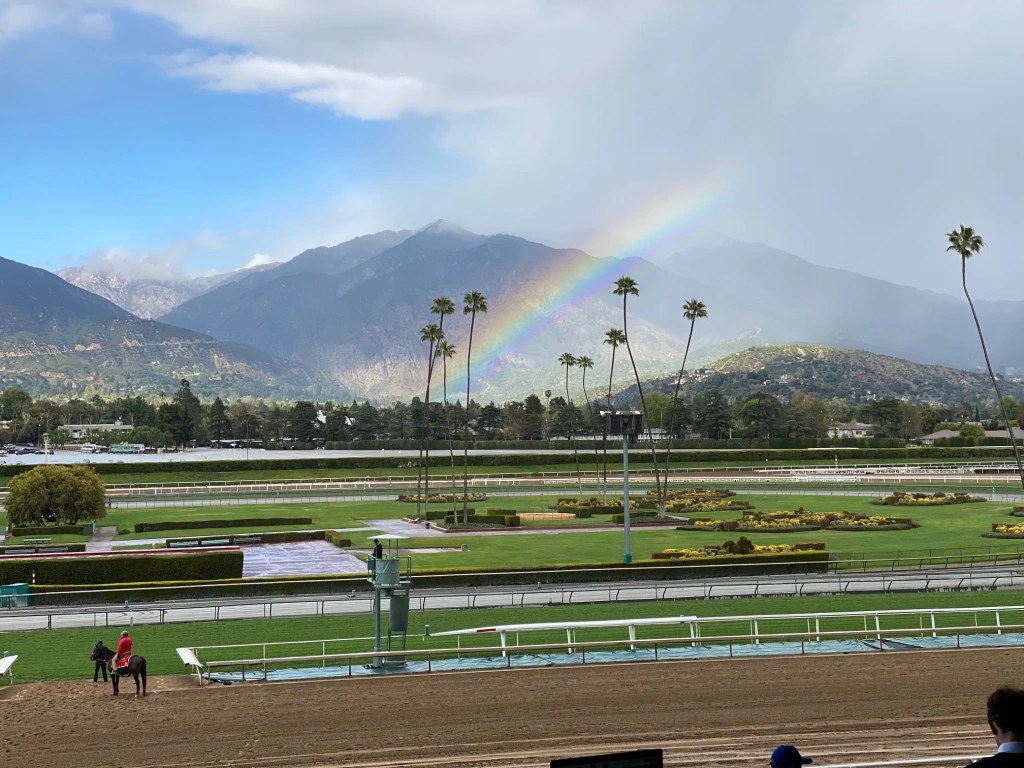
Saratoga and Del Mar seasons are underway, a worthy time to consider pari-mutuel wagering.
While some might think that pari-mutuel wagering has been around ever since organized horse racing started, this is hardly the case. There is a clear history to pari-mutuel wagering, and there is one actual and acknowledged inventor in Joseph Oller. The invention of pari-mutuels was not even Oller’s major contribution to cultural history. He was probably better known as the founder and manager of Moulin Rouge, probably the most famous nightclub of all time.
The pari-mutuel story dates from Paris in 1862. Oller pioneered a sweepstakes game based on horse racing results. This was a system based on total chance. The bettor paid for a chance and was randomly assigned a horse on a given race.
This was however illegal in France. Betting wasn’t illegal, but lotteries were. So:
In place of the system under which the bettors were assigned their designated horse by pure chance, Oller devised a system under which the bettors selected the horses themselves. “By this scheme each investor selected the horse he desired to bet on, and if his favorite proved successful, he became entitled to all the money in the pool, less the commission exacted by Mr. Oller.
Meanwhile, in the US:
Before 1870, the main form of wagering at the American tracks – which were reopening after the Civil War – was the auction pool, also known as the Calcutta pool. Under this system, bettors bid on the right to choose horses in a race. The highest bidder got to pick the horse of his choice, usually the favorite.
In time, an engineer named Harry Straus devised a machine that would issue a printed ticket, and update bettors on the odds.
Straus developed the totalizer – a system of rotary switches and relays based on the principles of automatic dial telephone.
Straus founded a company, American Totalisator, which is now owned by Stronach Group, which owns Santa Anita, Pimlico, Gulfstream, and few other racetracks.
All that from an illuminating article, “Pari-Mutuels: What Do They Mean and What is at Stake in the 21st Century?” by Bennett Liebman in Marquette Sports Law Review, Vol. 27 Issue 1, Fall 2016.
It’s illuminating to know that bettors were once assigned a horse at random. Liebman’s writing on the legal meanings of “pari mutuel” is thrilling intellectual history.
Many state constitutions exempt or have unusual rules for different kinds of wagering like lotteries and “pari mutuel betting.” Struggles over the definitions have meaningful consequences.
Take the case of “historical racing machines.” These are pretty much just slot machines but technically (maybe) their outcomes are generated on the results of horse races, and the betting is arguably “pari mutuel.” Liebman’s article offers good examples of the law being whatever convinces the judge.
Choosing a horse at random may not be a terrible method, especially given that the pari mutuel market as a whole tends to be pretty sharp. Many a study has looked for inefficiencies, and though they exist, I do not know of a study that’s found an enduring profitable angle. Bill Benter’s work took advantage of inefficiencies in Hong Kong racing, combined with sophisticated modeling developed over painful trial and error. Dr. Z might be onto something but who wants to do all that math?
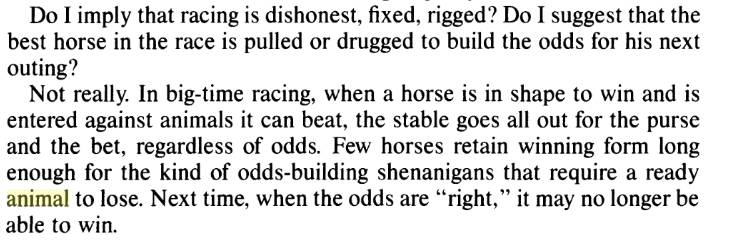
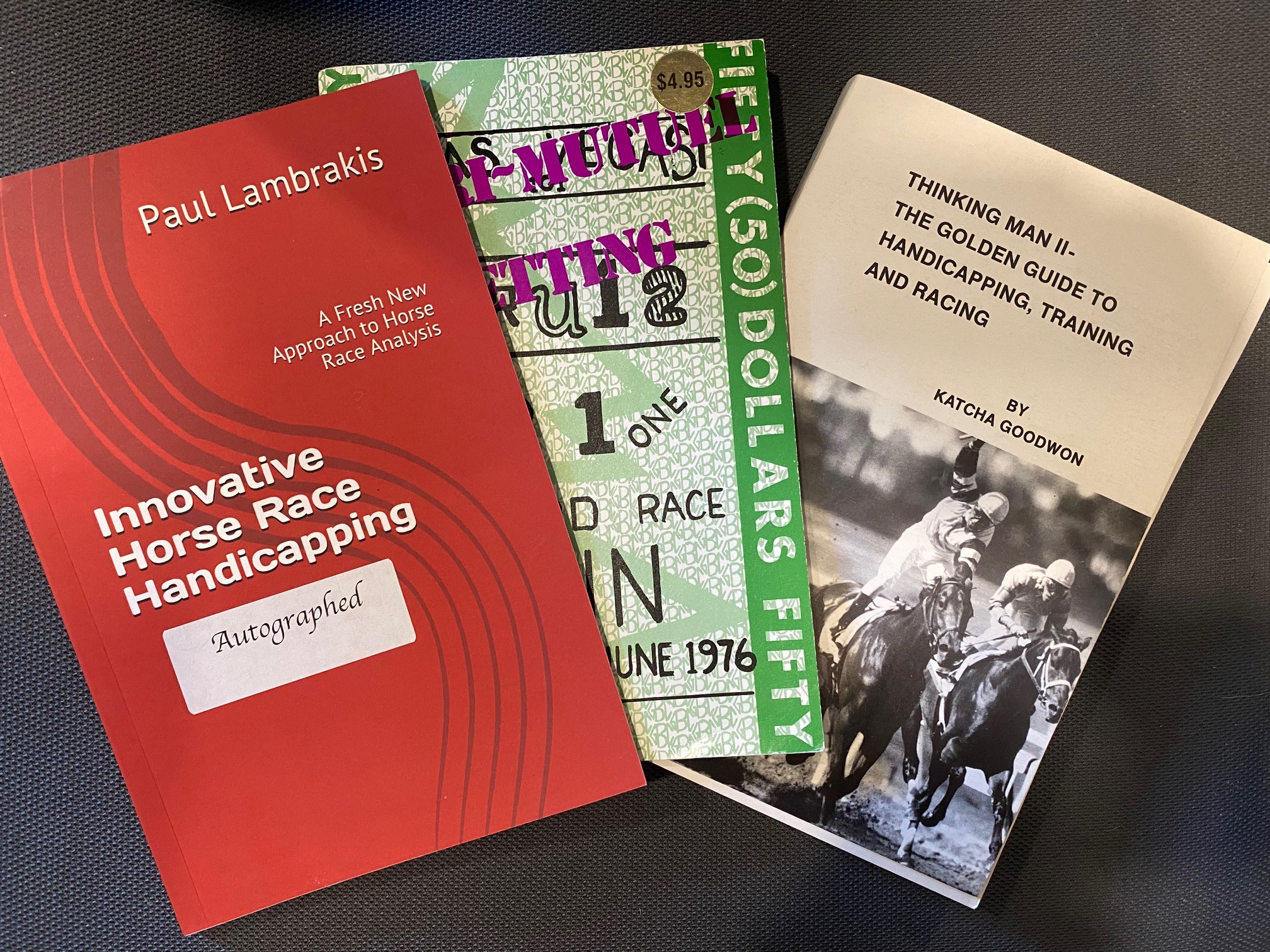
Horse handicapping is more art than science. I’ve found Brad Free’s book to be the most readable and clear-eyed. Steven Crist (whose own memoir Betting On Myself is fantastic) recommends Davidowitz, which is indeed full of insight. My copy of James Quinn’s Complete Handicapper is thoroughly marked up. Tom Ainslie writes with a style that makes the whole game seem amusing, for example his choice use of the word “animal”:
These books I bought at the Gambler’s Book Shop in Las Vegas all brought me some delight and in a limited way insight.
Andy Beyer’s books are all quite fun. Even the heroes of the great 1970s era of horse race betting, when Beyer discovered his E=mc^2 (“six furlongs in 1:13 equals seven furlongs in 1:26 and a fifth”) tell that it’s near impossible to make money these days. Certain trainer patterns can be exploited from time to time. The dominance of Bob Baffert in southern California can’t be ignored as an example.
Remember that the takeout is sometimes as high as 25%, even higher once you factor in rebates given to high rollers. Something like 40% of the money in competition might be from syndicates working with advanced computer modeling. And note, in the case of the Stronach Group, the track owners are themselves invested in one of the syndicates! Should be illegal but isn’t.
Liebman quotes the UK’s Chief Justice Cockburn, making a ruling in 1871:
experience shews that there is nothing about which there is so much uncertainty as the event of a horse race.
But when that rainbow shines over the racetrack, and you’ve got the Form open, and you think Forbidden Kingdom might be for real? Nothing better.
The Doors of Perception by Aldous Huxley
Posted: July 19, 2022 Filed under: America Since 1945, art history, drugs Leave a comment
It’s 1953, Aldous Huxley’s in California. He’s close to sixty, a literary man who’s also made a good living as a screenwriter. A friend, one of the “sleuths – biochemists, psychiatrists, psychologists” – has got some mescaline, the active ingredient in peyote. He gives four-tenths of a gram to Aldous and we’re off.
What if you could “know, from the inside, what the visionary, the medium, even the mystic were talking about?” That’s what he’s after.
The mescaline kicks in. Aldous looks at flowers, and the furniture. He looks at a book of Van Gogh paintings, and then a book of Botticelli. He ponders, in particular, the folds of drapery in the pictures.
I knew that Botticelli – and not Botticelli alone, but many others too – had looked at draperies with the same transfigured and transfiguring eyes as had been mine that morning. They had seen the Istigkeit, the Allness and Infinity of folded cloth and had done their best to render it in paint and stone.
Cool. He lies down and his friend hands him a color reproduction of a Cezanne self-portrait.
For the consummate painter, with his little pipeline to Mind at Large by-passing the brain valve and ego-filter, was also just as genuinely this whiskered goblin with the unfriendly eye.
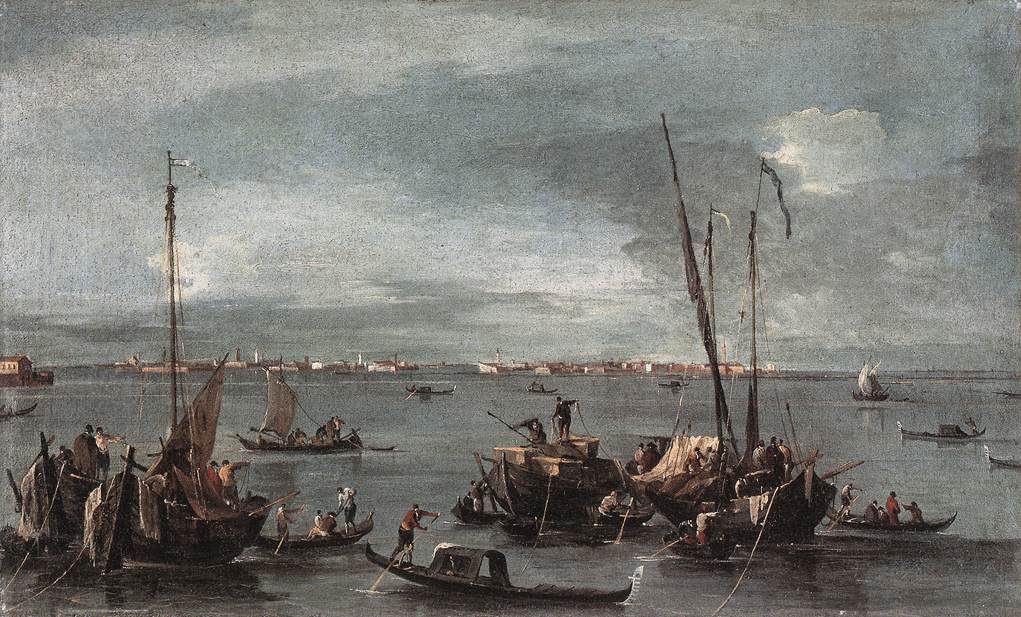
Huxley feels an experience of connecting to “a divine essential Not-self.” Vermeer, Chinese landscape painting, the Biblical story of Mary and Martha, all pass through his mind. William Blake comes up, from him Huxley took his title. Huxley listens to Mozart’s C-Minor Piano Concerto but it leaves him feeling cold. He does appreciate some madrigals of Gesauldo. He finds Alban Berg’s Lyric Suite kind of funny. He’s offered a lunch he’s not interested in, he’s taken for a drive where he “sees what Guardi had seen.”
this?
he comes down.
OK, says Huxley, ideally we’d have some kind of better mescaline that doesn’t last this long and doesn’t cause a small percentage of takers to really spin out. But: we’ve got something here. A possible help on the road to salvation. A substance which allows you to perceive the Mind at Large, to feel the connection to the divine superpower, what he calls in the next essay “out there.”
However, once you go through the Door In The Wall (Huxley credits this phrase to H. G. Wells) you’re not gonna come back the same. You’ll come back “wiser but less cocksure, happier by less self-satisfied,” humbler in the face of the “unfathomable Mystery.”
My friend Audrey who works at the bookstore tells me she sells a lot of copies of this book, mostly to young dudes. The edition I have comes with an additional essay, “Heaven and Hell,” which considers visionary experiences both blissful and appalling, and tries to sort out what we can from them. There’s also an appendix:
Two other, less effective aids to visionary experience deserve mention – carbon dioxide and the stroboscopic lamp.
Huxley finds these less promising.
Who runs Bartertown?
Posted: July 18, 2022 Filed under: America Since 1945, business, politics Leave a commentWhen he gets to Bartertown, Max is taken up in the tower to meet Aunty (Tina Turner). She tells him she wants him to kill somebody. Who? Master Blaster.
Master is a little gnome who rides around on the giant Blaster. Aunty explains that the energy to run the lights and electricity of Bartertown comes from the underworld, a horrible factory-like place where pig shit generates methane.
Max goes down to the underworld under the guise of a pig-shit shoveler. While there, he meets Master Blaster, who is determined to show him who really runs Bartertown. Master Blaster turns off the methane to Bartertown. Everything goes dark. Master Blaster calls up to Aunty. His demand to turn the methane back on is that she answer the question: Who run Bartertown? Reluctantly, she answers: Master Blaster. He makes her say it publicly, over the PA system. Who run Bartertown? Master Blaster. Once she’s said this he smiles and turns the methane back on.
That’s all pretty early in the movie, we haven’t even gotten inside the Thunderdome yet. And since the movie is called Mad Max Beyond Thunderdome, we know we’re barely getting started.
I Am Alive and You Are Dead
Posted: July 17, 2022 Filed under: America Since 1945, writing Leave a comment
You don’t need to have read a single book by Philip K. Dick – there are 44+ – to feel his influence. Ridley Scott told Dick he never read his source material (Do Androids Dream of Electric Sheep?) before making the adaptation Blade Runner. Total Recall, Minority Report, Man In The High Castle, The Adjustment Bureau, these are a few of the filmed versions. In Slacker Richard Linklater films himself telling stories of Dick’s life and beliefs; later he made a version of A Scanner Darkly. PKD was picking up a signal and asking qs that pretty soon everybody would have to think about:
what if there were a robot so good that you didn’t know it was a robot?
what if there was a robot so good it didn’t know it was a robot?
what if we’re living in a simulation? what if our art and dreams and visions are what’s real and the rest is… what? A trick?
what does it mean if we can invent worlds the feel realer than world world?
what if we were all on so many powerful drugs we lost the thread of reality?
what if we were all on so many powerful drugs we found the thread of reality?
what if surveillance became so elaborate that we ended up surveilling ourselves?
It’s one leap to come up with ideas like this, but another to make them as vivid and lived in as PKD did. (Take even the term “blade runner” – what??)
Despite (because?) of this profound, influential imaginative work, PKD led a marginal existence, almost all in second-tier California towns, ending when he was found unconscious in his apartment in Santa Ana in 1982 and was “disconnected from life support” (an idea he would’ve invented if it hadn’t already existed) days later.
Wrapping your head around this guy isn’t easy, especially since he spent about eight years writing a million plus word “exegesis” that got launched when the fish symbol around the neck of a pharmacy delivery girl convinced him VALIS (vast active living intelligence system) was communicating with him while we were all living in an unending Roman empire.
Imagine what it was like for PKD:
The drugs he had taken during the 1960s, he was convinced formed a chemical soup in which his brain now stewed.
Mostly prescription stuff; he took LSD once and had a real bad time. His place got broken into, and at first he thought the FBI might’ve done it, but then he wondered if he’d done it himself. He was somewhat plausibly worried government agents were monitoring everything he did, but then he wondered why, or if it was even possible he was monitoring himself. Imagine how he felt, then, when the President of the United States (also an Orange County bro) was investigated (on TV) in regard to a mysterious break-in, caught by his own hidden surveillance system that he’d apparently installed to try and remember what he himself had been saying, and thus all his paranoid obsessions became the national, still-unraveled narrative?
Tough challenge for the biographer.
The book you hold in your hands is a very peculiar book. In it I have tried to depict the life of Philip K. Dick from the inside, in other words, with the same freedom and empathy – indeed with the same truth – with which he depicted his own characters. It’s a trip into the brain of a man who regarded even his craziest books not as works of imagination but as factual reports.
Mission accomplished. This is one of the best bios of a writer I’ve ever read. It passes one of the key tests, telling us what Philip K. Dick ate (frozen meals, stuff he got at the local convenience store). It functions as useful psychic history of California from 1950-1980, from the Communist scene in Berkeley to the turn from druggy hippie near utopia to speedfreak nightmare to a semi-religious recovery. Towards the end, PKD was half-convinced he might be living in the Book of Acts (which he hadn’t read), but also thought it possible he was just losing it.
Terry Car, the Ace paperback editor, used to joke that if the Bible had been published as science fiction, it would have had to be cut down to two volumes of twenty thousand words each; the Old Testament would have been retitled “Master of Chaos,” and the New Testament “The Thing with Three Souls.”
How about this?:
[PKD] told the doctor what John Collier, the British writer of fantastic fiction, had said – that the universe was a pint of beer and the galaxies nothing but the rising bubbles. A few people living in one of the bubbles happen to see the guy pouring the beer, and for them nothing will ever be the same again. That, said Phil, is what had happened to him.
In a way PKD was sort of an anti-Joan Didion, who took a deadeyed look at the results of the nightmare, while he himself wondered if the nightmare might be the fruit of his own imagination. Where did one end and the other begin? A wild ride.
The first story PKD sold, “Roog,” kinda hints at it all, here is the summary:
“Roog” is a story told from the point of view of a dog named Boris, who observes his masters carefully storing food in containers outside of their house day after day. Unbeknownst to the dog, these are the human’s trash cans for garbage. The dog is later horrified to witness some food being ‘stolen’ by garbagemen who the dog believes are predatory carnivores from another planet. The dog comes to know these beings as ‘Roogs’, and tries to warn his master of each ‘theft’ with cries of ‘Roog!’ ‘Roog!’. The humans, unable to comprehend the hound’s message, think the dog is just being rowdy. Thus they attribute the sound the dog makes to be the sound that all dogs make when they are excited: ‘Roog!’ ‘Roog!’ The tale concludes with the animal being somewhat distraught, barking “ROOG!” very loudly at the garbagemen before they make off once more with trash in their garbage truck.
Poor PKD was kinda like Boris. You can’t help but like him.
Roog is apparently also “the Supreme God and creator of the Serer religion of the Senegambia region.” That’s the kind of thing that would’ve sent PKD spinning for weeks in his apartment in Santa Ana.
The Open
Posted: July 16, 2022 Filed under: Uncategorized Leave a comment
(Gordon Hatton for Wikipedia)
What with The Open going on I was reading up on The Old Course. Bobby Jones:
After he received the key, he said “I could take out of my life everything but my experiences here in St Andrews and I would still have had a rich and full life.”
I believe that monument you can see in the background commemorates some Protestants who were burnt at the stake.
Genius of the system
Posted: July 15, 2022 Filed under: America Since 1945, Hollywood, the California Condition Leave a comment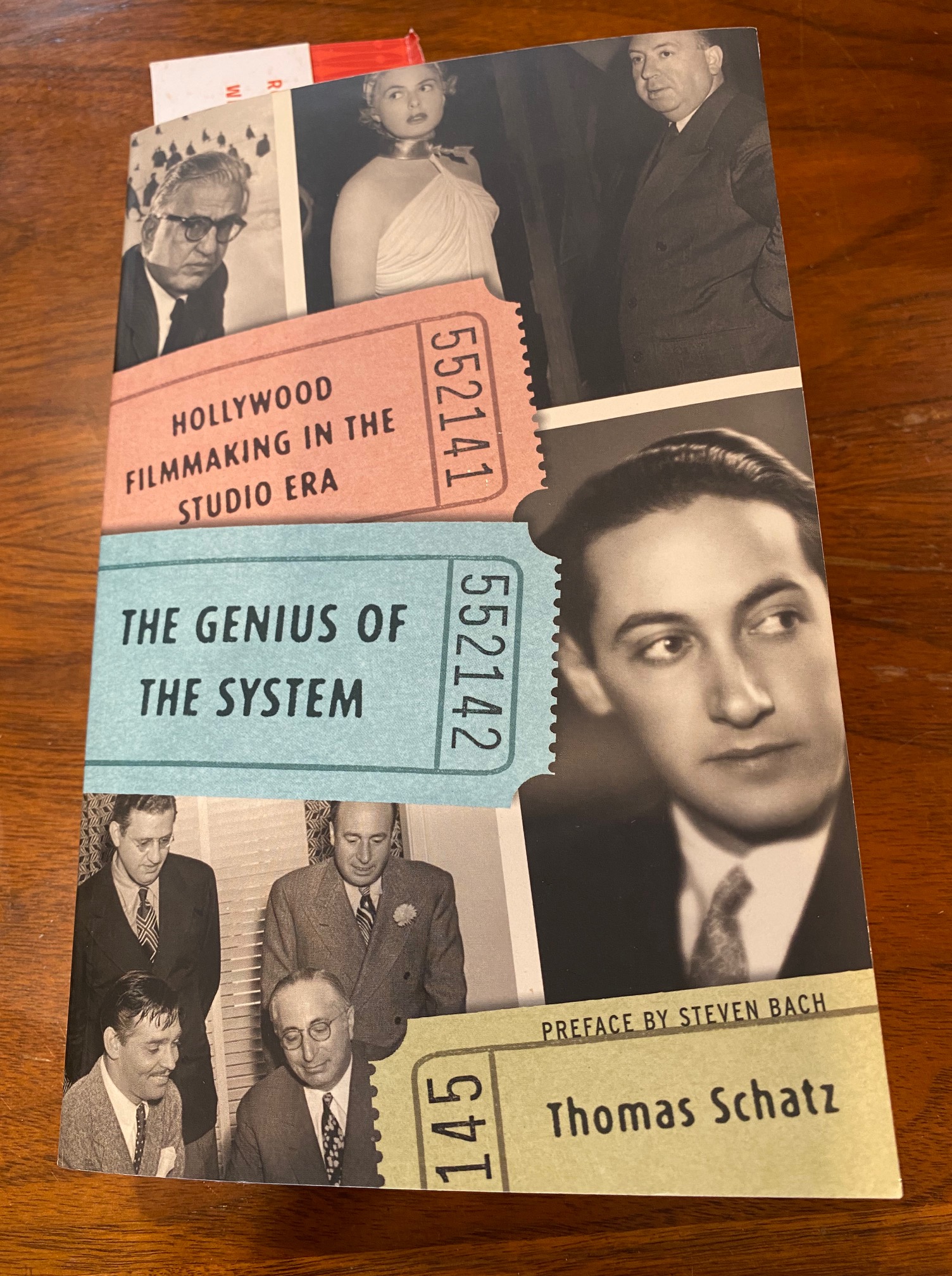
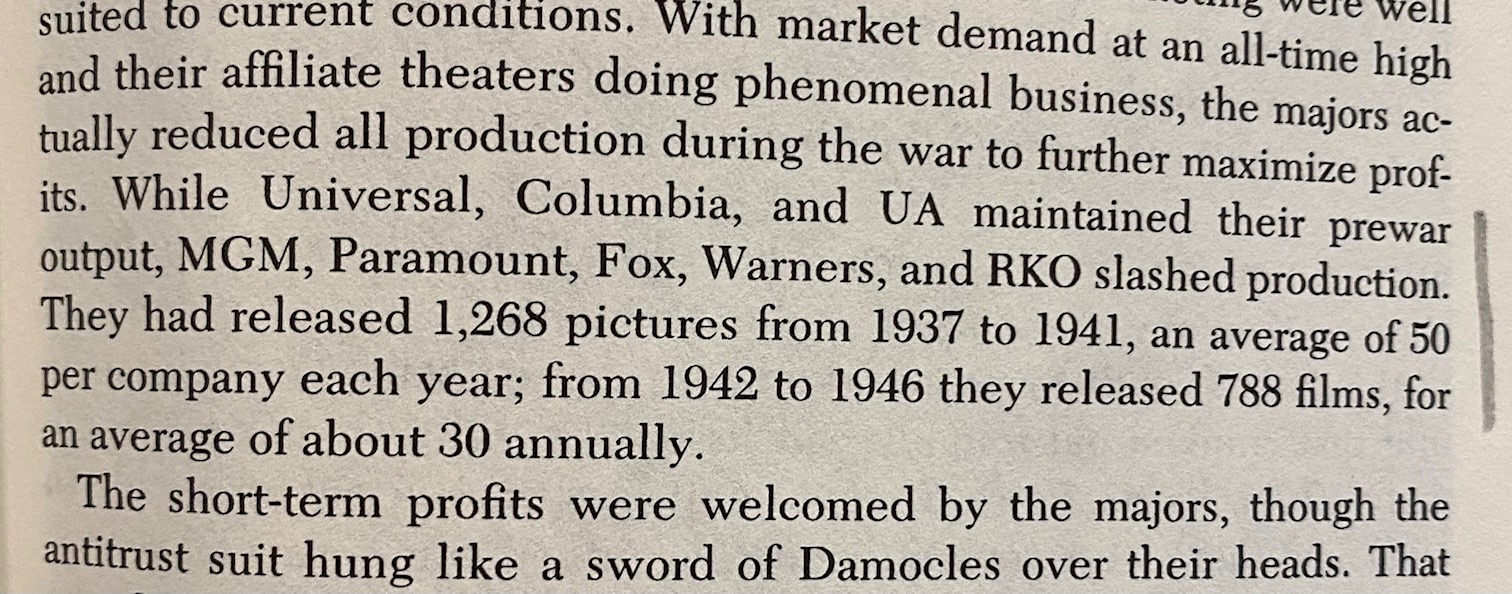
The sheer number of movies Hollywood cranked out during the peak of the studio system is wild. In 1936, for example, Paramount released 69 movies, RKO had 39, Fox had 50 movies, MGM put out 48 movies, Warner 56, Universal 34.
This was the factory-like story production processes Faulkner was working under.
Thomas Schatz’s book The Genius of the System is of daunting thickness, but it’s very readable, and I like the thesis: despite the factory nature and control by the money guys rather than the directors, real style and art was achieved.
Auterism itself would not be worth bothering with if it hadn’t been so influential, effectively stalling film history and criticism in a prolonged stage of adolescent romanticism. But the closer we look at Hollywood’s relations of power and hierarchy of authority during the studio era, at its division of labor and assembly-line production process, the less sense it makes to assess filmmaking or film style in terms of the individual director – or any individual, for that matter.
Should we look at the old studio system trying to find cases where a rare director snuck art past the suits? Or should we look at it and see a miraculous time, when thousands of artists and craftspeople came together for a brief period to create the collective dreams of a nation?
Schatz gives a good short summary of his work and the rise and fall of the studio system in this 1989 Fresh Air interview.
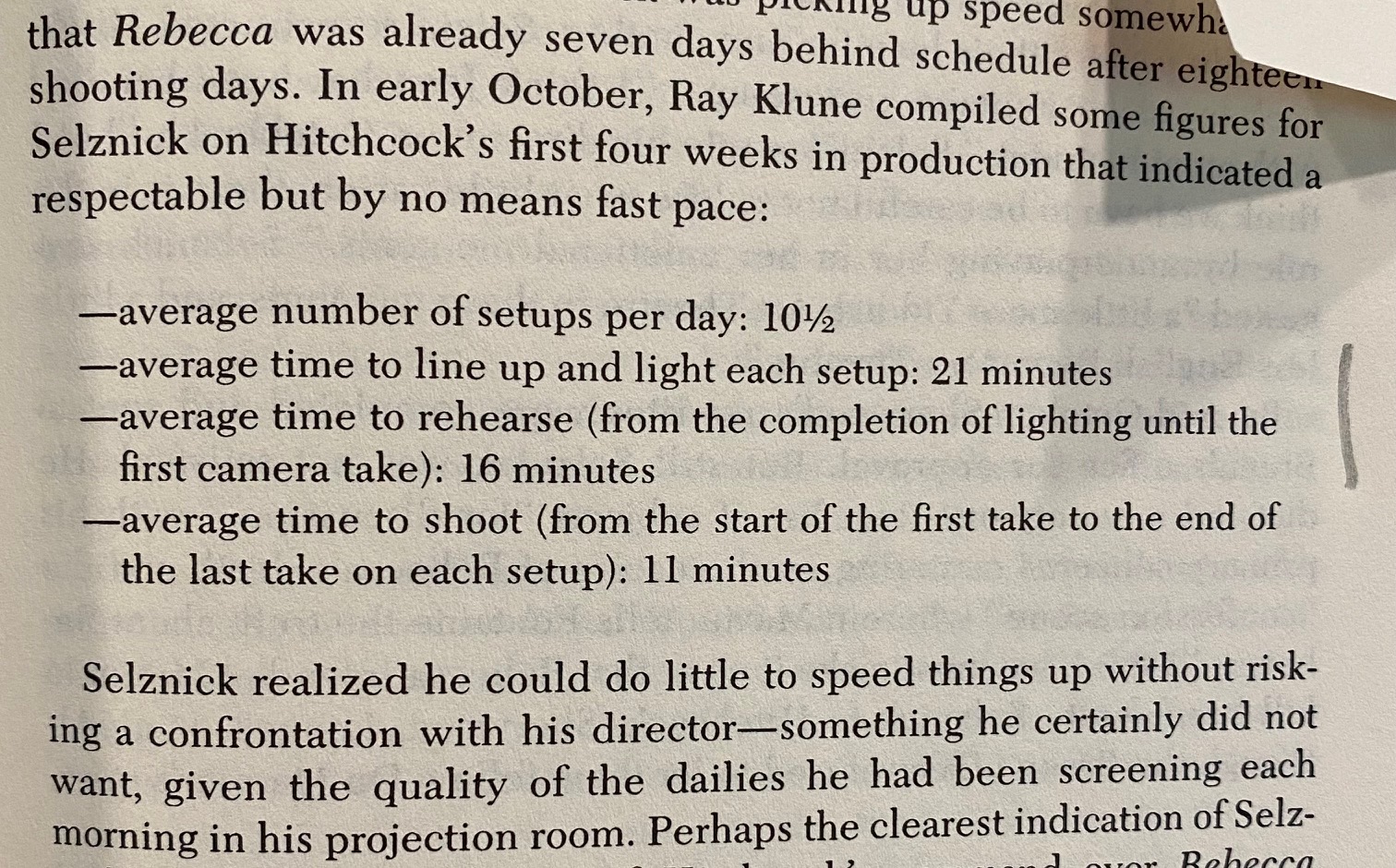
In The Offer, Paramount +’s show about the making of Paramount Pictures’ The Godfather, you can see dramatized some of the problems from the end of the true studio system days. The show was shot on the Paramount lot, doubling as the Paramount lot from 1971. There’s a studio, but when they start a movie, they start from scratch. Casting, finding the right people for technical roles, chain of command, getting a workflow going, dealing with the unions, the mob: all these are begun anew for each production. Poor Al Ruddy has to solve each problem fresh. Robert Evans is there, but he’s no Thalberg, with central command over all the gears in the machine. When the movie’s, it’s over. Everything resets. In the year The Godfather came out, Paramount put out sixteen pictures.
Sometimes companies manage to recreate the cohesion of the studio system. Take Pixar, for example, or the Marvel movies. How about Hallmark movies? Individual directors and producers can have runs like this too: Selznick was doing it by 1935. But at nowhere like the studio scale.
Studios had specialties, flavors: MGM had musicals, Universal had monster movies, Warner Brothers had gangster pictures. In 2022, do the streamers have anything like this? I know what BritBox is.
Even on our startup model, plenty of dreams get produced. Movies might be uncountable, how many are there? 403? How many scripted TV shows are there? 532?
Gracenote, a Nielsen company, listed more than 817,000 unique program titles across U.S. traditional TV and streaming services, with many of those titles featuring hundreds of individual episodes and chapters. Back in December 2019, there were just over 646,000 unique program titles.
So says Nielsen’s State of Play report. I found this Hollywood Reporter piece citing an FX report from 2016 that lists all 1,400 primetime shows, starting with Big Bang Theory and ending with:

The Paramount decree in 1948 stopped the studios from owning the theaters. One of many blows, along with TV, shifting lifestyles, etc that forced change on the system. But we’ve re-evolved back around on vertical integration. Disney, for example, is a studio yet owns its own distribution: Disney +. Is that a violation of the Paramount decree? Let’s look into it:
As part of a 2019 review of its ongoing decrees, the Department of Justice issued a two-year sunsetting notice for the Paramount Decree in August 2020, believing the antitrust restriction was no longer necessary as the old model could never be recreated in contemporary settings.
Oh!
slop
Posted: July 14, 2022 Filed under: America Since 1945 Leave a comment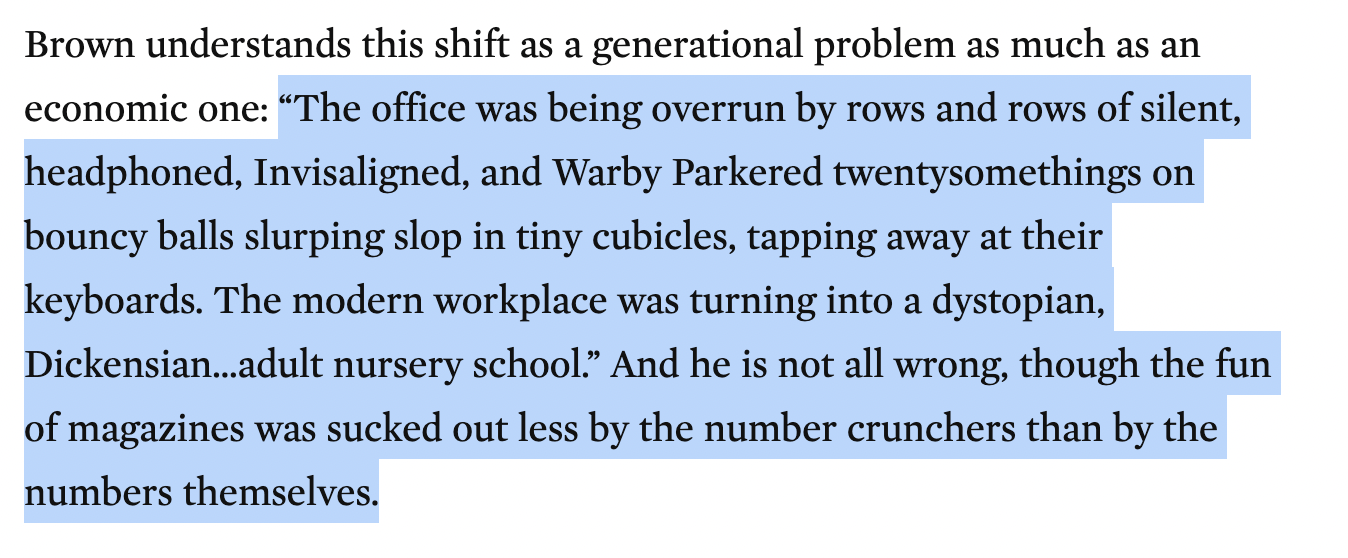
from The Nation’s review of Dana Brown’s DILETTANTE: TRUE TALES OF EXCESS, TRIUMPH, AND DISASTER, a memoir of life as Graydon Carter’s assistant at Vanity Fair and the decline of magazine high life in NYC.
Nice pattern
Posted: July 14, 2022 Filed under: UK Leave a comment
Later, he adds that Britain has “got such a dark past and the country is founded on such crazy exploitation and imperialism. You can’t just look at a Union Jack and say ‘Oh it’s a nice pattern.’”
Jarvis Cocker having Lunch with FT.
(Can’t you though? Isn’t that sorta what Jasper Johns was getting at?

Market research
Posted: July 10, 2022 Filed under: business Leave a commentMy data-driven advice for getting rich for someone with good analytical skills and deep experience in a field is to start a market research business. Use your specialized knowledge in the field to write up reports; sell them widely and charge a fortune to your contacts in the field. I have estimated that more than 10 percent of owners of market research businesses are in the top 0.1 percent.
from this NY Times op-ed, “The Rich Are Not Who We Think They Are,” by Seth Stephens-Davidowitz.
Intrigued, I Googled “how to start a market research business” and found:
There are a number of market researchers out there fighting for the same business you are. Consider your own business the firm’s first client. What does your target audience respond most to? Build a marketing strategy around that. Highlight your strengths through the use of existing contacts, networking, and cold calling. Get involved by attending conferences. Offer to speak at a conference or become a committee member.
Bold is mine, that’s brilliant. It does sound like a lot of work though. But, Stephens-Davidowitz tells us:
A study of thousands of millionaires led by researchers at Harvard Business School did find a gain in happiness that kicks in when people’s net worth rises above $8 million. But the effect was small: A net worth of $8 million offers a boost of happiness that is roughly half as large as the happiness boost from being married.
That sounds good?
How to get through a meeting (Faulkner’s version)
Posted: July 8, 2022 Filed under: America Since 1945, writing Leave a comment
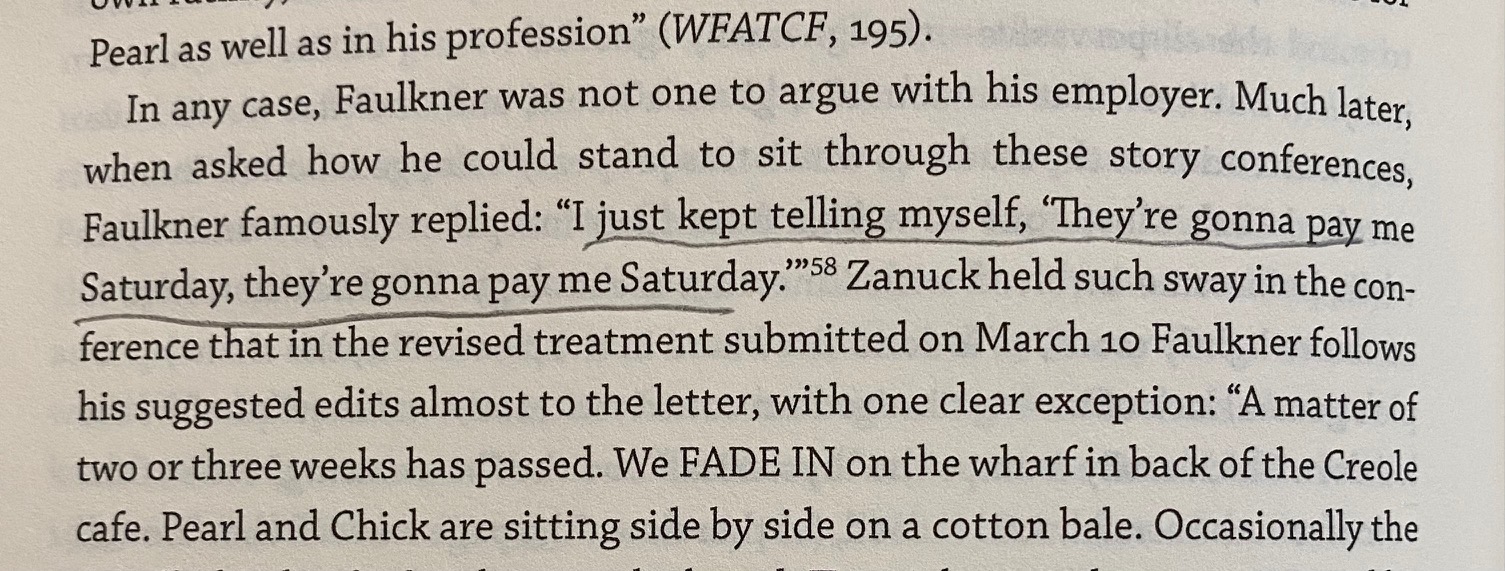
This book is very illuminating if you’re interested in studio screenwriting methods of the late 1930s and early ’40s, although at some point the effort to pick apart Faulkner’s contributions to particular screenplays becomes an unknowable bit of textual archaeology. Faulkner would often be one of 5-7 writers working simultaneously or overlapping on the same property. Faulkner didn’t take Hollywood personally. He managed his Hollywood career better than Fitzgerald did, and later benefited from his collaboration with Howard Hawks, who seems to have both liked Faulkner as a guy and liked having the legend around. Faulkner was fast and hard working. If I have the timeline right, he worked on Gunga Din (his version not used) while also revising Absalom, Absalom.
LRB on Roe
Posted: July 7, 2022 Filed under: America Since 1945 Leave a commentDeborah Friedell in London Review of Books has a wild review of The Family Roe: An American Story by Joshua Prager. Jane Roe’s real name was Norma McCorvey:
She blames her religious parents (Pentecostals turned Jehovah’s Witnesses) for neglecting to tell her how babies were made. When she became pregnant at seventeen, she was ‘shocked’ – ‘somehow what Woody and I had been doing together didn’t seem to be what was needed to create a whole new life.’
An important player in how the case evolved was Judge Sarah Hughes, who swore in LBJ on Air Force One, November 22, 1963.
Coffee would probably have continued to work on the case by herself if she hadn’t received a phone call from her old law school classmate Sarah Weddington. They weren’t friends, but Weddington had a question about federal procedure, and knew that Coffee had clerked for a federal judge – Sarah Hughes, who was instrumental in securing Texan women the right to serve on juries, though she’ll always be most famous for swearing in Lyndon Johnson as president on Air Force One after Kennedy’s assassination. … Coffee … said it would be smarter to file in Dallas, not Austin, so there would be a chance of arguing in front of Judge Hughes.
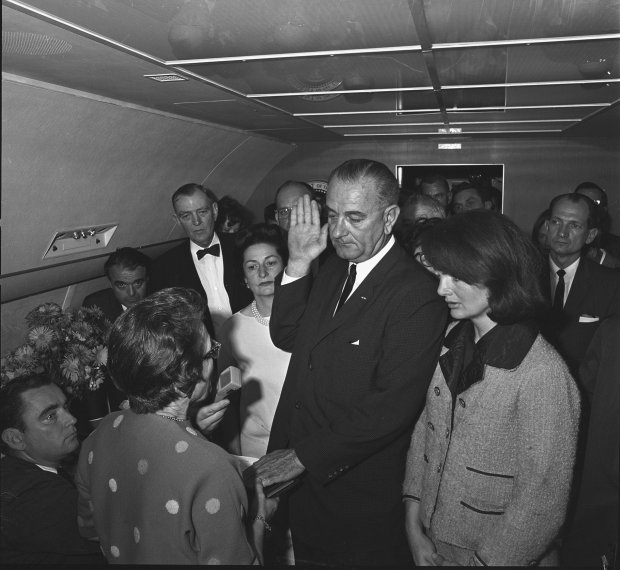
Judge Hughes in the spotted dress. She had an incredible life’s journey:
She attended classes at night and during the day worked as a police officer. As a police officer, Hughes did not carry a gun or wear a police uniform because she worked to prevent crimes among women and girls, patrolling areas where female runaways and prostitutes were normally found. Her job was an expression of the progressive idea of rehabilitation instead of punishment. Hughes later credited this job with instilling in her a sense of commitment and responsibility to women and children. At that time she lived in a tent home near the Potomac River and commuted to the campus by canoe each evening.
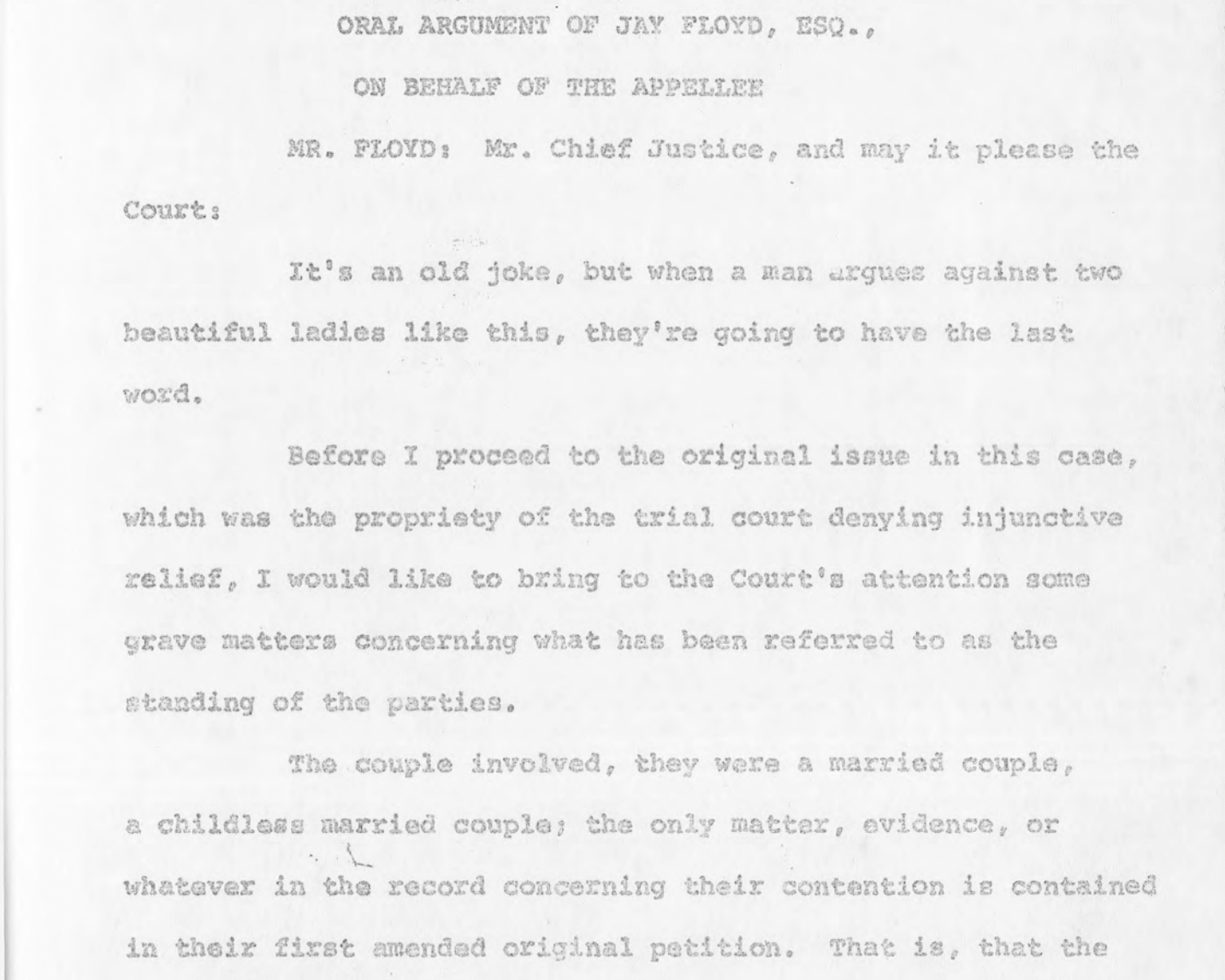
The lawyer representing Texas in the case opened his Supreme Court oral argument with a “joke”:
The lawyer representing Texas began his argument by saying: ‘It’s an old joke, but when a man argues against two beautiful ladies like this, they’re going to have the last word.’ When no one laughed, Weddington thought he became ‘unnerved’.
I had to look this up to confirm. But there it is!
At the end of everything, this is how Norma McCorvey came to feel:

Maybe America will resolve this issue with voting, as was done in Ireland.
Often when LRB writes about USA stuff, it’s great, just a new perspective. David Runciman’s piece on Colin Kaepernick was really good, addressed to readers who have to have American football explained to them, and in so doing brings beginner’s mind to one of those controversies that’s become locked-in.
Chancellor of the Exchequer
Posted: July 6, 2022 Filed under: United Kingdom Leave a commentThe UK has a new Chancellor of the Exchequer. The last guy, Rishi Sunak, resigned as the Johnson government teeters due to accumulated scandals that center around drunken stupidity and general boorishness.
The new Chancellor (for now) is Nadhim Zahawi, who was born in Baghdad. Let’s see what wickedness lurks on his Wikipedia page:
In late January 2018, it was reported in the media that Zahawi was one of the attendees at a men-only dinner event organised by the Presidents Club at the Dorchester Hotel in London. Media reports alleged that female hostesses were subjected to sexual harassment and incidents of groping and inappropriate touch. Following the revelations of his attendance at the event, Zahawi posted a tweet condemning such behaviour and stated that he felt uncomfortable at what he saw happening.
Wow! The Financial Times sent some undercover operatives to the event disguised as hostesses:
At their initial interviews, women were warned by Ms Dandridge that the men in attendance might be “annoying” or try to get the hostesses “pissed”. One hostess was advised to lie to her boyfriend about the fact it was a male-only event. “Tell him it’s a charity dinner,” she was told. “It’s a Marmite job. Some girls love it, and for other girls it’s the worst job of their life and they will never do it again . . . You just have to put up with the annoying men and if you can do that it’s fine,” Ms Dandridge told the hostess.
I read further on the event:
Some MPs called for the resignation of children and families minister Nadhim Zahawi, who had been among the guests, as well as for a police investigation of the event. Presidents Club co-chairman David Meller resigned from his Department of Education directorship. Jonathan Mendelsohn, another of the guests, was removed from the Labour frontbench in the House of Lords. Several bookshops stopped the sale of books by the comedian David Walliams, who had hosted the event and put up the right to name a character in his next book as a prize. All of these men said to the media that they had neither participated in nor witnessed any misconduct.
Who is David Walliams?
Walliams has been diagnosed with bipolar disorder, and he described his 2006 swim of the English Channel as “some sort of redemption”.
You see this everywhere in the UK character: the desire to escape their island taking absurd form. Joining the Navy, invading India, looking for the source of the Nile, whatever it takes to flee. Swim if necessary. The sad fact is the British are stuck on a wet island, and not only that, but stuck with each other. Aside from alcoholism, the Irish solutions to the same wet island problem, namely indulging in poetry, historical brooding or music, only sometimes occur to the average Englishman, though many an Irish transplant trapped in Britain has demonstrated this method successfully (see Paul McCartney for example, or Morrissey).
Dead pool
Posted: July 5, 2022 Filed under: the American West, the California Condition Leave a comment
from a June 20, 2022 LA Times piece, “As water crisis worsens on Colorado River, an urgent call for Western states to ‘act now’” by Ian James.
I must admit that as catastrophic as it would be, kind of curious to see how the dead pool would play out. Would they have to shut down Las Vegas?

Meanwhile in Lake Mead, they keep discovering weird stuff as the water level sinks. There was the dead body found in a barrel:
Investigators are dating the crime to the late 1970s or early ’80s, with KLAS quoting Las Vegas Lt. Ray Spencer as saying, “The victim’s clothes and shoes were sold at Kmart in the mid-to-late 1970s.”
Who were the forensic fashion investigators who put that together? Human ingenuity is remarkable, maybe with that kind of brainpower and creativity we’ll solve the southwestern water crisis before we deadpool.
The dentist
Posted: July 5, 2022 Filed under: advice Leave a commentMy beloved dentist retired, which is too bad. I went to meet the new dentist.
The new dentist said he was more of a coach than a dentist. He said,
I’ve never seen a tooth without a person attached.
Then he asked me if I drink much seltzer or sparkling water (not really) and he told me there’s citric acid in the canned green tea his wife buys, and that three days a week he drives up from Orange County listening to podcasts about the dark web and marketing.
I told him my previous dentist always gave me nitrous, part of her “relax the patient” philosophy. The new dentist said they didn’t have nitrous in his office, so I said I’m in the wrong office and he didn’t laugh.
Then he declared me healthy and I got X-rayed. That was the last I heard from him and my teeth are working fine, so I guess I’ll just go back to get them cleaned again in a couple months.
The Empty Space
Posted: July 3, 2022 Filed under: shakespeare, the theater Leave a comment
At Stratford where we worry that we don’t play our repertoire long enough to milk its full box office value, we now discuss this quite empirically: about five years, we agree, is the most a particular staging can live. It is not only the hair-styles, costumes and make-up that look dated. All the different elements of staging – the shorthands of behaviour that stand for certain emotions; gestures, gesticulations and tones of voice – are all fluctuating on an invisible stock exchange all the time.
I see that theater director Peter Brook has died. I got a lot out of his book, The Empty Space.
In Haitian voodoo, all you need to begin a ceremony is a pole and people. You begin to beat the drums and far away in Africa the gods hear your call. They decide to come to you, and as voodoo is a very practical religion, it takes into account the time that a god needs to cross the Atlantic. So you go on beating your drum, chanting and drinking rum. In this way, you prepare yourselves. Then five or six hours pass and the gods fly in – they circle above your heads, but it is not worth looking up as naturally they are invisible. This is where the pole becomes so vital. Without the pole nothing can link the visible and the invisible worlds. The pole, like the cross, is a junction.
Brook has much to say about actors:
For instance, a young actor playing with a group of inexperienced friends may reveal a talent and a technique that put professionals to shame. Yet take the very same actor who has, as it were, proved his worth and surround him with the older actors he most respects, and often he becomes not only awkward and stiff, but even his talent goes. Put him then amongst actors he despises and he will come into his own again. For talent is not static, it ebbs and flows according to many circumstances.

This must’ve been something:
There the company toured villages bordering the Sahara, using a carpet as a stage upon which to improvise stories in imaginary languages.
Mishopshnow
Posted: July 3, 2022 Filed under: the California Condition Leave a comment
land acknowledgments can ring hollow, but who wouldn’t support returning some California places to their native names? For example Carpinteria could revert to the name the Chumash apparently gave it.

A Climate for Health and Wealth
Everest
Posted: July 2, 2022 Filed under: nature Leave a commentThe world’s biggest bacteria discovered in Caribbean mangrove swamp:

That’s from the Financial Times, paywalled but this link should work for the first three bacteria fans who click.
Santa Barbara, 1834
Posted: July 2, 2022 Filed under: the California Condition Leave a comment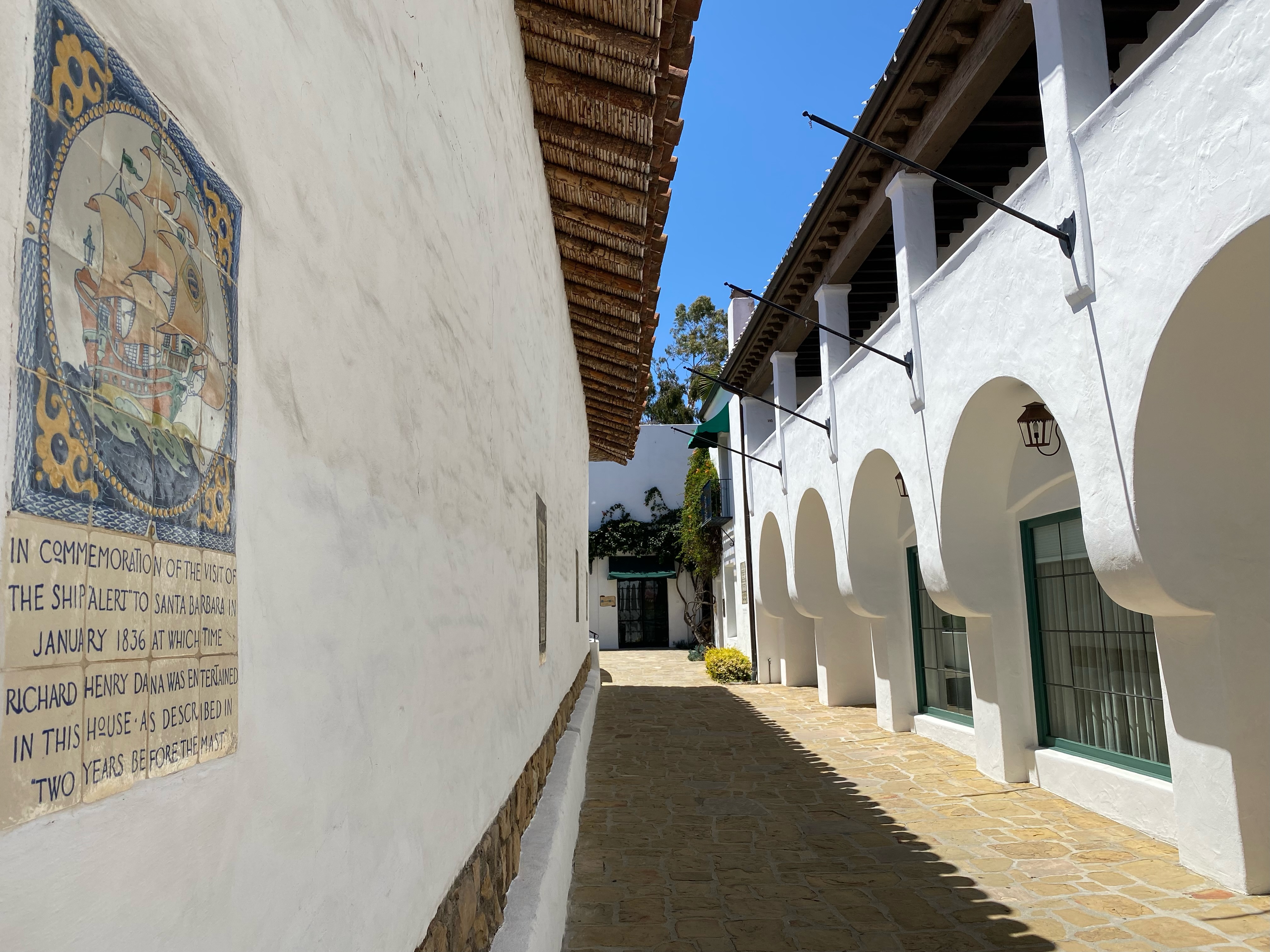
Strolling through El Paseo in Santa Barbara, I saw this on the wall and got to thinking about Dana.
The year was 1834. Richard Henry Dana Jr was a Harvard student who caught the measles and then noticed he was losing his eyesight. Thinking it might be good for him, he left school and enlisted as a sailor on a trip around Cape Horn to California.
The ship’s trade was in buying up cow hides from the ranches of Mexican California:
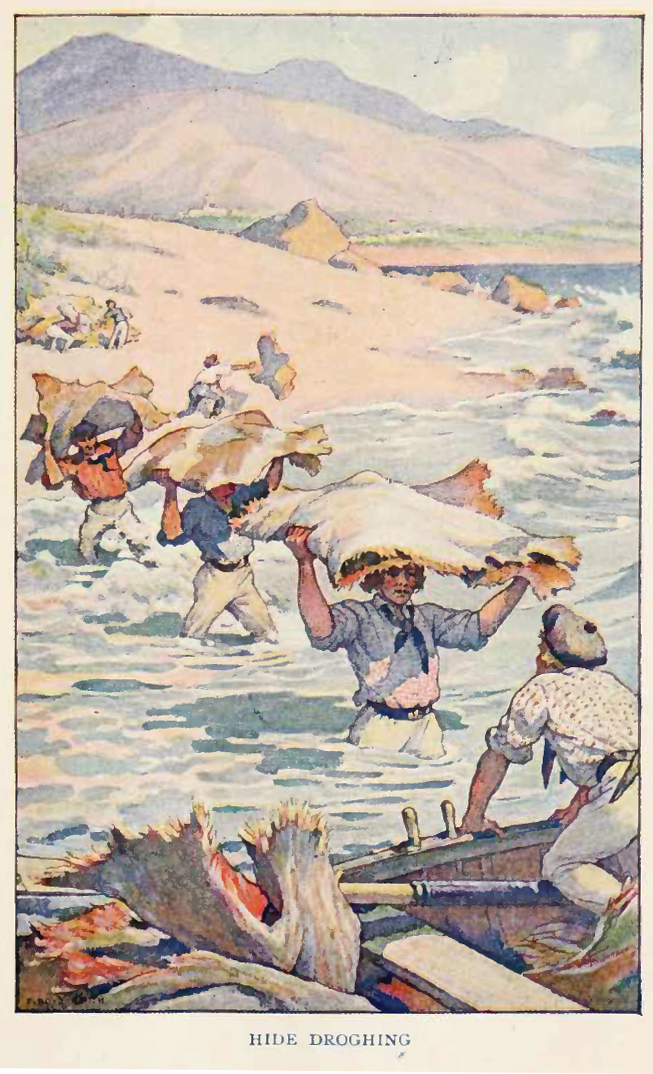
(from illustrations for a 1911 edition. Wikipedia credits this one to Sidney Chase but I think it’s by E. Boyd Smith.)
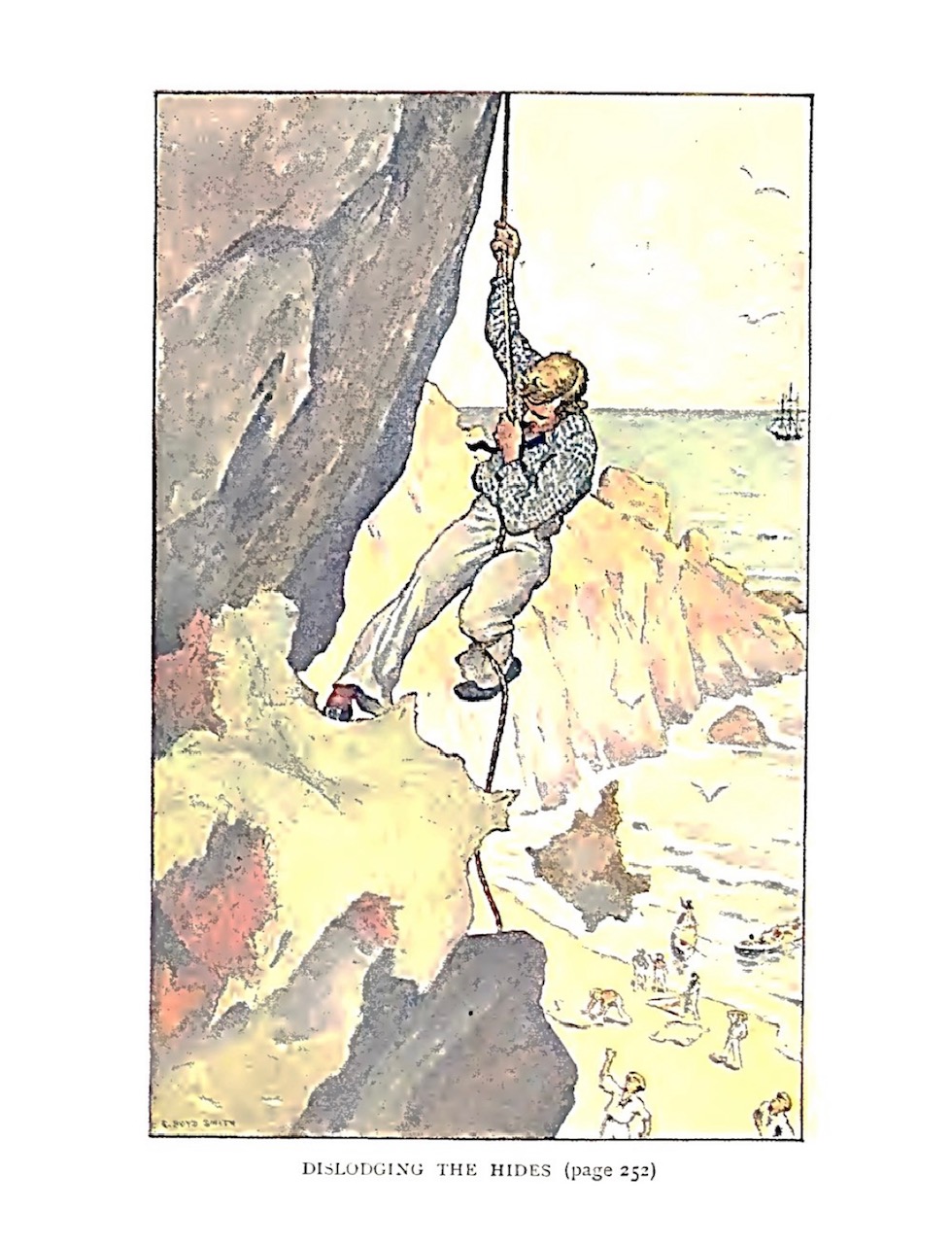
At one point, finding themselves at the top of a cliff, threw the hides down to the ocean over the edge. The site where this occurred is now Dana Point, California.
Dana doesn’t have much to say about Los Angeles, although he spent some miserable time doing hard work in San Pedro. Here he is on Santa Barbara, where he had a chance to get a slice of life:
In the middle of this crescent, directly opposite the anchoring ground, lie the mission and town of Santa Barbara, on a low, flat plain, but little above the level of the sea, covered with grass, though entirely without trees, and surrounded on three sides by an amphitheatre of mountains, which slant off to the distance of fifteen or twenty miles. The mission stands a little back of the town, and is a large building, or rather a collection of buildings, in the centre of which is a high tower, with a belfry of five bells; and the whole, being plastered, makes quite a show at a distance, and is the mark by which vessels come to anchor. The town lies a little nearer to the beach—about half a mile from it—and is composed of one-story houses built of brown clay—some of them plastered—with red tiles on the roofs. I should judge that there were about an hundred of them; and in the midst of them stands the Presidio, or fort, built of the same materials, and apparently but little stronger. The town is certainly finely situated, with a bay in front, and an amphitheatre of hills behind. The only thing which diminishes its beauty is, that the hills have no large trees upon them, they having been all burnt by a great fire which swept them off about a dozen years before, and they had not yet grown up again. The fire was described to me by an inhabitant, as having been a very terrible and magnificent sight. The air of the whole valley was so heated that the people were obliged to leave the town and take up their quarters for several days upon the beach.
He goes ashore:
We were then pulled ashore in the stern of the boat, and, with orders to be on the beach at sundown, we took our way for the town. There, everything wore the appearance of a holyday. The people were all dressed in their best; the men riding about on horseback among the houses, and the women sitting on carpets before the doors. Under the piazza of a “pulperia,” two men were seated, decked out with knots of ribbons and bouquets, and playing the violin and the Spanish guitar. These are the only instruments, with the exception of the drums and trumpets at Monterey that I ever heard in California; and I suspect they play upon no others, for at a great fandango at which I was afterwards present, and where they mustered all the music they could find, there were three violins and two guitars, and no other instrument. As it was now too near the middle of the day to see any dancing and hearing that a bull was expected down from the country, to be baited in the presidio square, in the course of an hour or two we took a stroll among the houses. Inquiring for an American who, we had been told, had married in the place, and kept a shop, we were directed to a long, low building, at the end of which was a door, with a sign over it, in Spanish. Entering the shop, we found no one in it, and the whole had an empty, deserted appearance. In a few minutes the man made his appearance, and apologized for having nothing to entertain us with, saying that he had had a fandango at his house the night before, and the people had eaten and drunk up everything.
“Oh yes!” said I, “Easter holydays?”
“No!” said he, with a singular expression to his face; “I had a little daughter die the other day, and that’s the custom of the country.”
Here I felt a little strangely, not knowing what to say, or whether to offer consolation or no, and was beginning to retire, when he opened a side door and told us to walk in. Here I was no less astonished; for I found a large room, filled with young girls, from three or four years of age up to fifteen and sixteen, dressed all in white, with wreaths of flowers on their heads, and bouquets in their hands. Following our conductor through all these girls, who were playing about in high spirits, we came to a table, at the end of the room, covered with a white cloth, on which lay a coffin, about three feet long, with the body of his child. The coffin was lined on the outside with white cloth, and on the inside with white satin, and was strewed with flowers. Through an open door we saw, in another room, a few elderly people in common dresses; while the benches and tables thrown up in a corner, and the stained walls, gave evident signs of the last night’s “high go.” Feeling, like Garrick, between tragedy and comedy, an uncertainty of purpose and a little awkwardness, I asked the man when the funeral would take place, and being told that it would move toward the mission in about an hour, took my leave.
A funeral procession, a cockfight, a horse race:
Here was as peculiar a sight as we had seen before in the house; the one looking as much like a funeral procession as the other did like a house of mourning. The little coffin was borne by eight girls, who were continually relieved by others, running forward from the procession and taking their places. Behind it came a straggling company of girls, dressed as before, in white and flowers, and including, I should suppose by their numbers, nearly all the girls between five and fifteen in the place. They played along on the way, frequently stopping and running all together to talk to some one, or to pick up a flower, and then running on again to overtake the coffin. There were a few elderly women in common colors; and a herd of young men and boys, some on foot and others mounted, followed them, or walked or rode by their side, frequently interrupting them by jokes and questions. But the most singular thing of all was, that two men walked, one on each side of the coffin, carrying muskets in their hands, which they continually loaded, and fired into the air. Whether this was to keep off the evil spirits or not, I do not know. It was the only interpretation that I could put upon it.
As we drew near the mission, we saw the great gate thrown open, and the pádre standing on the steps, with a crucifix in hand. The mission is a large and deserted-looking place, the out-buildings going to ruin, and everything giving one the impression of decayed grandeur. A large stone fountain threw out pure water, from four mouths, into a basin, before the church door; and we were on the point of riding up to let our horses drink, when it occurred to us that it might be consecrated, and we forbore. Just at this moment, the bells set up their harsh, discordant clang; and the procession moved into the court. I was anxious to follow, and see the ceremony, but the horse of one of my companions had become frightened, and was tearing off toward the town; and having thrown his rider, and got one of his feet caught in the saddle, which had slipped, was fast dragging and ripping it to pieces. Knowing that my shipmate could not speak a word of Spanish, and fearing that he would get into difficulty, I was obliged to leave the ceremony and ride after him. I soon overtook him, trudging along, swearing at the horse, and carrying the remains of the saddle, which he had picked up on the road. Going to the owner of the horse, we made a settlement with him, and found him surprisingly liberal. All parts of the saddle were brought back, and, being capable of repair, he was satisfied with six reáls. We thought it would have been a few dollars. We pointed to the horse, which was now half way up one of the mountains; but he shook his head, saying, “No importe!” and giving us to understand that he had plenty more.
Having returned to the town, we saw a great crowd collected in the square before the principal pulperia, and riding up, found that all these people—men, women, and children—had been drawn together by a couple of bantam cocks. The cocks were in full tilt, springing into one another, and the people were as eager, laughing and shouting, as though the combatants had been men. There had been a disappointment about the bull; he had broken his bail, and taken himself off, and it was too late to get another; so the people were obliged to put up with a cock-fight. One of the bantams having been knocked in the head, and had an eye put out, he gave in, and two monstrous prize-cocks were brought on. These were the object of the whole affair; the two bantams having been merely served up as a first course, to collect the people together. Two fellows came into the ring holding the cocks in their arms, and stroking them, and running about on all fours, encouraging and setting them on. Bets ran high, and, like most other contests, it remained for some time undecided. They both showed great pluck, and fought probably better and longer than their masters would have done. Whether, in the end, it was the white or the red that beat, I do not recollect; but, whichever it was, he strutted off with the true veni-vidi-vici look, leaving the other lying panting on his beam-ends.
This matter having been settled, we heard some talk about “caballos” and “carrera” and seeing the people all streaming off in one direction, we followed, and came upon a level piece of ground, just out of the town, which was used as a race-course. Here the crowd soon became thick again; the ground was marked off; the judges stationed; and the horses led up to one end. Two fine-looking old gentlemen—Don Carlos and Don Domingo, so called—held the stakes, and all was now ready. We waited some time, during which we could just see the horses twisting round and turning, until, at length, there was a shout along the lines, and on they came—heads stretched out and eyes starting;—working all over, both man and beast. The steeds came by us like a couple of chain-shot—neck and neck; and now we could see nothing but their backs, and their hind hoofs flying in the air. As fast as the horses passed, the crowd broke up behind them, and ran to the goal. When we got there, we found the horses returning on a slow walk, having run far beyond the mark, and heard that the long, bony one had come in head and shoulders before the other. The riders were light-built men; had handkerchiefs tied round their heads; and were bare-armed and bare-legged. The horses were noble-looking beasts, not so sleek and combed as our Boston stable-horses, but with fine limbs, and spirited eyes. After this had been settled, and fully talked over, the crowd scattered again and flocked back to the town.
Returning to the large pulperia, we found the violin and guitar screaming and twanging away under the piazza, where they had been all day. As it was now sundown, there began to be some dancing. The Italian sailors danced, and one of our crew exhibited himself in a sort of West India shuffle, much to the amusement of the bystanders, who cried out, “Bravo!” “Otra vez!” and “Vivan los marineros!” but the dancing did not become general, as the women and the “gente de razón” had not yet made their appearance. We wished very much to stay and see the style of dancing; but, although we had had our own way during the day, yet we were, after all, but ‘foremast Jacks; and having been ordered to be on the beach by sundown, did not venture to be more than an hour behind the time; so we took our way down
A return:
Santa Barbara looked very much as it did when I left it five months before: the long sand beach, with the heavy rollers, breaking upon it in a continual roar, and the little town, imbedded on the plain, girt by its amphitheatre of mountains. Day after day, the sun shone clear and bright upon the wide bay and the red roofs of the houses; everything being as still as death, the people really hardly seeming to earn their sun-light. Daylight actually seemed thrown away upon them.
He attends a wedding:
The great amusement of the evening,—which I suppose was owing to its being carnival—was the breaking of eggs filled with cologne, or other essences, upon the heads of the company. One end of the egg is broken and the inside taken out, then it is partly filled with cologne, and the whole sealed up. The women bring a great number of these secretly about them, and the amusement is to break one upon the head of a gentleman when his back is turned. He is bound in gallantry to find out the lady and return the compliment, though it must not be done if the person sees you. A tall, stately Don, with immense grey whiskers, and a look of great importance, was standing before me, when I felt a light hand on my shoulder, and turning round, saw Donna Angustia, (whom we all knew, as she had been up to Monterey, and down again, in the Alert,) with her finger upon her lip, motioning me gently aside. I stepped back a little, when she went up behind the Don, and with one hand knocked off his huge sombrero, and at the same instant, with the other, broke the egg upon his head, and springing behind me, was out of sight in a moment. The Don turned slowly round, the cologne, running down his face, and over his clothes, and a loud laugh breaking out from every quarter. He looked round in vain, for some time, until the direction of so many laughing eyes showed him the fair offender. She was his niece, and a great favorite with him, so old Don Domingo had to join in the laugh. A great many such tricks were played, and many a war of sharp manoeuvering was carried on between couples of the younger people, and at every successful exploit a general laugh was raised.
Another singular custom I was for some time at a loss about. A pretty young girl was dancing, named, after what would appear to us the sacrilegious custom of the country—Espiritu Santo, when a young man went behind her and placed his hat directly upon her head, letting it fall down over her eyes, and sprang back among the crowd. She danced for some time with the hat on, when she threw it off, which called forth a general shout; and the young man was obliged to go out upon the floor and pick it up. Some of the ladies, upon whose heads hats had been placed, threw them off at once, and a few kept them on throughout the dance, and took them off at the end, and held them out in their hands, when the owner stepped out, bowed, and took it from them. I soon began to suspect the meaning of the thing, and was afterward told that it was a compliment, and an offer to become the lady’s gallant for the rest of the evening, and to wait upon her home. If the hat was thrown off, the offer was refused, and the gentleman was obliged to pick up his hat amid a general laugh. Much amusement was caused sometimes by gentlemen putting hats on the ladies’ heads, without permitting them to see whom it was done by. This obliged them to throw them off, or keep them on at a venture, and when they came to discover the owner, the laugh was often turned upon them.
Twenty-four years later, 1859, he returns:
Santa Barbara has gained but little. I should not know, from anything I saw, that she was now a seaport of the United States, a part of the enterprising Yankee nation, and not still a lifeless Mexican town. At the same old house, where Señor Noriego lived, on the piazza in front of the court-yard, where was the gay scene of the marriage of our agent, Mr. Robinson, to Doña Anita, where Don Juan Bandini and Doña Augustia danced, Don Pablo de la Guerra received me in a courtly fashion. I passed the day with the family, and in walking about the place; and ate the old dinner with its accompaniments of frijoles, native olives and grapes, and native wines. In due time I paid my respects to Doña Augustia, and notwithstanding what Wilson told me, I could hardly believe that after twenty-four years there would still be so much of the enchanting woman about her.
A visit to Los Angeles:
The Pueblo de los Angeles I found a large and flourishing town of about twenty thousand inhabitants, with brick sidewalks, and blocks of stone or brick houses. The three principal traders when we were here for hides in the Pilgrim and Alert are still among the chief traders of the place,—Stearns, Temple, and Warner, the two former being reputed very rich.
There used to be a replica of Dana’s ship, the Pilgrim, in Dana Point, CA, but I’m just now learning it keeled over and sank in 2020!
Sorry these excerpts are kinda long, I just wanted to have all of Dana’s thoughts on Santa Barbara in one place.
 Helytimes

