Plans are worthless, but planning is everything
Posted: May 14, 2019 Filed under: America Since 1945, war, writing, WW2 Leave a comment
During a speech in November 1957 Eisenhower employed the saying again. He told an anecdote about the maps used during U.S. military training. Maps of the Alsace-Lorraine area of Europe were used during instruction before World War I, but educational reformers decided that the location was not relevant to American forces. So the maps were switched to a new location within the U.S. for planning exercises. A few years later the military was deployed and fighting in the Alsace-Lorraine: 2
I tell this story to illustrate the truth of the statement I heard long ago in the Army: Plans are worthless, but planning is everything. There is a very great distinction because when you are planning for an emergency you must start with this one thing: the very definition of “emergency” is that it is unexpected, therefore it is not going to happen the way you are planning.
so says Quote Investigator. Eisenhower’s speech can be found here. Nixon picked up the quote in

I remember learning at the Nixon library about Nixon’s writing routine when he wrote this book in a house in Apple Valley, CA:
He used a Dictaphone or wrote longhand, working in seclusion, according to Esquire Magazine.
For breakfast, he ate a bowl of Grape Nuts and drank a can of orange juice. He wrote until noon, then paused for a ham sandwich.
Believe I first heard Eisenhower’s quote from Jeff Melvoin at a WGA showrunner training like mini-camp. I’ve found it profound.
One time a female Uber driver told me the secret to winning over women is “plan ahead.”
A brief skim of Eisenhower images on NARA.GOV leads us to this gem

General Eisenhower’s dog, Telek, poses for photographers on top of desk. [65-658]
Lionsgate
Posted: May 10, 2019 Filed under: business Leave a comment
Lionsgate continues to grow into a vertically integrated global content platform of increasing diversity, reach and scale. The Company’s portfolio of assets includes one of the largest independent television businesses in the world, a 17,000-title film and television library, a world-class film business and an expanding global distribution footprint.
says their investor website. What is Lionsgate? How do we value an entertainment company?
I’m interested in Lionsgate, because they have a majority ownership of 3 Arts

The management company where I am represented. In a way, I work for them?
Here’s a brief history of Lionsgate – which is not very old – from this recent LA Times article by Ryan Faughnder, entitled
Founded in 1997 in Vancouver, Canada, the company became known early on for edgy indie and horror films such as “American Psycho” and “Saw.” Lionsgate grew its firepower and boosted its stock price through acquisitions, catapulting itself into the big leagues with its 2012 purchase of “Twilight Saga” studio Summit Entertainment and the release of the first “Hunger Games.” The four-movie apocalyptic “Hunger Games” series grossed $2.97 billion. It impressed investors with its tactic of offsetting the risk of producing movies by pre-selling foreign distribution rights and bringing in co-financiers.
Then they had some busts:
“Gods of Egypt,” a $140-million mythological epic released in 2016, flopped after it was slammed by critics and accused of whitewashing its cast. A reboot of billionaire Haim Saban’s “Power Rangers” franchise disappointed after Feltheimer said on an earnings call that the company could produce multiple films based on the kids series.The studio’s decision to turn the third book in the “Divergent” series into two movies backfired when “Allegiant” flopped. A planned fourth installment was never produced.
That LA Times article is entitled Lionsgate, the studio behind ‘Hunger Games’ movies, struggles in shifting Hollywood currents.
The Wall Street Journal had a whack, too, a few days later:
Management Tension, Mounting Competition Sink Lions Gate’s Stock
As rivals grow larger, studio struggles to find box-office hits and synergies with pay-TV network
Lions Gate’s movie business has lost ground since ‘The Hunger Games’ series ended in 2015. PHOTO: LIONS GATE/EVERETT COLLECTION

Apparently they are, at the moment, attempting to salvage a huge and expensive turd:
Lions Gate faces a major challenge called “Chaos Walking.” The first of several planned adaptations of a series of young-adult science fiction novels cost around $100 million to produce but turned out so poorly it was deemed unreleasable by executives who watched initial cuts last year, according to current and former employees.
A scalding take:
I’m not sure how much Wall Street has built the disaster here into the stock’s price.
Sir John Templeton taught us to look for points of maximum pessimism. Is Lionsgate an opportunity? How should we value an entertainment company, which is liable to have big swings and misses?
First, what does Lionsgate own?
Over the course of its life, Lionsgate scooped up a bunch of film companies, in the process acquiring a library. They swallowed up:
- International Media Group
don’t know what their big movies were
- Sterling Home Entertainment
- Trimark Holdings
Their biggest franchise might be Leprechaun
- Modern Times Group
- Roadside Attractions
They produced, among others, Supersize Me, Manchester By The Sea, Mystery Team, Winter’s Bone, Mud
- Mandate Pictures
Juno, This Is The End
- Summit Entertainment
Hurt Locker, Red, Hellboy, John Wick, American Pie, Ender’s Game
- Artisan Entertainment
Blair Witch Project, Ninth Gate, House of the Dead, Step Into Liquid
From that library I have to imagine Lionsgate will continue to make some kind of money. Some of these films are things people will want to see and resee or rediscover, and it’s a good business to keep selling something that’s already made. All told, according to their 2018 investor letter, Lionsgate has something like 17,000 films in its library.
I was surprised by this fact:
In fiscal 2018, we shipped approximately 65 million DVD/Blu-ray finished units.
The Lionsgate investor page highlights some of their big ones:
MOTION PICTURE GROUP
Lionsgate’s Motion Picture Group encompasses eight film labels and more than 40 feature film releases a year, including 15-20 wide releases from the Lionsgate and Summit Entertainment mainstream commercial labels. Lionsgate’s film slate has grossed nearly $10 billion at the global box office over the past five years, and films from Lionsgate and its predecessor companies have earned 122 Academy Award® nominations and 30 Oscar® wins.

As well as some of their TV productions and co-productions:
TELEVISION GROUP
The Lionsgate’s Television Group has carved out a unique position as a leading supplier of premium scripted content to streaming platforms, cable channels and broadcast networks alike. One of the largest independent television businesses in the world with nearly 90 series on 40 different networks, Lionsgate’s premium quality programming includes the ground-breaking Orange is the New Black, fan favorite Nashville, the hit dramedy Casual, the critically-acclaimed Dear White People and the breakout success Greenleaf. The Company continues to build on its legacy of award-winning premium series that include the iconic multiple Emmy Award-winning Mad Men, one of the best reviewed series of all time, Weeds and Nurse Jackie.
The Company’s development and production slate includes a number of high-profile premium properties including The Rook (Starz), a Lionsgate/Liberty Global coproduction executive produced by Twilight creator Stephenie Meyer with acclaimed producer Stephen Garrett serving as showrunner, The Kingkiller Chronicle (Showtime), Step Up: High Water (YouTube Red), Get Christie Love! (ABC) and American Lion (HBO).

As they note:
many of the titles in our library are not presently distributed and generate substantially no revenue. Additionally, our rights to the titles in our library vary; in some cases, we have only the right to distribute titles in certain media and territories for a limited term.
Coming down the pike are some high-risk, potential high-reward titles. From the LA Times:
Lionsgate could rebound this year with the release of movies including “Long Shot” and a third “John Wick” movie, analysts said. But otherwise, the schedule includes few obvious hits. Upcoming films include “Angel Has Fallen,” the third installment in the “Olympus Has Fallen” series, “Rambo V: Last Blood” and a Roland Emmerich remake of “Midway.”
How much do people want to see an expensive movie about the Battle of Midway, I wonder?

All told:
the Company’s consolidated revenues from its reporting segments included Motion Pictures 44.1%, Television Production 19.5% and Media Networks 37.1%
The big engine at Lionsgate in Media Networks is Starz, the premium network.

Home to Outlander, Power, Ash vs Evil Dead, a bunch of costume-y looking shows. Starz produces a lot of the profits:
Starz has performed well financially, with revenue increasing 4% to $366.8 million and profits up nearly 10% to $134.1 million in the fiscal third quarter ended Dec. 31. It added just over one million subscribers in 2018.
There was a writeup of Lionsgate in a recent issue of Graham and Doddsville, “an investment newsletter from the students at Columbia Business School.” You can read it free, here. Amit Bushan, Bruce Kim, and Stephanie Moroney won 1st place at the CSIMA Stock Pick Challenge with their case.

Above-consensus subs projection results in a 12% above-consensus NTM adj. EBITDA. Given the FCF stability of the subscriptionbased business, we are applying a premium over movie studios (~10x). Note that 12x multiple is 12% lower than Starz’s recent average (13.7x). Catalysts: 1) higherthan-consensus OTT subs growth in the next few quarters; 2) increased visibility on the impact of the international expansion; 3) M&A.
Not sure I agree with this assessment. But there are a couple points I think are interesting about Lionsgate.
- Starz is easy to add on to your Amazon Prime. In addition to being its own channel, it’s like an add-on to your Amazon. To me as a customer, that makes it very accessible.
- 3 Arts is cool, and represents a lot of top tier talent. It’s kind of hard to find a list of their clients if you don’t have IMDb pro, but here’s the top ranked by “Star Meter”
|
7
|
|
|
|
60
|
|
|
|
78
|
|
|
|
256
|
|
|
|
357
|
|
|
|
379
|
|
|
|
604
|
|
|
|
721
|
|
|
|
786
|
|
|
|
820
|
|
|
|
1,025
|
|
|
|
1,043
|
|
|
|
1,047
|
|
|
|
1,081
|
|
|
|
1,128
|
|
|
|
1,270
|
|
|
|
1,311
|
|
|
|
1,319
|
|
|
|
1,347
|
|
|
|
1,353
|
|
|
|
1,464
|
|
|
|
1,481
|
|
|
|
1,483
|
|
|
|
1,550
|
|
|
|
1,620
|
||
|
1,682
|
|
|
|
1,816
|
|
|
|
1,823
|
|
|
|
1,881
|
|
|
|
1,882
|
|
|
|
1,903
|
|
|
|
1,961
|
|
|
|
1,966
|
|
|
|
2,136
|
|
|
|
2,157
|
|
|


What impact that will really have on 3 Arts’ bottom line, I’m not sure. But they do have access and potential synergies with some pretty explosive entertainers and creators.
- The company has been profitable over the last four years:
| Net Income | 473,600 | 14,800 | 50,200 | 181,800 |
As always around here, we like to look at a picture of the company’s CEO:

Here is John Feltheimer. He gets paid a lot of money.
Is this company worth $2.8 billion dollars?
I’ll be interested to hear their fourth quarter earnings report on May 23.
Thank you for joining us on a continued journey to learn about business and entertainment.
What? Are You Jealous?
Posted: April 26, 2019 Filed under: painting, pictures, Tahiti Leave a comment
The painting evokes a sense of Pacific paradise in which sexual relations are playful and harmless. According to Professor Peter Toohey, “this jealousy is not the product of a threat to an exclusive sexual relationship or jilted love affair – it is the result of one of the sisters having enjoyed more sex than the other the night before”.
So says Professor Toohey. Gauguin.org counters:
Despite the title, there seems to be no rivalry between the two women, who are not talking. Rather, the question might be directed at those who would see the painting in the future and might envy Gauguin and his models their tropical dolce far niente.
We’ve discussed the incredible titles of Gauguin paintings before.
Over at Paul-Gauguin.net, you can view his works according to some ranking of popularity.
Last place:

Breton Village Under Snow.
First:

Here in LA, at LACMA, we have:

And a few others, none of them currently on view:

How about a wood carving?:

“Be in love and you will be happy.”

Gauguin’s ankle was injured in a fight in 1894. This is sometimes referred to as “a drunken brawl,” or “a brawl with sailors,” but in this book

we’re told that
on an outing to Concarneau, he and Anna and a couple of friends got into a squabble with some children
(we’ve all been there, you’re at the beach and you get in a fight with some children).
Local sailors came to the youngsters’ assistance, and in the ensuing brawl, Gauguin broke his ankle.
Anna by the way was not Gauguin’s wife and mother of his kids, but his mistress, seen here:

who would dance with a little monkey for society gentlemen
Gauguin: what a piece of work!

Self Portrait with Halo and Snake
Barbarian Days
Posted: April 25, 2019 Filed under: news, Tahiti, the world around us, travel, world Leave a comment
sometimes reading “the news” I am reminded of this part from Barbarian Days:
In the cemeteries in Tonga, late in the day, there always seemed to be old women tending the graves of their parents – combing the coral-sand mounds into proper coffin-top shape, sweeping away leaves, hand-washing faded wreaths of plastic flowers, rearranging the haunting patterns of tropical peppercorns, orange and green on bleached white sand.
A shiver of secondhand sorrow ran through me. And an ache of something else. It wasn’t exactly homesickness. It felt like I had sailed off the edge of the known world. That was actually fine with me. The world was mapped in so many different ways. For worldly Americans, the whole globe was covered by the foreign bureaus of the better newspapers – the New York Times, the Washington Post, the Wall Street Journal – and, at that time, the big newsweeklies. Every place on earth was part of somebody’s beat. Bryan understood that map before I did, having gone to Yale. But when I’d found an old copy of Newsweek on Captain Brett Hilder’s bridge, and tried to read a George Will column, I’d burst out laughing. His Beltway airs and provincialism were impenetrable. The truth was, we were wandering now through a world that would never be a part of any correspondent’s beat (let alone George Will’s purview). It was full of news, but all of it was oblique, mysterious, important only if you listened and watched and felt its weight.
As the Jamaican cab driver said, the news is a Babylon thing.
Tupaiai’s Map
Posted: April 23, 2019 Filed under: islands, maps Leave a comment
After he landed in Tahiti in 1769*, Captain James Cook met an island man, Tupaia, who drew him a map of islands of the South Pacific.
That Cook respected and trusted Tupaia is evidenced by the fact that for an entire month, he let Tupaia navigate his precious ship through the archipelago of the Society Islands, and on southward across open waters to Rurutu in the Austral Group. Tupaia turned out to be an invaluable linguistic and cultural translator for the crew, especially so in Aotearoa/New Zealand, where Cook landed next. Only when the Endeavour reached Australia did Tupaia’s powers to communicate fail; he eventually fell ill and tragically died in Batavia, today’s Jakarta in Indonesia.
Only copies remain, and they’re hard to comprehend:
For almost 250 years, Tupaia’s Map posed a riddle to historians, anthropologists and geographers of the Pacific alike. Until more recently, only a rather small number of islands on the map could be reliably identified. The British on Cook’s ship knew little Tahitian, and their linguistic talent was limited. They wrote down what they heard Tupaia say when he named the islands he drew, in an often very corrupted English transcription. What is more, many of the Tahitian island names are no longer in use in the region. But the more foundational problem is that even those islands which could be identified are hardly where one would expect them according to the logic of a Western map. By the standards of maps in Mercator projection as Cook used and drew them, the islands seem to be all over the place: Islands thousands of kilometers apart appear right next to each other, islands which should be to the south of Tahiti appear in the northern quadrants, small islands can have very large outlines, etc.
To cut a much longer story short: In Tupaia’s cartographic system, avatea marks a bearing to the north. It references the direction of the sun in its highest position at noontime (which south of the tropic of Capricorn, and most of the year south of the equator, points due north). Tupaia thus overrode the cardinal logic the Europeans set up for him: For the islands he subsequently drew, north would no longer be ‘up,’ east ‘right,’ south ‘down,’ west ‘left.’ North would from now on be in the center of the chart. What he thus also overrode is the logic of a singular, central perspective.
In Tupaia’s logic, there is no singular orientation abstracted from the traveller. True to his wayfinding tradition, the center of observation is always the va‘a (canoe). Rather than imaging an aloof bird-eye perspective, Tupaia must have invited his European collaborators to situate themselves in the chart, on a va‘a at any of the islands he subsequently drew.
One can’t help but be reminded of Super Mario Bros. 3, World 4:

* thanks to the many emphatic readers who noted my error (Cook’s voyage reached Tahiti in 1769, not 1767 as originally stated)
Showbiz
Posted: April 15, 2019 Filed under: Hollywood, the California Condition Leave a commenta non-industry friend asked me to summarize the current dispute between the WGA and the ATA. I did my best:


Anyway. We welcome comment!

Breakfast inequality
Posted: April 14, 2019 Filed under: food Leave a comment
saw this on Bloomberg, but I don’t think it really tracks. Maybe just the specific combination of regular milk, one egg, two slices of toast, and one fruit, an ideal of breakfast we can probably say evolved in Europe, is just easier to get in North America and Europe than it is in sub-Saharan Africa?
As Bloomberg notes:
Bloomberg picked the four food items based on widely available commodities that allow for price comparisons globally. What people across the world actually eat for their first meal of the day varies from egg-and-potato tacos in Mexico City to fried pork buns in Shanghai to cooked fava beans in Cairo.
Damn all those sound good.
In my own experience trying to get breakfast in Latin America or Asia, you might not be able to get milk, an egg, two slices of toast, and one fruit, but you can easily and inexpensively get say pupusas or a tasty medu vada or something.
Still, the point they are going for, worth considering:
The 30 cities with the least affordable breakfasts were largely concentrated in South America, Eastern Europe, Southeast Asia and Africa. Many of these regions suffer from food insecurity, or limited access to affordable and nutritious food, which can lead to additional problems such as disease and even death.
In Accra and Lagos, the two cities with the least affordable food prices, the standard breakfast would take more than 2 hours of work to purchase. The index would show an even more staggering disparity if Caracas were included. However, due to hyperinflation and the complex currency situation, that nation’s capital was excluded from this year’s list.
Top Of The Rock
Posted: April 14, 2019 Filed under: America Since 1945, TV Leave a comment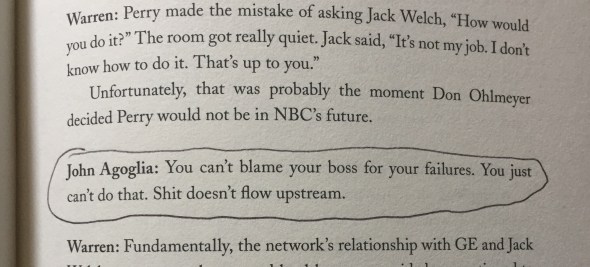
Purging some books from my collection.

This one no longer sparks joy. Perhaps because the cover itself is too busy, and also summons up a specific 90s period that now feels almost grotesque?

I got a lot out of this book. What an era – when the most popular TV show really was the funniest. On Frasier:

What a great, brilliant innovation. It really gave Frasier a different, quieter feel than some of the other shows of the era.
How about this story about Clooney on the first day of E.R.:

How far could you get from LA using public transportation networks?
Posted: April 11, 2019 Filed under: the California Condition Leave a comment
For the purposes of this exercise, let’s rule out Amtrak. It’s “public transportation” in a way but that’s another level. Let’s talk about traveling, by public transit only, no Greyhound, connecting network to network, and see how far you could get.
Worked on this problem briefly and here’s what I came up with.

The key is really Lancaster. From LA you could take an 785 Antelope Valley Transit Authority Bus to Lancaster.

From Lancaster, you could connect on Kern Valley Transit and go as far as Lost Hills or Delano, or even out to Ridgecrest.

You’ll be dropped off around here:

But, you could also hop on the Eastern Sierra Transit Authority’s Mammoth Express, go out to Lone Pine, change there for a bus that will take you to Reno, Nevada.

You could even hop off early, in Carson City, Nevada. It’s thus easier to travel in this method to Nevada’s state capitol than it is to California’s.
Far as I can tell, closest you can get to Sacramento without resorting to Amtrak or Greyhound from Los Angeles is Delano or Lost Hills.
Along the coast I don’t see how you get farther than Santa Barbara.
If you’re heading east, I could see you getting to Hemet with some help from the Riverside Transit Authority, or you could work your way all the way to the east side of the Salton Sea with some help from the Sunline Transit Agency.

We welcome corrections from our transit-minded readers!
Busy
Posted: April 10, 2019 Filed under: America Since 1945, writing Leave a comment
Noticed something about myself, but maybe it’s true for you, too. I am most productive when I am a certain level of “busy.”
When I have absolutely nothing to do, like zero, I rarely get anything done.
There’s a level of overwhelmedment where I am also useless.
But at just the right level of medium busy, my machinery hums and I get a lot done.
Surely there’s meaning in this!
(Image found by doing a search on NARA.gov for “busy.”
Original Caption: Older Citizens, Retired Persons and Those Unable to Care for Themselves Physically Are Cared for in Two Community Centers. This Man Lives at the Highland Manor Retirement Home, Keeping Busy with “Old Country” Crafts. New Ulm Is a County Seat Trading Center of 13,000 in a Farming Area of South Central Minnesota. It Was Founded in 1854 by a German Immigrant Land Company That Encouraged Its Kinsmen to Emigrate From Europe.
U.S. National Archives’ Local Identifier: 412-DA-15875
Photographer: Schulke, Flip, 1930-2008
Subjects:
New Ulm (Brown county, Minnesota, United States) inhabited place
Environmental Protection Agency
Project DOCUMERICA
Persistent URL: arcweb.archives.gov/arc/action/ExternalIdSearch?id=558325
)
Four Views of Yosemite
Posted: April 9, 2019 Filed under: the California Condition Leave a comment



Yosemite has to be one of the most photographed places in the world. Yet, everyone there is: producing more photos. You walk around and see everyone with their phones out, snapping away. Or people not satisfied with phones, hauling big cameras too.
What is the meaning of continuing to photograph it? Maybe there’s an appeal like what draws rock climbers there, you want to try your stuff on the famous playground of the masters.
My mind was opened reading this Playboy interview with Ansel Adams, where he talks about trying to make the photograph capture what he was feeling:
Similarly, while the landscapes that I have photographed in Yosemite are recognized by most people and, of course, the subject is an important part of the pictures, they are not “realistic.” Instead, they are an imprint of my visualization. All of my pictures are optically very accurate–I use pretty good lenses–but they are quite unrealistic in terms of values. A more realistic simple snapshot captures the image but misses everything else. I want a picture to reflect not only the forms but what I had seen and felt at the moment of exposure.
More:
Playboy: When did you know you could accomplish it?Adams: I had my first visualization while photographing Half Dome in Yosemite in 1927. It was a remarkable experience. After a long day with my camera, I had only two photographic plates left. I found myself staring at Half Dome, facing the monolith, seeing and feeling things that only the photograph itself can tell you. I took the first exposure and, somehow, I knew it was inadequate. It did not capture what I was feeling. It was not going to reflect the tremendous experience. Then, to use Stieglitz’ expression, I saw in my mind’s eye what the picture should look like and I realized how I must get it. I put on a red filter and figured out the exposure correctly, and I succeeded! When I made the prints, it proved my concept was correct. The first exposure came out just all right. It was a good photograph, but it in no way had the spirit and excitement I had felt. The second was Monolith, the Face of Half Dome, which speaks for itself.

Jobs
Posted: April 8, 2019 Filed under: business, the California Condition 2 Comments
from:

Kondo’ing some books. Picking up Walter Isaacson’s bio of Steve Jobs does not spark joy, but I did take another look at several passages I’d noted.
Here’re some previous Helytimes posts related to Steve Jobs.
Paul Beatty’s Literature From Los Angeles Class
Posted: April 4, 2019 Filed under: the California Condition, writing Leave a commentOV: You teach an MFA class at Columbia called Literature from Los Angeles. Why didyou decide to do that?
PB: Why? I guess my reason is twofold. I stole the idea from a friend of mine who actually taught a class like that. She’s always complaining, “These kids never have any setting!” So I wanted to talk about setting and what setting means, not just in terms of place but what the notions of setting are. So it’s partly that. And partly a way of getting the students to read stuff they haven’t read before. So we read Chester Himes, we read Michael Jaime-Becerra; we read Wanda Coleman, we read Karen Tei Yamashita; we readBret Easton Ellis, we read Bukowski. We read a ton of stuff.
I’d like to take the class Paul Beatty lays out in this LitHub interview. Sent me to learn about Chester Himes.

Mike Davis in City of Quartz: Excavating the Future of Los Angeles, describing the prevalence of racism in Hollywood in the 1940s and ’50s, cites Himes’ brief career as a screenwriter for Warner Brothers, terminated when Jack L. Warner heard about him and said: “I don’t want no niggers on this lot.”[4] Himes later wrote in his autobiography:
Up to the age of thirty-one I had been hurt emotionally, spiritually and physically as much as thirty-one years can bear. I had lived in the South, I had fallen down an elevator shaft, I had been kicked out of college, I had served seven and one half years in prison, I had survived the humiliating last five years of Depression in Cleveland; and still I was entire, complete, functional; my mind was sharp, my reflexes were good, and I was not bitter. But under the mental corrosion of race prejudice in Los Angeles I became bitter and saturated with hate.
Should we boycott The Beverly Hills Hotel?
Posted: April 3, 2019 Filed under: Hollywood, the California Condition 1 Comment
George Clooney says yes. The reason why is because this hotel, along with nine other fancy hotels, the Bel-Air here and some in London and France, are owned by the Sultan of Brunei. Clooney:
At the head of it all is the Sultan of Brunei who is one of the richest men in the world. The Big Kahuna. He owns the Brunei Investment Agency and they in turn own some pretty spectacular hotels.
A couple of years ago two of those hotels in Los Angeles, The Bel-Air and The Beverly Hills Hotel were boycotted by many of us for Brunei’s treatment of the gay community. It was effective to a point. We cancelled a big fundraiser for the Motion Picture Retirement Home that we’d hosted at the Beverly Hills Hotel for years. Lots of individuals and companies did the same. But like all good intentions when the white heat of outrage moves on to the hundred other reasons to be outraged, the focus dies down and slowly these hotels get back to the business of business.
But now there’s a new law going into place in Brunei. Says Clooney:
The date April 3rd has held a unique place in our history over the years. Theologians and astronomers will tell you that Christ was crucified on that date.
(what?)
On April 3rd Harry Truman signed the Marshall Plan, arguably the greatest postwar intervention in the history of man. The first portable cellphone call was made on April 3rd. Marlon Brando was born on that day.
But this April 3rd will hold its own place in history. On this particular April 3rd the nation of Brunei will begin stoning and whipping to death any of its citizens that are proved to be gay. Let that sink in. In the onslaught of news where we see the world backsliding into authoritarianism this stands alone.
Here’s the thing though. The last execution of any kind in Brunei was in 1957.
It’s not like they’re stoning people all the time. The 1957 execution actually happened while Brunei was a UK protectorate.
Meanwhile, in Saudi Arabia, four years ago:
In 2014, a 24-year-old Saudi Arabian man was sentenced to three years detention and 450 lashes after a Medina court found him guilty of “promoting the vice and practice of homosexuality”, after he was caught using Twitter to arrange dates with other men.[18]
A year ago, in Hollywood:
On Wednesday night, M.B.S. was welcomed to a Hollywood dinner hosted by producer Brian Grazer and his wife Veronica, alongside William Morris Endeavor boss Ari Emanuel, who is finalizing a deal with M.B.S. for a $400 million stake in Emanuel’s talent agency. The guest list was saturated with executives, including Amazon’s Jeff Bezos, Disney’s Bob Iger, Patriots owner Robert Kraft, and Snapchat’s Evan Spiegel, as well as tech entrepreneur Kobe Bryant, whom the prince reportedly made a special request to meet. Having traded his traditional ceremonial garb for a suit, M.B.S. kibitzed with former Trump aide Dina Powell and Vice co-founder Shane Smith; discussed the exploding use of Snapchat in Saudi Arabia; and asked Kobe how he got his Oscar. Topics that were deemed off-limits included the 32-year-old’s bombing campaign in Yemen, which has killed thousands of civilians; his abduction of Lebanon’s prime minister, Saad Hariri, in November; and the decidedly un-Hollywood-like repression of independent media and journalists, one of whom was recently imprisoned for five years for “insulting” the royal court.
And guess what? The Four Seasons

is 45% owned by the Kingdom Holding Company of Saudi Arabia!
For whatever reason, Brunei likes to fantasize, pretend, and profess to having Sharia law. Hollywood likes to judge them for that, while obviously not being serious about caring about human rights in countries where it’s more important to do business and whose hotels it would be more inconvenient to boycott.
One of the easiest things in the world is to point out hypocrisy. I think George Clooney is cool. But why are we always picking on poor Brunei? Because it’s easy?
What we’re pretending to be mad about, what we’re pretending to do about it, what Brunei is pretending their punishments are: it’s all make-believe.
I will boycott the Beverly Hills Hotel I guess. But I’ll be sad about it because I think it’s a beautiful, cool landmark. I especially like the Fountain Coffee Room.

I predict in a few years we will once again forget about our mission to improve things in Brunei.
The truth is the truth, all around the world
Posted: April 2, 2019 Filed under: comedy Leave a comment
Tuned in to see Tracy light up Jussie but really found the advice around 2:20-2:50 to be succinct and profound.
Visualization
Posted: April 1, 2019 Filed under: sports Leave a comment
Vernon smiles and then, as motivation is one of her key themes, she continues. “Looking back, I didn’t motivate myself in a good way for that race. I motivated myself by imagining the Chinese flag going up the Olympic flagpole. They were our main rivals and that was how I pushed myself. Then I’m standing on the podium in Beijing. The Chinese flag is in the middle and I’m living my nightmare. Since I’ve retired I see things differently – but a part of me will always think: ‘That was your chance, and you blew it.’”
Fascinated by this Guardian piece on Annie Vernon and her book, Mind Games: Determination, Doubt and Lucky Socks: An Insider’s Guide to the Psychology of Elite Athletes. Pumping yourself up by visualizing your worst nightmare does sound kind of depleting.
We had one meeting several months later where we analysed our splits and established that the Chinese had a phenomenal last 500m. Did we ever confront exactly what went on the year before? No. This week was the first time Fran and I spoke in detail about it. I asked Fran: ‘How do you feel about Beijing? How do you explain to yourself what happened?’ My take was that we were so desperate to win we arrived there terrified we might mess up. That tension affected us.”
Vernon is at peace now and able to see a fresh outcome. “In lots of ways Beijing led me to Mind Games because I wanted to do something in elite sport that left me feeling positive. I didn’t want that to be the defining feature of my career or my life. Maybe one day, rather than the woman who stood on the podium in Beijing wishing she was anywhere but there, I’ll be known more as the author of Mind Games.”
Shrimp
Posted: March 27, 2019 Filed under: food Leave a comment
New Orleans heaved a collective sigh of relief when the U.S. Food and Drug Administration (FDA) determined that Gulf seafood was safe to eat. The sigh was premature. The FDA made its assessment using the model of a 176-pound adult who ate, for example, just four shrimp per week. Yes 75% of women in the United States weigh less than this, as do nearly all children. Gulf residents also generally consume a far larger and more diverse seafood diet than the one considered by the FDA…
from this incredible atlas of New Orleans.

Suttree
Posted: March 27, 2019 Filed under: America Since 1945, books, cormac, writing Leave a comment
Moving stuff around in my house I found the handwritten list of words I had to look up from Suttree, by Cormac McCarthy, and their definitions.


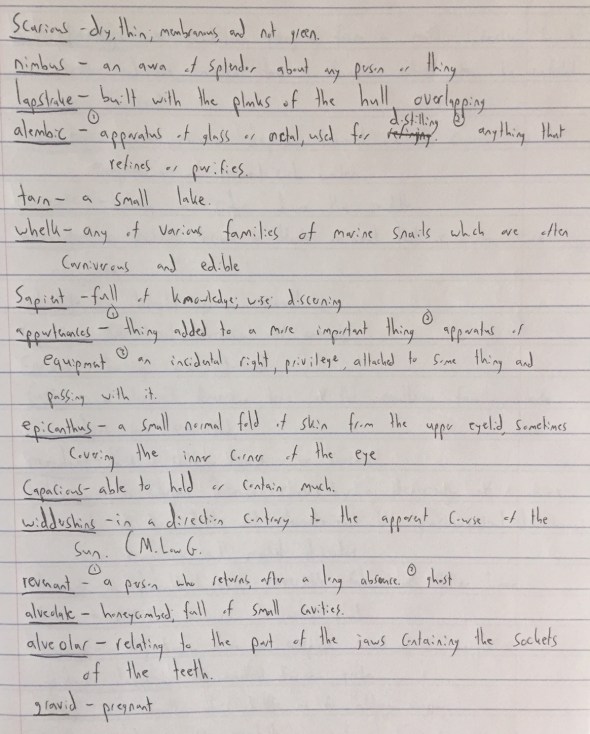


Trull: a prostitute or a trollop.
Tellurian: an inhabitant of Earth.
Feels like I used to have a lot more spare time.
Suttree is set along the river in Knoxville, TN.

If you think Suttree might be for you, try the first sentence:
Dear friend now in the dusty clockless hours of the town when the streets lie black and steaming in the wake of the watertrucks and now when the drunk and the homeless have washed up in the lee of walls in alleys or abandoned lots and cats go forth highshouldered and lean in the grim perimeters about, now in these sootblacked brick or cobbled corridors where lightwire shadows make a gothic harp of cellar doors no soul shall walk save you.

Highlights for Children
Posted: March 26, 2019 Filed under: books Leave a comment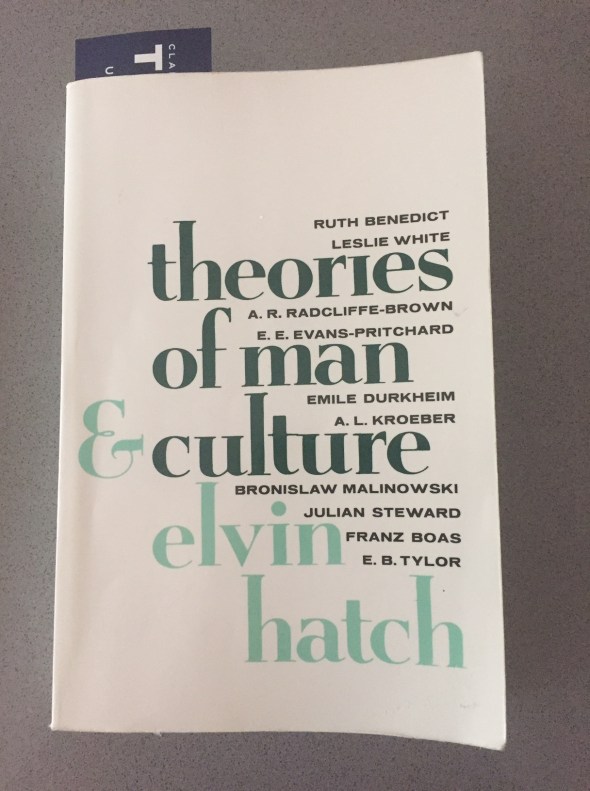
On the suggestion of Neomarxisme I got a copy of this book, which he said was a pretty readable roundup of the big theories in anthropology and a history of the field. I love that kinda book. I bought a used copy, which the seller noted was somewhat highlighted. I enjoy books that are a little marked up, feels fun and human. But the previous reader really went nuts!

TAUGHT
Marijuana and psychosis
Posted: March 26, 2019 Filed under: America Since 1945, business, coffee Leave a comment
This was in today’s Economist newsletter, and I’ve seen it elsewhere too. Scary! But then again, what is the definition of psychosis?

Isn’t getting your thought and emotions so impaired that you lose contact with external reality the point of high THC content marijuana? Is this a feature not a bug? External reality can be rough.
The study, in The Lancet, used the ICD-10 Criteria (F20-33), so schizophrenia and manic/bipolar episodes. The study compared people hospitalized for that kind of thing versus a control general population. Here’s how the study worked:
We included patients aged 18–64 years who presented to psychiatric services in 11 sites across Europe and Brazil with first-episode psychosis and recruited controls representative of the local populations.
Then this part:
We applied adjusted logistic regression models to the data to estimate which patterns of cannabis use carried the highest odds for psychotic disorder. Using Europe-wide and national data on the expected concentration of Δ9-tetrahydrocannabinol (THC) in the different types of cannabis available across the sites, we divided the types of cannabis used by participants into two categories: low potency (THC <10%) and high potency (THC ≥10%). Assuming causality, we calculated the population attributable fractions (PAFs) for the patterns of cannabis use associated with the highest odds of psychosis and the correlation between such patterns and the incidence rates for psychotic disorder across the study sites.
“expected” and “assuming” are two words that do a lot of work here, but I don’t have time to read the whole study, I have to write cartoons.
In my neighborhood the most booming new shops sell either marijuana or cold brew coffee. Personally I wonder if drinking huge amounts of highly caffeinated cold brew might be more crazy-making than marijuana.
There is certainly ample psychosis in Los Angeles, so much so that it might be necessary to induce mild psychosis just so you can understand what’s going on with everybody. The chicken and egg, correlation and causation on psychosis / drug use is a tough one to unravel, as the study’s authors acknowledge. The study also notes that patients presenting with psychosis were more likely to have smoked ten or more cigarettes a day.
 Helytimes