Freud on major/minor decisions
Posted: February 2, 2026 Filed under: advice 1 CommentAlmost 100 years ago in Vienna, Theodor Reik asked Sigmund Freud for advice about choosing a career. Freud replied: “When making a decision of minor importance, I have always found it advantageous to consider all the pros and cons. In vital matters, however, such as the choice of a mate or profession, the decision should come from the unconscious, from somewhere within ourselves.”
that quote has stuck with me, perhaps I first read it in this Feb. 2006 letter to the editor of the NYT.
More McConaughey: Want To Be Here
Posted: October 28, 2025 Filed under: advice, Hollywood Leave a comment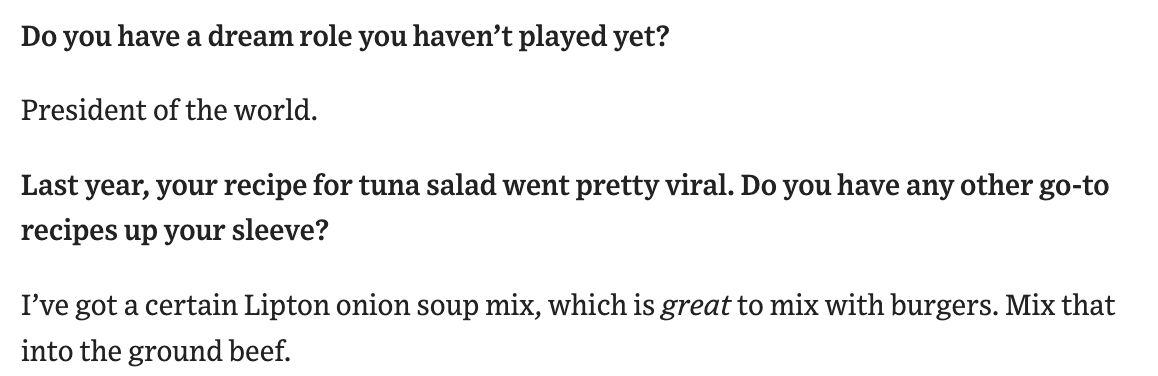
in WSJ.

in Singju Post
I always repeat this, but one of the coolest and simplest things I heard early on. I was onThe Jay Leno Show, my first talk show. He comes by the green room. He goes, “You nervous?” I go, “Yeah, a little bit.” He goes, “Look, I got simple advice, how to make this work.” I go what? He goes, “Just want to be here.” It’s always stuck with me: You just want to be there. All of a sudden the clock goes faster. You look back, you enjoy what you did more.
in Paper Magazine.
His Dallas Buyers Club diet:

That’s in Greenlights.
A striking aspect of Greenlights is how few of the stories take place on movie sets. For example, in this one paragraph he blows past the making of six different movies.
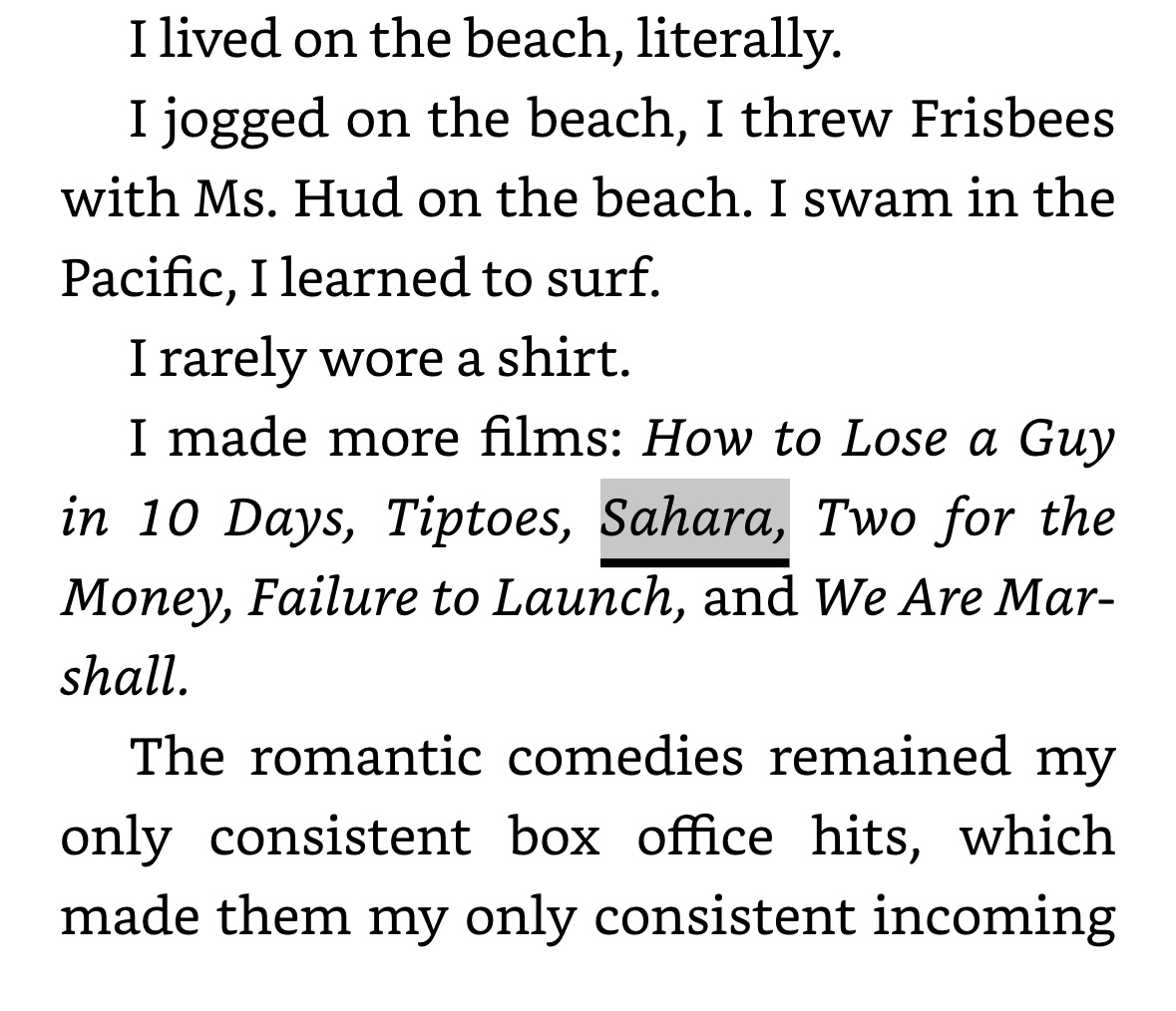
The actual making of movies may not be that interesting.
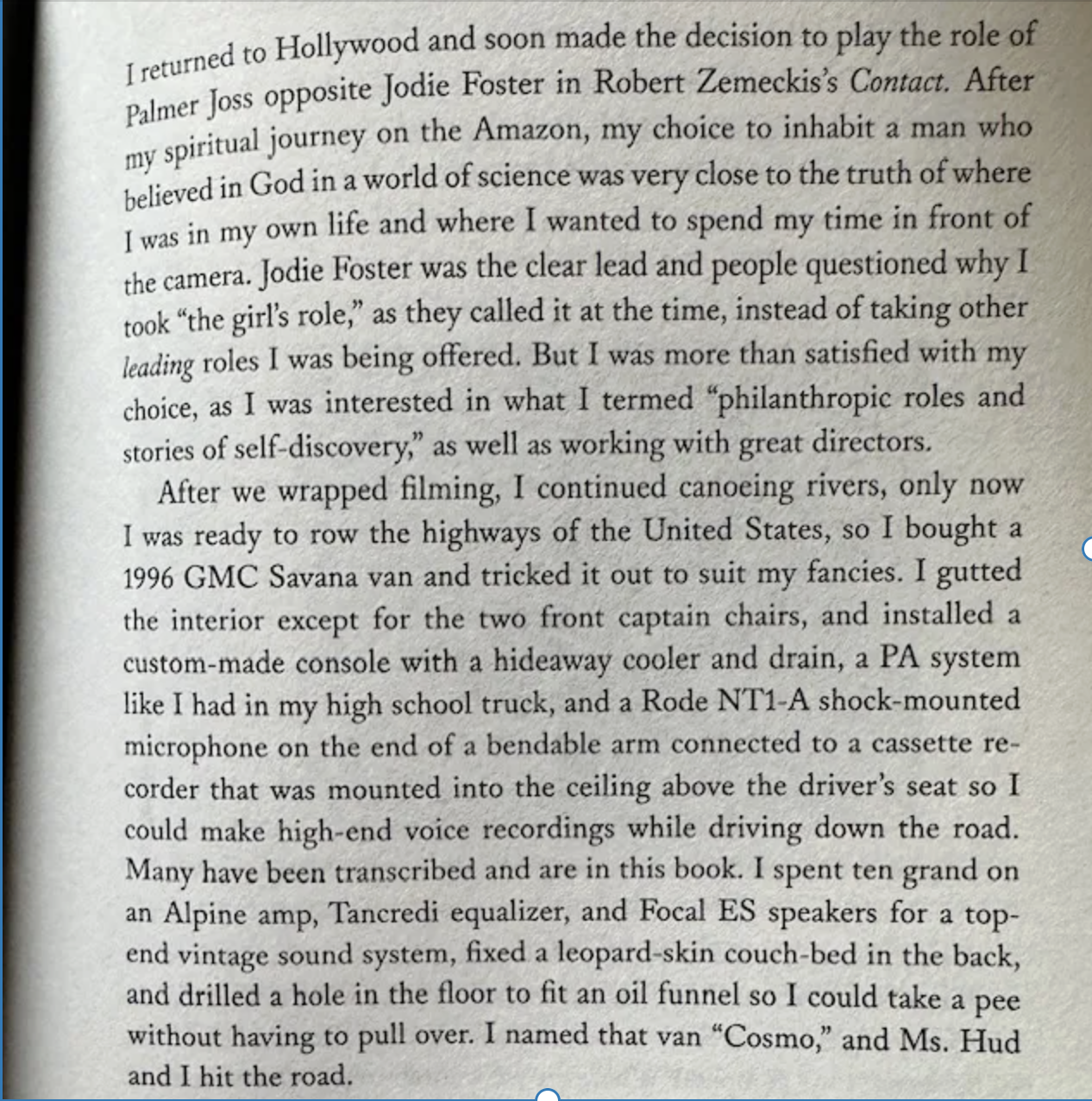
Greenlights is best received as an audiobook, as that’s how McConaughey composed it, talking into a microphone while driving:
Finish drafts
Posted: October 24, 2025 Filed under: advice, writing, writing advice from other people 1 Comment
Woody Allen: NOT in fashion.
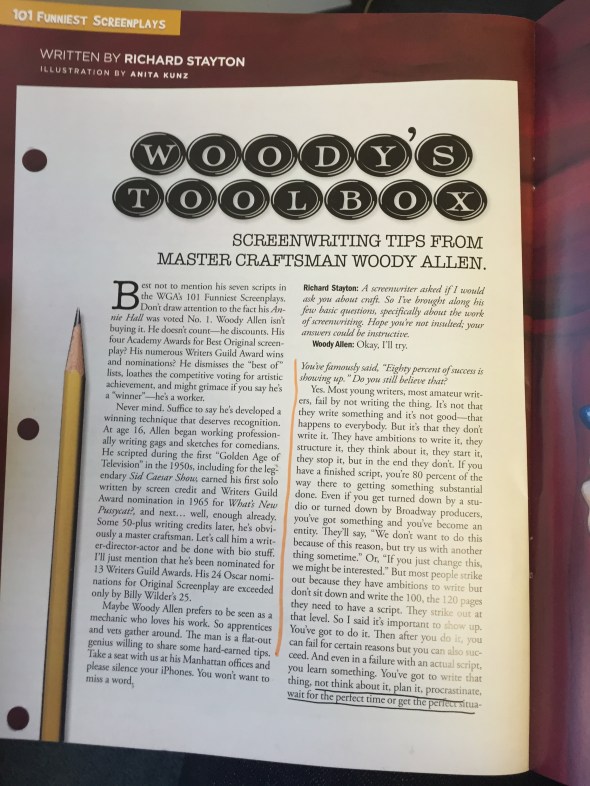
I’m interested only in his productivity. Whatever else you say about him, my guy made a lot of movies. How?:

appears in an interview from 2015 with Richard Stayton in Written By magazine.
(For the love of Buddha if you are easily triggered don’t look at the WGA’s list of 101 funniest screenplays)
“Buy when there’s blood in the streets”
Posted: April 6, 2025 Filed under: advice, business 3 Comments
On the famous quote sometimes attributed to Nathan Rothschild
His four brothers helped co-ordinate activities across the continent, and the family developed a network of agents, shippers and couriers to transport gold—and information—across Europe. This private intelligence service enabled Nathan to receive in London the news of Wellington’s victory at the Battle of Waterloo a full day ahead of the government’s official messengers.[2] He is famously quoted as saying “Buy when there’s blood in the streets”, though the original quote is believed to have appended “even if the blood is your own”. The quote refers to his contrarian investing strategy that he is well known for adhering to as to buy assets when the financial markets are crashing and panicking investors are selling. The quote has a tremendous impact today on value investing and modern businesspeople and investors alike when buying assets in down markets when investment opportunities arise.[3][4][5]
The first part of this concerning the Battle of Waterloo has already been adequately dealt with. The second part of this seems equally dubious, and I can’t find a good source for it. You can find this “buy when there is blood in the streets” quote in many modern business books, but they hardly count as a reliable source for a biography of Nathan Rothschild. The earliest sources I’ve found so far date from 1907/8 – for example Thomas Gibson’s Market Letters for 1907 contains the following supposed conversation:
“Buy Rentes,” advised Rothschild.
“But the streets of Paris are running with blood.”
“That is why you can buy Rentes so cheap.”
Grateful to Wikipedia editor Franz for getting to the bottom of that quote.
The first time I heard Cass McCombs was in a car in Queensland, Australia. The aux cord wasn’t working properly, so the vocals weren’t coming through, just the instrumentals. For awhile I was like “who is this genius that just plays rhythmic patterns?!” It was cool either way!
People drop this quote every time there’s a stock market downturn. But it sounds like Rothschild was speaking of a time when blood was literally running in the streets.
Power by Jeffrey Pfeffer (2010)
Posted: February 22, 2025 Filed under: advice, America Since 1945, business Leave a comment
Pulled this one from my shelf because I remembered there was a funny claim about how flattery 100% of the time no exceptions always works. Indeed:
Most people underestimate the effectiveness of flattery and therefore underutilize it. If someone flatters you, you essentially have two ways of reacting. You can think that the person was insincere and trying to butter you up. But believing that causes you to feel negatively about the person whom you perceive as insincere and not even particularly subtle about it. More importantly, thinking that the compliment is just a strategic way of building influence with you also leads to negative self-feelings— what must others think of you to try such a transparent and false method of influence? Alternatively, you can think that the compliments are sincere and that the flatterer is a wonderful judge of people— a perspective that leaves you feeling good about the person for his or her interpersonal perception skill and great about yourself, as the recipient of such a positive judgment delivered by such a credible source. There is simply no question that the desire to believe that flattery is at once sincere and accurate will, in most instances, leave us susceptible to being flattered and, as a consequence, under the influence of the flatterer.
So, don’t underestimate—or underutilize-the strategy of flattery.
University of California-Berkeley professor Jennifer Chatman, in an unpublished study, sought to see if there was some point beyond which flattery became ineffective. She believed that the effectiveness of flattery might have an inverted U-shaped relationship, with flat tery being increasingly effective up to some point but beyond that becoming ineffective as the flatterer became seen as insincere and a “suck up.” As she told me, there might be a point at which flattery became ineffective, but she couldn’t find it in her data.
Amazing. A powerful move:
I have observed similar ploys used to gain power in business meetings. In most companies, the strategy and market dynamics are taken for granted. If someone challenges these assumptions-such as how the company is competing, how it is measuring success, what the strategy is, who the real competitors are now and in the future— this can be a very potent power play. The questions and challenges focus attention on the person bringing the seemingly commonsense…
How to get powerful? There’s a simple plan:
The fundamental principles for building the sort of reputation that will get you a high-power position are straightforward: make a good impression early, carefully delineate the elements of the image you want to create, use the media to help build your visibility and burnish your image, have others sing your praises so you can surmount the self-promotion dilemma, and strategically put out enough negative but not fatally damaging information about yourself that the people who hire and support you fully understand any weaknesses and make the choice anyway. The key to your success is in executing each of these steps well.
A tale of California politics:
In government, Jesse Unruh, a former Democratic political boss and treasurer of Califor-nia, called money the mother’s milk of politics. Former two-term San Francisco mayor Willie Brown, whose 16 years as speaker and virtual ruler of the California Assembly prior to becoming mayor marked him as an extremely effective politician, began his campaign for the legislative leadership post by raising a lot of money. And since he was from a “safe” district, he gave that money to his legislative colleagues to help them win their political contests. Brown understood an important principle: having resources is an important source of power only if you use those resources strategically to help others whose support you need, in the process gaining their favor. In contrast to Brown, the Assembly speaker at the time, Leo McCarthy, irritated his Democratic colleagues to the point of revolt by holding a $500,000 fundraiser in Los Angeles featuring Ted Kennedy and then using 100 percent of the money for his nascent efforts to run for statewide office.’ He was soon out of his job, replaced by Willie Brown.
(Similar schemes are a theme in Caro’s LBJ book, he got lots of money from powerful Texas guys to whom he steered government contracts for projects like dams, then he distributed that money around Congress to his desperate colleagues).
If you want power don’t give up power:
You need to be in a job that fits and doesn’t come with undue political risks, but you also need to do the right things in that job. Most important, you need to claim power and not do things that give yours away. It’s amazing to me that people, in ways little and big, voluntarily give up their power, preemptively surrendering in the competition for status and influence. The process often begins with how you feel about yourself. If you feel powerful, you will act and project power and others will respond accordingly. If you feel power-less, your behavior will be similarly self-confirming.
Randall Collins on Sex and Violence
Posted: May 8, 2024 Filed under: advice, brain Leave a comment
We’ve discussed before the work of microsociologist Randall Collins. Not sure why his work isn’t more popular. His insights about violence are both profound and practical. Here’s a summary he gave of much of his own work.
Now that we have photos and videos of violent situations, we see that at the moment of action the expression on the faces of the most violent participants is fear. Our folk belief is that anger is the emotion of violence, but anger appears mostly before any violence happens, and in controlled situations where individuals bluster at a distant enemy. I have called this confrontational tension/fear; it is the confrontation itself that generates the tension, more than fear of what will happen to oneself. Confrontational tension is debilitating; phenomenologically we know (mainly from police debriefings after shootings) that it produces perceptual distortions; physiologically it generates racing heart beat, an adrenaline rush which at high levels results in loss of bodily control.
Collins speaks of what sociologists have learned from CCTV footage of fights at bars:
This explains another, as yet little recognized pattern: when violence actually happens, it is usually incompetent. Most of the times people fire a gun at a human target, they miss; their shots go wide, they hit the wrong person, sometimes a bystander, sometimes friendly fire on their own side. This is a product of the situation, the confrontation. We know this because the accuracy of soldiers and police on firing ranges is much higher than when firing at a human target. We can pin this down further; inhibition in live firing declines with greater distance; artillery troops are more reliable than infantry with small arms, so are fighter and bomber crews and navy crews; it is not the statistical chances of being killed or injured by the enemy that makes close-range fighters incompetent. At the other end of the spectrum, very close face-to-face confrontation makes firing even more inaccurate; shootings at a distance of less than 2 meters are extremely inaccurate.
(Now, Collins does cite the work of S. L. A. Marshall, who is controversial. Story for another day.).
Why do most potential fights defuse before they start?:
Most of the time both sides stay symmetrical. Both get angry and bluster in the same way. These confrontations abort, since they can’t get around the barrier of confrontational tension.
Practical advice:
Keep any confrontation emotionally symmetrical; make confrontational tension work for you by maintaining face contact; avoid micro-escalations; let the situation calm down out of boredom, which is what happens when an interaction becomes locked into repetition. In the violent sociology of emotions, boredom is your friend.
Go read the whole thing. He also speaks on sex:
the strongest sexual attraction is not pleasure in one’s genitals per se, but getting the other person’s body to respond in mutually entraining erotic rhythms: getting turned on by getting the other person turned on. If you don’t believe me, try theorizing the attractions of performing oral sex. This is an historically increasing practice, and one of the things that drives the solidarity of homosexual movements. Gay movements are built around effervescent scenes, not around social media.
Scraps of time
Posted: January 1, 2024 Filed under: advice, writing Leave a comment
Douglas Southall Freeman is out of fashion these days. He was a great perpetuator the Robert E. Lee myth, simply by writing so damn much about him. His biography of Lee takes up four volumes:

and Lee’s Lieutenants (that is to say his generals) get three!:

Then again Lee already had a statue in Richmond, which Freeman saluted every day on the way to work:
Freeman’s work ethic was legendary. Throughout his life, he kept a demanding schedule that allowed him to accomplish a great deal in his two full-time careers, as a journalist and as a historian. When at home, he rose at three every morning and drove to his newspaper office, saluting Robert E. Lee’s monument on Monument Avenue as he passed. Twice daily, he walked to a nearby radio studio, where he gave news broadcasts and discussed the day’s news. After his second broadcast, he would drive home for a short nap and lunch and then worked another five or six hours on his current historical project, with classical music, frequently the work of Joseph Haydn, playing in the background.
from the intro to this book of Freeman’s speeches:
Freeman later remarked that a statement made by [Prof. S. C. Mitchell] during a lecture on Martin Luther meant a great deal to him:
Young gentlemen, the man who wins is the man who hangs on for five minutes longer than the man who quits.
I found some advice that I’m going to make my New Year’s Resolution, boldface mine.
Know your stuff. Now that means a lot in the way of the utilization
of your time. And it means a lot in the way of utilization of a navy
wife or an army wife. You boys think you have a hard life to lead. You
don’t have any tougher life to lead than the life of a navy wife. And
both the navy husband and the navy wife need to learn all they can,
when they can. I’d like to give you a little motto on that question. I
gave it to one of my historical secretaries. She happens to be the one
who came up with me this morning. She said it was the most useful
thing I’d ever told her. It came from Oliver Wendell Holmes, a justice
of the Supreme Court of the United States, who should have been chief
justice. Holmes would get a boy from Harvard Law School every year,
and that boy would have one year as Holmes’ law clerk, a magnificent
training, out of which in their generations have come some of the best
lawyers in public service in America. And one of the favorite things
that he would tell these boys was, “Young man, make the most of the
scraps of time.” Now believe me, if you want to know your swuff and
know it better than the other man, you’ve got to spend more time on
it; and if you are going to spend more time on it, you’ve got to make
the most of the scraps of time. The difference between mediocrity and
distinction in many a professional career is the organization of your
time. Do you organize it; do you make the most of the scraps of time?
Bless my soul, I don’t suppose that the admiral, with his dignity and
justice and regard for all the amenities, says no to you about playing
bridge; but there is many a man who would have three more stripes
on his sleeve if he gave to study the time that he gives to bridge. Don’t
say that you have to have the recreation. You have to have enough
recreation, but diversification of work is the surest recreation of the
mind.
(Note: the source of this advice is Union vet/Bostonian OWH Jr., not Confederate sympathizer DSF, so we’re clean.)
Most of the speeches in this book were given in the late 1930s and early 1940s at The Army War College and the Navy War College. Freeman was conveying lessons learned in the Civil War/War of the Rebellion to the generals and admirals who would end up fighting the Second World War. Freeman’s own father had been in the Army of Northern Virginia.
In the book Freeman tells a bunch of good stories, here’s one about Jubal Early (who Freeman met many times):
Early had about him a carping, singularly bitter manner that alienated nearly every man who was
under him. Lee, if there was a doubt whether a fault was his or a subordinate’s, would always assume it; Early, never. Sometimes his wit was good. You may not be familiar with his great exchange with John
C. Breckinridge. Breckinridge had been, as you remember, a candidate for the presidency in 1860. Before that time he had been a great political leader, standing on the principle of the right of slavery in the territories. He fought with Early through a part of the Valley campaign of 1864. Early never forgot that he was a politician, though Breckinridge was a very good soldier. In a very desperate hour-I think it was at
Winchester-when Rodes had been killed and the situation was very desperate, Breckinridge was in full retreat. Early met him in the road and said, “Well, General Breckinridge, what do you think about slavery
in the territories now?”
The Mind of Napoleon
Posted: October 8, 2022 Filed under: advice Leave a comment
[Conversation, 1805] There is only one thing to do in this world, and that is to keep acquiring more and more money and power. All the rest is chimerical.
[Conversation, December 3, 1804, the day after his coronation] I come too late, nothing great remains to be done… Yes, I admit that I have had a fine career, I have gone far. But what a difference with antiquity! Look at Alexander: when he had conquered Asia and presented himself to the nations as the son of Jupiter, the whole Orient believed him, except for Olympias, who knew better, and except for Aristotle and a few Athenian pedants. Well, if I declared myself the sone of the Eternal Father… every fishwife would hoot when she saw me pass by. The masses are too enlightened these days: nothing great can be done anymore.
[Conversation, 1816] General rule: No social revolution without terror
[Incident, Saint Helena, 1815, related by Las Cases] Several slaves carrying heavy crates crossed our path. Mrs. Balcombe told them angrily to make room, when the Emperor intervened saying “Respect for the burden, Madam!”
[Reminiscence of Chaptal] Once among many times, Josephine was to take the waters at Aachen. The First Consul had me called and said “Josephine is leaving tomorrow for her water cure. I mist dictate her itinerary and outline her conduct. Write.” And he dictated twenty-one large sheets of paper.
[Letter, 1810] Poland exists only in the imagination of those who want to use it as a pretext for spinning dreams.
[Dictation, Saint Helena] A battle is a dramatic action which has its beginning, its middle, and its end. The battle order of the opposing armies and their preliminary maneuvers until they come to grips form the exposition. The countermaneuvers of the army which has been attacked constitute the dramatic complication. They lead in turn to new measures and bring about the crisis, and from this results the outcome of denouement.
[1808, letter] You say you have four hundred thousand men under arms, which is more than your monarchy ever had. You want to double their number: we shall follow your example. Soon even the women will have to be conscripted. When things come to this point, when all the springs are thus strained, war becomes desirable in order to bring about a release. Thus, in the physical world, at the approach of a storm, nature is in a state of tension, so painful that the outbreak of the storm is desirable because it relaxes the exacerbated nerves and restores heaven and earth to peaceful serenity. An acute but short pain is preferable to prolonged suffering.
[Note, August 27, 1808] In war, moral factors account for three quarters of the whole; relative material strength accounts for only one quarter.
[Conversation, 1800s] Military science consists in first calculating all the possibilities accurately and then making an almost mathematically exact allowance for accident. It is on this point that one must make no mistake; a decimal more or less may alter everything.
[Conversation, 1813] When an enemy army is in flight, you must either build a golden bridge for it or stop it with a wall of steel
Napoleon speaks of how Wellington devastated Spain during his retreat to Portugal:
In all of Europe, only Wellington and I are capable of carrying out such measures. But there is a difference between him and myself: in France… I would be criticized, whereas England will praise him.
There are a couple of interesting pages in this book where Napoleon explains all the reasons why he should have won the battle of Waterloo. Shoulda woulda coulda. More on Napoleon, his mind. Got this book after the recommendation of Scott Locklin‘s website.
Note to devoted readers: the pace of dispatches on this site will likely be diminished in the future as I’ve been directed by the System to write and produce ten episodes of a TV show.
The patience of the pursuer
Posted: July 27, 2022 Filed under: advice, America Since 1945 Leave a commentThe subject is Warren Beatty:
“You’d go up to his penthouse at the Beverly Wilshire two to three hours a day and go through a whole argument,” recalled writer and director Paul Schrader. “You’d go back the next day and start at zero until, finally, you realized we will have the same argument over and over until he wins, and that’s when I realized why he was such a successful lothario. [He had] the infinite patience of the pursuer.”
from Rock Me On The Water: 1974 The Year Los Angeles Transformed Movies, Music, Television and Politics by Ronald Brownstein. I bought it over at Chevalier Books in Larchmont.
The patience of the pursuer reminded me of this, from The Man Who Ran Washington: The Life and Times of James A. Baker III by Peter Baker and Susan Glasser:

The dentist
Posted: July 5, 2022 Filed under: advice Leave a commentMy beloved dentist retired, which is too bad. I went to meet the new dentist.
The new dentist said he was more of a coach than a dentist. He said,
I’ve never seen a tooth without a person attached.
Then he asked me if I drink much seltzer or sparkling water (not really) and he told me there’s citric acid in the canned green tea his wife buys, and that three days a week he drives up from Orange County listening to podcasts about the dark web and marketing.
I told him my previous dentist always gave me nitrous, part of her “relax the patient” philosophy. The new dentist said they didn’t have nitrous in his office, so I said I’m in the wrong office and he didn’t laugh.
Then he declared me healthy and I got X-rayed. That was the last I heard from him and my teeth are working fine, so I guess I’ll just go back to get them cleaned again in a couple months.

The Coen Brothers Interviews
Posted: December 12, 2020 Filed under: advice, film, movies 3 Comments
If you’re out in Hollywood, you probably have a relationship with the movies. Even just at the most basic level, the movie theaters are better here. There are the big movie palaces, Grauman’s Chinese and all that, for special occasions, and The Aero and the Egyptian, but just for everyday moviegoing, I’ll take the Arclight over any place I went to in New York City. There’s now an Arclight in Boston, and a few elsewhere, but man, when I first got to LA I was like OK, here’s how to see a movie.
Of course, you may think you’re pretty into movies, and then you dive in and realize, whoa, some of these people are into movies. I remember hearing a talk by Steve Zalian at some Writers Guild thing where he mentioned he’d seen Serpico ninety times. Doesn’t appear to be online, but there’s a 2014 Playboy interview with David Fincher where he talks about movies he’d seen a hundred times or so. Listen to Brad Pitt and Leo on Maron talk about watching movies with Quentin Tarantino.
You’re liable to be quickly humbled as just a movie fan once you encounter the level of movie fan out here. Some people make their whole identity as film enthusiasts and amateur or semi-pro critics. Not everyone who’s obsessed with movies is a big success at them:
INTERVIEWER
What happens to those girls, those aspiring starlets? Do they sit around in Schwab’s drugstore, or the Brown Derby, or whatever?
SOUTHERN
In the beginning, they come to Hollywood, presumably, with the idea of the action. Then they find out that you can’t even get into any of these buildings without an agent, that there’s no possibility of getting in, that even a lot of the agents can’t get in. Meanwhile a substitute life begins, and they get into the social scene, you know. They’re working as parking attendants, waitresses, doing arbitrary jobs . . .
INTERVIEWER
Hoping that somebody will see them?
SOUTHERN
Finally they forget about that, but they’re still making the scene. They continue to have some vague peripheral identification with films—like they go to a lot of movies, and they talk about movies and about people they’ve seen on the street, and they read the gossip columns and the movie magazines, but you get the feeling it’s without any real aspiration any longer. It’s the sort of vicariousness a polio person might feel for rodeo.
Terry Southern, talking to The Paris Review. Not clear what year that interview was conducted, certainly well before 1995, when Southern died.
I’d been obsessing over the Conversations With Writers series from the University Press of Mississippi. Browsing their website, I saw they had a whole Conversations With Filmmakers series. The website had a spot where you could request a review copy, so I asked for a review copy of The Coen Brothers Interviews, and Courtney at UP of Miss very kindly sent me one.
These books take the form of collections of interviews published elsewhere. There are 28 in this case, including a transcript of a Terry Gross interview, an Onion A.V. Club interview with Nathan Rabin, a Vogue profile (? was Vogue different in 1994) by Tad Friend. The interviews are often keyed to a particular movie out or in production at the time of the piece. This volume came out in 2006, and the last two short pieces, more articles than interviews, are focused on the soon to be released The Ladykillers.
There’s a thoughtful introduction as well by William Rodney Allen, who explores in particular and appropriately enough the connection the brothers have to the Mississippi Delta, as seen in O Brother Where Art Thou. I was surprised to learn from this book that Miller’s Crossing was shot in New Orleans.
“We looked around San Francisco, but you know what that looks like: period but upscale – faux period,” says Ethan. Then someone suggested New Orleans, parts of which surprisingly fit the bill. Outside of the distinctive French Quarter, there were plenty of places that could pass for a generic Anytown in the late 1920s. “New Orleans is sort of a depressed city; it hasn’t been gentrified,” says Ethan. “There’s a lot of architecture that hasn’t been touched, storefront windows that haven’t been replaced in the past sixty years.”
The Coen Brothers don’t seem particularly interested in being interviewed. Don’t take my word for it:
We often resist the efforts of… people who are interviewing us to enlist us in the process ourselves. And we resist it not because we object to it but simply because it ins’t something that particularly interests us.
so says Joel in an interview with Damon Wise of Moving Pictures magazine, which itself isn’t reprinted in this book, but is quoted in a Boston Phoenix piece from 2001 by Gerald Peary which you will find here. True enough, in most of the conversations the Coens seem game enough but not effusive, and the interviewers or profilers often have to do a bit of legwork themselves to find some meat. They ask why Hudsucker Proxy wasn’t more successful (“I dunno, why was Fargo not a flop?” replies Joel. “It’s as much a mystery to me that people went to see Fargo, which was something we did thinking ah, y’know, about three people will end up seeing it, but it’ll be fun for us”). They ask why the brothers are drawn to James M. Cain (“what intrigues us about Cain is that the heroes of his stories are nearly always schlubs – loser guys involved in dreary, banal existences,” says Joel, again).
One aspect of their career I hadn’t realized before I read this book was Joel’s relationship with Sam Raimi, who gave him a job as an assistant editor on Evil Dead.
Raimi had remarked that the Coens have several thematic rules: The innocent must suffer; the guilty must be punished; you must taste blood to be a man… Joel and Ethan shrugged, separately.
Barry Sonnenfeld was their first director of photography, I also hadn’t known that, perhaps common knowledge to true Coenheads.
In terms of moviemaking secrets, how to get them made, without interference and while maintaining a vision, as the Coens so consistently have, this might be the closest we come. Joel once more, talking to Kristine McKenna for Playboy, 2001:
Our movies are inexpensive because we storyboard our films in the the same highly detailed way Hitchcock did. As a result, there’s little improvisation. Preproduction is cheap compared with trying to figure things out on a set with an entire crew standing around.
Amazon has a couple other glitzier books on the Coens. This book is more raw data than polished product. Sometimes the interviews cover similar turf, or bore down on the specifics of some upcoming project. To me, I find you get a great deal from going to the source. Going to the source is a theme of Helytimes. This book is really a sourcebook, and that’s very valuable.
If not the Coens, perhaps another in the Conversations with Filmmakers series. There are 105! Errol Morris? David Lynch? Jane Campion? I’d like to read all of them, if I had but the time!
In my opinion, a book review should 1) give you some summary, basic idea, and nuggets of insight from the book and 2) give you enough info to know whether you should buy it or not.
I hope I’ve done that for you!
Conversations With series from the University Press of Mississippi
Posted: August 31, 2020 Filed under: advice, America Since 1945, Mississippi, writing, writing advice from other people Leave a comment This is one my favorite books, I’m serious. Shelby Foote is a great interview, obviously, just watch his interviews with Ken Burns. (“Ken, you made me a millionaire,” Shelby reports telling Burns after the series aired.) You may not want to read the whole of Shelby’s three volume Civil War, it can get carried away with the lyrical, and following the geography can be a challenge. But the flavor of it, some of the most vivid moments, and anecdotes, come through in these collected conversations with inquirers over the years.
“You’ve got to remember that the Civil War was as big as life,” he explains. “That’s why no historian has ever done it justice, or ever will. But that’s the glory of it. Take me: I was raised up believing Yankees were a bunch of thieves. But it’s absolutely incredible that a people could fight a Civil War and have so few atrocities.
“Sherman marched with 60,000 men slap across Georgia, then straight up though the Carolinas, burning, looting, doing everything in the world – but I don’t know of a single case of rape. That’s amazing because hatreds run high in civil wars…
There were still a lot of antique virtues around them. Jackson once told a colonel to advance his regiment across a field being riddled by bullets. When the officer protested that nobody could survive out there, Jackson told him he always took care of his wounded and buried his dead. The colonel led his troops into the field.”
Finally treated myself to a few more of these editions. These books are casual and comfortable. They’re collections of interviews from panels, newspapers, magazines, literary journals, conference discussions. Physically they’re just the right size, the printing is quality and the typeface is appealing.
Why not start with another Mississippian, someone Foote had quite a few conversations with himself?

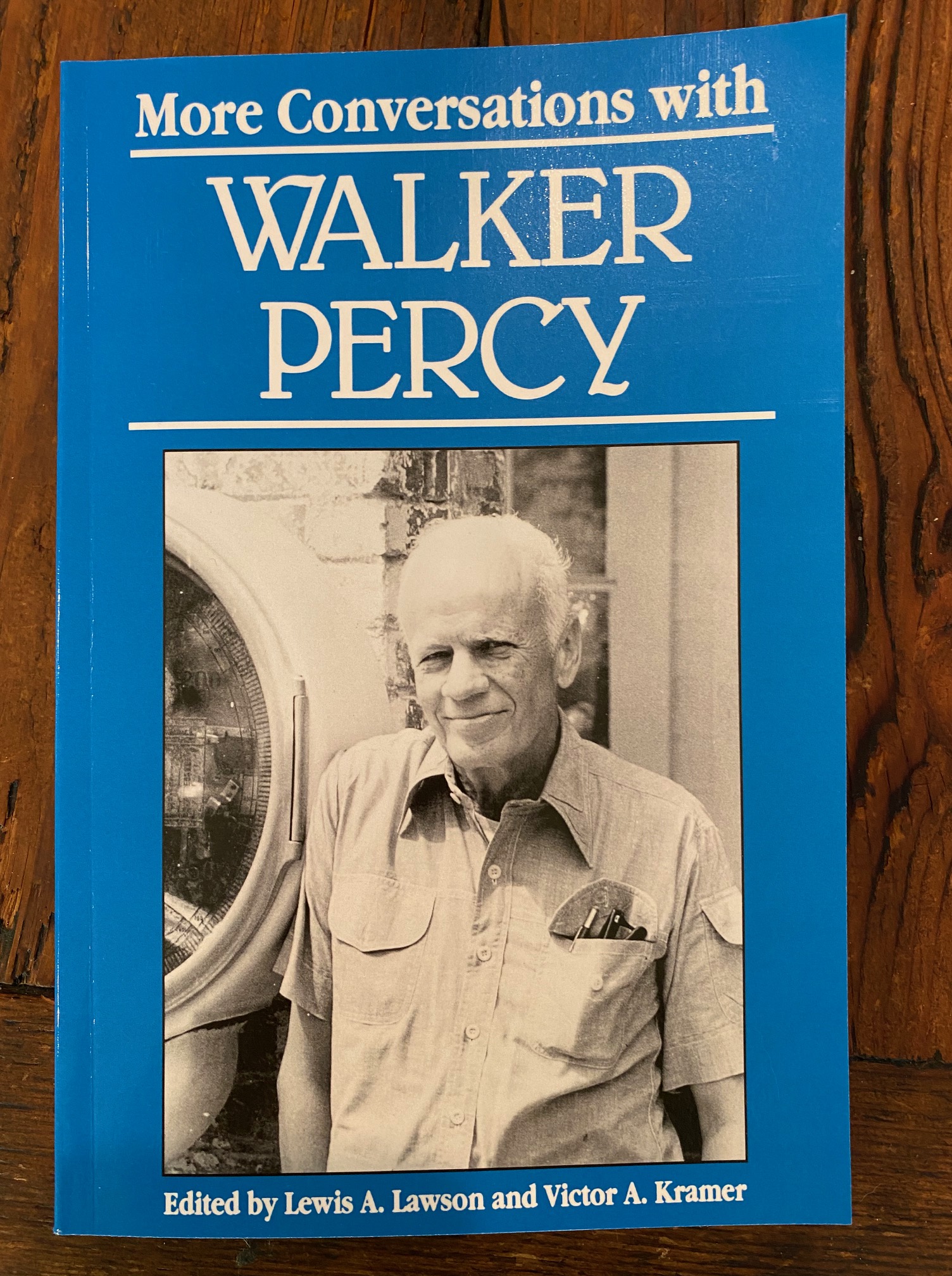
Wow, Walker Percy could converse. 
Later, different interview:

Do we dare attempt conversation with the father of them all?

I’ve long found interviews with Faulkner, even stray details from the life of Faulkner, to be more compelling than his fiction. Maybe it’s the appealing lifestyle: courtly freedom, hunting, fishing, and all the whiskey you can handle. The life of an unbothered country squire, preserving a great tradition, going to Hollywood from time to time, turning the places of your boyhood into a world mythology.
We’ll have more to say about the Conversations with Faulkner, deserves its own post! Maybe Percy gets to the heart of it in one of his interviews:
Q: Did you serve a long apprenticeship in becoming a writer?
Percy: Well, I wrote a couple of bad novels which no one wanted to buy. And I can’t imagine anyboy doing anything else. Yes it was a long apprenticeship with some frustration. But I was lucky with the third one, The Moviegoer; so, it wasn’t so bad, I guess.
Q: Had you rather be a writer than a doctor?
Percy: Let’s just say I was the happiest doctor who ever got tuberculosis and was able to quit it. It gave me an excuse to do what I wanted to do. I guess I’m like Faulkner in that respect. You know Faulkner lived for awhile in the French Quarter of New Orleans where he met Sherwood Anderson, and Faulkner used to say if anybody could live like that and get away with it he wanted to live the same way.

There’s one of these for you, I’m sure. They also have Comic Artists and Filmmakers.

only one subject with whom I myself had a conversation
For the advanced student:
The Wanderer’s Hávamál translated by Jackson Crawford
Posted: January 27, 2020 Filed under: advice, travel, words, writing Leave a comment
loving this one. Supposedly the words of Odin himself.

Even Odin gets sloppy sometimes.
Crawford includes the Old Norse, if you need that. I’m not up on my Old Norse, I’m way behind on my Arabic as it is, my French is déchet, my Spanish is worse, most of my Irish is forgotten, but it’s cool to look at some of these syllables.

Charlie Munger Deep Cuts
Posted: September 2, 2018 Filed under: advice, business 1 Comment
In 2011 Warren Buffett and Charlie Munger came to visit The Office to film a video for the Berkshire Hathaway annual meeting. I hadn’t heard of Charlie Munger. From the Internet I learned that he was a brilliant dude in his own right, as well as a guy Warren Buffett trusted, learned from, and considered his closest partner.
At lunchtime, everyone was huddled around the more famous Buffett, while Charlie Munger was sitting by himself. In this way I ended up having lunch with Charlie Munger.
From his Wikipedia page I knew he’d been a meteorologist in World War II, so I asked him about that. His job was hand drawing weather maps to make predictions as the US was sending planes over the Bering Strait to our then-ally the Soviet Union.
Ever since this encounter I’ve read everything I can find by Charlie Munger.

This is a good place to start.

In my hunt for Munger deep cuts, came across this speech he gave in October 1998 at the Santa Monica Miramar Hotel to a group of institutional investors. Stunningly blunt and direct advice on how to invest:
In the United States, a person or institution with almost all wealth invested, long term, in just three fine domestic corporations is securely rich. And why should such an owner care if at any time most other investors are faring somewhat better or worse. And particularly so when he rationally believes, like Berkshire, that his long-term results will be superior by reason of his lower costs, required emphasis on long-term effects, and concentration in his most preferred choices.
I go even further. I think it can be a rational choice, in some situations, for a family or a foundation to remain 90% concentrated in one equity. Indeed, I hope the Mungers follow roughly this course. And I note that the Woodruff foundations have, so far, proven extremely wise to retain an approximately 90% concentration in the founder’s Coca-Cola stock. It would be interesting to calculate just how all American foundations would have fared if they had never sold a share of founder’s stock. Very many, I think, would now be much better off. But, you may say, the diversifiers simply took out insurance against a catastrophe that didn’t occur. And I reply: there are worse things than some foundation’s losing relative clout in the world, and rich institutions, like rich individuals, should do a lot of self insurance if they want to maximize long-term results.
If only stupid Harvard had listened!
More:
My controversial argument is an additional consideration weighing against the complex, high-cost investment modalities becoming ever more popular at foundations. Even if, contrary to my suspicions, such modalities should turn out to work pretty well, most of the money-making activity would contain profoundly antisocial effects. This would be so because the activity would exacerbate the current, harmful trend in which ever more of the nation’s ethical young brainpower is attracted into lucrative money-management and its attendant modern frictions, as distinguished from work providing much more value to others. Money management does not create the right examples. Early Charlie Munger is a horrible career model for the young, because not enough was delivered to civilization in return for what was wrested from capitalism. And other similar career models are even worse.
More Munger deep cuts from the 2017 Shareholders Meeting of Daily Journal Co., (I found here on the wonderful Mine Safety Disclosures website but it’s in a couple places). Daily Journal Co is a business that, as I understand it, exists on the fact that companies have to publish legal notices somewhere, and this company more or less has a monopoly on the business.
Munger gets real:
the Mungers have three stocks: we have a block of Berkshire, we have a block of Costco, we have a block of Li Lu’s Fund, and the rest is dribs and drabs. So am I comfortable? Am I securely rich? You’re damn right I am.
Could other people be just as comfortable as I who didn’t have a vast portfolio with a lot of names in it, many of whom neither they nor their advisors understand? Of course they’d be better off if they did what I did. And are three stocks enough? What are the chances that Costco’s going to fail? What are the chances that Berkshire Hathaway’s going to fail? What are the chances that Li Lu’s portfolio in China is going to fail? The chances that any one of those things happening is almost zero, the chances that all three of them are going to fail.
That’s one of the good ideas I had when I was young. When I started investing my little piddly savings as a lawyer, I tried to figure out how much diversification I would need if I had a 10 percentage advantage every year over stocks generally. I just worked it out. I didn’t have any formula. I just worked it out with my high school algebra, and I realized that if I was going to be there for 30 or 40 years, I’d be about 99% sure that it would be just fine if I never owned more than three stocks and my average holding period is three or four years.
Once I had done that with my little pencil, I just…I never for a moment believed this balderdash they teach about. Why diversification? Diversification is a rule for those who don’t know anything. Warren calls them “know-nothing investors”. If you’re a know-nothing investor, of course you’re going to own the average. But if you’re not a know-nothing —if you’re actually capable of figuring out something that will work better—you’re just hurting yourselves looking for 50 when three will suffice. Hell, one will suffice if you do it right. One. If you have one cinch, what else do you need in life?
Li Lu is himself a super interesting character.

A student leader in the Tiananmen Square protests, escapes China (with the help of Western intelligence?) ends up penniless at Columbia, hears about a lecture by Warren Buffett and misunderstands that this has something to do with a “buffet” and becomes of the most successful investors in the world?

More from Munger on a range of topics:
on Lee Kuan Yew and the history of Singapore:
Lee Kuan Yew may have been the best nation builder that ever lived. He took over a malarial swamp with no assets, no natural resources, nothing, surrounded by a bunch of Muslims who hated him, hated him. In fact, he was being spat out by the Muslim country. They didn’t want a bunch of damn Chinese in their country. That’s how Singapore was formed as a country—the Muslims spat it out. And so here he is, no assets, no money, no nothing. People were dying of malaria, lots of corruption—and he creates in a very short time, by historical standards, modern Singapore. It was a huge, huge, huge success. It was such a success, there is no other precedent in the history of the world that is any stronger.
Now China’s more important because there are more Chinese, but you can give Lee Kuan
Yew a lot of the credit for creating modern China because a lot of those pragmatic communist leaders—they saw a bunch of Chinese that were rich when they were poor and they said, “to hell with this”. Remember the old communist said, “I don’t care whether the cat is black or white, I care whether he catches mice”. He wanted some of the success that Singapore got and he copied the playbook. So I think the communist leadership that copied Lee Kuan Yew was right. I think Lee Kuan Yew was right. And of course, I have two busts of somebody else in my house. One is Benjamin Franklin, and the other is Lee Kuan Yew. So, that’s what I think of him.
on real estate:
MUNGER: Real estate?
Q: Yeah, real estate.
MUNGER: The trouble with real estate is that everybody else understands it and the people who you are dealing with and the competing with, they specialized in a little 12 blocks in a little industry. They know more about the industry than you do. And you got a lot of bullshitters and liars and brokers. So it’s not that easy. It’s not a bit easy.
Your trouble is if it’s easy—all these people, a whole bunch of ethnics that love real estate,. You know, Asians, Hasidic Jews, Indians from India, they all love real estate; they’re smart people and they know everybody and they know the tricks. And the thing is you don’t even see the good offers in real estate. They show the big investors and dealers. It’s not an easy game to play from a beginners point of view; whereas with stocks, you’re equal with everybody if you’re smart. In real estate, you don’t even see the opportunities when you’re a young person starting out. They go to others. The stock market’s always open, except venture capital. Sequoia sees the good stuff. You can open an office—Joe Shmo Venture Capitalist—startups come to me. You’d starve to death.
You’ve gotta figure out what your competitive position is in what you’re choosing. Real estate has a lot of difficulties. And those Patels from India that buy all the motels, they know more about motels than you do. They live in a god damn motel. They pay no income taxes. They don’t pay much in worker’s compensation and every dime they get, they fix up the thing to buy another motel. Do you want to compete with the Patels? Not I.
on Sumner Redstone:
Well, I never knew Sumner Redstone but I followed him because he was a little ahead of me in Law School, but Sumner Redstone is a very peculiar man. Almost nobody has ever liked him. He’s a very hard-driven, tough tomato, and basically almost nobody has ever liked him, including his wives and his children. And he’s just gone through life. There’s an old saying, “Screw them all except six and save those for pallbearers.” And that is the way Sumner Redstone went through life. And I think he was in to the pallbearers because he lived so long. So I’ve used Sumner Redstone all my life as an example of what not to do.
He started with some money, and he’s very shrewd and hard-driven. You know he saved his life by hanging while the fire was up in his hands. He’s a very determined, high IQ maniac, but nobody likes him and nobody ever did. And though he paid for sex in his old age, cheated him, you know always had one right after another.
That’s not a life you want to admire. I used Sumner Redstone all my life as an example of what I don’t want to be. But for sheer talent, drive and shrewdness, you would hardly find anybody stronger than Sumner. He didn’t care if people liked him. I don’t care if 95% of you don’t like me, but I really need the other 5%. Sumner just…
on the movie business:
And the movie business I don’t like either because it’s been a bad business-—crooked labor unions, crazy agents, crazy screaming lawyers, idiosyncratic stars taking cocaine-—it’s just not my field. I just don’t want to be in it.
on copying other investors:
Q: On the topic of cloning, do you really believe that Mohnish said that if investors look at the 13Fs of super investors, that they can beat the market by picking their spots? And we’ll add spinoffs.
MUNGER: It’s a very plausible idea and I’d encourage one young man to look at it, so I can hardly say that it has no merit. Of course it’s useful if I were you people to look at what other—what you regard as great—investors are doing for ideas. The trouble with it is that if you’d pick people as late in the game as Berkshire Hathaway, you’re buying our limitations caused by size. You really need to do it from some guy that’s operating in smaller places and finding places with more advantage. And of course, it’s hard to identify the people in the small game, but it’s not an idea that won’t work.
If I were you people, of course I would do that. I would want to know exactly what the shrewd people were doing and I would look at every one of them, of course. That would be a no-brainer for me.
on Li Lu:
I got to tell you a story about Li Lu that you will like. Now General Electric was famous for always negotiating down to the wire and just before they were at close, they’ll add one final twist. And, of course, it always worked, the other guy was all invested, so everybody feels robbed and cheated and mad, but they get their way in that last final twist.
So, Li Lu made a couple of venture investments and he made this one with this guy. The guy made us a lot of money in a previous deal and we’re now going in with him again on another—a very high-grade guy and smart and so forth.
Now we come to the General Electric moment. Li Lu said, “I have to make one change in this investment.” It sounds just like General Electric just about to close. I didn’t tell Li Lu to do it; he did it himself. He said, “You know, this is a small amount of money to us and you got your whole net worth in it. I cannot sign this thing if you won’t let me put in a clause saying if it all goes to hell we’ll give you your money back.” That was the change he wanted. Now, you can imagine how likely we were to see the next venture capital investment. Nobody has to tell Li Lu to do that stuff. Some of these people, it’s in their gene power. It’s just such a smart thing to do. It looks generous and it is generous, but there’s huge self-interest in it.
on Al Gore:
Oh, I got another story for you that you’ll like.
Yeah get that thing (peanut brittle out of here or I’ll eat it all).
Al Gore has come into you fella’s business. Al Gore, he has made $300 or $400 million in your business and he is not very smart. He smoked a lot of pot. He coasted through Harvard with a Gentlemen’s C. But he had one obsessive idea that global warming was a terrible thing and he understandably predicted the world for it. So his idea when he went into investment counseling is he was not going to put any CO2 in the air. So he found some partner to go into investment counseling with and he says, “we are not going to have any CO2”. But this partner is a value investor. And a good one.
So what they did was Gore hired his staff to find people who didn’t put CO2 in the air. And of course, that put him into services-—Microsoft and all these service companies that were just ideally located. And this value investor picked the best service companies. So all of a sudden the clients are making hundreds of millions of dollars and they’re paying part of it to Al Gore, and now Al Gore has hundreds of millions of dollars in your profession. And he’s an idiot. It’s an interesting story and a true one.
Lou Harrison’s Centennial
Posted: December 8, 2017 Filed under: advice, music, the California Condition Leave a comment
an email from Redcat informs me that there will be a concert this Saturday as part of the ongoing celebration of Lou Harrison’s centennial.

Out in Joshua Tree there is the Harrison House, a residency and performance space.
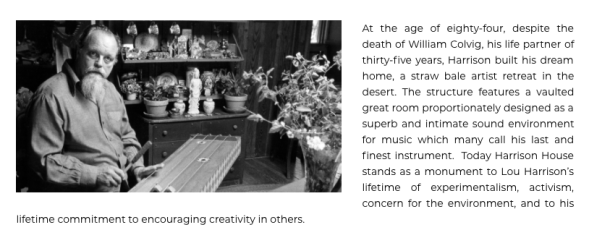
Built with straw bale architecture:

from Wiki user Jonathan Cross, “Straw Bale Construction.”
Checked out Lou’s music on Spotify and found it fantastic and soothing and terrific.
Lou Harrison:
Cheers to Lou.

E. B. White in the Paris Review
Posted: April 26, 2017 Filed under: advice, writing Leave a comment
Found here, what a great interview:
INTERVIEWER
You have wondered at Kenneth Roberts’s working methods—his stamina and discipline. You said you often went to zoos rather than write. Can you say something of discipline and the writer?
WHITE
Kenneth Roberts wrote historical novels. He knew just what he wanted to do and where he was going. He rose in the morning and went to work, methodically and industriously. This has not been true of me. The things I have managed to write have been varied and spotty—a mishmash. Except for certain routine chores, I never knew in the morning how the day was going to develop. I was like a hunter, hoping to catch sight of a rabbit. There are two faces to discipline. If a man (who writes) feels like going to a zoo, he should by all means go to a zoo. He might even be lucky, as I once was when I paid a call at the Bronx Zoo and found myself attending the birth of twin fawns. It was a fine sight, and I lost no time writing a piece about it. The other face of discipline is that, zoo or no zoo, diversion or no diversion, in the end a man must sit down and get the words on paper, and against great odds. This takes stamina and resolution. Having got them on paper, he must still have the discipline to discard them if they fail to measure up; he must view them with a jaundiced eye and do the whole thing over as many times as is necessary to achieve excellence, or as close to excellence as he can get. This varies from one time to maybe twenty.
The whole thing is good. White describes how he came to draw the above New Yorker cover, his only one. And he talks about the diaries of Francis Kilbert, which sure do sound interesting. (Jump to “4. Relations With Girls”)

Roundup of books I haven’t read all the way through but have in a crate in my garage
Posted: April 3, 2017 Filed under: advice, America Since 1945, heroes Leave a comment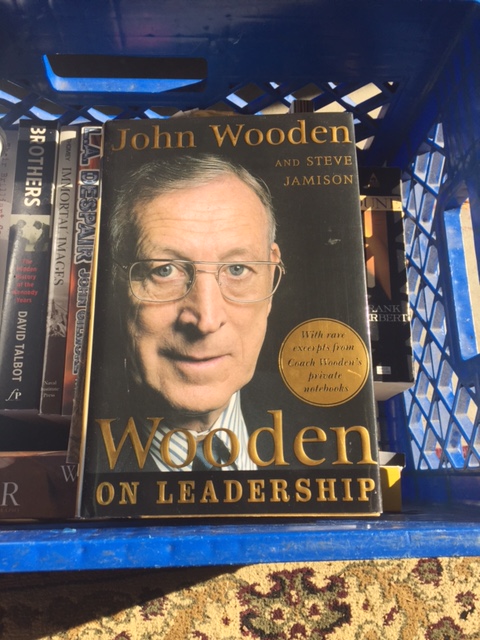
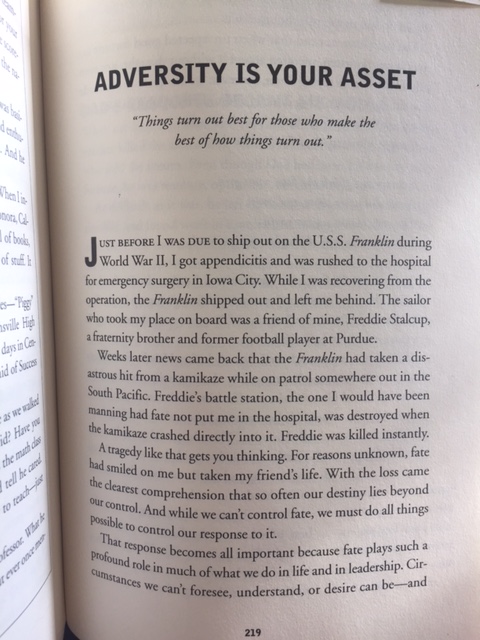
Wow.

PFC Albert Bullock took this one of the damaged Franklin.
My copy is pre-owned and comes already highlighted:


I’ve always hated Hugo’s. On acting technique:

How about this one, about Australian historians?
Geoffrey Blainey’s recipe for peach-tin eggs:

Graeme Davison on the wrong side of the law in Melbourne:

There are no wasted humans:

from the boss Thomas Cleary:


And finally, some Daily Drucker:


Heartlessness
Posted: February 14, 2017 Filed under: advice, buddhism, Japan Leave a comment
My friend Sammy on her Instagram posted some quotes from her boyfriend’s Zen calendar that were not helping.

Due to the turbulent times, Saigyō focuses not just on mono no aware (sorrow from change) but also on sabi (loneliness) and kanashi (sadness). Though he was a Buddhist monk, Saigyō was still very attached to the world and the beauty of nature.
Others elsewhere translate mono no aware as something like beautiful melancholy or a feeling of longing so agonizing it’s pleasure.
To be “heartless” was an ideal of Buddhist monkhood, meaning one had abandoned all desire and attachment.
From Saigyō’s Wikipedia page.

Source. Public domain under Japanese law
Above we see Saigyō drawn by Kikuchi Yōsai, famous for his monochrome portraits of historical figures.

Buffett
Posted: February 3, 2017 Filed under: advice, America Since 1945, business, politics, presidents Leave a comment
Warren Buffett’s advice always sounds simple, which isn’t the same as easy to follow.


Loved the doc about him on HBO. The first scene is him advising high school kids to take care of their minds and bodies. The second scene is him in the drive-through line at McDonald’s.
 Helytimes
#/media/File:Attack_on_carrier_USS_Franklin_19_March_1945.jpg)