How big is Iran compared to the United States?
Posted: June 18, 2025 Filed under: America Since 1945 Leave a comment
It’s pretty big. It would stretch from Oregon to Texas.
(Move it around yourself).
I was reminded of this from Halberstam’s Best and the Brightest:
There were men who opposed the invasion or at the very least were uneasy with it, and to a degree, they were the same men who would later oppose the Vietnam commitment. One was General David M. Shoup, Commandant of the Marine Corps. When talk about invading Cuba was becoming fashionable, General Shoup did a remarkable display with maps. First he took an overlay of Cuba and placed it over the map of the United States. To everybody’s surprise, Cuba was not a small island along the lines of, say, Long Island at best. It was about 800 miles long and seemed to stretch from New York to Chicago. Then he took another overlay, with a red dot, and placed it over the map of Cuba. “What’s that?” someone asked him. “That, gentlemen, represents the size of the island of Tarawa,” said Shoup, who had won a Medal of Honor there, “and it took us three days and eighteen thousand Marines to take it.” He eventually became Kennedy’s favorite general.
from Shoup’s Wikipedia page:
On May, 14 1966, Shoup began publicly attacking the [Vietnam] policy in a speech delivered to community college students at Los Angeles Pierce College in Woodland Hills, California, for their World Affairs Day:
I believe that if we had and would keep our dirty, bloody, dollar-soaked fingers out of the business of these nations so full of depressed, exploited people, they will arrive at a solution of their own—and if unfortunately their revolution must be of the violent type because the “haves” refuse to share with the “have-nots” by any peaceful method, at least what they get will be their own, and not the American style, which they above all don’t want crammed down their throats by Americans.
While yapping about Thucydides Trap did we forget Herodotus Trap (war w/Persia? No! Why?)
Good Press
Posted: June 18, 2025 Filed under: America Since 1945, everyone's a critic Leave a commentHaving a good press week:

New York Times, The Best TV Shows of 2025 So Far

Vulture, 119 Books Every Comedy Fan Should Read

Hollywood Reporter, Ten Best TV Shows of 2025


Vanity Fair, The Best TV Shows of 2025 So Far.

Alan Sepinwall writing in Rolling Stone
You know what? Showbiz is mostly heartbreak and failure so we’re gonna celebrate our wins around here.
They can’t give this thing away!
Posted: June 3, 2025 Filed under: America Since 1945 Leave a comment
Back in 2021 we reported on Platt National Park/Chickasaw National Recreation area, which as far as I know is the only national park ever to be downgraded. We even had a chance to visit. The nature there has been heavily altered by human hand, it’s almost a crafted landscape. That’s not usually how we now like to think of or act in our national parks.
Yesterday in Bloomberg:

mentions the former Platt NP:
Republican Representative Tom Cole of Oklahoma has offered Chickasaw National Recreation Area in Oklahoma as a candidate to be transferred to the Chickasaw Nation, which sold it to the federal government in 1902. Congress turned it into Platt National Park, until it stripped the park of “crown jewel” status and changed its name in 1976.
Today, the park service spends about $4.5 million to accommodate more than 1.5 million annual visitors at Chickasaw NRA.
Cole’s office said the Chickasaw Nation hasn’t asked for the recreation area to be returned, but the nation’s governor, Bill Anoatubby, said in a statement that it’s interested.
So far, though, there’s little other interest in transfers.
Sure, why not?
Worth remembering how we got here though:
In some cases, the National Park Service was put in charge of some areas because residents didn’t trust the states to manage them.
That’s what happened at Big Cypress, which became the first national preserve in 1974. Congress agreed with many south Floridians that the Rhode Island-sized wetland needed to be protected from the state’s plan to build what would have been the world’s largest commercial airport.
Floridians “wanted to protect it and they didn’t trust the state,” McAliley said. “People wanted the Park Service because they trusted them to manage natural qualities.”
Based
Posted: April 3, 2025 Filed under: America Since 1945 Leave a comment
from THR’s White Lotus oral history.

Professor Longhair
Posted: March 4, 2025 Filed under: America Since 1945, music, New Orleans Leave a comment
Mardi Gras has me thinking about Professor Longhair. In his memoir Rhythm and Blues Jerry Wexler tells a story about Ahmet Ertegun finding the Professor:
I’d started noticing Atlantic’s early releases with Professor Long-hair’s “Hey Now Baby,” “Hey Little Girl,” and “Mardi Gras in New Orleans.” Fess—as the Professor was called—was a revelation for me, my first taste of the music being served up in Louisiana in the late forties.
There were traces of Jelly Roll Morton’s habanera-Cuban tango influence in his piano style, but the overall effect was startlingly original, a jambalaya Caribbean Creole rumba with a solid blues bottom.
In a foreshadowing of trips I myself would later take to New Orleans, Ahmet described the first of his many ethnomusicological expeditions. “Herb and I went down there to see our distributor and look for talent. Someone mentioned Professor Longhair, a musical shaman who played in a style all his own. We asked around and finally found ourselves taking a ferry boat to the other side of the Mississippi, to Algiers, where a white taxi driver would deliver us only as far as an open field. ‘You’re on your own,’ he said, pointing to the lights of a distant village. ‘I ain’t going into that n***ertown.’ Abandoned, we trudged across the field, lit only by the light of a crescent moon. The closer we came, the more distinct the sound of distant music—some big rocking band, the rhythm exciting us and pushing us on. Finally we came upon a nightclub—or, rather, a shack—which, like an animated cartoon, appeared to be expanding and deflating with the pulsation of the beat. The man at the door was skeptical. What did these two white men want? ‘We’re from Life magazine,’ I lied.
Inside, people scattered, thinking we were police. And instead of a full band, I saw only a single musician—Professor Longhair—playing these weird, wide harmonies, using the piano as both keyboard and bass drum, pounding a kick plate to keep time and singing in the open-throated style of the blues shouters of old. “ ‘My God,’ I said to Herb, ‘we’ve discovered a primitive genius.’ “Afterwards, I introduced myself. ‘You won’t believe this,’ I said to the Professor, ‘but I want to record you.’ “ ‘You won’t believe this,’ he answered, ‘but I just signed with Mercury.’
Ahmet recorded him anyway—“ I am many men with many names who play under many styles,” Fess used to say—and jewels from that first session remain in the Atlantic catalogue today, over four decades later.”
(source on that photo) Previous coverage of New Orleans.
Snappy lines from Uncle Warren
Posted: February 24, 2025 Filed under: America Since 1945, business Leave a commentWarren Buffett at 94 still writing in a crisp, appealing style in his annual letter. Is he fibbing a bit when he brags about not doing due diligence on real estate purchases? And bragging on himself for how much tax he pays, when he surely uses every dodge he can? Maybe so. He’s a mythmaker.
A decent batting average in personnel decisions is all that can be hoped for. The cardinal sin is delaying the correction of mistakes or what Charlie Munger called “thumb-sucking.” Problems, he would tell me, cannot be wished away. They require action, however uncomfortable that may be.
The philosophy:
… we own a small percentage of a dozen or so very large and highly profitable businesses with household names such as Apple, American Express, Coca-Cola and Moody’s. Many of these companies earn very high returns on the net tangible equity required for their operations. At yearend, our partial-ownership holdings were valued at $272 billion. Understandably, really outstanding businesses are very seldom offered in their entirety, but small fractions of these gems can be purchases Monday through Friday on Wall Street, and very occasionally, they sell at bargain prices.
Inflation:
Paper money can see its value evaporate if fiscal folly prevails. In some countries, this reckless practice has become habitual, and, in our country’s short history, the U.S. has come close to the edge. Fixed-coupon bonds provide no protection against runaway currency.
Businesses, as well as individuals with desired talents, however, will usually find a way to cope with monetary instability as long as their goods or services are desired by the country’s citizenry. So, too, with personal skills. Lacking such assets as athletic excellence, a wonderful voice, medical or legal skills or, for that matter, any special talents, I have had to rely on equities throughout my life. In effect, I have depended on the success of American businesses and I will continue to do so.
One way or another, the sensible – better yet imaginative – deployment of savings by citizens is required to propel an ever-growing societal output of desired goods and services. This system is called capitalism. It has its faults and abuses – in certain respects more egregious now than ever – but it also can work wonders unmatched by other economic systems.
The insurance biz:
When writing P/C insurance, we receive payment upfront and much later learn what our product has cost us – sometimes a moment of truth that is delayed as much as 30 or more years.
(We are still making substantial payments on asbestos exposures that occurred 50 or more years ago.)
This mode of operations has the desirable effect of giving P/C insurers cash before
they incur most expenses but carries with it the risk that the company can be losing money – sometimes mountains of money – before the CEO and directors realize what is happening.
After some years of reading Warren Buffett and Charlie Munger materials these letters become kind of familiar, but it’s soothing, like hearing a folktale told once again with a few variations.
Juicy headline
Posted: February 23, 2025 Filed under: America Since 1945, the California Condition Leave a comment
Picked up a copy of Los Angeles Daily Journal, Orange County Edition, and was intrigued by this story. The evidence seems lopsided:
Anaheim police officers arrested Ferguson at his home in August 2023 after receiving a report of a shooting. Ferguson told officers at the scene and his court clerk via text that he shot his wife, Sheryl, after the couple returned home from dinner, according to affidavits filed in 2023 by Orange County District Attorney Todd Spitzer’s office.
Seeking more information I found this:
The couple’s adult son called 911 to report the shooting. A court filing from prosecutors states Ferguson texted his court clerk and bailiff minutes after the killing: “I just lost it. I just shot my wife. I won’t be in tomorrow. I will be in custody. I’m so sorry.”
…
Earlier that day, Ferguson had been drinking when he argued with his wife about finances during dinner at a local restaurant and later while watching “Breaking Bad” at home with their adult son, said prosecutor Seton Hunt. At one point in the evening, Ferguson made a gun hand gesture toward her, and she later chided him to point a real one at her, Hunt said.
Ferguson proceeded to do so and pulled the trigger, Hunt said.
Just a strange little story in California. Reminded of Hemingway in A Moveable Feast while he’s on a road trip with Scott Fitzgerald:
While waiting for the waiter to bring the various things I sat and read a paper and finished one of the bottles of Macon that had been uncorked at the last stop. There are always some splendid crimes in the newspapers that you follow from day to day, when you live in France. These crimes read like continued stories and it is necessary to have read the opening chapters, since there are no summaries provided as there are in American serial stories and, anyway, no serial is as good in an American periodical unless you have read the all-important first chapter. When you are traveling through France the papers are disappointing because you miss the continuity of the different crimes, affaires, or scandales, and you miss much of the pleasure to be derived from reading about them in a cafe. Tonight I would have much preferred to be in a café where I might read the morning editions of the Paris papers and watch the people and drink something a little more authoritative than the Macon in preparation for dinner. But I was riding herd on Scott so I enjoyed myself where I was.
In the same paper:

I found this phrase vivid:
“We had a phrase in dependency: ‘Clear is kind,” she said. “If you’re clear about what you’re doing, why you’re doing it, and what orders mean, people are more likely to comply.”
Power by Jeffrey Pfeffer (2010)
Posted: February 22, 2025 Filed under: advice, America Since 1945, business Leave a comment
Pulled this one from my shelf because I remembered there was a funny claim about how flattery 100% of the time no exceptions always works. Indeed:
Most people underestimate the effectiveness of flattery and therefore underutilize it. If someone flatters you, you essentially have two ways of reacting. You can think that the person was insincere and trying to butter you up. But believing that causes you to feel negatively about the person whom you perceive as insincere and not even particularly subtle about it. More importantly, thinking that the compliment is just a strategic way of building influence with you also leads to negative self-feelings— what must others think of you to try such a transparent and false method of influence? Alternatively, you can think that the compliments are sincere and that the flatterer is a wonderful judge of people— a perspective that leaves you feeling good about the person for his or her interpersonal perception skill and great about yourself, as the recipient of such a positive judgment delivered by such a credible source. There is simply no question that the desire to believe that flattery is at once sincere and accurate will, in most instances, leave us susceptible to being flattered and, as a consequence, under the influence of the flatterer.
So, don’t underestimate—or underutilize-the strategy of flattery.
University of California-Berkeley professor Jennifer Chatman, in an unpublished study, sought to see if there was some point beyond which flattery became ineffective. She believed that the effectiveness of flattery might have an inverted U-shaped relationship, with flat tery being increasingly effective up to some point but beyond that becoming ineffective as the flatterer became seen as insincere and a “suck up.” As she told me, there might be a point at which flattery became ineffective, but she couldn’t find it in her data.
Amazing. A powerful move:
I have observed similar ploys used to gain power in business meetings. In most companies, the strategy and market dynamics are taken for granted. If someone challenges these assumptions-such as how the company is competing, how it is measuring success, what the strategy is, who the real competitors are now and in the future— this can be a very potent power play. The questions and challenges focus attention on the person bringing the seemingly commonsense…
How to get powerful? There’s a simple plan:
The fundamental principles for building the sort of reputation that will get you a high-power position are straightforward: make a good impression early, carefully delineate the elements of the image you want to create, use the media to help build your visibility and burnish your image, have others sing your praises so you can surmount the self-promotion dilemma, and strategically put out enough negative but not fatally damaging information about yourself that the people who hire and support you fully understand any weaknesses and make the choice anyway. The key to your success is in executing each of these steps well.
A tale of California politics:
In government, Jesse Unruh, a former Democratic political boss and treasurer of Califor-nia, called money the mother’s milk of politics. Former two-term San Francisco mayor Willie Brown, whose 16 years as speaker and virtual ruler of the California Assembly prior to becoming mayor marked him as an extremely effective politician, began his campaign for the legislative leadership post by raising a lot of money. And since he was from a “safe” district, he gave that money to his legislative colleagues to help them win their political contests. Brown understood an important principle: having resources is an important source of power only if you use those resources strategically to help others whose support you need, in the process gaining their favor. In contrast to Brown, the Assembly speaker at the time, Leo McCarthy, irritated his Democratic colleagues to the point of revolt by holding a $500,000 fundraiser in Los Angeles featuring Ted Kennedy and then using 100 percent of the money for his nascent efforts to run for statewide office.’ He was soon out of his job, replaced by Willie Brown.
(Similar schemes are a theme in Caro’s LBJ book, he got lots of money from powerful Texas guys to whom he steered government contracts for projects like dams, then he distributed that money around Congress to his desperate colleagues).
If you want power don’t give up power:
You need to be in a job that fits and doesn’t come with undue political risks, but you also need to do the right things in that job. Most important, you need to claim power and not do things that give yours away. It’s amazing to me that people, in ways little and big, voluntarily give up their power, preemptively surrendering in the competition for status and influence. The process often begins with how you feel about yourself. If you feel powerful, you will act and project power and others will respond accordingly. If you feel power-less, your behavior will be similarly self-confirming.
Restaurants and Railroads: Chili’s Triple Dip Boom
Posted: February 20, 2025 Filed under: America Since 1945, beverages, business, food 1 Comment
Once I’m cast off from show business perhaps I’ll start a newsletter called Restaurants and Railroads. This will analyze those two types of businesses, specifically publicly traded companies. Hedge funds as well as passionate hobbyists will subscribe. They’ll invite me to their conferences, to which I’ll travel in style, by rail when possible. I’ll sample the various restaurants as I go, Tijuana Flats for example, and Pizza Inn which I’ve never tried. In a world of niche media I wonder if I could make that work.
You might not think restaurants and railroads are a natural combination. Fred Harvey might disagree, but I’ll concede they’re very different businesses. The railroads have no new competition, no one is building a new railroad. Only a handful of companies control all the track. Two railroads serve the port of LA: one is BSNF, owned by Berkshire Hathaway, and one is Union Pacific. A duopoly.
The restaurants on the other hand are in frantic, constant competition. They must capture taste and vibe. Tastes change, vibes shift. Plus your customer could always just make a sandwich. How restaurants stay profitable? How do they maintain quality, especially at scale?
These two differing business categories are the two I’m excited to read about when I get an issue of ValueLine. Consumer Staples, Metals & Mining, etc, these lose our interest. But take a look at a personality like Kent Taylor’s or a real railroader like Hunter Harrison (or Casey Jones) and the mind comes to life, it’s hard to get bored.
In the publicly traded restaurant space, a big story this year has been Chili’s:
Chili’s may have just pulled off one of the greatest comebacks in restaurant history.
Same-store sales at the bar and grill chain surged more than 31% from October to December, marking its best quarter since the period just after COVID and accelerating a streak of double-digit same-store sales increases that began last April.
The growth once again was driven by a mix of social media buzz, value-based advertising and a renewed focus on restaurant operations and atmosphere that seemed to snowball as the year progressed.
Just to put this into context, these numbers are comparable to when Popeye’s went off with their spicy chicken sandwich. CEO Kevin Hochman points to TikTok:
About halfway through last year, its Triple Dipper appetizer platter, a staple on the chain’s menu for years, went viral on TikTok, where young customers showed off their “cheese pulls” with the Triple Dipper’s fried mozzarella sticks. …
“What’s happening is that young people are coming in after they’ve seen us on TikTok, and they’re like, ‘Wow, this experience is really good,’ and it becomes a part of the rotation,” Hochman told analysts during an earnings call Wednesday. “I think that’s why you’ve seen the longevity in the results and the acceleration, not just kind of a boom-splat that you typically would see without the operational investments that we’ve made in the business.”

Kevin Hochman seems like a brand guy: while at P&G he worked on Old Spice. $EAT stock has indeed thrived:

On an episode of A Deeper Dive, a quick service restaurant business podcast, the host and guest discussed Chili’s phenomenal success, and possible reasons for it. The fast food competitive price with the sit down experience came up, as did the mix and match. But in the end they agreed people just kinda like it.
It does seem like Chili’s is doing something right:

Spoonful
Posted: February 7, 2025 Filed under: America Since 1945, music Leave a commentHave been listening to Spoonful as recorded by Howlin Wolf lately.
The lyrics relate men’s sometimes violent search to satisfy their cravings, with “a spoonful” used mostly as a metaphor for pleasures, which have been interpreted as sex, love, and drugs
Chester Arthur Burnett was born in White Station Mississippi, near West Point, in the “Black Prairie” (later remarketed as the “Golden Triangle“). JD Walsh digs up a photo, source undescribed, of our guy working on a horse’s hoof while he was in the 9th Cavalry.

Howlin Wolf was an apprentice/student to Charlie Patton. I first heard about Charlie Patton from R. Crumb’s comic, which was reprinted in an anthology of underground comics they had at the Needham Public Library.

The Library also had a cassette of some of these blues guys. Living walking distance to the library, a life-changer.
Blues research is a famous graveyard for the curious – we’ve gone about as far as we dare on this topic, see previous coverage. Listening to Charlie Patton especially with the warble of the old recordings sounds spooky, and there’s a desire to see this as emerging from some mysterious beyond, but the turth might be more interesting, these people were modern. Elijah Wald shed some light on Delta blues in his book Escaping the Delta:
If someone had suggested to the major blues stars that they were old-fashioned folk musicians carrying on a culture handed down from slavery times, most would probably have been insulted.
Mississippi was legally dry until 1966, at least in theory, a factor in blues history.
It is startling to thank that all of the evolution from the first Bessie Smith record to the first Rolling Stones record took only forty years. When Skip James and John Hurt appeared at the Newport Folk Festival, they were greeted as emissaries from an ancient, vanished world, but it was only three decades since they had first entered a recording studio – that is, they were about as ancient as disco is to us today.
The Mississippi Delta at this time was actually kind of a dynamic region, crisscrossed with railroads, you could quit your job and move and get another one.
Wald tells of an anthropological team from Fisk University and the Library of Congress that visited the Delta in 1941 and 1942. They reported:
There are no memories of slavery in the delta. This section of the delta has little history prior to the revolution of 1861
Howlin’ Wolf was on to health insurance for musicians long before Chappell Roan was born:
After he married Lillie, who was able to manage his professional finances, he was so financially successful that he was able to offer band members not only a decent salary but benefits such as health insurance. This enabled him to hire his pick of available musicians and keep his band one of the best around. According to his stepdaughters, he was never financially extravagant (for instance, he drove a Pontiac station wagon rather than a more expensive, flashy car).[48]
That Sun Records link reports that Howlin’ Wolf was 6’6″ and close to 300 lbs.
reviewing some news in The Wall Street Journal
Posted: February 3, 2025 Filed under: America Since 1945, business, food 3 Comments


I don’t care for Applebee’s, it’s sub Friday’s and way sub Chili’s, but I do like living in the United States of America. All told this was a nice story. The conclusion:

Common Side Effects, Sunday Feb 2 11:30pm on Cartoon Network, streaming on MAX Feb 3
Posted: January 31, 2025 Filed under: America Since 1945, drugs, the California Condition Leave a comment
Our attitude towards critics is influenced by the Duke of Wellington, who supposedly didn’t let his troops cheer for him because that meant they could also boo him.
While he is said to have disapproved of soldiers cheering as “too nearly an expression of opinion”,[247] Wellington nevertheless cared for his men
(He did call them the scum of the earth but w/e).
But hey, these reviews are terrific and we must celebrate our wins in a business full of heartbreak. Making a TV show is so difficult and time consuming, Resistance fights the work of art at every stage, very blessed to have worked with this amazing team on this project.
Here is The New York Times. And we’ll take this one:

A treat and a half says Margaret Lyons!

Here’s a funny one, a pharma ad embedded right in there:

(I don’t think the reporter here edited his AI transcript.) Neil Postman would’ve predicted if you made a TV show satirizing pharmaceuticals they would use it to sell pharmaceuticals. In Amusing Ourselves to Death he predicted The Daily Show.
Anyhoo watch, stream, and spread the word, we’ll return to amateur history and digestions here on Helytimes as time permits! I’ve been meeting to write up the Atlanta Cyclorama, where Van Gogh bought his paints and the role of the aluminum tube in art history, Lester Hiatt’s Arguments About Aborigines, Dan Levy’s Maxims For Thinking Analytically, Randall Collins Violence, the Santa Barbara Channel, and more!

The Chumash people of the region have traditionally known Point Conception as the “Western Gate”, through which the souls of the dead could pass between the mortal world and the heavenly paradise of Similaqsa.[4]
It is called Humqaq (“The Raven Comes”) in the Chumashan languages.

Carter’s, congealed electricity, AI and Needham
Posted: January 30, 2025 Filed under: America Since 1945, business, children, New England, Uncategorized Leave a comment
If you have a little kid in the US you will have some clothes from Carter’s. They sell them at Target and Wal-Mart as well as 1,000 or so Carter’s stores, and they cost $8.

Before I had a kid it didn’t occur to me that kids outgrow their clothes so fast they can’t cost too much.
When I see the Carter’s label, I think of my home town.
William Carter founded Carter’s in Needham, Massachusetts in 1865. Textiles were a big business in New England. Two inputs, labor and electricity, were cheap. Labor from excess farm children, and electricity from running streams? That would’ve been the earliest mode, what were they using by 1865? Coal?
One of the biggest buildings in Needham, certainly the longest, is the former Carter’s headquarters, which stretches itself along Highland Avenue. A prominent landmark, it took a long time to walk past.

The story of Carter’s is a global economic story in miniature.

Old Carter mill #2, found here.

The Carter family sold the company in the 1990s. It went public in 2003. In 2005, Carter’s acquired OshKosh B’gosh, a company famous for making children’s overalls. This company started in 1895 in Oshkosh, Wisconsin (the name comes from an Ojibwe word, “The Claw,” that was the name of a local chief).
The term “B’gosh” began being used in 1911, after general manager William Pollock heard the tagline “Oshkosh B’Gosh” in a vaudeville routine in New York.[4] The company formally adopted the name OshKosh B’gosh in 1937.
OshKosh B’Gosh’s Wisconsin plant was closed in 1997. Downsizing of domestic operations and massive outsourcing and manufacturing at Mexican and Honduran subsidiaries saw the domestic manufacturing share drop below 10 percent by the year 2000.
OshKosh B’Gosh was sold to Carter’s, another clothing manufacturer for $312 million
The headquarters of Carter’s moved to Atlanta. Labor and electricity were cheaper in Georgia, Carter’s had been opening mills in the South for awhile. Now the clothes are made overseas. I look at the labels on Carter’s clothes: Bangladesh, India, Cambodia, Vietnam. If you factor in the shipping and the markup how much of that $8 is going to your garment maker in Bangladesh? Then again maybe it’s the best job around, raising Bangladeshis out of poverty, and soon Chittagong will look like Needham.
The former Carter’s headquarters, now vacant, became a facility for elder living. My mom worked there, briefly. Carter’s today is headquarted in the Phipps Tower in Buckhead, Atlanta, which I happened to pass by the other day.
The loss of the mill and the company headquarters was not a crisis for Needham. Needham is very close to Boston, an easy train ride away, and along of the 128 Corridor. There are growth businesses in the area, hospitals, biotech companies, universities. TripAdvisor is based in Needham. Needham is a pleasant town, there are ongoing talks to turn the former Carter’s building into housing. It would be close to public transport and walkable to the library and the Trader Joe’s. That seems to be stalled.
Needham has brain jobs, attached to a dense brain network, while brawn jobs are being shipped overseas. There are many other towns in Massachusetts where the old run down mill is a sad derelict as production moved first south and then overseas. These towns are bleak. Oshkosh, Wisconsin seems ok, but the shipping of steady jobs overseas is of course a major factor in our politics, Ross Perot was talking about it in 1992 and no one did anything about it and now Trump is the president.
A similar story lies in the history of Berkshire Hathaway – the original New Bedford textile mill, not the conglomerate Warren Buffett built on top of it using the same name. Buffett talks about this, I believe this is from the 2022 annual meeting:
CHARLIE MUNGER: Well, I remember when you had a textile mill —
WARREN BUFFETT: Oh, god.
CHARLIE MUNGER: — and it couldn’t —
WARREN BUFFETT: I try to forget it. (Laughs)
CHARLIE MUNGER: — and the textiles are really just congealed electricity, the way modern technology works.
And the TVA rates were 60% lower than the rates in New England. It was an absolutely hopeless hand, and you had the sense to fold it.
WARREN BUFFETT: Twenty-five years later, yeah. (Laughs)
CHARLIE MUNGER: Well, you didn’t pour more money into it.
WARREN BUFFETT: No, that’s right.
CHARLIE MUNGER: And, no — recognizing reality, when it’s really awful, and taking appropriate action, just involves, often, just the most elementary good sense.
How in the hell can you run a textile mill in New England when your competitors are paying way lower power rates?
WARREN BUFFETT: And I’ll tell you another problem with it, too. I mean, the fellow that I put in to run it was a really good guy. I mean, he was 100% honest with me in every way. And he was a decent human being, and he knew textiles.
And if he’d been a jerk, it would have been a lot easier. I would have probably thought differently about it.
But we just stumbled along for a while. And then, you know, we got lucky that Jack Ringwalt decided to sell his insurance company [National Indemnity] and we did this and that.
But I even bought a second textile company in New Hampshire, I mean, I don’t know how many — seven or eight years later.
I’m going to talk some about dumb decisions, maybe after lunch we’ll do it a little.
Congealed electricity, what a phrase. In the 1985 annual letter, Buffett discusses the other input, labor, which was cheaper in the South, and why he kept Berkshire Hathaway running in Massachusetts anyway:
At the time we made our purchase, southern textile plants – largely non-union – were believed to have an important competitive advantage. Most northern textile operations had closed and many people thought we would liquidate our business as well.
We felt, however, that the business would be run much betterby a long-time employee whom. we immediately selected to be president, Ken Chace. In this respect we were 100% correct: Ken
and his recent successor, Garry Morrison, have been excellent managers, every bit the equal of managers at our more profitable businesses.… the domestic textile industry operates in a commodity business, competing in a world market in which substantial excess capacity exists. Much of the trouble we experienced was attributable, both directly and indirectly, to competition from foreign countries whose workers are paid a small fraction of the U.S. minimum wage. But that in no way means that our labor force deserves any blame for our closing. In fact, in comparison with employees of American industry generally, our workers were poorly paid, as has been the case throughout the textile business. In contract negotiations, union leaders and members were sensitive to our disadvantageous cost position and did not push for unrealistic wage increases or unproductive work practices. To the contrary, they tried just as hard as we did to keep us competitive. Even during our liquidation period they performed superbly. (Ironically, we would have been better off financially if our union had behaved unreasonably some years ago; we then would have recognized the impossible future that we faced, promptly closed down, and avoided significant future losses.)
Buffett goes on, if you care to read it, to discuss the dismal spiral faced by another New England textile company, Burlington.
Charlie Munger, in his 1994 USC talk, spoke on the paradoxes here:
For example, when we were in the textile business, which is a terrible commodity business, we were making low-end textiles—which are a real commodity product. And one day, the people came to Warren and said, ‘They’ve invented a new loom that we think will do twice as much work as our old ones.’
And Warren said, ‘Gee, I hope this doesn’t work because if it does, I’m going to close the mill.’ And he meant it.
What was he thinking? He was thinking, ‘It’s a lousy business. We’re earning substandard returns and keeping it open just to be nice to the elderly workers. But we’re not going to put huge amounts of new capital into a lousy business.’
And he knew that the huge productivity increases that would come from a better machine introduced into the production of a commodity product would all go to the benefit of the buyers of the textiles. Nothing was going to stick to our ribs as owners.
That’s such an obvious concept—that there are all kinds of wonderful new inventions that give you nothing as owners except the opportunity to spend a lot more money in a business that’s still going to be lousy. The money still won’t come to you. All of the advantages from great improvements are going to flow through to the customers.”
Is something similar happening with AI? Who will it make rich, and at what cost? To whose ribs will the profits stick?
I’m not sure we could call AI congealed but it is more or less just more and more electricity run through expensive processors. Who will win from that? So far it’s been the makers of the processors, but if DeepSeek shows you don’t need as many of those the game is changed. Personally I’m unimpressed with DeepSeek – try asking it what happened in Tiananmen Square in June 1989.
How does Carter’s itself continue to survive? Target’s own brand, Cat & Jack, is right next door on the shelves. Could another company shove Carter’s aside if they can cut the margins even thinner, get the price down to $7? Here’s what Carter’s CEO Michael Casey has to say in their most recent annual letter:

Hard to build the operational network Carter’s has over 150+ years. There will be a challenge awaiting the next CEO of Carter’s as Michael Casey is retiring. Carter’s stock ($CRI) is pretty beaten up over the past year, down 30%. A possible macro problem for Carter’s is that the number of births in the United States appears to be declining.
It is powerful, when I’m changing my daughter, to contemplate my home town, and global commerce, and the people in Cambodia who made these clothes, and the ways of the world.
Gizmodo interview
Posted: January 25, 2025 Filed under: America Since 1945, the California Condition Leave a comment
As Matt at the office put it, they came out SWINGING with Luigi as the first question:

I declare the event both “upsetting” but also “cool”? Maybe I do need media training. Here’s a link.
Here’s what matters:

Streaming next day on MAX. Is it still called HBO Max in Australia? I know they’ve got Max in Europe and LatAm.
Occurs to me this site has been lax on one of our missions, reporting news from Helys around the world. There’s just too much!
Living Room on the tracks
Posted: January 16, 2025 Filed under: America Since 1945, railroads Leave a comment
A photo by O. Winston Link, at the Smithsonian. That is Lithia, Virginia.
Stuart Spencer (1927-2025)
Posted: January 14, 2025 Filed under: America Since 1945, presidents, the California Condition 2 Comments
I read in The LA Times that Stuart Spencer died. His Miller Center Oral History interview is one of the most vivid on the rise of Ronald Reagan, California, politics in general:
After many discussions with [Reagan], we realized this guy was a basic conservative. He was obsessed with one thing, the communist threat. He has conservative tendencies on other issues, but he can be practical.
When you look at the 1960s, that’s a pretty good position to be in, philosophically and ideologically. Plus, we realized pretty early on that the guy had a real core value system. Most people in my business don’t like to talk about that, but you know something? The best candidates have a core value system. Either party, win or lose, those are still the best candidates. They don’t lose because of their core value system. They lose because of some other activity that happens out there. But the best candidates to deal with, and to work with, are those who have that. A lot of them have it and a lot of them don’t, but Reagan had it.
The power players of Southern California:
Holmes Tuttle was a man of great . . . He was a car dealer, a Ford dealer in southern California and he also had some agencies in Tucson, I think. Holmes was a guy that came from Oklahoma on a freight car. He had no money and he started working—I don’t think he finished high school—for a car dealership, washing cars, cleaning cars. He’s a man of tremendous energy, tremendous drive and strong feelings—which most successful businessmen have—about how the world should be run, how the country should be run as well as how their business should be run and how your business should be run. They’re always tough and strong that way. That was Holmes’ background.
In the southern California—I won’t say California because we have two segments, north and south—framework of the late ’30s and the ’40s, there were movies made about a group. I can’t remember what they were called, but there were 30 of them. In this group were the owner and publisher of the L.A. Times, the [Harry] Chandler family top business guys, Asa Call of what is now known as Pacific Insurance. It was Pacific Mutual Insurance then, a local company. Now it’s a national company. Henry Salvatori, the big oil guy; Holmes; Herbert Hoover, Jr.; the Automotive Club of Southern California; that type of people, they ran southern California. They had the money. They had the mouth, the paper. They ran it. [William Randolph] Hearst was a secondary player. He had a paper, but he was secondary player. He wasn’t in the group. Hearst was more global.
These guys worried about everything south of the Tehachapi Mountains. That’s all they worried about. They worried about water. They worried about developments. They’ve made movies about that. Most of it’s true. The Southern Pacific was the big power player, but these guys were trying to upset the powers of the Southern Pacific to a degree. Holmes Tuttle came out of that power struggle, that power group.
He was a guy who would work hard. Asa Call was the brains. Holmes was the Stu Spencer, the guy that went out and made it happen. He was aggressive and he played a role. He started playing a role in the political process in the ’50s, post Earl Warren. None of these guys were involved with Earl Warren to any degree. But after Earl Warren and Nixon, they were players there. They never were in love with Nixon, but they were pragmatic. The Chandlers were in love with Nixon, and a few others, but with these bunch of guys, Ace would like Nixon. Holmes was the new conservative and Nixon was a different old conservative.
There were little differences there. Holmes emerged in the new conservative element and was heavily involved in the Goldwater campaign of ’64. Of course that’s a whole ’nother story. When Nixon went down the tube all of a sudden—it was lying there latent in the Goldwater movement and they were waiting for Nixon to get beat and when he did [sound effect]—here they were up in your face.
Reagan was the first legitimate person that Holmes was absolutely, totally, in synch with, and who he totally loved.
On Ron and Nancy:
Here’s an important point in my story. We met with the Reagans. The Reagans are a team politically. He would have never made the governorship without her. He would have never been victorious in the presidential race without her. They went into everything as a team.
It was a great love affair, is a great love affair. Early on I thought it was a lot of Hollywood stuff. I really did. I could give you anecdotes of her taking him to the train when he had to go to Phoenix because they didn’t fly in those days, or to Flagstaff to do the filming of the last segments of that western he was doing. We’d be in Union Station in L.A. at nine o’clock at night. They’re standing there kissing good-bye and it goes on and it goes on and it goes on. I’m embarrassed and I’m saying,
Wow.It was just like a scene out of Hollywood in the 1930s, late ’30s, ’40s. I tell you that, but then I tell you now twenty-five, thirty, forty years later, whatever it is, it was a love affair. It was not Hollywood.At that time I thought, oh, boy. It’s not only a partnership, it’s a great love affair. She was in every meeting that Bill and I were at with Reagan, discussing things, us asking questions, with him asking us questions. The curve of her involvement over the years was interesting because she was in her 40s then probably. She always lied about her age so I can’t tell you exactly, but she was somewhere around 45, I’d guess. She was quiet. With those big eyes of hers, she’d be watching you. Every now and then she’d ask a question, but not too often.
As time went on—I’m talking about years—she grew more and more vocal. But she was on a learning curve politically. She learned. She’s a very smart politician. She thinks very well politically. She thinks much more politically than he thinks. I think it’s important that Ronald Reagan and Nancy Reagan were the team that went to the Governor’s office and that went to the White House. They did it together. They always turned inward toward each other in times of crisis. She evolved a role out of it, her role. No one else will say this, but I say this: she was the personnel director.
She didn’t have anything to do with policy. She’d say something every now and then and he’d look at her and say,
Hey, Mommy, that’s my role.She’d shut up. But when it came to who is the Chief of Staff, who is the political director, who is the press secretary, she had input because he didn’t like personnel decisions. Take the best example, Taft Schreiber, who was his agent out at Universal for years, and Lew Wasserman. After we signed on, Taft was in this group of finance guys and he said to me,Kid, we’ve got to have lunch.I had lunch with Taft and he proceeded to tell me,
You’re going to have to fire a lot of people.I said,What do you mean?He said,Ron—meaning Reagan—has never fired anybody in his life.He said,I’ve fired hundreds of people. He’s never fired anybody.I laughed. I said to myself, Taft’s overstating the case. Taft was right. I fired a lot of people after that.Reagan hated personnel problems. He hated to see differences of opinion among his staff. His line was,
Come on, boys. Go out and settle this and then come back.You’re going to have a lot of that in politics. You’re going to have a lot of that in government. That’s what makes the wheels go round. It doesn’t mean that they’re not friends or anything. They have differences of opinion, but Reagan didn’t like that too much, especially over the minutia, and it usually happens over the minutia.
The sum total of Reagan:
The sum total of him is simply this: here’s a man who had a basic belief, who thought America was a wonderful, great country. I don’t think you can go back through 43 Presidents and find a President of the United States who came from as much poverty as Reagan came from; income-wise, dysfunctional families. I can’t quite remember where [Harry] Truman came from, but you’re not going to find one.
This guy came from an alcoholic family, no money, no nothing. He was a kid who was a dreamer. He dreamed dreams and dreamed big dreams and went out to fulfill those dreams with his life and he did it. As he moved down his career and got really involved in the ideological side of the political spectrum, which is where he started, he had real concerns about all this leaving us because of communism.
You look back—some of it sounds a little silly—but at the time there was perceived all kinds of threats, all over the world about communism moving into Asia, moving into Africa. That was the driving force behind his political participations. It was the only thing that he really thought about in depth, intellectualized, thought about what you can do, what you can’t do, how you can do it.
With everything else, from welfare to taxation, he went through the motions. Now, this is me talking, but every night when he went to bed, he was thinking of some way of getting [Leonid Ilyich] Brezhnev or somebody in the corner. He told me this prior to the beginning of the presidency. Because I asked questions like, What the hell do you want this job for?
I’d get the speech and the program on communism. He could quote me numbers, figures. He’d say, We’ve got to build our defenses until they’re scary. Their economy is going down and it’s going to get worse. I’m simplifying our discussion. He watched and he fought for defense. God, he fought for defense. He cut here, he cut there for more defense. He took a lot of heat for it. All the time he delivered, in his mind, the message to Russia, we’re not going to back off. We’ll out-bomb you. We’ll out-do everything to you.
His backside knew that we have the resources, this country has the resources and the Russians don’t. If they try to keep up with us defensively, they’re going to be in poverty. They’re going to be economically dead and an economically dead country can only do one of two things, either spring the bomb or come to the table. He was willing to roll those dice because he absolutely had an utter fear of the consequences of nuclear warfare.
Again he was lucky. He couldn’t deal with Brezhnev. He was over the hill and out of it. [Yuri Vladimirovich] Andropov was gone, dead. Reagan lucked out. In comes this guy [Mikhail] Gorbachev who was smart enough to see the trend in his own country. He started talking with Reagan about cutting a deal. That’s what it got down to. In that context Reagan was very benevolent. He was willing to give up a lot. If this guy was serious and willing to go down this road, he was willing to give up things to get the job done, which was to get rid of the cold war. To him the cold war was the threat of nuclear holocaust in this country and other countries.
That was a dream that he had before he was in the presidency. These words I’m giving you and interpreting for you were given to me prior to his election to the presidency. If you do a lot of research, you’ll see that he was always asking questions of the intelligence people, What’s the state of the economy in Russia? He must’ve had a Dow Jones bottom line in his mind—what he thought it was going to take to do it—because he always knew how many nukes we had and where they were. He was really into this.
Young
Does that mean that Reagan was a visionary?
Spencer
I don’t know. He was a dreamer. He was a dreamer. He dreamed that he was going to be the best sportscaster in America, that he was going to be one of the better actors in Hollywood. You know he got tired of playing the bad guy alongside Errol Flynn, who got the women all the time. But he still dreamed big dreams. That’s the way he was.
On Reagan’s interpersonal style:
Young
He was good at communications obviously. How was he at working the room with politicians?
Spencer
Terrible. Ronald Reagan is a shy person. People don’t understand this. He was not an introvert. Nixon was almost an introvert and paranoid. That’s a bad combination. Reagan was shy. People who I met through the years said to me,
I saw President Reagan at this,orI saw President Reagan one-on-one, two or three people in the Oval Office,or something. He never talked about anything substantive. He just told jokes.Ronald Reagan used his humor and his ability to break the ice. He wasn’t comfortable with you and you coming in the Oval Office with strangers and talking.
Number one, he’s not going to tell you about what he’s doing. He doesn’t think it’s any of your damn business. Secondly, he’s not comfortable and so he uses his humor. He can do dialects. I mean the Jewish dialect, a gay dialect. He can tell an Irish ethnic joke. The guy was just unbelievably good at it and he’d break the ice with it. You’d listen to him. But if you were that type of person, you’d walk out of there and you’d say,
What the hell were we talking about? He didn’t tell me anything.“
The Reagans had very few friends:
The Reagans never had a lot of friends. I cannot sit here today and tell you of a good, close, personal friend. They had each other and a lot of acquaintances. Maybe Robert Taylor was, maybe Jimmy Stewart was, some of those people. Maybe Charlie Wick and his wife, but other than that, I don’t know of any that they had. The Tuttles? They were not what you’d call close friends of theirs. They did things together but . . . it was he and Nancy.
An aside on Jimmy Carter:
The primary campaign for Jimmy Carter, 1976, was one of the best campaigns I’ve ever seen in my lifetime. They did an outstanding job. The guy in January was nine per cent in the polls in terms of his name ID. He ends up getting the nomination. Lots of things had to go right for them. Lots of breaks they had to get, breaks that they didn’t create, but they got them.
All that considered, the primary campaign was just an outstanding one. It was a lot of Jimmy Carter’s effort. He worked his tail off. Things kept setting up for him. The Kennedys kept vacillating and going this way and that. Everything kept setting up for him. They ran an outstanding campaign.
They had problems in ’80 because issues caught up with them. Their governance was not as good as their ability to run, which happens. I attribute most of it to his micromanagement. All of the Reagan people learned a lot from watching that because we had the opposite. [laughs]
The whole thing is great, on Bush, Dan Quayle, Clinton, Thatcher, it’s like 129 pages long.
Two items to note from the obituary, by Mark A. Barabak:

and:

Spencer voted third party in 2016, for Joe Biden in 2020 and for Kamala Harris in 2024.
Some final advice from Spencer:
Finally I gave some major paper interview. It was on the plane. Marilyn [Quayle] was there and Dan Quayle was there. I was here and the press guy was here. The press guy starts out kind of warm and fuzzy and he says,
Who are your favorite authors?He looks at Marilyn, and he says,Who are my favorite authors?Oh, God.The second question is something about music. My position is, if you really haven’t thought about it in your own life, about who your favorite authors are, you can always say [Ernest] Hemingway. There are some names out there that you can use. If it’s music, you can say the Grateful Dead. Say anything you want to and think about it afterwards.
I was wrong, I like this guy better.
Jimmy Carter reconsidered
Posted: January 6, 2025 Filed under: America Since 1945, politics, presidents 1 Comment
Tyler Cowen didn’t like him. George Will didn’t like him. Ken Layne made me laugh:

Aren’t we always interested in the history that came right before we appear?

Delta Airlines has not one but two documentaries about Jimmy Carter available to view: Carterland and Jimmy Carter: Rock and Roll President. (Do these movies make money? Who is funding them?) I was able to watch most of both of them (without sound, with subtitles) on recent transcontinental travels. Rock and Roll President was particularly interesting, for example how Carter did not turn on Gregg Allman even after he was busted for and then testified in a case involving pharmaceutical cocaine, or the role John Wayne played in helping the Panama Canal treaty to pass
All this has me to prepared to somewhat revise my view of Carter’s presidency. His inability to “do something” about the Iranian hostage crisis was because he was unwilling to start a war or kill a lot of innocent Iranians. Though his temperament may not have suited him to win reelection, he improved life in the United States, made a lot of difficult choices on tough problems, avoided war (Panama could’ve been one). His presidency was devoted to peace, and helped heal the United States.
The contradictions are endless but was it not good for us, in that moment, to have a prayerful man of peace and leadership that reached for the spiritual?
Similar to the way Gerald Ford was later honored for his courage (?) in pardoning Richard Nixon, should Jimmy Carter be honored for absorbing political consequences of hard decisions and hard efforts that kept the peace?
At the Carter Library the fact that Carter never dropped a bomb or fired a missile during his presidency is highlighted. He’s the last president of whom that can be said. The American people don’t seem to want that.
Perhaps his story is a Christian story, of the martyr, the saint, who suffers as he absorbs our sins. A traveling preacher who came to town.
Perhaps all post-1945 US presidents should be judged on one standard only: whether there was a nuclear war on their watch. We must give Carter an A!
In his Miller Center interview, Jimmy Carter notes several times that the governor of Georgia is very powerful – more powerful, relative to the legislature, than the president is to Congress:
Fenno
Mr. President, I just wanted to follow up one question about the energy preparation. In your book you note that when you came to present the energy package, you were shocked, I think the word was shocked, by finding out how many committees and subcommittees this package would have to go through.
Carter
Yes.
Fenno
I guess my question is in the preparation that you went through, didn’t Congressmen tell you what you were going to find? Why were you shocked?
Carter
Well, I don’t know if I expressed it accurately in the book. I don’t think it was just one moment when all of a sudden somebody came in the Oval Office and said there was more than one committee in the Congress that has got to deal with energy. I had better sense than to labor under that misapprehension. But I think when Tip O’Neill and I sat down to go over the energy package route through the House, I think Jim Wright was there also, there were seventeen committee or subcommittee chairmen with whom we would have to deal. That was a surprise to me, maybe shock is too strong a word. But in that session or immediately after that, Tip agreed as you know to put together an ad hoc committee, an omnibus committee, and to let [Thomas Ludlow] Ashley do the work.
That, in effect, short-circuited all those fragmented committees. The understanding was, after the committee chairmen objected, that when the conglomerate committee did its work, then the bill would have to be resubmitted, I believe to five different, major committees. There were some tight restraints on what they could do in the way of amendment. So that process was completed as you know between April and August, an unbelievable legislative achievement.
In the Senate though, there were two major committees and there had to be five different bills and unfortunately, Scoop Jackson was on one side and Russell Long was on the other. They were personally incompatible with each other and they had a different perspective as well. Scoop had been in the forefront of those who were for environmental quality and that sort of thing, and Russell represented the oil interest. That was one of the things that caused us a problem. But we were never able to overcome the complexities in the Senate. In the House, we did short circuit the process. I never realized before I got to Washington, to add one more sentence, how fragmented the Congress was and how little discipline there was, and how little loyalty there would be to an incumbent Democratic President. All three of those things were a surprise to me.
Truman
Were those in sharp contrast to the experience in the Georgia legislature?
Carter
Well, there’s no Democratic-Republican alignment of the Georgia legislature. It’s all Democrats, and therefore, there is no party loyalty. You had to deal with individual members. The Governor is really much more powerful in Georgia than the President is in the United States. As Georgia Governor, I had line-item veto, for instance, in the appropriations bills. And, as you also know, in Georgia and in Washington, most of the major initiatives come from the executive branch. There’s very seldom a major piece of legislation that ever originates in the legislature. I think that there is a parallel relationship between the independent legislature confronting an independent Governor or the independent Congress confronting an independent President. At the state level, the Governor, at least in Georgia, is much more powerful than the President in Washington.
Neustadt
Did you have the same kind of subcommittee structure?
Carter
No. It’s not nearly so complicated.
Neustadt
That helps you too.
Carter
The seniority and the guarding of turf and so forth is not nearly so much of a pork barrel arrangement in the state legislature. Also, the Georgia legislature only serves forty days a year. They come and do their work in a hurry, and then they go home.
Truman
A simple legislature doesn’t have much staff either.
Carter
They are growing rapidly in staff, but nothing like the Congress. And you don’t have the insidious, legal bribery in the Georgia legislature that is so pervasive in the Congress. That’s a problem that’s becoming much more serious and I don’t believe that it’s going to be corrected until we have a major, national scandal in the Congress. I think it’s much worse than most people realize.
The reviews all focus on the presidency but Carter was an extremely effective governor of Georgia.
wish I could read this redacted story:

The ex-presidency of Carter is often cited as admirable, the work on guinea worm is undeniable. James Baker contacted Carter frequently. He helped convince Daniel Ortega to leave office. But then:
In the run-up to the 1991 Gulf War, Carter’s relationship with President Bush turned sour. Carter felt passionately that Saddam Hussein’s invasion of Kuwait wasn’t worth going to war over, even though Bush cited the Carter Doctrine in justifying it. The former president said so publicly, then took matters a fateful step further, writing each member of the UN Security Council and urging them to vote against the United States on the resolution.
That is wild! Brian Mulroney told the Bush White House about it and they were unsurprisingly pissed!
The Carter/ Bill Clinton relationship is funny, Alter says Carter’s freelance riffing with North Korea made Clinton apoplectic. Bill and Jimmy, could make an almost not boring play.
Maybe I will stake out the take that Carter was a great president and a mixed bag as an ex-president. Could be fun!
Consider this:
In 2016, the squabbling children of Martin Luther King Jr. needed Carter to mediate. They were at one another’s throats over their family’s possessions, including an old pool table. Brothers Marty and Dexter teamed up to sue sister Bernice, who had possession of their father’s Bible (used by Barack Obama to take the oath of office) and his Nobel Peace Prize. Carter’s approach was the same as at Camp David: both sides would agree at the end of the process to one document. This time, the document went through six or seven drafts, with the parties finally agreeing that Carter’s decisions on what would be sold or kept were to be final. One night Carter would be hard on Bernice; the next, on Dexter or Marty. Carter finally determined — and a judge soon ratified that Marty, as chairman of the estate, had control of the Bible and the Nobel, but they would be displayed at the King Center in Atlanta, not sold.
The one document method might be something practical we can all learn from Jimmy Carter. I haven’t felt like time spent studying this American original has been wasted. The more I learn about him the more complex he becomes.
(photo of Dolly and Jimmy borrowed from Parton News instagram)
His Very Best: Jimmy Carter, A Life by Jonathan Alter
Posted: December 31, 2024 Filed under: America Since 1945 Leave a comment
If you’re wondering why he’s wearing watchface facing in, submariner’s habit, so you could tell time while working the periscope.
As a preteen he castrated hogs, ploughed a field with a mule (Emma), sheered sheep, pulled boil weevils from cotton by hand. By the time he was a teenager he was a slumlord, renting out tenant cabins to black farmers. After he graduated the Naval Academy he went to work for Admiral Rickover, who was inventing the nuclear navy. “Life is a constant fight against stupidity,” Rickover used to say. When the classified Chalk River Laboratories – National Research Experimental reactor nearly melted down, he led a group of twenty four who donned primitive “anti-C” suits and rehearsed removing as many flanges and turning as many valves as possible in an allotted ninety seconds before entering the contaminated space. Their urine and feces was examined for six months afterwards (they turned out to have no ill effects). When his father died, he agonized about what to do, but decided to quit the Navy and go back home without telling his wife, who was furious.
“No matter what happened – if it was a beautiful day or my older son made all As on his report card… underneath it was gnawing wawy because I owned twelve thousand dollars and didn’t know how I was going to pay it,” he would say about the next two years. Around this time he joined the Lions Club, as his father had:
Any time Jimmy wanted a toehold in some distant community, he would speak at one of Georgia’s 180 Lions Clubs, most in small towns.
He became obsessed with the poetry of Dylan Thomas, and it was his efforts that started a movement that led to a stone for Thomas being placed in Poets’ Corner at Westminster Abbey.
In Georgia at this time, there was a state requirement that busses carrying black kids to black schools had to have their fender painted black. Jimmy Carter was not a leader on integration. “This was a time, I’d say, of very radical elements on both sides,” he would say while he ran for president.
In 1962 the Supreme Court ruling in Baker v Carr enshrined a “one man, one vote” principle. Previously Georgia was organized on a “county unity system,” which meant Fulton County got only three times as many votes as a small rural county, even though it was 200x bigger.
Carter saw that by curbing the power of old courthouse politicians, Baker v. Carr would make a career in politics possible for a moderate like him.
The first time he ran for governor of Georgia he lost. “Show me a good loser and I’ll show you a loser,” was how he felt about that. He resolved to never lose another election. In 1970 he ran again, against Carl Sanders, who had helped bring major league baseball, football and basketball teams to Atlanta for the first time. Carter needed to win both racist George Wallace voters and liberal and black voters.
His solution was to avoid explicit mention of race in favor of class based populist appeals to Wallace voters, as well a overtures to moderates on education, the environment, and efficiency in government.
A research paper about southern populism by 25 year old Jody Powell affected his thinking. Powell would be a close aide all the way to the White House.
Carter shared his technique: “Notice how I didn’t ask for his vote. I said: ‘I want you to consider voting for me.'” At small and midsized campaign events, he would arrive early and park himself by the door so that he shook hands with every person entering the room – a simple and effective gesture neglected by many politicians.
During his inaugural speech as governor, he declared “the time for racial discrimination is over.” About a dozen conservative senators who had supported him walked out. But the speech got him on the cover of Time magazine.

During his term as governor he expected his team to work eighty and ninety hour weeks. He was aggressive, unrelenting, confrontational. Hunter S. Thompson would call Jimmy Carter one of the three meanest men he ever met – the other two being Muhammed Ali and Hells Angels president Sonny Barger.
“The conventional image of a sexy man is one who is hard on the outside and soft on the inside,” Sally Quinn wrote in the Washington Post. “Carter is just the opposite.”
When he ran for president his family was a tremendous advantage. During the Florida primary, Rosalynn and Edna Langford, her son’s mother-in-law, would drive into a town, look for the tallest antenna, and ask the station manager if someone wanted to interview them. Carter’s dynamic mother Lillian, who joined the Peace Corps at age sixty eight, would become a frequent guest on The Tonight Show.
Dick Cheney was working for Carter’s opponent Gerald Ford:
“Everybody knows about Plains Georgia and Lillian. Nobody really knows Ford,” Cheney wrote in a memo. “He never had a hometown. He never had a mother. He never had a childhood as far as the American people are concerned.”
Meanwhile:
Cutting the other way, Billy Carter crisscrossed Texas telling enthusiastic audiences that the Carers had always been conservatives, and that he would shoot Cesar Chavez, leader of the United Farm Workers of America union, if he came on his property.
It was a narrow win. If Ford hadn’t chucked Nelson Rockefeller, if Ford hadn’t said the thing in the debate about Eastern Europe, if.. if…
Exit polls showed that Carter won on pocketbook issues… The improbability of Carter’s victor struck speechwriter Rick Hertzberg who said later that electing him was as close “as the American people have every come to picking someone out of the phone book to be president.”
Hertzberg’s quote does not ring true to me. This was not a random guy. A nuclear engineer, a canny politician, a furious worker, a poet, rigid, deeply strange. As Alter says, comparing his post-presidency to the Clintons and Obamas, Carter was “built differently.” But then again Hertzberg knew him and I didn’t.
The parts of this book about the Carter presidency are mostly quite sad. Frustrations, bad luck, endless problems, prayers, defeats. An almost desperate search for spiritual answers, not even political ones. The great triumph, the Camp David Accords, took up enormous amounts of time and energy. Sadat had already visited Jerusalem, were Israel and Egypt on the road to peace anyway? I don’t know enough about it.
A good man, but not a good president, was and is a widely held opinion. Was he not a good president because he was a good man? Does dealing with the Ayatollah (or Congressional committee chairs) require a nasty operator on the level of Johnson or Nixon? Consider Reagan’s team, who got their hands on Carter’s debate prep book, and almost certainly cut a secret deal with the Iranians that involved selling weapons for the war with Iraq which killed more than a million people.
Was Carter caught between the pious Sunday school teacher and the tough engineer with not enough of the jolly, dealmaking, wink and a handshake stuff you need in our system?
Carter vocally committed the US to “human rights” as president. The resulting hypocrisies are not hard to spot. The Carter administration was effectively advising the Shah of Iran to shoot protestors, to take one example. Can human rights really be a presidential interest in this soiled world?
Can a true follower of Jesus ever be an effective US president?
Maybe the biggest way the Carter presidency ripples through daily life in 2025: deregulation. Trucking, rail, airlines, natural gas. Southwest Airlines, Wal-Mart, Amazon, the shale boom, none of these would be the same without Carter-era deregulation. The consequences are many and mixed, and the result may not have matched the vision. The main stated goal was to fight inflation, massive problem and major part of Carter’s undoing.
Biographies have to make the case for the subject’s significance (otherwise why am I reading?). So they might be biased towards showing a master shaping events. Alter’s Carter doesn’t come off like that, he seems blown about by winds beyond his control.
The book is great by the way, I was very absorbed. Something I should learn more about would be Carter’s relationship to unions, organized labor. In Passage of Power Caro, reporting on LBJ’s first presidential weekend mentions several calls with labor leaders like Walter Reuther. By the next Democratic presidency I hear almost nothing about labor. Jimmy was a business owner, manager and employer. Georgia was not a union friendly state. Maybe there’s a bigger story to be told about the collapse of US labor power between 1963 and 1976. Maybe Carter is a part of that story.
While he was governor Carter launched the Georgia Film Commission, which has had a significant impact on my life, as my friends are always flying to Atlanta to shoot stuff. Los Angeles is being outcompeted as a filming location.

Carter was friends with James Dickey, and helped arrange Georgia as a shooting location for Deliverance and The Longest Yard (using Georgia inmates).
On a recent visit to Atlanta* I had a chance to visit the Carter Library. I thought I might buy my daughter a present at the gift shop. After all, at the Reagan Library the gift shop is enormous, mugs, toys, models, posters, DVDs. At the Carter Library, not so:

Very sparse, not even all of Jimmy’s books.
There’s a replica of the Oval Office as it existed in Carter’s time. A recording of Carter says that tough, strong-willed people he’d known in Georgia would come to see him in the Oval Office, and the aura of the room would strike them dumb, they’d forget what they came to see him about.

I was very struck by this photo of Amy:

So vulnerable.

*Trip unrelated to Georgia Film Commission, although related to the Ted Turner cable empire, a tentacle of which will air Common Side Effects, premiering Feb. 2, 11:30pm, first airing on Cartoon Network/Adult Swim, streaming on Max next day. Don’t miss!
Jimmy Carter and Bob Dylan
Posted: December 8, 2024 Filed under: America Since 1945 Leave a commentJimmy Carter bonded with his son Chip over Dylan:
In 1969 Chip and his father hadn’t spoken for a year, mostly because of Chip’s drug use. They reconnected through Bob Dylan, whose album The Times They Are A-Changin’ they had enjoyed together. “We talked on the phone in Dylan verses because of the tensions,” Chip remembered. Struggling at Georgia Southwestern, Chip drove home to Plains at two in the morning, went to the foot of his parents’ bed, and informed them he was addicted to speed. Jimmy’s response was to tell his nineteen-year-old son to cut his hair, put away his bell-bottom jeans, and buy a suit. After promoting Powell, he assigned Chip to be his part-time driver in the campaign; that way, he could be with him often enough to make sure he wasn’t abusing drugs. Chip’s decades of substance abuse had only begun, but he said later that his parents’ intervention in 1969 saved his life.
Talking to Hunter S. Thompson:
The governor first impressed Thompson when he said that after theologian Reinhold Niebuhr, “the other source of my understanding about what’s right and wrong in this society is from a friend of mine, a poet named Bob Dylan.” He explained, “I grew up a landowner’s son. But I don’t think I ever realized the proper relationship between the landowner and those who worked on the farm until I heard Dylan’s record ‘I Ain’t Gonna Work on Maggie’s Farm No More?” Carter’s easy familiarity with Dylan’s work would harvest young votes once the 1976 primaries began.
Dylan enthusiasm culminated in a meeting while Carter was governor of Georgia:
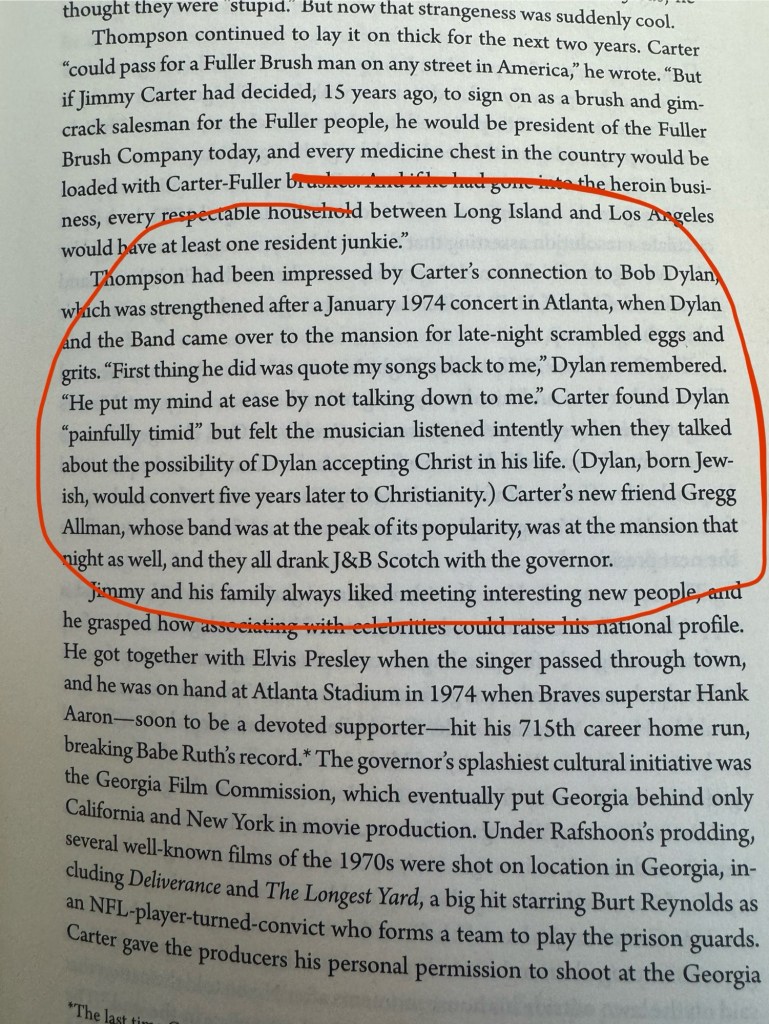
From Jonathan Alter, His Very Best: Jimmy Carter, A Life. I shared this story with Dylan enthusiast Vali, who told me posting it would be a service to the Dylan community. But the Dylan community being what it is, all connections to Carter are thoroughly covered in a post on flaggingdown.com, where I find this photo of Chip, Dylan, Jimmy and Jeff Carter.

Concerts became an important part of Carter’s early presidential campaign. It was not Dylan but another musician Carter considered indispensible:
October 1975 was when the campaign began to cohere. Rafshoon filmed Carter in a Florida pulpit and turned the sermon into two ads that began running in Iowa. Because each spot was five minutes long, Iowa voters saw them as news pieces, and they began breaking through. In the ads, Carter says, “T’ll never tell a lie. I’ll never make a false statement. I’ll never betray the confidence you have in me, and I won’t avoid a controversial issue. Watch television. Listen to the radio. If I do any of those things, don’t support me.” The ads were paid for in part by a series of inspired concerts arranged by the “godfather of rock” Phil Walden, president of Capricorn Records and a friend of Carter from Georgia. The first, by the Marshall Tucker Band, was held at Atlanta’s Fox Theatre. Soon Carter would raise money with the help of Charlie Daniels, Willie Nelson, Lynyrd Skynyrd, John Denver, Jerry Jeff Walker, Jimmy Buffett, and the Allman Brothers.* “If it hadn’t been for Gregg Allman, I never would have been president,” Carter said after Allman died in 2017.
The political risks of being associated with a druggy counterculture never concerned the candidate, even when he saw handmade “Coke Fiends for Carter” signs at his rallies. His admiration of the long-haired musicians was real and reciprocated, with many saying later that they felt a deep, almost mystical connection to him. And the fund-raising advantage offered by the rock concerts was significant. Each ticket stub was used as a receipt to show a contribution that could later be used for matching federal campaign funds.
Carter was also pals with Elvis. Elvis called Carter on the phone one day at the White House, apparently fucked up, shortly before he died.
Carter was smart at these concerts:
Carter understood just what to do onstage. “I’m gonna say four things,” he said at a rock concert in Providence, Rhode Island, in 1975. “First of all, I’m running for president. Secondly, I’m gonna be elected. Third, this is very im-portant, would you help me? Fourth, I want to introduce to you, my friends and your friends, the great Allman Brothers!” This was followed by thunderous applause. A politician who knew better than to make a speech at a rock concert was guaranteed to win the votes of thousands of grateful fans.
 Helytimes
